
Best Kitchen Tiles in Jaipur: Designs, Price & Where to Buy in 2027
Discover the best kitchen tiles in Jaipur, from Blue Pottery-inspired backsplashes and Kota stone to vitrified tiles, with 2027 prices, designs, and buying locations.
- Blue Pottery's Influence on 2027 Kitchen Backsplash Design
- The Real Local Alternative: Rajasthan Stone vs Morbi Vitrified
- Dry Heat and Dust: What Jaipur's Climate Actually Demands
- What Kitchen Tiles Cost in Jaipur, 2027
- Where to Buy in Jaipur
- What a Kitchen Retile Actually Costs, Installed
- Common Mistakes When Choosing Jaipur Kitchen Tiles
- Choosing With Jaipur's Own Resources in Mind
Jaipur kitchen tile choice can genuinely draw on two local resources most Indian cities don't have, Blue Pottery-inspired ceramic design and Rajasthan's own quarried stone, alongside dry-climate practicalities like dust-resistant glazes, priced roughly Rs. 30 to Rs. 180 per square foot.
Most Indian cities buying kitchen tiles are choosing entirely between Morbi-manufactured options shipped in from Gujarat. Jaipur gets two genuine local alternatives most buyers don't realise they have: Blue Pottery, the city's own centuries-old ceramic craft tradition, has started showing up as a real backsplash design language rather than just a souvenir item, and Rajasthan's own sandstone, Kota stone, and Jaisalmer stone quarries sit close enough to be a practical flooring choice, not just a natural-stone novelty.
Layered on top of both is Jaipur's climate, desert heat rather than the humidity most other North Indian guides assume, which changes which finishes and glazes actually hold up here. This guide works through all three: the craft-inspired design angle, the local stone option, and the dry-climate practicalities, before covering pricing and exactly where to buy across the city.
Blue Pottery's Influence on 2027 Kitchen Backsplash Design
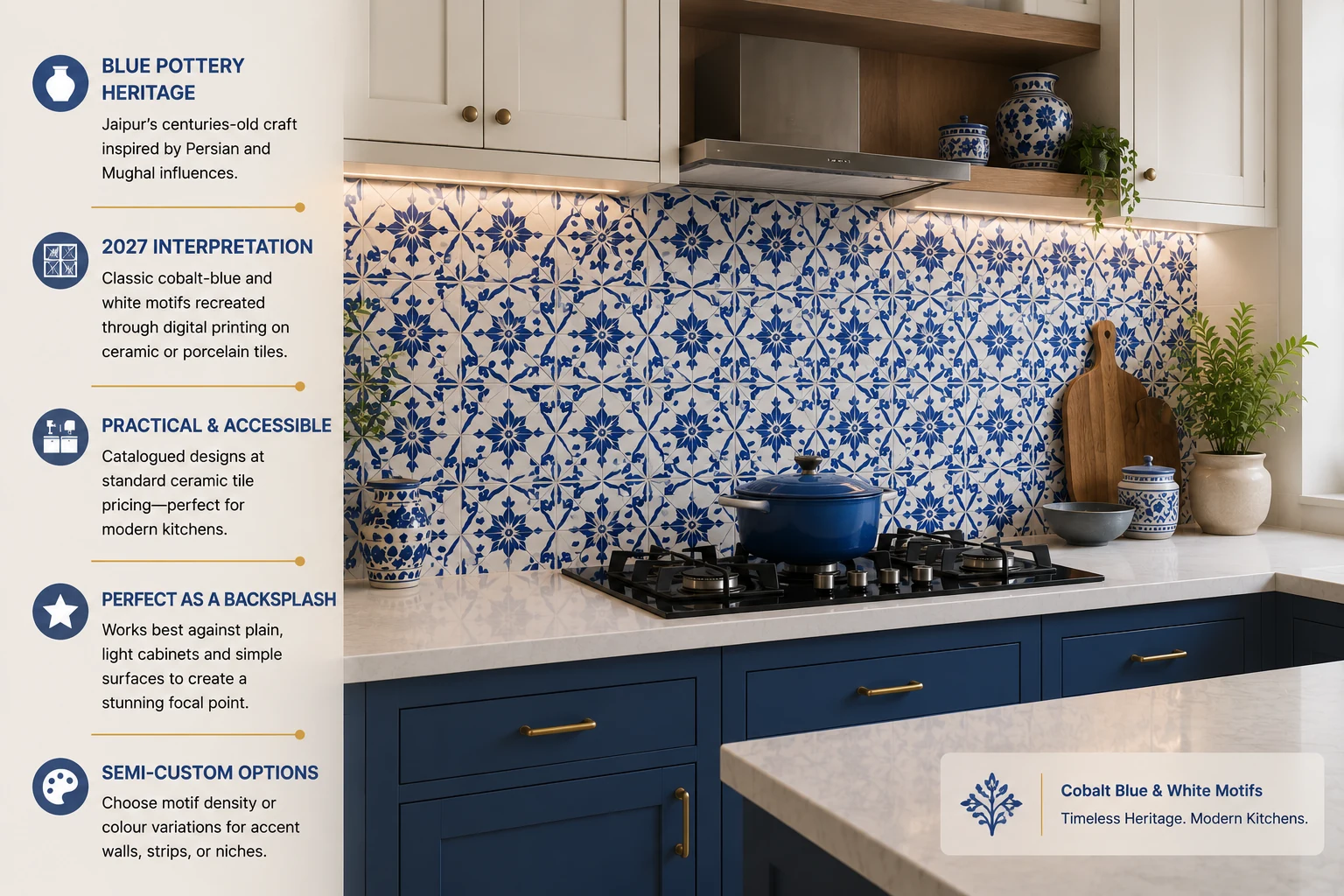
Jaipur's Blue Pottery tradition, cobalt blue and white glazed ceramic work with roots tracing back through Persian and Mughal decorative influence, has historically shown up on vases, tiles, and architectural fragments rather than purely decorative objects, which makes its translation into modern kitchen backsplash tile a genuinely natural extension rather than a forced trend.
The 2027 interpretation typically takes the classic cobalt-and-white palette and floral or geometric repeat pattern and reproduces it through digital printing on a standard ceramic or porcelain base, rather than using actual hand-painted pottery tiles, which remain more fragile and considerably more expensive for a full backsplash application. Several manufacturers now carry this as a catalogued design option, making the look accessible at standard ceramic tile pricing rather than requiring custom commission work.
Used as a backsplash rather than a full-kitchen treatment, the pattern's visual density works best against plain, light cabinetry and a simple field tile elsewhere in the kitchen, letting the Blue Pottery-inspired wall function as the room's clear focal point rather than competing with other patterned surfaces.
It's worth understanding a little of the craft's actual history to see why this translation works so naturally. Blue Pottery isn't native to Jaipur originally; it arrived via Persian and Central Asian ceramic traditions and was refined locally under royal patronage during the 19th century, using a distinctive quartz-based body rather than clay, fired at lower temperatures than standard ceramic. That quartz body is part of why genuine antique Blue Pottery pieces are fragile and command high prices at Jaipur's craft markets, and exactly why a digitally printed tile interpretation, built on a standard durable ceramic or porcelain base, makes more practical sense for a kitchen wall than sourcing actual pottery tiles.
A few Jaipur-based designers and boutique tile studios have also started offering semi-custom Blue Pottery pattern work, letting a buyer select a specific motif density or colour variation rather than a single fixed catalogue design, though this route costs meaningfully more than a standard printed ceramic backsplash and suits a smaller accent area, a single wall strip or niche, better than a full kitchen wall given the higher per-square-foot cost.
The Real Local Alternative: Rajasthan Stone vs Morbi Vitrified
Unlike Surat or Vadodara, which sit close to Morbi but essentially produce nothing themselves, Jaipur has a genuine local material option in Rajasthan's own stone quarries. Sandstone, Kota stone, and Jaisalmer yellow stone are all quarried within the state, and local Jaipur dealers carry a real advantage in this category specifically, since these materials don't need the same long-distance freight that vitrified and ceramic tile does from Gujarat.
The tradeoff is real too. Natural stone is more porous than vitrified tile, meaning it needs periodic sealing to resist oil and staining, a genuine maintenance commitment in a kitchen specifically, where spills are routine. In exchange, stone offers a cooler underfoot feel that many buyers find genuinely pleasant through Jaipur's punishing summer months, along with a natural material character no digitally printed tile fully replicates. For a kitchen floor specifically, vitrified remains the lower-maintenance default; for a countertop or accent application, local stone is a reasonable, genuinely regional alternative worth comparing in person.
Kota stone specifically deserves a closer look for kitchen use, since it's a limestone variety with a naturally low water absorption rate for a natural stone, denser and less porous than sandstone, which is part of why it has a long-standing reputation as a practical, budget-friendly flooring choice across Rajasthan generally, not just in premium applications. It's commonly finished in a matte, slightly textured surface that resists slipping better than a polished stone, a genuine practical advantage in a kitchen where water and oil both end up on the floor eventually.
Sandstone and Jaisalmer yellow stone lean more toward wall cladding, exterior elevation, and accent applications than kitchen flooring specifically, given their higher porosity relative to Kota stone. If the appeal is the warm, golden tone these stones carry, a digitally printed vitrified alternative in a similar colourway is worth comparing directly, since it delivers a close visual match without the sealing commitment, an increasingly common compromise among Jaipur buyers who like the local stone look but want vitrified's lower maintenance.
Popular tiles right now



Dry Heat and Dust: What Jaipur's Climate Actually Demands
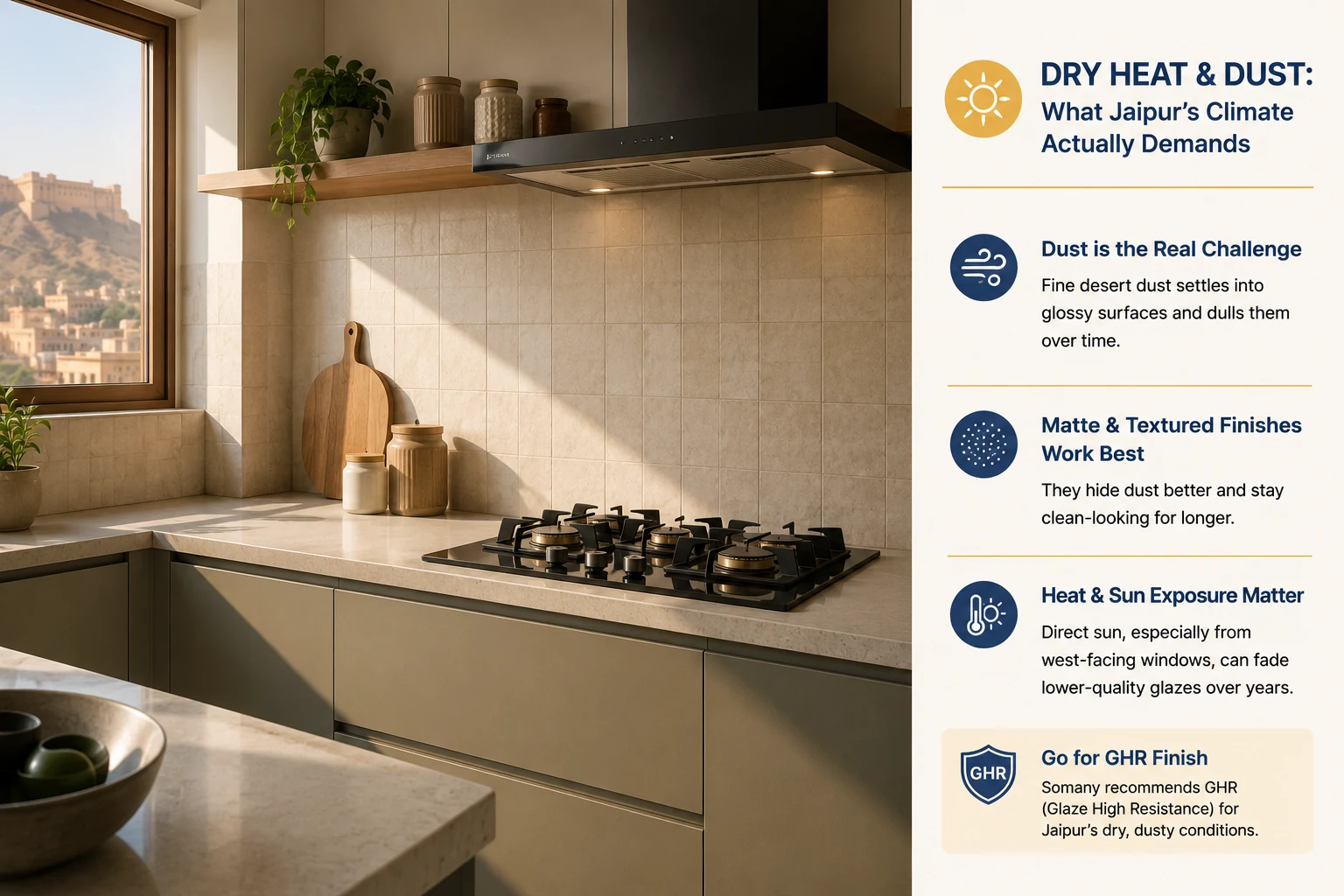
Jaipur's climate is a different design problem than the humidity-driven concerns that shape kitchen tile advice in Mumbai or Kolkata. The city sits at the edge of the Thar Desert, meaning kitchen tile here has to handle sustained dry heat and fine settled dust rather than moisture and mould.
Somany specifically recommends its GHR, or Glaze High Resistance, finish for Jaipur's dusty, dry conditions, since it holds up better against the fine dust that settles into a standard glaze and gradually dulls its finish over years of exposure. More broadly, matte and textured finishes hide settled dust between cleanings far better than glossy tile, which shows a dust film as a visible dulling far sooner, particularly in darker tones.
Heat and direct sun exposure matter too, more than in most other Indian kitchen contexts. A kitchen with a west-facing window catching several hours of direct Jaipur summer sun can, over years, show gradual colour fading on a lower-quality glaze, worth asking about specifically if your kitchen layout puts a tiled wall in that kind of direct light path.
What Kitchen Tiles Cost in Jaipur, 2027
Kajaria's Jaipur showrooms price vitrified tiles roughly Rs. 65 to Rs. 180 per square foot, covering everything from standard GVT floor tiles to large-format slabs up to 800x2400mm for feature walls. Somany's range runs a comparable Rs. 60 to Rs. 160 per square foot, including its dust-resistant GHR finish. Blue Pottery-inspired printed ceramic backsplash tiles sit within standard ceramic pricing, generally Rs. 30 to Rs. 90 per square foot depending on pattern complexity and finish, while local sandstone or Kota stone for a countertop or floor accent typically runs Rs. 40 to Rs. 120 per square foot before sealing and finishing costs.
Where to Buy in Jaipur
Mansarovar and Bani Park carry the city's most established brand showrooms, including Kajaria's widest local display and Somany's Experience Centre, both well suited to comparing GVT, PGVT, and ceramic ranges in one visit. Malviya Nagar hosts an Orientbell boutique with the brand's full wall, floor, kitchen, and bathroom tile range on display. For H&R Johnson specifically, Saraswati Marbles on Tonk Road near Gandhi Nagar is an established authorised dealer with a broad general catalogue.
For local stone specifically, sandstone and Kota stone dealers tend to operate more as independent yards than branded showrooms, and are worth asking about directly at any of the multi-brand dealers in Mansarovar, since several carry both manufactured tile and regional stone rather than specialising in just one.
Sikar Road and the industrial pockets around Kartarpura also carry a handful of general tile and marble dealers worth knowing for bulk or budget-focused orders, though the design range at these outlets tends to be narrower than the branded Mansarovar and Bani Park showrooms. For a Blue Pottery-specific backsplash design, it's worth calling ahead to any shortlisted dealer, since this remains a speciality catalogue item even among Jaipur's own tile sellers, not something every showroom keeps in physical stock for browsing.
With Blue Pottery-inspired designs and local stone being genuinely Jaipur-specific categories rather than standard national catalogue items, not every showroom stocks both, and confirming availability before a visit saves a wasted trip. TilesFinders lists verified Jaipur suppliers by finish, material, and locality, useful for checking who actually carries a Blue Pottery-pattern backsplash or Kota stone flooring option before working through Mansarovar's showrooms one at a time.
What a Kitchen Retile Actually Costs, Installed
Tile price alone leaves out adhesive, grout, and labour, which add meaningfully to the final number, particularly for a stone installation. For a standard 40 square foot backsplash in Blue Pottery-inspired or plain ceramic tile, material runs Rs. 30 to Rs. 90 per square foot, adhesive and grout add roughly Rs. 8 to Rs. 14 per square foot, and installation labour a further Rs. 20 to Rs. 35 per square foot, putting a typical backsplash project between Rs. 2,300 and Rs. 5,600 all-in.
A Kota stone or sandstone kitchen floor costs more once sealing is factored in. Material runs Rs. 40 to Rs. 120 per square foot; installation typically Rs. 30 to Rs. 50 per square foot, given the more careful handling stone needs, and initial sealing adds a further Rs. 10 to Rs. 20 per square foot, with resealing needed periodically thereafter, generally every one to three years depending on how heavily the kitchen is used. Vitrified flooring at the same square footage skips the sealing cost entirely, the core reason it remains the lower-maintenance default despite stone's local sourcing advantage.
Common Mistakes When Choosing Jaipur Kitchen Tiles
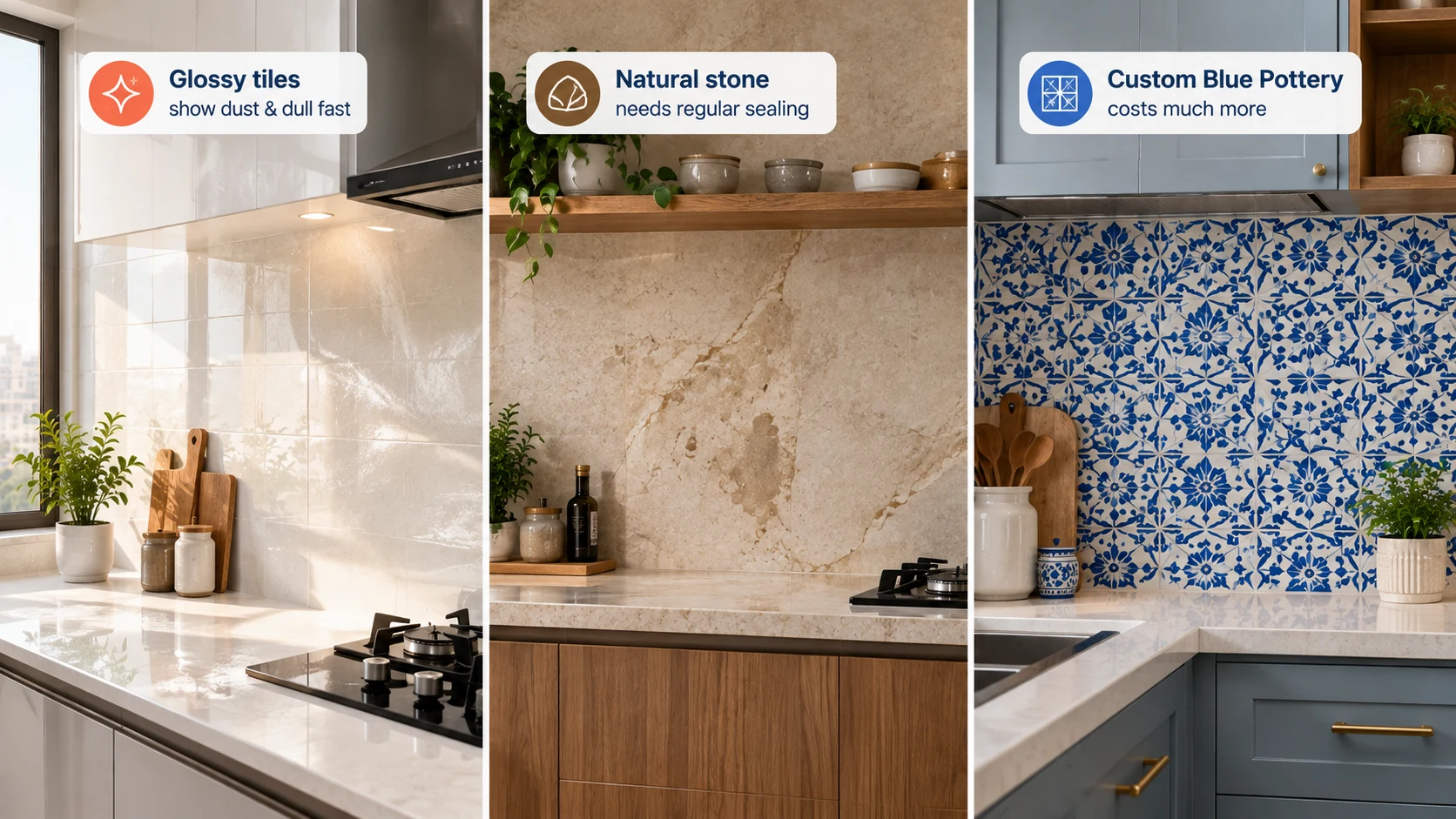
The most frequent mistake is choosing a glossy tile for a kitchen wall or floor without accounting for how quickly Jaipur's dust settles into a reflective surface. A glossy finish that looks immaculate on installation day can show a visible dulling within weeks in a dusty season, well before any grease or cooking residue even factors in, which is exactly why matte and GHR-finished options are worth prioritising over gloss for this specific climate.
A second common error is choosing natural stone for its local, regional appeal without budgeting for sealing as an ongoing cost, not a one-time installation step. Stone left unsealed, or resealed too infrequently, stains permanently in a kitchen far faster than it would in a lower-traffic room, and the resulting patchy, discoloured look is one of the more common complaints among Jaipur homeowners who chose stone primarily for its look without planning for its upkeep.
Finally, some buyers commission a fully custom Blue Pottery mural for an entire kitchen wall without first checking a smaller-scale printed version, ending up with a considerably higher cost than the design actually required. Starting with a single accent strip or niche in the custom or semi-custom route, rather than covering a full wall, is usually enough to get the visual impact without the full custom price tag.
Choosing With Jaipur's Own Resources in Mind
A Jaipur kitchen doesn't have to default to whatever Morbi ships in. Between Blue Pottery-inspired backsplash design, genuinely local Kota stone and sandstone, and glaze choices built for dry heat and dust rather than humidity, this is one of the few Indian cities where the "local" option is a real, practical alternative rather than a marketing angle.
If you're planning a kitchen retile in Jaipur, you can compare Blue Pottery-pattern backsplash tiles, local stone options, and standard vitrified ranges by price and finish, and connect with verified Mansarovar and Bani Park dealers on TilesFinders.
FAQs
Yes, several manufacturers now offer cobalt-and-white digitally printed ceramic and porcelain tiles that draw directly on Blue Pottery's floral and geometric motifs, giving the look without the higher cost and fragility of genuine hand-painted pottery pieces.
It can be, particularly for buyers wanting a genuinely local material with a cooler underfoot feel that suits Jaipur's summer heat. The trade-off is porosity, natural stone needs periodic sealing to resist oil and staining in a kitchen specifically, which vitrified tile doesn't require.
GHR, or Glaze High Resistance, is a finish some manufacturers, including Somany, specifically recommend for Jaipur's dusty, dry climate, since it holds up better against the fine dust that settles and gets ground into a standard glaze over time in this kind of environment.
Matte and textured finishes hide settled dust between cleanings more effectively than glossy tile, which shows dust as a visible dull film far sooner, particularly on darker or more reflective surfaces.
Direct, sustained sun exposure near a west-facing kitchen window can cause gradual fading on lower-quality glazes over years. Asking specifically about UV and colour-fastness ratings is worth doing for any tile installed in a spot that gets several hours of direct afternoon sun.
Mansarovar and Bani Park host the city's main Kajaria and Somany showrooms, Malviya Nagar has an Orientbell boutique, and Tonk Road near Gandhi Nagar is home to established dealers like Saraswati Marbles, an H&R Johnson authorised outlet.
Roughly every one to three years, depending on how heavily the kitchen is used and how promptly spills get wiped up. A kitchen floor sees more oil and liquid exposure than most other rooms, so it's worth erring toward the more frequent end of that range rather than waiting until staining becomes visible.
For most kitchens, a digitally printed ceramic or porcelain interpretation delivers nearly the same visual impact at a fraction of the cost and with far better day-to-day durability than genuine hand-painted pottery tiles. A custom or semi-custom route makes more sense for a small, deliberately showcased accent area, a niche or narrow strip, rather than a full working wall.


See our tile guides first
Set TilesFinders as a preferred source and our buying guides surface ahead of the rest for you.
Add as preferred sourceTakes one tap. Nothing to install.
What Readers Say
I was about to redo my parking area with the wrong tile size until I read this. The layout comparisons saved me from a costly mistake.
We reference TilesFinders guides while briefing clients on material selection. The size and pattern breakdowns are accurate and easy to explain visually.
On site, I get asked about grout spacing all the time. This article gave me a solid reference I now share with my team before every job.
Finally a guide that doesn't just push generic advice. The oil stain removal steps actually worked on our clubhouse driveway tiles.
I run a small construction firm and now send this link to clients directly when they ask about entrance tile sizing. Saves me an hour of explaining.
Good practical detail, though I wish there were more examples for compact apartment entrances specifically, not just villas.
My mother-in-law wanted marble, I wanted vitrified. This blog gave us the neutral comparison we needed to actually decide together.
Detailed without being overwhelming. I appreciated that it covered both cost and maintenance, not just the aesthetics.
Used the algae and hard water removal tips on our terrace tiles after the monsoon. Worked better than what our regular cleaner was doing.
As someone who sources tiles for multiple builder projects, I find these comparisons genuinely useful for vendor conversations, not just consumer content.
Recommended this to a client who kept second-guessing the entrance design. The small vs large layout section settled the debate instantly.
Straightforward and honest, no unnecessary jargon. Would like to see a similar breakdown for outdoor pool-deck tiles next.
We've bookmarked several TilesFinders guides for our design handbook. Reliable source when clients want data, not just opinions.
Two paths, one marketplace.
Get free quotes from verified suppliers.
Share your room, budget, and style. Suppliers in local area respond within hours.
Get Free QuotesList your business, reach real buyers.
Put your showroom in front of homeowners searching for tiles right now.
List Your BusinessMore Blogs
See all
Kitchen Backsplash Tile Design Ideas: 25+ Trending Looks for Indian Homes 2027
Discover 25+ kitchen backsplash tile ideas for Indian homes in 2027. Compare subway, marble-look,...
Read More
Hexagon Tiles in India: Complete Shape Guide for Bathrooms, Kitchens and Feature Walls
A 2027 guide to hexagon tiles in India, covering wet-zone grip, room-by-room sizing, 15–20% wasta...
Read More
Best Kitchen Tiles Under Rs 60 per Sq Ft in India: 2027 Picks
A kitchen is the smallest tiled room and the hardest working, so per sq ft rates mislead most her...
Read More