
Best Ways to Use 200x1000 mm Tiles in Living Rooms and Bedrooms
From stylish living room tiles to cosy bedroom retreats, 200x1000mm planks offer endless design p...


Loading designs...




















The living room floor is the largest single surface in most Indian homes, and the one that every design decision in the room reads against. The sofa sits on it. The rug defines a zone within it. The coffee table, the TV unit, and the chairs all have legs on it. The tile choice for a living room floor is not just about how it looks in isolation: it has to work under furniture, around a rug, beside the kitchen transition, and across the full expanse from one wall to the other. Finding the right living room tiles means making the tile choice in the context of the whole room, not just from a tile sample held against a showroom wall.
The living room floor in an Indian home is a dry, indoor surface with moderate to heavy foot traffic. It is not exposed to water the way a bathroom floor is, and it does not face the grease and chemical exposure of a kitchen floor. This opens up the finish range considerably: polished GVT, satin matte, and even large-format luxury tiles in marble-look or abstract stone patterns are all practical choices for a dry living room floor that would not work as well in wetter or rougher-use areas of the house.
This page focuses specifically on the floor tile decision for the main sitting area: how to match tile format and finish to the room's use and proportions, how different colour directions behave in a living room over time, what tile types are available across different budgets, and how to handle the transitions to adjacent spaces, including the balcony, dining area, and kitchen.
A living room floor is looked at more than it is walked on. In a bathroom, the floor is a functional surface that gets wet and cleaned daily. In a kitchen, the floor takes spills, chair movement, and constant foot traffic around a cooking zone. In a living room, the floor is more often seen from seated height: people look down at it from the sofa, notice it in the expanse between the coffee table and the TV unit, and judge the room's quality partly by what the floor looks and feels like underfoot when they walk across it barefoot.
This means that the finish quality and the visual composition of a living room floor tile matter more here than in most other rooms. A polished GVT tile in the living room catches and amplifies natural light from windows in a way that a matte tile does not. A large-format tile with book-matched marble veining reads as a continuous designed surface. A wood-look GVT plank in a warm tone changes the character of the room from cool and contemporary to warm and domestic. These are design-led decisions that the practical considerations of body type and water absorption only frame, not determine.
GVT (Glazed Vitrified Tiles) rated under IS 15622:2006 with water absorption below 0.05% is the most used floor tile body type in Indian living rooms across all price points. GVT is hard enough for daily foot traffic, available in every finish used in living rooms, produced in Morbi in all sizes from 600x600mm to 1200x1800mm, and priced across a wide range from Rs. 40 per sq.ft for plain matte options to Rs. 130 per sq.ft for large-format luxury surface designs.
The finish range in GVT covers every living room application: polished for a high-shine reflective floor, satin matte for a soft sheen that hides footprints, matte for the lowest-maintenance flat surface, GHR for a stone-like textured surface, and sugar finish for a fine granular texture with warm diffused light reflection. The right GVT finish for a living room depends on how much cleaning the floor will receive, how much natural light the room gets, and whether the priority is visual drama or day-to-day ease.
Porcelain tiles for a living room floor absorb 2% to 5% water, which is significantly better than ceramic but not as low as GVT. On a dry indoor living room floor, this difference in water absorption has no practical consequence: the floor is not getting wet. The real distinction of porcelain tile flooring for a living room is surface hardness and finish availability. Porcelain is harder than ceramic but typically available in fewer finish and size options than GVT, and is generally positioned as a mid-range body type between ceramic and vitrified. Price range: Rs. 40 to Rs. 90 per sq ft.
Ceramic tile flooring for a living room is suitable in specific contexts. Ceramic floor tiles, rated under IS 13630 with 12% to 16% water absorption, are the correct specification only for light-traffic living room floors in 300x300mm format. For the primary floor of a family living room with regular daily foot traffic from household members and guests, the surface hardness of ceramic will show micro-scratches and gradual dulling faster than GVT or porcelain. As a budget-conscious option for a compact sitting room in an apartment where traffic is genuinely light, ceramic floor tiles are adequate. Price range: Rs. 25 to Rs. 60 per sq ft.
White living room floor tiles in polished or satin matte GVT are the brightest-reading floor option and work best in rooms with good natural light and a colour palette that does not compete with a white or near-white floor. The practical reality of white floor tiles in a living room is that they are the highest-maintenance colour in this space: dust, pet hair, and the marks from dark-soled shoes are all more visible on a white or cream floor than on grey or beige. In a home with children or pets, white living room floor tiles demand daily sweeping or vacuuming and more frequent mopping than any other colour direction.
White tiles work best on living room floors in homes where the aesthetic discipline of maintaining a light-coloured floor is matched by the lifestyle of the household. A formal drawing room used primarily for receiving guests, with furniture on protective pads and a rug covering the primary traffic zone, is a context where white floor tiles read beautifully and stay clean with reasonable effort. A daily family living room with children, pets, and open access to outdoor spaces is a context where beige, grey, or stone-look tiles will hold their appearance significantly better.
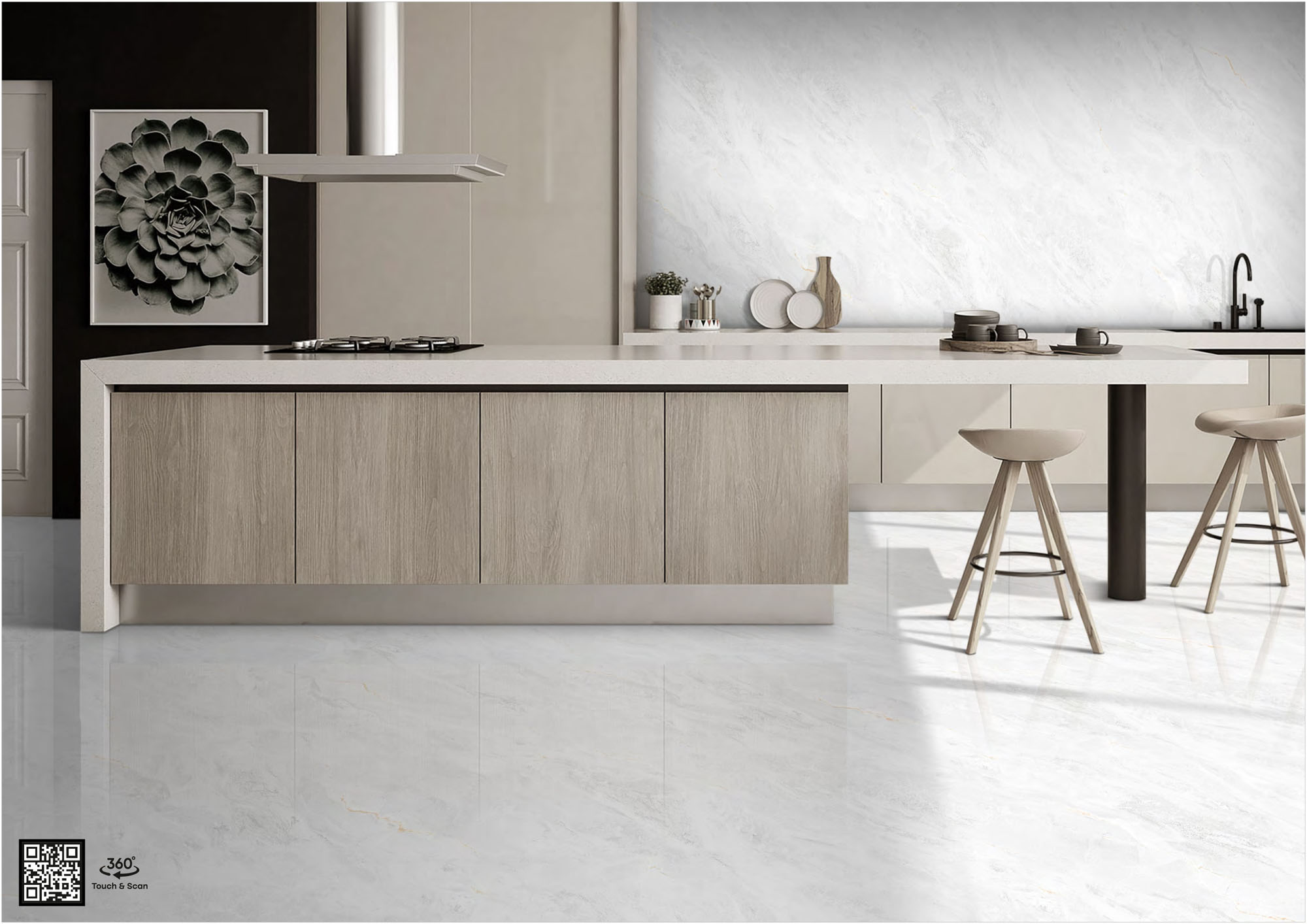
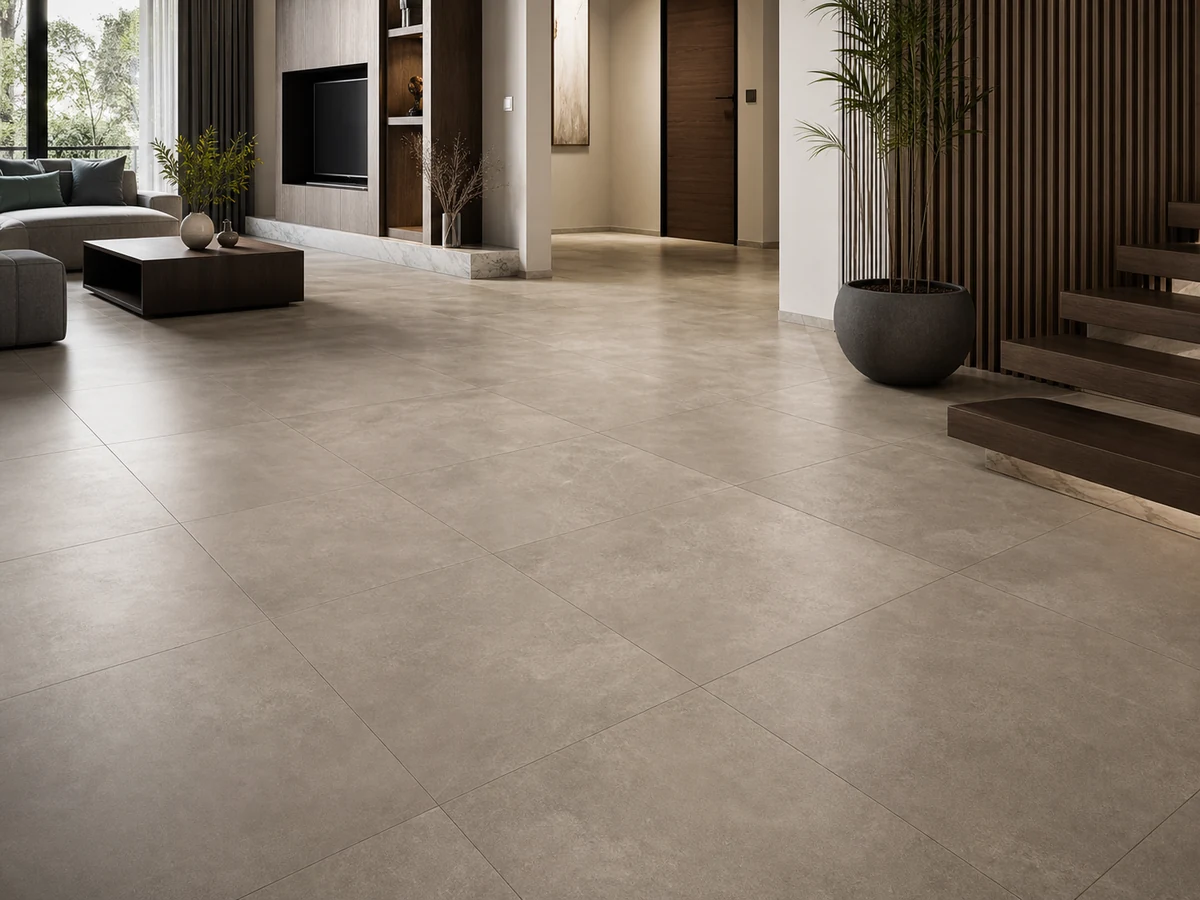
Grey floor tiles for a living room are the most practical and the most used neutral floor tile colour in Indian homes today. The appeal of grey is consistent: it works against warm-toned furniture, cool-toned walls, coloured rugs, and natural wood equally well. Grey does not show dust and minor marks the way white does, does not read as dated the way deep browns can, and does not carry the visual weight that very dark floors bring to smaller rooms.
The range within grey living room floor tiles is wide: light silver-grey in polished finish amplifies light and reads as contemporary and airy, mid-grey in satin matte is the most neutral and forgiving colour in daily use, and dark charcoal in matte gives the room a grounded, architectural quality. Size affects the reading of grey in a living room: a light grey in 600x1200mm polished creates a very different room from the same grey in 300x600mm matte. The former reads as a modern slab floor, the latter as a more traditional grid.
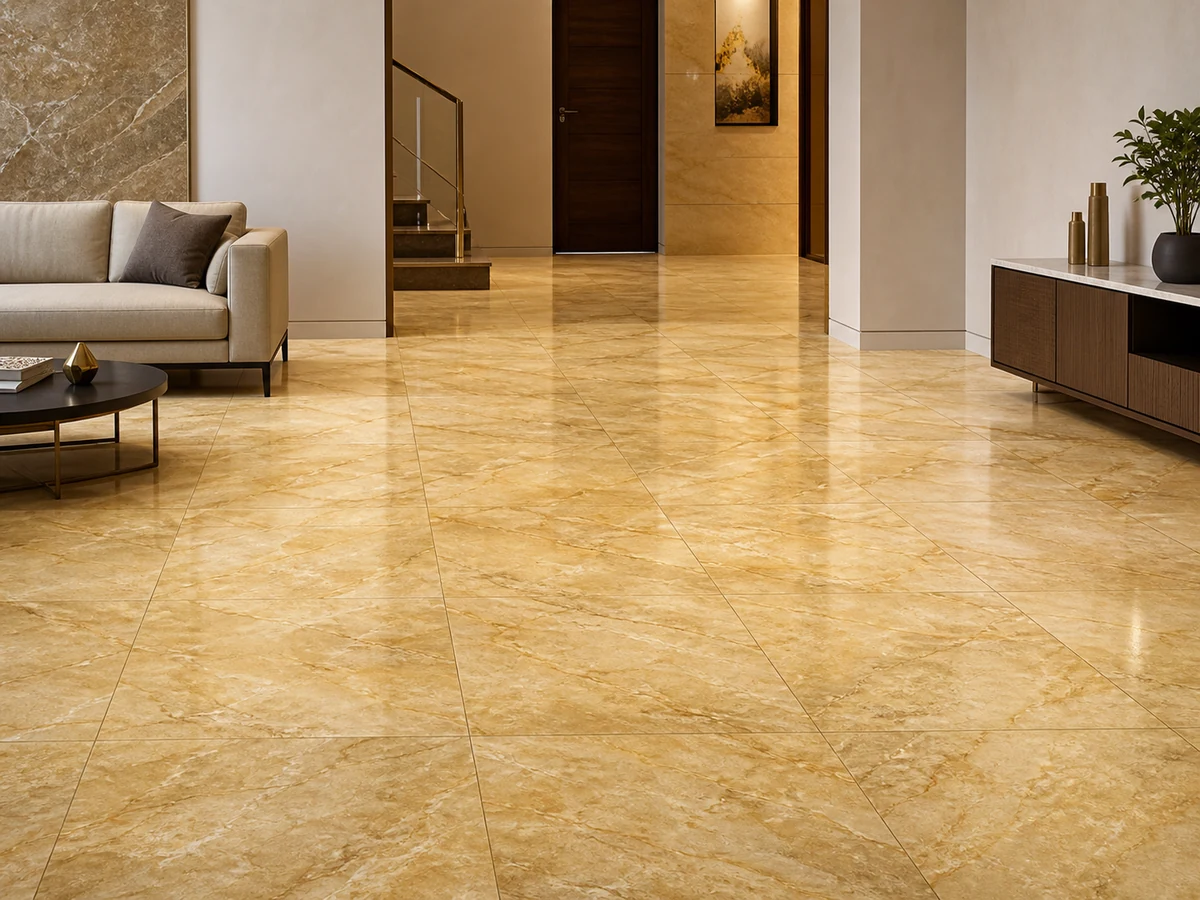
Marble floor tiles for a living room, in the Indian residential market, are almost entirely GVT marble-look tiles rather than actual cut marble. The visual result at room scale is comparable, and the performance advantage of GVT over actual marble on a living room floor is significant: GVT does not absorb oils, cleaning chemicals, or coloured liquids the way natural marble does, does not require acid-free cleaning products, and does not need periodic sealing.
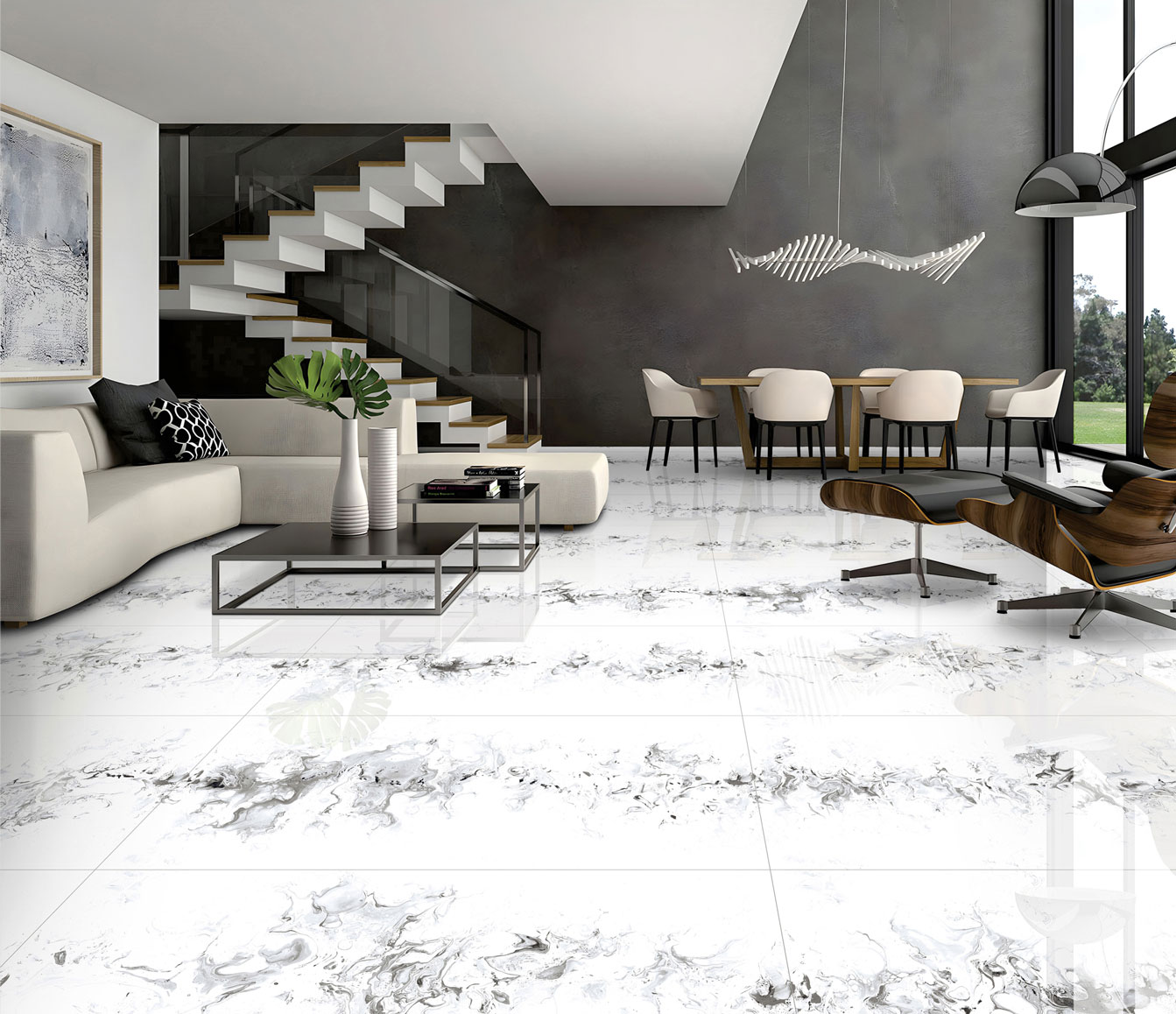
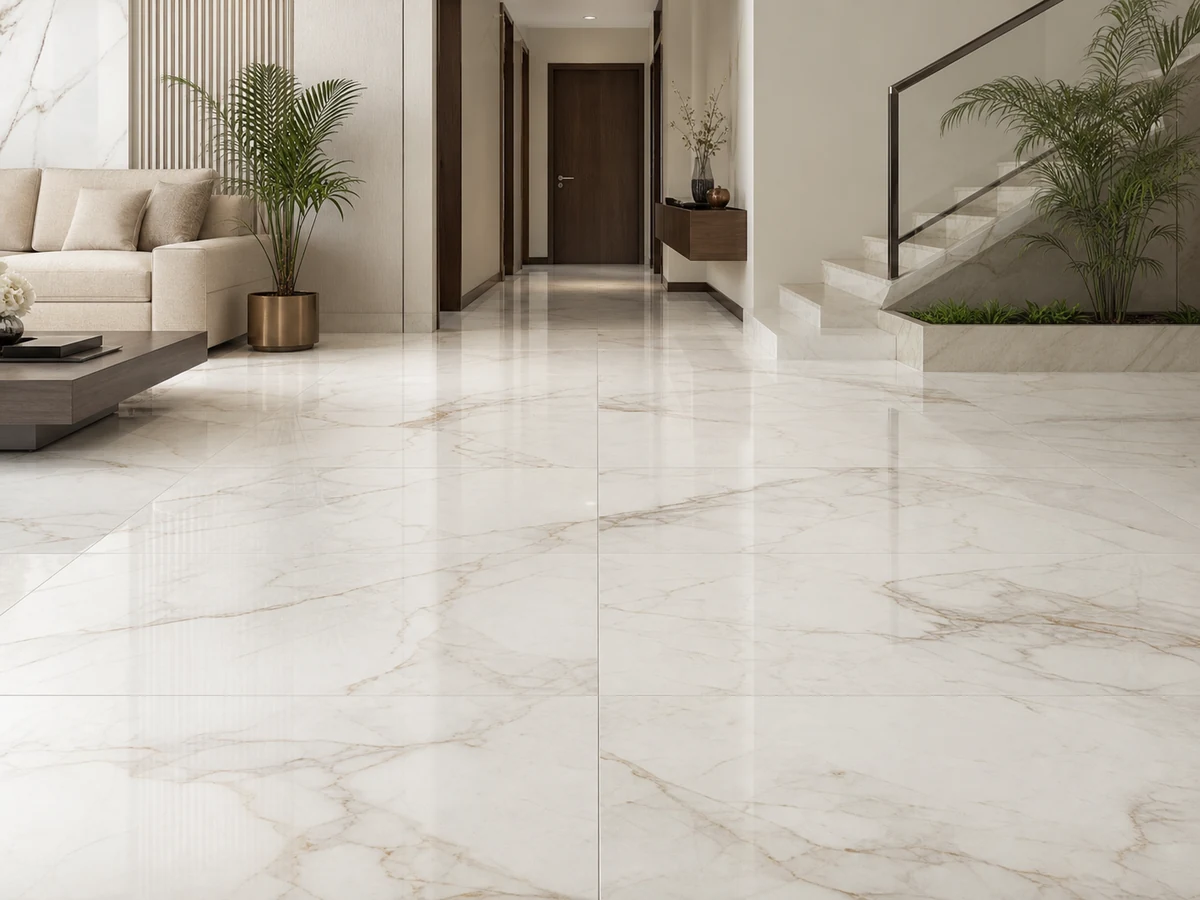
The most used marble-look directions for Indian living room floors are Carrara white with fine grey veining in polished GVT, Statuario with bolder gold and grey veining in polished or satin matte, and Calacatta with dramatic thick veining for a more high-design look. In 800x1600mm or larger format, marble-look GVT floor tiles in a book-matched layout create the appearance of a continuous marble slab across the floor. Price range: Rs. 65 to Rs. 130 per sq ft for marble-look GVT living room floor tiles from Morbi.
Brown floor tiles for a living room range from warm amber and honey tones, which suit traditional and semi-traditional Indian interiors with dark wood furniture, to deep walnut and chocolate, which give the room a rich, grounded quality in contemporary settings. Brown tiles in a living room work best when there is enough contrast in the room above the floor: a deep brown floor with dark furniture and dark walls reads as heavy and enclosed. A warm brown floor with lighter walls and natural-toned furniture creates a welcoming, layered space.
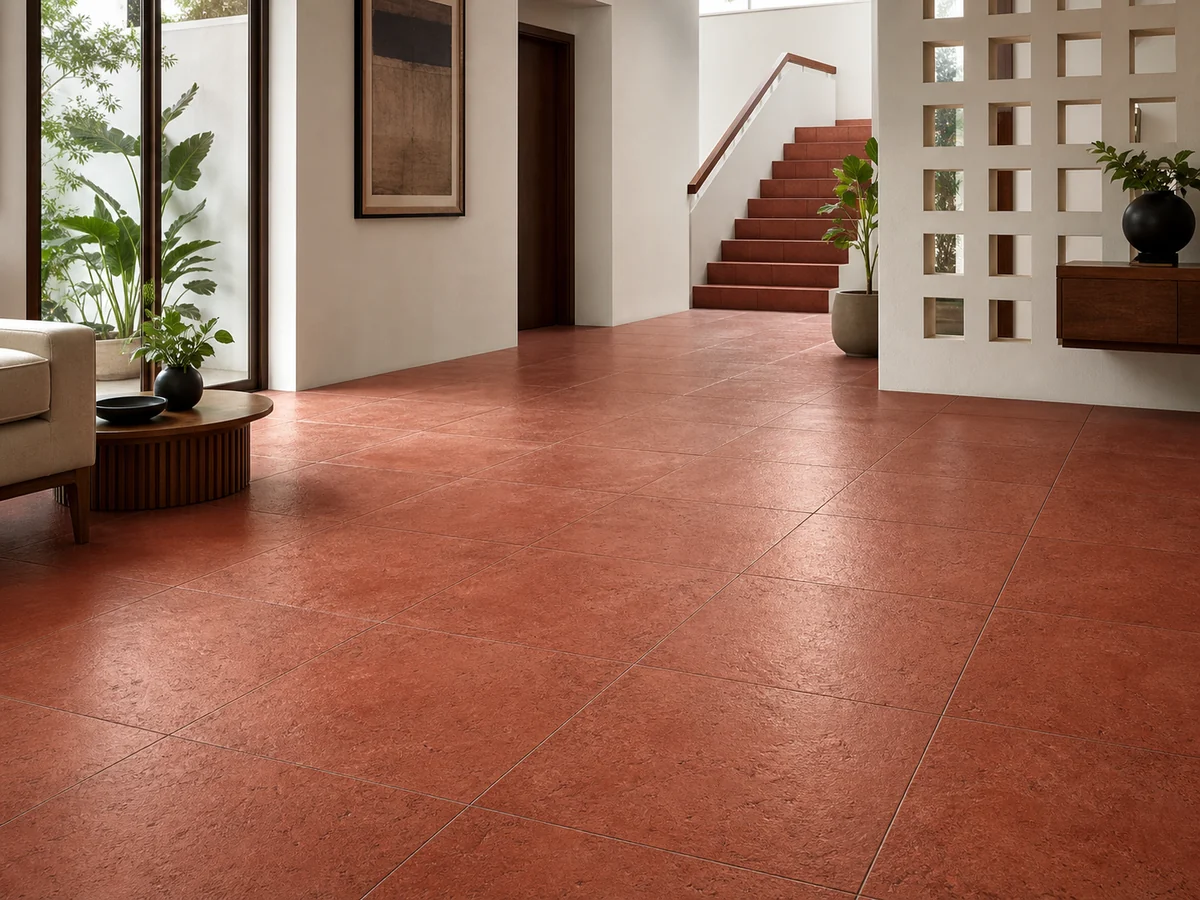
Brown GVT floor tiles in satin matte or polished finish are the standard specification. At 600x1200mm in polished warm brown with gold undertones, the floor reads as a formal drawing room surface. At 600x600mm in matte terracotta-brown, it reads as a casual, warm family room. Price range: Rs. 45 to Rs. 100 per sq ft for brown GVT living room floor tiles from Morbi.
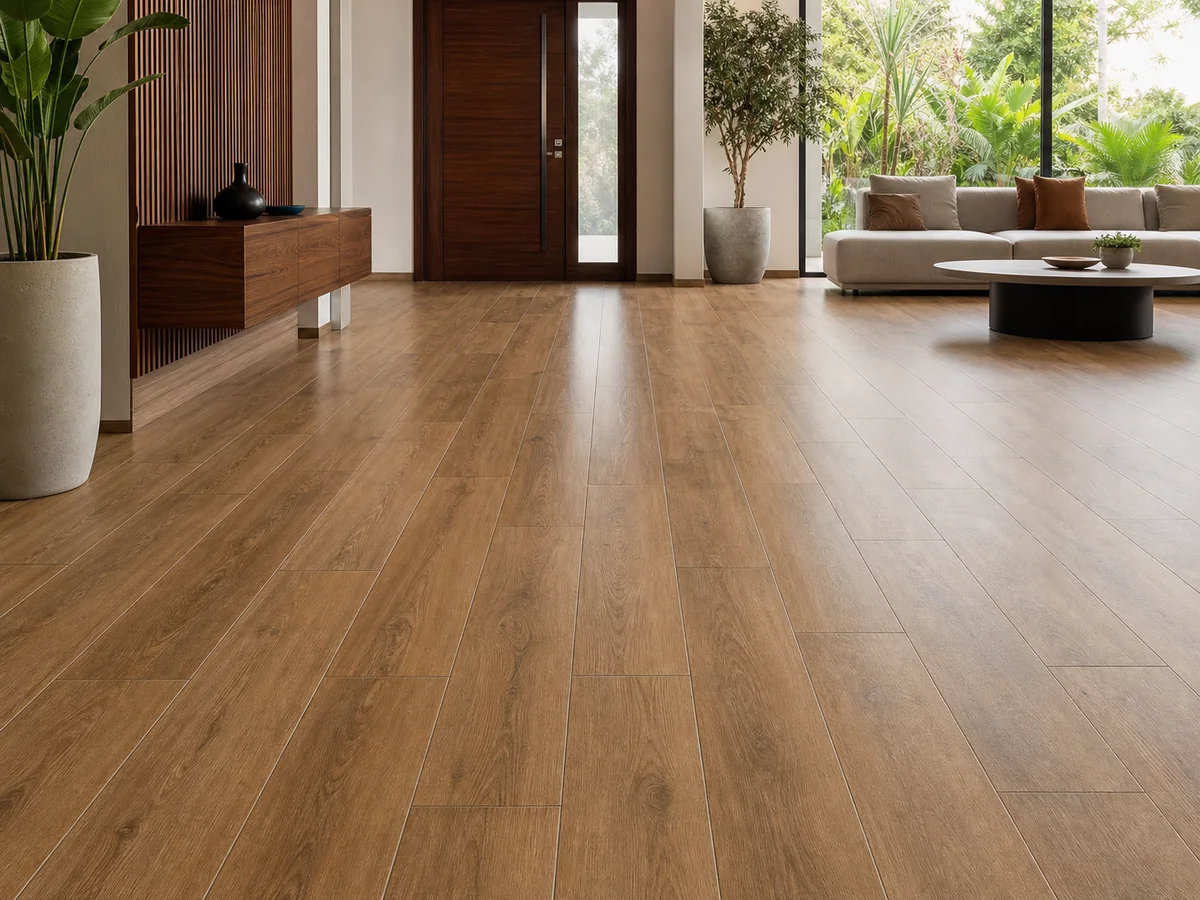
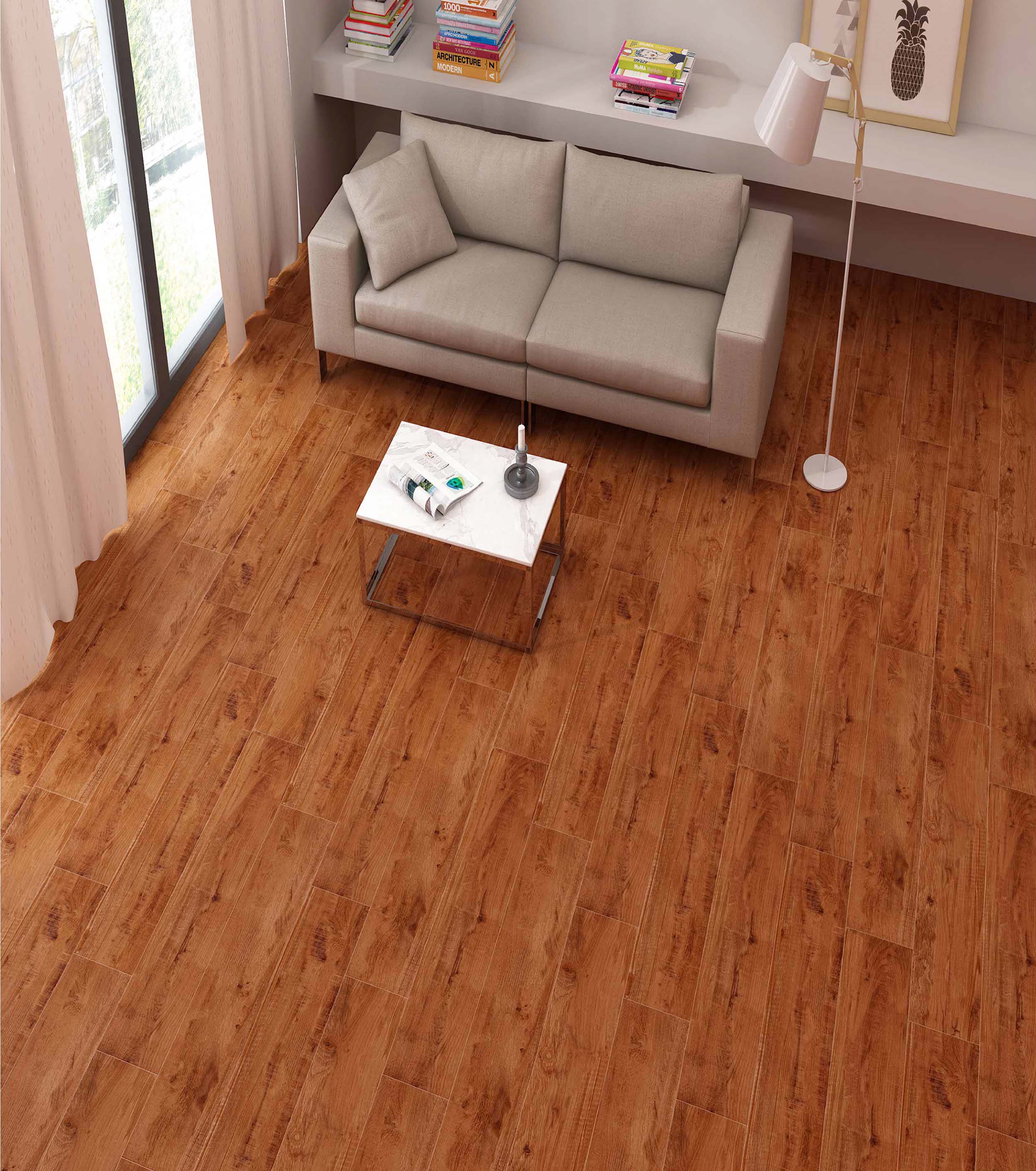
Wooden floor tiles for a living room are GVT tiles with a wood-grain surface design that replicates the colour, grain pattern, and plank proportions of timber flooring. In Indian residential interiors, wood-look tiles are used in living rooms where the warmth and linear character of a timber floor is the design intention, but the maintenance, cost, or structural requirements of actual hardwood are prohibitive. A GVT wood-look tile in 200x1200mm or 300x1200mm plank format in a warm oak or walnut grain, laid in a straight bond running the length of the room, gives the living room the feel of a timber floor without any of the swelling, warping, or refinishing requirements of actual wood. Wood look tiles in GVT matte or satin matte finish in plank formats are available from Morbi at Rs. 55 to Rs. 110 per sq.ft.
The most convincing wood-look tile floors in living rooms use two elements: a tile format that matches the proportions of real timber planks (long and narrow, typically 200x1200mm or 300x1200mm), and a grain print with enough contrast between lighter and darker grain lines to read as genuine wood texture from standing height. Avoid pale, low-contrast wood-look prints that wash out under Indian interior lighting and lose the timber character the tile is meant to deliver.
3D floor tiles are a frequently searched category for living rooms. In practice, a raised three-dimensional surface relief on an indoor living room floor is uncomfortable underfoot, difficult to clean between the ridges, and creates an uneven surface that chair legs and furniture feet sit awkwardly on. The indoor living room floor is a walking and sitting surface first, and a highly textured relief tile works against both of those functions.
What most buyers are looking for when they search for 3D floor tiles for a living room is floor tiles with strong visual depth and surface variation: marble-look tiles with realistic veining, stone-look tiles with a surface texture that catches light differently across the tile face, or wood-look tiles with grain depth that reads as three-dimensional even though the surface is flat. These effects are achieved through digital printing technology on a flat-surface GVT tile, not through a physical surface relief. A GVT tile in satin matte finish with a deep-grain stone or marble-look print delivers the visual depth that 3D floor tiles searches are looking for, on a flat, comfortable, easy-to-clean floor surface.
For genuine three-dimensional tile design in a living room, the correct application is the feature wall, not the floor. A 3D Matte Carving GVT tile on the TV wall or sofa back wall creates the shadow-depth and texture of a 3D tile on a surface where it can be fully appreciated without underfoot concerns.
Most Indian living rooms use a rug to define the primary seating area, and the interaction between the floor tile and the rug is a design relationship that rarely gets considered at the tile selection stage. A light grey or cream polished GVT tile with a coloured rug reads very differently from a dark charcoal matte tile with the same rug: the light tile reflects the rug's colours back into the room, while the dark tile makes the rug appear as a floating island above a receding floor plane.
The tile size also relates to the rug practically. A rug that sits on a 600x1200mm tile grid will align naturally with the tile edges if the rug dimensions are multiples of the tile size. A rug that cuts across tile joints at odd angles draws attention to the grout lines at the rug perimeter. When selecting a living room floor tile, consider the likely rug size and whether the tile size can be laid so the rug zone falls cleanly on full tiles.
For living rooms that connect to a balcony or outdoor area, the tile transition at the threshold is a design and specification decision simultaneously. The balcony tile must be outdoor-rated GVT with a textured finish. The living room tile can be polished or satin matte. A threshold strip at the doorway separates the two cleanly. If the same tile is used on both surfaces, it must be outdoor-rated GVT in matte or textured finish, which affects the finish choice for the living room floor. Balcony tiles cover the outdoor tile specification for surfaces adjacent to a living room in detail.
Large floor tiles in 800x1600mm and above deliver the cleanest, most contemporary floor look in a living room by minimising the number of visible grout lines. A living room floor laid in 800x1600mm with 1.5mm joints has roughly one quarter the number of grout lines as the same floor in 600x600mm. This significantly changes how the floor reads: fewer joints means the tile colour and surface design dominate rather than the grid pattern.
The substrate preparation required for large living room floor tiles is more demanding than for smaller formats. The floor base must be flat to within 3mm across any 3-metre span for 800x1600mm tiles, and within 2mm for 1200x1800mm tiles. Any variation beyond this causes lippage: a visible height difference at tile edges where adjacent tiles are not flush. Lippage on a living room floor is most visible with polished large-format tiles under raking light in the late afternoon. Achieving the correct flatness requires a floor screed precisely levelled before tiling begins.
Adhesive coverage for large floor tiles must be complete across the full back of the tile. Use a large-notched trowel to apply adhesive to the floor, and then back-butter each tile before laying. Any unfilled void behind a large tile creates a hollow spot that cracks under point load from chair legs or furniture. This is the most common cause of large-format tile failure in living rooms and is entirely preventable with correct installation technique.
The floor tile and the wall tile in a living room do not need to match, but they do need to coordinate. The most common coordination approach in Indian living rooms is a neutral floor tile in grey or cream and a more characterful wall tile on one accent wall: a marble-look PGVT on the wall against a plain grey matte GVT floor, or a 3D stone-look GVT on the TV wall against a warm beige polished floor. The floor recedes visually, and the wall tile advances. When both the floor and the wall tiles are high-contrast or richly patterned, the room feels busy, and neither surface can be appreciated. For the full range of living room wall tile options and how to coordinate them with a floor tile, the living room wall tiles guide covers the accent wall and half-wall decisions in detail.
The most used modern tile flooring directions in Indian living rooms fall into four broad approaches, each with a distinct visual character and installation requirement.
The first is the seamless light slab: an 800x1600mm or 1200x1800mm GVT tile in light grey, cream, or warm white in polished or satin matte finish, laid with 1.5mm joints and a matching grout. The floor reads as a continuous light plane that amplifies the room. This is the most widely aspirational living room floor look in contemporary Indian residential interiors.
The second is the marble-look statement floor: a GVT marble-look tile in Statuario or Calacatta pattern in 800x1600mm or larger, with book-matched tiles creating continuous veining across the floor. This requires tile-matching at ordering and careful layout planning before installation, but delivers a floor that is genuinely distinct from any other floor treatment available at the price point.
The third is the warm-wood plank floor: GVT in a plank format, 200x1200mm or 300x1200mm, in an oak, walnut, or dark teak grain, laid in a straight bond along the length of the room. This direction is growing fastest in younger homeowner segments and in homes with a mix of contemporary and natural material finishes.
The fourth is the textured neutral: a 600x600mm or 600x1200mm GVT in stone-look or concrete-look in matte or GHR finish. This gives the living room a grounded, low-maintenance floor that does not demand attention but has enough surface variation to avoid looking plain. Preferred in family living rooms and open-plan spaces where the floor needs to be durable and easy to maintain.
| Tile Type | Body Type | Format | Finish | Price Range (Rs./sq.ft) |
|---|---|---|---|---|
| Plain colour, standard | GVT | 600x600mm | Polished or Matte | Rs. 40 to Rs. 65 |
| Stone or concrete look | GVT | 600x600mm, 600x1200mm | Matte or GHR | Rs. 50 to Rs. 90 |
| Marble look | GVT | 600x1200mm, 800x1600mm | Polished or Satin Matte | Rs. 65 to Rs. 130 |
| Wood look plank | GVT | 200x1200mm, 300x1200mm | Matte or Satin Matte | Rs. 55 to Rs. 110 |
| Luxury large format | GVT or Full Body Vitrified | 800x1600mm, 1200x1800mm | Polished or Satin Matte | Rs. 90 to Rs. 180 |
| Porcelain floor tile | Porcelain | 600x600mm | Matte or Satin Matte | Rs. 40 to Rs. 90 |
| Ceramic floor tile (light traffic) | Ceramic | 300x300mm | Matte or Glossy | Rs. 25 to Rs. 60 |
Note: Retail prices across Indian cities are 25% to 40% above ex-factory Morbi prices, depending on city and dealer margin. Installation costs for living room floor tiles: Rs. 35 to Rs. 55 per sq.ft for standard straight lay, Rs. 55 to Rs. 80 per sq ft for large-format tiles in 800x1600mm and above requiring back-buttering and precise levelling.
Living room floor tile selection starts with the room's proportions, the light conditions, and the furniture palette, then works through body type, finish, and size. Browse GVT, porcelain, and luxury large-format living room floor tiles across all colour and design directions on TilesFinders and compare finish, size, and body type before shortlisting.
GVT in polished or satin matte finish is the best floor tile for Indian living rooms. GVT absorbs less than 0.05% water under IS 15622:2006, handles daily foot traffic without surface degradation, and is available in every size and colour direction used in living rooms. 600x1200mm and 800x1600mm are the most used sizes. Price range: Rs. 50 to Rs. 130 per sq.ft from Morbi, depending on finish and size.
Both GVT and porcelain are suitable for living room floors. GVT absorbs less than 0.05% water under IS 15622:2006 and is available in a wider range of finishes, sizes, and surface designs than porcelain. Porcelain absorbs 2% to 5% water, which has no practical consequence on a dry living room floor. The main advantage of GVT over porcelain in this application is the broader product range and the lower price per sq.ft at equivalent quality levels. Porcelain price range: Rs. 40 to Rs. 90 per sq.ft.
Large format tiles in 600x1200mm and above create fewer grout lines across the floor, which makes the living room look larger and the floor more composed. They require a flatter, more precisely levelled floor base than smaller tiles and must be installed with full adhesive coverage on the tile back. For rooms above 250 square feet, 600x1200mm or 800x1600mm tiles are the most used formats. For compact living rooms under 150 square feet, 600x600mm gives a proportionally correct tile scale.
White and near-white living room floor tiles show dust, pet hair, and marks from footwear more readily than grey, beige, or stone-look tiles. In a home with children, pets, or regular outdoor-to-indoor foot traffic, white floor tiles require daily sweeping and more frequent mopping than mid-tone tiles. Polished white tiles show marks more than satin matte white. If a light floor is the design intention, warm ivory or cream in satin matte is a lower-maintenance alternative to pure bright white in polished finish.
Yes. GVT wood-look tiles in plank formats are widely used in Indian living rooms. The standard sizes for a wood-look plank tile are 200x1200mm and 300x1200mm in matte or satin matte finish. GVT wood-look tiles do not swell, warp, or require refinishing the way actual hardwood does, and they handle Indian humidity and temperature cycling without the maintenance that real timber flooring demands. Price range: Rs. 55 to Rs. 110 per sq ft from Morbi.
Three-dimensional relief tiles with a raised surface texture are not suitable for an indoor living room floor. A raised relief on a floor creates an uneven walking surface that is uncomfortable underfoot, collects dirt in the grooves, and makes furniture difficult to level. What most buyers looking for 3D floor tiles actually want is tiles with strong visual depth and surface variation, which is achieved through deep digital printing on a flat-surface GVT tile in stone-look, marble-look, or wood-look finishes. For genuine 3D tile design in a living room, the TV feature wall or sofa back wall is the correct application.
Standard cement grout is adequate for living room floor tile joints. Living room floors are dry and do not need the waterproof performance of epoxy grout. For large-format polished tiles with light-coloured joints, use a non-sanded cement grout with a stain-resistant additive to keep the grout lines clean. Grout joint width: 1.5mm to 2mm for 600x1200mm and larger tiles, 2mm to 3mm for 600x600mm tiles. Match the grout colour to the tile body to minimise joint visibility.
Polished GVT on a living room floor amplifies natural light and makes the room feel larger. It shows dust and footprints more readily and needs more frequent cleaning. Satin matte GVT gives a softer sheen, hides footprints better, and is the lower-maintenance choice for a daily-use family living room. Full matte GVT is the easiest to maintain and suits casual living rooms and open-plan spaces where the floor is a background surface rather than a design statement. The choice depends on how much cleaning the floor will receive and whether the priority is visual drama or day-to-day ease.