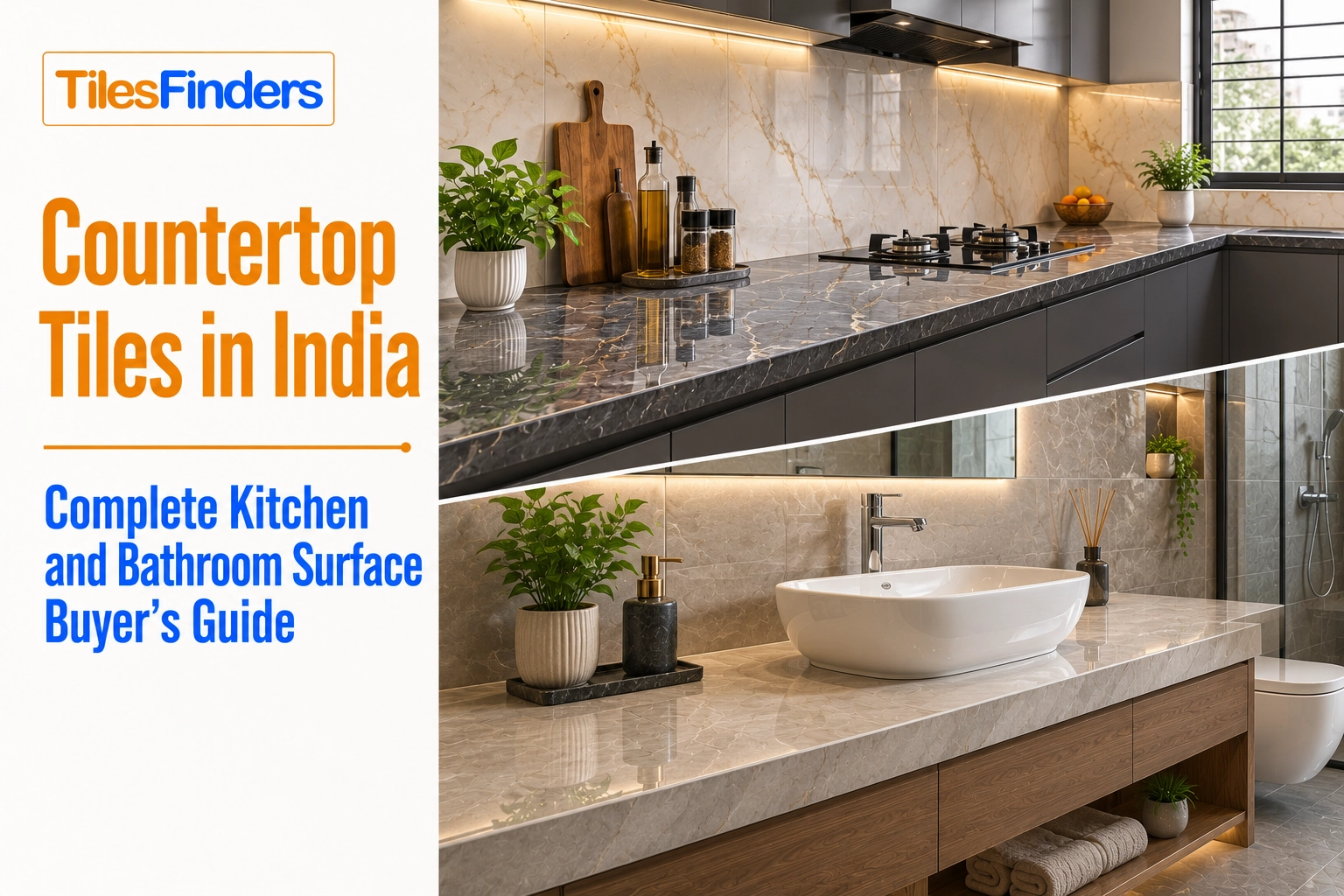
Countertop Tiles in India: Complete Kitchen and Bathroom Surface Buyer's Guide
Choose the right countertop tiles for Indian kitchens and bathrooms with this guide covering GVT ...


Loading designs...



















A tiled countertop occupies a specific position in the tile hierarchy that is distinct from every other surface discussed in home tile selection. It is horizontal but not a floor. It is indoors but exposed to water, heat, food acids, and cleaning chemicals simultaneously. It is seen and touched at close range many times daily. And, critically, it has grout joints that are in direct contact with raw food, cooking oils, and cleaning agents, which makes grout specification more consequential on a countertop than on any other tile surface in the house.
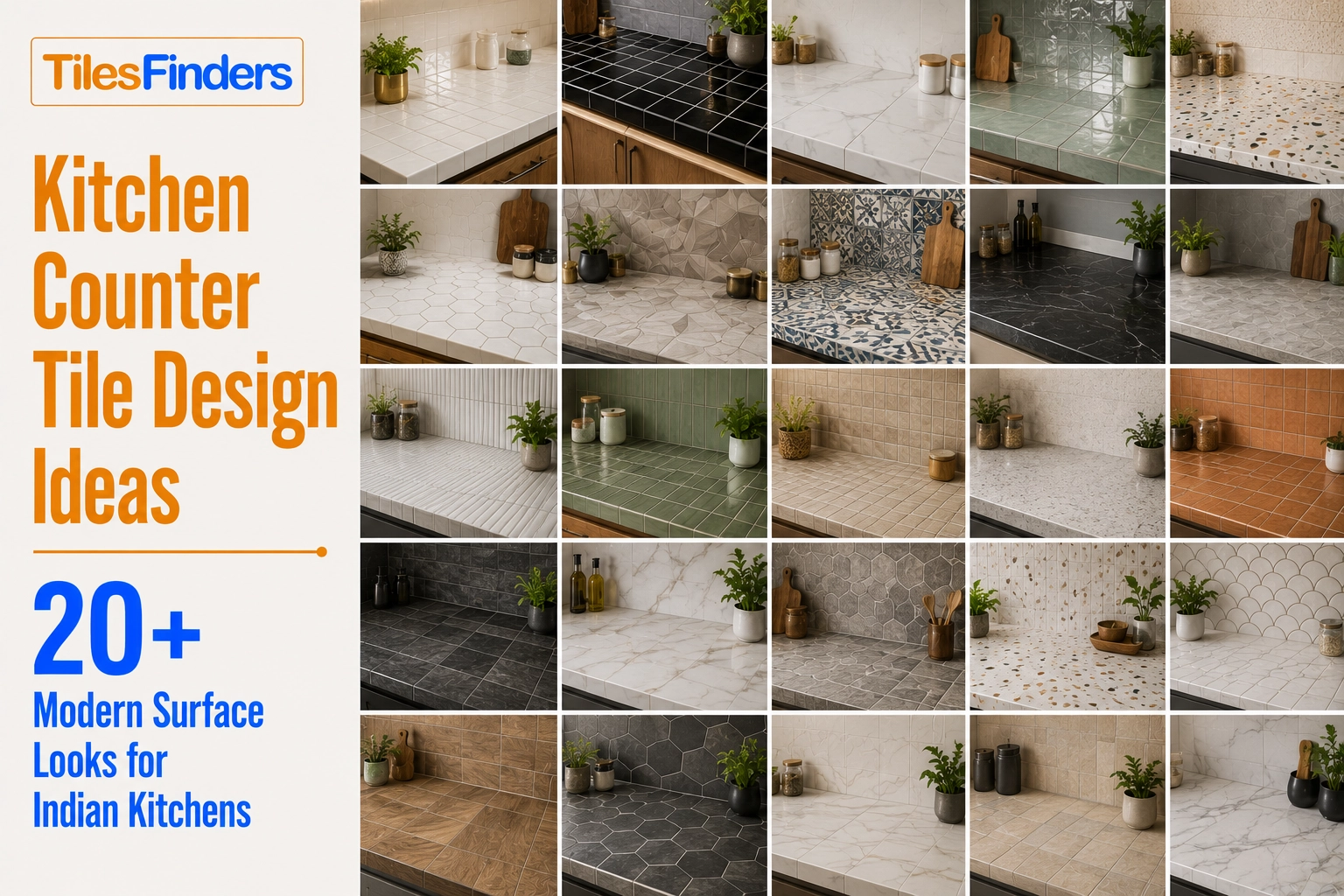
Countertop tiles in India are used in kitchen platforms beside and behind the cooking hob and sink, in bathroom vanity tops, in home bar and wet bar surfaces, and increasingly as large-format tile slab countertops that replicate the look of stone or marble slabs. Each of these applications has a distinct design requirement and a slightly different practical specification, but they share the same fundamental concern: the tile must be non-porous enough to resist staining from food and chemicals, the surface must be cleanable without degrading, and the grout joints must be sealed with a product that prevents bacterial and food residue accumulation.
This page covers countertop tiles across all three main applications in Indian homes: kitchen worktop tiles, bathroom vanity top tiles, and bar top tiles. It covers the tile body type and finish decisions that suit each surface, the large format tile slab countertop as a growing design direction, edge treatment options, and the grout specification that makes a tiled countertop genuinely hygienic over time.
A countertop is a horizontal working surface, which means it faces a completely different set of stresses from a wall tile or a floor tile. Wall tiles face no load, no impact, and no chemical exposure beyond occasional cleaning. Floor tiles face foot traffic, chair castors, and foot-borne grit. A countertop tile faces knife impact (from cutting near the edge), heat from hot pots placed directly on the surface, water pooling around the sink, cooking oil and food acid (tomato, lemon, curry) staining, and daily cleaning with kitchen cleaning products.
These stresses put specific demands on the tile surface and the grout. The tile body type must be dense and non-porous enough that food acids and cooking oils do not penetrate the tile surface. The tile finish must be either hard enough to resist knife-edge scratching or matte enough to hide scratching when it occurs. And the grout must be epoxy, not cement: cement grout in countertop joints absorbs food residue and moisture, creating a surface that is impossible to clean to a hygienic standard over time.
The anti-slip specification that applies to outdoor and bathroom floors does not apply to countertops in the same way. A countertop is not a walking surface. The finish choice on a countertop is about practical performance (scratch visibility, stain resistance, heat tolerance) and visual quality, not outdoor grip.
Porcelain tiles with 2% to 5% water absorption are the most widely used tile body type for countertops globally and in India. Porcelain tile is harder than ceramic, denser than standard GVT, and more resistant to staining from food acids. In an Indian kitchen context where cooking with mustard oil, turmeric, tamarind, and curry paste is standard, the denser body of porcelain makes it more resistant to the penetrating staining that these ingredients create on more porous surfaces. Large-format porcelain tile countertops in 600x1200mm or larger create very few grout joints across the countertop surface, which is the most practical advantage in a kitchen setting.
Porcelain tile countertop finishes: honed (satin matte) porcelain is the most practical kitchen countertop finish because it hides knife scratches better than polished, does not show every fingerprint and water mark, and is easier to wipe clean without showing residue marks. Polished porcelain on a kitchen countertop looks impressive, but every scratch from a knife placed on the surface and every water ring from a glass is visible at close range in kitchen light.
GVT (Glazed Vitrified Tiles) with water absorption below 0.05% under IS 15622:2006 are used as countertop tiles in Indian kitchens and bathrooms at mid-range price points. GVT is harder at the glaze surface than ceramic, resists staining from kitchen chemicals, and is available in every design direction used for countertops: marble-look, stone-look, solid colour, and terrazzo-look. For a kitchen worktop, the most practical GVT format is 600x1200mm or larger, where a single tile can span the full 600mm counter depth in one piece with only one or two joints across the length of an 8-foot counter. At slab sizes of 1200x1800mm and above, GVT creates a near-seamless countertop surface with minimal visible grout. GVT tiles in satin matte or polished finish are the most used countertop tile specification in Indian modular kitchen installations. Price range: Rs. 45 to Rs. 110 per sq ft from Morbi.
Ceramic countertops with 12% to 16% water absorption are the entry-level price point for countertop tiles. Ceramic tile countertops have been the standard in Indian kitchen platforms for decades: the traditional Indian kitchen with a cement-and-tile platform uses ceramic glossy tiles in 200x300mm or 300x600mm format on the countertop surface. Ceramic countertops in glossy finish are easy to clean, available in a wide colour range, and are the most affordable specification at Rs. 25 to Rs. 60 per sq.ft. The practical limitation is the body's porosity: kitchen acids and oils can stain ceramic tile joints and, over time, the glaze can develop micro-crazing that makes the surface harder to keep clean.
For a new kitchen platform where longevity and low maintenance over ten to fifteen years is the priority, porcelain or GVT is a better specification than ceramic. For a renovation where budget is the primary constraint and the countertop will be relaid in five to seven years, ceramic glossy tile is a practical, affordable choice.
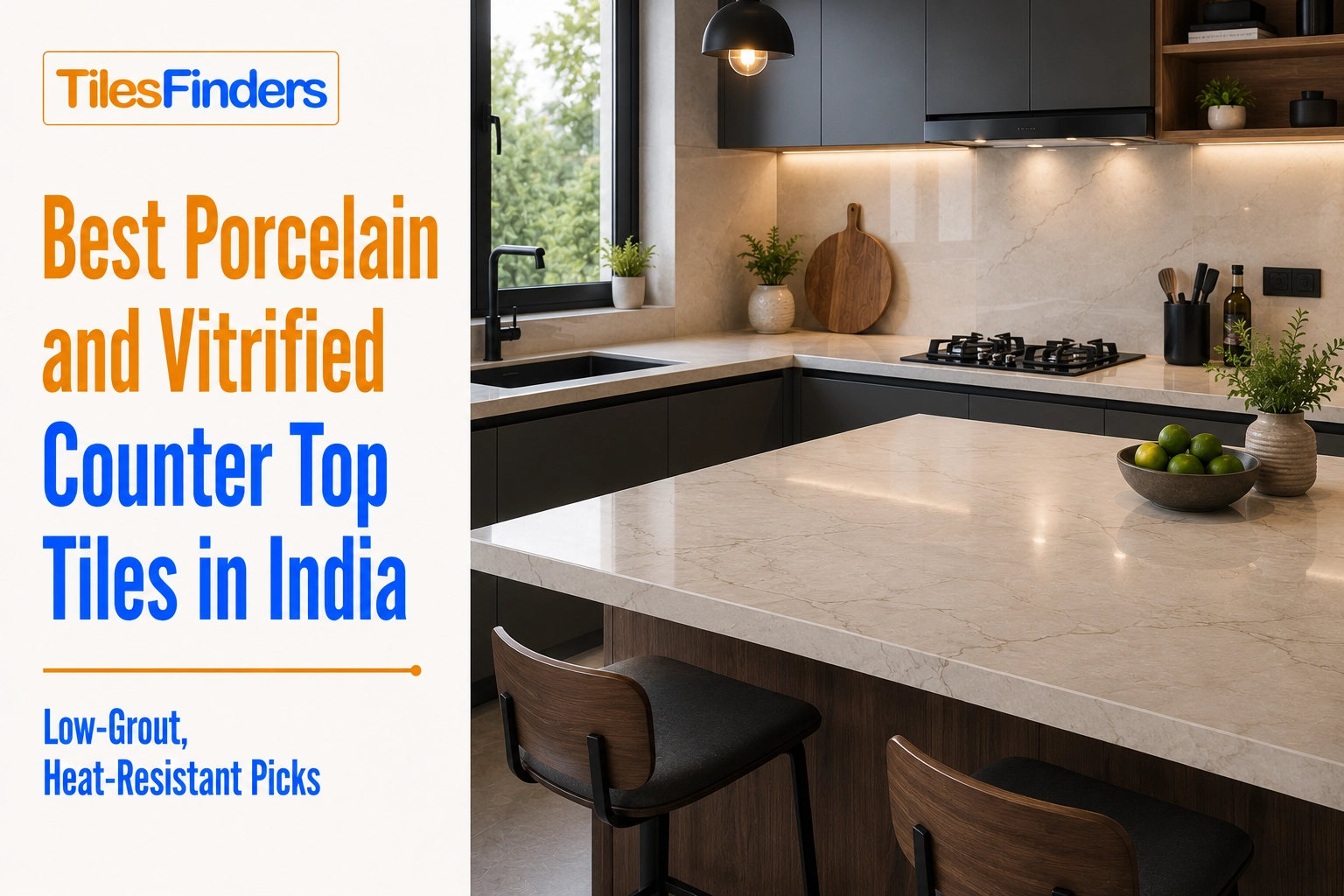
The tile slab countertop is a growing design direction in Indian premium kitchen and bathroom design. It uses genuinely large slab-format tiles, starting from 1200x1800mm and going up to 1200x2400mm, as the full countertop surface. A single 1200x1800mm tile spans the full 600mm counter depth and a significant portion of the counter length in one continuous piece, creating the visual effect of a natural stone or marble slab at a fraction of the cost of actual stone. The grout joints across the counter surface are reduced to one or two at most, and at a 1.5mm joint width with epoxy grout in a matching colour, those joints are nearly invisible in a polished or honed surface.
For kitchens where a full slab tile is not practical due to installation access or structural constraints, 600x1200mm is the practical step down: it is a large-format tile rather than a slab, but it still creates only one joint across the 600mm counter depth and two to three joints along an 8-foot counter length, which is a significant reduction from standard-format tile layouts. The visual quality of a 600x1200mm countertop is close to a slab at normal viewing distance, but it is not technically a slab format and should not be described as one.
Slab-format tile countertops in 1200x1800mm and 1200x2400mm require extremely precise substrate levelling, a rigid mortar bed or cement board with no flex, and professional installation with full back-buttering and a large-format tile adhesive rated for countertop applications. Any unevenness in the substrate or any void in the adhesive coverage will cause a slab tile to crack under the point load of heavy pots or under thermal stress. Price range: Rs. 90 to Rs. 180 per sq.ft for slab-format porcelain countertop tiles from Morbi.
The kitchen worktop is the most demanding countertop application. It faces the full range of kitchen stresses: knife impact, hot pot heat transfer, cooking acid staining, water pooling, and daily cleaning with detergent and sometimes bleach. The most practical kitchen countertop tile is a large-format porcelain or GVT in honed or satin matte finish in a neutral or mid-tone colour.
White tile countertops are popular in Indian modular kitchens for the clean, bright quality they give a kitchen. The practical consideration for white kitchen countertops is maintenance: turmeric, curry paste, and cooking oil stain white tile countertop surfaces more visibly than mid-grey or beige surfaces. A white porcelain countertop requires immediate wiping of spills rather than the more casual cleaning a darker surface allows. White tile countertops in a kitchen that cooks Indian food daily require more disciplined daily cleaning than any other colour direction.
Black porcelain countertops give the kitchen a high-contrast, contemporary look that works well in white or grey modular kitchen cabinets. The practical advantage of dark countertops is that they hide cooking oil and minor staining better than white or cream. The disadvantage is that water drops and limestone deposits from hard Indian water are highly visible on a dark, polished surface. Matte or honed black porcelain is more forgiving than polished black on an Indian kitchen countertop.
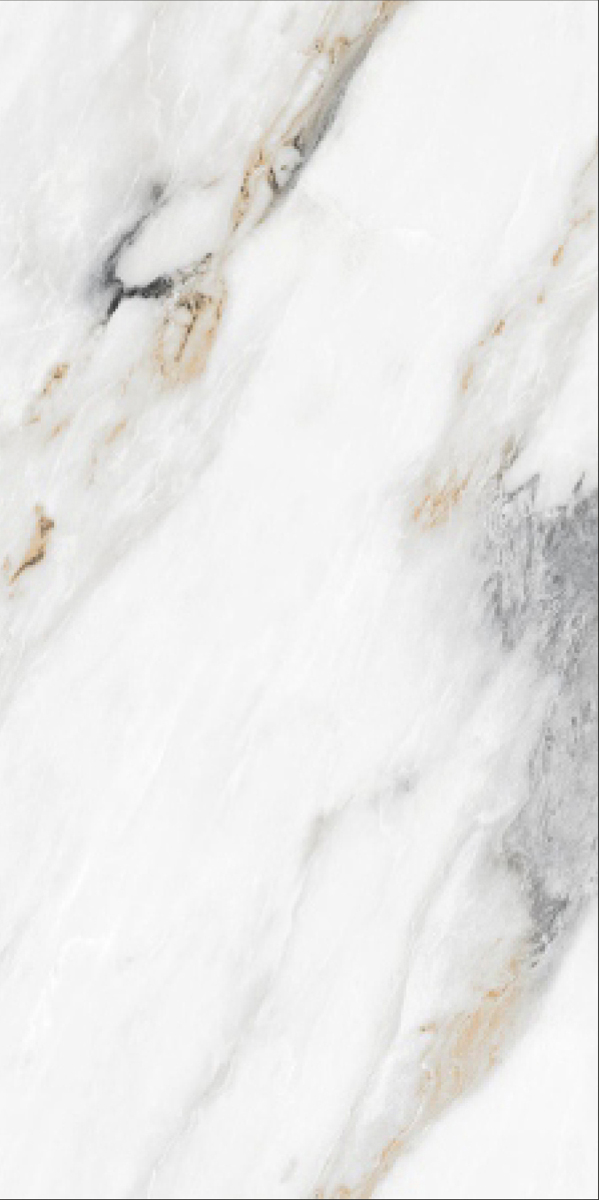
Marble tile countertop options in GVT or porcelain marble-look in honed finish give the kitchen a premium quality without the porosity and maintenance of actual marble, which stains badly from Indian kitchen acids. GVT marble-look in satin matte or honed finish is the practical alternative to natural marble on a kitchen countertop where food is prepared.
Bathroom vanity top tiles cover the horizontal surface of the bathroom vanity cabinet or the ledge around a drop-in or under-mount washbasin. This surface faces water from the basin and cleaning products, but not the heat, food acids, or cutting impact of a kitchen. The finish range for a bathroom vanity tile is wider than for a kitchen: polished marble-look GVT or polished solid-colour porcelain in white or cream works well on a bathroom vanity because the cleaning loads are lighter, and the visual quality of a polished surface in a bathroom is particularly effective. A bathroom tiles approach of coordinating the vanity top tile with the bathroom floor and wall tile gives the space a composed, unified quality.
Tile vanity tops in Indian bathrooms most commonly use white or cream porcelain in polished or glossy finish in 600x600mm or 600x1200mm format. A large-format vanity top tile with minimal joints is easier to clean and more hygienic than smaller formats with more grout lines. A 600x1200mm single tile across a standard 600mm deep vanity top creates only one joint across the depth and two or three joints across the length, which is the minimum practical grout joint count.
A home bar or wet bar countertop tile has more design freedom than a kitchen worktop tile because the bar top faces fewer functional stresses: no hot pots, no knife cutting, no cooking acid. The primary concerns are alcohol and mixer staining, water glass rings, and frequent wiping with bar cloths. This more relaxed stress profile allows a wider range of tile directions on a bar top than on a kitchen countertop.
Bar top tiles in Indian home bars and entertainment areas: herringbone pattern in 300x600mm GVT in a warm grey or stone-look gives the bar top a designed, craft-bar quality. Terrazzo-look GVT in a large format gives the bar top a contemporary, hotel-bar aesthetic. Patterned decorative ceramic tiles (sometimes called Mexican-style or encaustic-look tiles) in 150x150mm or 200x200mm give the bar top a handcrafted, character-rich surface. For outdoor bar tops in garden or rooftop entertainment areas, GVT in matte or textured finish is mandatory: an outdoor countertop faces rain, heat, and UV and must be correctly specified for outdoor exposure.
The exposed front edge of a tiled countertop, the lip visible from a standing position, is one of the most important and most overlooked details in a tile countertop installation. A bare cut tile edge at the countertop front looks unfinished and is both visually weak and physically vulnerable to chipping. There are four standard approaches to tile countertop edging in Indian residential and commercial installations.
Bullnose edge tile: A bullnose tile is a tile with one factory-finished rounded edge. Fixed vertically on the countertop front, the rounded edge creates a smooth, seamless-looking transition from the countertop surface to the front panel. Bullnose tiles are available in standard sizes matching common countertop tile ranges. This is the cleanest-looking edge finish and is the most used in mid-range to premium Indian kitchen countertops.
Metal edge trim: A stainless steel or aluminium L-shaped edge profile is fixed to the countertop edge before tiling, and the tile is laid flush against the inner face of the trim. The metal edge provides a hard, chip-resistant boundary at the countertop front and gives the kitchen a contemporary, professional quality. Metal edge trims in brushed stainless or aluminium are the most used edge treatment in Indian modular kitchen tile countertops.
Pencil trim or border tile: A narrow 20 to 30mm ceramic or stone tile border is fixed vertically on the countertop edge, creating a thin coloured or contrasting line at the edge. This is a more decorative edge treatment used on bar tops and bathroom vanity tops where the edge is seen from the room and contributes to the design.
Bevelled edge tile: A tile cut at a 45-degree angle on the exposed edge creates a mitre joint where the top and front tiles meet at a clean diagonal. This is the most labour-intensive edge treatment and requires precise cutting, but it gives the countertop the look of a continuous solid material rather than two tiles meeting at a corner.
Epoxy grout is the correct and only appropriate grout specification for any tile countertop application. This is more important on a countertop than on any other tiled surface because the countertop is in direct contact with food, water, cooking chemicals, and cleaning products daily.
Cement grout on a countertop absorbs cooking oils, food colourings (turmeric is one of the most penetrating), cleaning chemicals, and bacteria into the porous grout body. Over weeks and months of kitchen use, a cement-grouted tile countertop develops dark, stained grout lines that are impossible to fully clean, regardless of scrubbing effort. The staining is within the grout body, not on the surface, and no surface cleaner can remove it.
Epoxy grout is non-porous. It does not absorb any liquid, food colouring, cooking oil, or cleaning chemicals. Turmeric, curry, red chilli, and cooking oil all wipe off epoxy grout with a damp cloth without leaving any residue or staining. Over ten years of Indian kitchen use, an epoxy-grouted tile countertop looks the same as on installation day, with appropriate daily cleaning. Cement grout in the same period will be permanently discoloured.
Joint width for tile countertops: as narrow as practical, typically 1.5mm to 3mm. Narrower joints mean less grout area exposed to food contact. With large-format tiles in 600x1200mm or 800x1600mm, the total grout joint area on a kitchen countertop can be reduced to under 5% of the surface, which is the minimum achievable with tile.
The large-format tile countertop, using 600x1200mm, 800x1600mm, or even larger-format tiles as a near-seamless countertop surface, is the most significant development in Indian countertop tile design in recent years. It addresses the grout joint hygiene problem by reducing the joint count to a minimum, and it replicates the visual quality of a natural stone slab at a tile price point.
In a standard Indian kitchen counter of 8 feet length and 600mm depth, a 600x1200mm tile laid with the 1200mm dimension along the counter length requires only one joint longitudinally across the 600mm depth. The 8-foot length requires approximately two full tiles plus a short cut piece, creating two to three joints along the length at 1.5mm width. The total grout area on this counter is a small fraction of the surface compared to a 300x300mm or even 300x600mm tile layout.
| Tile Size | Approx Joints per 8ft Counter (600mm deep) | Total Grout Area (approx) | Visual Effect | Price Range (Rs./sq.ft) |
|---|---|---|---|---|
| 300x300mm | Many joints, approx 15 to 20 across the surface | 15% to 20% of the surface area | Dense grid, traditional kitchen look | Rs. 28 to Rs. 65 |
| 300x600mm | Moderate joints, 8 to 12 across the surface | 10% to 15% of the surface area | Balanced grid, most common Indian kitchen tile | Rs. 38 to Rs. 80 |
| 600x600mm | Few joints, 4 to 6 across the surface | 5% to 8% of surface area | Clean, contemporary countertop | Rs. 48 to Rs. 95 |
| 600x1200mm | Minimal joints, 2 to 4 across the surface | 2% to 5% of surface area | Near-slab quality, premium look | Rs. 65 to Rs. 120 |
| 800x1600mm and above | 1 to 2 joints maximum | Below 2% of the surface area | True slab appearance, hotel-quality kitchen | Rs. 85 to Rs. 150 |
| Application | Recommended Tile | Finish | Key Concern | Epoxy Grout? | Price Range (Rs./sq.ft) |
|---|---|---|---|---|---|
| Kitchen worktop, food prep | Porcelain or GVT, 600x600mm or 600x1200mm | Honed or Satin Matte | Heat, acid, stain resistance | Mandatory | Rs. 48 to Rs. 120 |
| Kitchen worktop, white | Porcelain or GVT, large format | Honed Matte | Shows stains from turmeric and curry; requires immediate cleaning | Mandatory | Rs. 55 to Rs. 120 |
| Kitchen worktop, dark/black | Porcelain, large format | Matte or Honed | Shows watermarks and limestone deposits | Mandatory | Rs. 60 to Rs. 130 |
| Bathroom vanity top | GVT or Porcelain, 600x600mm or 600x1200mm | Polished or Satin Matte | Water and cleaning product resistance | Mandatory | Rs. 48 to Rs. 110 |
| Home bar top | GVT or Ceramic, any format | Matte, Polished, or Patterned | Alcohol and water ring resistance | Mandatory | Rs. 38 to Rs. 100 |
| Outdoor bar or kitchen top | GVT outdoor-rated, 300x600mm or 600x600mm | Matte or Textured | Weather, UV, and heat resistance | Mandatory | Rs. 45 to Rs. 90 |
Porcelain and GVT countertop tiles from Morbi, Gujarat, are available in all formats and design directions used in Indian residential and commercial countertop applications. Ex-factory prices: Rs. 25 to Rs. 45 per sq ft for ceramic glossy tiles in 200x300mm and 300x600mm, Rs. 40 to Rs. 72 per sq ft for GVT in satin matte or polished in 600x600mm, Rs. 55 to Rs. 100 per sq ft for 600x1200mm porcelain in honed or polished finish, and Rs. 75 to Rs. 140 per sq ft for 800x1600mm large-format porcelain slab tiles. Retail prices across Indian cities are 25% to 40% above ex-factory. Installation cost for countertop tiles: Rs. 45 to Rs. 75 per sq.ft for standard sizes. Large-format tiles in 600x1200mm and above require precise substrate levelling and rigid adhesive, adding Rs. 15 to Rs. 25 per sq ft to the installation cost.
Countertop tile selection starts with the application (kitchen worktop, bathroom vanity, bar top), then the staining and heat exposure level the surface will face, and then the format size that minimises grout joints for the counter dimensions. Use epoxy grout on every countertop tile application without exception. Browse porcelain, GVT, and ceramic countertop tiles across all design directions on TilesFinders. Confirm the tile format and the edge treatment approach before installation begins.
Large-format porcelain in honed or satin matte finish in 600x600mm or 600x1200mm is the best tile for an Indian kitchen countertop. Porcelain's denser body resists kitchen acid staining better than ceramic, and the large format minimises grout joints, which is the most important practical advantage in a food preparation surface. Honed or satin matte finish hides knife scratches better than polished. Epoxy grout is mandatory. Price range: Rs. 55 to Rs. 120 per sq ft from Morbi.
Yes. Ceramic glossy tiles have been the standard for Indian kitchen platforms for decades and are still widely used. The practical limitations are the body's porosity (Indian kitchen acids and oils can stain over time) and the grout joints (cement grout on a ceramic countertop cannot be kept hygienic long-term). For a new kitchen platform intended to last fifteen or more years, porcelain or GVT with epoxy grout is the more durable specification. For a renovation on a budget, ceramic with epoxy grout is a practical, affordable choice.
Epoxy grout is non-porous and does not absorb food, cooking oils, food colourings, or cleaning chemicals. In an Indian kitchen where turmeric, curry paste, and cooking oil are daily ingredients, cement grout on countertop joints becomes permanently stained within weeks of use. No amount of cleaning removes the staining because it is within the grout body, not on the surface. Epoxy grout wipes clean with a damp cloth regardless of what spills on it. On a countertop tile, epoxy grout is not optional.
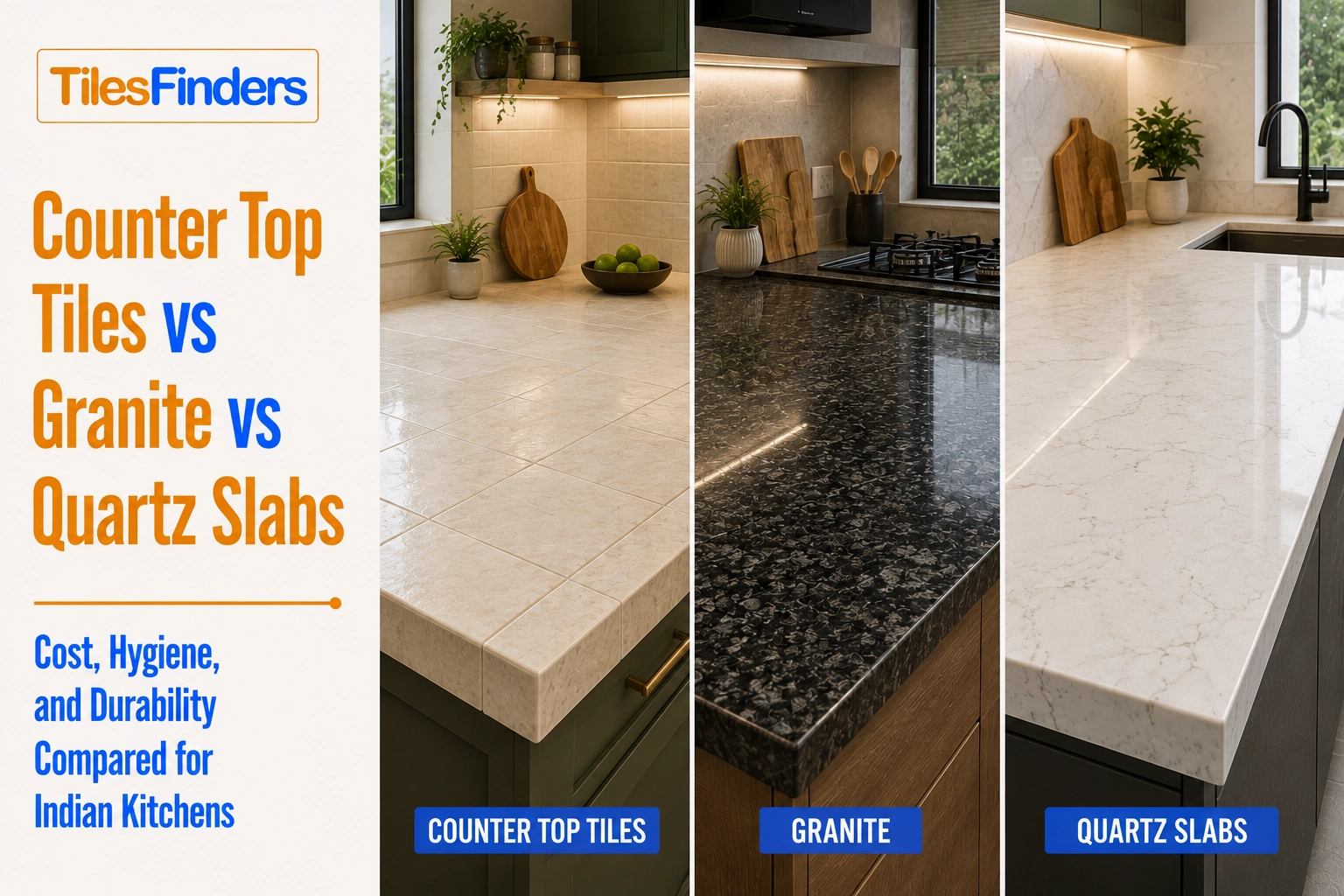
A tile slab countertop uses large-format tiles of 600x1200mm or larger as a near-seamless countertop surface, replicating the look of a continuous stone or marble slab with minimal grout joints. In a standard 8-foot kitchen counter, a 600x1200mm tile creates only one to three joints across the full surface. The visual effect at 1.5mm joint width with epoxy grout in a matching colour is close to a seamless slab surface. This approach is significantly more affordable than actual quartz or granite slabs while delivering a comparable visual quality. Price range: Rs. 65 to Rs. 140 per sq ft for large-format tile slab countertops.
Four edge treatments are used on tile countertops: a bullnose tile on the front edge (rounded factory finish, cleanest look), a metal edge trim in stainless steel or aluminium (chip-resistant, contemporary, most common in Indian modular kitchens), a pencil trim or decorative border tile for bar tops and vanity tops, and a bevelled mitre-cut edge where the top and front tiles meet at a 45-degree diagonal (requires precise cutting, creates a slab-like appearance). Metal edge trim is the most practical and durable option for an Indian kitchen countertop that will take daily use.
Yes. GVT or porcelain marble-look tiles in honed or satin matte finish are a practical and popular countertop tile direction in Indian kitchens and bathrooms. Marble-look tiles replicate the veining and colour of natural marble without the porosity that makes actual marble highly vulnerable to acid staining in a kitchen. Lemon juice, tamarind, and tomato acid permanently etch natural marble but do not affect a well-specified porcelain marble-look tile. A honed or satin matte finish is preferred over polished on a kitchen marble-look countertop because it hides knife scratches better.
Black porcelain countertops in matte or honed finish are practical in Indian kitchens with disciplined daily cleaning. The primary maintenance challenge is limestone deposits from hard Indian water: white water marks are highly visible on dark matte or polished surfaces and must be wiped off before they dry. Indian cities with hard water supply will show more frequent water marking on dark countertops than cities with soft water. Black matte porcelain hides cooking oil and food staining better than black polished, which also shows every fingerprint. With epoxy grout and daily wiping, black porcelain countertops are durable and low-maintenance beyond the water-marking issue.
GVT or porcelain in polished or satin matte finish in 600x600mm or 600x1200mm is the most used tile for Indian bathroom vanity tops. The bathroom vanity faces lighter stresses than a kitchen countertop: water from the basin and cleaning products, but no cooking acids, heat, or cutting. This allows polished GVT in marble-look or solid white in the bathroom vanity, where the same finish would not be practical on a kitchen worktop. Large-format tiles with minimal grout joints are the most hygienic and easiest to clean. Epoxy grout is mandatory even on a bathroom vanity top.