Countertop Tiles in India: Complete Kitchen and Bathroom Surface Buyer's Guide
Choose the right countertop tiles for Indian kitchens and bathrooms with this guide covering GVT slabs, granite, thickness, heat resistance, edge profiles, pricing, and buying tips.
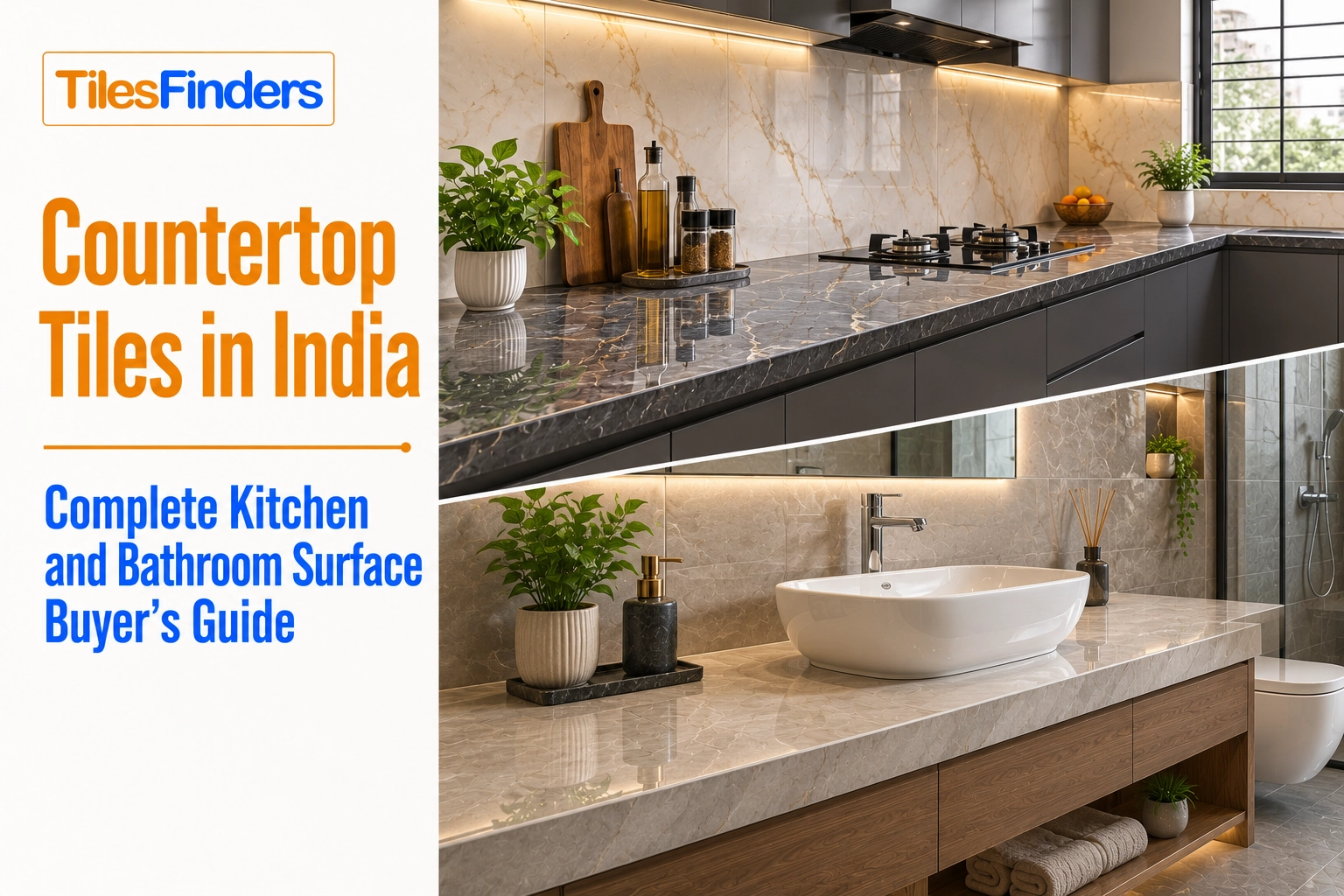
Kitchen and bathroom countertops require thicker, heat-resistant, low-absorption materials than regular floor or wall tiles. Choose 12–20 mm GVT slabs, granite, or engineered surfaces based on usage, and confirm thickness, heat resistance, edge profile, and structural support before installation.
A countertop surface answers to a completely different set of demands than a floor or wall: it needs to resist heat from hot vessels, survive knife and utensil contact, handle food and cosmetic staining, and do all of this at a thickness that provides genuine structural support across an unsupported span. This guide covers what makes countertop tile specification distinct from floor and wall tile, and how to choose correctly for Indian kitchen and bathroom counters.
Why Countertops Need Different Specifications Than Floors and Walls
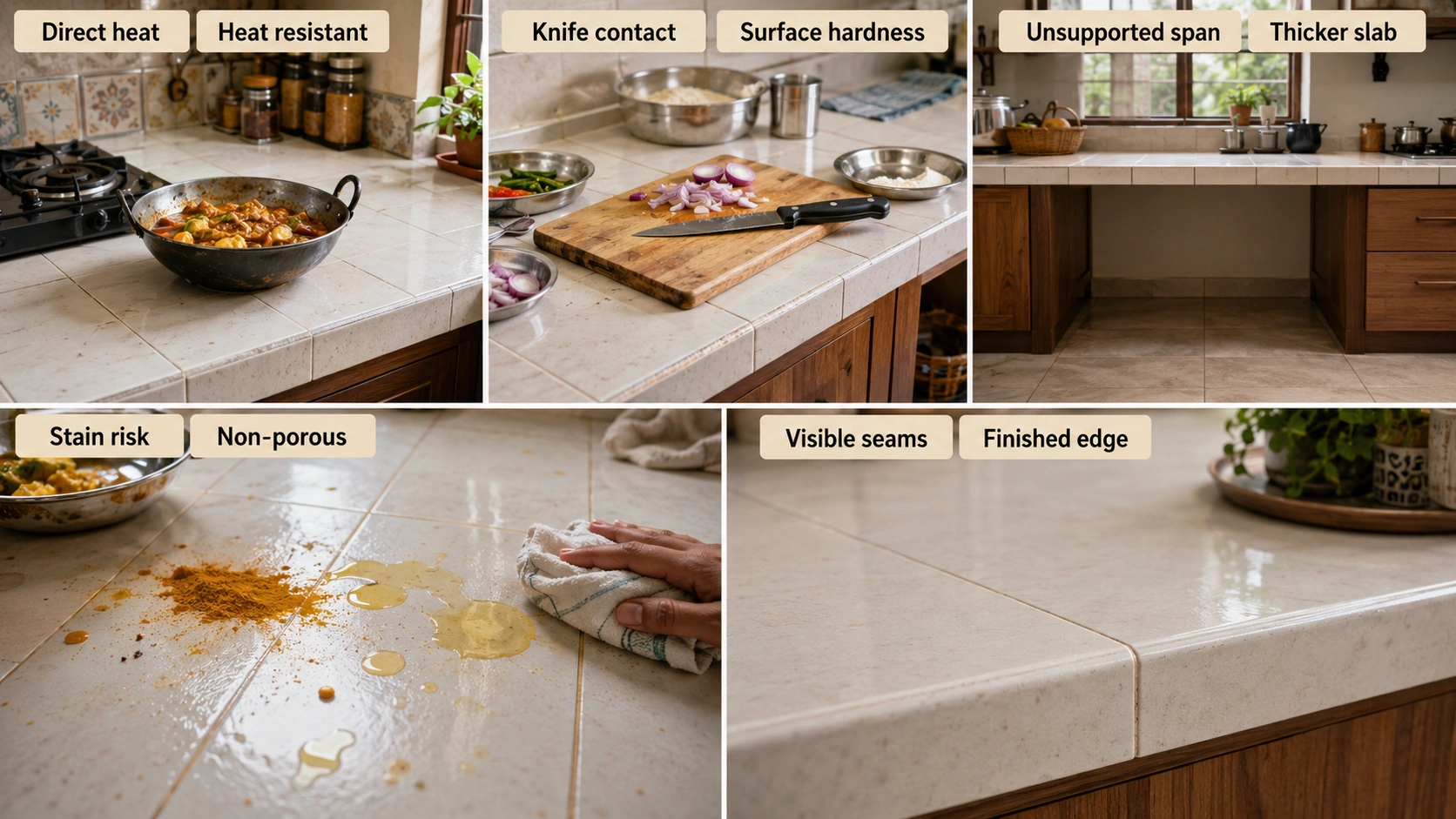
| Countertop Condition | Practical Implication | Tile Requirement |
| Direct heat contact | Hot vessels, pans straight from the stove, and hot water contact are routine on a kitchen counter | Confirmed heat resistance rating, GVT generally handles this well, standard ceramic less reliably |
| Knife and utensil contact | Chopping, cutting, and general utensil use create scratch and impact risk absent from floor and wall applications | High surface hardness and impact resistance, thicker slab formats perform better than thin standard tile |
| Unsupported span structural load | A countertop spans between cabinet supports and needs to bear its own weight plus daily use without flexing or cracking | Thicker slab format, typically 12mm to 20mm, rather than the 8 to 10mm standard floor and wall tile thickness |
| Food and cosmetic staining | Turmeric, oil, wine, and in bathrooms, cosmetics and hair dye, all contact the surface directly and repeatedly | Non-porous surface at 0.05% water absorption or below, essential for stain resistance |
| Seam and edge visibility | Unlike a floor, a countertop's edges and any seams are viewed constantly at close range during daily use. | Confirmed edge profile finishing and seam planning before installation, not an afterthought. |
From The Marketplace
Popular tiles right now

Material Comparison for Countertops
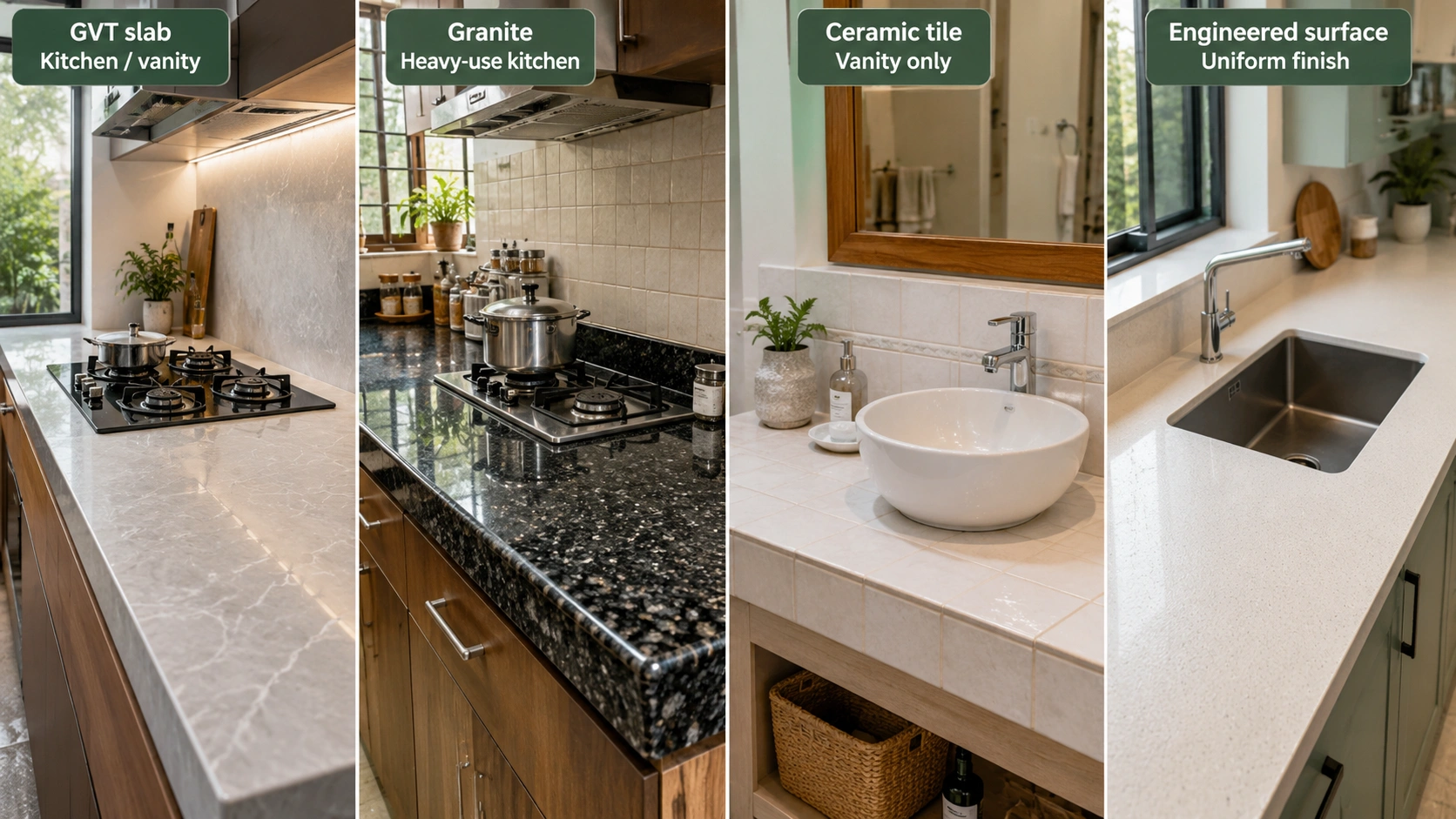
| Material | Heat Resistance | Scratch Resistance | Best Application | Price Range |
| GVT slab, 12 to 20mm | Good, confirm specific rating for direct hot pan contact | Very good, harder surface than standard ceramic | Kitchen counters, bathroom vanity tops | Rs. 250 to Rs. 600/sq.ft |
| Granite | Excellent, the traditional Indian countertop material for good reason | Excellent | Kitchen counters, particularly in heavy-use family kitchens | Rs. 150 to Rs. 500/sq.ft |
| Standard ceramic tile | Poor to moderate, not recommended for direct hot pan contact | Moderate, more vulnerable to scratching than GVT slab or granite | Not recommended for kitchen counters; acceptable for a low-use bathroom vanity top only | Rs. 60 to Rs. 150/sq.ft |
| Quartz-adjacent engineered surface | Good, though less heat-tolerant than granite or GVT slab | Very good | Kitchen and bathroom counters want a more uniform, less porous surface than natural granite | Rs. 250 to Rs. 550/sq.ft |
The core distinction: Standard floor and wall GVT, even at 0.05% water absorption, is generally too thin for direct countertop use without additional structural backing. Genuine countertop specification requires slab-format GVT at 12mm or above, or an alternative material like granite, specifically manufactured and rated for this application. Do not substitute standard 8 to 10mm floor tile for a kitchen counter.
Kitchen vs Bathroom Counter Differences
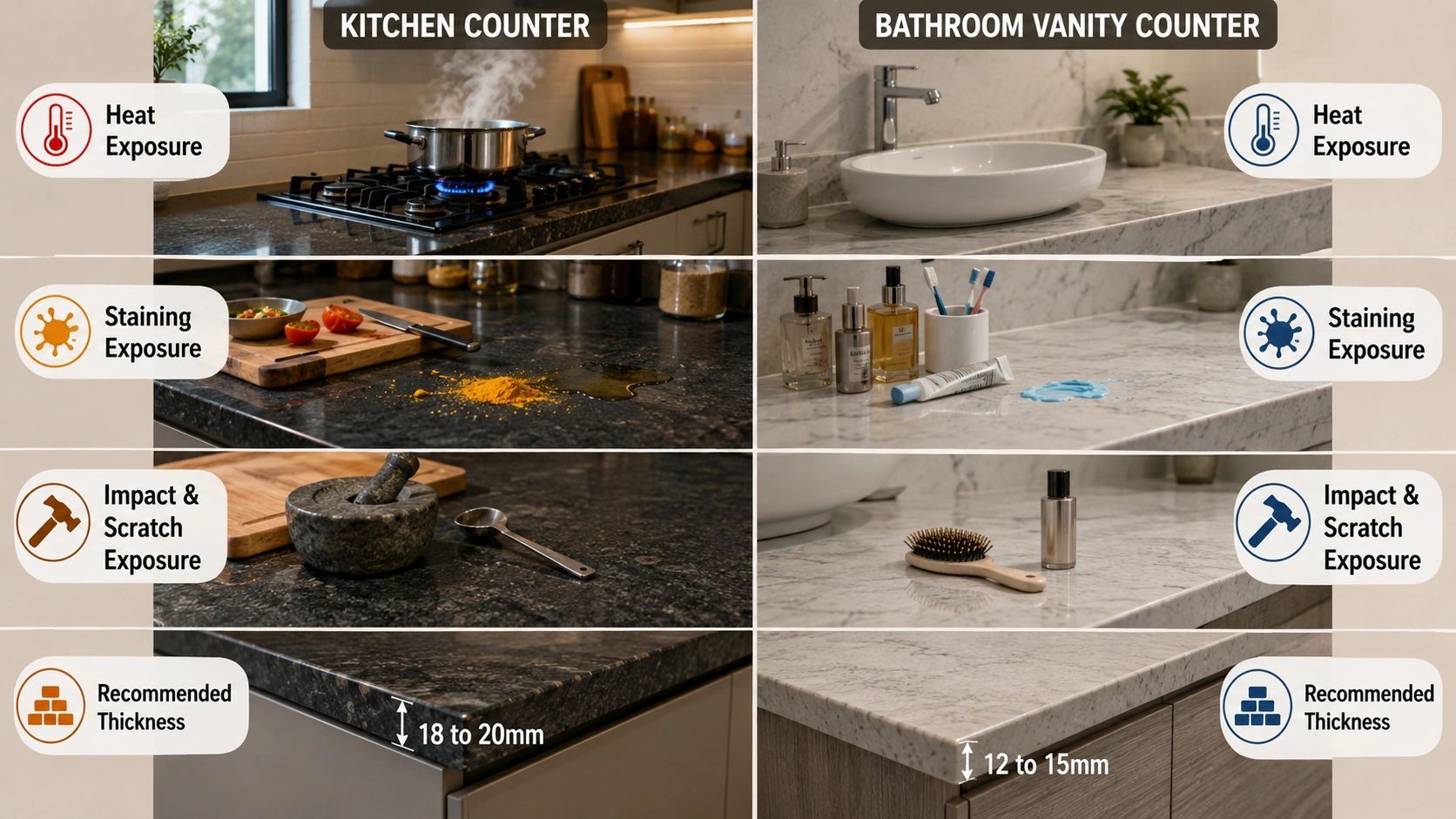
| Factor | Kitchen Counter | Bathroom Vanity Counter |
| Heat exposure priority | High, direct hot pan and vessel contact is routine | Low, occasional hot water contact only |
| Staining exposure priority | High, turmeric, oil, and food contact throughout the day | Moderate, cosmetics, hair dye, and toothpaste contact |
| Impact and scratch exposure | High, chopping, and utensil contact routine | Low, minimal impact risk in normal bathroom use |
| Recommended thickness | 18 to 20mm for the highest-use kitchen counters | 12 to 15mm is generally sufficient, given lower structural and impact demands |
Edge Profile Options
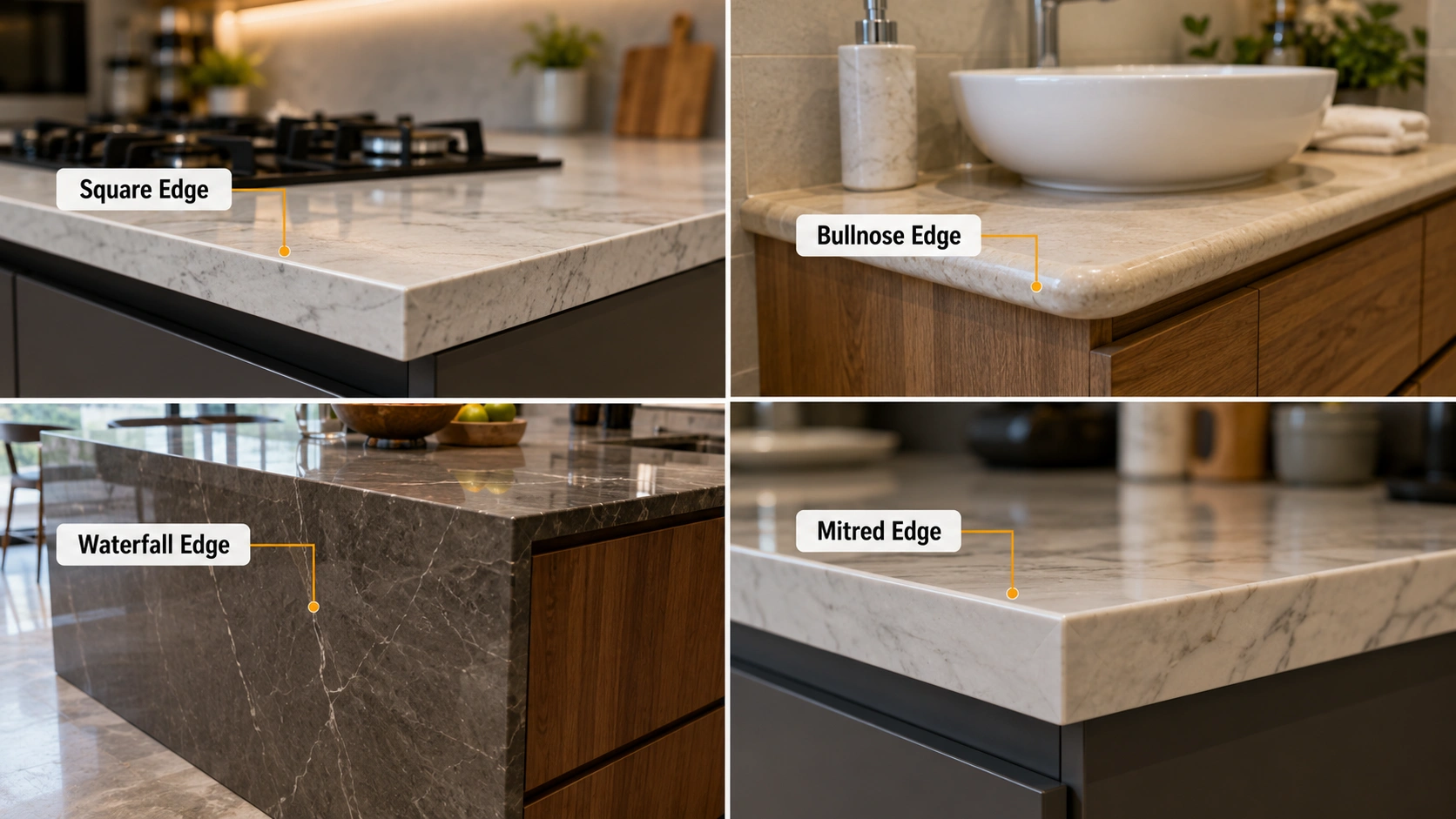
- Square edge (pencil edge). A clean, minimal 90-degree edge with a very slight chamfer, the most contemporary and widely specified profile for GVT slab counters.
- Bullnose (full round). A fully rounded edge, softer in appearance and safer for households with young children, though less commonly specified for kitchen counters than bathroom vanities.
- Waterfall edge. The slab material continues down the side of the cabinet to the floor in a single continuous plane, a premium, high-visual-impact profile increasingly specified for kitchen islands in 2026.
- Mitred edge. Two pieces joined at an angle to create the visual appearance of a thicker slab than the actual material, a cost-effective way to achieve a substantial-looking edge without the material cost of a genuinely thicker slab.
Buying Checklist
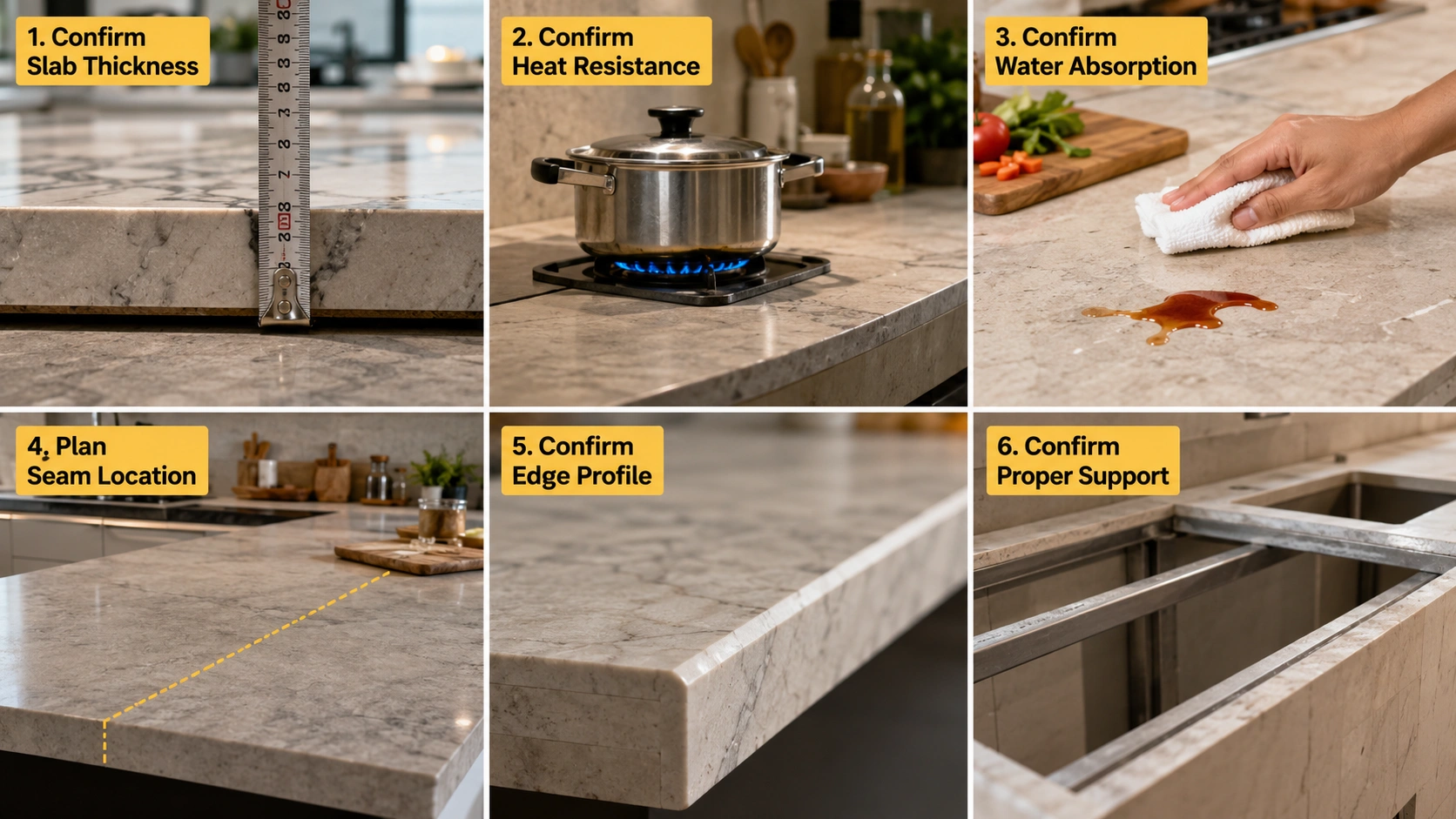
- Confirm slab thickness, 12mm minimum, 18 to 20mm for high-use kitchen counters. Never substitute standard floor tile thickness for a countertop application.
- Confirm heat resistance rating specifically for kitchen counters, requesting the TDS figure rather than assuming standard GVT specifications apply at slab thickness.
- Confirm water absorption at 0.05% or below for stain resistance, essential given the direct, repeated food and cosmetic contact a countertop experiences.
- Plan seam locations before fabrication, particularly for a large kitchen counter run that may require more than one slab, since seam placement affects both appearance and structural integrity.
- Confirm the edge profile and request a physical sample of the finished edge, not just the flat slab surface, before finalising the order.
- Confirm installation includes proper support, since a countertop's unsupported spans, particularly around a sink or hob cutout, need confirmed structural backing regardless of slab thickness.
Countertop Tiles in India: 2026 Manufacturing Context
GVT slab countertop material is manufactured in Morbi, Gujarat, by a specialist subset of manufacturers producing the thicker 12mm to 20mm format specifically for this application, distinct from the standard 8 to 10mm floor and wall tile production that dominates the broader Morbi output. Granite remains the most established and widely fabricated Indian kitchen countertop material, sourced from quarries across Rajasthan, Karnataka, and Andhra Pradesh, with local fabrication expertise for granite generally more widespread across Indian cities than for GVT slab countertop installation, which is a comparatively newer specialisation.
Explore Countertop Options on TilesFinders
GVT slab in 12mm to 20mm thickness for kitchen and bathroom counters can be compared alongside granite and engineered surface options on TilesFinders, with edge profile and heat resistance documentation available before you commit to a countertop fabrication order.
FAQs
Not recommended. Standard floor and wall GVT at 8 to 10mm thickness generally lacks the structural support needed for an unsupported countertop span. Genuine countertop specification requires slab-format GVT at 12mm or above, or an alternative material like granite specifically rated for this application.
Both perform well. Granite has the longest track record in Indian kitchens with excellent heat and scratch resistance. GVT slab offers a more uniform, non-porous surface with a wider design range, including marble-look and concrete-look finishes not available in natural granite.
18 to 20mm for the highest-use kitchen counters, with 12 to 15mm acceptable for lower-use applications or bathroom vanity counters where structural and impact demands are lower than in a kitchen.
Acceptable for a low-use bathroom vanity top, given the lower heat and impact exposure compared to a kitchen, though a GVT slab or an engineered surface remains the more durable and stain-resistant choice even for bathroom use.
Waterfall edge, where the slab material continues down the side of the cabinet to the floor, is an increasingly popular premium choice for kitchen islands in 2026, delivering a high-visual-impact, seamless appearance.
Generally, yes, though the specific heat resistance rating should be confirmed in the TDS rather than assumed, since performance can vary between manufacturers and slab thickness.
GVT slab ranges from Rs. 250 to Rs. 600 per sq.ft. Granite ranges from Rs. 150 to Rs. 500 per sq.ft, depending on stone type. Engineered quartz-adjacent surfaces range from Rs. 250 to Rs. 550 per sq.ft.
Confirm seam locations with the fabricator before the slab is cut, ideally positioning any seam away from the sink and hob area where it would be most visible and most exposed to water and heat, and request that the seam finish be inspected in person before final installation.


See our tile guides first
Set TilesFinders as a preferred source and our buying guides surface ahead of the rest for you.
Add as preferred sourceTakes one tap. Nothing to install.
What Readers Say
I was about to redo my parking area with the wrong tile size until I read this. The layout comparisons saved me from a costly mistake.
We reference TilesFinders guides while briefing clients on material selection. The size and pattern breakdowns are accurate and easy to explain visually.
On site, I get asked about grout spacing all the time. This article gave me a solid reference I now share with my team before every job.
Finally a guide that doesn't just push generic advice. The oil stain removal steps actually worked on our clubhouse driveway tiles.
I run a small construction firm and now send this link to clients directly when they ask about entrance tile sizing. Saves me an hour of explaining.
Good practical detail, though I wish there were more examples for compact apartment entrances specifically, not just villas.
My mother-in-law wanted marble, I wanted vitrified. This blog gave us the neutral comparison we needed to actually decide together.
Detailed without being overwhelming. I appreciated that it covered both cost and maintenance, not just the aesthetics.
Used the algae and hard water removal tips on our terrace tiles after the monsoon. Worked better than what our regular cleaner was doing.
As someone who sources tiles for multiple builder projects, I find these comparisons genuinely useful for vendor conversations, not just consumer content.
Recommended this to a client who kept second-guessing the entrance design. The small vs large layout section settled the debate instantly.
Straightforward and honest, no unnecessary jargon. Would like to see a similar breakdown for outdoor pool-deck tiles next.
We've bookmarked several TilesFinders guides for our design handbook. Reliable source when clients want data, not just opinions.
Two paths, one marketplace.
Get free quotes from verified suppliers.
Share your room, budget, and style. Suppliers in Morbi respond within hours.
Get Free QuotesList your business, reach real buyers.
Put your showroom in front of homeowners searching for tiles right now.
List Your Business