










Parking Tile Design Ideas for Homes & Commercial Spaces
Transform your parking space with the right tiles. Learn about heavy-duty materials, ideal thickn...


Loading designs...
The checkerboard pattern is one of the oldest floor layouts in use. It requires no complex tile shape, no special laying technique, and no elaborate design decision. Two square tiles, alternated in a grid, produce a pattern that reads clearly from across a room and holds up visually across decades of use without looking dated. That staying power is why the black and white checkerboard tile floor appears in Indian kitchens built in the 1960s and in contemporary apartment renovations completed last year.
What changes between those two eras is the tile body, not the pattern. Early checkerboard floors used cement or Kota stone tiles. Today, GVT vitrified tiles in 300x300mm or 400x400mm carry the same pattern with water absorption below 0.05%, no sealing required, and scratch resistance that cement tiles cannot match. The pattern is identical. The performance is significantly different.
All the black tile options that form one half of any checkerboard floor sit under black tiles. This page focuses on the specific layout decisions, tile specifications, and area-by-area guidance that apply when the two colours are laid in alternating squares.
Most buyers assume a checkerboard floor means buying two types of tile and alternating them. That is the traditional approach. There is also a second option worth understanding before ordering.
A traditional checkerboard floor uses one solid black tile and one solid white tile of the same size, laid in an alternating grid. The buyer orders equal quantities of both colours, and the pattern is created during laying. This gives full control over the grid alignment, the grout joint, and the proportion of the pattern relative to the room. Most Indian tile showrooms stock solid black GVT and solid white GVT in the same size, so matching the body type and water absorption across both colours is straightforward.
The risk in a two-tile checkerboard is colour matching across batches. If the black tile and white tile are from different manufacturers, the tile thickness may vary by 0.5mm to 1mm, which creates an uneven floor surface under grout joints. Always buy both colours from the same manufacturer and specify the same body type, size, and batch for both.
A printed checkerboard tile carries the alternating pattern on a single large tile face, typically 600x600mm or 800x800mm, where four or more alternating squares appear on one tile. This approach is faster to lay because the pattern alignment is built into the tile. The risk is at tile edges: if the laying is not perfectly square and level, the pattern break at the grout joint between large tiles becomes visible. For rooms with irregular walls or non-square floor plans, a printed checkerboard tile is harder to manage than two separate 300x300mm tiles.
The tile size changes how the pattern reads in the room. Smaller squares give the floor a fine-grained texture. Larger squares make the room feel wider, but can look oversized in small rooms.
| Tile Size | Alias | Room Suitability | Pattern Character | Body Type |
|---|---|---|---|---|
| 200x200mm | 8x8 | Small bathrooms, pooja rooms | Fine, traditional, suited to narrow spaces | GVT, Ceramic (walls only for ceramic) |
| 300x300mm | 1x1 (12x12) | Bathrooms, kitchens, corridors | Classic, proportionate for most rooms | GVT, Ceramic (wall), Porcelain |
| 400x400mm | 16x16 | Kitchens, entrance halls, garages | Bold, fewer grout lines, reads clearly | GVT, Full Body Vitrified |
| 600x600mm | 2x2 | Large kitchens, corridors, and commercial areas | Graphic, architectural, fewer cuts needed | GVT, Full Body Vitrified |
| 600x600mm printed | 2x2 (4-square pattern) | Open-plan floors, commercial | Fast to lay, pattern built into tile | GVT |
Note: Ceramic tiles in any size are wall-only tiles. Do not use ceramic checkerboard tiles on floors. The 12% to 16% water absorption and lower body strength make ceramic unsuitable for floor laying in Indian homes. Use GVT or full-body vitrified for all checkerboard floor applications.
The kitchen is the most common space for a black and white checkerboard kitchen floor in Indian homes. The pattern works in both traditional and contemporary kitchens because neither the black nor the white reads as a colour statement on its own. Together, they create a neutral, graphic floor that does not compete with cabinet colours or countertop materials.
In Indian cooking kitchens, the floor takes oil splatter, water from washing, and regular mopping. A 300x300mm or 400x400mm GVT tile in matte or GHR finish handles all of these without showing wear at the tile surface. GHR finish gives better grip under wet conditions than plain matte, which matters in Indian kitchens where the floor gets wet during cooking and cleaning multiple times a day. In homes across monsoon-heavy states, where humidity keeps kitchen floors damp for extended periods during the rainy season, GHR finish outperforms plain matte for safety. Epoxy grout in grey or charcoal prevents grout staining between the black and white tiles over repeated washing.
The 300x300mm (1x1) GVT matte finish is the standard specification for a checkerboard bathroom floor. At this size, the alternating squares sit proportionately in most Indian bathroom floor areas without excessive cuts around toilet bases, vanity units, and floor drains. For bathrooms above 60 sq. ft., a 400x400mm (16x16) format reads better from standing height. For bathrooms under 25 sq. ft., dropping to 200x200mm keeps the pattern visible without looking cramped at the edges.
Grout colour matters more here than in any other room because hard water in most Indian cities leaves mineral deposits on grout lines. White grout between the black tiles shows these deposits clearly within a few months. Dark grey or charcoal epoxy grout stays consistent against both colours and resists the moisture and mineral staining that cement grout develops in bathroom conditions.
For buyers comparing hexagon and checkerboard patterns for the same bathroom floor, black hexagon tiles cover size options, grout combinations, and anti-skid specifications for that format.
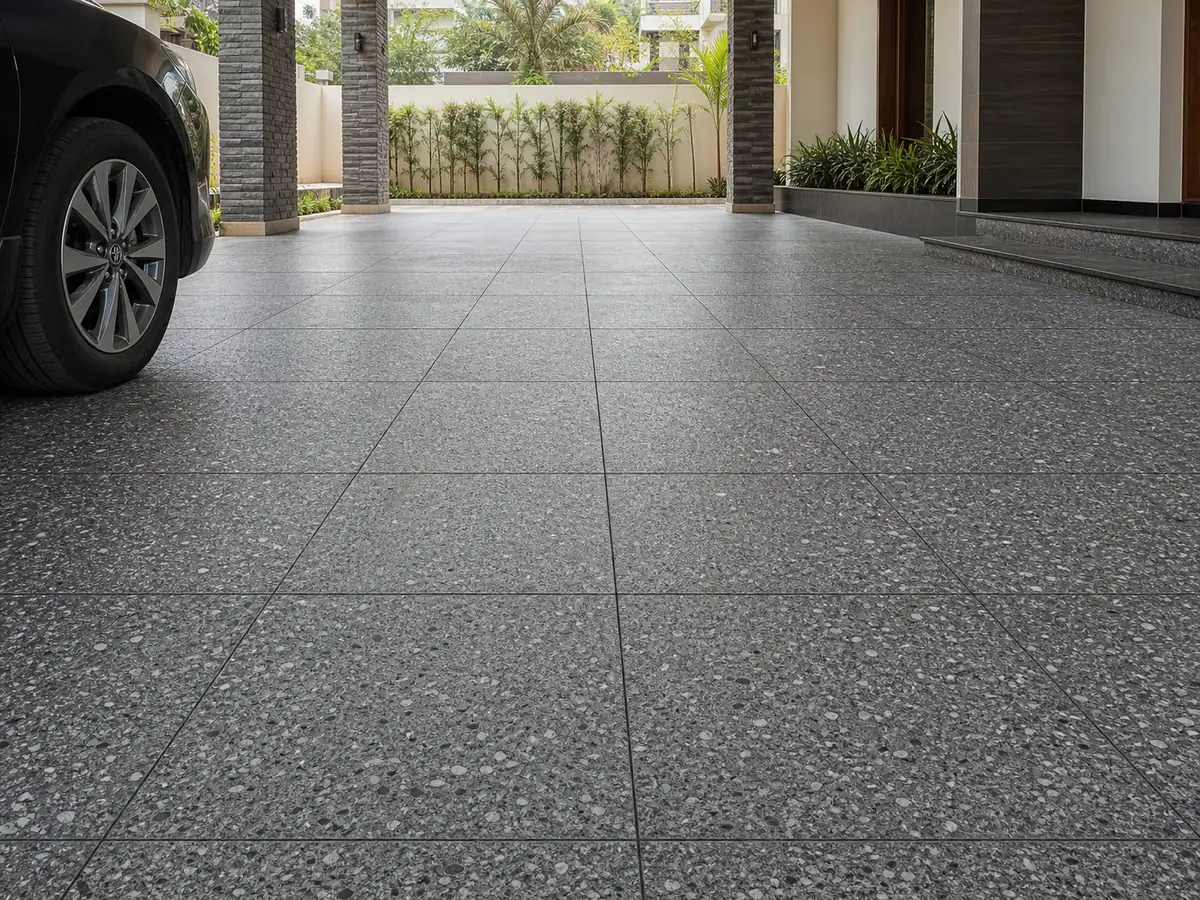
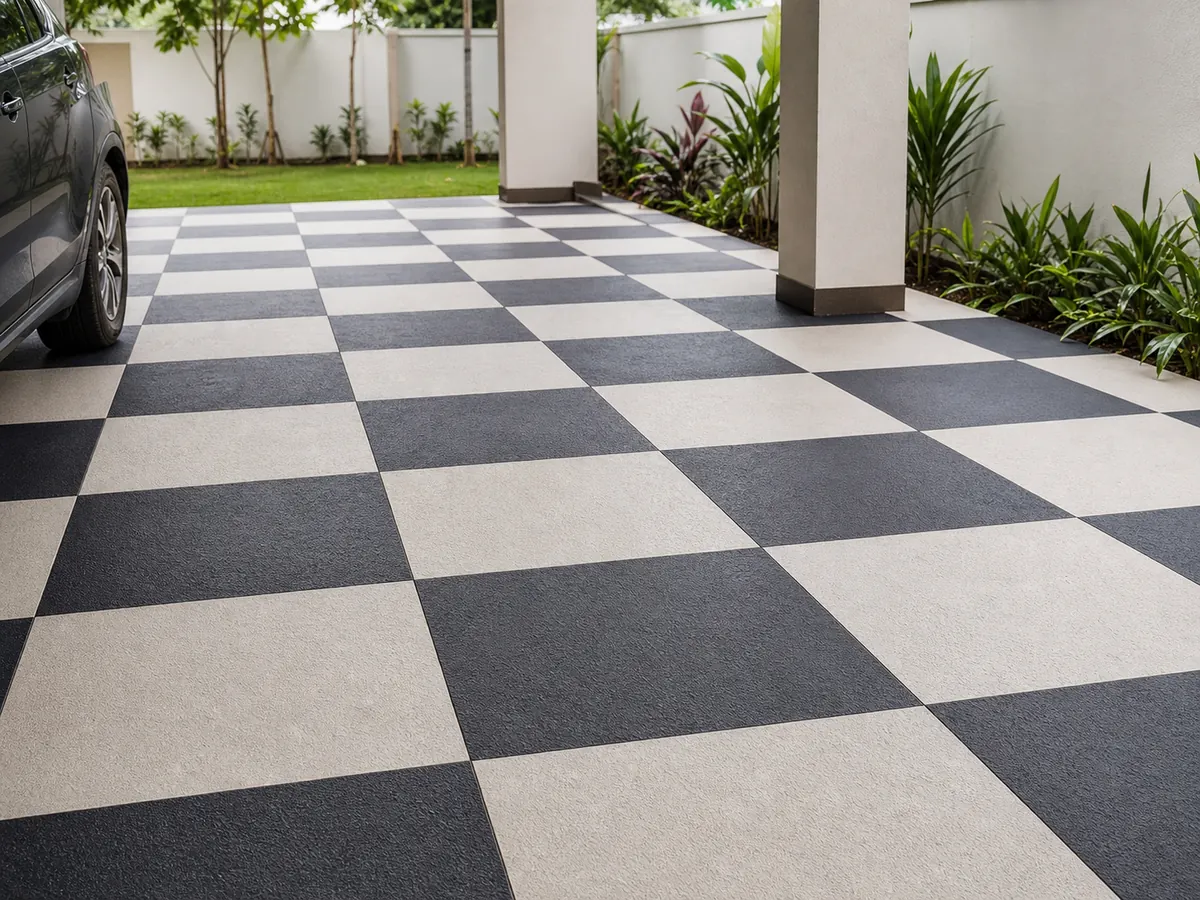
A black and white checkered garage floor requires a different specification than a kitchen or bathroom floor. The garage surface must carry vehicle weight, resist tyre rubber marking, and handle oil and fuel spills without staining the tile body. Full body vitrified in 400x400mm with GHR finish is the correct specification for a garage checkerboard floor. The full body tile has colour running through the entire tile thickness rather than only in a surface glaze, which means scratches from vehicle movement do not expose a white clay body beneath the black or white surface.
The checkerboard pattern in Indian homes appears in entrance halls and pooja rooms because of its historical connection to traditional Indian floor patterns. Encaustic cement tiles in black and white checkerboard were common in South Indian and Maharashtrian homes built before the 1970s. GVT in the same pattern continues that visual language in a body that needs no maintenance.
In pooja rooms, the 200x200mm checkerboard in GVT gives a fine-grained floor pattern suited to smaller room dimensions. The pooja room tiles page covers finish requirements, auspicious colour guidance, and size recommendations specific to this space.
A checkerboard floor can be laid in two orientations: straight grid (squares parallel to the walls) or diagonal (squares at 45 degrees to the walls). The pattern is the same; only the axis changes.
| Straight Grid | Diagonal Layout | |
|---|---|---|
| Visual effect | Clean, geometric, contemporary | Wider-looking room, traditional, Victorian reference |
| Tile wastage | 5% to 8% standard wastage | 15% to 20% wastage on border cuts |
| Laying difficulty | Standard | More complex, requires careful baseline setup |
| Best rooms | Kitchens, bathrooms, garages, and large open areas | Small bathrooms, entrance halls, and formal dining rooms |
| Grout joint | Straight lines both ways | Diamond-pattern grout grid |
For most Indian kitchens and bathrooms, the straight grid is the practical choice. It wastes less tile, is easier for the mason to set out, and reads as a clean, uncluttered floor. The diagonal is worth the extra tile cost in entrance halls where the diamond orientation of the grout grid gives the entry a more formal quality.
Grout colour on a checkerboard floor has a stronger visual impact than on most other tile layouts because the grout runs continuously between alternating light and dark squares. The grout line is always visible against one colour or the other.
Grey or charcoal epoxy grout is the most common choice in Indian homes because it sits neutrally between the black and the white without drawing the eye to the grout line. White cement grout against the black tiles emphasises the grid pattern strongly, which can look good when fresh, but requires regular cleaning as it stains quickly. Black grout against the white tiles creates a very dark, graphic grid that reads as a strong design statement rather than a neutral floor.
Epoxy grout is strongly recommended over cement grout for all checkerboard floor applications. In kitchens and garages, cement grout absorbs cooking grease and oil spills into the grout body, and staining is difficult to reverse. Epoxy grout resists both moisture and oil penetration and keeps its colour consistently across years of use.
GVT tiles in solid black and solid white for checkerboard floors are manufactured in Morbi, Gujarat, in sizes from 200x200mm up to 600x600mm. Both colours carry water absorption below 0.05% under IS 15622:2006 and come in matte, GHR, and polished finishes. The key buying rule is to order both the black and the white tiles from the same Morbi manufacturer and the same production batch to ensure identical body thickness, water absorption figure, and tile flatness across both colours. A thickness mismatch between the two colours creates an uneven grout line that is difficult to correct after laying.
Black and white GVT tiles in 300x300mm for a checkerboard floor run Rs. 50 to Rs. 120 per sq.ft per colour at the showroom level. Full body vitrified in 400x400mm for garage-grade checkerboard floors runs Rs. 70 to Rs. 150 per sq.ft per colour. In total, a checkerboard floor in 300x300mm GVT matte costs Rs. 100 to Rs. 240 per sq.ft for both tile colours combined, plus epoxy grout and laying charges. These figures apply across most Indian cities; Maharashtra, Rajasthan, and Karnataka show the widest price variation from Morbi factory pricing due to transport distance. In coastal states and monsoon-heavy regions, GHR finish tiles are recommended over plain matte for any checkerboard floor area that stays damp for extended periods.
Two decisions make the biggest difference on a checkerboard floor purchase: the tile size relative to the room dimensions, and whether to use two separate tiles or a single printed checkerboard tile. Both affect how the pattern reads once laid and how complex the installation is. TilesFinders lists black and white GVT tiles by size, body type, water absorption, and finish, so you can compare both the black and the white tile in the same size and body type from the same manufacturer before placing an order.
The 300x300mm (1x1) is the most common size for black and white checkerboard floors in Indian homes because it fits bathroom and kitchen floor areas without excessive cutting. Larger rooms, such as corridors, entrance halls, and open-plan kitchens, can use 400x400mm or 600x600mm formats where the larger squares read more clearly from a distance. Rooms under 6 sq.ft in total floor area are better suited to 200x200mm to keep the pattern proportionate to the space.
The 300x300mm (1x1) is the most common size for black and white checkerboard floors in Indian homes because it fits bathroom and kitchen floor areas without excessive cutting. Larger rooms, such as corridors, entrance halls, and open-plan kitchens, can use 400x400mm or 600x600mm formats where the larger squares read more clearly from a distance. Rooms under 6 sq.ft in total floor area are better suited to 200x200mm to keep the pattern proportionate to the space.
Both options exist. A traditional checkerboard floor uses two separate tile bodies, one solid black and one solid white, alternated in a grid. A printed checkerboard tile carries the full alternating pattern on a single tile face, typically in 600x600mm or larger, where four or more checkerboard squares appear on one tile. Printed versions are faster to lay, but the pattern breaks at the tile edge, which can look misaligned if the laying is not precise. Separate tiles give full pattern control and are the standard approach in India.
GVT in matte or GHR finish in 300x300mm or 400x400mm is the right body type for a checkerboard kitchen floor. GVT carries water absorption below 0.05%, handles cooking spills and frequent mopping, and the matte finish does not show grease marks as visibly as a polished tile. Do not use ceramic tiles on kitchen floors; the ceramic body water absorption of 12% to 16% makes it unsuitable for floor use in Indian kitchens.
Grey or charcoal epoxy grout is the most practical choice for a black and white checkerboard floor because it reads as neutral against both colours and does not show staining as quickly as white grout does on a dark tile. White grout against the black tiles emphasises the grid strongly and can look striking when freshly done, but it stains within a few months in kitchens and high-traffic corridors. Epoxy grout in any colour is recommended over cement grout for checkerboard floors to prevent moisture ingress and discolouration.
Yes, but the tile specification must be correct. GVT or full body vitrified in 300x300mm or 400x400mm with GHR or textured finish and water absorption below 0.05% is the right specification for a garage floor. The tile must carry a load rating sufficient for the vehicle's weight. Standard residential GVT is rated for foot traffic; a tile intended for garage use with vehicles should be full-body vitrified with a higher load rating. Do not use ceramic or standard glazed tiles in garages.
There is no product difference. Checkered is the American English spelling, and chequered is the British English spelling. Both describe the same alternating two-colour pattern. In India, both spellings appear in tile showrooms and online searches. The tile, the pattern, and the installation method are identical regardless of spelling.
A diagonal layout, where the tiles are set at 45 degrees to the wall, makes a room look wider and is the traditional format for Victorian and Art Deco checkerboard floors. A straight grid layout is easier to lay, wastes less tile on border cuts, and reads as cleaner in contemporary Indian interiors. For small bathrooms, the diagonal layout can make the space feel more open. For kitchens and corridors, the straight grid is more practical.
Solid black and solid white GVT tiles in 300x300mm for a traditional checkerboard floor run Rs. 50 to Rs. 120 per sq ft per colour, bought as two separate tile types. Printed checkerboard GVT tiles with the alternating pattern on a single tile face run Rs. 70 to Rs. 150 per sq.ft. Prices vary by brand, size, and city. Most checkerboard floor tiles sold in India are manufactured in Morbi, Gujarat.


-1e76854d-c5b0-4e73-bdde-a2d6ee6086c3.webp)