Heavy Duty Parking Tiles: What They Are and Why They Last Longer
Learn how heavy-duty parking tiles last longer with the right thickness, anti-skid finish, breaking strength, and weather resistance for Indian homes, driveways, and society parking areas
- What Are Heavy Duty Parking Tiles and How Are They Different from Regular Tiles?
- Why Heavy Duty Parking Tiles Last Longer
- Best Types of Parking Tiles for Indian Homes
- What Thickness Is Best for Parking Tiles?
- Best Anti-Skid Finishes for Car Parking Tiles
- Parking Tiles Design Ideas for Indian Homes 2026
- How to Choose Heavy-Duty Parking Tiles for Your Home
- Parking Tiles Price, Rate and Cost Guide for India 2026
- How to Clean Parking Tiles
- Common Mistakes When Choosing Parking Tiles
- Choosing the Right Parking Tiles
Most homeowners spend weeks picking tiles for their living room or bathroom. The parking area gets whatever is left in the budget, usually the cheapest option available. That choice fails fast.
Car weight, monsoon water, tyre friction, engine oil, and direct sun are conditions no living room tile is built for. Parking tiles take more punishment than almost any other surface in an Indian home. Getting this choice wrong means cracked tiles, slippery surfaces, and expensive replacement within two or three years.
This guide explains what makes heavy-duty parking tiles different, why they hold up longer, which types work best in Indian homes, what designs work in 2026, and how to pick the right tile before you spend a rupee.
What Are Heavy Duty Parking Tiles and How Are They Different from Regular Tiles?
Most buyers do not know the difference between regular tiles and parking tiles until one of them cracks under a car tyre. The difference is not just thickness. It is the entire way the tile is manufactured.
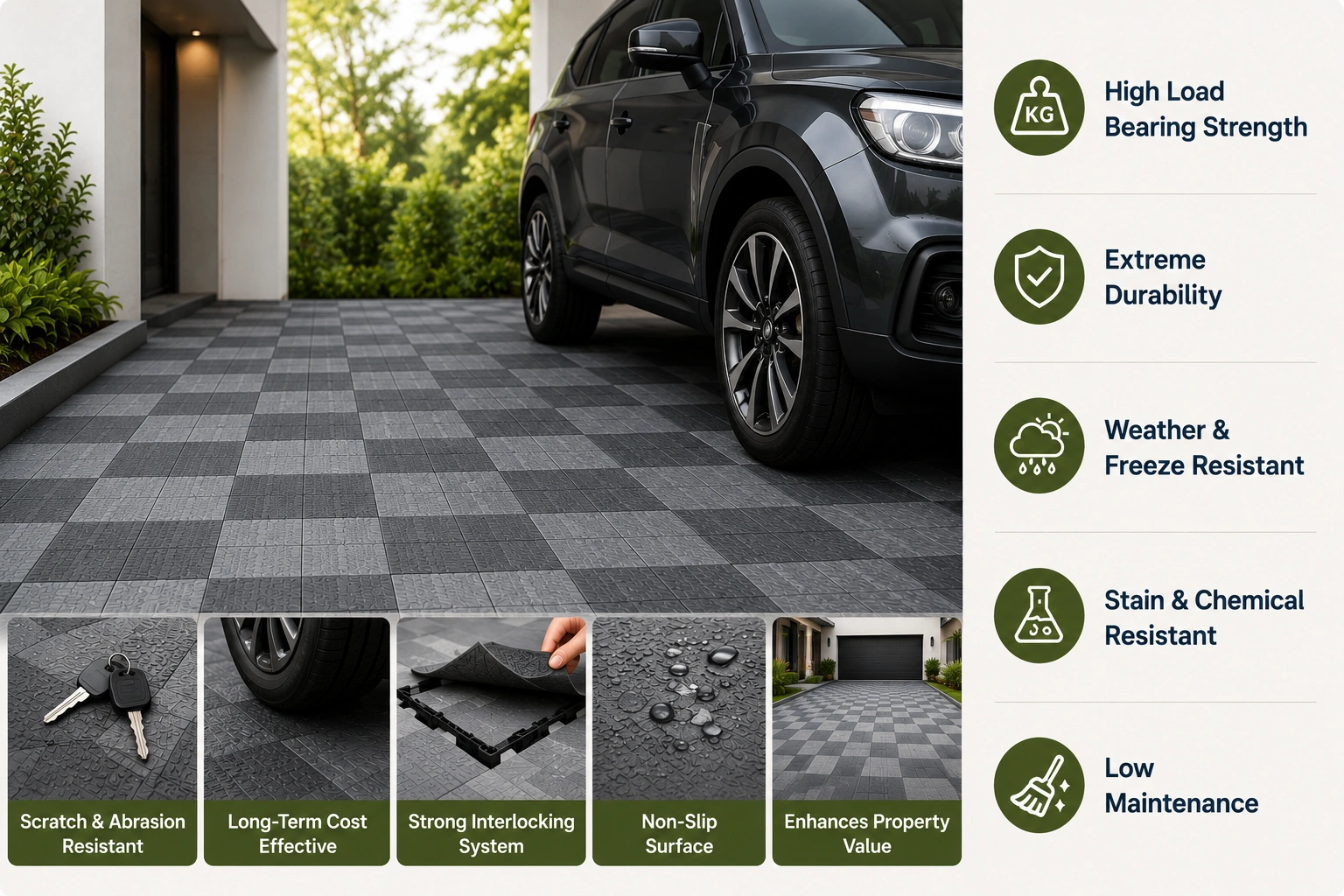
What is the difference between regular tiles and parking tiles? Regular floor tiles are pressed and fired to handle foot traffic. Parking tiles are pressed at significantly higher pressure, fired at higher temperatures, and produced in greater thickness specifically to carry vehicle loads. A standard floor tile may have a breaking strength of 1,000 N to 2,000 N. A parking tile starts at 3,000 N and goes higher.
Regular tiles also have finishes designed for interior conditions: smooth surfaces, polished or semi-polished coatings, and decorative prints. Parking tiles have textured surfaces for skid resistance, thick unglazed bodies for outdoor durability, and manufacturing standards that account for temperature change, rain, and vehicle load.
| Feature | Regular Floor Tiles | Heavy Duty Parking Tiles |
| Thickness | 8 to 12 mm | 18 to 25 mm (parking specific) |
| Breaking strength | 1,000 to 2,000 N | 3,000 N and above |
| Surface finish | Glossy, matte, polished | Textured, anti-skid, GHR |
| Water absorption | 0.05% to 16% (varies by category) | Less than 3% (vitrified and porcelain) |
| Outdoor use | Most are not rated for outdoor use use | Built for outdoor exposure |
| Vehicle load | Not rated | Rated for car and light commercial load |
Why Heavy Duty Parking Tiles Last Longer
Why do heavy-duty parking tiles last longer? The answer sits in four technical properties that most showrooms do not bother to explain.
The first is breaking strength. A tile rated at 3,000 N breaking strength can take the load of a car tyre, distributing weight across it without fracturing. Tiles with lower breaking strength develop hairline cracks under repeated vehicle movement, especially at tyre entry points and drainage channels.
The second is abrasion resistance. Every time a car moves on a tile, the tyre surface scrapes the tile's face. Tiles with high abrasion resistance, measured by the PEI rating scale (PEI IV and PEI V for heavy traffic areas), keep their surface intact longer. Lower-rated tiles wear visibly within months of regular use.
The third is Mohs hardness. Parking tiles made from vitrified or full-body material typically score 6 to 8 on the Mohs hardness scale. Regular ceramic floor tiles score 3 to 5. Harder tiles resist scratching, surface degradation, and gravel damage from car tyres.
The fourth is tile thickness. Thicker tiles distribute load better across the substrate below them. Parking tiles rated for car use typically run 18 mm to 25 mm thick. A 10 mm tile under a car will transfer that load to the adhesive and substrate as stress rather than distribute it, leading to cracking from below rather than above.
Best Types of Parking Tiles for Indian Homes
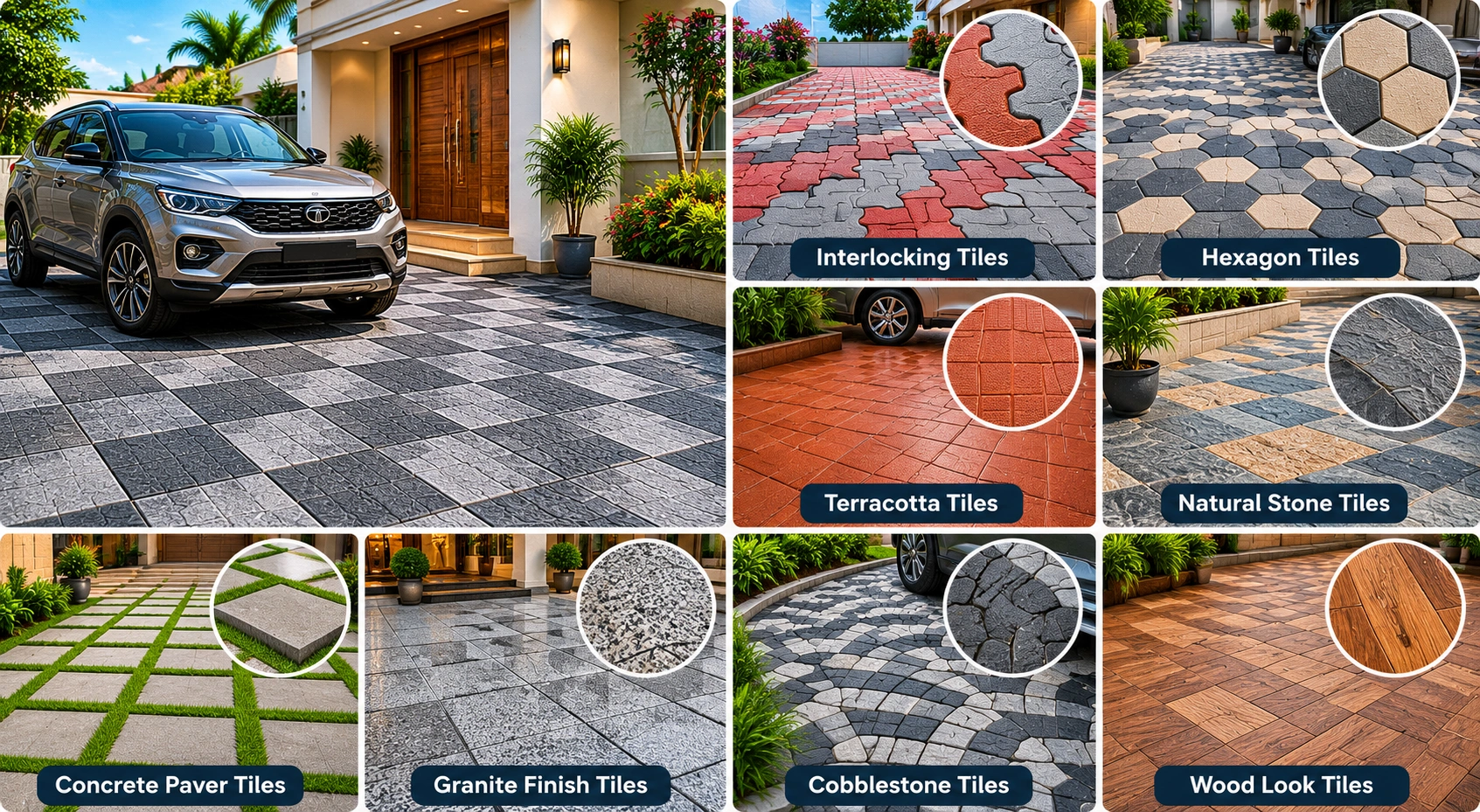
Which tiles are best for parking areas in Indian homes? Five material types cover most Indian home and society parking situations, each with different price points and performance levels.
Vitrified Parking Tiles
Vitrified parking tiles are the most widely used option for Indian home parking in 2026. GVT (Glazed Vitrified) and Full Body vitrified tiles absorb less than 0.05% water, which means they stay stable through monsoons, dry summers, and the freeze-thaw cycles that affect northern Indian cities like Delhi and Chandigarh.
Are vitrified tiles good for parking areas? Yes, but only in the correct subtype and finish. GVT in GHR (Glaze High Resistance) or matte finish with anti-skid texture works well for home parking. PGVT (Polished Glazed Vitrified) should never be used outdoors: the polished surface becomes slippery when wet and wears fast under tyre friction. Full Body vitrified tiles are the strongest subtype for parking because the colour runs through the entire tile body, so chipping from heavy load does not expose a visibly different interior.
Sizes available for parking: 400x400 mm (16x16), 500x500 mm (20x20), 600x600 mm (2x2), and 600x1200 mm (2x4). The 400x400 mm and 500x500 mm sizes are the most practical for parking areas because they are easier to cut cleanly at irregular edges and drainage channels. Approximate price: ₹60 to ₹180 per sq. ft., varies by brand and dealer.
Porcelain Parking Tiles
Porcelain parking tiles have water absorption of 2% to 5%, higher than vitrified but still within the acceptable range for outdoor parking. They are available mostly in matte finish in India, which is practical for parking surfaces because it reduces slip risk and does not show tyre marks as visibly as glossy surfaces.
Porcelain tiles score slightly lower on breaking strength than full-body vitrified tiles, but perform well for home parking areas where car weight is the primary load. They are a practical mid-range option when the budget sits above ceramic but below full-body vitrified. Approximate price: ₹90 to ₹220 per sq. ft.
Granite Parking Tiles
Granite parking tiles score 6 to 7 on the Mohs hardness scale and carry very strong breaking strength ratings. Natural granite handles outdoor exposure, oil stains, and vehicle loads well. The material comes primarily from Karnataka and Rajasthan in India and is available in black, grey, red, and multi-tone finishes.
The limitation of granite for home parking is maintenance. Polished granite becomes slippery when wet, requiring anti-slip treatment or a rough-finished surface specification. Granite is also heavier and harder to cut precisely than vitrified tiles, which adds to the installation cost. Approximate price: ₹80 to ₹250 per sq. ft., depending on finish and source.
Concrete Parking Tiles
Concrete parking tiles are the most functional and least decorative option available. They are thick (typically 25 mm to 40 mm), carry high load ratings, and are resistant to engine oil, fuel spills, and tyre friction. Indian readymade concrete parking tiles are available in standard grey and are widely used in societies, commercial complexes, and industrial compounds.
For individual home parking where appearance matters alongside function, concrete tiles are less popular than vitrified options. They have a utilitarian look that suits industrial flooring tile applications better than home entrance areas. Approximate price: ₹35 to ₹80 per sq. ft. for standard grey concrete tiles.
Interlocking Parking Tiles
Interlocking parking tiles use a clip or paver system where tiles lock together without adhesive. This makes them removable, which is useful in rented homes or parking areas where the surface layout changes. They are available in rubber, concrete, and vitrified variants in India.
The main advantage of interlocking parking tiles for Indian homes is drainage. The gaps between interlocking units let rainwater pass through rather than pooling on the surface, which helps during heavy monsoon months. Approximate price: ₹40 to ₹150 per sq. ft,. depending on material and variant.
What Thickness Is Best for Parking Tiles?
What thickness is best for parking tiles? The answer depends on what kind of vehicle uses the space and how the subfloor is prepared.
| Parking Use | Recommended Thickness | Category | Notes |
| Two-wheelers only (scooter, bike) | 12 to 15 mm | GVT or Porcelain | Light load; standard tile thickness works |
| Car parking at home (single car) | 18 to 20 mm | Full Body Vitrified or GVT | Standard home car load; most home parking tiles fall here |
| Two-car home driveway | 20 to 25 mm | Full Body Vitrified or Granite | Higher repeat load; thicker bed required |
| Society parking or light commercial | 25 mm and above | Concrete or Full Body Vitrified | Multiple vehicles; requires proper substrate preparation |
Tile thickness alone does not determine load capacity. Load-bearing tiles need a properly prepared substrate as much as they need the right thickness. The adhesive quality, bed thickness, and substrate cure time all contribute equally to how the surface performs under vehicle load. A 20 mm tile on a poorly prepared base fails faster than an 18 mm tile on a properly levelled, cured concrete bed.
Best Anti-Skid Finishes for Car Parking Tiles
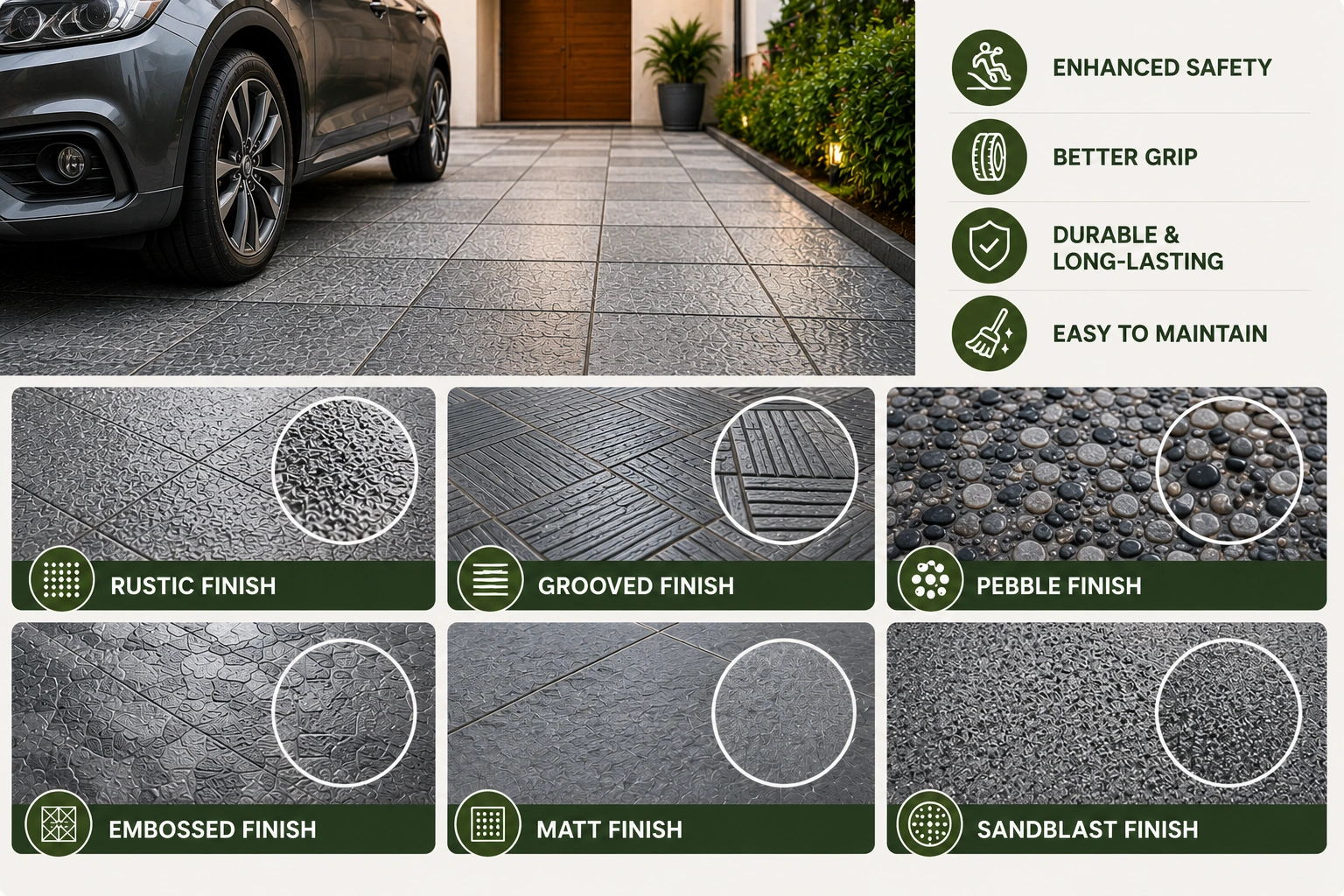
Skid resistance on parking tiles saves vehicles from sliding during wet parking manoeuvres and protects people walking across the surface after rain. The surface of a parking tile needs an anti-slip surface that holds grip even when wet, dusty, or covered in light oil spray.
GHR (Glaze High Resistance) is the strongest finish for parking tiles used in vitrified and GVT categories. It gives a stone-like textured surface that grips well under all conditions. Textured parking tiles in this finish maintain skid resistance even after years of tyre friction and weathering.
Matte finish in GVT or full body vitrified gives good anti-skid performance for home parking. It is the most widely available option across Indian tile brands. Rain drops finish (raised glossy dots on a matte base) gives a grip similar to GHR and is worth asking for at dealerships for home car parking areas.
Weatherproof flooring for outdoor parking also needs to resist UV fading. Tiles with colour fired through the body (full body vitrified) fade far less than surface-printed GVT tiles under constant sun exposure. For south-facing driveways or open parking without shade, full-body tiles are the more practical pick.
| Finish | Skid Resistance | Good For Parking? | Notes |
| GHR (Glaze High Resistance) | Excellent | Yes | Best for car parking; holds grip in wet and dry conditions |
| Matte | Good | Yes | Widely available; works for home parking |
| Rain Drops | Good | Yes | Good anti-skid; ask dealer for outdoor-rated version |
| Matte Carving | Moderate to Good | Yes (light use) | Home entrance areas; not for heavy vehicle load |
| Glossy / High Glossy | Poor | No | Dangerous when wet; never use on any parking floor |
| Polished (PGVT) | Very Poor | No | Not rated for outdoor or vehicle areas |
| Satin Matte | Poor | No | Slippery when wet; indoor use only |
Parking Tiles Design Ideas for Indian Homes 2026
Parking tile design has changed significantly in Indian homes over the past two or three years. The tile parking design approach now considers how the driveway looks from the gate, not just how it functions under the car.
Anti-skid parking tiles are a non-negotiable part of every modern design spec because a beautiful driveway that becomes slippery in the rain is a safety hazard. The latest parking tile design for hothe me now combines grip, weather resistance, and visual appeal in one tile choice.
Classic Black and White Parking Tiles
Parking tiles, black and white,e are still the most requested colour combination for Indian home driveways in 2026. The contrast holds well outdoors, does not show tyre marks visibly on the dark tiles, and gives the entrance a clean, defined look. A standard black and white parquet design uses 16x16 tiles in a checkerboard or diagonal pattern.
The key is to use full-body vitrified tiles in both colours, not surface-printed GVT. Surface prints on outdoor tiles fade with direct sun exposure over two to three years. Full body tiles keep the colour through the tile body and stay consistent far longer.
Stone-Look and Cobblestone Designs
Stone-look parking tiles, a new design in GHR or matte finish with a rough stone texture, have become popular in independent houses and villas across cities like Ahmedabad, Hyderabad, and Pune. The surface looks like natural stone but carries the performance properties of vitrified tile, which natural stone often cannot match for outdoor durability and low maintenance.
Cobblestone-pattern tiles in 400x400 mm simulate the look of traditional paving without the uneven surface. They work well for home parking areas where the visual direction of the space should feel residential rather than industrial.
Modern Concrete-Look Tiles for Parking
Modern parking tile design in 2026 increasinglyuses concrete-lookk vitrified tiles. These tiles combine the industrial look of bare concrete with the performance of a vitrified body: low water absorption, strong breaking strength, and easier cleaning than actual concrete. A warm grey concrete-look tile in 600x600 mm (2x2) or 600x1200 mm (2x4) gives a clean, contemporary feel to a home driveway.
Outdoor parking tiles designed in this direction work best with a dark grey or charcoal grout. Light grout on outdoor parking tiles shows tyre rubber deposits and environmental staining within weeks.
Entrance-Specific Designs for Home Parking
Parking tiles for home entrance areas face a slightly different set of requirements than open driveway sections. The entrance is the first visual impression of the home. Here, car parking tiles design choices can include bordered patterns, logo-style medallions, or contrasting colour bands at the entry point.
Parking tiles design for home entrance: use the main field tile in a neutral (charcoal, grey, beige) and add a border tile in a contrasting tone at the property boundary and at the garage threshold. This creates a visual frame without needing expensive custom tiles. Latest parking tiles design trends from 2026 Indian home projects favour earth tones and stone-look finishes over the older terracotta and red oxide combinations.
How to Choose Heavy-Duty Parking Tiles for Your Home
How to choose heavy-duty parking tiles for the home comes down to matching the tile's technical spec to the actual conditions of your parking area. The right choice for a covered basement in a Mumbai society is different from an open driveway in a Rajasthan villa.
Start with the load. House parking tiles for a single car and two-wheeler need a tile with at least 3,000 N breaking strength and 18 mm thickness. Home parking tiles for two cars or a heavy SUV need 20 mm or above, with a substrate professionally levelled and cured before laying.
Outdoor parking tiles need a water absorption rate below 3% to handle monsoon conditions without expanding, cracking, or growing algae along grout lines. GVT and full body vitrified meet this. Ceramic tiles, which absorb 12% to 16% water, are not suitable as outdoor parking tiles at any price point.
Car parking tiles for home entrances that see direct sun need UV-stable surface colour. Full-body vitrified tiles are more UV-resistant than surface-printed GVT. For covered parking or basement parking, GVT in GHR or matte finish is sufficient and comes with a wider design range than full-body tiles.
Parking tiles for the home entrance should also account for the drainage slope. Tiles must be laid with a 1:100 slope toward the drainage point so water does not pool. Pooling water on exterior paving tiles breaks the grout bond over time and allows algae to grow along grout lines.
For society parking or areas that function closer to industrial flooring tiles (multiple vehicles, service vehicles, constant use), concrete tiles or full body vitrified at 25 mm and above with epoxy grout are the correct specification. Standard tile adhesive and sand-cement grout will not hold under that level of heavy traffic flooring use.
Parking Tiles Price, Rate and Cost Guide for India 2026
Parking tiles price in India varies by category, thickness, finish, and brand. The table below covers approximate 2026 market rates for the most common options. All prices are ex-GST and vary by dealer location and order volume.
| Tile Category | Thickness | Parking Tiles Rate (per sq. ft. ex-GST) | Best For |
| Concrete Parking Tiles | 25 to 40 mm | ₹35 to ₹80 | Society parking, industrial use, and budget projects |
| Ceramic (not recommended for parking) | 8 to 10 mm | ₹30 to ₹80 | Not suitable for car load or outdoor exposure |
| GVT Matte / GHR (Vitrified) | 18 to 20 mm | ₹60 to ₹150 | Home car parking, covered driveways |
| Porcelain Parking Tiles | 18 to 20 mm | ₹90 to ₹220 | Mid-range home parking, open driveways |
| Full Body Vitrified | 20 to 25 mm | ₹90 to ₹200 | Heavy use, open driveways, two-car homes |
| Granite Parking Tiles | 18 to 25 mm | ₹80 to ₹250 | Premium driveways, independent houses |
| Interlocking Parking Tiles | Varies by type | ₹40 to ₹150 | Rented homes, drainage-priority areas |
Parking tiles cost also includes installation. A properly prepared parking tile bed needs sand and cement levelling, polymer-modified adhesive, and either epoxy grout (for heavy use) or standard grout with a waterproofing additive. Installation adds approximately ₹40 to ₹90 per sq. ft. for home car parking areas in Indian cities.
The best parking tiles for the full-body home are not always the most expensive. The best parking tiles match the load, drainage, and sun exposure of the specific area. A mid-range full body vitrified tile in GHR finish, properly laid, outperforms an expensive surface-printed GVT tile on a poorly prepared bed.
How to Clean Parking Tiles
How to clean parking tiles depends on what you are removing. For daily dust and light tyre marks, a stiff-bristle broom followed by a mop with water and a pH-neutral cleaner is enough. Do not use acidic cleaners on vitrified or porcelain tiles: acid degrades the grout and can dull the tile surface over time.
Engine oil or fuel stains need a degreaser applied directly to the stain and left for five to ten minutes before scrubbing. Do not let engine oil sit on grout lines. Grout is porous and will absorb oil permanently if not treated within a few hours.
Algae on outdoor parking grout lines is the most common maintenance issue in Indian monsoon climates. A 1:10 bleach solution applied with a stiff brush and rinsed after twenty minutes removes algae effectively. To prevent regrowth, keep the drainage slope clear and use a grout sealer applied annually on exposed outdoor grout.
For concrete parking tiles, avoid high-pressure water blasting unless the tile surface is rated for it. High-pressure strips grout from joints on older concrete tiles. A medium-pressure garden hose and scrubbing brush are usually sufficient for regular cleaning.
Common Mistakes When Choosing Parking Tiles
Using Regular Floor Tiles in the Parking Area
This is the most expensive mistake in parking tile buying. Ceramic parking tiles and regular GVT floor tiles are not rated for vehicle load. They look fine for the first few months, then develop hairline cracks at tyre entry points. By the second monsoon, water gets under the tiles through the cracks,s and the adhesive bond fails. Full replacement is the only fix.
Choosing Glossy or Polished Finish for Outdoor Use
Glossy and polished tile finishes become dangerous on outdoor surfaces when wet. A polished vitrified tile on a home driveway after rain has almost no grip. This applies to PGVThigh-glossy, and satin matte finishes. Matte, GHR, and textured finishes are the only surface types suitable for parking areas.
Skipping Proper Substrate Preparation
A parking tile is only as strong as the surface it is laid on. Many tile failures in Indian home parking come not from the tile itself but from a poorly levelled or inadequately cured concrete substrate. Always let a new concrete base cure for at least 28 days before tiling. Damp concrete causes adhesive failure, and tiles pop up within months.
Using White or Light Grout Outdoors
White grout on outdoor parking tiles looks clean at installation and becomes permanently stained within one monsoon season. Tyre rubber, mud, algae, and environmental dust all show clearly on light grout outdoors. Use dark grey, charcoal, or a shade one tone darker than the tile for any outdoor grout. Epoxy grout is worth the additional cost for parking areas because it resists staining and oil penetration far better than standard cement-based grout.
Buying Without Checking the Breaking Strength Rating
Not all tiles sold as parking tiles are rated to carry vehicle loads. Ask the dealer specifically for the breaking strength rating in Newtons. A tile without this specification printed on the carton or in the technical data sheet should not be used for car parking,g regardless of what the dealer says.
Choosing the Right Parking Tiles
The best parking tiles for home are the ones that match your actual load, drainage conditions, and sun exposure, not the cheapest tile that fits the budget or the most decorative one in the showroom.
Before buying, confirm the breaking strength rating on the carton, check that the finish is rated for outdoor anti-skid use, and get the substrate professionally levelled before laying. A tile laid on a properly prepared bed at the right thickness will last ten to fifteen years in an Indian home parking area without cracking.
You can browse parking tiles by category, finish, thickness, and design on TilesFinders and compare options from Indian manufacturers before heading to a local showroom. Seeing what is available at different price points in one place makes it easier to shortlist before the dealer conversation begins.

FAQs
Full-body vitrified tiles in GHR or matte finish are the best option for home car parking in India. They absorb less than 0.05% water, carry high breaking strength ratings, and hold their surface finish under tyre friction and outdoor exposure. Granite tiles are a strong alternative for premium driveways. Avoid glossy, polished, or surface-printed tiles in any outdoor parking area.
Heavy-duty parking tiles last longer because they have a higher breaking strength (3,000 N and above), score 6 to 8 on the Mohs hardness scale, exhibit higher abrasion resistance (rated at PEI IV or PEI V), and are manufactured with a thickness of 18 mm to 25 mm. These properties let them distribute vehicle load, resist tyre friction, and handle outdoor weather without cracking or wearing through.
Regular floor tiles are pressed and fired for foot traffic loads and interior conditions. Parking tiles are manufactured at higher pressure and temperature, in greater thickness (18 to 25 mm), with textured anti-skid surfaces and breaking strength ratings above 3,000 N. Regular tiles crack under vehicle load. Parking tiles are built specifically to carry it.
For home car parking, 18 to 20 mm thickness in full body vitrified or GVT is the minimum. Two-car driveways and heavier SUV use need 20 to 25 mm. Society parking or commercial areas need 25 mm and above in concrete or full body vitrified tiles. Thickness alone is not enough: the substrate must be properly levelled and cured for the tile to perform as rated.
Yes, but only the right subtype. GVT and full-body vitrified tiles in GHR or matte finish are suitable for car parking areas. PGVT (Polished Glazed Vitrified) tiles should never be used outdoors or in parking: the polished surface becomes slippery when wet and is not rated for vehicle load. Always specify outdoor-rated, anti-skid, and parking-thickness vitrified tiles.
For daily cleaning, sweep with a stiff brush and mop with a pH-neutral cleaner. For engine oil stains, apply a degreaser, leave for five to ten minutes, then scrub and rinse. For algae on grout lines, use a 1:10 bleach solution, scrub, and rinse after 20 minutes. Use dark grout outdoors and apply grout sealer annually to reduce staining and algae growth.

See our tile guides first
Set TilesFinders as a preferred source and our buying guides surface ahead of the rest for you.
Add as preferred sourceTakes one tap. Nothing to install.
What Readers Say
I was about to redo my parking area with the wrong tile size until I read this. The layout comparisons saved me from a costly mistake.
We reference TilesFinders guides while briefing clients on material selection. The size and pattern breakdowns are accurate and easy to explain visually.
On site, I get asked about grout spacing all the time. This article gave me a solid reference I now share with my team before every job.
Finally a guide that doesn't just push generic advice. The oil stain removal steps actually worked on our clubhouse driveway tiles.
I run a small construction firm and now send this link to clients directly when they ask about entrance tile sizing. Saves me an hour of explaining.
Good practical detail, though I wish there were more examples for compact apartment entrances specifically, not just villas.
My mother-in-law wanted marble, I wanted vitrified. This blog gave us the neutral comparison we needed to actually decide together.
Detailed without being overwhelming. I appreciated that it covered both cost and maintenance, not just the aesthetics.
Used the algae and hard water removal tips on our terrace tiles after the monsoon. Worked better than what our regular cleaner was doing.
As someone who sources tiles for multiple builder projects, I find these comparisons genuinely useful for vendor conversations, not just consumer content.
Recommended this to a client who kept second-guessing the entrance design. The small vs large layout section settled the debate instantly.
Straightforward and honest, no unnecessary jargon. Would like to see a similar breakdown for outdoor pool-deck tiles next.
We've bookmarked several TilesFinders guides for our design handbook. Reliable source when clients want data, not just opinions.
Two paths, one marketplace.
Get free quotes from verified suppliers.
Share your room, budget, and style. Suppliers in Morbi respond within hours.
Get Free QuotesList your business, reach real buyers.
Put your showroom in front of homeowners searching for tiles right now.
List Your Business