Best Tiles for Kitchen Wall in India: Top Recommendations for 2026
Stop scrubbing masala stains! Discover 2026's top kitchen wall tiles. Learn why glossy ceramic is best behind the hob and how to style feature walls with premium GVT.

- What Your Kitchen Wall Tiles Are Actually Worth
- The Four Kitchen Wall Zones and What Each One Needs
- Top Tile Categories for Kitchen Walls in India
- Kitchen Wall Tiles Colour Guide for Indian Homes
- Choosing a Finish by Kitchen Style
- Kitchen Wall Tiles Budget Breakdown for India
- Six Things to Confirm Before Buying Kitchen Wall Tiles
Kitchen renovations in India typically cost between ₹1.5 lakh and ₹6 lakh for a standard modular setup in a 2BHK or 3BHK flat. Wall tiles account for a small portion of that budget, usually between ₹8,000 and ₹35,000 for a standard kitchen, depending on the tile category and wall area covered.
That budget share is small. But the wall tile sits at eye level for every meal, every morning cup of chai, every guest who walks into the kitchen. It is the surface that gets seen the most and cleaned the most. Getting it right has a disproportionately large impact on how the whole kitchen looks and how manageable it is to maintain.
This guide breaks down the best kitchen wall tiles design choices for Indian homes in 2026, organised by kitchen wall zone, tile category, colour, and style, with honest budget guidance across all three price brackets.
What Your Kitchen Wall Tiles Are Actually Worth
Most renovation decisions are made on visual appeal first and practicality second. For kitchen wall tiles, reversing that order pays off. A wall tile that photographs beautifully in a showroom but turns yellow from masala in six months, or shows every watermark near the sink, costs you in daily cleaning time and eventually in replacement costs.
The wall tile you choose sets the visual character of the kitchen more than the floor tile does, simply because it is closer to eye level. It also influences how much time you spend cleaning after cooking. Those two things together make the kitchen wall tile decision worth spending more time on than most homeowners do.
The Four Kitchen Wall Zones and What Each One Needs
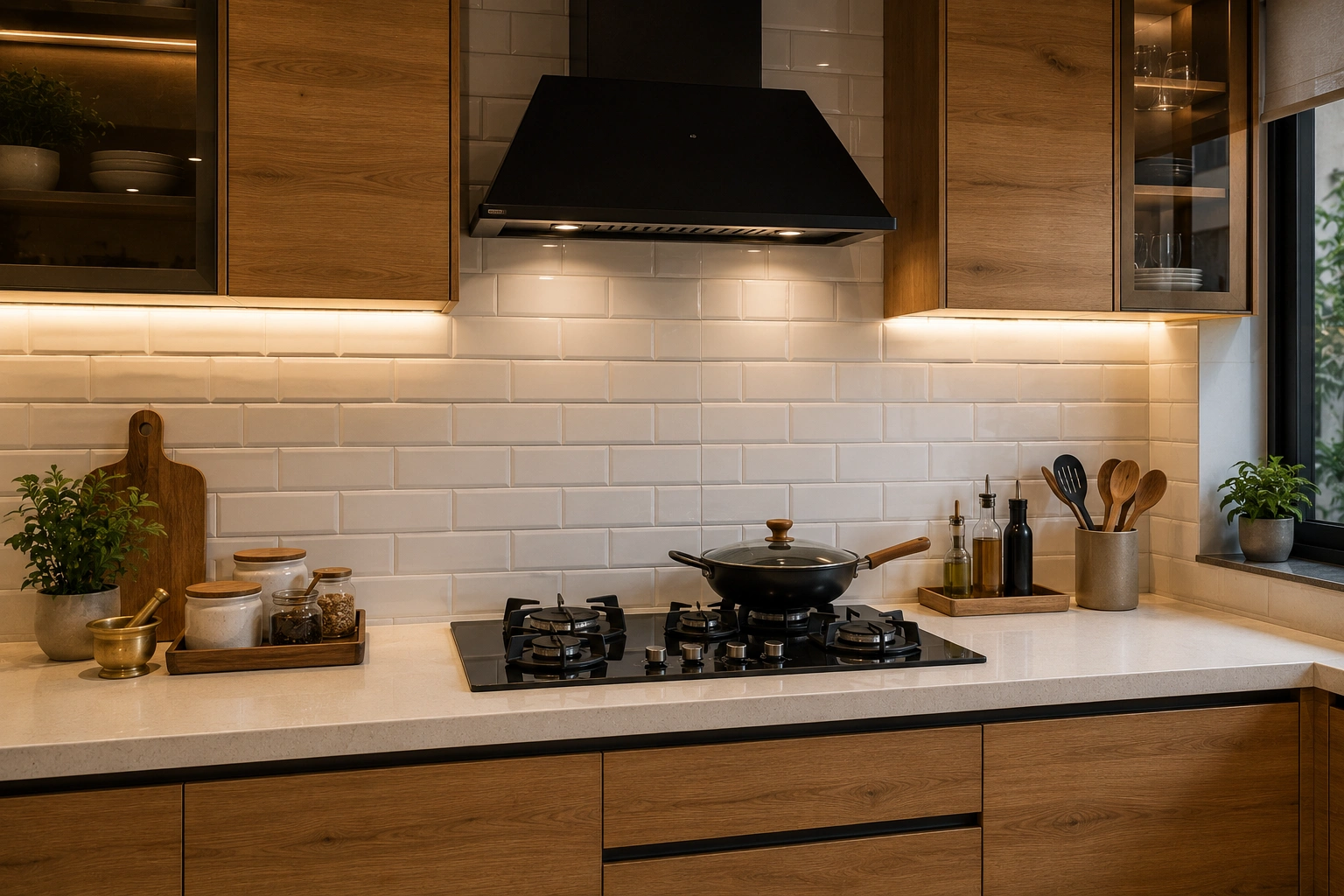
Not every kitchen wall faces the same conditions. Treating all four walls the same leads to tiles that work well in one place and perform poorly in another. Here is how to think about each zone before choosing a tile.
Zone 1: The Cooking Zone Wall (Behind the Hob)
This wall takes the hardest use in the kitchen. Cooking oil vapour, turmeric splatter, and steam land on it every day. The chimney above reduces direct grease deposits but does not eliminate them. This zone needs a smooth surface that wipes clean fast.
Best tile choice here: glossy ceramic in 12x18 or 12x24 size. The smooth gloss surface does not absorb oil or masala. A damp cloth cleans it in seconds. Avoid textured or deeply grooved tiles in this zone. They look interesting in catalogues but hold cooking residue in their grooves and take scrubbing rather than wiping to clean.
Grout choice matters as much as tile choice here. Charcoal or mid-grey grout resists turmeric staining far better than white or light grout. In a working Indian kitchen, light grout near the hob is a maintenance problem from the first month onwards.
Zone 2: The Sink and Prep Wall
The wall behind the sink handles water splash and hard water deposits more than oil. In cities with hard water such as Jaipur, Ahmedabad, and Delhi, the tile behind the sink develops calcium deposits that make glossy tiles look chalky over time. A smooth, glossy tile is still the easiest to clean here, but it needs more frequent wiping to stay looking clean than the cooking zone wall does.
An alternative worth considering for the sink wall: a matte GVT tile in a 2x2 or 2x4 size. The matte surface does not show water marks the way a glossy tile does, which means it maintains a cleaner appearance with less frequent attention. Matte tiles near the sink are slightly harder to wipe oil off, but the sink wall sees far less cooking oil than the hob wall.
Zone 3: The Side and Utility Walls
The walls that run perpendicular to the main cooking counter, including the refrigerator wall and the end walls of the kitchen, see the least direct stress of any kitchen wall. They do not face oil splatter, direct steam, or water splash in normal use. This makes them the best zone for design choices that would be impractical in the cooking zone.
PGVT polished tiles in a 2x2 or 2x4 format work well on these walls. The high-shine surface adds light reflection and visual depth without the maintenance burden it would carry on the backsplash. Textured or third-fired decorative tiles also suit these walls, since they are away from cooking residue and are only visually prominent rather than in constant cleaning rotation.
Zone 4: The Feature Wall (Visible from the Living or Dining Area)
Open-plan kitchen-living layouts in newer 3BHK and 4BHK flats often have one kitchen wall that is directly visible from the sofa or dining table. This wall is as much a part of the living space as it is of the kitchen. It needs to hold up as a design statement, not just as a functional surface.
Large format GVT tiles in 2x4 or slab sizes in a marble-look or stone-look pattern read as expensive and intentional from a distance. A single 800x2400 mm (32x96) slab tile used as a feature panel on this wall creates a seamless, gallery-quality surface with near-zero grout lines. This is the wall to spend a little more on from a design perspective, since it contributes to how the living area looks, not just the kitchen.
If you also want help choosing kitchen floor tiles, finishes, layouts, and materials, read our complete kitchen tiles guide for Indian homes.
Top Tile Categories for Kitchen Walls in India
| Tile Category | Best Kitchen Wall Zones | Available Sizes | Key Strength | Avoid When |
| Ceramic (Glossy) | Cooking zone, sink wall, backsplash | 12x18, 12x24 | Easiest to clean in high-splatter zones. Widest design range. Most accessible price. | Deep textured designs near the hob. Never use on kitchen floors. |
| GVT (Glazed Vitrified) | All four zones; most flexible | 2x2, 2x4, 8x48 (plank) | Dual use (wall and floor). Large format options. Low water absorption. Marble, stone, wood-look designs. | Polished GVT in wet zones (shows water marks). |
| PGVT (Polished Vitrified) | Side walls, feature wall, utility walls away from cooking | 2x2, 2x4, 32x48, 6x4 | Mirror-shine finish. Premium marble and solid colour looks. Makes dark kitchens feel brighter. | Behind hob or sink. Shows oil film and calcium deposits fast. |
| Third Fired (Decorative) | Accent panels, side walls, border strips | Decorative sizes (varies) | Raised relief patterns, metallic effects, hand-painted looks that standard tiles cannot replicate. | Near the hob. Oil collects in surface grooves. |
| Full Body / Colour Body | Feature walls, open kitchen facing areas | 2x2, 2x4, 32x64, 6x4, 8x4 | Consistent colour through tile body. Good for high-design feature walls. | Small kitchens where large slabs overpower the space. |
Kitchen Wall Tiles Colour Guide for Indian Homes
Colour on kitchen walls does more than set a mood. It affects how spacious the kitchen feels, how visible daily stains are, and how well the tiles age alongside changing cabinet colours or countertop upgrades over the years.
White and off-white remain the most popular kitchen wall tile colours in India because they make spaces feel larger and brighter, pair with every cabinet colour, and give the kitchen a fresh look that holds up across interior trend cycles. The practical downside in Indian kitchens is that white grout near the hob stains fast. The solution is not to avoid white tiles but to use dark grout with them.
Grey has become the most dependable neutral for kitchen walls in modular homes. A mid-grey ceramic or a grey stone-look GVT reads as clean even when it is not immaculate, which matters in a space where perfect cleanliness between meals is not always realistic. It also transitions well from a bright daytime kitchen to an ambient evening kitchen under recessed lighting.
Colour is gaining ground in 2026. Sage green, slate blue, warm terracotta, and bottle green have moved from boutique hotel kitchens into Indian residential renovations. These tones work best on the backsplash or feature wall, not on all four walls. A single coloured wall against white or cream cabinetry reads as considered and contemporary rather than overwhelming.
| Wall Tile Colour | Works Best With (Cabinet) | Kitchen Size Suitability | Stain Visibility | 2026 Trend Status |
| White / off-white | Any | All sizes | Medium (shows water marks; use dark grout) | Timeless, never fading |
| Light grey | White, charcoal, natural wood | All sizes | Low | Strong and growing |
| Mid grey/stone look | White, dark navy, olive green | Medium and large | Very low | Mainstream in 2026 |
| Sage green | White, cream, light oak | Medium and large | Low on dark tones | Rising fast |
| Dark navy or bottle green | White, natural wood | Best in open or large kitchens | Very low (stains invisible) | Bold statement trend |
| Terracotta/rust | Cream, off-white, warm wood | All sizes | Low | Regional stronghold (Rajasthan, Gujarat, South India) |
| Marble-look (GVT) | Dark grey, charcoal, black | All sizes | Low on veined patterns | Premium mainstream |
Choosing a Finish by Kitchen Style
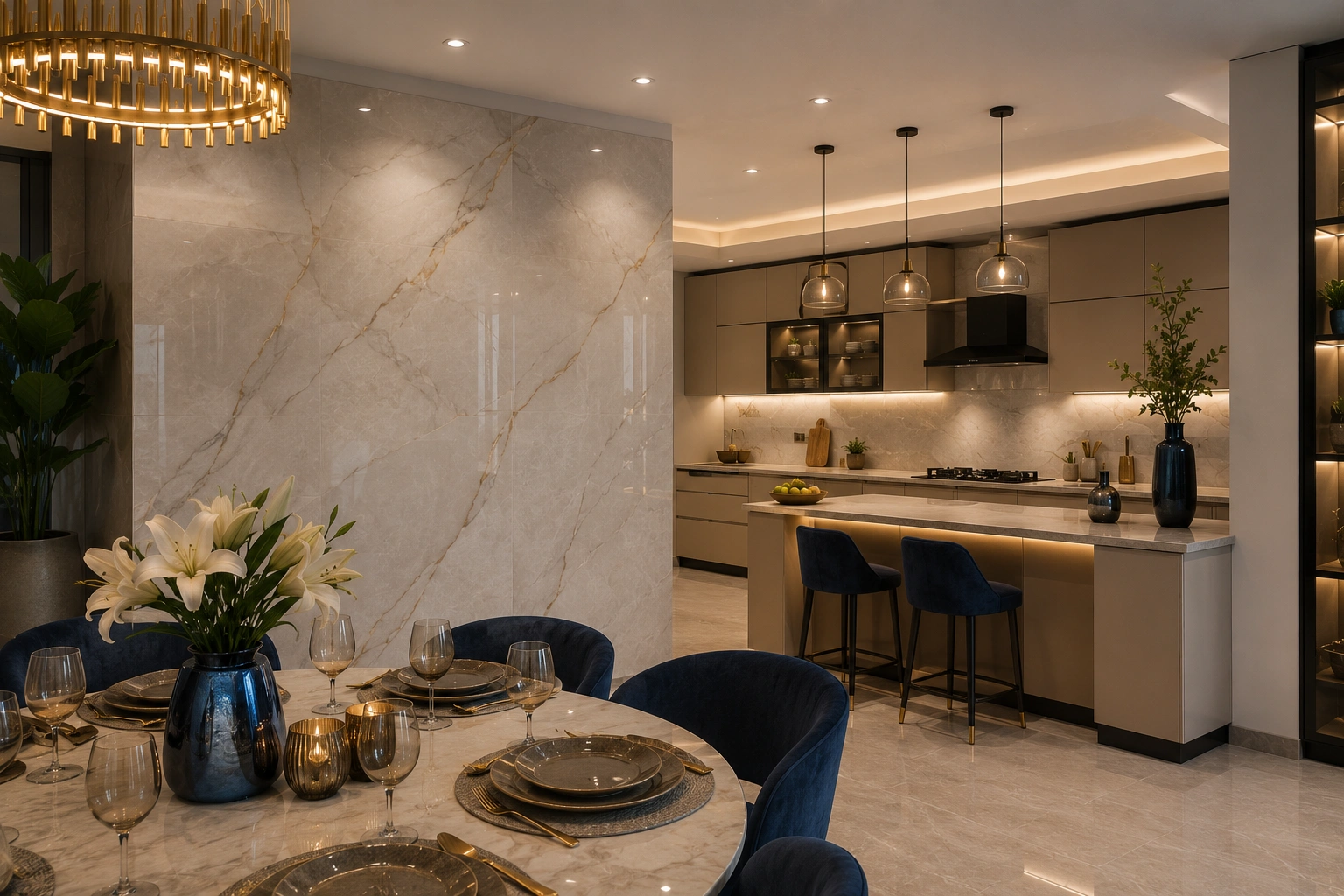
The finish of a wall tile changes its character more than the pattern does in some cases. A plain white tile in a glossy finish reads as modern and crisp. The same white in a matte finish reads as Scandinavian and understated. The same white in a Sugar finish sits somewhere between the two with a tactile quality that photographs well.
| Kitchen Style | Recommended Wall Tile Finish | Tile Category That Fits | What to Avoid |
| Standard Indian modular kitchen | Glossy ceramic on backsplash, matte or GHR GVT on side walls | Ceramic, GVT | Deep textured tiles near hob |
| Scandinavian or minimal | Matte or Satin Matte GVT on all walls | GVT, Porcelain | High-gloss finishes; they conflict with the understated style |
| Bold contemporary (urban apartment) | High Glossy or PGVT on feature wall; matte ceramic on cooking zone wall | PGVT, GVT, Ceramic | Mixing too many finishes across four walls |
| Traditional Indian (South Indian, Rajasthani) | Third Fired decorative accent strips with glossy ceramic field tiles | Ceramic, Third Fired | Large-format plain tiles; they conflict with traditional ornamental detail |
| Premium open kitchen | Large format PGVT or GVT marble-look on feature wall; glossy ceramic on cooking zone | PGVT, GVT | Small-format tiles on the feature wall; reduces visual impact |
Kitchen Wall Tiles Budget Breakdown for India
Kitchen wall tile costs vary across three distinct budget brackets in India. The bracket you choose determines the tile category, finish quality, and design range available to you. All price ranges below are per sq. ft. and exclude GST and installation.
| Budget Bracket | Price Range (per sq. ft.) | Tile Category | Finish Options | Best For |
| Entry | ₹30 to ₹70 | Ceramic (12x18, 12x24) | Glossy, Satin, basic patterns | Rental properties, first renovations, compact kitchens where the backsplash is the only tiled wall |
| Mid | ₹70 to ₹130 | GVT (2x2, 2x4), Ceramic premium | Matte, GHR, Glossy, stone-look and marble-look prints | Standard modular kitchens in 2BHK and 3BHK flats across metro and Tier 1 cities |
| Premium | ₹130 to ₹300+ | PGVT (2x4, 32x48, 6x4), Full Body, slab tiles | PGVT Polished, High Glossy, large-format stone and marble looks | Open-plan luxury kitchens, feature walls in premium 3BHK and 4BHK flats, builder upgrades |
A practical approach for most Indian 2BHK and 3BHK kitchens: spend the mid-range budget on the backsplash and cooking zone wall where the tile sees the most use and is most visible, and use entry-level ceramic tiles on the side walls and utility walls that see less stress and are less prominent. This combination keeps the total wall tile spend in check while putting quality where it counts.
Six Things to Confirm Before Buying Kitchen Wall Tiles
1. Confirm the tile is wall-rated for your chosen zone. Ceramic 12x18 and 12x24 are wall-only. GVT in 2x2 and 2x4 is wall and floor rated. PGVT is wall-only in kitchen contexts. Third Fired decorative tiles are wall-only and should go away from the cooking zone. Confirm the rating with the dealer before purchasing.
2. Measure the backsplash height before choosing the tile size. The backsplash wall height in most Indian kitchens (countertop to overhead cabinet base) is 450 mm to 600 mm. A 12x18 tile fills this with one tile and a small cut. A 12x24 fills it cleanly with one full tile. A 2x4 tile will need to be cut significantly to fit this height, generating waste and additional installation complexity.
3. Take a physical sample home and check it in your kitchen's actual lighting. Showroom LED spotlights make every tile look bright and sharp. A glossy white tile in a north-facing kitchen with tube lights can look grey and flat. Check the sample under your kitchen's existing or planned lighting before confirming the order.
4. Choose the grout colour at the same time as the tile. Grout choice changes the look of a tile installation significantly. White grout with white tiles reads as seamless. Charcoal grout with white tiles creates contrast and a graphic quality. Either is a valid design choice, but choosing grout after installation means making a decision under pressure with no ability to change the tile if the combination does not work.
5. Account for outlets and switches in your tile layout plan. Mark the positions of all electrical outlets, light switches, and exhaust fan points on the wall before planning the tile layout. Tiles that fall over outlets need precise cutting, and larger format tiles generate more cutting waste around obstacles. Share this information with the tile installer before work begins.
6. Buy 10 to 15% more tiles than your measured wall area. Kitchen wall tiles involve more cuts than living room walls because of the backsplash height, outlet positions, and the chimney mounting area. This wastage adds up. Buying a buffer also protects you if a tile cracks during installation or needs replacement later from a different production lot.
What Most Homeowners Get Wrong About Kitchen Wall Tiles
Using the same tile on all four walls. The cooking zone wall and the side utility walls face completely different conditions. A glossy ceramic that works perfectly behind the hob may look clinical and out of place on the feature wall facing the dining area. Using different tiles in different zones, coordinated by colour and tone, gives the kitchen more visual depth without making it look unplanned.
Choosing the tile before confirming the cabinet colour. Kitchen wall tiles sit sandwiched between overhead and base cabinets. If the cabinet colour changes during the project (which happens often when delivery timelines shift or the homeowner changes their mind), the wall tile that was chosen to complement the original cabinet colour may now clash. Confirm the cabinet colour first, then choose the wall tile.
Skipping the feature wall entirely. In open-plan kitchens, the wall visible from the living area is often left with the same plain backsplash treatment as the cooking zone wall. This wall deserves specific attention. Even a single design change, a different tile format, a marble-look GVT instead of a plain ceramic, or a PGVT tile with stronger veining, transforms how the kitchen reads from outside the cooking space.
Installing PGVT or polished GVT directly behind the hob. The high-shine polished finish on PGVT and polished GVT tiles looks impressive in showrooms. Behind the hob in a working Indian kitchen, cooking oil vapour leaves a film on the surface that dulls the shine within weeks. Polished tiles on the cooking zone wall require significantly more cleaning than glossy ceramic to maintain their appearance.
Buying tiles before confirming the chimney installation height. The chimney mounting bracket on a kitchen wall needs to be positioned before tiling begins, or it will cut through tile mid-panel and look unfinished. Many kitchens are tiled before the chimney is confirmed, resulting in a bracket that bisects a tile or lands on an awkward grout line. Confirm all appliance wall-mounting points before the tile work starts.
Kitchen wall tiles are one of those choices where spending an extra hour before buying saves weeks of cleaning and years of looking at a surface you are not happy with.
Before finalising, walk through your kitchen and think about each of the four wall zones separately. The cooking zone wall needs a smooth, wipe-clean surface. The feature wall in an open kitchen deserves a stronger design treatment. The side walls can handle more decorative choices. Each zone has different priorities.
You can browse kitchen wall tiles on TilesFinders by category, finish, size, and colour to compare options from Indian manufacturers. Filter by zone requirement or budget bracket to shortlist tiles before visiting a showroom.

FAQs
Glossy ceramic tiles in 300x450 mm (12x18) or 300x600 mm (12x24) are the most practical choice for the cooking zone and backsplash wall in Indian kitchens. They are smooth, wipe clean after oil and masala splatter, are available in a wide design range, and start from approximately ₹30 per sq. ft. For the feature wall in open kitchens, GVT or PGVT tiles in 600x1200 mm (2x4) in a marble-look or stone-look pattern are the stronger visual choice.
White, off-white, and light grey are the most practical kitchen wall tile colours for Indian homes because they reflect light, make compact kitchens feel larger, and pair with any cabinet colour. For a more distinctive look in 2026, sage green, slate blue, and terracotta are strong accent wall options. Dark navy or bottle green on the backsplash wall paired with white cabinetry is a high-contrast combination that also hides masala marks better than pale tile colours.
The 300x600 mm (12x24) size is the most versatile for Indian kitchen walls. It fits standard backsplash heights cleanly with one tile and minimal cutting, works in both horizontal subway and vertical stacked layouts, and is available in ceramic across a wide price range. For larger open kitchens where a seamless look is the goal, 600x1200 mm (2x4) GVT tiles reduce grout lines and work well on feature walls. For compact kitchens below 80 sq. ft., the 300x450 mm (12x18) size keeps the backsplash proportionate.
Yes. Glossy tiles are actually the recommended finish for kitchen walls in Indian homes, particularly for the backsplash and cooking zone wall. The smooth glossy surface does not absorb cooking oil or masala, and a damp cloth wipes it clean in seconds. Glossy tiles also reflect ambient light, which helps in kitchens with limited natural light. The only caution is that glossy and polished finishes show water marks near the sink more readily than matte tiles do, and they should never be used on kitchen floors.
Kitchen wall tile costs in India range from approximately ₹30 per sq. ft. for standard glossy ceramic to ₹300 or more per sq. ft. for premium PGVT, Full Body, or large-format slab tiles. For a standard modular kitchen backsplash of around 30 to 40 sq. ft., the total wall tile cost falls between ₹900 and ₹12,000 for the tiles alone at entry and mid-range price points, excluding GST and installation. Mid-range GVT tiles in 2x2 or 2x4 sizes cost approximately ₹70 to ₹130 per sq. ft.
Only if the tile category supports both applications. GVT tiles in matte or GHR finish can go on both walls and floors. Ceramic tiles in 12x18 and 12x24 are wall-only and should not be used on kitchen floors because of their high water absorption. PGVT is wall-only in kitchen contexts because its polished finish is slippery when wet. If you want a coordinated wall-and-floor look, choose a GVT tile that is rated for both, using a glossy or matte finish on the wall and a matte or GHR finish on the floor.
Smooth glossy ceramic is the easiest finish to clean on kitchen walls in an Indian home, particularly in the cooking zone behind the hob and the backsplash around the sink. The non-porous gloss surface does not absorb oil or turmeric, and a single wipe with a damp cloth removes most cooking splatter. Matte tiles are slightly harder to clean in high-oil zones but show fewer water marks near the sink. Avoid textured finishes with deep grooves (Glossy Carving, High Depth punch) on cooking zone walls as they trap grease and require scrubbing rather than wiping.

See our tile guides first
Set TilesFinders as a preferred source and our buying guides surface ahead of the rest for you.
Add as preferred sourceTakes one tap. Nothing to install.
What Readers Say
I was about to redo my parking area with the wrong tile size until I read this. The layout comparisons saved me from a costly mistake.
We reference TilesFinders guides while briefing clients on material selection. The size and pattern breakdowns are accurate and easy to explain visually.
On site, I get asked about grout spacing all the time. This article gave me a solid reference I now share with my team before every job.
Finally a guide that doesn't just push generic advice. The oil stain removal steps actually worked on our clubhouse driveway tiles.
I run a small construction firm and now send this link to clients directly when they ask about entrance tile sizing. Saves me an hour of explaining.
Good practical detail, though I wish there were more examples for compact apartment entrances specifically, not just villas.
My mother-in-law wanted marble, I wanted vitrified. This blog gave us the neutral comparison we needed to actually decide together.
Detailed without being overwhelming. I appreciated that it covered both cost and maintenance, not just the aesthetics.
Used the algae and hard water removal tips on our terrace tiles after the monsoon. Worked better than what our regular cleaner was doing.
As someone who sources tiles for multiple builder projects, I find these comparisons genuinely useful for vendor conversations, not just consumer content.
Recommended this to a client who kept second-guessing the entrance design. The small vs large layout section settled the debate instantly.
Straightforward and honest, no unnecessary jargon. Would like to see a similar breakdown for outdoor pool-deck tiles next.
We've bookmarked several TilesFinders guides for our design handbook. Reliable source when clients want data, not just opinions.
Two paths, one marketplace.
Get free quotes from verified suppliers.
Share your room, budget, and style. Suppliers in Morbi respond within hours.
Get Free QuotesList your business, reach real buyers.
Put your showroom in front of homeowners searching for tiles right now.
List Your Business