Best Tiles for Car Parking Area: Top Picks for Indian Climate
Find the best car parking tiles for Indian homes with anti-skid, matte, and heavy-duty finishes. Compare GVT, full body, and outdoor parking tiles on TilesFinders.
- Why Indian Climate Makes Parking Tile Selection Different
- Best Types of Parking Tiles for Indian Homes and Driveways
- Anti-Skid Surface Finishes: What Works in Indian Parking Areas
- Parking Tile Thickness and Size: The Numbers That Matter
- Parking Tiles Design Ideas for Indian Homes in 2026
- Which Parking Tiles Work Best in the Indian Climate Region?
- Parking Tile Price in India: 2026 Reference
- Expert Tips Before Buying Parking Tiles for Indian Homes
- Common Mistakes When Choosing Parking Tiles for Indian Homes
- Finding the Right Parking Tiles for Your Home or Project
Choosing the right car parking tiles in India is not a single decision. It depends on where your parking is (open, covered, basement, or ramp), what vehicles use it, and how the local climate behaves across twelve months.
A tile that holds up perfectly in a covered garage in Pune can crack or slip on an open driveway in Chennai, where heat, humidity, and heavy monsoon rains all hit the same surface within weeks of each other. Indian conditions are hard on outdoor flooring in ways that standard showroom advice does not always account for.
This guide covers the tile categories that actually work for car parking in India, the climate-specific factors to keep in mind by region, what to check on parking tiles design and finish, and a practical price reference to plan your budget.
Why Indian Climate Makes Parking Tile Selection Different
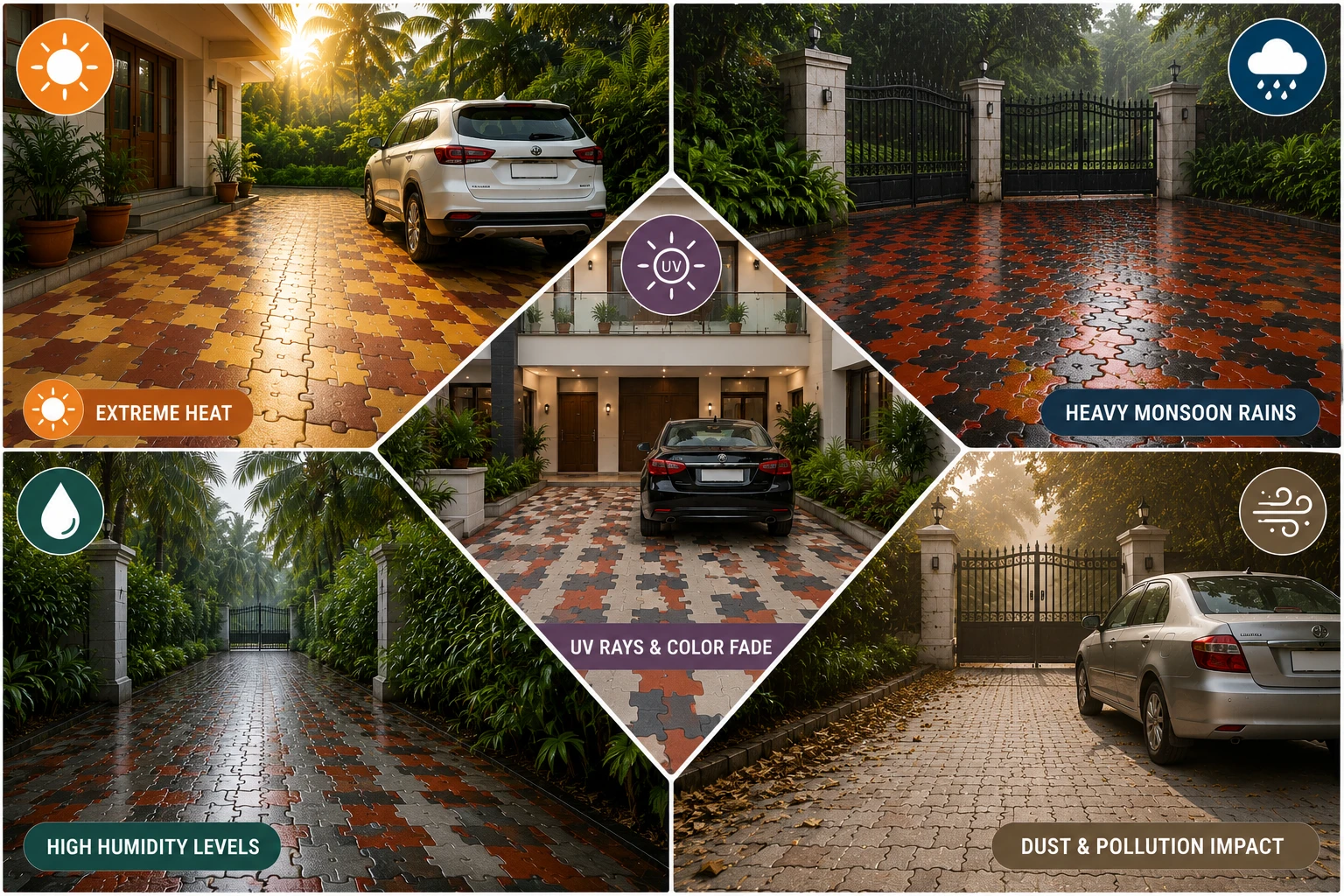
India does not have one climate; it has at least four distinct outdoor floor challenges packed into a single year. Any tiles for a parking area in India must be picked with all of them in mind.
Extreme summer heat: In cities like Ahmedabad, Nagpur, and Delhi, open parking surfaces routinely reach 35 to 45 degrees Celsius in May and June. Tiles with high thermal expansion or low heat resistance warp, crack at grout lines, or fade in colour over two to three summers. Heat-resistant tiles with a low thermal coefficient handle this without any visible surface change.
Monsoon water and thermal shock: When a rain shower hits a surface baked in afternoon sun, the sudden temperature drop creates thermal stress. Tiles with high water absorption (like ceramic) absorb that moisture and crack from the inside. Rainproof outdoor flooring for parking must have near-zero water absorption to survive repeated thermal shock through the monsoon season.
Oil and chemical exposure: Car parking floors take daily oil drips, fuel spills, and tyre rubber deposits. Tiles for the parking area must resist stain penetration. Porous tiles stain permanently within months and cannot be cleaned back to their original appearance.
Coastal humidity and salt air: In Mumbai, Kochi, Chennai, and Vizag, salt-laden air accelerates surface deterioration on tiles that are not designed for outdoor durability. Full body and GVT tiles fired at very high temperatures are not affected by coastal air. Ceramic tiles and some porcelain grades degrade faster in these conditions.
Best Types of Parking Tiles for Indian Homes and Driveways
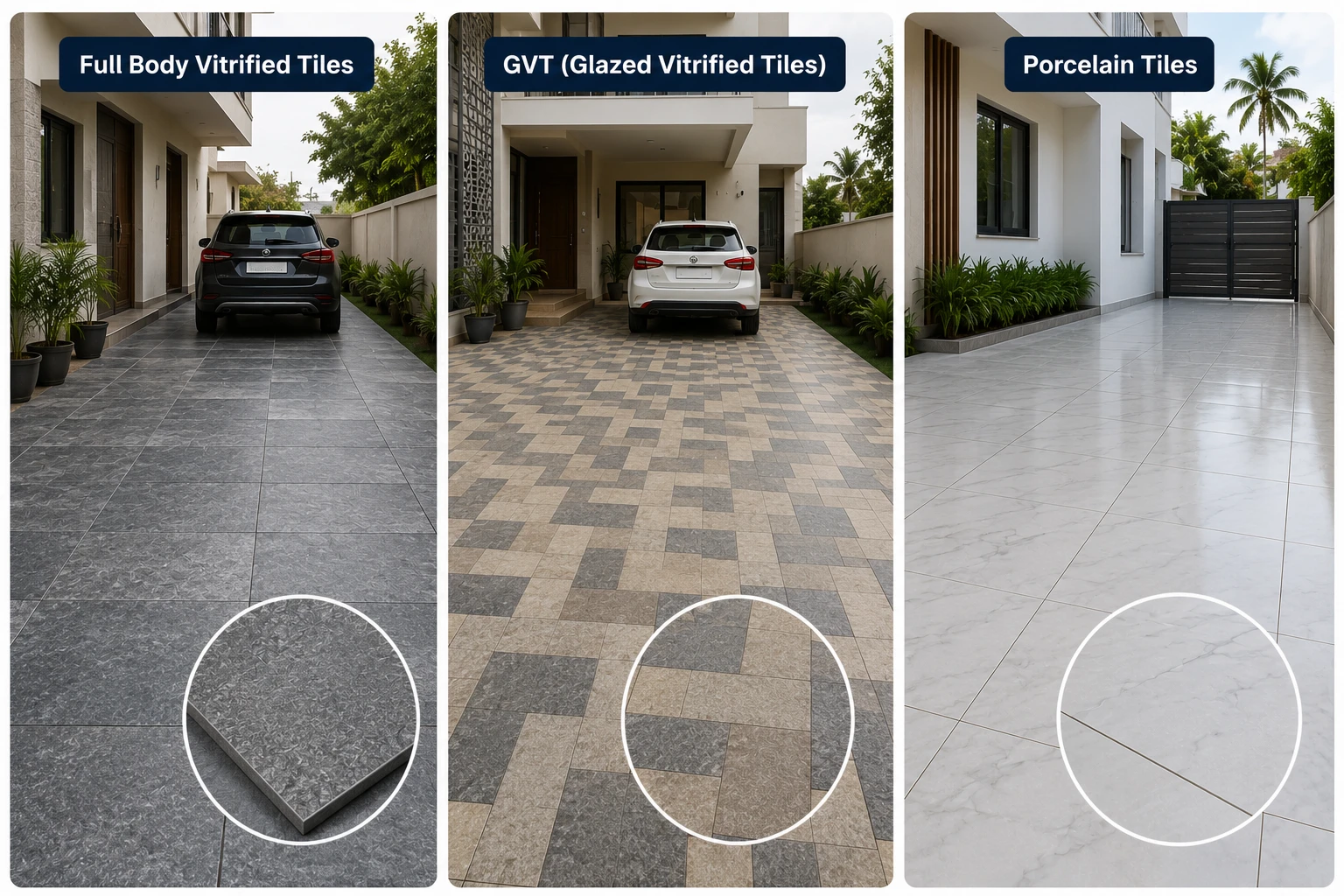
Three tile categories work well for car parking in Indian conditions. Each has different strengths, and the right one depends on the parking setup.
Full Body Vitrified Tiles: The Strongest All-Round Pick
Full-body vitrified tiles are the top choice for heavy-duty parking tiles in India. The tile's colour and composition run through the entire thickness, not just the surface layer. When tyre grit scratches the surface over the years, the tile looks the same underneath. This is what makes them the go-to for society parking areas, commercial car parks, and sloped driveways with frequent traffic.
For commercial areas, ramps, or heavy SUVs, standard parking specifications may not be enough. Learn when heavy-duty tiles are worth the higher investment.
These tiles have very low water absorption, strong resistance to oil staining, and hold up to heavy load capacity from SUVs, MUVs, and loading vehicles. They are available in matte and GHR (Glaze High Resistance) finishes that provide tyre grip even when wet. For open outdoor parking tiles exposed to full Indian sun and rain, a full-body vitrified tile in matte or textured finish is the most reliable option.
Available sizes: 600x600 mm (2x2) and 600x1200 mm (2x4) are the most commonly specified for parking areas in India.
GVT (Glazed Vitrified Tiles): Good for Residential Car Parking
GVT tiles are vitrified tiles with a glazed surface layer fired onto a vitrified body. They have 0.05% water absorption, making them suitable for outdoor use. For residential car parking, including home garages, society parking slots, and open home driveways, GVT tiles in a matte or rough texture finish handle standard vehicle weight and weather exposure well.
The glazed surface also gives more design flexibility. Homeowners who want a parking tile design that looks clean and matches the building exterior will find a wider range of tones and textures in GVT. The key is to avoid glossy finishes and stick to matte finish tiles or GHR surfaces for outdoor applications.
Porcelain Tiles: For Decorative and Lighter Parking Applications
Porcelain outdoor tiles work well for residential driveways, car porch flooring in standalone bungalows, and lighter vehicle parking areas where appearance matters alongside function. They are mostly available in matte finish in India, which suits outdoor use. Water absorption runs between 2 and 5%, which is higher than that of vitrified tiles.
For bungalow parking areas that typically handle one or two passenger vehicles per day and have proper drainage, 16x16 tiles (400x400 mm) or 20x20 inch (500x500 mm) tiles are generally considered a practical and durable choice for everyday residential use. They are not the right pick for ramps, sloped basement entrances, or heavy commercial parking,, where full-body vitrified is a better fit.
What About Parking Ceramic Tiles?
Parking ceramic tiles appear in some older constructions and low-cost residential applications, but they are not recommended for new work. Ceramic tiles have 12 to 16% water absorption, which is too high for outdoor or wet parking conditions. Many parking failures happen because standard indoor floor tiles are used outdoors under vehicle load. See how parking vs floor tiles differ in durability, thickness, and weather resistance.
Under repeated monsoon exposure and vehicle load, they crack within a few years and are difficult to replace piece by piece once the design is discontinued. For any parking area tiles project in India today, vitrified or porcelain categories are the right starting point.
| Tile Category | Water Absorption | Is Outdoor OK? | Heavy Load? | Best For |
| Full Body Vitrified | Very low | Yes | Yes | Society, ramps, commercial, driveways |
| GVT (Glazed Vitrified) | 0.05% | Yes | Standard | Home parking, bungalow car porch, society slots |
| Porcelain | 2% to 5% | Light use | Moderate | Bungalow driveway, light residential use |
| Ceramic | 12% to 16% | Not advised | Poor | Not recommended for any outdoor parking |
Anti-Skid Surface Finishes: What Works in Indian Parking Areas
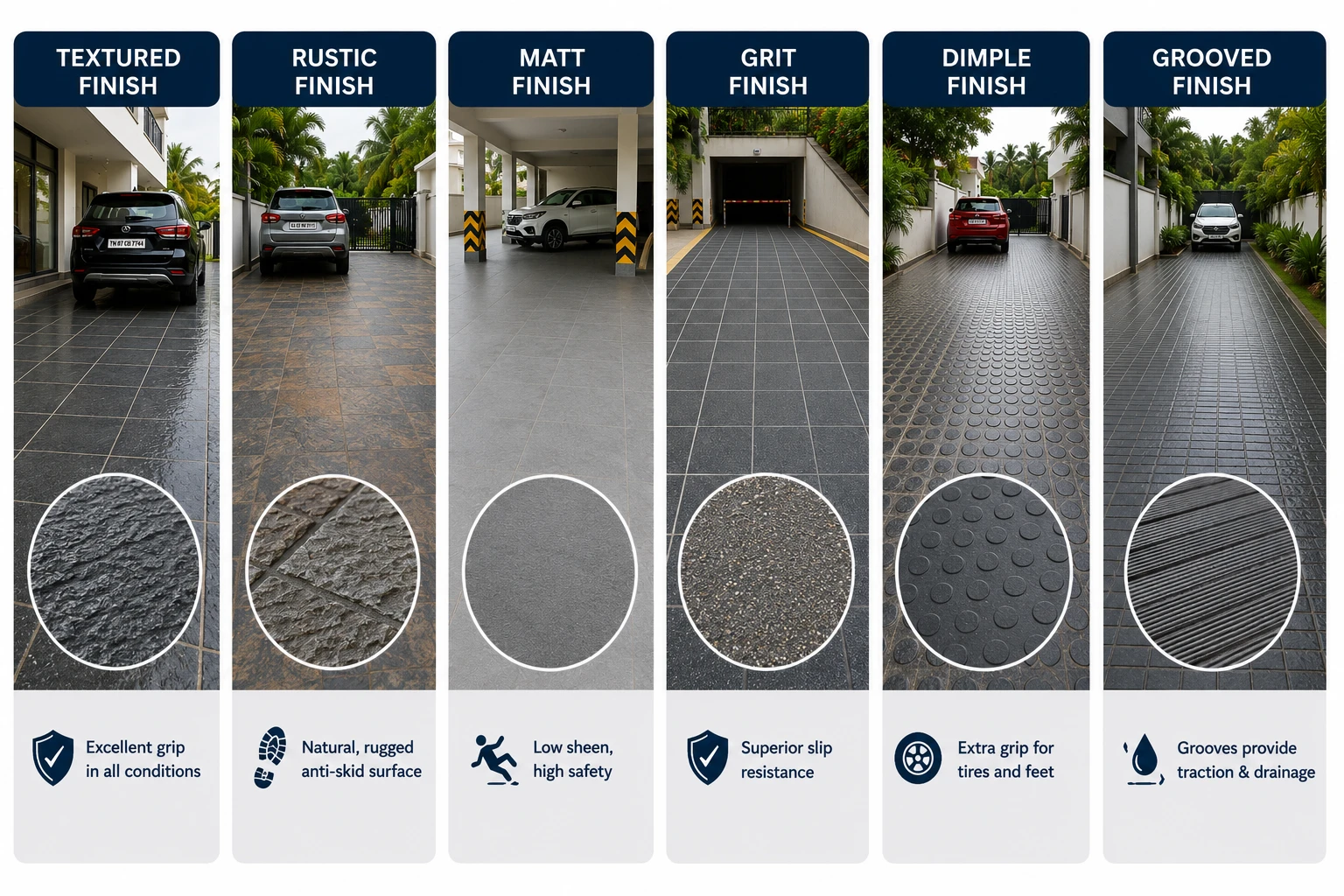
The tile category decides the body strength. The finish decides the safety. For outdoor parking in India, the finish must give tyre grip and foot traction in both dry summer heat and wet monsoon conditions. Here are the finishes that work. Slip resistance depends on more than just finish type. Understanding R-values, anti-skid ratings, and safety standards helps avoid choosing parking tiles that become risky during monsoon conditions. Explore our guide on anti-skid tiles.
Matte Finish Tiles: Matte finish tiles are the most practical and widely available finish for parking areas across India. The surface has low reflectivity, good scratch resistance, and stays slip-resistant even when wet. They hide tyre marks and dust better than lighter or smoother finishes. For any covered or open residential parking, matte is the default right choice.
GHR (Glaze High Resistance): The GHR finish creates a stone-like textured surface with strong anti-skid surface grip. It is well-suited to outdoor driveways, open-air society parking, and ramp surfaces where water accumulates during rain. The finish looks natural and hides dirt well between cleaning cycles.
Rough Texture Tiles: Rough texture tiles have a more pronounced surface grain. These are used in industrial-strength applications like heavy-duty parking in factories, warehouses, and loading bays, but also appear in open residential driveways in coastal areas. The depth of the texture traps water away from the walking or rolling surface, providing traction even on slopes.
Rain Drops Finish: Rain drop tiles carry glossy or matte drops on a matte base. The pattern creates micro-traction points across the tile surface. These work in covered parking areas where the combination of appearance and grip matters.
Finishes to avoid: any glossy, high-glossy, polished, or satin matte finish is a poor fit for parking areas. These surfaces look good in a showroom but become dangerously slippery when wet. Polished vitrified tiles, regardless of how strong the body is, are not safe for vehicle-friendly flooring outdoors.
Parking Tile Thickness and Size: The Numbers That Matter
Getting the size and parking tile thickness right is as important as the category and finish. Both affect how long the tiles last and how safe the surface stays.
Thickness by Vehicle Type
| Vehicle Type | Recommended Thickness | Notes |
| Two-wheelers (bikes, scooters) | 8 mm to 10 mm | Good for two-wheeler dedicated home parking |
| Sedans, hatchbacks, small SUVs | 10 mm to 12 mm | Standard for residential and society parking |
| Large SUVs, MUVs, vans | 12 mm | Full body vitrified at 12 mm recommended |
| Trucks, heavy commercial vehicles | 12 mm or paver blocks | Industrial-strength tiles or concrete paver blocks for very heavy loads |
Size Recommendations by Parking Type
| Tile Size (mm) | Inches | Best Parking Application |
| 400x400 mm | 16x16 | Compact home parking, two-wheeler bays, decorative garden driveways |
| 500x500 mm | 20x20 | Standard residential parking, car porch tiles for bungalows, driveway parking tiles |
| 600x600 mm | 2x2 | Society parking, covered garage parking tiles, open home parking |
| 600x1200 mm | 2x4 | Large commercial parking, wide driveways, flat parking area, and flooring tiles |
Parking Tiles Design Ideas for Indian Homes in 2026
Parking area design does not have to stop at function. With the range of textures, tones, and layouts available from Indian manufacturers, a parking floor can look purposeful and clean without any extra effort.
Cement-look parking tiles: Cement-look parking tiles in grey or charcoal tones are the most popular design choice across Indian cities. They hide tyre marks and dust naturally, require low maintenance, and suit both modern and traditional exteriors. These are available in GHR or matte finish in the full-body vitrified category.
Stone-finish tiles for bungalows: Stone tiles in brown, beige, or slate tones suit standalone bungalow driveways and villa parking areas. The textured parking tiles' surface handles grip requirements while giving a natural, landscaped look to the parking area.
Two-tone layout for defined bays: A combination of a darker centre tile with a lighter border, or a contrasting bay marking tile, gives a clean, organised look to home parking. This works well in larger society parking areas, too, where visual lane marking is useful.
Light neutral tones for garage floor tiles: For covered parking and garage parking tiles, light beige or off-white matte tiles make the space feel brighter and more spacious. These work for parking areas that double as a utility space or workshop area in the home.
Textured parking tiles with grid pattern: A grid or ribbed surface pattern on matte vitrified tiles creates both visual structure and traction across the parking surface. These designs are commonly used in residential parking flooring for homes with modern exteriors.
Which Parking Tiles Work Best in the Indian Climate Region?
The same tile specification does not serve every part of India equally. Here is a quick reference by climate zone.
| Region / Climate | Key Challenge | Best Tile Specification |
| North India (Delhi, Jaipur, Lucknow) | Extreme heat, cold winters, thermal expansion | Full body vitrified matte, 10 to 12 mm, with expansion joints at 3 m intervals.s |
| West India (Mumbai, Surat, Ahmedabad) | Heavy monsoon rain, humidity, and oil staining | GVT or full body vitrified, GHR finish, R11 slip resistance, epoxy grout |
| South India (Chennai, Bangalore, Kochi) | Year-round humidity, coastal salt air, UV exposure | Full body vitrified, darker tones to hide sun bleaching, matte anti-skid finish |
| East India (Kolkata, Bhubaneswar) | High humidity, long monsoon, waterlogging risk | Full body vitrified, good drainage slope, slip-resistant flooring at R11 or above |
Parking Tile Price in India: 2026 Reference
Parking tile price in India varies by category, finish, size, and brand origin. Tiles from Morbi-based manufacturers are typically 15 to 25% more affordable than branded equivalents for the same specification. All prices below are approximate and exclude GST and installation.
| Tile Type and Finish | Approx. Price / sq. ft. | Notes |
| GVT matte / GHR | Rs. 60 to Rs. 150 | Most popular for residential car parking and society lots |
| Full Body Vitrified matte / textured | Rs. 90 to Rs. 200 | Best for heavy-use, ramps, and weather-exposed parking |
| Porcelain matte | Rs. 90 to Rs. 220 | Bungalow driveways, decorative residential parking |
Installation adds approximately Rs. 25 to Rs. 50 per sq. ft., depending on the city and contractor. Always add 10% to the tile quantity for wastage and future replacements, and confirm the GST component separately with the dealer.
Expert Tips Before Buying Parking Tiles for Indian Homes
1. Match the tile to the parking type, not just the look: Open driveway parking tiles face full sun, rain, and temperature swings. Garage parking tiles in a covered space face grease and tyre wear. Basement parking needs weatherproof tiles that also handle low lighting and vehicle exhaust. Each needs a slightly different specification.
2. Always ask for R-rated anti-skid tiles: Anti-skid tiles for parking should carry a certified R-value, not just a general anti-skid label. R10 is the minimum for open residential parking. R11 or R12 for ramps and slopes. This one check prevents most slip-related incidents.
3. Choose durable parking tiles that are stain-resistantas stain-resistant. Look for tiles described as stain-resistant tiles with low porosity. Full-body vitrified tiles resist oil and fuel staining at the body level. Lower-grade tiles with a thin surface glaze stain permanently after the surface is scratched.
4. Keep colour in mind for heat: Very dark tiles absorb heat in summer and become uncomfortable to touch or walk on barefoot. For open parking in Rajasthan, Gujarat, or Telangana, mid-tones like grey, stone-beige, or earthy brown manage heat better than jet black.
5. Get the subbase right before tiling: Tiles are only as strong as the base under them. An uneven or weak subbase causes tiles to crack even if the tile itself is perfectly rated. Confirm that the contractor is preparing a proper cement bed before laying, and ask about expansion joints for large open areas.
6. Order samples before full purchase: Outdoor tiles look different under direct sunlight than under a showroom ceiling. Take a few sample tiles home, lay them in the actual parking space, and observe them in morning light, afternoon sun, and after a water spray to simulate rain. This one step prevents most design regrets.
7. Plan for drainage slope: Good outdoor tile durability depends partly on water draining away from the surface quickly. Ask your contractor to lay the parking area with a 1 to 2% slope toward the drain. Tiles that sit in pooled water wear faster and carry more risk of slipping.
Common Mistakes When Choosing Parking Tiles for Indian Homes
Using polished or glossy tiles outdoors: The most common and costly error. Polished tiles look good when dry, but become a serious slip hazard when wet. No amount of anti-skid claim fixes a polished or high-gloss surface finish for outdoor use in India.
Picking tiles for looks alone: Parking area flooring tiles chosen purely for how they appear in a catalogue often fail the practical test. Dark Italian marble-look polished tiles in an open Mumbai driveway look good in photos for exactly one dry season.
Underestimating Indian summer heat: Light-coloured tiles reflect heat. Dark-coloured tiles absorb it. For parking areas with direct sun in hot-climate cities, black or very dark tiles make the surface very hot and can warp vehicle tyres over time. Mid-tone grey or brown tones handle Indian summers better.
No expansion joints in large open areas: Outdoor tiles expand in heat and contract at night. Without expansion joints at regular intervals, tiles buckle and crack. This is an installation mistake, but buyers should confirm it is planned before work begins.
Buying too thin for the vehicle: 8 mm tiles rated for foot traffic crack under vehicle weight. Parking tiles for car use need a 10 to 12 mm thickness. Getting this wrong means relaying the entire floor within two years.
Ignoring grout selection: Standard white cement grout stains permanently in parking conditions. Use epoxy or polymer-modified grout for any parking area. The tile may be stain-resistant, but an untreated grout line absorbs everything.
Finding the Right Parking Tiles for Your Home or Project
Parking tiles for Indian homes are a long-term investment in both safety and appearance. The right tile holds its surface under vehicle weight, survives the monsoon without staining, and looks the same five years from now as it did on the day it was laid.
Before placing an order, note your parking type (open, covered, ramp, or driveway), the vehicles using it, and the climate in your city. Take those three inputs to the tile selection process and ask specifically for matte or GHR finish, full body or GVT category, 10 to 12 mm thickness, and a certified R-rating of R10 or above.
You can browse and compare car parking tiles across finishes, categories, and sizes from manufacturers across India through TilesFinders. The platform helps you shortlist parking area flooring tiles with the right specifications for your parking type, see pricing ranges, and connect with dealers without visiting multiple showrooms.

FAQs
Full-bodyall-around vitrified tiles with a matte or GHR finish are the best all-round choice for car parking areas in India. They have very low water absorption, strong abrasion resistance, and can handle vehicle weight without cracking. For residential use, GVT tiles with a matte or rough texture finish also work well. Porcelain tiles are a good fit for decorative bungalow driveways with lighter traffic.
Yes, but the type of vitrified tile matters. Full-body vitrified tiles are the best option because the material runs through the entire tile, making them more scratch-resistant than GVT tiles, whose wear affects the glaze surface layer over time. Both are good for residential parking. Avoid PGVT (polished glazed vitrified) tiles for any parking application,n as the polished surface becomes slippery when wet.
For open outdoor parking tiles in India, full body vitrified or GVT tiles in a matte, GHR, or rough texture finish are the right pick. These handle monsoon water, summer heat, thermal expansion, and UV exposure without significant surface degradation. Avoid ceramic tiles and any polished or glossy finishes outdoors. Always confirm the tile is rated for outdoor use with near-zero water absorption.
Yes. Anti-skid tiles are not optional for any outdoor or wet parking surface in India. Even in covered parking, vehicle tyres carry water and oil from the road onto the parking floor. A non-slip surface reduces tyre skid, prevents pedestrian falls, and matters most on ramps and slopes. Look for a certified R-rating of R10 or above for open residential parking and R12 for ramps.
The best parking tiles for Indian homes across climate zones are full-body vitrified tiles with matte or GHR finish, in 600x600 mm or 500x500 mm size, at 10 to 12 mm thickness. For coastal cities like Mumbai or Kochi, confirm the tiles are weather-resistant tiles with low water absorption and fade resistance. For North Indian cities with cold winters, proper expansion joints in the installation are as important as the tile spec itself.
For standard passenger cars and SUVs, 10 mm to 12 mm thick tiles are the right specification. Two-wheeler-only parking can use 8 mm to 10 mm tiles. For heavy commercial vehicles or loading areas, 12 mm is the minimum, and some applications use 15 mm or paver blocks. Thin tiles (7 mm or 8 mm) sold for wall or light indoor use should not be used in any vehicular parking area.
For parking tiles for bungalow driveways and home car porches, GVT or porcelain tiles in 500x500 mm (20x20) size with matte or stone-look finish work well. These sizes handle single or double car traffic comfortably. Choose tones that complement the gate and exterior wall colour. Avoid very light colours in open driveways where tyre marks and dust are visible quickly.

See our tile guides first
Set TilesFinders as a preferred source and our buying guides surface ahead of the rest for you.
Add as preferred sourceTakes one tap. Nothing to install.
What Readers Say
I was about to redo my parking area with the wrong tile size until I read this. The layout comparisons saved me from a costly mistake.
We reference TilesFinders guides while briefing clients on material selection. The size and pattern breakdowns are accurate and easy to explain visually.
On site, I get asked about grout spacing all the time. This article gave me a solid reference I now share with my team before every job.
Finally a guide that doesn't just push generic advice. The oil stain removal steps actually worked on our clubhouse driveway tiles.
I run a small construction firm and now send this link to clients directly when they ask about entrance tile sizing. Saves me an hour of explaining.
Good practical detail, though I wish there were more examples for compact apartment entrances specifically, not just villas.
My mother-in-law wanted marble, I wanted vitrified. This blog gave us the neutral comparison we needed to actually decide together.
Detailed without being overwhelming. I appreciated that it covered both cost and maintenance, not just the aesthetics.
Used the algae and hard water removal tips on our terrace tiles after the monsoon. Worked better than what our regular cleaner was doing.
As someone who sources tiles for multiple builder projects, I find these comparisons genuinely useful for vendor conversations, not just consumer content.
Recommended this to a client who kept second-guessing the entrance design. The small vs large layout section settled the debate instantly.
Straightforward and honest, no unnecessary jargon. Would like to see a similar breakdown for outdoor pool-deck tiles next.
We've bookmarked several TilesFinders guides for our design handbook. Reliable source when clients want data, not just opinions.
Two paths, one marketplace.
Get free quotes from verified suppliers.
Share your room, budget, and style. Suppliers in Morbi respond within hours.
Get Free QuotesList your business, reach real buyers.
Put your showroom in front of homeowners searching for tiles right now.
List Your Business