Anti-Skid Parking Tiles India: Safety Standards and Buying Tips
Anti-skid parking tiles for Indian homes with R-value ratings, PEI standards, tile thickness, grip finishes, and parking tile prices for driveways, ramps, and basement areas.
- Why Anti-Skid Parking Tiles Matter More Than Most Buyers Realise
- India Safety Standards for Parking Tile Slip Resistance: The R Value Explained
- PEI Rating and Abrasion Resistance: The Other Safety Standard for Parking Tiles
- Best Finishes for Anti-Skid Parking Tiles
- Best Categories for Anti-Skid Parking Tiles in India
- Parking Tiles Design: Does Anti-Skid Mean Sacrificing Looks?
- How to Check If Parking Tiles Are Anti-Skid Before Buying
- Anti-Skid Parking Tiles Price in India per Square Feet: 2026 Guide
- Buying Tips Before Choosing Anti-Skid Parking Tiles
- Key Things to Check Before Buying Parking Tiles
The parking area looks fine until it rains. The first monsoon shower turns a smooth, glossy driveway into a surface where cars slide on reverse, and people slip while walking to their gate. That is not a tile quality problem. It is a tile selection problem.
Anti-skid parking tiles are not a luxury addition for high-end projects. In Indian conditions, with monsoon rains, oil dripping from parked vehicles, and mixed pedestrian and car traffic, slip resistance is the starting point for any decision on parking floor tiles.
This guide explains how India's safety standards for parking tile grip work, which finishes and categories genuinely deliver anti-skid performance, and what to check before placing any order.
Why Anti-Skid Parking Tiles Matter More Than Most Buyers Realise
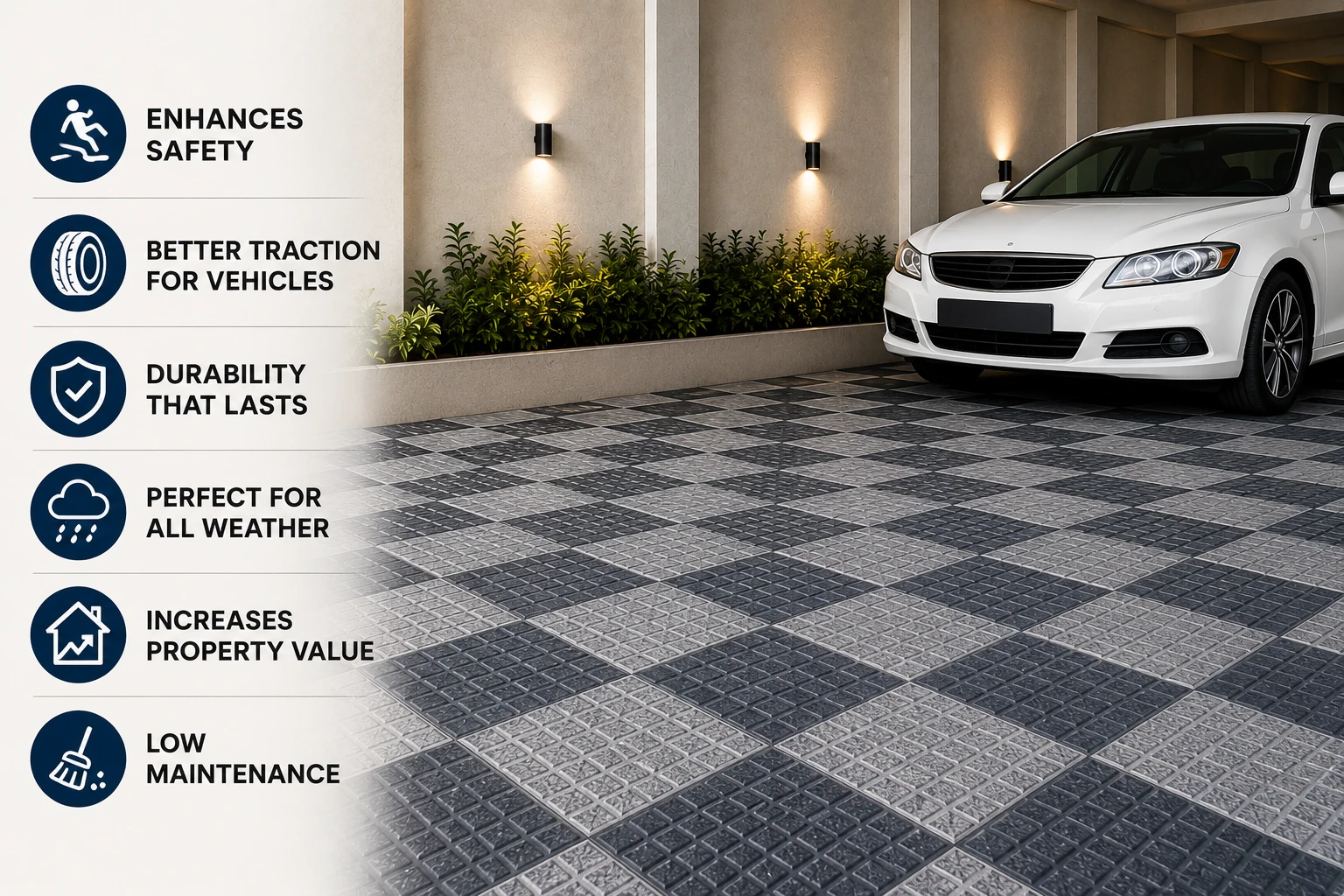
Most parking tile decisions in India are made on three factors: colour, price, and what the dealer recommends. Slip resistance rarely comes up until someone skids. By then, the tile is already laid, the adhesive has cured, and replacement is the only fix.
Parking areas face conditions that no living room or bathroom tile encounters. Tyre grip demands change every time a vehicle reverses or turns on the surface. Rainwater mixed with tyre rubber deposits creates a thin film that is more slippery than standing water. Engine oil drips create localised slip zones near the front and rear of parked cars. All of these conditions need a tile with a surface designed specifically to create friction, not just one that looks good in the showroom.
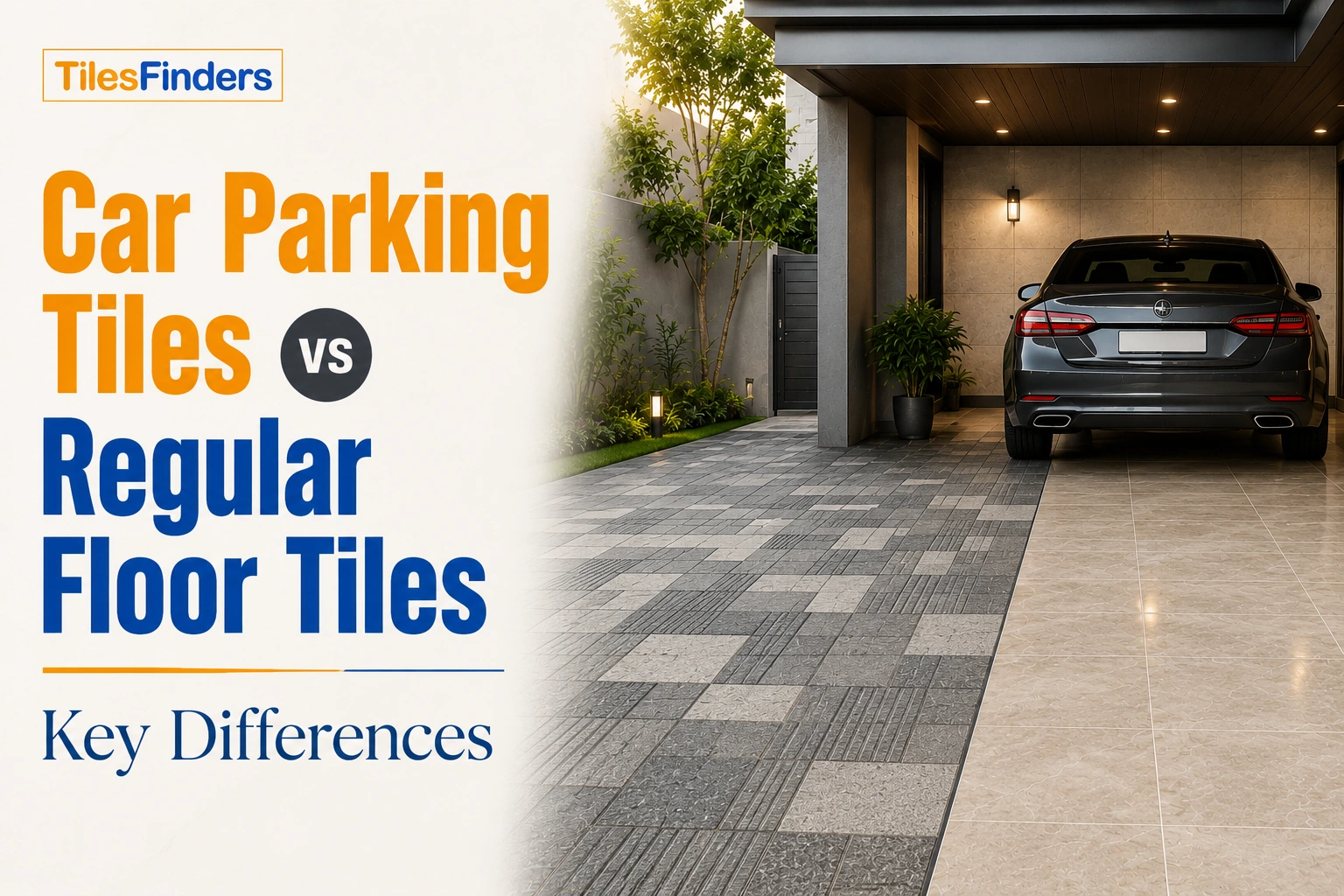
This is also why standard indoor flooring often fails in parking spaces. If you are unsure whether regular floor tiles can handle vehicle load, tyre friction, and outdoor exposure, read our detailed comparison on car parking tiles vs regular floor tiles before choosing any parking flooring.
In homes with elderly residents or children, the driveway and home parking entrance are serious fall risk areas. A non-slip parking tile specification is not optional in these situations. It is the right starting point before any design decision.
India Safety Standards for Parking Tile Slip Resistance: The R Value Explained
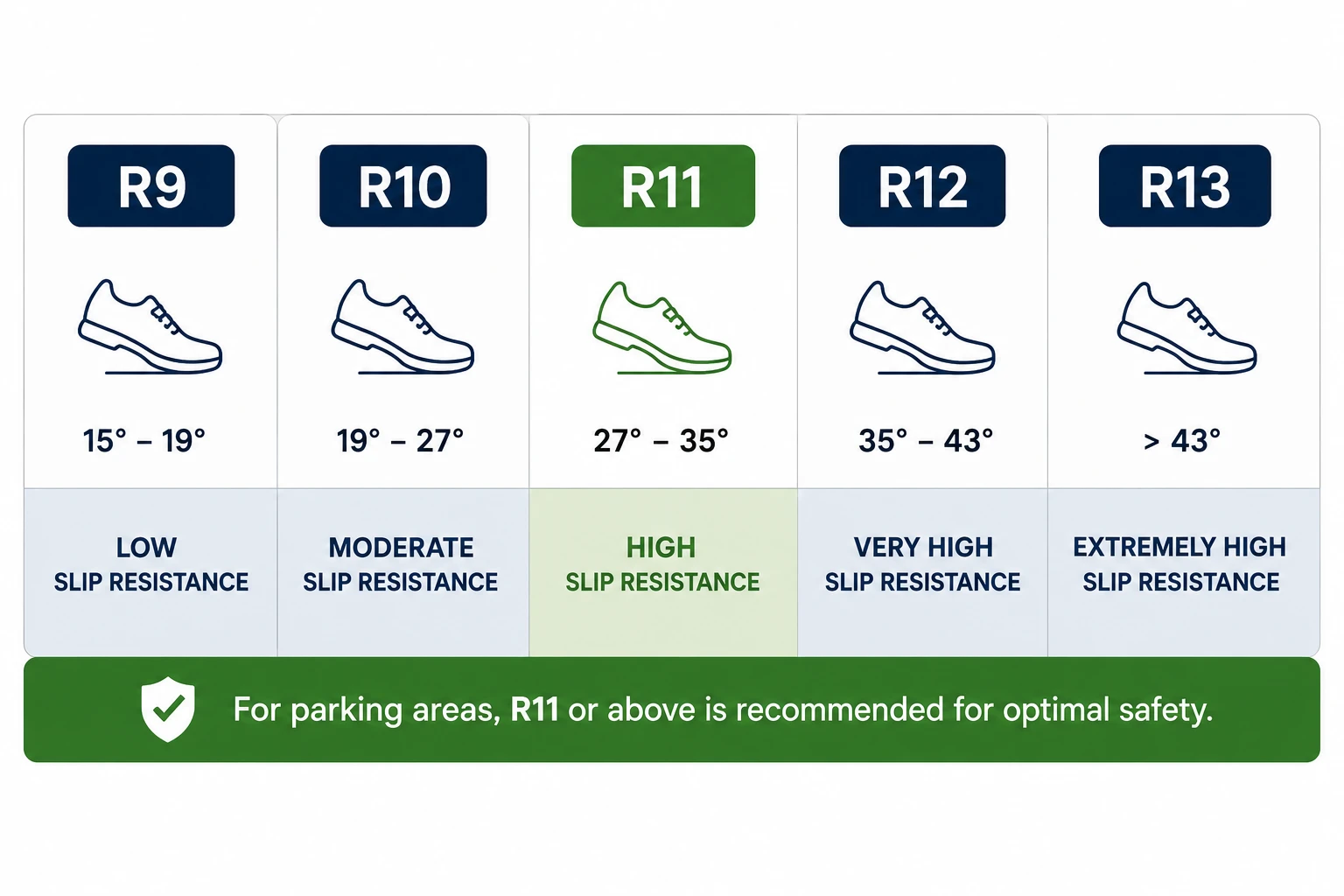
Parking tiles' safety standards in India uses are based on the R value system, which comes from the German DIN 51130 standard for ramp testing. The R value (R9 to R13) measures skid resistance: how much grip a tile surface provides when tested on an inclined surface with oil applied. The higher the R value, the stronger the slip resistance.
What is the R value in parking tiles in India? The parking tiles' R value matters more than any other specification for outdoor safety. It is the anti-skid rating assigned to a tile after a standardised wet ramp test. A person walks on the wet, oiled tile surface at increasing incline angles. The angle at which the person begins to slip determines the R value. R9 is the minimum for general wet areas. R10 covers home driveways and standard parking floors. R11 and R12 are for ramps, sloped surfaces, and commercial parking. R13 is for industrial ramps with oil exposure.
| R Value | Slip Resistance Level | Recommended For |
| R9 | Basic wet area grip | Covered basement parking, light residential use |
| R10 | Good anti-skid surface | Home car parking, open driveways, flat surfaces |
| R11 | Strong grip for slopes | Sloped driveways, parking ramps, and society parking entry |
| R12 | High grip, wet ramp rated | Steep ramps, underground parking entries, and commercial ramps |
| R13 | Maximum grip, oil-rated | Industrial workshops, vehicle service ramps, heavy-duty use |
For a home car parking area on a flat surface, R10 is the minimum to ask for. For parking tiles for ramp situations, sloped driveways, or covered parking entries, R11 or R12 is the right specification. Always ask the dealer for the R value before buying any outdoor anti-slip tiles in India or abroad.
PEI Rating and Abrasion Resistance: The Other Safety Standard for Parking Tiles
The PEI rating parking tiles measure surface hardness and abrasion resistance under repeated foot and vehicle traffic. PEI stands for Porcelain Enamel Institute and rates tiles from 1 to 5. PEI 5 is the hardest, built for heavy vehicular traffic tiles. PEI 1 is the softest, suitable for wall use only.
For any parking area that sees car movement, PEI 4 is the minimum, and PEI 5 is the right choice for high-traffic parking floors. Tiles with lower PEI ratings wear visibly under tyre friction and foot traffic within months. The surface degrades, grip reduces further, and the abrasion resistance that made the tile safe when new disappears within one to two years.
Mohs hardness, which measures surface scratch resistance, is a related specification. Parking tiles for car and heavy vehicle areas should score 6 to 8 on the Mohs scale. Tiles manufactured by companies like H&R Johnson's Endura range are rated at 7 and above on the Mohs scale, equivalent to quartz hardness, which holds up under daily vehicle and foot movement without scratching through.
Best Finishes for Anti-Skid Parking Tiles
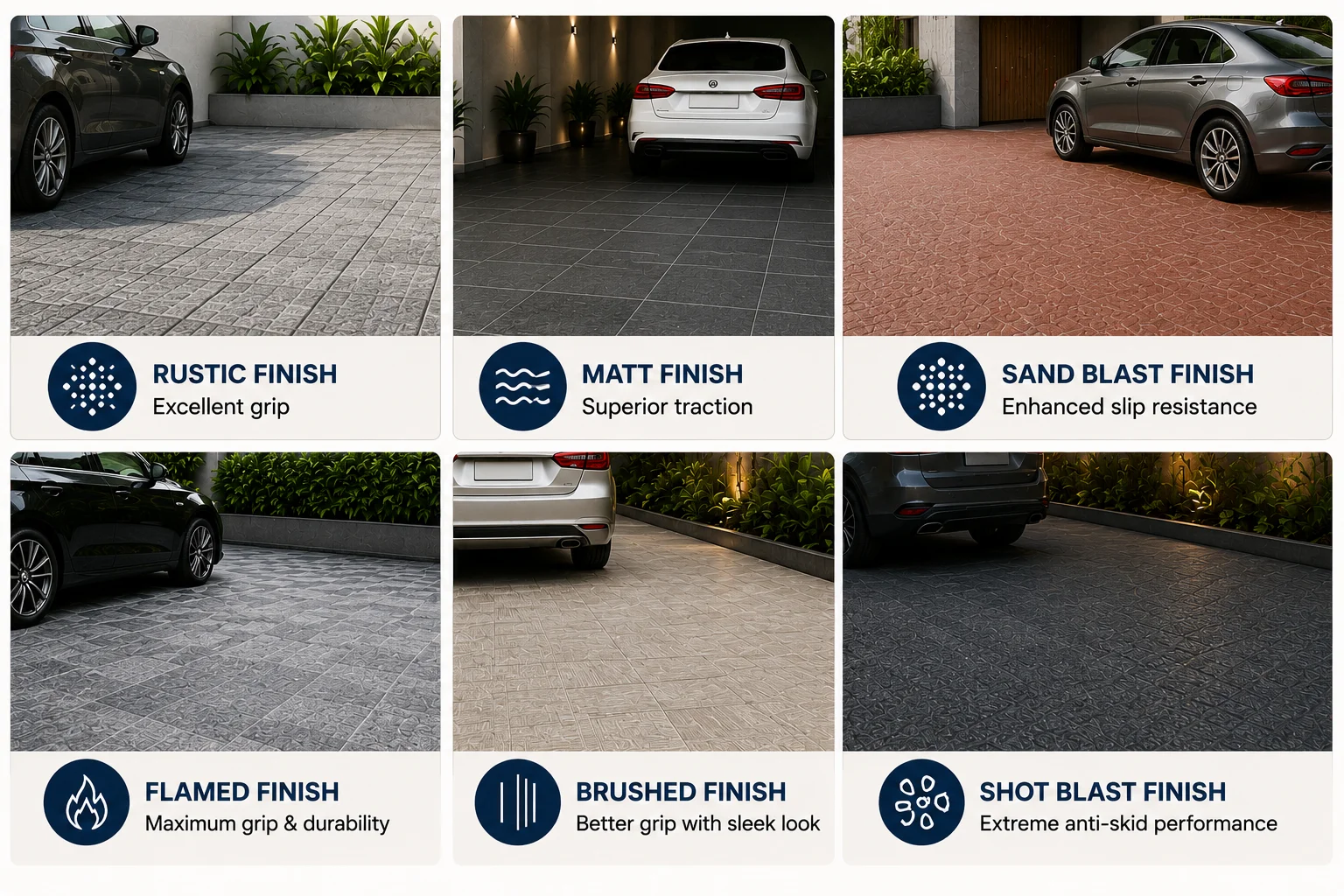
Are matte finish tiles good for parking? Yes. Matte tiles are the most practical and widely available anti-skid option for Indian home parking. The matte surface gives consistent grip in dry, wet, and dusty conditions and does not show tyre marks or water stains as clearly as polished or glossy finishes. Matte finish parking tiles in GVT or full body vitrified category are the most common specification across Indian home parking projects in 2026.
GHR (Glaze High Resistance) finish is the strongest anti-skid option for outdoor parking tiles in the vitrified category. It gives a stone-like rough surface that holds grip even when wet with tyre rubber residue or light oil. GHR finish tiles carry R10 to R11 ratings as standard. These are the right choice for open driveways, home entrances, and society parking areas where rain and weather exposureares constant.
Rough surface tiles with raised patterns give the highest friction on flat parking surfaces. Rough finish parking tiles work particularly well in basement parking. They work particularly well in basement parking where the floor gets washed regularly and stays damp for longer periods after cleaning.
| Finish | Anti-Skid Rating | Good For Parking? | Notes |
| Matte | Good (R10 to R11) | Yes | Most versatile; works for all home parking situations |
| GHR (Glaze High Resistance) | Excellent (R10 to R11) | Yes | Best for open driveways and society parking |
| Rain Drops (outdoor rated) | Good (R10) | Yes | Raised dots give grip; ask for an outdoor-rated version |
| Rough / Textured | Excellent (R11 to R12) | Yes | Best for ramps and wet basement parking |
| Glossy / High Glossy | Very Poor | No | Dangerous when wet; never use on any parking floor |
| Polished (PGVT) | Very Poor | No | Indoor walls only; not rated for outdoor or vehicle areas |
| Satin Matte | Poor | No | Smooth surface; becomes slippery when wet |
Best Categories for Anti-Skid Parking Tiles in India
Which anti-skid parking tiles are best for the home in India? Slip-resistant parking tiles India buyers trust most fall into three categories: full-body vitrified tiles, outdoor-rated GVT, and porcelain parking tiles. Each covers a different price point and performance level. Each covers a different price point and performance level.
Full Body Vitrified Tiles: The Strongest Anti-Skid Option
Full-body vitrified parking tiles are load-bearing tiles with the colour and composition running through the entire tile thickness. If the surface gets chipped by a vehicle wheel, the damage is barely visible because the interior looks the same as the top layer. This makes them the most practical heavy-duty parking tiles for Indian conditions. They absorb less than 0.05% water, carry PEI 5 ratings for most outdoor vitrified tiles in this category, and hold up through monsoon cycles without swelling, cracking, or losing grip.
Available sizes for parking: 400x400 mm (16x16) and 500x500 mm (20x20). These are the floor-best sizes for parking, specifically because they are easier to cut cleanly around drainage channels and irregular boundaries. Approximate price: ₹90 to ₹200 per sq. ft. ex-GST, varies by brand and dealer.
Glazed Vitrified Tiles (GVT): Wide Design Range, Good Anti-Skid Performance
Outdoor vitrified tiles in the GVT category give the widest design range for anti-skid parking tiles, covering stone-look, concrete-look, and cobblestone patterns in matte and GHR finish. They absorb only 0.05% water and carry the same low water absorption benefit asfull-bodyy tiles. The key distinction from indoor GVT is the outdoor rating and anti-skid finish specification. Always confirm the tile is outdoor-rated with an R10 or above slip resistance value before ordering.
The best anti-skid tiles for driveway use in the vitrified category are outdoor GVT in GHR finish. They work well for home driveways, parking tiles for home entrance areas, and flat society parking. Approximate price: ₹60 to ₹150 per sq. ft. ex-GST. For car parking tiles specifically, GHR or matte finish outdoor GVT at 18 mm thickness is the most practical starting point.
Porcelain Parking Tiles: Mid-Range with Natural Anti-Skid Properties
Porcelain parking tiles are available mostly in matte finish in India, which gives them natural anti-skid properties without needing a special surface treatment. Water absorption for porcelain is 2% to 5%, higher than vitrified but acceptable for outdoor parking use. They work well for parking tiles for driveway situations where the budget sits above concrete but below full-body vitrified. Approximate price: ₹90 to ₹220 per sq. ft. ex-GST.
Basement Parking Tiles: Specific Considerations
Basement parking tiles face different conditions from open driveways. The floor stays damp longer after rainwater enters, vehicle washing water pools near drains, and there is less natural ventilation to dry the surface quickly. For basement parking, full-body vitrified or outdoor GVT in GHR or rough finish at R10 to R11 is the right specification. Drainage slope is as important as tile choice: a 1:100 slope toward the drain prevents water pooling that makes any surface more slippery, regardless of finish.
Parking Tiles Design: Does Anti-Skid Mean Sacrificing Looks?
This is the most common concern buyers raise in showrooms. The assumption is that anti-skid parking tiles design options are limited to plain grey or industrial-looking surfaces. That was true five years ago. It is not true in 2026.
Stone-look parking tiles design in warm beige, charcoal, and brown tones with GHR or matte anti-skid finish now come from all major Indian brands. Cobblestone-pattern tiles in 400x400 mm (16x16) with textured surfaces combine traditional visual appeal with R10 grip ratings. Even parking tiles for home entrance areas now come in coordinated designs that match the main flooring of the property boundary wall.
The design rule for outdoor anti-skid tiles is simple: any design that comes in matte or GHR finish works for parking. Designs that are only available in glossy or polished finishes do not. The design range in matte and GHR is wide enough to cover virtually every aesthetic direction for Indian home parking.
Driveway flooring in India has also moved away from plain concrete-look tiles. Parking paver tiles in natural stone patterns with textured anti-skid surfaces are now a popular option for independent houses and villas across cities like Hyderabad, Pune, and Bangalore. These combine the visual warmth of natural stone with the performance of outdoor vitrified tiles and weatherproof tiles in one product.
How to Check If Parking Tiles Are Anti-Skid Before Buying
How to check if parking tiles are anti-skid is a question most buyers do not think to ask until they are already looking at a sample. These are the four checks to run at any showroom before placing an order.
1. Ask for the R Value Certificate
Any tile claiming to be anti-skid for parking should have an R value printed on the carton or in the technical data sheet. Ask the dealer to show it. A tile without a documented R value is not certified for slip resistance. Do not accept verbal assurances in place of the printed rating.
2. Wet the Sample and Step on It
Ask for a sample tile. Wet it with water, then step on it in footwear similar to what you normally wear in or around the parking area. If the surface feels slippery under wet conditions at any angle, the tile is not safe for parking floors. This test takes two minutes and costs nothing. Skipping it is the reason most parking tile complaints happen.
3. Check the PEI Rating for Vehicle Traffic
Confirm the PEI rating is 4 or 5 for any parking area that sees vehicle movement. PEI 3 and below are not rated for vehicular traffic tiles. Lower PEI tiles wear through their anti-skid surface within months under tyre and foot traffic, losing the grip that made them safe when new.
4. Check the Finish and Reject Glossy or Polished Options
Glossy, polished, satin matte, and high-gloss finishes are not anti-skid. A tile dealer sometimes offers these finishes for parking areas because they are in stock or carry a higher margin. The finish names to accept for parking floors are: matte, GHR, rough, textured, and raindrops (outdoor-rated). Any other finish should be declined.
Anti-Skid Parking Tiles Price in India per Square Feet: 2026 Guide
Anti-skid parking tiles price in India per square foot does not carry a significant premium over standard parking tiles in the same category. The difference in cost between a matte finish and a GHR finish tile from the same brand is typically Rs. 5 to Rs. 20 per sq. ft. The safety benefit is far greater than the price difference.
| Category | Anti-Skid Finish | Parking Tiles Price (per sq. ft. ex-GST) | Best Use |
| Outdoor GVT (matte or GHR) | R10 to R11 | ₹60 to ₹150 | Home car parking, open driveways |
| Full Body Vitrified (matte or GHR) | R10 to R11 | ₹90 to ₹200 | Heavy use, open driveways, two-car homes |
| Porcelain Parking Tiles (matte) | R10 | ₹90 to ₹220 | Mid-range home and society parking |
| Concrete Parking Tiles (textured) | R10 to R12 | ₹35 to ₹80 | Society and industrial parking, ramps |
| Parking Paver Tiles (textured) | R11 to R12 | ₹70 to ₹180 | Home entrance, sloped driveways, ramps |
All prices are approximate and ex-GST. Add 18% GST and installation cost of ₹40 to ₹90 per sq. ft. when calculating the total project budget. Parking tiles for homes in premium stone-look designs can go up to ₹250 per sq. ft. while still carrying full anti-skid R10 ratings.
Buying Tips Before Choosing Anti-Skid Parking Tiles
1. Decide the Use Case Before the Showroom Visit
Know whether you need non-slip floor tiles for parking on a flat driveway, a sloped driveway, a basement entry ramp, a home entrance path, or a society parking floor before walking into any showroom. Each situation needs a different R value specification. Taking a photo of the area and describing the slope, drainage point, and vehicle type will help the dealer give you the right product.
2. Choose the Right Size for the Area
400x400 mm (16x16) and 500x500 mm (20x20) are the most practical sizes for parking tiles. They cut cleanly around drains and boundary edges, lay faster, and give more grout lines per sq. ft., which actually increases grip compared to large format tiles. Avoid tiles above 600x600 mm (2x2) for most parking areas because they are harder to level on outdoor substrates and more prone to lippage on uneven surfaces.
3. Specify the Right Thickness for Vehicle Load
Parking tiles thickness in India standard for home car use is 18 to 20 mm. Two-wheeler areas can use 12 to 15 mm. Ramps and society parking with heavy vehicle movement need 20 to 25 mm. Tiles without thickness matching the load specification will crack, regardless of how good the anti-skid rating is on the surface.
4. Use the Right Adhesive and Grout
Stain-resistant tiles in parking areas last only as long as the grout holds. Use polymer-modified adhesive for all outdoor parking tile installation. Use epoxy grout or weather-rated cement grout for parking areas. Standard white cement grout absorbs engine oil, tyre rubber deposits, and moss within one monsoon cycle. Dark grey or charcoal grout stays looking clean and hides stains far better on any outdoor parking tile.
5. Check Water Absorption for Outdoor Areas
Water absorption below 3% is the threshold for outdoor vitrified tiles and porcelain tiles in parking use. Full body vitrified, and GVT absorb less than 0.05%. Porcelain tiles absorb 2% to 5%. Both ranges work for outdoor parking. Ceramic tiles with 12% to 16% water absorption are not suitable for any outdoor parking application and should be declined regardless of price or dealer recommendation.
6. Buy 10Per centtt Extra From the Same Batch
Parking tile installation involves more waste than indoor rooms because of the cuts at drains, slopes, and boundary edges. A cracked tile replacement six months later may not match if the batch is discontinued. Buy 10% extra tiles from the same lot number and store them safely. The cost difference is small. The relief when you need a replacement tile is significant.
Key Things to Check Before Buying Parking Tiles
The difference between a safe parking area and a slippery hazard comes down to three numbers: R value, PEI rating, and tile thickness. Getting all three right costs very little extra compared to choosing the wrong tile and replacing it after the first monsoon.
Before finalising any purchase, ask for tR-valuelue certificate, wet the sample and test the grip personally, and confirm the thickness matches your vehicle load. Take those three steps, as a full body, and the right tile becomes easy to identify at any showroom.
You can browse anti-skid parking tiles by finish, R value, size, and category on TilesFinders to compare options from Indian manufacturers at different price points before heading to a local dealer.
FAQs
Full-body vitrified tiles in GHR or matte finish with an R10 slip resistance rating are the best anti-skid parking tiles for home use in India. They absorb less than 0.05% water, carry PEI 5 surface hardness, and hold grip under tyre friction and monsoon conditions. Outdoor-rated GVT tiles in matte or GHR finish are a strong alternative at a lower price point.
The R value is the slip resistance rating assigned to a tile after a standardised German DIN 51130 wet ramp test. R9 is the minimum for general wet areas. R10 is recommended for home parking on flat surfaces. R11 and R12 are for ramps and sloped driveways. R13 is for industrial oil-exposed surfaces. For any home car parking area, ask the dealer for R10 or above rated anti-skid tiles before purchasing.
Yes. Matte finish tiles give consistent anti-skid grip in dry, wet, and dusty conditions and are the most widely available anti-skid parking tile option in India. They hide tyre marks and water stains better than glossy tiles and carry R10 ratings from most major Indian brands. Matte finish in full-body vitrified or outdoor GVT is the most practical specification for Indian home parking.
Start with the R value: R10 for flat home parking, R11 for ramps and slopes. Then confirm the PEI rating is 4 or 5 for vehicle areas. Choose full-body vitrified or outdoor-rated GVT in matte or GHR finish. Check the tile thickness is 18 mm or above for car load. Wet the sample and step on it before buying. Never use glossy, polished, satin matte, or high-gloss finish tiles in any parking area.
For sloped parking areas and ramps, tiles should have an R11 or R12 anti-skid rating for better grip and safety. Full-body vitrified tiles and concrete parking tiles are commonly preferred because they offer durability and traction in Indian outdoor conditions. For long-term performance, choose tiles with 18–20 mm thickness and use polymer-modified adhesive instead of regular sand-cement during installation.
Anti-skid parking tiles price in India per square foot ranges from ₹35 to ₹220 ex-GST,, depending on the category. Textured concrete tiles cost ₹35 to ₹80. Outdoor GVT in matte or GHR finish costs ₹60 to ₹150. Full-body vitrified tiles cost ₹90 to ₹200. Porcelain parking tiles cost ₹90 to ₹220. The price difference between matte and GHR anti-skid finishes within the same category is typically only ₹5 to ₹20 per sq. ft. Add 18% GST and ₹40 to ₹90 per sq. ft. installation.
Ask the dealer for the R value printed on the carton or technical data sheet. Wet the sample tile and step on it. Confirm the PEI rating is 4 or 5. Check that the finish is matte, GHR, rough, or textured, not glossy, polished, or satin matte. A tile without a documented R value should not be used in any parking area, regardless of what the dealer says.

See our tile guides first
Set TilesFinders as a preferred source and our buying guides surface ahead of the rest for you.
Add as preferred sourceTakes one tap. Nothing to install.
What Readers Say
I was about to redo my parking area with the wrong tile size until I read this. The layout comparisons saved me from a costly mistake.
We reference TilesFinders guides while briefing clients on material selection. The size and pattern breakdowns are accurate and easy to explain visually.
On site, I get asked about grout spacing all the time. This article gave me a solid reference I now share with my team before every job.
Finally a guide that doesn't just push generic advice. The oil stain removal steps actually worked on our clubhouse driveway tiles.
I run a small construction firm and now send this link to clients directly when they ask about entrance tile sizing. Saves me an hour of explaining.
Good practical detail, though I wish there were more examples for compact apartment entrances specifically, not just villas.
My mother-in-law wanted marble, I wanted vitrified. This blog gave us the neutral comparison we needed to actually decide together.
Detailed without being overwhelming. I appreciated that it covered both cost and maintenance, not just the aesthetics.
Used the algae and hard water removal tips on our terrace tiles after the monsoon. Worked better than what our regular cleaner was doing.
As someone who sources tiles for multiple builder projects, I find these comparisons genuinely useful for vendor conversations, not just consumer content.
Recommended this to a client who kept second-guessing the entrance design. The small vs large layout section settled the debate instantly.
Straightforward and honest, no unnecessary jargon. Would like to see a similar breakdown for outdoor pool-deck tiles next.
We've bookmarked several TilesFinders guides for our design handbook. Reliable source when clients want data, not just opinions.
Two paths, one marketplace.
Get free quotes from verified suppliers.
Share your room, budget, and style. Suppliers in Morbi respond within hours.
Get Free QuotesList your business, reach real buyers.
Put your showroom in front of homeowners searching for tiles right now.
List Your Business