


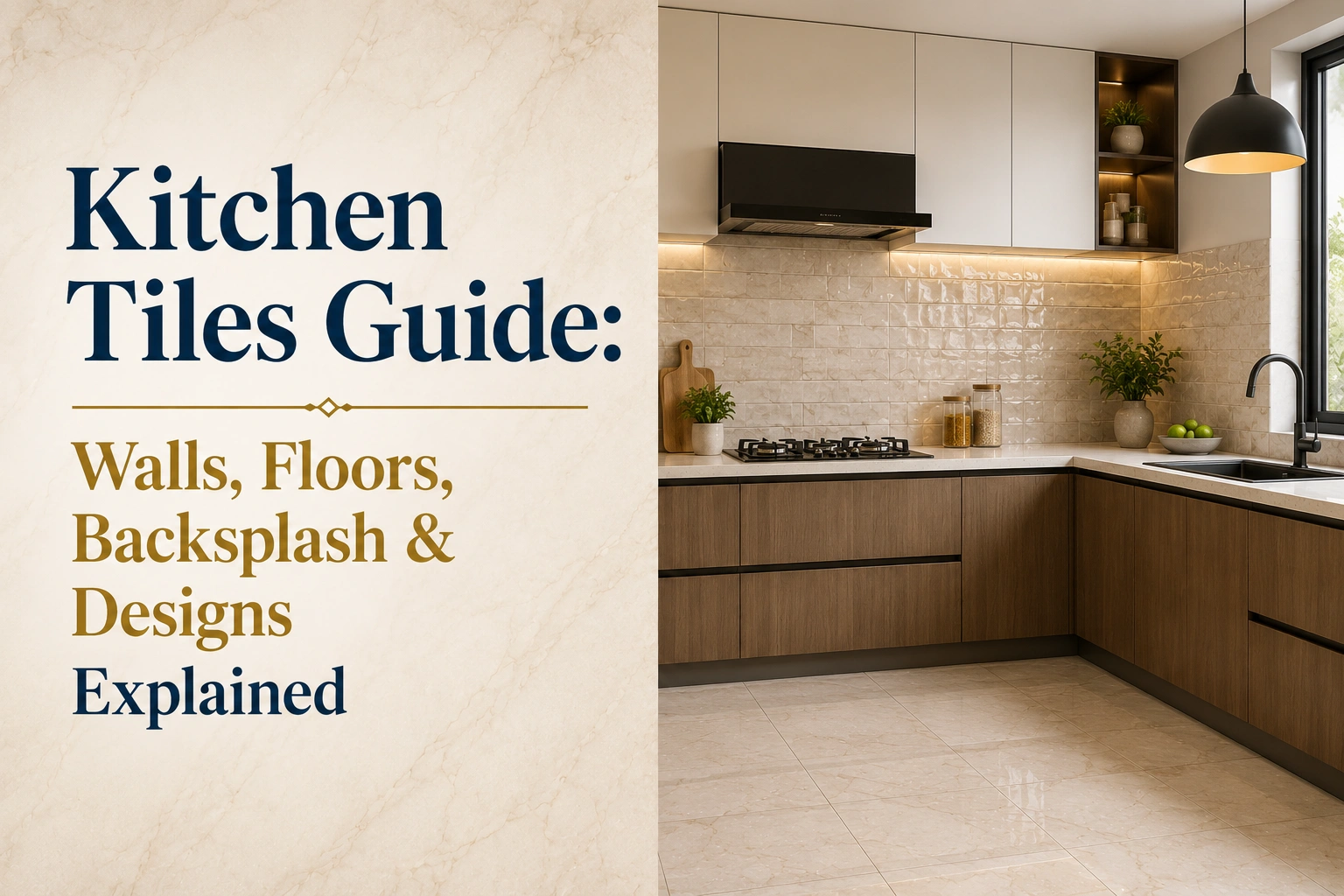
Kitchen Tiles Guide: Walls, Floors, Backsplash & Designs Explained
Master your kitchen renovation. Learn why vitrified matte floors and glossy walls are the secret ...


Loading designs...












Wooden kitchen tiles are not real wood. They are manufactured tiles, primarily GVT and porcelain, produced in a long, narrow plank format with a digital wood grain print on the glaze. The result is a tile that reads as a timber floor or wall from a standing distance, with none of the problems that real wood brings to an Indian kitchen: no swelling in monsoon humidity, no warping in summer heat, no termite risk, and no annual oiling or sealing requirement.
The wood-look tile is one of the fastest-growing categories in the kitchen tiles range from Indian manufacturers. This page covers the full specification for wooden kitchen tiles on both floors and walls: which tile body and size to use, how the grain direction and laying direction affect the visual result, how to choose between the main wood species looks available from Indian manufacturers, and the one decision that determines whether the final floor reads as a real timber deck or as tiles with a wood pattern on them.
Real hardwood flooring in an Indian kitchen is a premium material with well-documented problems in the Indian climate. The comparison with wood-look tile is not close in most kitchen applications:
| Property | Real Wood Flooring | Wood Look GVT (Matte) | Wood Look Porcelain (Matte) |
| Water absorption | High; wood absorbs water and expands | 0.05% (IS 15622) | 2% to 5% (IS 13630) |
| Monsoon humidity | Swells and warps; gaps open between planks in the dry season | Unaffected | Unaffected |
| Termite risk | Yes, common in Indian homes | None | None |
| Maintenance | Annual oiling or lacquering; damp-mop carefully; no excess water | Mop with mild cleaner; no sealing; no restriction on water | Same as GVT |
| Kitchen grease and stains | Penetrates the wood surface; hard to remove from the grain | Sits on a glazed surface; wipes off | Same as GVT |
| Slip resistance outdoors / in wet zones | Slippery when wet; needs grip coating | Matte finish is anti-skid; safe in the kitchen | Same as GVT |
| Price range (Rs./sq.ft) | Rs. 200 to Rs. 800+, depending on wood species | Rs. 90 to Rs. 200 | Rs. 60 to Rs. 130 |
| IS standard | No tile standard; governed by timber grading | IS 15622 | IS 13630 |
The only thing real wood flooring provides that wood look tile does not is genuine material warmth underfoot and the natural variation of a living material. For a kitchen that is used for daily Indian cooking, those qualities do not outweigh the practical problems. For a dry dining area or a living room where the wood look tile continues from the kitchen, GVT in the same wood look gives a seamless floor that performs correctly in both the wet cooking zone and the dry living zone.
Two tile bodies and two size ranges cover the wood-look tile market for kitchen applications in India:
GVT in the 200x1200 plank format is the most convincing wood look tile available from Indian manufacturers. The 1,200mm length gives a plank proportion that is close to standard hardwood flooring (which typically runs 900 to 2,400mm in length). The 200mm width replicates the narrow plank width of traditional timber flooring. Water absorption of 0.05% makes it the most durable tile body for kitchen floor use. Available in matte and matte carving finish. Matte carving tiles follow the grain pattern of the tile and give a physical surface texture that references the hand-sanded feel of real timber. Price: Rs. 90 to Rs. 200 per sq.ft.
Porcelain in 200x1000 is a slightly shorter plank that gives a similar visual proportion to GVT 8x48. Water absorption of 2% to 5% is adequate for kitchen floor use. Lighter per sq.ft than GVT, which matters for high-rise apartment kitchens where floor loading is a consideration. The colour depth in the porcelain glaze is slightly shallower than GVT tiles, which gives a less convincing wood grain visual at close inspection. From a standing distance in a finished kitchen, the difference is not visible. Price: Rs. 60 to Rs. 130 per sq ft.
Some Indian manufacturers produce wood-look tiles in 300x1200 (a wider plank) and 600x1200 in a wood or concrete-wood hybrid look. The 300x1200 gives a wider plank that suits a kitchen-dining open plan, where a wider plank reads better at the larger scale. The 600x1200 in a wood look is more of a concrete-with-wood-tone look than a convincing timber plank. For a kitchen floor that genuinely reads as wood, 200x1000 or 200x1200 is the right format.
Note: Wood look tiles in matte finish are safe for kitchen floors. Satin matte, semi-polished, and glossy wood look tiles must not be used on kitchen floors. A glossy wood look tile is both slippery when wet and unconvincing as a timber look because real timber flooring is never glossy.
Wood look tiles from Indian GVT and porcelain manufacturers reproduce the grain, colour, and knot patterns of the most popular timber species. Each species looks suited to a different kitchen style and cabinet colour combination:
| Wood Species Look | Colour Range | Grain Character | Best Kitchen Style | Cabinet Pairing | Price Range (Rs./sq.ft) |
| Light oak | Pale honey to warm blonde | Fine, straight grain; minimal knots | Scandi-style, modern, light-filled kitchens | White, light grey, or pale timber cabinets | Rs. 90 to Rs. 160 |
| Golden teak | Warm amber to golden brown | Medium grain; some natural variation in tone | Traditional Indian, transitional kitchens with warm materials | Cream, warm timber, or terracotta-toned cabinets | Rs. 95 to Rs. 175 |
| Walnut (dark warm brown) | Deep chocolate brown to warm espresso | Rich grain with occasional knots; strong visual weight | Contemporary, designed kitchens; open-plan spaces | White or off-white cabinets; brass fixtures | Rs. 100 to Rs. 190 |
| Grey ash / weathered grey | Cool grey to silver-grey with wood grain | Subtle grain; reads as a modern, low-contrast wood | Industrial, Japandi, or minimal kitchens | White, grey, or charcoal cabinets; matte black fixtures | Rs. 90 to Rs. 170 |
| Driftwood / reclaimed look | Bleached grey-brown with rustic grain variation | High grain contrast; knots and splits visible in the pattern | Coastal, farmhouse, or rustic-modern kitchens | White, cream, or aged timber cabinets | Rs. 95 to Rs. 180 |
| Dark ebony / dark wenge | Very dark brown to near-black wood tone | Dense, fine-grained; high visual weight | Designed luxury kitchens with strong lighting | White cabinets only; brass or gold fixtures | Rs. 100 to Rs. 200 |
Light oak and golden teak are the most widely stocked wood-look tile species from Indian manufacturers. Walnut and grey ash are available from a wider range of manufacturers but may need stock confirmation before ordering large quantities. Driftwood and dark ebony looks are available from premium manufacturer ranges and may not be available in every market.
Grout colour is the single most important decision for a wood-look kitchen tile floor. More than the species look, more than the tile size, more than the brand, the grout colour determines whether the finished floor reads as a timber deck or as tiles with a wood pattern on them. This is the detail that most buyers and contractors get wrong.
Wood floors do not have grout lines. They have gaps between planks that are filled with the same wood material or a matching filler that reads as part of the floor. The gap between real timber planks is not white or grey; it is a warm tone that matches or complements the timber shade. When a wood-look tile floor is grouted in white or standard grey, the white or grey lines between the planks immediately identify the surface as tiles rather than timber. The tile format may be convincing; the grout undoes it.
The correct grout approach for a wood-look kitchen floor:
A wood-look tile floor with correctly colour-matched grout at 2mm width reads as a timber floor from a standing distance. The same tile with white or standard grey grout reads as a tiled floor with a wood pattern. The tile cost is the same; the grout colour is a few hundred rupees of additional thought, and it changes the entire result.
Plank tiles are directional in a way that square tiles are not. The direction the planks run changes how the kitchen reads visually and spatially. Three laying directions are used for wood-look tiles in Indian kitchens:
| Laying Direction | Visual Effect | Best Kitchen Plan | Wastage | Installation Note |
| Parallel to the longest wall | Makes the kitchen feel longer; leads the eye toward the far wall; the most common direction for kitchen plank floors | Rectangular kitchens; galley kitchens; kitchens where the entry view is across the longer dimension | 10 to 12% | Standard laying starts from the longest wall and works inward |
| Parallel to the shortest wall | Makes the kitchen feel wider; draws the eye across rather than down the length | Square kitchens or wide open-plan spaces, where extending the visual width is the goal | 10 to 12% | Standard laying starts from the end wall |
| Diagonal to the walls (45 degrees) | More dynamic, the angled plank reads as a deliberate design decision; it adds visual complexity | Large kitchens or open-plan kitchen-dining where the floor is viewed from multiple angles | 20 to 25% wastage; every perimeter tile needs an angled cut | Higher cost; wet-saw cutter essential; experienced tile-layer needed |
| Herringbone | Traditional, parquet-like pattern; the most formal wood tile laying option | Heritage, bungalow, or deliberately traditional kitchen styles | 20 to 25% wastage; complex to set out and lay accurately | Most expensive to lay; a contractor experienced in herringbone with plank tiles is needed |
For most Indian modular kitchens, planks laid parallel to the longest wall in a standard brick bond (each plank offset by a third or half its length from the adjacent row) gives the most convincing timber deck result with standard wastage and laying cost. The brick bond offset is important: planks laid in a full straight bond (all joints aligned) read as a grid and lose the flowing timber deck quality.
Wood look tiles on kitchen walls are a design choice that appears in open-plan kitchens, cafe-style kitchen-diners, and Japanese-influenced (Japandi) kitchen designs. The application is less common than on floors and has specific considerations that differ from both wall tiles and floor plank tiles.
Using a wood-look tile as a kitchen backsplash is possible, but comes with a practical constraint: the grout joints on a kitchen backsplash collect oil and cooking grease, and a warm-coloured wood-tone grout near the cooktop will show cooking residue more visibly than a white or light grey grout would on a plain ceramic backsplash. For the backsplash zone directly behind the cooktop, a wood-look tile with a matched warm grout is higher maintenance than a plain ceramic gloss tile. If the wood look backsplash is behind the food preparation counter rather than the cooktop, the maintenance burden is lower.
GVT in 200x1200 matte on the backsplash wall, laid horizontally in the same direction as the kitchen floor planks, gives a continuous visual from floor to wall that reads as a full timber room. For a kitchen wall specification that works across all materials and applications, the kitchen wall tiles page covers the full framework.
A wood-look GVT plank tile in 200x1200 matte laid vertically on one kitchen wall gives a feature wall that reads as vertical timber cladding, referencing shiplap or vertical board-and-batten panelling. This works well on the wall behind an open kitchen shelf or the wall that faces the dining area in an open-plan kitchen. Laid vertically, the plank tiles make the ceiling feel higher.
Wood look tiles on kitchen walls can be in matte or a slightly sheen finish. The gloss constraint that applies to floors does not apply to walls. However, a high gloss or polished wood look tile on a kitchen wall reads as artificial: timber panelling is never highly reflective, so a shiny wood look tile on the wall undermines the very illusion it is trying to create. Matte or matte carving finish on kitchen walls gives the most convincing timber cladding result.
| Kitchen Type | Recommended Tile | Size | Direction | Grout Colour | Price Range (Rs./sq.ft) |
| Small modular kitchen (under 80 sq.ft) | Light oak GVT matte | 200x1200 | Parallel to the longest wall | Pale tan or warm buff | Rs. 90 to Rs. 155 |
| Standard modular kitchen (80 to 150 sq.ft) | Light oak or teak GVT matte | 200x1200 | Parallel to the longest wall, brick bond offset | Warm buff or tan to match tile grain | Rs. 90 to Rs. 175 |
| Large kitchen or open-plan (above 150 sq.ft) | Walnut or grey ash GVT matte | 200x1200 or 300x1200 | Parallel to the longest wall or diagonal in very large spaces | Warm brown (walnut) or light grey (ash) | Rs. 100 to Rs. 190 |
| Kitchen extending to the dining area | Light oak or teak GVT matte (same tile throughout) | 200x1200 | Continuous direction through both rooms | Consistent grout across the full floor | Rs. 90 to Rs. 175 |
| Heritage or bungalow kitchen | Teak or driftwood porcelain matte | 200x1000 | Herringbone or parallel | Warm tan | Rs. 60 to Rs. 130 |
| Japandi or minimal kitchen | Grey ash GVT matte | 200x1200 | Parallel to the longest wall | Light grey matches the lighter tone | Rs. 90 to Rs. 170 |
| Budget kitchen floor | Porcelain wood look matte | 200x1000 | Parallel to the longest wall | Warm buff | Rs. 60 to Rs. 100 |
Four things to confirm before ordering wood-look kitchen tiles:
Wood look kitchen tiles in GVT plank format 200x1200 and porcelain 200x1000 from verified Indian manufacturers are listed at TilesFinders in species looks from light oak to walnut and grey ash. Matte and matte carving finishes are shown separately for every product, so the correct floor specification is easy to confirm before ordering. Porcelain wood look starts from Rs. 60 per sq ft; GVT in matte carving finish runs from Rs. 90 to Rs. 200 per sq ft. Use the look and size filters to find the right plank tile for your kitchen floor before shortlisting. All GVT tiles listed meet IS 15622; all porcelain tiles meet IS 13630.
GVT in 200x1200 matte or matte carving finish is the best wood look tile for an Indian kitchen floor. The 0.05% water absorption handles daily mopping and kitchen water contact, the plank proportion reads convincingly as timber, and the matte surface is anti-skid. Light oak look is the most practical species for a standard Indian modular kitchen; it pairs with the widest range of cabinet colours and reads well under warm-white LED lighting. Porcelain in 200x1000 matte is the budget alternative with adequate performance for kitchen floor use.
Yes. GVT or porcelain in 200x1200 matte finish can be used on kitchen walls, laid horizontally or vertically. On the backsplash zone behind the cooktop, the matched warm grout requires more frequent cleaning than a plain gloss ceramic. On a feature wall away from the cooktop or as a continuous surface from the kitchen floor, wood-look wall tiles give a convincing timber panelling effect. Matte finish is the right choice on walls for the most realistic timber look; high gloss wood look tiles on walls look artificial.
200x1200 GVT in a light oak look works in small kitchens as long as the plank direction runs parallel to the longest wall. The long plank makes a narrow galley kitchen feel longer. In a small kitchen under 60 sq. ft., the 200x1200 plank may produce more wastage at the perimeter than a 200x1000 porcelain, which is the more economical choice in compact kitchens. Avoid 300x1200 in small kitchens; the wider plank proportion is too large for a compact space, and the few plank repeats across the width look incomplete.
Match the grout colour to the lighter tone in the wood grain of the tile. For light oak, use warm buff or pale tan. For teak, use a warm tan or golden-brown. For walnut, use a warm mid-brown. For grey ash, use a pale or mid-grey. Keep the joint at 1.5 to 2mm and use epoxy grout for kitchen floors to resist cooking oil staining. White or standard grey grout with a wood look tile immediately identifies the surface as tiles rather than timber. The grout colour is the single most important factor in achieving a convincing wood look result.
GVT is better in technical terms: lower water absorption (0.05% vs 2% to 5%), more consistent colour across large production runs, and matte carving finish gives a more convincing grain texture. Porcelain is the practical choice when kitchen floor loading is a concern (high-rise apartments) or when the budget is tighter. For a kitchen floor that will be looked at closely and compared to real timber, GVT gives a noticeably more convincing result. For a kitchen where the floor reads from a normal viewing distance and budget matters, porcelain matte in a good wood look is adequate.
Yes, and this is one of the strongest arguments for using a wood-look tile rather than real wood in an open-plan home. GVT or porcelain in the same species look and size can run continuously from the kitchen through the dining area and into the living room, something real wood flooring can only do if the same species and grade are used throughout (which adds significantly to cost). Using the same wood-look tile on both surfaces removes the visual break at the kitchen-dining boundary and makes the open-plan floor read as a single continuous timber surface.
Matte finish gives a flat, non-reflective surface with a smooth tile face. The wood grain is printed in the glaze and visible visually, but not physically. Matte carving has carved grooves in the tile face that follow the wood grain pattern. The carving gives a physical surface texture: running your hand across a matte carving tile feels different from a flat matte tile because the carved grooves create ridges and channels that reference the way wood grain rises and recedes in real timber. For a floor where texture adds to the timber illusion, matte carving is the more convincing finish. For a wall or a floor where easy cleaning is the priority, flat matte is simpler to maintain.
No, in most configurations. A light oak or pale wood look plank tile laid parallel to the longest wall makes a kitchen feel longer and more open, not smaller. The long plank lines lead the eye toward the far wall and create a sense of depth. Dark species looks (walnut, ebony) can make a small kitchen feel heavier if used on both floor and walls, but on the floor alone in a kitchen with white cabinets, even a dark wood look tile reads as grounding rather than enclosing.