Kitchen Wall Tiles vs Kitchen Floor Tiles: Key Differences Explained
Compare kitchen wall and floor tiles for Indian homes. Learn the differences in finish, thickness, slip resistance, durability, and best tile types for each area.
- Why Kitchen Wall and Floor Tiles Are Not the Same Thing
- Key Differences: Kitchen Wall Tiles vs Kitchen Floor Tiles
- Best Tile Categories for Kitchen Walls
- Best Tile Categories for Kitchen Floors
- Can Wall Tiles Be Used on Kitchen Floors?
- Choosing the Right Finish: Walls vs Floors
- Expert Tips for Buying Kitchen Wall and Floor Tiles in India
- Common Mistakes When Choosing Kitchen Wall and Floor Tiles
- Final Thoughts on Choosing Kitchen Wall and Floor Tiles
Most homeowners treat kitchen tiles as a single category. They pick a design they like in the showroom and ask for the same tile everywhere. The kitchen floor then becomes slippery within months, or the wall tiles start cracking after a year of mopping the floor around them.
Kitchen wall and floor tiles are built differently, rated differently, and perform very differently in daily use. Mixing them up is one of the most common renovation mistakes in Indian homes.
This guide breaks down the real differences between kitchen wall tiles and kitchen floor tiles, covers which tile categories and finishes belong where, and helps you make decisions that hold up for years in an Indian kitchen.
Why Kitchen Wall and Floor Tiles Are Not the Same Thing
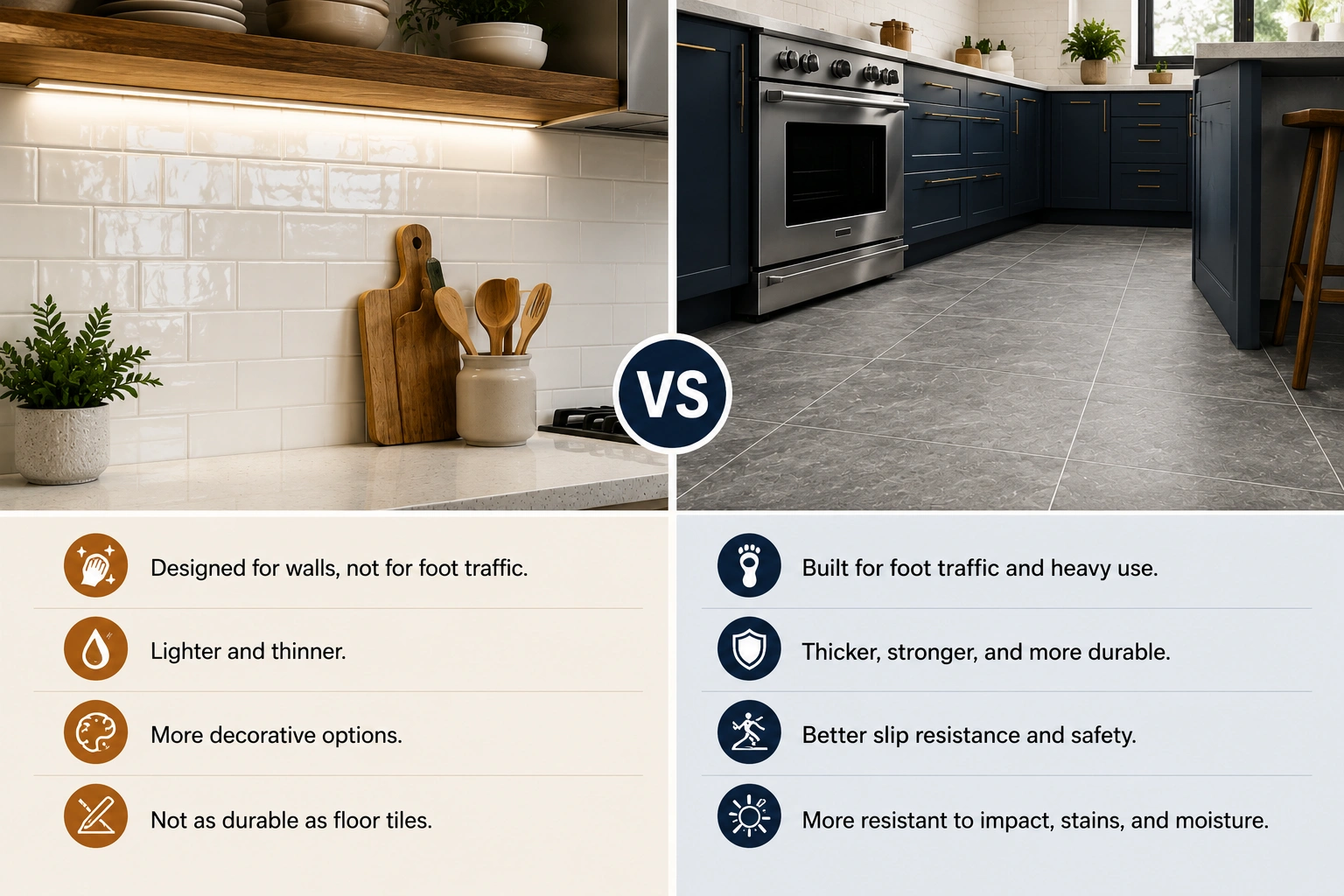
Wall tiles and floor tiles are manufactured to handle completely different kinds of stress. Kitchen floor tiles bear constant foot traffic, dropped vessels, chair movement, and the weight of heavy appliances like refrigerators and dishwashers. Kitchen wall tiles do not bear any of that. They need to handle moisture, cooking vapour, masala splatter, and repeated surface cleaning.
The industry measures this difference using water absorption rate, surface hardness, slip resistance, and tile thickness. A tile built for walls may look identical to a floor tile in the showroom, but it will crack, slip, or wear through on a kitchen floor within a year of use.
Understanding these differences before buying saves you the cost and disruption of replacing tiles mid-renovation or after an accident.
Key Differences: Kitchen Wall Tiles vs Kitchen Floor Tiles
| Feature | Kitchen Wall Tiles | Kitchen Floor Tiles |
| Primary job | Resist moisture, stains, and cooking vapour | Bear foot traffic, weight, and impact |
| Tile thickness | 6 to 8 mm typical | 8 to 10 mm typical; heavier duty |
| Water absorption | Moderate to high acceptable (walls stay drier) | Must be very low (0.05% for vitrified, under 3% for porcelain) |
| Slip resistance | Not required | Required, especially in wet cooking zones |
| Surface finish | Glossy, high-gloss, satin, and PGVT polished all work | Matte, GHR, Rain Drops, Texture finishes only for wet floors |
| Tile categories suitable | Ceramic (all sizes), GVT, PGVT, Third-Fired decorative | GVT (matte/GHR finish), Porcelain, Full Body, Colour Body |
| Weight | Lighter; easier to adhere to walls | Heavier; built for structural load |
| PEI rating needed | Not applicable for walls | PEI 3 minimum; PEI 4 for heavy-use family kitchens |
| Price range (approx.) | ₹30 to ₹160 per sq. ft. | ₹60 to ₹220 per sq. ft. |
The most critical difference is slip resistance. Glossy or polished tiles become dangerously slippery when any liquid touches them. On a kitchen wall, this does not matter. On a kitchen floor where cooking oil and water are a daily presence, a slippery tile is a real safety risk.
Best Tile Categories for Kitchen Walls
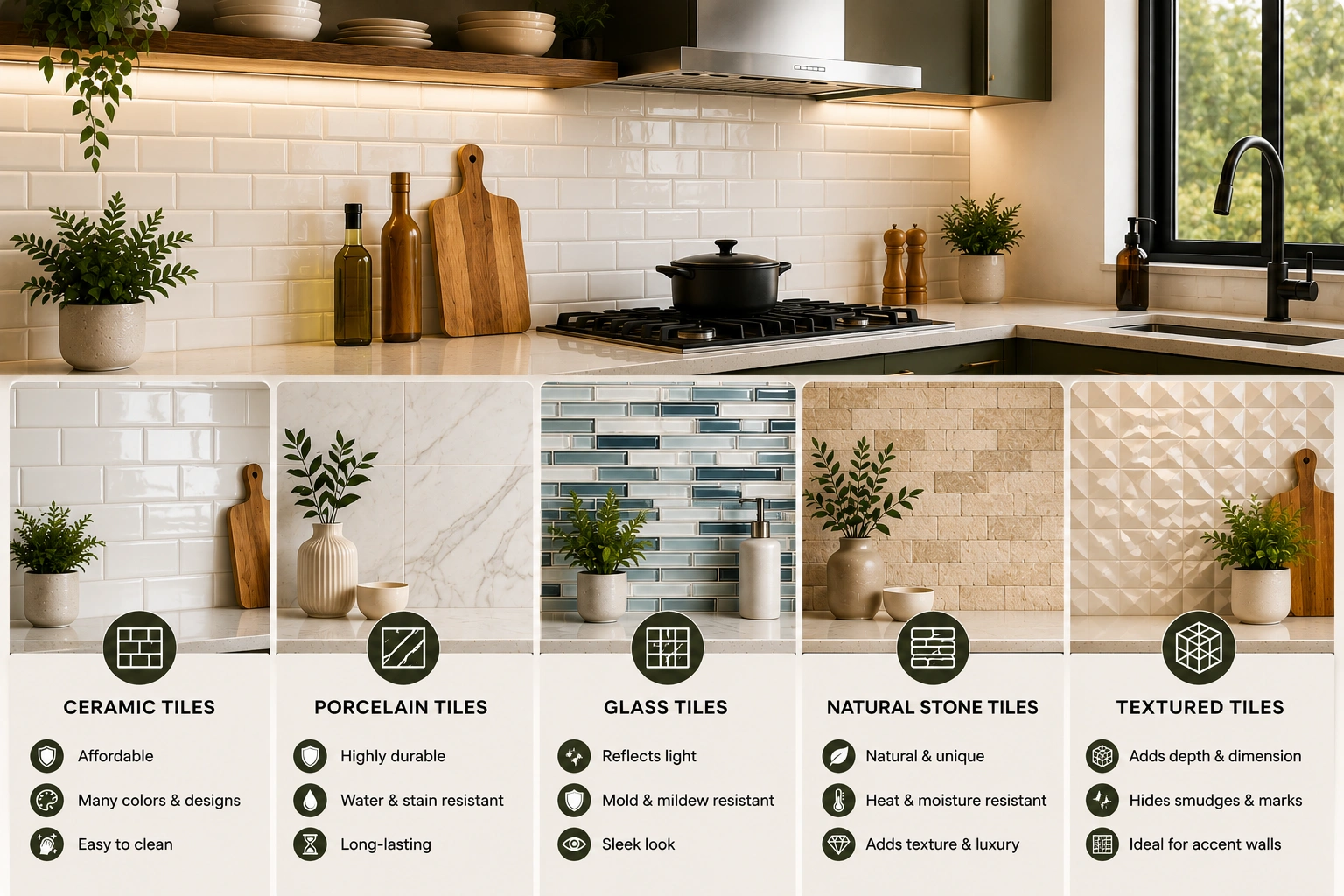
Kitchen walls have two distinct zones: the backsplash area behind the cooking counter and sink, and the remaining walls. The backsplash deals with oil splatter, steam, and direct water contact. The other walls see much less stress. Both can use wall tiles, but the finish choice matters for the backsplash zone.
Ceramic Wall Tiles for Kitchen
Ceramic tiles are the standard choice for kitchen walls across India because of the wide design range, accessible pricing, and light weight. They come in 300x300 mm (1x1), 300x450 mm (12x18), and 300x600 mm (12x24) sizes. The 12x18 and 12x24 sizes are most popular for kitchen backsplash areas.
Ceramic tiles have 12 to 16% water absorption. This makes them suitable for walls but rules them out entirely for kitchen floors. Placing ceramic tiles on a kitchen floor causes water to seep into the body of the tile over time, weakening the adhesive bond and eventually causing tiles to crack or lift.
Glossy ceramic wall tiles are popular for the backsplash because the smooth surface wipes clean easily after oil splatter. For the cooking zone wall specifically, a plain glossy ceramic or a subway-format ceramic is far easier to clean than a textured surface. Price range: approximately ₹30 to ₹80 per sq. ft.
GVT and PGVT for Kitchen Feature Walls
GVT (Glazed Vitrified Tiles) in sizes like 600x600 mm (2x2) and 600x1200 mm (2x4) work on both kitchen walls and floors, which gives them flexibility in open modular kitchen layouts where the same tile runs across zones. On walls, they carry marble-look, stone-look, and contemporary graphic patterns that ceramic tiles cannot print as sharply.
PGVT (Polished Glazed Vitrified Tiles) is a strong choice for kitchen feature walls away from the cooking zone. The high-shine polished surface makes marble-look and solid-colour tiles look more expensive. However, PGVT belongs only on walls in kitchen contexts. Its polished finish is slippery in wet conditions, so it must never go on kitchen floors.
Price range: GVT and PGVT run from approximately ₹60 to ₹160 per sq. ft., depending on size, design, and brand.
Best Tile Categories for Kitchen Floors
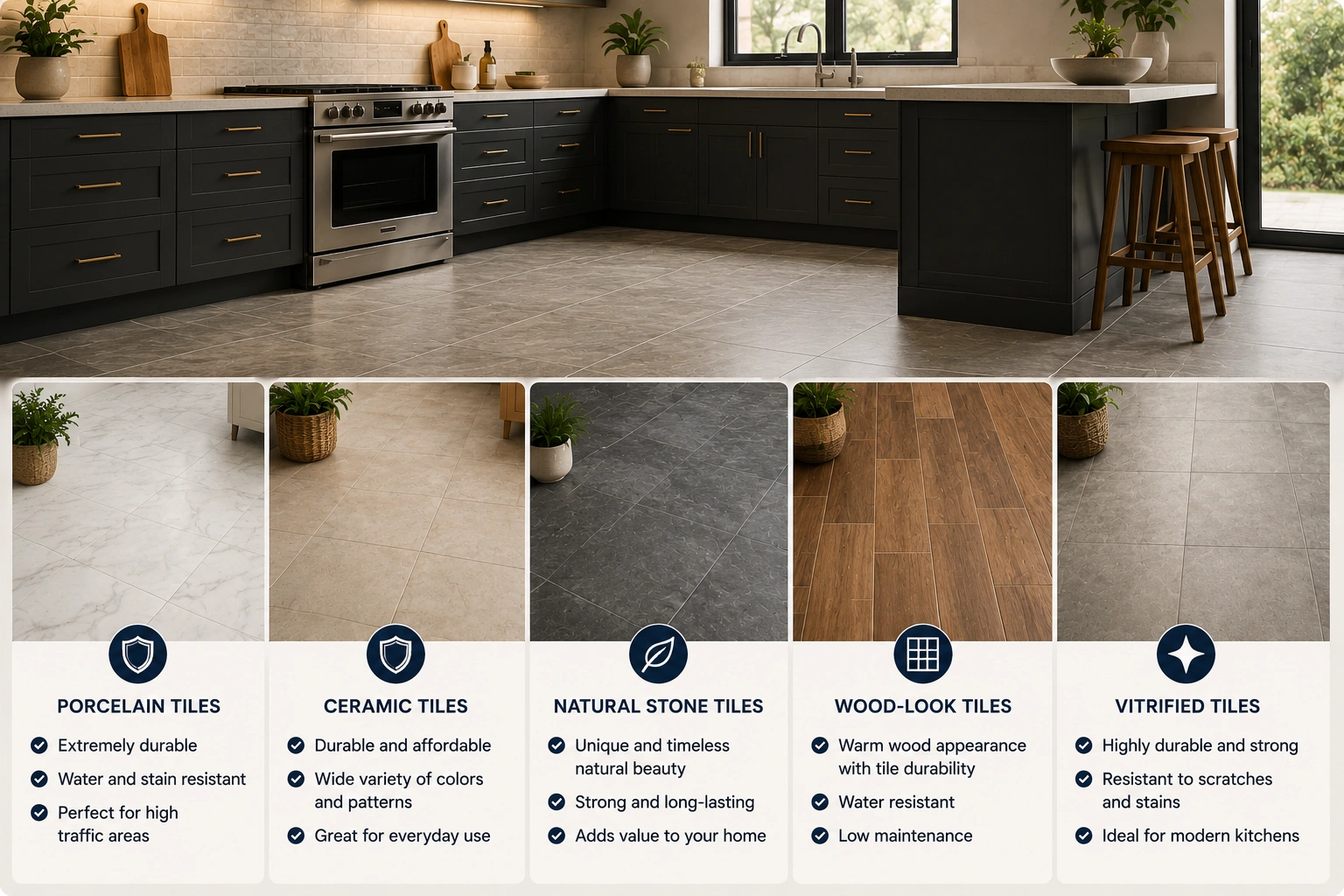
Kitchen floor tiles in Indian homes carry more load than most homeowners account for. A family kitchen sees sixty to eighty foot contacts per day, dropped steel vessels, occasional movement of appliances, and daily mopping with water and cleaning agents. The tile category and finish must handle all of that without wearing through or becoming hazardous.
GVT for Kitchen Floors
GVT in a matte, GHR (Glaze High Resistance), or Rain Drops finish is the most practical choice for kitchen floors in Indian homes. Water absorption below 0.05% means masala stains and cooking oil sit on the surface. A mop cleans them without leaving residue. The tile body holds up to dropped vessels and daily scrubbing without wearing through.
Popular sizes for kitchen floors are 600x600 mm (2x2) and 600x1200 mm (2x4). The 2x4 format reduces grout lines, which cuts the area where cooking grease can collect. For larger open-plan kitchen-dining spaces, wooden plank GVT tiles in 200x1200 mm (8x48) add warmth while keeping the same practical performance.
Price range: GVT kitchen floor tiles run from approximately ₹60 to ₹150 per sq. ft.
Anti-Skid Finishes for Kitchen Floor Tiles
Slip resistance is not optional on kitchen floors. Indian kitchens deal with cooking oil, water, and steam daily. The surface finish determines whether a tile grips underfoot or becomes a hazard.
| Finish Type | Anti-Skid? | Suitable for Kitchen Floor? | Notes |
| Matte | Yes | Yes | Best all-round kitchen floor finish. Hides smudges, grips well. |
| GHR (Glaze High Resistance) | Yes | Yes | Most durable for heavy-traffic Indian kitchens. |
| Rain Drops | Yes | Yes | Glossy drops on a matte surface. Good grip and easy clean. |
| Texture (0.3 to 1mm depth) | Yes | Yes | Fabric or slate feel. Good for cooking zones. |
| Matte Carving | Yes | Yes | Matte surface with glossy veins. Grip stays intact. |
| Glossy | No | No | Slippery when wet. Wall use only. |
| High Glossy / Super High Glossy | No | No | Very slippery. Expensive. Wall use only. |
| PGVT Polished | No | No | Wall and indoor dry floors only. Not for kitchens. |
| Satin Matte | No | No | Looks matte but slippery in wet zones. Wall use only. |
| Semi Polished / Baby Polished | No | No | Do not use on any wet or kitchen floor. |
Can Wall Tiles Be Used on Kitchen Floors?
This is one of the most searched questions from homeowners trying to save budget by using leftover wall tiles on kitchen floors. The direct answer: no, ceramic wall tiles cannot be safely used on kitchen floors, and most wall-only tiles will fail on floors within a year or two.
There are three reasons for this. First, ceramic tiles have 12 to 16% water absorption. When used on floors and mopped repeatedly, water seeps into the tile body, weakens the adhesive layer, and eventually causes the tile to crack or de-bond. Second, standard wall tile thickness (6 to 8mm) is not built for the load-bearing and impact stress of kitchen floors. A dropped steel vessel can crack a thin wall tile installed on a floor. Third, wall tiles, especially ceramic and PGVT, do not have anti-skid finishes. They become dangerous on a wet kitchen floor.
The one limited exception: 300x300 mm (1x1) ceramic tiles can go on bathroom floors to match wall designs already installed. This exception does not apply to kitchens, which are much higher-load and wetter environments.
If you want the same visual across your kitchen wall and floor, use GVT tiles that are rated for both applications. A 2x4 marble-look GVT in a polished finish on the wall, and the same tile in a matte or GHR finish on the floor, gives a coordinated look without the safety or durability problems of putting a wall tile on the floor.
If you also want design inspiration, material comparisons, tile trends, and practical buying tips, read our complete kitchen tiles guide for Indian homes.
Choosing the Right Finish: Walls vs Floors
The finish choice is where most kitchen tile decisions go wrong. Homeowners see a glossy tile on the wall, love the look, and ask for the same finish on the floor. The finish that makes kitchen walls look clean and bright is exactly the finish that makes kitchen floors slippery and hard to maintain.
| Finish | Kitchen Wall? | Kitchen Floor? | Why |
| Glossy | Yes, good choice | No | Stain-resistant on walls, slippery on floors |
| High Glossy | Yes, feature walls | No | Mirror finish looks good on walls, dangerous on wet floors |
| PGVT Polished | Yes, away from hob | No | Premium wall look, slippery in wet zones |
| Matte | Yes, good choice | Yes, best choice | Safe, hides smudges, works everywhere |
| GHR | Yes | Yes, best for heavy traffic | Stone-textured, highly durable for floors |
| Matte Carving | Yes | Yes | Decorative matte surface, safe grip |
| Rain Drops | Yes | Yes | Anti-skid by design, good for cooking zones |
| Satin Matte | Yes | No | Looks matte but slips when wet |
| Sugar | Yes | No | Decorative only, not anti-skid |
| Third Fired | Yes, decorative accent | No | Decorative wall-only tiles |
For most Indian kitchens, the practical finish combination is: glossy or high-gloss ceramic on the backsplash wall for easy oil-wipe cleaning, and matte tiles or GHR vitrified on the floor for grip and durability. This split gives you the best of both without compromising either.
Expert Tips for Buying Kitchen Wall and Floor Tiles in India
1. Always Confirm the Tile Category Before Buying
Ask the dealer specifically: Is this tile rated for floor use, wall use, or both? Ceramic tiles in 12x18 and 12x24 sizes are wall-only. GVT in matte or GHR finish works for both. PGVT is wall-only in kitchen contexts. Getting this confirmed before purchase prevents costly mistakes.
2. Check PEI Rating for Kitchen Floor TilesThe
PEI rating tells you how much foot traffic a floor tile can handle. For a standard Indian family kitchen, PEI 3 is the minimum. Homes with joint families or high daily cooking activity should use PEI 4 tiles. This rating is usually on the tile box or can be confirmed with the dealer.
3. Match Grout Colour to Your Cooking Habits
Light white grout on kitchen wall tiles near the hob turns yellow from turmeric and cooking oil within six months. Mid-grey or charcoal grout holds its appearance far longer in working Indian kitchens. On the floor, a matching or slightly darker grout than the tile itself hides daily dirt without needing frequent scrubbing.
4. Buy Extra Tiles as Buffer Stock for Both Wall and Floor
Tile production runs have slight shade variations. If a tile cracks on the floor six months later and you reorder, the new batch may not match. Buy 10% above your measured area for both wall and floor. Keep the extras stored flat in a dry space.
5. Consider Tile Thickness for Floor Durability
Standard kitchen floor tiles are 8 to 9mm thick. For kitchens in older buildings where the sub-floor is uneven, or for heavy-appliance zones, 10mm floor tiles give better impact resistance. Confirm thickness at the point of purchase, not just after delivery.
Common Mistakes When Choosing Kitchen Wall and Floor Tiles
Using the same tile and finish across the wall and floor. A 12x24 glossy ceramic on the floor looks exactly like the wall version in the showroom. On the floor, it cracks under load and slips when wet. Always use different finishes for the wall and floor, even if the design pattern matches.
Putting PGVT or polished vitrified tiles on kitchen floors. PGVT is a popular choice for its mirror finish. It belongs on kitchen walls only. On kitchen floors, polished surfaces become slippery the moment any liquid is present.
Ignoring water absorption ratings. Many homeowners skip this entirely and choose tiles by look alone. A tile with 12 to 16% water absorption (ceramic) on the kitchen floor will absorb every drop of cooking oil, masala water, and mop water over time, staining the body of the tile permanently.
Choosing very light grout for the backsplash wall. White grout behind the hob is a maintenance problem. Even with regular cleaning, turmeric stains bond to white grout permanently over time. Mid-grey or epoxy grout in a dark tone resists this.
Skipping a physical sample check. Online catalogue images show tile design accurately, but not surface texture, weight, or light reflection. A matte tile that looks dark on screen may appear lighter in your actual kitchen. Always ask for a physical sample before ordering.
Final Thoughts on Choosing Kitchen Wall and Floor Tiles
The difference between kitchen wall and floor tiles is not about price or design. It is about how each tile is built and what it needs to do every day.
Before buying, confirm the tile category with your dealer (ceramic, GVT, PGVT, porcelain), check the finish against the zone you are tiling, and ask for the PEI rating on anything going on the floor. Get physical samples of both wall and floor tiles and place them in your kitchen's actual lighting together before you commit.
You can browse kitchen floor tiles and kitchen wall tiles by category, finish, and size on TilesFinders to compare options from Indian manufacturers and find combinations that work for your kitchen layout and budget.
-d1476270-6634-42a9-90c8-1f6da025031b.webp)
FAQs
No. Ceramic wall tiles should not be used on kitchen floors. They have 12 to 16% water absorption, which causes them to absorb cooking liquids and mopping water over time, weakening the adhesive bond and eventually causing cracking or lifting. They also lack the anti-skid finish needed for safe kitchen floor use. If you want matching visuals across your kitchen wall and floor, use GVT tiles that are rated for both zones, but choose a matte or GHR finish for the floor version.
GVT (Glazed Vitrified Tiles) in a matte or GHR (Glaze High Resistance) finish are the best choice for kitchen floors in Indian homes. They absorb less than 0.05% water, resist masala and oil stains, and the anti-skid surface finish keeps the floor safe when wet. Popular sizes are 600x600 mm (2x2) and 600x1200 mm (2x4). Porcelain tiles in matte finish are also a strong choice, especially in homes with hard water.
Glossy ceramic is the most practical finish for kitchen backsplash walls because the smooth surface wipes clean after oil splatter with minimal effort. For feature walls away from the cooking zone, PGVT polished or high-gloss GVT adds a premium look. Matte and GHR finishes also work on kitchen walls and are easier to maintain in high-humidity kitchens. Avoid deep-textured finishes near the hob as they trap cooking grease.
Kitchen floor tiles are thicker (8 to 10mm), have lower water absorption (under 0.05% for vitrified), carry a PEI rating for foot traffic, and must have an anti-skid finish. Kitchen wall tiles are lighter (6 to 8mm), can tolerate higher water absorption since they do not get mopped, and can use glossy or polished finishes that would be slippery on floors. Using the wrong type in the wrong zone causes cracking, slipping, or premature tile failure.
GVT tiles in a GHR (Glaze High Resistance) finish with a PEI 4 rating are the most durable option for heavy-use Indian kitchens. Joint families with high daily cooking activity benefit from the GHR finish, which has a stone-textured surface that resists scratching and handles dropped vessels better than standard matte tiles. Sizes of 600x600 mm (2x2) or 600x1200
The best combination for Indian homes is glossy ceramic on the kitchen backsplash wall for easy oil-wipe cleaning, and matte or GHR vitrified on the kitchen floor for anti-skid safety and durability. This split gives you a bright, clean wall surface that handles daily masala splatter, and a floor that stays safe and maintains its appearance through years of mopping and heavy use.
Yes. Indian kitchens deal with cooking oil, steam, and water on the floor as part of daily cooking. Even a small amount of oil on a glossy or polished tile surface creates a serious slip hazard, particularly for elderly family members or children. Matte, GHR, Rain Drops, and Texture punch finishes provide the grip needed for safe kitchen floors. These finishes are available across GVT and porcelain categories in all standard kitchen floor sizes.

See our tile guides first
Set TilesFinders as a preferred source and our buying guides surface ahead of the rest for you.
Add as preferred sourceTakes one tap. Nothing to install.
What Readers Say
I was about to redo my parking area with the wrong tile size until I read this. The layout comparisons saved me from a costly mistake.
We reference TilesFinders guides while briefing clients on material selection. The size and pattern breakdowns are accurate and easy to explain visually.
On site, I get asked about grout spacing all the time. This article gave me a solid reference I now share with my team before every job.
Finally a guide that doesn't just push generic advice. The oil stain removal steps actually worked on our clubhouse driveway tiles.
I run a small construction firm and now send this link to clients directly when they ask about entrance tile sizing. Saves me an hour of explaining.
Good practical detail, though I wish there were more examples for compact apartment entrances specifically, not just villas.
My mother-in-law wanted marble, I wanted vitrified. This blog gave us the neutral comparison we needed to actually decide together.
Detailed without being overwhelming. I appreciated that it covered both cost and maintenance, not just the aesthetics.
Used the algae and hard water removal tips on our terrace tiles after the monsoon. Worked better than what our regular cleaner was doing.
As someone who sources tiles for multiple builder projects, I find these comparisons genuinely useful for vendor conversations, not just consumer content.
Recommended this to a client who kept second-guessing the entrance design. The small vs large layout section settled the debate instantly.
Straightforward and honest, no unnecessary jargon. Would like to see a similar breakdown for outdoor pool-deck tiles next.
We've bookmarked several TilesFinders guides for our design handbook. Reliable source when clients want data, not just opinions.
Two paths, one marketplace.
Get free quotes from verified suppliers.
Share your room, budget, and style. Suppliers in Morbi respond within hours.
Get Free QuotesList your business, reach real buyers.
Put your showroom in front of homeowners searching for tiles right now.
List Your Business