
Modern Kitchen Tiles Design: 30+ Trending Ideas for Indian Homes in 2026
Upgrade your kitchen with 2026's top tile trends! Discover 30+ designs, from wood-look floors to ...


Loading designs...
















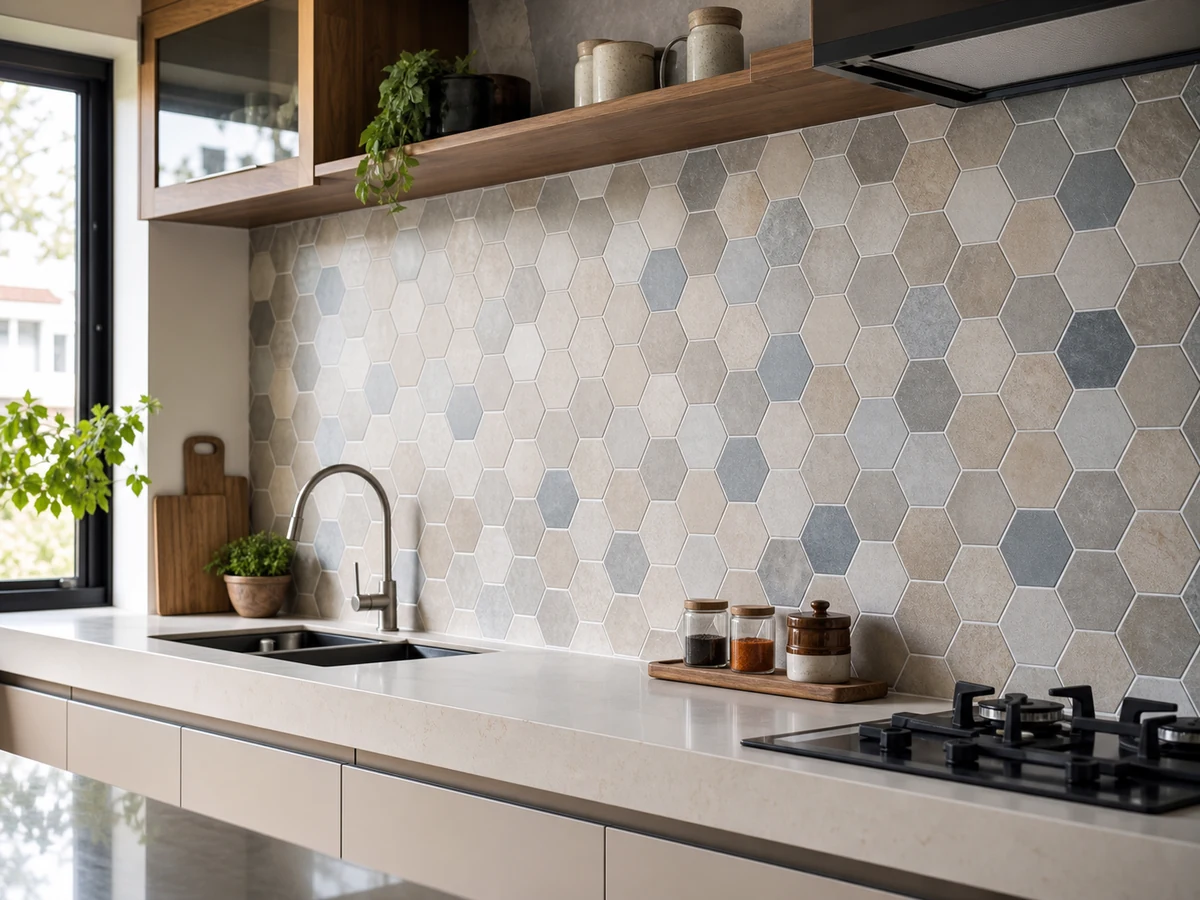
Hexagonal kitchen tiles are the only tile format in which the shape itself creates a visible geometric pattern regardless of colour or finish. A plain white square tile on a backsplash reads as a white surface with grout joints. A plain white hexagon tile on the same backsplash reads as a geometric honeycomb pattern. The shape does the design work that colour and pattern print do in other tile formats, which means the design decisions for hexagonal tiles are fundamentally different from those for square or rectangular tiles.
This is the only shape-focused page in the kitchen tiles subpage cluster. Where other pages cover colour, material, or surface zone, this page covers what is specific to the hexagonal format: how tile size affects pattern scale, how orientation changes the spatial reading of a kitchen, why grout colour is the most consequential design decision in hexagonal tiling, and where the hexagonal format works best and where it does not in Indian kitchen configurations.
Hexagonal tiles in India are sold differently from standard square or rectangular tiles. Standard ceramic and GVT are individual tiles that the contractor cuts and lays one at a time. Most hexagonal tiles available from Indian manufacturers come as mesh-backed sheets: small hexagonal tiles factory-mounted on a fibreglass mesh sheet, typically 300x300mm overall, which the contractor lays as a sheet rather than as individual hex tiles. The mesh dissolves into the adhesive during laying; only the tiles and grout joints remain visible once the work is complete.
Three size categories cover most of what Indian manufacturers produce in hex format:
| Hex Size | Tile Dimension (approx.) | Sheet Format | Tiles per Sheet (approx.) | Visual Pattern Scale | Best Kitchen Application |
| Small hex | 25mm to 50mm across the flat | 300x300mm mesh-backed sheet | 30 to 100 tiles per sheet, depending on hex size | Fine, dense honeycomb; reads as a texture from a distance | Backsplash, full wall, bathroom-style feature floor in small kitchen |
| Medium hex | 75mm to 100mm across the flat | 300x300mm or larger mesh-backed sheet or individual tiles | 7 to 15 tiles per sheet | Clear geometric pattern visible from normal viewing distance | Backsplash, kitchen floor in standard modular kitchen, feature panel |
| Large hex | 150mm to 200mm across the flat | Individual tiles; no mesh backing in most cases | Single tile laying | Bold, graphic; reads clearly from across the room | Kitchen floor in large or open-plan kitchens; feature wall panel |
Large individual hexagonal tiles (above 150mm across) are less commonly produced by standard Indian manufacturers in Morbi and Rajkot. Most of what is available in the Indian market in this size comes from importers or from manufacturers who produce them as a special run. For a kitchen project specifying large hex, confirm stock availability and lead time before including it in the project timeline. Small and medium hex tiles on mesh sheets are available from a wider range of Indian manufacturers in white, grey, black, and colour options.
A regular hexagon has six sides, which means it can be laid in two orientations: with a flat side at the top (flat-top), or with a point at the top (pointy-top, also called diamond or elongated orientation). Both orientations use the same tile; the difference is only in which edge the contractor places at the top during laying. The visual result is completely different:
| Orientation | Description | Visual Reading | Spatial Effect | Best Kitchen Use |
| Flat-top (honeycomb) | A flat edge runs horizontally atthe top and bottom of each tile horizontally; rows run left to right | Classic honeycomb pattern; the most recognisable hex tile look; horizontal emphasis | Makes the wall feel wider and more stable; grounding horizontal lines | Backsplash strips where horizontal width is the primary visual; floors |
| Pointy-top (elongated diamond) | A point at the top and bottom of each tile; columns run up and down | More dynamic, almost diamond-like pattern; vertical emphasis in the grid | Makes the wall feel taller; adds energy and movement to the surface | Tall narrow backsplash walls; feature walls where vertical interest is wanted; smaller tile count per row gives more cuts at the perimeter |
For most Indian kitchen backsplash applications, flat-top (honeycomb) orientation is the standard. It is what most buyers picture when they search for hexagon kitchen tiles, and it is what most tile contractors in India are experienced in laying correctly. Pointy-top orientation requires more precise setting out because the point-to-point alignment must be true across every row; even a small deviation in alignment becomes visible across a large backsplash area.
In square and rectangular tiles, grout is a background element. In hexagonal tiles, grout is an active design element. The six-sided shape creates a grout web that is visible from every angle and in every viewing direction. The grout pattern is as prominent as the tile colour itself, which makes the grout colour decision more consequential in hex tiles than in any other tile format except a black and white checkerboard.
White hexagon tiles with white grout give a uniform white surface where the tile edges are visible only as very faint lines. From a distance, the surface reads almost as a single white plane with a subtle geometric texture. This is the most common specification for white hex kitchen tiles and the most restrained version of the hex look. It suits kitchens where the buyer wants the hexagonal shape without a strong pattern statement.
White hex tiles with dark grey or black grout give the full honeycomb visual: a graphic geometric web in dark lines on a white background. This is the boldest version of the white tile and is also the most demanding to maintain in an Indian kitchen: the dark grout near the cooktop and sink collects cooking grease and oil residue visibly. For a backsplash with white hex and dark grout, epoxy grout in dark grey is essential; cement-based dark grout near a cooktop will show oil staining within months.
A coloured hex tile (sage green, navy, terracotta, mid-grey) with a grout that matches the tile colour closely reads as a continuous tonal surface where the hex shape is visible as a subtle texture rather than a strong pattern. This is the most sophisticated version of the hex tile look and the most difficult to execute: the grout colour must be very close to the tile colour or the mismatch reads as a manufacturing error rather than a design choice.
A coloured hex tile with white or cream grout gives a full-colour honeycomb pattern where both the tile colour and the geometric web read simultaneously. This is the most visually active version and works well as a contained feature panel or a small backsplash rather than a full kitchen wall. On a large wall area, a coloured hex with contrasting white grout creates a very busy surface that competes with the cabinet colour, countertop, and appliances.
| Tile Colour | Grout Colour | Visual Result | Best Application | Maintenance Level |
| White | White or off-white | Subtle geometric texture; near-uniform white surface | Full backsplash, full wall, floor | Low; white on white hides both calcium and cooking marks on grout |
| White | Dark grey or black | Bold honeycomb web; graphic black-and-white pattern | Feature panel, backsplash in white cabinet, kitchen | High near the cooktop; dark grout shows oil; use epoxy grout |
| Grey | Mid-grey (matching) | Tonal surface with visible hex shape | Full backsplash, full wall, small floor area | Low to moderate |
| Green, blue, or terracotta | White or cream | Full colour honeycomb pattern; highly graphic | Small feature panel, single backsplash strip | Moderate; white grout near the cooktop collects oil |
| Green, blue, or terracotta | Tone-matched | Colour-tonal surface; hex visible as texture | Full backsplash or feature wall | Low; matched grout hides residue in the joint |
| Black or near-black | White | Reverse honeycomb; white web on black surface | Feature panel or contained backsplash only | High, white grout on black hex shows every oil mark |
| Black or near-black | Dark grey or anthracite | Near-continuous dark surface with subtle hex texture | Feature wall or backsplash in a large kitchen | Moderate; dark grout hides residue better than white |
The kitchen backsplash is the most practical application for hexagonal kitchen tiles in Indian homes. The contained zone between counter and overhead cabinets (typically 18 to 24 inches tall) limits the total grout web area, which reduces the maintenance burden of a high-grout-line format like hex. On a backsplash strip of three to four tile rows in medium hex, the geometric pattern reads clearly and completely from across the kitchen without dominating the full room.
For the backsplash zone behind the cooktop, specifically, small or medium white hex tiles with off-white grout is the most practical specification. Gloss finish on the tile face wipes clean from oil. Off-white grout reduces the visibility of cooking oil residue in the grout lines compared to dark grout. Large hex on a narrow backsplash strip produces very few tile repeats across the height of the strip; in a backsplash that is only 18 inches tall, a 150mm hex tile gives only two and a half tile rows, which looks incomplete.
For the full specification framework covering backsplash surface rules, finish constraints, and zone-by-zone guidance for all kitchen wall tiles, the kitchen wall tiles page covers those in detail.
Note: Hexagonal tiles in gloss finish are safe for kitchen backsplash and wall use. Gloss hex tiles must not be used on kitchen floors. For hex kitchen floor tiles, use matte or GHR finish only.
Hexagonal kitchen floor tiles are a less common application than the backsplash or wall format, but they are genuinely effective in the right kitchen configuration. The honeycomb floor pattern has a long tradition in Indian heritage architecture, from Raj-era bungalow floors to traditional Chettinad and Kerala tile flooring, which makes it a natural choice for heritage and transitional kitchen renovations.
Hexagonal kitchen floor tiles must be in matte or GHR finish without exception. Glossy hex tiles on a kitchen floor are dangerous when wet. The additional complication with hex on a floor is that the grout web is more complex than a square tile grid; there are more grout joints per square foot in a hex layout than in a square layout of the same tile size, which means more joint area where water and oil can accumulate. Matte finish on the tile face reduces the additional slip risk that comes from a complex wet grout web.
Size for kitchen floors
Medium hex (75mm to 100mm) in matte ceramic or porcelain on mesh sheets is the most practical hex floor tile for a standard Indian kitchen. It gives enough pattern repeats across the floor for the honeycomb to read as a complete pattern (not just a few tiles) while keeping individual tile size manageable for the contractor to align correctly. A small hex on a kitchen floor gives a very fine, mosaic-like texture that reads from across the kitchen as a light geometric surface rather than a bold honeycomb.
Large hex (150mm to 200mm) on a kitchen floor works in large kitchens above 150 sq. ft., where the bigger tile size reads proportionally. In a small kitchen under 80 sq. ft., large hex tiles produce very few complete repeats across the floor, and the pattern looks incomplete rather than bold. The wastage for a large hex on a kitchen floor is higher than for a medium hex: at each perimeter wall, the angled hex edges produce more off-cut waste. Add 15% for large hex floor tile orders versus the standard 10%.
Mid-grey epoxy grout is the most practical grout for a hex kitchen floor in any colour. Epoxy resists cooking oil, turmeric, and cleaning product staining in the grout lines. Mid-grey reads neutrally with white, grey, and light-coloured hex tiles without the maintenance pressure that white grout or dark grout creates in a kitchen floor context. Use unsanded grout for hex tiles with joints under 3mm; hex tiles on mesh sheets typically have 2mm preset joints that need unsanded grout.
White hexagon kitchen tiles are the most requested hex format in Indian kitchens. The combination of the honeycomb geometric shape with a white surface gives a result that reads as both fresh and considered, traditional and contemporary. The white hex backsplash is particularly popular in cafe-style kitchens, Scandi-influenced kitchen designs, and heritage bungalow renovations where the hex shape references the original encaustic floor tiles of the building.
White hex tiles in gloss ceramic on a mesh-backed sheet in small or medium hex are the standard specification for a white hex kitchen backsplash. Gloss white gives the brightest reading and is the easiest to wipe clean from oil. Matte white hex on a backsplash reads softer; it is valid but requires slightly more cleaning effort near the cooktop. For white kitchen tiles across all formats and sizes, including GVT and ceramic in standard square and rectangular formats, the white kitchen tiles page covers the complete range.
White hex tiles in matte ceramic or porcelain on a mesh sheet are the correct specification for a white hex kitchen floor. White matte hex on a kitchen floor looks the sharpest but is the most demanding to maintain: dark cooking residue and footprints show clearly on a white floor in a daily-use Indian kitchen. Buyers choosing white hex for the kitchen floor must commit to frequent cleaning. White matte hex with off-white grout is more forgiving on the floor than white matte hex with dark grey grout, which shows every footprint in the grout web.
| Colour | Best Hex Application | Grout Colour | Cabinet Pairing | Price Range (Rs./sq.ft) | Finish |
| White | Backsplash, floor, full wall | White (subtle) or dark grey (bold) | Any cabinet colour; most versatile hex option | Rs. 55 to Rs. 110 | Gloss (walls); Matte (floors) |
| Light grey | Backsplash and full wall | Mid-grey matching or white for contrast | White, cream, or timber cabinets | Rs. 60 to Rs. 115 | Gloss (walls); Matte (floors) |
| Dark grey or charcoal | Backsplash as accent; feature panel | Anthracite matching or white for bold contrast | White cabinets only | Rs. 65 to Rs. 120 | Gloss (walls); Matte (floors) |
| Sage or mint green | Backsplash feature strip; small feature panel | White or off-white | White, cream, or light timber cabinets | Rs. 65 to Rs. 125 | Gloss (walls) |
| Navy or dark blue | Small backsplash feature panel; feature wall section | White for contrast; dark blue matching for seamless | White cabinets only | Rs. 70 to Rs. 130 | Gloss (walls) |
| Terracotta or reddish-brown | Backsplash, floor in heritage or farmhouse kitchens | Off-white or cream | Cream, timber, or aged timber cabinets | Rs. 60 to Rs. 120 | Matte (floors); Gloss or Matte (walls) |
| Black | Small feature panel; backsplash accent in white kitchen | White (high contrast) or anthracite (seamless) | White cabinets only | Rs. 65 to Rs. 125 | Gloss (walls); Matte (floors) |
The hexagonal format is not universally applicable in an Indian kitchen. Three situations where it works well and three where it does not:
| Your Kitchen Requirement | Recommended Hex Tile | Size | Finish | Grout | Price Range (Rs./sq.ft) |
| White hex backsplash, standard kitchen | White gloss ceramic small or medium hex on mesh | 50mm to 100mm | Gloss | Off-white or white epoxy | Rs. 55 to Rs. 110 |
| White hex kitchen floor | White matte ceramic or porcelain medium hex | 75mm to 100mm | Matte | Off-white epoxy grout | Rs. 60 to Rs. 115 |
| Coloured hex feature backsplash panel | Sage, grey, or terracotta gloss ceramic hex | 50mm to 75mm | Gloss | White or cream (contrast) or tone-matched | Rs. 65 to Rs. 130 |
| Heritage bungalow kitchen floor | Terracotta or black-and-white matte ceramic hex | 75mm to 100mm | Matte | Off-white or cream epoxy | Rs. 60 to Rs. 120 |
| Bold backsplash, white kitchen, white hex dark grout | White gloss ceramic medium hex | 75mm to 100mm | Gloss | Dark grey epoxy (mandatory for cooktop zone) | Rs. 55 to Rs. 110 |
| Minimal hex, subtle texture | White or light grey gloss ceramic small hex, matching grout | 25mm to 50mm | Gloss | White or off-white matching | Rs. 55 to Rs. 100 |
| Large open-plan kitchen with hex floor | Medium to large matte porcelain or ceramic hex | 100mm to 150mm | Matte | Mid-grey epoxy | Rs. 65 to Rs. 130 |
Hexagonal kitchen tiles in white, grey, green, terracotta, and black in small and medium formats are listed at TilesFinders in both gloss finish for backsplash and wall use and matte finish for kitchen floors. Mesh-backed hex sheets for backsplash and wall applications start from Rs. 55 per sq ft; matte hex for kitchen floors runs from Rs. 60 to Rs. 130 per sq ft. Use the shape filter to find hex formats specifically, then confirm finish (gloss for walls; matte for floors) before shortlisting. All ceramic tiles listed meet IS 13630.
Hexagonal kitchen tiles are tiles with six equal sides. Unlike square tiles, where grout runs in two directions (horizontal and vertical), hex tiles create a six-direction grout web that forms a visible honeycomb or geometric pattern across the whole surface. This means the tile shape itself creates a design element even when using a single plain colour, which is different from square tiles, where colour and pattern must carry the design. The shape-driven pattern makes grout colour the most consequential design decision in hex tile work.
Matte or GHR finish only. Gloss hexagonal tiles must not be used on kitchen floors. Gloss is safe on kitchen walls and backsplash. On a kitchen floor, the complex grout web of a hex layout combined with a gloss tile surface creates a high slip risk when cooking water or oil reaches the floor. Matte or GHR finish is mandatory for all hexagonal kitchen floor tiles, regardless of colour or size.
A flat-top hex has a horizontal flat edge at the top and bottom of each tile, creating rows that run left to right across the wall or floor. A pointy-top hex has a point at the top and bottom, creating columns that run up and down. The same tile can be laid in either orientation. Flat-top (honeycomb) is the most common and familiar orientation for kitchen backsplash and floor tiles. Pointy-top creates a more vertical, dynamic pattern and is less commonly seen in Indian kitchen tiling.
For white hex on a kitchen backsplash, off-white epoxy grout gives the most balanced result: close enough to white to avoid a strong contrast, but warm enough to not read as a stark white line against the tile. If a bold honeycomb grid is wanted, dark grey epoxy grout creates the full geometric web effect. For white hex on a kitchen floor, mid-grey epoxy grout in a 2mm joint is the most practical: it resists cooking oil and turmeric staining, reads neutrally against the white tile, and is easier to keep clean than white or dark grout in a floor cooking environment.
Yes. Hexagonal tiles require more precise setting-out before laying begins because any misalignment in the hex grid becomes visible and difficult to correct once tiles are fixed. Mesh-backed hex sheets simplify the process because the spacing between tiles is factory-set. For individual large hex tiles without a mesh backing, the contractor must set out the grid with chalk lines and dry-lay tiles before fixing to confirm the alignment. Pointy-top orientation is harder to lay than flat-top because the vertical column alignment is more sensitive to small errors. Budget for slightly higher laying costs than standard square tiles.
Yes, but with different specifications for each surface. Use gloss ceramic hex in small or medium sizes on the backsplash. Use matte ceramic or porcelain hex in medium size on the floor. If the same tile is used on both surfaces, ensure it is available in both gloss (for the backsplash version) and matte (for the floor version) from the same manufacturer, or use two different tiles in the same colour. Never use the same gloss hex tile on both surfaces: gloss on the kitchen floor is a safety hazard.
White gloss ceramic small hex on mesh sheets for kitchen backsplash starts from Rs. 55 to Rs. 90 per sq.ft. Medium hex in colour (grey, green, terracotta) runs Rs. 65 to Rs. 130 per sq.ft. Matte hex for kitchen floors in ceramic or porcelain runs from Rs. 60 to Rs. 120 per sq.ft. Prices vary by tile size, colour, and whether the hex comes on a mesh sheet (typically more expensive per sq ft than standard format tiles) or as individual tiles. Add 15% wastage allowance for hex tiles versus 10% for standard square tiles.
Medium hex at 75mm to 100mm across the flat is the most practical size for a standard Indian kitchen backsplash. It gives enough tile repeats across the backsplash height (typically 18 to 24 inches) to read as a complete honeycomb pattern. Small hex (25mm to 50mm) gives a finer, denser pattern that reads as a mosaic texture from a distance rather than a clear honeycomb grid. A large hex (above 150mm) on a narrow backsplash strip does not have enough tile rows to read as a complete pattern.