Modern Wall Tile Designs for Living Room, Bedroom & Kitchen
Transform your walls with modern designs. Explore monolithic living room slabs, cosy bedroom wood...


Loading designs...


















Porcelain sits in a specific position in the Indian kitchen tile market that neither ceramic nor GVT occupies. Ceramic is the right tile for kitchen walls and backsplash: affordable, easy to cut, available in every colour. GVT is the right tile for kitchen floors in mid-range to premium kitchens: very low water absorption, wide colour range, hard body. Porcelain fills the gap between them: it can go on kitchen floors where ceramic cannot, it is lighter per square foot than GVT, which matters in high-rise apartments, and it costs less than GVT while outperforming ceramic on floors.
This page covers porcelain kitchen tiles across every surface. It explains the technical difference between porcelain and ceramic in plain terms, covers which porcelain sizes and finishes are correct for kitchen floors versus walls, and addresses the specific buyer questions around white porcelain, porcelain backsplashes, and what the term porcelain tile kitchen counter actually means in scope. The full kitchen tiles range includes ceramic, porcelain, and GVT; this page focuses on porcelain specifically and when it is the right choice over the other two.
All three tile types, ceramic, porcelain, and GVT, are covered under IS 13630 in India, but they fall into different water absorption classes within that standard. That absorption difference is what determines where each can be safely used in a kitchen:
| Property | Ceramic (IS 13630, Class BIII) | Porcelain (IS 13630, Class BIa/BIb) | GVT (IS 15622) |
| Water absorption | Above 10% (typically 12% to 16%) | 0.5% to 5%, depending on class | 0.05% or less |
| Body density | Porous; lower density | Denser than ceramic; lower porosity | Near-glass density; least porous |
| Kitchen wall use | Yes, standard backsplash and wall tile | Yes, all wall applications | Yes, all wall applications |
| Kitchen floor use | Not recommended; 300x300 bathroom floor exception only | Yes, with matte or GHR finish | Yes, with matte or GHR finish |
| Weight per sq.ft | Lightest | Lighter than GVT in the same size | Heavier matters on high-rise balconies |
| Cutting ease | Easiest; score-and-snap cutter | Slightly harder than ceramic; wet-saw for larger sizes | Wet-saw required for most sizes |
| Colour and look range | Widest for wall tiles | Wide, stone, wood, plain colour, marble look | Widest for floor tiles |
| Price range (Rs./sq.ft) | Rs. 35 to Rs. 110 | Rs. 45 to Rs. 140 | Rs. 80 to Rs. 250 |
The key distinction that makes porcelain worth a dedicated page is that it is the only tile body in IS 13630 that is suitable for kitchen floors. Ceramic under IS 13630 is wall-only in standard kitchen sizes. GVT under IS 15622 is the premium floor tile. Porcelain sits between them and earns its place in the kitchen floor specification when the budget does not support GVT or when the floor loading of a high-rise apartment favours the lighter porcelain body over GVT. For a detailed comparison of ceramic specifically, the ceramic tiles for kitchen page covers the tile body in full.
Porcelain kitchen flooring is the correct specification for kitchen floors in the budget-to-mid-range segment, where GVT is more expensive than the project allows. The tile body at 2% to 5% water absorption handles the daily mopping, cooking water, and monsoon humidity that an Indian kitchen floor experiences. The glazed face seals the porcelain body from surface staining. With the right finish, porcelain on a kitchen floor performs well for many years.
Porcelain kitchen floor tiles must be in matte or GHR (Glaze High Resistance) finish. Gloss, high gloss, satin matte, and semi-polished porcelain must not be used on kitchen floors. These finishes become slippery when the smallest amount of cooking water, oil, or cleaning liquid reaches the surface. The matte finish on porcelain provides adequate slip resistance for a kitchen floor in normal cooking and cleaning conditions. GHR finish is the better specification for the area immediately in front of the sink where water regularly reaches the floor.
Sizes for porcelain kitchen floors
Porcelain kitchen floor tiles are available in four standard sizes that suit different kitchen configurations:
| Size | Alias | Best Kitchen Use | Notes | Price Range (Rs./sq.ft) |
| 300x300 | 1x1 | Very small kitchens under 50 sq.ft; utility kitchen, step treads | More joints per sq. ft. than larger sizes; use 2mm grout joints | Rs. 45 to Rs. 75 |
| 400x400 | 16x16 | Standard modular kitchens; budget kitchen floors; balcony-adjacent kitchen floors | Good balance of joint count and cutting flexibility; most commonly stocked size | Rs. 50 to Rs. 90 |
| 500x500 | 20x20 | Mid-size kitchens, where fewer joints are wanted without moving to GVT 2x2 | Fewer joints than 400x400; good for kitchens 8 ft wide or more | Rs. 60 to Rs. 110 |
| 600x600 | 2x2 (24x24) | Larger kitchens, where the buyer wants the 2x2 format at a lower cost than GVT | Needs a flat screed; fewer joints than 500x500; most visual impact for the price | Rs. 70 to Rs. 130 |
| 200x1000 | 8x40 (plank) | Kitchens where a wood plank look is wanted at a lower price than GVT 200x1200 | Lighter per sq. ft. than GVT plank; good for high-rise apartment kitchens | Rs. 60 to Rs. 130 |
Note: Gloss, high gloss, satin matte, and semi-polished porcelain must not be used on kitchen floors. Matte or GHR finish is the only safe specification for porcelain kitchen flooring.
For kitchen walls, ceramic in 12x18 or 12x24 is the default specification and the right choice for most Indian kitchen budgets. Porcelain tiles on kitchen walls make sense in specific situations where ceramic's limitations become relevant:
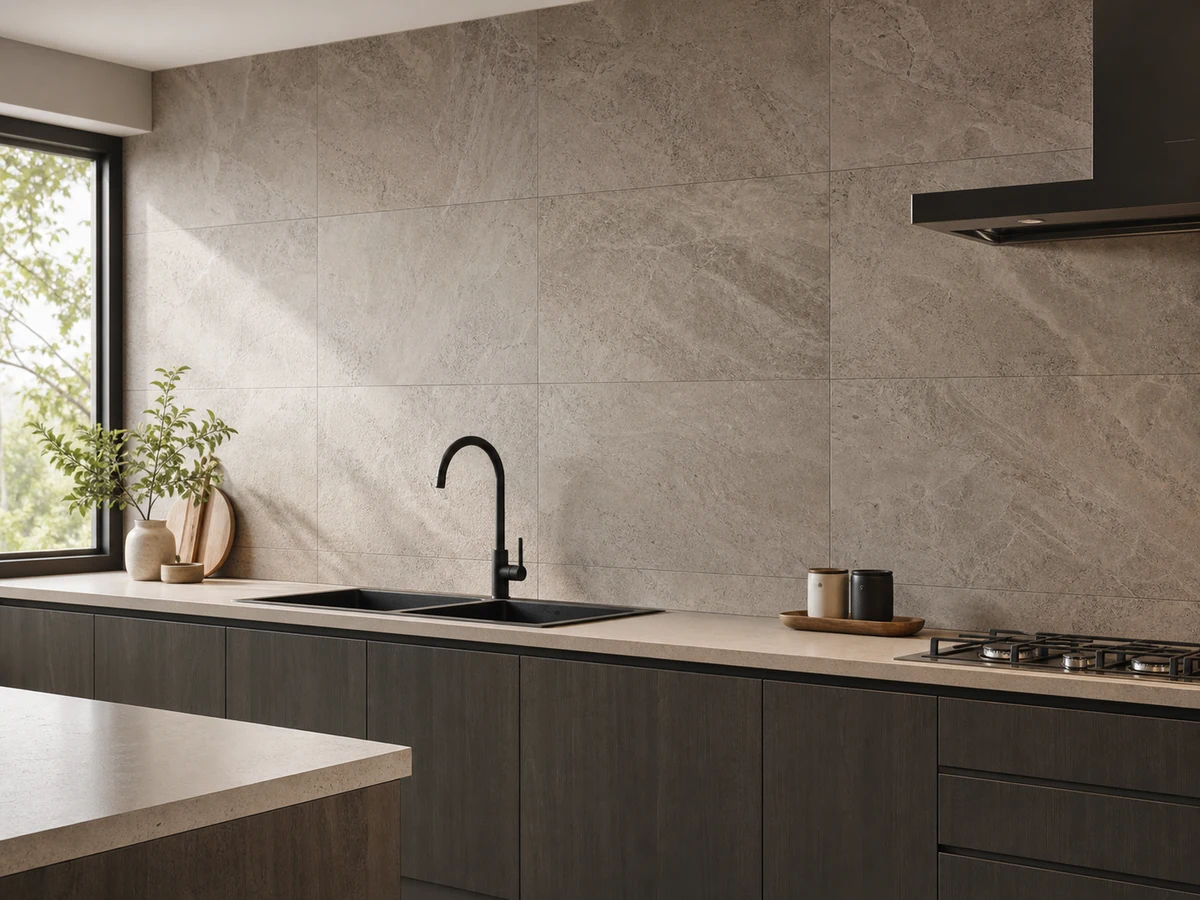
Porcelain kitchen wall tiles in 600x600 or 600x1200 are available in gloss, matte, and polished glossy finishes. On walls, all three finishes are safe; the finish choice is a design decision, not a safety one. Gloss and polished glossy porcelain on kitchen walls gives a reflective surface that reads as premium. Matte porcelain on kitchen walls gives a quieter, more stone-like surface that suits modern and Japandi kitchen styles.
For the full kitchen wall tile specification framework covering all tile bodies and surfaces, the kitchen wall tiles page covers the zone-by-zone rules.
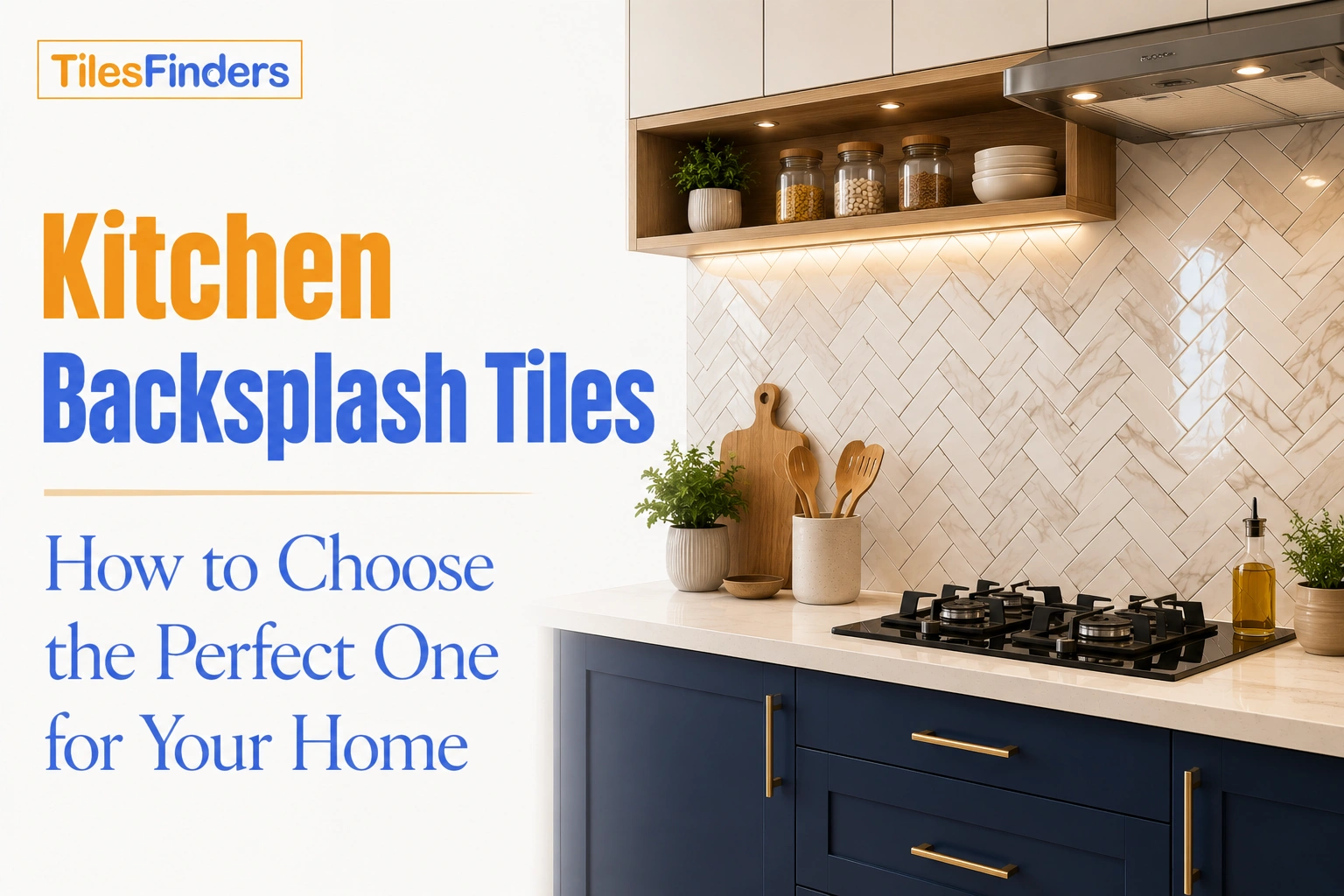
The kitchen backsplash is the zone where ceramic and porcelain overlap most directly. Both tile bodies work on the backsplash wall; the choice between them comes down to format and finish rather than body performance.
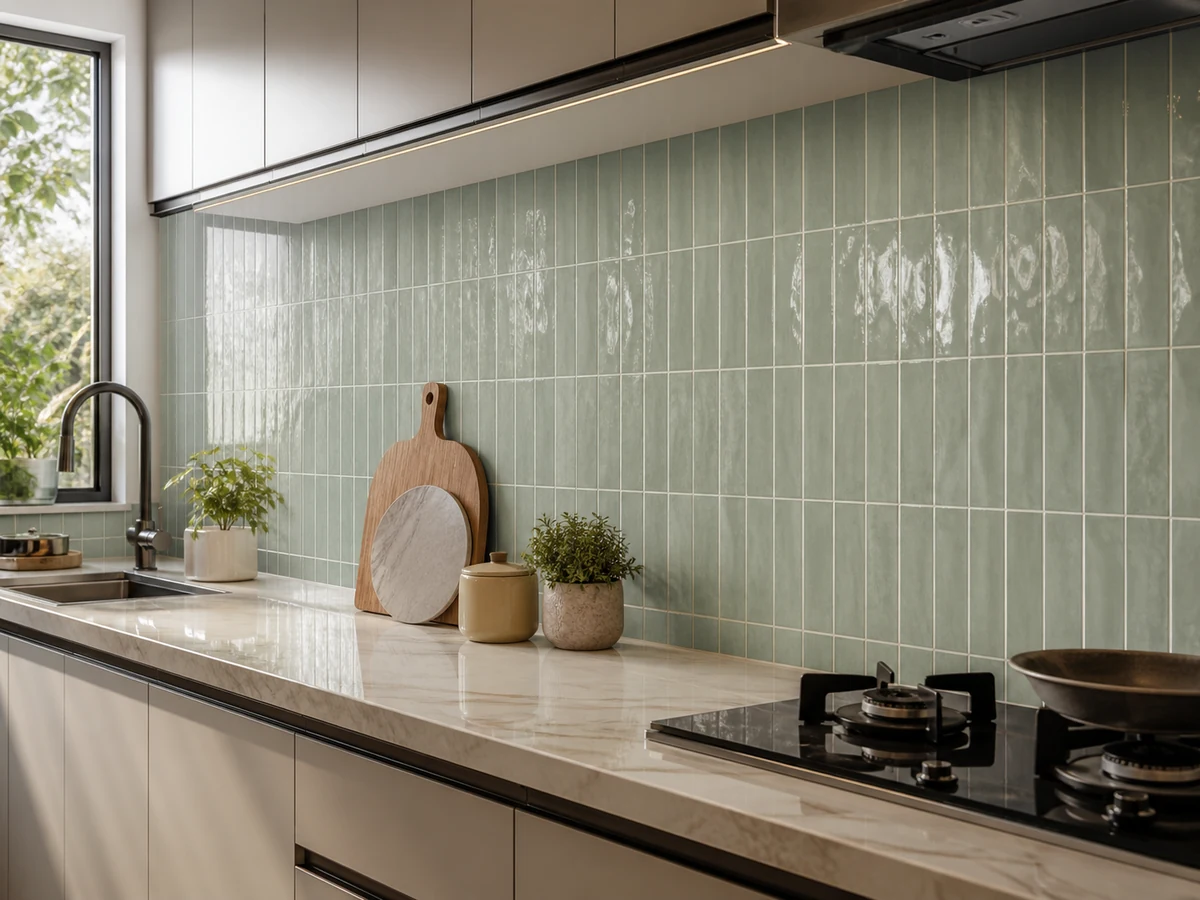
Ceramic in 12x24 gloss is the standard backsplash specification. Porcelain in 600x600 gloss or matte on the backsplash gives fewer visible grout lines because the larger format covers more area per tile. For a backsplash that reads as a near-slab surface rather than a tiled grid, porcelain in 600x600 with 2mm white grout gives a cleaner result than ceramic in 12x24 with the same grout colour.
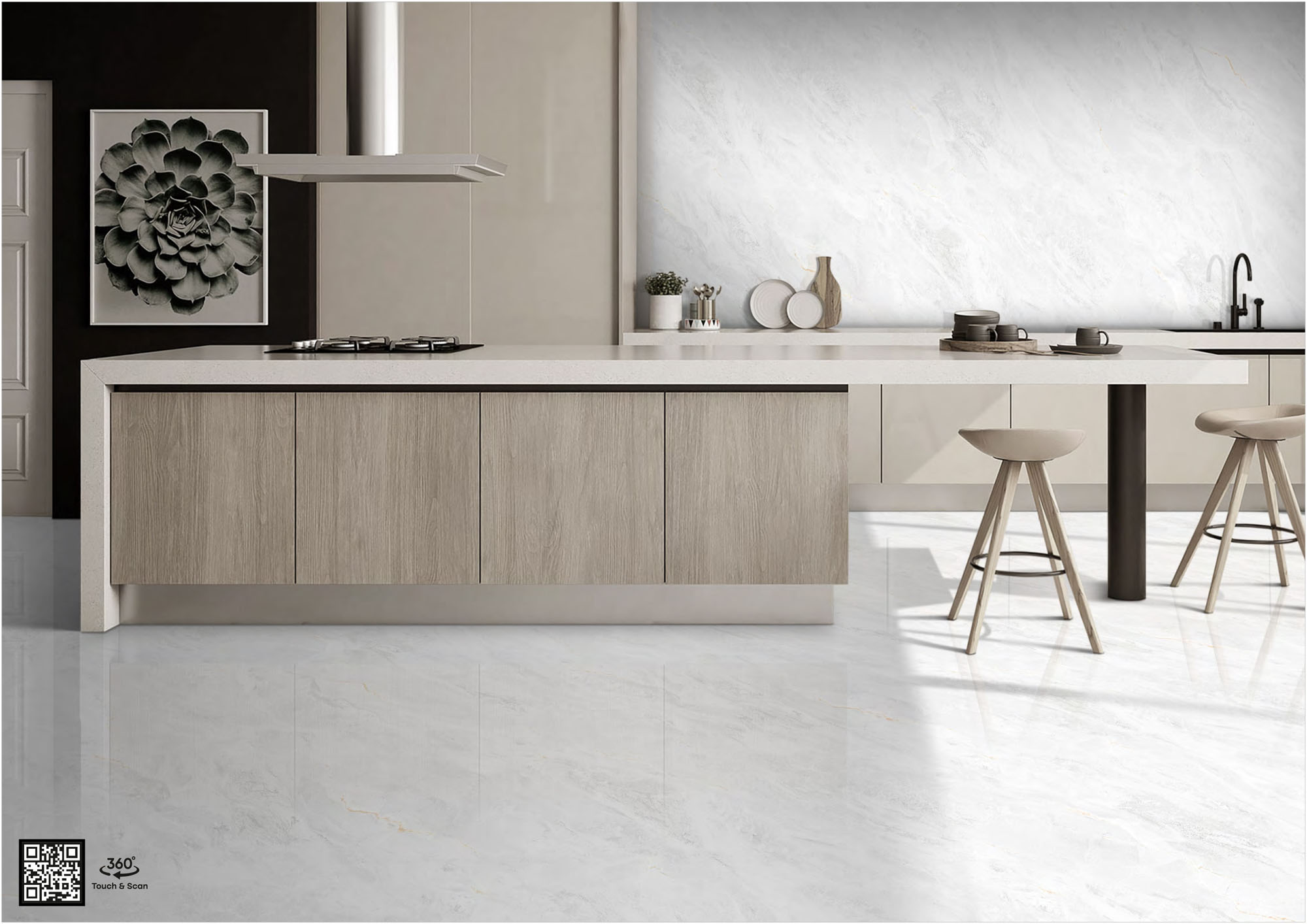
Porcelain in a marble look in 600x600 gloss or matte on the backsplash is the mid-range specification for a marble backsplash without moving to GVT. The marble pattern glaze on porcelain gives a convincing veined surface at a lower price per sq.ft than GVT in the same look. Water absorption of 2% to 5% is adequate for a backsplash wall that does not sit in prolonged water contact.
For the backsplash zone directly behind the cooktop, gloss porcelain is the right finish. The glazed surface repels oil mist and cooking splashes. Matte porcelain on a backsplash near the cooktop holds cooking grease in the surface texture more visibly than gloss and requires more frequent scrubbing. For a kitchen with heavy Indian cooking, gloss porcelain on the cooktop backsplash zone and matte porcelain on the remaining wall is a practical combination.
White is the most searched colour in porcelain kitchen tiles, both for floors and walls. White porcelain behaves differently from white ceramic and white GVT in a kitchen context, and understanding those differences helps buyers choose the right product.
White porcelain floor tiles in matte finish in 600x600 are the correct specification for a white kitchen floor on a porcelain body. The matte surface is anti-skid and hides the smooth gloss reflection that makes a white polished floor look like a showroom rather than a functional kitchen. White matte porcelain in 600x600 runs from Rs. 70 to Rs. 130 per sq ft.
The maintenance reality of white on a kitchen floor applies to porcelain as it does to GVT: dark cooking residue, oil marks, and footprints show more clearly on white than on any other floor colour. White porcelain kitchen flooring is the cleanest-looking option in the kitchen and the most demanding to maintain in daily Indian cooking conditions. For a white floor that is used for daily cooking with oil and spices, a light grey or warm beige porcelain matte in the same size gives the same specification with significantly lower maintenance visibility. For the full range of white tile options across all tile bodies, the white kitchen tiles page covers walls, floors, and finishes in detail.
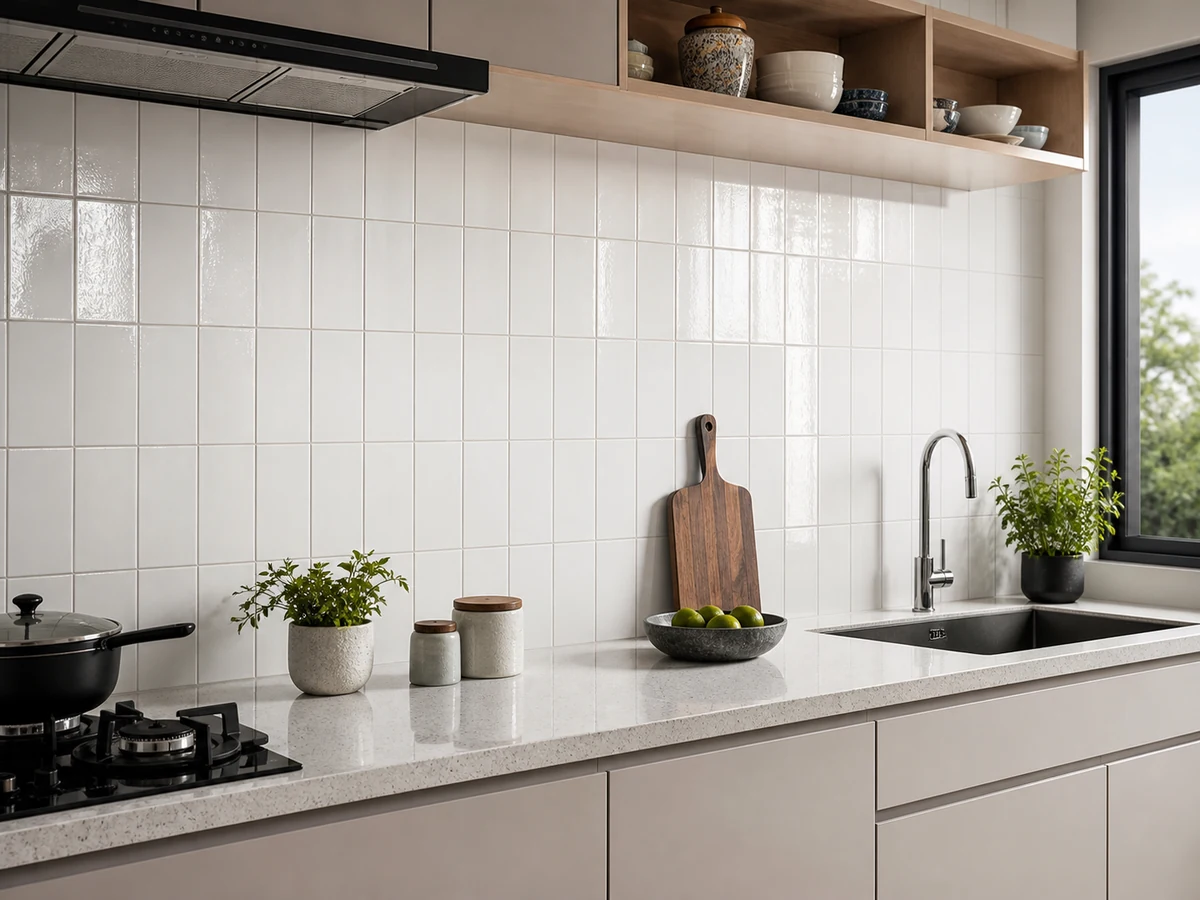
White porcelain in 600x600 gloss or matte on kitchen walls gives a larger format alternative to white ceramic in 12x24. The 600x600 format reduces the number of visible grout lines on the wall, which is the main reason buyers choose porcelain over ceramic for full-height kitchen wall cladding. White porcelain in 600x600 gloss on a kitchen wall runs from Rs. 65 to Rs. 120 per sq ft, which is higher per sq ft than white ceramic in 12x24 but lower per sq ft than white GVT in 2x2.
For white specifically, confirming the UV stability of the porcelain glaze before ordering is important for any wall that receives direct afternoon sun. Some white porcelain glazes yellow under prolonged direct sun exposure. This matters more for exterior-adjacent walls or open kitchen layouts with large windows than for enclosed kitchen walls with no direct sun.
This is the most common decision buyers face when specifying a kitchen floor tile above the ceramic price point. Both porcelain and GVT are suitable for kitchen floors in matte or GHR finish. The differences that matter in practice:
| Decision Factor | Porcelain | GVT | Which to Choose |
| Water absorption | 2% to 5% | 0.05% | GVT for open terraces or kitchens with prolonged water contact; porcelain is adequate for standard enclosed kitchen floors |
| Weight per sq.ft | Lighter, around 18 to 22 kg per sq.m, depending on thickness | Heavy, around 20 to 25 kg per sq.m in the same size | Porcelain for high-rise apartments above the 5th floor, where dead load matters; GVT for ground floor and low-rise |
| Colour and look range | Wide, marble, stone, wood, plain colour | Widest; more variety in stone, concrete, and designer looks | GVT if a specific premium look is required; porcelain for most standard colours and looks |
| Price per sq.ft | Rs. 45 to Rs. 140 | Rs. 80 to Rs. 250 | Porcelain for budget-to-mid-range; GVT for mid-range to premium |
| Cutting | Easier than GVT; wet-saw for 500x500 and above | Wet-saw required for all sizes above 400x400 | Porcelain is slightly easier on-site for irregular kitchen layouts with many cuts |
| Batch consistency | Moderate; some colour variation between boxes in the same catalogue item | High; GVT glaze is more consistent across large production runs | GVT for large floor areas where colour consistency across many boxes matters |
| IS standard | IS 13630 | IS 15622 | Both are standard-compliant; different standards cover different absorption classes. |
The practical guideline: porcelain is the right kitchen floor tile when the budget is between Rs. 45 and Rs. 140 per sq. ft., when the kitchen is in a high-rise apartment where tile weight matters, or when the buyer wants a single tile body that can be used on both walls and floor. GVT is the right choice when the budget allows Rs. 80 per sq.ft and above, and the buyer wants the widest colour range and the best long-term water resistance. For a full comparison of GVT tiles alongside porcelain and ceramic, the category page shows the complete available range.
| Kitchen Situation | Recommended Porcelain Tile | Size | Finish | Price Range (Rs./sq.ft) |
| Budget kitchen floor, standard apartment | Plain grey or beige matte porcelain | 400x400 | Matte | Rs. 50 to Rs. 80 |
| Mid-range kitchen floor, modular kitchen | Stone or marble looks matte porcelain | 500x500 or 600x600 | Matte | Rs. 65 to Rs. 120 |
| High-rise apartment kitchen (weight-conscious) | Lightweight matte porcelain | 400x400 or 500x500 | Matte | Rs. 50 to Rs. 100 |
| Kitchen near sink, high water contact | Porcelain GHR finish | 400x400 or 500x500 | GHR | Rs. 65 to Rs. 115 |
| Wood look kitchen floor, budget option | Porcelain plank wood look matte | 200x1000 | Matte | Rs. 60 to Rs. 130 |
| White kitchen floor, porcelain body | White matte porcelain | 600x600 | Matte | Rs. 70 to Rs. 130 |
| Same tile on the wall and the floor | Stone or plain colour porcelain matte | 600x600 (floor and wall) | Matte (floor); Matte or Gloss (wall) | Rs. 65 to Rs. 130 |
| Small kitchen, tight budget | Basic matte porcelain | 300x300 or 400x400 | Matte | Rs. 45 to Rs. 75 |
Porcelain kitchen tiles across every size from 300x300 to 600x600 and plank format 200x1000, in matte, GHR, and gloss finishes for wall and floor use, are listed at TilesFinders with water absorption, IS standard, finish, and size shown for every product. Basic matte porcelain for kitchen floors starts from Rs. 45 per sq ft; stone and marble look porcelain in 600x600 runs from Rs. 70 to Rs. 130 per sq ft. Use the tile type filter to find porcelain separately from ceramic and GVT, then filter by finish to confirm the right surface specification before shortlisting. All porcelain tiles listed meet IS 13630.
Yes. Standard ceramic in 300x450 and 300x600 must not be used on kitchen floors because its water absorption of 12% to 16% makes it vulnerable to adhesive bond failure when the floor gets wet repeatedly. Porcelain at 2% to 5% water absorption is suitable for kitchen floors in matte or GHR finish. Porcelain on a kitchen floor performs correctly and lasts well. Ceramic on a kitchen floor is an incorrect practice that leads to tile lifting within a few monsoon seasons in most Indian climates.
GVT has better water absorption (0.05% vs 2% to 5%) and a wider colour range, making it the stronger technical choice for kitchen floors. Porcelain is the practical choice when the budget does not support GVT pricing, when the kitchen is in a high-rise apartment where tile weight is a consideration, or when the buyer wants a single tile body for both walls and floor. For a standard enclosed Indian kitchen floor, porcelain in matte finish performs adequately. For a kitchen with a wet zone near the sink or a terrace-connected outdoor kitchen, GVT's lower water absorption is the better specification.
Matte or GHR finish only. Gloss, high gloss, satin matte, and semi-polished porcelain must not be used on kitchen floors. These finishes become slippery when wet from cooking water, cleaning liquid, or oil. Matte porcelain provides adequate anti-skid properties for standard kitchen floor conditions. GHR (Glaze High Resistance) is the better choice for the area in front of the sink where water regularly reaches the floor.
Yes. This is one of the practical advantages of porcelain over ceramic. Porcelain in 600x600 can go on both kitchen walls (in any finish) and kitchen floors (in matte or GHR finish only). Using the same tile body on both surfaces simplifies sourcing and keeps the visual consistent. Ceramic cannot do this because standard ceramic sizes are wall-only.
White ceramic in 12x24 is a wall-only tile. White porcelain in 600x600 can go on both walls and floors with the correct finish. White ceramic gloss in 12x24 gives a reflective white surface that is standard for kitchen backsplash and wall applications. White porcelain matte in 600x600 gives a larger format, fewer grout lines, and can be used on the kitchen floor with a matte finish. White porcelain costs more per sq.ft than white ceramic but less than white GVT.
Porcelain countertop slabs for kitchen worktops are a separate product category from floor and wall tiles and are not in the Tilesfinders tile range. Where porcelain tiles are relevant near the counter is the backsplash upstand (the vertical strip where the counter meets the wall) and the splashback panel behind the hob. These are wall tile applications and porcelain in gloss or matte finish handles them correctly. For countertop material, consult stone fabricators and worktop suppliers who produce engineered porcelain or quartz worktop slabs.
For a standard modular kitchen 8 to 10 ft wide, 400x400 or 500x500 porcelain gives the right balance of joint count and cutting flexibility. In a kitchen under 60 sq. ft., 300x300 or 400x400 produces less wastage at the perimeter. In a kitchen 10 ft wide or more, 600x600 gives fewer grout lines and reads better at the larger scale. For a wood look kitchen floor in porcelain, 200x1000 is the correct plank format. Always add 10% to the measured floor area for cuts and wastage before ordering.
Porcelain sits at a mid-range price point between ceramic and GVT. Basic matte porcelain in 400x400 for kitchen floors starts from Rs. 45 to Rs. 80 per sq ft. Stone or marble look porcelain in 600x600 runs from Rs. 70 to Rs. 130 per sq ft. White porcelain in 600x600 for walls or floors costs Rs. 65 to Rs. 130 per sq ft. These are tile supply prices; laying, adhesive, and grout are additional. Porcelain costs more per sq.ft than ceramic but covers both walls and floors, which ceramic cannot do in standard kitchen sizes.