
300x300 Tiles in India: The Small-Format Classic for Bathrooms, Outdoor and Utility Spaces
Discover where 300x300 tiles outperform large formats in Indian bathrooms, utility areas and outdoors, with practical guidance on drainage, grip, cutting, repairs, cost and substrate tolerance.
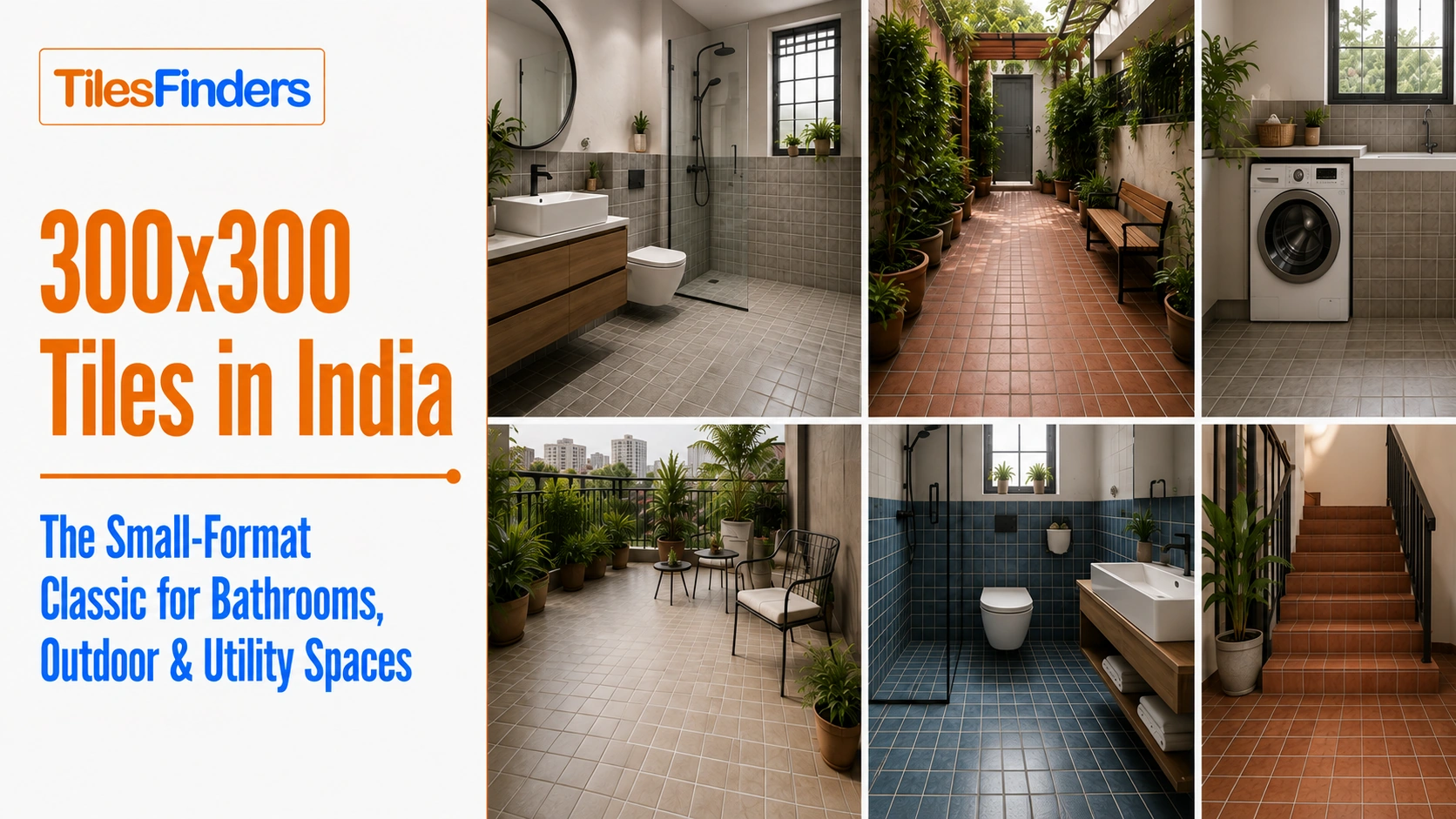
- Six Situations Where Small Format Wins
- Advantage One: Drainage
- Advantage Two: Grip Registration
- Advantage Three: Cutting Economy
- Advantage Four: Repairability
- Advantage Five: Substrate Tolerance
- Advantage Six: Cost
- Where Large Format Genuinely Wins
- The Rooms Where 300x300 Is Still the Right Answer
- What to Confirm
- Find Small-Format Ranges on TilesFinders
300x300 tiles remain highly practical for shower floors, small bathrooms, utility areas, outdoor steps and repair-prone surfaces because they improve drainage, cutting efficiency and substrate tolerance. Large formats still win on open, flat surfaces where fewer grout joints and a seamless appearance matter more than small-format advantages.
The tile industry has spent a decade moving toward larger formats, and for open living room floors that shift is entirely justified. But the same logic applied to a bathroom, a wash area or an outdoor step produces a worse floor, not a better one. This guide sets out the six situations where a 300x300 tile genuinely outperforms a large one, is honest about where it does not, and explains why the smallest common format has survived a trend that was supposed to replace it.
Six Situations Where Small Format Wins
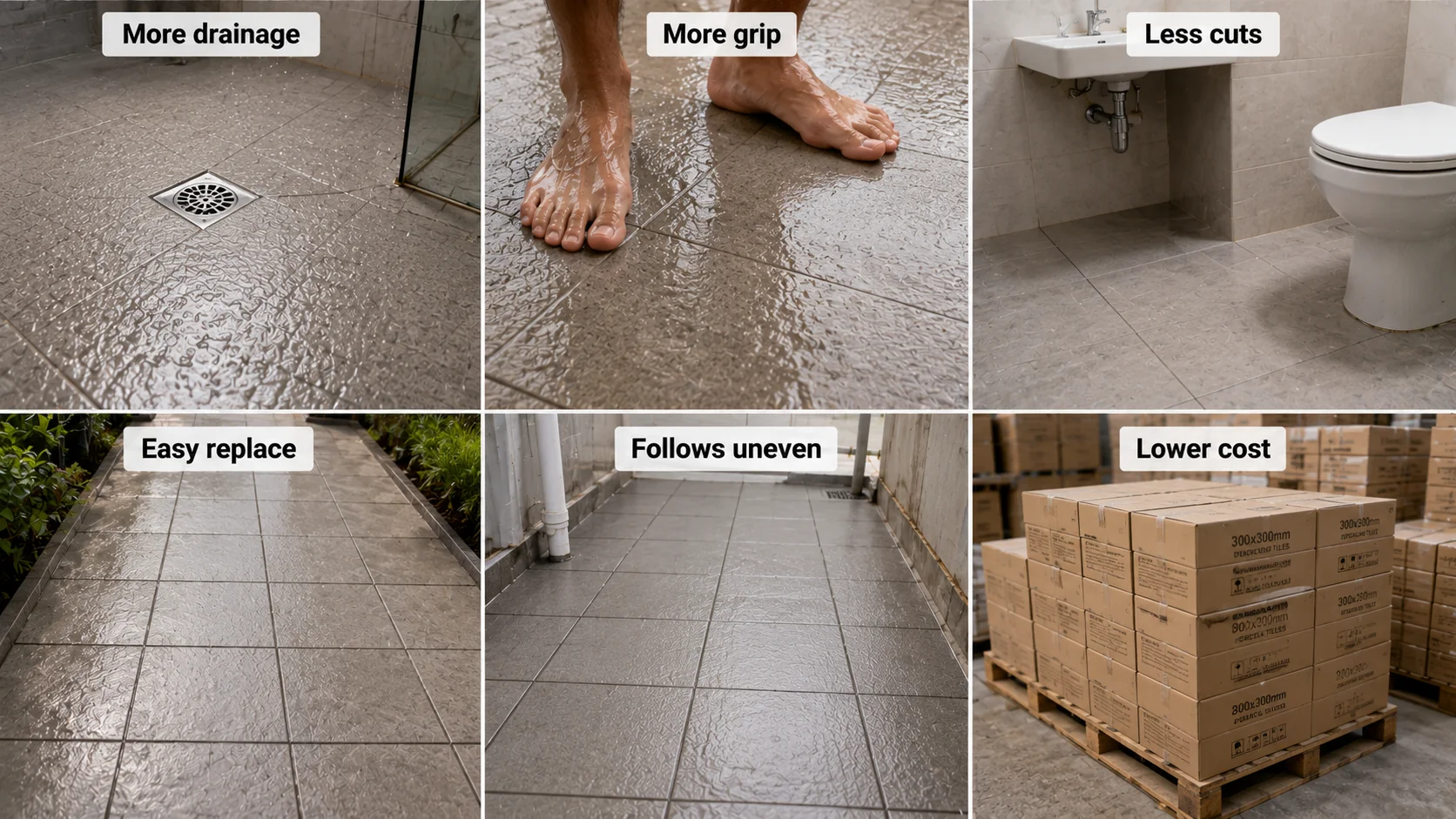
- More grout lines mean more drainage paths, which matters on shower floors, wet rooms and any surface falling to a drain.
- More edges underfoot mean more grip registration, on bathroom floors, outdoor steps and wash areas.
- Cuts consume less material around fixtures, in small bathrooms, utility rooms and anywhere fixture-dense.
- Individual tiles can be replaced without disturbing the field, on outdoor pathways, parking bays and service areas.
- Small rigid pieces follow an uneven substrate, which decides most renovations and older buildings.
- Lower cost per square foot and lower handling breakage, on budget-constrained projects and large utility areas.
Advantage One: Drainage
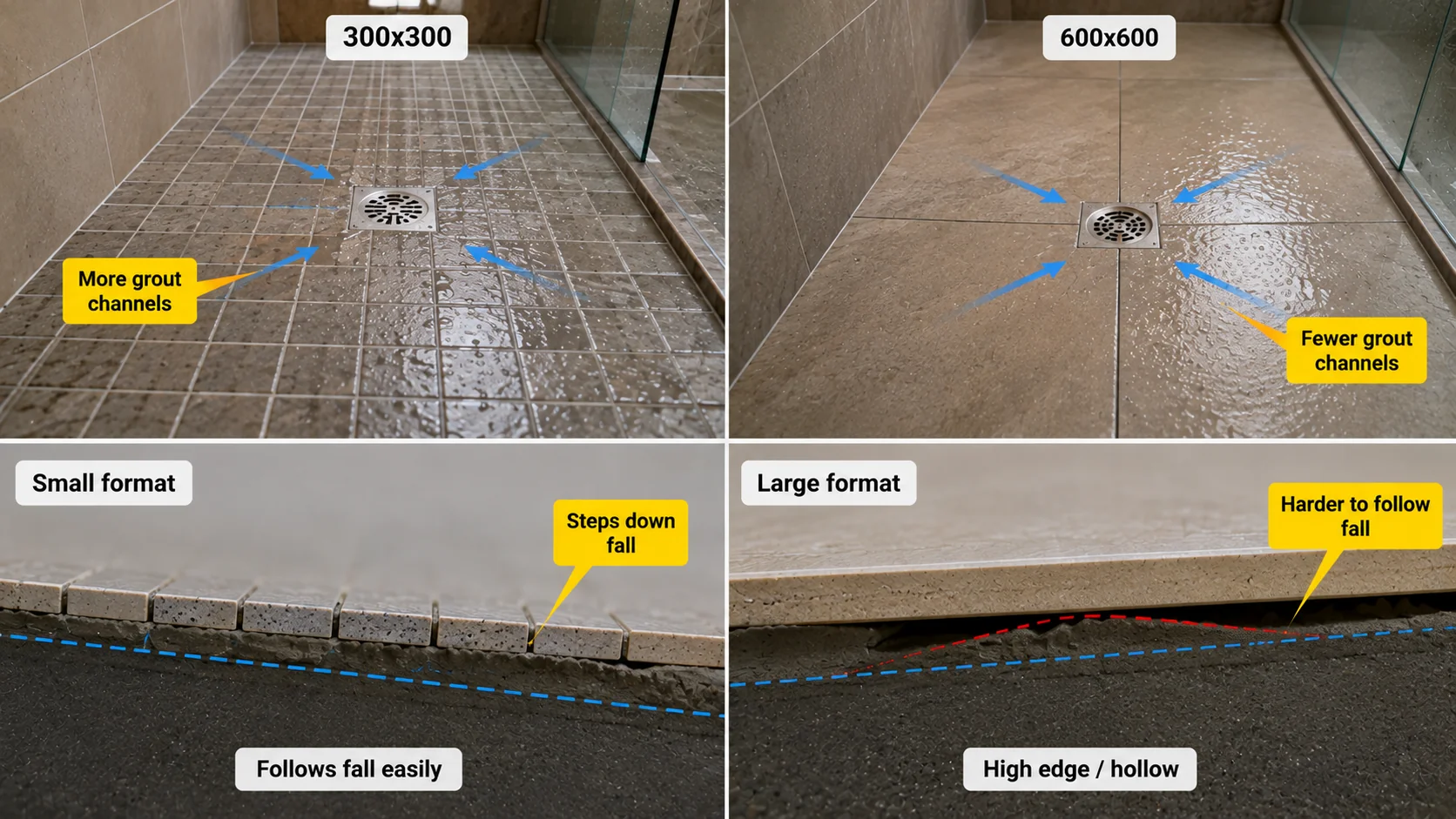
The reason shower floors resisted the large-format trend: Water leaves a floor along grout lines as much as across tile faces, because the grout joint sits fractionally below the tile surface and acts as a shallow channel. Across a shower floor with a fall to a central drain, a 300x300 tile gives roughly twice as many of those channels per square metre as a 600x600 does. That is why wet room floors have stayed small-format while the walls around them have grown, and it is a functional reason rather than a stylistic one. A large tile on a shallow fall holds water on its face; a small one moves it to the nearest joint and away. |
The related geometry point: A drainage fall is a curved or angled plane, and a rigid tile is flat. The larger the tile, the harder it is to lay it following a fall without either creating a high edge or a hollow beneath it. Small formats step down a fall in small increments, which is why they produce a cleaner drainage plane in practice as well as in theory. |
Advantage Two: Grip Registration
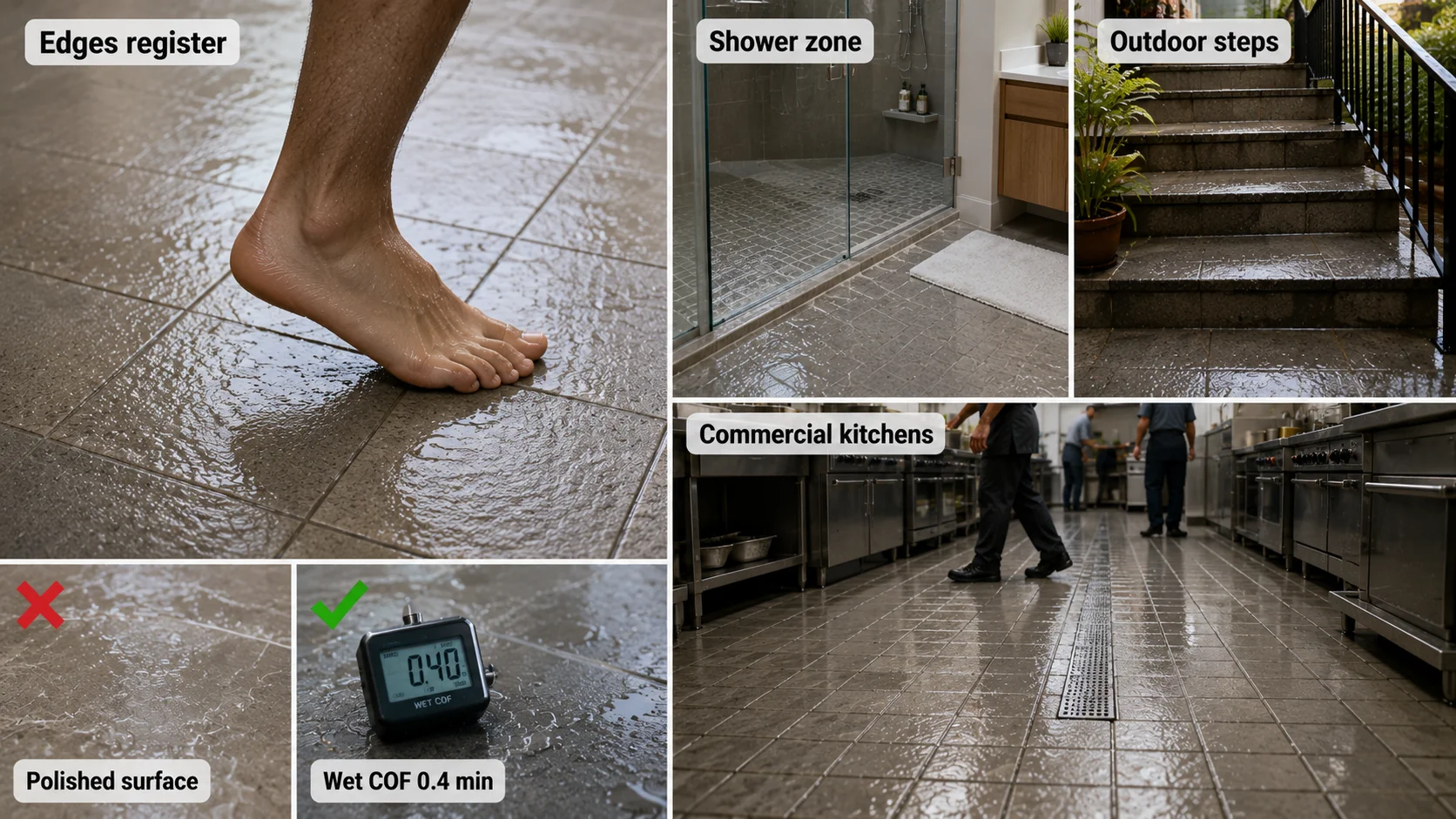
A foot landing on a wet floor registers edges as well as texture. Every grout line is a small change in level and material that gives a foot something to catch against, independent of whatever anti-skid rating the tile carries.
- This supplements rather than replaces the tile's own grip. A confirmed wet coefficient of friction of 0.4 minimum is still required, and no amount of grout line compensates for a polished surface.
- It matters most where feet land unpredictably, which is the shower zone, the strip immediately outside it, and outdoor steps.
- It is one reason commercial kitchens specify small formats, alongside the drainage benefit, in a room where staff move quickly across wet and greasy floors.
Advantage Three: Cutting Economy
Every cut around a fixture consumes a whole tile, and the offcut is usable only if a similar cut exists elsewhere. The larger the tile, the more material each cut destroys.
| Room Type | 300x300 Overage | 600x600 Overage | Practical Difference |
| Simple rectangular room | 5 to 7% | 6 to 8% | Negligible, large format is fine |
| Standard bathroom with several fixtures | 8 to 10% | 12 to 15% | Meaningful on a larger order |
| Small bathroom or utility room | 10 to 12% | 15 to 18% | Substantial, and cuts are harder to execute cleanly |
The point that matters more than the percentage: Cutting a 600x600 mm tile accurately around a floor drain or a pedestal takes longer and goes wrong more often than the same cut in a 300 mm tile, simply because there is more material to control and more consequence when the cut wanders. On a fixture-dense floor, the labour and breakage cost of large format frequently exceeds the material saving that motivated it. |
Advantage Four: Repairability
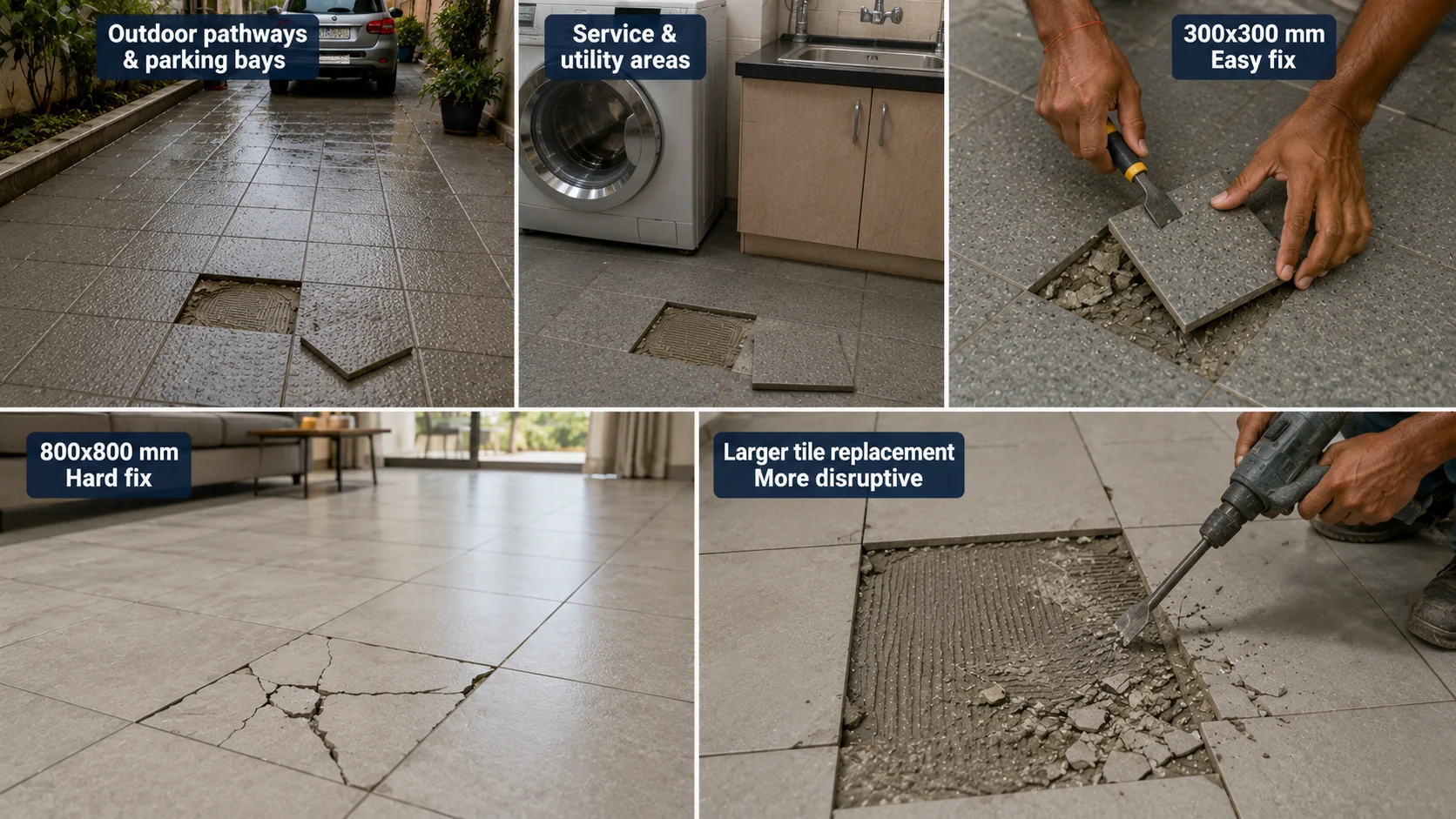
A damaged tile is replaced by lifting it and its adhesive bed without disturbing its neighbours. That operation gets harder as tiles get larger, because a bigger tile shares more edge with more neighbours and transmits more vibration when broken out.
- Outdoor pathways and parking bays benefit most, since these are the surfaces most likely to suffer a single localised failure from impact or a settled sub-base.
- Service and utility areas benefit similarly, where a dropped tool or a leaking appliance damages one area rather than a whole floor.
- A single 300x300 replacement is genuinely a small job, whereas replacing one 800x800 tile in a laid floor is disruptive enough that people frequently live with the damage instead.
Advantage Five: Substrate Tolerance
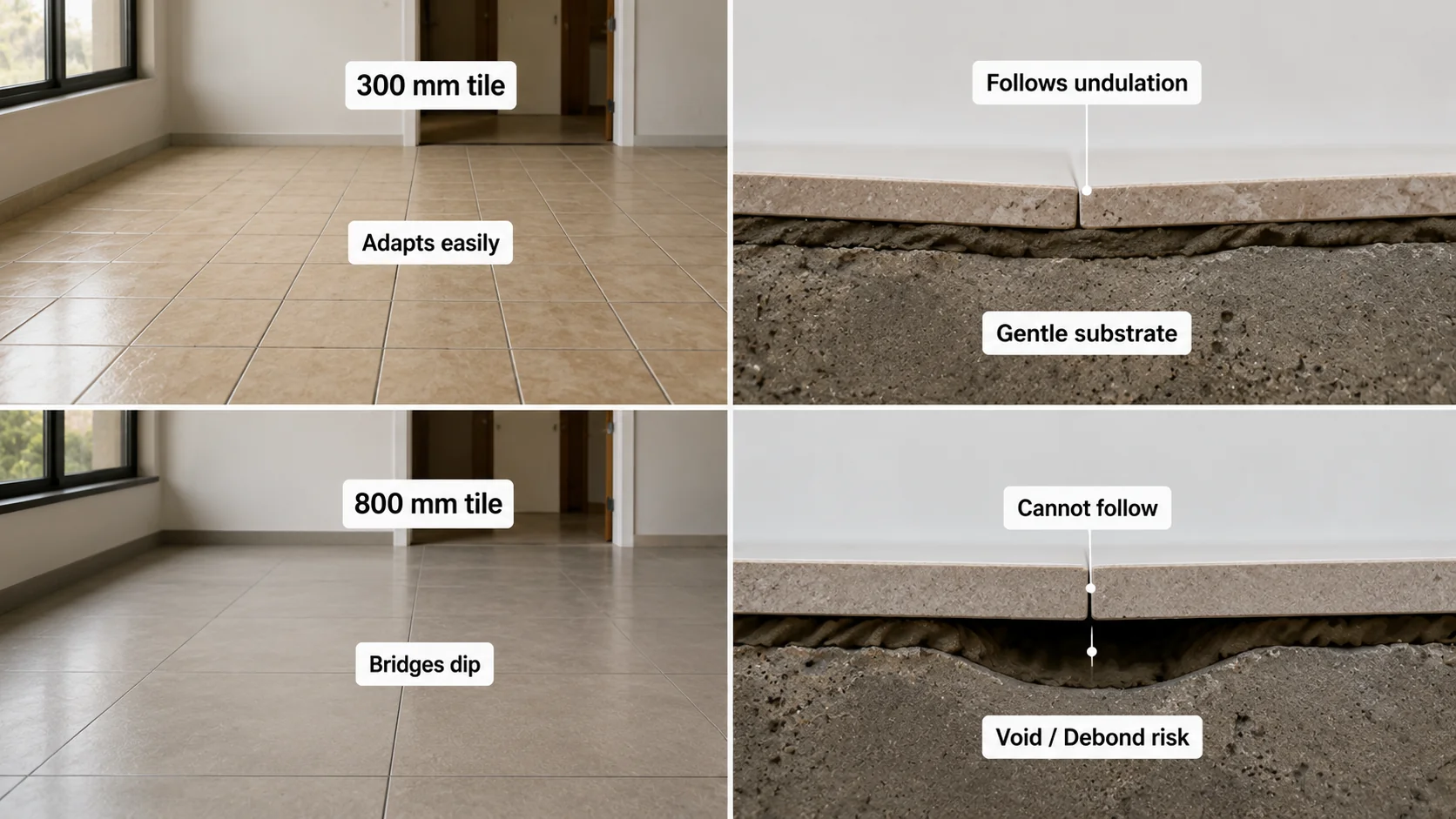
The advantage that decides most renovation projects: Every rigid tile has to sit on a plane. A 300 mm tile spans 300 mm of substrate and can accommodate a gentle undulation by tilting very slightly; an 800 mm tile spans 800 mm and cannot, so it bridges any dip and either sits proud at one edge, creating a raised lip, or leaves a void beneath that eventually debonds. In a new build with a freshly poured and levelled screed, this is irrelevant. In a renovation where you are tiling over an existing floor that is nobody's idea of flat, it is frequently the difference between a floor that works and one that fails. Small format is the pragmatic choice when the substrate is what it is, and re-screeding is not in the budget. |
Advantage Six: Cost
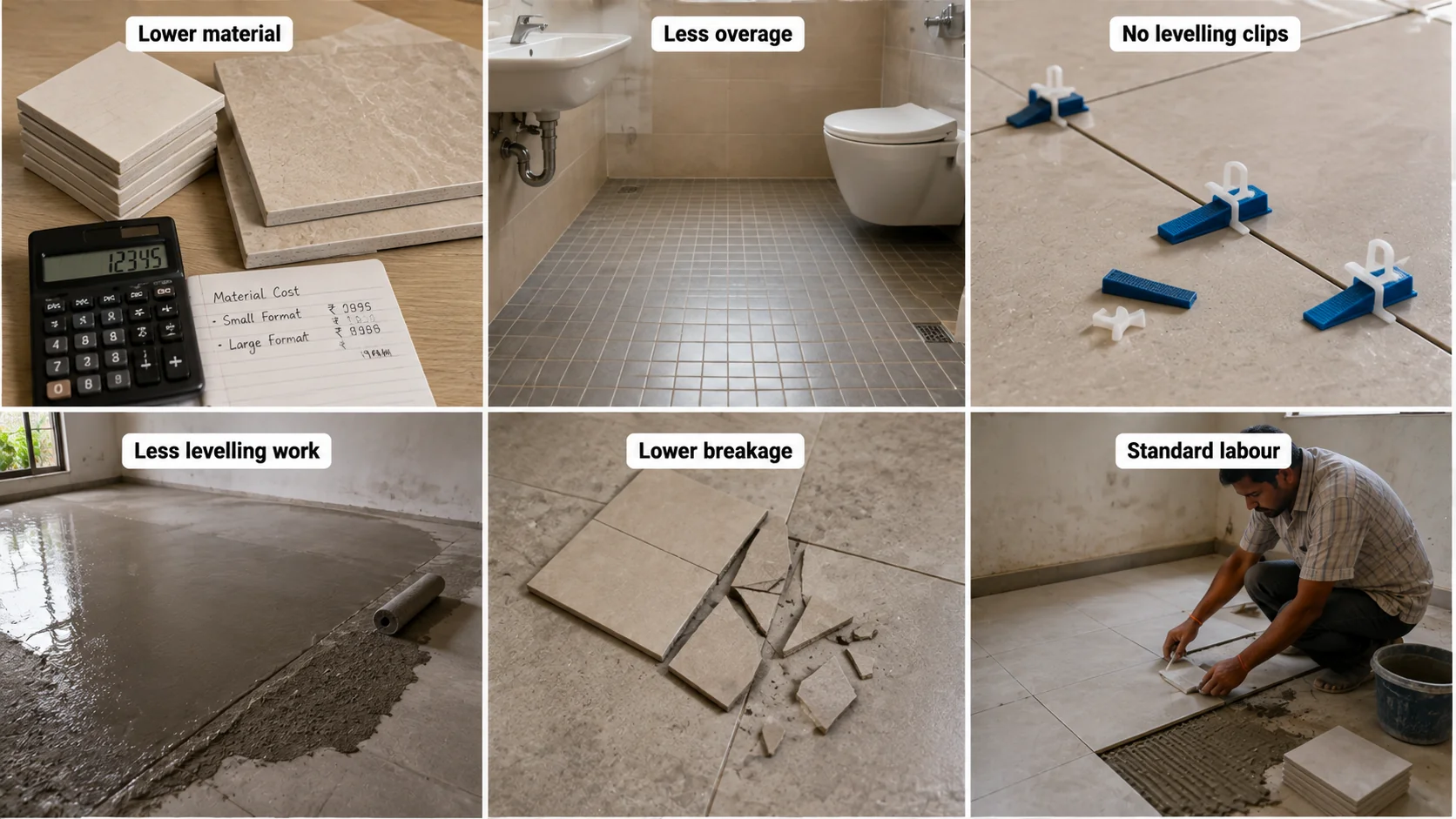
Material is cheaper per square foot, and that is the smallest part of the saving. Overage in fixture-dense rooms runs 8 to 12% against 12 to 18% for large format. Levelling clip systems, which become genuinely necessary above 600 mm, are rarely needed at this size. Substrate correction is often avoidable rather than required. Handling breakage is lower, and each breakage costs less when it happens. Labour rates are standard rather than carrying a large-format premium.
Taken together, the gap between a small-format and a large-format floor in a fixture-dense room is consistently wider than the difference in shelf price suggests, and occasionally runs the other way entirely once substrate correction enters the quotation.
Where Large Format Genuinely Wins
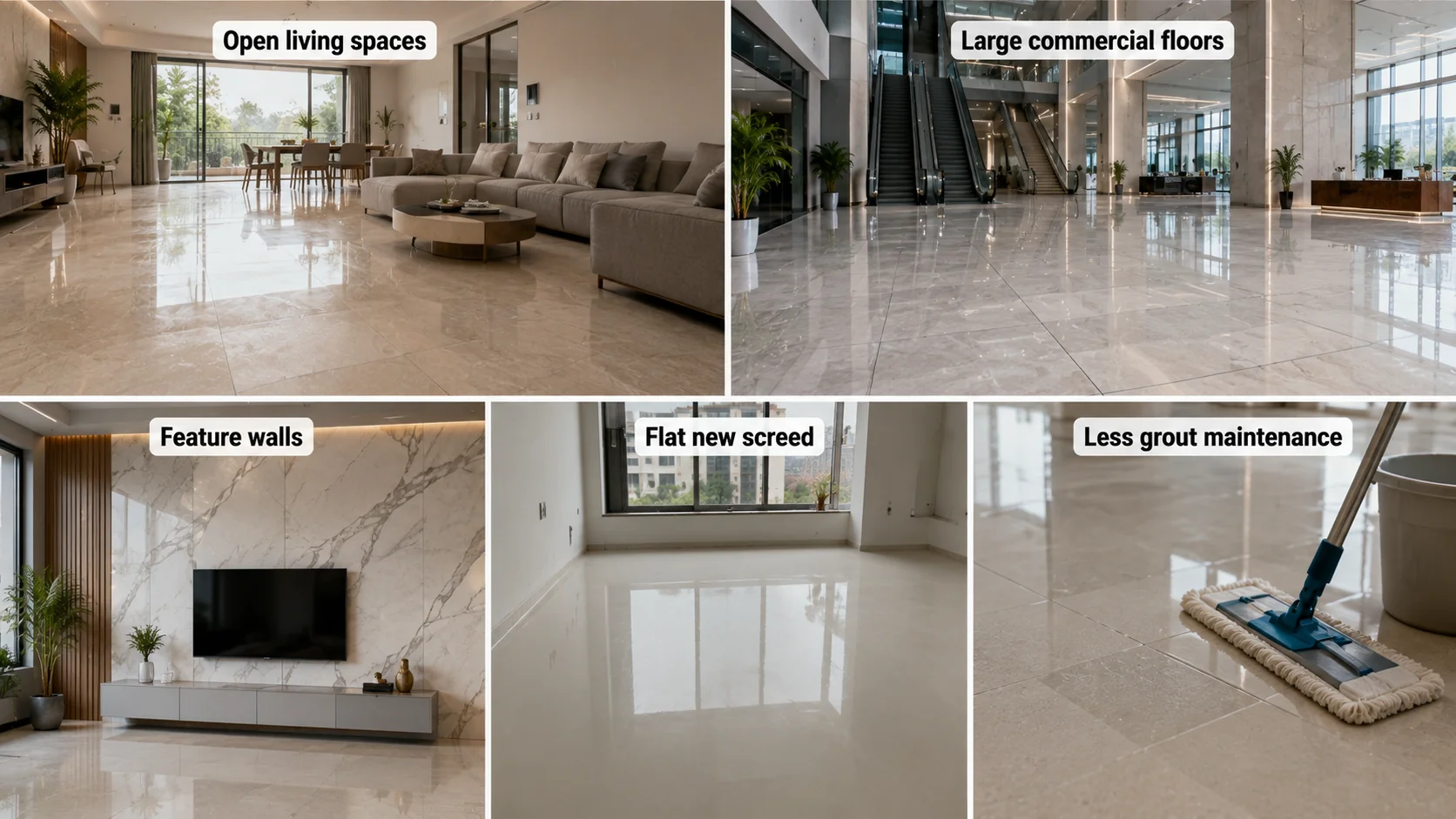
A guide arguing small format was always better would be useless. These are the situations where the move toward larger tiles is entirely correct.
- Open living room and bedroom floors, where fewer joints read as more seamless, and there is no drainage or grip requirement to trade against.
- Large commercial floor plates, where fewer grout lines mean less to clean and maintain across a very large area.
- Feature walls, where there is no foot traffic, no water and no fixtures to cut around, so every argument for small format disappears.
- Rooms with a genuinely flat new screed, since the substrate advantage of small format simply does not apply when the base is properly prepared.
- Any surface where grout maintenance is the primary concern, because fewer joints means less to keep clean and less to discolour.
The Rooms Where 300x300 Is Still the Right Answer
| Room | Verdict | Deciding Factor |
| Shower floor and wet room | Clearly the right choice | Drainage paths and grip registration together |
| Small bathroom under 40 sq.ft | Right choice | Cutting economy and fixture density |
| Wash and utility area | Right choice | Drainage, grip, repairability and cost all point the same way |
| Outdoor steps | Right choice | Grip registration matters most where a fall has furthest to travel |
| Outdoor pathway | Right choice | Individual replacement after localised damage |
| Parking bay | Right choice | Individual replacement, plus tolerance of a less than perfect sub-base |
| Commercial kitchen | Right choice | Drainage and grip in a room where staff move quickly on wet floors |
| Balcony | Depends on size | Small balcony yes, large terrace often better in a mid format |
| Standard bathroom above 50 sq.ft | Consider 500x500 instead | Fixture density drops relative to area, so the middle format balances better. |
What to Confirm
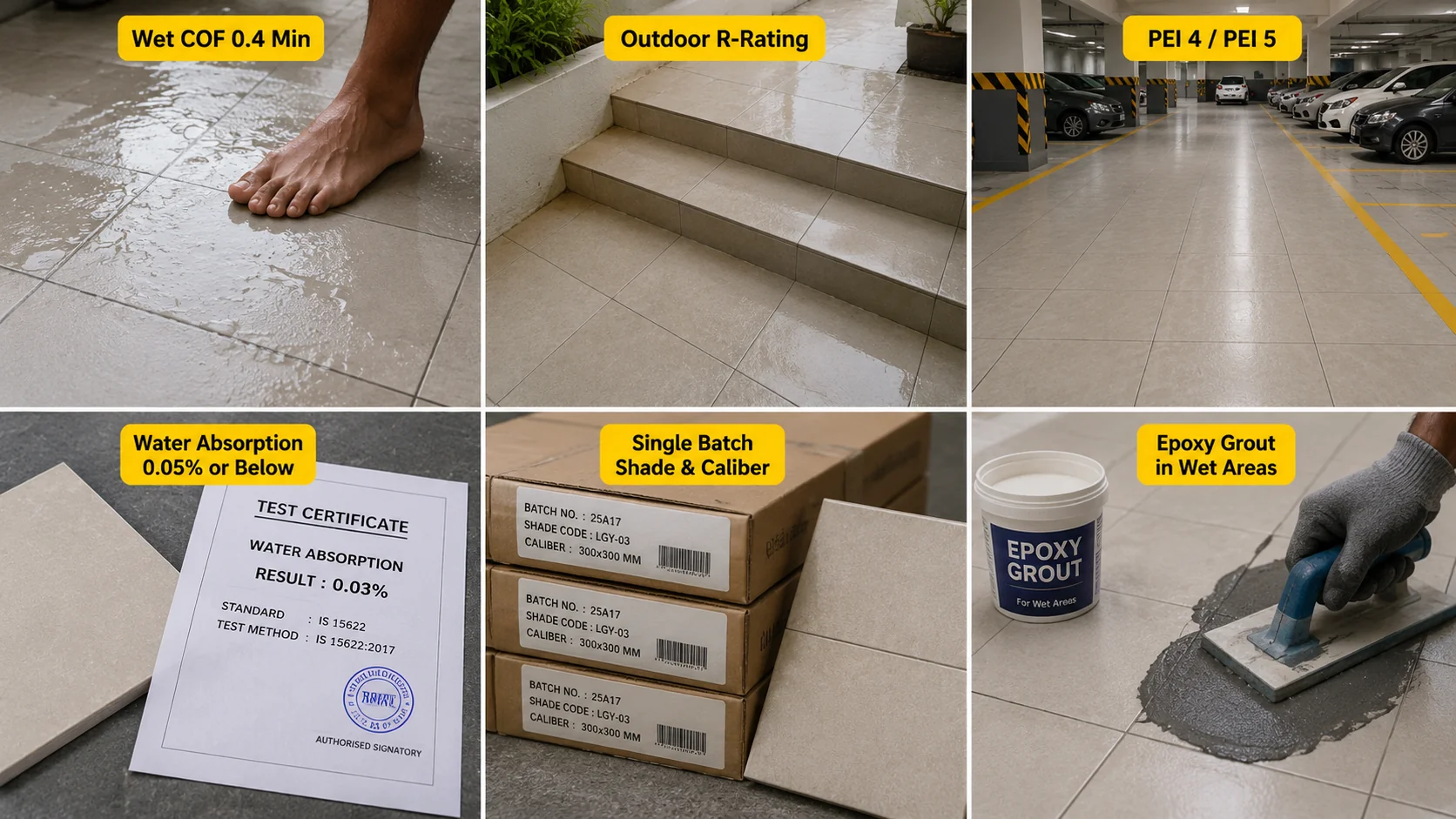
- Wet coefficient of friction of 0.4 minimum for any floor that gets wet, since format size supplements grip but never provides it.
- Outdoor R-rating for steps, pathways and exposed balconies, in addition to wet COF.
- PEI 4 minimum for residential floors, PEI 5 for parking or vehicle load, as stated on the technical data sheet.
- Water absorption of 0.05% or below for vitrified tile, the benchmark set by the Bureau of Indian Standards under IS 15622, with the test certificate requested.
- Single batch, shade code and calibre across the full quantity, since a calibre mismatch shows as uneven joints and small formats have more joints to show it.
- Epoxy grout in wet areas, because the drainage advantage of small format comes with more grout line to keep sound.
The honest trade-off to accept: More grout lines are the mechanism behind three of the six advantages above, and it is also the format's main drawback. There is more grout to clean, more to discolour over time and more to maintain. Epoxy grout in wet areas addresses most of this, and it is the reason the small-format advantages come with a specification requirement attached rather than free. |
Find Small-Format Ranges on TilesFinders
300x300 mm ranges can be filtered on TilesFinders by finish, anti-skid rating and body type, so you can specify small format where its advantages genuinely apply and move up a size where they do not.
FAQs
Not for wet areas, fixture-dense rooms or outdoor surfaces. The move to large format is correct for open living room floors and feature walls, where there is no drainage or grip requirement to trade against. In a shower or a wash area, small format still performs better for functional reasons.
Drainage and grip. Grout joints sit fractionally below the tile face and act as shallow channels, so a 300x300 tile gives roughly twice as many drainage paths per square metre as a 600x600. Small tiles also step down a drainage fall in smaller increments, producing a cleaner plane.
It supplements it rather than providing it. More grout lines mean more edges for a foot to register, but a confirmed wet coefficient of friction of 0.4 minimum is still required, and no joint density compensates for a polished surface.
Considerably. A 300 mm tile spans less substrate and can accommodate gentle undulation by tilting very slightly, while an 800 mm tile bridges a dip and either sits proud at an edge or leaves a void that eventually debonds. In renovations where re-screeding is not in the budget, this frequently decides the format.
In a small or fixture-dense bathroom, roughly 10 to 12% overage against 15 to 18% for 600x600. The larger practical saving is in labour and breakage, since cutting a 600 mm tile around a drain takes longer and goes wrong more often.
More grout line to clean, to keep sound and to watch for discolouration. This is the same property that produces the drainage and grip advantages, so it is a trade-off rather than a flaw. Epoxy grout in wet areas addresses most of it.
In a bathroom above roughly 50 square feet, where fixture density drops relative to floor area and the middle format balances joint count against cutting economy better than either extreme.When should I choose 500x500 instead? In a bathroom above roughly 50 square feet, where fixture density drops relative to floor area and the middle format balances joint count against cutting economy better than either extreme.
Yes, largely for repairability. Outdoor surfaces suffer localised damage from impact or a settled sub-base, and replacing a single 300x300 tile is a small job while replacing one large-format tile in a laid floor is disruptive enough that people often live with the damage.


See our tile guides first
Set TilesFinders as a preferred source and our buying guides surface ahead of the rest for you.
Add as preferred sourceTakes one tap. Nothing to install.
What Readers Say
I was about to redo my parking area with the wrong tile size until I read this. The layout comparisons saved me from a costly mistake.
We reference TilesFinders guides while briefing clients on material selection. The size and pattern breakdowns are accurate and easy to explain visually.
On site, I get asked about grout spacing all the time. This article gave me a solid reference I now share with my team before every job.
Finally a guide that doesn't just push generic advice. The oil stain removal steps actually worked on our clubhouse driveway tiles.
I run a small construction firm and now send this link to clients directly when they ask about entrance tile sizing. Saves me an hour of explaining.
Good practical detail, though I wish there were more examples for compact apartment entrances specifically, not just villas.
My mother-in-law wanted marble, I wanted vitrified. This blog gave us the neutral comparison we needed to actually decide together.
Detailed without being overwhelming. I appreciated that it covered both cost and maintenance, not just the aesthetics.
Used the algae and hard water removal tips on our terrace tiles after the monsoon. Worked better than what our regular cleaner was doing.
As someone who sources tiles for multiple builder projects, I find these comparisons genuinely useful for vendor conversations, not just consumer content.
Recommended this to a client who kept second-guessing the entrance design. The small vs large layout section settled the debate instantly.
Straightforward and honest, no unnecessary jargon. Would like to see a similar breakdown for outdoor pool-deck tiles next.
We've bookmarked several TilesFinders guides for our design handbook. Reliable source when clients want data, not just opinions.
Two paths, one marketplace.
Get free quotes from verified suppliers.
Share your room, budget, and style. Suppliers in local area respond within hours.
Get Free QuotesList your business, reach real buyers.
Put your showroom in front of homeowners searching for tiles right now.
List Your Business