





















Trending Tile Looks for 2026: Subway, Marble, Wood, 3D, and Bookmatch for Indian Homes
Upgrade your interiors with 2026's top 5 tile trends! From classic subway to bold bookmatch, expl...


Loading designs...
Ceramic is the most affordable body in the wood tiles category and also the most restricted in terms of where it can go. The trade-off is straightforward: ceramic wood tiles give you a realistic wood grain surface on walls at the lowest price in the category, starting from Rs. 30 per sq. ft., but they cannot be used on any floor. Understanding this before buying saves a costly mistake.
Ceramic tiles absorb 12% to 16% water. On a wall, the glazed face of the tile does not let water through, so this absorption rate does not cause problems. On a floor, that same body takes in moisture with every wet mop and every monsoon-humid day, which eventually weakens the adhesive bond and causes tiles to hollow and lift. This is why ceramic that looks like wood is produced for walls only under IS 13630, and why the Group BIII absorption classification on a ceramic tile box means wall use exclusively.
The practical result is that wood-look ceramic tiles make most sense for two specific applications: kitchen backsplash, walls, and bathroom walls. These are the rooms where a glossy, easy-clean wood grain surface on the wall works hardest, and where the lower price per square foot of ceramic compared to GVT or porcelain makes a real difference to the project budget.
The short answer is water absorption. The longer answer matters for anyone buying tiles in India.
When a floor tile is cleaned, it sits under standing water for the duration of the mopping cycle. In a bathroom, a floor tile may be wet for several hours a day. In a kitchen, spills, cleaning, and cooking steam create near-constant moisture at floor level during use. A tile that absorbs 12% to 16% of its weight in water takes in measurable moisture during every one of these events. Over months, that moisture compromises the adhesive layer underneath, the tile body itself softens at the base, and the tile eventually sounds hollow when tapped. Hollow tiles crack under foot traffic and require full re-laying.
On a wall, none of this applies. The glazed face of the tile repels water. The wall surface behind the tile stays dry if the grout joints are properly sealed. The tile body never sits in standing water. This is why ceramic is a safe and long-lasting specification for walls but not for floors.
Buyers sometimes see wood-effect ceramic floor tiles marketed online or in smaller tile shops. The word 'floor' in that description refers to the visual category the buyer is shopping for, not a technical confirmation that the tile is safe on floors. Always check the water absorption rate on the box before purchasing. A rate above 3% means the tile is not suitable for wet room floors. A rate above 10% means the tile is not suitable for any floor in India.
Note: If a tile box is marked Group BIII under IS 13630, the tile is wall-only. Do not use it on any floor, regardless of how it is described in a catalogue or by a supplier.
The kitchen backsplash is the strongest use case for ceramic wood grain tiles in Indian homes. The wall behind the cooking hob and the counter takes splatter from oil, water, and masalas daily. A glossy ceramic tile in a wood grain pattern wipes clean with a damp cloth after cooking, which is exactly the maintenance level that a kitchen wall needs.
The 300x600mm (12x24) tile size is the standard for kitchen backsplash installations. It aligns with standard counter heights without awkward cuts and covers the backsplash area efficiently. Light beige and grey wood grain tones work alongside most Indian kitchen cabinet colours, particularly white, cream, and light grey modular cabinets. Darker walnut grain tones work well with lighter cabinet finishes, where the wall is meant to provide contrast.
Grout joint treatment matters more in a kitchen than almost anywhere else. Cooking oil enters cement-based grout and stains it brown over time in a way that cannot be cleaned out. Epoxy grout in kitchen wall tile joints seals the joint completely and can be wiped with the same cloth used on the tile face. A 2mm joint width for rectified ceramic and 3mm for non-rectified keeps the visual line between tiles consistent across the wood grain pattern.
One practical consideration specific to kitchens: fix the backsplash tiles after the counter is in place, not before. This gives an exact measurement for the tile course height and avoids an awkward gap or an over-cut tile at the counter edge.
Bathrooms are the second major application for ceramic wood grain tiles. The key decision in a bathroom is how high to tile: dado height (900mm to 1200mm from the floor), three-quarter height, or full height from floor to ceiling.
Full-height tiling on all bathroom walls gives complete moisture protection. Bare plaster above dado height absorbs ambient bathroom humidity during the monsoon months and eventually discolours and peels. Tiling the full wall eliminates this problem. A wood-grain ceramic tile from floor to ceiling on a bathroom wall creates a consistent surface that looks deliberate and finishes the room properly.
For smaller bathrooms, a wood-grain ceramic tile on one or two walls with plain ceramic or paint on the remaining walls keeps the room feeling open. The wood-grain wall is typically the wall opposite the entry door or the wall behind the basin, as these are the first surfaces a person sees when entering the room.
White and light beige wood grain ceramic tiles are the most practical colour for bathroom walls because they reflect light in a space that often has limited natural illumination. Grey ceramic wood tiles suit bathrooms with adequate natural light or good artificial lighting. Dark tones work in larger bathrooms where the floor is light, and the wood-grain wall is an accent rather than the primary surface.
The decision between ceramic and porcelain for a wood-grain wall comes down to three factors: moisture exposure, room type, and whether the same tile needs to cover both a floor and a wall in the same space.
For walls in rooms that have no floor tile requirement, ceramic is the more cost-effective choice at Rs. 30 to Rs. 65 per sq ft versus porcelain at Rs. 45 to Rs. 80 per sq ft. The visual result on the wall is comparable because both bodies carry the same type of digital inkjet wood grain print on the glazed face.
For projects where the same wood grain needs to run from a wall surface down onto a dry room floor, porcelain is the only lower-budget body that covers both.
The full specification comparison between ceramic and porcelain body types, including which dry room floors are appropriate for porcelain and which are not, is detailed on the wood look porcelain tiles page.
For wet room floors such as bathrooms and kitchens, neither ceramic nor porcelain is the correct specification. GVT with 0.05% water absorption is the minimum standard for those surfaces under IS 15622:2006.
| Ceramic | Porcelain | GVT | Full Body Vitrified | |
| Water Absorption | 12% to 16% | 2% to 5% | 0.05% | 0.05% |
| Floor Use | Never | Dry rooms only | All rooms | All rooms |
| Wall Use | Yes | Yes (dry walls) | Yes | Yes |
| Wood Grain Price Start | Rs. 30/sq.ft | Rs. 45/sq.ft | Rs. 55/sq.ft | Rs. 90/sq.ft |
| IS Standard | IS 13630 (Group BIII) | IS 13630 (Group Bib) | IS 15622:2006 | IS 15622:2006 |
Ceramic tiles are produced in two-dimensional tolerances: rectified and non-rectified. For a wood grain tile where the grain line needs to read continuously across joints, this distinction affects how the finished wall looks.
Non-rectified ceramic tiles have a slight size variation between individual tiles, typically 0.5mm to 1mm, which is a natural result of the kiln firing process. To accommodate this variation without tiles sitting unevenly, a 3mm to 4mm grout joint is used. On a wood grain tile, a wider joint breaks the visual continuity of the grain at every joint line. This is more noticeable in tiles with a strong horizontal grain direction than in tiles with a more random or knotted grain pattern.
Rectified ceramic tiles are cut to a precise size after firing, which brings size variation down to within 0.2mm. This allows a 2mm grout joint, which keeps the grain line much more continuous across the wall. Rectified ceramic wood grain tiles cost slightly more than non-rectified in the same size, typically Rs. 5 to Rs. 10 per sq ft more, but the result on a large kitchen or bathroom wall is noticeably cleaner.
When specifying ceramic wood grain tiles for a full bathroom wall or a long kitchen backsplash, ask the supplier whether the tile is rectified. If the supplier cannot confirm this, use a 3mm joint as a safe default.
Ceramic wood grain tiles are produced in a broad colour range because the lower firing temperature and simpler body composition of ceramic allow for more colour variation in the glaze than vitrified bodies. This gives ceramic a wider colour choice than porcelain at a lower price.
Grey ceramic wood tiles are the most widely stocked colour in this category across Indian suppliers. The grey grain tones range from light ash, which suits bathrooms and kitchens with white fittings and white cabinets, to a darker charcoal grey that suits more contemporary spaces. Grey wood grain in a ceramic glossy finish starts from Rs. 32 per sq.ft.
White wood ceramic tiles use a near-white or bleached grain and are the second most common colour. They suit bathrooms with limited natural light because the white surface reflects ambient light more effectively than darker tones. Glossy white wood grain ceramic tiles start from Rs. 30 per sq.ft.
Light beige and honey tones are the warmest option and suit traditional Indian kitchens and bathrooms, where a cooler grey or white might feel out of place alongside warm-toned fittings and wooden furniture.
Dark walnut and mahogany grain tones in ceramic are available primarily in matte finish and suit feature areas: a single bathroom wall, the wall behind a kitchen island, or a living room dado strip. These darker tones used across an entire small bathroom can make the room feel enclosed, so they work better as an accent.
| Colour | Best Room | Finish to Pair | Price Rs./sq.ft |
| Grey wood grain | Kitchen, bathroom | Glossy | Rs. 32 to Rs. 55 |
| White wood grain | Bathroom, bedroom wall | Glossy, Matte | Rs. 30 to Rs. 52 |
| Light beige wood grain | Kitchen, living room dado | Glossy, Matte | Rs. 30 to Rs. 50 |
| Dark walnut grain | Bedroom accent wall, bar | Matte | Rs. 35 to Rs. 60 |
Ceramic wood tiles are produced in wall-appropriate sizes, all smaller than the large plank and slab formats used in GVT and PGVT. The sizes available in ceramic reflect what works practically on walls, where tile weight and fixing strength are constraints.
The 300x600mm (12x24) is the most useful size for full bathroom walls and kitchen backsplash in Indian homes. It gives a wide board proportion on the wall and covers the ground quickly. Most wood-style ceramic tile ranges in India stock this size as the primary format.
The 300x450mm (12x18) is a smaller format that suits compact bathrooms, toilet walls, and areas where the 12x24 would require many cuts around fixtures. The narrower height of this tile gives a slightly different proportion to the wood grain pattern on the wall.
The 200x600mm (8x24) gives the closest proportion to a real timber plank on a wall. This narrow format is available in some ceramic wood grain ranges and suits kitchens where a plank-like horizontal line across the backsplash is the design goal.
Smaller formats such as 250x375mm (10x15) are used for dado strips and accent bands rather than full wall coverage.
| Size (mm) | Alias | Best Wall Use | Finish | Price Rs./sq.ft |
| 300x450 | 12x18 | Bathroom walls, small kitchen backsplash | Glossy, Matte | Rs. 30 to Rs. 55 |
| 300x600 | 12x24 | Kitchen backsplash, bathroom full wall | Glossy, Matte | Rs. 32 to Rs. 65 |
| 200x600 | 8x24 | Narrow plank wall look, kitchen | Glossy | Rs. 35 to Rs. 60 |
| 250x375 | 10x15 | Dado height, accent strips | Glossy, Matte | Rs. 28 to Rs. 48 |
Every ceramic tile box sold through a legitimate supplier in India carries an IS 13630 classification. Knowing how to read this marking helps buyers confirm they are buying the right tile for the right application before the purchase is made.
The absorption group marking is the most important number on the box. Group BIII covers tiles absorbing more than 10% water. This is the standard ceramic wall tile category and the correct classification for wood-look ceramic tiles. Group BIIb covers 6% to 10%. Group BIIa covers 3% to 6%. Group Bib covers 0.5% to 3%, which is the porcelain range. Group Bia covers below 0.5%, which is GVT and full body vitrified.
A box marked BIII is a wall tile. A box marked BIa or BIb is a floor-safe tile. If a supplier presents a BIII tile as suitable for a kitchen or bathroom floor, this is incorrect. The IS marking on the box is the definitive reference, not the verbal description given at the point of sale.
The dimensional tolerance marking is also useful for wood grain tiles. An RE marking indicates a rectified tile. A non-RE tile is non-rectified and needs a wider grout joint.
The glazed face of a ceramic wood grain tile handles Indian bathroom and kitchen humidity without any degradation. The grout joints are the vulnerable point. In a bathroom where the walls are tiled, but the joints are filled with cement-based grout, monsoon-season humidity drives moisture into the grout over time, particularly in joints that were not fully packed during installation. The grout absorbs moisture, darkens, and eventually cracks. Epoxy grout in ceramic tile joints prevents this entirely. It is impermeable to water and does not change colour with moisture exposure. The cost difference between cement grout and epoxy grout on a standard 8x10-foot bathroom wall is typically Rs. 800 to Rs. 1,500 for materials, which is a fraction of the cost of re-tiling a wall where grout failure has caused tiles to come loose.
Ceramic wood grain tiles for the Indian market are manufactured in Morbi, Gujarat, alongside GVT and porcelain ranges. Morbi ceramic production covers the full standard wall size range in wood grain: 300x450mm, 300x600mm, and 200x600mm in glossy and matte finishes. Prices from Morbi manufacturers start from Rs. 28 per sq.ft for 12x18 glossy ceramic wood grain and reach Rs. 65 per sq ft for larger 12x24 rectified matte formats with more complex grain patterns. As with all tile categories manufactured in Morbi, prices vary between brands, batch complexity, and order quantity. Buyers ordering a full bathroom or kitchen should confirm the batch number and order 10% extra tile to account for cuts and breakage.
Kitchen backsplash ceramic wood tiles in 300x600mm and 200x600mm sizes, bathroom wall ceramic wood grain tiles in 300x450mm, and accent wall formats in grey, white, beige, and dark walnut tones are all listed on TilesFinders with the IS absorption group, finish type, and rectified or non-rectified status shown on every product card. Use the body type filter to select ceramic and the finish filter to switch between glossy and matte options.
No. Wood-look ceramic tiles must not be used on floors. Ceramic tiles absorb 12% to 16% water, which is too high for any floor use in India. On a bathroom or kitchen floor, this level of absorption causes the tile body to take in moisture with every cleaning cycle, weakening the adhesive bond and eventually causing tiles to hollow and lift. Ceramic wood grain tiles are manufactured for wall use only. For wood grain on floors, GVT or porcelain wood tiles are the correct specifications, starting from Rs. 45 per sq.ft.
The 300x600mm (12x24) size is the most practical for wood-look ceramic tiles on kitchen walls. It aligns naturally with standard kitchen counter heights, cuts cleanly around sockets and switches, and covers the backsplash area with fewer tiles than smaller formats. The 200x600mm (8x24) size is also available and gives a narrower plank proportion that suits smaller kitchens. Both sizes come in glossy finish ceramic wood grain from Rs. 30 per sq.ft.
Glossy and matte finishes are the two standard finishes in wood-look ceramic tiles. Glossy finish is the most common and is the practical choice for kitchen backsplash and bathroom walls because the surface wipes clean easily. Matte finish in ceramic gives a flatter, more subdued wood grain surface and suits bedroom walls and living room dado areas. Satin and semi-glossy finishes are available in some ceramic ranges at a slightly higher price than standard glossy.
Grey ceramic wood tiles are available in India in 300x450mm (12x18) and 300x600mm (12x24) sizes in both glossy and matte finishes. The ash and silver-grey grain tones in ceramic wood tiles suit contemporary kitchen and bathroom wall designs. Grey ceramic wood grain tiles start from Rs. 32 per sq ft in glossy finish and Rs. 35 per sq ft in matte. Most grey ceramic wood tiles sold in India are manufactured in Morbi, Gujarat.
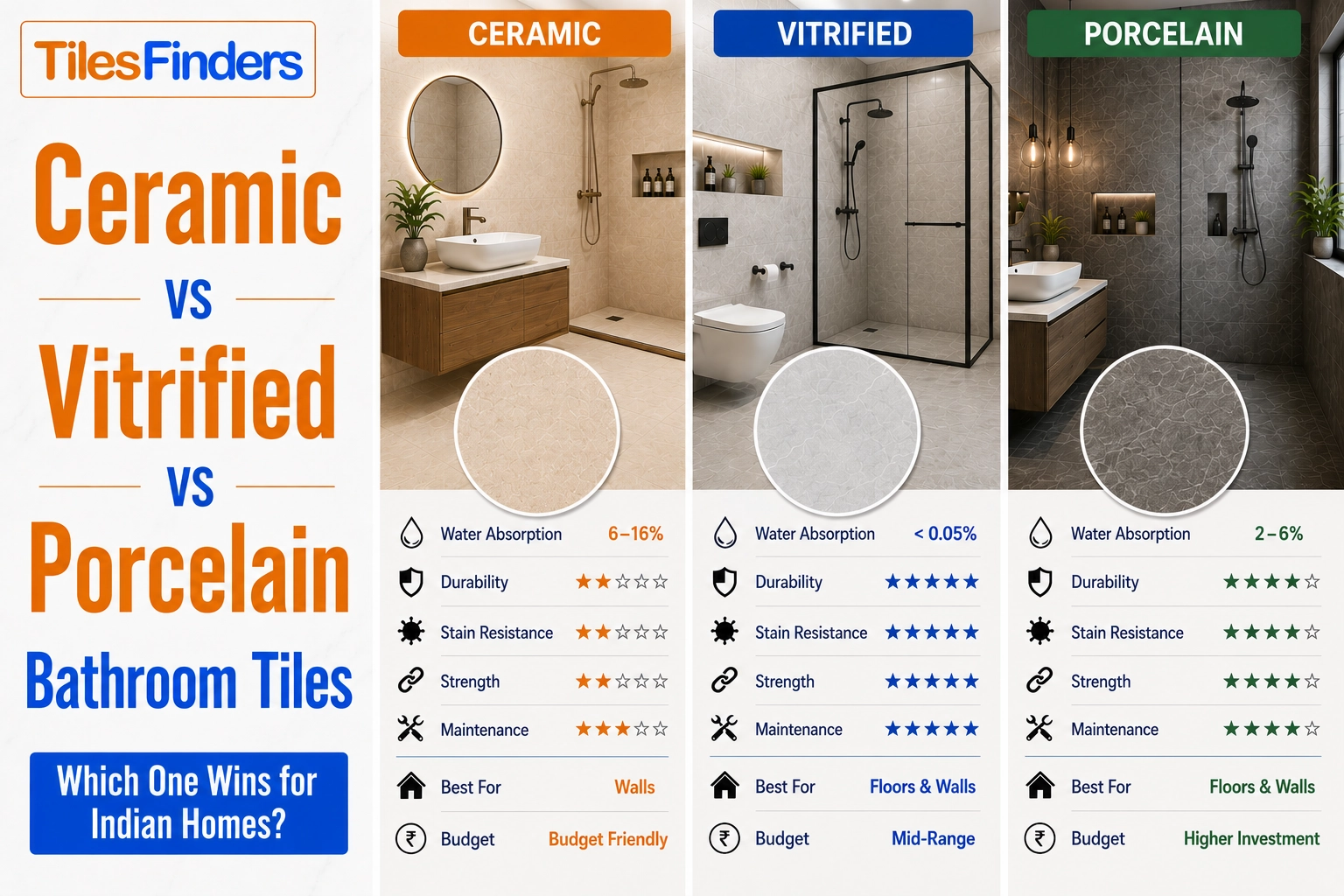
Ceramic wood look tiles absorb 12% to 16% water and are wall-only. Porcelain wood look tiles absorb 2% to 5% water and can be used on dry room floors as well as walls. Both are less water-resistant than GVT, which absorbs 0.05% and is safe for all floor and wall applications, including bathrooms and kitchens. Ceramic is the most affordable option in the wood grain category, starting from Rs. 30 per sq. ft, while porcelain starts from Rs. 45 per sq ft and GVT from Rs. 55 per sq ft.
Ceramic tile boxes in India carry an absorption class marking under IS 13630. Group BIII covers tiles with water absorption above 10%, which includes standard ceramic wall tiles at 12% to 16%. Group Bib covers tiles between 3% and 6%, which includes porcelain. Group BIa covers tiles below 0.5%, which includes GVT and full-body vitrified tiles. A tile marked BIII is wall-only under Indian standards. If you see this marking on a box labelled as a floor tile, do not use it on floors.
White wood ceramic tiles in a glossy finish are suitable for bathroom walls, including wet walls around the shower and bath area. The glazed surface of a ceramic tile does not absorb water through its face; only the unglazed body edges and the grout joints are vulnerable to moisture. Use epoxy grout in all bathroom ceramic tile joints to seal the joint completely. Do not use ceramic wood tiles on bathroom floors, regardless of colour or finish, as the tile body absorbs too much water for floor use.
A 2mm grout joint is standard for rectified ceramic wood grain tiles in 300x600mm size. Non-rectified ceramic tiles need a wider joint of 3mm to 4mm to accommodate size variation between tiles. For wall tiles where the grain runs horizontally, consistent joint width is important because uneven joints break the visual continuity of the wood grain across the wall. Use a plastic tile spacer to maintain joint width during fixing, and fill all joints with epoxy grout in bathrooms and kitchens.