Ceramic vs Vitrified vs Porcelain Bathroom Tiles: Which One Wins for Indian Homes?
Compare ceramic, vitrified, and porcelain bathroom tiles for Indian homes. Discover the best options for walls, floors, water resistance, anti-skid safety, and 2026 pricing.
- Why the Material Choice Matters More in an Indian Bathroom
- Understanding the Three Tile Types Before Comparing Them
- Head-to-Head Comparison: Ceramic vs Vitrified vs Porcelain Bathroom Tiles
- For Bathroom Walls: Which Material Should You Choose?
- For Bathroom Floors: Which Material Should You Choose?
- Price Comparison: Ceramic vs Vitrified vs Porcelain in India (2026)
- Choosing the Right Finish for Indian Bathroom Tiles
- How to Choose Based on Your Bathroom Type and Budget
- Common Mistakes Indian Buyers Make When Choosing Bathroom Tiles
- Choosing Correctly the First Time
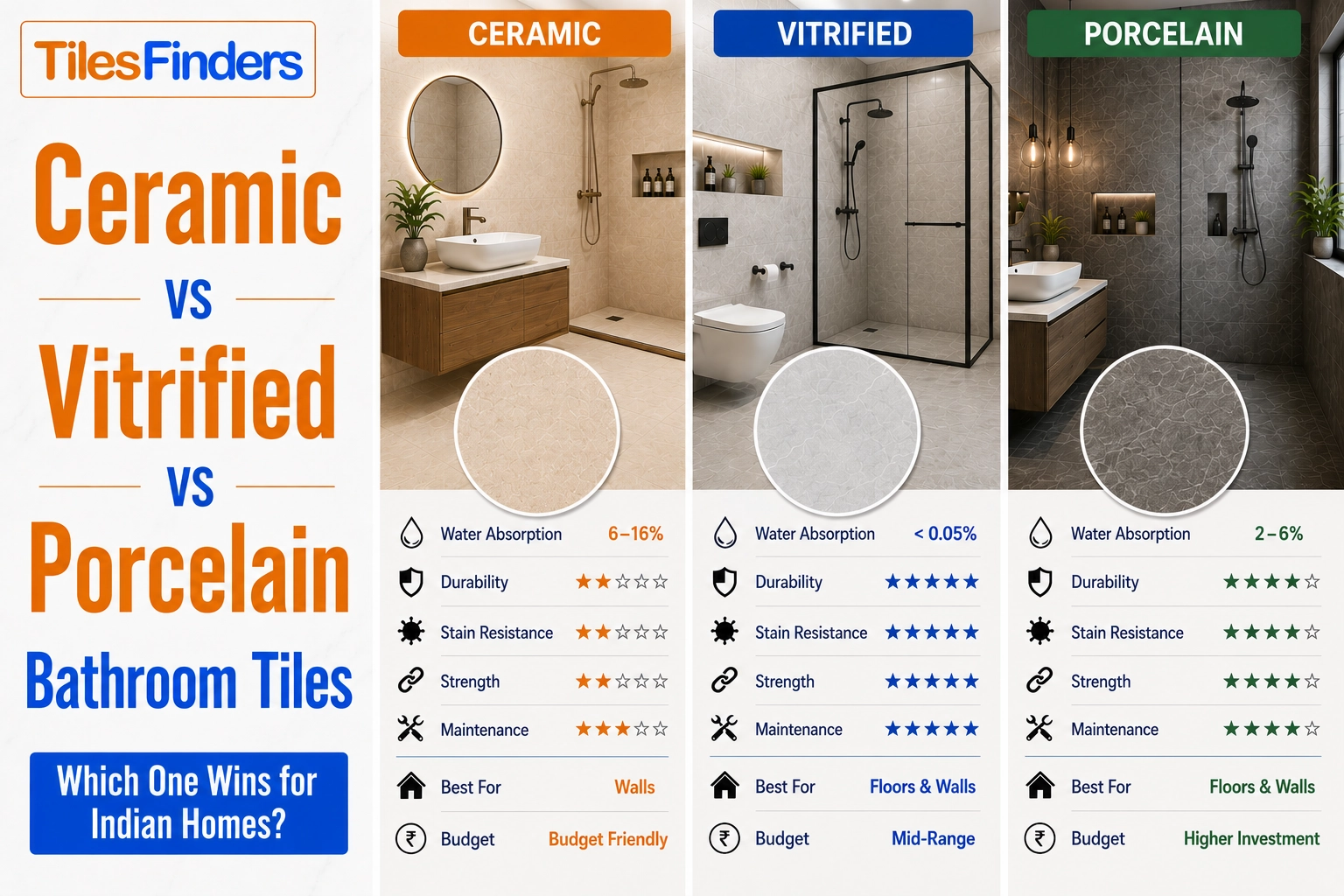
Ceramic, vitrified, and porcelain tiles serve different purposes in Indian bathrooms. Ceramic is the most affordable option and works best on walls due to its wide design range. Vitrified tiles, especially matte GVT, offer the lowest water absorption and are the preferred choice for bathroom floors and walls. Porcelain sits between the two, providing a premium finish with good durability.
Every bathroom tile project in India starts the same way. Someone walks into a showroom, gets shown three different tile types, hears three different sales pitches, and leaves more confused than when they arrived.
The three types are ceramic, vitrified, and porcelain. They look similar on a display panel. Their names sound interchangeable. But put them in a bathroom for over ten years, and the differences become very clear.
The wrong tile choice in a bathroom can be evident in cracked grout due to moisture absorption, a glossy floor that becomes slippery after a bath, or walls that stain from hard water and never appear clean. These are not rare problems. They are what happens when material selection is skipped in favour of colour selection.
This comparison covers water absorption, slip resistance, price, wall vs floor suitability, and Indian climate reality, so you can choose correctly the first time.
Why the Material Choice Matters More in an Indian Bathroom
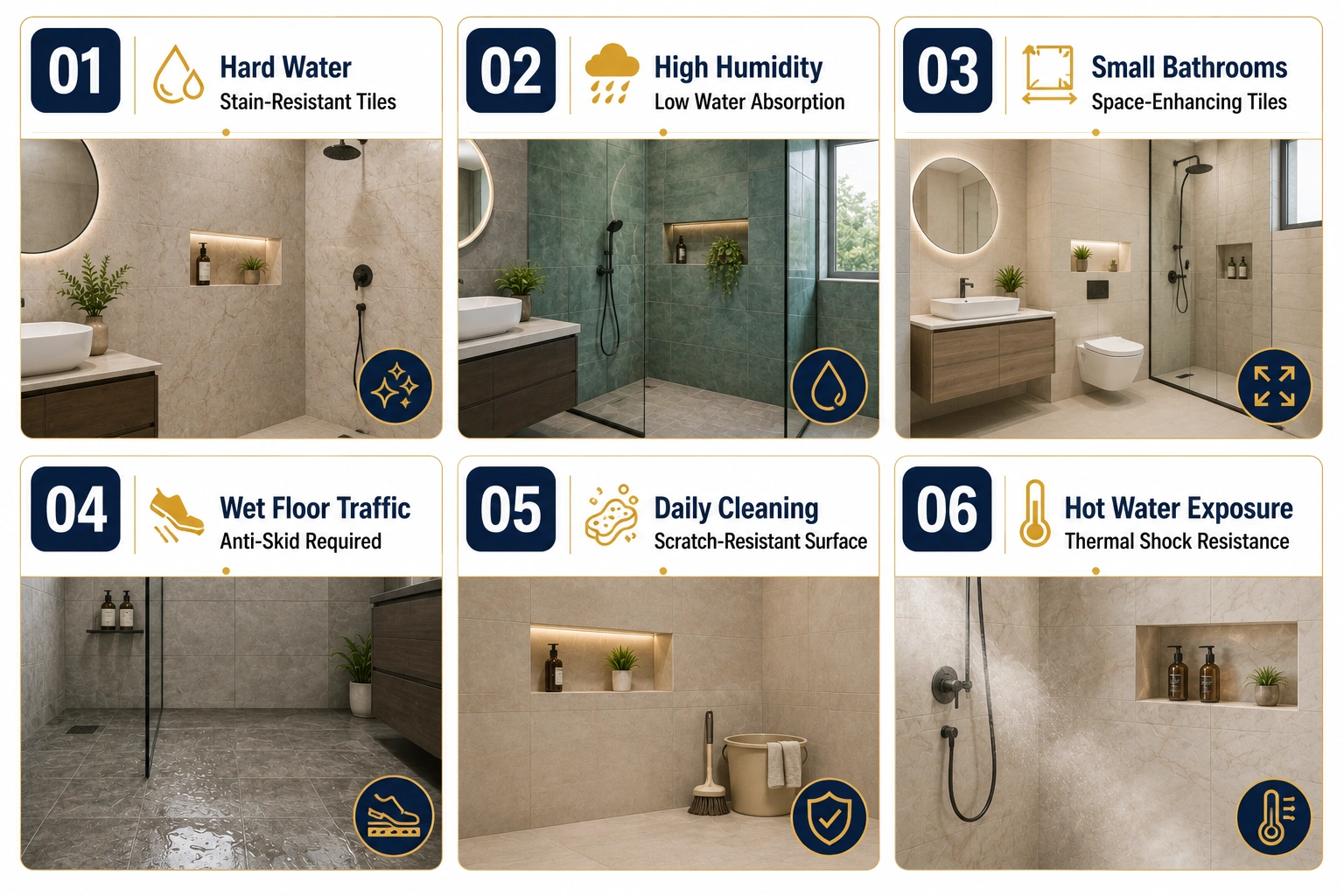
Indian bathrooms deal with conditions that most tile comparison blogs ignore. Hard water in cities like Delhi, Jaipur, Ahmedabad, and Nagpur leaves calcium deposits that permanently stain porous tiles. Monsoon humidity across coastal cities like Mumbai, Kochi, and Chennai keeps surfaces damp for months.
Bathrooms in 2BHK and 3BHK apartments see multiple family members using a single bathroom. Frequent wet-floor traffic means anti-skid performance matters far more than in a European home where bathrooms are used less intensively.
On top of that, Indian bathrooms are typically smaller than 40 sq. ft. Tile choice directly affects how spacious or cramped the space feels. Getting the material wrong costs you both function and finish.
| Indian Bathroom Challenge | Why It Affects Tile Choice |
|---|---|
| Hard water (most North Indian cities) | Porous tiles absorb mineral deposits and stain permanently |
| High humidity (coastal cities, monsoon) | Low water absorption tiles resist mould and damage longer |
| Small bathroom sizes (under 40 sq. ft.) | Tile size and finish affect how open or tight the space looks |
| Multiple daily users, wet floors | Anti-skid finish on floor tiles is a safety requirement, not optional |
| Daily hard scrubbing for cleaning | Soft or low-scratch-resistance tiles show wear within 2 to 3 years |
| Hot water from geysers on the walls | Thermal shock resistance varies significantly across tile types |
Understanding the Three Tile Types Before Comparing Them
Most buying mistakes happen because the three categories get mixed up. Here is what each one actually is.
What Are Ceramic Tiles?
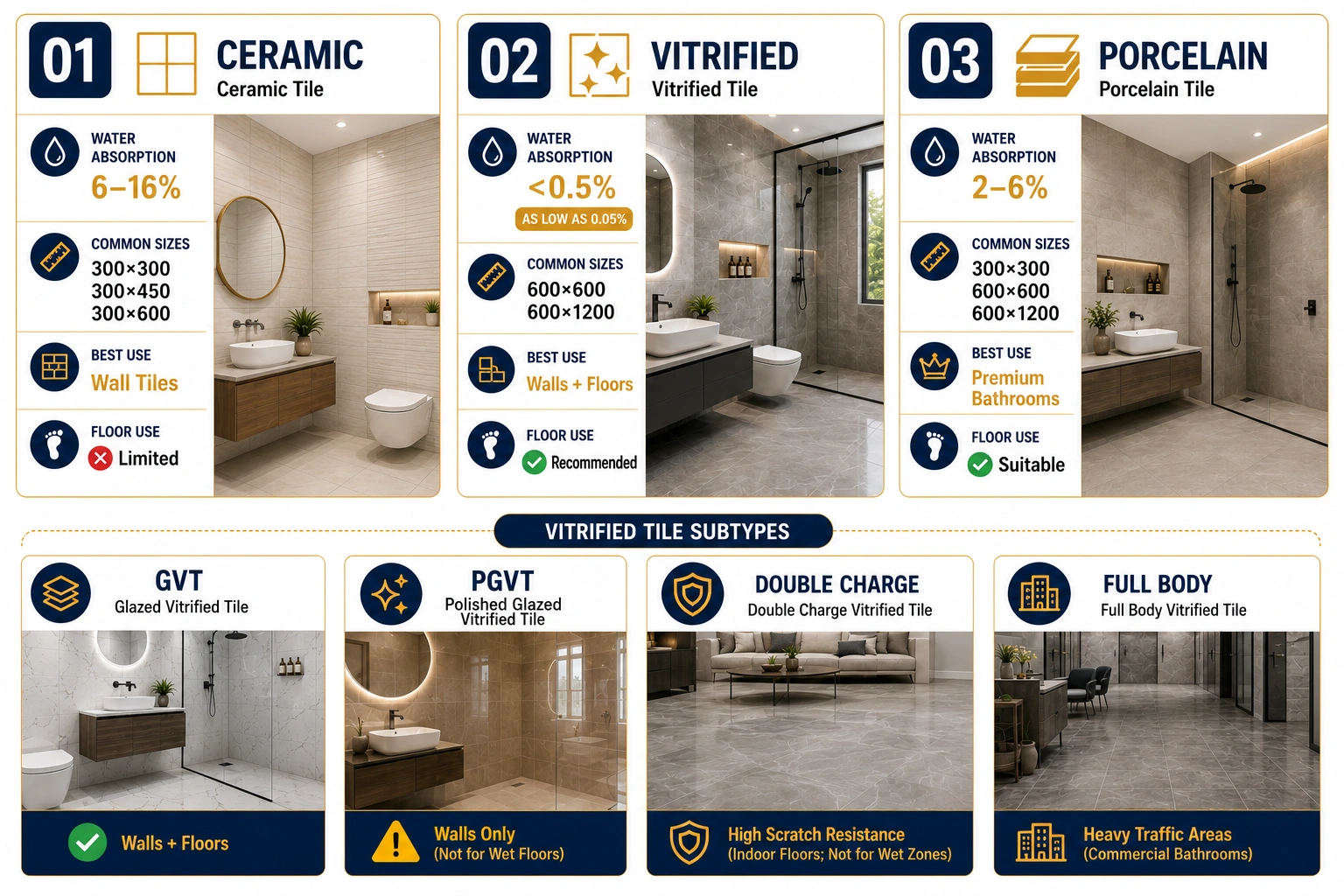
Ceramic tiles are made from refined clay mixed with other natural materials, then kiln-fired at lower temperatures (around 1,000 to 1,150 degrees Celsius). This process leaves the tile body slightly porous, with a water absorption rate between 6% to 16%, depending on the grade.
In India, ceramic tiles almost always come in smaller formats: 300x300 mm (1x1), 300x450 mm (12x18), and 300x600 mm (12x24). The 300x450 mm and 300x600 mm sizes are wall-only formats. The 300x300 mm size can work on bathroom floors as an exception when used as a coordinated set with wall tiles.
Key technical fact: Because of higher water absorption, ceramic tiles are not recommended for bathroom floors in wet zones. Their primary use in bathrooms is wall cladding.
What Are Vitrified Tiles?
Vitrified tiles are made by fusing silica and clay at much higher temperatures (around 1,200 to 1,400 degrees Celsius). This process creates an almost glass-like, very dense tile body with water absorption below 0.5%, and often as low as 0.05% in quality grades. The name 'vitrified' comes from the Latin 'vitrum', meaning glass.
In India, vitrified tiles have four main subtypes that buyers often see listed separately in showrooms.
| Vitrified Subtype | Full Form | Key Characteristic | Best Bathroom Use |
|---|---|---|---|
| GVT | Glazed Vitrified Tile | Digital-printed glaze on vitrified body; widest design range | Floor and wall |
| PGVT | Polished Glazed Vitrified Tile | Polished high-gloss surface on the GVT body | Bathroom walls only (not wet floors) |
| Double Charge | Double Charge Vitrified | Double-layer colour firing; highest scratch resistance | Indoor floors; not wet zones |
| Full Body | Full Body Vitrified | Colour runs through the full tile thickness | Commercial bathrooms, heavy-traffic |
Key technical fact: PGVT and high-gloss vitrified tiles are slippery when wet. They should never be used on bathroom floors where water contact is regular.
What Are Porcelain Tiles?
Porcelain is a specific sub-category of ceramic tile, but in the Indian market, the two are treated as separate product categories because their specifications differ meaningfully. Porcelain tiles use finer, purer clay (kaolin), fired at very high temperatures, producing a tile with water absorption between 2 to 6%, denser and harder than standard ceramic but not as low-porosity as vitrified.
In India, porcelain tiles are available in sizes including 300x300 mm, 400x400 mm, 500x500 mm, 600x600 mm, 600x1200 mm, and 200x1000 mm wooden plank format. They come mostly in matte finish in the Indian market and are common in premium projects.
Key technical fact: Never describe GVT, PGVT, Double Charge, or Full Body tiles as 'porcelain' in India. These are vitrified tiles. The categories are separate, and the technical properties are different.
Head-to-Head Comparison: Ceramic vs Vitrified vs Porcelain Bathroom Tiles
The table below compares all three across the factors that matter most in an Indian bathroom.
| Factor | Ceramic | Vitrified (GVT) | Porcelain |
|---|---|---|---|
| Water Absorption | 6% to 16% | < 0.05% | 2% to 6% |
| Hardness (Mohs) | Softer (3 to 4) | Hard (6 to 7) | Medium-hard (5 to 6) |
| Primary Bathroom Use | Walls only | Wall and floor | Wall and floor |
| Anti-skid (floor) | Not ideal for wet floors | Matte/GHR finish: YES. Gloss: NO | Matte finish: YES |
| Scratch Resistance | Low to medium | Medium to high | Medium |
| Stain Resistance (hard water) | Lower (more porous) | High (very low porosity) | Moderate |
| Thermal Shock Resistance | Good for walls | Good | Good |
| Finish Options in India | Glossy, matte, digital print | Matte, gloss, sugar, carving, GHR | Mostly matters in India |
| Price Range (per sq. ft.) | Rs. 30 to Rs. 80 | Rs. 60 to Rs. 150 | Rs. 90 to Rs. 220 |
| Available Sizes in India | 300x300, 300x450, 300x600 mm | 400x400 to 1200x2400 mm | 300x300 to 600x1200 mm |
| Rectified Options | Limited | Widely available | Available in larger sizes |
| Cleaning Effort | Moderate (more porous) | Low (dense surface) | Low to moderate |
| Best Climate Fit | All zones for walls | All zones are excellent for humid | All zones |
| Resale Value Signal | Standard | Higher for large formats | Premium look in projects |
All prices are approximate 2026 Indian market rates. Actual prices vary by brand, series, and dealer.
For Bathroom Walls: Which Material Should You Choose?
Bathroom walls deal with water splashes, soap residue, steam, and hard water deposits every single day. Wall tiles do not carry weight or foot traffic, so hardness is less of a concern here. What matters is water resistance, stain resistance, and ease of cleaning.
Ceramic for Bathroom Walls
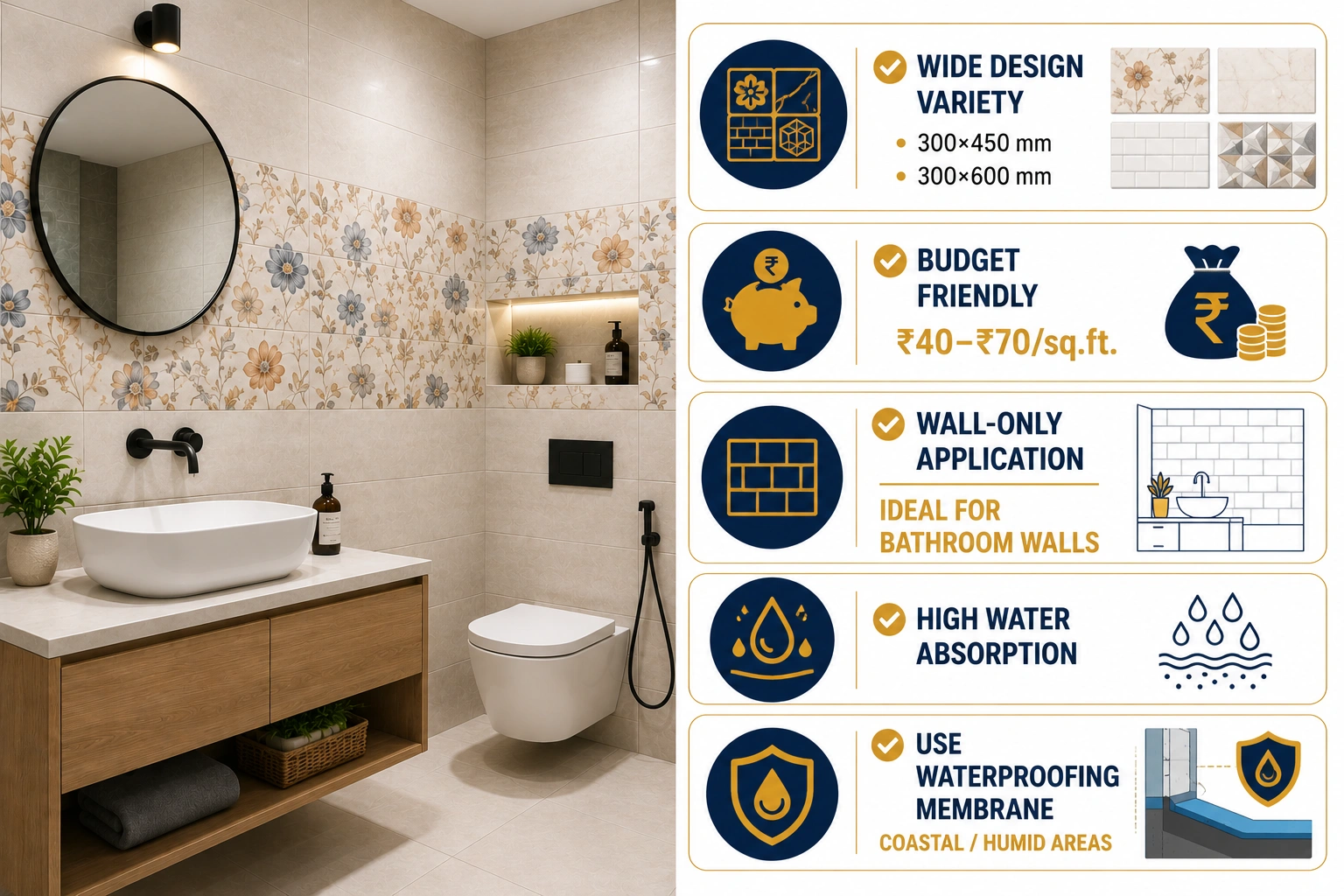
Ceramic wins on bathroom walls because of its design range and price point. Indian manufacturers produce a massive variety of digital-print ceramic bathroom wall tiles in 300x600 mm (12x24) and 300x450 mm (12x18), both of which are wall-only formats. Floral patterns, marble effects, subway tile looks, and decorative motifs are far more available in ceramic than in other categories.
If you are still deciding on aesthetics, these trending Bathroom Wall Tile Designs can help narrow down the right style for your bathroom.
For a 2BHK bathroom renovation where the budget per sq. ft. is between Rs. 40 to Rs. 70, ceramic wall tiles give the best design-to-cost ratio. The lower hardness does not matter on walls since there is no foot traffic.
Watch out for: High water absorption in ceramic means walls in very humid bathrooms (like those in Mumbai or coastal Kochi) can show grout darkening and moisture seepage over time if the installation is not done well. Use a waterproofing membrane before tiling in coastal zones.
Vitrified for Bathroom Walls
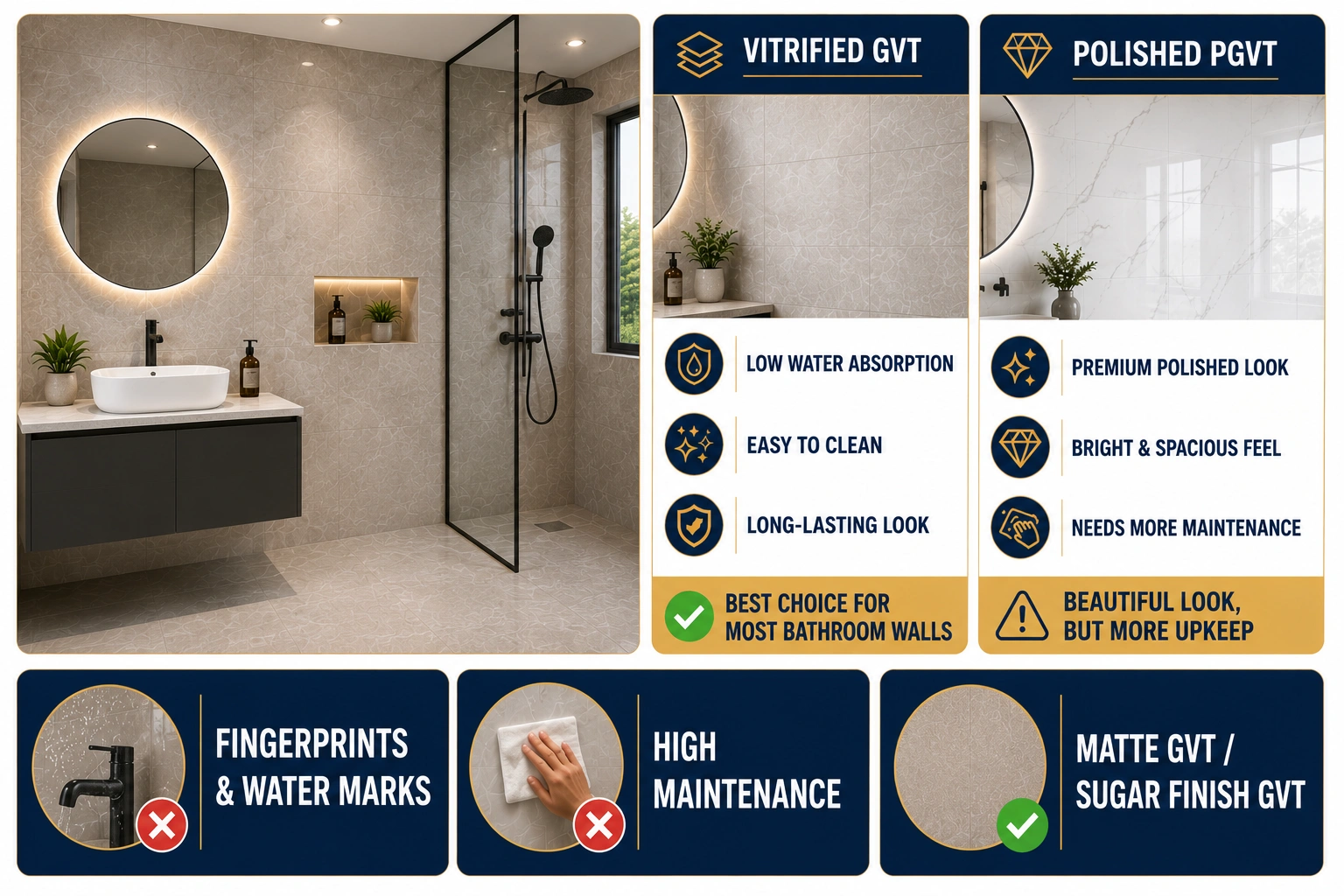
GVT works very well on bathroom walls, particularly in large-format sizes like 600x1200 mm (2x4). The low water absorption means zero moisture creep, no hard water staining on the tile body, and easy wipe-down cleaning. For bathrooms with hard water from a municipal supply, GVT walls look newer for longer.
PGVT on bathroom walls gives a mirror-like polished look that many premium apartment buyers prefer. The polished surface does catch soap marks more visibly than matte, so it needs more frequent wiping to stay looking clean.
Watch out for: PGVT and high-gloss GVT on walls show every fingerprint and water droplet mark. In a bathroom used by children, this means constant wiping. Matte GVT or sugar-finish GVT is easier to maintain on walls for family bathrooms.
Porcelain for Bathroom Walls
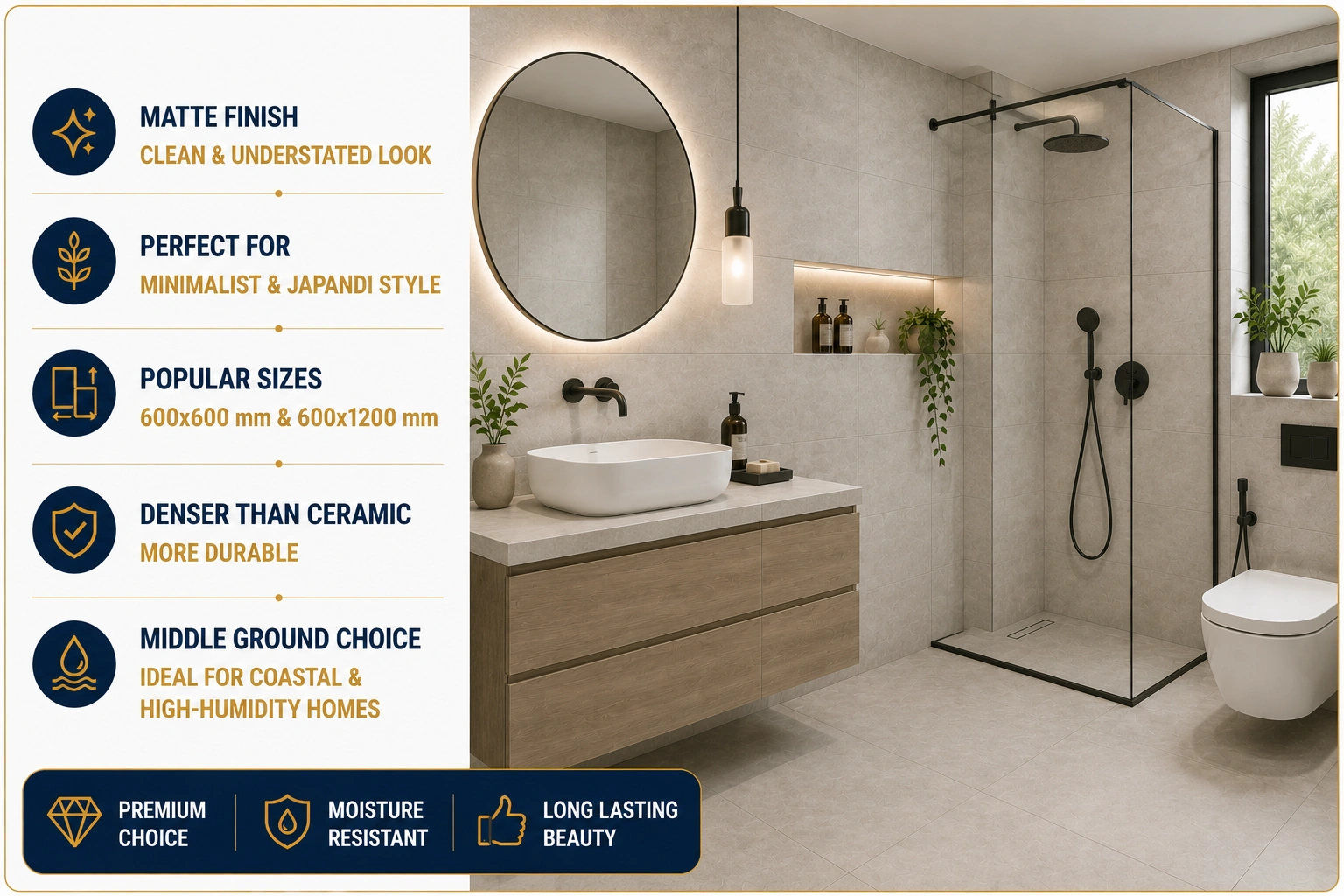
Porcelain wall tiles in matte finish give a clean, understated look that works well in minimalist and Japandi-style bathrooms. The 600x600 mm and 600x1200 mm porcelain tiles in soft grey, beige, or off-white tones are popular in premium 3BHK and 4BHK projects. They are denser than ceramic but not as low-porosity as vitrified, which puts them in the middle ground for coastal and high-humidity homes.
| Material | Wall Suitability | Design Range | Best For |
|---|---|---|---|
| Ceramic | Very Good | Highest in India | Budget bathrooms, decorative walls, 2BHK renovation |
| GVT (Matte) | Excellent | Wide | Hard water zones, low-maintenance family bathrooms |
| PGVT (Polished) | Good (maintenance-heavy) | Wide, premium look | Premium apartments feature walls |
| Porcelain (Matte) | Excellent | Moderate in India | Premium minimalist bathrooms |
For Bathroom Floors: Which Material Should You Choose?
Bathroom floors carry weight, handle constant wet contact, and need to resist slipping. This is where the material and finish choice becomes a safety matter, not just an aesthetic one.
Ceramic for Bathroom Floors
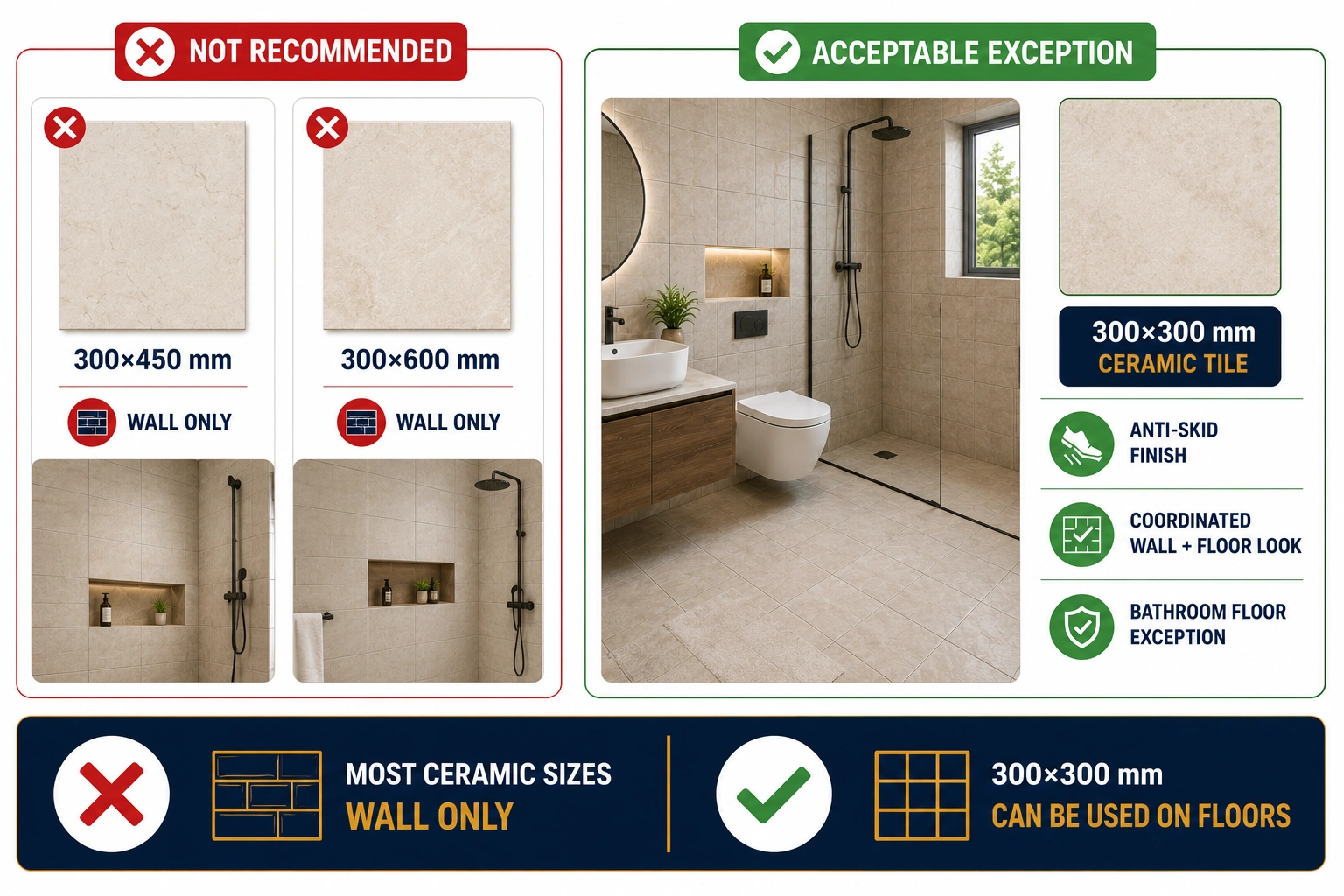
Standard 300x450 mm and 300x600 mm ceramic tiles are wall-only formats. Do not use them on bathroom floors. The one exception is 300x300 mm ceramic tile, which can be used on bathroom floors to create a coordinated look with the wall tiles, provided the finish has adequate anti-skid properties.
Even then, ceramic's water absorption rate means it is not the strongest performer on bathroom floors over the years of wet use, particularly in cities with hard water. Its practical role in bathroom projects is mostly wall cladding.
Vitrified for Bathroom Floors
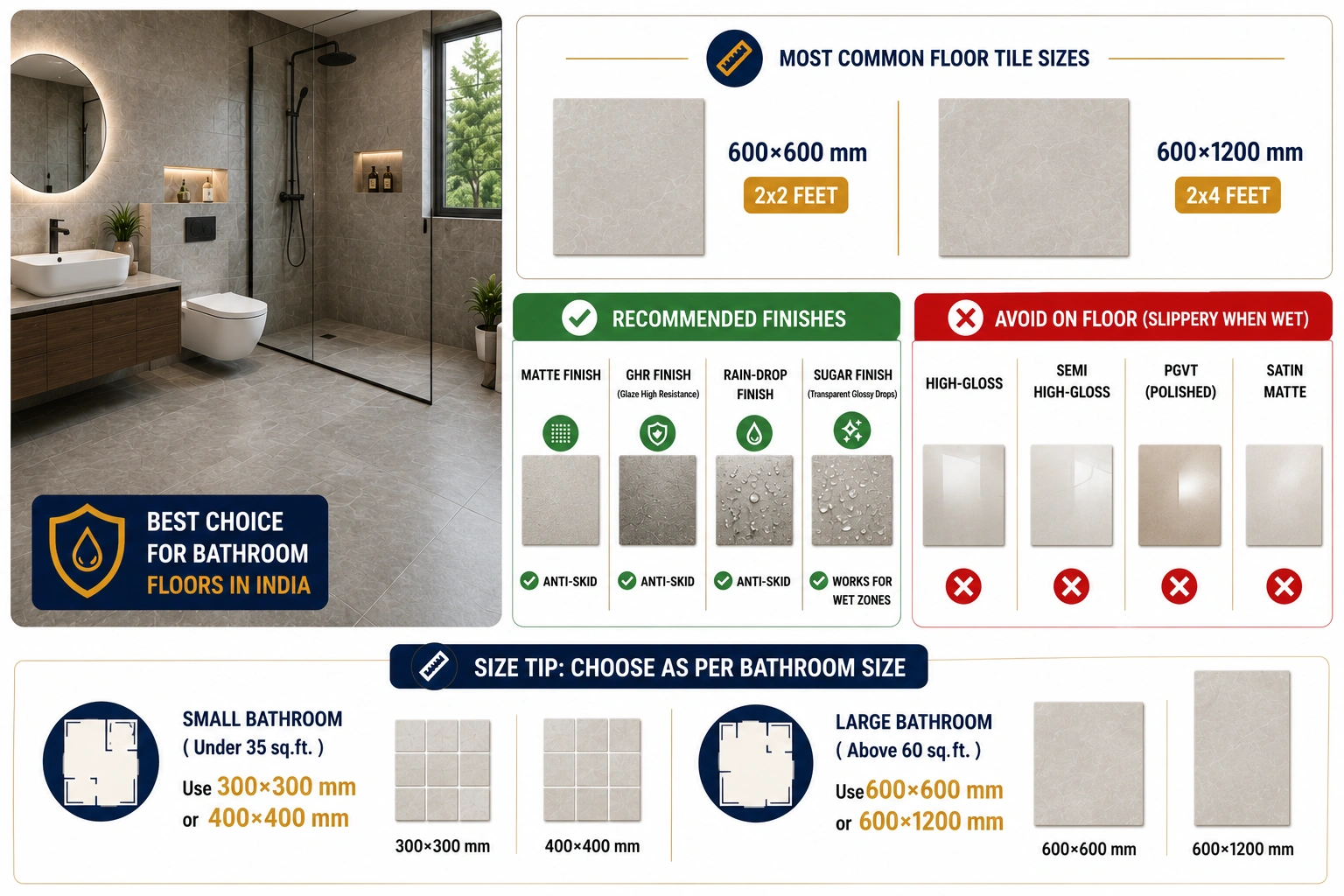
GVT is the go-to choice for bathroom floors in India, but finish selection is critical. The 600x600 mm (2x2) and 600x1200 mm (2x4) formats are the most common for bathroom floor installation.
For floor use, always choose matte finish, GHR (Glaze High Resistance) finish, or rain-drop finish GVT. These have adequate anti-skid ratings for wet zones. Sugar finish (transparent glossy drops on matte body) also works for bathroom floors. Never use high-gloss, semi-high-gloss, PGVT, or satin matte finishes on bathroom floors; they are slippery when wet and have caused injuries in homes.
Size tip: In a small bathroom (under 35 sq. ft.), 300x300 mm or 400x400 mm floor tiles maintain proportion better. In a larger master bathroom (above 60 sq. ft.), 600x600 mm or 600x1200 mm tiles make the space feel more open.
Porcelain for Bathroom Floors
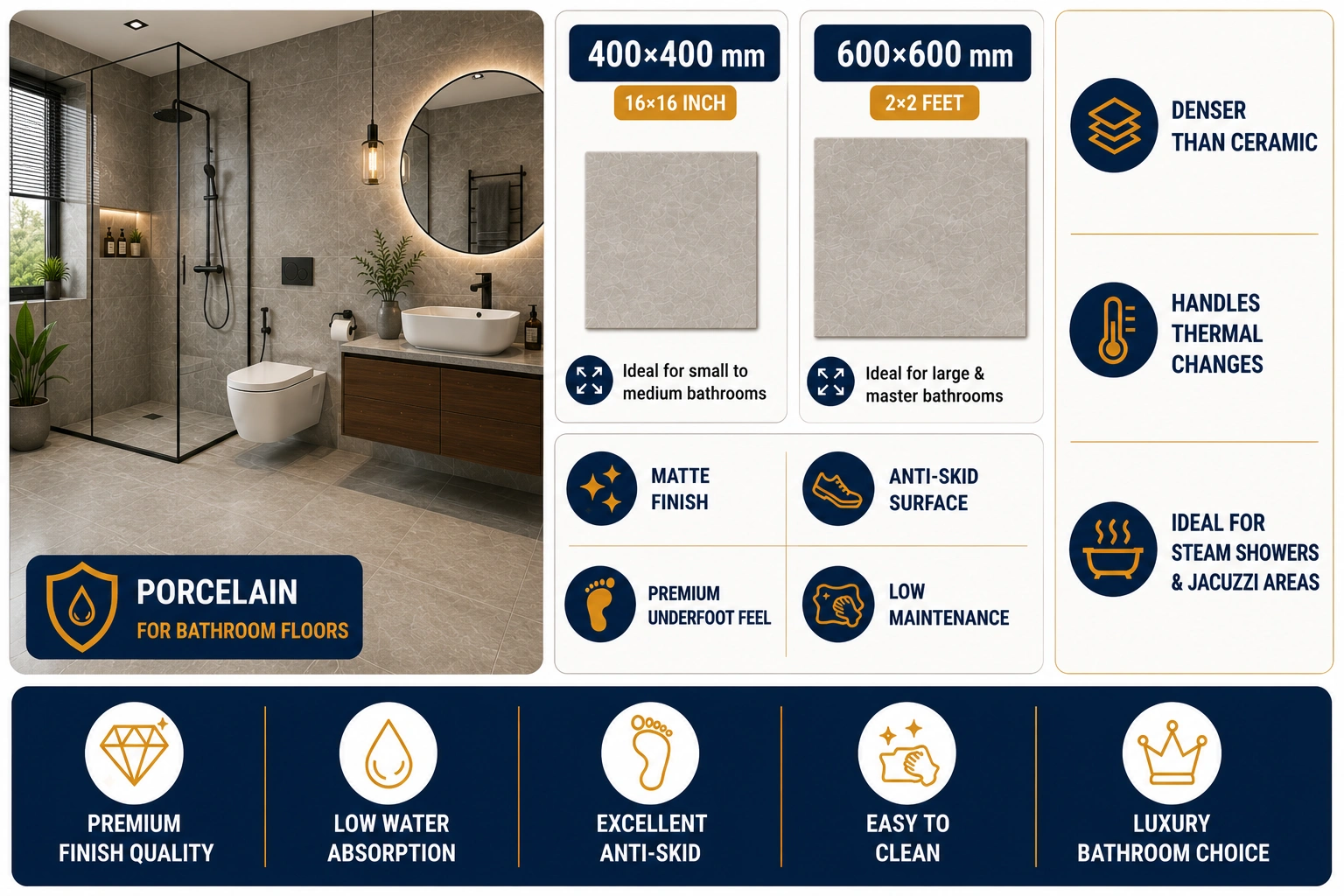
Porcelain in matte finish works well on bathroom floors. The 400x400 mm (16x16) and 600x600 mm (2x2) formats in matte porcelain give a premium underfoot feel with adequate anti-skid properties. Porcelain is denser than ceramic but softer than vitrified, which means it handles thermal changes from hot-water geysers well.
For bathrooms with a steam shower or attached jacuzzi area, porcelain's moderate hardness and low-maintenance matte surface is a practical choice. Pricing is higher than standard GVT, but the finish quality in premium grades is noticeably better.
| Material | Floor Suitability | Anti-Skid Options | Not Recommended |
|---|---|---|---|
| Ceramic (300x300 only) | Limited; 300x300 only | Matte 300x300 ceramic | 300x450, 300x600 sizes on floors |
| GVT (Matte/GHR/Rain Drop) | Excellent | Matte, GHR, Sugar, Rain Drop | High Gloss, PGVT, Satin Matte on floors |
| GVT (Glossy / PGVT) | NOT recommended | None (slippery) | Any wet or outdoor floor |
| Porcelain (Matte) | Very Good | Matte finish, natural texture | Polished porcelain on wet floors |
Price Comparison: Ceramic vs Vitrified vs Porcelain in India (2026)
Prices vary by brand, series, finish, and dealer. The ranges below reflect Indian market reality from Morbi-sourced and branded dealer stock in 2026. Always add 18% GST when calculating the final project cost.
For a complete breakdown of renovation expenses beyond tile rates, refer to our Bathroom Tile Cost Guide before planning your project budget.
| Tile Category | Price Range (per sq. ft.) | Where It Sits |
|---|---|---|
| Ceramic wall tiles (standard) | Rs. 30 to Rs. 60 | Most affordable; suitable for budget bathroom walls |
| Ceramic wall tiles (digital print) | Rs. 50 to Rs. 80 | Mid-range; wide design options |
| GVT floor and wall (matte/GHR) | Rs. 60 to Rs. 110 | Mid-range; workhorse of Indian bathroom projects |
| GVT large format (600x1200 mm+) | Rs. 80 to Rs. 150 | Mid to upper range; modern, spacious look |
| PGVT (polished vitrified) | Rs. 80 to Rs. 180 | Upper mid-range; premium wall finish |
| Porcelain (400x400 to 600x600 mm) | Rs. 90 to Rs. 160 | Upper mid; premium minimalist projects |
| Porcelain (600x1200 mm, matte) | Rs. 140 to Rs. 220 | Premium, large format with quality finish |
| Imported tiles (Italian, Spanish) | Rs. 400 to Rs. 2000+ | Luxury segment; limited to high-end projects |
Note: Prices exclude GST (currently 18% on most tiles in India). For commercial or builder projects, input tax credit on GST is available. Always confirm current rates with your dealer.
Choosing the Right Finish for Indian Bathroom Tiles
The material type sets the foundation, but the finish decides day-to-day performance. This is where most bathroom tile mistakes happen in Indian homes.
| Finish | Best Use in Bathroom | Avoid In | Maintenance |
|---|---|---|---|
| Matte | Floor and wall; excellent all-round | Nowhere; most versatile | Low; hides water spots well |
| GHR (Glaze High Resistance) | Floor; best for anti-skid | No restrictions for floor/wall | Low; stone-like look, easy to clean |
| Sugar | Floor and wall | Not for outdoor or very wet | Low; tiny glossy drops hide marks |
| Rain Drop | Floor: strong anti-skid | No restrictions | Low; best anti-skid option |
| Matte Carving | Wall feature panels | Wet floors (groves collect water) | Moderate; grooves need attention |
| Polished Glossy (PGVT) | Bathroom walls only | Any floor in wet zones | High; shows every watermark |
| High Glossy / Semi Gloss | Dry bathroom walls only | All floors, humid walls | Very high; shows all marks |
| Satin Matte | Dry walls only | Any floor; slippery when wet | Moderate |
| Posh (near-zero reflection) | Premium feature walls | Wet floors | Low, marble-like look |
The one rule to remember: If water will touch it regularly and someone might slip on it, use matte, GHR, sugar, or rain-drop finish. Any polished, glossy, or satin surface on a bathroom floor is a safety risk.
How to Choose Based on Your Bathroom Type and Budget
The right tile combination depends on your bathroom size, location, water quality, and budget. Here is a practical guide for the most common Indian bathroom situations.
1BHK or 2BHK Compact Bathroom (Under 35 sq. ft.), Budget Rs. 40 to Rs. 70 per sq. ft.
Use ceramic tiles (300x600 mm, wall-only) for walls in a design that adds visual height. For the floor, 300x300 mm matte ceramic or 400x400 mm GVT matte works well. Keep the colour scheme to whites, off-whites, or light greys to make the small space feel bigger. Avoid dark floor tiles in small bathrooms; they make the space feel lower and smaller.
Homeowners working with limited space can also explore Small Bathroom Tile Ideas for additional ways to improve visual openness and functionality.
Mid-Range 3BHK Bathroom (35 to 60 sq. ft.), Budget Rs. 70 to Rs. 120 per sq. ft.
This is where GVT gives the best return on investment. Use 600x600 mm or 600x1200 mm matte GVT for both the floor and walls. A single tile used across the floor and wall creates a coordinated, modern look that photographs well and feels spacious. Sugar or matte carving finish on walls adds texture without the maintenance load of full gloss.
The final appearance can also change significantly depending on the Bathroom Tile Layout Patterns used during installation.
In cities with hard water (Delhi, Jaipur, Agra, Ahmedabad), matte GVT on walls is a significant quality-of-life upgrade over ceramic because hard water spots wipe off cleanly from a denser surface.
Master Bathroom or Premium Project (Above 60 sq. ft.), Budget Rs. 120 to Rs. 250 per sq. ft.
Consider porcelain in 600x600 mm or 600x1200 mm matte for flooring with PGVT in 600x1200 mm polished on the shower and feature wall. This combination gives the marble-like premium look without real marble's maintenance demands. Add a GHR or rain-drop finish strip at the shower entry zone for safety.
For a full marble-look statement, large-format PGVT slabs (800x2400 mm) work beautifully on shower cubicle walls. Note that these slab sizes are for wall and countertop use only; they should never be used on floors.
Bathroom in a Coastal or High-Humidity Zone (Mumbai, Kochi, Goa, Chennai)
Prioritise water absorption above all else. In coastal zones, tile joints and grout are constantly exposed to humidity. Use GVT (0.05% water absorption) rather than ceramic (3 to 16% absorption) even for walls. Epoxy grout instead of cement grout makes a significant difference in preventing joint darkening and mould growth in humid bathrooms.
| Bathroom Type | Floor Recommendation | Wall Recommendation | Approx. Budget (sq. ft.) |
|---|---|---|---|
| 1BHK compact (under 35 sq. ft.) | 300x300 ceramic matte OR 400x400 GVT matte | 300x600 ceramic digital print | Rs. 40 to Rs. 70 |
| Standard 2BHK or 3BHK | 600x600 GVT matte or GHR | 300x600 ceramic OR 600x600 GVT matte | Rs. 65 to Rs. 110 |
| Modern 3BHK (full GVT) | 600x600 or 600x1200 GVT matte | 600x1200 GVT matte or sugar | Rs. 80 to Rs. 140 |
| Premium master bathroom | 600x1200 porcelain matte | 600x1200 PGVT polished (walls only) | Rs. 130 to Rs. 250 |
| Coastal / high-humidity zone | GVT matte with epoxy grout | GVT matte (not ceramic) | Rs. 75 to Rs. 150 |
Common Mistakes Indian Buyers Make When Choosing Bathroom Tiles
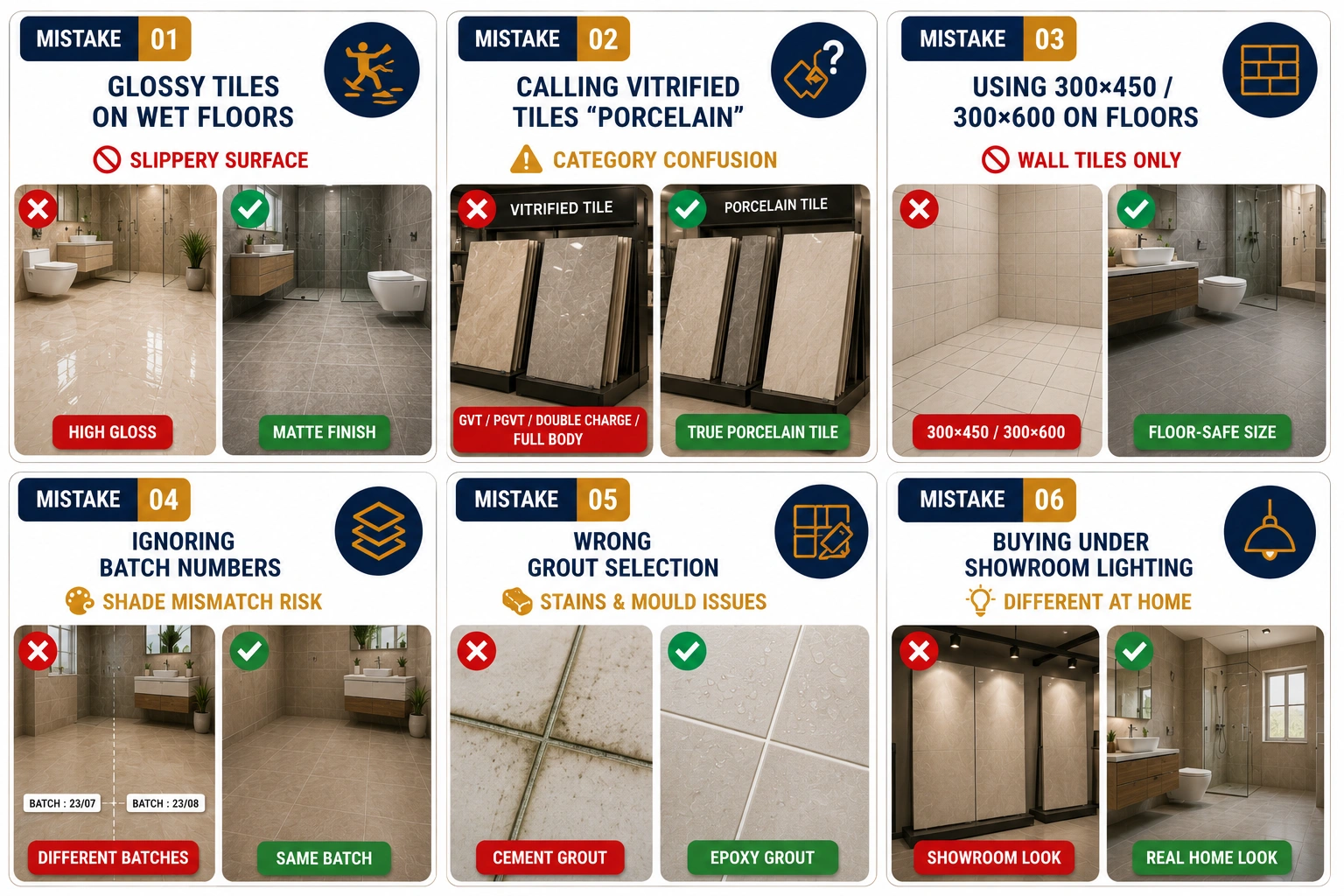
Using glossy vitrified tiles on bathroom floors. This is the single most common mistake in Indian bathroom projects. PGVT, high-gloss GVT, and satin matte finishes are dangerously slippery on wet floors. Many families only realise this after an elderly family member slips. Always use matte, GHR, sugar, or rain-drop finish on any floor that gets wet.
Many of these Bathroom Tile Mistakes are discovered only after installation, when fixing them becomes expensive and disruptive.
Calling GVT tiles 'porcelain' at the shop. If you ask for 'porcelain' at an Indian tile shop, you may receive GVT, PGVT, or any vitrified tile since the terms are often used loosely by salespeople. Ask specifically by the subtype name: GVT, PGVT, Double Charge, or Full Body. This ensures you get the correct technical product for your application.
Using 300x450 or 300x600 mm tiles on bathroom floors. These are wall-only formats. Their dimensions make them structurally unsuitable for floor load, and their water absorption rate makes them unsuitable for wet floor zones. Many homeowners order one tile size for both walls and floors without realising the format limitation.
Skipping batch number checks for large bathrooms. A bathroom tiled with two different production batches of the same tile can show a visible shade difference. This is especially noticeable on large-format tiles. Always confirm that the full quantity comes from a single batch before the delivery is packed.
Ignoring grout colour and type. Ceramic tiles with light grout in a hard-water zone look grey within a year because the grout absorbs minerals and stains. Dark grout on white tiles hides staining better but shows dust. For any bathroom, epoxy grout is worth the extra cost because it does not absorb water or harbour mould.
Choosing tiles only under showroom lighting. Showroom lighting is bright and often warm-toned, which makes every tile look better than it will at home. Always carry samples to your bathroom and check them under your actual lighting before placing the order. A tile that looks ivory in the showroom can look yellow under your bathroom's warm LED.
Choosing Correctly the First Time
Ceramic, vitrified, and porcelain are not competing products. There are different tools for different jobs in the same bathroom. Ceramic handles walls affordably with the widest design range. GVT covers floors and walls with the best water resistance for Indian conditions. Porcelain fills the premium gap where the finish quality matters as much as the technical performance.
The practical sequence for any bathroom project is straightforward. Decide on wall versus floor application first. Then choose material based on water resistance and budget. Then choose finish based on whether the surface will be wet or dry. Colour and design come last because almost every material and finish is available in every colour combination.
Before you finalise, always test tile samples in your actual bathroom under your actual lighting. The showroom is a starting point, not the final verdict.
You can browse and compare ceramic, GVT, PGVT, and porcelain bathroom tiles across verified Indian dealers on TilesFinders, where products are listed by category, finish, size, and price range. It helps shortlist options before the showroom visit and avoids the confusion of being shown everything at once.

FAQs
For bathroom floors in India, GVT (Glazed Vitrified Tile) in matte, GHR, sugar, or rain-drop finish is the strongest choice. It has water absorption below 0.1%, resists hard water staininand withithn the right finish, provides good anti-skid performance. Porcelain in matte finish is a good alternative for premium projects. Avoid any glossy, polished, or satin finish on bathroom floors.
Yes. GVT (matte, GHR, or rain-drop finish) works for both bathroom walls and floors. PGVT (polished vitrified) is suitable for bathroom walls but should not be used on bathroom floors because its polished surface is slippery when wet. Always match the vitrified subtype and finish to the application zone before buying.
Ceramic tiles have higher water absorption (3% to 16%) and are best used on bathroom walls. Vitrified tiles have extremely low water absorption (0.05% to 0.5%) and work for both walls and floors. Vitrified tiles last longer in hard water conditions and require less maintenance. Ceramic tiles cost less and have a wider design range in smaller formats commonly used on walls.
They serve different purposes well. Porcelain in matte finish is excellent for premium bathroom floors and walls, especially in projects where a natural stone look is wanted without the maintenance. GVT (vitrified) is denser, more scratch-resistant, and lower in water absorption than porcelain. For most Indian bathrooms, GVT is the practical choice. Porcelain adds a premium finish quality in the higher price range.
Ceramic tiles on bathroom walls are not a slipping concern. On floors, the answer depends on the finish. Matte ceramic (300x300 mm) has reasonable anti-skid properties when dry, but can be slippery when wet. Glossy ceramic should never be used on bathroom floors. For wet zone safety, GVT matte or GHR finish tiles on floors are a stronger choice than ceramic.
GVT (vitrified) tiles handle hard water best because their near-zero water absorption means minerals cannot penetrate the tile surface. Hard water deposits sit on the surface and wipe off. Ceramic tiles, being more porous, allow mineral deposits to work into the tile body and grout over time. For cities like Delhi, Jaipur, Nagpur, and Ahmedabad with known hard water, vitrified tiles on both floors and walls are a long-term quality decision.
For a bathroom under 35 sq. ft., 300x600 mm tiles on walls create visual height. For the floor, 300x300 mm or 400x400 mm tiles maintain proportion and avoid the cut-tile waste that larger tiles create in small spaces. Keeping floor and wall tiles in similar colour tones makes the bathroom feel more connected and spacious. Avoid dark or heavily patterned floor tiles in compact bathrooms.

See our tile guides first
Set TilesFinders as a preferred source and our buying guides surface ahead of the rest for you.
Add as preferred sourceTakes one tap. Nothing to install.
What Readers Say
I was about to redo my parking area with the wrong tile size until I read this. The layout comparisons saved me from a costly mistake.
We reference TilesFinders guides while briefing clients on material selection. The size and pattern breakdowns are accurate and easy to explain visually.
On site, I get asked about grout spacing all the time. This article gave me a solid reference I now share with my team before every job.
Finally a guide that doesn't just push generic advice. The oil stain removal steps actually worked on our clubhouse driveway tiles.
I run a small construction firm and now send this link to clients directly when they ask about entrance tile sizing. Saves me an hour of explaining.
Good practical detail, though I wish there were more examples for compact apartment entrances specifically, not just villas.
My mother-in-law wanted marble, I wanted vitrified. This blog gave us the neutral comparison we needed to actually decide together.
Detailed without being overwhelming. I appreciated that it covered both cost and maintenance, not just the aesthetics.
Used the algae and hard water removal tips on our terrace tiles after the monsoon. Worked better than what our regular cleaner was doing.
As someone who sources tiles for multiple builder projects, I find these comparisons genuinely useful for vendor conversations, not just consumer content.
Recommended this to a client who kept second-guessing the entrance design. The small vs large layout section settled the debate instantly.
Straightforward and honest, no unnecessary jargon. Would like to see a similar breakdown for outdoor pool-deck tiles next.
We've bookmarked several TilesFinders guides for our design handbook. Reliable source when clients want data, not just opinions.
Two paths, one marketplace.
Get free quotes from verified suppliers.
Share your room, budget, and style. Suppliers in Morbi respond within hours.
Get Free QuotesList your business, reach real buyers.
Put your showroom in front of homeowners searching for tiles right now.
List Your Business