
Modern Kitchen Tiles Design: 30+ Trending Ideas for Indian Homes in 2026
Upgrade your kitchen with 2026's top tile trends! Discover 30+ designs, from wood-look floors to ...


Loading designs...













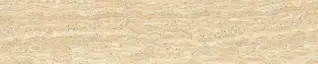



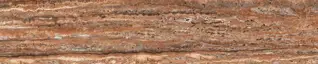
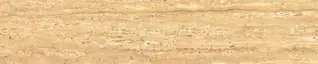

Brown is the colour of every residue that an Indian kitchen produces. Cooking oil is brown. Turmeric stains are yellow-brown. Cooking dust is warm brown-grey. Chai spillage is brown. Soil tracked in from outside is brown. When brown kitchen tiles sit in a kitchen where all of these things land on the surfaces regularly, the residue blends into the tile colour rather than showing against it. This is not an accident; it is the practical logic behind why brown is the single most forgiving kitchen tile colour for Indian daily cooking conditions, more forgiving even than beige on the warmest, richest end of the brown spectrum.
This page covers brown kitchen tiles across every surface and shade: light brown, mid-brown, and dark brown for walls and floors, the backsplash zone specifically, and the area around the kitchen sink, where brown tiles have a specific maintenance advantage over both white and dark tiles. The full kitchen tiles range includes brown in ceramic for wall applications and GVT for floors and full-wall cladding, in looks from plain warm brown to stone, chocolate, walnut, and Emperador marble. This page covers the brown colour family specifically, not the plank wood format; for wood-look plank tiles, see the wooden kitchen tiles page.
The maintenance argument for brown tiles in an Indian kitchen is straightforward and data-supported by the residues Indian cooking produces:
| Kitchen Residue | Colour of Residue | Shows on White | Shows on Grey | Shows on Beige | Shows on Brown |
| Cooking oil mist | Yellow-brown | Very visible | Visible on light grey | Moderate; warms into the beige tone | Least visible; warm brown absorbs the visual |
| Turmeric splash | Bright yellow-orange | Highly visible | Visible | Visible but less than on white | Less visible than any other colour, yellow-brown reads as part of the brown tile |
| Chai or coffee spill | Rich brown | Highly visible | Visible | Moderate | Least visible; the brown spill reads into the brown tile surface |
| Cooking dust and fine residue | Warm grey-brown | Very visible | Moderate | Low | Lowest of all colours; warm brown residue on warm brown tile is nearly invisible |
| Hard water calcium rings | White | Not visible | Visible on mid-to-dark grey | Slightly visible on light beige | Slightly visible on light brown; less visible than on dark tiles |
| Soil tracked in from outside | Dark brown to terracotta | Very visible | Visible | Moderate | Lowest; dark soil on brown tile is the least visible combination |
The practical summary: brown kitchen tiles hold their clean appearance between mopping sessions longer than any other kitchen tile colour in Indian daily cooking conditions. This is not a reason to avoid cleaning; it is a reason why brown is the colour that a working Indian kitchen tile should be when the choice is between looking clean and being clean.
| Shade | Colour Character | How It Reads in a Kitchen | Best Kitchen Style | Cabinet Pairing | Price Range (Rs./sq.ft) |
| Light brown (caramel, warm tan) | Pale warm brown; sits between cream-beige and mid-brown; sandy or honey quality | Open and warm; the most versatile brown for kitchens of any size or orientation | Traditional, transitional, modern; any style that uses warm neutrals | Cream, off-white, timber in any tone, terracotta accent | Rs. 45 to Rs. 120 (ceramic wall and GVT floor) |
| Mid-brown (coffee, chocolate, warm brown) | Clearly brown; reads as a deliberate colour choice rather than a warm neutral | Warm and grounded; adds visual weight without making the kitchen feel dark | Traditional Indian kitchens, farmhouse, and natural material kitchens | Cream or off-white cabinets; warm timber; terracotta accents; brass fixtures | Rs. 50 to Rs. 150 (ceramic and GVT) |
| Dark brown (espresso, walnut, dark chocolate) | Deep, rich brown; reads as a near-neutral dark in low light; reveals warm brown depth in direct light | Bold and anchoring; the strongest brown tone; needs good lighting to avoid reading as too dark | Designed kitchens, luxury modular kitchens, and open-plan spaces | Cream or white cabinets only; warm timber upper cabinets; brass or antique bronze fixtures | Rs. 55 to Rs. 185 (GVT primarily) |
| Reddish-brown (terracotta-brown, rust) | Warm red-brown; reads as a natural earth colour; closest to terracotta | Earthy and vivid; the most character-driven brown; strong personality in any kitchen | Farmhouse, heritage bungalow, Mediterranean, rustic-modern kitchens | Cream, warm white, pale timber; avoid cool grey or white-gloss modern kitchens | Rs. 50 to Rs. 130 (ceramic and GVT) |
Light brown is the most practical shade for a daily-use Indian kitchen because it gives the maintenance benefits of the brown colour family without the visual weight of mid or dark brown. In a standard modular kitchen under 100 sq. ft., mid or dark brown on the full wall or full floor can make the kitchen feel smaller. As a backsplash accent or a floor tile with white or cream cabinets above, mid-brown reads as a warm, deliberate choice without enclosing the space.
Brown ceramic wall tiles in 12x24 gloss or sugar finish are the standard specification for a brown kitchen backsplash or wall tile in Indian homes. Gloss finish gives brown its richest, most saturated reading on the wall. Sugar finish gives a slightly matte, softer quality that suits farmhouse and heritage kitchen styles, where a flat gloss reads as too polished. Matte brown ceramic on the backsplash near the cooktop collects cooking grease slightly more visibly than gloss; for heavy Indian cooking, gloss finish is the more practical choice on the backsplash zone.
Brown ceramic wall tiles in 12x24 are available from Indian manufacturers in a range from pale tan through coffee to dark espresso. The mid-brown range (coffee, chocolate, warm brown) is the most widely stocked. Light tan and dark espresso are available from a wider range of manufacturers, but may need stock confirmation before ordering in large quantities. Prices run from Rs. 45 to Rs. 90 per sq. ft for brown gloss ceramic in 12x24. For the full kitchen wall tile specification covering all surfaces and tile types, the kitchen wall tiles page covers the zone-by-zone rules.
GVT in a warm brown stone look or plain dark brown in 2x4 on a kitchen wall gives a full-height cladding that reads as a premium-designed surface. The GVT tiles category includes brown and dark brown options in stone look, concrete look, and plain colour finishes. A dark brown GVT in polished glossy finish in 2x4 on one kitchen wall in an open-plan kitchen is the specification behind the warm, dramatic feature wall look that appears in contemporary Indian kitchen designs. GVT brown in 2x4 polished glossy (walls only) runs from Rs. 110 to Rs. 200 per sq.ft.
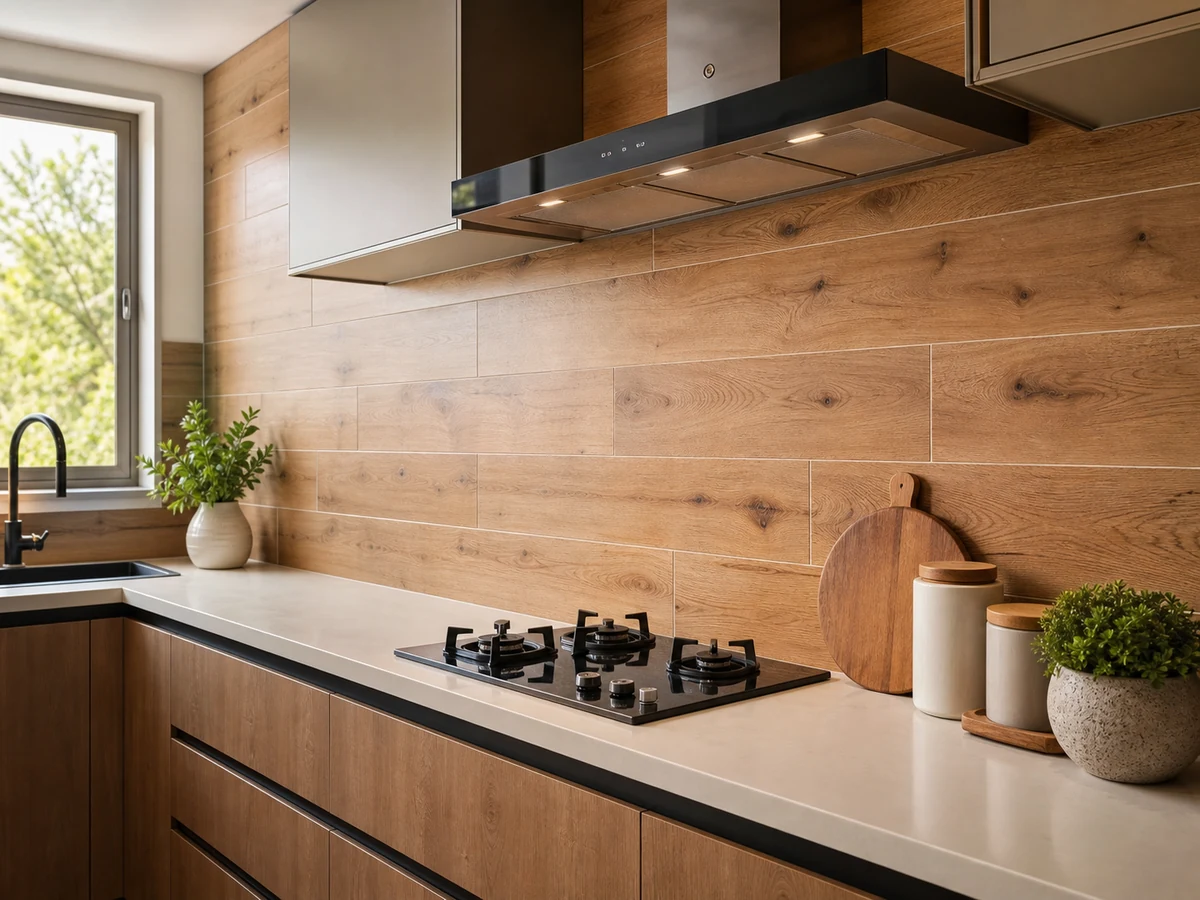
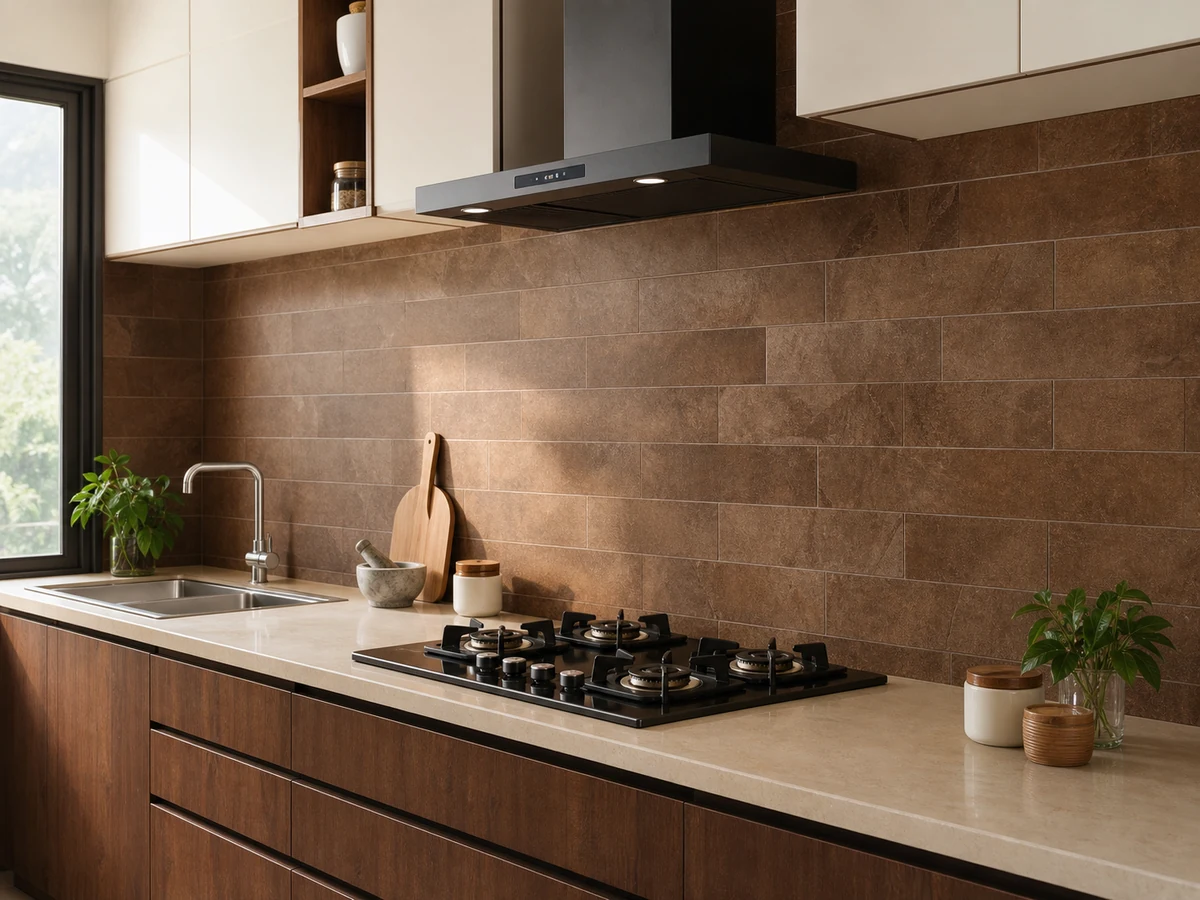
A brown kitchen backsplash is one of the most practical backsplash choices in an Indian kitchen. The warm brown surface is the most forgiving of the daily oil mist and cooking residue that lands on the backsplash zone, and it pairs naturally with the timber, cream, and terracotta material palette that Indian kitchen cabinets and countertops often use.
Mid-brown in gloss ceramic in 12x24 is the most specified brown backsplash tile in Indian kitchens. The chocolate or coffee tone reads as warm and deliberate against cream or off-white cabinets and picks up the warmth of brass or antique bronze fixtures. Light brown on the backsplash reads closer to beige and can merge visually with a cream or off-white cabinet above it without enough contrast to define the two surfaces. Dark brown on the backsplash reads well against white or cream cabinets but requires good lighting to avoid reading as a flat dark strip rather than a rich warm surface.
Warm off-white or cream grout with light and mid-brown tiles gives the most balanced result. The warm off-white grout reads as a natural gap between warm brown tiles, similar to the mortar joint in natural stone or brickwork. White grout with brown tiles creates a stronger contrast grid that reads more graphically. Dark brown or matching grout with dark brown tiles eliminates the grid and makes the backsplash read as a near-continuous dark warm surface. Epoxy grout on the backsplash in any brown tile kitchen is the right specification: epoxy resists turmeric and oil staining in the grout line, which matters more in a brown kitchen where the tile colour hides the stain but the white or cream grout does not.
The area around the kitchen sink is the hardest-working tile surface in any kitchen. It takes water splash continuously, hard water calcium rings from drying water droplets, soap and detergent residue, and food preparation residue. In most Indian cities with hard municipal water, the calcium in the water leaves white ring marks on any surface as the water dries.
Brown tiles in the backsplash and wall area around the kitchen sink have a specific maintenance advantage over white, grey, and dark tiles in this zone:
This means that for the backsplash immediately beside and behind the sink, mid-brown gloss ceramic is a more practical colour than either white or dark grey from a pure daily cleaning perspective. The brown surface still requires wiping down after use; the benefit is that marks are less alarming between cleans.
Use gloss or sugar finish on brown tiles near the sink. Matte finish near the sink holds soap and calcium residue in the surface texture more visibly than gloss. Gloss ceramic in a mid-brown shade in 12x24 on the sink backsplash is the specification that gives the best daily maintenance result in Indian hard-water conditions.
A brown kitchen floor is the most intuitive kitchen floor choice in Indian homes because it references natural earth materials: clay, soil, stone, and timber. The warm brown floor under a kitchen that uses timber cabinets, terracotta accents, brass fixtures, or natural stone countertops reads as part of a coherent material language rather than a contrasting element. Brown kitchen floor tiles in GVT matte finish are available in plain warm brown, chocolate, walnut, Emperador stone look, and terracotta-brown from Indian manufacturers.
The correct tile for a brown kitchen floor is GVT in matte or matte carving finish. For kitchen floor tile specification rules covering finish, body, and size constraints across all colours, the kitchen floor tiles page covers those in detail. The constraints for brown are the same as for any kitchen floor colour: matte or GHR finish, GVT body for mid-range and above, porcelain matte for budget applications.
Note: Gloss, polished glossy, and satin matte finishes must not be used on kitchen floors regardless of tile colour. Brown gloss ceramic tiles in 12x24 are wall-only. For a brown kitchen floor, use GVT in matte or matte carving finish in a floor-rated size.
600x600 (2x2) GVT matte in a warm brown or chocolate shade is the most specified brown kitchen floor tile in Indian mid-range kitchens. The square format gives a clean, even floor pattern. 600x1200 (2x4) in a dark brown stone look gives fewer grout lines and a more slab-like floor surface in larger kitchens. For brown floor tiles in a stone or Emperador look, matte carving adds physical surface texture that references natural stone. Plain warm brown GVT matte in 2x2 runs from Rs. 85 to Rs. 155 per sq.ft; brown stone look GVT matte carving in 2x2 runs from Rs. 100 to Rs. 185 per sq.ft.
Light brown kitchen floor tiles in GVT matte in a warm tan or caramel shade give the most open, spacious feel of the brown range on a kitchen floor. In a standard modular kitchen under 100 sq. ft., light brown GVT matte gives the maintenance benefits of the brown family without the visual weight that mid or dark brown can add in a smaller space. Light brown GVT matte in 2x2 runs from Rs. 80 to Rs. 145 per sq.ft.
Dark brown kitchen tiles, in shades from espresso to near-black walnut, are the most design-forward end of the brown family. They have the visual weight and presence of dark grey or charcoal tiles, but read warmer because of the brown undertone, which makes dark brown easier to pair with timber, brass, and natural stone than cool dark grey would be.
Dark brown GVT in matte finish in 2x2 on a kitchen floor pairs most successfully with cream or off-white cabinets. The high contrast between the ark brown floor and the light cabinet reads as deliberate and confident. With dark timber lower cabinets and cream upper cabinets, a dark brown floor reads more heavily; the combination works in a large kitchen with good natural light, but is too much visual weight in a small or north-facing kitchen.
On kitchen walls, dark brown GVT in a polished glossy finish in 2x4 as a feature wall in a large or open-plan kitchen reads as a premium, warm alternative to the charcoal or near-black GVT feature walls that are common in contemporary Indian villa kitchens. The warm undertone in dark brown GVT gives the wall a richer, less industrial quality than grey.
One maintenance note for dark brown tiles that is specific to the brown family: turmeric residue, which is the most common staining agent in Indian kitchens, is actually less visible on dark brown tiles than on any other tile colour, including mid-brown and beige. The yellow-orange of turmeric on dark brown reads as a warm stain rather than a bright contrast mark. This is not a reason to leave turmeric stains uncleaned, but it means dark brown tiles in a kitchen that uses heavy spice cooking are more forgiving than dark grey or black tiles in the same kitchen.
Brown marble look tiles reference the Emperador marble family from Spain: a rich brown background with white or gold veining that gives a warm, dramatic stone surface. In a kitchen context, the Emperador look in GVT matte carving or polished glossy finish gives brown tiles a luxury stone quality that plain brown ceramic does not have.
GVT in an Emperador or warm brown marble look is available from Indian manufacturers in 2x2 and 2x4. Matte carving on the floor gives the most convincing stone feel with the correct anti-skid surface for kitchen floor use. Polished glossy on a kitchen wall gives the sharpest, most reflective Emperador effect. For a full coverage of marble look tiles across all colours and the specific finish constraints for kitchen floors and walls, the marble kitchen tiles page covers that in detail. Emperador GVT matte carving in 2x2 runs from Rs. 95 to Rs. 185 per sq ft.
| Cabinet Colour | Brown Tile Shade | Best Surface | Fixture Finish | Grout Colour |
| White or off-white | Mid-brown or dark brown; the contrast between the white cabinet and the brown tile reads as bold and considered | Backsplash and floor; avoid full brown wall with white cabinets in small kitchens | Brass, matte black, or antique bronze | Warm off-white on backsplash; brown-tan on floor |
| Cream or ivory cabinets | Light to mid-brown; any shade works; warm undertones align | Wall and floor both; cream cabinet with mid-brown floor is the most cohesive warm-neutral kitchen combination | Brass or brushed gold | Warm cream on the walls; tan or brown on the floor |
| Warm timber (teak, walnut, oak) | Light to mid-brown that coordinates with the timber tone rather than matching it exactly | Backsplash in mid-brown; floor in light brown, so the timber cabinet does not read against a similarly dark floor | Brass, antique bronze, or copper | Off-white on walls; warm tan on floor |
| Dark timber (dark teak, wenge) | Light brown on walls as contrast; avoid dark brown floor with dark timber cabinets | Backsplash and wall in light or mid-brown; floor in light to mid-brown for visual lift | Brass or antique bronze | Off-white on walls; warm tan on floor |
| Grey cabinets (cool grey) | Warm brown with a red or orange undertone rather than a yellow-brown; the warmth of reddish-brown bridges cool grey and warm floor | Backsplash in warm reddish-brown; floor in mid-brown GVT matte | Matte black or chrome; avoid brass with cool grey | Mid-grey on backsplash; warm off-white on floor |
| Your Kitchen Requirement | Recommended Tile | Size | Finish | Price Range (Rs./sq.ft) |
| Brown backsplash, mid-range kitchen | Mid-brown gloss ceramic | 12x24 | Gloss | Rs. 50 to Rs. 85 |
| Brown kitchen floor, a practical choice | Light to mid-brown GVT matte | 2x2 | Matte | Rs. 85 to Rs. 155 |
| Dark brown floor, designed kitchen | Espresso or walnut GVT matte | 2x2 or 2x4 | Matte | Rs. 95 to Rs. 185 |
| Brown marble-look floor | Emperador GVT matte carving | 2x2 or 2x4 | Matte Carving | Rs. 95 to Rs. 185 |
| Brown feature wall, open-plan kitchen | Dark brown GVT polished glossy | 2x4 | Polished Glossy (walls only) | Rs. 110 to Rs. 200 |
| Light brown kitchen, all warm neutrals | Light brown gloss ceramic walls + light brown GVT matte floor | 12x24 walls; 2x2 floor | Gloss walls; Matte floor | Rs. 45 to Rs. 145 |
| Brown tiles near the kitchen sink | Mid-brown gloss ceramic (reduces calcium mark visibility) | 12x24 | Gloss | Rs. 50 to Rs. 85 |
| Budget brown kitchen floor | Light brown porcelain matte | 400x400 or 600x600 | Matte | Rs. 50 to Rs. 100 |
Brown kitchen tiles in ceramic for walls and GVT for floors and full-wall cladding from verified Indian manufacturers are listed at tilesfinders, from light tan and caramel through mid-brown coffee and chocolate to dark espresso, and Emperador stone looks. Ceramic brown gloss for backsplash and walls starts from Rs. 45 per sq ft; GVT in matte and matte carving for kitchen floors runs from Rs. 85 to Rs. 185 per sq ft. Use the colour filter to narrow to the right shade and the finish filter to confirm floor-safe matte versus wall-only gloss before shortlisting. All ceramic tiles listed meet IS 13630; all GVT tiles meet IS 15622.
Brown is the most practical kitchen tile colour for daily Indian cooking. The warm brown surface hides cooking oil mist, turmeric residue, cooking dust, and chai spillage better than any other tile colour. The warm brown tone of these residues blends into the tile surface rather than standing out against it. Between mopping sessions, a brown kitchen floor and backsplash look cleaner for longer than white, grey, or even beige in a kitchen with heavy daily oil cooking.
Mid-brown in gloss ceramic in 12x24 is the most practical and most commonly specified brown backsplash shade for Indian kitchens. Coffee, chocolate, or warm mid-brown reads as a deliberate, warm accent against cream or white cabinets. Light brown on the backsplash can merge with cream or off-white cabinets without enough contrast. Dark brown on the backsplash reads well but needs good lighting to reveal the warm depth of the colour rather than reading as a flat dark strip.
Yes. GVT in matte or matte carving finish in brown, chocolate, walnut, or Emperador stone look is suitable for kitchen floors. Matte finish is anti-skid and handles daily mopping and kitchen traffic. Gloss or polished finish must not be used on kitchen floors. Brown ceramic in 12x24 is wall-only and must not be used on kitchen floors. GVT matte in brown in 2x2 costs Rs. 85 to Rs. 185 per sq.ft, depending on shade and finish.
Hard water in most Indian cities leaves white calcium ring marks as it dries on any surface. On white tiles, calcium rings are not visible because the mark is white on white. On dark grey or black tiles, white calcium rings are highly visible. On mid-brown tiles, the warm brown background reduces the contrast between the white calcium mark and the tile surface, making the rings less visible than on dark tiles, but without the irony of white marks on white tile being invisible. For daily cleaning discipline, mid-brown gloss near the sink requires the least obvious maintenance.
On the floor in a standard-size kitchen, mid-to-dark brown can add visual weight but does not necessarily make the kitchen feel smaller if the walls and cabinets are light (cream or white). On a full wall, dark brown in a small kitchen under 80 sq. ft can feel enclosed. The safe approach for a smaller kitchen: use light or mid-brown on the floor and keep walls in cream or white. Reserve dark brown for the backsplash strip only, or for feature walls in large or open-plan kitchens where the floor area of dark tile is large enough to read as a grounding surface rather than an enclosing one.
Cream, off-white, and warm timber cabinets are the strongest pairings for brown kitchen tiles. The warm undertone of brown aligns with cream and timber without competing. White gloss cabinets with a mid-brown floor create a high-contrast combination that reads as deliberately designed. Avoid cool grey cabinets with yellow-brown tiles; the cool-warm clash reads as a colour conflict. If the cabinets are grey, choose a reddish-brown or neutral brown with a red undertone rather than a yellow-brown to bridge the cool grey and warm brown.
Warm off-white, cream, or tan grout in the same warm tone family as the tile gives the cleanest result. White grout with brown tiles creates a visible grid that reads as a contrast element rather than a joint. Brown-matched or tan grout minimises the visible grid and lets the tile surface read as a continuous warm plane. On a dark brown floor, a warm mid-brown grout makes the joins nearly invisible. Use epoxy grout on the backsplash to resist turmeric and oil staining in the grout lines, which matters in a brown kitchen where the tile hides cooking residue, but a white or cream grout line would not.
Brown is the colour that benefits most from warm LED lighting (2700K to 3000K). The warm yellow quality of warm LED light enriches brown tones and makes them read richer, deeper, and more intentional than they do under cool daylight or fluorescent light. Under warm LED, a mid-brown tile reads as a warm chocolate or coffee tone. Under cool daylight, the same tile can look slightly grey-brown or flat. For a kitchen that depends primarily on warm artificial light, brown is the most responsive colour in the tile range to that light condition.