
Stylish Kitchen Backsplash Ideas That Are Easy to Clean
Upgrade your kitchen with beautiful, practical, easy-clean backsplash ideas—from glossy classics ...


Loading designs...


















Cream kitchen tiles occupy the space between pure white and beige on the warm neutral scale. They carry the brightness and openness of white but avoid the cold, clinical edge that pure white can take on in a north-facing kitchen or under warm LED lighting. In a kitchen where the buyer wants a light, open feel without the harshness of stark white, cream is the tile colour that delivers that balance with the least design risk.
The choice between cream and white is often described as personal preference, but in Indian kitchens, it is actually a lighting and cabinet decision. Cream tiles read warmer under the warm-white LED lighting that most Indian kitchens use, and they sit more comfortably against the cream, off-white, or timber cabinets that are standard in Indian modular kitchens than pure white does. The full kitchen tiles range includes cream in ceramic for walls and GVT for floors and full-wall cladding. This page covers the complete cream kitchen tile decision: where cream works, the specific cream formats available (metro, subway, brick), the black-and-cream combination, and how to use cream tiles in a kitchen that already has white cabinets.
The three warm neutrals overlap in buyer searches but cover distinct colour territories in tile selection. Getting clear on which one is being asked for prevents ordering the wrong product:
| Property | White | Cream / Ivory | Beige |
| Colour description | Pure white; no undertone; maximum brightness | Warm off-white; yellow-white undertone; softer than white | Warm earthy neutral; grey-yellow or yellow-brown undertone; clearly not white |
| How it reads under warm LED (2700K to 3000K) | Can look slightly blue-white or clinical; loses some warmth | Reads warm and soft; the warm LED enhances the cream tone | Reads richest and warmest; most enriched by warm LED |
| How it reads under cool LED or daylight | Reads as clean, fresh white | Can read as very pale or slightly yellow in strong cool light | Reads correctly as a warm neutral |
| Best cabinet pairing | White cabinets; any cabinet colour | White, cream, timber; any warm material for the kitchen | Timber, cream, terracotta; does not suit cool white cabinets well |
| Kitchen feel | Brightest; most open; can feel cold in north-facing kitchens | Open and warm; the most comfortable pale kitchen tile colour in Indian conditions | Warm and grounded; earthy feel rather than a light, open feel |
| Typical tile products | White gloss ceramic 12x24; white GVT matte 2x2 | Cream or ivory gloss ceramic 12x24; cream GVT matte 2x2 | Sandstone or travertine look GVT matte 2x2; beige gloss ceramic 12x24 |
| Price range (Rs./sq.ft) | Rs. 35 to Rs. 200+ across all bodies | Rs. 40 to Rs. 190 across all bodies | Rs. 40 to Rs. 200 across all bodies |
The practical decision for a buyer choosing between white and cream: if the kitchen has white cabinets and strong natural light, white tiles work well, and the kitchen reads as clean and fresh. If the kitchen has white or cream cabinets and relies primarily on warm LED artificial light, cream tiles give a warmer, more comfortable result without the slightly clinical quality that pure white can take on. For the complete white tile range and specification, the white kitchen tiles page covers that colour in full. For the beige range, the beige kitchen tiles page covers stone and sandstone looks.
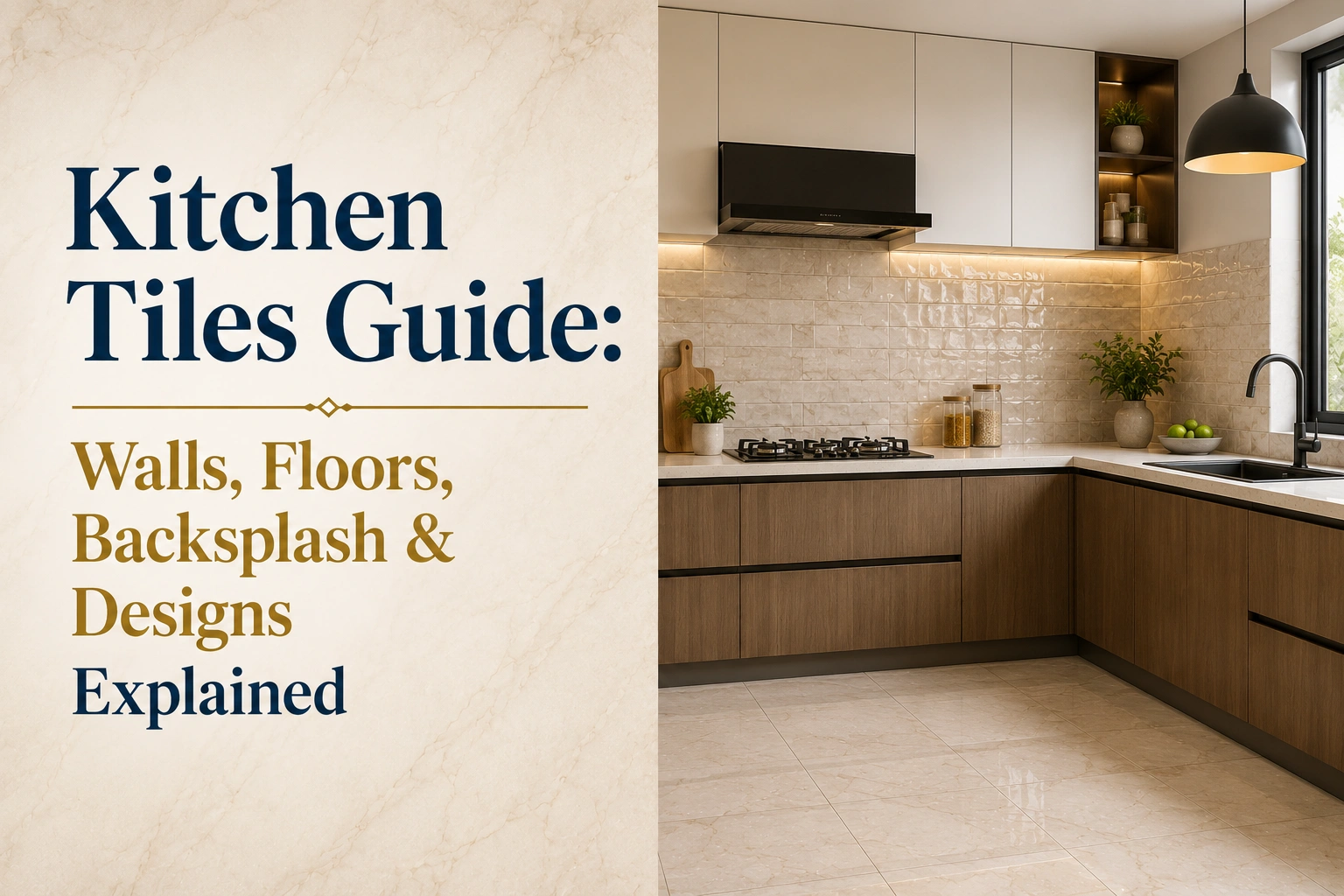
Cream and ivory gloss ceramic tiles in 300x600 (12x24) are the standard cream kitchen wall tile specification for Indian kitchens. The gloss finish gives the cream colour its warmth and makes the backsplash easy to wipe clean from oil and cooking splashes. Sugar finish is the second option: it gives a soft sheen rather than a flat gloss and suits kitchens with abundant natural light where a more muted surface is preferred.
Cream ceramic wall tiles in 12x24 are the wall tile equivalent of a warm off-white paint on a kitchen wall: they lighten the space, carry the warmth of the warm LED light, and pair comfortably with every cabinet colour that is not a saturated or cool-toned shade. Prices run from Rs. 40 to Rs. 80 per sq.ft for cream gloss or sugar finish ceramic in 12x24.
GVT for full-height cream walls
For a full kitchen wall from floor to ceiling in cream, GVT tiles in a warm ivory or cream stone look in 2x2 or 2x4 give fewer grout lines and a more consistent colour depth than ceramic. The GVT glaze carries the cream colour with more depth and variation than a flat ceramic print. Cream or ivory GVT in a travertine or warm stone look in 2x4 is a popular full-height wall specification in Indian premium kitchen renovations. GVT in a cream stone look in 2x4 runs from Rs. 100 to Rs. 200 per sq ft.
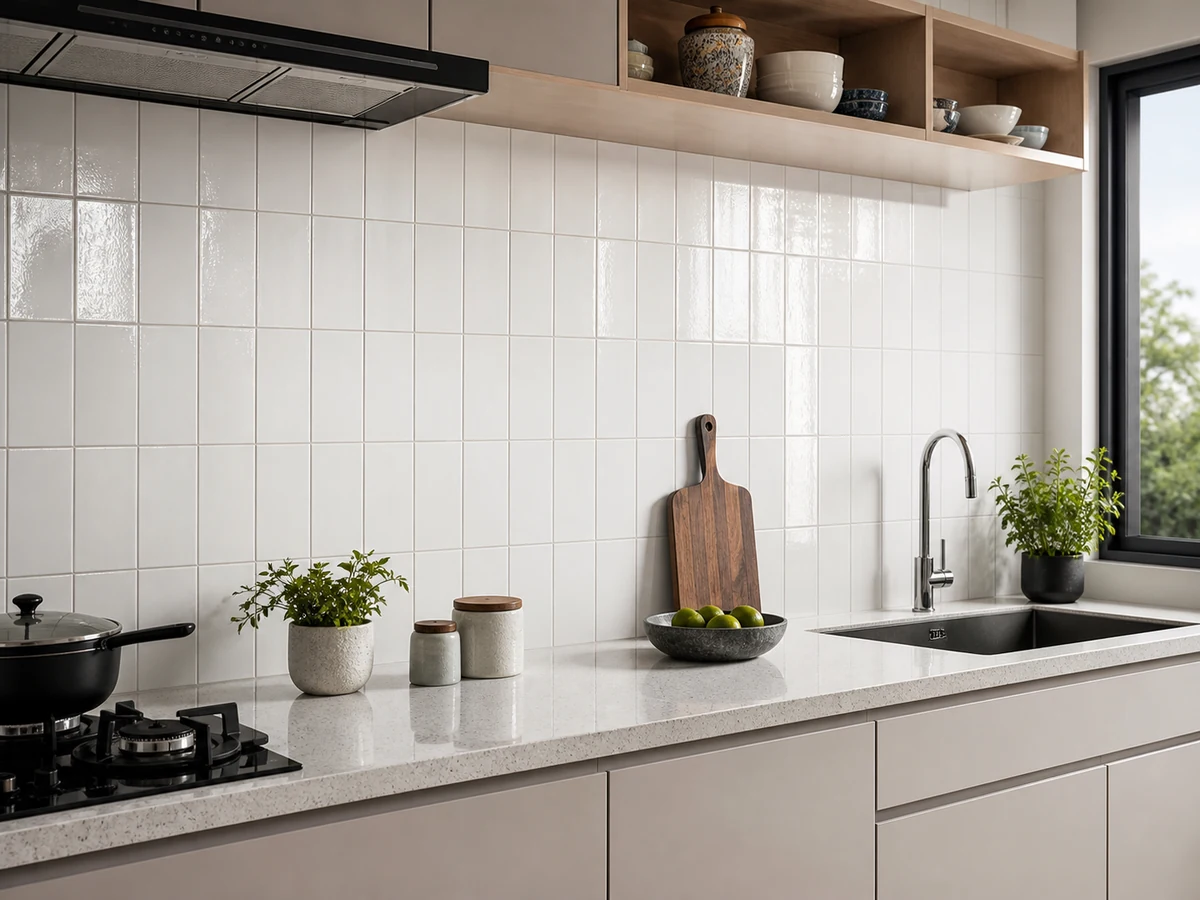
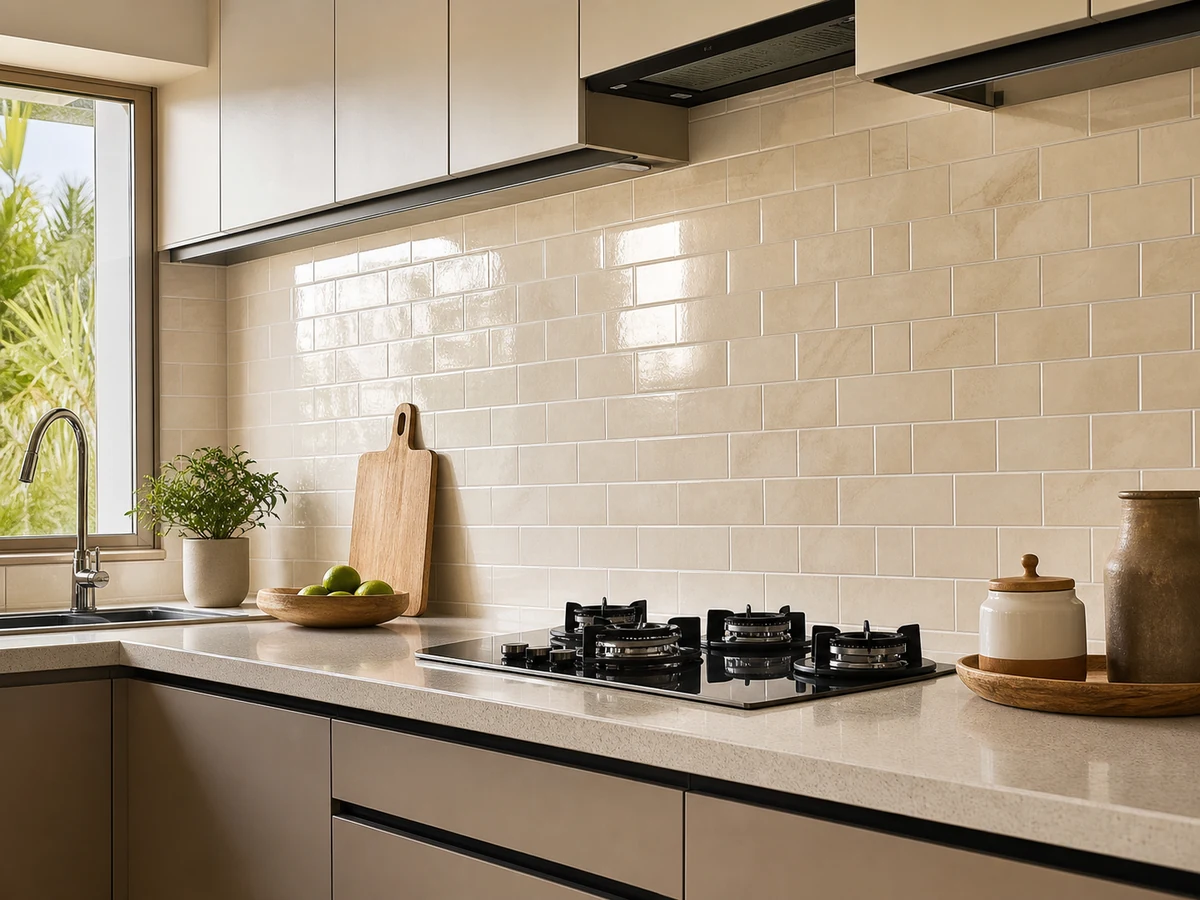
Cream metro tiles kitchen and cream subway tiles kitchen refer to the same format: ceramic in the rectangular 12x18 or 12x24 proportion in a cream or ivory gloss finish, laid in a horizontal brick bond. Metro and subway are terms used interchangeably for this tile shape in the Indian market.
The cream subway or metro tile is the warm alternative to the classic white subway tile. On a kitchen backsplash with white or cream cabinets, cream ceramic in a subway format reads warmer and more traditionally grounded than white subway tiles. The difference between a white subway backsplash and a cream subway backsplash is subtle in a brightly lit kitchen with cool light; in a kitchen with warm LED lighting, the cream reads noticeably warmer, and the white reads noticeably cooler by comparison.
Cream metro tiles in 12x24 in gloss finish are laid in a horizontal brick bond with a 2mm white or off-white grout. White grout with cream tiles gives a clean contrast line that reads as a considered design choice. Cream or off-white grout with cream tiles minimises the visible grid and gives the backsplash a more unified, continuous surface. For the full technical specification of the subway and metro tile format across all colours, the subway tiles kitchen page covers sizes, finishes, and laying patterns.
Note: Cream metro and subway tiles in 12x18 and 12x24 are wall-only sizes. They must not be used on kitchen floors.
Cream brick tiles for a kitchen wall use high-depth punch ceramic in 300x450 or 300x600 in a cream, buff, or warm white colour. The high-depth punch gives a physical surface depth of 2.5 to 5mm that replicates the look and feel of real brick facing on the kitchen wall. In cream or buff, the effect references the warm, handmade quality of traditional Indian lime-washed brick rather than the industrial exposed brick look that dark or terracotta brick tiles create.
Cream high-depth punch ceramic on the kitchen wall works well in three specific kitchen styles: farmhouse and rustic kitchens, where raw material textures are part of the design language, heritage bungalow kitchen,s where the brick tile references the original construction material of the building, and contemporary kitche, ns where one textured feature wall behind the open kitchen shelf or dining-facing side adds tactile contrast to the otherwise smooth material palette.
High-depth punch cream brick tiles in 300x450 run from Rs. 55 to Rs. 100 per sq.ft. They are more expensive per sq.ft than flat cream ceramic because the textured surface depth requires more clay and a more complex press tool during manufacturing.
Note: High-depth punch tiles are for wall and elevation use only. They must never be used on kitchen floors regardless of the colour. The raised surface depth makes them structurally unsuitable for floor adhesion and unsafe underfoot.
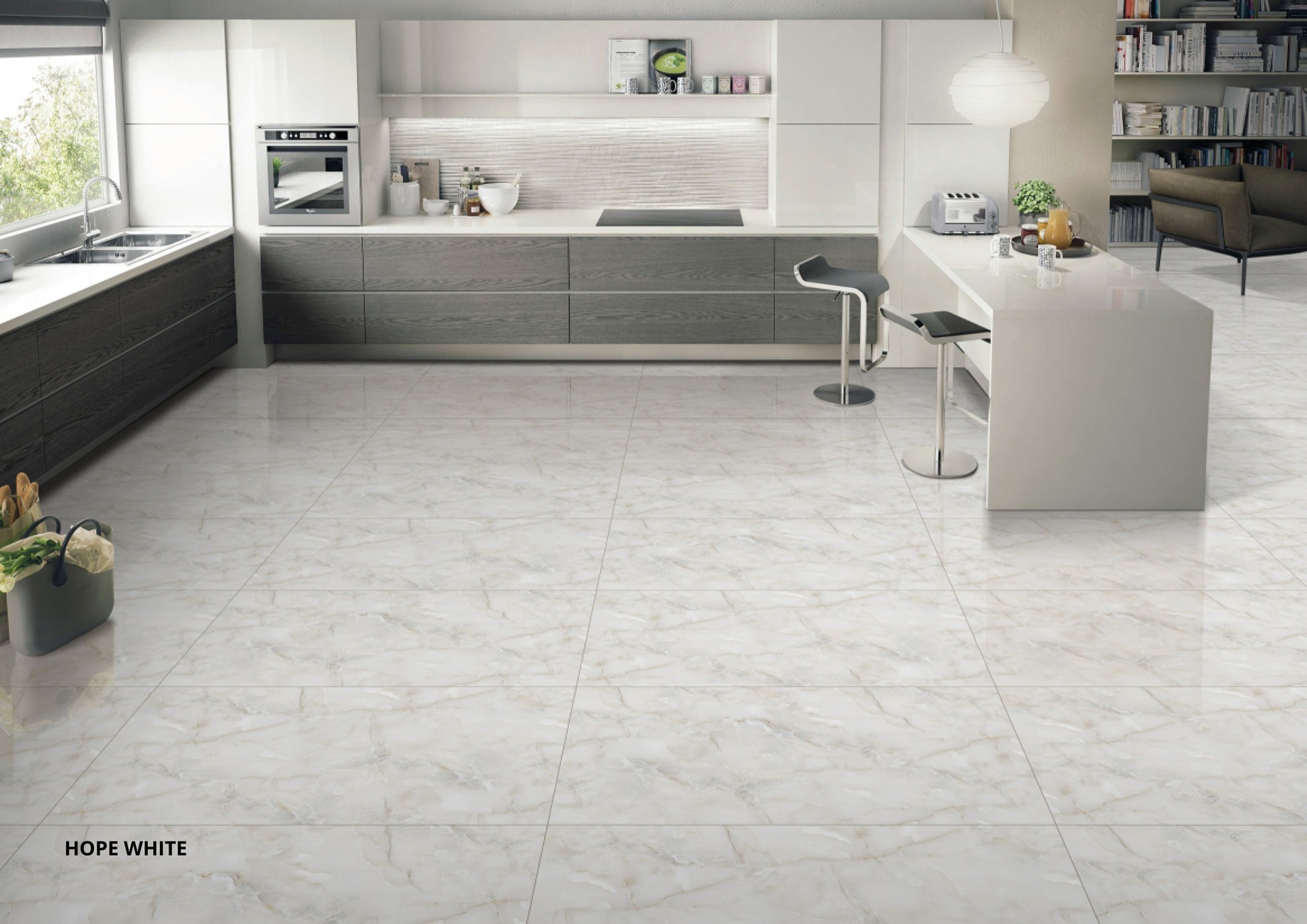
A cream kitchen floor with the right tile body and finish is one of the most practical and visually cohesive floor choices for an Indian kitchen with warm LED lighting and cream or timber cabinets. Cream on the floor reads warmer than white and more open than beige; it bridges the two and suits the widest range of Indian kitchen cabinets and countertop combinations.
The correct tile for a cream kitchen floor is GVT in matte or matte carving finish. A plain cream or ivory GVT matte tile in 600x600 (2x2) is the most commonly specified cream kitchen floor tile in the Indian mid-range segment. Matte carving in a cream travertine or warm stone look adds a physical surface texture that references natural stone while keeping the cream colour and the matte anti-skid finish that a kitchen floor requires.
Note: Gloss, polished glossy, and satin matte finishes must not be used on kitchen floors regardless of colour. Cream gloss tiles are wall-only. For a cream kitchen floor, use GVT in matte or matte carving finish only.
A cream kitchen floor sits between white (which shows dark marks clearly) and beige (which hides most marks well) in maintenance visibility. Dark cooking residue, footprints, and soil tracked in from outside show on a cream floor more than they would on mid-beige, but less than on pure white. Hard water calcium deposits from mopping show on cream less aggressively than on dark grey or dark blue floors. Overall, a cream matte floor is a manageable kitchen floor colour in Indian daily-use conditions.
Use a warm off-white or cream grout on a cream floor rather than pure white or grey. White grout on a cream floor creates a subtle but visible undertone contrast where the blue-white of the white grout reads against the yellow-white of the cream tile. A warm off-white grout in the same tone family as the tile reads as a continuous cream surface.
The most common buyer question about cream kitchen tiles is how they work with white cabinets, which is the dominant cabinet colour in Indian modular kitchens. The concern is whether cream tiles alongside white cabinets look like a colour mismatch, as if the tiles were meant to be white but missed.
The honest answer: cream tiles with white cabinets work well when the contrast between the two is managed through material texture and surface type rather than through colour alone. A cream gloss ceramic backsplash with white gloss cabinet doors sits in the same reflective surface family; the difference between cream and white reads as slight and intentional. A cream matte GVT floor with white gloss cabinets creates a material contrast (matte floor, gloss cabinets) that reads as deliberate rather than as a colour failure.
The combination that does not work: cream matte wall tiles with white matte cabinet doors in the same surface register. When two similar colours are in the same finish and surface type at a similar scale, the difference between them reads as a mismatch rather than a combination. To avoid this, ensure the cream tile and the white cabinet are in different surface types (one gloss, one matte) or at clearly different scales (full-height wall vs cabinet door panel).
| Cream and White Combination | Cream Tile Specification | White Cabinet | Why It Works | What to Add for Definition |
| Cream gloss ceramic backsplash, white gloss cabinets | Cream gloss ceramic 12x24 | White gloss finish | Both reflective, slight cream warmth reads as chosen, not mismatched | White or off-white grout; chrome or stainless fixtures |
| Cream matte GVT floor, white gloss cabinets | Cream GVT matte 2x2 | White gloss finish | Ma,erial contrast (matte floor vs gloss cabinet) makes the difference intentional | Warm off-white grout on floor; no grout contrast needed on walls |
| Cream wall GVT full-height, white cabinets | Cream GVT polished glossy 2x4 (walls only) | White semi-matte or gloss | Large format cream wall with minimal grout lines reads as a wall panel, not tiles; the scale separates it from the cabinet | Dark grey or anthracite grout to define the panel joins clearly |
| Cream brick tile feature wall, white cabinets | Cream high depth punch ceramic 300x450 | White semi-matte | Texture contrasts: the rough brick surface reads completely differently from the smooth cabinet door | Mortar-pointed joints in cream tone; warm lighting to enhance the texture |
Black and cream is a high-contrast combination like black and white, but the cream softens the stark quality of a pure black and white kitchen. Where black and white reads as graphic and sharp, black and cream reads as more traditional, more grounded, and more compatible with warm material kitchens that include timber, brass, or natural stone.
Black and cream kitchen tiles work in two primary applications:
A black gloss ceramic backsplash strip (two to three rows between counter and overhead cabinets) with cream gloss ceramic continuing above on the full kitchen wall. The black backsplash reads as a strong accent; the cream wall above it reads as the background. With cream cabinets above and a cream or warm beige floor below, the black backsplash strip is the only dark element in the kitchen, and it grounds the space without overwhelming it.
A checkerboard or alternating pattern combining black and cream tiles on the kitchen floor or backsplash. The cream is warmer than white in this combination, which gives the checkerboard a less graphic, more organic quality than a black and white checkerboard. For floor use, the black tiles must be in matte finish, and the cream tiles must be in matte finish; no gloss in a checkerboard floor.
Grout for a black and cream combination: warm mid-grey or warm off-white grout works for both colours. The grout must sit between the black and the cream in tone rather than matching either; a mid-tone grout prevents the grid from reading as a third competing colour.
| Cabinet Colour | Cream Tile Shade | Wall or Floor | Fixture Finish | Grout Colour |
| White or off-white | Cream or ivory gloss ceramic on walls; cream GVT matte on floor | Both | Chrome, stainless, or brass | Off-white on backsplash; warm off-white on floor |
| Cream or ivory cabinets (same tone as tile) | Slightly darker cream or a warm stone look GVT for the floor; lighter cream ceramic for walls. | The wall is lighter than the floor; same tone family but clearly different shades. | Brass or brushed gold to add warmth | Tone-matched cream grout on both; avoid white grout, which creates too many contrast levels |
| Liis ght timber (oathe k, pine) | Cream gloss ceramic on walls; cream or ivory GVT matte on floor | Both | Brushed nickel, brass, or matte black | Off-white on walls; warm cream or tan on floor to pick up the timber tone |
| Dark timber (walnut, teak) | Cream gloss ceramic on walls as contrast; cream GVT matte floor | Wall cream for contrast; floor cream for visual lift | Brass or antique bronze | Off-white on walls; cream on floor |
| Grey cabinets | Ivory rather than warm cream; the cooler ivory tone bridges the grey cabinet and cream tile better than a strongly yellow cream | Backsplash and wall, floor in matte ivory GVT | Chrome or matte black | Light grey or warm off-white |
| Your Kitchen Requirement | Recommended Tile | Size | Finish | Price, Range (Rs./sq.ft) |
| Cream backsplash, white or cream cabinets | Cream or ivory gloss ceramic | 12x24 | Gloss | Rs. 40 to Rs. 80 |
| Cream metro tile kitchen backsplash | Cream gloss ceramic subway format | 12x18 or 12x24 | Gloss | Rs. 40 to Rs. 75 |
| Cream brick tile feature wall | Cream high-depth punch ceramic | 300x450 | High Depth / Buff look | Rs. 55 to Rs. 100 |
| Cream kitchen floor, mid-range | Cream or ivory GVT matte | 2x2 | Matte | Rs. 80 to Rs. 150 |
| high-depth | 2x2 or 2x4 | Matte Carving | Rs. 100 to Rs. 200 | |
| Full cream wall, floor to ceiling | Cream stone look GVT | 2x4 | Polished Glossy (walls only) or Matte | Rs. 100 to Rs. 200 |
| Black and cream backsplash combination | Black gloss ceramic backsplash; cream gloss above | 12x24 for both | Gloss | Rs. 40 to Rs. 95 |
| Cream tiles in a white kitchen, coordinated | Cream gloss ceramic walls + cream GVT matte floor | 12x24 walls; 2x2 floor | Gloss walls; Matte floor | Rs. 40 to Rs. 150 |
Cream and ivory kitchen tiles in ceramic for walls and GVT for walls and floors are listed at TilesFinders across the full range of sizes and formats, from 12x24 gloss ceramic for backsplash and metro tile looks to 2x2 and 2x4 GVT matte for kitchen floors and full-height walls. Cream ceramic gloss starts from Rs. 40 per sq. ft.; cream GVT in matte and matte carving finish runs from Rs. 80 to Rs. 200 per sq ft. Use the colour filter to find cream and ivory shades, then confirm the finish before shortlisting. All ceramic tiles listed meet IS 13630; all GVT tiles meet IS 15622.
Cream kitchen tiles have a warm yellow-white undertone that makes them read softer and warmer than pure white, particularly under the warm-white LED lighting that most Indian kitchens use. White tiles have no undertone and read as the brightest, coolest pale surface. In a kitchen with warm LED lighting (2700K to 3000K), cream tiles read richer and more intentional than white. In a kitchen with cool natural light or cool LED, white reads fresher and cream can read slightly yellow. The choice between them is primarily a lighting and cabinet colour decision.
Yes, with the right combination strategy. Cream gloss ceramic on the backsplash with white gloss cabinet doors reads as a chosen warm accent, not a colour mismatch, because both surfaces are reflective and the slight cream warmth reads as deliberate. Cream matte GVT on the floor with white gloss cabinets works because the material contrast (matte vs gloss) makes the combination intentional. What does not work is cream matte tiles on the wall with white matte cabinet doors of similar scale; without a surface or finish contrast, the two similar warm neutrals read as a near-miss rather than a combination.
Yes, with GVT in matte or matte carving finish. Cream gloss ceramic in 12x24 is wall-only and must not be used on kitchen floors. For a cream kitchen floor, use GVT in 600x600 matte or matte carving. The matte finish is anti-skid and handles daily mopping and kitchen traffic. Cream GVT matte in 2x2 costs Rs. 80 to Rs. 150 per sq.ft.
Cream metro tiles are ceramic in the rectangular 12x18 or 12x24 format in a cream or ivory gloss finish, laid in a horizontal brick bond on the kitchen wall or backsplash. They are the warm-toned alternative to white subway tiles. Cream metro tiles pair naturally with white or cream cabinets, timber lower cabinets, and brass or chrome fixtures. They are wall-only tiles and must not be used on kitchen floors. Prices run from Rs. 40 to Rs. 75 per sq.ft.
Cream brick tiles for kitchen walls use high-depth punch ceramic in 300x450 in a cream, buff, or warm white colour with a 2.5 to 5mm physical surface depth that replicates the look of real brick facing. They are a wall and elevation product only and must not be used on kitchen floors. Cream brick tiles work well on farmhouse, heritage, and feature kitchen walls as a textured contrast surface. Prices run from Rs. 55 to Rs. 100 per sq.ft.
Cream is one of the better colour choices for a north-facing kitchen. North-facing kitchens receive cool, diffused light without direct sun. Pure white in a north-facing kitchen can look cold or flat because the cool diffused light does not lift the warmth in white the way direct sun does. Cream, with its warm yellow-white undertone, adds inherent warmth to the surface that does not depend on light direction to read correctly. Under warm LED lighting in a north-facing kitchen, cream reads more warmly and comfortably than white.
Warm off-white or cream grout in the same tone family as the tile gives the best result. White grout with cream tiles creates a subtle undertone conflict where the slightly blue-white of standard white grout reads against the yellow-white of cream tile at the joint. The result is a grid that looks slightly off rather than clean. An off-white or ivory grout in the same warm tone family as the tile makes the joins read as part of the tile surface. On a cream floor, a warm cream or tan grout keeps the floor reading as a continuous warm plane rather than a grid.