
Third Fired vs Ceramic vs PGVT Tiles: What Makes Over-Glaze Decoration Different for Indian Buyers
Compare third fired, ceramic and PGVT tiles through real Indian pooja room and bathroom examples, with costs, specifications and practical guidance on where each tile belongs.
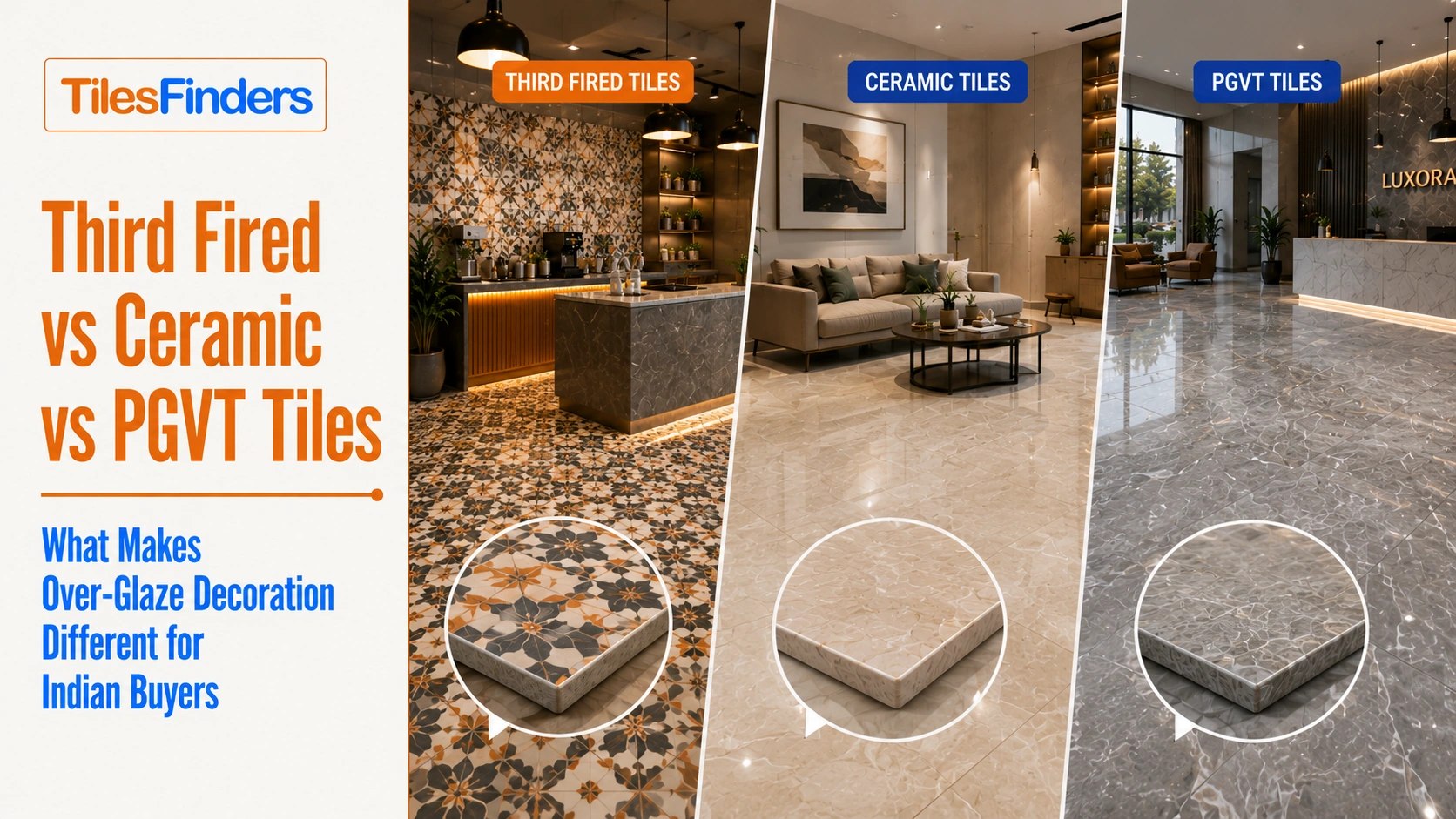
Third fired, ceramic and PGVT are not direct alternatives: ceramic and PGVT describe the tile body or finish, while third fired describes decorative over-glaze work. Use ceramic or PGVT where their construction makes sense, and reserve third-fired decoration for small, low-contact accent areas.
This comparison is usually presented as a choice between three products, which is why it confuses people. In practice, third fired tiles, full body tiles, and standard glazed tiles can appear in the same room, doing different jobs, and a well-specified pooja room or bathroom may use at least two of them together. Rather than argue which is best, this guide builds two real rooms surface by surface and shows where each belongs, what it costs, and what happens when they are treated as alternatives instead.
Why This Is Not a Three-Way Choice
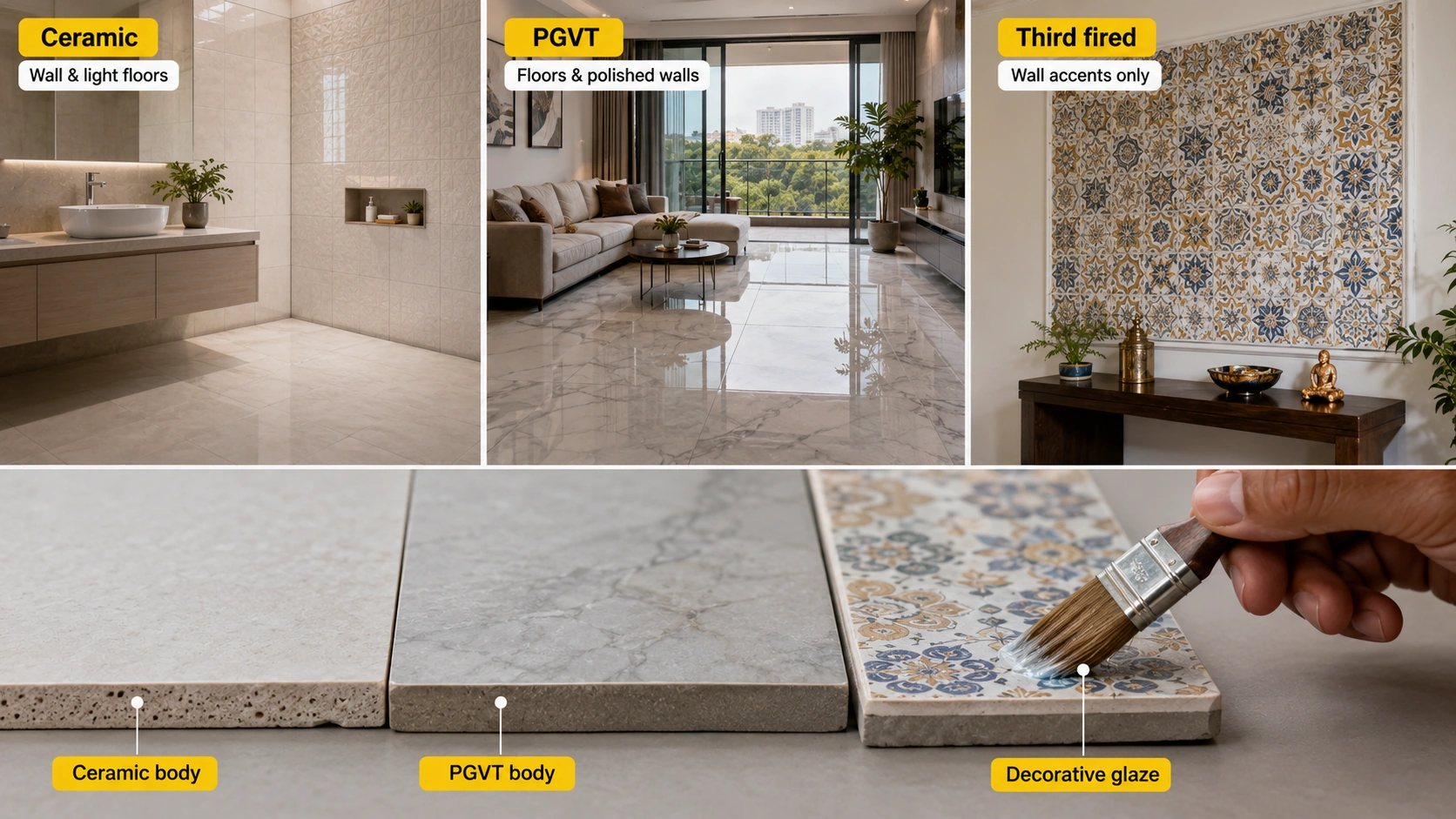
| What It Is | What It Does in a Room | |
| Ceramic | A body construction, fired at high temperature | Wall field tile, and light-duty floors in dry rooms |
| PGVT | A body construction, polished after firing | Floors and walls where a polished finish is wanted |
| Third fired | A decoration applied on top of a finished tile | Accent panels and borders only, on walls, at low contact |
The structural point behind that table: Ceramic and PGVT tile answer the question “What is this tile made of?” Third fired answers the question “What has been done to it afterwards.” A third-fired tile has a body underneath, and that body is very often ceramic. So asking whether to choose third fired or ceramic is close to asking whether to choose the paint or the wall. The genuinely useful questions are two, not three: what body construction does each surface in this room need, and where, if anywhere, does a decorative over-glaze earn its place on top. |
If you want to understand the material behind the decorative finish before choosing an accent, start with Third Fired Tiles in India. It explains how the third firing works, why gold lustre is delicate, and where this over-glaze category makes practical sense.
Room Build One: A Pooja Room
A compact pooja room of roughly 30 square feet of floor and 80 square feet of wall, specified surface by surface.
The floor
| Specification | |
| What it needs | A dry-room floor taking light foot traffic, occasionally with oil or ghee spillage near the lamp |
| Correct choice | PGVT for a polished formal finish, or ceramic for a more accessible matte one |
| Why not third fired | The over-glaze is fired at around 700 to 850 degrees, far below floor-grade hardness, and cannot survive foot contact |
| Indicative cost | 30 sq.ft at around Rs. 120/sq.ft, so about Rs. 3,600 |
The wall field
| Specification | |
| What it needs | A quiet background surface across the majority of the wall area |
| Correct choice | Ceramic wall tile, which is the appropriate body for a dry interior wall and the most economical across a large area |
| Why not PGVT | Polished vitrified is unnecessary on a dry wall and costs more for no functional gain here |
| Indicative cost | 80 sq.ft at around Rs. 70/sq.ft, so about Rs. 5,600 |
The accent panel
| Specification | |
| What it needs | A decorative focal surface behind the idol placement, viewed rather than touched |
| Correct choice | Third fired gold lustre, on a ceramic base, at a genuinely small area |
| Why it earns its place | Real fired metal responds to diya flame in a way a printed metallic finish cannot, and this is the one surface in the room where that matters |
| Indicative cost | 6 sq.ft at around Rs. 350/sq.ft, so about Rs. 2,100 |
Once the technical limits are clear, the next question is how to use the finish without overwhelming the room. Third Fired Tile Design Ideas covers practical decorative layouts for pooja rooms and bathrooms, from focused borders to statement backdrop panels.
What the completed room costs
| Surface | Product | Area | Cost |
| Floor | PGVT or ceramic | 30 sq.ft | Rs. 3,600 |
| Wall field | Ceramic | 80 sq.ft | Rs. 5,600 |
| Accent panel | Third fired on ceramic base | 6 sq.ft | Rs. 2,100 |
| Total | All three, working together | 116 sq.ft | Rs. 11,300 |
The number worth noticing: The third fired element is about nineteen per cent of the material cost of the room, and it occupies five per cent of the tiled area. That ratio is what makes this material work. Used as an accent on top of ordinary ceramic, genuine fired gold is affordable in a normal Indian home. Used as though it were a wall tile, across the full eighty square feet, the same room would cost around Rs. 31,600 and the gold would have stopped reading as precious. The comparison in this guide's title dissolves once you see the three as a stack rather than a shortlist. |
Room Build Two: A Bathroom
A standard 45 square foot bathroom, where the same three products divide differently because water changes everything.
| Surface | Correct Choice | Reasoning |
| Floor | Anti-skid matte vitrified, not PGVT | A polished floor is unsafe when wet. Confirm wet coefficient of friction at 0.4 minimum, which neither PGVT nor third fired provides |
| Shower enclosure walls | Ceramic or PGVT | Both wipe down well. Third fired is excluded entirely, since abrasive cleaning here is routine |
| General wall field | Ceramic | The appropriate body for dry interior walls, and the most economical across the largest area |
| Vanity mirror surround | Third fired border, optional | The one bathroom surface genuinely clear of splash and abrasion, seen daily at close range |
| Splash zone behind the basin | Ceramic or PGVT | Water contact and cleaning frequency both rule out over-glaze decoration |
The bathroom rule that overrides everything above: PGVT is a polished finish, and a polished floor is unsafe when wet regardless of how well the tile is made. In a bathroom, PGVT belongs on walls rather than the floor, and the floor needs a confirmed wet coefficient of friction of 0.4 minimum in an anti-skid matte, punch, sugar or matte carving tile. Third fired contributes nothing to slip resistance either, and has no business on a bathroom floor at all. Neither of the two premium options in this comparison is the right answer for the surface people actually stand on. |
What Each Actually Contributes
| Ceramic | PGVT | Third Fired | |
| Area it typically covers | The majority | Floors and selected walls | Under ten per cent |
| Cost per sq.ft | Lowest | Moderate | Highest by a wide margin |
| Durability | Good for walls and dry floors | High, and repolishable if scratched | Delicate, low contact only |
| Water absorption | Higher, per IS 13712 | 0.05% or below, per IS 15622 | Determined by the body beneath, not by the decoration |
| Suitable for wet floors | Only in an anti-skid matte specification | No, polished surfaces are unsafe wet | Never |
| What it is for | Doing the bulk of the work economically | Durable floors and formal polished surfaces | One focal moment that nothing else can produce |
What Goes Wrong When They Are Treated as Alternatives
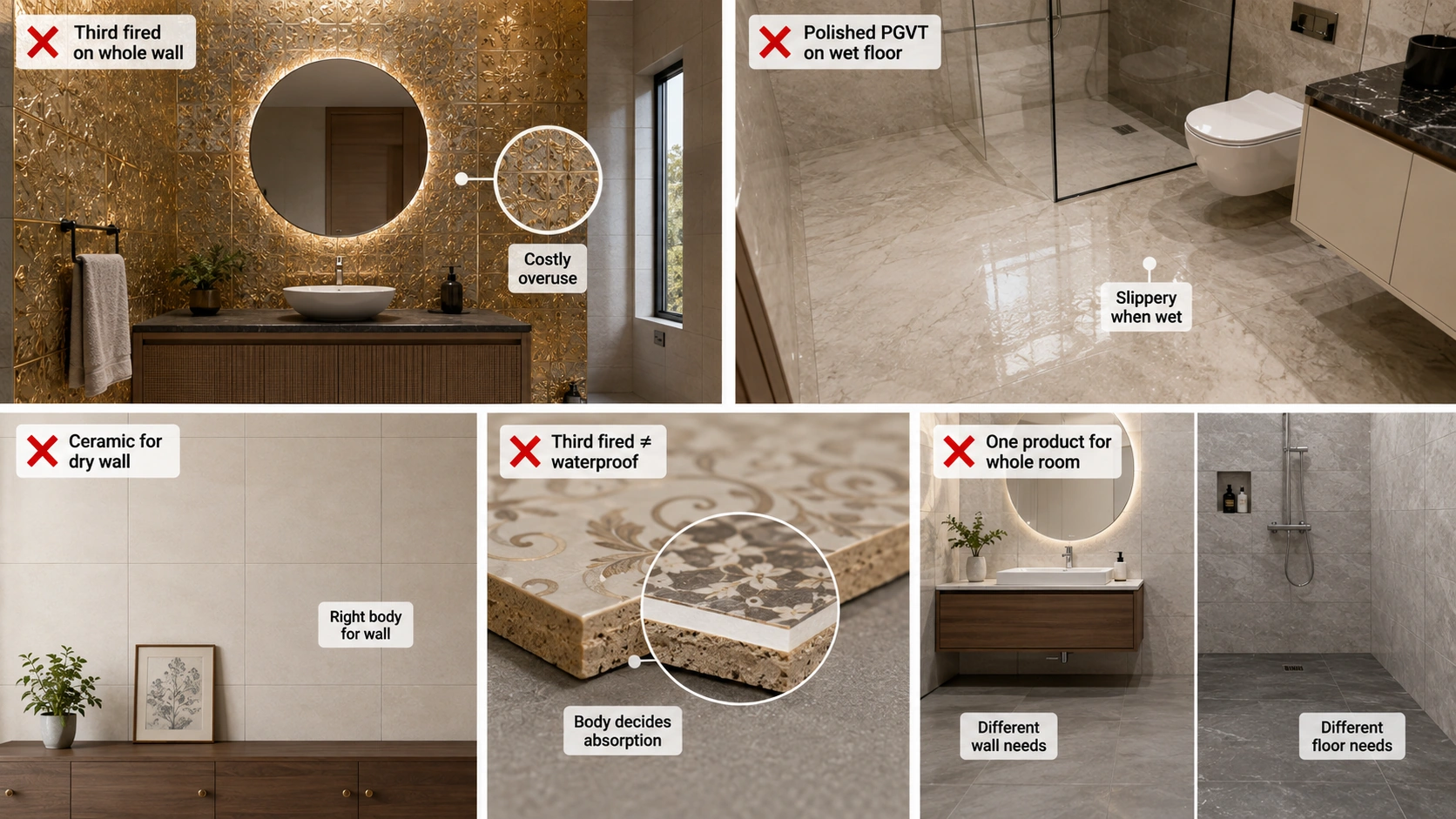
- Choosing third fired instead of a wall tile. The material is priced as decoration, so covering a full wall multiplies cost roughly fivefold while the effect diminishes, because gold reads as precious only against something plainer.
- Choosing PGVT for a bathroom floor because it is the premium option. Polished is unsafe wet, and premium pricing does not change the physics.
- Rejecting ceramic as the cheap choice. Ceramic is the correct body for dry interior walls, and using vitrified there is spending money on water resistance a wall will never need.
- Assuming third fired says something about the tile's water absorption. It does not. The decoration sits on top; the body underneath determines absorption, and that needs confirming separately.
- Specifying one product for a whole room. Every room in this guide needs at least two, because floors and walls have genuinely different requirements and no single product serves both well.
Specifying Correctly
When a supplier presents these as three options: "I understand third fired is a decoration applied over a base tile rather than a separate construction. What body is underneath the third fired range you are showing me, and what is its water absorption figure?" |
On a bathroom floor: "This is a bathroom floor, so I need a confirmed wet coefficient of friction of 0.4 minimum. Polished vitrified will not work here regardless of grade. What anti-skid options do you have in the same design family?" |
Sizing a decorative accent: "I want a third fired accent panel of around six square feet with ceramic field tile around it. Can you quote both together, and confirm the accent range will still be available if I need a repair in a few years?" |
Confirming the Specification
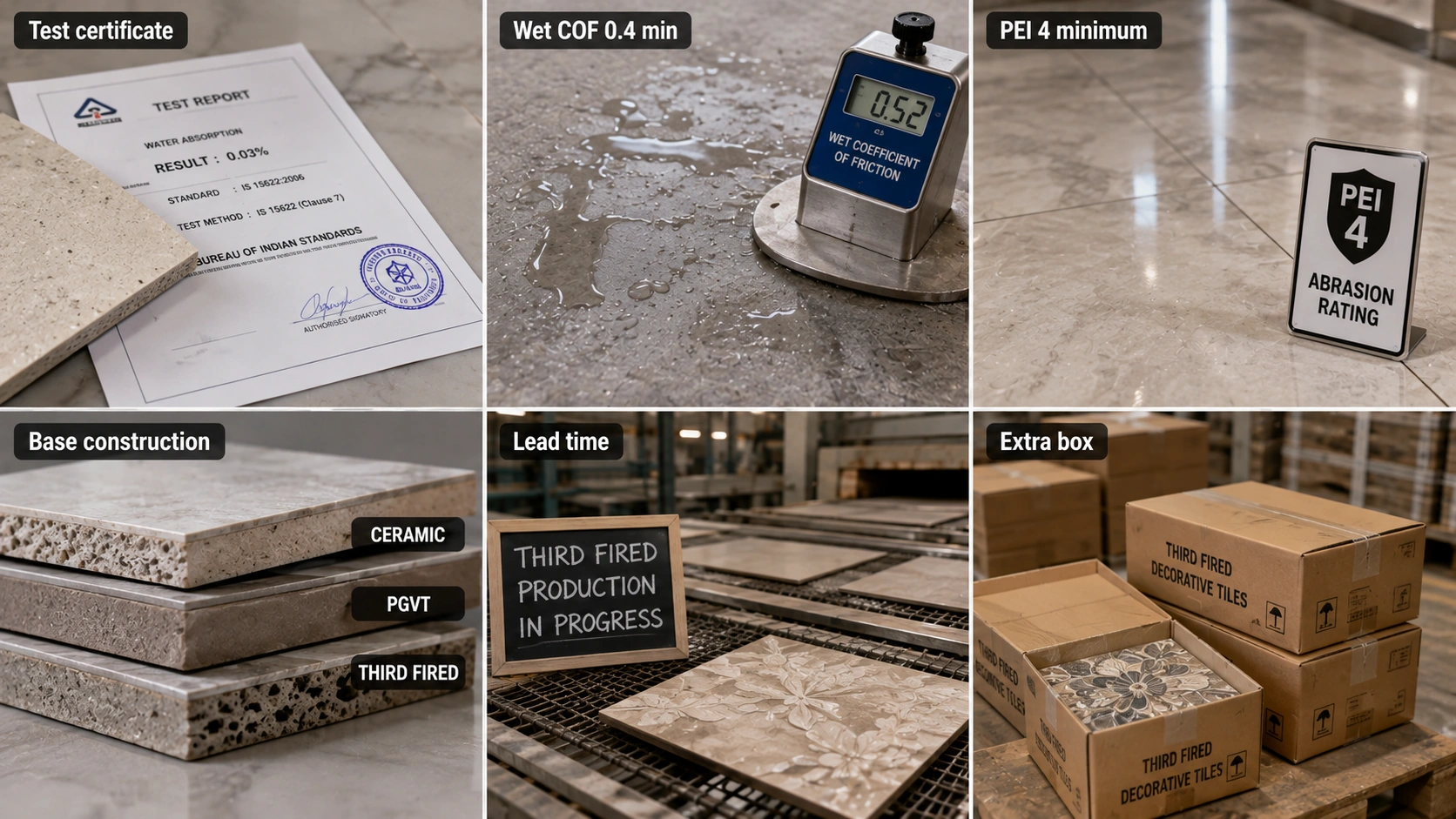
- Water absorption against the body type, referencing IS 13712 for ceramic and IS 15622 for vitrified, requested as a test certificate rather than a claim.
- Wet coefficient of friction of 0.4 minimum for every floor that gets wet, which neither PGVT nor third fired provides.
- PEI abrasion rating for any floor, at PEI 4 minimum for residential use.
- The base construction under any third fired range, since the decoration tells you nothing about the tile beneath it.
- Lead time for the third fired element separately, because three firings and a specialist facility make it the slowest component in any combined order.
- An extra box of the decorative accent, since specialist batches are small and discontinued faster than core ceramic and vitrified ranges.
Specify the Whole Room on TilesFinders
Ceramic, PGVT and third fired ranges can be compared together on TilesFinders, so a pooja room or bathroom can be specified as a complete stack of surfaces rather than as a single product decision.
FAQs
They are not competing. Ceramic and PGVT describe what a tile is made of, while third fired describes a decoration applied to a finished tile, usually one with a ceramic body. A well-specified room uses at least two of them together.
You can, but it costs roughly five times a ceramic field for a diminished effect, because metallic lustre reads as precious only against something plainer. In a typical pooja room, the accent is about nineteen per cent of the material cost while covering five per cent of the tiled area, which is the ratio that makes it work.
No. PGVT is a polished finish and polished surfaces are unsafe when wet, regardless of grade or price. Use an anti-skid matte, punch, sugar or matte carving finish with a confirmed wet coefficient of friction of 0.4 minimum, and keep PGVT for walls if you want it in the room.
No. The decoration sits on top of a finished tile, so absorption is determined entirely by the body underneath. Ask what that body is and request its test certificate separately, since the decorative description tells you nothing about it.
It is the correct option for dry interior walls, which is a different thing. Specifying vitrified tile on a wall costs money on water resistance the surface will never need. Ceramic doing the bulk of the work is what makes a decorative accent affordable.
For a compact room of about 30 square feet of floor and 80 of wall, roughly Rs. 11,300 in materials, split as Rs. 3,600 floor, Rs. 5,600 ceramic wall field and Rs. 2,100 third-fired accent.
A vanity mirror surround, and essentially nowhere else. It is the one surface genuinely clear of splash and abrasive cleaning. Shower walls, splash zones and floors all rule it out.
Third fired, without question, since it involves three firings and often a specialist facility. In a combined order, it is the component that determines the programme, so confirm its lead time before fixing any dates.
Not well. Floors and walls have genuinely different requirements around slip resistance, water absorption and durability, so every room discussed here needs at least two specifications working together.


See our tile guides first
Set TilesFinders as a preferred source and our buying guides surface ahead of the rest for you.
Add as preferred sourceTakes one tap. Nothing to install.
What Readers Say
I was about to redo my parking area with the wrong tile size until I read this. The layout comparisons saved me from a costly mistake.
We reference TilesFinders guides while briefing clients on material selection. The size and pattern breakdowns are accurate and easy to explain visually.
On site, I get asked about grout spacing all the time. This article gave me a solid reference I now share with my team before every job.
Finally a guide that doesn't just push generic advice. The oil stain removal steps actually worked on our clubhouse driveway tiles.
I run a small construction firm and now send this link to clients directly when they ask about entrance tile sizing. Saves me an hour of explaining.
Good practical detail, though I wish there were more examples for compact apartment entrances specifically, not just villas.
My mother-in-law wanted marble, I wanted vitrified. This blog gave us the neutral comparison we needed to actually decide together.
Detailed without being overwhelming. I appreciated that it covered both cost and maintenance, not just the aesthetics.
Used the algae and hard water removal tips on our terrace tiles after the monsoon. Worked better than what our regular cleaner was doing.
As someone who sources tiles for multiple builder projects, I find these comparisons genuinely useful for vendor conversations, not just consumer content.
Recommended this to a client who kept second-guessing the entrance design. The small vs large layout section settled the debate instantly.
Straightforward and honest, no unnecessary jargon. Would like to see a similar breakdown for outdoor pool-deck tiles next.
We've bookmarked several TilesFinders guides for our design handbook. Reliable source when clients want data, not just opinions.
Two paths, one marketplace.
Get free quotes from verified suppliers.
Share your room, budget, and style. Suppliers in local area respond within hours.
Get Free QuotesList your business, reach real buyers.
Put your showroom in front of homeowners searching for tiles right now.
List Your Business