
Third Fired Tiles in India: The Decorative Over-Glaze Category Explained for Buyers
Third fired tiles use a cooler third kiln cycle to create genuine metallic lustre, making them ideal for decorative walls, pooja panels and low-contact areas but unsuitable for floors.
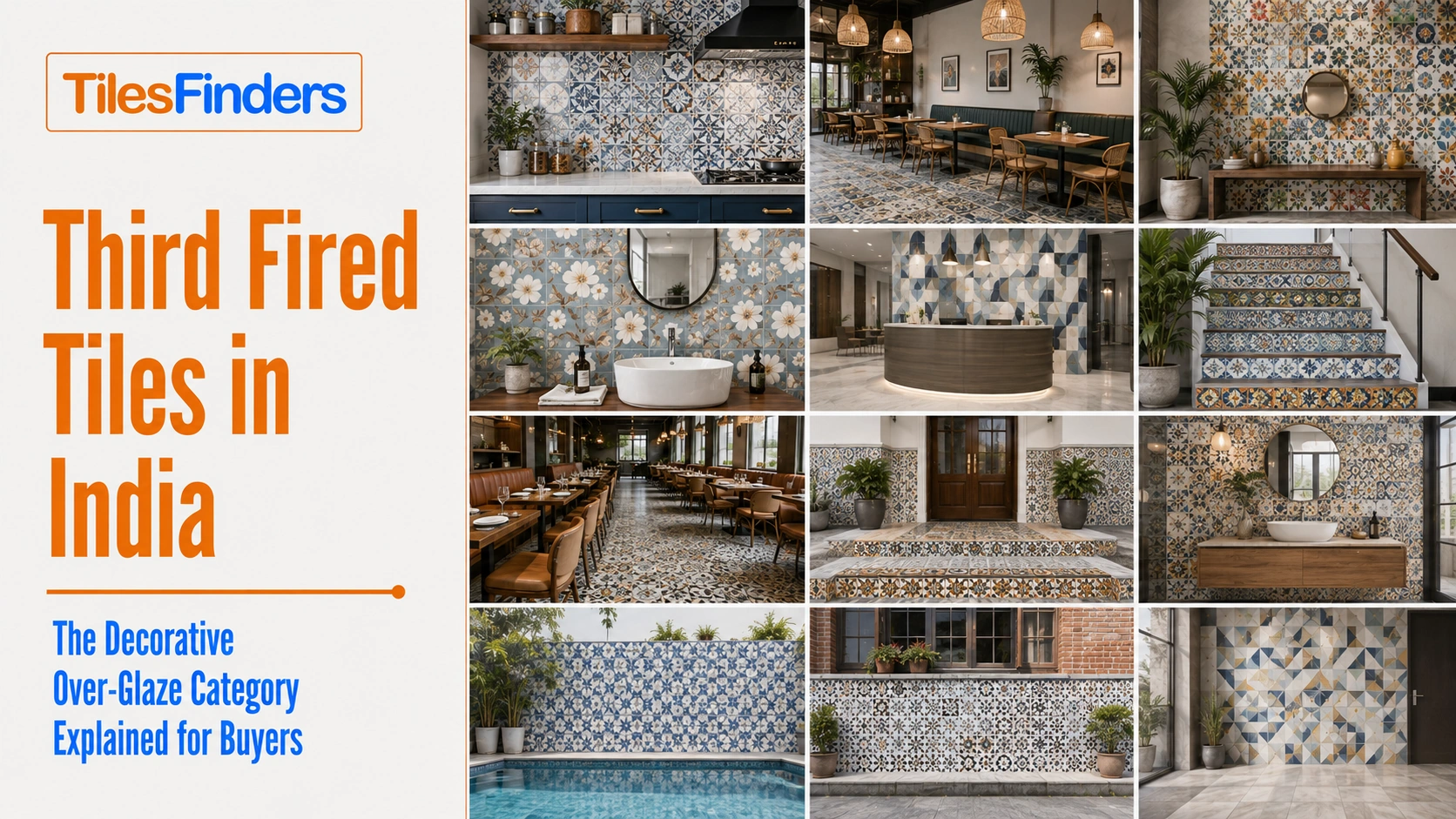
Third fired tiles receive a cooler third kiln firing that creates genuine gold or platinum lustre but makes the decorative layer delicate. Use them on pooja panels, borders and protected walls—not floors or shower areas—and order carefully because matching later can be difficult.
Almost every question buyers have about third-fired tiles- why they cost what they do, why they cannot go on floors, why they need careful handling, and why lead times are longer- has the same answer. It sits in the temperature of the third firing. This guide follows a third-fired tile through all three trips into the kiln because, once the process is clear, every limitation and every strength of the category logically follow from it rather than needing to be memorised.
The Three Firings
| Firing | Indicative Temperature | What It Creates | What It Determines |
| First | Around 1,150 to 1,250 degrees Celsius | The vitrified or ceramic body | Strength, water absorption, dimensional stability |
| Second | Similar high temperature | The glaze and printed design | Colour, pattern, surface hardness, stain resistance |
| Third | Around 700 to 850 degrees Celsius | Metallic lustre in gold, platinum or similar | The decorative effect, and every limitation the category carries |
On these temperatures: Figures are indicative and vary by manufacturer, body type and the specific decoration being applied. What matters is not the exact number but the relationship between them: the third firing happens at roughly half to two-thirds the temperature of the first two, and that gap is the origin of everything that follows in this guide. |
Firing One: The Body
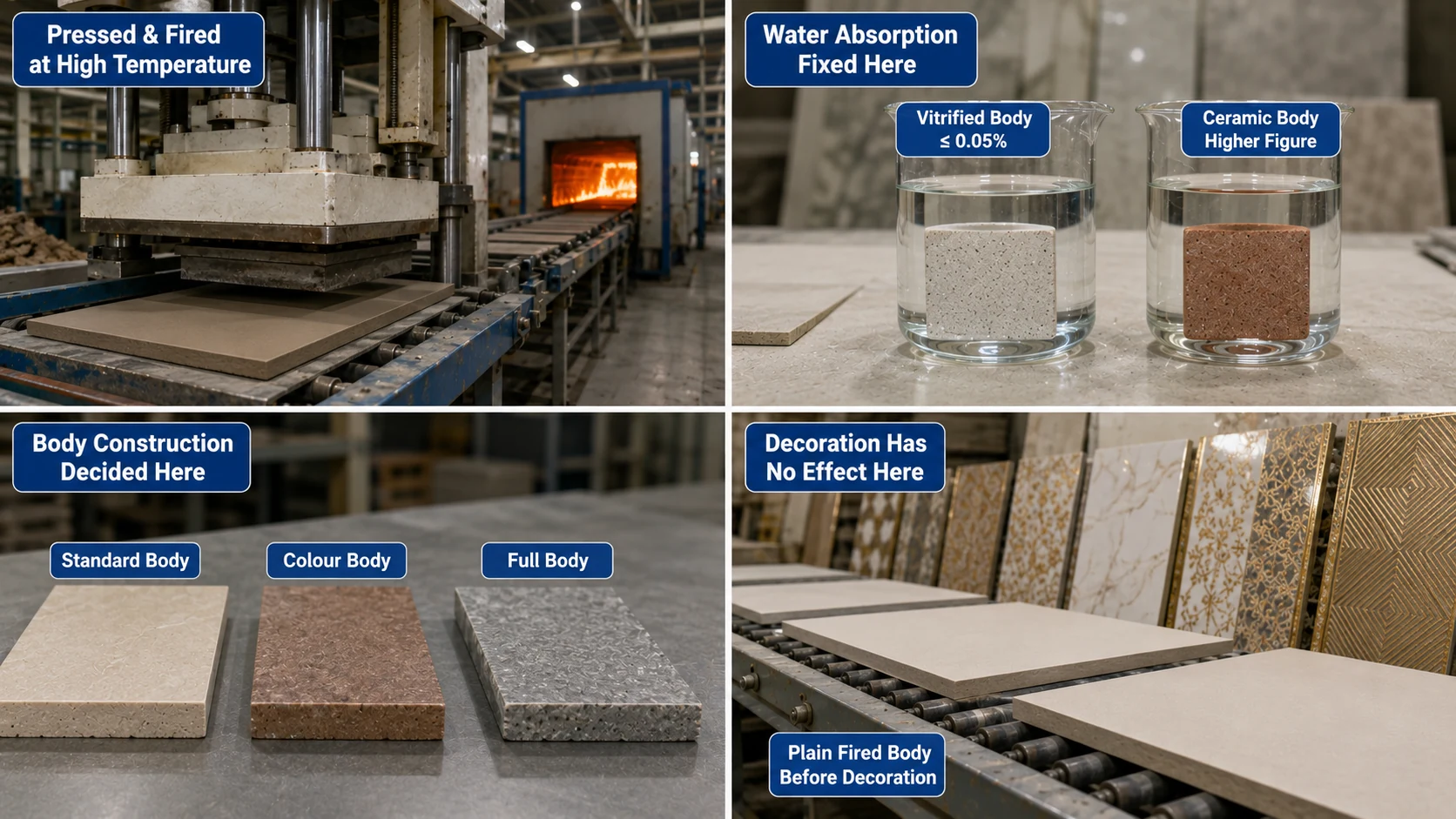
The tile is pressed and fired at high temperature, which vitrifies the clay body and gives it its structural properties. Everything about how strong the tile is, how much water it absorbs and how dimensionally stable it stays is decided here, before any decoration exists.
- Water absorption is fixed at this stage. A vitrified body reaches 0.05% or below under the Bureau of Indian Standards specification IS 15622, while a ceramic body governed by IS 13712 carries a higher figure appropriate to dry interior walls.
- Body construction is decided here too, whether standard, colour body or full body, though third-fired decoration is most commonly applied over standard ceramic and vitrified bodies rather than the heavy-duty constructions.
- Nothing about the eventual decoration affects this stage. A tile destined for gold lustre is, at this point, an ordinary tile.
Firing Two: The Glaze and the Design
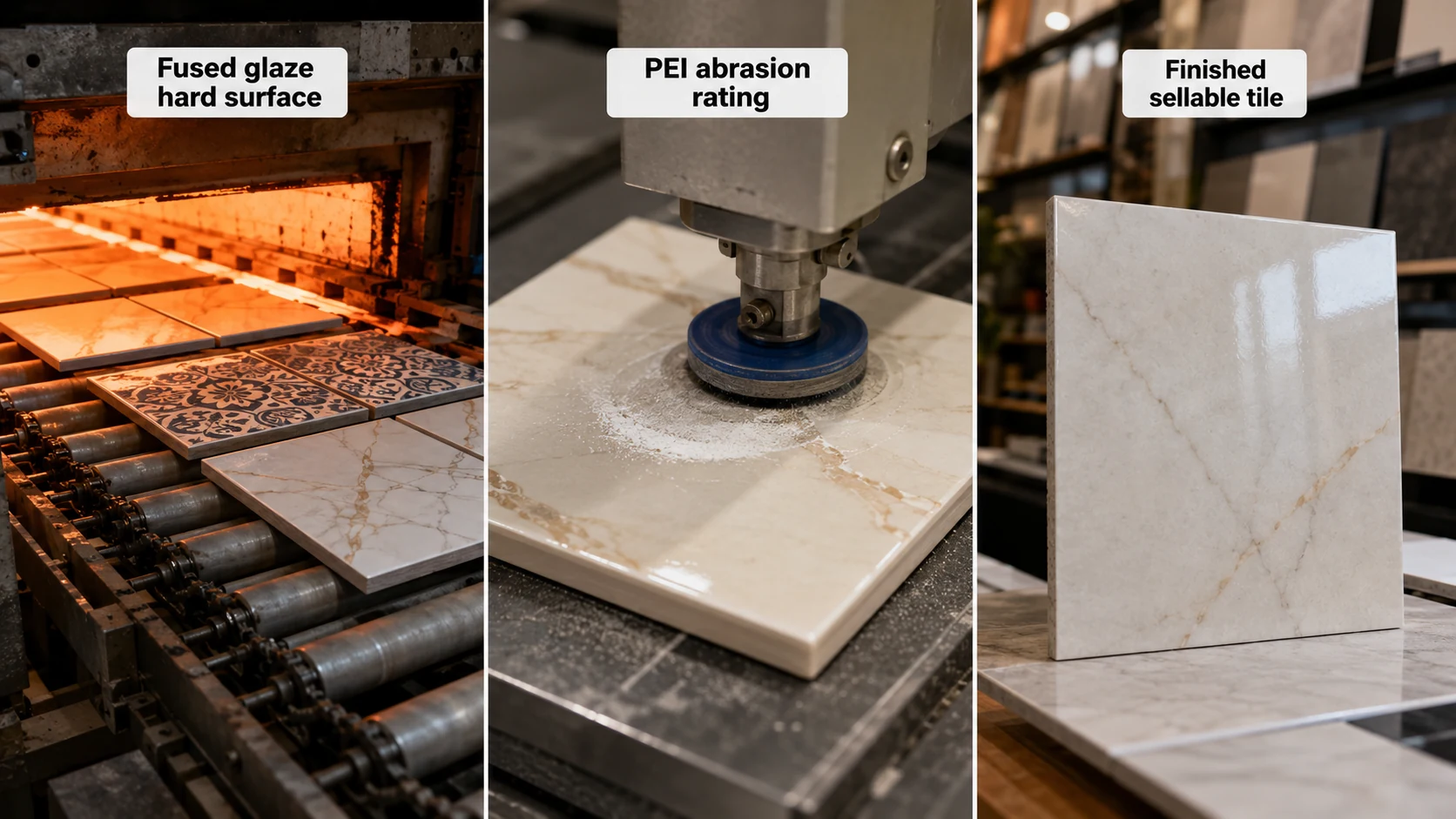
Glaze and printed decoration are applied and fired at high temperature, fusing them into a hard, durable, glassy surface. This is where an ordinary tile becomes finished, and where its everyday performance is set.
- Surface hardness and stain resistance come from this firing. The glaze becomes genuinely tough because it is fired hot enough to fuse into a continuous glassy layer.
- PEI abrasion rating is a property of this layer, and it is why a standard glazed tile can carry a rating suitable for floors.
- At the end of firing two, the tile is a complete, sellable product. Many tiles stop here. A third fired tile goes back into the kiln one more time, and that decision changes what it becomes.
Firing Three: The Lustre, and the Trade-Off
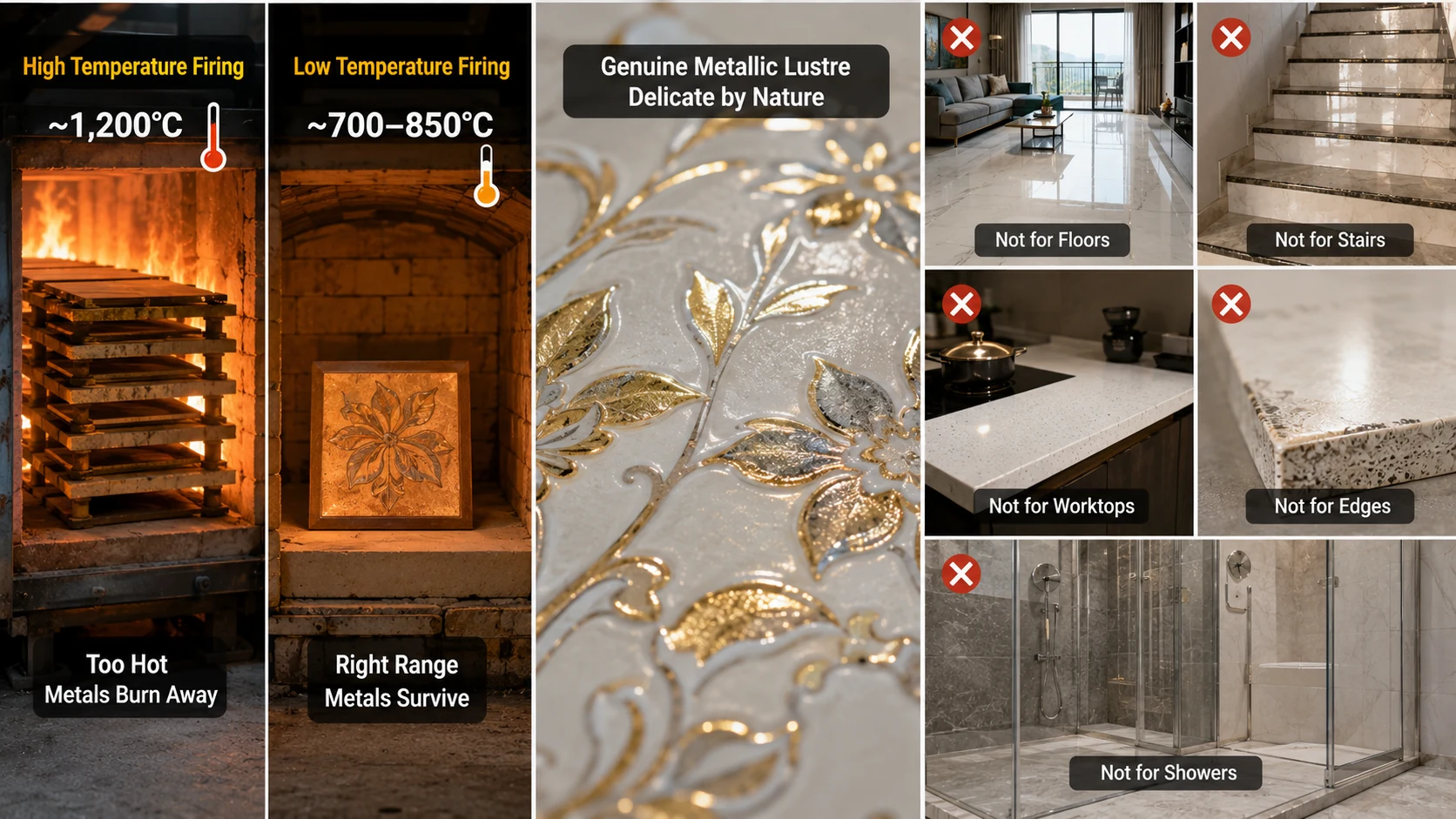
The temperature paradox that defines this entire category: Metallic lustres containing genuine gold, platinum and similar metals cannot survive the temperatures used for the first two firings. At around 1,200 degrees, the metallic compounds would simply burn away, leaving nothing behind. To fire them onto a tile at all, the kiln has to run considerably cooler, in the region of 700 to 850 degrees. That lower temperature is what makes genuine fired metallic decoration possible. It is also, unavoidably, what makes it delicate, because a glaze layer fired at 750 degrees cannot form the same hard, fully fused bond that one fired at 1,200 degrees does. The softness is not a manufacturing shortcut or a quality compromise. It is the direct physical price of being able to fire precious metal onto ceramic at all. You cannot have genuine fired-on gold and floor-grade durability in the same layer, because the two require incompatible temperatures. |
What follows from that, without exception: Third fired decoration belongs on walls and low-contact surfaces only. Never a floor, never a stair tread, never a kitchen worktop, never a heavily handled edge, and never a shower enclosure where abrasive cleaning will be routine. This is not a cautious recommendation that a durable product might overcome. It is a consequence of the temperature that made the decoration possible in the first place, and no manufacturer can engineer around it while still using genuine metallic lustre. |
What the Process Explains
Every characteristic buyers ask about traces back to the third firing rather than needing a separate explanation.
| Characteristic | Why It Is So |
| Higher cost | An additional kiln cycle, additional handling, precious metal content, and frequently hand application of the decoration |
| Longer lead time | Three production stages instead of two, and often a specialist facility handling the third |
| Wall and low-contact use only | The low third firing temperature cannot produce a floor-grade bond |
| Careful cleaning required | Abrasive cleaners and strong chemicals attack the softer over-glaze layer directly |
| Smaller production batches | Specialist process, lower volume, which also makes future matching harder |
| Higher breakage in handling and cutting | The decorated layer is vulnerable at edges, so cuts need care and offcuts are less reusable |
| Genuine metallic appearance | Real fired metal reflecting light, rather than a printed simulation of it |
Third Fired Versus a Printed Metallic Look
Both exist in the market; they photograph almost identically, and they are entirely different products at entirely different prices.
| Third Fired Lustre | Printed Metallic Effect | |
| What creates the effect | Genuine metallic compounds fired onto the glaze | Ink and coating simulating metal optically |
| Number of firings | Three | Two |
| Appearance in person | Continuous metallic sheen that shifts with viewing angle | Convincing at a distance, flatter close up and under direct light |
| Durability | Delicate, low-contact wall use only | As durable as the standard glaze beneath it |
| Cost | Substantially higher | Modest premium over a standard tile |
| Where each belongs | Pooja panels, accent borders, decorative feature work | Larger decorative areas, and anywhere durability matters |
How to tell them apart in a showroom: Tilt the sample and move it under the light. A genuine fired lustre shifts and shimmers as the angle changes, because you are looking at real metal reflecting light. A printed effect stays visually consistent, because you are looking at a picture of metal. Then ask directly whether the decoration is third fired, and ask how many firings the tile has been through, which is a question a supplier either knows the answer to or does not. |
Where It Genuinely Belongs
| Application | Verdict | Reasoning |
| Pooja room backdrop or border | Strongest application | Small contained area, no physical contact, and genuine metal responds to diya and lamp light exactly as intended |
| Decorative wall border or accent band | Excellent | Concentrated effect using very little material, above contact height |
| Feature panel in a niche or alcove | Excellent | Contained, protected, and viewed rather than touched |
| Bathroom vanity mirror surround | Good, with care | Keep clear of splash zones and avoid abrasive cleaning entirely |
| Kitchen decorative panel away from cooking | Acceptable | Oil aerosol dulls the lustre, so distance from the hob is essential |
| Full wall coverage | Poor use | Expensive, and metallic lustre at scale overwhelms rather than accents |
| Any floor | Never | The low firing temperature cannot produce a floor-grade surface |
| Shower enclosure | Never | Constant water and the abrasive cleaning it demands will degrade the over-glaze |
Buying and Handling
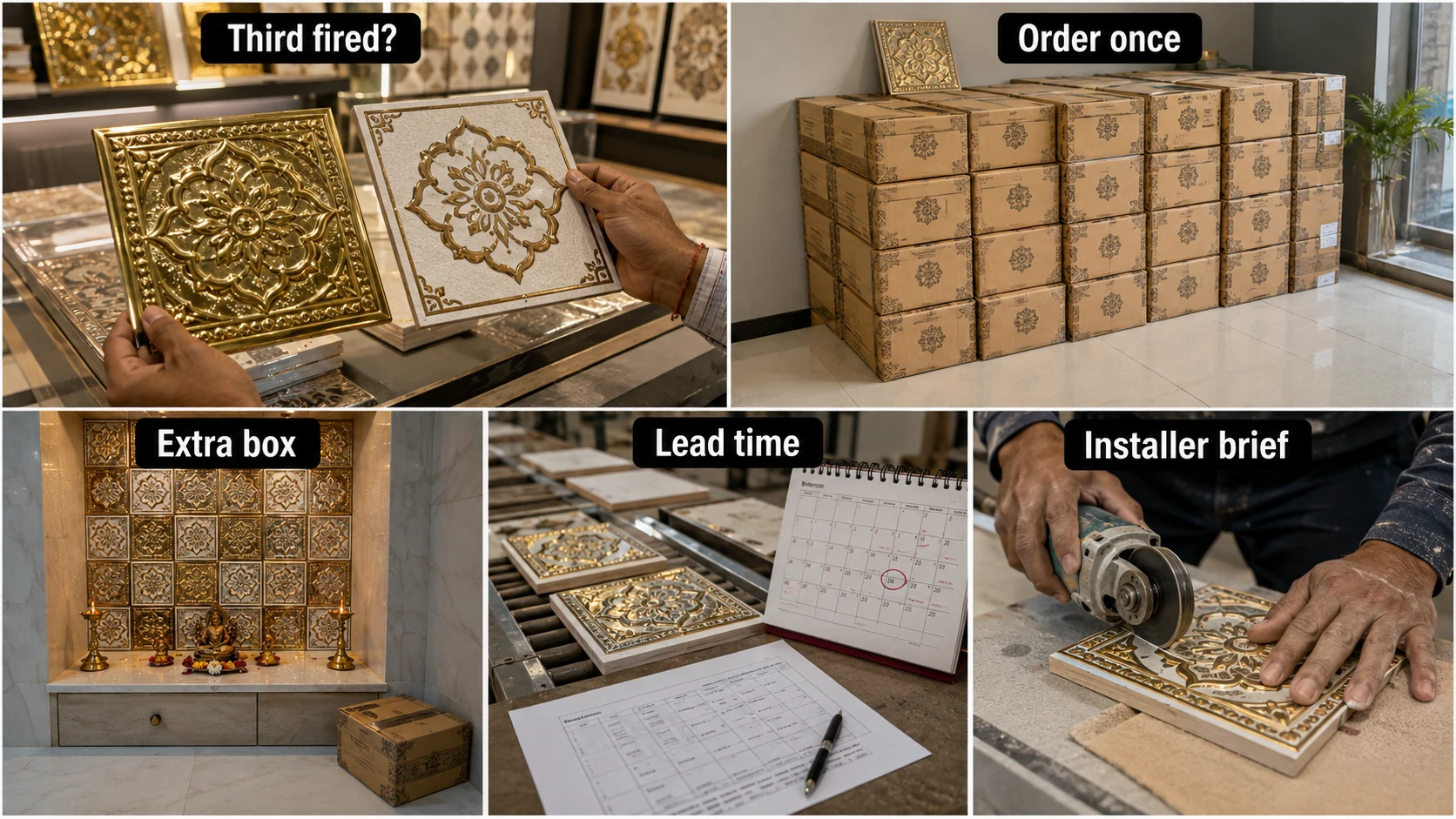
- Ask explicitly whether the decoration is third fired, and how many firings the tile has been through, since printed metallic effects photograph identically and cost far less.
- Order generously and order once. Specialist batches are small, discontinued faster than core ranges, and matching later is frequently impossible.
- Add an extra box rather than a percentage. On a small decorative panel, percentage overage is meaningless, and edge damage during cutting is more likely than with a standard tile.
- Confirm lead time before finalising a programme, since three production stages and a specialist facility make this the slowest category to source.
- Brief the installer specifically, because the decorated layer is vulnerable at cut edges and standard handling assumptions do not apply.
- Specify cleaning at handover. Mild detergent and a soft cloth only, with abrasive pads and acidic cleaners excluded, since damage to the over-glaze cannot be polished out.
Living With It
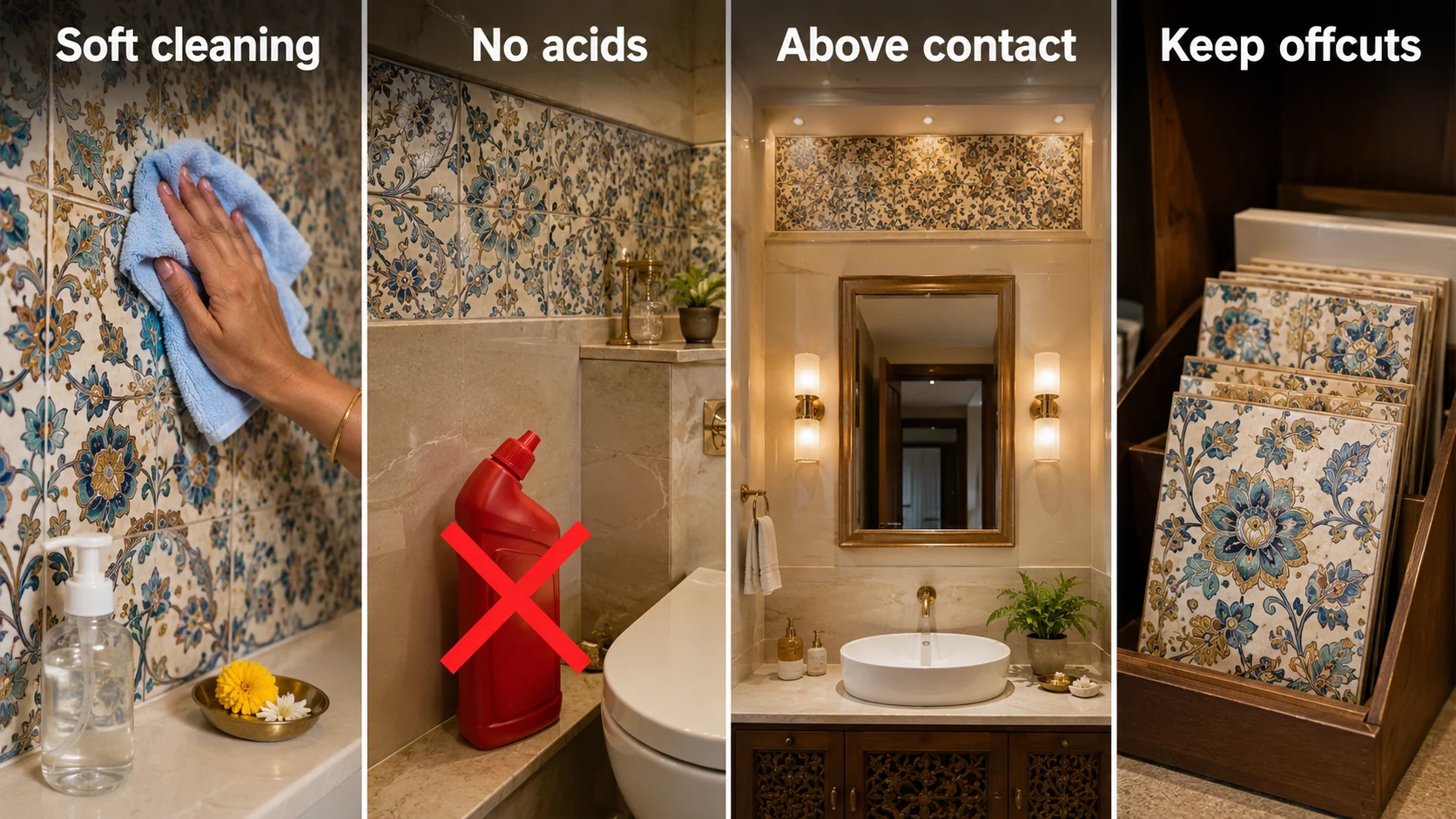
- Clean with mild detergent and a soft cloth. The over-glaze layer is softer than the glaze beneath it, so anything abrasive removes decoration rather than dirt.
- Never use acidic descalers on or near it, which are common in Indian bathrooms for hard water deposits and are among the fastest ways to damage a lustre finish.
- Keep the panel above contact height where the layout allows, since the most common damage is simply repeated handling rather than any dramatic event.
- Retain the offcuts. Given batch sizes and discontinuation rates, your leftovers are realistically your only future repair stock.
Explore Third Fired Ranges on TilesFinders
Third fired decorative ranges can be browsed on TilesFinders alongside printed metallic alternatives, so you can compare what each actually is, confirm the firing process, and match the specification to whether the surface will be looked at or lived on.
FAQs
The tile has been through the kiln three times. The first two firings create the body and the glazed design at high temperature. The third firing runs considerably cooler, around 700 to 850 degrees Celsius, and fires metallic lustre such as gold or platinum onto the finished glaze.
Because of the firing temperature, metallic lustres would burn away at the 1,200 degrees used for normal glaze firing, so the third firing must run much cooler, and a layer fired at 750 degrees cannot form the hard bond a floor requires. The delicacy is a physical consequence of what makes the decoration possible.
For a small decorative application such as a pooja panel or an accent border, frequently yes, because genuine fired metal looks materially different from a printed simulation and the area involved is small. For larger areas, the cost rises quickly while the effect becomes less special.
Tilt the sample under the light. Genuine fired lustre shifts and shimmers as the angle changes because it is real metal reflecting light, while a printed effect stays visually consistent. Then ask directly how many firings the tile has been through.
Mild detergent and a soft cloth only. The over-glaze layer is softer than the glaze beneath it, so abrasive pads remove decoration rather than dirt, and acidic descalers commonly used against hard water deposits are among the fastest ways to damage it.
Three production stages instead of two, often with the third handled by a specialist facility, and typically in smaller batches. This makes third-fired the slowest category to source and the one most worth confirming before committing to a programme.
Frequently not. Specialist batches are small, and these ranges are discontinued faster than core ranges, so ordering generously once is considerably safer than planning to top up. Keep the offcuts as your future repair stock.
On a vanity mirror surround or a wall panel clear of splash zones, yes, with care. Never inside a shower enclosure, where constant water and the abrasive cleaning it demands will degrade the over-glaze layer.
Yes, though for different reasons. The base determines water absorption and structural properties, which govern which rooms the tile suits, while the third firing determines the decorative effect and its handling requirements. Confirm both rather than assuming the decoration describes the whole product.


See our tile guides first
Set TilesFinders as a preferred source and our buying guides surface ahead of the rest for you.
Add as preferred sourceTakes one tap. Nothing to install.
What Readers Say
I was about to redo my parking area with the wrong tile size until I read this. The layout comparisons saved me from a costly mistake.
We reference TilesFinders guides while briefing clients on material selection. The size and pattern breakdowns are accurate and easy to explain visually.
On site, I get asked about grout spacing all the time. This article gave me a solid reference I now share with my team before every job.
Finally a guide that doesn't just push generic advice. The oil stain removal steps actually worked on our clubhouse driveway tiles.
I run a small construction firm and now send this link to clients directly when they ask about entrance tile sizing. Saves me an hour of explaining.
Good practical detail, though I wish there were more examples for compact apartment entrances specifically, not just villas.
My mother-in-law wanted marble, I wanted vitrified. This blog gave us the neutral comparison we needed to actually decide together.
Detailed without being overwhelming. I appreciated that it covered both cost and maintenance, not just the aesthetics.
Used the algae and hard water removal tips on our terrace tiles after the monsoon. Worked better than what our regular cleaner was doing.
As someone who sources tiles for multiple builder projects, I find these comparisons genuinely useful for vendor conversations, not just consumer content.
Recommended this to a client who kept second-guessing the entrance design. The small vs large layout section settled the debate instantly.
Straightforward and honest, no unnecessary jargon. Would like to see a similar breakdown for outdoor pool-deck tiles next.
We've bookmarked several TilesFinders guides for our design handbook. Reliable source when clients want data, not just opinions.
Two paths, one marketplace.
Get free quotes from verified suppliers.
Share your room, budget, and style. Suppliers in local area respond within hours.
Get Free QuotesList your business, reach real buyers.
Put your showroom in front of homeowners searching for tiles right now.
List Your Business