
Third Fired Tile Design Ideas: 15+ Intricate Decorative Looks for Indian Bathrooms and Pooja Rooms
See how 18 third-fired tile ideas bring gold and platinum detailing into Indian pooja rooms and bathrooms, with smart guidance on scale, placement, lighting, cleaning and long-term care.
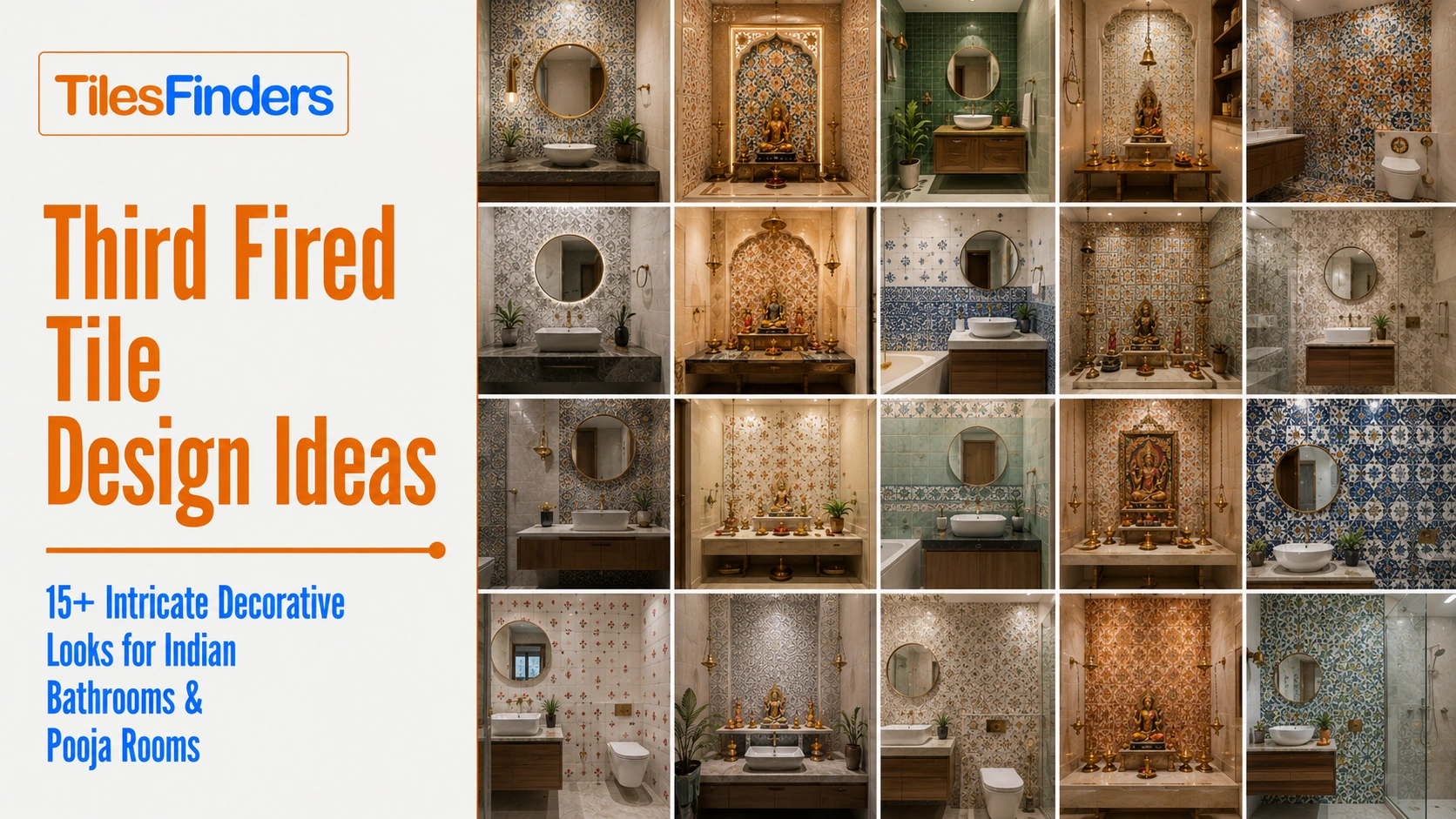
Third-fired tiles create genuine gold and platinum lustre through a cooler third kiln firing, giving walls a distinctive decorative finish. They work best in pooja rooms, vanity surrounds, niches and feature panels. Because the over-glaze is delicate, avoid floors, showers and high-contact areas, and use gentle cleaning methods.
With a material this expensive and this delicate, the first design decision is not which pattern but how much of it. A single gold border strip and a full backdrop panel are the same third fired tiles used at eight times the cost and eight times the risk. These 18 looks are ordered by scale of commitment, from a two square foot band upward, so you can find the level you are comfortable with before choosing what goes on it.
The rule that applies to all 18 without exception: Third fired decoration is wall and low-contact only. The metallic lustre is fired at around 700 to 850 degrees Celsius, far below the temperature that hardens the glaze beneath it, which is precisely what allows genuine gold and platinum to survive the kiln at all. That lower temperature cannot produce a floor-grade bond. Never a floor, never a stair, never a worktop, never inside a shower enclosure, and never anywhere abrasive cleaning will be routine. |
All 18 at a Glance
| # Look | Scale | Typical Cost | Commitment Level |
| 1. The Single Line | 2 sq.ft | Rs. 500 to 960 | Lowest |
| 2. The Mirror Frame | 3 sq.ft | Rs. 750 to 1,440 | Lowest |
| 3. The Threshold Band | 3 sq.ft | Rs. 750 to 1,440 | Lowest |
| 4. The Lit Niche | 4 sq.ft | Rs. 1,000 to 1,920 | Low |
| 5. The Medallion | 4 sq.ft | Rs. 1,200 to 2,400 | Low |
| 6. The Shelf Backdrop | 5 sq.ft | Rs. 1,250 to 2,400 | Low |
| 7. The Pooja Panel | 6 sq.ft | Rs. 1,500 to 2,880 | Moderate |
| 8. The Vanity Backdrop | 10 sq.ft | Rs. 2,500 to 4,800 | Moderate |
| 9. The Alcove Lining | 12 sq.ft | Rs. 3,000 to 5,760 | Moderate |
| 10. The Full Backdrop | 18 sq.ft | Rs. 4,500 to 8,640 | High |
| 11. The Double-Height Accent | 24 sq.ft | Rs. 6,000 to 11,520 | High |
| 12. The Feature Column | 20 sq.ft | Rs. 5,000 to 9,600 | High |
| 13. The Gold on Plain | 6 sq.ft accent | Rs. 1,500 to 2,880 plus field | Moderate, combination |
| 14. The Border on Marble | 4 sq.ft accent | Rs. 1,000 to 1,920 plus field | Low, combination |
| 15. The Mixed Metal | 8 sq.ft | Rs. 2,000 to 3,840 | Moderate, combination |
| 16. The Minimal Line | 2 sq.ft | Rs. 560 to 1,100 | Lowest, restrained |
| 17. The Contemporary Grid | 9 sq.ft | Rs. 2,250 to 4,320 | Moderate, restrained |
| 18. The Quiet Platinum | 6 sq.ft | Rs. 1,680 to 3,120 | Moderate, restrained |
Before exploring the design ideas, it helps to understand exactly what third-fired tiles are and why their decorative over-glaze behaves differently from standard tiles. Our Third Fired Tiles Explained Guide breaks down the three-firing process, durability limitations and correct applications for buyers.
Lowest Commitment: Under 3 Square Feet
Where the material costs less than a good light fitting, and the risk of regret is close to zero.
1. THE SINGLE LINE
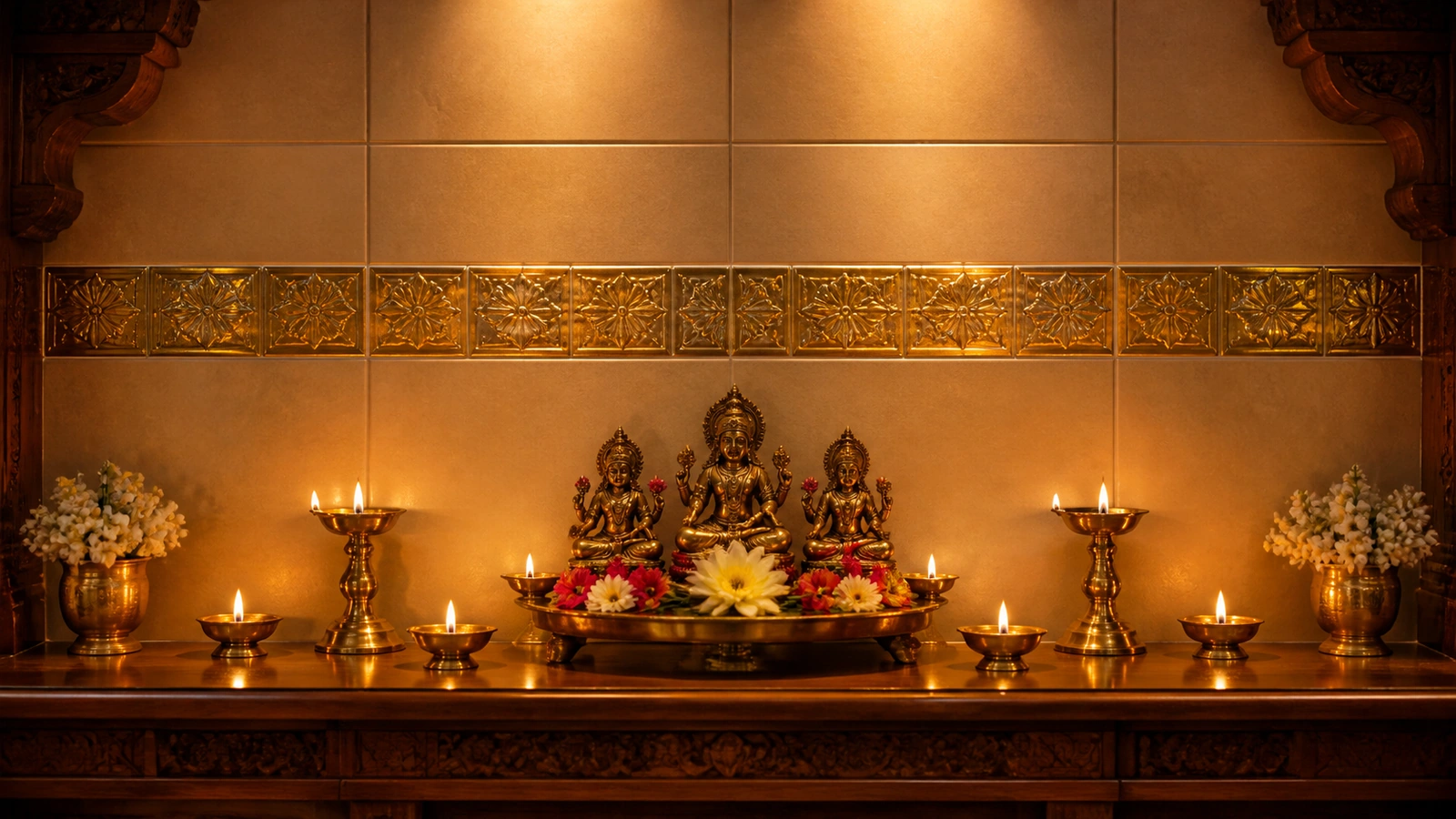
Gold Lustre Border Strip, Pooja Room
Third fired gold lustre border | 75x300 mm strip | Wall, low contact | Rs. 250 to Rs. 480/sq.ft
Typical room cost: About Rs. 500 to Rs. 960 for a 2 sq.ft run
A single horizontal band of genuine gold lustre running above a pooja shelf. The smallest meaningful use of the material, and the one that teaches you whether you actually like it before spending more.
Get this detail right: Set the line at or just above eye level from a seated position, since a pooja space is used seated and a band placed for a standing viewer sits wrong.
Pair with: Plain matte or subtle marble-look wall tile above and below, and a warm 2700K light or the diya itself.
Avoid: Placing the line at standing eye level, which is the most common way this simple idea ends up looking arbitrary.
2. THE MIRROR FRAME
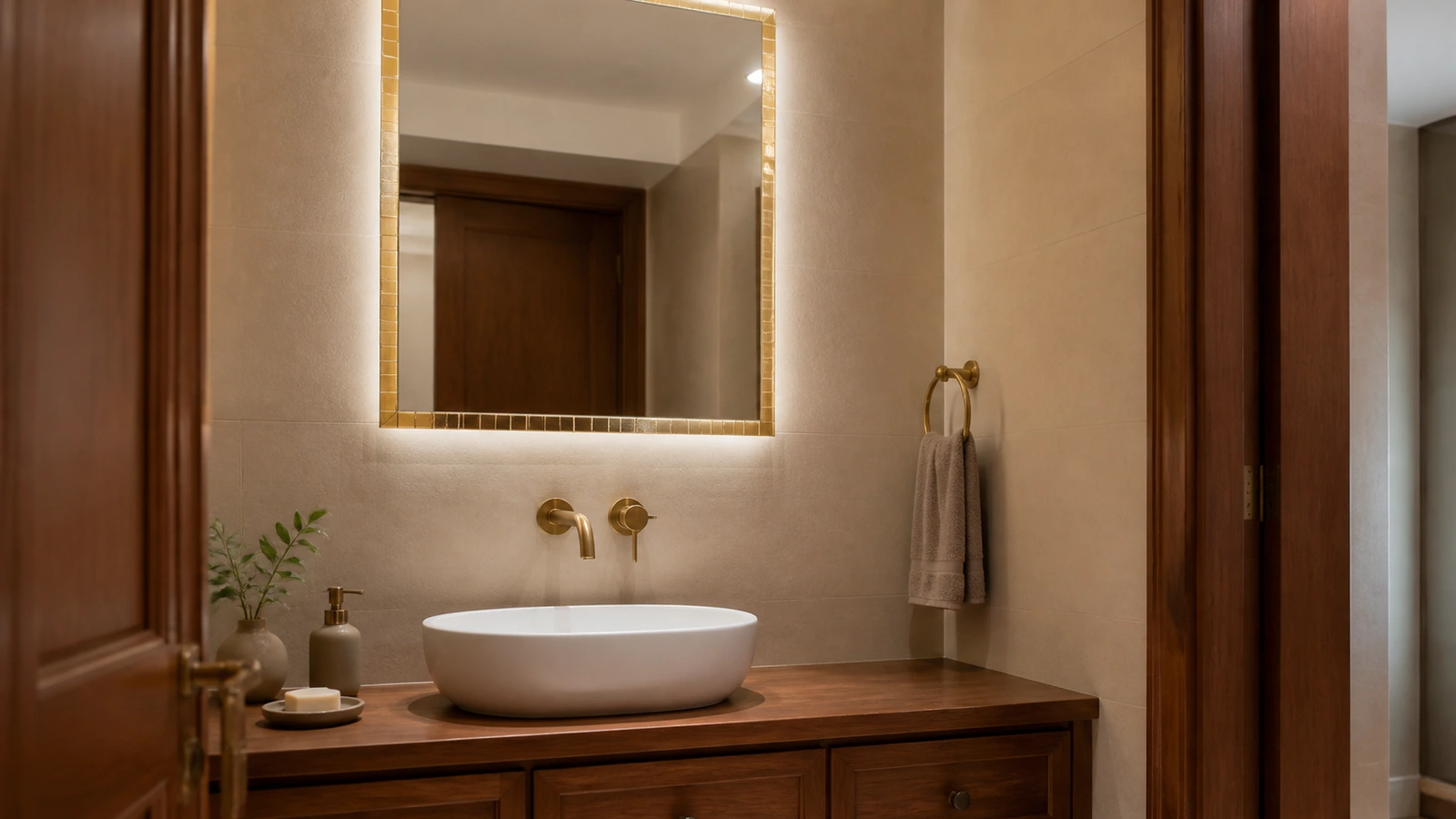
Gold Lustre Surround, Bathroom Vanity
Third fired gold lustre border | 75x300 mm strip | Wall, low contact | Rs. 250 to Rs. 480/sq.ft
Typical room cost: About Rs. 750 to Rs. 1,440 for a 3 sq.ft surround
A slim gold band framing the vanity mirror, seen at close range every day and entirely out of splash contact. One of the few genuinely daily-use applications for this material.
Get this detail right: Keep the frame at least 300 mm clear of the basin rim, since splash and the acidic descalers used against hard water are the two fastest ways to damage a lustre finish.
Pair with: Brushed brass or antique gold tapware to echo the tone, and mirror lighting close to the wall.
Avoid: Running the frame down to counter level, where it will meet water, cleaning products and hands daily.
3. THE THRESHOLD BAND
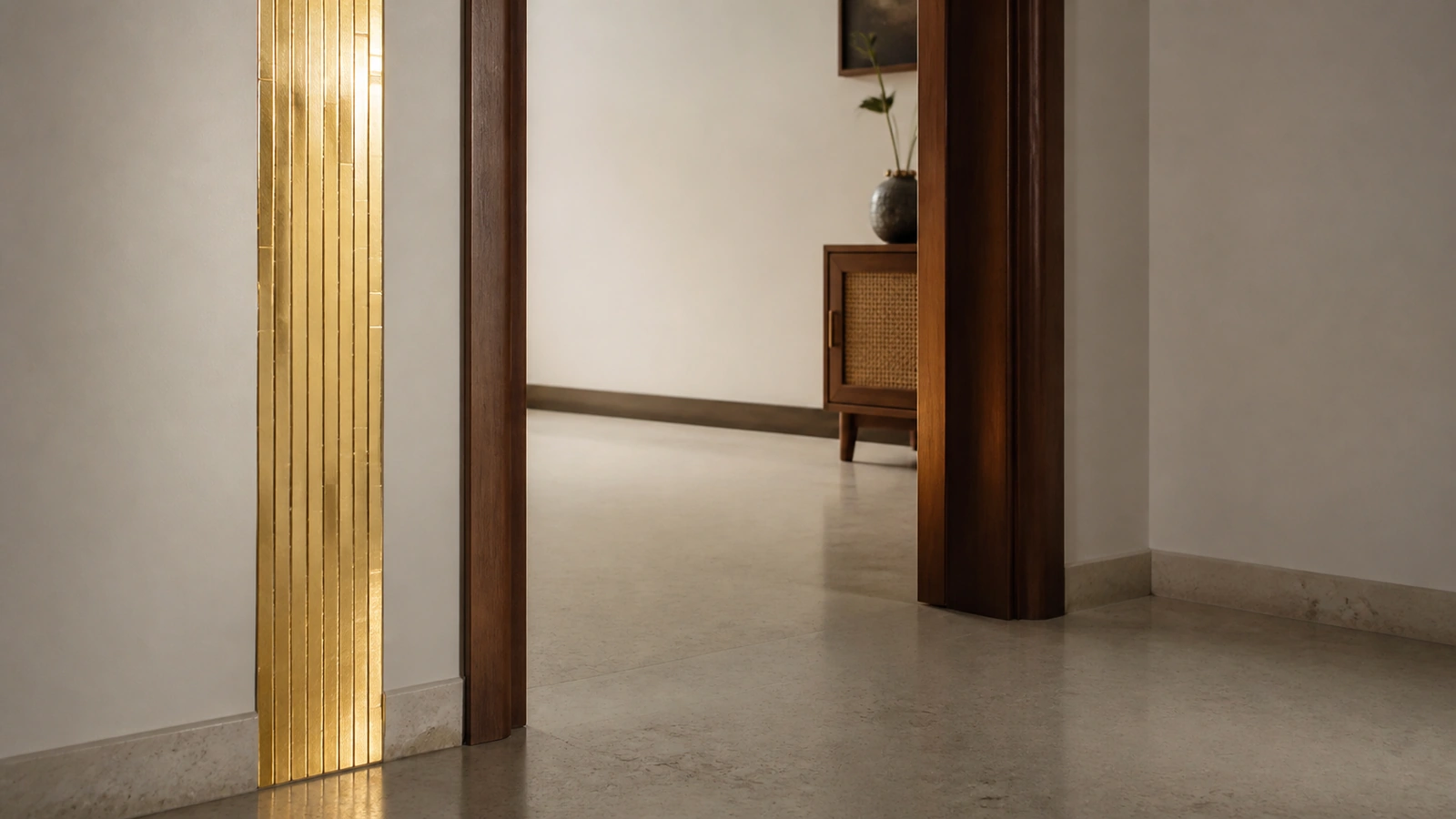
Gold Lustre Inlay, Entrance or Room Divide
Third fired gold lustre border | 75x300 mm strip | Wall, low contact | Rs. 250 to Rs. 480/sq.ft
Typical room cost: About Rs. 750 to Rs. 1,440 for a 3 sq.ft band
A vertical gold band on the wall at a room threshold or doorway reveal, marking the transition between spaces without the cost of decorating either one.
Get this detail right: Run it on the wall reveal rather than across the floor threshold, since a floor application is impossible with this material and the reveal achieves the same visual marking.
Pair with: Plain walls either side so the band reads as deliberate, and a light source that catches it from one side.
Avoid: Any attempt to carry the band across the floor, which the material cannot survive.
Low Commitment: 4 to 6 Square Feet
4. THE LIT NICHE
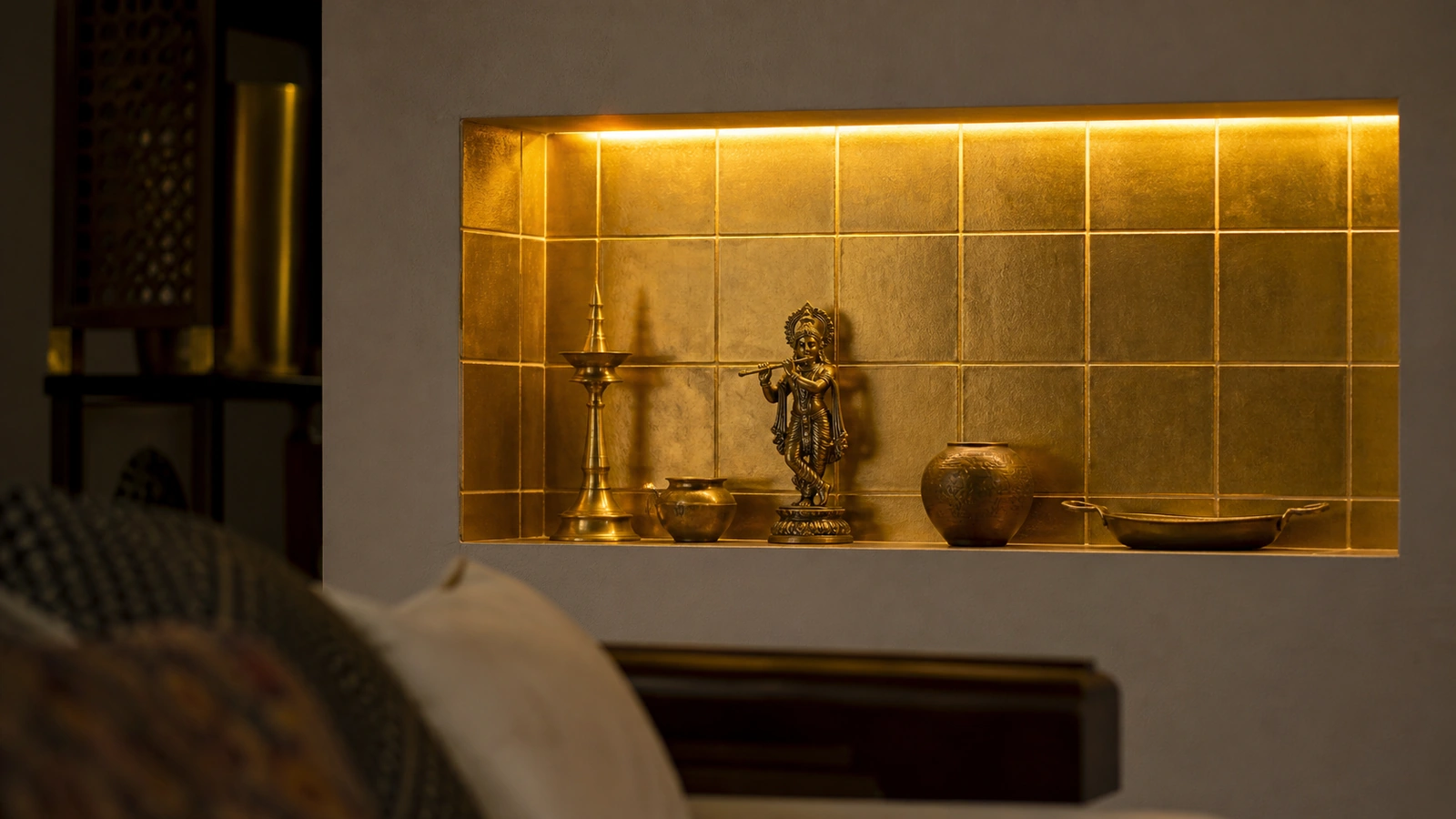
Gold Lustre Niche Lining, Living or Pooja Room
Third fired gold lustre | 300x300 mm | Wall, low contact | Rs. 250 to Rs. 480/sq.ft
Typical room cost: About Rs. 1,000 to Rs. 1,920 for a 4 sq.ft niche
A recessed display niche lined in gold lustre, which glows against an otherwise plain wall and gives whatever sits inside it a genuinely luxurious backdrop.
Get this detail right: Fit the light inside the niche rather than outside it, because a deep recess lit from the room shadows its own back panel and the lustre never activates.
Pair with: A concealed warm strip at the niche head, and brass or bronze objects displayed within.
Avoid: Lining a niche in this material and leaving it unlit, which wastes the one property you paid for.
5. THE MEDALLION
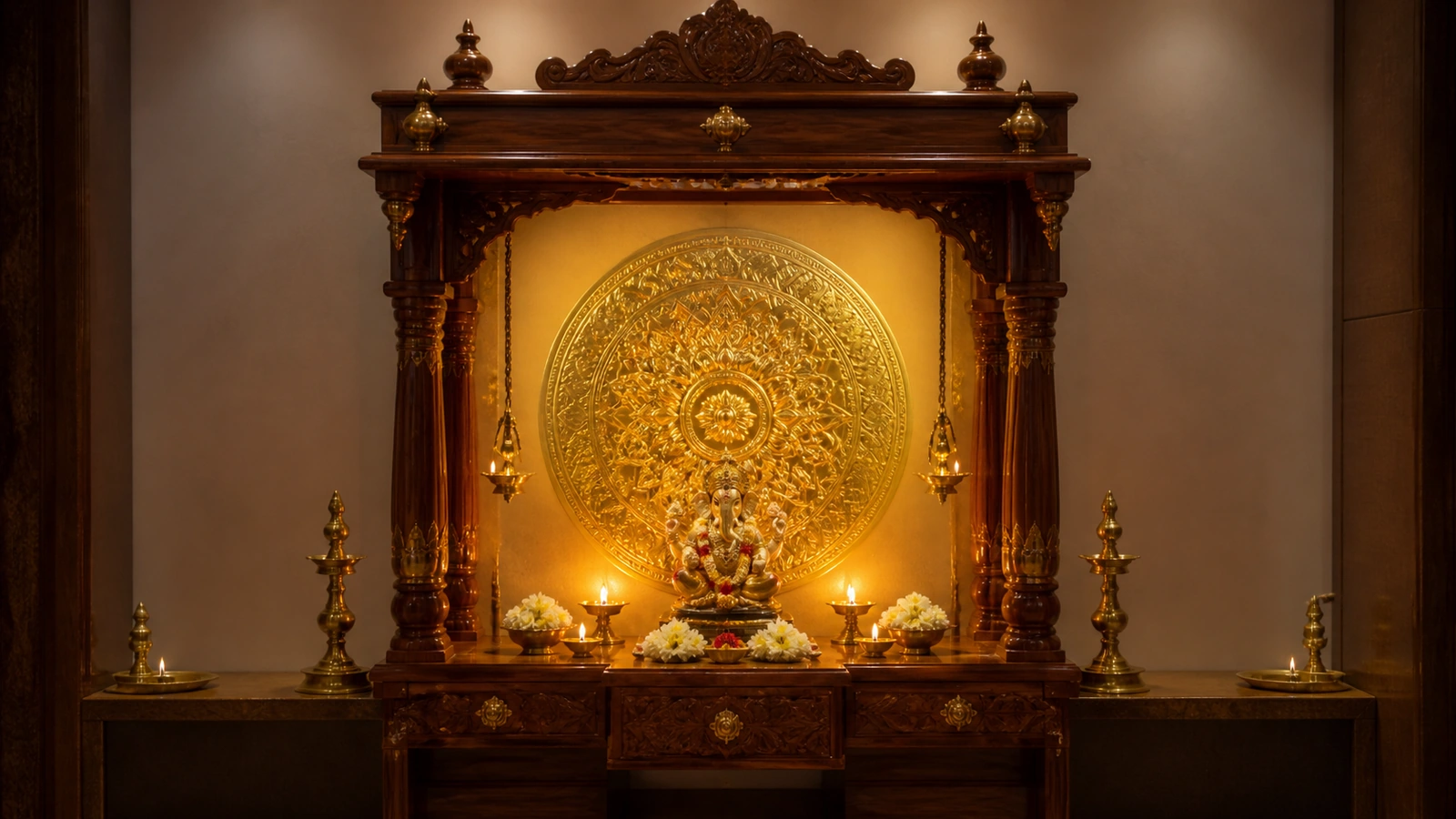
Raised Motif Gold Medallion, Pooja Room
Third fired gold lustre, raised decorative motif | Custom panel | Wall, low contact | Rs. 300 to Rs. 600/sq.ft
Typical room cost: About Rs. 1,200 to Rs. 2,400 for a 4 sq.ft medallion
A raised motif with gold accenting, centred behind the idol placement. The most intricate decorative option in the category and the most ceremonially deliberate.
Get this detail right: Confirm the raised relief is fired rather than applied afterwards, since a genuinely fired raised motif behaves differently to an applied one over years.
Pair with: Symmetrical placement centred on the idol rather than the wall, and warm light from below where the diya sits.
Avoid: Off-centre placement relative to the idol, which reads as an error in a space where symmetry carries meaning.
6. THE SHELF BACKDROP
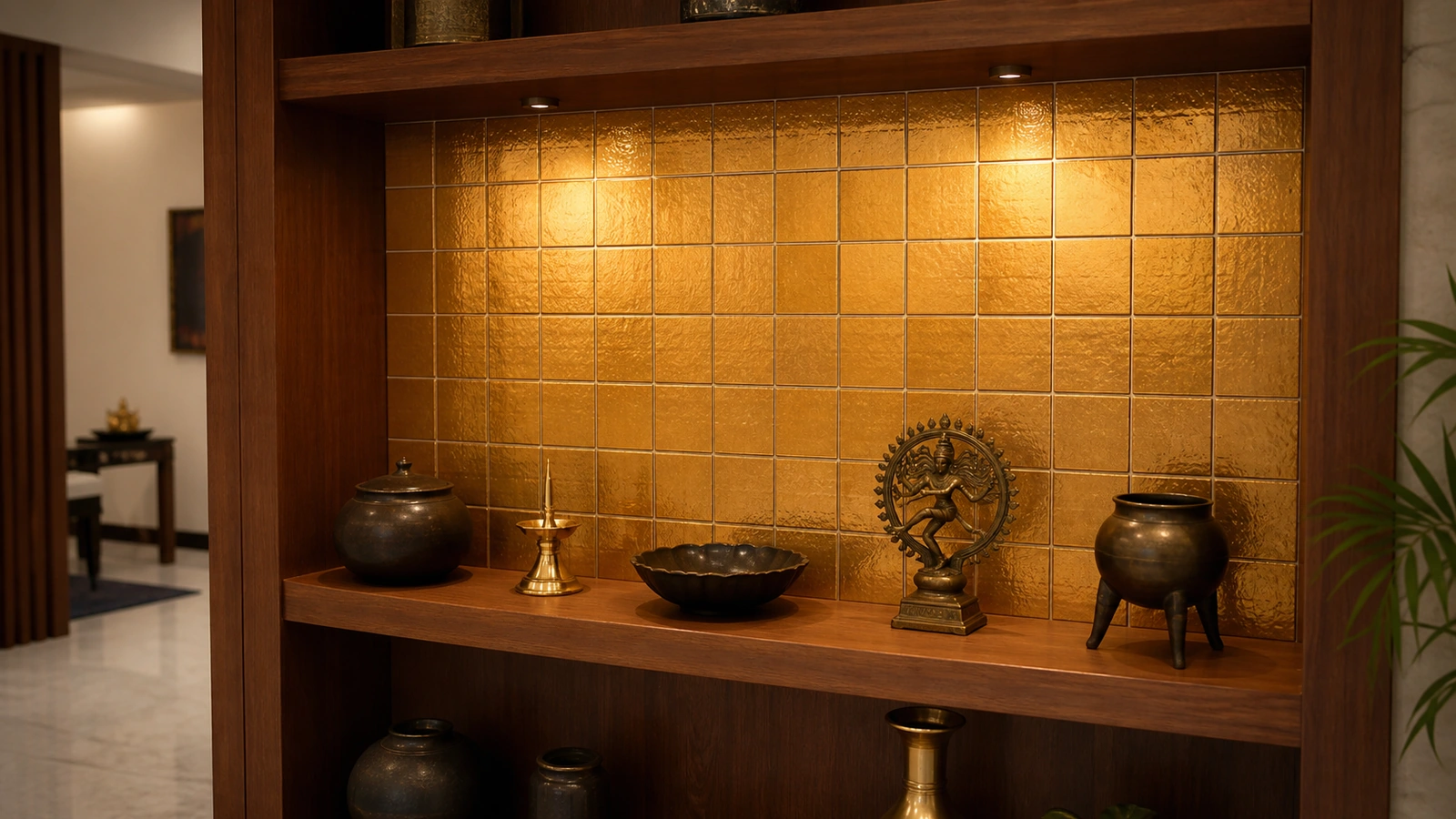
Gold Lustre Panel Behind an Open Shelf
Third fired gold lustre | 300x300 mm | Wall, low contact | Rs. 250 to Rs. 480/sq.ft
Typical room cost: About Rs. 1,250 to Rs. 2,400 for a 5 sq.ft panel
A contained gold panel behind an open display shelf in a living or dining room, where objects placed in front of it are lifted by the reflected warmth behind.
Get this detail right: Size the panel to the shelf rather than the wall, and stop it at the shelf edges, since a panel wider than what it backs reads as unresolved.
Pair with: Warm lighting from above the shelf, and objects in brass, bronze or dark ceramic which read well against gold.
Avoid: Placing frequently handled objects directly against the panel, where repeated contact will wear the lustre.
Moderate Commitment: 6 to 12 Square Feet
7. THE POOJA PANEL
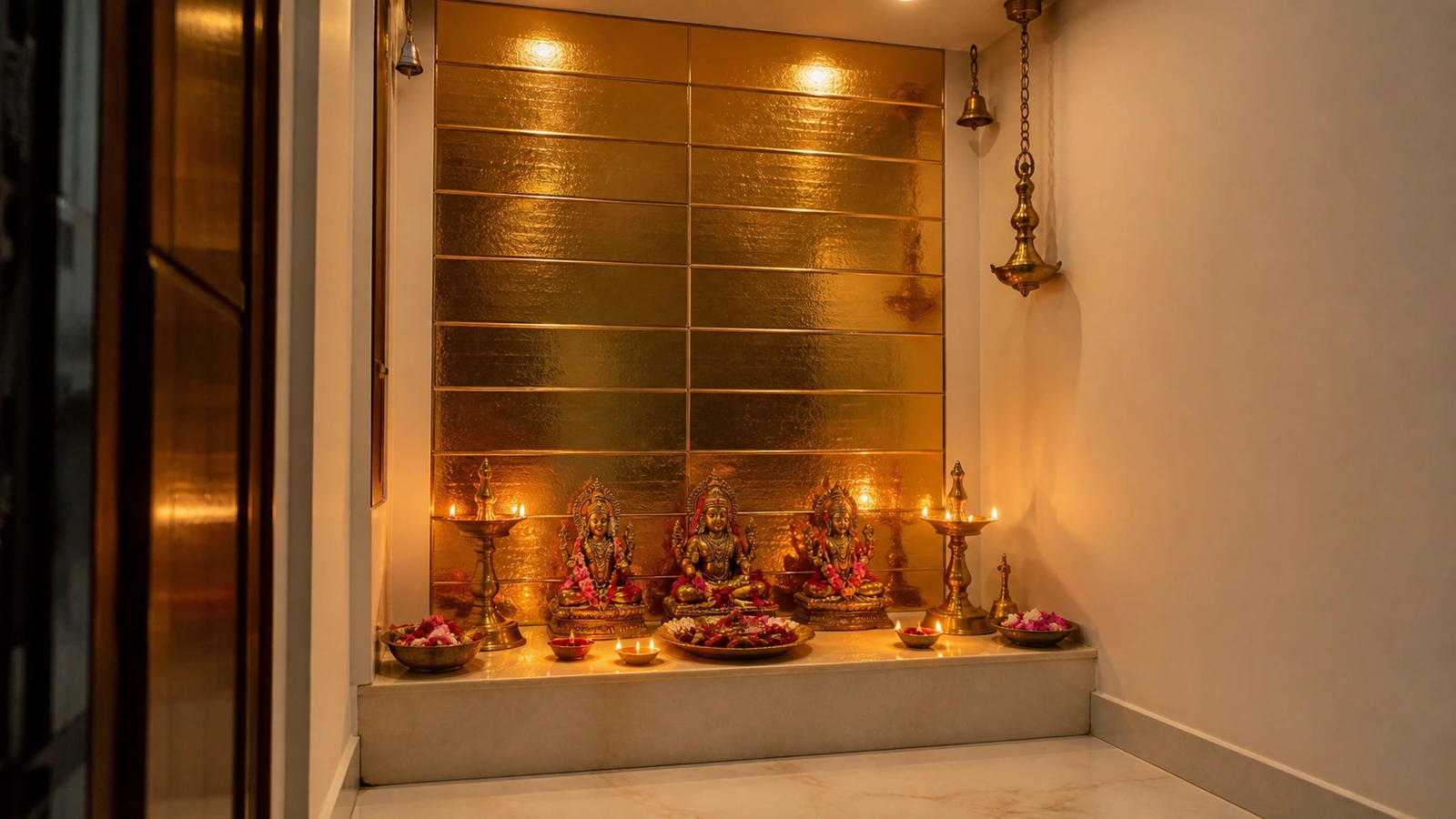
Full Gold Lustre Backdrop, Pooja Room
Third fired gold lustre | 300x300 mm or 300x600 mm | Wall, low contact | Rs. 250 to Rs. 480/sq.ft
Typical room cost: About Rs. 1,500 to Rs. 2,880 for a 6 sq.ft panel
The benchmark application for this material anywhere in an Indian home. Genuine fired gold responds to diya flame in a way no printed metallic can, because a moving flame is exactly the light source real metal was made to answer.
Get this detail right: Position the panel so lamp light reaches it directly rather than being blocked by a deep shelf, and bring the panel forward to the shelf edge if the recess is deep.
Pair with: Brass fittings, plain surrounding walls, and no competing decorative surface in the same sightline.
Avoid: A deep shelf casting shadow across the panel, which leaves genuine gold performing like printed gold.
8. THE VANITY BACKDROP
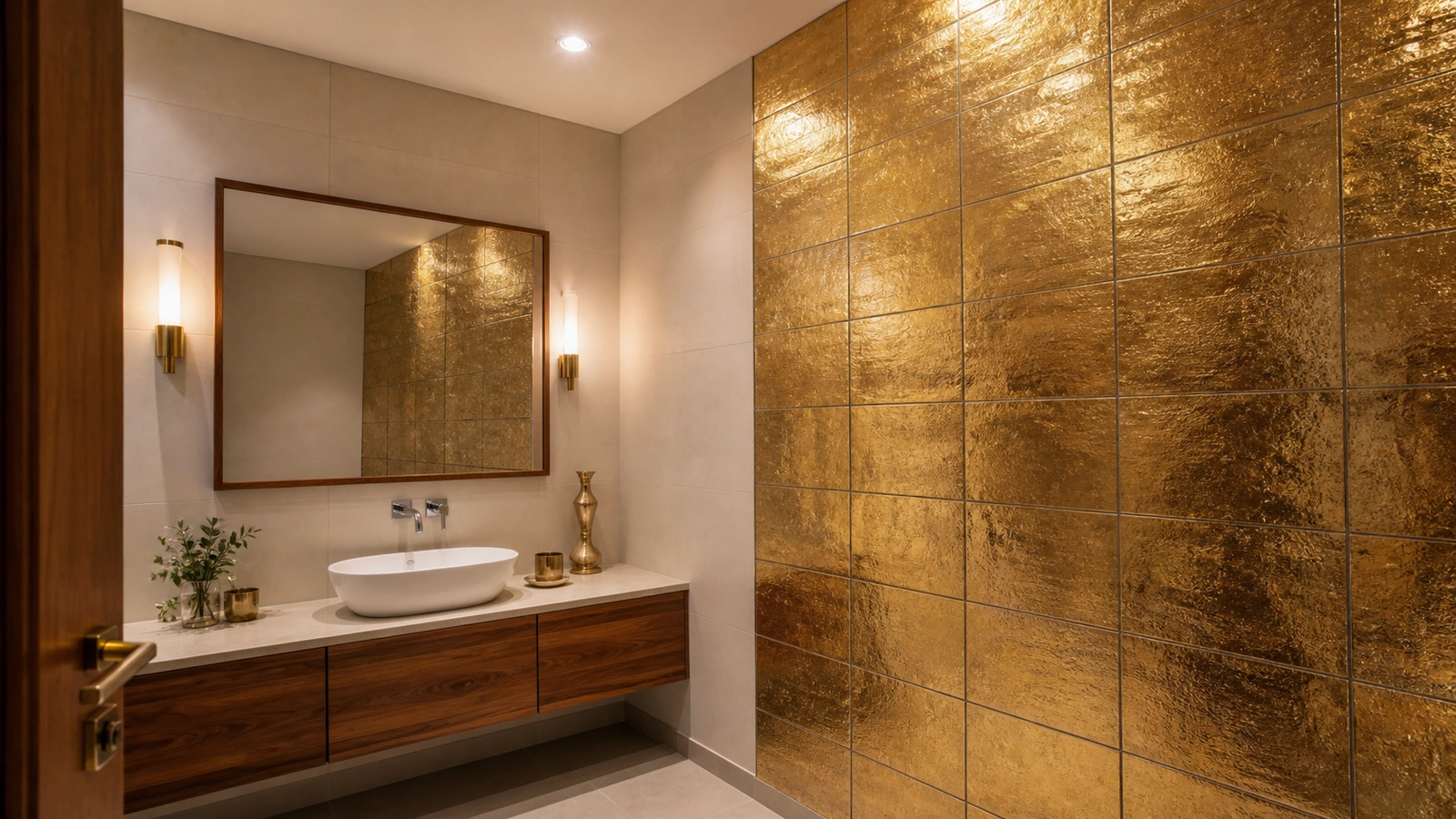
Gold Lustre Panel, Bathroom Vanity Wall
Third fired gold lustre | 300x600 mm | Wall, low contact | Rs. 250 to Rs. 480/sq.ft
Typical room cost: About Rs. 2,500 to Rs. 4,800 for a 10 sq.ft panel
A full vanity backdrop rather than a border, for a bathroom where this wall is genuinely the design feature and the rest of the room stays quiet.
Get this detail right: Specify the cleaning regime at handover in writing, since a lustre panel in a bathroom will be cleaned by someone who does not know what it is unless they are told.
Pair with: Chrome or brass fittings depending on the lustre tone, mirror lighting close to the wall, and plain tiling elsewhere.
Avoid: Acidic descalers anywhere in the room, which are routine against hard water in India and will reach this panel eventually.
9. THE ALCOVE LINING
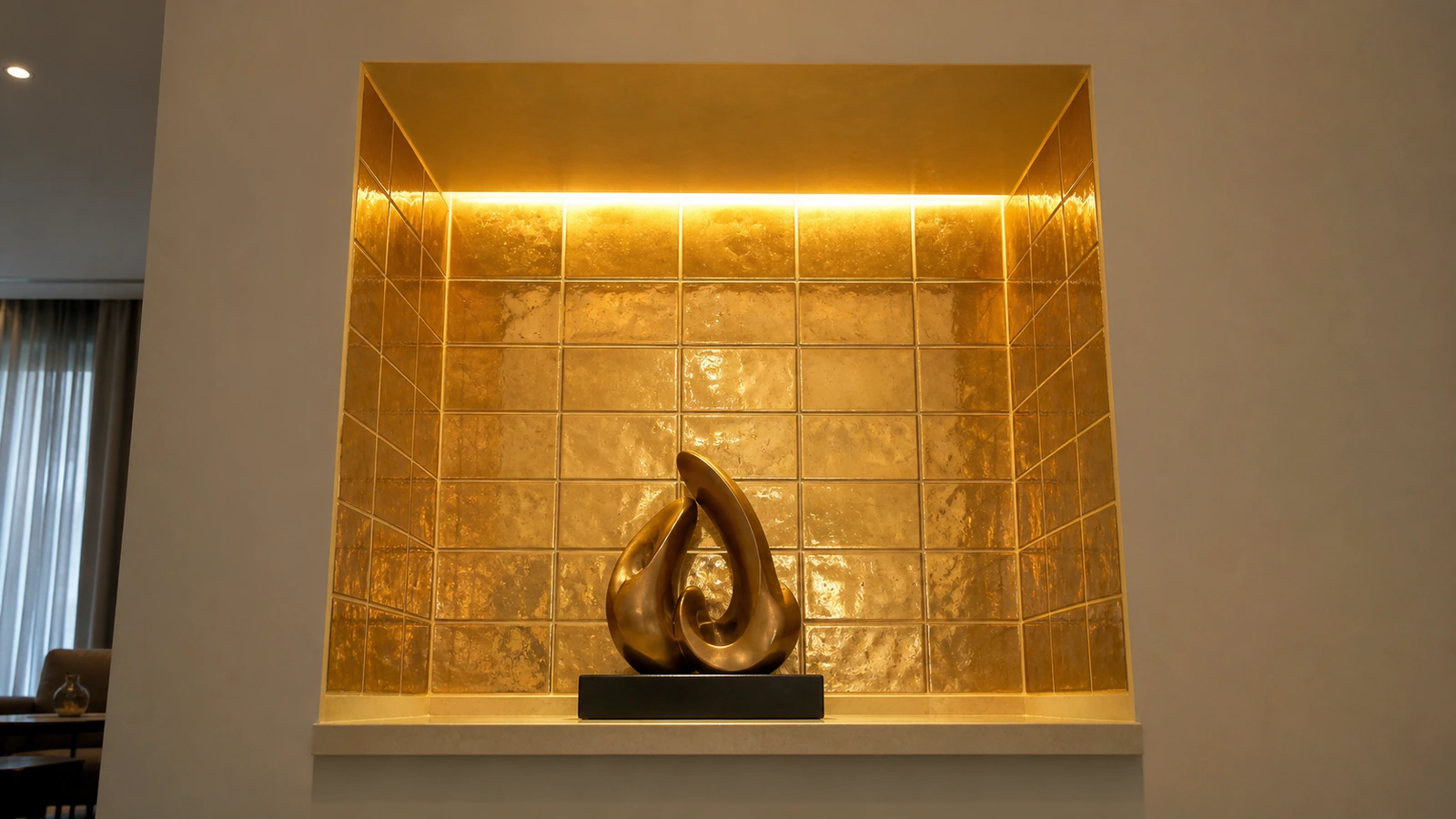
Gold Lustre Alcove, Living Room Feature
Third fired gold lustre | 300x300 mm | Wall, low contact | Rs. 250 to Rs. 480/sq.ft
Typical room cost: About Rs. 3,000 to Rs. 5,760 for a 12 sq.ft alcove
A full alcove lined on three faces, which produces reflections between the surfaces and gives the recess considerably more depth and warmth than a single flat panel would.
Get this detail right: Line the side returns as well as the back face, because the reflections between adjacent surfaces are what distinguish an alcove from a flat panel at this cost.
Pair with: A concealed strip at the head washing down all three faces, and a plain surrounding wall.
Avoid: Lining only the back face, which loses the inter-reflection that justifies the additional area.
High Commitment: 18 Square Feet and Above
At this scale, the material cost becomes significant, and the decision deserves genuine thought about whether the effect scales with it.
10. THE FULL BACKDROP
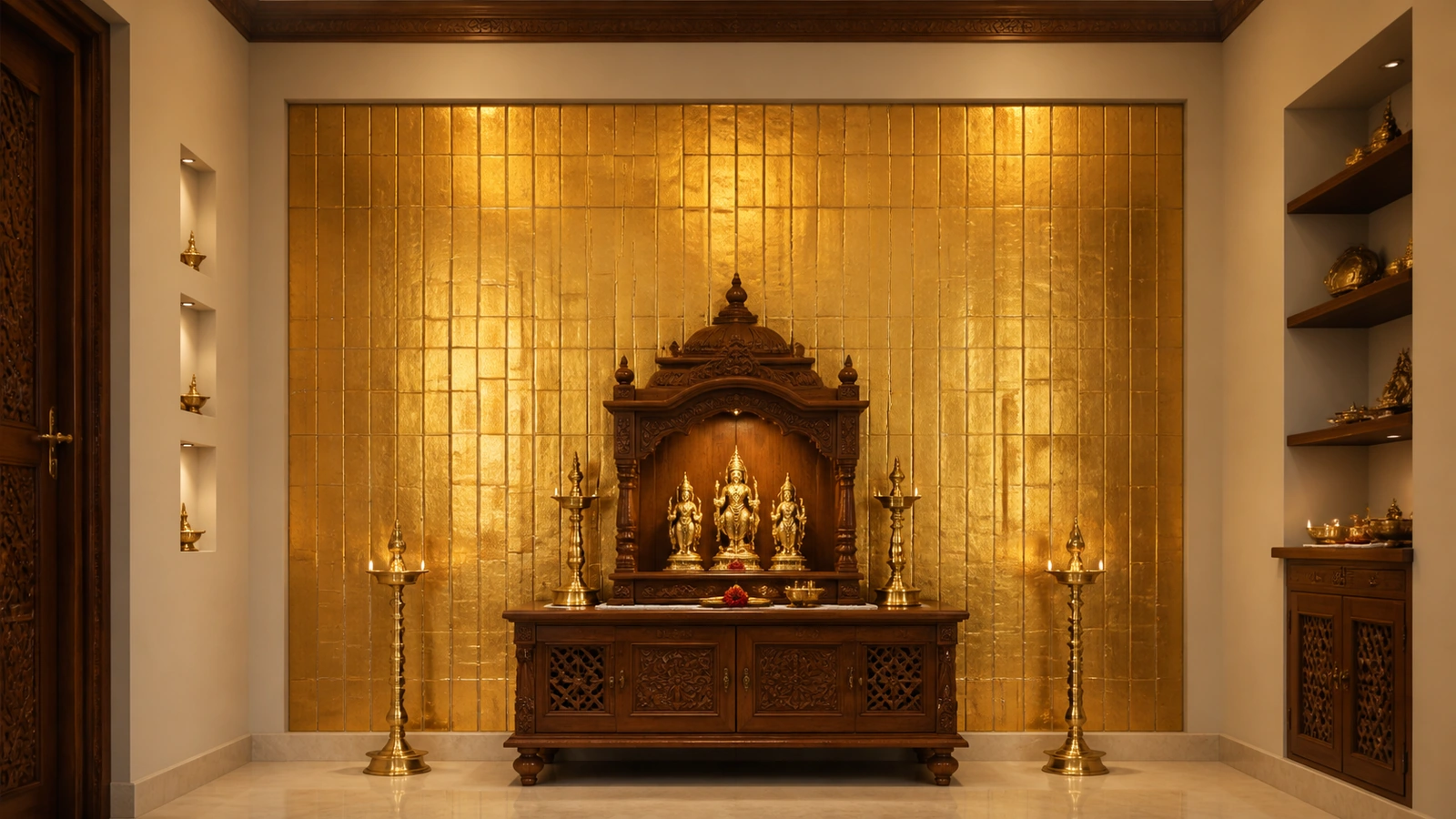
Gold Lustre Feature Wall, Formal Pooja Room
Third fired gold lustre | 300x600 mm | Wall, low contact | Rs. 250 to Rs. 480/sq.ft
Typical room cost: About Rs. 4,500 to Rs. 8,640 for an 18 sq.ft wall
A complete pooja room tile wall in gold lustre, for a household where the space is genuinely formal, and the material cost is proportionate to how the room is used.
Get this detail right: Break the field with a plain border or a change of tone at the perimeter, because an unbroken gold wall at this scale loses the sense of being a deliberate accent.
Pair with: Restrained lighting rather than bright, since a large gold surface under strong light becomes overwhelming.
Avoid: Full coverage with no visual break, which turns a precious material into an undifferentiated gold surface.
11. THE DOUBLE-HEIGHT ACCENT
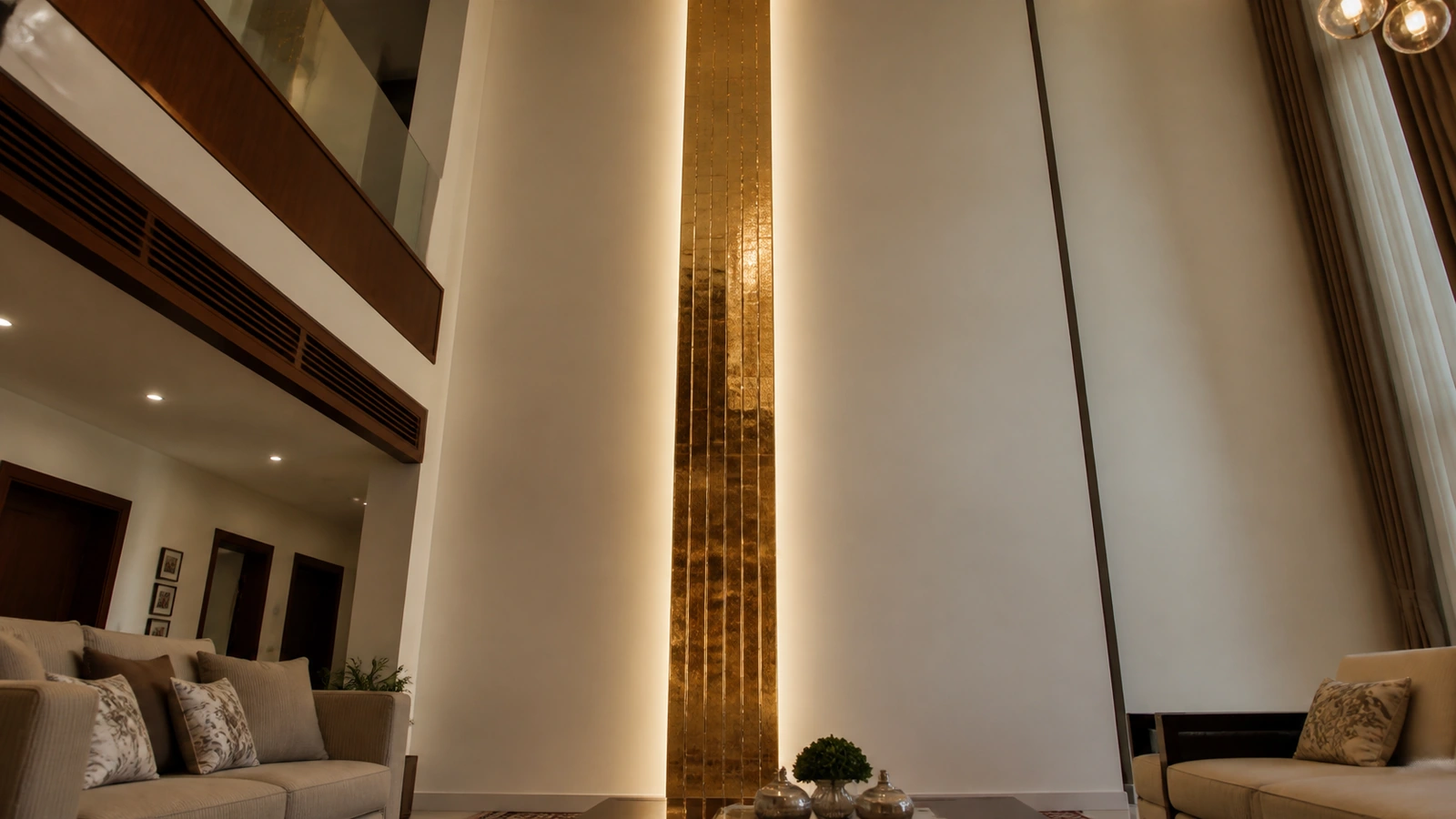
Gold Lustre Vertical Band, Double-Height Wall
Third fired gold lustre | 300x600 mm | Wall, low contact | Rs. 250 to Rs. 480/sq.ft
Typical room cost: About Rs. 6,000 to Rs. 11,520 for a 24 sq.ft band
A narrow full-height gold band on a double-height wall, which uses the height rather than the width and costs considerably less than a full panel of the same visual impact.
Get this detail right: Keep the band narrow, ideally under 600 mm wide, since the drama comes from the height rather than the area and a wide band multiplies cost without multiplying effect.
Pair with: Vertical wall-wash lighting running the full height, and plain surfaces on either side.
Avoid: Widening the band to fill the wall, which triples the cost for a diminishing return.
12. THE FEATURE COLUMN
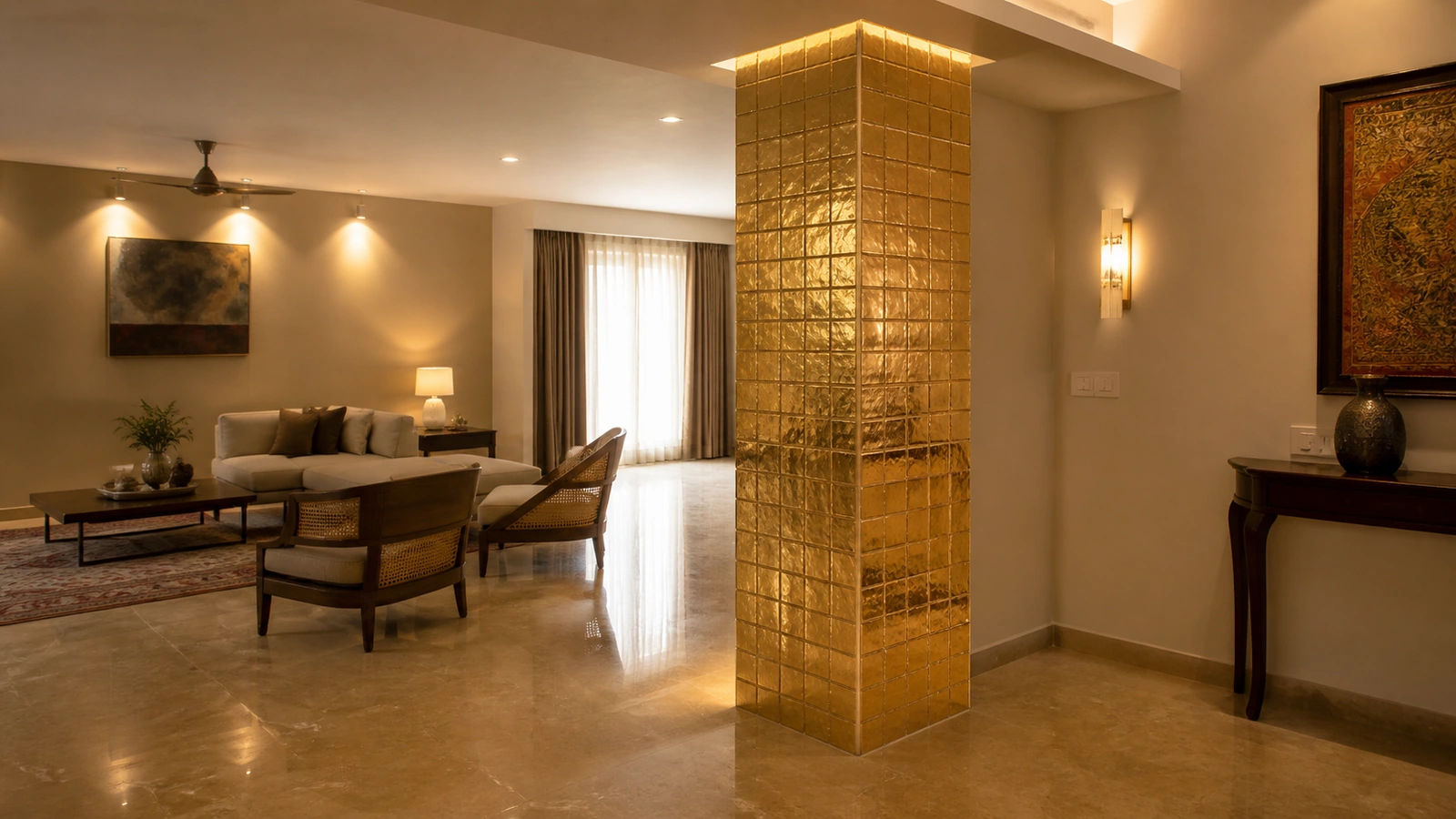
Gold Lustre Clad Column or Pier
Third fired gold lustre | 300x300 mm | Wall, low contact | Rs. 250 to Rs. 480/sq.ft
Typical room cost: About Rs. 5,000 to Rs. 9,600 for a 20 sq.ft column
Cladding a structural column or pier in gold lustre, which turns an architectural obstacle into the room's focal point and is viewed from every angle as people move around it.
Get this detail right: Confirm the column is genuinely out of contact paths, since a clad column at shoulder height in a circulation route will be touched constantly and this material cannot take it.
Pair with: Lighting from two directions so the curve or corners read, and plain surrounding surfaces.
Avoid: Cladding a column in a corridor or circulation route, where contact is inevitable.
Combination Schemes
Where third fired accents a larger area of standard tile, which is how the material is used most cost-effectively.
13. THE GOLD ON PLAIN
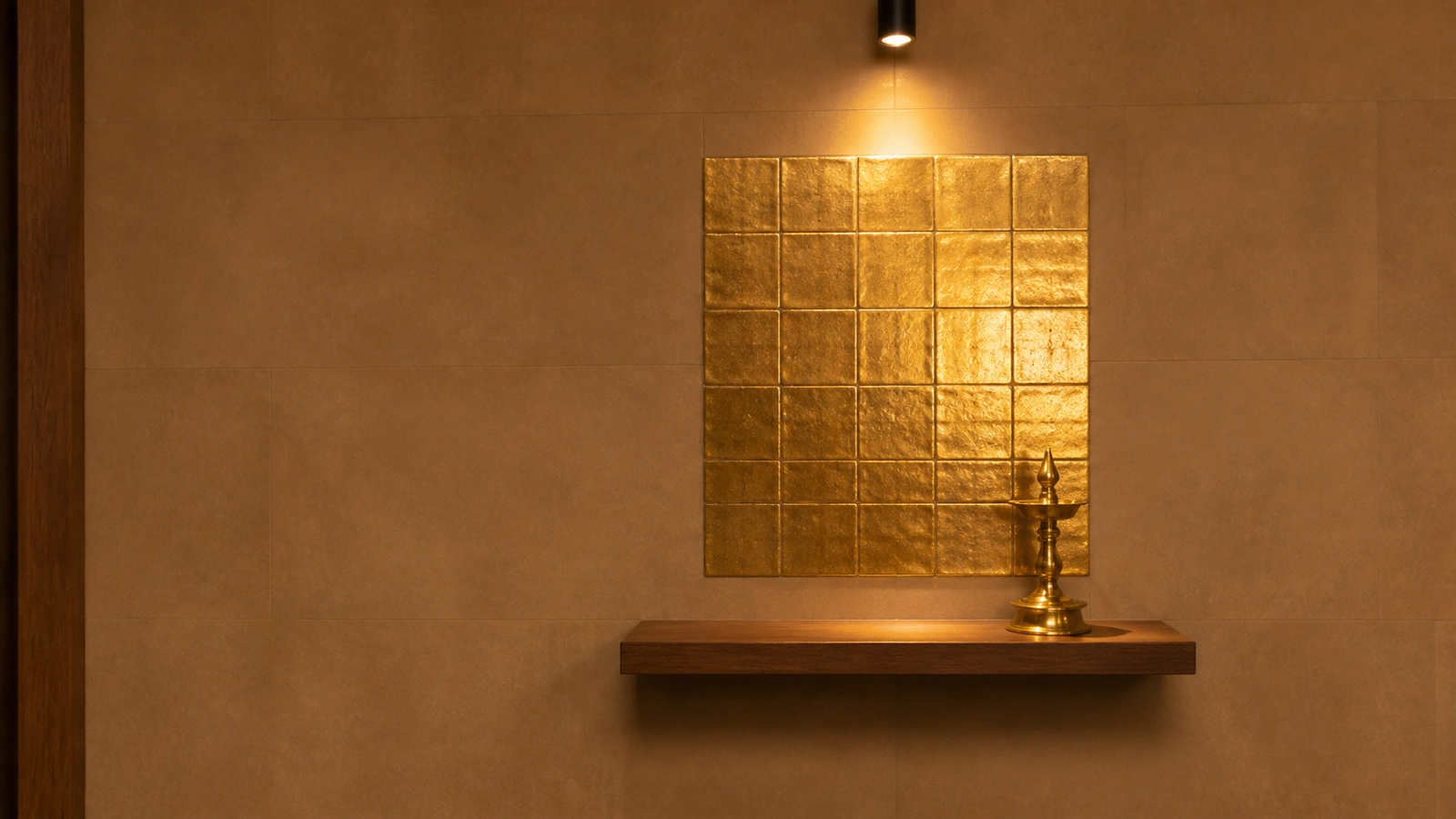
Gold Lustre Accent on a Plain Matte Field
Third fired gold lustre accent + plain matte wall tile | 300x300 mm accent | Wall, low contact | Rs. 250 to Rs. 480/sq.ft accent
Typical room cost: About Rs. 1,500 to Rs. 2,880 for a 6 sq.ft accent plus field tile
The most cost-effective way to use this material. A small gold accent against a large plain field, where the plainness is what makes the gold register as precious.
Get this detail right: Choose a field tile in a quiet mid-tone rather than white, since gold against stark white reads harsher than gold against a warm neutral.
Pair with: A single warm light source aimed at the accent, and no other decorative element in the same sightline.
Avoid: A patterned or textured field tile, which competes with the accent and diminishes both.
14. THE BORDER ON MARBLE
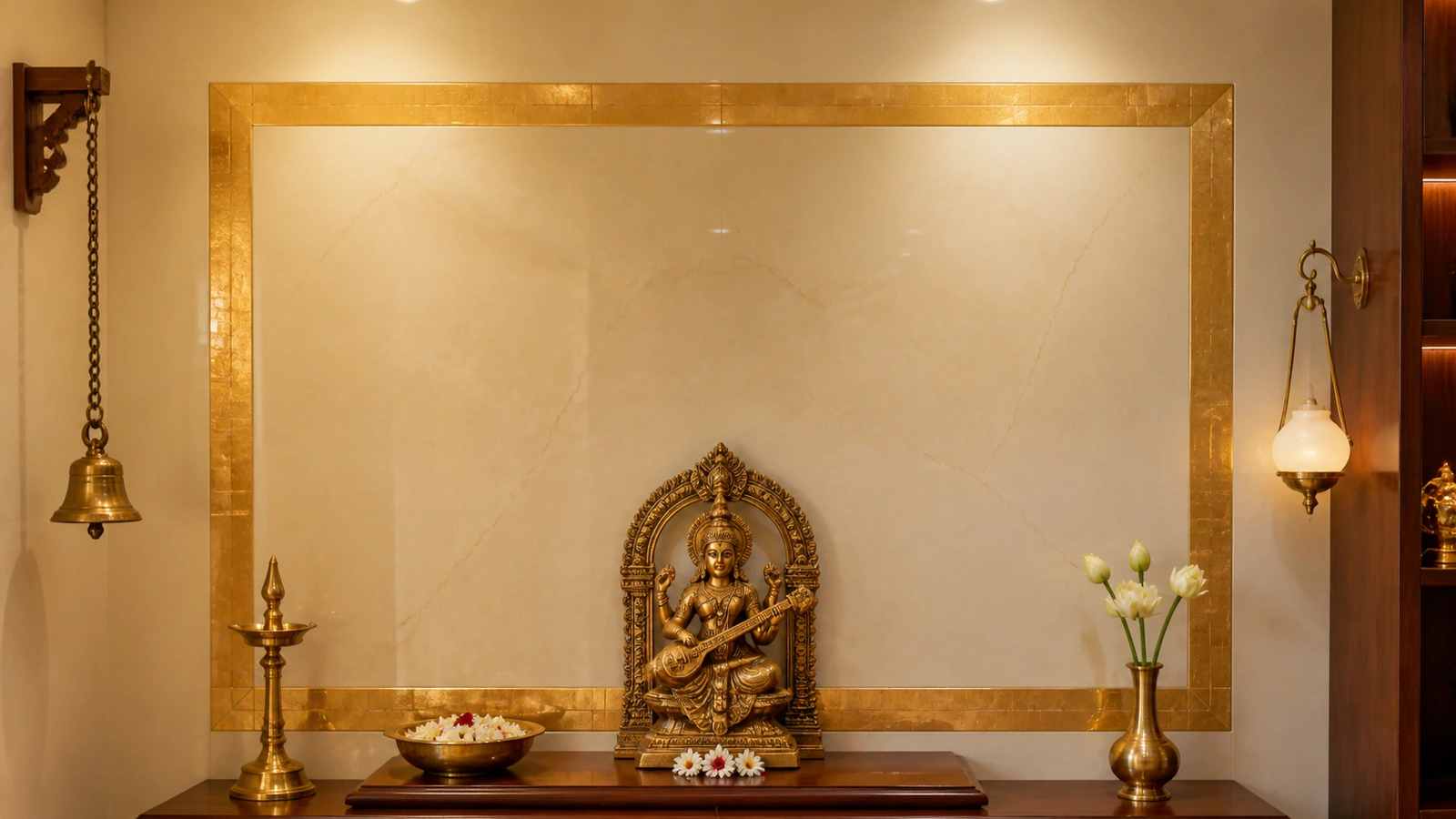
Gold Lustre Border Framing Marble-Look Field
Third fired gold lustre border + marble-look field | 75x300 mm border | Wall, low contact | Rs. 250 to Rs. 480/sq.ft border
Typical room cost: About Rs. 1,000 to Rs. 1,920 for a 4 sq.ft border plus field
A slim gold border framing a marble-look panel, which is the classical pairing and reads as considered rather than ostentatious because the gold is doing a defined job.
Get this detail right: Match the gold tone to the marble's warm or cool undertone, since warm gold against a cool grey marble is the most common mismatch in this pairing.
Pair with: Warm lighting for a beige or cream marble, neutral for a grey one, and brass fittings throughout.
Avoid: Gold border against a cool grey marble under cool light, where the two tones actively fight.
15. THE MIXED METAL
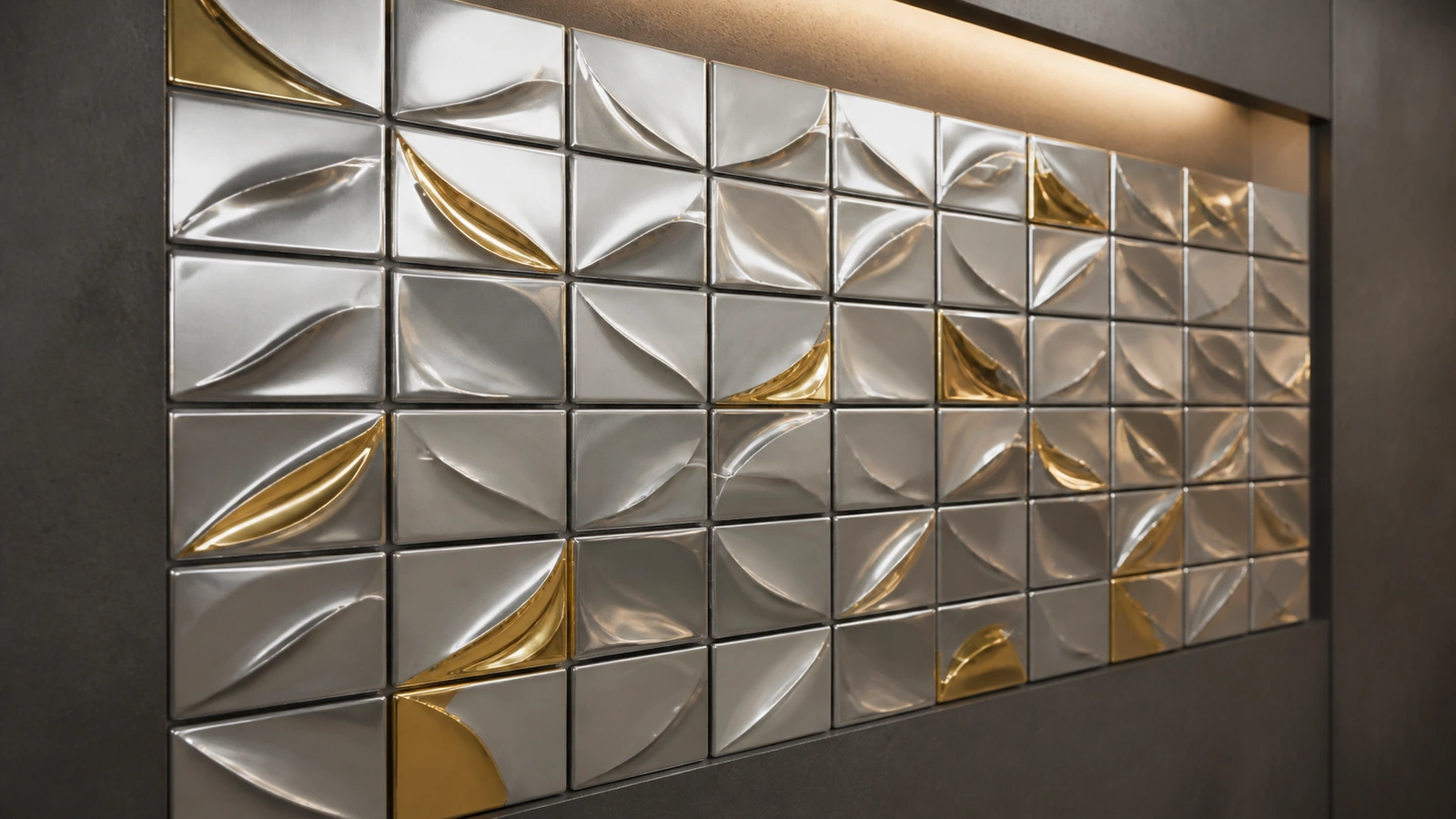
Gold and Platinum Lustre Together
Third fired gold and platinum lustre | 300x300 mm | Wall, low contact | Rs. 250 to Rs. 480/sq.ft
Typical room cost: About Rs. 2,000 to Rs. 3,840 for an 8 sq.ft panel
Two lustres in one composition, typically platinum as the field with gold as the accent, which produces a genuinely layered metallic effect that a single lustre cannot.
Get this detail right: Let one metal dominate clearly rather than splitting the area evenly, since equal quantities of two metals read as indecision rather than as a designed combination.
Pair with: Neutral 3000K lighting which flatters both metals, and fittings in whichever metal dominates.
Avoid: A fifty-fifty split between the two, which is the most common way this idea goes wrong.
Restrained and Contemporary
For households that want genuine fired metal without the traditional ornamental register.
16. THE MINIMAL LINE
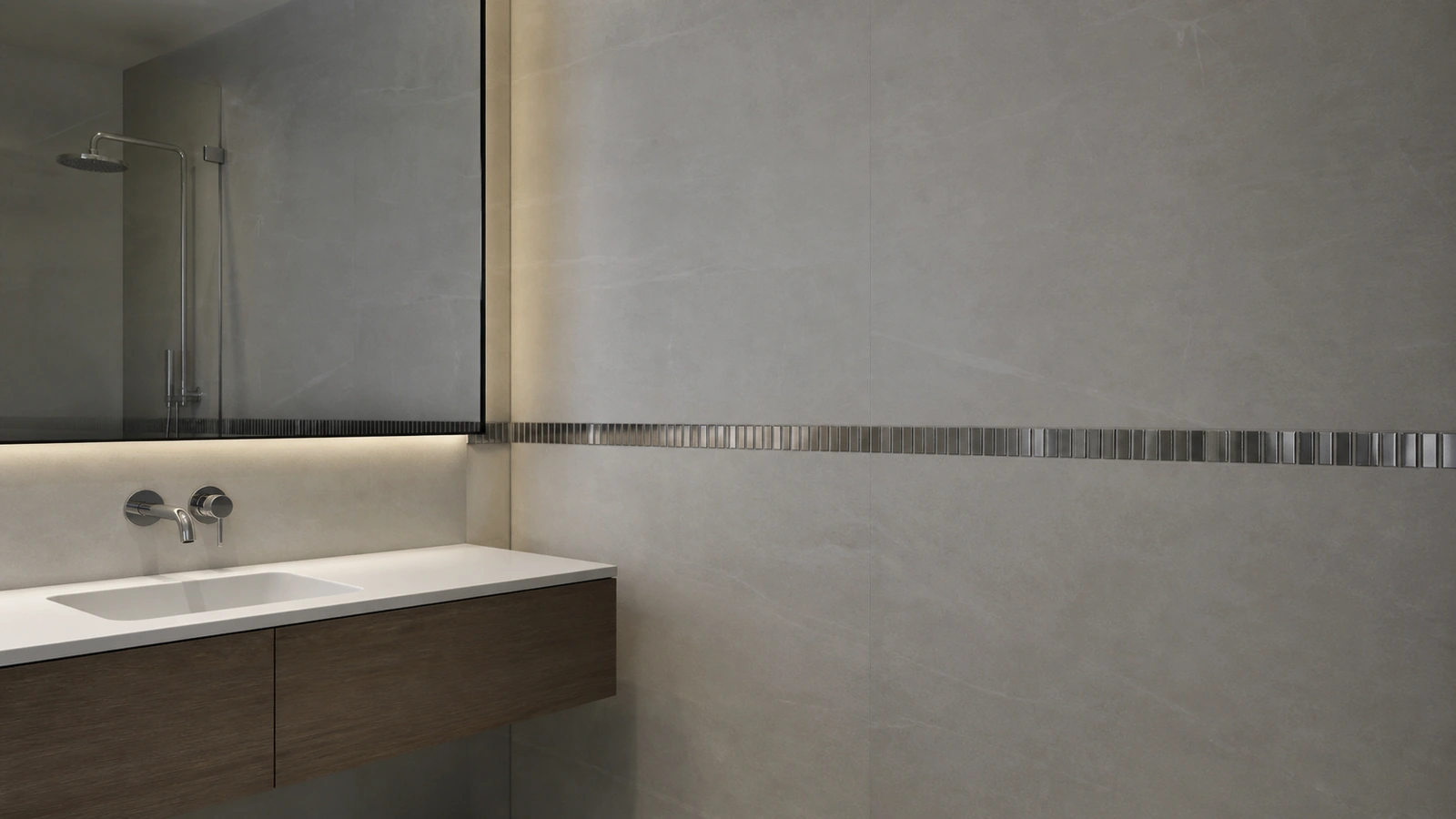
Single Platinum Lustre Line, Contemporary Bathroom
Third fired platinum lustre border | 75x300 mm strip | Wall, low contact | Rs. 280 to Rs. 550/sq.ft
Typical room cost: About Rs. 560 to Rs. 1,100 for a 2 sq.ft run
A single platinum line on an otherwise plain contemporary wall, which reads as a deliberate architectural detail rather than as decoration.
Get this detail right: Align the line with something structural, a mirror edge, a shelf, a change of material, since an unaligned line in a minimal scheme reads as a mistake rather than a choice.
Pair with: Cool 3500K to 4000K lighting which suits platinum, and chrome or brushed steel fittings.
Avoid: Warm lighting on platinum, which yellows it and removes the cool precision that makes it work in a minimal scheme.
17. THE CONTEMPORARY GRID
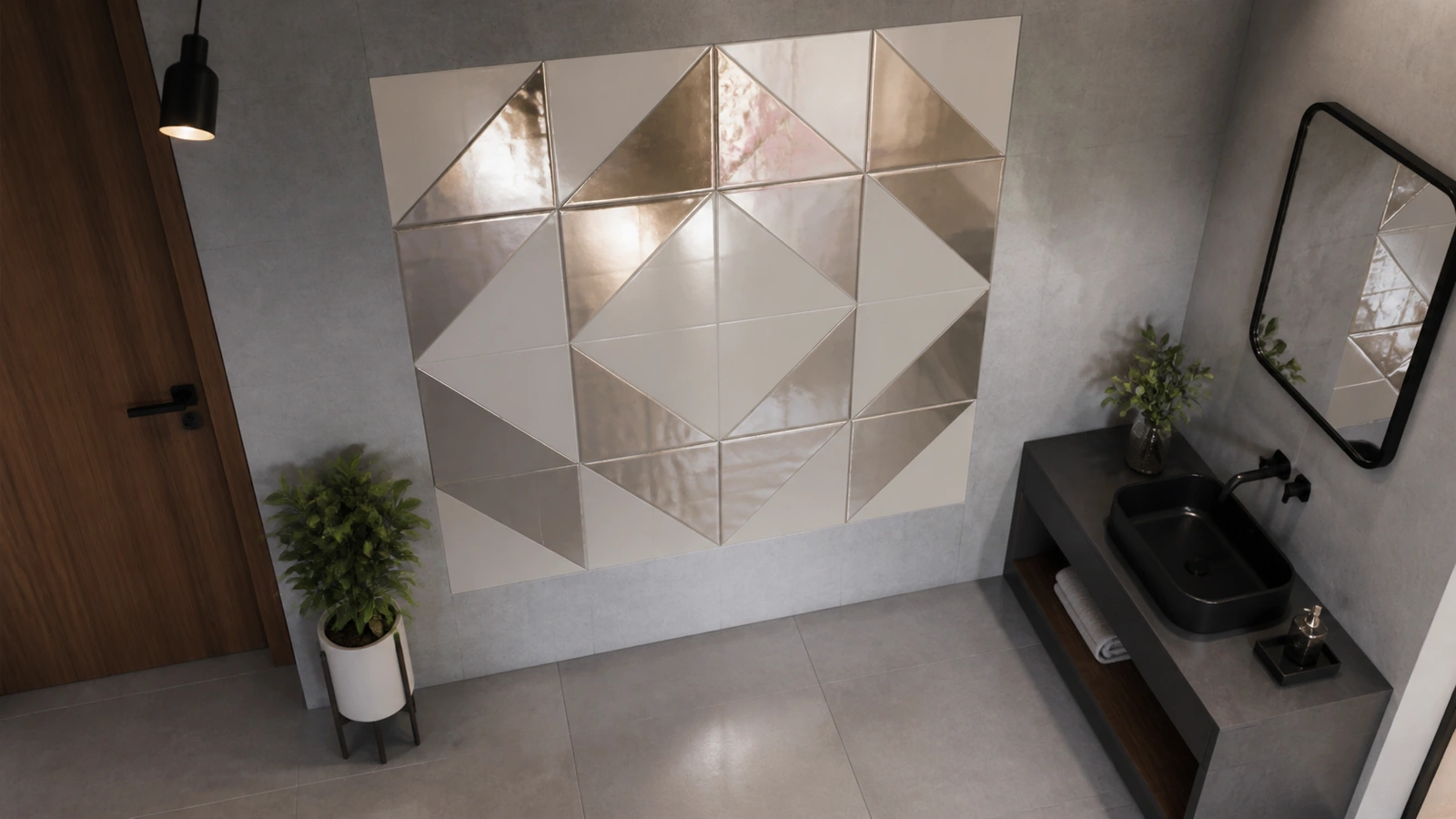
Geometric Platinum Lustre Panel
Third fired platinum lustre, geometric pattern | 300x300 mm | Wall, low contact | Rs. 280 to Rs. 550/sq.ft
Typical room cost: About Rs. 2,250 to Rs. 4,320 for a 9 sq.ft panel
A geometric rather than ornamental composition in platinum, which brings genuine fired metal into a contemporary scheme without any traditional decorative reference.
Get this detail right: Keep the geometry simple and large-scale, since fine intricate geometry in metallic lustre reads as traditional ornament regardless of how the pattern was drawn.
Pair with: Neutral lighting, matte black or steel fittings, and a plain concrete-look or plain matte surround.
Avoid: Intricate small-scale geometry, which defeats the contemporary intent.
18. THE QUIET PLATINUM
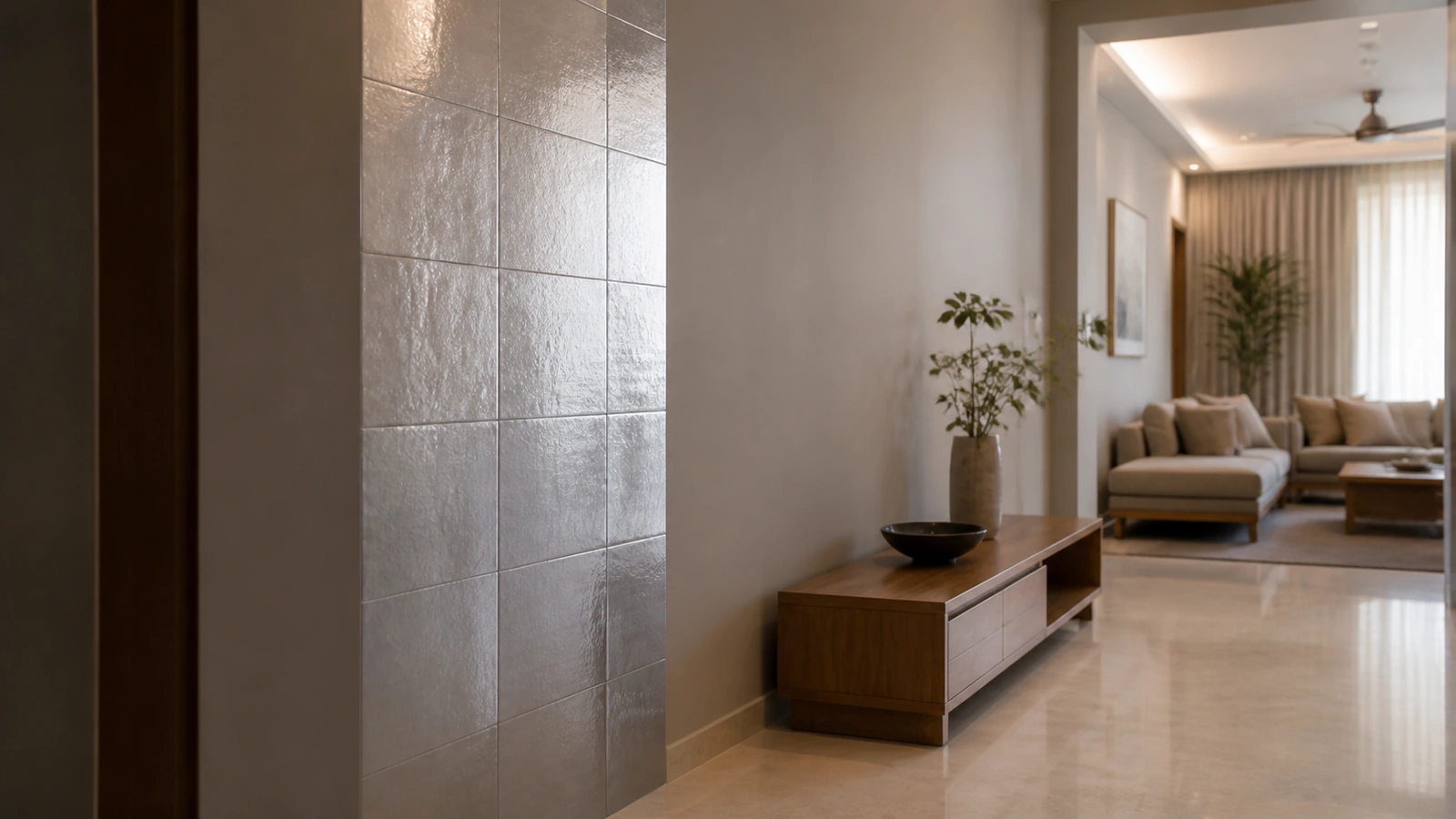
Subtle Platinum Sheen, Understated Feature
Third fired platinum lustre, plain | 300x600 mm | Wall, low contact | Rs. 280 to Rs. 520/sq.ft
Typical room cost: About Rs. 1,680 to Rs. 3,120 for a 6 sq.ft panel
A plain platinum panel with no pattern at all, relying entirely on the shifting metallic sheen as light moves across it. The most restrained possible use of genuine fired metal.
Get this detail right: Position it where the viewing angle changes as people move, since a plain lustre panel viewed from one fixed position shows far less of what makes it special.
Pair with: A grazing light source rather than a direct one, which reveals the sheen shift across the surface.
Avoid: A static viewing position with flat frontal light, where a plain lustre panel reads as merely grey.
What Every Look Above Requires
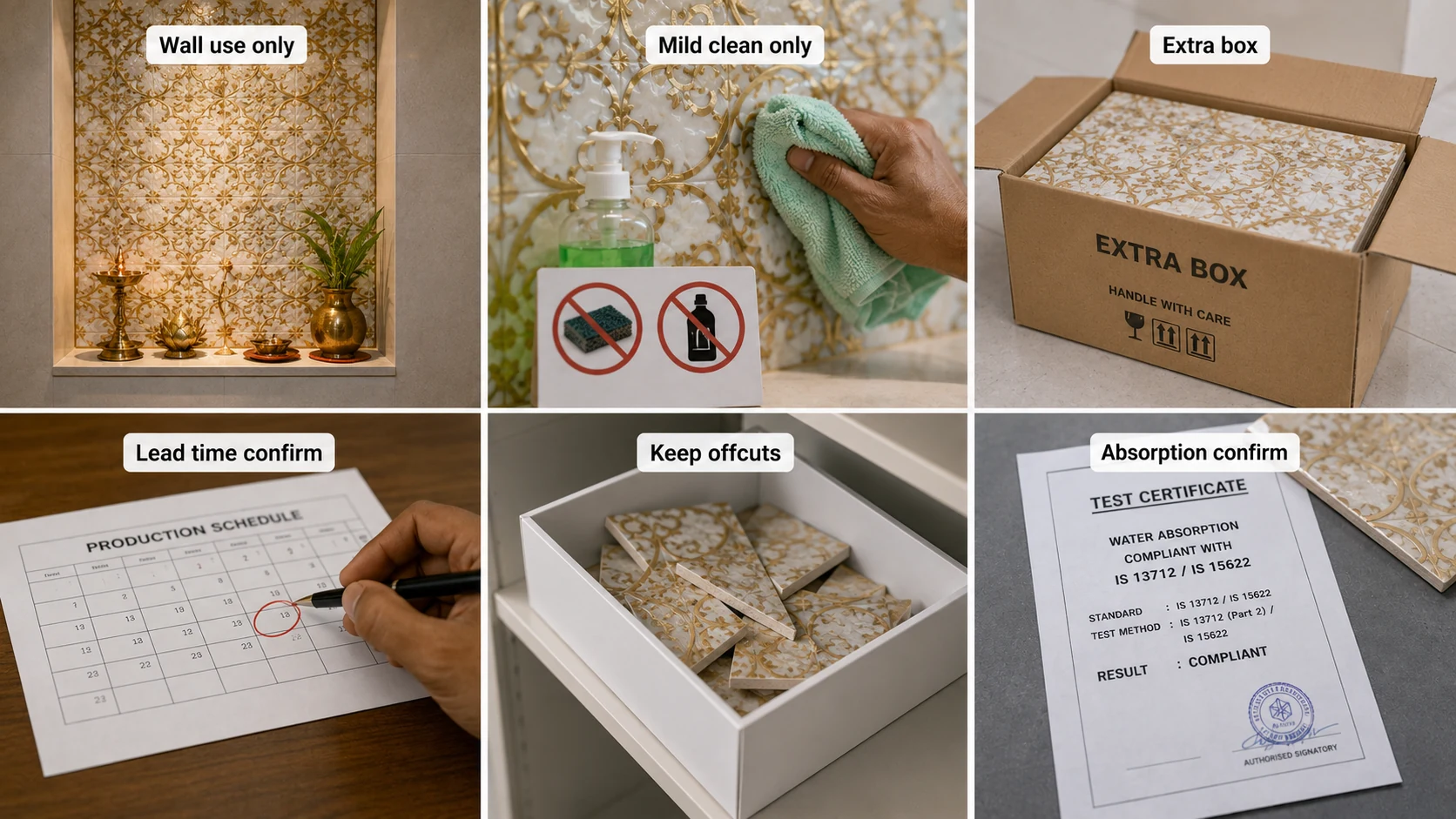
- Wall and low-contact placement only. No floors, stairs, worktops, shower enclosures or heavily handled edges, since the low third firing temperature cannot produce a durable-contact bond.
- Mild detergent and a soft cloth for cleaning, with abrasive pads and acidic descalers excluded entirely, and the regime specified at handover in writing.
- An extra box rather than a percentage overage, since these are small specialist batches and edge damage during cutting is more likely than with standard tile.
- Lead time confirmed before the programme is fixed, because three production stages and a specialist facility make this the slowest category to source.
- Offcuts retained as repair stock, since these ranges are discontinued faster than core ranges and matching later is frequently impossible.
- Water absorption confirmed against the room, referencing IS 13712 for ceramic and IS 15622 for vitrified bodies, with the test certificate requested.
Find Your Scale on TilesFinders
Third fired gold and platinum ranges can be browsed on TilesFinders alongside printed metallic alternatives, so you can compare what each genuinely is and match the commitment level to the effect you actually want.
FAQs
A single gold lustre border strip of around two square feet, costing roughly Rs. 500 to Rs. 960. It is enough to see genuine fired metal working in your own light, and cheap enough that regret costs less than a light fitting.
A pooja room backdrop panel. Genuine fired gold responds to diya flame in a way printed metallic finishes cannot, because a moving flame is exactly the kind of light source real metal was made to answer.
On a mirror surround or vanity backdrop clear of splash contact, yes. Never inside a shower enclosure. Keep any panel at least 300 mm from a basin rim, and exclude acidic descalers from the room entirely, since those are routine against hard water in India.
Rarely. At around eighteen square feet and above, an unbroken gold field stops reading as a deliberate accent and becomes an undifferentiated surface. If you want scale, a narrow full-height band uses height rather than area and costs considerably less for comparable impact.
Let one metal clearly dominate, typically platinum as the field with gold as the accent. An even split between two metals reads as indecision rather than as a designed combination, and it is the most common way this pairing fails.
Yes, using platinum rather than gold, plain or large-scale geometric rather than ornamental, under cool lighting. Fine intricate patterning reads as traditional ornament regardless of intent, so keep the geometry simple and the scale generous.
From inside the niche, not from the room. A deep recess lit from outside shadows its own back panel, which means the lustre never activates and the material you paid for does nothing.
Because lining the side returns as well as the back face creates reflections between adjacent surfaces, which gives the recess depth and warmth a single flat panel cannot produce. Lining only the back face loses exactly what justifies the extra area.
A full extra box rather than a percentage. On a small decorative panel, a percentage is meaningless; patches are small and discontinued quickly, and edge damage during cutting is more likely with a decorated layer than with a standard tile.


See our tile guides first
Set TilesFinders as a preferred source and our buying guides surface ahead of the rest for you.
Add as preferred sourceTakes one tap. Nothing to install.
What Readers Say
I was about to redo my parking area with the wrong tile size until I read this. The layout comparisons saved me from a costly mistake.
We reference TilesFinders guides while briefing clients on material selection. The size and pattern breakdowns are accurate and easy to explain visually.
On site, I get asked about grout spacing all the time. This article gave me a solid reference I now share with my team before every job.
Finally a guide that doesn't just push generic advice. The oil stain removal steps actually worked on our clubhouse driveway tiles.
I run a small construction firm and now send this link to clients directly when they ask about entrance tile sizing. Saves me an hour of explaining.
Good practical detail, though I wish there were more examples for compact apartment entrances specifically, not just villas.
My mother-in-law wanted marble, I wanted vitrified. This blog gave us the neutral comparison we needed to actually decide together.
Detailed without being overwhelming. I appreciated that it covered both cost and maintenance, not just the aesthetics.
Used the algae and hard water removal tips on our terrace tiles after the monsoon. Worked better than what our regular cleaner was doing.
As someone who sources tiles for multiple builder projects, I find these comparisons genuinely useful for vendor conversations, not just consumer content.
Recommended this to a client who kept second-guessing the entrance design. The small vs large layout section settled the debate instantly.
Straightforward and honest, no unnecessary jargon. Would like to see a similar breakdown for outdoor pool-deck tiles next.
We've bookmarked several TilesFinders guides for our design handbook. Reliable source when clients want data, not just opinions.
Two paths, one marketplace.
Get free quotes from verified suppliers.
Share your room, budget, and style. Suppliers in local area respond within hours.
Get Free QuotesList your business, reach real buyers.
Put your showroom in front of homeowners searching for tiles right now.
List Your Business