
GHR Tile Design Ideas: 15+ Durable Surface Looks for Indian Commercial and Heavy-Use Floors
18 GHR tile design ideas for Indian commercial spaces, matched to retail, restaurants, offices, healthcare, warehouses and high-traffic areas with practical durability and safety specifications.
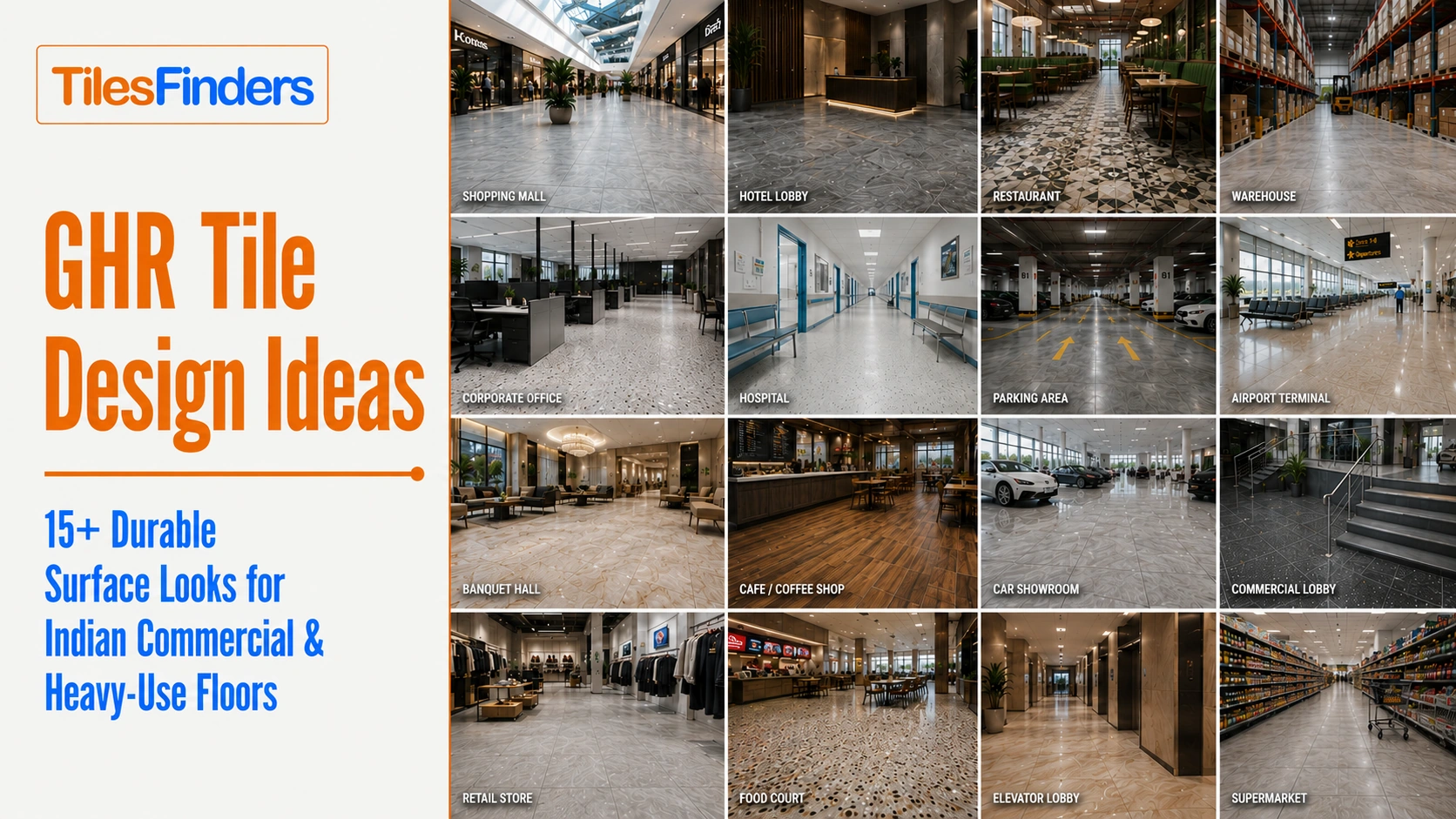
GHR tiles are best specified by facility rather than across an entire commercial building, because traffic, chemicals, impact and wet-floor risk vary by zone. PEI 5 handles heavy wear, but wet COF, body construction, thickness and installation must be specified separately for the actual environment.
A restaurant floor fails differently from a warehouse floor, which fails differently from a hospital corridor. Grease, point loading, and chemical exposure are three separate problems, and specifying a single GHR tile across a whole building ignores that. These 18 looks are organised by facility type, each with its cost in realistic commercial areas and the operational details that determine whether it lasts.
Before any of these: GHR does not cover slip resistance: Every look below assumes wet coefficient of friction is confirmed separately at 0.4 minimum for any zone that gets wet, and higher for entrances, kitchens and washrooms. GHR covers abrasion, chemical and impact resistance, all of which describe how the surface withstands what happens to it. None of them describes how a foot behaves on it. In a commercial building, that distinction carries liability, not just inconvenience. |
All 18 at a Glance
| # Look | Facility | Typical Cost | Critical Spec |
| 1. The Showroom Floor | Retail | Rs. 1.1 to 1.8 L / 1,000 sq.ft | PEI 5, matte for dust |
| 2. The High-Footfall Retail | Retail | Rs. 1.2 to 1.9 L / 1,000 sq.ft | PEI 5, full body |
| 3. The Boutique Finish | Retail | Rs. 65,000 to 1.1 L / 500 sq.ft | PEI 5, appearance-led |
| 4. The Restaurant Workhorse | Food service | Rs. 95,000 to 1.5 L / 800 sq.ft | PEI 5, wet COF, chemical |
| 5. The Commercial Kitchen | Food service | Rs. 48,000 to 78,000 / 400 sq.ft | High wet COF, chemical, grease |
| 6. The Café Floor | Food service | Rs. 60,000 to 95,000 / 500 sq.ft | PEI 5, wet COF at entrance |
| 7. The Open-Plan Office | Corporate | Rs. 2.2 to 3.6 L / 2,000 sq.ft | PEI 5, matte, acoustics |
| 8. The Corporate Reception | Corporate | Rs. 78,000 to 1.4 L / 600 sq.ft | PEI 5, appearance, entrance grip |
| 9. The Meeting Room | Corporate | Rs. 39,000 to 65,000 / 300 sq.ft | PEI 4 is sufficient here |
| 10. The Hospital Corridor | Healthcare | Rs. 1.3 to 2.0 L / 1,000 sq.ft | Chemical resistance, wet COF |
| 11. The Lab Floor | Healthcare | Rs. 66,000 to 1.0 L / 500 sq.ft | Chemical resistance, full body |
| 12. The Clinic Waiting Area | Healthcare | Rs. 78,000 to 1.2 L / 600 sq.ft | PEI 5, cleanable, calm tone |
| 13. The Warehouse Floor | Industrial | Rs. 2.6 to 4.0 L / 2,000 sq.ft | PEI 5, full body, thickness |
| 14. The Workshop Surface | Industrial | Rs. 96,000 to 1.5 L / 800 sq.ft | Impact, chemical, full body |
| 15. The Loading Bay | Industrial | Rs. 78,000 to 1.2 L / 600 sq.ft | Vehicle load rating, R11 |
| 16. The Building Lobby | Circulation | Rs. 1.1 to 1.9 L / 1,000 sq.ft | PEI 5, entrance grip, appearance |
| 17. The Stairwell and Corridor | Circulation | Rs. 52,000 to 84,000 / 400 sq.ft | PEI 5, nosing contrast, wet COF |
| 18. The Entrance Transition | Circulation | Rs. 26,000 to 45,000 / 200 sq.ft | Highest wet COF in the building |
Retail and Showrooms
1. THE SHOWROOM FLOOR
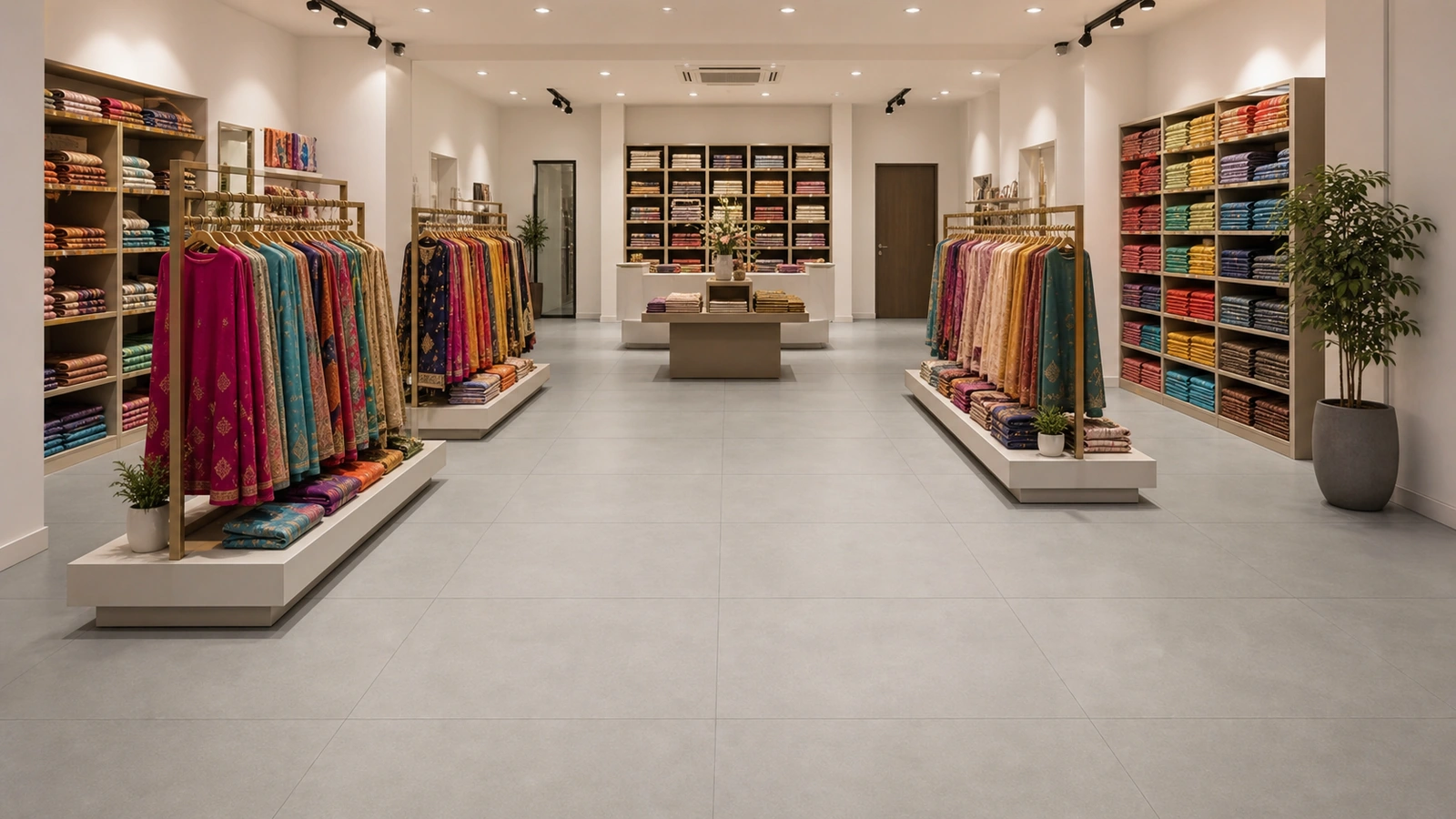
Light Grey GHR, Large Format
GHR classification GVT, PEI 5 | 800x800 mm, rectified | Matte | Rs. 110 to Rs. 180/sq.ft
Typical room cost: About Rs. 1.1 to 1.8 lakh for a 1,000 sq.ft showroom
A quiet light grey floor that lets merchandise carry the colour, in a matte finish that hides the dust a street-facing showroom accumulates daily without needing constant attention.
Get this detail right: Plan the tile grid around fixed display positions before laying, so cut tiles do not land in the sightline from the entrance where a customer forms their first impression.
Pair with: Even ceiling lighting rather than spots, since spots create hot patches on a large floor, and a plain field so the product remains the focus.
Avoid: Gloss, which shows every footprint in a space that must look clean throughout trading hours.
The showroom example shows where the GHR surface itself earns its premium: repeated foot traffic and tracked-in grit can gradually dull an ordinary finish. GHR Finish Tiles explains this surface technology in greater detail, including what its resistance rating covers and where it is genuinely worth specifying.
2. THE HIGH-FOOTFALL RETAIL
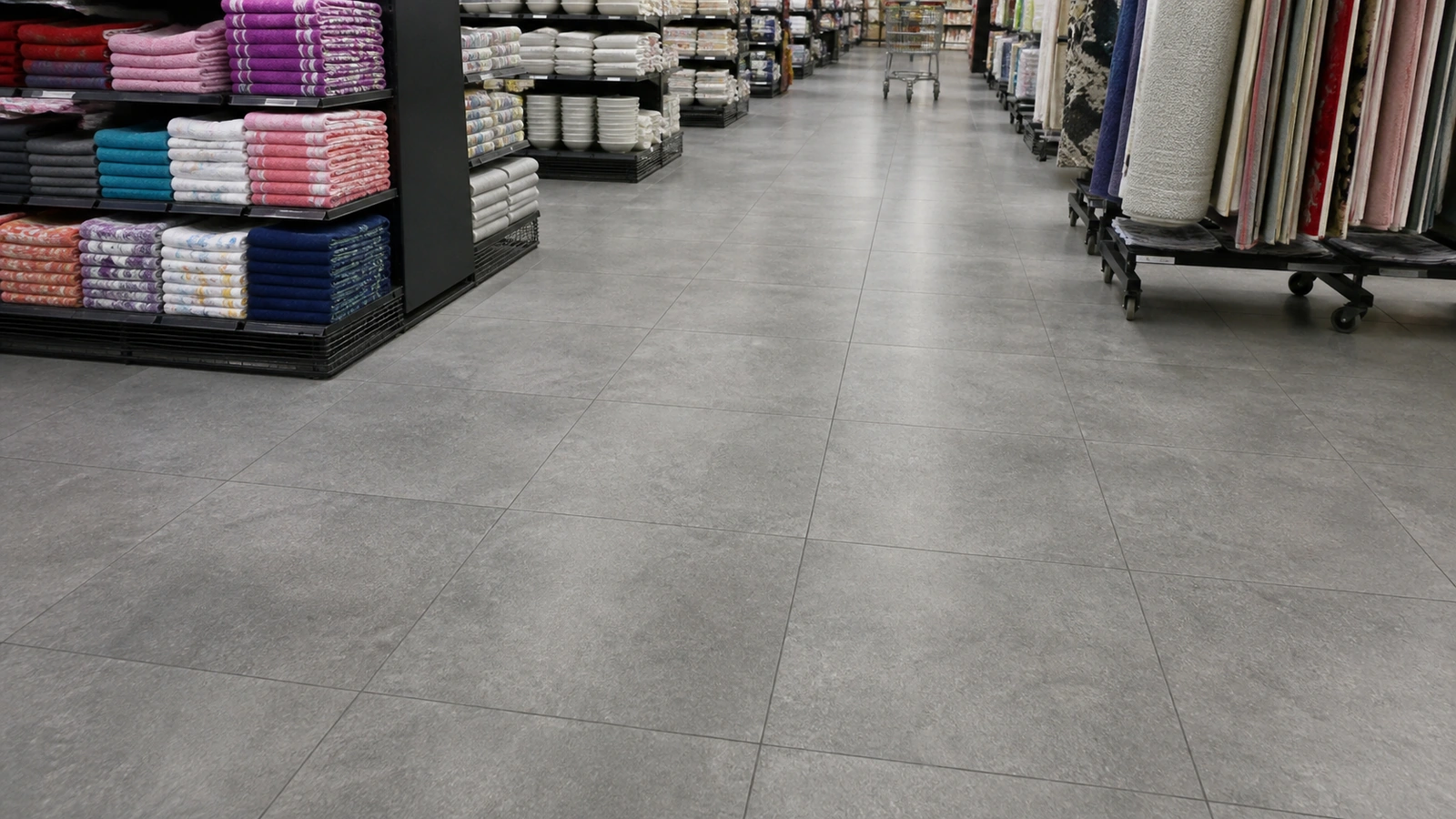
Mid-Grey GHR Full Body, Stone-Look
GHR classification GVT, full body, PEI 5 | 600x600 mm, rectified | Matte | Rs. 120 to Rs. 190/sq.ft
Typical room cost: About Rs. 1.2 to 1.9 lakh for a 1,000 sq.ft store
Full body construction underneath the GHR surface, so the inevitable trolley and fixture chips stay near-invisible because the colour runs through the tile rather than stopping at the glaze.
Get this detail right: Specify full body rather than only GHR if trolleys, stock movement or fixture changes are routine, since GHR reduces the chance of a chip while full body reduces how much it shows.
Pair with: A mid-tone that hides both dust and scuffing, and a smaller 600 mm format that is easier to replace individually.
Avoid: Pale tones in a store with heavy stock movement, where every scuff and trolley mark registers.
3. THE BOUTIQUE FINISH
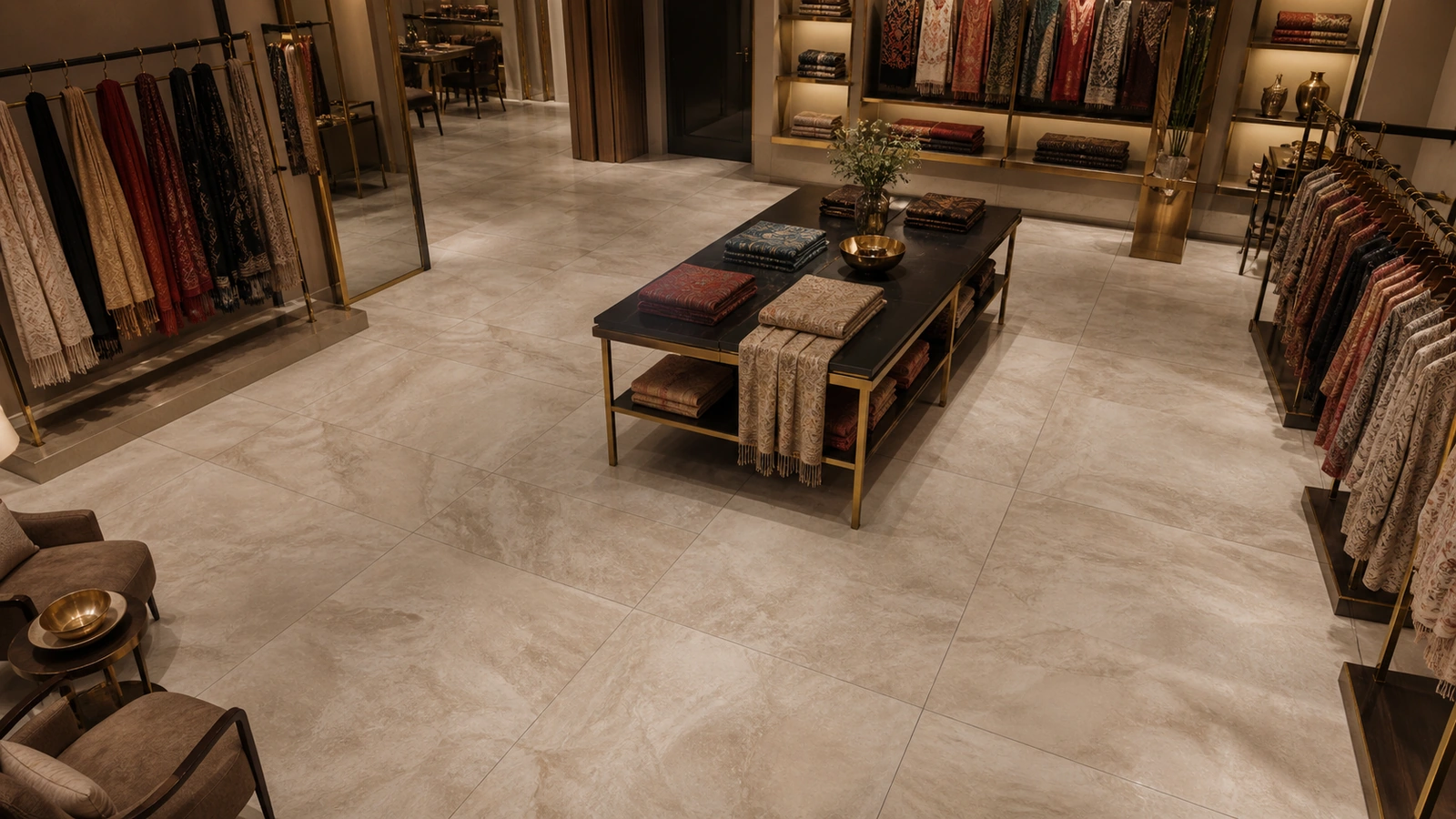
Warm Greige GHR, Marble-Look
GHR classification GVT, PEI 5 | 800x800 mm, rectified | Matte | Rs. 130 to Rs. 210/sq.ft
Typical room cost: About Rs. 65,000 to Rs. 1.1 lakh for a 500 sq.ft boutique
For a smaller retail space where the floor is part of the brand rather than a background. Marble-look in a warm neutral reads premium while the GHR surface handles the traffic a boutique still receives.
Get this detail right: Confirm face variation across the range, since a repeating marble pattern is far more visible in a small floor area than in a large one and undermines the premium effect entirely.
Pair with: Warm 3000K lighting to bring out the greige, and brass or blackened steel fixtures.
Avoid: A low face variation count, which makes an expensive marble-look floor read as printed.
Restaurants and Food Service
4. THE RESTAURANT WORKHORSE
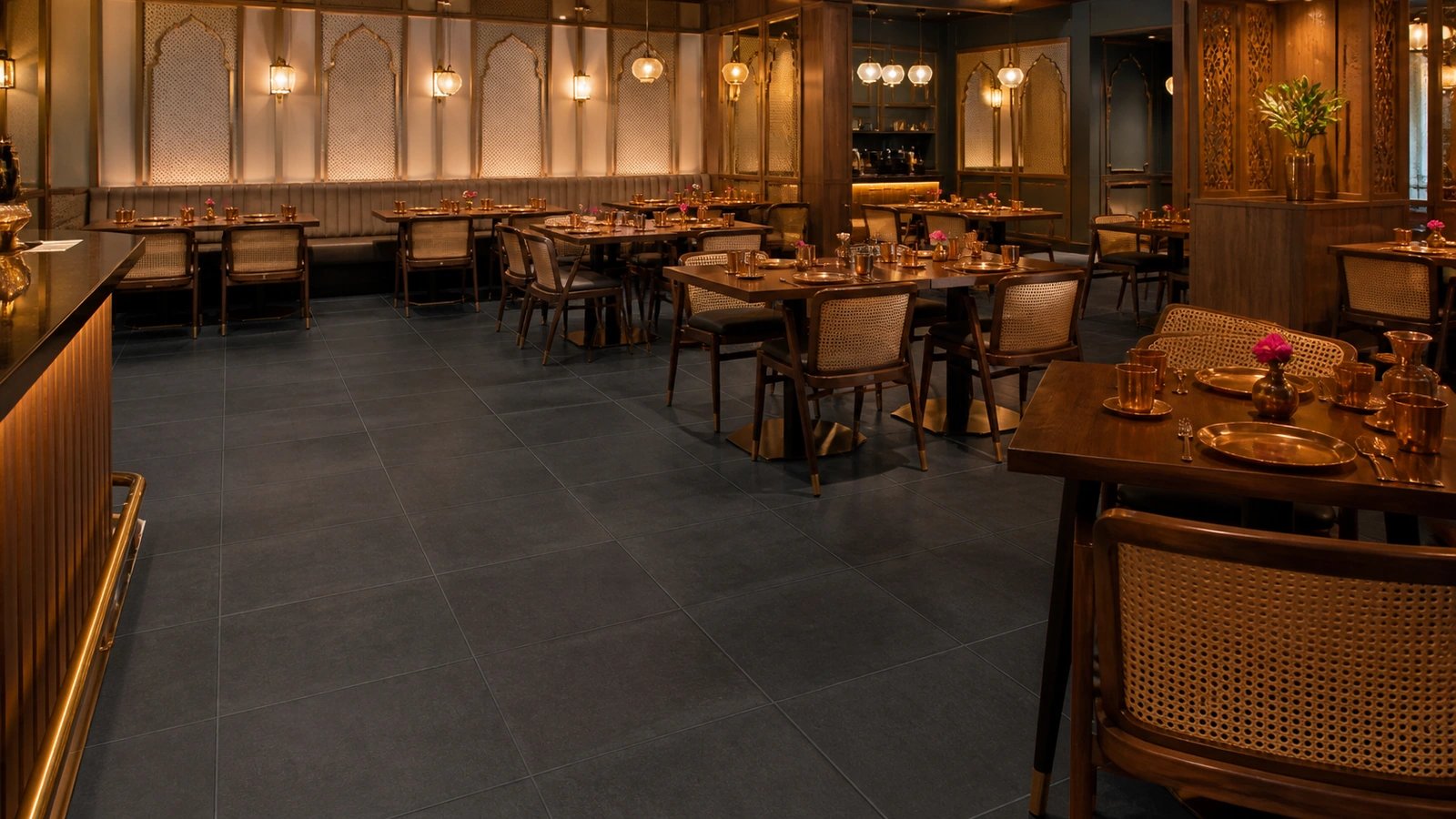
Charcoal GHR, Anti-Skid Confirmed
GHR classification GVT, PEI 5, confirmed wet COF | 600x600 mm | Matte anti-skid | Rs. 115 to Rs. 185/sq.ft
Typical room cost: About Rs. 95,000 to Rs. 1.5 lakh for an 800 sq.ft dining area
A dining floor takes spilt food, wine, oil and constant chair movement, then gets cleaned hard every night. Charcoal hides the marks between cleans and GHR chemical resistance survives the cleaning regime.
Get this detail right: Confirm the tile tolerates the specific cleaning chemicals your operation actually uses, in writing, since restaurant cleaning is far harsher than domestic and chemical resistance is graded rather than absolute.
Pair with: Felt pads on every chair leg, which prevent more floor damage than any surface rating, and epoxy grout throughout.
Avoid: Cement grout in a dining room, which stains from spilt food within months and cannot be recovered.
5. THE COMMERCIAL KITCHEN
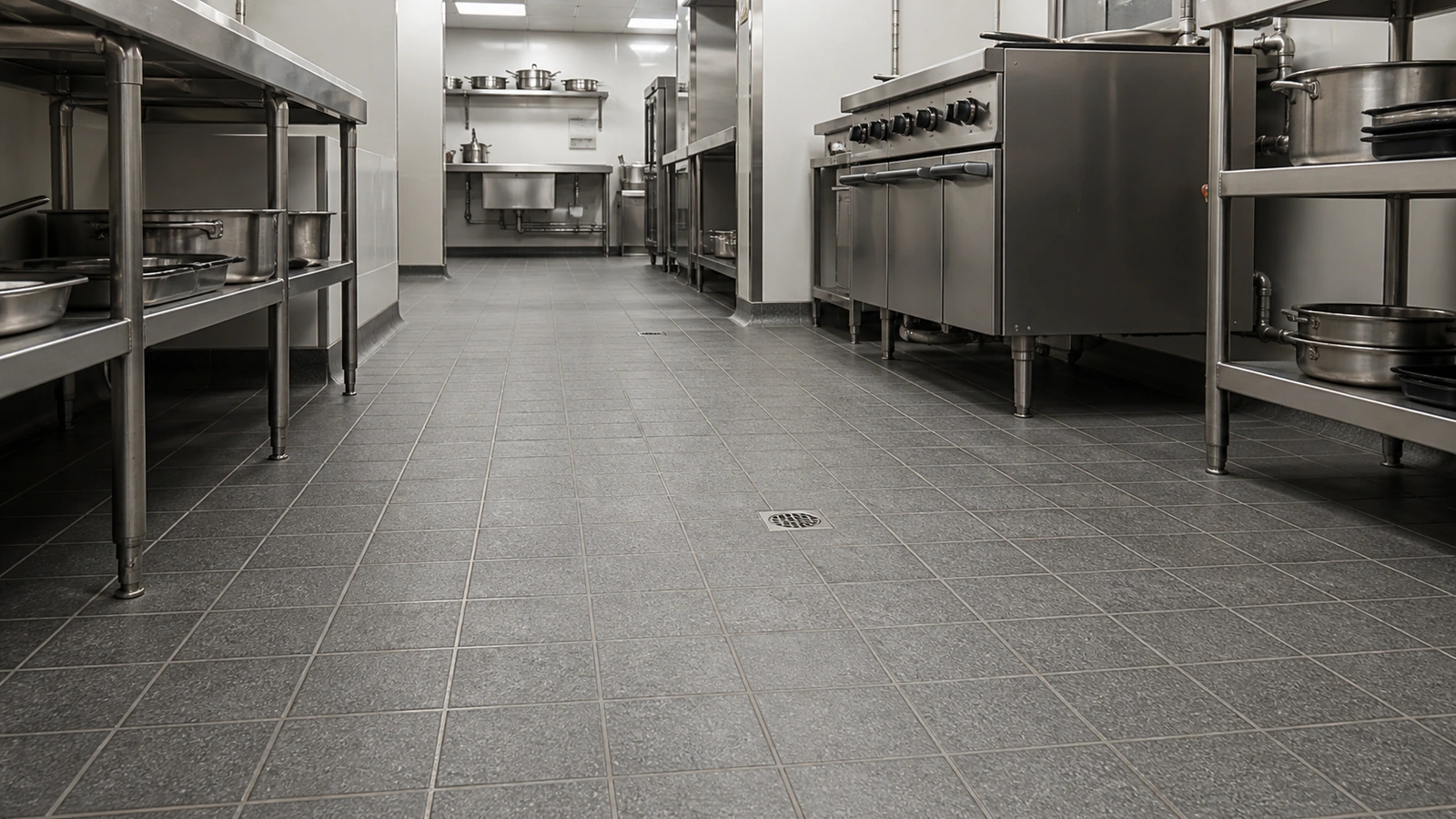
Mid-Grey GHR, High Wet COF
GHR classification GVT, PEI 5, high wet COF | 300x300 mm | Matte anti-skid | Rs. 120 to Rs. 190/sq.ft
Typical room cost: About Rs. 48,000 to Rs. 78,000 for a 400 sq.ft kitchen
The most demanding floor in any hospitality building. Grease, water, heat, dropped equipment and staff moving quickly, all at once. The smaller format gives more grout lines across drainage falls and more edges underfoot.
Get this detail right: Specify the highest wet COF available rather than the minimum, because grease on a wet floor is a considerably more slippery combination than water alone and staff move fast in this room.
Pair with: A proper drainage fall to floor gullies, epoxy grout throughout, and coving at the wall junction for cleaning.
Avoid: Large-format tiles here, which give fewer drainage paths and fewer edges precisely where both matter most.
6. THE CAFÉ FLOOR
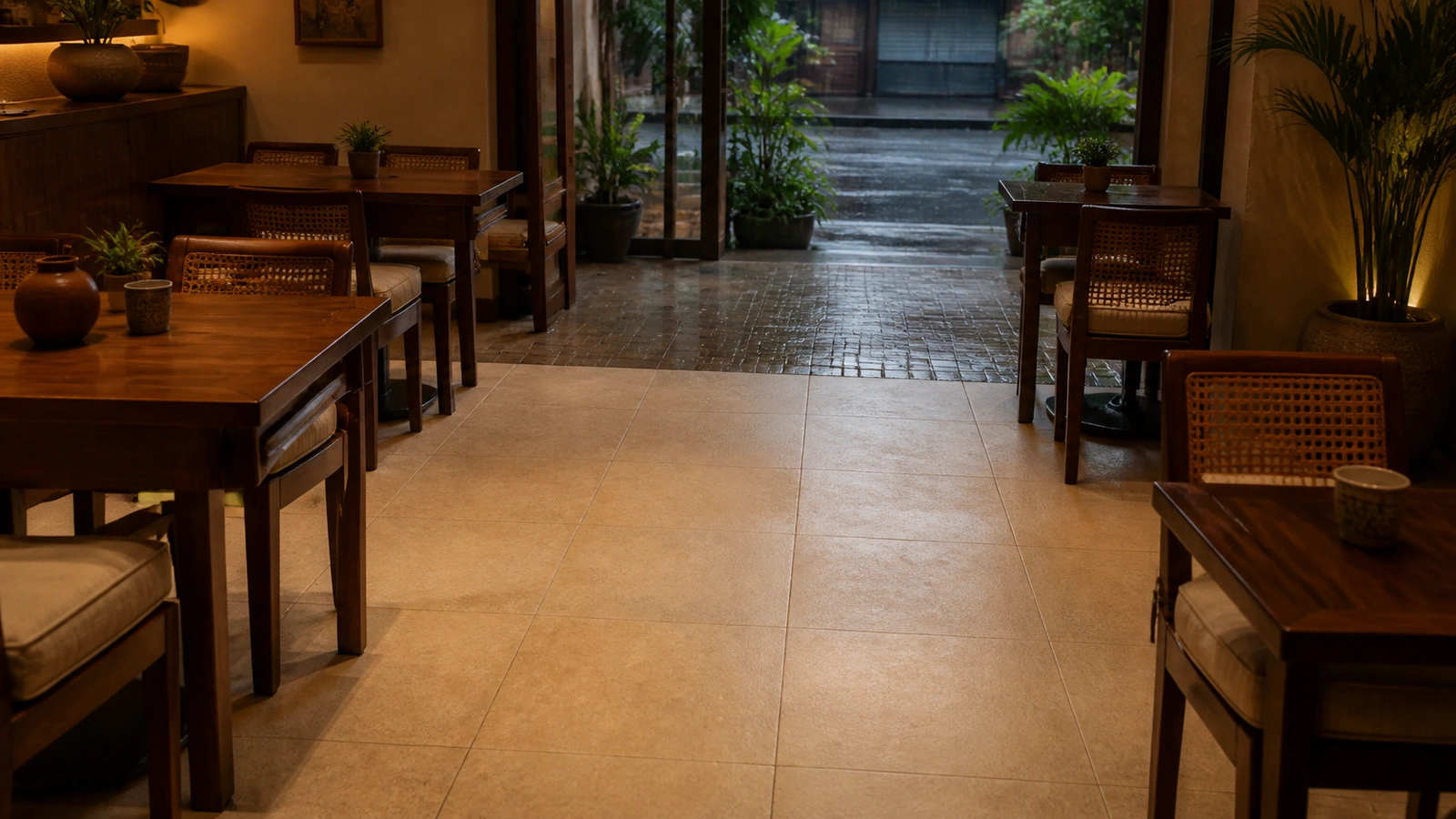
Warm Sand GHR, Stone-Look
GHR classification GVT, PEI 5 | 600x600 mm | Matte | Rs. 110 to Rs. 180/sq.ft
Typical room cost: About Rs. 60,000 to Rs. 95,000 for a 500 sq.ft café
Cafés need a floor that reads welcoming rather than institutional while still handling spills and continuous seating turnover. Warm sandstone-look does both without looking like a commercial specification.
Get this detail right: Extend a higher-grip specification across the first two metres inside the door, since customers arrive with wet footwear in monsoon and this strip carries the real slip risk in a café.
Pair with: Warm 3000K lighting, timber furniture, and epoxy grout in a tone close to the tile.
Avoid: A single specification across the whole floor including the entrance, which under-specifies exactly the zone that needs the most grip.
Popular tiles right now
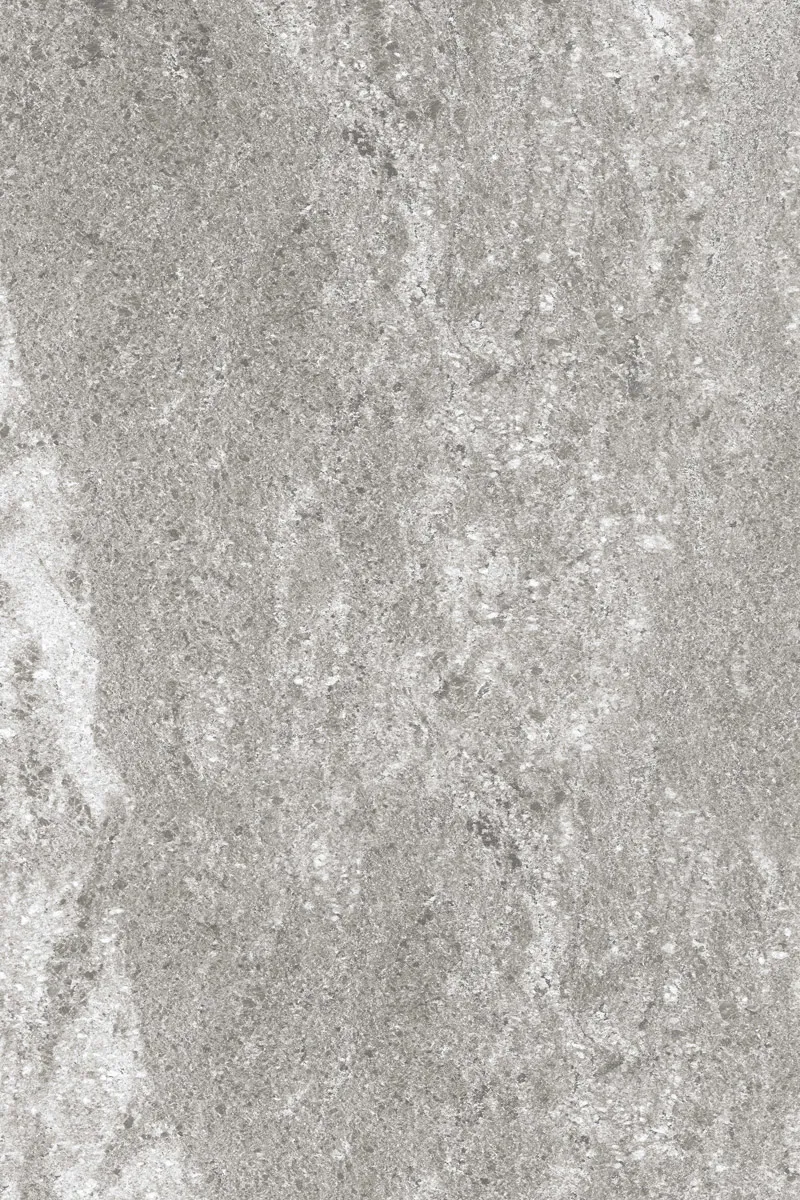
Roma
View Design
Cotto Sentosa Night
View Design
Cotto Sealine Musterd Decor
View Design
Cotto Sealine Kota Decor
View Design
Cotto Sealine Cement Decor
View Design
Cotto Sealine Mocha
View Design
Cotto Sealine Cement
View Design
Rust Metal Teal (800x1600)
View Design
Cotto Sealine Terracotta Decor (800x1600)
View DesignOffices and Corporate
7. THE OPEN-PLAN OFFICE
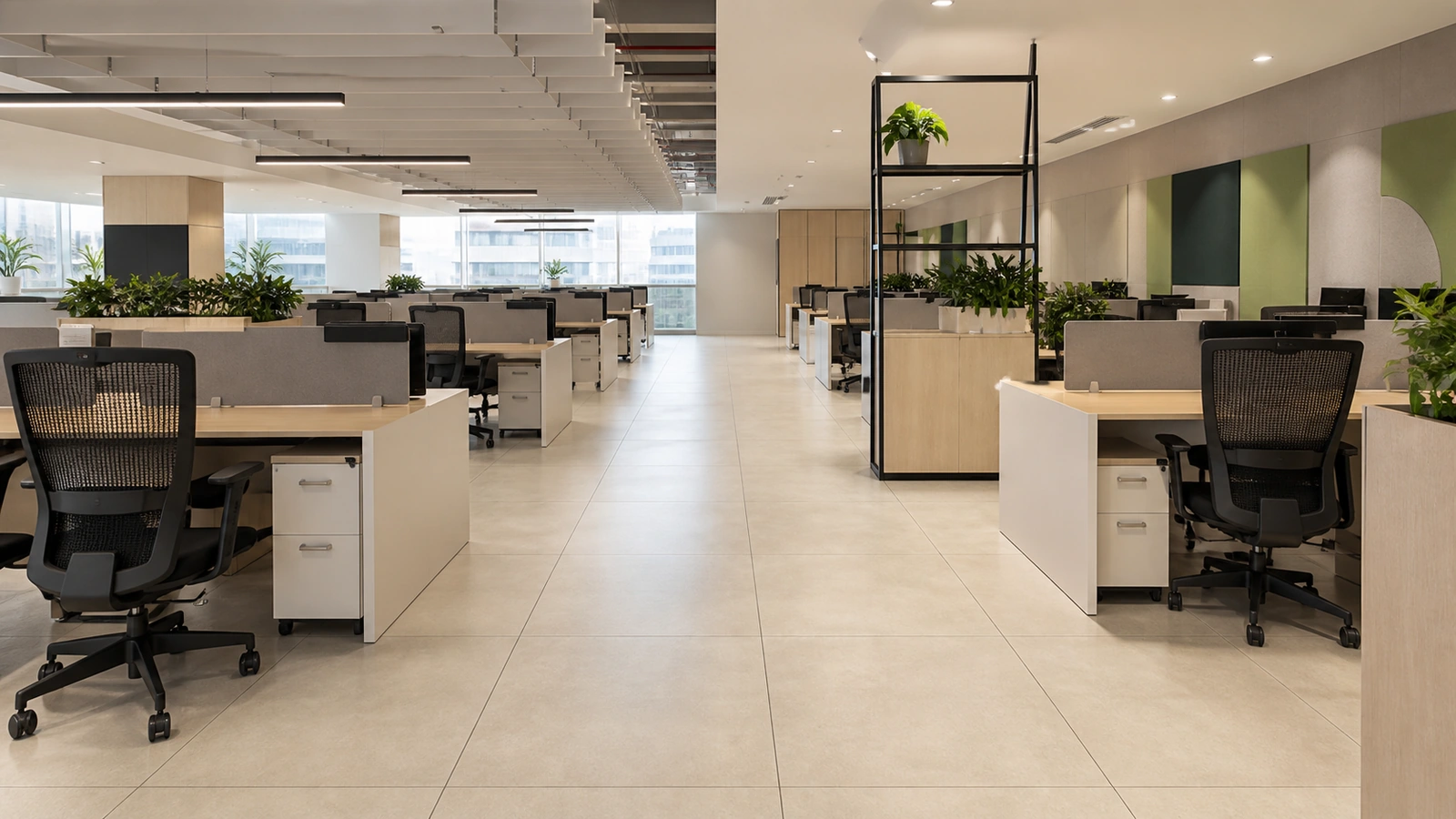
Light Greige GHR, Large Format
GHR classification GVT, PEI 5 | 800x800 mm, rectified | Matte | Rs. 110 to Rs. 175/sq.ft
Typical room cost: About Rs. 2.2 to 3.6 lakh for a 2,000 sq.ft floor plate
Large format keeps the joint count low across an open floor plate, and a light neutral reflects ambient light, which reduces the lighting load. Matte handles the dust that any Indian office accumulates.
Get this detail right: Plan the grid around the desk layout rather than the room, so cut tiles fall under workstations rather than in circulation routes where they are permanently visible.
Pair with: Acoustic treatment elsewhere in the room, since a hard floor across a large plate raises reverberation noticeably.
Avoid: Gloss in an office, which produces glare on screens from overhead lighting and shows every mark.
8. THE CORPORATE RECEPTION
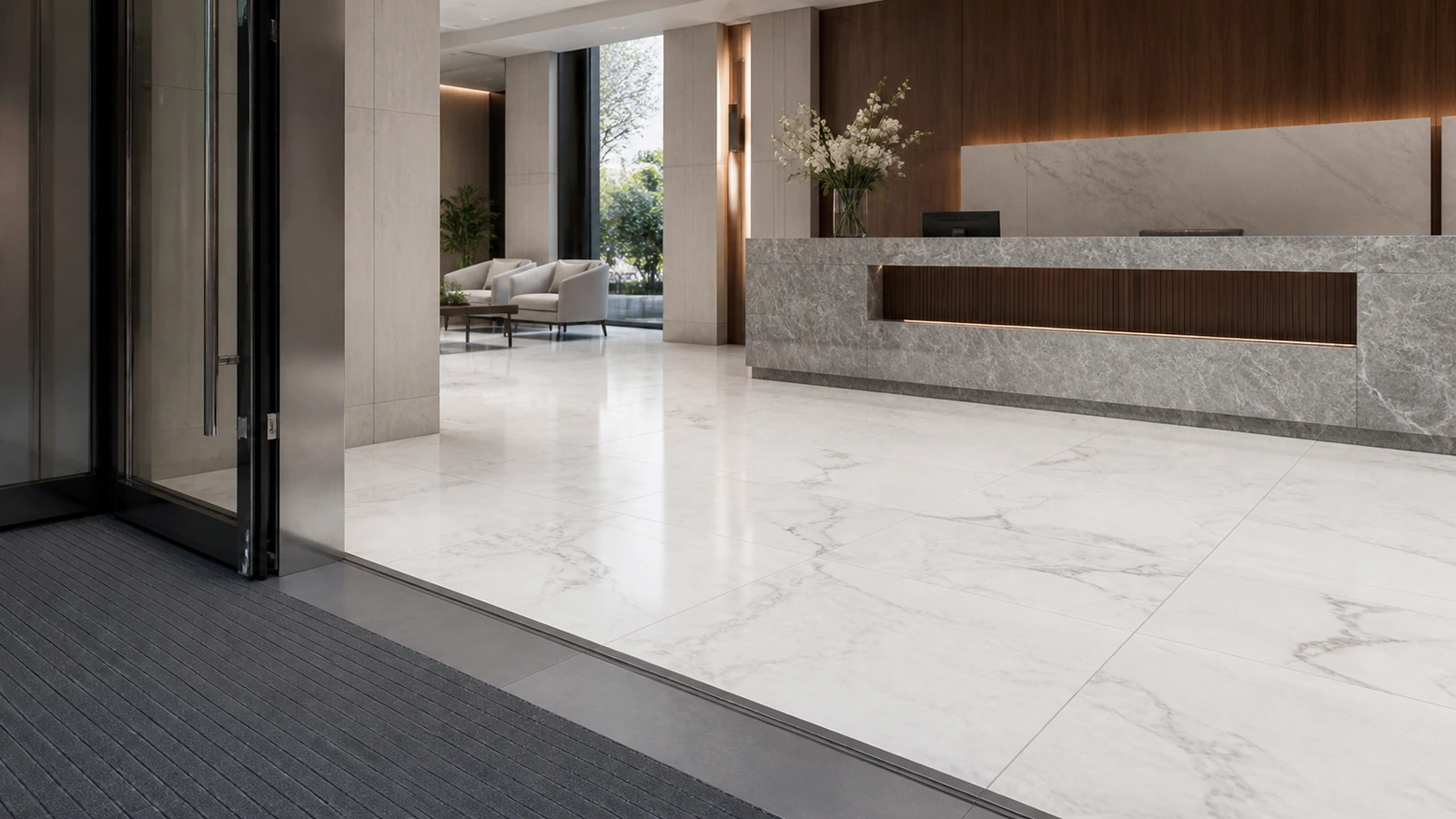
White Marble-Look GHR, Large Format
GHR classification GVT, PEI 5 | 800x800 mm, rectified | Matte or semi-polished | Rs. 130 to Rs. 210/sq.ft
Typical room cost: About Rs. 78,000 to Rs. 1.4 lakh for a 600 sq.ft reception
The floor a visitor forms an impression from within seconds of entering. Marble-look at large format reads formal, while the GHR surface handles the traffic every visitor and employee puts through this one space.
Get this detail right: Keep the polished or semi-polished specification back from the entrance itself and run an anti-skid zone across the arrival threshold, since wet footwear during monsoon lands exactly there.
Pair with: 4000K neutral lighting which keeps white marble crisp, and brushed steel or blackened brass fittings.
Avoid: Running a semi-polished finish right up to the door, which is a genuine liability in a public building during monsoon.
9. THE MEETING ROOM
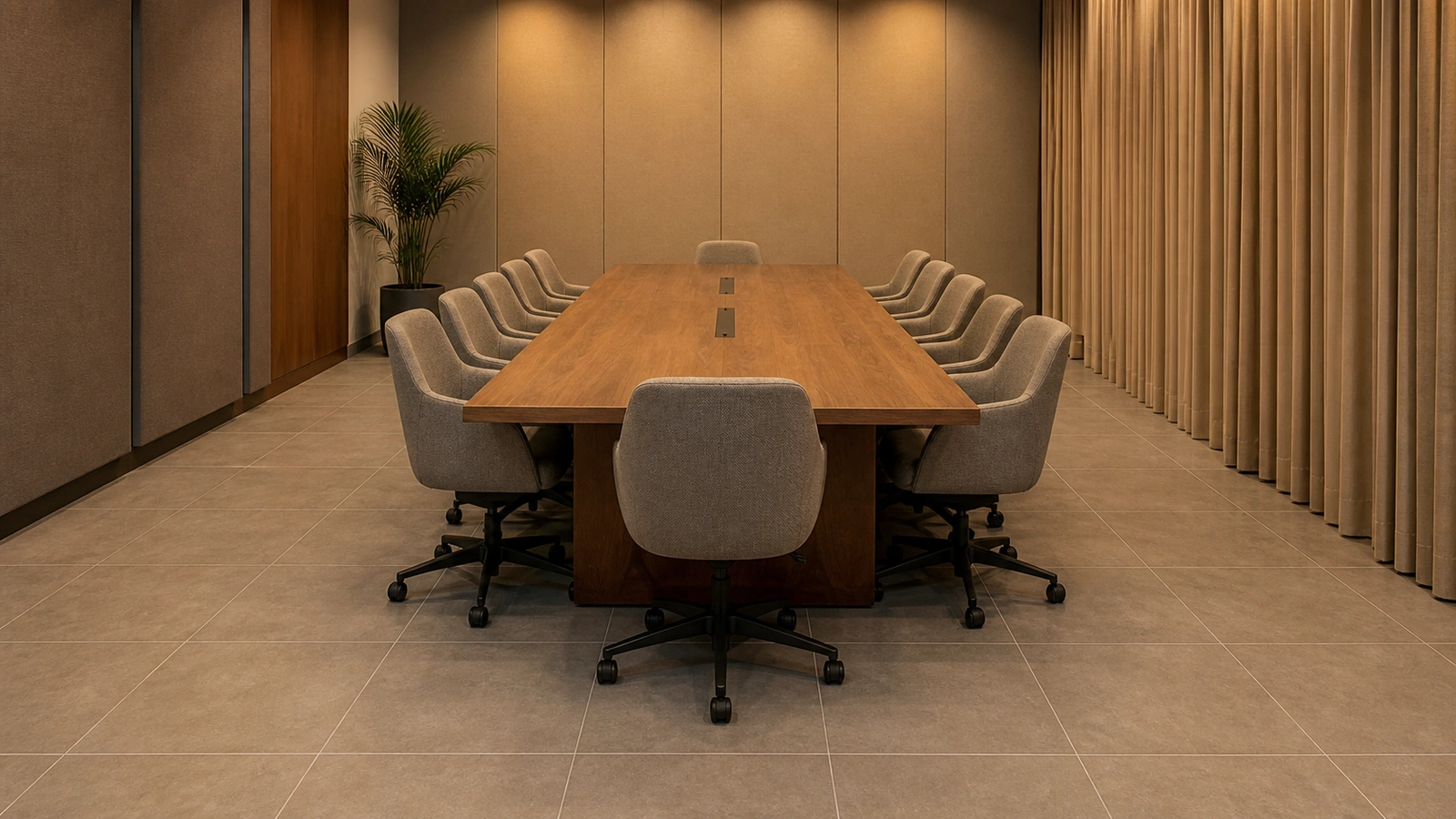
Warm Grey GHR, Medium Format
PEI 4 vitrified, GHR not required | 600x600 mm | Matte | Rs. 90 to Rs. 150/sq.ft
Typical room cost: About Rs. 39,000 to Rs. 65,000 for a 300 sq.ft room
The honest entry in this guide. A meeting room sees a fraction of the traffic a corridor does, so PEI 4 handles it comfortably, and the GHR premium buys a property this room will never test.
Get this detail right: Spend the saving on acoustic treatment instead, which affects how a meeting room actually performs far more than the floor's abrasion rating ever will.
Pair with: Soft furnishings and wall treatment to control reverberation, and a warm tone to keep the room from feeling clinical.
Avoid: Specifying GHR across an entire office including meeting rooms, which is a common and expensive default.
Healthcare and Laboratories
10. THE HOSPITAL CORRIDOR
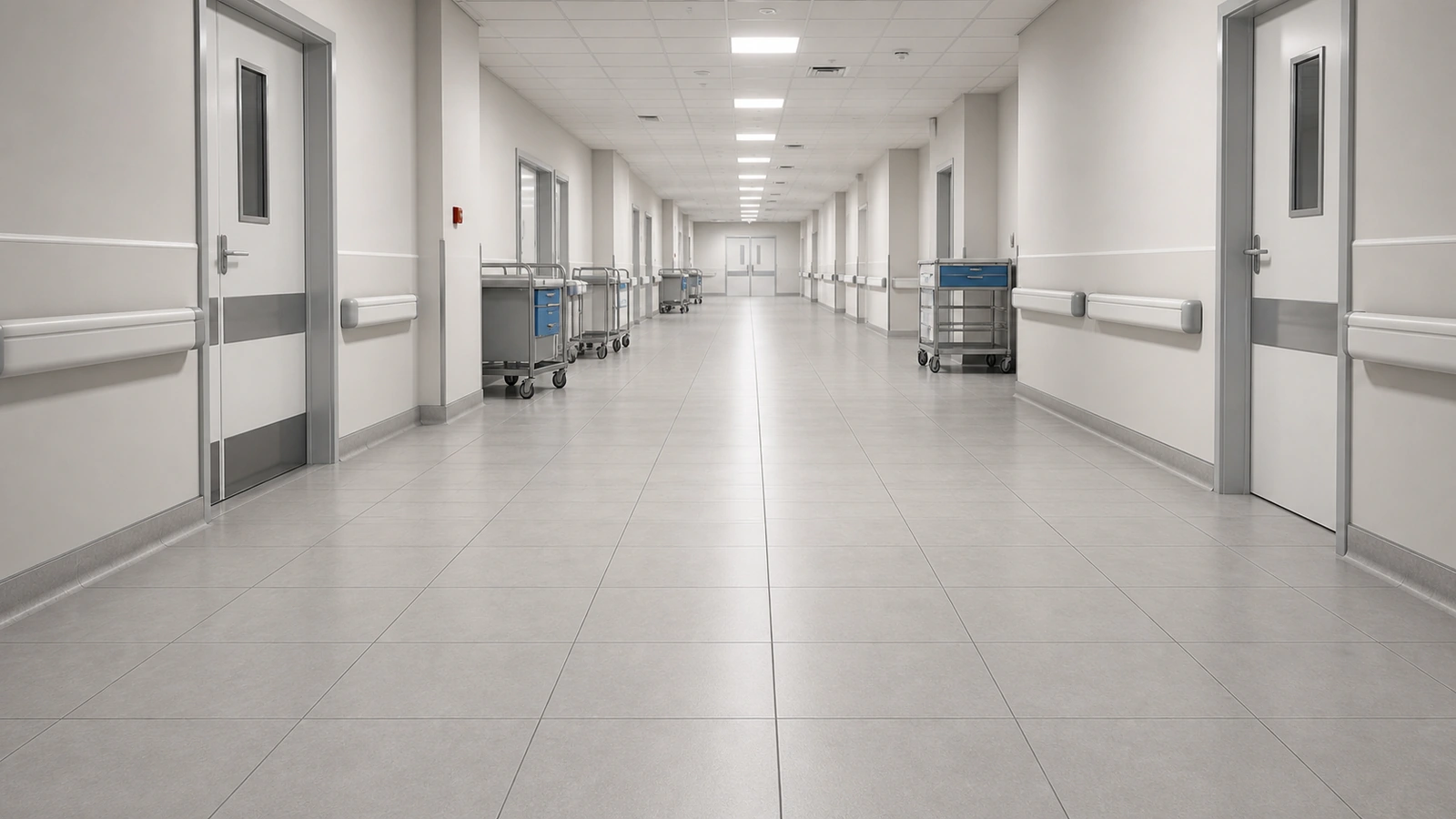
Light Grey GHR, Chemical Resistant
GHR classification GVT, PEI 5, chemical resistant, confirmed wet COF | 600x600 mm | Matte anti-skid | Rs. 130 to Rs. 200/sq.ft
Typical room cost: About Rs. 1.3 to 2.0 lakh for a 1,000 sq.ft corridor
Continuous trolley traffic, disinfectant cleaning several times daily, and a population that includes people who are unsteady on their feet. Chemical resistance matters more here than almost anywhere else.
Get this detail right: Confirm compatibility with the specific disinfectants in your cleaning protocol, since hospital-grade agents are considerably more aggressive than commercial cleaners and vary between institutions.
Pair with: Coved skirting for cleaning, epoxy grout throughout, and even lighting with no shadowed patches.
Avoid: Standard cement grout in a healthcare setting, which harbours residue and degrades under repeated disinfectant cleaning.
11. THE LAB FLOOR
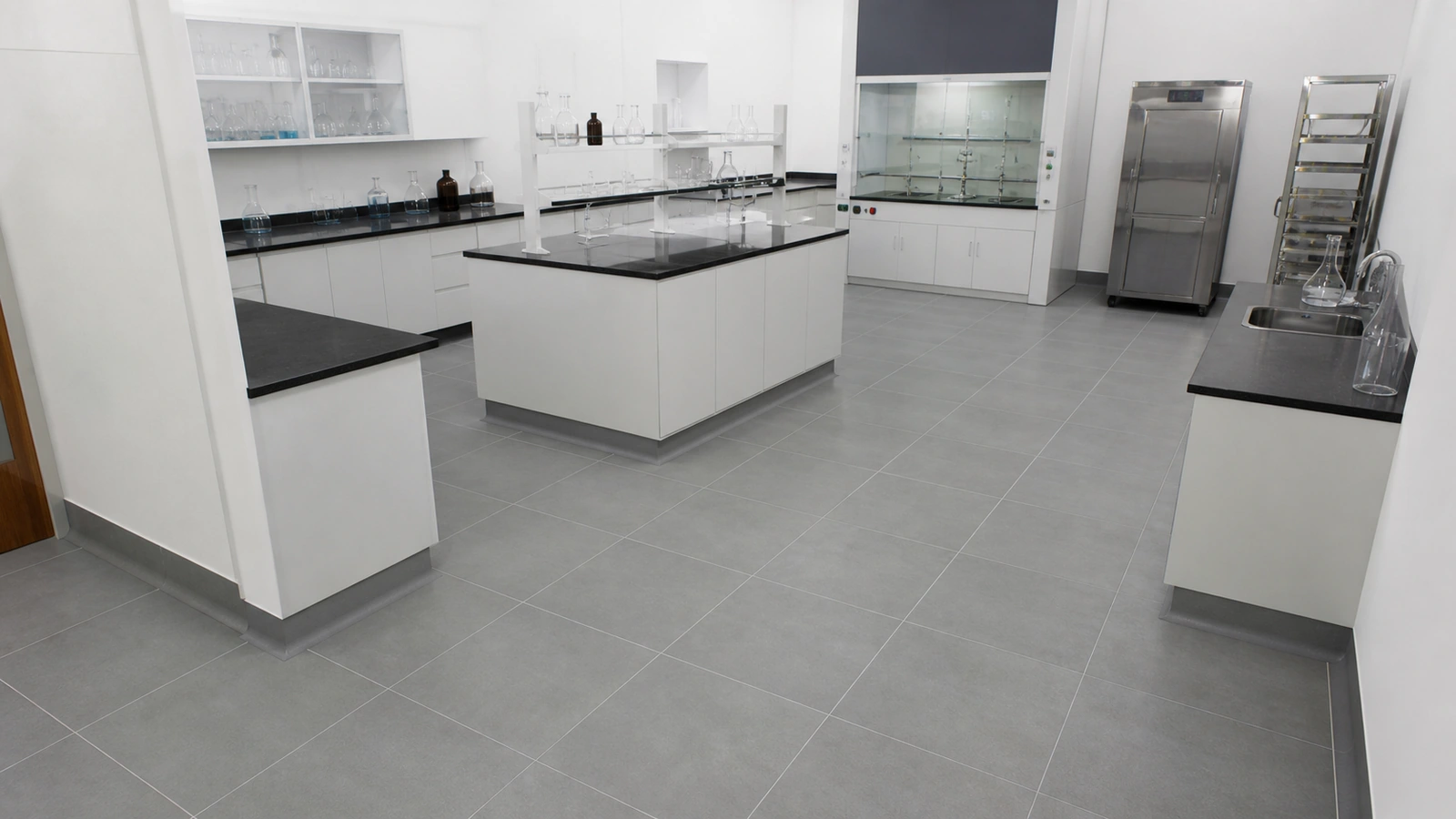
Mid-Grey GHR Full Body, Chemical Resistant
GHR classification GVT, full body, PEI 5, chemical resistant | 600x600 mm | Matte anti-skid | Rs. 140 to Rs. 210/sq.ft
Typical room cost: About Rs. 66,000 to Rs. 1.0 lakh for a 500 sq.ft lab
Full body under the GHR surface, because a laboratory floor faces both chemical spills and dropped glassware, and a chip that exposes a pale body underneath is a contamination point as much as a cosmetic one.
Get this detail right: Specify full body rather than colour body here, since chemical exposure through a chip reaches the body itself and colour body offers less depth of protection.
Pair with: Coved skirting, epoxy grout, and a documented cleaning protocol matched to the tile specification.
Avoid: Standard body construction, where a chip exposes a different material with different chemical tolerance.
12. THE CLINIC WAITING AREA
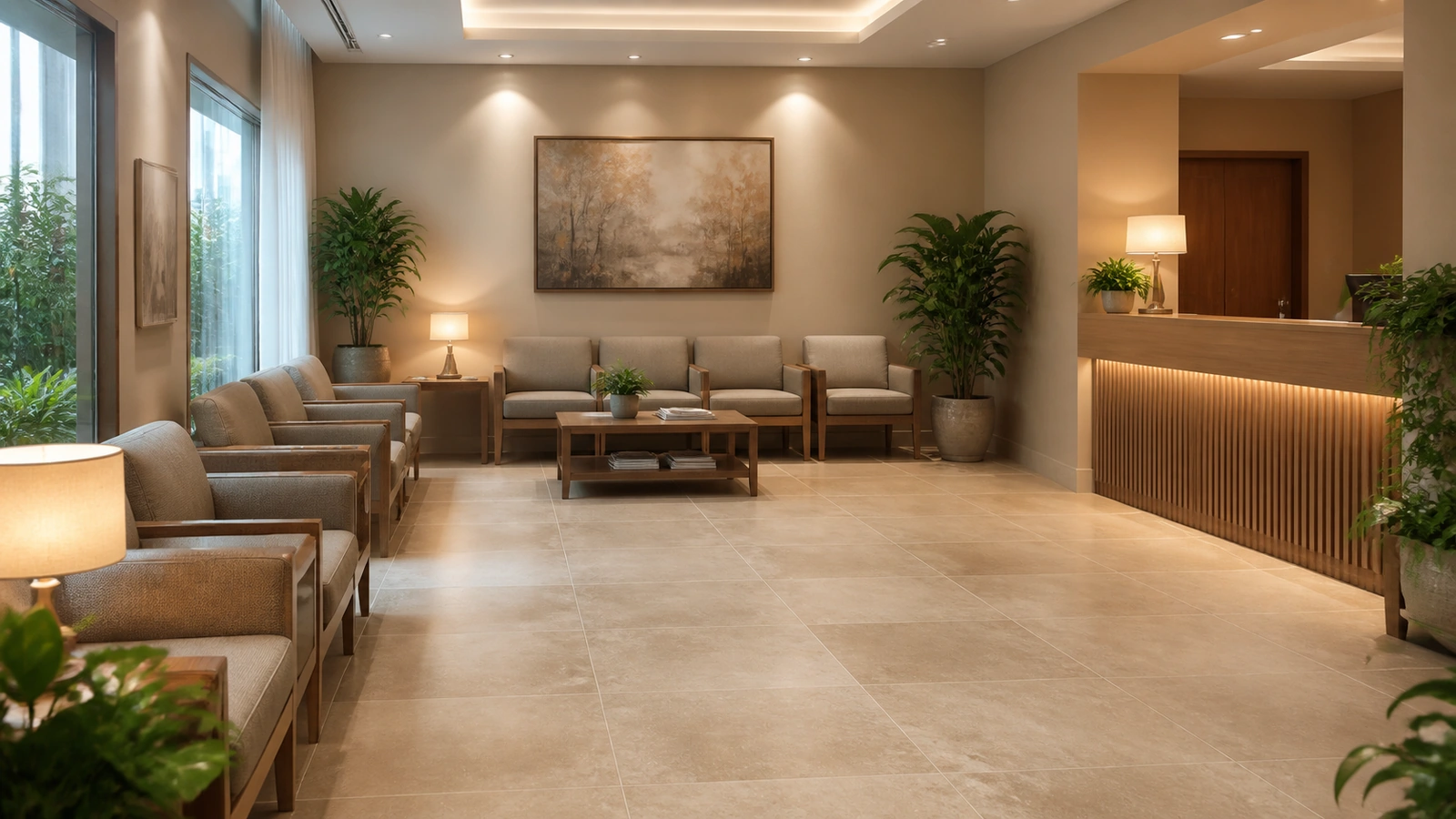
Warm Beige GHR, Stone-Look
GHR classification GVT, PEI 5, confirmed wet COF | 600x600 mm | Matte | Rs. 115 to Rs. 185/sq.ft
Typical room cost: About Rs. 78,000 to Rs. 1.2 lakh for a 600 sq.ft waiting area
A waiting area should not feel like a corridor. Warm beige stone-look reads calm and domestic while still cleaning to a clinical standard and handling continuous seating turnover.
Get this detail right: Choose a tone that does not show every mark, because a waiting room cannot be cleaned between patients and a floor that looks soiled reads as poor hygiene whether or not it is.
Pair with: Warm 3000K lighting, upholstered seating for acoustics, and epoxy grout in a matched tone.
Avoid: Cool clinical white in a waiting area, which increases anxiety in a space where people are already uncomfortable.
Warehouses and Workshops
13. THE WAREHOUSE FLOOR
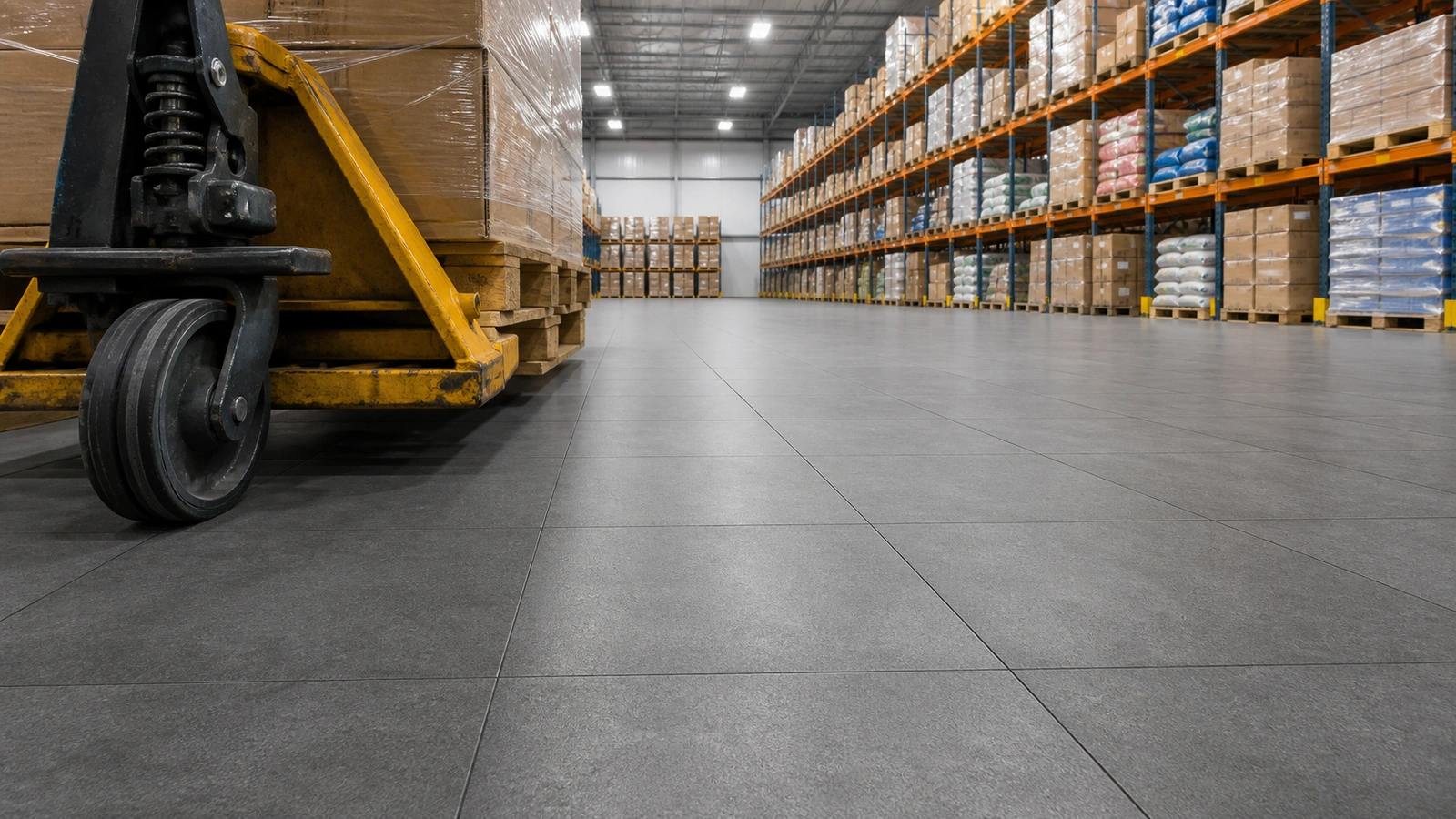
Charcoal GHR Full Body, Heavy Thickness
GHR classification GVT, full body, PEI 5, heavy thickness | 600x600 mm | Matte anti-skid | Rs. 130 to Rs. 200/sq.ft
Typical room cost: About Rs. 2.6 to 4.0 lakh for a 2,000 sq.ft warehouse
Pallet trucks, dropped stock and continuous point loading. Full body construction and a heavier thickness matter more here than the surface classification alone, and charcoal hides the marks this environment guarantees.
Get this detail right: Confirm the thickness is rated for your actual equipment loading, not general commercial use, since a pallet truck wheel concentrates weight onto a very small contact area.
Pair with: Movement joints at correct intervals across a large floor, and a substrate assessment before laying anything.
Avoid: Standard thickness under wheeled load, which cracks at the point of contact rather than wearing gradually.
14. THE WORKSHOP SURFACE
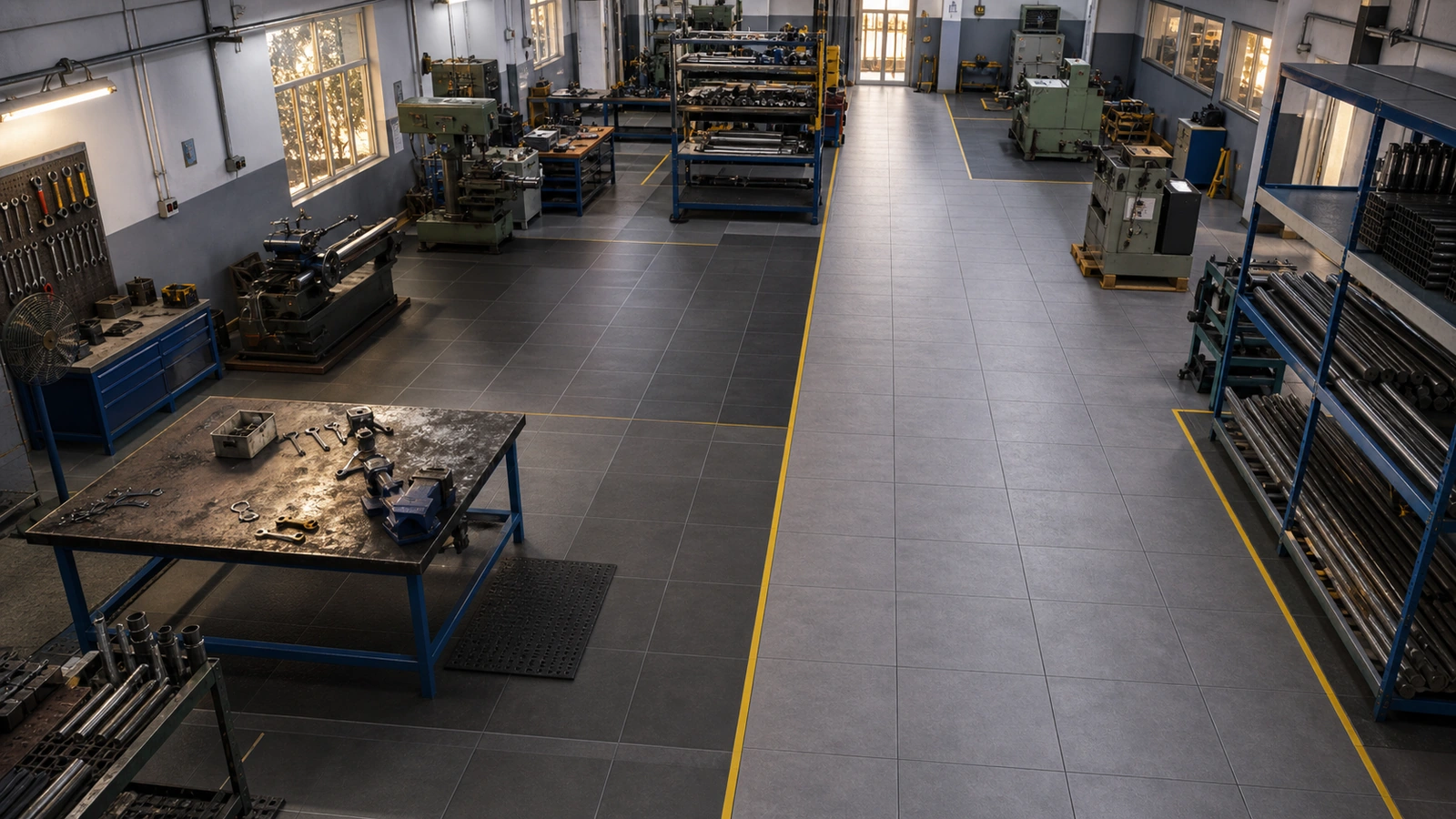
Mid-Grey GHR Full Body
GHR classification GVT, full body, PEI 5, chemical resistant | 600x600 mm | Matte anti-skid | Rs. 130 to Rs. 200/sq.ft
Typical room cost: About Rs. 96,000 to Rs. 1.5 lakh for an 800 sq.ft workshop
Impact from dropped tools, oil and solvent exposure, and abrasion from moving equipment, all in the same room. This is the environment GHR and full body were both designed for, working together.
Get this detail right: Zone the floor by activity and specify accordingly, since the area under a workbench faces different demands from a walkway and specifying one tile across both wastes money in one zone or under-specifies the other.
Pair with: Anti-fatigue matting at fixed working positions, which protects both the floor and the people standing on it.
Avoid: Treating the whole workshop as one specification, which is the most common way commercial tile budgets are misallocated.
15. THE LOADING BAY
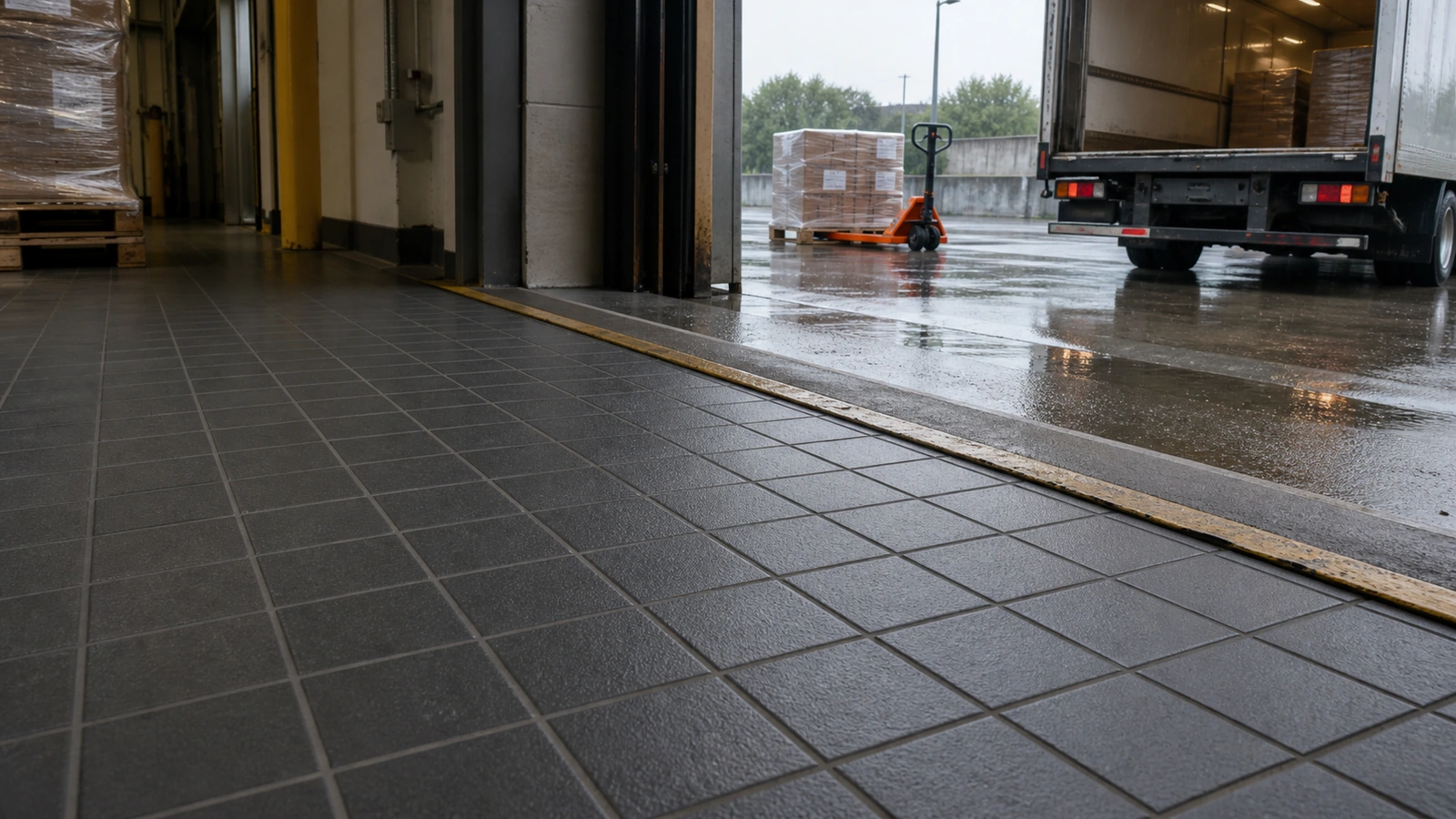
Charcoal GHR, Vehicle Load Rated, R11
GHR classification GVT, full body, PEI 5, vehicle load rated, R11 | 300x300 mm | Matte anti-skid | Rs. 135 to Rs. 200/sq.ft
Typical room cost: About Rs. 78,000 to Rs. 1.2 lakh for a 600 sq.ft bay
Vehicle loading, weather exposure at the opening, and wet footwear coming in and out. The smaller format is deliberate, since individual tiles are easier to replace when one inevitably fails.
Get this detail right: Confirm vehicle load rating separately from PEI, since PEI measures surface abrasion while vehicle loading is a structural question about thickness and body construction.
Pair with: R11 rating at the exposed opening, a drainage fall away from the interior, and contrasting edge marking at the threshold.
Avoid: PEI 5 alone as a vehicle-load specification, which confuses surface wear resistance with structural capacity.
Lobbies and Circulation
16. THE BUILDING LOBBY
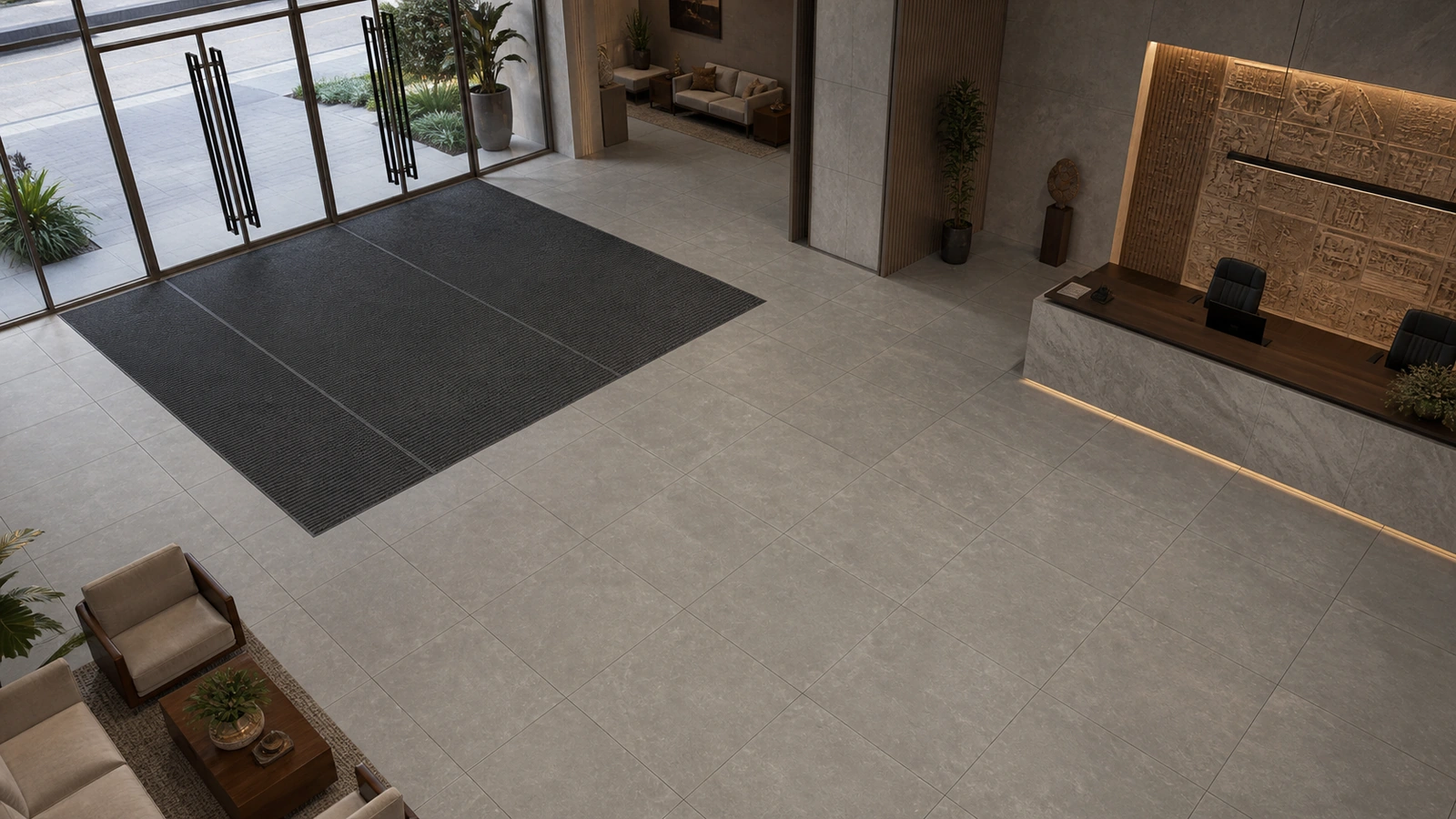
Grey Stone-Look GHR, Large Format
GHR classification GVT, PEI 5, confirmed wet COF | 800x800 mm, rectified | Matte | Rs. 120 to Rs. 190/sq.ft
Typical room cost: About Rs. 1.1 to 1.9 lakh for a 1,000 sq.ft lobby
A lobby concentrates the entire building's traffic into one space, which is why it wears faster than any individual floor above it while also being the space judged most.
Get this detail right: Budget for a barrier matting zone of at least four metres from the entrance, which removes most of the grit that causes abrasion before it reaches the tile and extends the floor's life materially.
Pair with: 4000K lighting, and a specification that steps up in grip toward the entrance rather than staying uniform.
Avoid: Skipping entrance matting to save cost, which transfers grit directly onto the most expensive floor in the building.
17. THE STAIRWELL AND CORRIDOR
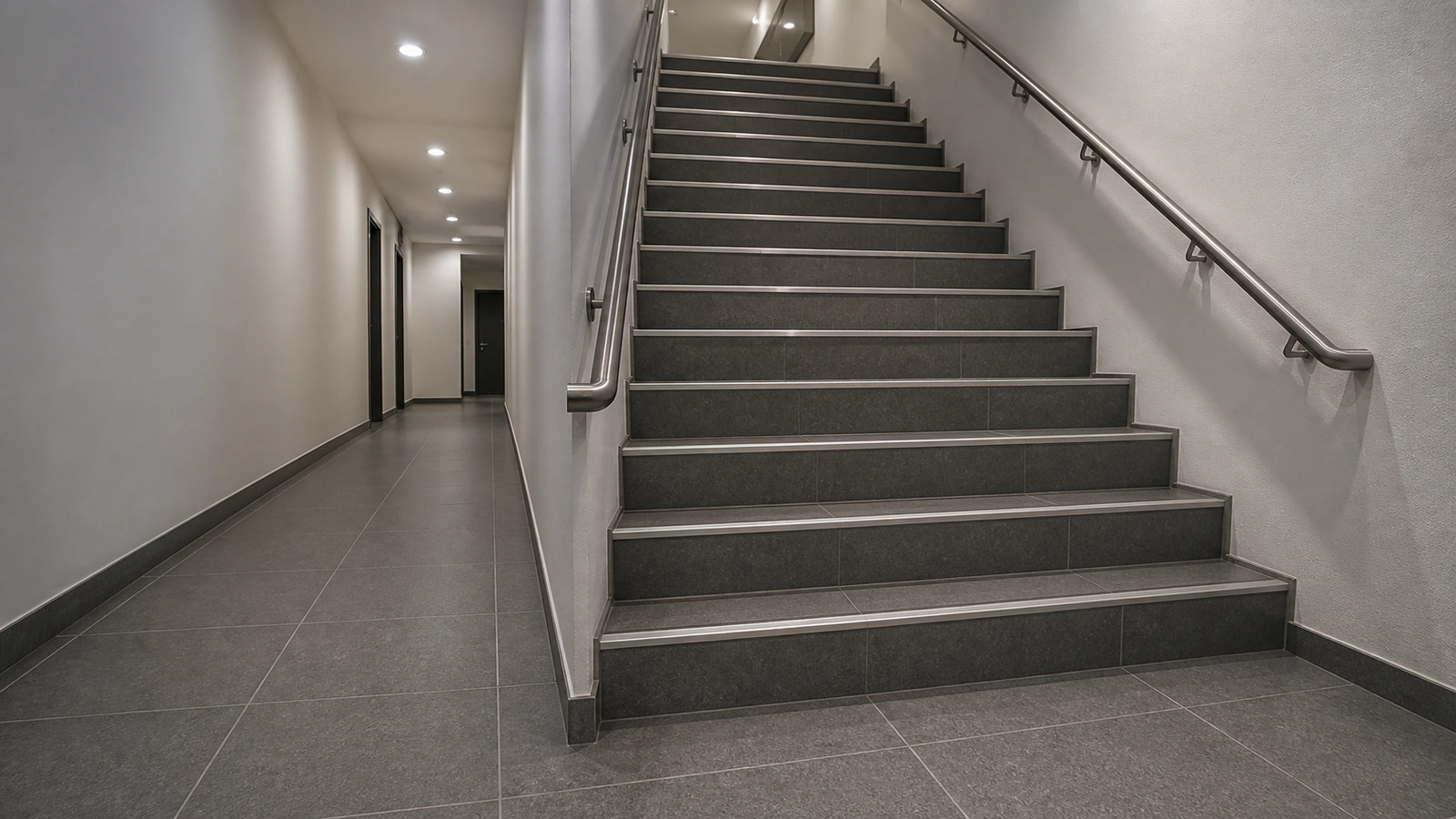
Mid-Grey GHR with Contrast Nosing
GHR classification GVT, PEI 5, confirmed wet COF | 600x600 mm | Matte anti-skid | Rs. 115 to Rs. 185/sq.ft
Typical room cost: About Rs. 52,000 to Rs. 84,000 for a 400 sq.ft run
Circulation routes take concentrated traffic in a narrow area, and stairs add consequence to any slip. A contrasting nosing on each tread is a safety element rather than a decorative one.
Get this detail right: Make every riser height consistent within 5 mm and mark each nosing in a contrasting tone, since inconsistent risers and unreadable step edges cause more falls than surface finish does.
Pair with: Lighting that reaches the tread rather than only the landing, and a handrail on both sides where width allows.
Avoid: A uniform tone across treads and risers, which makes step edges genuinely hard to read in poor light.
18. THE ENTRANCE TRANSITION
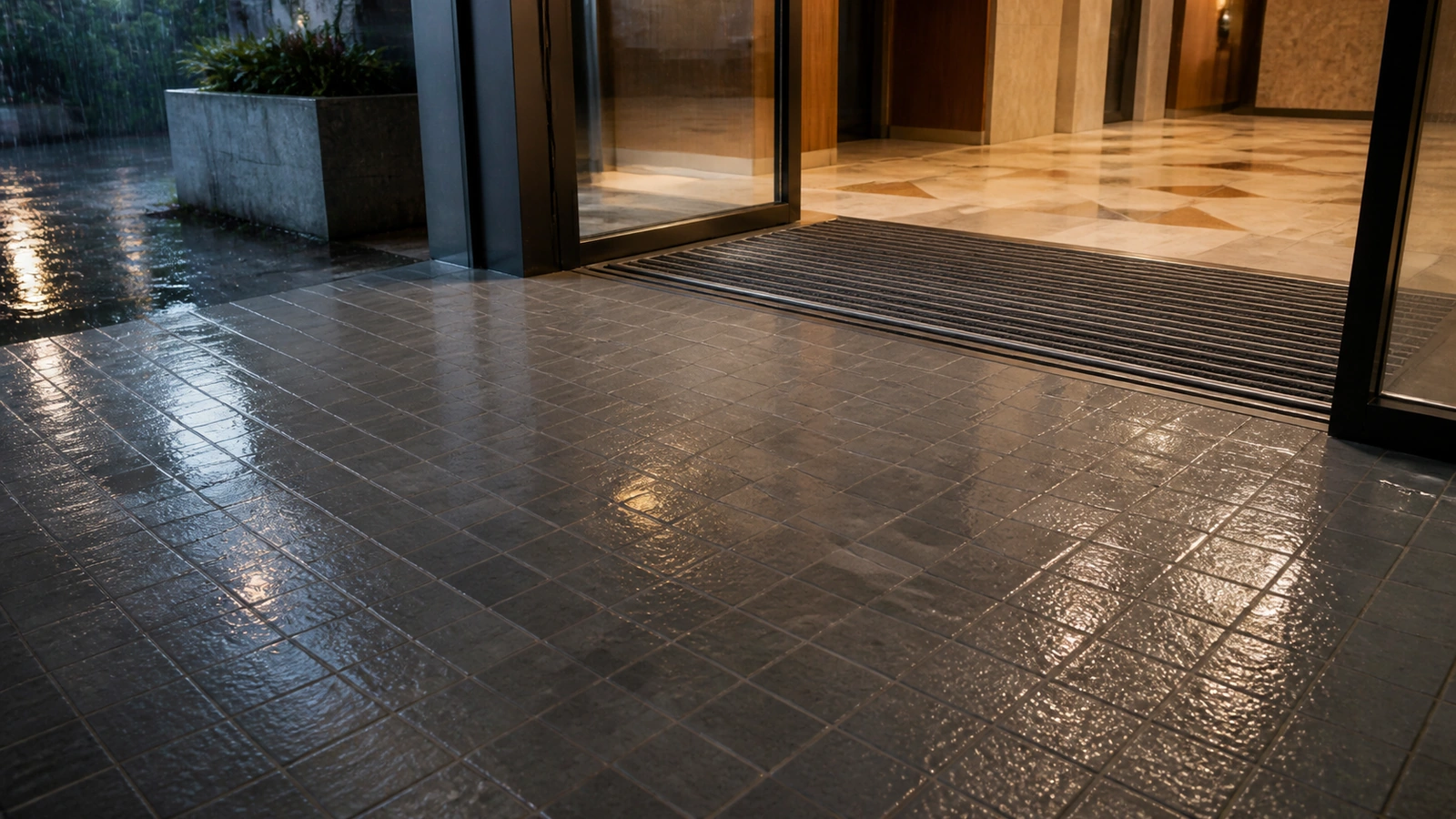
Charcoal GHR, Highest Wet COF, R11
GHR classification GVT, PEI 5, highest available wet COF, R11 | 300x300 mm | Matte anti-skid | Rs. 130 to Rs. 200/sq.ft
Typical room cost: About Rs. 26,000 to Rs. 45,000 for a 200 sq.ft entrance zone
The smallest area in this guide and the one carrying the most liability. Every person entering the building arrives here with whatever weather is outside on their feet.
Get this detail right: Specify this zone separately from the lobby beyond it, at the highest wet COF available rather than the building standard, since a uniform specification always under-serves the entrance.
Pair with: Barrier matting immediately inside, a drainage fall away from the interior, and lighting that shows the floor is wet.
Avoid: Extending the lobby's appearance-led specification to the door, which is where monsoon slip incidents in commercial buildings concentrate.
What Every Look Above Assumes
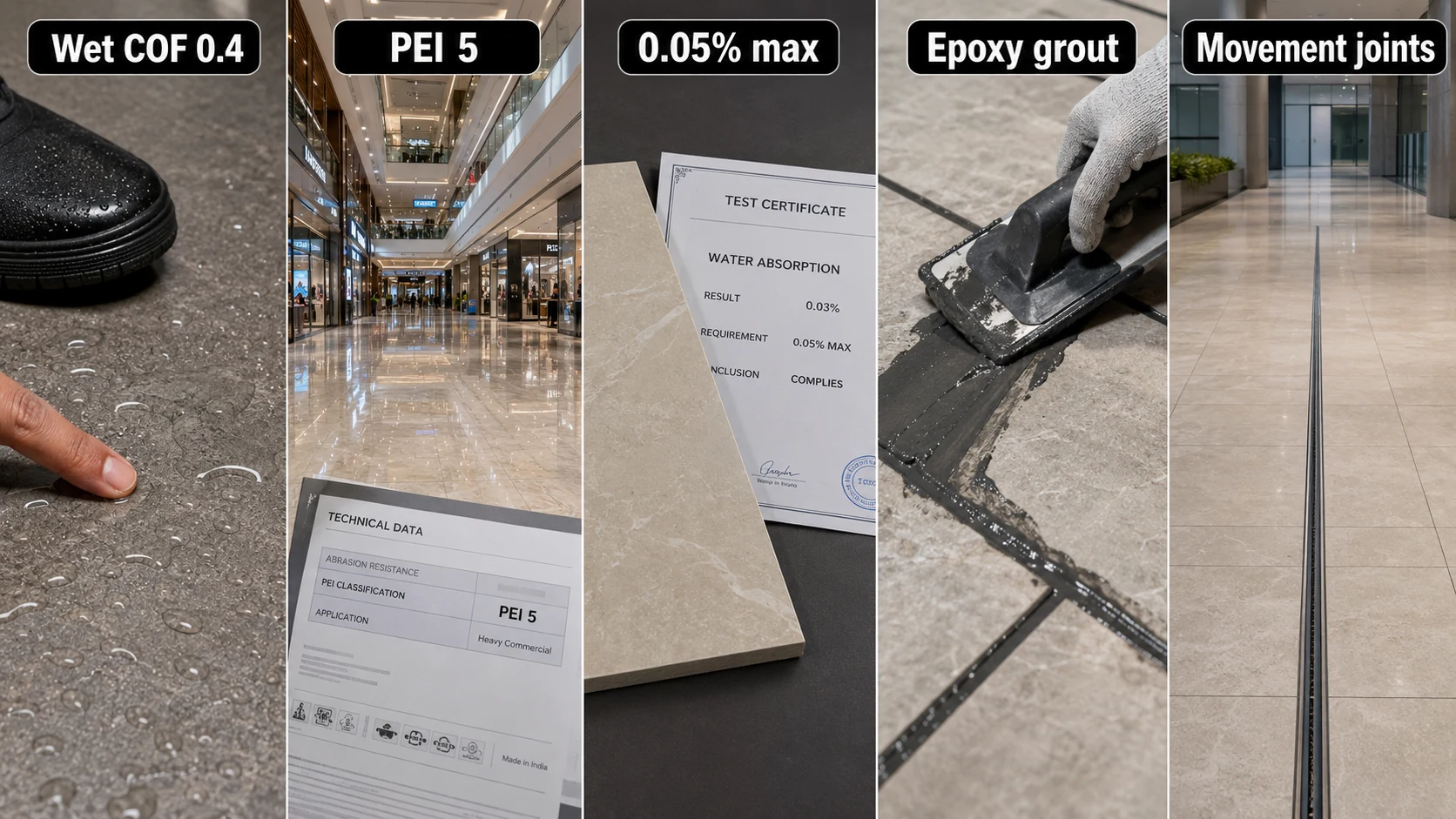
- Wet coefficient of friction confirmed separately at 0.4 minimum, and higher for entrances, kitchens and washrooms, since GHR does not cover slip resistance.
- PEI 5 confirmed on the technical data sheet, with PEI 4 genuinely sufficient in low-traffic rooms such as meeting rooms.
- Water absorption of 0.05% or below for vitrified tile, the benchmark set by the Bureau of Indian Standards under IS 15622, with the test certificate requested.
- Full body construction where impact or chemical penetration matters, since GHR reduces the chance of a chip while full body reduces its consequence.
- Epoxy grout throughout commercial floors, which survives the cleaning regimes these environments require in a way cement grout does not.
- Movement joints at correct intervals on large floor plates, since the most common commercial floor failure is installation-related rather than wear-related.
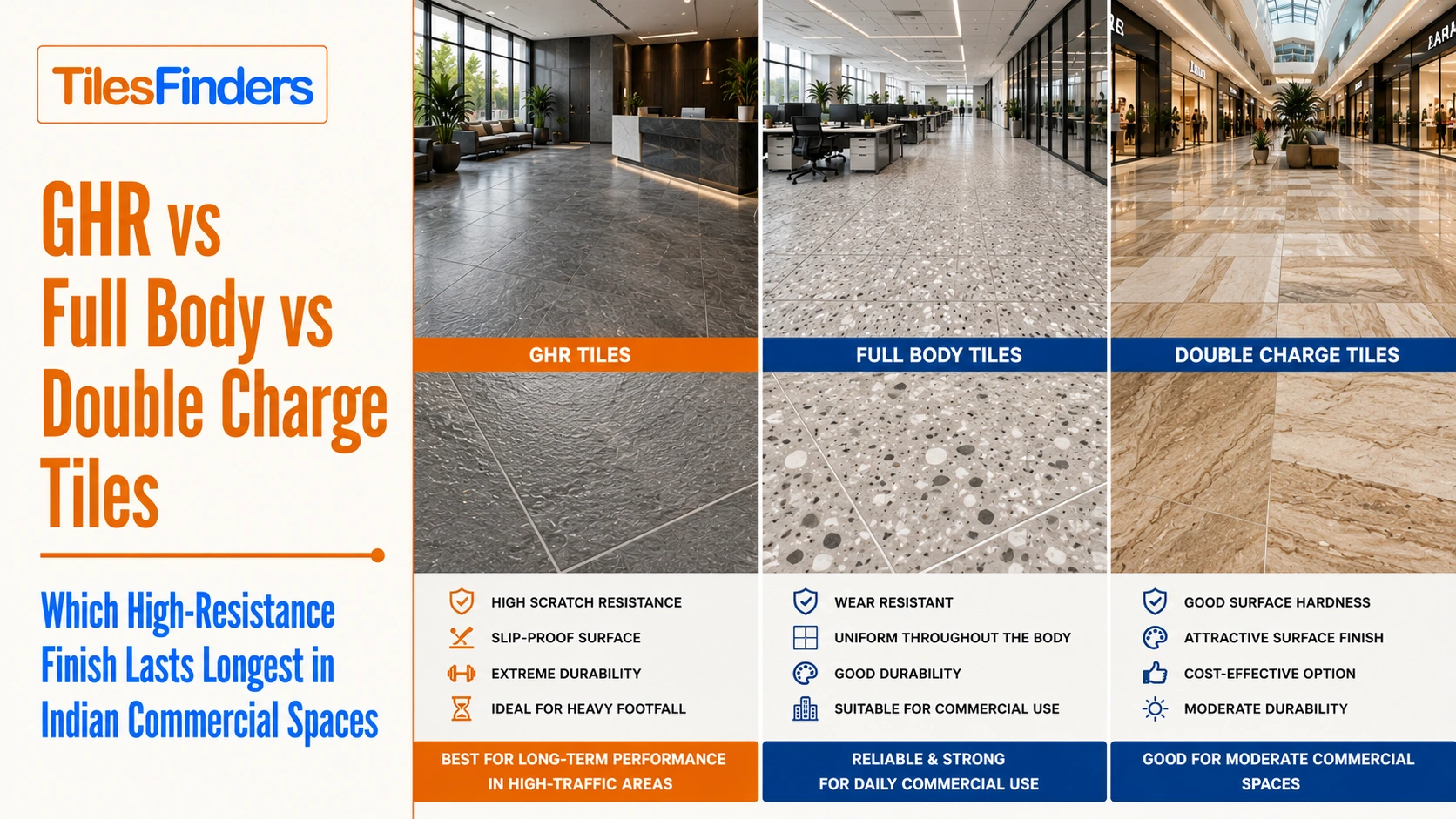
Surface durability is only one part of a commercial tile specification. GHR vs Full Body vs Double Charge explains how the surface rating differs from body construction and why combining the two can matter in high-impact environments.
Specify by Facility on TilesFinders
GHR ranges can be filtered on TilesFinders by rating, body construction and format, and the TilesFinders trade desk can support phased delivery and consolidated documentation for multi-zone commercial fit-outs where different areas need different specifications.
FAQs
No, and this is the most common way commercial tile budgets are misallocated. An entrance needs the highest available wet COF, a meeting room needs only PEI 4, and a warehouse needs full body construction and rated thickness. Specifying by zone costs less and performs better.
A commercial kitchen, which combines grease, water, heat, dropped equipment and staff moving quickly. Specify the highest wet COF available rather than the minimum, since grease on a wet floor is considerably more slippery than water alone.
No. GHR covers abrasion, chemical and impact resistance, all of which describe how the surface withstands what happens to it. Slip resistance is a separate measured property, and in a commercial building, the distinction carries liability rather than just inconvenience.
Because every person entering brings the outside weather in on their feet, concentrating wet-floor risk into a small area. A uniform building specification always under-serves the entrance, which is where monsoon slip incidents in commercial buildings concentrate.
Yes, and it is one of the highest-return items in a commercial fit-out. A barrier matting zone of at least four metres removes most of the grit that causes abrasion before it reaches the tile, materially extending the life of the most expensive floor in the building.
Where impact is routine or where a chip has consequences beyond appearance. In a warehouse, a chip is cosmetic; in a laboratory, it is a contamination point with different chemical tolerance from the surface, which is why full body matters there specifically.
Generally not. A meeting room sees a fraction of a corridor's traffic, so PEI 4 handles it comfortably. The saving is better spent on acoustic treatment, which affects how the room actually performs far more than the floor's abrasion rating.
A smaller format, such as 300x300 mm, which gives more grout lines across drainage falls and more edges underfoot. Large formats give fewer of both, precisely in the room where both matter most.
Installation rather than wear. Missing movement joints, inadequate adhesive coverage and substrate problems account for more failed commercial floors than surface abrasion, which is why the installation specification deserves as much attention as the tile rating.


See our tile guides first
Set TilesFinders as a preferred source and our buying guides surface ahead of the rest for you.
Add as preferred sourceTakes one tap. Nothing to install.
What Readers Say
I was about to redo my parking area with the wrong tile size until I read this. The layout comparisons saved me from a costly mistake.
We reference TilesFinders guides while briefing clients on material selection. The size and pattern breakdowns are accurate and easy to explain visually.
On site, I get asked about grout spacing all the time. This article gave me a solid reference I now share with my team before every job.
Finally a guide that doesn't just push generic advice. The oil stain removal steps actually worked on our clubhouse driveway tiles.
I run a small construction firm and now send this link to clients directly when they ask about entrance tile sizing. Saves me an hour of explaining.
Good practical detail, though I wish there were more examples for compact apartment entrances specifically, not just villas.
My mother-in-law wanted marble, I wanted vitrified. This blog gave us the neutral comparison we needed to actually decide together.
Detailed without being overwhelming. I appreciated that it covered both cost and maintenance, not just the aesthetics.
Used the algae and hard water removal tips on our terrace tiles after the monsoon. Worked better than what our regular cleaner was doing.
As someone who sources tiles for multiple builder projects, I find these comparisons genuinely useful for vendor conversations, not just consumer content.
Recommended this to a client who kept second-guessing the entrance design. The small vs large layout section settled the debate instantly.
Straightforward and honest, no unnecessary jargon. Would like to see a similar breakdown for outdoor pool-deck tiles next.
We've bookmarked several TilesFinders guides for our design handbook. Reliable source when clients want data, not just opinions.
Two paths, one marketplace.
Get free quotes from verified suppliers.
Share your room, budget, and style. Suppliers in local area respond within hours.
Get Free QuotesList your business, reach real buyers.
Put your showroom in front of homeowners searching for tiles right now.
List Your Business