
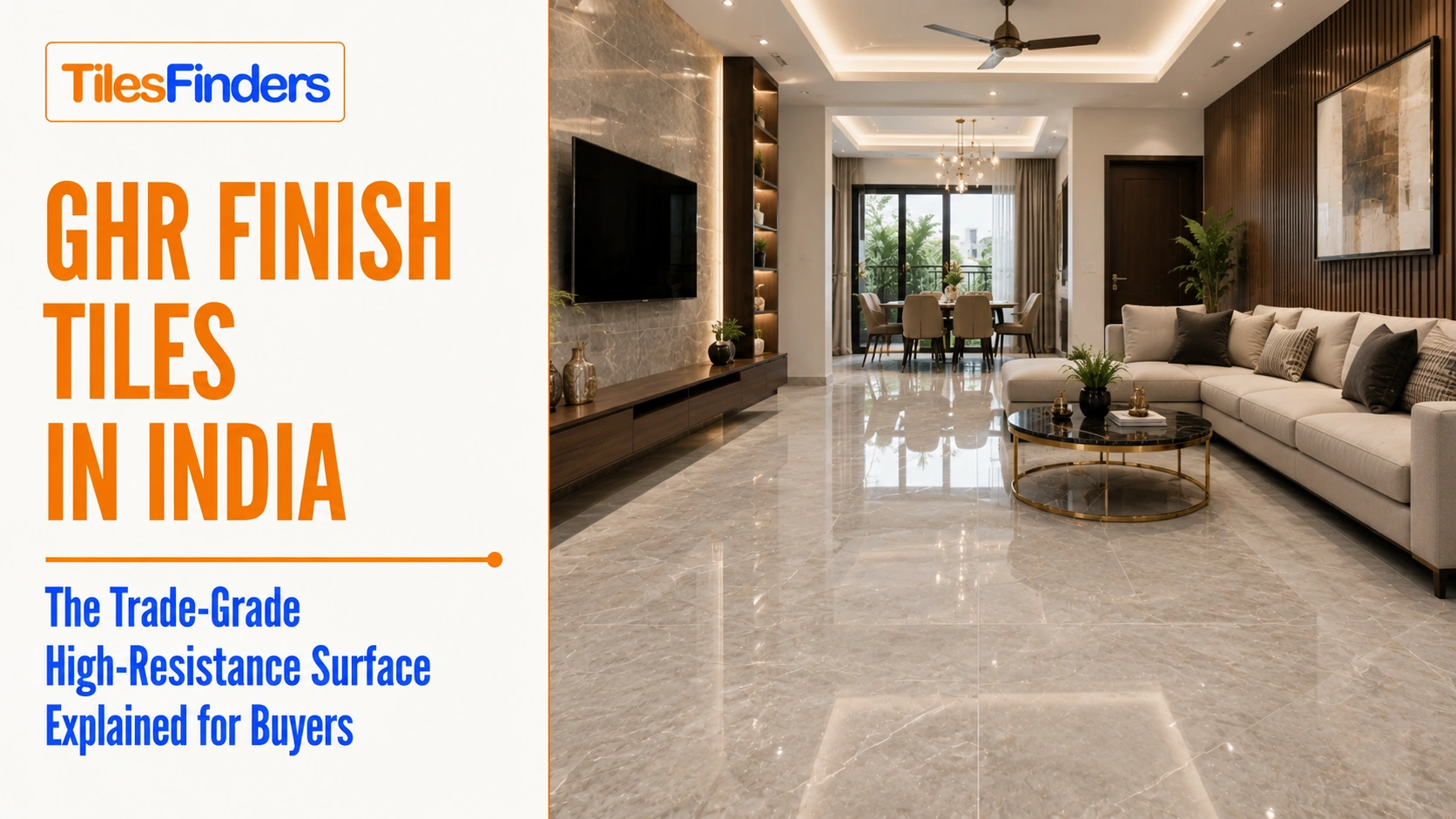
GHR Finish Tiles in India: The Trade-Grade High-Resistance Surface Explained for Buyers
GHR tiles deliver high resistance against abrasion, chemicals and impact, making them valuable for demanding commercial floors while leaving slip resistance, installation and structural performance to separate specifications.
- What GHR Bundles Together
- Failure One: The Floor Wears Dull in the Traffic Paths
- Failure Two: Cleaning Chemicals Etch or Dull the Surface
- Failure Three: Chips From Dropped Objects
- Failure Four: Somebody Slips
- Failure Five: The Tile Cracks Along a Line
- Failure Six: Tiles Lift, Tent or Sound Hollow
- The Verdict Across All Six
- Who Genuinely Needs GHR
- Who Is Probably Overpaying
- Questions to Ask a Supplier
- Buying Checklist
- Specify by Demand on TilesFinders
GHR tiles are built for heavy abrasion, chemical exposure and impact, making them most useful in demanding commercial environments. They do not guarantee slip resistance, prevent cracking or stop tiles from lifting, so those requirements must be specified separately.
GHR is a bundle rather than a single property, and understanding which failures it prevents is more useful than understanding what the letters stand for. This guide works through six ways a tiled floor actually fails in Indian conditions and gives an honest verdict on each: whether GHR tiles would have prevented it, reduced it, or made no difference at all. Two of the six it does not address, and one of those two is the failure people most often buy it to avoid.
What GHR Bundles Together
| Included in GHR | Not Included in GHR |
| PEI 5 abrasion resistance, the highest wear classification | Slip resistance, which is a separate measured property |
| Chemical resistance to cleaning agents and spills | Structural strength against substrate movement |
| Impact resistance against dropped objects | Water absorption performance, which depends on body type |
| A hard-wearing glazed surface built for commercial traffic | Anything to do with installation quality or adhesive |
The one-sentence version worth carrying with you: GHR describes how tough the surface is. It says nothing about how safe it is underfoot, how well it was laid, or what is underneath it. Every property it covers relates to the top layer of the tile resisting things that happen on top of it, which is genuinely valuable in the right setting, and completely irrelevant to the most common causes of floor failure in Indian homes. |
Failure One: The Floor Wears Dull in the Traffic Paths
A corridor, entrance or shop floor develops visibly duller lanes where people walk, while the untrafficked areas stay as they were.
| Assessment | |
| What causes it | Micro-abrasion from grit carried in on footwear, concentrated along predictable paths |
| Does GHR prevent it | Yes, this is exactly what it is for. PEI 5 is the highest abrasion classification and is genuinely worth having under heavy footfall |
| Who this affects | Shops, showrooms, offices, restaurants, building lobbies and commercial corridors |
| Who it does not affect | Most homes, where foot traffic across any single path is a fraction of commercial volume |
Failure Two: Cleaning Chemicals Etch or Dull the Surface
A floor cleaned daily with strong agents loses its finish, developing patches or an overall dullness that no amount of further cleaning restores.
| Assessment | |
| What causes it | Repeated exposure to acidic or alkaline cleaning agents attacking the glaze |
| Does GHR prevent it | Yes, chemical resistance is part of the bundle and is the property most undervalued by buyers |
| Who this affects | Commercial kitchens, hospitals, laboratories, food service floors, and anywhere cleaned with industrial agents daily |
| Who it does not affect | Households using mild detergent, which is the overwhelming majority |
Where this one crosses into homes: Chemical resistance becomes particularly relevant in a residential setting where someone cleans hard, routinely using strong acidic products on bathroom floors to tackle hard water deposits. That is common enough in India to be worth mentioning, though the better answer is usually to change the cleaning product rather than to specify a commercial tile. |
Failure Three: Chips From Dropped Objects
A visible chip appears where something heavy or sharp was dropped, exposing the body beneath the glaze.
| Assessment | |
| What causes it | Point impact exceeding what the glaze and body can absorb |
| Does GHR prevent it | Reduces rather than prevents. Impact resistance is part of the bundle, but no glaze is immune to a heavy object dropped from height |
| What helps more | A full body or colour body construction, where the colour runs through the tile so a chip is far less visible even when it happens |
| Who this affects | Warehouses, workshops, commercial kitchens, and homes where heavy items are handled over hard floors |
The distinction worth making here: GHR reduces the chance of a chip. Full body construction reduces how much a chip matters. They address the same failure from different directions, and they are not alternatives, which is why heavy-duty specifications frequently combine both. If chipping is your genuine concern, ask about body construction as well as surface rating rather than treating GHR as a complete answer. |
Failure Four: Somebody Slips
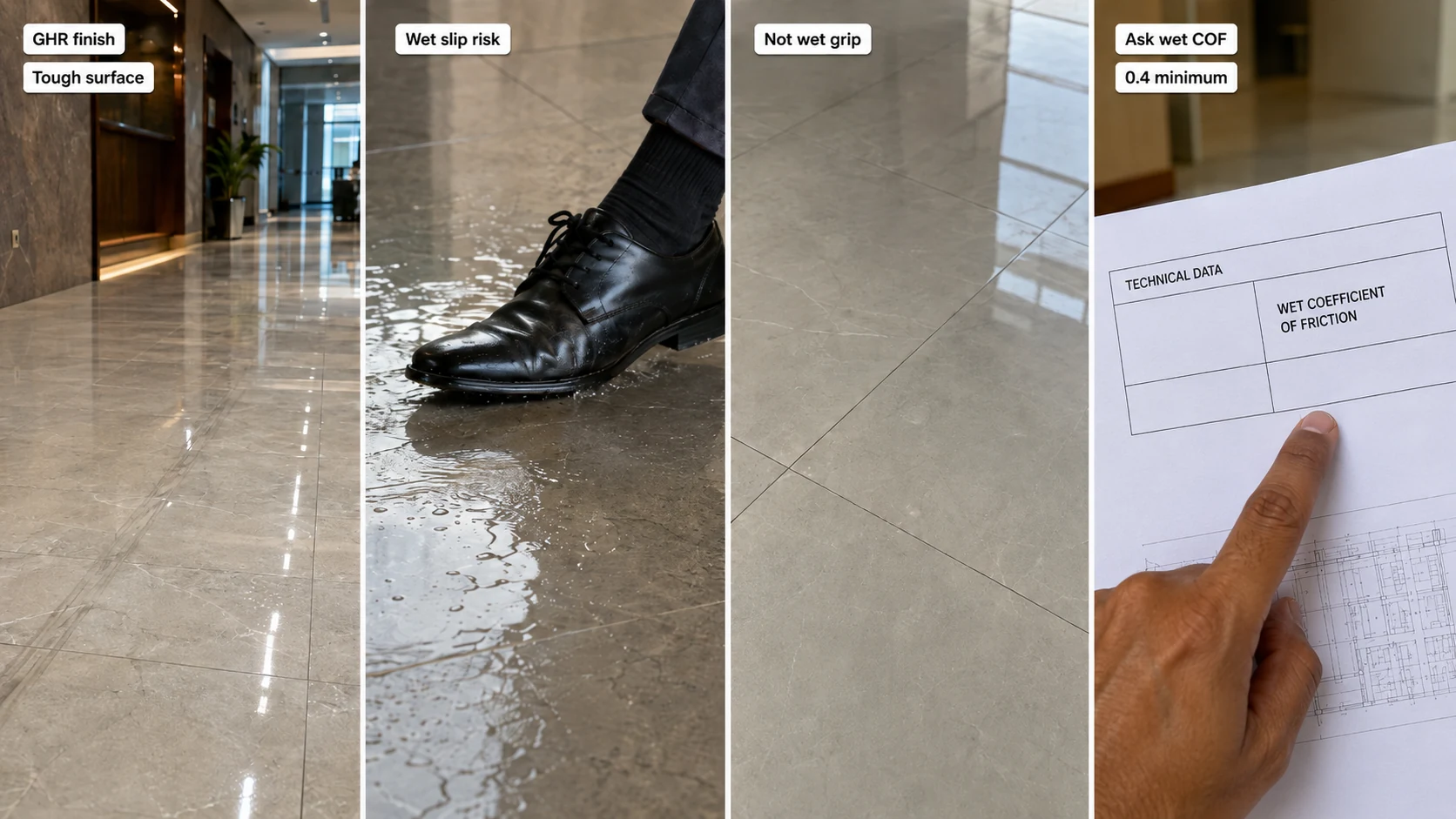
GHR contributes nothing to this, and it is the most consequential gap in the bundle: Abrasion resistance, chemical resistance and impact resistance all describe how the surface withstands what happens to it. None of them describes how a foot behaves on it when wet. A GHR tile can be entirely smooth and highly polished, and a smooth polished surface is unsafe on a wet floor regardless of how tough it is. This matters because GHR is marketed as a premium, heavy-duty, commercial-grade specification, and buyers reasonably infer that a tougher tile is a safer one. It is not the same property. For any floor that gets wet, ask for the wet coefficient of friction separately and look for 0.4 as the minimum, whatever the tile's resistance rating says. |
Popular tiles right now

Failure Five: The Tile Cracks Along a Line
Cracks appear running across several tiles in a consistent line, often following the same path through tile and grout alike.
| Assessment | |
| What causes it | Movement in the substrate beneath, whether from settlement, deflection or a structural crack telegraphing upward |
| Does GHR prevent it | No. This is a structural problem happening below the tile, and no surface property addresses it |
| What actually helps | Correct substrate preparation, adequate movement joints, and a structural assessment before relaying anything |
| Common misdiagnosis | Blaming the tile and specifying a tougher one, which produces the identical failure again in the same place |
Failure Six: Tiles Lift, Tent or Sound Hollow
Tiles debond from the substrate, lifting into a ridge or sounding hollow when tapped.
| Assessment | |
| What causes it | Missing expansion joints, inadequate adhesive coverage, an uncured screed or moisture reaching the underside |
| Does GHR prevent it | No. Every cause here sits at the interface between tile and building rather than on the tile surface |
| What actually helps | Expansion joints, full adhesive coverage, a properly cured substrate and resolved moisture sources |
| Why it matters here | This is among the most common floor failures in Indian buildings, and it is entirely unaffected by which surface rating you bought |
The Verdict Across All Six
| Failure | Does GHR Help? | Genuine Answer |
| Traffic path wear | Yes, substantially | PEI 5 abrasion resistance |
| Chemical etching | Yes, substantially | Chemical resistance in the bundle |
| Chips from impact | Partly | GHR reduces the chance; full body reduces the visibility |
| Slipping on a wet floor | No | Confirm wet coefficient of friction separately, 0.4 minimum |
| Cracking along a line | No | Substrate assessment and movement joints |
| Lifting and hollow tiles | No | Expansion joints, adhesive coverage, cured substrate |
What that table adds up to: GHR genuinely solves two of these six and partly addresses a third. All three are surface-wear problems, which is precisely what a heavy-duty glaze is designed for. The other three are the most common causes of floor failure in Indian buildings, and they are installation and structural issues that no tile specification can fix. Buying GHR to avoid them is buying the wrong solution to the right problem. |
Who Genuinely Needs GHR
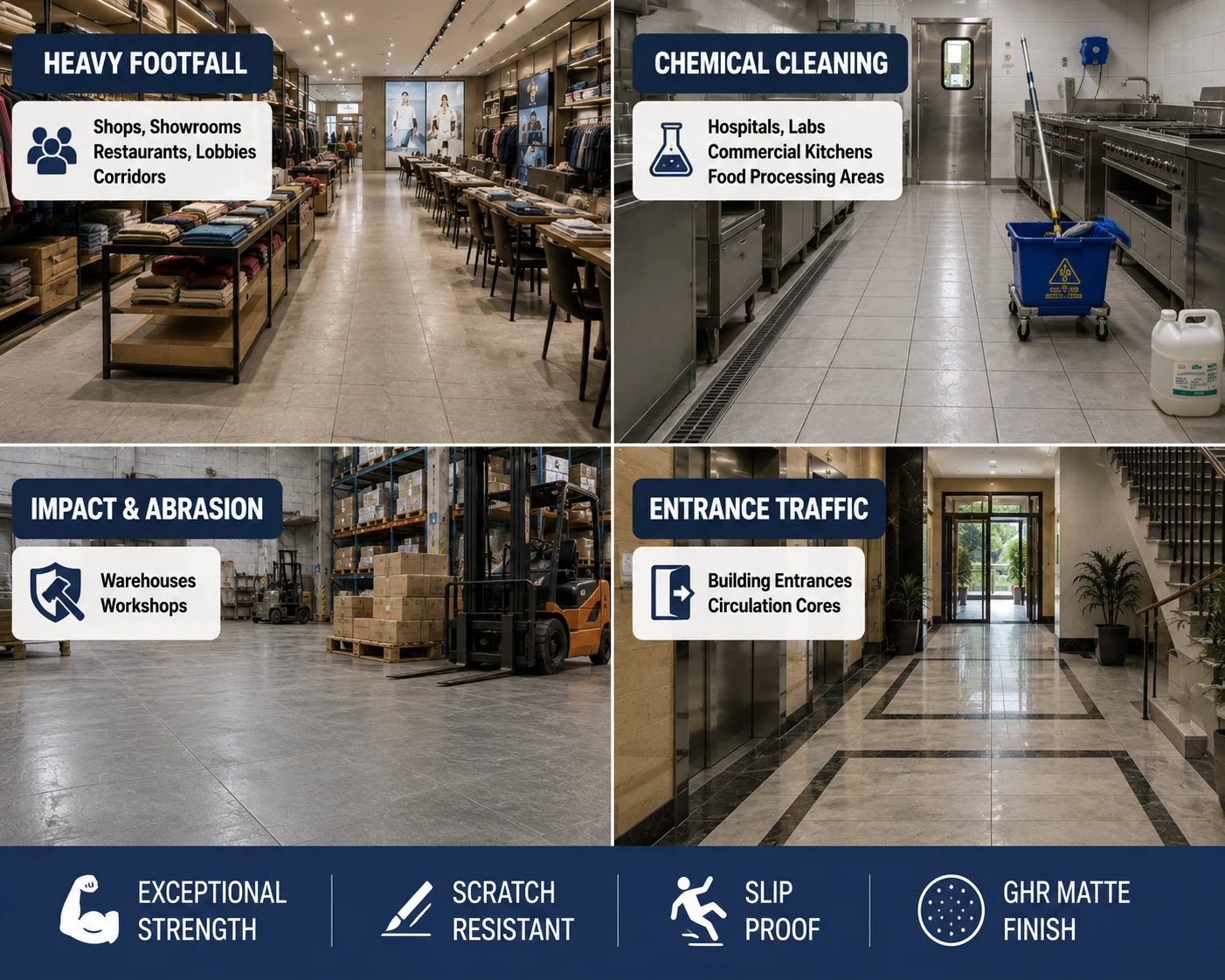
- Commercial floors with heavy daily footfall, including shops, showrooms, restaurants, office lobbies and building corridors, where traffic volume genuinely exceeds what a residential tile is built for.
- Facilities cleaned with industrial chemical agents daily, such as hospitals, laboratories, commercial kitchens and food processing areas.
- Warehouses and workshops, where impact and abrasion both occur routinely and often together.
- Building entrances and circulation cores, which concentrate the traffic of an entire building into a small area.
Who Is Probably Overpaying
| Situation | Why GHR Is Unnecessary | What to Specify Instead |
| Standard residential living room | Household foot traffic is a fraction of commercial volume; PEI 4 handles it comfortably | PEI 4 vitrified in the finish you actually want |
| Residential bedroom | Very light traffic, no chemical exposure, minimal impact risk | PEI 3 or 4 is genuinely sufficient |
| Home bathroom floor | Wet grip matters far more than abrasion here, and GHR does not provide it | Anti-skid matte, punch or matte carving with confirmed wet COF |
| Residential balcony | Weather resistance and grip are the requirements, not commercial abrasion | Outdoor-rated anti-skid with confirmed R-rating |
| Any wall | Walls experience no abrasion, no impact and no foot traffic at all | Whatever finish suits the design brief |
An honest note on the price difference: GHR typically carries a premium over an equivalent standard vitrified tile. In a genuinely commercial setting that premium buys years of additional service life and is straightforwardly worth paying. In a bedroom it buys a property that will never be tested. The tile is not being oversold in either case; the specification simply has to match the demand placed on it. |
Questions to Ask a Supplier
Confirming what the rating actually covers: "Is this GHR classification covering abrasion, chemical and impact resistance together, and can you show me the technical data sheet with the PEI figure stated?" |
Separating grip from toughness: "This floor will get wet. What is the wet coefficient of friction? I understand GHR covers surface resistance rather than slip resistance, so I need that figure separately." |
If chipping is your concern: "What is the body construction underneath, standard, colour body or full body? I want to know how visible a chip would be, not only how likely it is." |
When a supplier recommends GHR for a home: "What specifically about this room would benefit from commercial-grade abrasion and chemical resistance? If it is a normal residential floor, I would rather spend the difference on the finish or the format." |
Buying Checklist
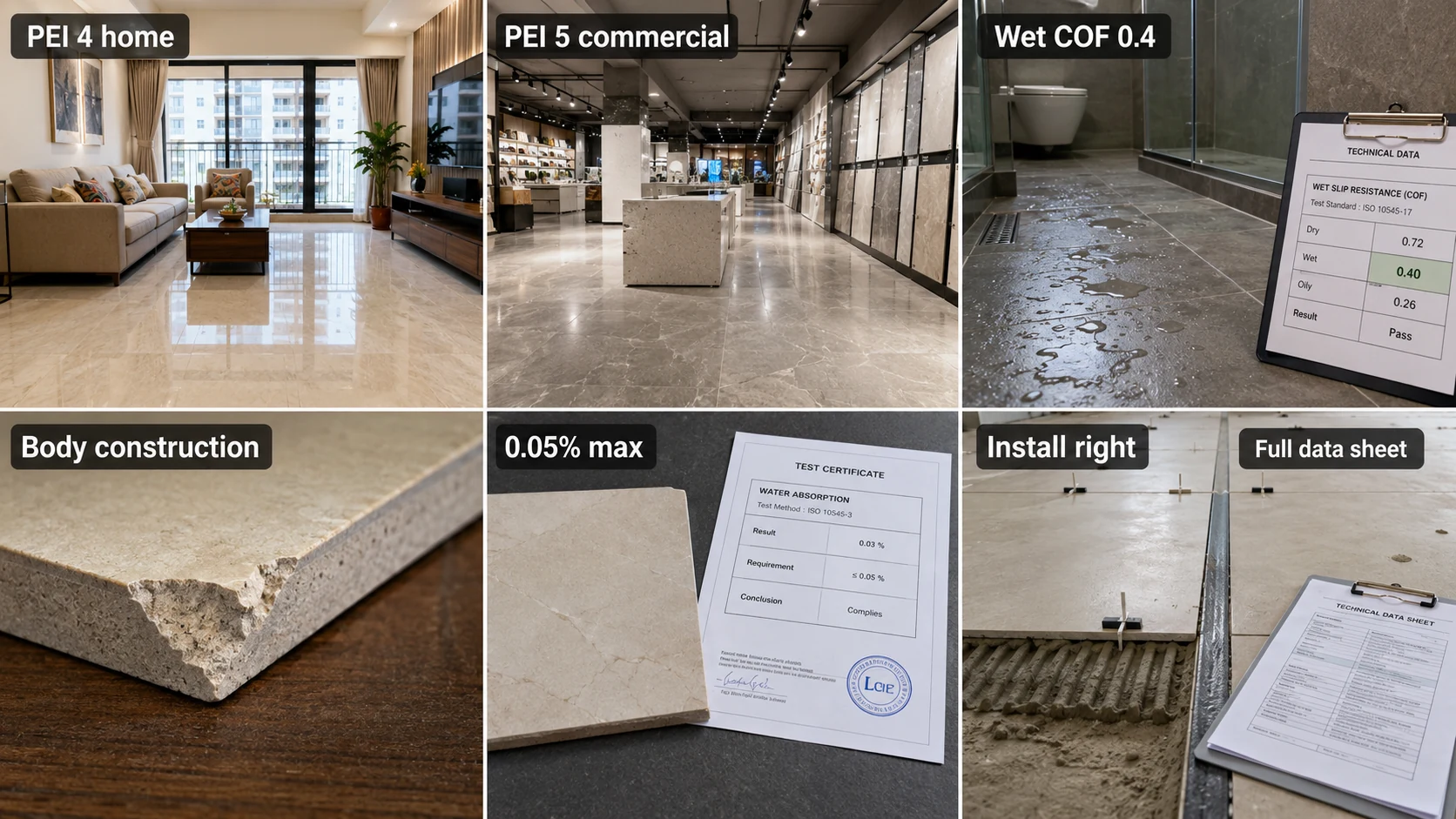
- Match the rating to the actual traffic, since PEI 4 handles normal residential use comfortably and PEI 5 exists for commercial volume.
- Confirm wet coefficient of friction separately for any floor that gets wet, at 0.4 minimum, because GHR does not address it.
- Ask about body construction as well as surface rating if impact and chipping are genuine concerns.
- Confirm water absorption of 0.05% or below for vitrified tile, the benchmark set by the Bureau of Indian Standards under IS 15622, with the test certificate requested.
- Get the installation right regardless of rating, since expansion joints, adhesive coverage and substrate preparation cause more floor failures than surface wear ever will.
- Request the full technical data sheet for tender or procurement, covering PEI, chemical resistance and impact tolerance together rather than a single marketing classification.
Specify by Demand on TilesFinders
GHR and standard vitrified ranges can be compared on TilesFinders by rating, body construction and finish, so you can match the specification to the demand a floor will actually face rather than paying for resistance a room will never test.

FAQs
PEI 5 abrasion resistance, chemical resistance to cleaning agents and spills, and impact resistance, bundled into one classification. All three describe how the surface withstands what happens on top of it.
No, and this is the most consequential misunderstanding around the classification. Slip resistance is a separate measured property. A GHR tile can be smooth and polished, which is unsafe on a wet floor, however tough the surface is. Ask for wet coefficient of friction separately, at 0.4 minimum.
No. Cracking along a line comes from substrate movement, and lifting or hollow tiles come from missing expansion joints, poor adhesive coverage or an uncured screed. All of those happen beneath the tile, where no surface property reaches.
Almost certainly not for living rooms, bedrooms, balconies or walls, where PEI 4 or lower handles the demand comfortably. It becomes worth considering only where residential use genuinely approaches commercial intensity, which is rare.
Shops, showrooms, restaurants, office lobbies, hospitals, laboratories, commercial kitchens, warehouses and building circulation cores, where footfall volume or chemical exposure would wear a standard tile within a few years.
They address different things. GHR reduces the chance of a chip happening; full body reduces how visible a chip is when it does, because the colour runs through the whole tile. Heavy-duty specifications frequently use both rather than choosing between them.
Only if the wet coefficient of friction is confirmed separately at 0.4 minimum. In a home bathroom, grip matters considerably more than abrasion resistance, so an anti-skid matte, punch or matte carving finish is usually the better specification.
Occasionally. Households that clean bathroom floors with strong acidic products to tackle hard water deposits do put a glaze under genuine chemical stress. The better answer is usually changing the cleaning product rather than specifying a commercial-grade tile.


See our tile guides first
Set TilesFinders as a preferred source and our buying guides surface ahead of the rest for you.
Add as preferred sourceTakes one tap. Nothing to install.
What Readers Say
I was about to redo my parking area with the wrong tile size until I read this. The layout comparisons saved me from a costly mistake.
We reference TilesFinders guides while briefing clients on material selection. The size and pattern breakdowns are accurate and easy to explain visually.
On site, I get asked about grout spacing all the time. This article gave me a solid reference I now share with my team before every job.
Finally a guide that doesn't just push generic advice. The oil stain removal steps actually worked on our clubhouse driveway tiles.
I run a small construction firm and now send this link to clients directly when they ask about entrance tile sizing. Saves me an hour of explaining.
Good practical detail, though I wish there were more examples for compact apartment entrances specifically, not just villas.
My mother-in-law wanted marble, I wanted vitrified. This blog gave us the neutral comparison we needed to actually decide together.
Detailed without being overwhelming. I appreciated that it covered both cost and maintenance, not just the aesthetics.
Used the algae and hard water removal tips on our terrace tiles after the monsoon. Worked better than what our regular cleaner was doing.
As someone who sources tiles for multiple builder projects, I find these comparisons genuinely useful for vendor conversations, not just consumer content.
Recommended this to a client who kept second-guessing the entrance design. The small vs large layout section settled the debate instantly.
Straightforward and honest, no unnecessary jargon. Would like to see a similar breakdown for outdoor pool-deck tiles next.
We've bookmarked several TilesFinders guides for our design handbook. Reliable source when clients want data, not just opinions.
Two paths, one marketplace.
Get free quotes from verified suppliers.
Share your room, budget, and style. Suppliers in local area respond within hours.
Get Free QuotesList your business, reach real buyers.
Put your showroom in front of homeowners searching for tiles right now.
List Your Business