
GHR vs Full Body vs Double Charge Tiles: Which High-Resistance Finish Lasts Longest in Indian Commercial Spaces
GHR, full-body and double charge tiles compared across 20 years, revealing how surface resistance, body construction, installation quality and service life affect Indian commercial flooring costs.
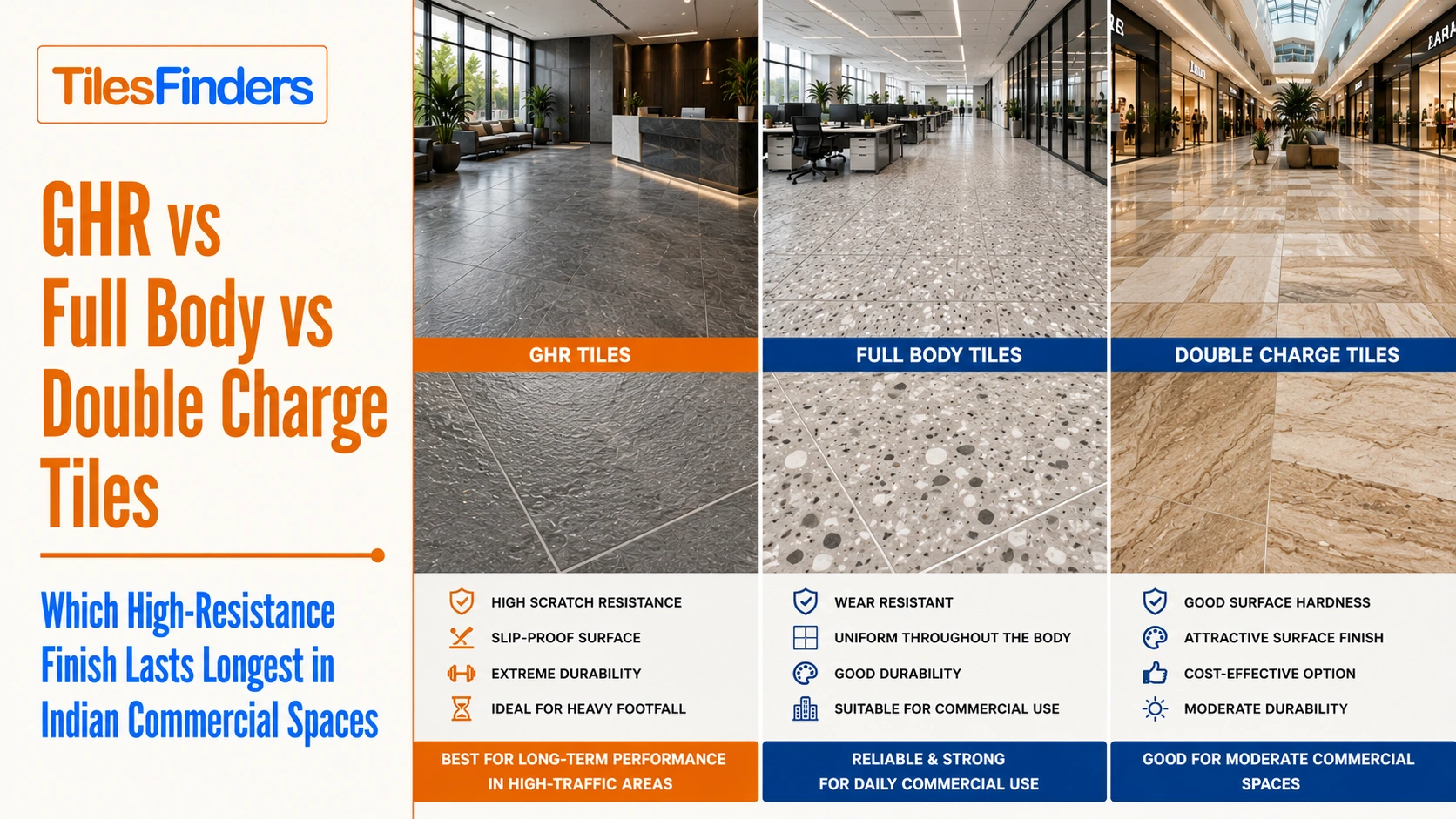
GHR protects the surface, while full body and double charge describe what lies beneath it; the strongest commercial specification can combine both. For genuinely heavy traffic, full body with GHR offers the longest service life, but correct installation matters more than any premium rating.
The honest answer to this question begins with a correction: these three are not competing options. GHR tiles describe the surface, while full body and double charge describe the body underneath it. You can have all three at once, and heavy-duty commercial specifications frequently do. But the lifespan question behind the comparison is a real one, so this guide traces what actually happens to each combination at year 1, 3, 5, 10 and 20, and works out what each costs per year of service rather than per square foot.
Popular tiles right now
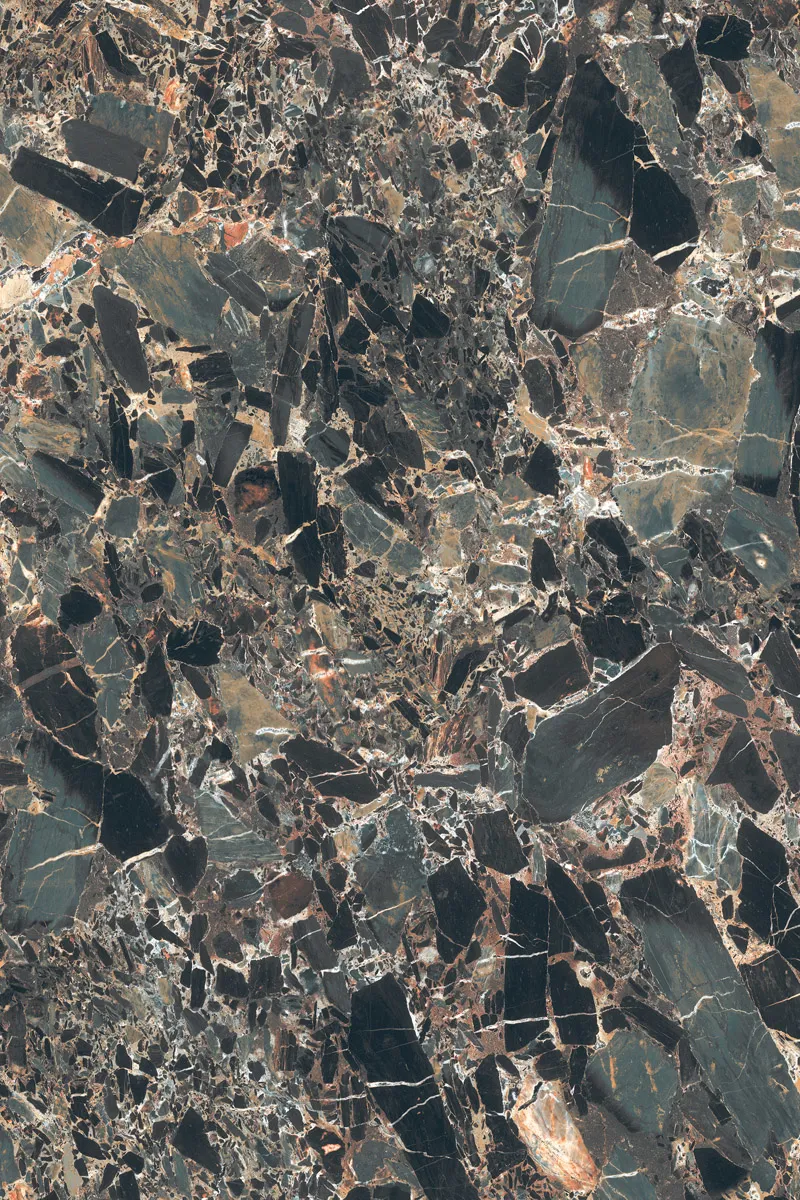
Damascus
View Design
Cotto Sealine White Decor
View Design
Cotto Sealine Musterd Decor
View Design
Cotto Sealine Mocha Decor
View Design
Cotto Sealine Kota Decor
View Design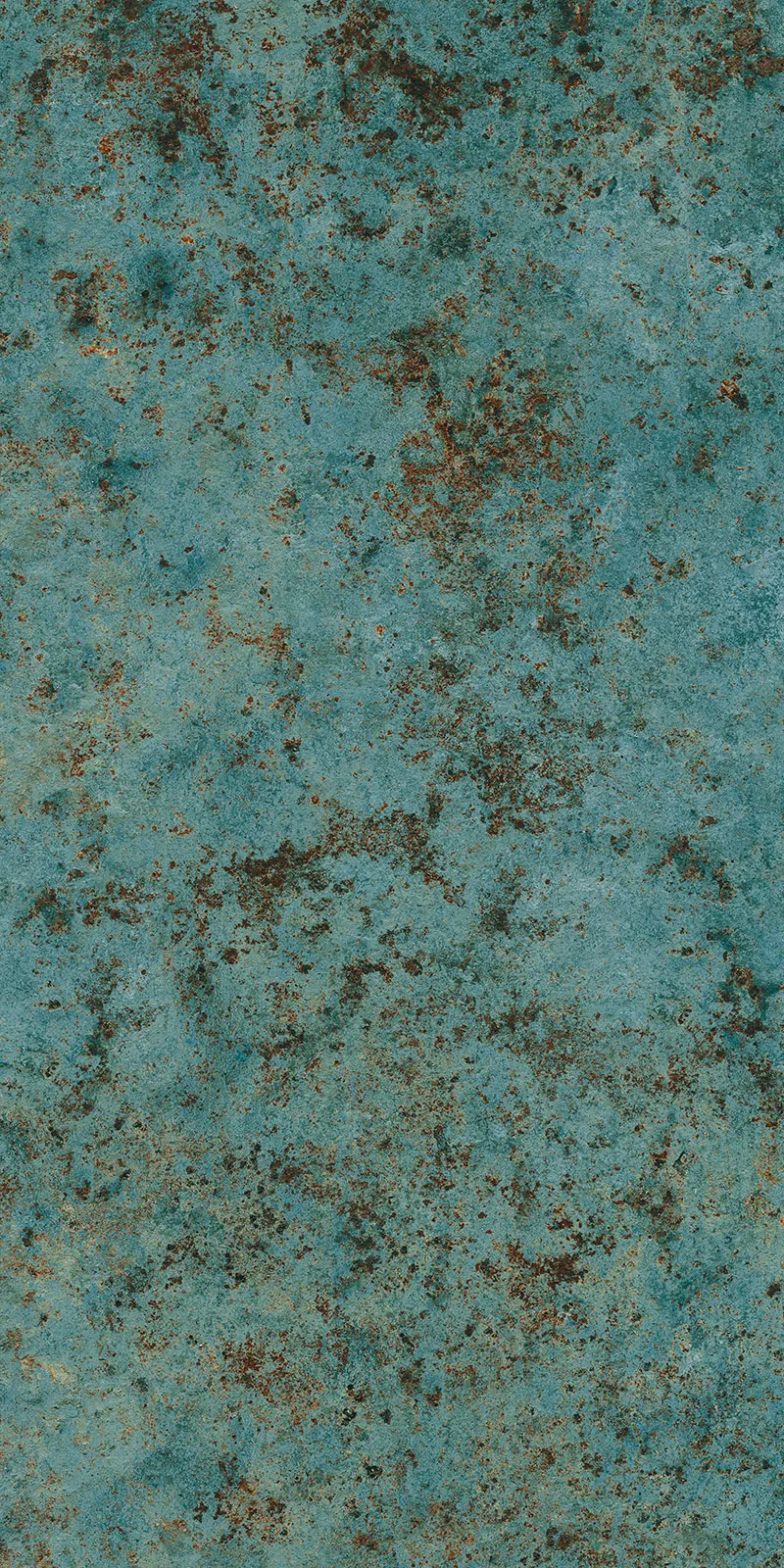
Rust Metal Teal (800x1600)
View Design
Cotto Sealine Terracotta Decor (800x1600)
View Design
cotto sealine crema Decor
View Design
Cotto Sealine Black Decor (800 x 1600)
View DesignTwo Axes, Not Three Options
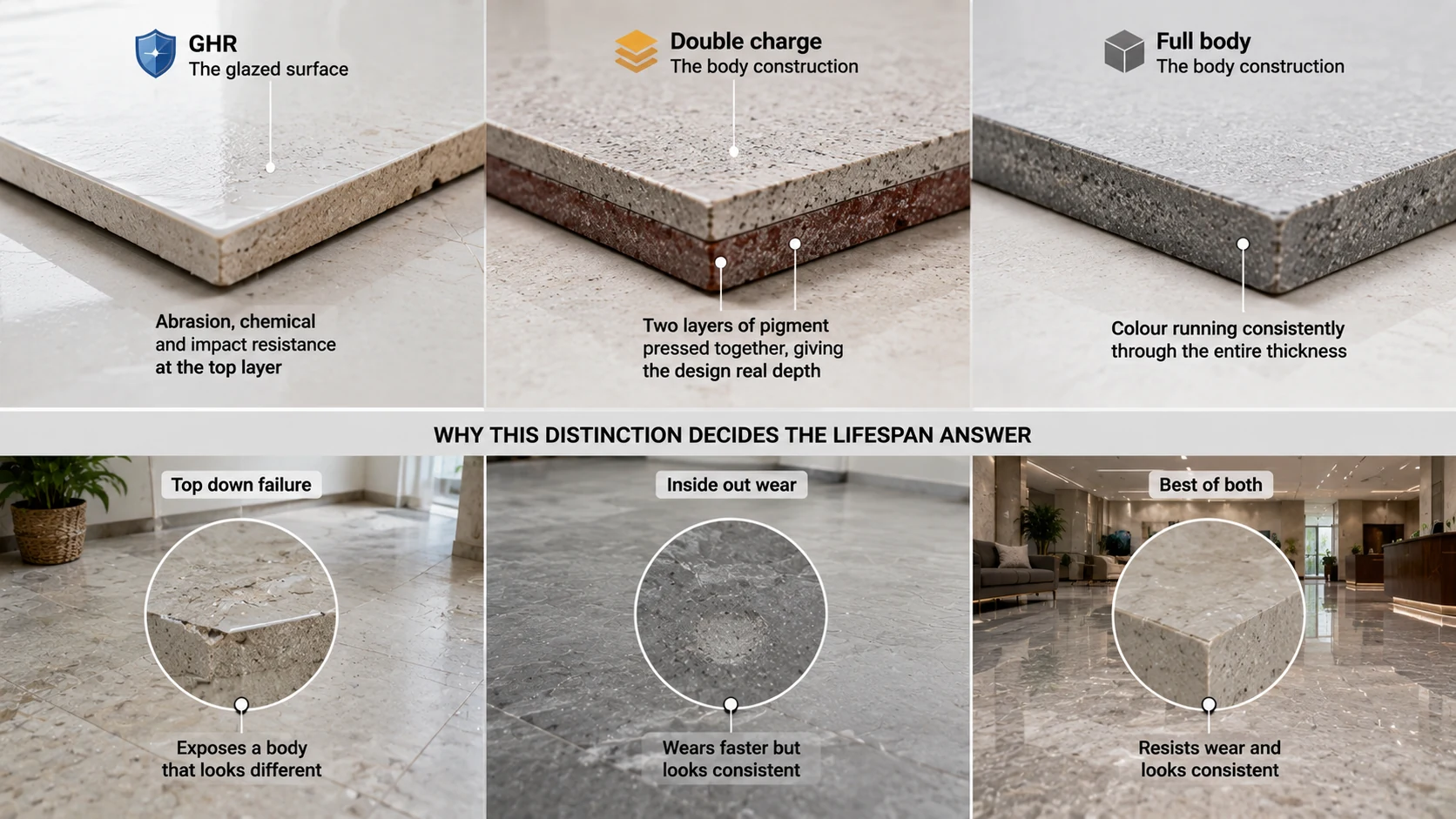
| What It Describes | What It Governs | |
| GHR | The glazed surface | Abrasion, chemical and impact resistance at the top layer |
| Double charge | The body construction | Two layers of pigment pressed together, giving the design real depth into the tile |
| Full body | The body construction | Colour running consistently through the entire thickness |
Why this distinction decides the lifespan answer: A floor can fail from the top down or from the inside out, and the two properties address different failure paths. GHR determines how long the surface resists wear before it starts dulling and losing its finish. Body construction determines what you see when the surface is eventually breached, whether by gradual wear or by a single dropped object. A GHR surface over a standard printed body looks excellent for years, and then, at the moment the surface gives way, exposes a body that looks nothing like the tile above it. A full body tile with no GHR surface wears faster but degrades gracefully, because what is underneath matches what was on top. The longest-lasting floor combines both, and understanding why is what turns this from a price comparison into a specification decision. |
The Timeline: What Actually Happens, Year by Year
Under genuinely heavy commercial traffic. A retail floor, a lobby or a restaurant, not an office meeting room.
Year 1
All four specifications look identical. Nobody can tell them apart, and any supplier can demonstrate any of them successfully. This is the year that misleads buyers, because a sample board tells you nothing about year eight.
Year 3
| Specification | Condition at Year 3 |
| Standard vitrified, PEI 4 | Traffic paths beginning to show as slight dulling in the main circulation routes |
| GHR surface only | No visible change; the abrasion resistance is doing its job |
| Double charge with GHR | No visible change |
| Full body with GHR | No visible change |
Year 5
| Specification | Condition at Year 5 |
| Standard vitrified, PEI 4 | Traffic lanes clearly visible against untrafficked areas; any chips show a pale body against the surface colour |
| GHR surface only | Surface still sound. Chips from dropped objects, where they have occurred, are visible because the body beneath does not match |
| Double charge with GHR | Surface sound, and the few chips present are far less obtrusive because the pigment runs into the tile |
| Full body with GHR | Surface sound, chips essentially invisible |
Year 10
| Specification | Condition at Year 10 |
| Standard vitrified, PEI 4 | Typically replaced by now in a genuinely high-traffic setting, or looking visibly tired enough to affect how the space reads |
| GHR surface only | Surface beginning to dull in the heaviest paths; accumulated chips increasingly noticeable against the mismatched body |
| Double charge with GHR | Still performing. Some surface dulling in the worst paths, but the floor reads as consistent |
| Full body with GHR | Still performing well, with wear distributed rather than concentrated in visible failures. |
Year 20
| Specification | Condition at Year 20 |
| Standard vitrified, PEI 4 | Replaced twice by this point in heavy traffic |
| GHR surface only | Replaced once, typically around year twelve |
| Double charge with GHR | Approaching replacement, having served roughly eighteen years |
| Full body with GHR | Frequently still in service, worn but consistent, because there is no visual difference between the surface and what is beneath it. |
On these figures: These are indicative service lives under heavy commercial traffic, not guarantees. Actual lifespan varies enormously with footfall volume, entrance matting, cleaning regime and installation quality. A well-matted, well-cleaned standard floor can outlast a neglected premium one. Treat the pattern as reliable and the specific years as a planning estimate. |
Cost Per Year of Service
The figure that matters for a commercial floor, and the one that inverts the price ranking entirely.
| Specification | Indicative Cost | Service Life | Cost Per Year |
| Standard vitrified, PEI 4 | Rs. 95/sq.ft | About 7 years | Rs. 13.6 per sq.ft. per year |
| GHR surface only | Rs. 150/sq.ft | About 12 years | Rs. 12.5 per sq.ft. per year |
| Double charge with GHR | Rs. 185/sq.ft | About 18 years | Rs. 10.3 per sq.ft. per year |
| Full body with GHR | Rs. 210/sq.ft | About 25 years | Rs. 8.4 per sq.ft. per year |
What that table means for a commercial buyer: The most expensive specification is the cheapest one, by a margin of roughly forty per cent per year of service against the cheapest. And that comparison only counts the tile. It excludes the cost of the labour to relay the floor twice instead of once, and it excludes the cost of closing a shop, restaurant or clinic while the work happens, which in most commercial settings exceeds the material cost of the floor by a considerable multiple. For a residential floor this arithmetic barely applies, because household traffic never approaches the volume that separates these specifications. For a commercial floor it is the whole argument. |
The Cost Nobody Puts in the Quotation
| Cost Element | Counted in the Tile Quote? | Real Impact |
| Tile material | Yes | The only figure most decisions are made on |
| Installation labour, each time | Sometimes | Paid again at every replacement, not just the first |
| Removing and disposing of the old floor | Rarely | A cost the first installation never faces |
| Business closure during relaying | Rarely | Frequently the highest single cost in a commercial replacement |
| Reputational effect of a tired-looking floor | Never | Real in retail, hospitality and healthcare, where the space is the product |
If you are still deciding whether GHR is necessary at all, a closer look at what the finish actually protects against can prevent over-specification. GHR Tiles Explained covers the six common floor failures and separates the problems GHR can address from those caused by installation or substrate movement.
Which Combination for Which Space
| Space | Recommended Combination | Reasoning |
| Warehouse, workshop, loading bay | Full body with GHR, rated thickness | Impact is routine, and chips are certain, so what lies beneath the surface matters as much as the surface itself |
| Laboratory, commercial kitchen | Full body with GHR, chemical resistant | A chip exposes the body to chemical contact, so body composition is a functional requirement rather than a cosmetic one |
| Retail with trolleys or heavy stock movement | Full body or double charge with GHR | Fixture and trolley chips accumulate over years, and mismatched bodies make each one conspicuous |
| Hospital corridor, high-traffic lobby | Double charge with GHR | Abrasion is the dominant failure mode, and impact is occasional rather than routine |
| Showroom, boutique retail, corporate reception | Double charge with GHR | Appearance matters most, traffic is heavy but controlled, and impact is rare |
| Open-plan office floor plate | GHR over standard body | Steady traffic without trolleys or dropped loads, so surface resistance carries the requirement |
| Meeting rooms, low-traffic offices | Standard vitrified, PEI 4 | None of these premiums will ever be tested; spend the difference elsewhere |
What Actually Ends a Commercial Floor's Life
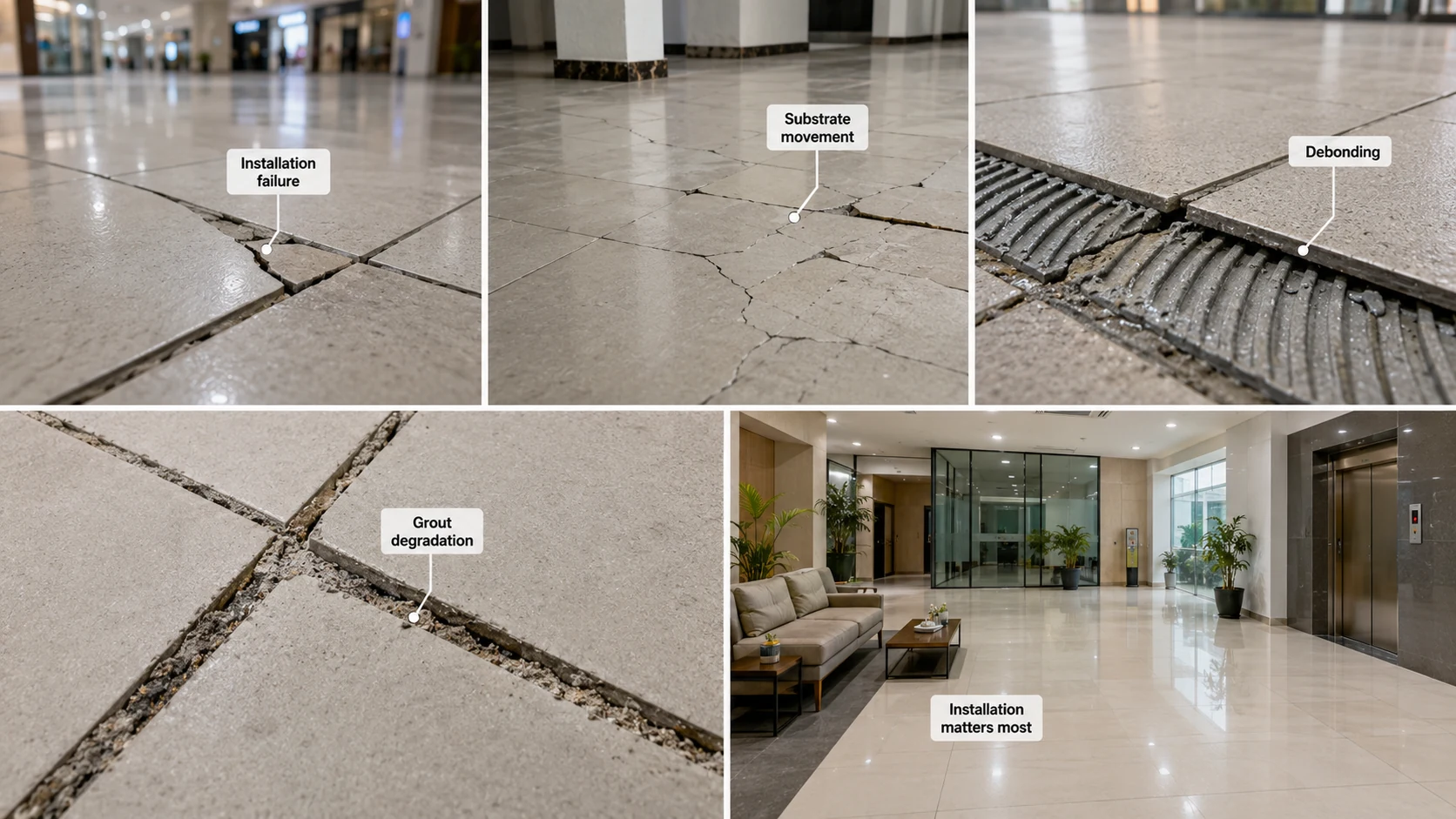
In practice, most commercial floors are replaced before they wear out: In Indian commercial buildings, floors are lifted more often for installation failures, cracking due to substrate movement, debonding from inadequate adhesive coverage, and grout degradation than for genuine surface wear. A specification chosen for twenty-five-year abrasion resistance and then laid over an uncured screed with no movement joints will fail in five years, and the tile rating will have contributed nothing. The specification decisions in this guide are worth making, and they are worth strictly less than getting the installation right. |
The three that end floors early, in order
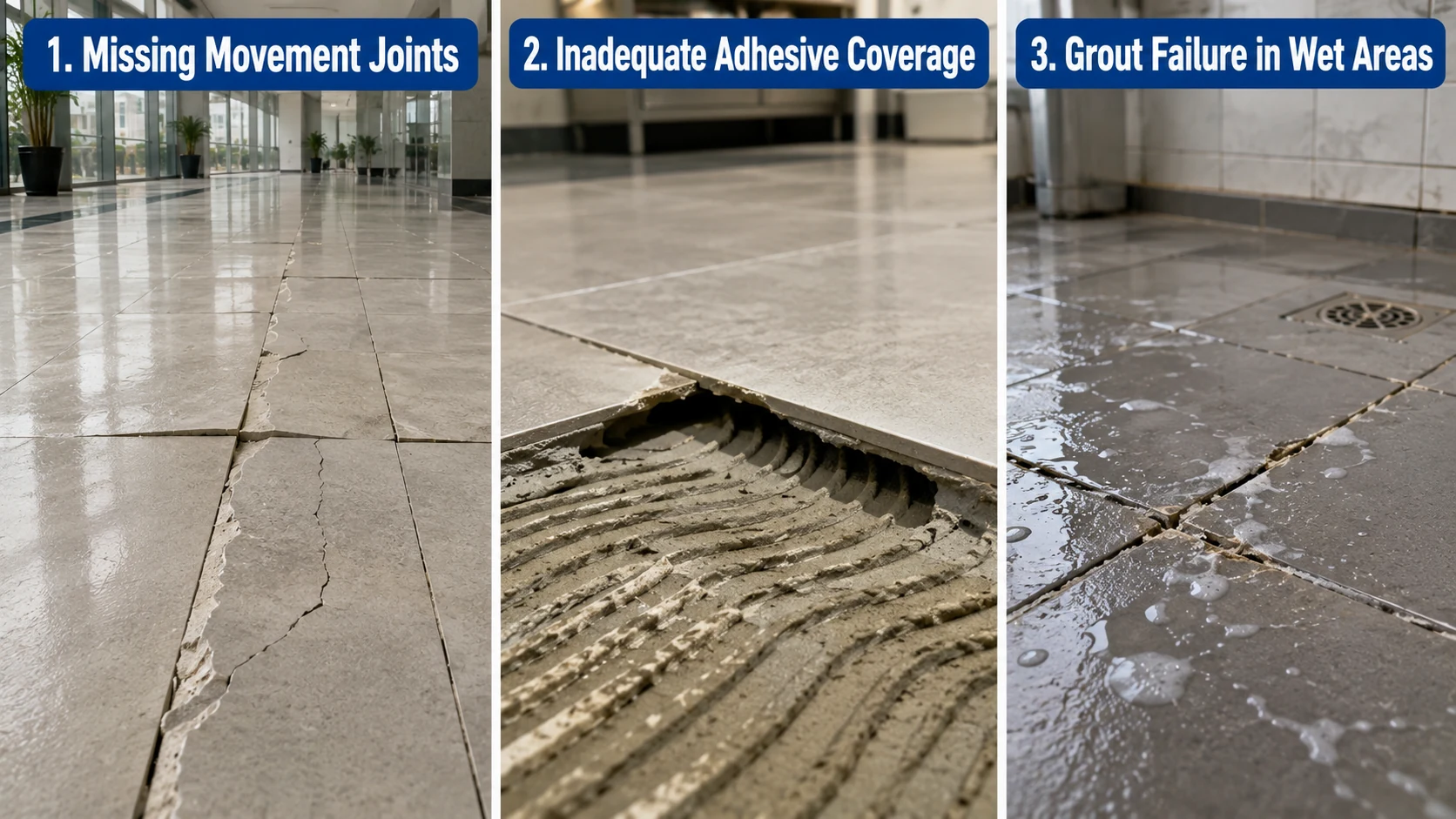
1. Missing or inadequate movement joints on large floor plates, which produces tenting and cracking regardless of how tough the tile is.
2. Inadequate adhesive coverage, which produces hollow tiles and progressive debonding under commercial traffic far faster than under domestic use.
3. Grout failure in wet or heavily cleaned areas, where cement grout degrades under commercial cleaning regimes and lets water beneath the tile.
Where the marginal rupee is best spent: If the budget forces a choice between upgrading the tile specification and getting the installation properly specified, choose the installation. A standard tile correctly laid with proper joints, full adhesive coverage and epoxy grout will outlast a premium tile laid badly, every time. Upgrade the tile once the installation is right, not before. |
Confirming the Specification
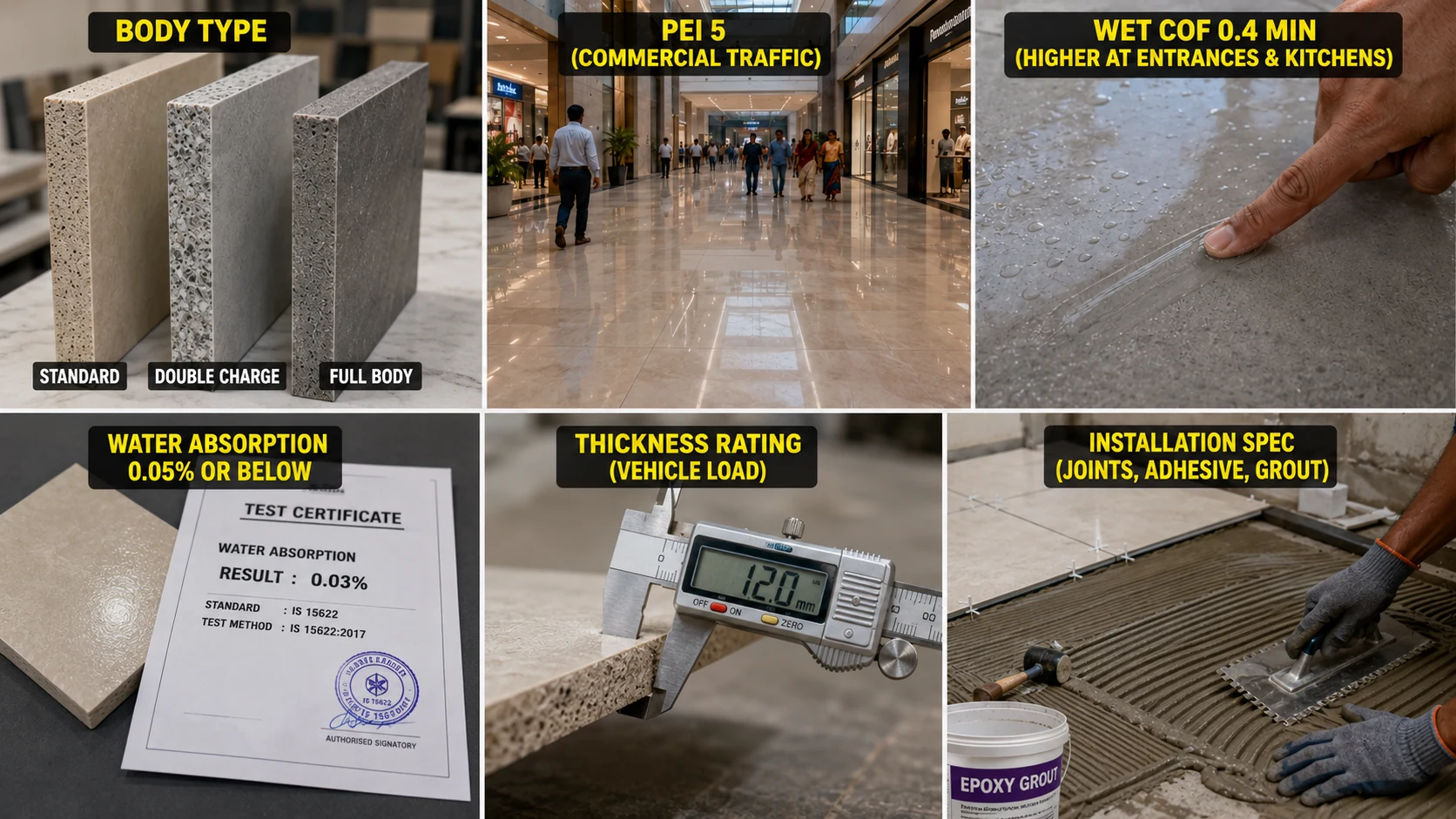
- Ask for the body construction explicitly: standard, double charge or full body, since GHR classification alone tells you nothing about what lies beneath the surface.
- Ask for PEI on the technical data sheet, and confirm it is PEI 5 for genuinely commercial traffic.
- Confirm wet coefficient of friction separately at 0.4 minimum, and higher at entrances and kitchens, since none of these three properties covers slip resistance.
- Confirm water absorption of 0.05% or below for vitrified tile, the benchmark set by the Bureau of Indian Standards under IS 15622, with the test certificate requested.
- Confirm thickness rating separately for vehicle load, since PEI measures surface abrasion rather than structural capacity.
- Get the installation specification in writing alongside the tile specification, covering movement joints, adhesive grade and grout type, since these determine more of the outcome than the tile does.
Specify the Full Stack on TilesFinders
GHR, double charge and full body ranges can be compared on TilesFinders by surface rating and body construction together, and the trade desk can support consolidated documentation and phased delivery for commercial projects where different zones need different combinations.
FAQs
They are not alternatives. GHR describes the glazed surface and its resistance to abrasion, chemicals and impact. Full body describes the body construction, where colour runs through the entire thickness. The longest-lasting commercial floors combine both rather than choosing between them.
Full body with a GHR surface lasts roughly twenty-five years under heavy commercial traffic, because the surface resists wear while the body ensures that any breach of that surface is barely visible. Double charge with GHR follows at around eighteen years.
On cost per year of service, yes and by a clear margin. Full body with GHR works out around Rs. 8.4 per sq.ft per year against Rs. 13.6 for standard vitrified, before counting the labour to relay twice and the cost of closing a commercial space while the work happens.
Double charge presses two layers of pigment together, giving the design genuine depth into the tile. Full body carries colour consistently through the entire thickness. Full body handles deep chips better; double charge is a meaningful improvement on standard at a lower premium.
Barely. Household traffic never approaches the volume that separates these specifications, so a PEI 4 vitrified tile serves a residential floor for decades. The arithmetic in this guide is a commercial argument, not a domestic one.
Surfaces get breached, whether by gradual wear over years or by one dropped object. When that happens, a standard body exposes a material that looks nothing like the tile above it, while a full-body tile shows the same colour and the damage barely registers.
Installation failures rather than wear. Missing movement joints, inadequate adhesive coverage and grout degradation lift more commercial floors than abrasion does, which is why a premium tile laid badly fails faster than a standard tile laid well.
Into the installation before the tile. Proper movement joints, full adhesive coverage and epoxy grout under a standard tile will outlast a premium tile laid without them. Upgrade the specification once the installation is right.
No, none of them. GHR, double charge and full body all describe durability rather than grip. Wet coefficient of friction is a separate measured property and must be confirmed independently at 0.4 minimum, higher at entrances and kitchens.


See our tile guides first
Set TilesFinders as a preferred source and our buying guides surface ahead of the rest for you.
Add as preferred sourceTakes one tap. Nothing to install.
What Readers Say
I was about to redo my parking area with the wrong tile size until I read this. The layout comparisons saved me from a costly mistake.
We reference TilesFinders guides while briefing clients on material selection. The size and pattern breakdowns are accurate and easy to explain visually.
On site, I get asked about grout spacing all the time. This article gave me a solid reference I now share with my team before every job.
Finally a guide that doesn't just push generic advice. The oil stain removal steps actually worked on our clubhouse driveway tiles.
I run a small construction firm and now send this link to clients directly when they ask about entrance tile sizing. Saves me an hour of explaining.
Good practical detail, though I wish there were more examples for compact apartment entrances specifically, not just villas.
My mother-in-law wanted marble, I wanted vitrified. This blog gave us the neutral comparison we needed to actually decide together.
Detailed without being overwhelming. I appreciated that it covered both cost and maintenance, not just the aesthetics.
Used the algae and hard water removal tips on our terrace tiles after the monsoon. Worked better than what our regular cleaner was doing.
As someone who sources tiles for multiple builder projects, I find these comparisons genuinely useful for vendor conversations, not just consumer content.
Recommended this to a client who kept second-guessing the entrance design. The small vs large layout section settled the debate instantly.
Straightforward and honest, no unnecessary jargon. Would like to see a similar breakdown for outdoor pool-deck tiles next.
We've bookmarked several TilesFinders guides for our design handbook. Reliable source when clients want data, not just opinions.
Two paths, one marketplace.
Get free quotes from verified suppliers.
Share your room, budget, and style. Suppliers in local area respond within hours.
Get Free QuotesList your business, reach real buyers.
Put your showroom in front of homeowners searching for tiles right now.
List Your Business