
Patio Tile Design Ideas: 20+ Outdoor Entertaining Space Looks for Indian Bungalows and Villas
Look 21 patio tile design ideas for Indian bungalows and villas, covering dining, poolside, barbecue, garden paths, family areas and indoor-outdoor transitions.
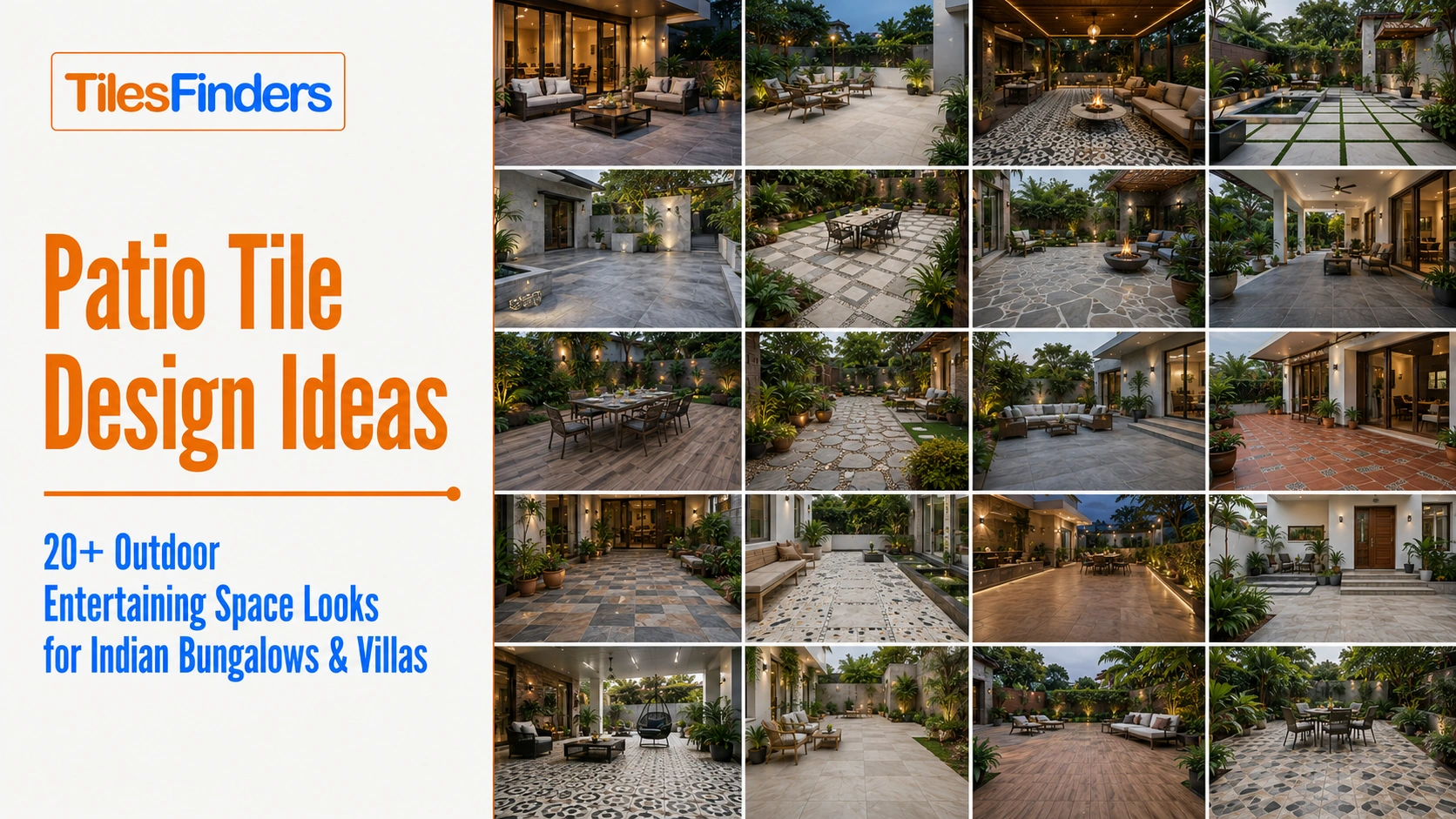
- All 21 Patio Design Ideas at a Glance
- Outdoor Dining Patio Tile Ideas
- Outdoor Lounge and Seating Area Tile Ideas
- Poolside and Pool Deck Tile Ideas
- Outdoor Kitchen and Barbecue Zone Tile Ideas
- Garden Path and Circulation Tile Ideas
- Indoor to Outdoor Transition Tile Ideas
- Family and Kids Outdoor Area Tile Ideas
- Patio Tile Specification Checklist for Every Zone
- Check Patio and Outdoor Tiles on TilesFinders
These 21 patio tile design ideas are organised by zone, matching dining, poolside, barbecue, circulation and family areas to their specific outdoor demands. Use colour, format, texture and rating strategically, because one tile specification rarely performs equally well across an entire patio.
A patio is rarely one surface doing one job. The dining area needs a floor flat enough for a table not to rock; the poolside needs grip under constantly wet feet; the barbecue zone will meet grease, and the path connecting them all needs to work in monsoon rain. These 20+ patio tile looks are organised by zone, because specifying one tile across the whole outdoor space means over-specifying most of it and under-specifying the part that matters.
All 21 Patio Design Ideas at a Glance
Before choosing a look, it helps to understand what an Indian patio needs to withstand across the year. Our guide to Patio Tiles in India covers heat, monsoon drainage, slip resistance, algae, UV exposure, grout and ground-level installation requirements.
| # Look | Zone | Critical Requirement |
| 1. The Dining Terrace | Outdoor dining | Flatness for table stability |
| 2. The Shaded Dining Court | Outdoor dining | Dark tone acceptable under cover |
| 3. The Long Table Run | Outdoor dining | Chair-resistant surface |
| 4. The Sun Lounge | Lounge and seating | Cool underfoot in summer |
| 5. The Evening Terrace | Lounge and seating | Warm tone under lamp light |
| 6. The Shaded Retreat | Lounge and seating | Algae resistance in shade |
| 7. The Pool Deck | Poolside | R11 and barefoot comfort |
| 8. The Pool Surround Border | Poolside | Visual edge marking |
| 9. The Wet Feet Path | Poolside | Grip on a constantly wet route |
| 10. The Barbecue Zone | Cooking | Grease resistance |
| 11. The Outdoor Kitchen Floor | Cooking | Chemical and stain resistance |
| 12. The Prep Counter Surround | Cooking | Easy-clean at spill height |
| 13. The Garden Path | Circulation | Drainage and narrow cutting |
| 14. The Stepped Approach | Circulation | Step edge visibility |
| 15. The Side Return | Circulation | Shade and moss management |
| 16. The Threshold Run | Indoor to outdoor | Level transition, water control |
| 17. The Continuous Look | Indoor to outdoor | Visual match, different ratings |
| 18. The Covered Veranda | Indoor to outdoor | R10 acceptable under cover |
| 19. The Play Surface | Kids and family | Grip plus surface temperature |
| 20. The Family Courtyard | Kids and family | Durability and mark-hiding |
| 21. The Pet-Friendly Patio | Kids and family | Claw resistance and cleaning |
Outdoor Dining Patio Tile Ideas
The zone where flatness matters more than anywhere else outdoors, because a table that rocks makes a dining terrace unusable, however good the tile looks.
1. THE DINING TERRACE
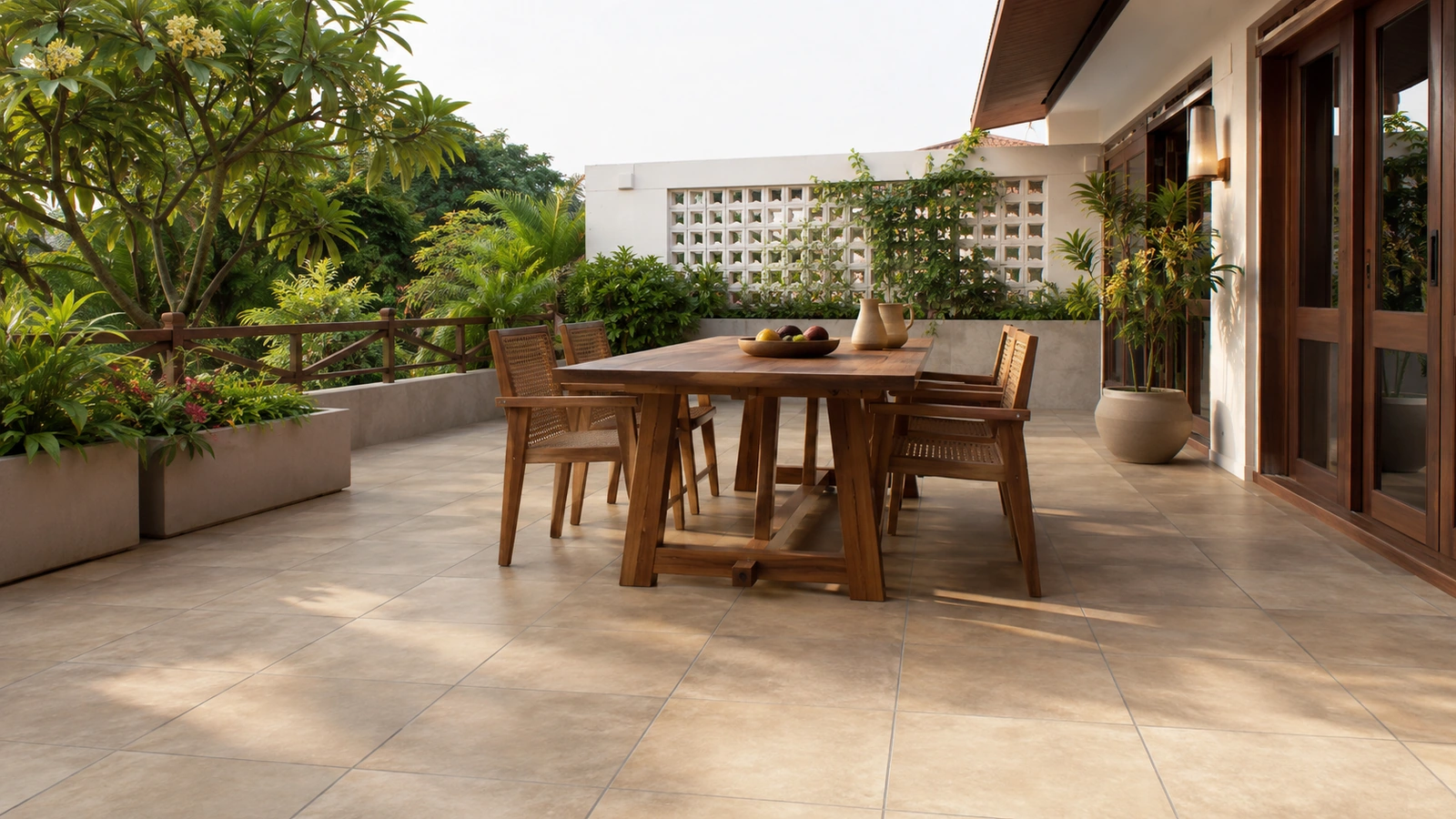
Warm Sand Anti-Skid GVT, 600x600 mm
Anti-skid GVT, R11 outdoor rated | 600x600 mm | Matte | Rs. 95 to Rs. 155/sq.ft
Typical room cost: About Rs. 19,000 to Rs. 31,000 for a 200 sq.ft dining terrace
Warm sand stays comfortable underfoot in summer and hides the food marks and dust an outdoor dining area tile inevitably collects, in a mid-format that lays flat more easily than a large one over an outdoor sub-base.
Get this detail right: Check flatness with a straightedge across the table position specifically, since a patio built to a drainage fall is by definition not level and a table needs a flatter zone than the rest of the terrace.
Pair with: Furniture with wide feet rather than narrow ones, and epoxy grout that survives food spills.
Avoid: A large-format tile over a ground-level sub-base, which bridges undulation and produces the raised edges that make chairs catch.
2. THE SHADED DINING COURT
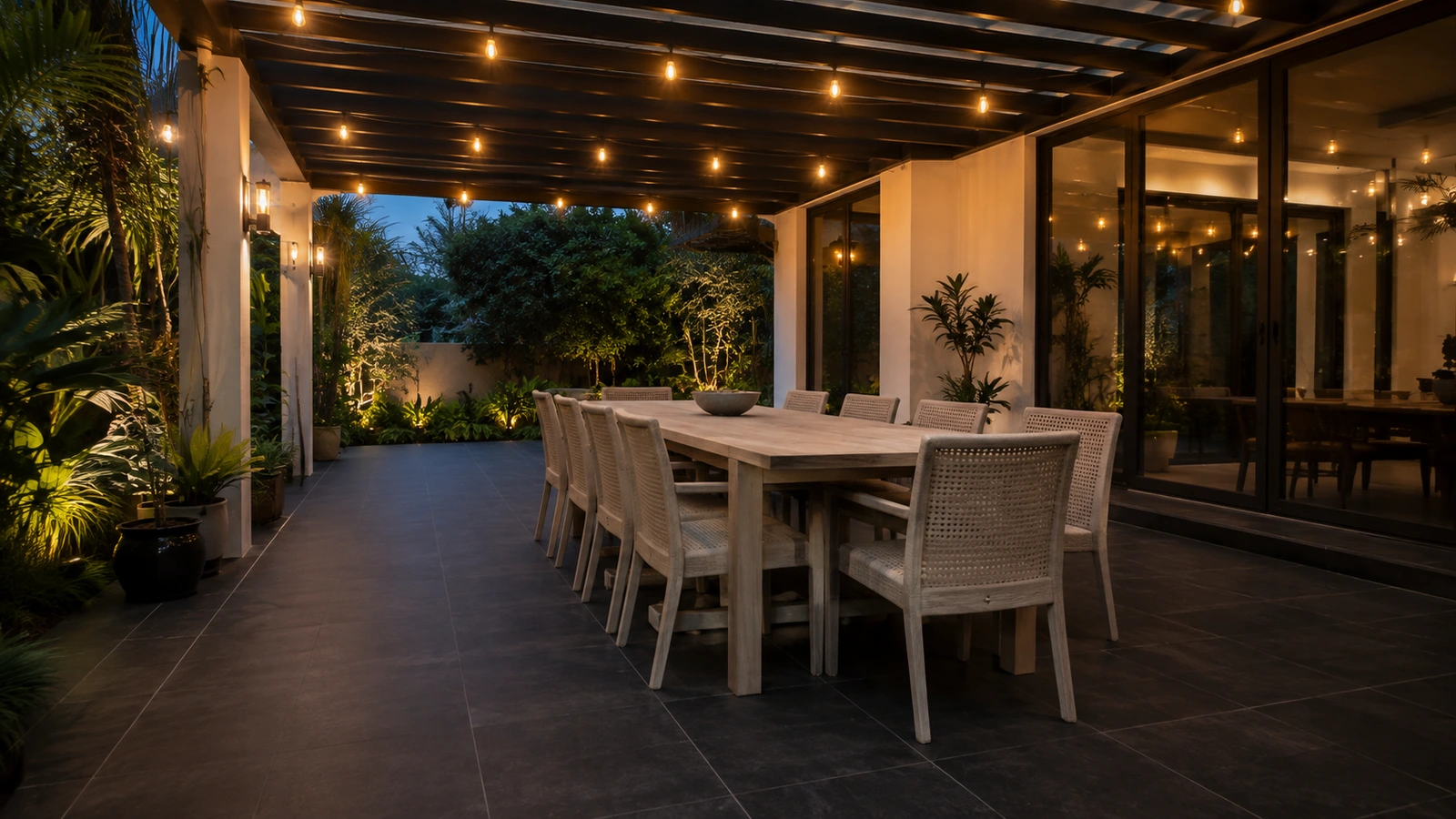
Charcoal Anti-Skid GVT, Under Pergola
Anti-skid GVT, R11 outdoor rated | 600x600 mm | Matte | Rs. 95 to Rs. 155/sq.ft
Typical room cost: About Rs. 19,000 to Rs. 31,000 for a 200 sq.ft court
Dark tones are genuinely defensible where a pergola, canopy or tree cover keeps direct sun off the surface, and charcoal hides food marks and dust better than any lighter option.
Get this detail right: Confirm the shade is year-round rather than seasonal, since a deciduous canopy that shades in August and drops its leaves in December leaves a dark patio in full winter sun.
Pair with: Warm string lighting, which reads beautifully against a dark floor, and pale furniture for contrast.
Avoid: Charcoal in a court that is only partially shaded, where the exposed portion becomes unusable barefoot in summer.
3. THE LONG TABLE RUN
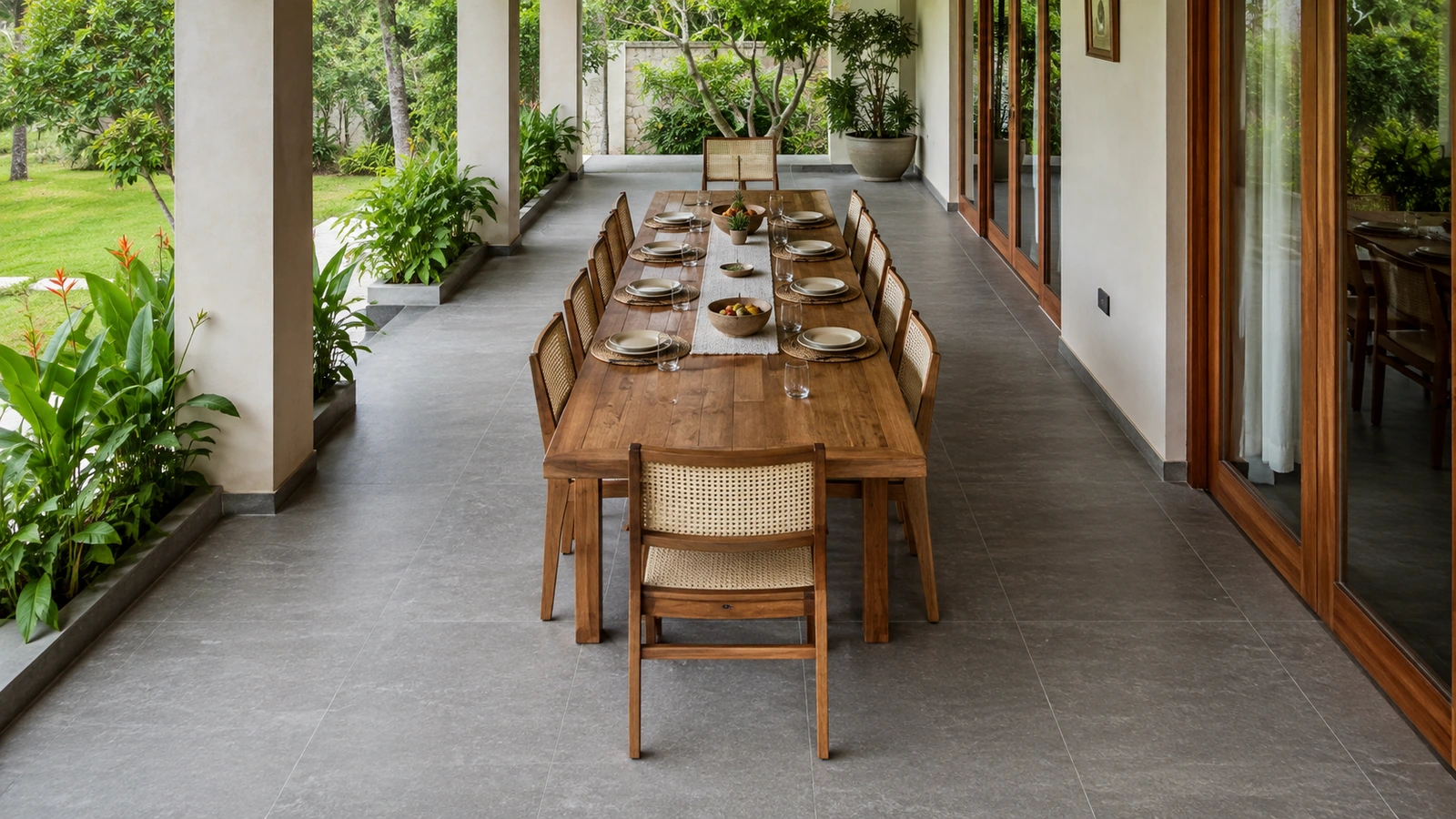
Grey Stone-Look Anti-Skid GVT, 600x1200 mm
Anti-skid GVT, R11 outdoor rated | 600x1200 mm | Matte | Rs. 110 to Rs. 175/sq.ft
Typical room cost: About Rs. 27,500 to Rs. 43,800 for a 250 sq.ft run
A long rectangular format run parallel to a long dining table, which reinforces the geometry of the space and reduces joint count along the direction people sit.
Get this detail right: Run the long joints along the table axis rather than across it, so chair legs slide along joints rather than catching across them repeatedly.
Pair with: A table centred on the tile grid rather than the room, and furniture feet that will not scratch a matte surface.
Avoid: Running the long dimension across the table axis, where every chair movement crosses a joint.
Outdoor Lounge and Seating Area Tile Ideas
4. THE SUN LOUNGE
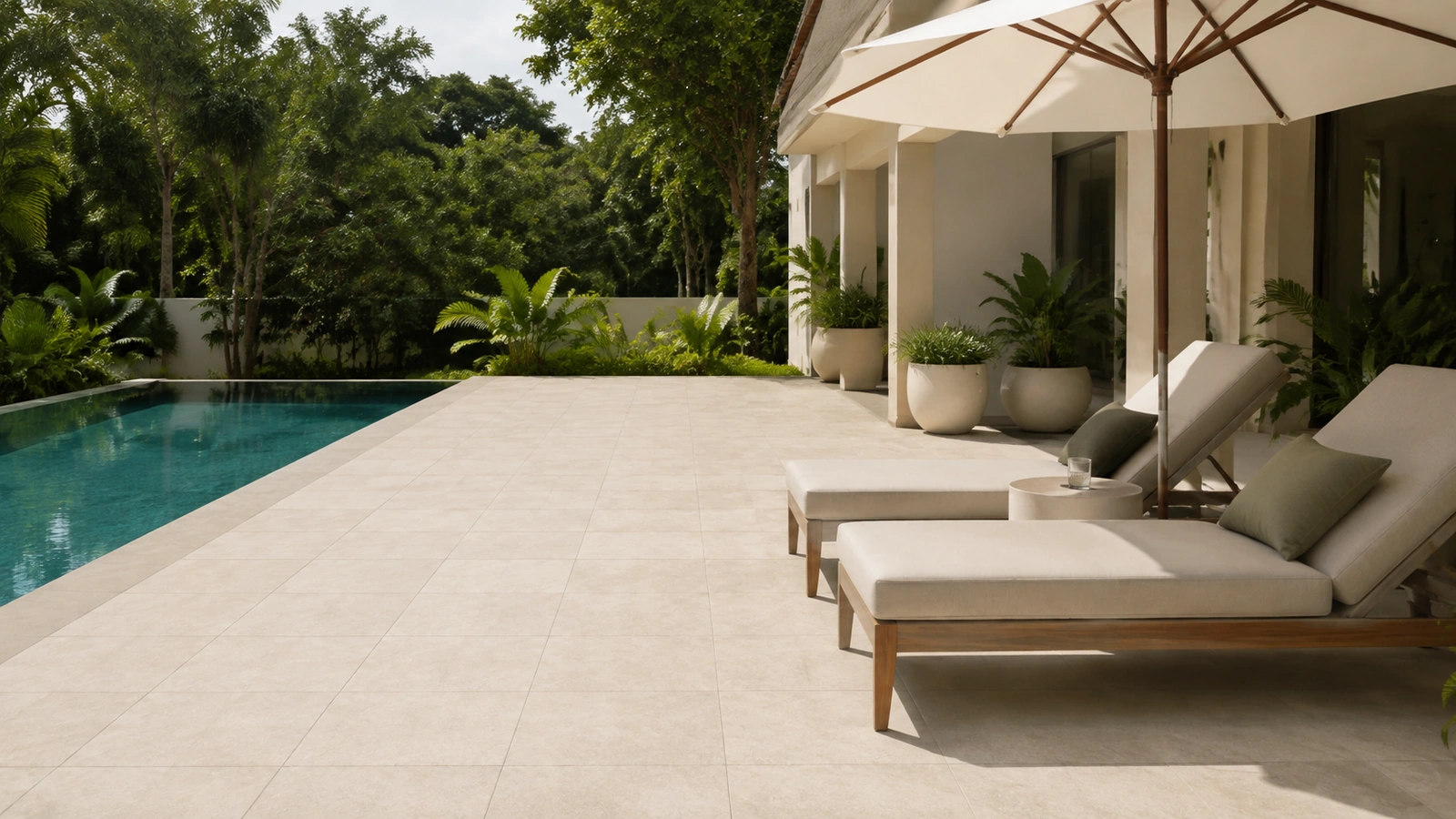
Pale Limestone-Look Anti-Skid GVT
Anti-skid GVT, R11 outdoor rated, UV stable | 600x600 mm | Matte | Rs. 100 to Rs. 160/sq.ft
Typical room cost: About Rs. 15,000 to Rs. 24,000 for a 150 sq.ft lounge
A pale surface for a fully exposed lounging area, chosen specifically because this is where people lie down and walk barefoot, and where surface temperature decides whether the space is usable through summer.
Get this detail right: Test the sample outdoors at two in the afternoon before ordering, since a lounging area is the one zone where surface heat is the deciding factor rather than a consideration.
Pair with: Fabric-covered seating, shade from an umbrella or pergola, and light-toned planters.
Avoid: Any dark tone in a fully exposed lounging area, which will be too hot to lie beside for a third of the year.
5. THE EVENING TERRACE
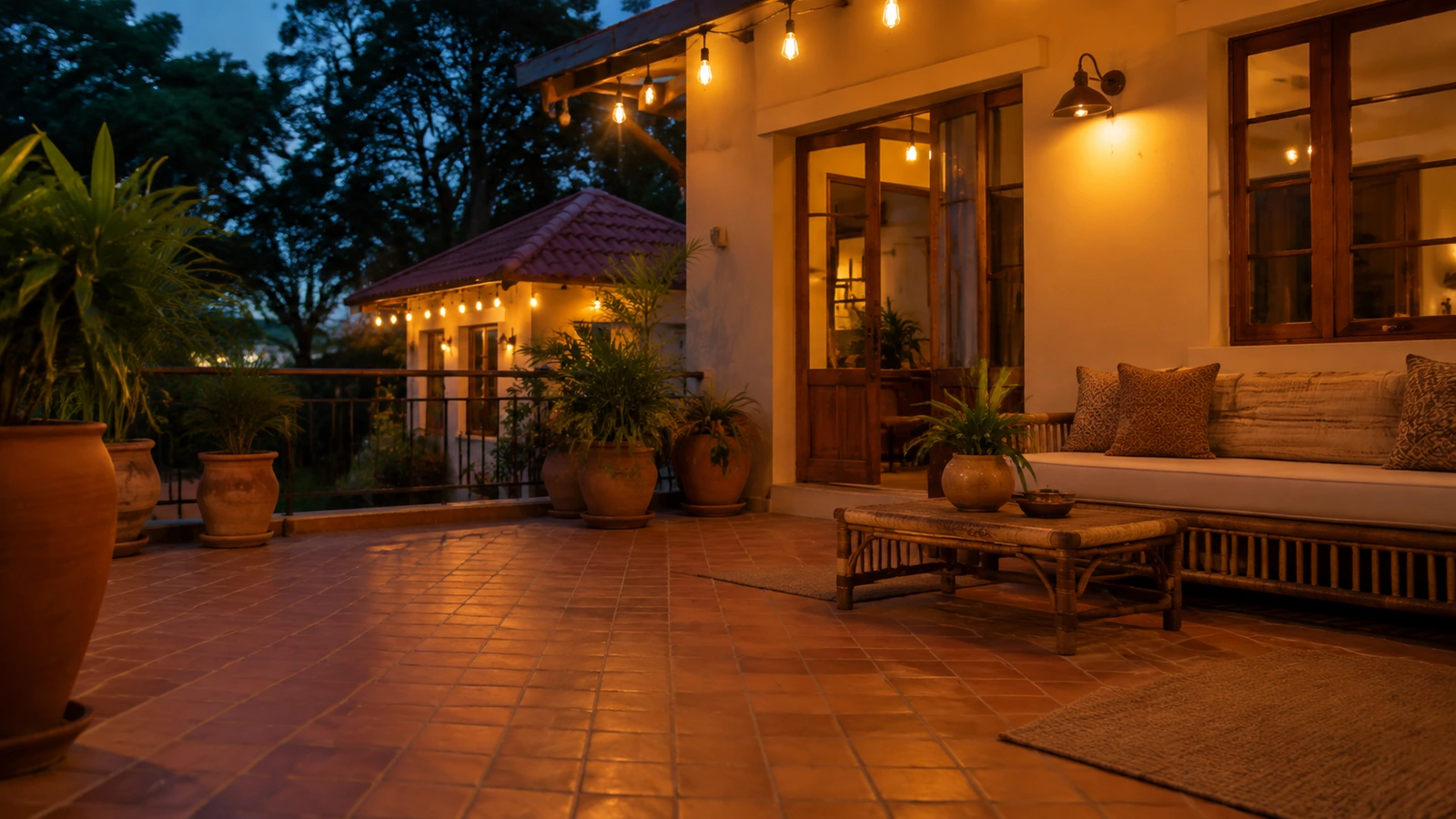
Warm Terracotta Anti-Skid GVT
Anti-skid GVT, R11 outdoor rated | 400x400 mm | Matte | Rs. 90 to Rs. 145/sq.ft
Typical room cost: About Rs. 13,500 to Rs. 21,800 for a 150 sq.ft terrace
Warm terracotta reads richest under evening lamp and string light, which is when a seating terrace is actually used in most Indian homes, and it references traditional outdoor floor tile without the maintenance.
Get this detail right: Plan the lighting before the tile, since terracotta under cool white light looks muddy while the same tile under warm light glows, and lighting is easier to change on paper than after installation.
Pair with: Warm 2700K lighting, brass or bronze fittings, and terracotta or brass planters.
Avoid: Cool white outdoor lighting, which strips the warmth that motivated the colour choice entirely.
6. THE SHADED RETREAT
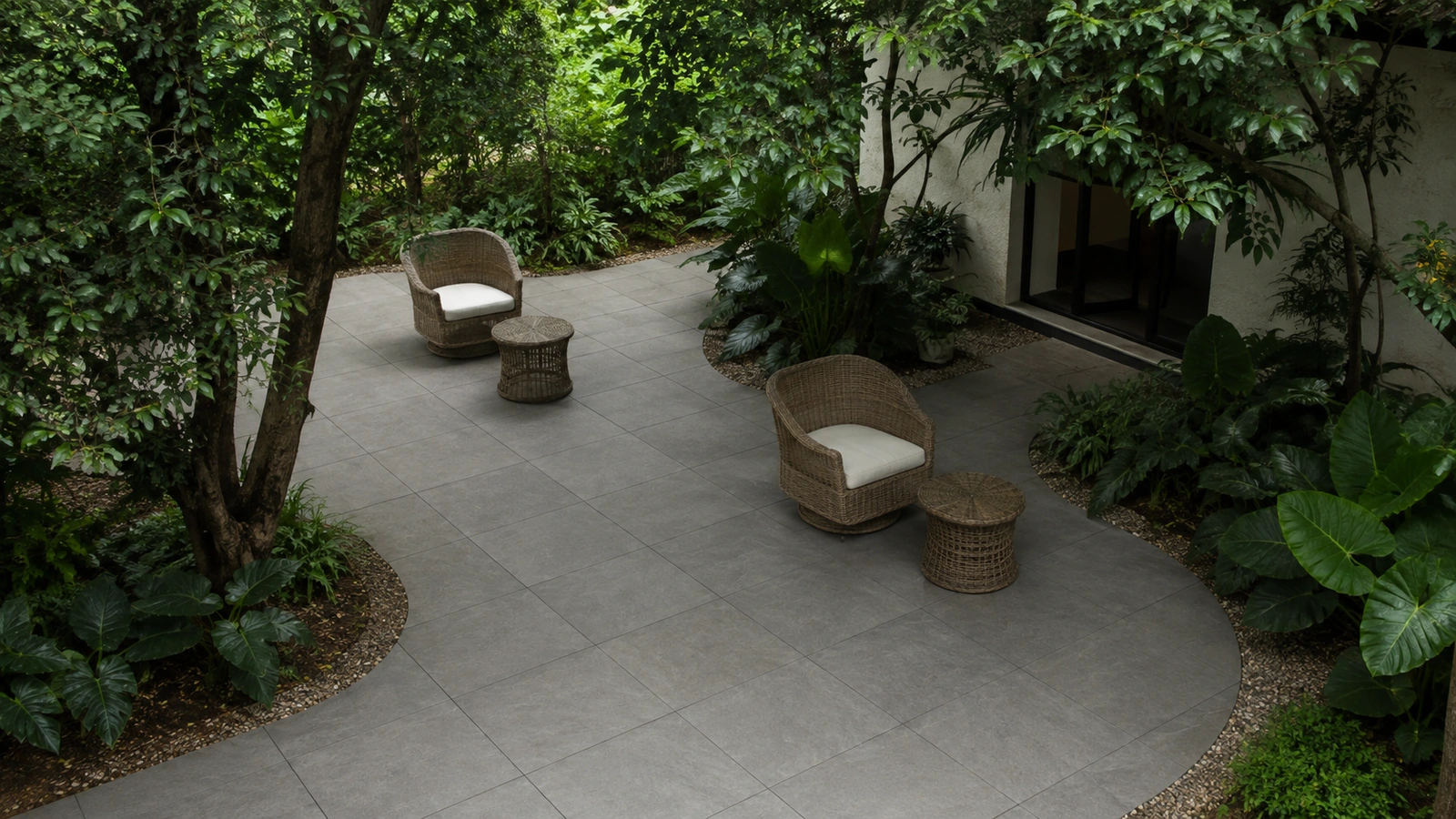
Mid-Grey Textured Anti-Skid GVT
Anti-skid textured GVT, R11 outdoor rated | 400x400 mm | Matte textured | Rs. 95 to Rs. 150/sq.ft
Typical room cost: About Rs. 11,400 to Rs. 18,000 for a 120 sq.ft retreat
A permanently shaded seating corner under trees, where the design problem is not sun but the algae that grows on surfaces that never fully dry after monsoon.
Get this detail right: Choose a textured mid-grey rather than a smooth pale surface, since algae is far more visible and far more slippery on a smooth tile, and mid-tones disguise the residual staining between cleans.
Pair with: A gravel margin at the planting edge, and annual pressure washing after the monsoon.
Avoid: A smooth pale tile in permanent shade, which shows every trace of biological growth and grips poorly when it appears.
Popular tiles right now

Poolside and Pool Deck Tile Ideas
Poolside is the highest-risk outdoor surface in any home: It combines permanently wet feet, bare skin, people moving quickly, and a hard edge with water beyond it. Specify the highest available wet coefficient of friction rather than the 0.4 minimum, confirm R11 outdoor rating, and keep polished and glossy finishes off the deck entirely regardless of what a supplier suggests. |
7. THE POOL DECK
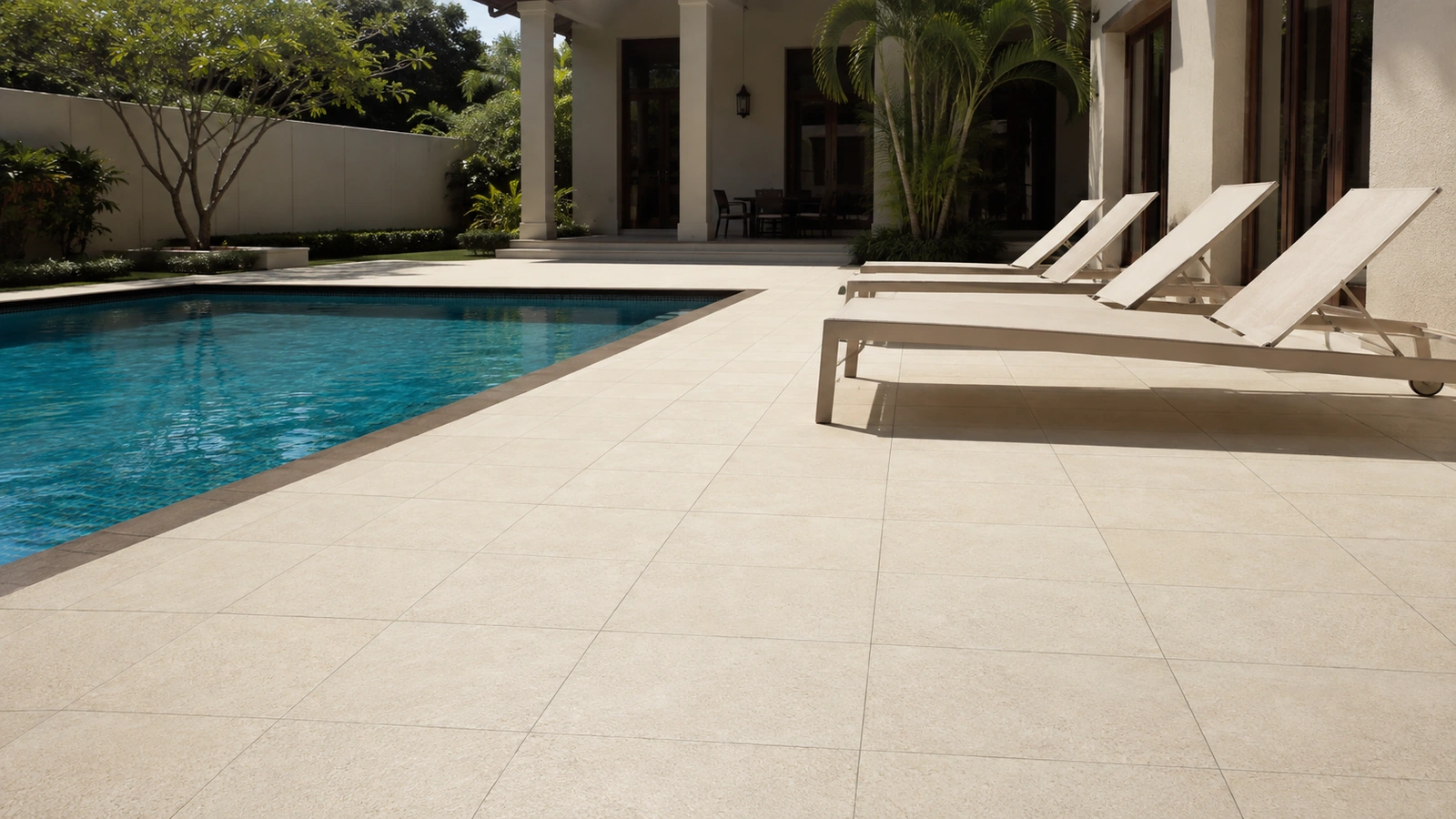
Pale Sand Textured Anti-Skid GVT
Anti-skid textured GVT, R11, high wet COF | 400x400 mm | Matte textured | Rs. 105 to Rs. 165/sq.ft
Typical room cost: About Rs. 21,000 to Rs. 33,000 for a 200 sq.ft deck
Pale for barefoot comfort in the sun, textured for grip on permanently wet feet, in a mid-small format that follows the fall to the drainage channel without bridging it.
Get this detail right: Confirm the deck falls away from the pool toward a drainage channel, so splash water leaves the deck rather than pooling on it and creating exactly the condition the texture is fighting.
Pair with: A drainage channel at the deck perimeter, and furniture with non-marking feet.
Avoid: A dark deck beside a pool, which combines maximum barefoot exposure with maximum surface temperature.
8. THE POOL SURROUND BORDER
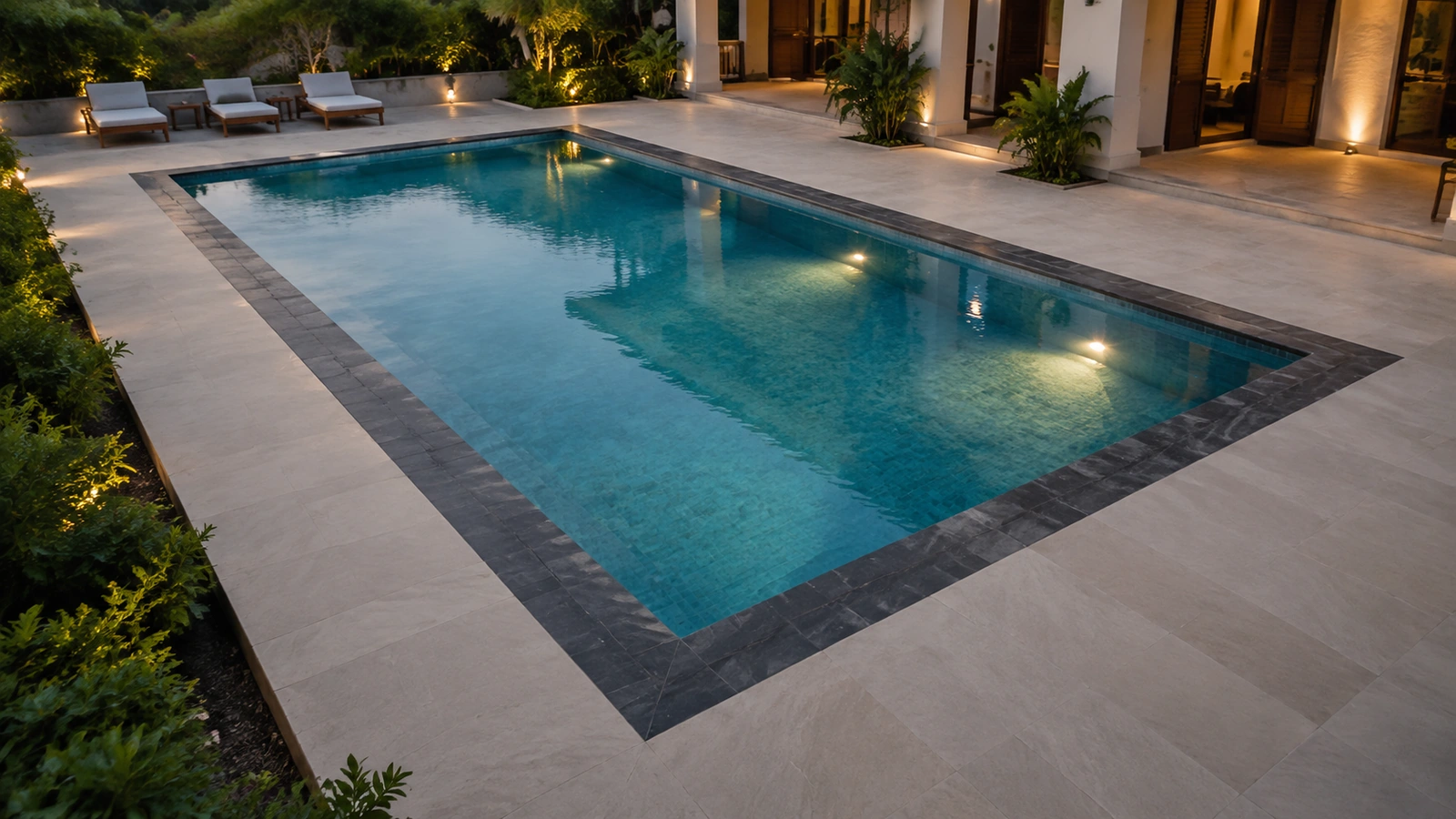
Contrasting Border Band at the Pool Edge
Anti-skid GVT in a contrasting tone, R11 | 300x600 mm border | Matte textured | Rs. 105 to Rs. 165/sq.ft
Typical room cost: About Rs. 6,300 to Rs. 9,900 for a 60 sq.ft border run
A contrasting band marking the pool edge, which is a genuine safety feature as much as a design one, because a clearly visible edge is one people are less likely to misjudge.
Get this detail right: Make the contrast strong enough to read at a glance and in poor light, since a subtle tonal shift disappears exactly when edge marking matters most.
Pair with: Underwater or edge lighting for evening use, and a consistent border width all the way round.
Avoid: A subtle tone-on-tone border, which looks elegant in daylight and does nothing at dusk.
9. THE WET FEET PATH
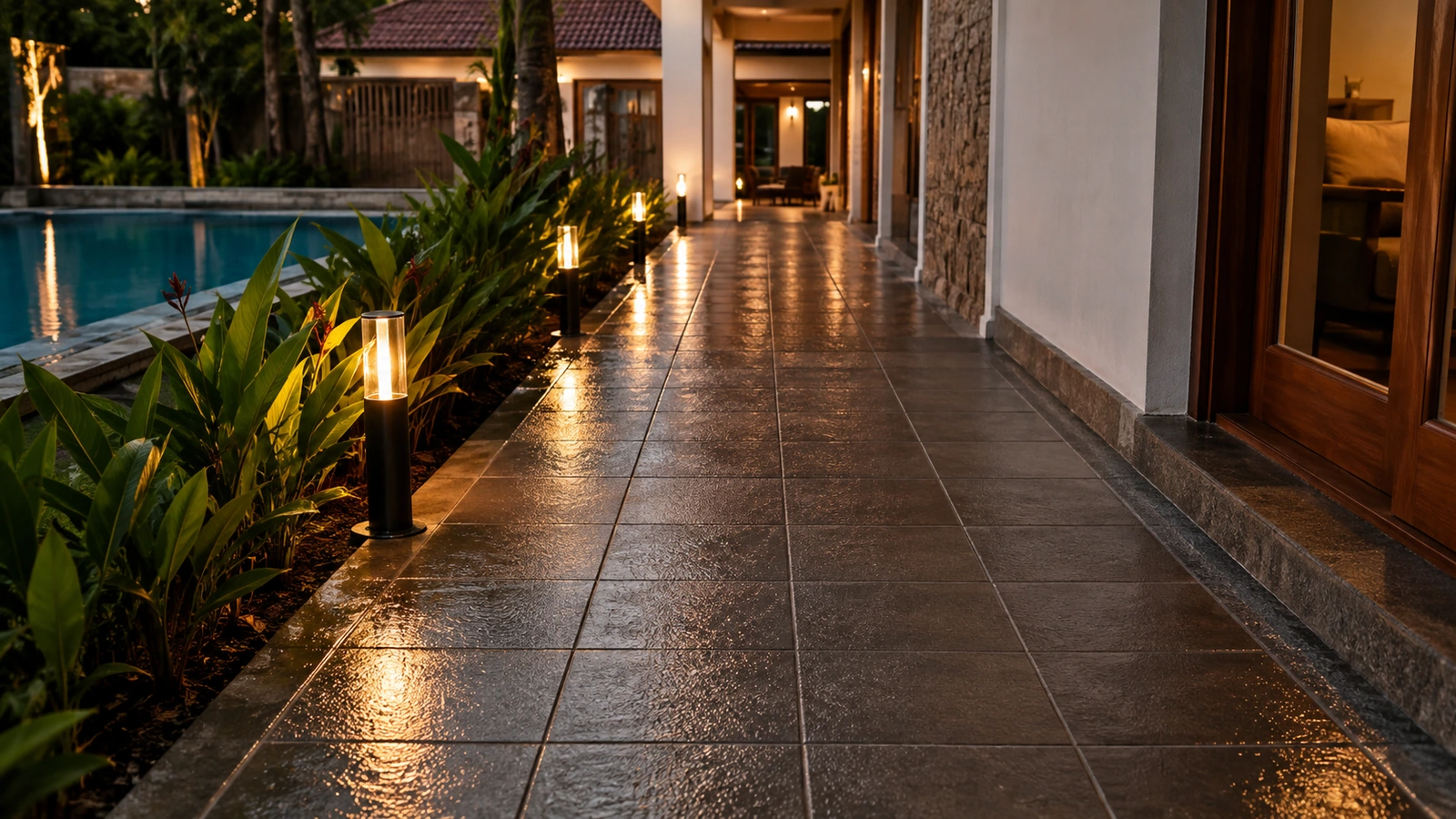
Textured Anti-Skid GVT, Pool to House Route
Anti-skid textured GVT, R11, high wet COF | 300x300 mm | Matte textured | Rs. 100 to Rs. 160/sq.ft
Typical room cost: About Rs. 8,000 to Rs. 12,800 for an 80 sq.ft path
The route people walk from the pool to the house with water running off them, which stays wet longer than the deck itself and is frequently specified as an afterthought in a lower grade than the deck it connects to.
Get this detail right: Specify this route at the same grade as the pool deck rather than as a general pathway, since it carries the same wet bare feet and often at more speed.
Pair with: A drainage fall along the path, and lighting for evening use.
Avoid: Treating the connecting path as ordinary circulation, which under-specifies the wettest walking route on the property.
Outdoor Kitchen and Barbecue Zone Tile Ideas
10. THE BARBECUE ZONE
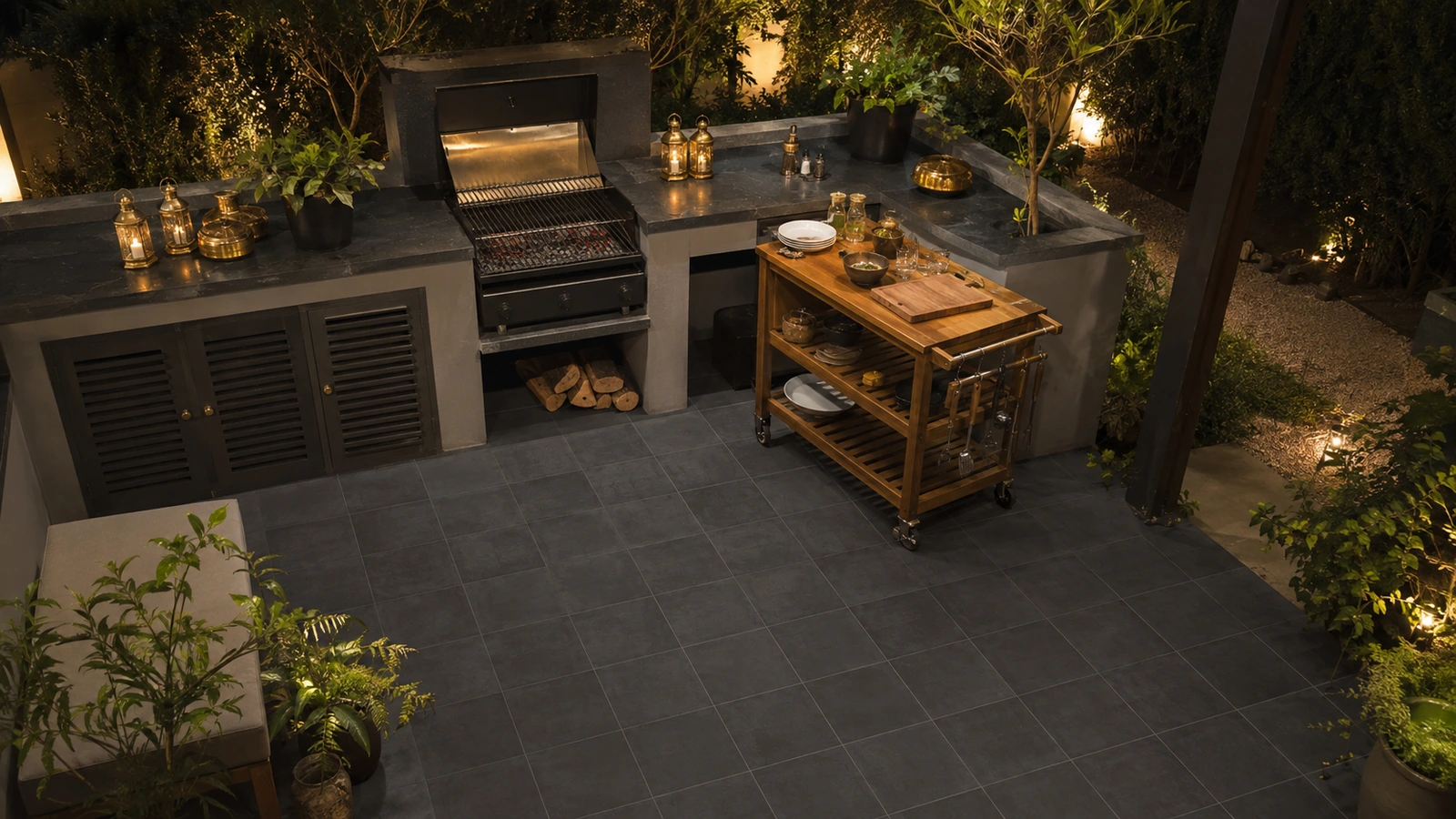
Charcoal Anti-Skid GVT, Grease Resistant
Anti-skid GVT, R11 outdoor rated | 400x400 mm | Matte | Rs. 95 to Rs. 155/sq.ft
Typical room cost: About Rs. 7,600 to Rs. 12,400 for an 80 sq.ft zone
The zone that will encounter dropped food, spilt oil and charcoal dust should be in a dark tone that hides all three and a lightly textured rather than heavily textured finish that does not trap grease.
Get this detail right: Keep the texture light in this zone specifically, since deep texture holds cooking grease in a way that is genuinely difficult to clean outdoors without pressure washing every time.
Pair with: Epoxy grout throughout, and a clear zone boundary so the grease-prone area is contained.
Avoid: Heavy texture in a barbecue zone, which trades a marginal grip gain for a real and recurring cleaning problem.
11. THE OUTDOOR KITCHEN FLOOR
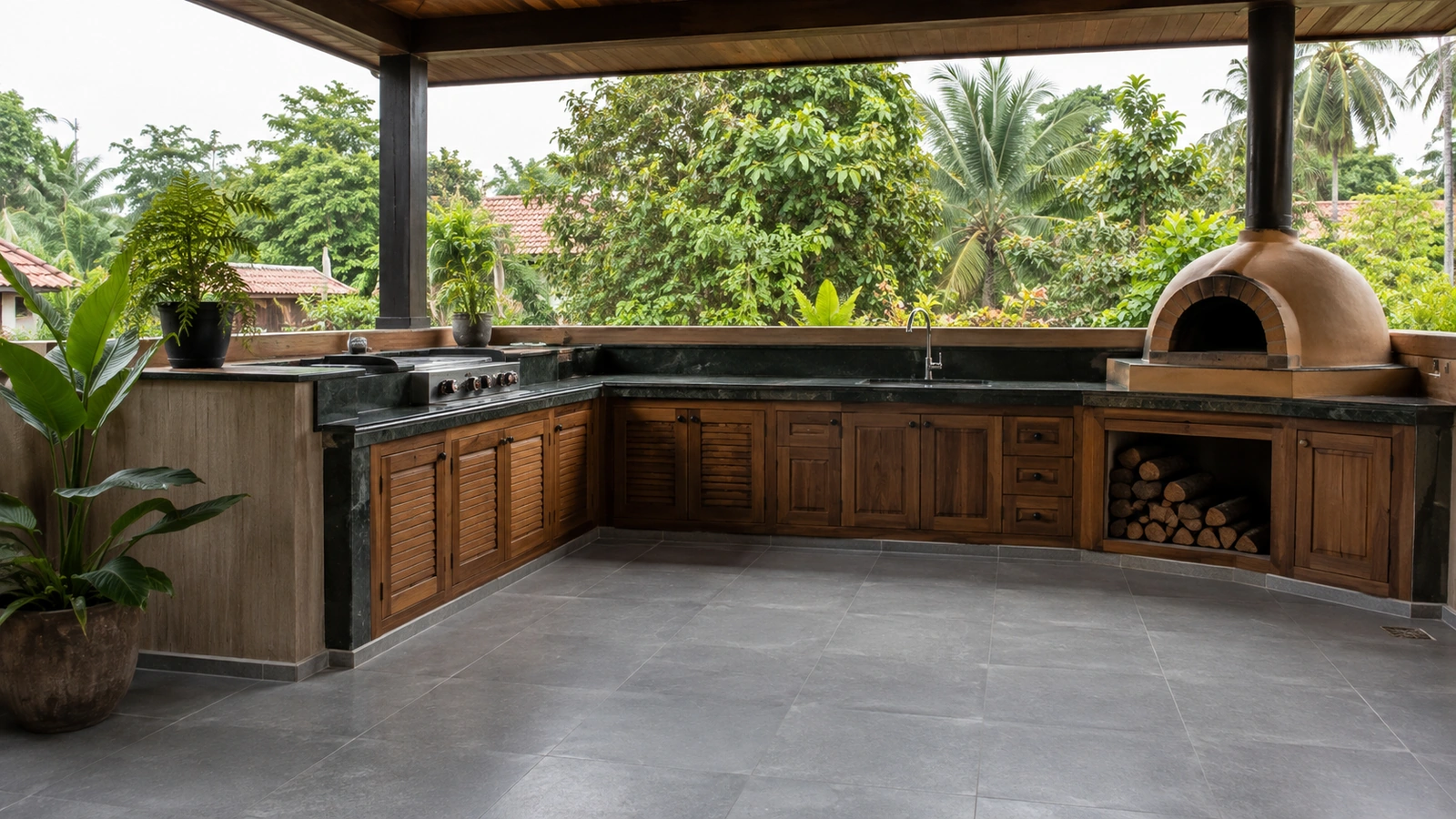
Grey Stone-Look Anti-Skid GVT, Chemical Resistant
Anti-skid GVT, R11, chemical resistant | 600x600 mm | Matte | Rs. 110 to Rs. 175/sq.ft
Typical room cost: About Rs. 13,200 to Rs. 21,000 for a 120 sq.ft outdoor kitchen
A full outdoor kitchen sees food, oil, cleaning chemicals and water together, which is closer to a commercial kitchen requirement than a domestic patio one.
Get this detail right: Confirm chemical resistance alongside the outdoor rating, since the degreasers needed for an outdoor cooking area are harsher than anything a normal patio meets.
Pair with: A drainage fall toward a gully, epoxy grout, and coving at the wall junction if there is a built structure.
Avoid: A standard patio specification in a working outdoor kitchen, which will stain and degrade within a few seasons.
12. THE PREP COUNTER SURROUND
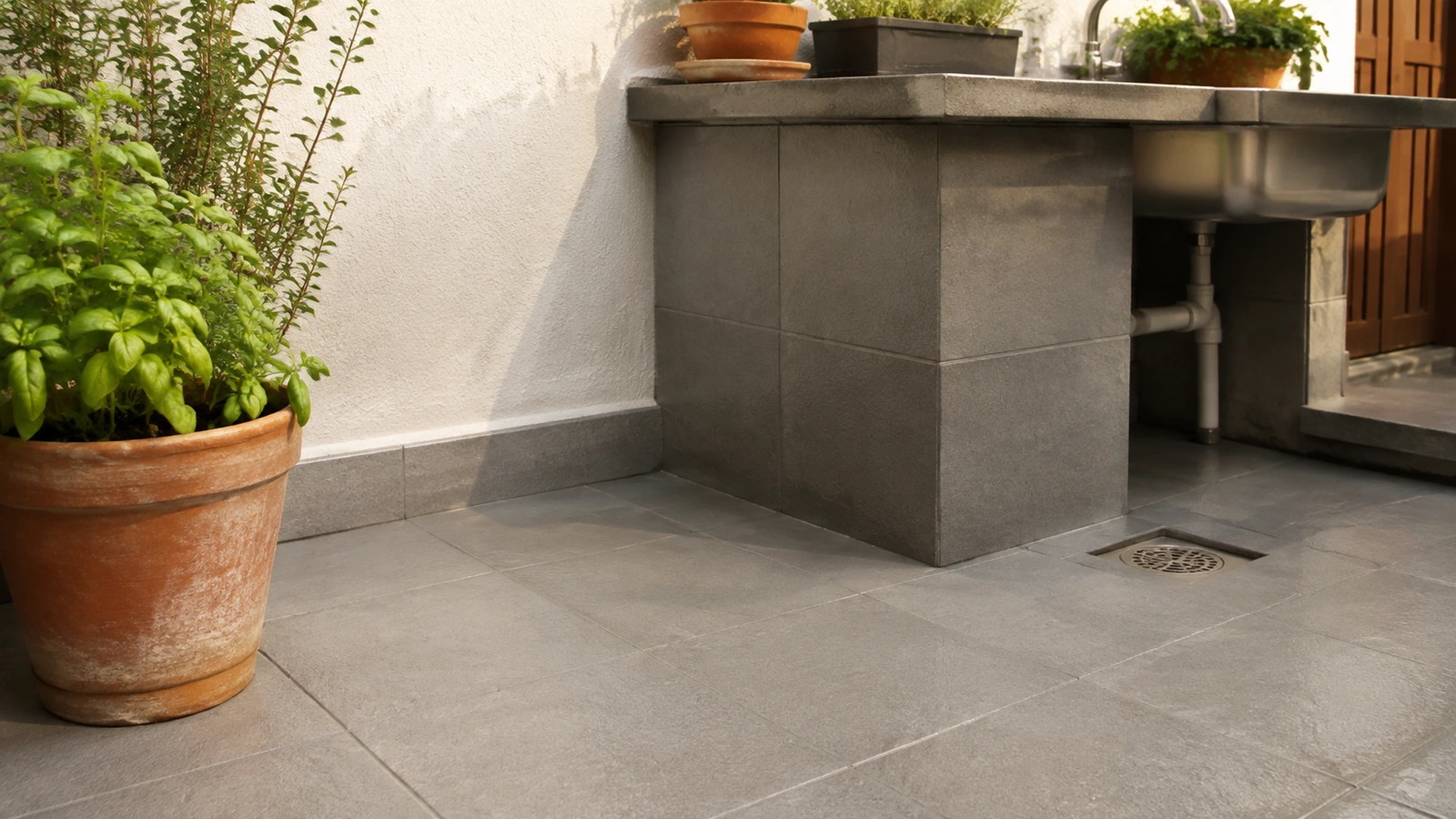
Mid-Grey Anti-Skid GVT, Splash Zone
Anti-skid GVT, R11 outdoor rated | 300x300 mm | Matte | Rs. 95 to Rs. 155/sq.ft
Typical room cost: About Rs. 4,800 to Rs. 7,800 for a 50 sq.ft surround
The floor immediately around an outdoor prep counter or sink, where splash is constant, and the small format handles the tight cutting around built structures and drainage points.
Get this detail right: Run the tile up the counter base as a coved detail rather than butting it, so spilt liquid does not sit in a floor-to-structure junction where it will eventually work through.
Pair with: Epoxy grout, a fall toward a gully, and easy access for cleaning behind the counter.
Avoid: A floor-to-structure junction with no coving, which is where outdoor kitchen floors most often fail first.
Garden Path and Circulation Tile Ideas
13. THE GARDEN PATH
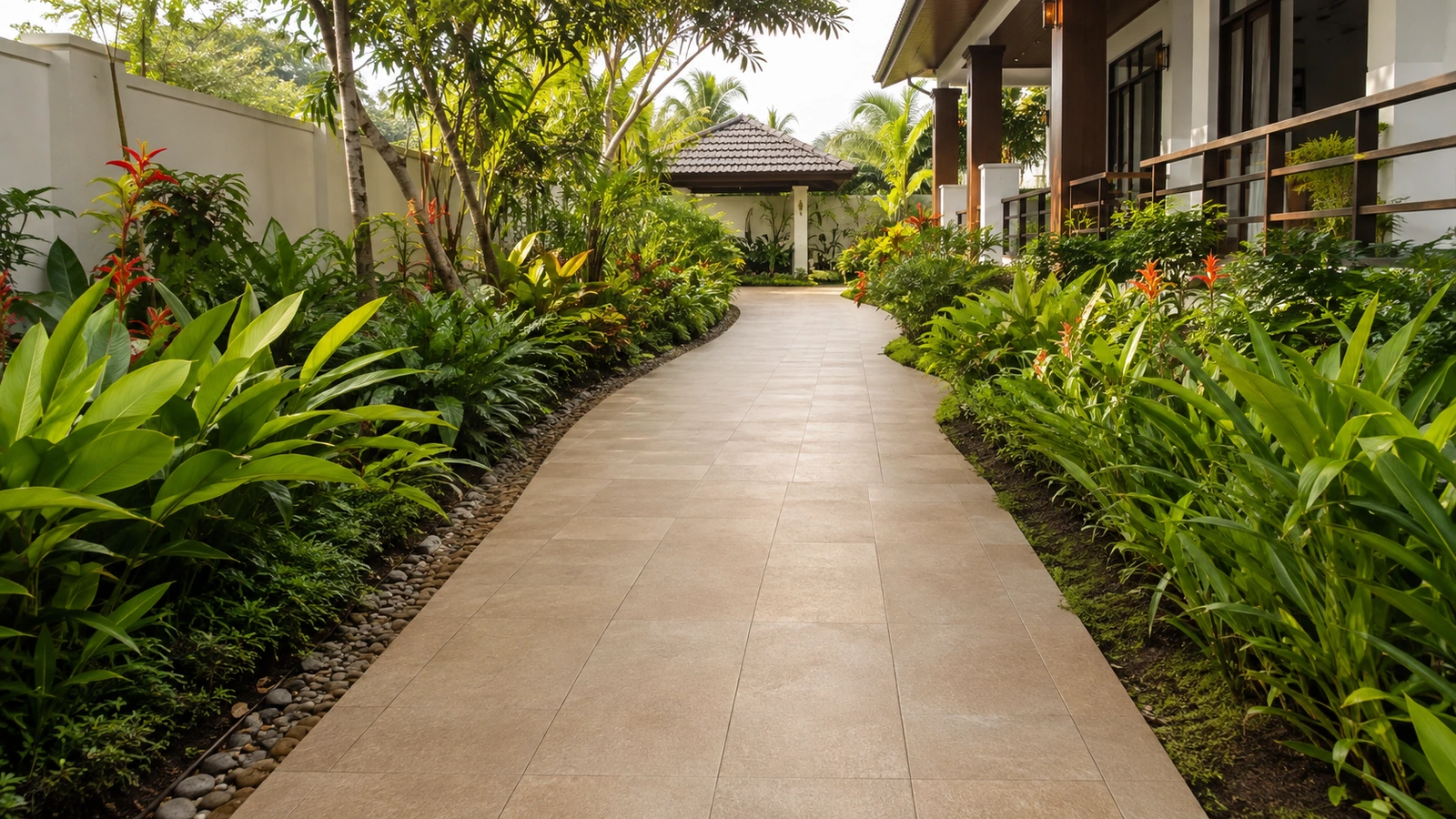
Warm Sand Anti-Skid GVT, 300x600 mm
Anti-skid GVT, R11 outdoor rated | 300x600 mm | Matte | Rs. 90 to Rs. 145/sq.ft
Typical room cost: About Rs. 5,400 to Rs. 8,700 for a 60 sq.ft path
A rectangular format runs along the path direction, which visually lengthens the route and reduces the number of cuts along a narrow run compared with a square tile.
Get this detail right: Run the long dimension along the path and lay the fall to one side rather than centrally, so water leaves the path onto planting rather than running down its length.
Pair with: A gravel or edging margin at the planting boundary, which stops soil splash reaching the tile.
Avoid: A square format on a narrow path, which produces more cuts and no lengthening effect.
14. THE STEPPED APPROACH
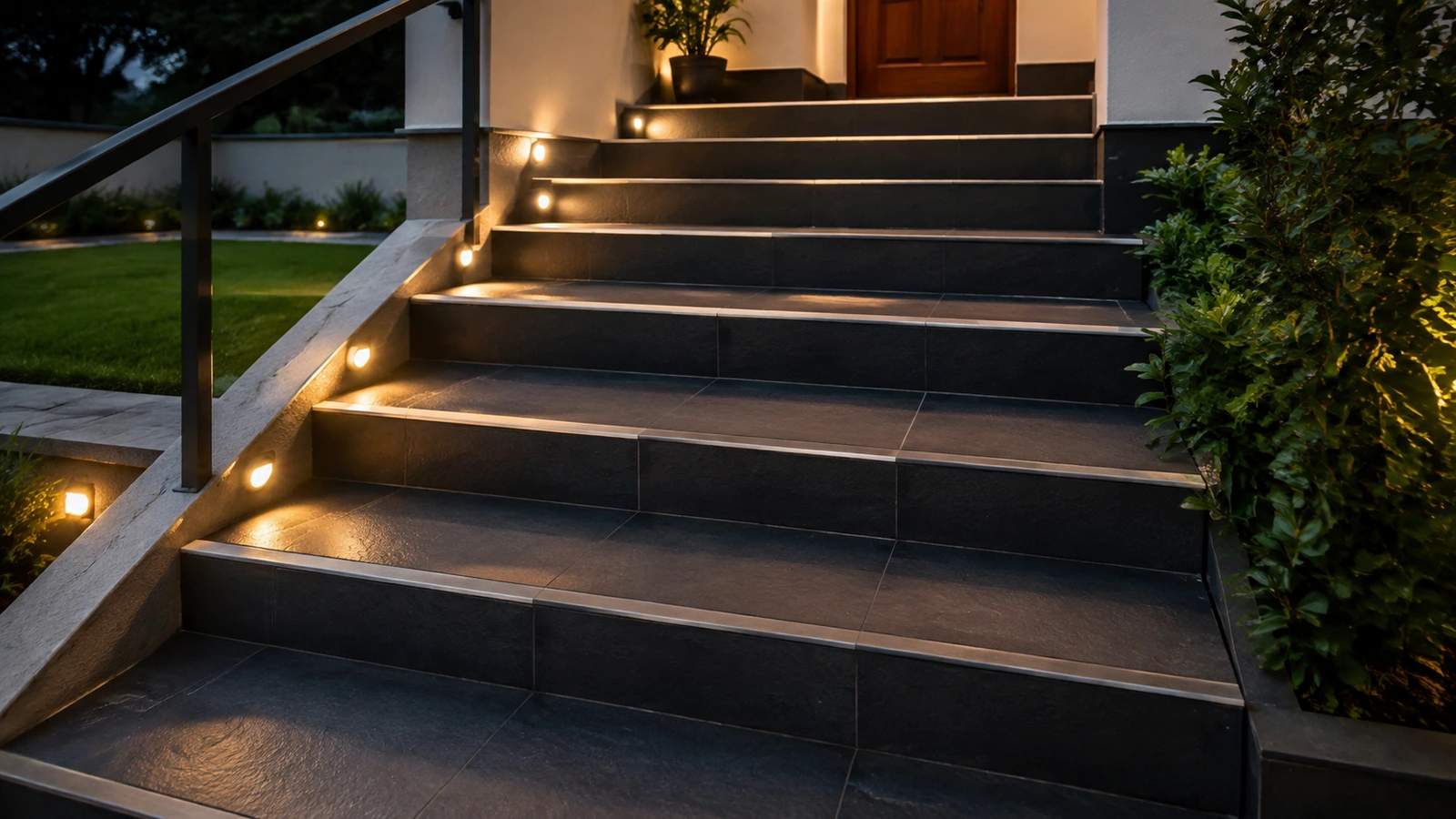
Charcoal Anti-Skid GVT with Contrasting Nosing
Anti-skid GVT, R11, high wet COF | 300x300 mm | Matte textured | Rs. 100 to Rs. 160/sq.ft
Typical room cost: About Rs. 4,000 to Rs. 6,400 for a 40 sq.ft flight
Outdoor steps are where a slip has the furthest to travel, so this gets the highest grip specification on the property and a contrasting nosing on every tread.
Get this detail right: Keep every riser within 5 mm of the same height, since inconsistent risers cause more outdoor falls than slippery surfaces do, and no tile specification compensates for them.
Pair with: Lighting that reaches the tread rather than only the landing, and a handrail where the flight is more than a few steps.
Avoid: A uniform tone across treads and risers, which makes step edges genuinely hard to read at dusk.
15. THE SIDE RETURN
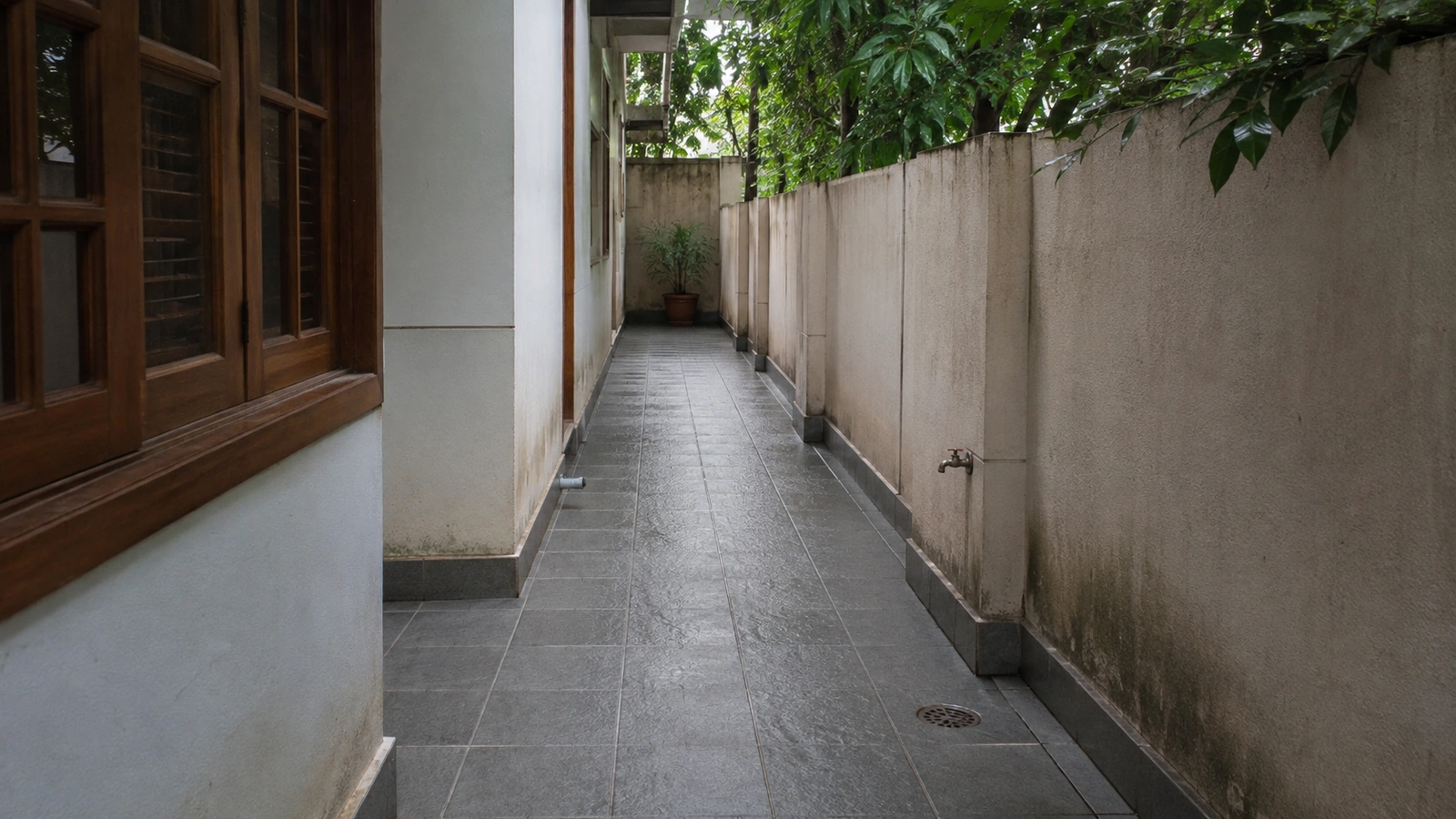
Mid-Grey Textured Anti-Skid GVT, Shaded Run
Anti-skid textured GVT, R11 outdoor rated | 300x300 mm | Matte textured | Rs. 95 to Rs. 150/sq.ft
Typical room cost: About Rs. 3,800 to Rs. 6,000 for a 40 sq.ft return
The narrow shaded passage down the side of a house, which stays damp the longest, grows the most algae and is almost always specified last and cheapest despite being the most slip-prone route on the property.
Get this detail right: Specify this at full grip grade despite it being a utility route, since permanent shade plus poor drainage plus infrequent cleaning is the exact combination that produces slippery surfaces.
Pair with: A drainage fall along the run, and clearance from the boundary wall for cleaning access.
Avoid: Treating a side return as a low-priority area, which is how the most slip-prone surface on a property ends up with the lowest specification.
Indoor to Outdoor Transition Tile Ideas
16. THE THRESHOLD RUN
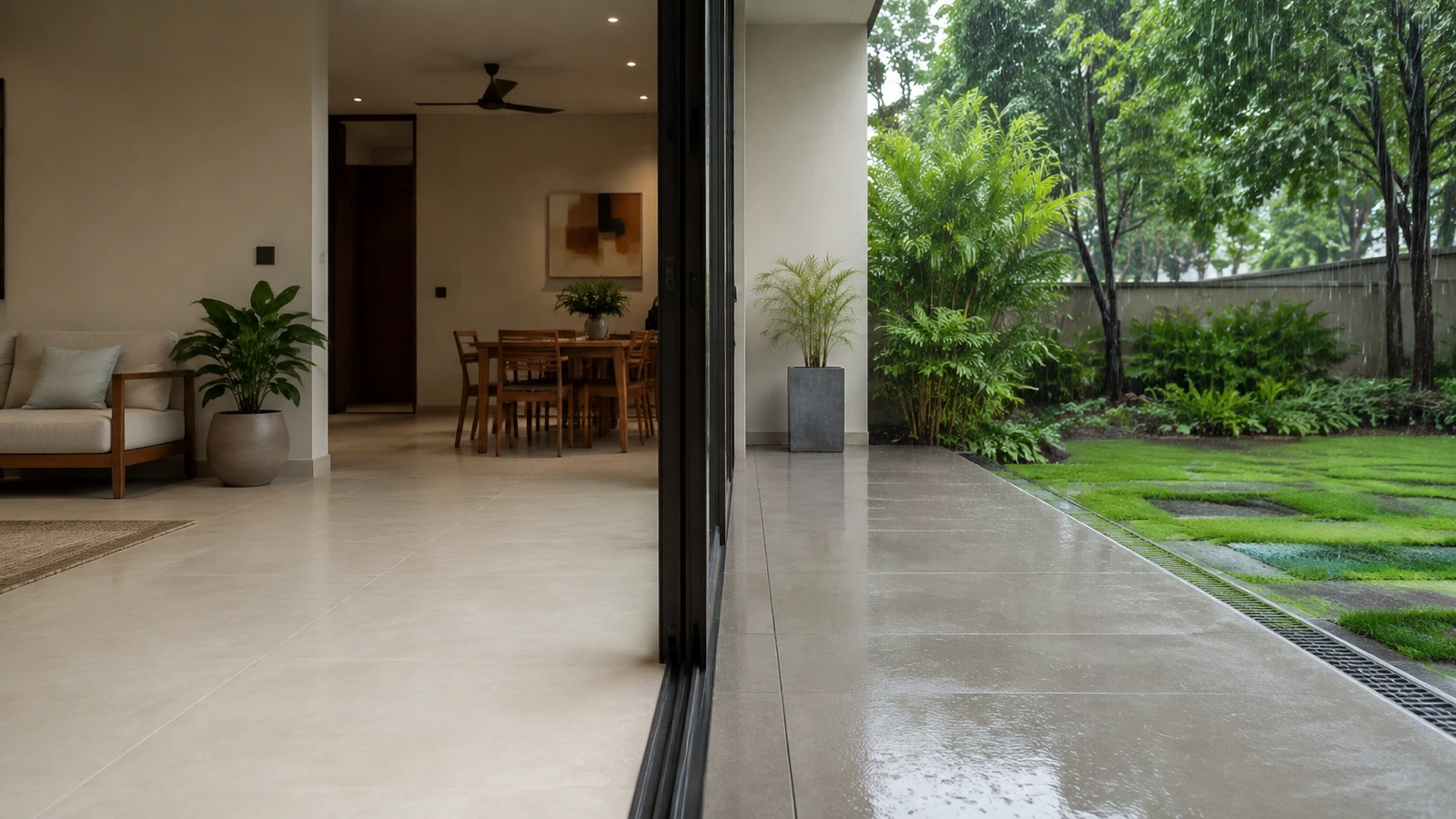
Matching Tone Across the Door Line
Indoor tile plus matching outdoor-rated GVT | 600x600 mm | Matte indoor, R11 outdoor | Rs. 95 to Rs. 165/sq.ft
Typical room cost: About Rs. 9,500 to Rs. 16,500 for 100 sq.ft across both sides
The same tone carried across the threshold, which visually extends the interior outward, with the outdoor portion specified separately at full outdoor rating.
Get this detail right: Set the outdoor side 10 to 15 mm below the interior floor level and fall away from the door, since a flush or inward-falling threshold sends monsoon water into the house.
Pair with: A drainage channel immediately outside the door line, and matching grout tone across both.
Avoid: A perfectly flush threshold with no fall, which looks elegant on a drawing and floods an interior in July.
17. THE CONTINUOUS LOOK
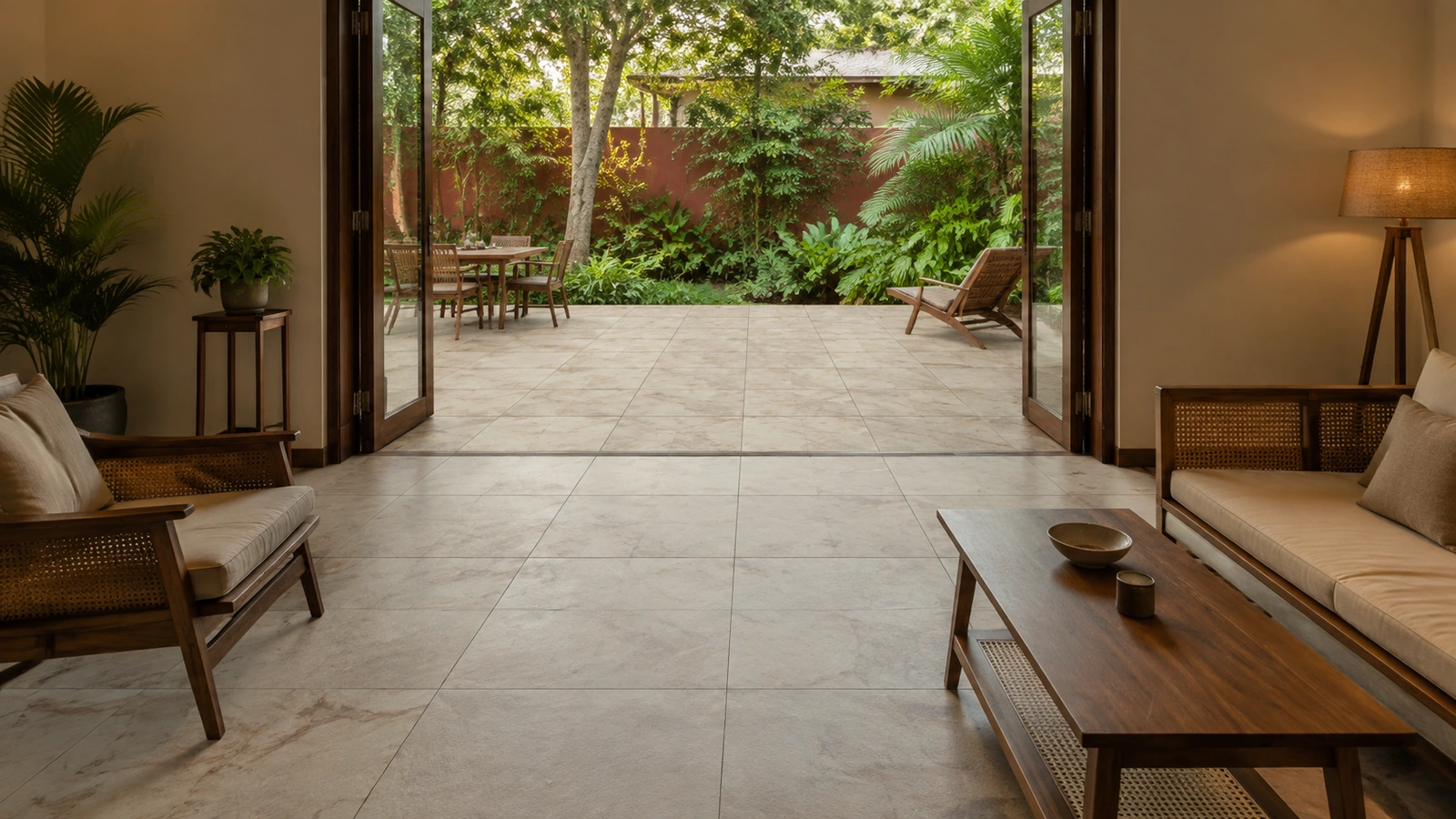
Same Design, Two Different Ratings
Indoor GVT plus outdoor-rated version of the same design | 600x600 mm | Matte indoor, R11 textured outdoor | Rs. 100 to Rs. 170/sq.ft
Typical room cost: About Rs. 10,000 to Rs. 17,000 for 100 sq.ft across both sides
Manufacturers frequently produce the same design in an indoor smooth and an outdoor textured version, which gives visual continuity while each side carries the rating it needs.
Get this detail right: Ask specifically whether the range has a matched outdoor variant, since this is common but rarely volunteered, and it solves the transition problem far better than compromising on one side.
Pair with: Matching grout across both, and consistent lighting temperature so the material reads as continuous after dark.
Avoid: Using the indoor tile outdoors to keep the match perfect, which is unsafe in monsoon regardless of how well it matches.
18. THE COVERED VERANDA
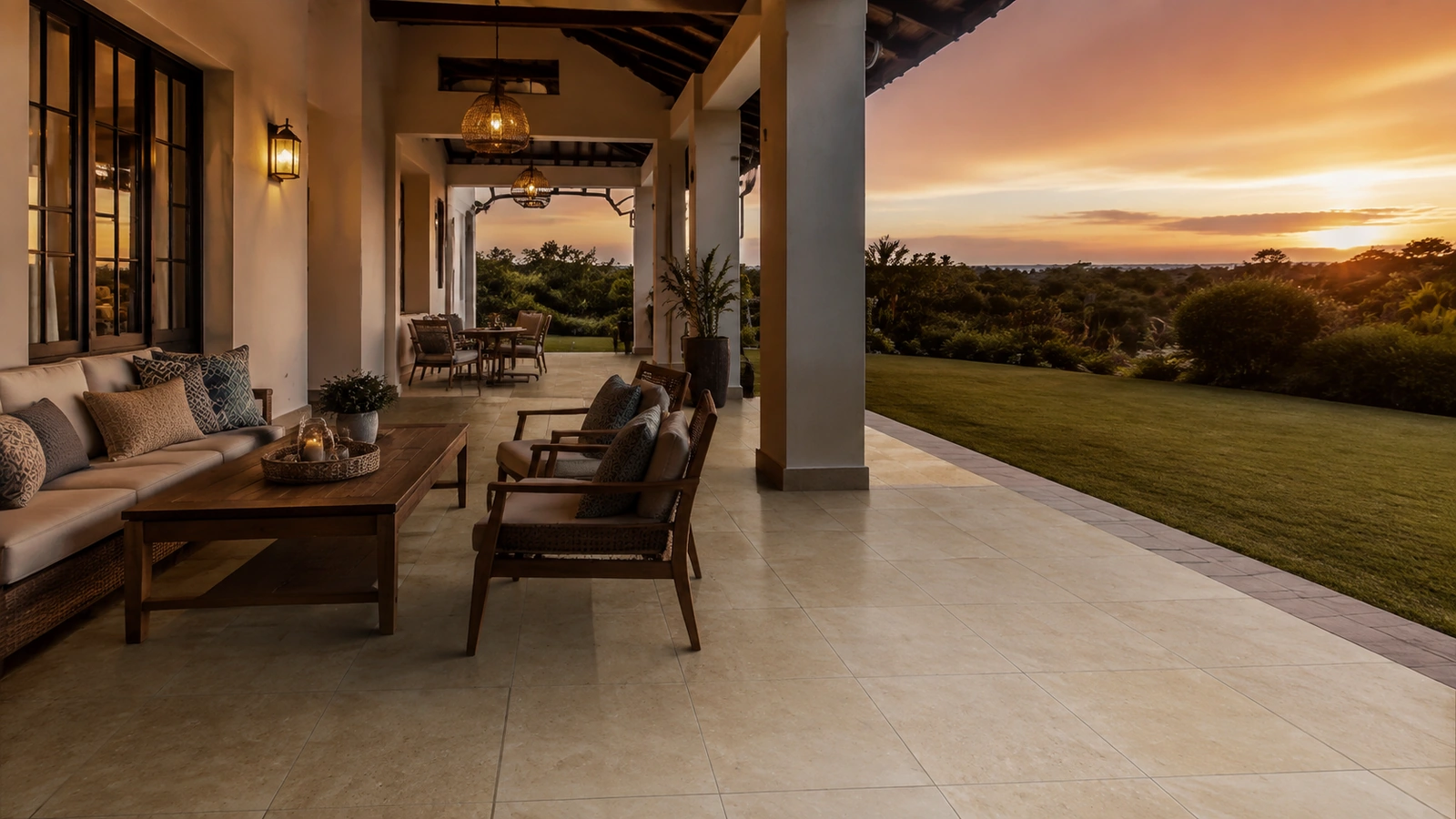
Warm Beige Anti-Skid GVT, R10 Under Cover
Anti-skid GVT, R10 outdoor rated | 600x600 mm | Matte | Rs. 90 to Rs. 145/sq.ft
Typical room cost: About Rs. 10,800 to Rs. 17,400 for a 120 sq.ft veranda
A genuinely covered veranda set back from driving rain can reasonably use R10 rather than R11, which widens the design choice and reduces the cleaning burden that heavier texture brings.
Get this detail right: Confirm the veranda is genuinely sheltered rather than nominally covered, since a shallow roof over a west-facing veranda takes driving monsoon rain and needs the full R11 specification.
Pair with: Warm lighting, timber or rattan furniture, and a threshold detail at the open edge.
Avoid: R10 on a veranda that gets wind-driven rain, which is a specification made for a drawing rather than for the weather.
Family and Kids Outdoor Area Tile Ideas
19. THE PLAY SURFACE
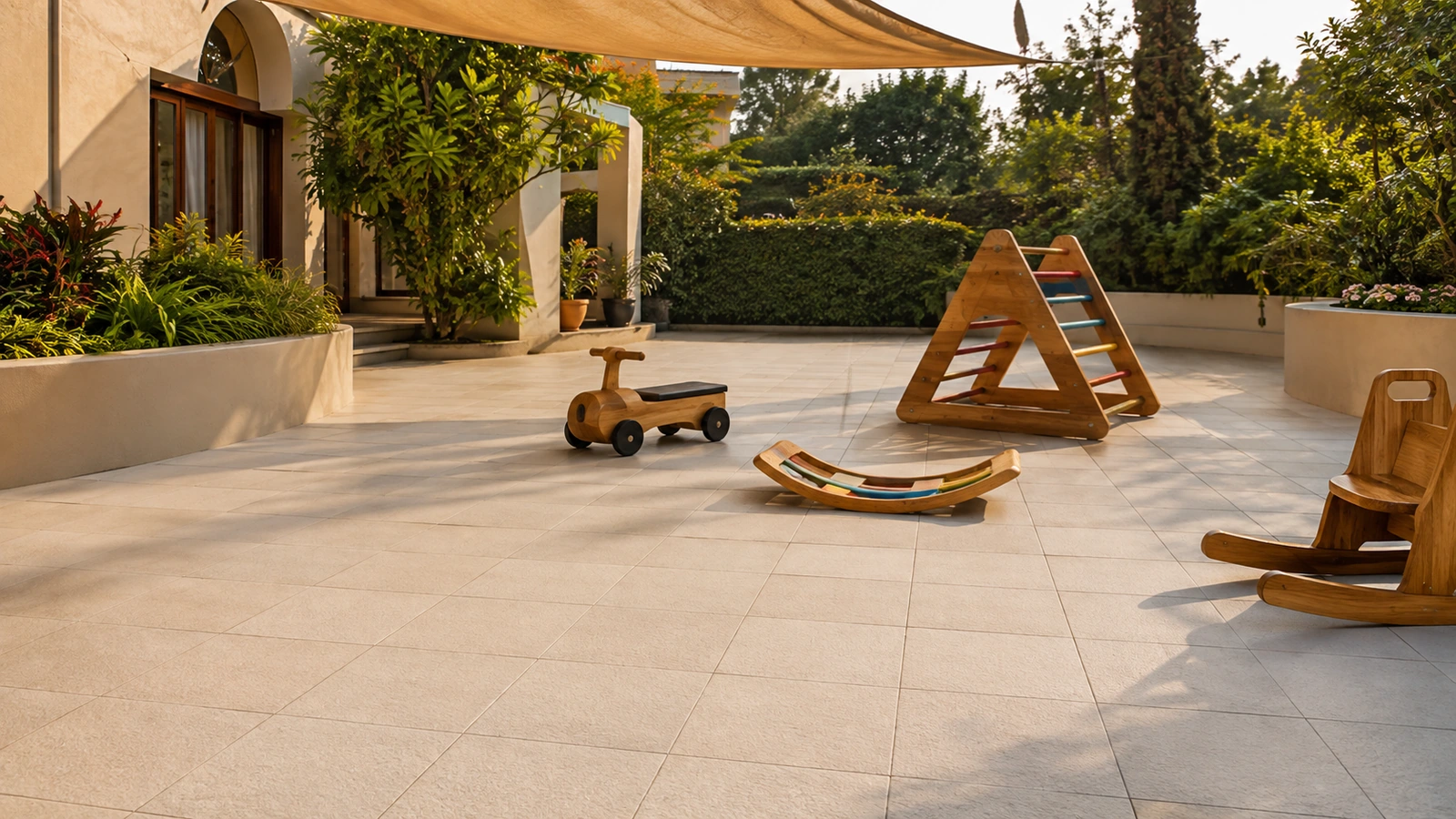
Pale Sand Textured Anti-Skid GVT
Anti-skid textured GVT, R11, high wet COF | 400x400 mm | Matte textured | Rs. 100 to Rs. 160/sq.ft
Typical room cost: About Rs. 12,000 to Rs. 19,200 for a 120 sq.ft play area
Children run on wet surfaces regardless of instruction and play barefoot in summer, which makes this the one zone where grip and surface temperature both have to be right rather than traded off.
Get this detail right: Choose pale over dark without exception here, since a play area that is too hot underfoot in May simply stops being used at exactly the time of year it is most wanted.
Pair with: Shade from a tree or canopy, rounded-edge planters, and no hard level changes within the play zone.
Avoid: Dark tones in a children's area, where surface heat and bare feet meet most often.
20. THE FAMILY COURTYARD
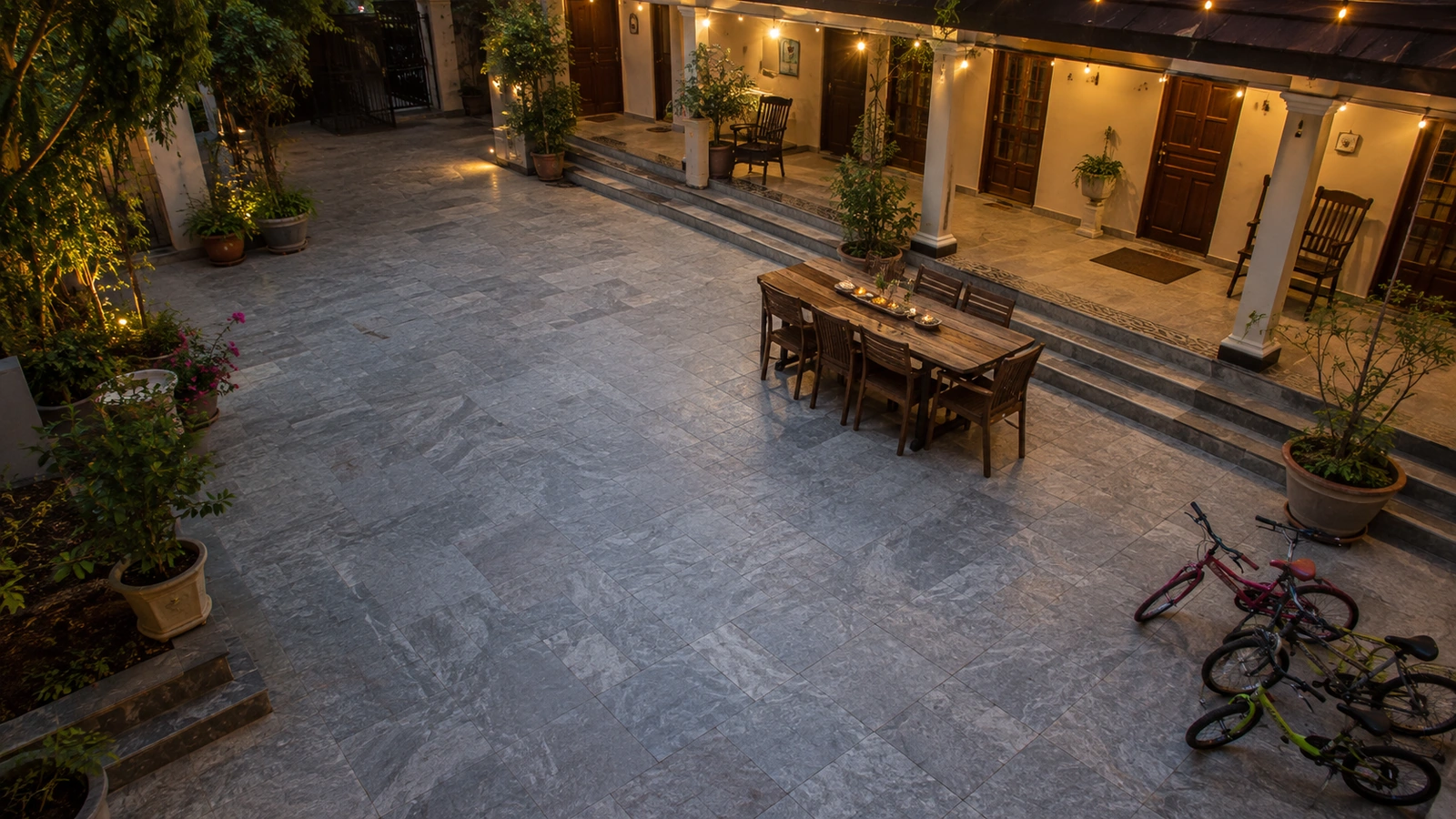
Mid-Grey Stone-Look Anti-Skid GVT
Anti-skid GVT, R11 outdoor rated | 600x600 mm | Matte | Rs. 95 to Rs. 155/sq.ft
Typical room cost: About Rs. 19,000 to Rs. 31,000 for a 200 sq.ft courtyard
A general-purpose family courtyard that will see everything from cycling to festival gatherings, in a mid-tone that hides marks and a stone-look that disguises the wear a hard-used space accumulates.
Get this detail right: Choose a range with high face variation, since a courtyard is a large area and a low variation count shows visible repetition across it.
Pair with: Durable planters that will survive being knocked, and lighting for evening use.
Avoid: A flat single-tone tile across a large courtyard, which shows every mark and every repeat.
21. THE PET-FRIENDLY PATIO
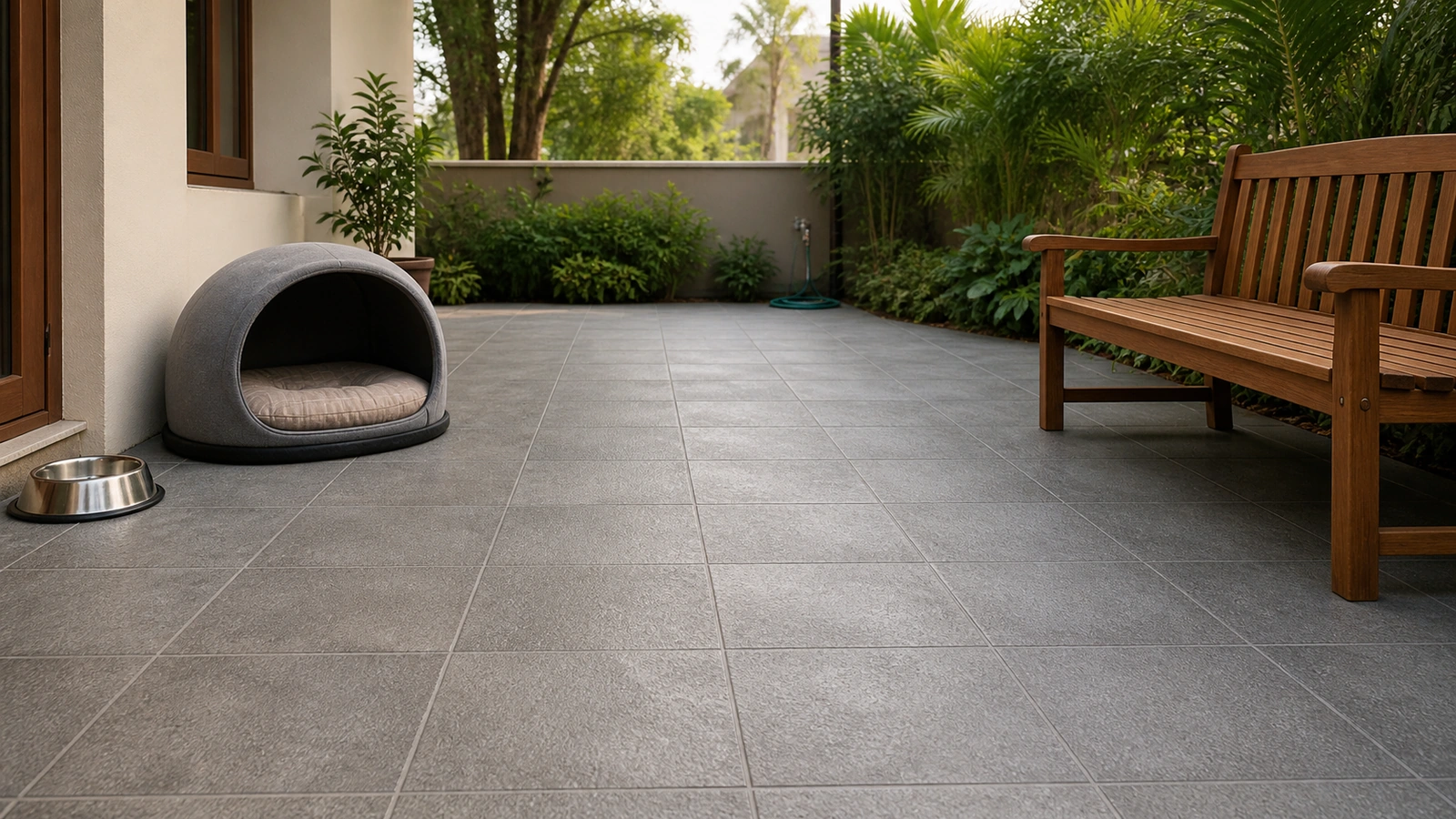
Textured Anti-Skid GVT, Mid Tone
Anti-skid textured GVT, R11 outdoor rated | 400x400 mm | Matte textured | Rs. 95 to Rs. 155/sq.ft
Typical room cost: About Rs. 11,400 to Rs. 18,600 for a 120 sq.ft patio
Vitrified tile handles claws considerably better than timber decking or natural stone, and a textured mid-tone gives pets grip while hiding the marks and hair that come with them.
Get this detail right: Choose a texture fine enough to hose clean, since deep texture holds pet hair and outdoor debris in a way that turns routine cleaning into a chore.
Pair with: A hose point within reach, epoxy grout, and shade for the animal in summer.
Avoid: Deep, aggressive texture, which grips well and holds everything else equally well.
Patio Tile Specification Checklist for Every Zone
- R11 outdoor rating and wet coefficient of friction of 0.4 minimum across all exposed zones, with the highest available grade at poolside and on steps.
- Fired ceramic pigment for UV colourfastness, since every zone above is exposed to sustained sun over years.
- Light or mid tones in any barefoot zone, particularly poolside, lounging and children's areas, where surface heat decides usability.
- A drainage fall of about 1 in 80 away from the building in every zone, since no texture compensates for standing water.
- Epoxy grout throughout, because outdoor grout faces sustained wetness that cement grout does not survive well.
- Water absorption of 0.05% or below, the benchmark set by the Bureau of Indian Standards under IS 15622 for vitrified tile, with the test certificate requested.
Check Patio and Outdoor Tiles on TilesFinders
Outdoor ranges can be filtered on TilesFinders by R rating, texture and format, so each zone of a patio can be specified for the demand it actually faces rather than to a single compromise across the whole space.
FAQs
Usually not. A dining area needs flatness, a pool deck needs maximum grip, a barbecue zone needs grease resistance, and a shaded side return needs algae management. One specification across all of them over-serves most zones and under-serves the one that matters.
A mid-format such as 600x600 in a warm mid-tone, laid over a substrate checked for flatness at the table position specifically. A patio built to a drainage fall is not level by definition, and a table needs a flatter zone than the rest of the terrace.
The highest available wet coefficient of friction rather than the 0.4 minimum, an R11 outdoor rating, a pale tone for barefoot comfort in the sun, and a fall away from the pool toward a drainage channel so splash water leaves the deck.
The shaded side return, and the path from the pool to the house. Both stay wet the longest, both are treated as utility routes, and both are frequently given a lower grade than the areas they connect, despite carrying the same wet bare feet.
Under genuine year-round shade, yes, it hides marks better than any pale option. Confirm the shade is permanent rather than seasonal, since a deciduous canopy that shades in August leaves a dark patio in full winter sun.
The outdoor side is set 10 to 15 mm below the interior floor level and falls away from the door, with a drainage channel immediately outside. A flush threshold looks elegant on a drawing and sends monsoon water into the house.
Not the same tile, but frequently the same design. Many ranges are produced in a smooth indoor version and a textured outdoor version, which gives visual continuity while each side carries its correct rating. Ask specifically, since it is rarely volunteered.
A dark tone with light rather than heavy texture. Dark hides dropped food, oil and charcoal dust, while light texture avoids trapping cooking grease, which is genuinely difficult to clean out of deep texture without pressure washing every time.


See our tile guides first
Set TilesFinders as a preferred source and our buying guides surface ahead of the rest for you.
Add as preferred sourceTakes one tap. Nothing to install.
What Readers Say
I was about to redo my parking area with the wrong tile size until I read this. The layout comparisons saved me from a costly mistake.
We reference TilesFinders guides while briefing clients on material selection. The size and pattern breakdowns are accurate and easy to explain visually.
On site, I get asked about grout spacing all the time. This article gave me a solid reference I now share with my team before every job.
Finally a guide that doesn't just push generic advice. The oil stain removal steps actually worked on our clubhouse driveway tiles.
I run a small construction firm and now send this link to clients directly when they ask about entrance tile sizing. Saves me an hour of explaining.
Good practical detail, though I wish there were more examples for compact apartment entrances specifically, not just villas.
My mother-in-law wanted marble, I wanted vitrified. This blog gave us the neutral comparison we needed to actually decide together.
Detailed without being overwhelming. I appreciated that it covered both cost and maintenance, not just the aesthetics.
Used the algae and hard water removal tips on our terrace tiles after the monsoon. Worked better than what our regular cleaner was doing.
As someone who sources tiles for multiple builder projects, I find these comparisons genuinely useful for vendor conversations, not just consumer content.
Recommended this to a client who kept second-guessing the entrance design. The small vs large layout section settled the debate instantly.
Straightforward and honest, no unnecessary jargon. Would like to see a similar breakdown for outdoor pool-deck tiles next.
We've bookmarked several TilesFinders guides for our design handbook. Reliable source when clients want data, not just opinions.
Two paths, one marketplace.
Get free quotes from verified suppliers.
Share your room, budget, and style. Suppliers in local area respond within hours.
Get Free QuotesList your business, reach real buyers.
Put your showroom in front of homeowners searching for tiles right now.
List Your Business