
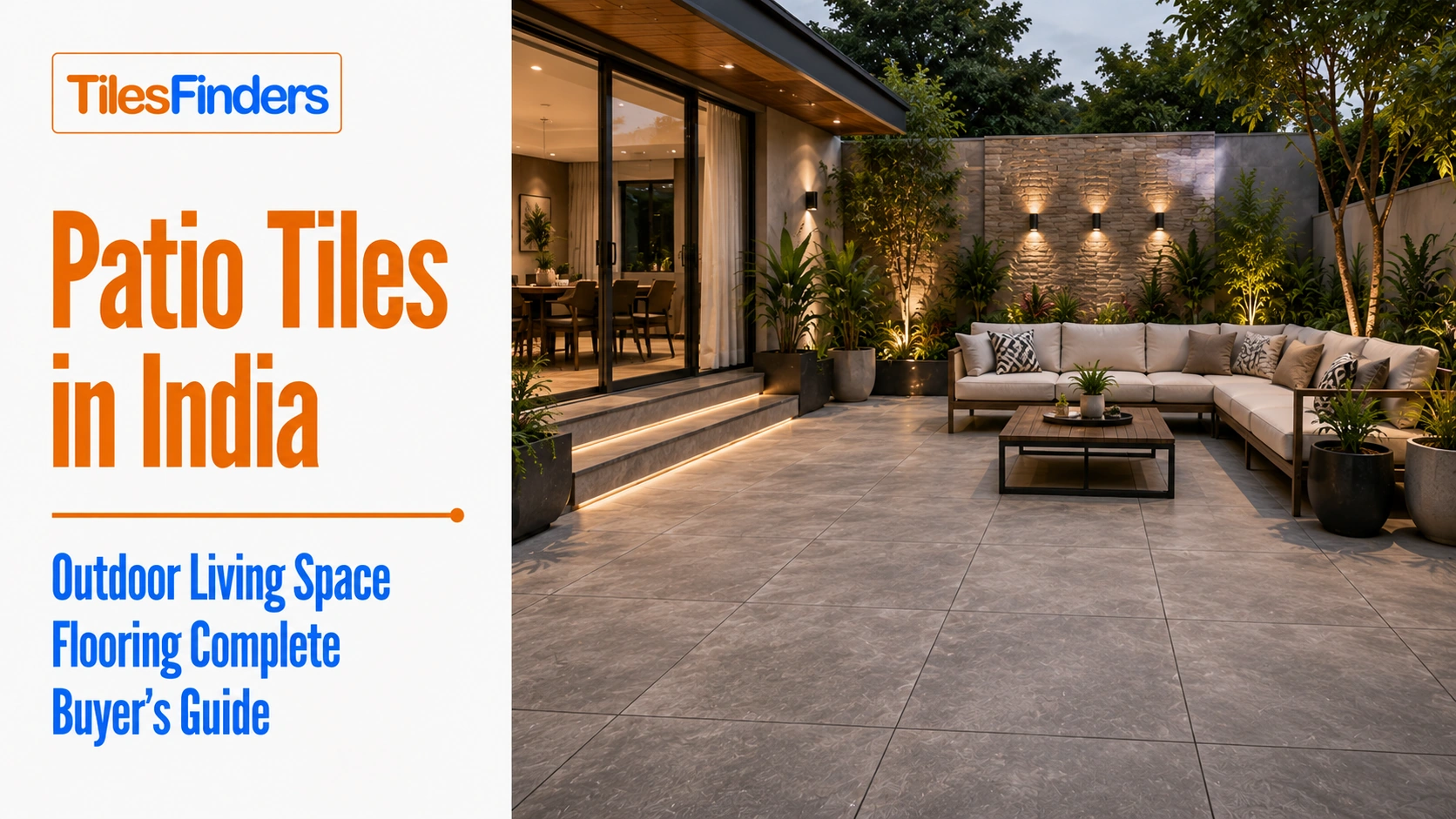
Patio Tiles in India: Outdoor Living Space Flooring Complete Buyer's Guide
Discover how to choose patio tiles in India for year-round outdoor use, covering summer heat, monsoon drainage, slip resistance, algae, UV exposure, colour, grout and ground preparation.
- What a Patio Faces Across One Indian Year
- Summer: Surface Heat and UV Colourfastness
- Monsoon: Drainage, Slip Resistance and R Rating
- Post-Monsoon: Algae, Moss and Why Patios Turn Slippery in September
- Winter and Dry Season: Dust, Soil and Morning Dew
- Patio Tile Specification: What the Year Adds Up To
- Ground-Level Patio Substrate and Drainage
- Patio Tile Buying Checklist
- Finalise Patio and Outdoor Tiles on TilesFinders
Patio tiles in India must handle intense summer heat, monsoon water, algae, dust and morning dew, making grip, drainage, UV stability and colour important year-round. Choose R11 outdoor-rated tiles with a wet COF of 0.4 minimum, proper drainage, epoxy grout and a well-compacted ground-level sub-base for lasting performance.
A patio is the only floor in an Indian home that has to survive four completely different sets of conditions in a single year. It bakes in April, floods in July, grows algae in September and collects dust and leaf litter through winter. A specification chosen for one of those seasons frequently fails in another, which is why patio tile floors are the outdoor surface most often relaid within five years. This guide works through the year season by season and sets out what a patio floor has to do in each.
What a Patio Faces Across One Indian Year
| Season | The Problem | What the Tile Must Do |
| Summer, March to June | Direct sun, extreme surface heat, intense UV | Stay walkable barefoot and hold its colour |
| Monsoon, June to September | Standing water, continuous wetness, slip risk | Drain fast and grip when wet |
| Post-monsoon, September to November | Algae and moss growth on damp surfaces | Resist biological growth and clean easily |
| Winter and dry season | Dust, leaf litter, soil splash, morning dew | Hide soiling and stay safe on damp mornings |
Popular tiles right now



Summer: Surface Heat and UV Colourfastness
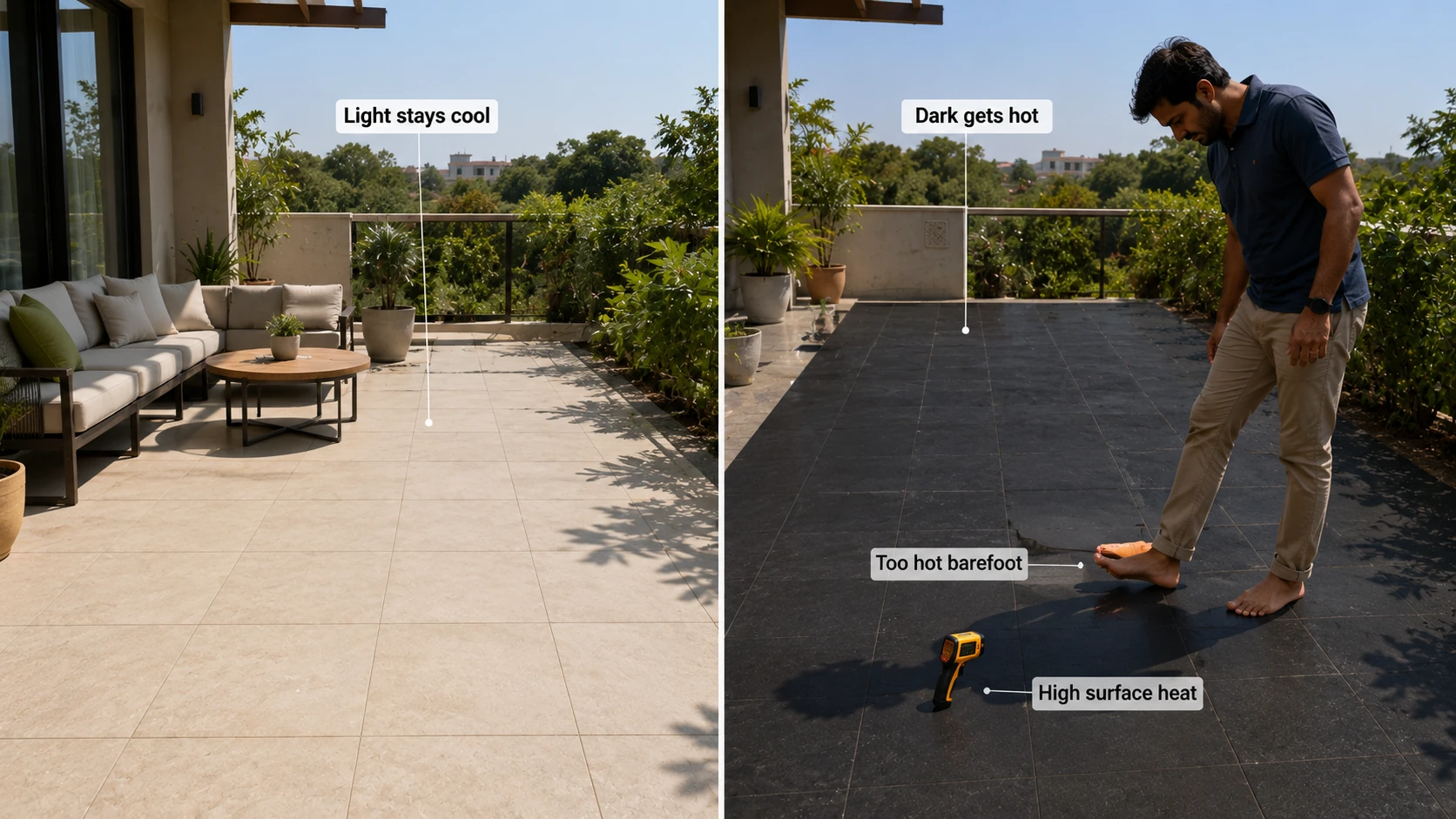
The problem nobody tests for in a showroom: A tile sample handled indoors tells you nothing about how the same tile behaves at two in the afternoon in May. Dark surfaces absorb considerably more solar energy than light ones and reach temperatures that make a patio genuinely unusable barefoot through the hottest months, which in much of India is a third of the year. This is not a durability question, since the tile is entirely unharmed. It is a usability question, and it is the single most common reason a beautiful dark patio ends up being walked around rather than walked on. The tile survives; the space does not get used. |
Choosing a Patio Tile Colour for Indian Summers
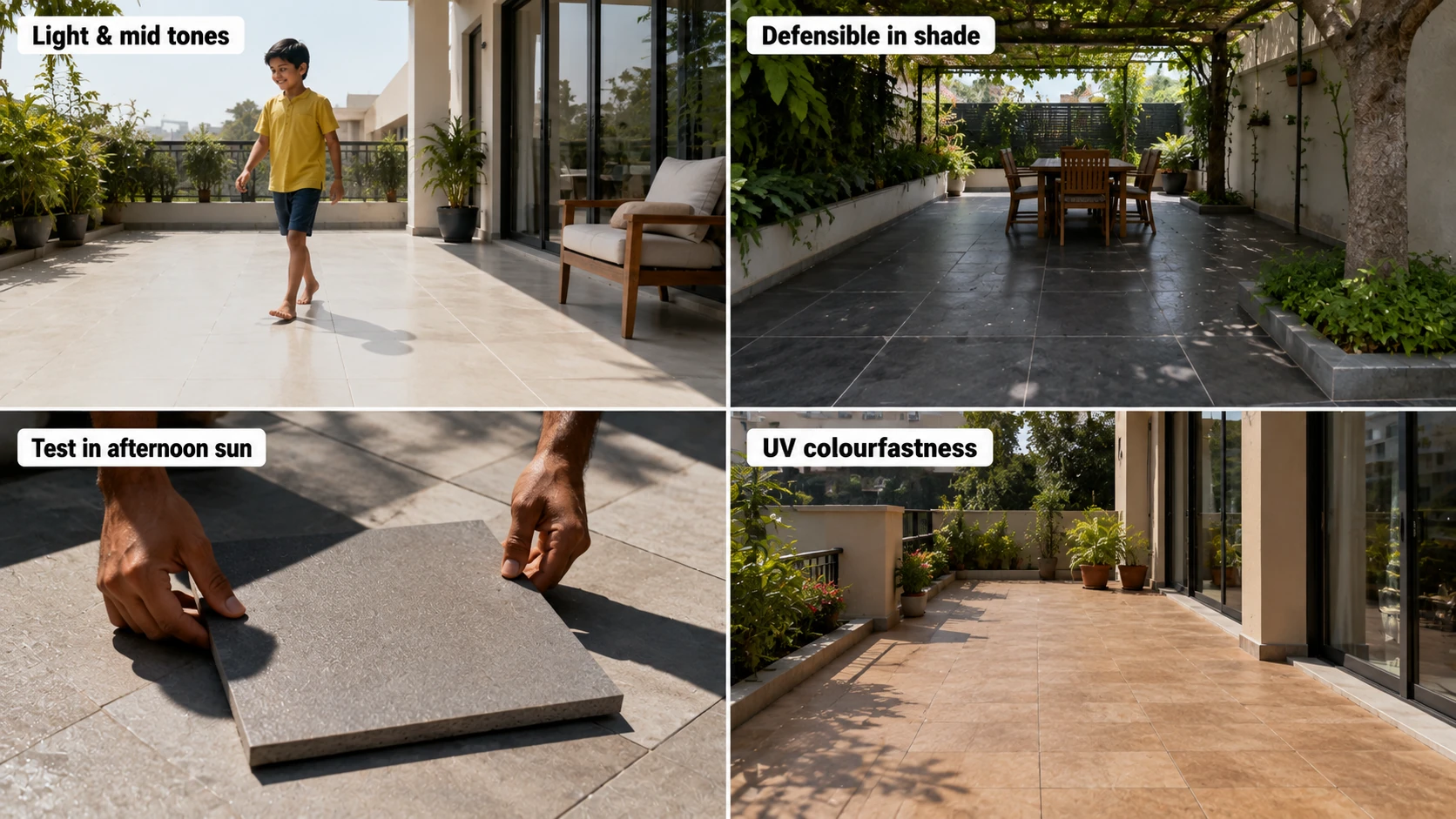
- Light and mid tones stay meaningfully cooler underfoot, which matters most on a patio used barefoot or by children.
- Dark tones are defensible in shaded patios, under a pergola or a tree canopy, where direct sun is limited.
- Test the actual sample outdoors in afternoon sun before committing, since this is the one property a showroom cannot demonstrate.
- UV colourfastness is separate from heat, and matters for whether the colour holds over years rather than how the surface feels today. Confirm it for any fully exposed patio.
Monsoon: Drainage, Slip Resistance and R Rating
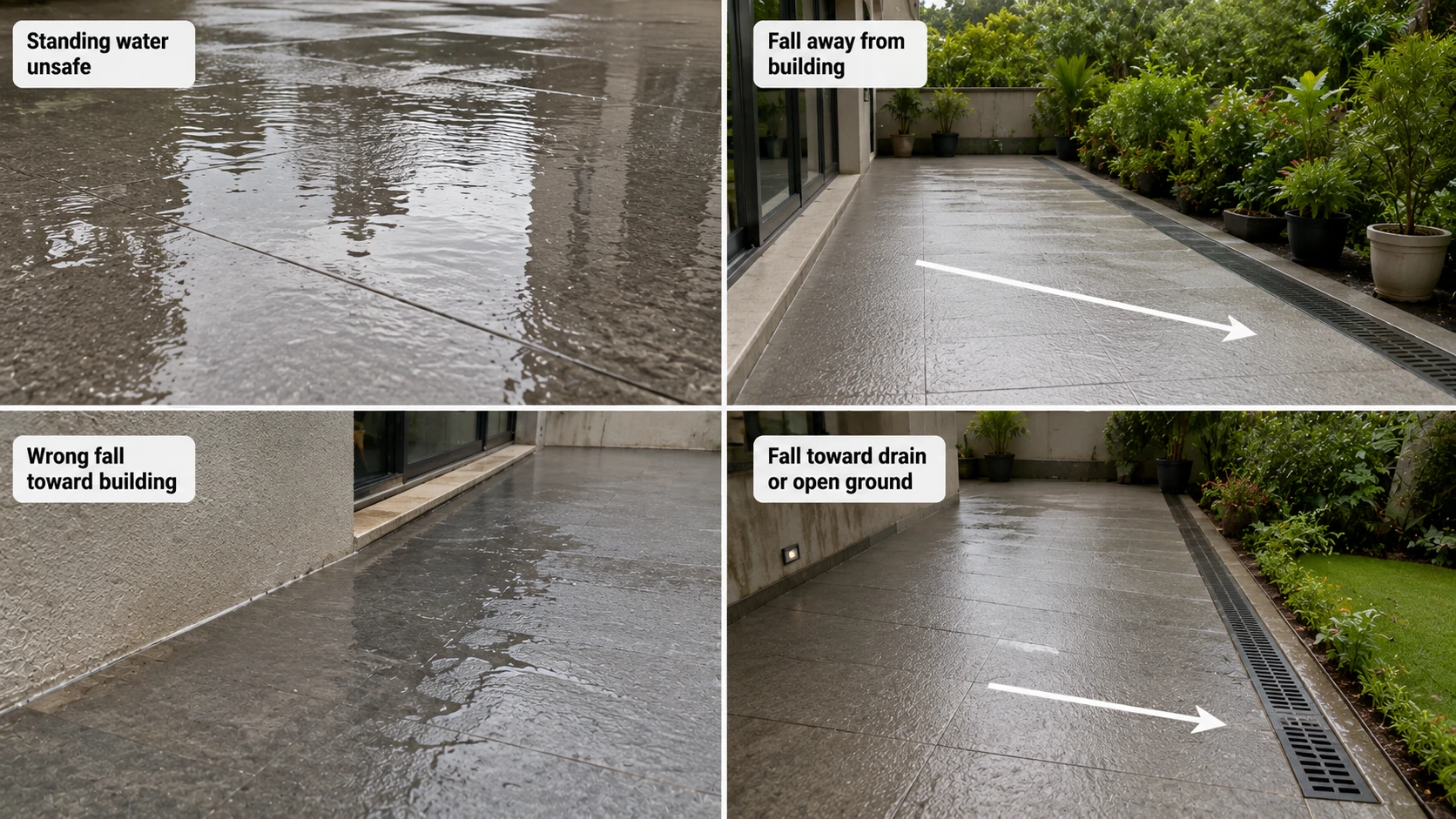
Drainage does more for patio safety than any anti-skid rating: A patio with standing water is unsafe in any finish, because a film of water on a level surface defeats grip regardless of texture. Get the fall right first and the tile second. A patio should fall away from the building at roughly 1 in 80 to 1 in 100, which is enough to move water without being noticeable underfoot, and it should fall toward a drain, a channel or open ground rather than toward the house. A patio falling toward the building sends every monsoon downpour at your foundation, which is a considerably more expensive problem than a slippery tile. |
Anti-Skid Rating for Fully Exposed Patios
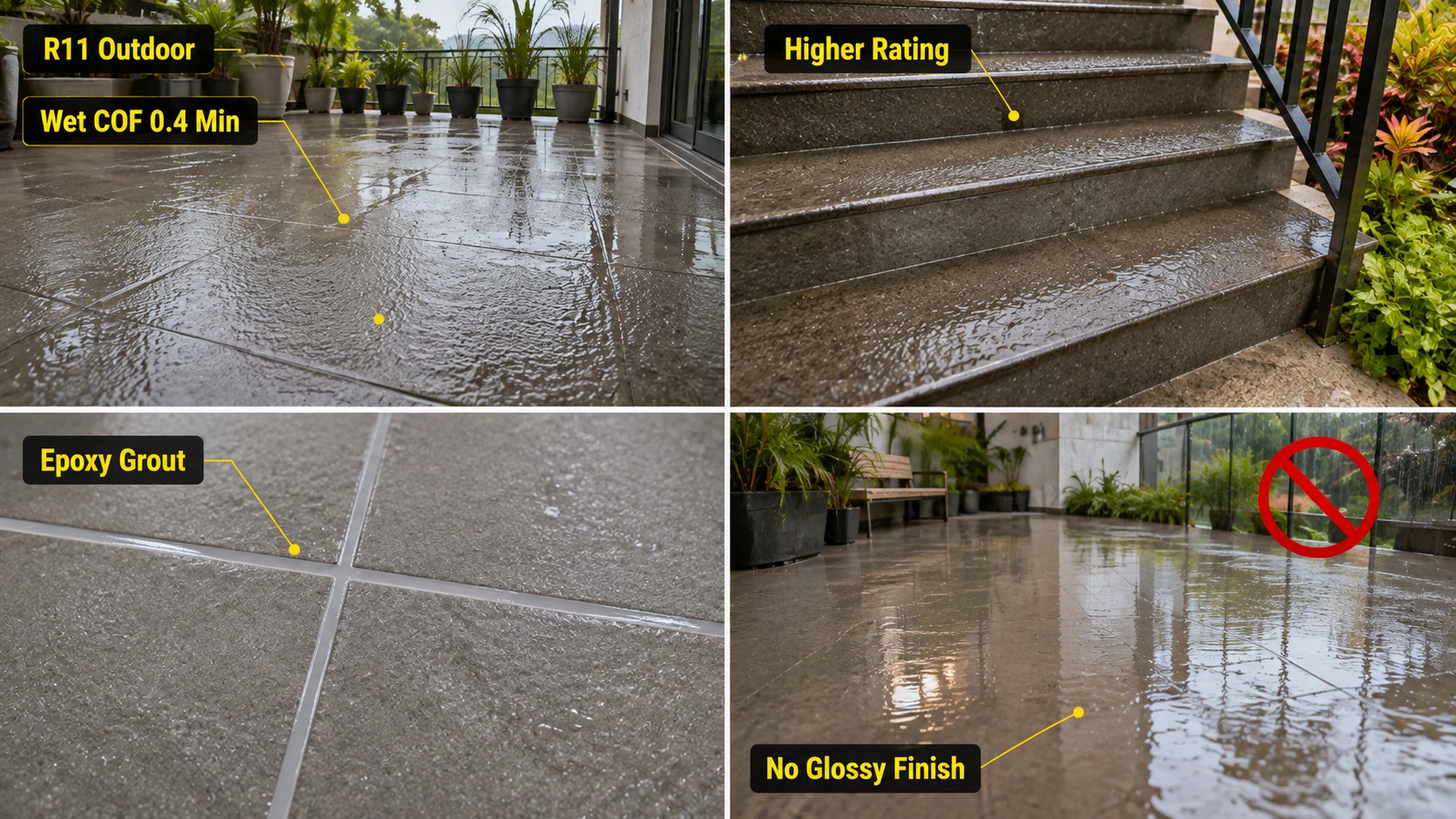
- Confirm an R11 outdoor rating for a fully exposed patio, alongside a wet coefficient of friction of 0.4 minimum, since these describe different aspects of the same problem.
- Confirm the higher rating for steps and level changes specifically, where a slip has furthest to travel, and consequences are greatest.
- Confirm epoxy grout throughout, because a patio sees more sustained water than any indoor floor tile, and cement grout degrades faster outdoors.
- Never specify polished or glossy finishes on a patio, whatever the R rating claims, since a smooth reflective surface and monsoon rain are a poor combination.
Post-Monsoon: Algae, Moss and Why Patios Turn Slippery in September
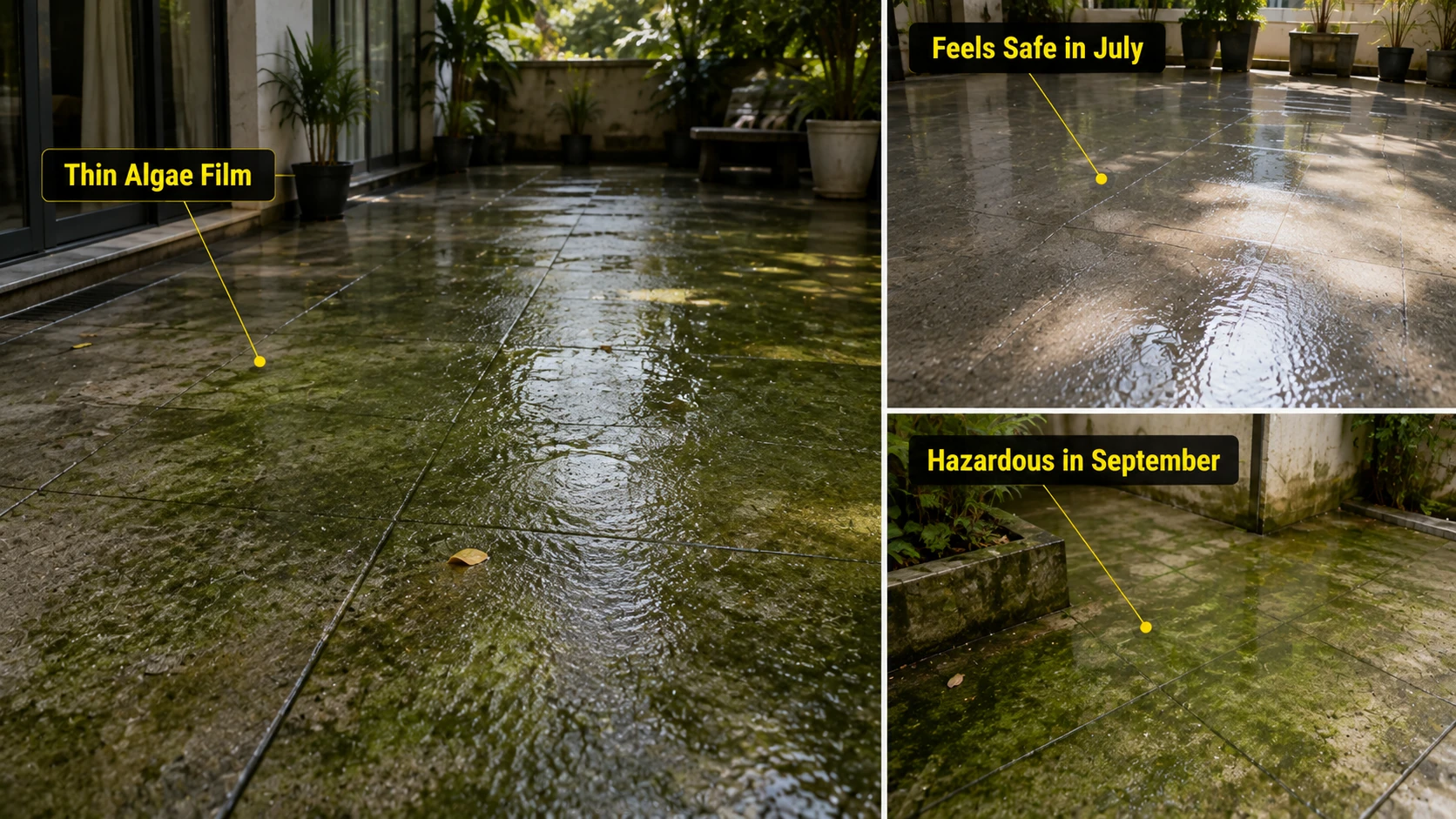
The seasonal failure most patio guidance skips entirely: In the weeks after the monsoon, a patio that stays damp and shaded grows a thin biological film of algae and moss. It is often barely visible, particularly on a mid-toned or textured surface, and it is considerably more slippery than water alone. This is why patios that felt entirely safe in July become genuinely hazardous in September, with no change to the tile and no obvious change to the surface. It affects shaded areas, north-facing patios and any zone under a tree canopy far more than open sunlit ones, and it recurs every year rather than being a one-off. |
Preventing and Removing Algae on Patio Tiles
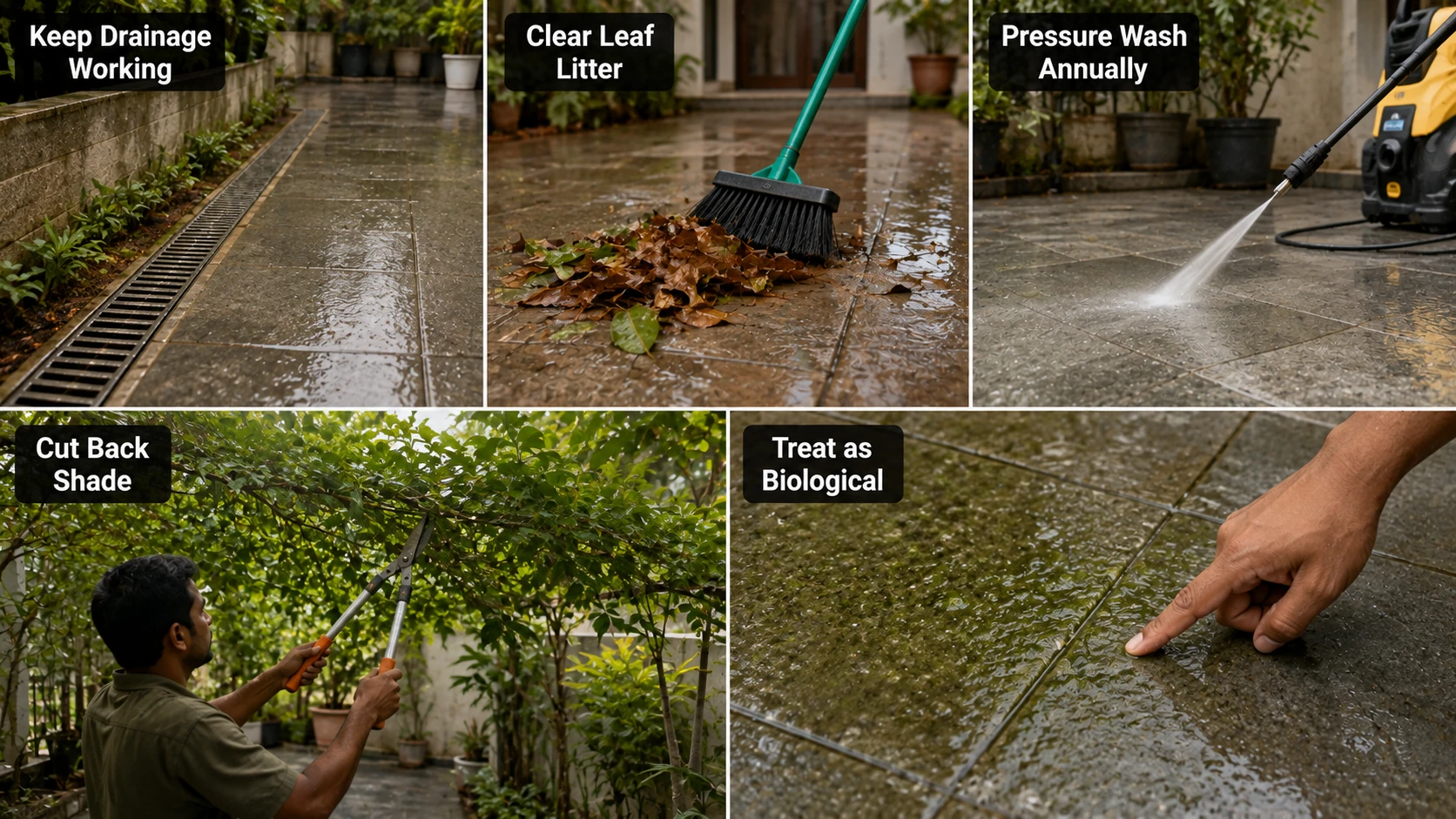
- Keep the drainage working, since algae needs sustained dampness and a patio that dries between showers grows far less of it.
- Clear leaf litter promptly during and after monsoon, because decaying organic matter holds moisture against the surface and feeds growth.
- Pressure wash at the end of the monsoon, which is the single most effective annual maintenance action for an Indian patio.
- Cut back overhanging planting where practical, since permanent shade is what turns a seasonal problem into a persistent one.
- Treat a slippery patch as biological until proven otherwise, since the fix is cleaning rather than replacement and people frequently relay a floor that only needed washing.
Winter and Dry Season: Dust, Soil and Morning Dew
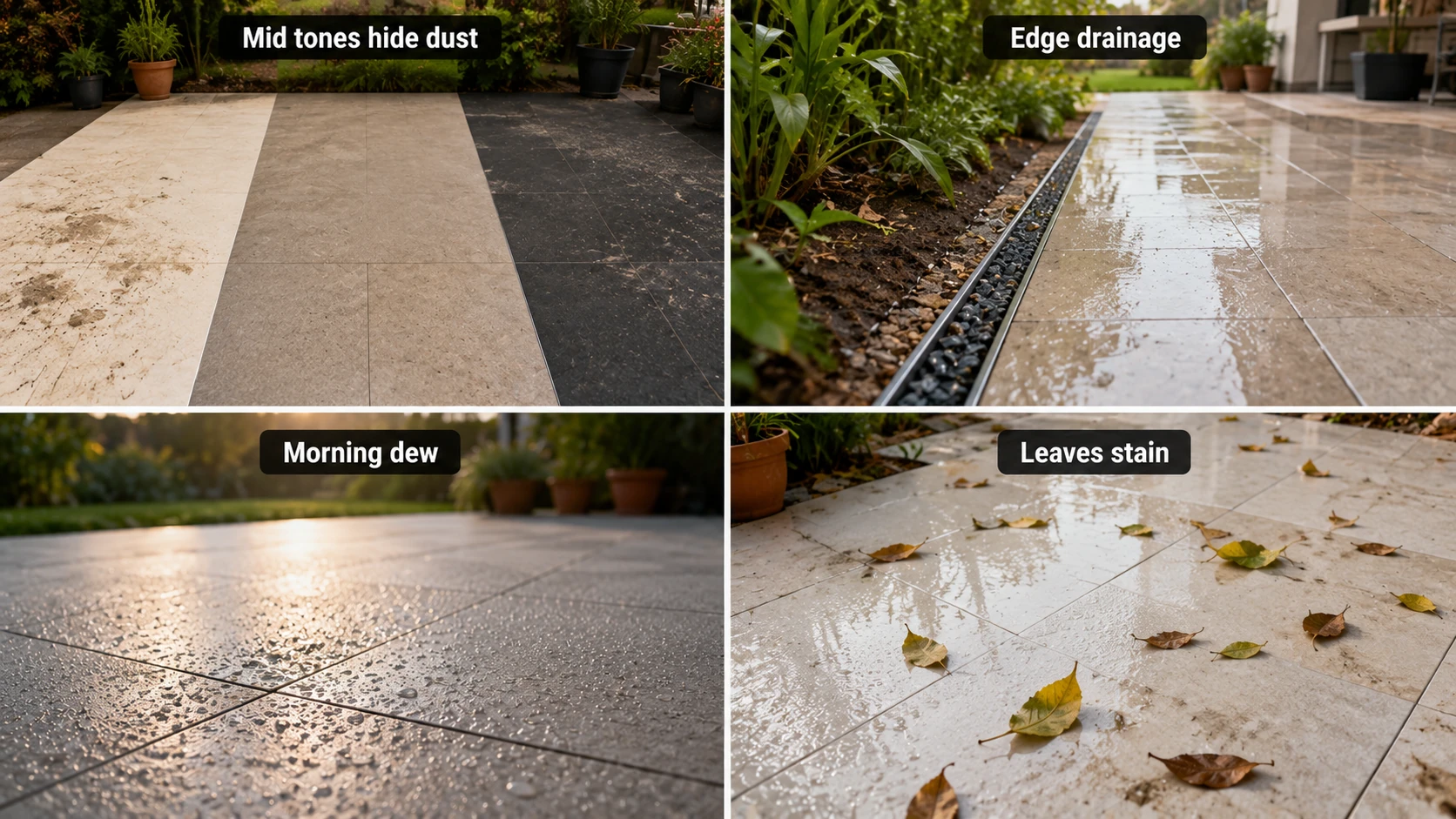
The undramatic season, but it accounts for most of how a patio looks for most of the year.
- Mid-tones hide dust and soil splash far better than pale or very dark ones, which is why patio colour is a maintenance decision as much as a design one.
- Garden-adjacent edges take soil splash during rain, so plan a channel, gravel margin or edging detail at the boundary rather than running tile straight into a planting bed.
- Morning dew makes a patio damp without rain, which matters for early users and is another argument for confirmed grip rather than a marginal rating.
- Fallen leaves stain if left on a damp surface, particularly on pale tiles, so the same colour logic that handles dust also handles leaf marking.
Patio Tile Specification: What the Year Adds Up To
Taken together, the four seasons produce a specification that is more demanding than an indoor floor and more specific than a general outdoor one.
| Requirement | Why the Year Demands It |
| R11 outdoor rating and wet COF 0.4 minimum | Monsoon standing water and post-monsoon algae both attack grip |
| Fired ceramic pigment for UV colourfastness | Sustained summer sun over years, on a surface with no shade |
| Light or mid tone in unshaded areas | Summer surface heat decides whether the patio gets used at all |
| Fall of about 1 in 80 away from the building | Drainage prevents both slip risk and algae growth |
| Epoxy grout throughout | Sustained outdoor wetness degrades cement grout faster than indoors |
| Water absorption 0.05% or below | Freezing is rare in most of India, but sustained saturation is not |
Ground-Level Patio Substrate and Drainage
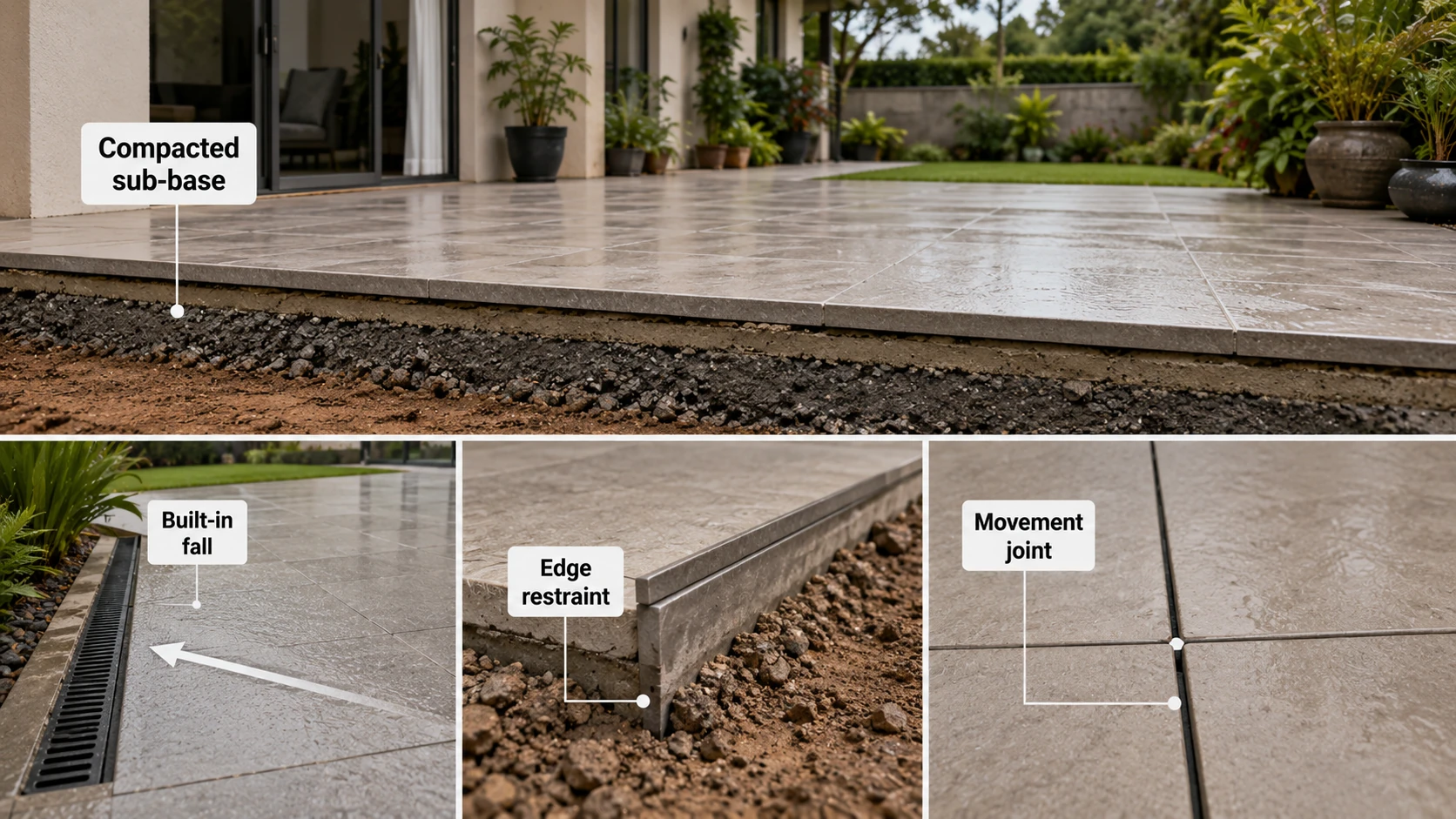
A patio differs from a balcony in one important way: it sits on ground rather than on a structural slab, which introduces problems a first-floor balcony tile surface never has.
- Confirm the sub-base is properly compacted before tiling, because ground settles and a patio laid over poorly prepared ground cracks at the settlement line regardless of tile quality.
- Confirm the fall is built into the substrate, not created with adhesive thickness, since a thick adhesive bed to make up a fall is a debonding risk.
- Plan an edge restraint or perimeter detail, particularly where the patio meets soft ground, so the outermost tiles are supported rather than cantilevered over a crumbling edge.
- Plan movement joints on larger patios, since a ground-level slab in full sun moves more than an interior floor and needs somewhere to expand.
Patio Tile Buying Checklist
- Test a sample outdoors in afternoon sun, which is the only way to judge surface heat and the one thing a showroom cannot show you.
- Confirm R11 outdoor rating and wet coefficient of friction of 0.4 minimum, with the higher rating for any steps.
- Confirm fired ceramic pigment rather than a surface-applied colour, for genuine UV colourfastness over years of exposure.
- Confirm water absorption of 0.05% or below, the benchmark set by the Bureau of Indian Standards under IS 15622 for vitrified tile, with the test certificate requested.
- Agree the drainage fall and its direction with the contractor before laying, including where the water actually goes.
- Specify epoxy grout and a perimeter edge detail at any boundary with planting or soft ground.
Finalise Patio and Outdoor Tiles on TilesFinders
Outdoor and patio ranges can be filtered on TilesFinders by R rating, finish and body type, so a specification can be built around the season that will test it hardest rather than the one it is bought in.

FAQs
Light or mid tones, which stay meaningfully cooler underfoot than dark ones in direct sun. Dark tiles are entirely undamaged by the heat, but a patio that cannot be walked on barefoot for a third of the year stops being used, which is the real failure.
Almost always algae and moss growth rather than any change in the tile. A thin biological film forms on surfaces that stay damp and shaded; it is frequently barely visible, and it is considerably more slippery than water alone. The fix is cleaning rather than replacement.
Roughly 1 in 80 to 1 in 100, falling away from the building toward a drain, channel or open ground. That is enough to move water without being noticeable underfoot, and a patio falling toward the house sends monsoon water at your foundation.
R11 outdoor rating alongside a confirmed wet coefficient of friction of 0.4 minimum, and the highest available rating on any steps or level changes where a slip has furthest to travel.
Place the sample outdoors in direct afternoon sun for an hour and then touch it. This is the one property a showroom genuinely cannot demonstrate, and it determines whether the finished patio gets used through the summer.
Vitrified tile with water absorption of 0.05% or less does not need sealing, since it absorbs almost nothing. The grout is the vulnerable element, which is why epoxy grout, rather than a sealant, is the correct answer outdoors.
A pressure wash at the end of the monsoon, which removes the algae and organic film that accumulate through the wet months and restores grip before the surface has a chance to become genuinely hazardous.
Because a patio sits on ground rather than a structural slab, and ground settles. A patio laid over a poorly compacted sub-base cracks along the settlement line, whatever the tile specification, which is why substrate preparation matters more here than for any elevated surface.


See our tile guides first
Set TilesFinders as a preferred source and our buying guides surface ahead of the rest for you.
Add as preferred sourceTakes one tap. Nothing to install.
What Readers Say
I was about to redo my parking area with the wrong tile size until I read this. The layout comparisons saved me from a costly mistake.
We reference TilesFinders guides while briefing clients on material selection. The size and pattern breakdowns are accurate and easy to explain visually.
On site, I get asked about grout spacing all the time. This article gave me a solid reference I now share with my team before every job.
Finally a guide that doesn't just push generic advice. The oil stain removal steps actually worked on our clubhouse driveway tiles.
I run a small construction firm and now send this link to clients directly when they ask about entrance tile sizing. Saves me an hour of explaining.
Good practical detail, though I wish there were more examples for compact apartment entrances specifically, not just villas.
My mother-in-law wanted marble, I wanted vitrified. This blog gave us the neutral comparison we needed to actually decide together.
Detailed without being overwhelming. I appreciated that it covered both cost and maintenance, not just the aesthetics.
Used the algae and hard water removal tips on our terrace tiles after the monsoon. Worked better than what our regular cleaner was doing.
As someone who sources tiles for multiple builder projects, I find these comparisons genuinely useful for vendor conversations, not just consumer content.
Recommended this to a client who kept second-guessing the entrance design. The small vs large layout section settled the debate instantly.
Straightforward and honest, no unnecessary jargon. Would like to see a similar breakdown for outdoor pool-deck tiles next.
We've bookmarked several TilesFinders guides for our design handbook. Reliable source when clients want data, not just opinions.
Two paths, one marketplace.
Get free quotes from verified suppliers.
Share your room, budget, and style. Suppliers in local area respond within hours.
Get Free QuotesList your business, reach real buyers.
Put your showroom in front of homeowners searching for tiles right now.
List Your Business