Waterproof Terrace Tiles: Why Monsoon-Ready Tiles Matter
Build a monsoon-ready terrace with the right waterproofing, drainage, screed, adhesive, and tile system. Learn how each layer works together to prevent leaks and cracks.
- What Actually Happens to a Terrace in the Indian Monsoon
- Why the Tile Alone Cannot Waterproof a Terrace
- Water Absorption: The Number That Decides Everything
- The Five-Layer Monsoon-Ready Terrace System
- How Tile Failure Starts (And What It Looks Like)
- Grout and Adhesive: Where Most Waterproofing Actually Fails
- Pre-Monsoon Terrace Tile Checklist
- Common Mistakes That Let Monsoon Win
- Keeping a Terrace Monsoon-Ready
The damage from a leaking terrace does not appear on the roof. It appears on the ceiling of the room below as a damp patch that grows through June and July, turning into a brown stain by August. By the time it is visible, the terrace slab has been taking in water for weeks.
Most homeowners respond to this by replastering the ceiling. The right response is to fix what allowed the water in from the top. That starts with understanding whether the terrace tile system, not just the tile itself, was ever built to handle an Indian monsoon.
This guide focuses specifically on waterproofing: why the tile category matters, why the tile alone is not enough, what a properly waterproofed terrace system looks like, and how to check whether yours holds up before the rains arrive.
What Actually Happens to a Terrace in the Indian Monsoon
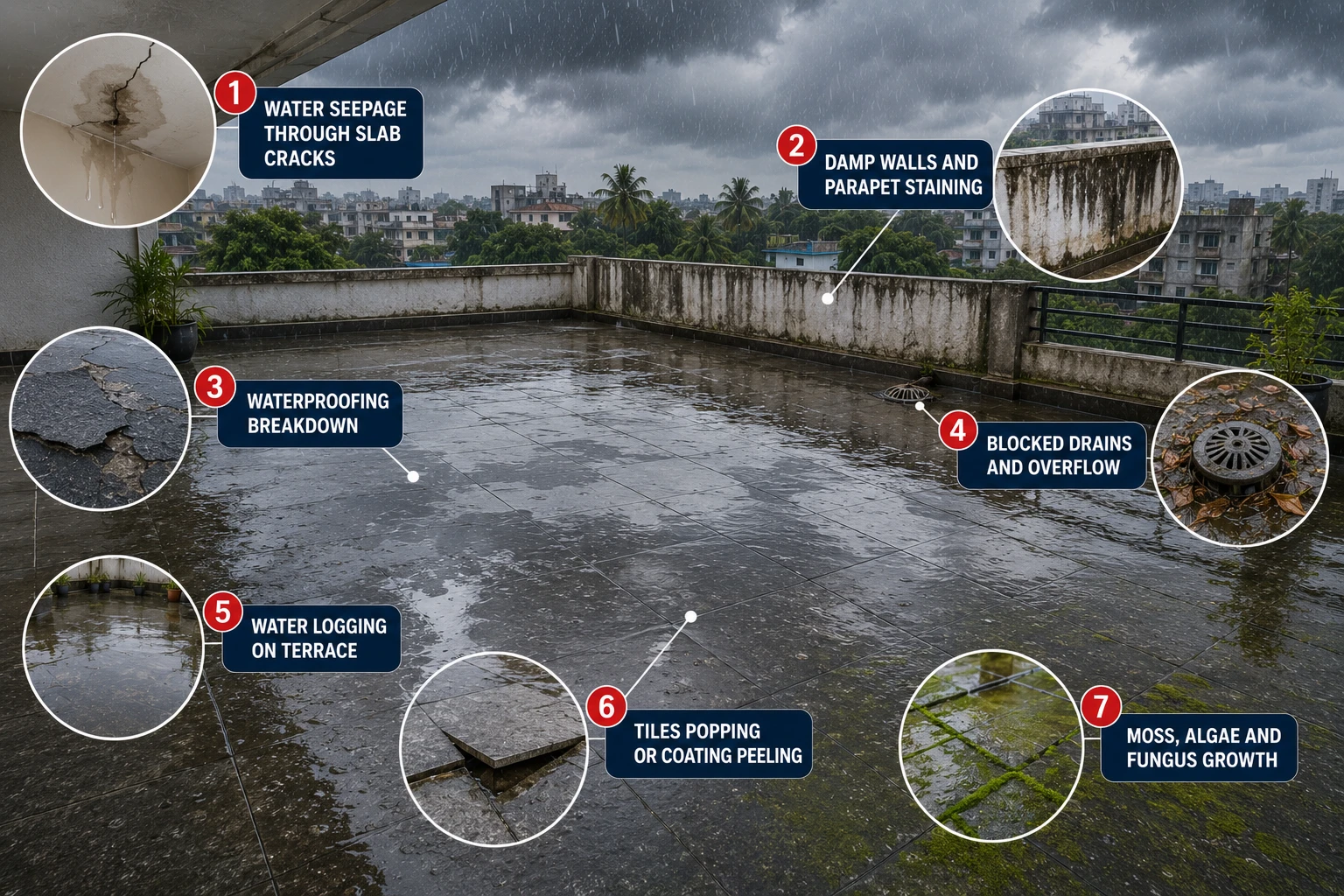
An Indian monsoon is not a single event. In cities like Mumbai, Kochi, or Mangaluru, a terrace can stay wet for eight to ten consecutive weeks. In Chennai and Kolkata, cyclone-driven rain delivers heavy bursts repeatedly through October. Even in drier regions like Jaipur or Ahmedabad, concentrated downpours hit flat rooftops with force and then sit because drainage was not built to handle sudden volume.
What water does to a poorly chosen terrace tile system in those conditions follows a clear sequence. First, the tile surface absorbs some water if the material is porous. Then the grout joints, which are the weakest points in any tiled surface, absorb more. Water works through micro-cracks in the grout and reaches the adhesive layer. A cement-based adhesive that was not formulated for outdoor wet exposure softens over time. The tile begins to lose its bond. The result is a hollow-sounding tile that moves slightly underfoot: the first sign that the system has already failed.
Below the adhesive sits the slab itself. Once moisture reaches the slab regularly, it corrodes the reinforcement steel inside, and the structural damage that follows is expensive. This is why waterproof terrace tiles are not a cosmetic choice. They are the first line of defence against a repair cost that typically runs ten to thirty times more than the cost of getting the tile system right the first time.
If you also want broader guidance on outdoor tiles for Indian weather conditions, anti-skid finishes, terrace durability, and climate-specific tile selection, read our complete outdoor tiles guide.
Why the Tile Alone Cannot Waterproof a Terrace
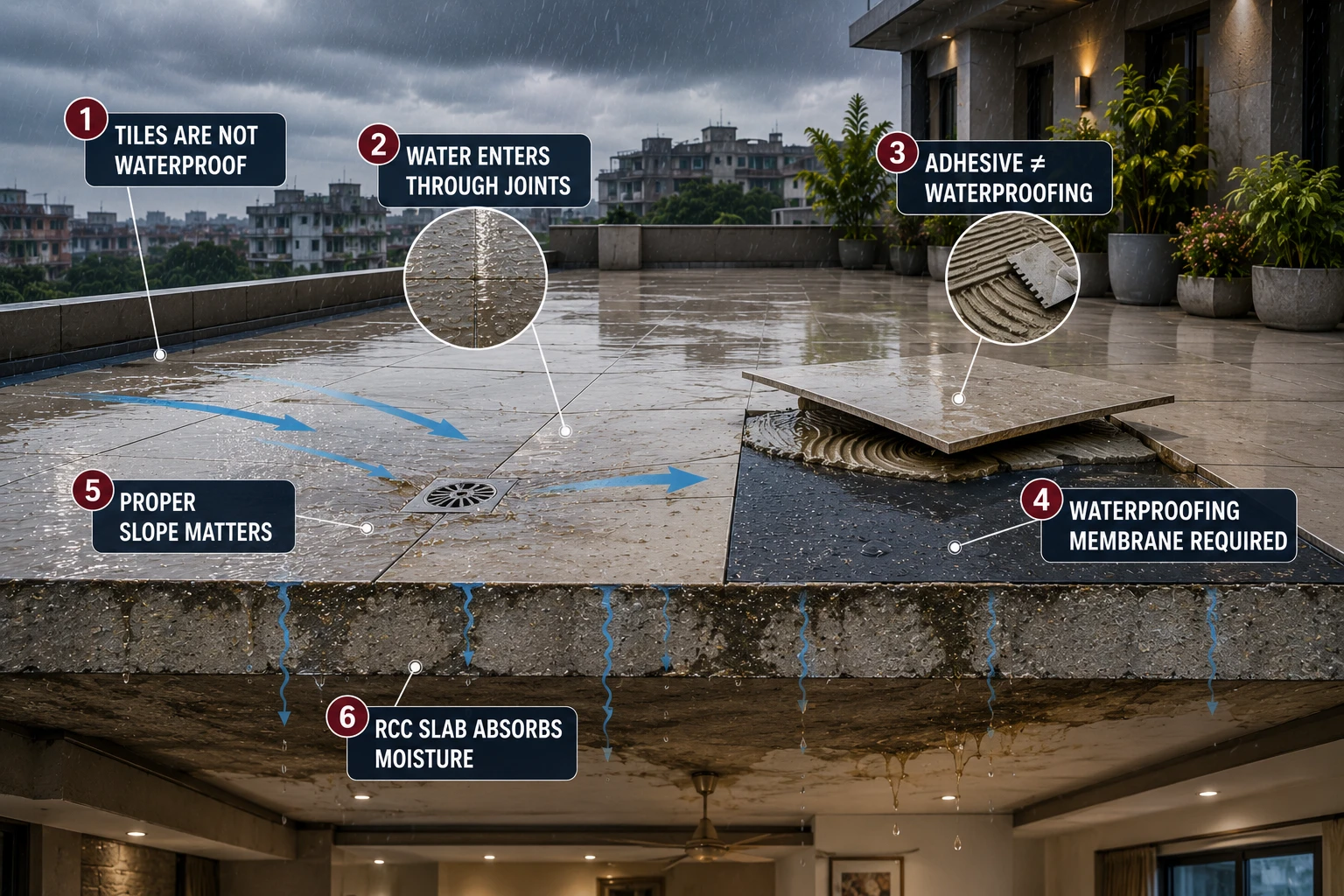
A common assumption is that choosing a waterproof tile makes the terrace waterproof. It does not. A tile is one layer. A terrace that performs through the monsoon is a system of five interdependent layers, and the tile is only one of them.
The grout joints between tiles are not covered by the tile itself. They are filled with a separate material. If that material is standard cement grout, it absorbs water. One cracked grout joint on a flat terrace is enough to let water reach the slab consistently over a full monsoon season.
The adhesive that bonds the tile to the substrate is another separate layer. A tile with near-zero water absorption bonded with an adhesive that breaks down in continuous outdoor moisture creates a false sense of security. The tile stays intact while the bond beneath it fails silently.
Experienced tile contractors in Mumbai, Pune, and Bangalore will tell you the same thing: the calls they get about terrace leakage in July mostly trace back to grout and adhesive decisions made during installation, not to the tile category choice.
Homeowners planning connected outdoor spaces can also explore our Garden & Patio Tiles Guide for design ideas, durability considerations, and tile recommendations for patios, courtyards, and landscaped areas.
Water Absorption: The Number That Decides Everything
Water absorption percentage is the single most important specification for any tile going on a terrace floor. It measures how much water the tile body takes in relative to its own weight. A tile on an outdoor terrace that absorbs water will swell during the monsoon, contract during the summer heat, and repeat that cycle every year. That movement breaks the tile-to-adhesive bond and stresses the grout joints. The lower the absorption, the less this cycle damages the installation.
GVT (Glazed Vitrified Tiles)
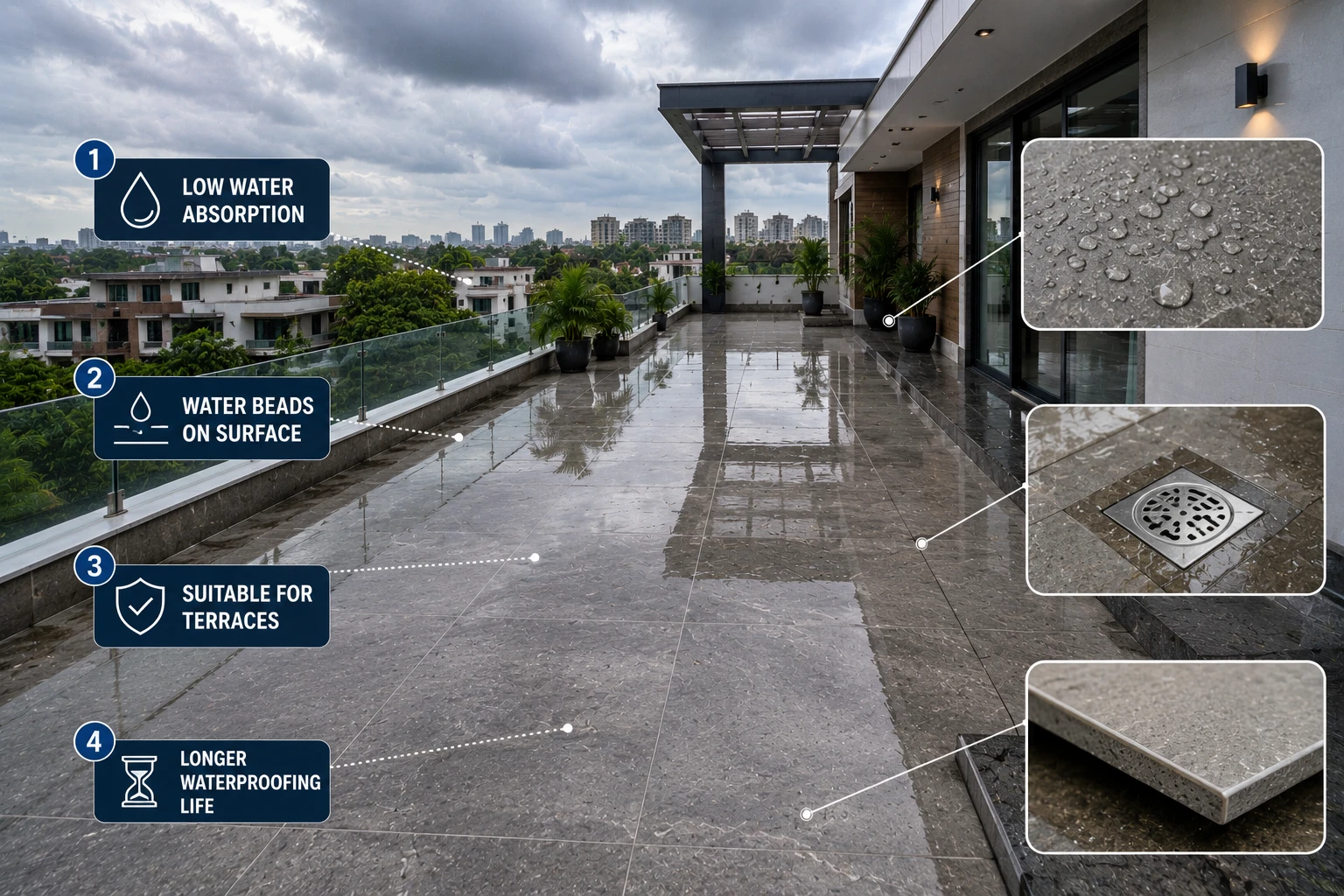
GVT tiles absorb less than 0.05 per cent water. That near-zero rate means the tile body itself contributes almost nothing to water ingress. GVT is the most widely available outdoor-rated vitrified category in India and comes in sizes suitable for terrace floors: 400x400 mm (16x16), 500x500 mm (20x20), and 600x600 mm (2x2). Confirm with your dealer that the specific GVT tile is rated for outdoor use, since some GVT designs within the same product range are manufactured for indoor floors only. Price range is approximately ₹60 to ₹150 per sq. ft.
Full Body Vitrified Tiles
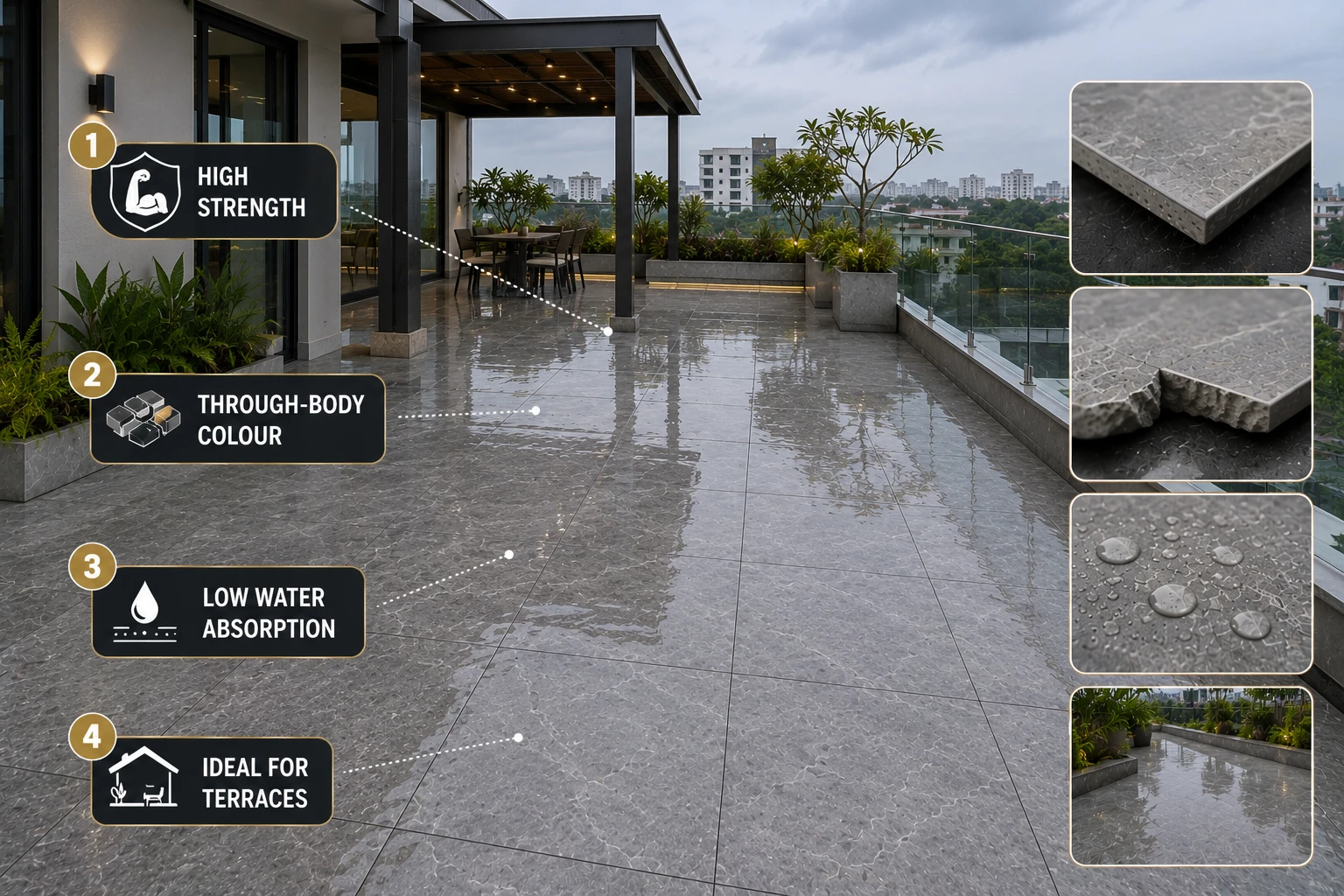
Full-body vitrified tiles have water absorption below 0.5 per cent and are fully outdoor-rated. The body colour and pattern run through the full tile thickness, so chips or edge wear do not expose a differently coloured core. For terraces that double as family gathering spaces or garden areas, Full Body tiles handle heavy furniture, large planters, and consistent foot traffic without structural change under monsoon conditions. Available in sizes from 600x600 mm (2x2) upward. Approximate price is ₹90 to ₹200 per sq. ft.
Porcelain Tiles
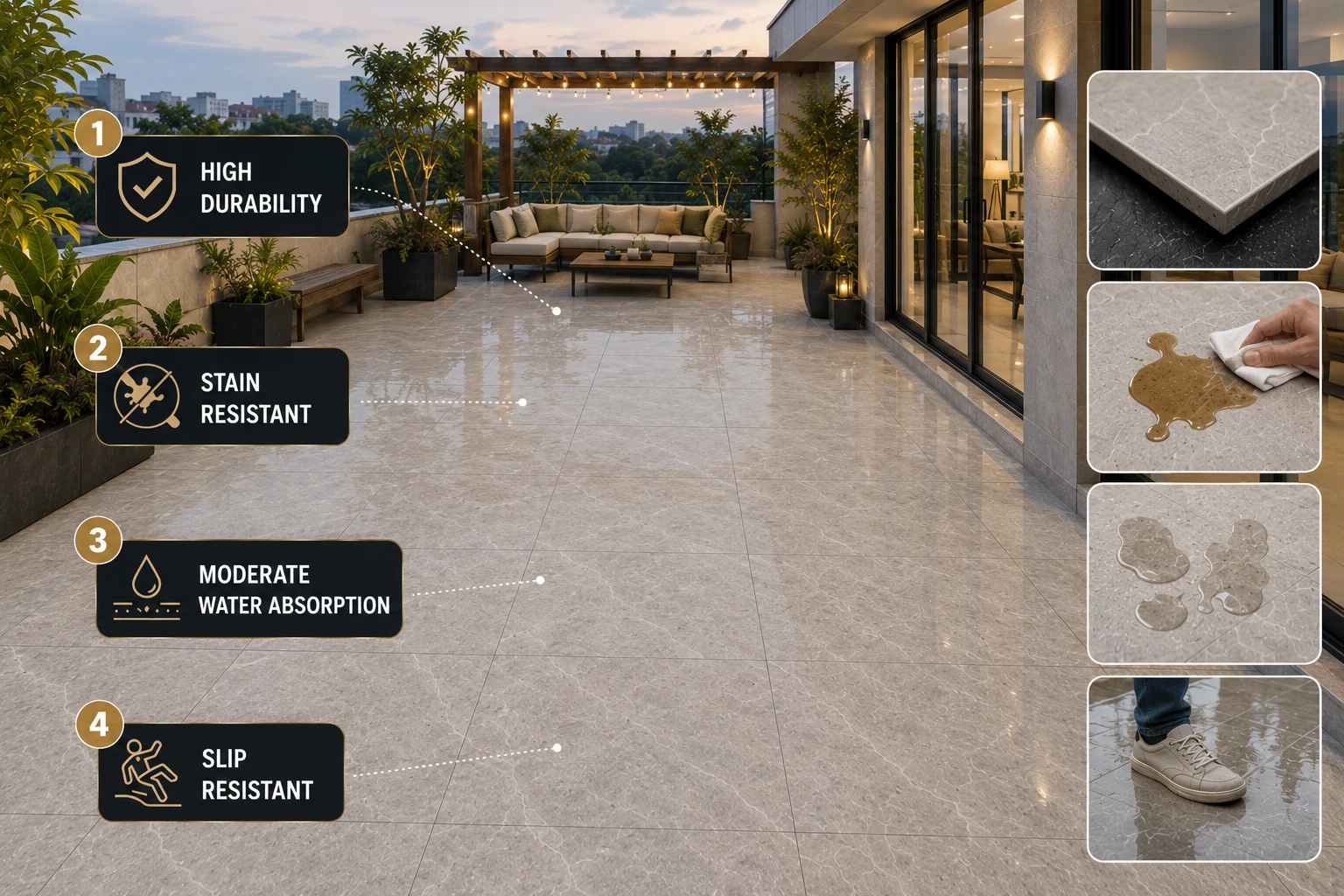
Porcelain tiles absorb between 2 and 5 per cent water, which is significantly higher than GVT or Full Body vitrified, but still well below ceramic. They are outdoor-rated and available mostly in matte finish in India, which gives them a natural grip. Porcelain works for covered terraces and semi-protected areas where prolonged water exposure is less likely. For fully open terraces in high-rainfall cities, the higher absorption relative to vitrified categories means the tile body takes in more water per monsoon cycle, which puts slightly more stress on the adhesive bond over years of use. Available in 400x400 mm (16x16), 500x500 mm (20x20), and 600x600 mm (2x2) sizes. Approximate price is ₹90 to ₹220 per sq. ft.
Categories to Avoid on Terrace Floors
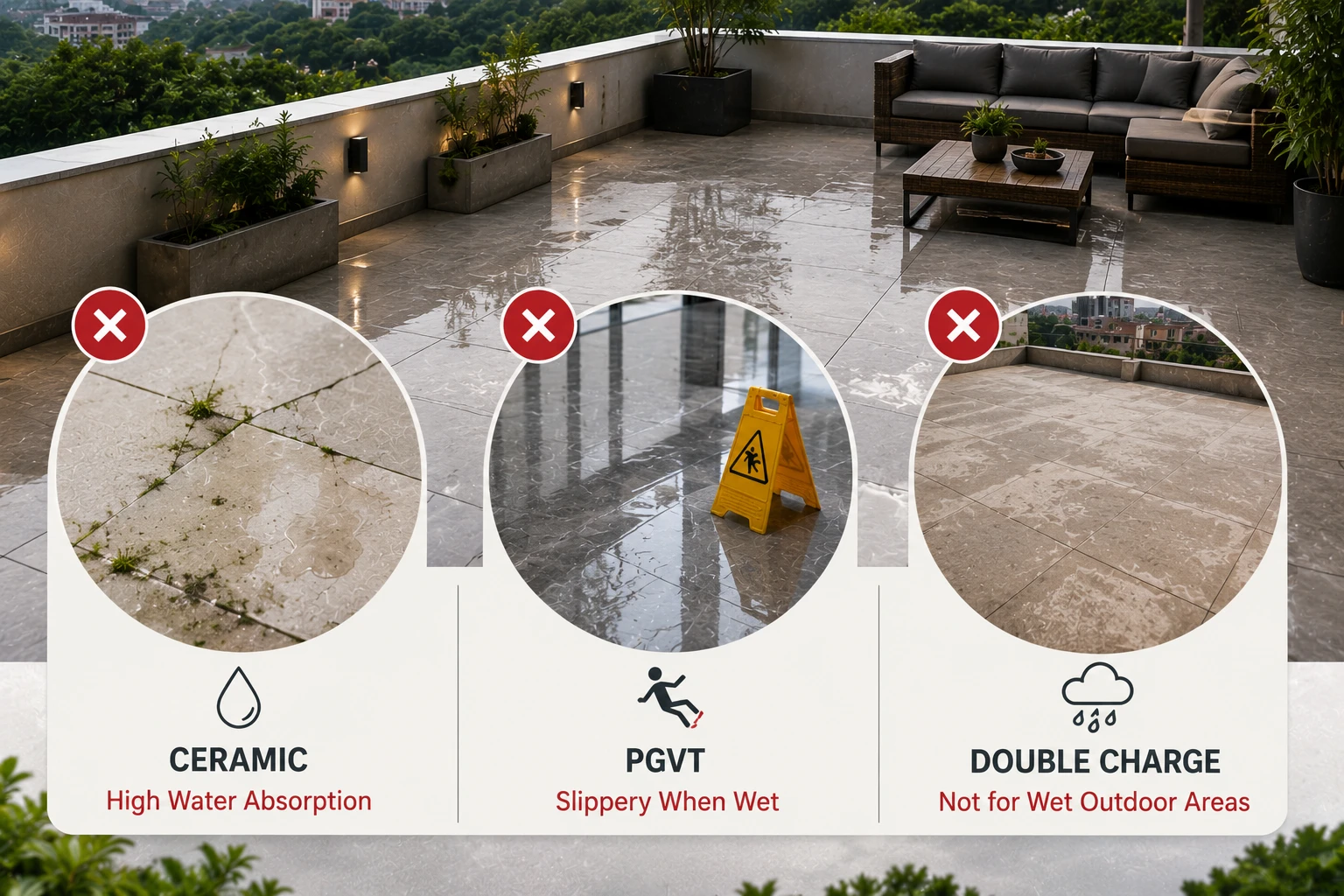
Ceramic tiles absorb 12 to 16 per cent water. They are wall tiles and are not suitable for any terrace flooring tiles. PGVT (Polished Glazed Vitrified Tiles) have near-zero water absorption but a polished surface that becomes dangerously slippery when wet. They belong on interior walls. Double Charge vitrified tiles are also not suitable for wet outdoor areas. The category table below shows absorption rates clearly.
Water Absorption by Tile Category: Terrace Suitability
| Tile Category | Water Absorption | Terrace Floor Safe? | Approx. Price/sq. ft. |
| GVT | Less than 0.05% | Yes (confirm outdoor rating per tile) | Rs. 60 to Rs. 150 |
| Full Body Vitrified | Less than 0.5% | Yes | Rs. 90 to Rs. 200 |
| Porcelain | 2% to 5% | Yes (covered terraces preferred) | Rs. 90 to Rs. 220 |
| PGVT | Less than 0.05% | No (slippery when wet) | Rs. 60 to Rs. 150 |
| Double Charge | Very low | No (not for wet areas) | Rs. 70 to Rs. 140 |
| Ceramic | 12% to 16% | No (wall tile only) | Rs. 30 to Rs. 80 |
Prices are approximate 2026 market ranges. Always confirm with your dealer. Outdoor suitability also depends on finish and specific product rating.
The Five-Layer Monsoon-Ready Terrace System
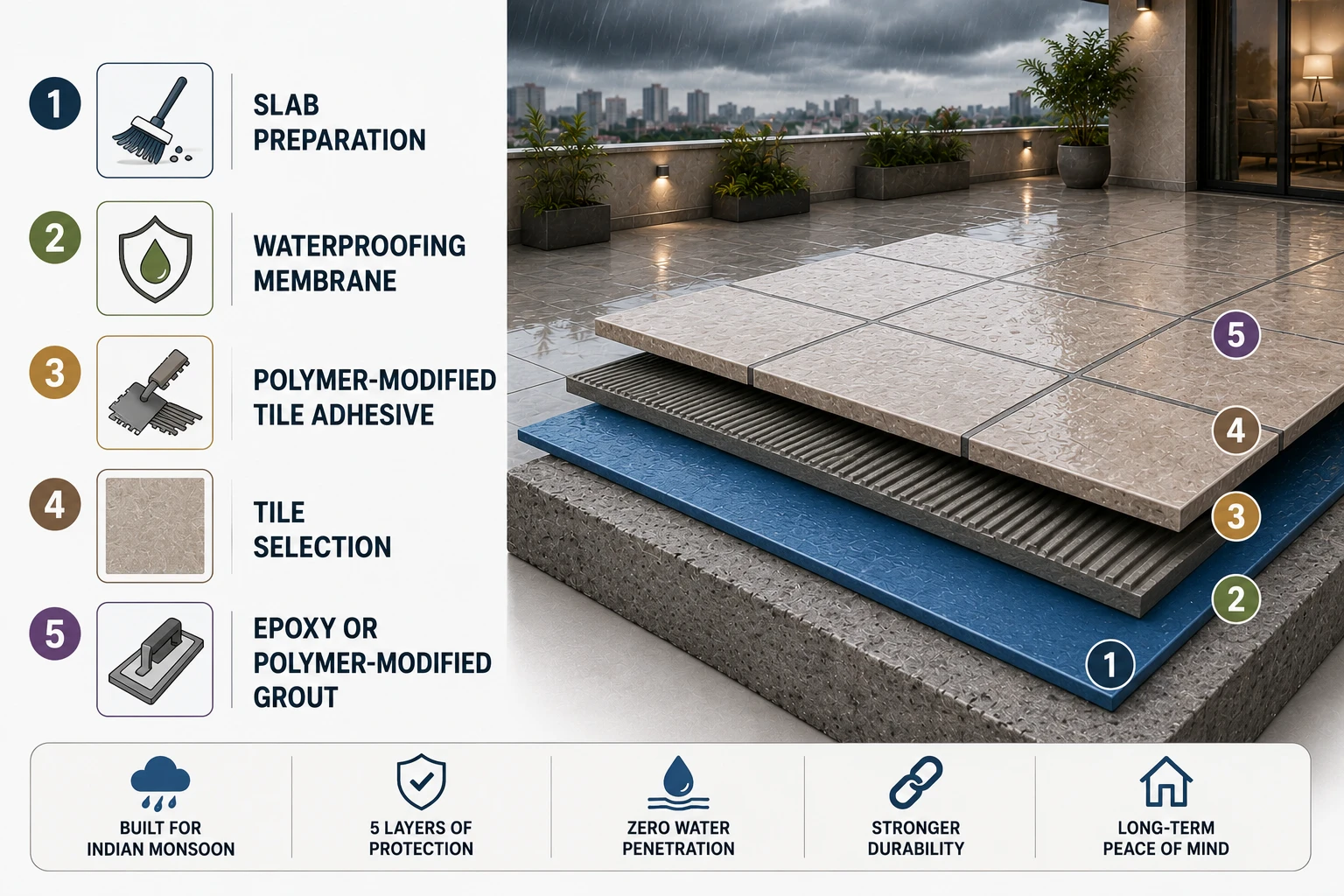
A terrace that holds through the Indian monsoon is not built around one good tile. It is built around five layers that each do a specific job. If one layer is wrong or skipped, the others cannot compensate.
Layer 1: Slab Preparation
The concrete slab must be clean, dry, and crack-free before anything goes on top of it. Old paint, dust, curing compounds, or existing crumbling plaster must be removed. Any existing cracks must be repaired with a cementitious repair mortar. Skipping this step means the waterproofing membrane goes over an unstable surface and will develop its own cracks within one monsoon season.
Layer 2: Waterproofing Membrane
The membrane is the most important layer for stopping water from reaching the slab. Three types are commonly used on Indian residential terraces. Liquid membrane coating (₹20 to ₹40 per sq. ft.) suits small to medium terraces and is flexible enough to handle minor slab movement. Cementitious waterproofing (₹30 to ₹50 per sq. ft.) is a standard choice for residential terraces and water tanks. Polyurethane coating (₹50 to ₹80 per sq. ft.) is the strongest option for fully open terraces in heavy-rainfall cities. All three must cure fully before tile installation begins. Rushing past the curing stage is one of the most common reasons terrace waterproofing fails in the first year.
Layer 3: Polymer-Modified Tile Adhesive
Standard cement mortar breaks down under repeated outdoor moisture cycling. For terrace tiling, use a polymer-modified tile adhesive. This type stays flexible after setting, which allows it to handle the expansion and contraction the tile goes through between summer heat and monsoon cool without losing its grip. A polymer adhesive also bonds better to a waterproofed substrate than standard cement mortar does.
Layer 4: Tile Selection
This is the layer most homeowners focus on, rightly. Choose GVT or Full Body vitrified tiles confirmed as outdoor-rated by the manufacturer or dealer. Use matte tiles, GHR (Glaze High Resistance), Texture, or Rain Drops finish. None of these finishes becomes slippery when wet. Leave 3 to 4 mm expansion gaps between tiles for outdoor installations. Without these gaps, tiles that expand in heat have nowhere to go and will press against each other, causing the weakest tile to pop or crack.
If you're comparing materials, finishes, and performance factors before making a purchase, our Terrace Tiles Guide explains the best heat-resistant and waterproof tile options for Indian terraces.
Layer 5: Epoxy or Polymer-Modified Grout
Standard cement grout absorbs water and cracks over time outdoors. Epoxy grout is water-resistant, does not shrink after setting, and does not allow moss or mould to grow in the joint. It costs more than cement grout but protects the adhesive layer below it from water ingress through the joints. For any open terrace that faces direct monsoon rain, epoxy or polymer-modified grout is the practical choice, not a luxury upgrade.
Five-Layer Monsoon-Ready Terrace System at a Glance
| Layer | Material | Common Failure if Skipped or Wrong |
| 1. Slab Prep | Crack repair + surface cleaning | Membrane delaminates in the first monsoon |
| 2. Waterproofing | Liquid, cementitious or PU membrane | Water reaches the slab, slab corrodes over time |
| 3. Adhesive | Polymer-modified tile adhesive | Bond breaks under wet-dry cycling, tiles hollow out |
| 4. Tile | GVT or Full Body vitrified, outdoor-rated, matte or GHR finish | Water absorption, crack, and slip hazard on a wet surface |
| 5. Grout | Epoxy or polymer-modified grout | Joint failure, water enters below the tile, and mould growth |
How Tile Failure Starts (And What It Looks Like)
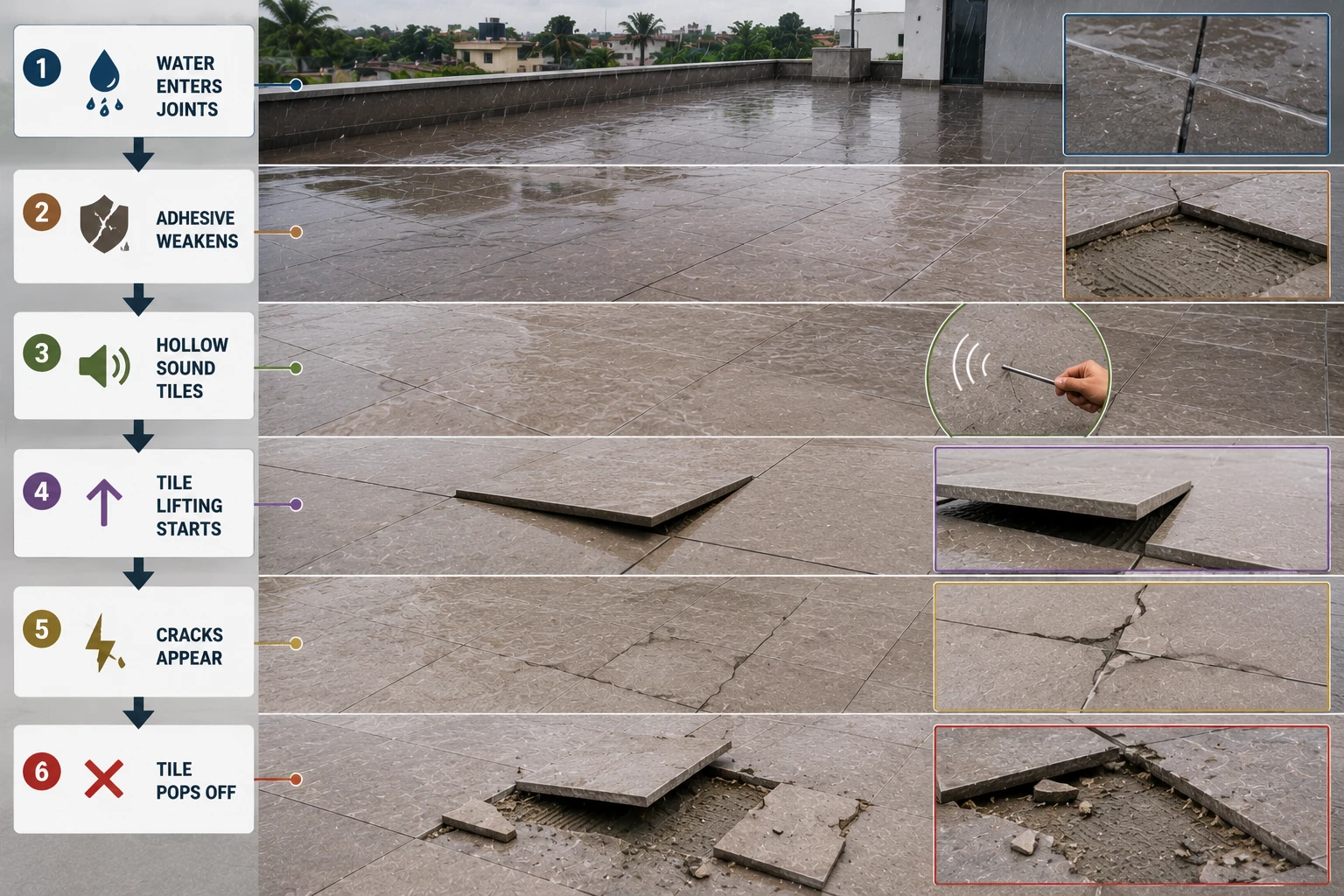
Most terrace tile failures do not appear suddenly. They develop over one or two monsoon seasons before they become visible or noisy. Knowing the early signs lets you catch the problem before it reaches the slab.
A hollow sound when you tap a tile with your knuckle or a coin is the most reliable early warning. It means the tile has lost adhesion to the substrate below. The tile may still look perfectly flat and intact on the surface. But the gap between tile and substrate is allowing water to pool and stay between layers, accelerating the breakdown of whatever adhesive remains.
White powder deposits on the tile surface, called efflorescence, appear when water moves through the substrate and evaporates at the tile surface, leaving mineral salts behind. This is a direct sign that water is travelling through the tile system in a direction it should not be. It usually means the grout or adhesive layer below has already been compromised.
Grout joints that turn dark, develop green moss, or show cracks are another visible sign. Cracked grout is an open channel for water. Once a grout joint cracks on an outdoor terrace, each monsoon shower sends water directly through the joint and into the adhesive layer. This is the stage where waterproofing damage accelerates fastest.
Tiles that have begun to lift at the edges or corners are the final stage before full tile debonding. At this point, the adhesive bond has failed, and walking on the tile can cause it to rock. If this is happening on a flat open terrace during monsoon, the water under those lifted tiles is pooling on the slab or membrane surface and finding any path down.
Grout and Adhesive: Where Most Waterproofing Actually Fails
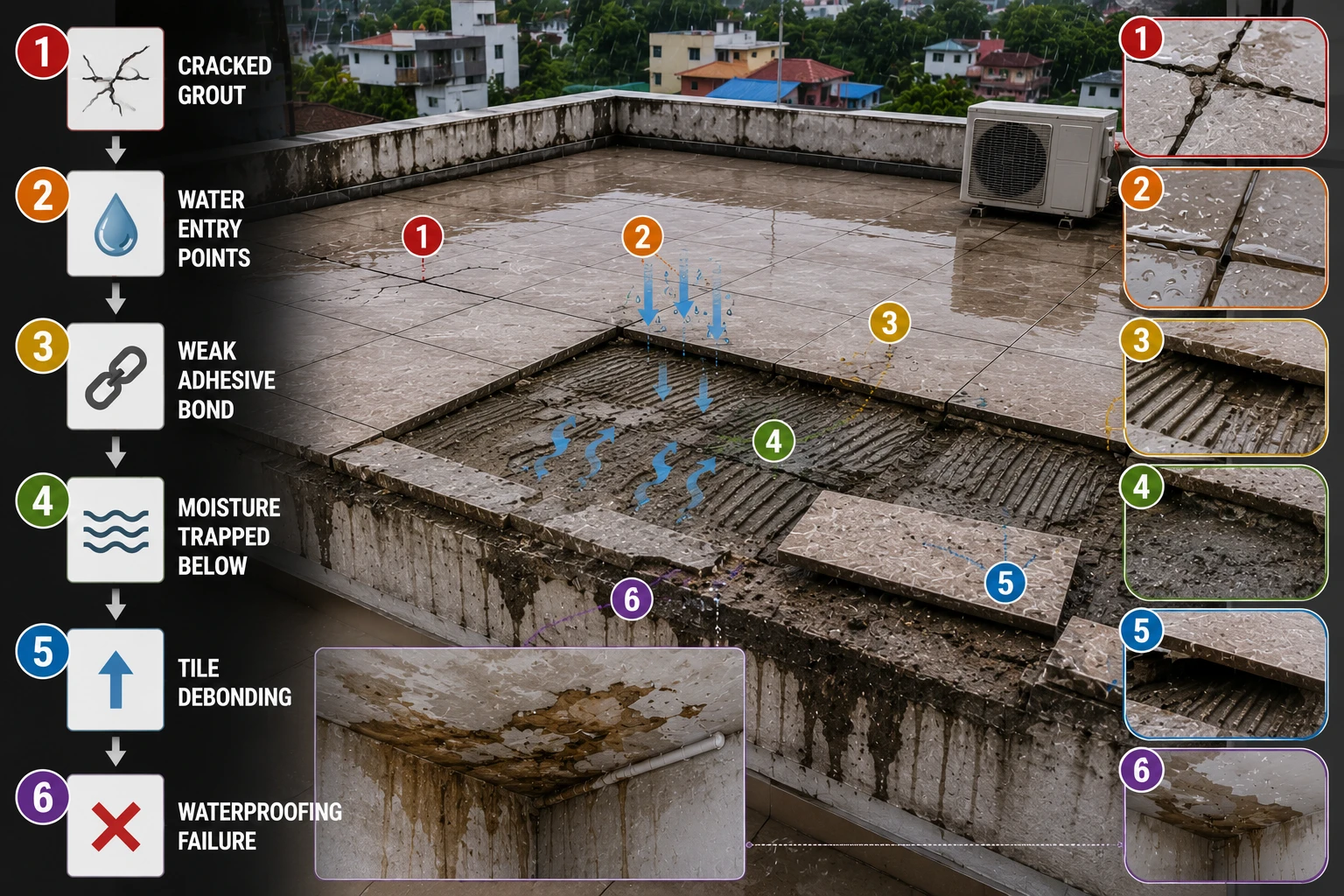
Tile contractors across Indian cities report the same pattern: homeowners invest in a good tile but allow the installer to use the cheapest available cement mortar as adhesive and standard cement grout for the joints. The tile lasts. The system fails.
Standard cement mortar mixed on-site is inconsistent in water-to-cement ratio, which means it is inconsistent in strength and water resistance. It also does not adhere well to a waterproofing membrane surface, which is exactly what lies below a properly built terrace tile installation. Polymer-modified adhesive bonds to waterproofed substrates reliably and stays flexible enough to handle the outdoor thermal cycle.
Cement grout shrinks slightly as it cures. On outdoor surfaces, it also expands and contracts with temperature. Over two to three monsoon seasons, hairline cracks appear in the grout joints first. These are invisible to the eye until moss or staining makes them obvious. By that point, each crack has been acting as a water channel for months.
Epoxy grout does not shrink on curing. It is chemically resistant to water and does not support moss or mould growth. The upfront cost is higher, but for an open terrace that will face direct monsoon rain every year, it pays for itself by protecting the much larger investment in tiles, adhesive, and waterproofing membrane beneath it.
Pre-Monsoon Terrace Tile Checklist
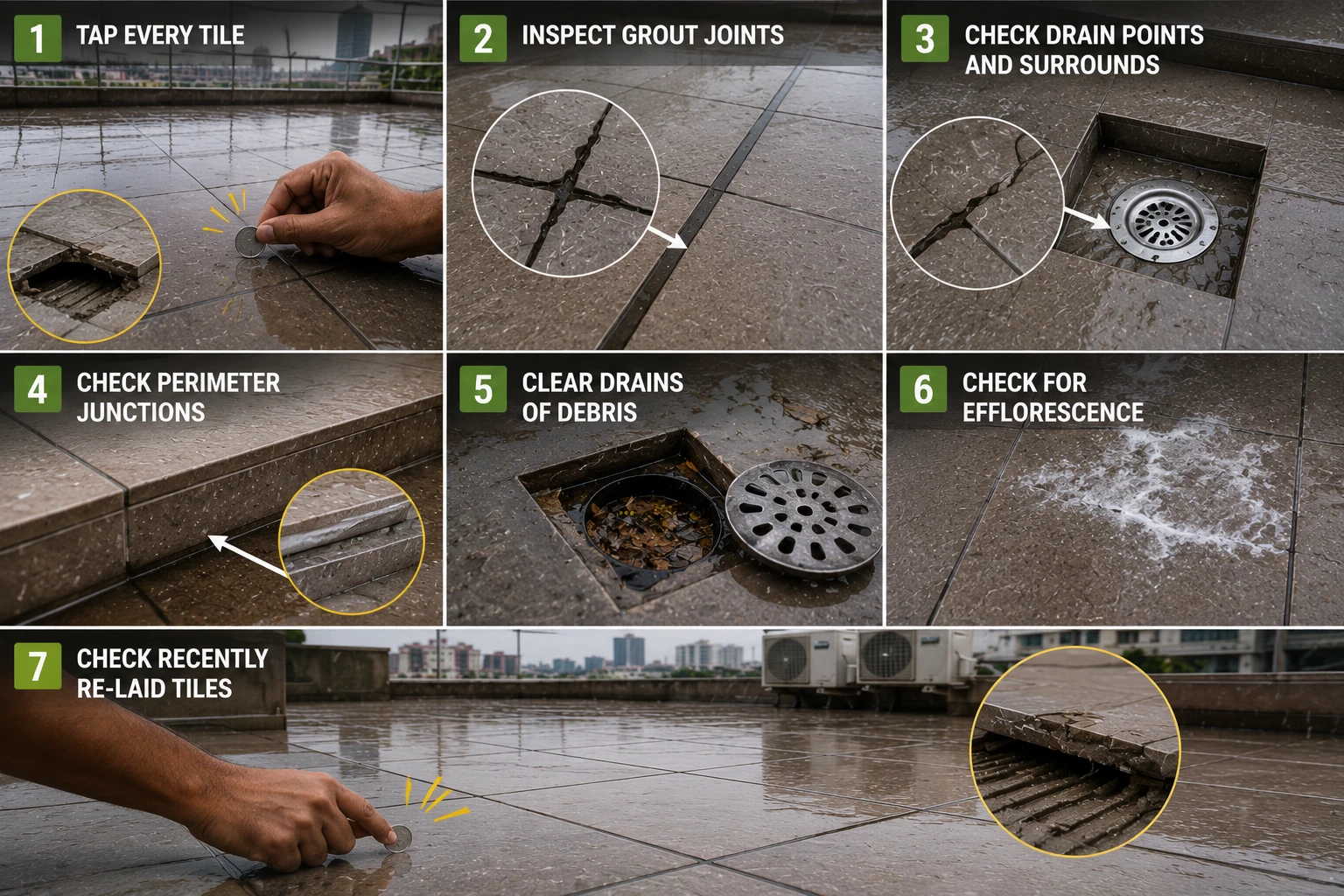
A terrace inspection before the first rains of June takes about thirty minutes and can prevent a monsoon season of ceiling leaks. These are the checks worth doing:
- Tap every tile with a coin or knuckle across the entire terrace. Any tile that sounds hollow has lost adhesion and needs re-bonding before the rains begin.
- Inspect all grout joints visually. Look for cracks, gaps, or missing grout. Any open joint on a flat outdoor surface needs to be re-grouted before the monsoon.
- Check drain points and drain surrounds. The tile and grout around each drainage outlet takes the most water stress. Re-grout this area with epoxy grout if the existing joint shows any cracking.
- Check the perimeter where the tile meets the parapet wall or raised edge. This junction is a common failure point where the tile or grout pulls away slightly. Seal any gap with a flexible waterproof sealant.
- Clear all drains of debris. A blocked drain on a flat terrace causes water to pool at depth and find the weakest tile joint under pressure.
- Check for efflorescence anywhere on the tile surface. If white mineral deposits are present, the tile system is letting water through from below, and the waterproofing layer needs professional assessment before the monsoon load arrives.
- If any tiles have been re-laid within the past year, tap those specifically to check the bond. Tiles laid in dry summer months sometimes lack proper curing of the adhesive before the thermal stress of the first monsoon.
Common Mistakes That Let Monsoon Win
Using standard cement mortar as tile adhesive on a terrace. Cement mortar is mixed on-site and has no polymer content. It does not adhere to waterproofing membranes reliably and breaks down in the wet-dry thermal cycle of Indian outdoor conditions. Polymer-modified adhesive costs more per bag but prevents bond failure that costs far more to fix.
Skipping the waterproofing membrane on a covered terrace. Partial cover from a pergola or shade net does not protect a terrace from monsoon splash and wind-driven rain. Every open terrace needs a waterproofing membrane under the tile layer, covered or not.
Use cement grout on all joints. For an open terrace, epoxy or polymer-modified grout should be used throughout. Using standard cement grout to save cost and then redoing the grout joints every two years costs more in total than doing it with the right material once.
Not leaving expansion gaps between tiles. Outdoor tiles need 3 to 4 mm gaps between them. Without this space, summer thermal expansion pushes tiles against each other and the weakest point in the layout, usually a tile or grout joint near the centre or at a wall junction, fails under the pressure.
Ignoring early warning signs. A hollow tile caught in May takes thirty minutes and a small amount of adhesive to fix. The same hollow tile discovered in August, after two months of monsoon, may have already allowed enough moisture into the slab to require a full retiling of the area, plus membrane repair. Pre-monsoon inspection is the single highest-return maintenance action for a tiled terrace.
Keeping a Terrace Monsoon-Ready
A terrace that lasts through the Indian monsoon without leaking into the rooms below is not the result of one good tile. It is the result of five layers chosen and installed correctly, with a thirty-minute inspection done before the first rain of the season.
The tile category sets the foundation. GVT and full-body vitrified tiles with outdoor-rated matte or GHR finish, laid with expansion gaps, give the tile layer the performance it needs. The membrane, adhesive, and grout do the rest.
You can compare GVT, Full Body vitrified, and other outdoor tile options for terraces on TilesFinders, where Indian buyers look at verified tile categories by water absorption, finish, size, and price before making their purchase decision.
FAQs
GVT (Glazed Vitrified Tiles) and Full Body vitrified tiles have the lowest water absorption rates (below 0.05 percent and 0.5 percent, respectively) and are the most reliable for Indian terrace floors. But the tile alone does not stop seepage. A full monsoon-ready system needs a waterproofing membrane under the tile, polymer-modified adhesive, and epoxy or polymer grout in the joints.
A properly waterproofed tiled terrace has five layers: prepared and repaired slab, waterproofing membrane (liquid, cementitious, or polyurethane), polymer-modified tile adhesive, an outdoor-rated tile in matte or GHR finish with 3 to 4 mm expansion gaps, and epoxy or polymer-modified grout in all joints. Skipping or using a cheaper substitute in any one of these layers compromises the whole system.
Tap each tile with a coin or knuckle. A hollow sound means the tile has separated from the adhesive below. Also, inspect grout joints for cracks or gaps, check tile edges for any lifting, and look for white efflorescence on the tile surface. Any of these signs indicate water is already moving through the system and needs to be fixed before monsoon loads increase the damage.
No. PGVT (Polished Glazed Vitrified Tiles) has very low water absorption, but its polished surface becomes slippery when wet. It is not suitable for any terrace or outdoor floor. It belongs on interior walls and dry indoor floors. For outdoor terrace floors, choose GVT or Full Body vitrified tiles in matte, GHR, Texture, or Rain Drops finish.
It is not advisable. High ambient humidity slows down the curing of both the waterproofing membrane and the tile adhesive. Adhesive that does not cure at the right rate forms a weaker bond. If tiling must happen during monsoon, use a quick-setting polymer adhesive formulated for high-humidity conditions, and ensure the membrane has had adequate curing time before tile installation begins.
Efflorescence is a white mineral powder that appears on the tile surface when water moves through the tile system from below and evaporates at the surface. It means water is passing through the grout or adhesive layers, picking up mineral salts from the cement below, and depositing them on the tile face as it exits. It is a reliable indicator that the waterproofing system has a failure point that needs professional assessment.
On an open terrace, inspect grout joints before every monsoon season. Standard cement grout on outdoor surfaces typically shows hairline cracking within two to three years. Re-grouting with epoxy grout extends the joint life considerably. If the grout was epoxy from the start, it generally holds without cracking for five or more years, depending on terrace usage and UV exposure.

See our tile guides first
Set TilesFinders as a preferred source and our buying guides surface ahead of the rest for you.
Add as preferred sourceTakes one tap. Nothing to install.
What Readers Say
I was about to redo my parking area with the wrong tile size until I read this. The layout comparisons saved me from a costly mistake.
We reference TilesFinders guides while briefing clients on material selection. The size and pattern breakdowns are accurate and easy to explain visually.
On site, I get asked about grout spacing all the time. This article gave me a solid reference I now share with my team before every job.
Finally a guide that doesn't just push generic advice. The oil stain removal steps actually worked on our clubhouse driveway tiles.
I run a small construction firm and now send this link to clients directly when they ask about entrance tile sizing. Saves me an hour of explaining.
Good practical detail, though I wish there were more examples for compact apartment entrances specifically, not just villas.
My mother-in-law wanted marble, I wanted vitrified. This blog gave us the neutral comparison we needed to actually decide together.
Detailed without being overwhelming. I appreciated that it covered both cost and maintenance, not just the aesthetics.
Used the algae and hard water removal tips on our terrace tiles after the monsoon. Worked better than what our regular cleaner was doing.
As someone who sources tiles for multiple builder projects, I find these comparisons genuinely useful for vendor conversations, not just consumer content.
Recommended this to a client who kept second-guessing the entrance design. The small vs large layout section settled the debate instantly.
Straightforward and honest, no unnecessary jargon. Would like to see a similar breakdown for outdoor pool-deck tiles next.
We've bookmarked several TilesFinders guides for our design handbook. Reliable source when clients want data, not just opinions.
Two paths, one marketplace.
Get free quotes from verified suppliers.
Share your room, budget, and style. Suppliers in Morbi respond within hours.
Get Free QuotesList your business, reach real buyers.
Put your showroom in front of homeowners searching for tiles right now.
List Your BusinessMore Blogs
See all
Balcony Wall Tiles vs Floor Tiles – Design Guide
Learn the golden rules of balcony design. Discover the key differences between wall and floor til...
Read More
Terrace Tiles: Heat-Resistant and Waterproof Options Explained
Discover heat-resistant and waterproof terrace tiles for Indian homes. Compare GVT, Full Body, an...
Read More
Best Tiles for Terrace in India: Heat-Resistant Top Picks
Find the best terrace tiles for Indian homes. Compare heat-resistant GVT, Full Body vitrified, an...
Read More