Top 10 Parking Tile Designs for Indian Bungalows and Apartments in 2026
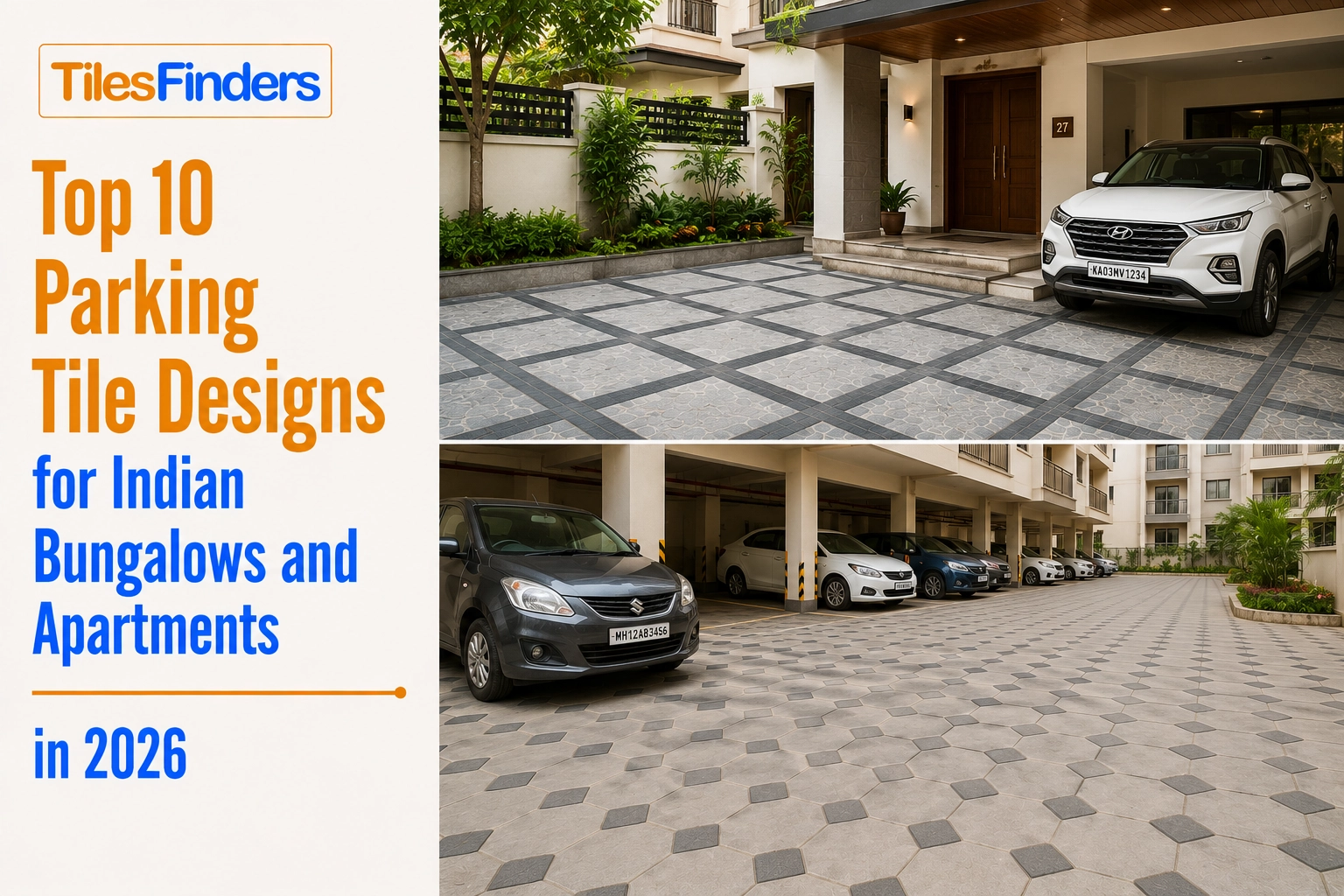
Explore the best parking tile designs for Indian bungalows and apartments, from modern large-format tiles to classic stone finishes that balance style and durability.
- Why Parking Tile Design Matters Beyond the Visual
- How to Use This List: Bungalow vs Apartment
- Design 1: Large-Format Grey Matte Vitrified
- Design 2: Dual-Tone Charcoal Field with Beige Inlay Border
- Design 3: Ivory and Off-White for Apartment Society Compounds
- Design 4: Wood-Look Plank Tiles for Covered Portico and Porch Areas
- Design 5: Natural Granite with Black Inlay Border for Premium Bungalows
- Design 6: Kota Stone Natural Green for Traditional and Heritage Bungalows
- Design 7: Dark Anthracite Matte for Contemporary Minimalist Bungalows
- Design 8: Terracotta-Look Vitrified for Rajasthani and Heritage-Style Bungalows
- Design 9: Chequered Black and White for Compact Apartment Parking Bays
- Design 10: Sandstone-Look GVT for Society Compounds and Large Villa Projects
- All 10 Designs at a Glance
- Choosing by Home Type: The Decision Framework
- Vastu Colour Guidance for Parking Tile Colours
- Common Design Mistakes in Indian Parking Tile Projects
- The Right Design for Your Specific Home
The best parking tile design depends on your home type, driveway size, climate, and maintenance preferences. From large-format GVT to Kota stone and granite, each option offers unique advantages. This guide compares 10 proven parking tile designs for Indian bungalows and apartments, covering appearance, durability, pricing, and practical suitability.
The parking area is the first thing a visitor sees when they arrive at your home. Before the door colour, before the garden, before the facade, the driveway sets the tone. In Indian homes, from compact apartment society compounds to spread-out bungalow driveways, this is usually the largest single horizontal surface in the property.
Most homeowners pick parking tiles by asking one question: which colour looks clean? That is a reasonable starting point. But colour is only one variable. Tile size relative to the driveway width determines whether the space feels expansive or chopped up. The finish determines whether the surface still looks good after two monsoons. The pattern determines whether the design reads well from both ground level and from an upper floor or terrace. A beautiful tile chosen without these considerations looks average within a year.
This list covers ten parking tile designs that work specifically in Indian conditions, for Indian home types, with the Indian climate in mind. Each entry includes the tile specification, the right home context, the price range, and what makes it stand apart from the alternatives. Bungalow and apartment compound applications are differentiated throughout because the design logic and practical constraints are not the same for both.
Why Parking Tile Design Matters Beyond the Visual
A well-chosen parking tile design does three things that a poorly chosen one does not. It makes the driveway look proportionate to the house, it photographs well for resale listings (a small but real factor in Indian real estate where compound images drive buyer interest), and it ages gracefully through repeated cleaning and weather cycles.
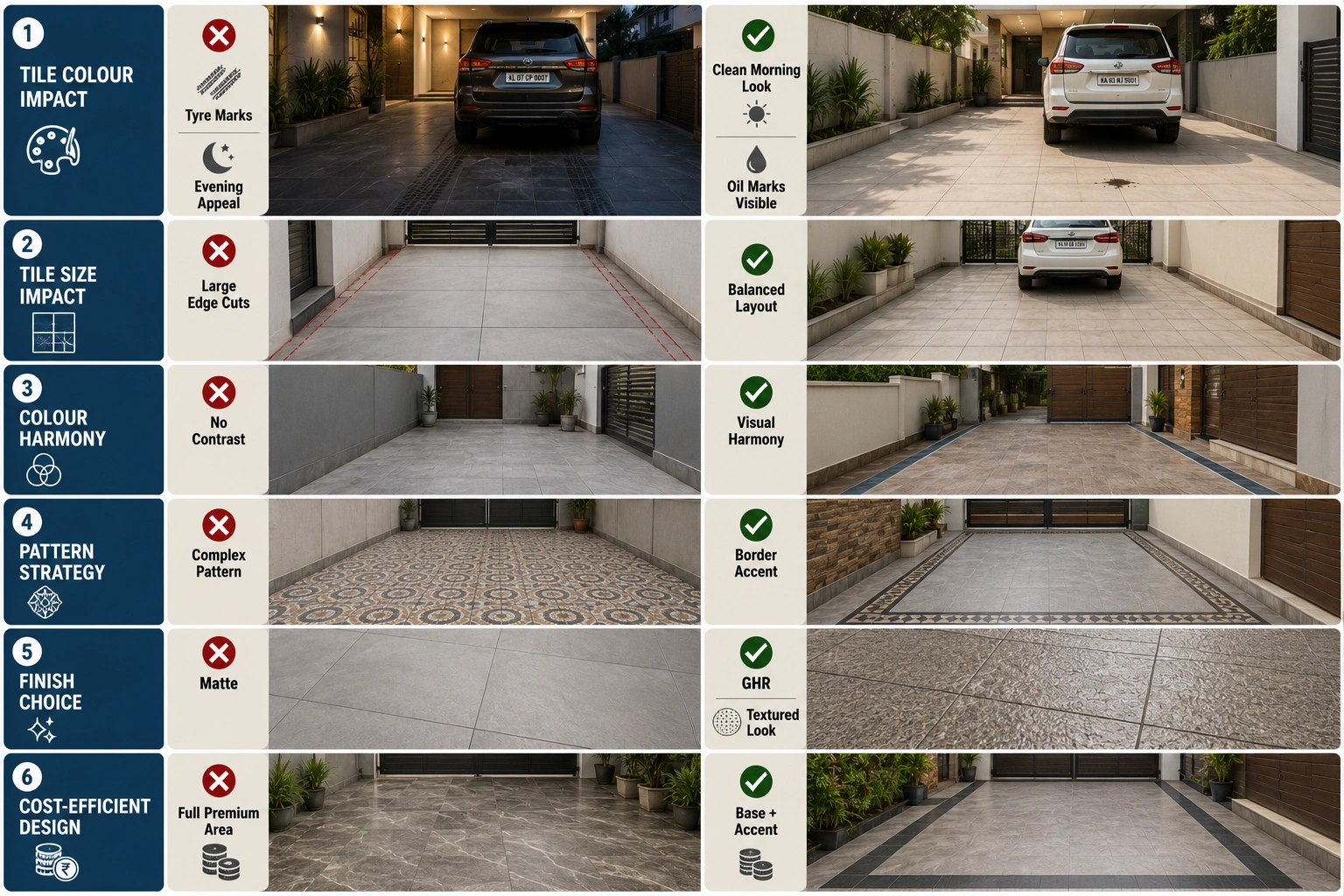
Dark tiles show tyre marks and dust accumulation more visibly, but photograph dramatically in the evening. Light tiles look clean in morning light, but show every oil drip. Large-format tiles in a small compound create an unbroken, spacious floor plane, but waste more material in cuts at the edges. Border patterns add visual interest at a lower cost than covering the entire area in premium tile.
The design decisions in parking tile selection are fundamentally the same as interior design decisions, just outdoors and with a higher technical requirement. The right design is the one that balances how it looks on day one with how it looks after three monsoon seasons and a hundred vehicle passes.
Even the best design fails without the right foundation. Our Parking Tile Installation Guide explains the correct base preparation, slope planning, and drainage setup required for Indian driveways.
| Design Decision | What It Affects | Common Mistake |
|---|---|---|
| Tile size vs driveway width | Proportionality; number of visible cut tiles at edges | Using 600x1200 mm tiles in a 3-metre driveway (too few tiles across, large edge cuts) |
| Tile colour vs surrounding wall colour | Visual harmony; whether the driveway reads as part of the home or a separate surface | Grey tile against grey compound wall; no contrast, no visual interest |
| Pattern vs plain field | Visual complexity; installation cost; maintenance visibility | Border-only pattern that requires matching at corners (difficult to execute cleanly) |
| Matte vs textured finish in the design context | How light plays on the surface; how clean it looks over time | Choosing matte only for grip when GHR gives equal or better grip with a more textured look |
| Single tile vs two-tile combination | Design depth; cost management per sq. ft. | Choosing a premium tile for the full area when a base tile with an accent border achieves the same look at a lower cost |
How to Use This List: Bungalow vs Apartment
The ten designs below are organised from the most widely applicable to the most context-specific. Each entry notes whether it works better for a bungalow, an apartment society compound, or both.
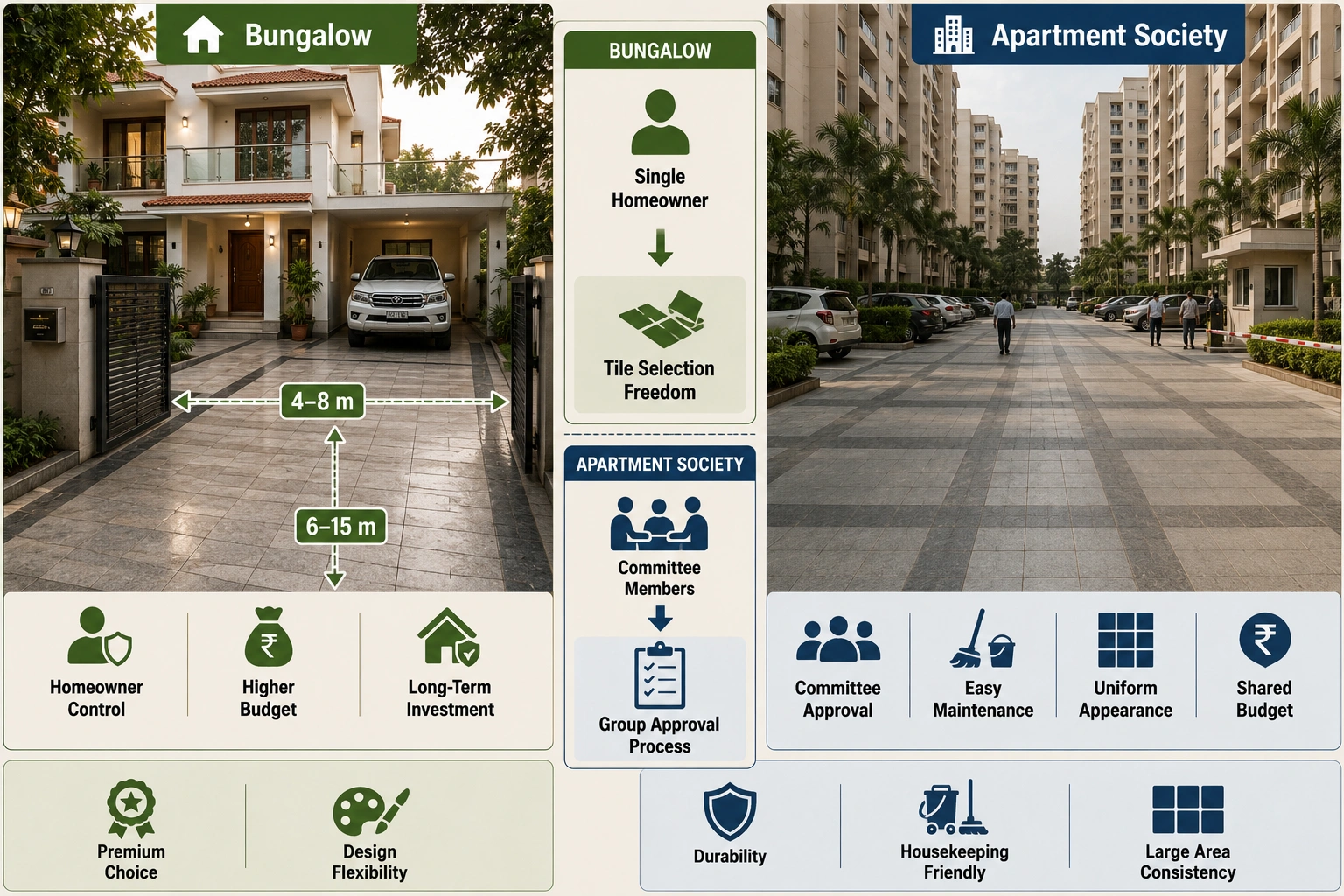
Bungalow driveways in India are typically 4 to 8 metres wide with a length of 6 to 15 metres from the gate to the parking bay. They are privately owned, and the homeowner has full control over tile choice. Budget per sq. ft. is generally higher because the homeowner is investing in their own long-term asset.
Apartment society compounds are typically managed by the residents' welfare association (RWA) or society committee. Tile decisions often go through a committee approval process. The focus is on durability, uniform appearance across a large area, ease of maintenance by the society's housekeeping staff, and a budget that reflects shared cost across all flat owners. Design complexity is usually lower than bungalow work.
Design 1: Large-Format Grey Matte Vitrified
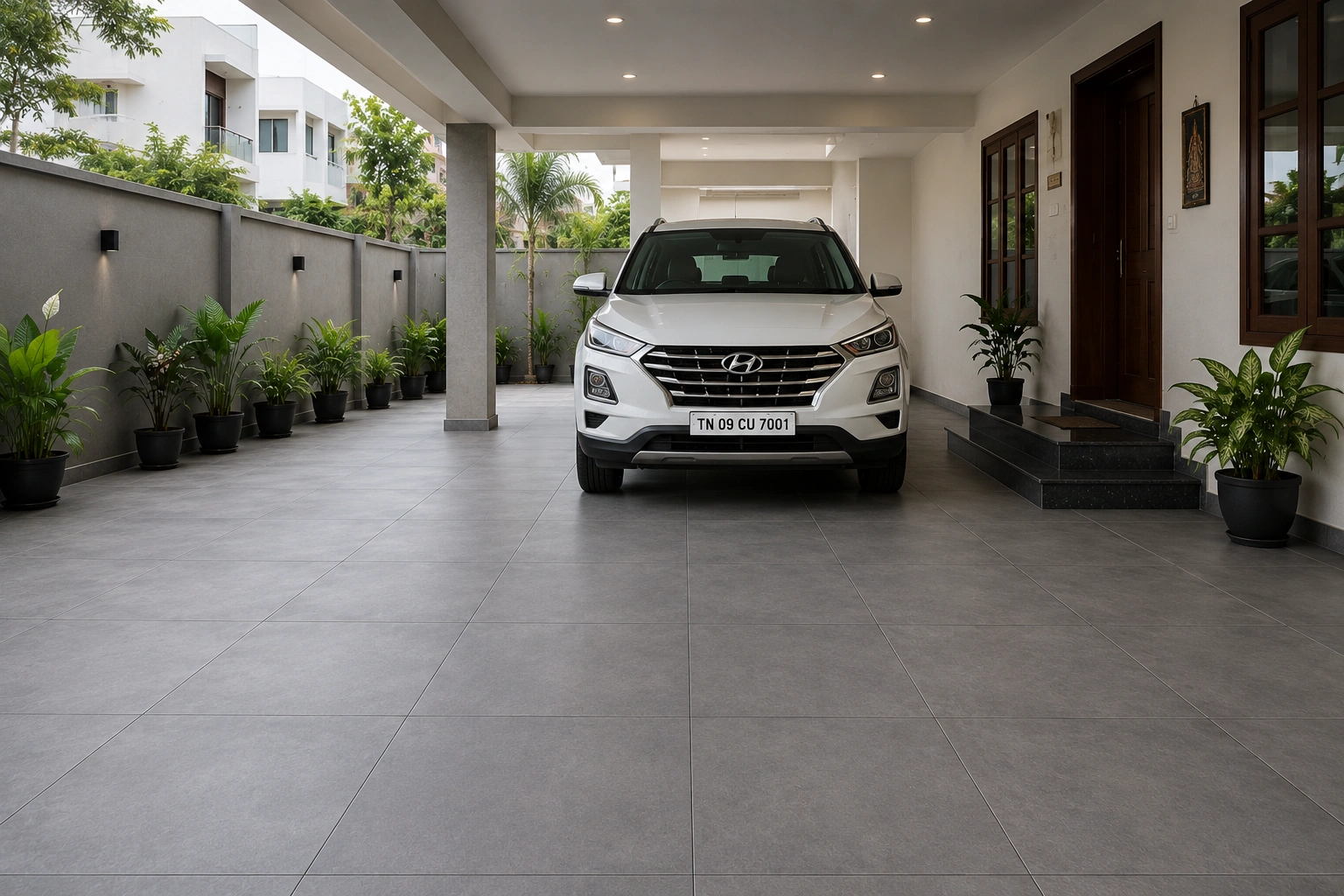
This is the most widely used contemporary parking tile design in Indian bungalows built since 2018. A 600x1200 mm (2x4) matte or GHR vitrified tile in mid-grey or warm grey tone, laid in a straight stack bond (tile edges aligned, not offset), creates a clean, unbroken floor plane that reads as genuinely contemporary from any angle.
The appeal is in its restraint. There are no patterns to maintain, no borders to align at corners, no second tile to match. The large format reduces the number of grout lines visible across the driveway, which makes the floor look wider and more continuous. A 5-metre driveway tiled in 600x600 mm shows roughly eight tile lengths across. The same driveway in 600x1200 mm shows only four tile lengths laid lengthwise, creating a very different visual rhythm.
In Indian conditions, grey matte and grey vitrified tiles have one more practical advantage: they show tyre marks and oil drips less visibly than light ivory or white tiles, while showing dust and dirt less than very dark tiles. The mid-grey tone sits in the optimal range for visual cleanliness between cleaning sessions.
Tile category: GVT matte or GHR finish
Tile size: 600x1200 mm (2x4 format) for driveways 5 metres and wider; 600x600 mm (2x2) for narrower driveways
Colour range: Warm grey, ash grey, concrete grey, slate grey
Finish: Matte or GHR; GHR preferred for open driveways in high-rainfall zones
Thickness: 12mm for sedans and compact SUVs; 15mm Full Body for Fortuner and Innova class vehicles
Best for: Modern bungalows, contemporary villas, high-rise society compounds with car parking bays
Price range: Rs. 75 to Rs. 140 per sq. ft. for 600x1200 mm GVT GHR 12mm
Design Tip: For a 5-metre-wide bungalow driveway, lay the 600x1200 mm tiles with the long axis perpendicular to the direction of vehicle entry. This creates horizontal lines that read across the driveway width, making the entry look wider and more welcoming than tiles laid lengthwise along the vehicle path.
Vastu Note: Grey is considered a neutral colour in Vastu and is acceptable for all directions of parking. For parking areas on the north or east side of the plot, off-white or light grey is slightly preferred over dark grey.
Design 2: Dual-Tone Charcoal Field with Beige Inlay Border
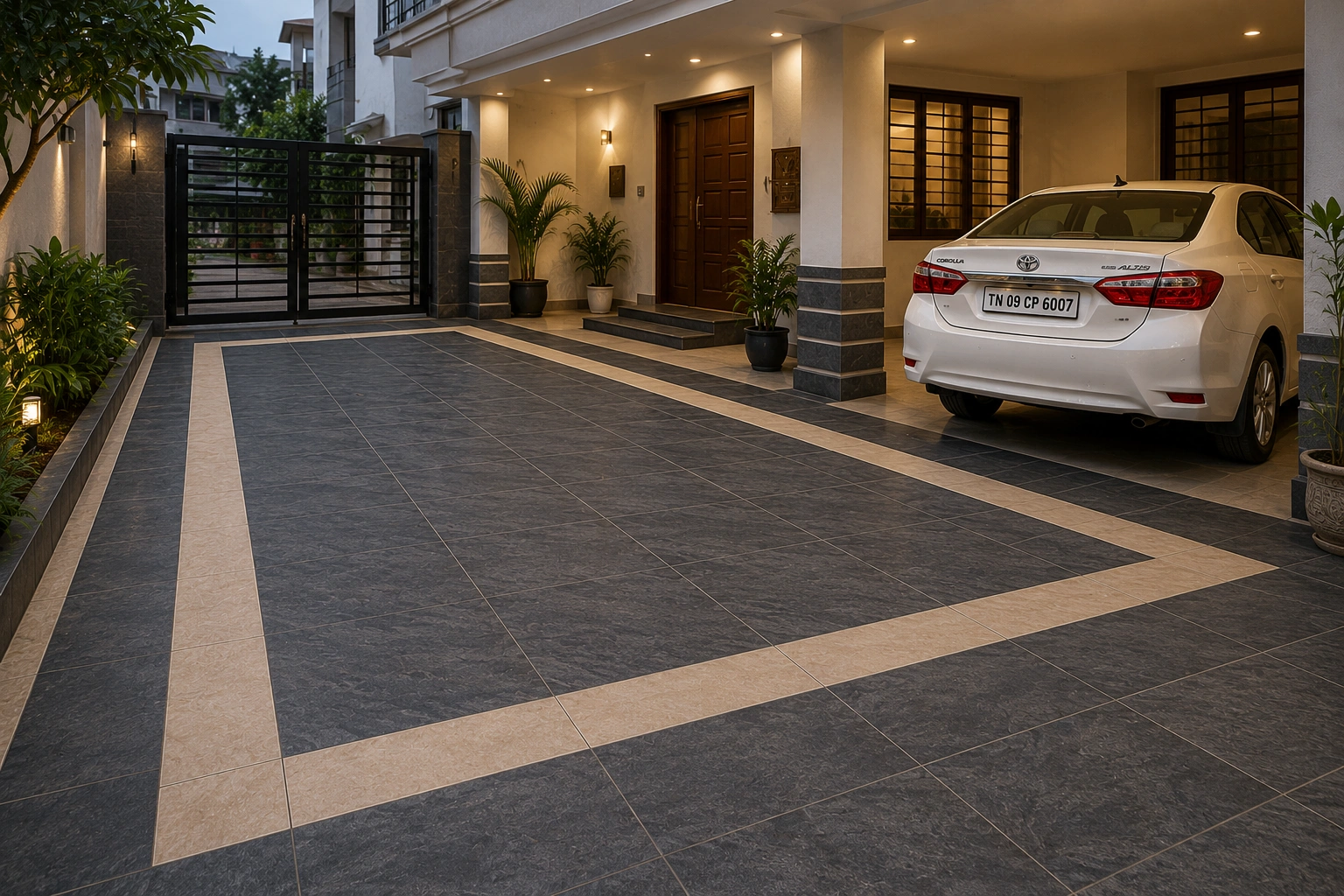
The dual-tone border design is the most popular pattern-based parking tile choice in Indian bungalows and independent villa projects. The concept is simple: a darker tile fills the main parking field (the area where vehicles stand), and a lighter or contrasting tile forms a single-row or double-row border around the perimeter and, optionally, as a dividing line between parking bays.
Charcoal as the field colour and beige or warm ivory as the border is the combination seen most often in Indian bungalow projects from 2020 onwards. The contrast is strong enough to read clearly from an upper-floor window but not so dramatic that it looks designed for a showroom rather than a private home. The beige border also connects visually to lighter compound wall colours, which Indian homes frequently use.
This design requires planning at the installation stage. The border tiles must be laid first, at the correct width for the overall driveway dimension, so the field tiles fill in cleanly without awkward partial cuts at the boundary. A driveway 4.8 metres wide with two rows of 300x600 mm border tiles on each side leaves a 3.6-metre field for the main tiles. That width accommodates exactly six rows of 600x600 mm field tiles with no cuts, which is the kind of clean execution this design needs.
Field tile category: GVT or Full Body vitrified in matte, or GHR finish
Field tile size: 600x600 mm (2x2) or 600x1200 mm (2x4)
Field tile colour: Charcoal, dark grey, dark anthracite, dark beige-brown
Border tile size: 300x600 mm (12x24) as a wall-only size must not be used on floors; use 400x400 mm (16x16) or 600x600 mm cut-to-size border pieces instead
Border tile colour: Warm beige, ivory, light cream, off-white
Best for: Bungalow driveways with 4 to 8 metres width; villa projects with defined parking bays; independent floors with compound entry
Price range: Rs. 80 to Rs. 150 per sq. ft. combined (field plus border at different price points)
Important: 300x600 mm tiles are wall-only format and must never be used as floor border tiles in a parking area, regardless of how they are sized or placed. For border strips, use 400x400 mm tiles cut to the required width, or order 600x600 mm tiles in the border colour and have them cut at the tile yard. Using wall-format tiles on a parking floor leads to cracking and water absorption failure.
Design Tip: Keep the border to a maximum of two rows (one row of the border tile on each side). A wider border reduces the field area and makes the design feel like a frame competing with the house rather than complementing it. The proportional rule is: border width should be no more than 15 per cent of the total driveway width.
Design 3: Ivory and Off-White for Apartment Society Compounds
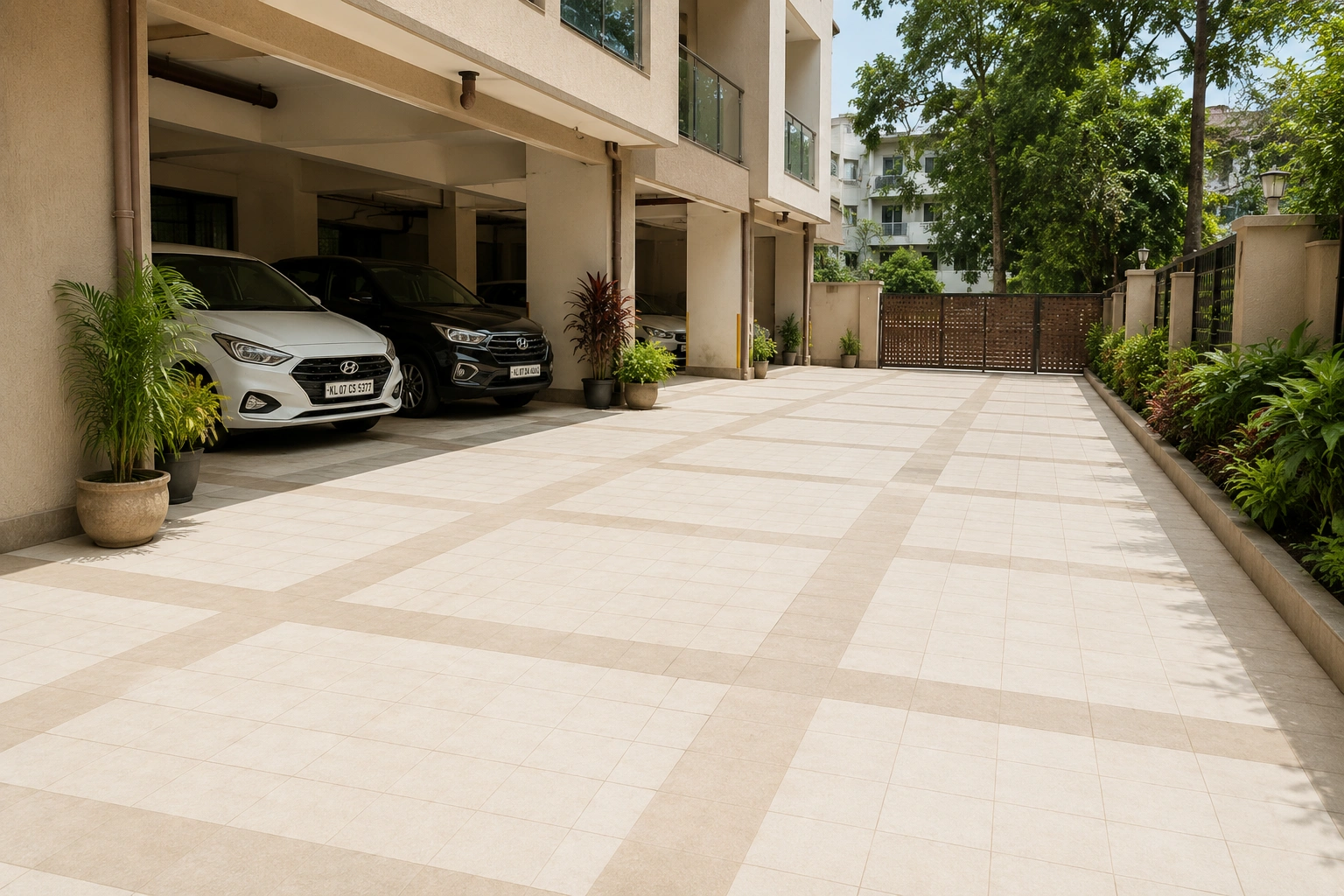
Society compound parking areas in Indian apartments face different constraints from bungalow driveways. The area is large, often 500 to 2,000 sq. ft. or more for mid-size societies. The tile must be approved by a committee that will prioritise uniformity and ease of future patching over design ambition. And the budget is shared, which typically means the per-sq. ft. cost matters as much as the design.
Ivory and off-white matte or GHR vitrified tiles in a 600x600 mm (2x2) format, laid in a straight stack bond, is the cleanest answer for society compound parking. The light tone makes the compound feel open and spacious, which matters especially for basement or covered society parking where artificial lighting is the primary source. The uniform colour makes future patching from the same batch far easier than a two-tone design, where batch matching is required for both colours.
The design is not exciting. It is not supposed to be. Society compound parking design should prioritise function, future maintenance ease, and visual neutrality that works with any building exterior colour. Ivory achieves all three.
Tile category: GVT matte or GHR finish; Full Body preferred for driveways with heavy vehicle access
Tile size: 600x600 mm (2x2) across the compound; 400x400 mm (16x16) in narrow aisles
Colour range: Ivory, off-white, cream, light warm beige
Finish: Matte or GHR; avoid high-gloss or polished finishes in any society parking area
Best for: Housing society compounds, apartment parking bays, common area driveways in gated communities
Price range: Rs. 65 to Rs. 110 per sq. ft. for standard GVT GHR 600x600 mm 12mm
Design Tip: For large society compound areas, ask the dealer to hold three to five additional boxes from the same production batch and store them at the society premises. Partial tile replacements are common in compound areas after years of use, and matching a tile from the same batch is far easier than trying to source a colour match five years later from a new production run.
Design 4: Wood-Look Plank Tiles for Covered Portico and Porch Areas
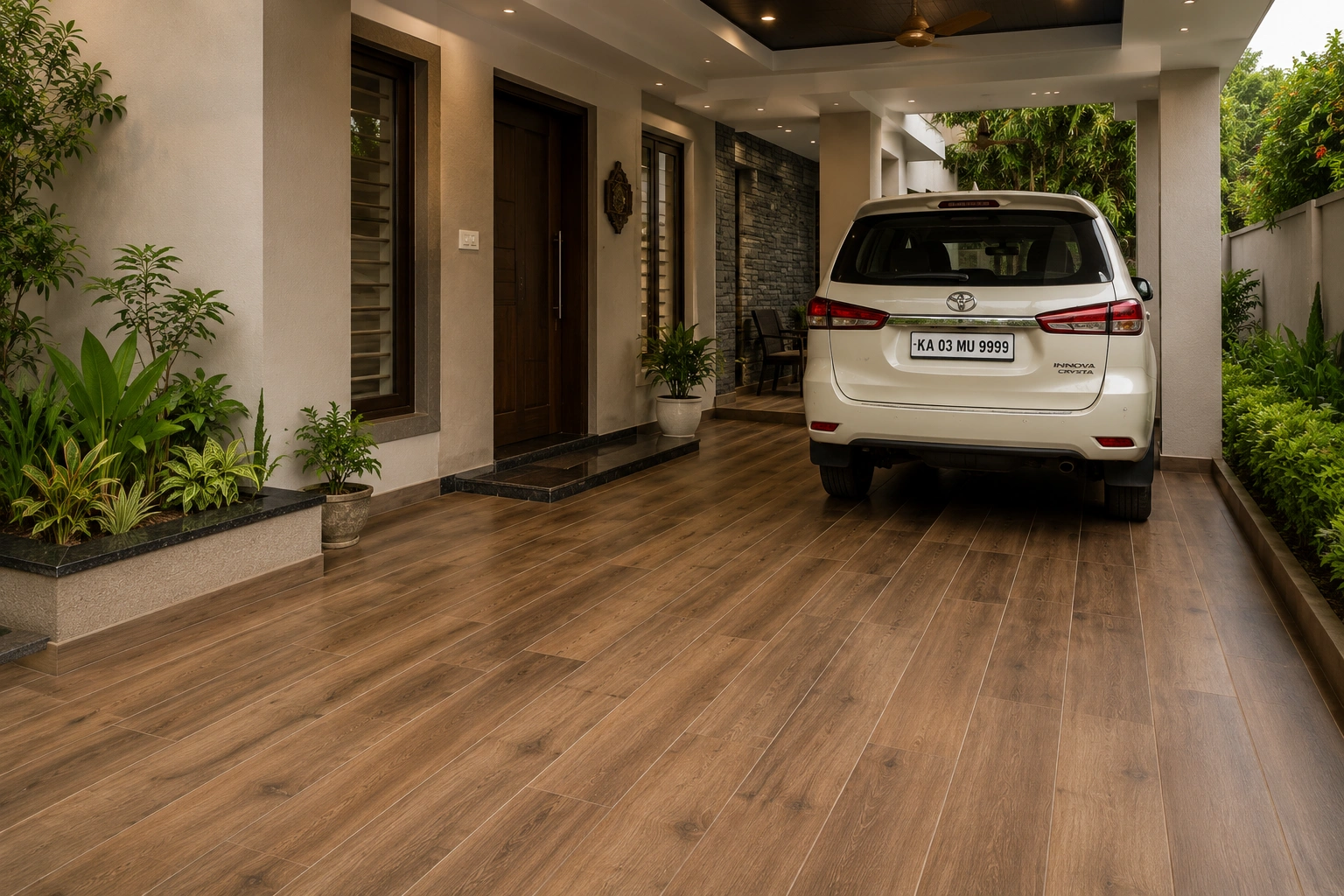
Wood-look vitrified tiles in a plank format are one of the fastest-growing parking design choices in Indian bungalows and independent floors built since 2020. The 200x1200 mm (8x48) or 200x1000 mm (8x40) plank tiles in warm oak, teak, dark walnut, or light ash tones create a surface that reads as warm and residential rather than cold and industrial.
The key context for this design is the covered porch or portico. A covered car porch that protects the vehicle from direct sun and rain changes the material requirements: the tile stays dry, faces no direct UV bleaching, and does not accumulate monsoon algae at the same rate as an open driveway. In this protected context, a wood-look plank tile performs reliably and brings an interior quality to what would otherwise be a standard grey driveway.
For open driveways, wood-look tiles need a matte or GHR finish in a format rated for outdoor use. The 200x1200 mm format creates fewer visible joints than smaller tiles, and the long horizontal lines lead the eye toward the entrance, which is a design effect interior designers use intentionally to create a sense of arrival.
Tile category: GVT matte or GHR finish; must confirm outdoor rating for open areas
Tile size: 200x1200 mm (8x48) for long portico runs; 200x1000 mm (8x40) for shorter porch areas
Colour range: Warm oak, light teak, dark walnut, ash grey, washed pine
Finish: Matte or GHR finish only for outdoor use; matte carving for covered porch areas with minimal rain exposure
Laying direction: Perpendicular to the direction of entry; long axis across the width creates the best visual depth
Best for: Covered bungalow car porch, portico areas with roof or pergola overhead, independent floor entry areas
Price range: Rs. 85 to Rs. 160 per sq. ft. for GVT wood-look 200x1200 mm
Important: Wood-look tiles in an open driveway with no roof overhead in heavy monsoon areas (Mumbai, Kerala, Goa) collect algae in the simulated wood grain texture faster than plain matte or GHR tiles. For uncovered driveways in heavy rainfall zones, use a GHR finish version of the wood-look tile and plan for a pre-monsoon cleaning session each year. The GHR glaze is easier to clean than a matte carving wood-grain finish.
Design Tip: Lay wood-look plank tiles with the long axis running across the driveway width, not along the driveway length. When tiles run in the same direction as the vehicle path, the driveway looks like a runway. Running them across the width frames the approach and draws attention to the house entrance.
Design 5: Natural Granite with Black Inlay Border for Premium Bungalows
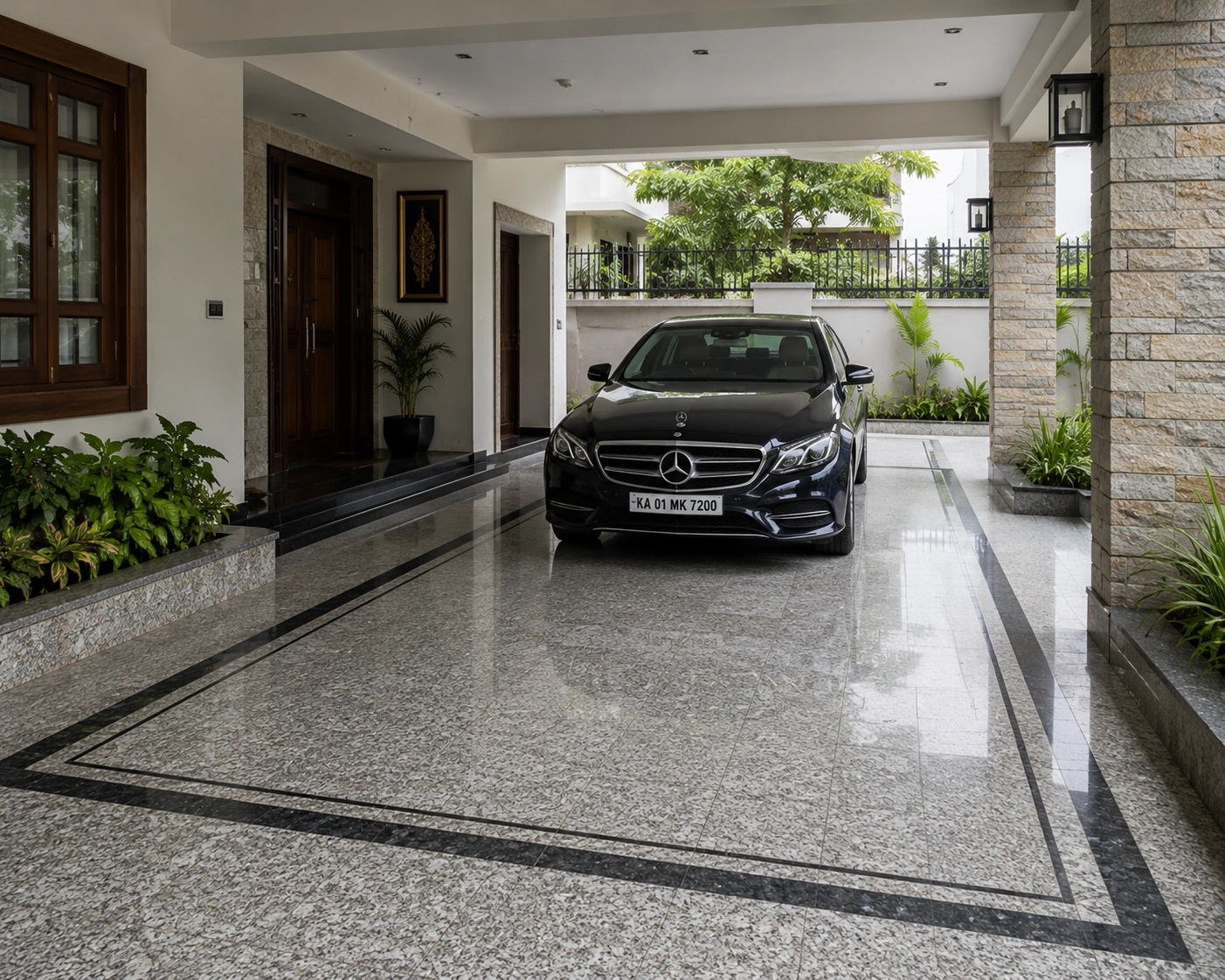
For bungalow projects in the Rs. 1 crore and above budget range, natural granite in a flamed or natural finish is a step change from any manufactured vitrified tile in terms of perceived quality and longevity. A granite parking surface does not just look premium. It feels different underfoot, sounds different under a tyre, and develops a surface character over years of use that manufactured tiles do not replicate.
The most popular granite choices for Indian bungalow driveways are Kashmir White, Steel Grey, Black Galaxy, Tan Brown, or the more affordable Kotda Black from Rajasthan. Paired with a single-row border of a contrasting granite or a black vitrified tile, the design reads as a deliberate architectural choice rather than a default material.
Flamed granite finish (where the surface is heated with a torch flame, causing the crystals to micro-fracture and create a rough, matte texture) gives R12 to R13 anti-skid performance, which is the highest grip rating available in any flooring material. This makes flamed granite an ideal choice for sloped bungalow driveways in cities with significant monsoons.
Material: Natural granite: Steel Grey, Kashmir White, Black Galaxy, Kotda Black, Tan Brown
Finish: Flamed (best for outdoor parking; R12 to R13 grip); natural cut also works on flat driveways
Thickness: 18mm minimum for vehicle parking; 20mm preferred for SUV and full-size vehicle driveways
Border: Single-row border in contrasting granite or black Full Body vitrified 12mm
Best for: Premium bungalows, architect-designed independent villas, high-value plot developments
Price range: Rs. 100 to Rs. 250 per sq. ft. for granite, depending on variety; border tile at Rs. 90 to Rs. 150 per sq. ft.
Design Tip: Flamed grey granite with a polished black granite border strip is a classic Indian bungalow driveway combination that has looked fresh since the 1990s and continues to be considered a quality signal in Indian residential property. The contrast between the rough field and the smooth border reads well from any angle and photographs extremely well.
Vastu Note: Black is generally avoided for the main field area in Vastu guidance. As a border element only, black is acceptable. For Vastu-conscious buyers, Steel Grey or Tan Brown granite as the field tile with a black border is a comfortable compromise.
Design 6: Kota Stone Natural Green for Traditional and Heritage Bungalows
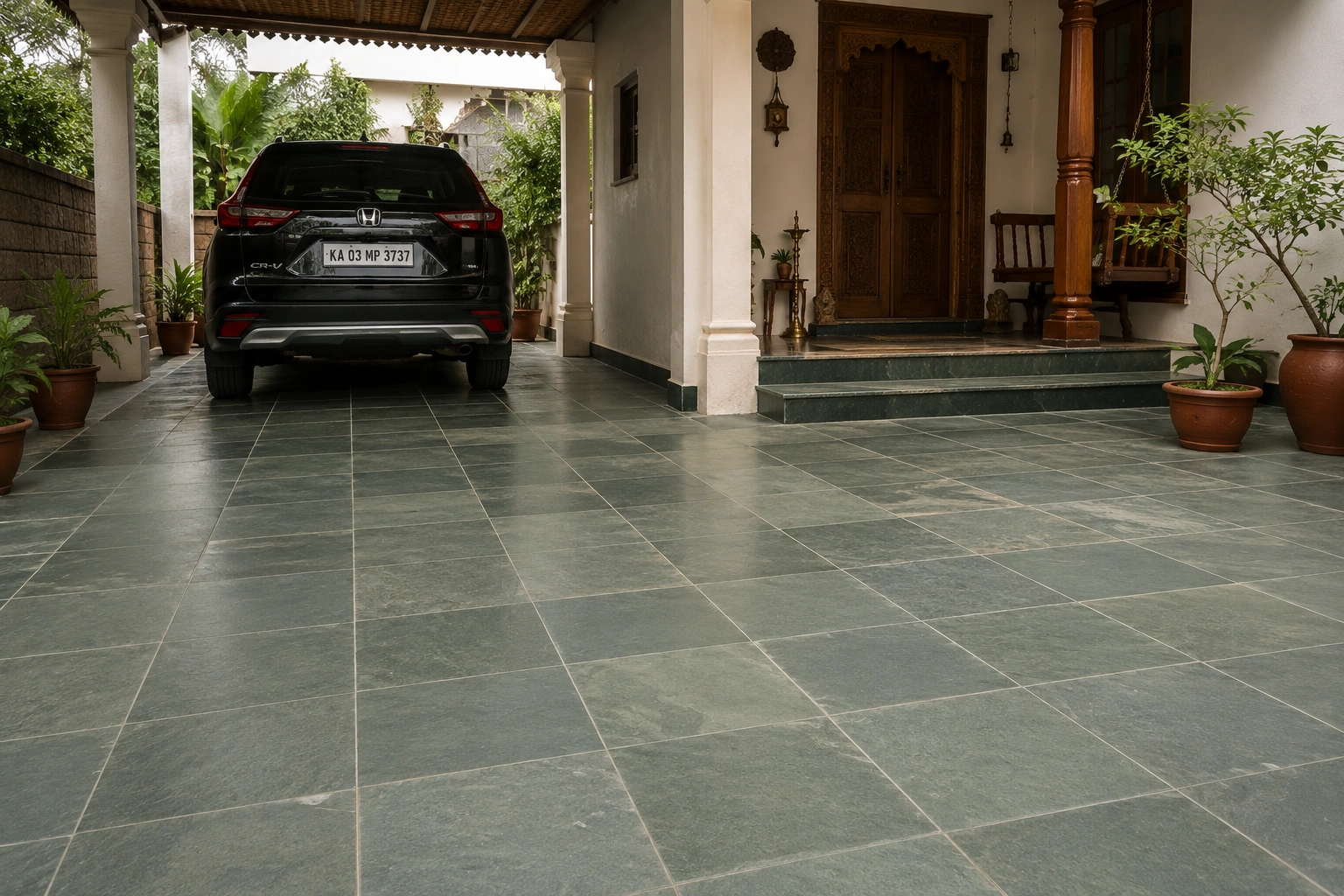
Kota stone from Kota, Rajasthan, has been used in Indian bungalow driveways, verandahs, and compound floors for over a century. Its distinctive dark green to greenish-brown colour, smooth natural surface, and moderate texture give it an appearance that no manufactured tile can replicate. In the right bungalow context, especially colonial-style, traditional Rajasthani, or older South Indian bungalow architecture, Kota stone does not just look appropriate. It looks like it was always supposed to be there.
Kota stone is quarried and cut in Rajasthan and is priced significantly lower than granite or manufactured vitrified tiles for large areas. A 40 to 60 mm thick Kota slab for a driveway costs Rs. 30 to Rs. 70 per sq. ft. excluding cutting and installation, which makes it the most cost-effective natural stone parking surface in India. Its hardness and natural texture give it R11 to R12 anti-skid performance, adequate for most Indian home driveways.
The critical requirement is sealing. Kota stone without a penetrating sealer absorbs oil and vehicle fluids quickly, and those stains are difficult to remove once set into the stone. A properly sealed Kota stone driveway, re-sealed every two years, resists staining and cleans with the same routine as vitrified tiles.
Material: Kota stone (natural quartzite from Kota, Rajasthan)
Finish: Natural honed surface (standard); machine-polished (for covered areas only; too slippery outdoors)
Thickness: 25mm minimum for vehicle parking areas; 40mm for SUV and heavy vehicle driveways
Colour: Dark green, greenish-brown, blue-grey (varies by quarry layer)
Sealing: Apply penetrating stone sealer before installation and re-seal every 18 to 24 months
Best for: Traditional, colonial, and heritage-style bungalows; properties in Rajasthan and Central India where Kota is locally available at low cost
Price range: Rs. 30 to Rs. 70 per sq. ft. for stone; sealing adds Rs. 8 to Rs. 15 per sq. ft. per application
Important: Do not use acid-based cleaners, vinegar, or descaling products on Kota stone at any time. Kota stone is calcium carbonate-based, and acids etch it permanently. Use only pH-neutral or mildly alkaline stone cleaners. Oil spills must be treated within the first hour using a pH-neutral stone degreaser to prevent permanent staining.
Vastu Note: Green and earthy tones are considered highly auspicious for ground floors and parking areas in Vastu Shastra. Kota stone's natural green tone is one of the best Vastu-aligned parking surface colours available.
Design 7: Dark Anthracite Matte for Contemporary Minimalist Bungalows
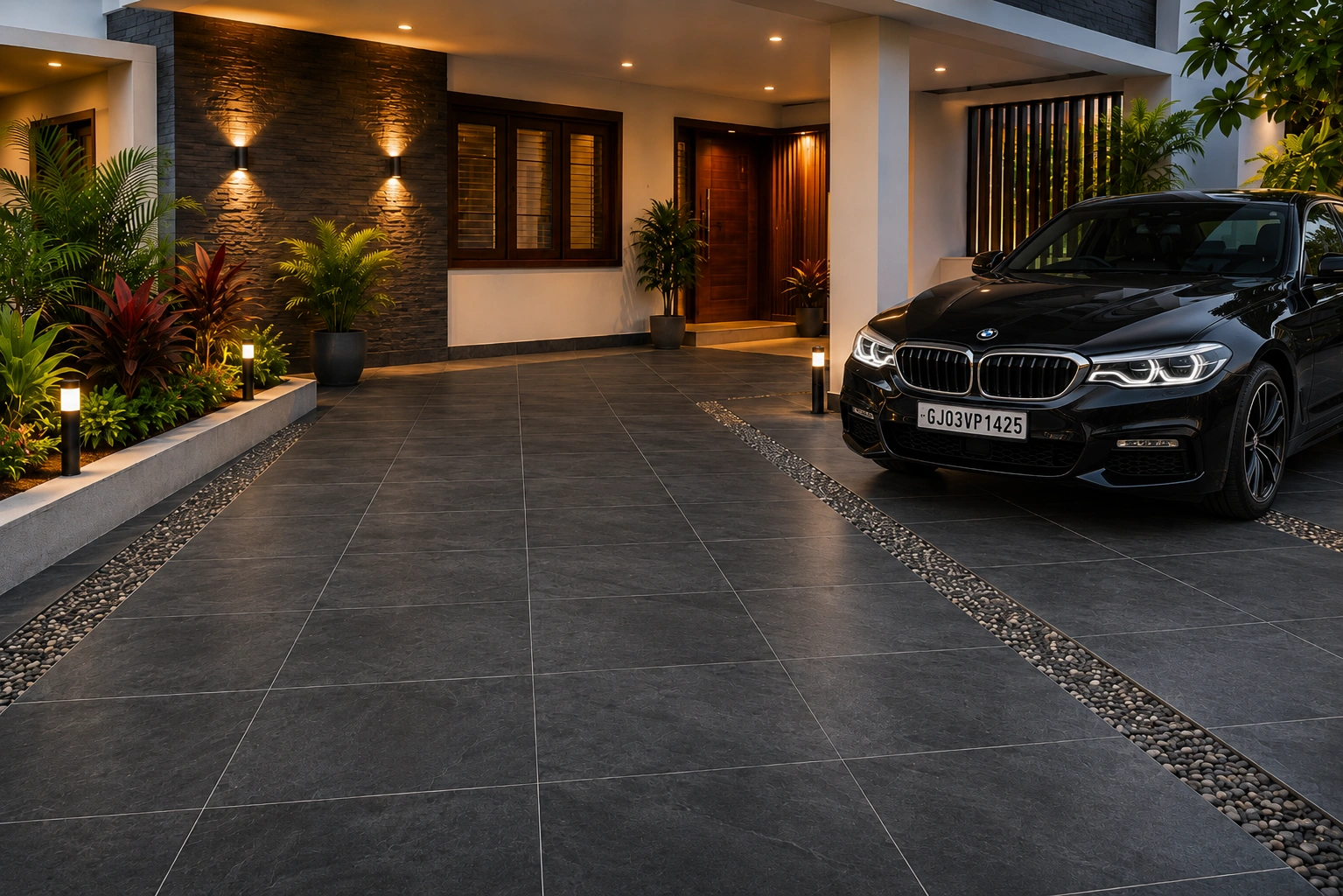
Contemporary minimalist architecture in India, particularly the flat-roof, white-plaster bungalow style that has become common in Ahmedabad, Pune, Bengaluru, and Hyderabad's premium residential layouts, calls for a parking tile that matches its austere quality. Dark anthracite matte vitrified, a near-black tile with a fine-grain surface texture, is the natural pairing for this style.
The anthracite tile reads as almost black in overcast or shade conditions and reveals a rich dark grey in direct sunlight. This tonal shift is what makes it work with white or light-grey compound walls. The contrast is dramatic without being garish. At night with driveway lighting, the reflective difference between the dark tile and the white plaster wall creates a strong visual definition that cheaper grey tiles cannot match.
The practical concern with very dark tiles is that they show dust and pale mineral deposits from hard water very visibly. In cities with high-TDS water, like Delhi, Jaipur, or Ahmedabad, this means more frequent wiping near the water line or garden tap area. This is a real maintenance consideration that should factor into the decision, not a dealbreaker.
Tile category: GVT matte or Full Body vitrified in matte or GHR finish
Tile size: 600x600 mm (2x2) or 600x1200 mm (2x4); large format strengthens the minimalist aesthetic
Colour range: Dark anthracite, near-black, graphite grey, iron grey
Finish: Matte or GHR; GHR preferred for open driveways; avoid any polished or semi-polished version
Best for: Contemporary flat-roof bungalows; architect-designed homes in Ahmedabad, Pune, Bengaluru, Hyderabad; homes with white or light grey exterior walls
Price range: Rs. 80 to Rs. 150 per sq. ft., depending on category and size
Design Tip: Install driveway lighting at ground level between parking tile rows when using dark anthracite tiles. Low-level pathway lights set into the driveway edge or border tiles transform a dark driveway from a safety concern at night into one of the best-looking architectural features of the property. The light-on-dark contrast is far more effective than the same lighting on a grey or ivory tile.
Design 8: Terracotta-Look Vitrified for Rajasthani and Heritage-Style Bungalows
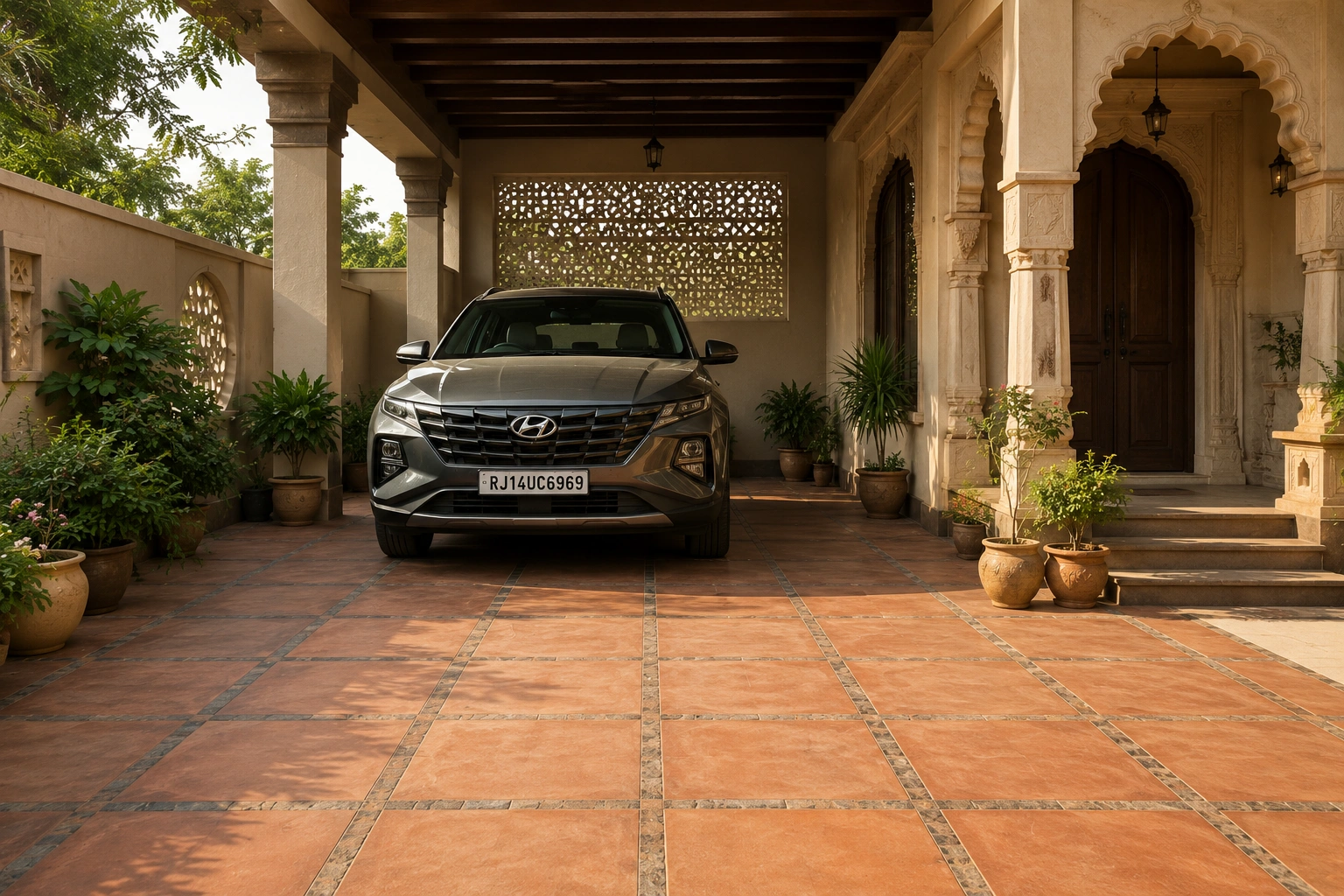
India has a long tradition of terracotta and red-oxide flooring in verandahs, courtyards, and compound areas. In Rajasthan, Gujarat, and parts of Maharashtra, the warm earth tones of terracotta connect the home to local building materials and climate in a way that grey concrete-look tiles simply do not. Contemporary vitrified tiles in terracotta-look and red-oxide tones bring these colour values to a modern tile product that does not require the sealing and maintenance of actual terracotta.
GVT tiles in terracotta, brick red, warm rust, and sand-orange tones are available from multiple Indian manufacturers in 600x600 mm (2x2) and 600x1200 mm (2x4) formats with matte and GHR finishes. These tiles look significantly better in real Rajasthani stone-and-plaster homes than the ubiquitous grey or ivory alternatives.
For large bungalow courtyards and entry compounds, a terracotta-look large-format tile in a straight bond paired with a cream or off-white border gives a result that is both traditional in character and easy to maintain. The warm tone also shows dust less visibly than darker tiles, which is a real advantage in the dry and dusty conditions of North and West India.
Tile category: GVT matte or GHR finish
Tile size: 600x600 mm (2x2) for standard driveways; 600x1200 mm (2x4) for large courtyards
Colour range: Terracotta, brick red, warm rust, sandstone orange, red oxide
Finish: Matte or GHR; matte carving available in some series for added texture.
Best for: Rajasthani-style bungalows; traditional Gujarat havelis; heritage homes in Maharashtra and Karnataka; courtyard areas
Price range: Rs. 70 to Rs. 130 per sq. ft.
Vastu Note: Red and warm earth tones are Vastu-positive for south and southeast-facing parking areas and compound floors. They represent the fire element and are considered grounding and protective for residential property.
Design Tip: Terracotta-look tiles show their best character when laid in a running bond (each tile offset by half a tile length from the row above) rather than a straight stack bond. The running bond pattern is the most natural fit for the traditional Indian flooring reference that terracotta comes from.
Design 9: Chequered Black and White for Compact Apartment Parking Bays
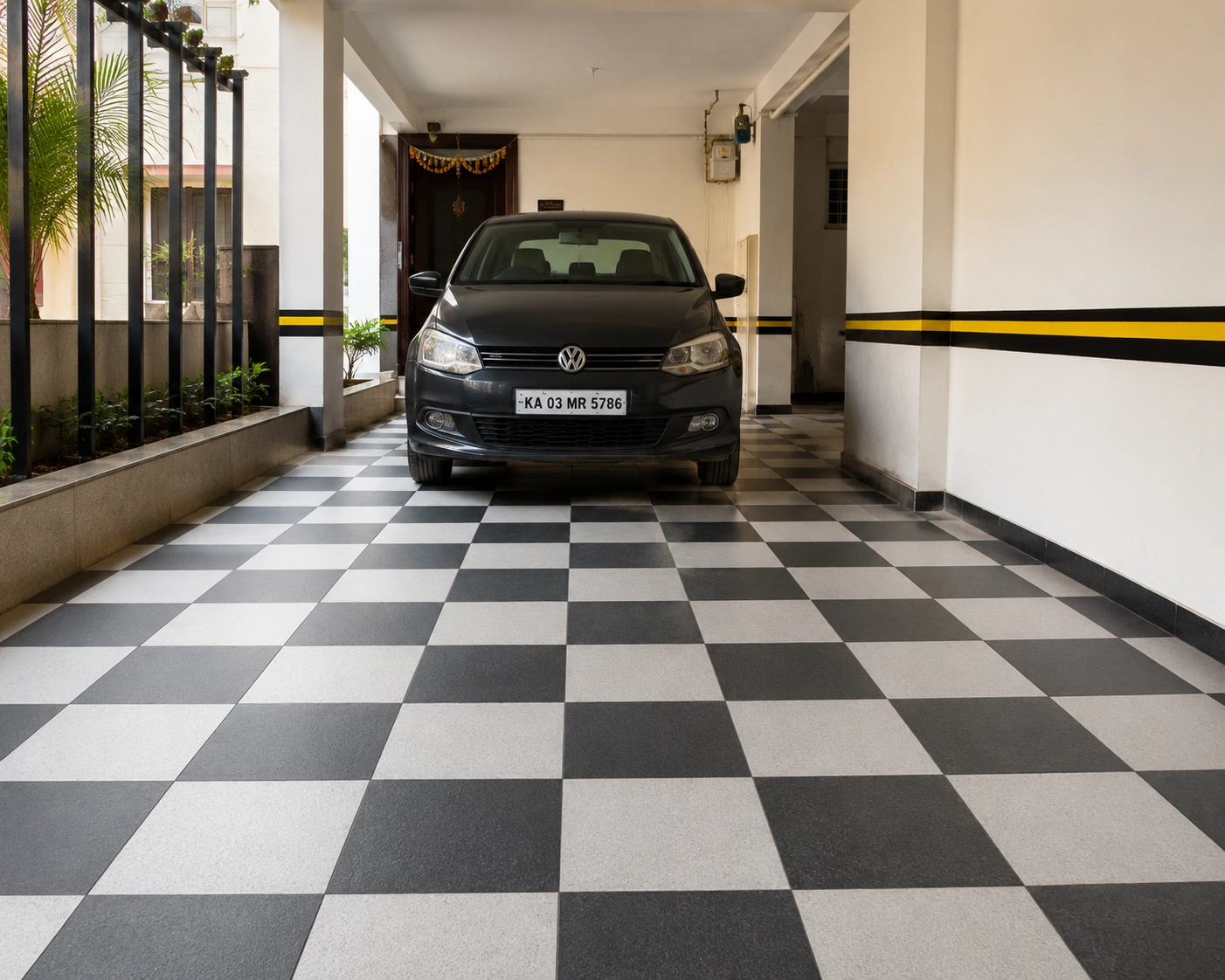
The chequered black and white parking tile pattern is a classic that has been used in Indian residential driveways and society compounds since at least the 1980s. It remains in use not because it is fashionable but because it is functional and practical to install. The high contrast between alternate black and white tiles means tyre marks show less on the dark tiles, while the light tiles keep the overall appearance from looking too heavy.
In a compact apartment parking bay of 10 to 15 sq. ft. per car, the chequered pattern creates visual interest that a plain single-colour tile cannot. The alternating pattern also means that when a single tile needs replacement after damage, only the tiles of the same colour in that row need to be pattern-matched, not the entire area.
The 400x400 mm (16x16) size is the traditional choice for chequered parking patterns. At this size, the pattern reads clearly across a standard parking bay without the squares being so large that the pattern dominates. For larger areas, 600x600 mm (2x2) in a chequered layout works well in covered basement parking and society entry zones.
Tile category: GVT matte or Full Body vitrified matte for both black and white tiles; ensure both tiles in the combination carry the same R-value
Tile size: 400x400 mm (16x16) for compact bays; 600x600 mm (2x2) for large compound areas
Colour combination: Jet black and bright white; dark charcoal and ivory (softer version); dark grey and light grey (most subtle version)
Finish: Matte only; never use polished or glossy black tiles outdoors
Best for: Apartment society compounds; covered basement parking; small bungalow driveways; standalone parking bays
Price range: Rs. 60 to Rs. 110 per sq. ft. for 400x400 mm GVT matte in black and white combination
Design Tip: Order the black and white tiles from the same manufacturer and the same product range where possible. Tiles from different manufacturers vary slightly in thickness and in the exact tile calibre (size tolerance). A chequered pattern where the black and white tiles have slightly different thicknesses or sizes will show uneven joints that no amount of careful installation can fully correct.
Design 10: Sandstone-Look GVT for Society Compounds and Large Villa Projects
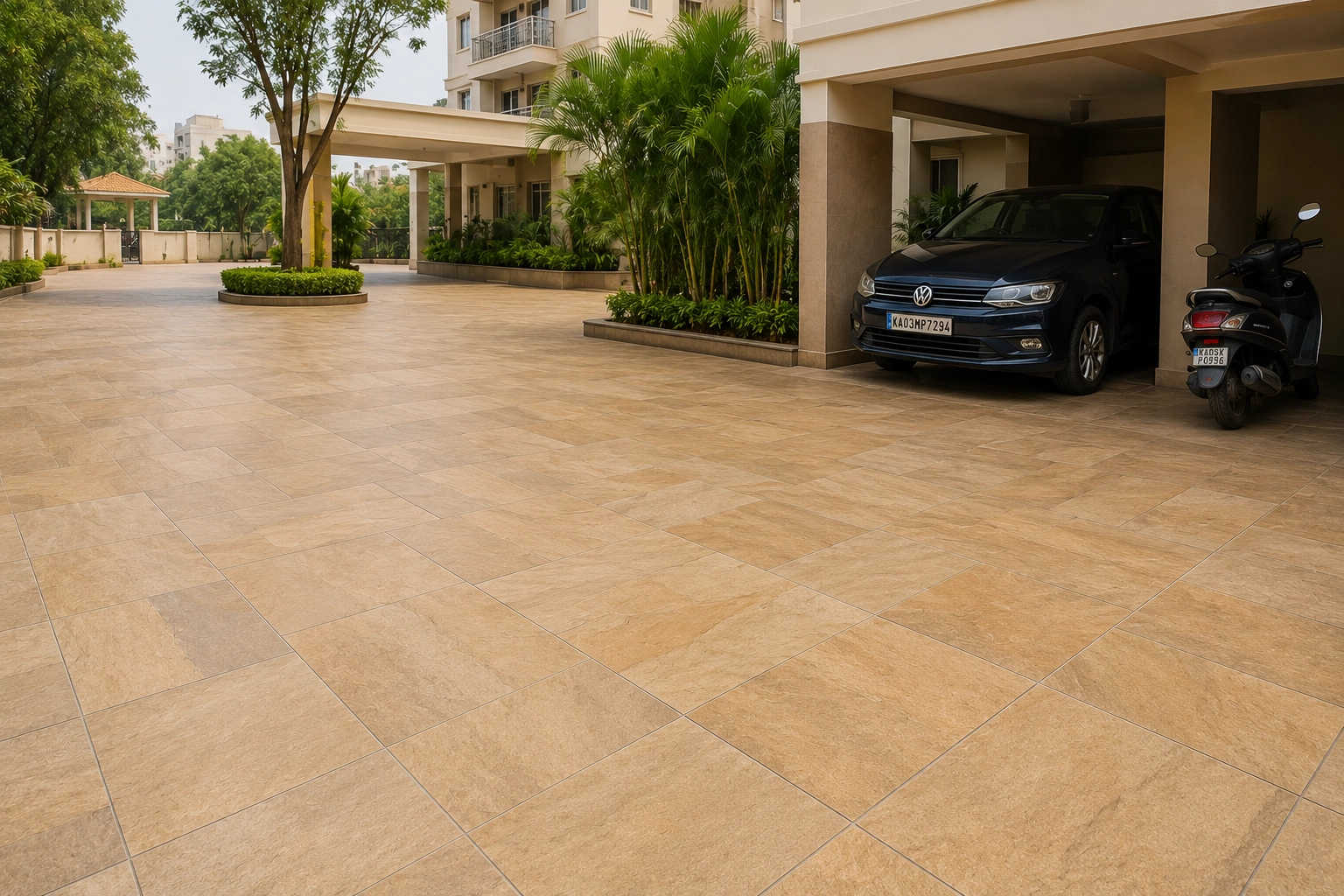
Sandstone-look GVT tiles in warm sand, buff, light brown, and ochre tones are the design choice that bridges the gap between natural stone character and modern vitrified tile performance. They bring the visual warmth of Rajasthani sandstone to a product that requires no sealing, handles monsoon without water absorption damage, and can be pressure-washed like any vitrified tile.
For large society compound areas and villa project common spaces, sandstone-look GVT in 600x600 mm (2x2) or 600x1200 mm (2x4) with GHR finish creates a consistent, warm, and visually unified floor plane that photographs well for property listings and holds its appearance through years of use.
The design is also forgiving in terms of batch variation. Sandstone-look tiles have inherent variation in their digital print, with each tile showing different vein intensity and colour saturation. This means that even when a section is replaced from a slightly different batch, the variation reads as natural rather than as a visible mismatch.
Tile category: GVT matte or GHR finish with sandstone digital print
Tile size: 600x600 mm (2x2) for standard compound areas; 600x1200 mm (2x4) for wide villa entry drives
Colour range: Warm sand, buff yellow, light brown, ochre, Jodhpur-stone cream
Finish: Matte or GHR; GHR preferred for open areas in any Indian climate zone
Best for: Gated society compounds, villa project common areas, townhouse cluster driveways, and independent bungalow compounds in North India
Price range: Rs. 70 to Rs. 130 per sq. ft. for GVT sandstone-look GHR 12mm
Vastu Note: Warm sandy and ochre tones are Vastu-positive for north-east and east-facing parking and compound areas. They represent earth element stability and are considered beneficial for residential compound floors.
Design Tip: For large society compound areas, combine the sandstone-look GVT field tile with a darker brown or terracotta border tile around the compound perimeter and at the pedestrian pathway edges. The border creates a visual boundary that defines the car movement zones from walking areas without requiring paint markings, which fade and need repainting.
All 10 Designs at a Glance
Use this table to shortlist the designs that fit your home type and budget before going into the detailed entries above.
| Design | Best For | Tile Size | Colour Tone | Price Range (sq. ft.) | Standout Feature |
|---|---|---|---|---|---|
| 1. Large-format grey matte | Modern bungalows, all societies | 600x1200 mm (2x4) | Mid to dark grey | Rs. 75 to Rs. 140 | Unbroken floor plane; fewest grout lines |
| 2. Dual-tone charcoal and beige border | Bungalows, independent villas | 600x600 or 600x1200 mm | Dark field, light border | Rs. 80 to Rs. 150 | Pattern depth at a lower cost than full-coverage premium tile |
| 3. Ivory for society compounds | Apartment compounds, gated societies | 600x600 mm (2x2) | Ivory, off-white, cream | Rs. 65 to Rs. 110 | Brightens covered parking; easy patching |
| 4. Wood-look plank for portico | Covered porch, carportico | 200x1200 mm (8x48) | Warm oak, walnut, ash | Rs. 85 to Rs. 160 | Residential warmth; covered areas only |
| 5. Granite with black border | Premium bungalows | 18 to 20mm slabs | Grey, white, black granite | Rs. 100 to Rs. 250 | Natural material; highest prestige signal |
| 6. Kota stone natural green | Traditional, heritage bungalows | 40mm natural slabs | Dark green, greenish-brown | Rs. 30 to Rs. 70 | Most cost-effective natural stone; Vastu-positive |
| 7. Dark anthracite minimalist | Contemporary flat-roof bungalows | 600x600 or 600x1200 mm | Near-black anthracite | Rs. 80 to Rs. 150 | Dramatic contrast with white walls; architectural quality |
| 8. Terracotta-look vitrified | Rajasthani heritage homes | 600x600 or 600x1200 mm | Terracotta, rust, earth red | Rs. 70 to Rs. 130 | Traditional warmth in la ow-maintenance format |
| 9. Chequered black and white | Compact apartment bays, basement | 400x400 mm (16x16) | Black and white alternate | Rs. 60 to Rs. 110 | Classic pattern; practical for partial replacement |
| 10. Sandstone-look GVT | Societies, villa compounds | 600x600 or 600x1200 mm | Warm sand, buff, ochre | Rs. 70 to Rs. 130 | Natural stone warmth; no sealing needed |
All prices are approximate 2026 Indian market rates, excluding GST. Prices vary by brand, dealer, thickness, and order quantity.
Choosing by Home Type: The Decision Framework
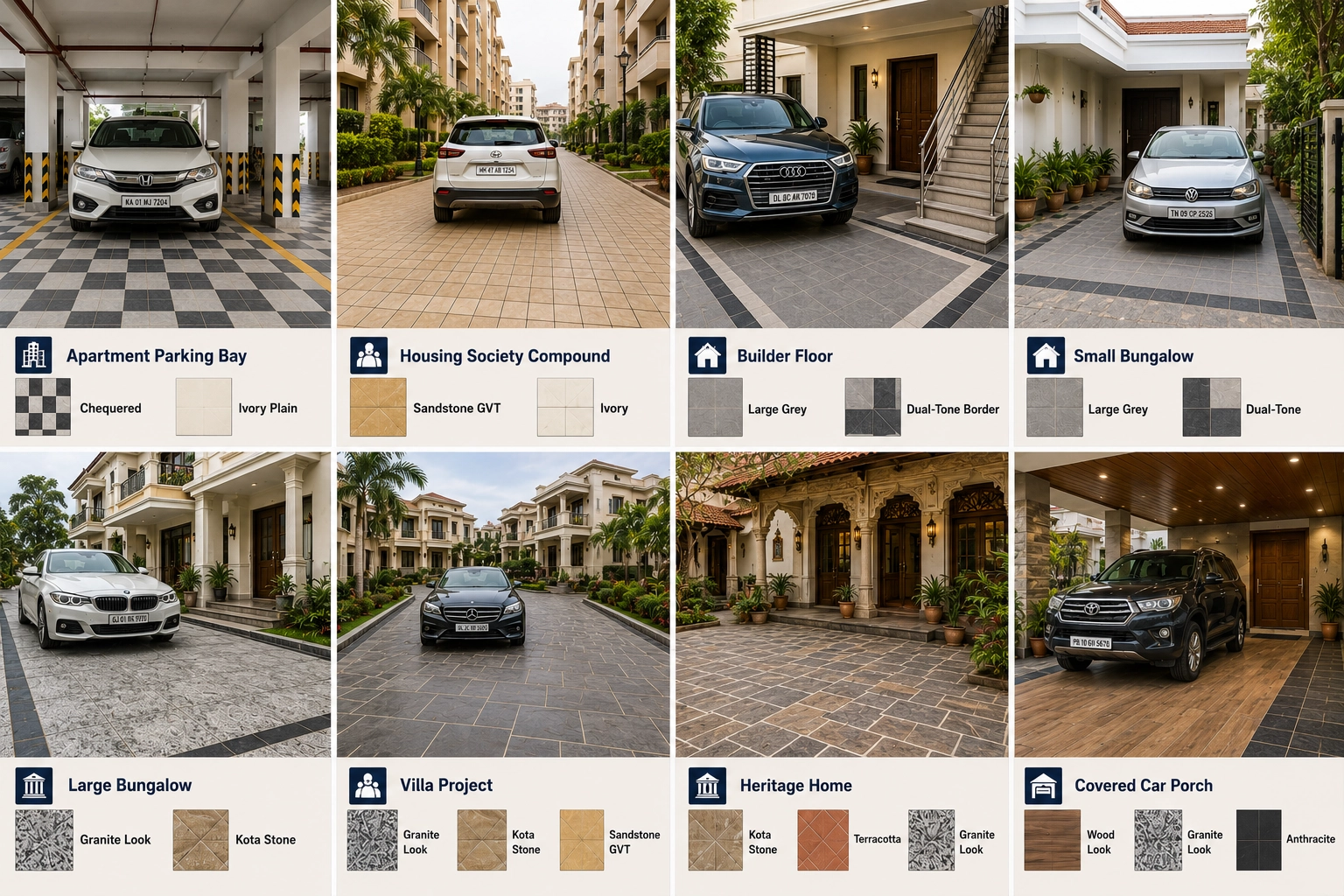
The right design is the one that matches the scale, architecture, and use pattern of the specific parking area. The same tile that looks outstanding in a 6-metre bungalow driveway looks mismatched in a 2.5-metre apartment parking bay.
| Home Type | Area (Typical) | Best Designs from This List | Key Constraint |
|---|---|---|---|
| 2BHK or 3BHK apartment (single bay) | 10 to 20 sq. ft. | Design 9 (chequered); Design 3 (ivory plain) | Bay size limits design complexity; keep it simple |
| Housing society compound (shared) | 500 to 3,000 sq. ft. | Design 3 (ivory); Design 10 (sandstone GVT) | Committee approval; batch continuity for a large area |
| Independent floor or builder floor | 30 to 80 sq. ft. | Design 2 (dual-tone border); Design 1 (large grey) | Matches the entry design of the floor; connects to the stairway |
| Small bungalow (200 to 300 sq. yards) | 60 to 120 sq. ft. | Design 1, 2, 4, 7, 8 | Gate-to-garage proportionality; budget per sq. ft. matters |
| Large bungalow (400 sq. yards and above) | 150 to 400 sq. ft. | Design 5 (granite), 6 (Kota stone), 2, 7 | Design must carry over a large area without becoming repetitive |
| Villa or villa project common | 200 to 1,000 sq. ft. | Design 5, 6, 10 (sandstone GVT) | The common area must look uniformly good across multiple units |
| Heritage or traditional home | Variable | Design 6 (Kota stone), 8 (terracotta), 5 (granite) | Material character must match the period of architecture |
| Covered car porch or portico only | 20 to 50 sq. ft. | Design 4 (wood-look), 5 (granite), 7 (anthracite) | No rain exposure; wider material and finish options available |
Before finalising a parking tile, review our Parking Tile Thickness Guide to understand whether 9mm, 12mm, or 15mm tiles are suitable for your vehicle type and traffic load.
Vastu Colour Guidance for Parking Tile Colours
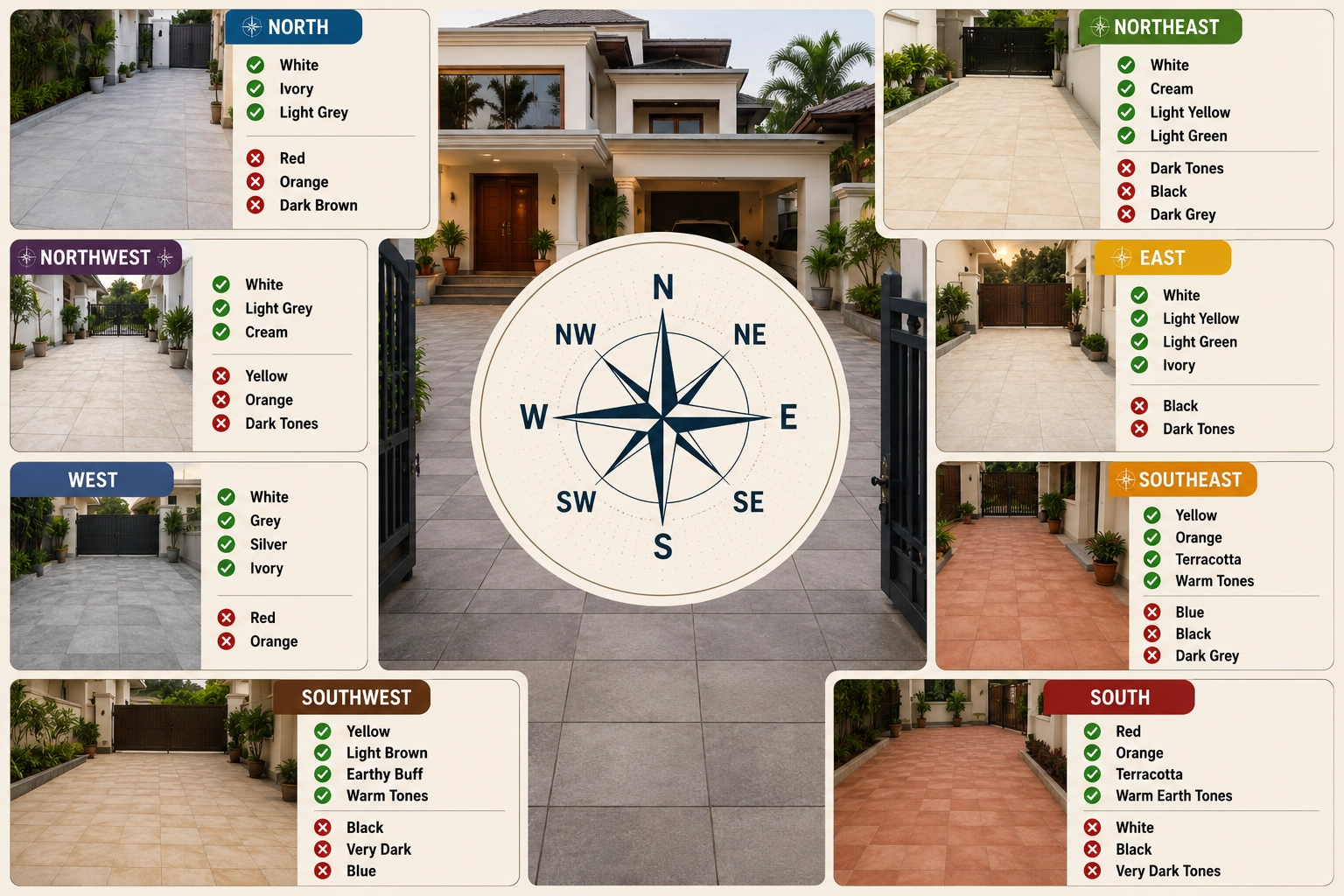
Vastu Shastra guidance for parking areas and compound floors is frequently asked about in North Indian households and in traditional families across India. The guidance below is drawn from standard Vastu sources and applies to the primary tile colour, not to border or accent tiles.
| Parking Direction (from house centre) | Vastu-Recommended Colours | Colours to Avoid | Design Options from This List |
|---|---|---|---|
| North | White, ivory, off-white, light grey, silver | Red, orange, dark brown | Design 3 (ivory), Design 1 (light grey) |
| Northeast (Ishan corner) | White, cream, light yellow, light green | Dark tones, black, dark grey | Design 3 (ivory), Design 10 (sandstone buff) |
| East | White, light yellow, light green, ivory | Black, dark tones | Design 3 (ivory), Design 10 (sandstone) |
| Southeast | Yellow, orange, terracotta, warm tones | Blue, black, dark grey | Design 8 (terracotta), Design 10 (ochre sandstone) |
| South | Red, orange, terracotta, warm earth tones | White, black, very dark tones | Design 8 (terracotta), Design 6 (Kota green is conditional) |
| Southwest (Nairutya) | Yellow, light brown, earthy buff | Black, very dark, blue | Design 10 (sandstone buff), Design 6 (Kota stone) |
| West | White, grey, light blue-grey, silver | Red, orange | Design 1 (grey), Design 3 (ivory), Design 7 (conditional) |
| Northwest | White, light grey, cream | Yellow, orange, dark tones | Design 1 (grey), Design 3 (ivory) |
Vastu Note: Vastu guidance for compound and parking areas is based on directional energy principles, not structural requirements. Most tile designs in this list can be adapted to Vastu colour preferences by choosing the appropriate tone within the tile category. Light grey GVT for a north-facing compound and sandstone buff GVT for a southeast-facing one can both come from the same manufacturer series.
Common Design Mistakes in Indian Parking Tile Projects
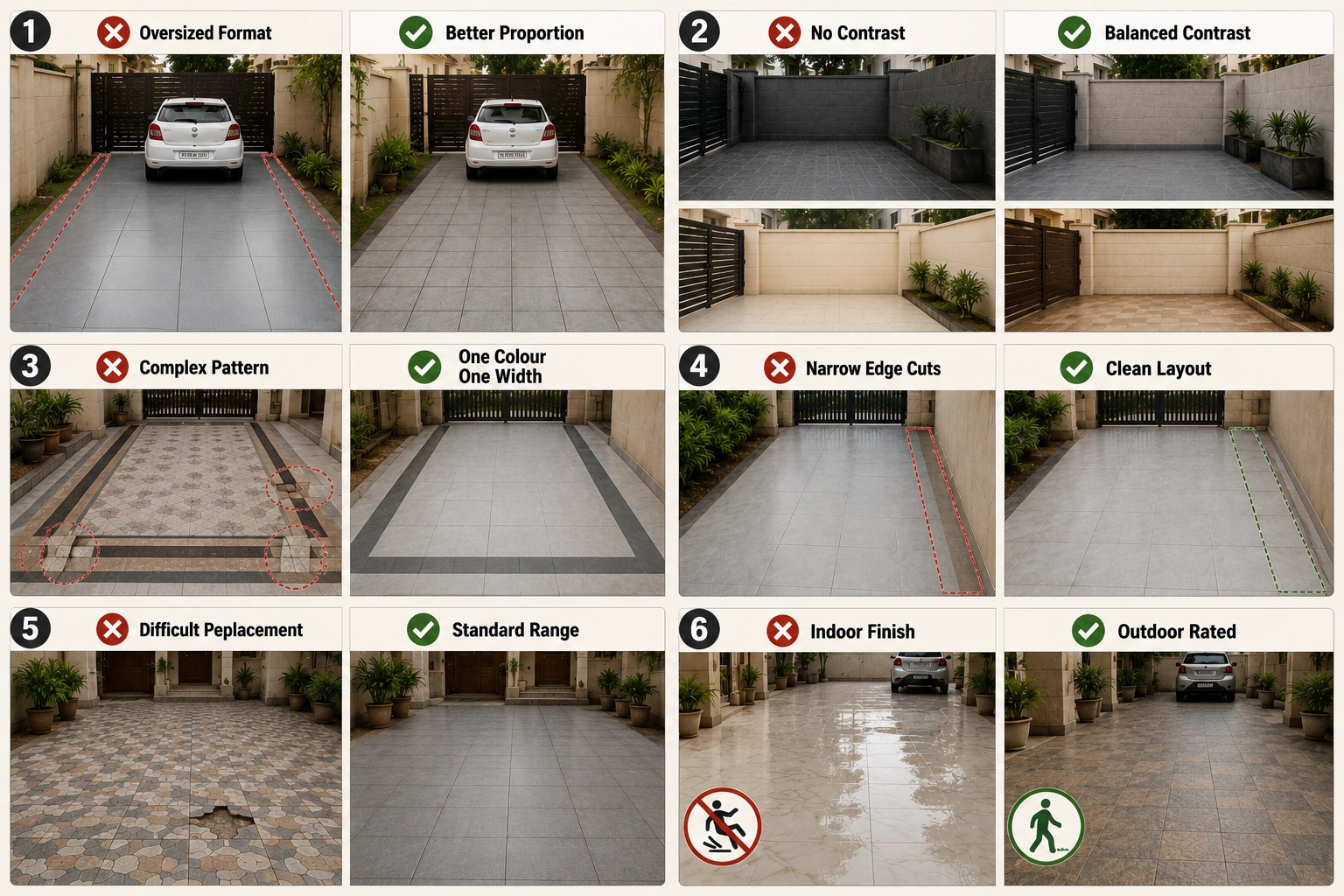
Using large-format tiles in a narrow driveway. A 600x1200 mm tile in a 2.5-metre-wide driveway leaves only two full tiles across the width, plus large cut tiles at both edges. The proportion looks wrong,g and the edge cuts look untidy. For driveways narrower than 3.5 metres, 600x600 mm is the maximum practical format. For driveways narrower than 2.5 metres, 400x400 mm gives better proportionality.
Choosing the tile colour in isolation from the wall colour. A driveway tile colour needs to be evaluated against the compound wall, boundary wall, and gate colour at the same time. Dark grey tiles against a dark grey compound wall disappear visually. Ivory tiles against cream-white walls create an undifferentiated surface. Choose the tile to contrast slightly with the surrounding walls, not to match them.
Creating an overly complex border pattern. Multiple border widths, different border tile sizes at corners, and inlay patterns that do not align with standard tile dimensions create installation problems that result in uneven joints and visible corrections. Keep border patterns simple: one colour, one width, one row. The effect comes from colour contrast, not from pattern complexity.
Not checking the tile size scale against the total area. A tile pattern should complete at the edges of the area without large cut tiles. Calculate the exact number of full tiles across both dimensions of the driveway before ordering. A half-tile cut at one end is acceptable. A narrow sliver cut (under 100 mm wide) at the end of a row looks unprofessional and is structurally weaker at the edge.
Using a design that requires matching a discontinued tile for future patching. Indian tile collections change every two to three years. A complex design with a speciality tile that is discontinued leaves the homeowner unable to patch individual broken tiles later without replacing entire sections. Choose designs that use tiles from the standard or core range of a manufacturer, notlimited too seasonal collections.
Extending an indoor design concept to an outdoor parking surface without checking the finish. Homeowners who see a beautiful interior tile and want to extend it to the driveway often find the interior series is not available in an outdoor-rated finish. Always confirm the outdoor rating and R-value of the tile before purchasing for a parking application. A beautiful tile in the wrong finish is a safety and durability problem from the first wet season.
For better wet-weather performance, see our Parking Tile Texture & Grip Guide, which compares surface patterns and anti-skid options for Indian monsoon conditions.
The Right Design for Your Specific Home
A parking tile design that works looks right for the specific house it belongs to, holds its appearance through several monsoon cycles, and does not create maintenance problems that no one signed up for. The ten designs in this list cover the range from the most practical society compound specification to the most premium bungalow statement, and each has been chosen because it performs well in Indian climate conditions with the right finish and thickness specification.
Regular maintenance is equally important. Our Parking Tile Cleaning Guide covers removing oil stains, tyre marks, algae growth, and monsoon dirt from driveway surfaces.
Before finalising any design, take the shortlisted tiles home as samples and check them in the actual driveway space under morning, afternoon, and evening light. Parking tiles in direct sunlight look different from the same tiles in an overcast showroom. The design choice you make in the showroom is not always the one that looks right once the driveway is complete.
Choosing the right parking tile becomes much easier when you can compare finishes, sizes, colours, and thicknesses side by side. TilesFinders helps you shortlist options across the categories covered in this guide, allowing you to compare products from verified Indian dealers before visiting a showroom. This saves time and gives you the technical details needed to ask the right questions when you arrive.
FAQs
Mid-grey and warm grey GVT in matte or GHR finish is the most consistently well-regarded choice for modern Indian bungalows. It shows tyre marks and oil drips less visibly than white or ivory, shows dust less than dark anthracite, and complements most Indian compound wall colours. For traditional or heritage homes, Kota stone green or terracotta-look vitrified connects better to the architecture. For Vastu-conscious buyers, the colour recommendation depends on the facing direction of the parking area.
Large-format grey matte and GHR vitrified in 600x1200 mm (2x4) format is the dominant residential bungalow choice in 2026. The dual-tone border design, with a dark field tile and a beige or ivory border, continues to grow. Wood-look plank tiles for covered portico areas are increasing in popularity, particularly in premium bungalow projects in Pune, Hyderabad, and Bengaluru. Society compounds are moving toward sandstone-look and ivory GVT as the standard specification for new builds and renovation projects.
For driveways 5 metres and wider, 600x1200 mm (2x4) tiles create the cleanest unbroken look with the fewest grout lines. For driveways between 3.5 and 5 metres, 600x600 mm (2x2) is more proportionate. For driveways narrower than 3.5 metres, 400x400 mm (16x16) or 600x600 mm is the right range. The rule is that the tile should fit across the driveway width with no cut tiles smaller than half a tile at the edges, and the overall pattern should not feel crowded with too many visible joints.
Yes. The dual-tone border design (Design 2 in this list) is built on exactly this principle. For a two-colour design to look intentional rather than accidental, the colour contrast needs to be strong enough to read clearly at ground level and from above. Mixing tiles that are too similar in tone creates a pattern that looks like a batch variation rather than a design choice. Keep both tiles from the same manufacturer and the same product range to ensure consistent thickness and calibre.
Wood-look tiles are best for covered portico and porch areas where rain exposure is limited. For open driveways in moderate-rainfall zones like Bengaluru and Pune, a GHR-finish wood-look tile in 200x1200 mm works with routine annual cleaning. For open driveways in heavy-monsoon cities like Mumbai, Kerala, and Goa, wood-look tiles accumulate algae in the simulated grain texture faster than plain GHR or matte tiles. In those zones, a GHR plain grey or sandstone-look tile is more practical for an uncovered driveway.
For compact apartment parking areas under 150 sq. ft., simplicity is the best design principle. Ivory or off-white GVT matte in 600x600 mm (2x2) keeps the space feeling as open as possible. The chequered black and white design in 400x400 mm (16x16) works well for individual parking bays and adds visual interest without requiring complex layout planning. Avoid large-format tiles, multi-colour patterns, and border designs in spaces under 50 sq. ft. because there is not enough area for the design to read correctly.
Natural granite in flamed finish with a contrasting border and natural Kota stone are the two choices that most consistently signal quality to Indian property buyers and valuers. In the manufactured tile category, large-format Full Body vitrified in dark grey or anthracite in 12mm or 15mm thickness reads as a premium specification to buyers and agents. A well-executed dual-tone border design in GVT adds visible design effort that photographs well in property listings, which is a practical resale consideration in today's Indian real estate market, where most buyer interest is first generated online.

See our tile guides first
Set TilesFinders as a preferred source and our buying guides surface ahead of the rest for you.
Add as preferred sourceTakes one tap. Nothing to install.
What Readers Say
I was about to redo my parking area with the wrong tile size until I read this. The layout comparisons saved me from a costly mistake.
We reference TilesFinders guides while briefing clients on material selection. The size and pattern breakdowns are accurate and easy to explain visually.
On site, I get asked about grout spacing all the time. This article gave me a solid reference I now share with my team before every job.
Finally a guide that doesn't just push generic advice. The oil stain removal steps actually worked on our clubhouse driveway tiles.
I run a small construction firm and now send this link to clients directly when they ask about entrance tile sizing. Saves me an hour of explaining.
Good practical detail, though I wish there were more examples for compact apartment entrances specifically, not just villas.
My mother-in-law wanted marble, I wanted vitrified. This blog gave us the neutral comparison we needed to actually decide together.
Detailed without being overwhelming. I appreciated that it covered both cost and maintenance, not just the aesthetics.
Used the algae and hard water removal tips on our terrace tiles after the monsoon. Worked better than what our regular cleaner was doing.
As someone who sources tiles for multiple builder projects, I find these comparisons genuinely useful for vendor conversations, not just consumer content.
Recommended this to a client who kept second-guessing the entrance design. The small vs large layout section settled the debate instantly.
Straightforward and honest, no unnecessary jargon. Would like to see a similar breakdown for outdoor pool-deck tiles next.
We've bookmarked several TilesFinders guides for our design handbook. Reliable source when clients want data, not just opinions.
Two paths, one marketplace.
Get free quotes from verified suppliers.
Share your room, budget, and style. Suppliers in Morbi respond within hours.
Get Free QuotesList your business, reach real buyers.
Put your showroom in front of homeowners searching for tiles right now.
List Your Business