Parking Tile Texture and Grip Guide: What Actually Works in Indian Monsoons
Learn which parking tile textures work best in Indian monsoons. Compare GHR, rain-drop, matte, and natural stone finishes using R-value grip ratings and real driveway conditions.
- Why Grip Matters More Than Colour in Indian Parking Areas
- How Parking Tile Anti-Skid Rating Actually Works: R-Values Explained
- The Six Finishes Used for Outdoor Parking in India
- Head-to-Head Finish Comparison for Indian Monsoon Parking
- Tyre Grip vs Foot Grip: Two Different Problems on the Same Surface
- How Indian Monsoon Conditions Stress Parking Tile Grip
- Texture Depth and Long-Term Grip: What Changes After Two Monsoon Seasons
- Common Mistakes When Choosing Parking Tile Texture for Indian Homes
- Choosing Texture for the Conditions, Not for the Showroom
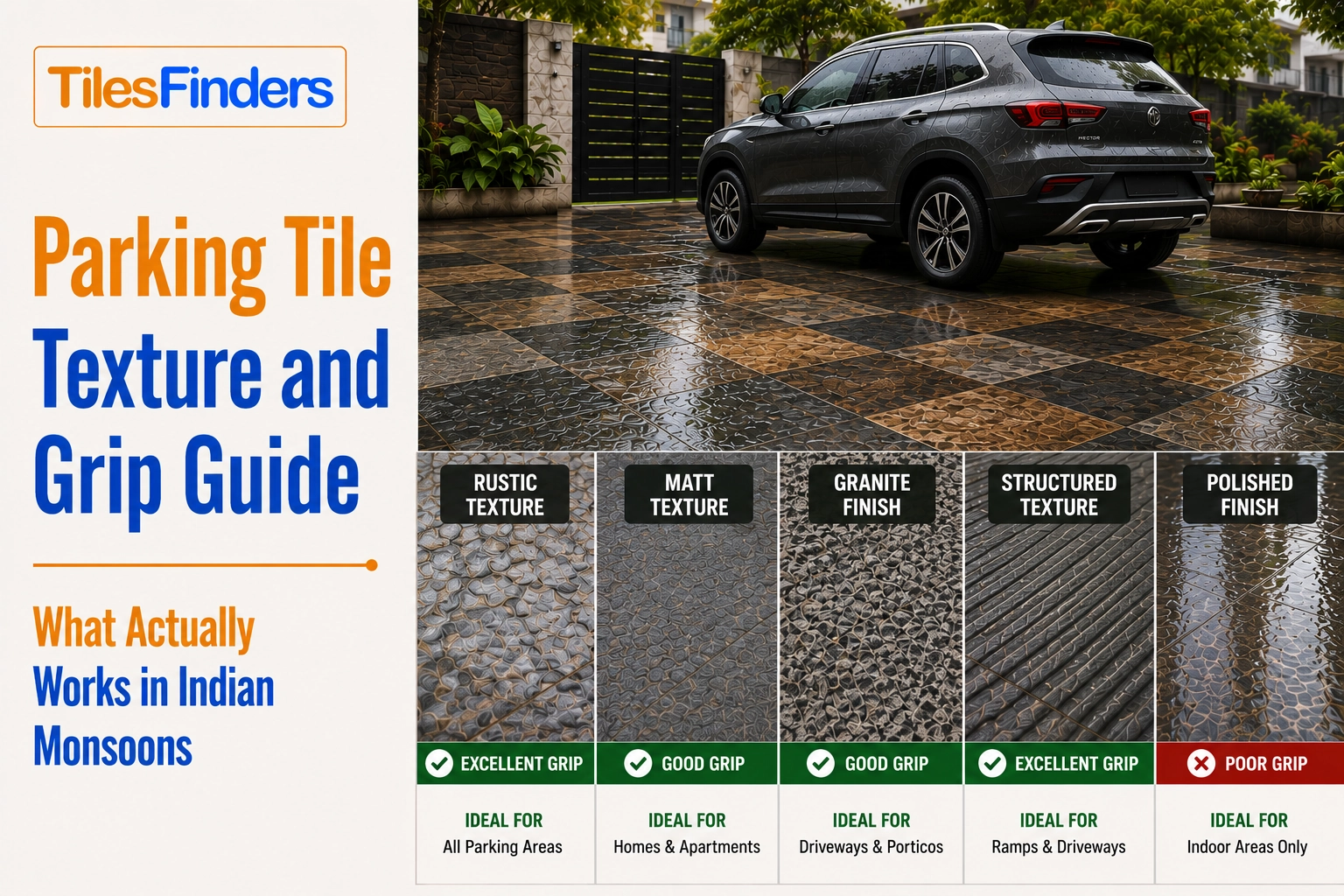
Parking tile grip matters more than appearance in Indian monsoon conditions. For most homes, GHR tiles with an R11–R12 rating provide the best balance of safety, durability, and maintenance. In heavy-rainfall cities such as Mumbai, Kerala, Goa, and Mangalore, rain-drop finish tiles with R12–R13 ratings offer superior wet-weather performance, especially on slopes and high-footfall areas.
Every parking tile sold in India carries some version of the phrase 'anti-skid' on its showroom display. The phrase covers everything from a slightly matte finish rated for dry indoor floors to a deeply textured GHR surface that holds a loaded SUV on a wet slope during a Mumbai downpour. These two products are not the same. The gap between them is where accidents happen.
Monsoon changes what a parking surface needs to do. In dry summer conditions, almost any matte tile manages foot traffic and vehicle movement adequately. Add 80 mm of rainfall in three hours, which is a normal June afternoon in Kerala or Konkan M, Maharashtra, and the same surface becomes a different proposition. Water on a parking tile is not just water. It carries silt, diesel residue, leaf debris, and in coastal zones, a fine salt film that together reduce grip far below what a clean water test would suggest.
This guide explains how parking tile anti-skid rating actually works, what the six outdoor finishes available in India each deliver, where each one is appropriate, and what Indian monsoon conditions specifically demand from a parking surface. It also covers two things no competitor blog addresses: the difference between vehicle tyre grip and pedestrian foot grip on the same surface, and how textured tiles behave after two years of monsoon cycle,s compared to how they perform on installation day.
Why Grip Matters More Than Colour in Indian Parking Areas
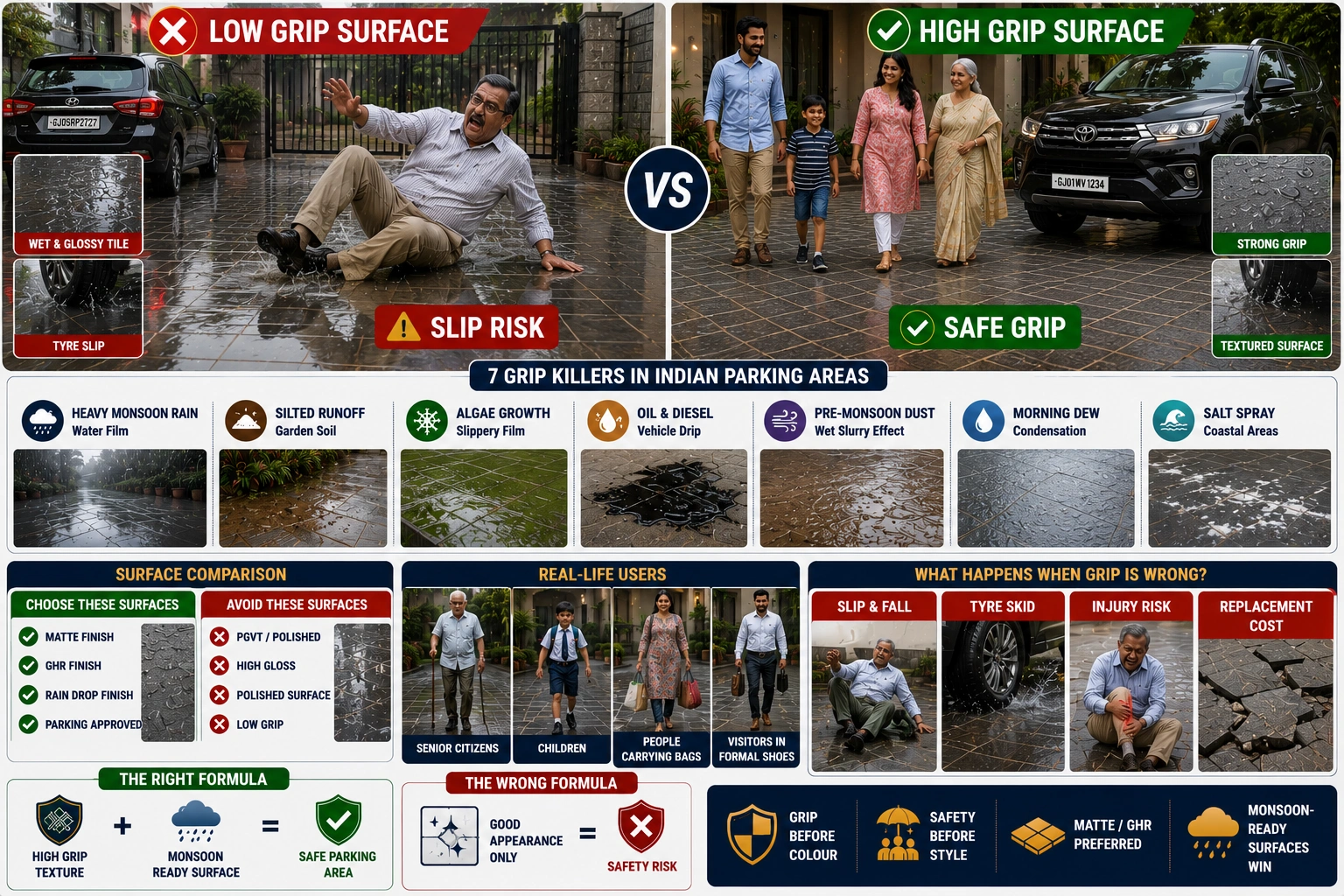
Parking tiles carry two completely different users at the same time: vehicle tyres and human feet. Most homeowners think about one of them, usually the visual impact on the curb, and forget that every family member who parks and walks to the front door crosses the same wet surface on foot. Older family members, children carrying bags, and visitors in formal footwear all cross the driveway in monsoon conditions.
In Indian homes, the driveway and parking area are also the crossing point between the public street and the private home. Unlike a covered parking structure, a home driveway has no roof. Every monsoon, it is fully exposed. A tile that looked ideal in a dry showroom in April can become a genuine safety concern by July.
The financial cost of getting texture wrong goes beyond replacement. A slip on a poorly specified parking surface, particularly for an elderly family member, has consequences far greater than the cost of the correct tile. This is the only category of tile selection where the consequence of the wrong choice is measured in injury, not just appearance or budget.
| Risk Factor | How It Reduces Parking Tile Grip | Affected Indian Locations |
|---|---|---|
| Sustained heavy monsoon rain | Water film eliminates surface contact between shthe oe/tyre and the road | Mumbai, Mangalore, Kochi, Goa, Vizag, Chennai coast |
| Silted runoff from compound soil | Fine clay-silt layer on wet tiles is more slippery than clean water | Any driveway adjacent to a garden or an unpaved area |
| Algae and biofilm growth | Biological film reduces cothe efficient of friction to near-zero when wet | Humid zones: Kerala, Goa, coastal Karnataka, Andaman |
| Diesel and oil residue | Vehicle drip creates a hydrocarbon film that water cannot wash away | Any driveway used by diesel vehicles or near the road |
| Monsoon dust before the first rain | Pre-monsoon dust coats the surface, then the first rain turns it to slurry | North India, Rajasthan, Gujarat, before the June onset |
| Morning dew in winter | A thin condensation layer on cold tiles creates a slipping risk in the mornings | Delhi NCR, Pune, Nagpur, interior South India, October to January |
| Salt spray in coastal areas | Salt film dries white and reduces grip on smooth or low-texture tiles | Mumbai seafront, Kochi, Visakhapatnam, Pondicherry coastal plots |
How Parking Tile Anti-Skid Rating Actually Works: R-Values Explained
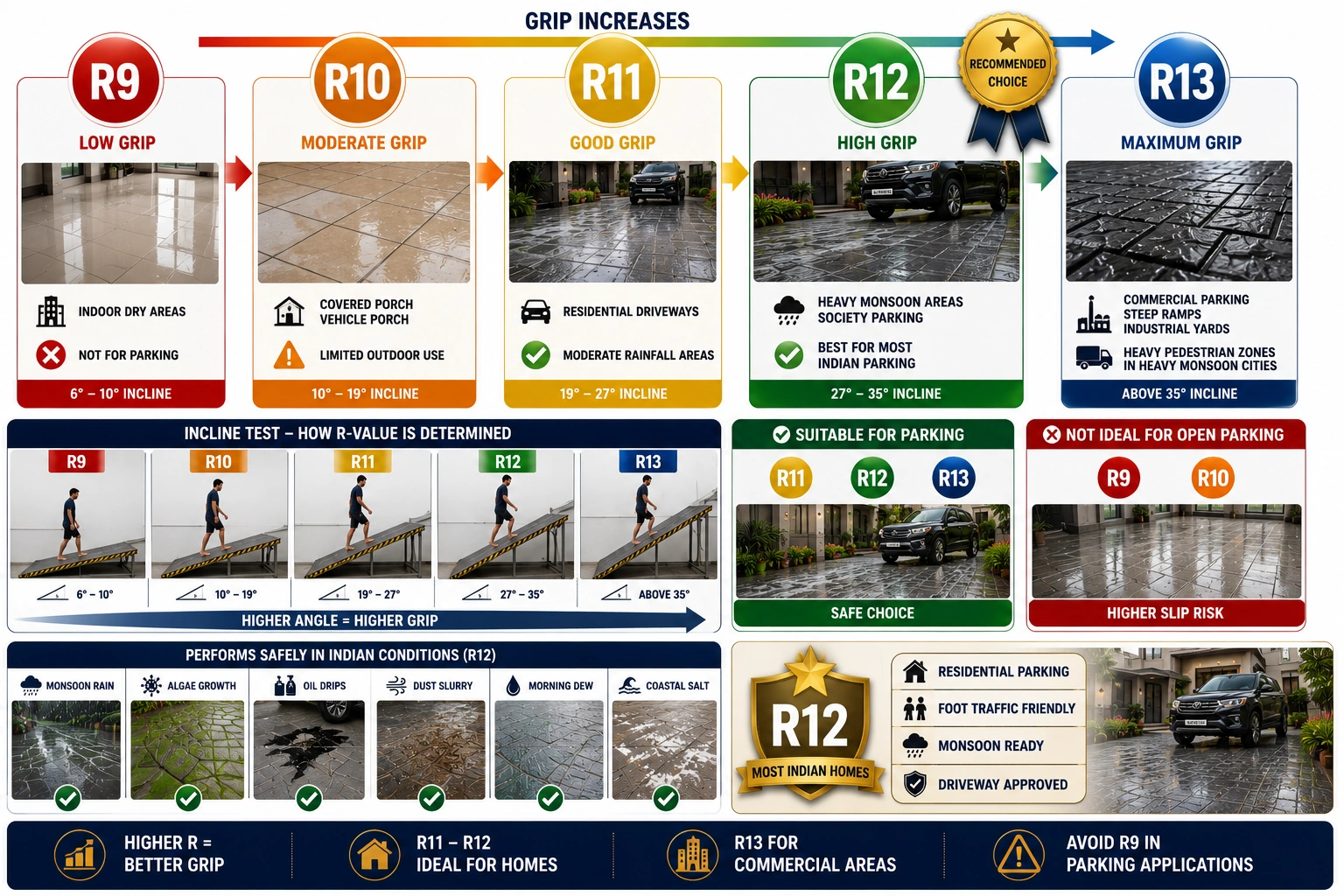
Anti-skid rating for floor tiles uses a German-developed scale called the R-value. The R stands for Rutschhemmung, the German term for slip resistance. This rating system is the most widely referenced technical standard for outdoor tile slip performance globally and is what Indian quality dealers and architects use when specifying tiles for wet outdoor zones.
Most Indian homeowners have never seen an R-value on a tile spec sheet because most dealers do not display it. But it is the only objective way to compare the IP between two tiles. Every other claim, including 'anti-skid,' 'non-slip,' and 'high grip,' is a marketing label with no standardised measurement behind it. R-value is the number that actually means something.
The R9 to R13 Scale
| R-Value | Slip Resistance Level | Incline Angle (Test) | Where It Is Used in India |
|---|---|---|---|
| R9 | Low grip | 6 to 10 degrees incline | Dry indoor areas only; light office corridors; never use outdoors |
| R10 | Moderate grip | 10 to 19 degrees incline | Covered outdoor areas, a vehicle porch, and now rainfall residential zones |
| R11 | Good outdoor grip | 19 to 27 degrees incline | Open driveways; residential car parking in moderate-rainfall cities |
| R12 | High outdoor grip | 27 to 35 degrees incline | Home driveways in high-rainfall zones, lope, society compounds with foot traffic |
| R13 | Maximum grip | Above 35 degrees incline | Commercial parking, steep ramps, industrial yards, and avy pedestrian zones in heavy monsoon cities |
How the test works: The R-value is measured by a human test subject walking barefoot on an oil-lubricated tile surface set at progressively steeper angles. The angle at which slipping first occurs determines the R-value grade. Oil is used because it more closely mimics the worst-case wet surface condition than water alone.
What R-Value Do Indian Driveways Need?
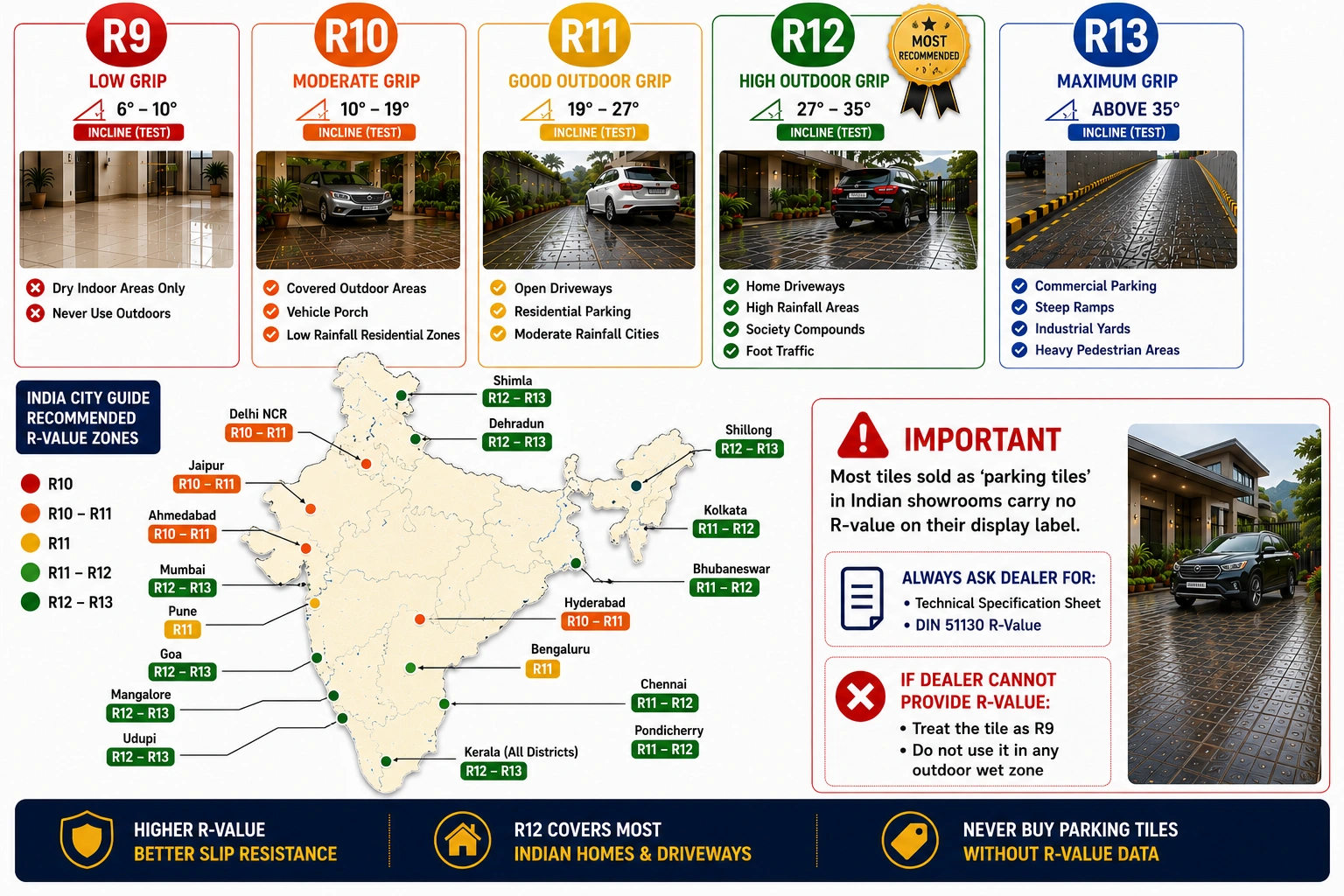
The required R-value depends on rainfall intensity, driveway slope, and whether the surface is used by foot traffic as well as vehicles. The table below gives city-level guidance.
Even the best anti-skid finish cannot compensate for poor water management. This Parking Tile Installation Guide explains how proper base preparation, slope design, and drainage work together to maintain grip during Indian monsoons.
| City or Zone | Monsoon Intensity | Driveway Slope | Minimum R-Value for Parking Tiles |
|---|---|---|---|
| Mumbai, Thane, Navi Mumbai | Very high (600 to 900 mm in June alone) | Any slope | R12 minimum; R13 for slopes above 1:20 |
| Kerala (all districts) | Very high (sustained July to September) | Any slope | R12 minimum; R13 near coast |
| Mangalore, Udupi, Goa | Very high (2,000 to 3,500 mm annual) | Any slope | R12 to R13 |
| Chennai, Pondicherry | High (northeast monsoon Oct,ober to December) | Flat or gentle slope | R11 to R12 |
| Bengaluru | Moderate to high (twin monsoon) | Flat or gentle slope | R11 |
| Hyderabad, Pune | Moderate | Flat or gentle slope | R10 to R11 |
| Delhi NCR, Jaipur, Ahmedabad | Moderate, concentrated July to August | Flat | R10; R11 if the driveway is exposed and sloped |
| Kolkata, Bhubaneswar | High, yclone risk | Flat or gentle slope | R11 to R12 |
| Shimla, Dehradun, Shillong | High, cold season adds ice risk | Often steep | R12 to R13; steep driveways R13 only |
Important: Most tiles sold as 'parking tiles' in Indian showrooms carry no R-value on their display label. Always ask the dealer for the technical specification sheet and look for the DIN 51130 R-value. If a dealer cannot provide it, treat the tile as R9 and do not use it in any outdoor wet zone.
The Six Finishes Used for Outdoor Parking in India
Six distinct finish types appear on outdoor parking tiles in the Indian market. Each has a different surface structure, a different grip mechanism, and a different maintenance requirement. Understanding what physically creates grip in each finish explains why some hold up through a monsoon season, and others do not.
Matte Finish: The Baseline for Outdoor Use
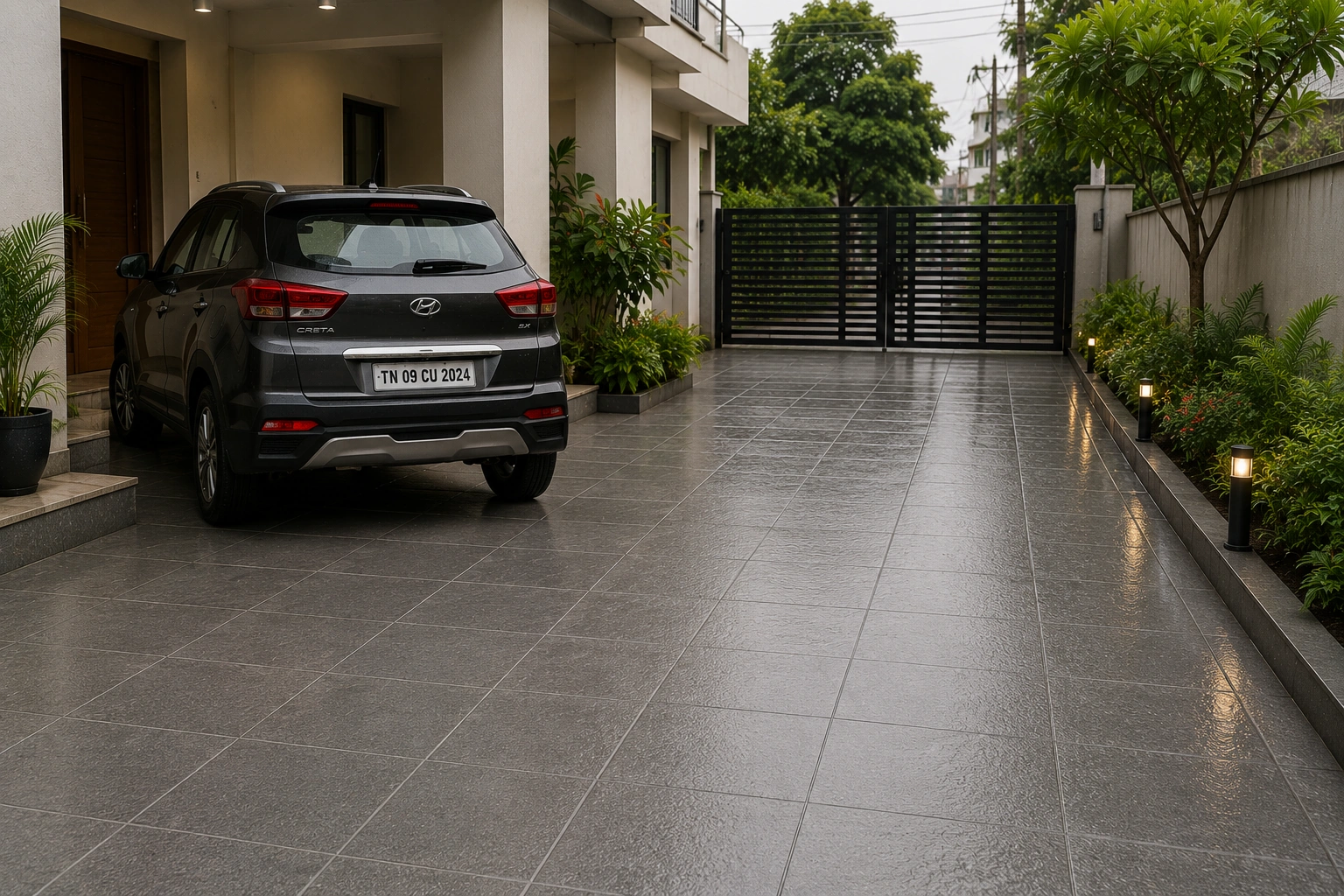
Matte finish tiles have a flat, slightly textured surface created by the firing process and the glaze composition. The texture is fine and even across the tile face. Under dry conditions, matte finish performs well for both vehicle and foot traffic. Under light rain, it still manages reasonably.
The limitation in Indian monsoon conditions is that standard matte finish occupies the R10 to R11 range, depending on the manufacturer and specific tile grade. In moderate-rainfall cities like Bengaluru, Pune, and Hyderabad, this is adequate for a flat driveway. In Mumbai, Kerala, or any sloped driveway, it is not enough.
Grip mechanism: Microscopic surface irregularities increase the contact area between the tile and footwear or tyre. Under a thin water film, this mechanism degrades because water fills the micro-voids, creating a continuous film between the surfaces.
Algae resistance: Moderate. Matte finish tiles do collect some algae in sustained humid conditions, but the relatively open surface cleans well with a stiff broom and a standard cleaning agent. Annual pre-monsoon cleaning prevents significant biofilm build-up.
| Parameter | Matte Finish |
|---|---|
| Typical R-value | R10 to R11 |
| Best for | Flat driveways in moderate rainfall cities; covered porches; car parking in Bengaluru, Pune, Hyderabad |
| Not suitable for | Sloped driveways, heavy monsoon cities, and any zone where elderly family members walk regularly on a wet surface |
| Texture depth | 0.1 to 0.3 mm surface micro-texture only |
| Cleaning frequency needed | Monthly sweeping; quarterly wet cleaning; annual pre-monsoon scrub |
| Typical price range | Rs. 60 to Rs. 110 per sq. ft. for GVT matte 12mm |
| Long-term grip degradation | Very low; matte texture is stable; no significant grip loss over 10 years |
GHR Finish: The Standard for Indian Driveway Parking
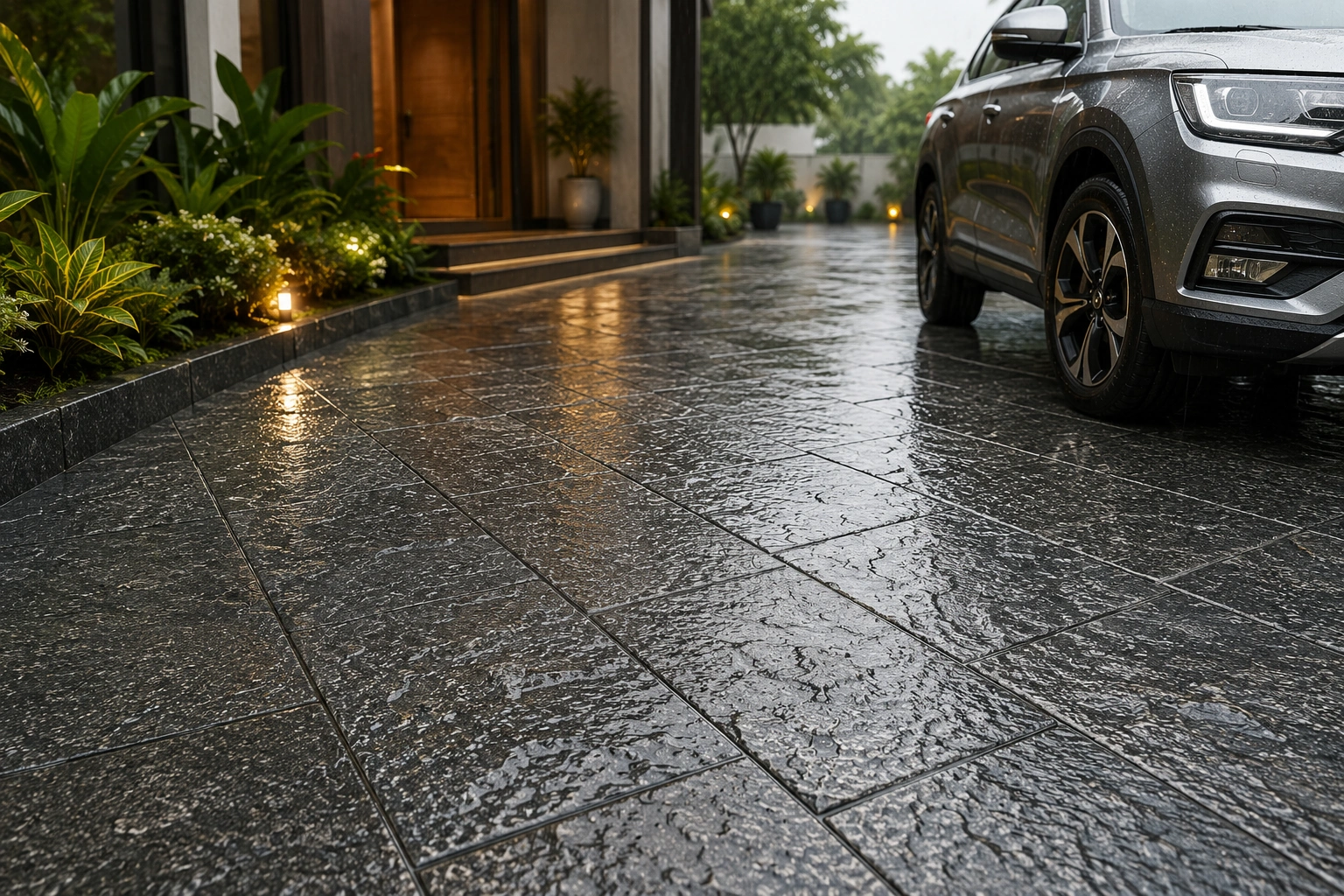
GHR stands for Glaze High Resistance. This finish is specifically engineered for high-traffic outdoor flooring and is the most technically appropriate tile finish for home driveway parking in India across most climate zones. The surface has a stone-like texture that is visually similar to natural stone but manufactured with a consistent, controlled roughness profile.
The GHR finish creates grip through a combination of surface texture depth (0.3 to 0.8 mm) and glaze composition that resists polishing under foot and vehicle traffic. Where a standard matte tile loses some grip smoothness over the years of use, GHR maintains its roughness profile longer because the hardness of the glaze matrix resists the micro-abrasion that smooth-surface tiles undergo.
Grip mechanism: The stone-like surface texture creates physical interlocking points between the tile and the contact surface. Even under a water film, the peaks of the texture break through the film and maintain contact. This is why GHR outperforms standard matte in heavy-rain conditions rather than just matching it.
Algae resistance: Good. GHR tiles have an open-pore surface structure that does not trap stagnant water as readily as deeper-texture finishes. Standard maintenance is enough to prevent algae establishment in all but the most persistently damp coastal zones.
| Parameter | GHR Finish |
|---|---|
| Typical R-value | R11 to R12 |
| Best for | Open driveways in all rainfall zones; home car parking; society compounds; flat to moderate slopes; recommended for all new driveway projects |
| Conditionally suitable for | Steep driveways in very heavy monsoon cities with R12-rated GHR product specifically; confirm R-value before buying |
| Texture depth | 0.3 to 0.8 mm controlled surface texture |
| Cleaning frequency needed | Monthly sweeping, half-yearly wet scrub, and annual pressure wash keeps surface clear |
| Typical price range | Rs. 75 to Rs. 130 per sq. ft. for GVT GHR 12mm |
| Long-term grip degradation | Low; GHR glaze resists polishing; grip profile stable through 10 to 15 years of normal use. |
Pro Tip: GHR is the best starting point for any Indian home driveway specification. If the driveway is flat and in a moderate-rainfall city, GHR at R11 is more than adequate. If the driveway slopes or is in a heavy monsoon zone, confirm the GHR tile's specific R-rating with the dealer and move to R12-rated GHR or rain-drop finish if R12 is not available in the chosen tile series.
Rain Drop Finish: Maximum Grip for Heavy Monsoon Zones
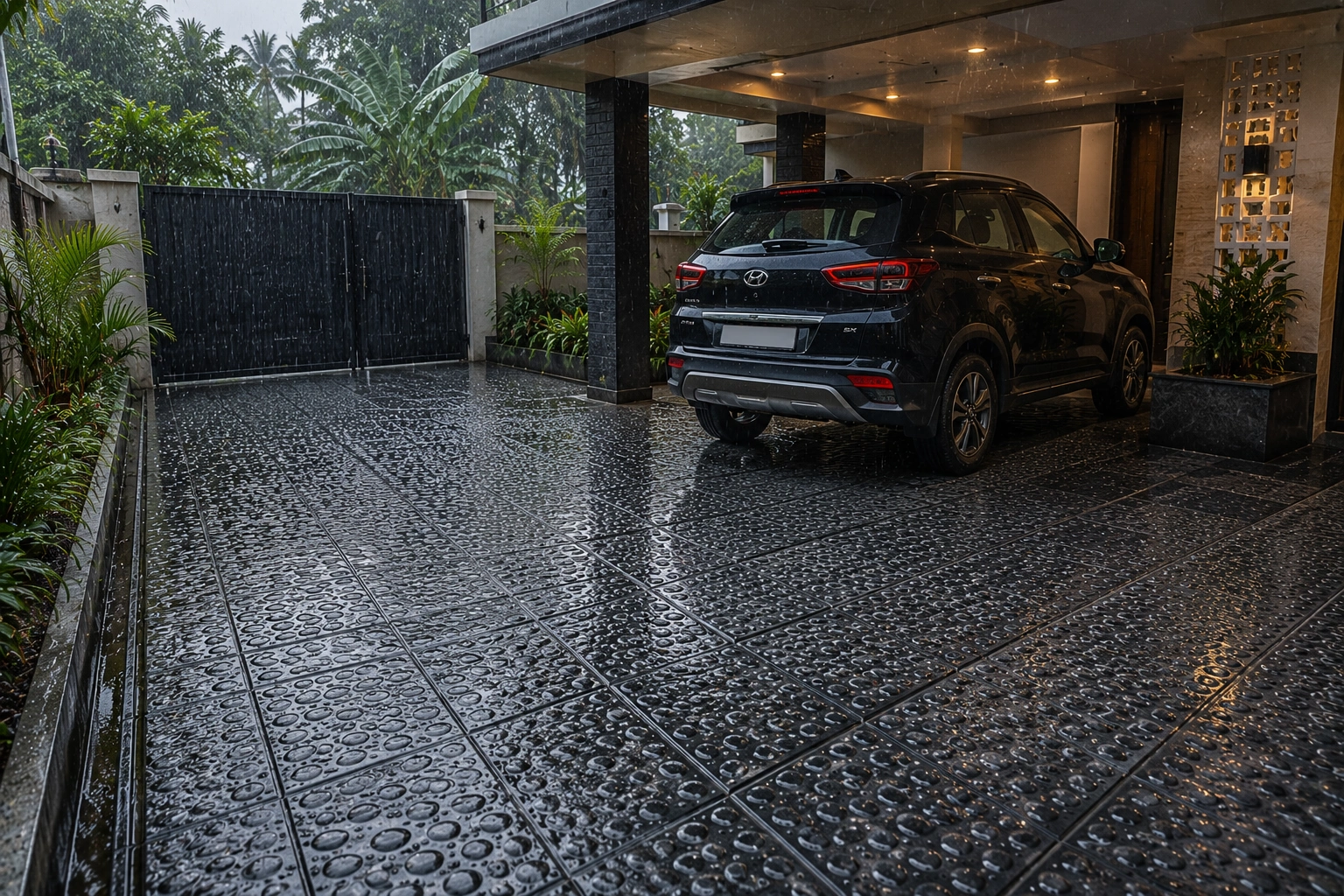
Rain Drop finish is the name used in the Indian tile industry for a specific surface texture where small raised dots or droplet-shaped nodules cover the tile face. These nodules stand proud of the tile surface by 0.5 to 1.5 mm and create defined high points that maintain contact with footwear even when the valleys between nodules are filled with water.
The design principle behind the raindrop finish is the same as the dimpling on a golf ball or the stud pattern on a road crossing button: raised points break through a water film more reliably than an evenly textured flat surface. This makes rain-drop finish the strongest performing finish for standing-water conditions and sustained heavy rain.
Grip mechanism: The nodule pattern creates multiple high-contact points that protrude above any water film. Even in 80 mm per hour rainfall conditions, the nodule peaks remain above the water film and provide direct contact with footwear. This mechanism is independent of water film thickness within normal rainfall ranges.
Algae resistance: Moderate. The valleys between nodules can trap moisture and debris in humid coastal environments. Rain-drop tiles in Kerala and Goa benefit from a pre-monsoon pressure wash to clear accumulated silt from between the nodules before the heavy rain season begins.
| Parameter | Rain Drop Finish |
|---|---|
| Typical R-value | R12 to R13 |
| Best for | Heavy monsoon cities (Mumbai, Kerala, Goa, Mangalore); sloped driveways; society entry zones with heavy foot traffic; all compounds in coastal Karnataka and Kerala |
| Cleaning consideration | Valleys between nodules need periodic scrubbing; fine silt accumulates in gaps during the monsoon; stiff brush quarterly |
| Texture depth | 0.5 to 1.5 mm raised nodule pattern |
| Cleaning frequency needed | Monthly sweep; quarterly scrub between nodules; pre-monsoon pressure wash strongly recommended |
| Typical price range | Rs. 70 to Rs. 125 per sq. ft. for GVT rain-drop 12mm |
| Long-term grip degradation | Very low; raised nodules are part of the tile body structure; grip profile does not change with normal use. |
Sugar Finish: Light-Duty Outdoor Grip
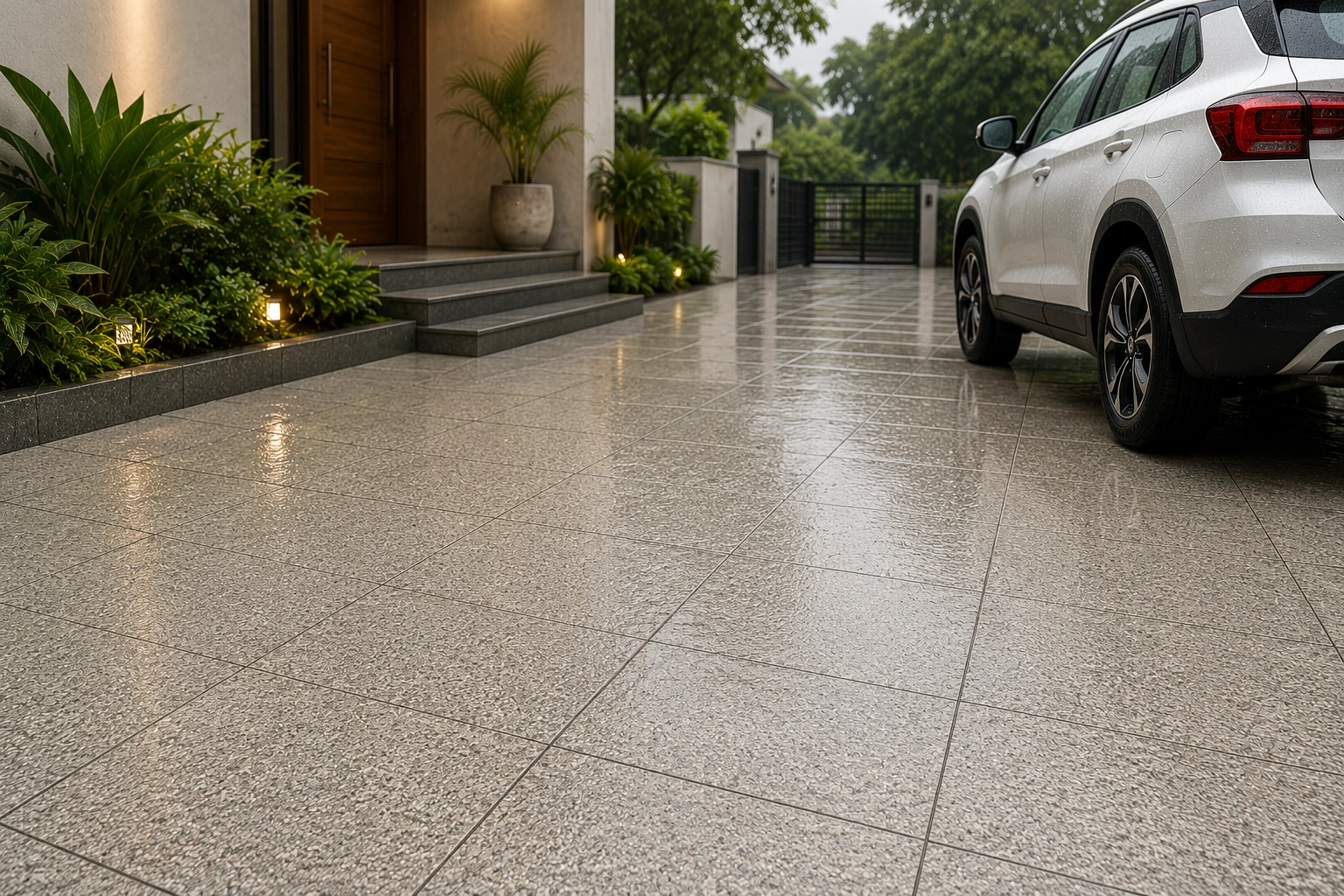
Sugar finish has transparent glossy droplets applied over a matte or semi-matte tile base. The name comes from the visual resemblance to granulated sugar crystals on the tile surface. These raised glossy spots add a light sparkle to the tile's appearance and provide moderate grip improvement over a fully smooth surface.
Sugar finish occupies the gap between indoor tile aesthetics and minimal outdoor grip requirements. It looks more refined than plain matte or GHR and carries more grip than a glossy tile, but it does not reach the grip performance of GHR or rain-drop in wet outdoor conditions. Its role in Indian parking is limited to covered or semi-covered parking areas where the tile stays largely dry.
Grip mechanism: The raised glossy droplets create intermittent contact points, but the glaze over the droplets is smooth. Under dry or lightly damp conditions, this helps. Under heavy rain or standing water, the smooth droplet surface contributes little grip, and the valleys between drops can hold a thin water film that reduces overall friction.
| Parameter | Sugar Finish |
|---|---|
| Typical R-value | R10 to R11 |
| Best for | Covered parking porches; vehicle porch floors with roof overhead; decorative driveway borders where grip is secondary |
| Not suitable for | Open driveways in monsoon cities; sloped parking; zones with regular rain exposure |
| Texture depth | 0.2 to 0.5 mm raised glossy droplets on a matte base |
| Cleaning frequency needed | Monthly sweep; periodic damp mop; low accumulation between drops |
| Long-term grip degradation | Low; droplet structure is stable over time, but rain-exposed surfaces benefit from annual scrubbing |
Matte Carving Finish: Decorative Texture with Grip Limitations
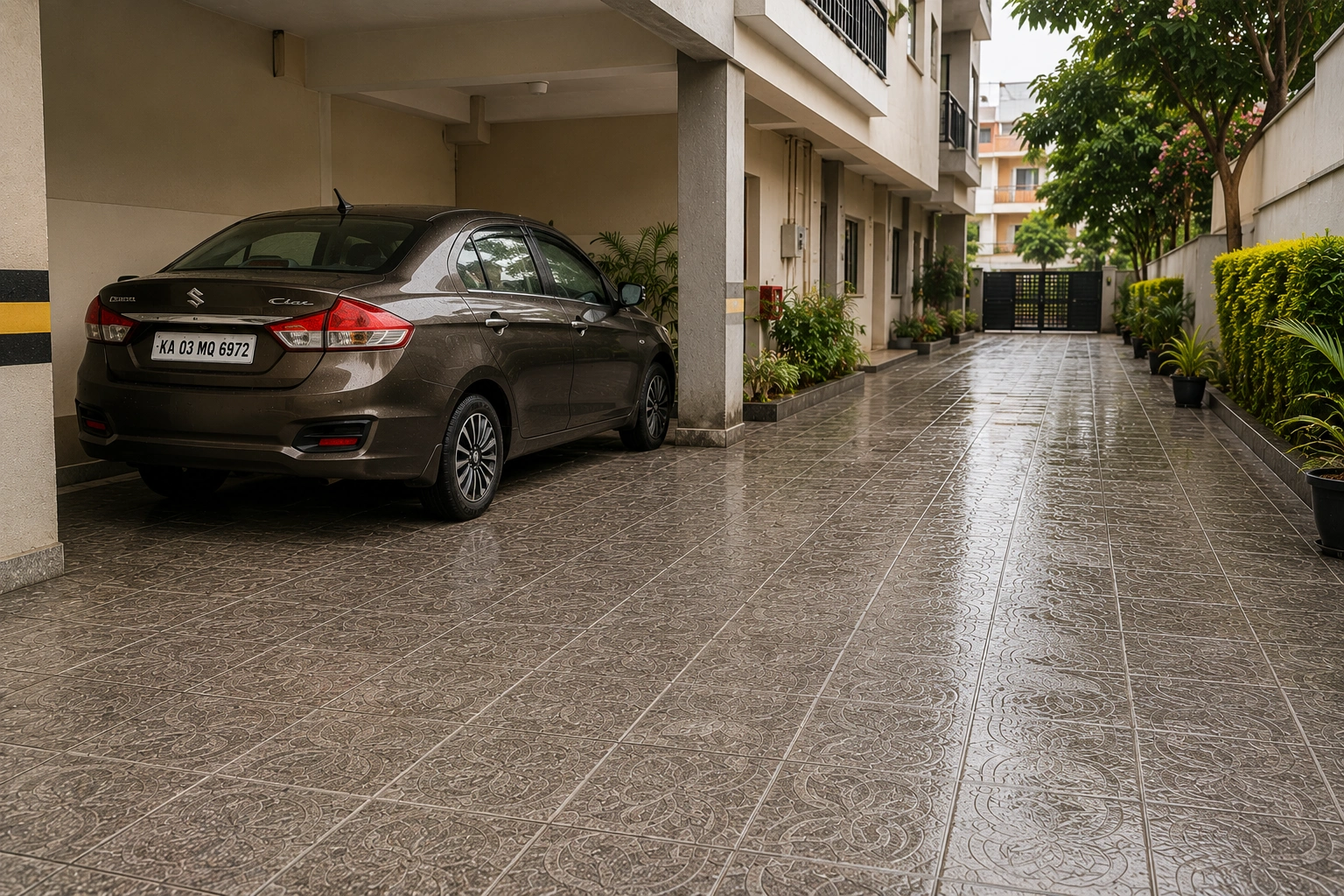
Matte carving finish has a flat matte surface with carved grooves or channels pressed into the tile body, creating a three-dimensional pattern. Veining and stone-look patterns are common. The overall surface is matte, but the carved lines and channels add visual texture depth beyond what plain matte provides.
For parking applications, the matte carving finish performs similarly to plain matte on flat surfaces. The carved channels can actually reduce effective contact area in some patterns, which makes the grip marginally worse than plain matte under heavy water load. The channels also accumulate silt and debris more readily than flat surfaces, which adds to maintenance in outdoor conditions.
Matte carving is better suited to pedestrian zones within a compound or to the decorative border areas around parking bays rather than the primary vehicle parking zones themselves.
| Parameter | Matte Carving Finish |
|---|---|
| Typical R-value | R10 to R11 (variable by pattern; channels can reduce effective grip area) |
| Best for | Pedestrian walkways within compound; decorative borders of parking bays; compound pathways in moderate-rainfall cities |
| Not suitable for | Primary vehicle parking zones in heavy monsoon cities, slopes, and any zone with a risk of standing water |
| Cleaning consideration | Carved channels accumulate silt, leaves, and algae faster than flat surfaces; needs quarterly high-pressure wash outdoors |
| Long-term grip degradation | Low on the flat surface; channel edges can accumulate biofilm in humid zones, which reduces local grip |
Natural Stone Texture: High Grip with Maintenance Trade-Offs
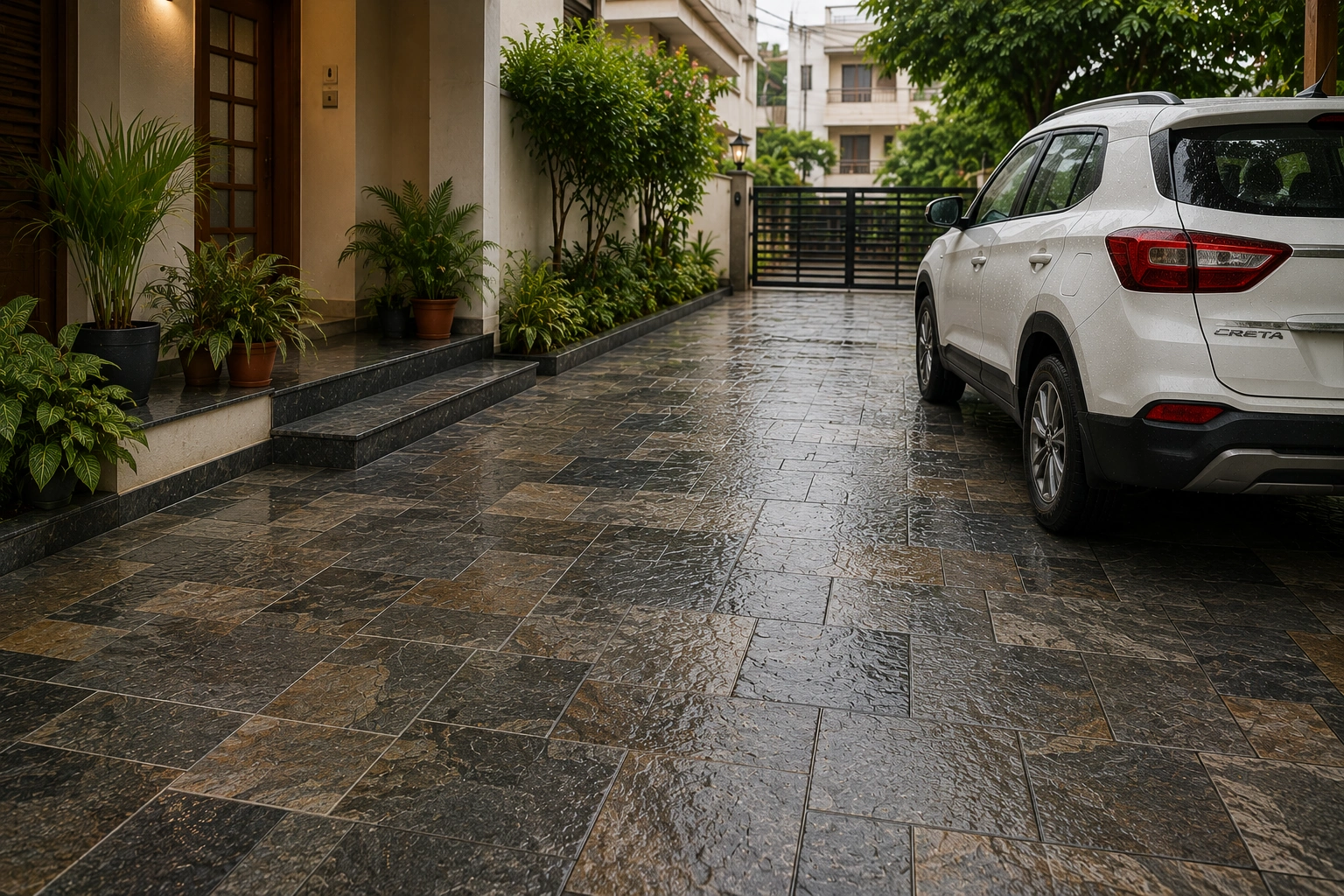
Natural stone brings its own surface texture profile that no manufactured tile finish fully replicates. Kota stone, which is quarried in Kota, Rajasthan, has a fine-grained natural surface with inherent micro-roughness that gives it a consistent R11 to R12 performance. Granite in its natural or flamed finish reaches R12 to R13, making it one of the highest grip options for Indian parking.
Sandstone, also commonly sourced from Rajasthan, has a coarser natural texture that provides a strong grip but absorbs more water and stains more readily than vitrified tile or granite. Sandstone needs sealing before installation and re-sealing every two to three years to maintain stain resistance in vehicle zones.
Natural stone grip advantage: The grip in natural stone comes from its crystalline surface structure, which does not rely on a fired glaze or surface treatment. This means the grip is inherent to the stone, does not degrade with normal foot traffic, and is not affected by glaze wear over time. Granite in flamed finish is particularly strong for sloped parking in heavy monsoon zones.
| Stone Type | Typical R-Value | Grip in Monsoon | Maintenance Requirement | Price Range (sq. ft.) |
|---|---|---|---|---|
| Kota stone (natural finish) | R11 to R12 | Very good on flat surfaces | Annual sealing; oil stain treatment after vehicle use | Rs. 30 to Rs. 70 |
| Granite (natural/flamed finish) | R12 to R13 | Excellent; flamed finish is best | Minimal; re-seal every 3 to 5 years | Rs. 80 to Rs. 200 |
| Sandstone (Rajasthan) | R11 to R12 | Good, but absorbs water if unsealed | Seal before install; re-seal every 2 years; stain-prone | Rs. 40 to Rs. 90 |
| Cuddapah/Kadappa stone | R11 | Good on a flat surface | Annual sealing; avoid acidic cleaners | Rs. 35 to Rs. 75 |
Head-to-Head Finish Comparison for Indian Monsoon Parking
The table below compares all six finishes across the factors that matter most for Indian outdoor parking conditions. Use this as the first filter when shortlisting tile options.
| Finish | R-Value Range | Heavy Monsoon | Sloped Driveway | Tyre Grip | Foot Grip (Wet) | Algae Risk | Maintenance Load | Recommended Zone |
|---|---|---|---|---|---|---|---|---|
| Matte GVT | R10 to R11 | Marginal | Not suitable | Good | Moderate | Low | Low | Flat driveway, moderate rainfall |
| GHR | R11 to R12 | Good | R12 GHR only | Very good | Good | Low | Low | All home driveways, standard choice |
| Rain Drop | R12 to R13 | Excellent | Yes | Very good | Excellent | Moderate | Moderate | Heavy monsoon cities, slopes, and society entry |
| Sugar | R10 to R11 | Poor | Not suitable | Moderate | Low | Low | Low | Covered porch only |
| Matte Carving | R10 to R11 | Marginal | Not suitable | Moderate | Moderate | Moderate | Moderate | Pedestrian walkways, driveway borders |
| Natural Stone (Granite) | R12 to R13 | Excellent | Yes (flamed) | Excellent | Excellent | Low | Low to moderate | Bungalow driveway, premium compounds |
| Kota Stone | R11 to R12 | Very good | Conditional | Good | Very good | Low | Moderate | Home parking, Rajasthan, and Central India |
Ratings above reflect typical product performance in Indian market conditions. Actual R-values vary by manufacturer, specific tile series, and thickness. Always confirm the R-value from the technical specification sheet before purchase.
Tyre Grip vs Foot Grip: Two Different Problems on the Same Surface
A home driveway serves two users simultaneously: rubber vehicle tyres at vehicle speed and human footwear at walking speed. Most buyers think about one or the other. The physics of what each needs from a tile surface are different enough that the ideal specification must satisfy both.
What Vehicle Tyres Need from a Parking Tile Surface
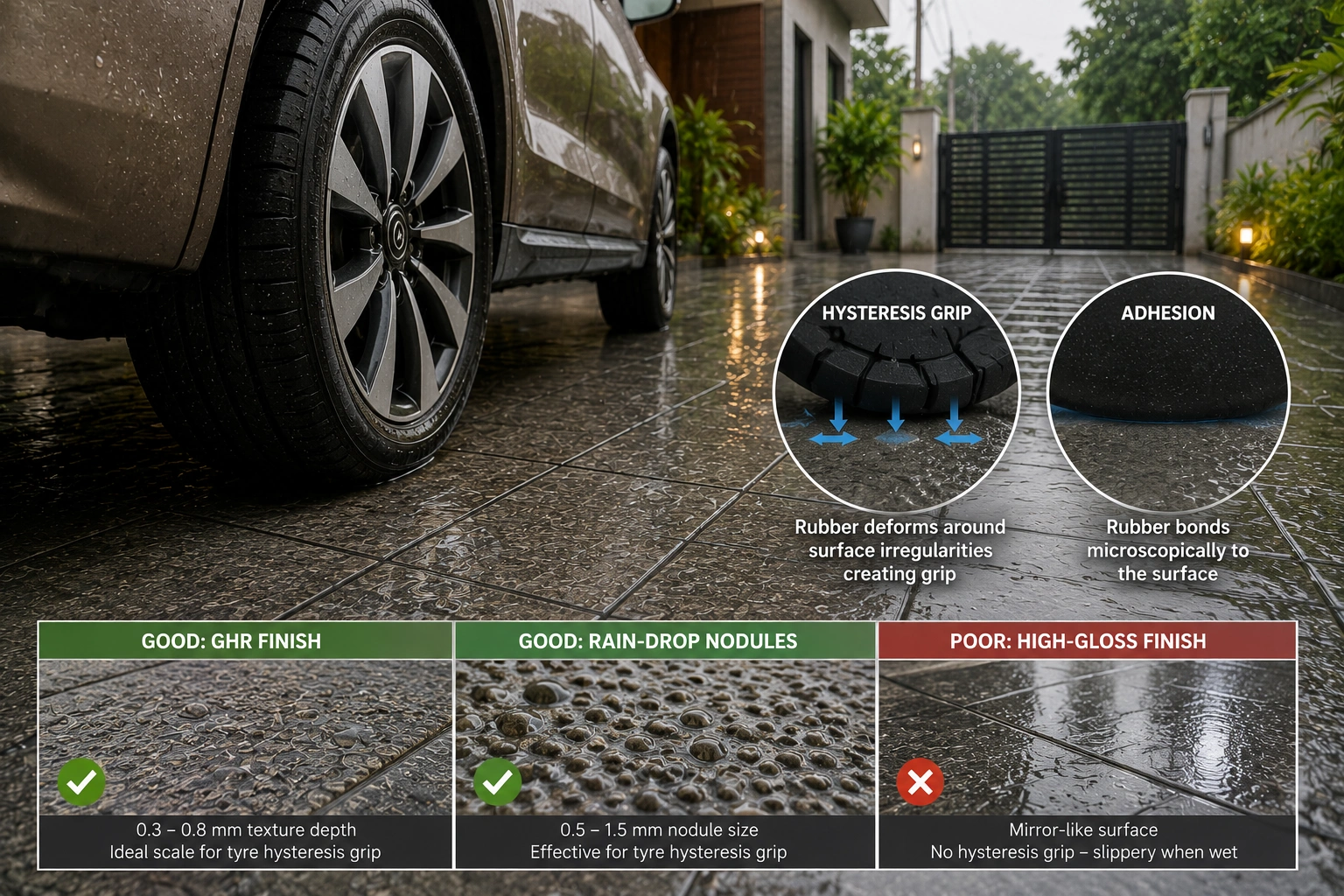
Vehicle tyres grip a surface through two mechanisms: adhesion, where the rubber compound bonds microscopically to the surface, and hysteresis, where the tyre rubber deforms slightly around surface irregularities and creates mechanical interlocking. For tyres on a wet parking tile at low speed, hysteresis matters more than adhesion.
Tyre hysteresis grip requires a surface with irregularities at the millimetre scale, roughly matching the scale of tyre tread blocks. GHR finish at 0.3 to 0.8 mm texture depth sits at the right scale for tyre hysteresis grip. Rain-drop nodules at 0.5 to 1.5 mm are slightly coarser but still effective.
The single most important tyre-related specification is the absence of a polished or high-gloss finish. PGVT and high-gloss GVT have an almost mirror surface that eliminates hysteresis grip under wet conditions. A vehicle braking on a wet, high-gloss tile behaves like braking on glass. This is not an exaggeration. It is the same physics.
What Bare Feet and Footwear Need from the Same Surface
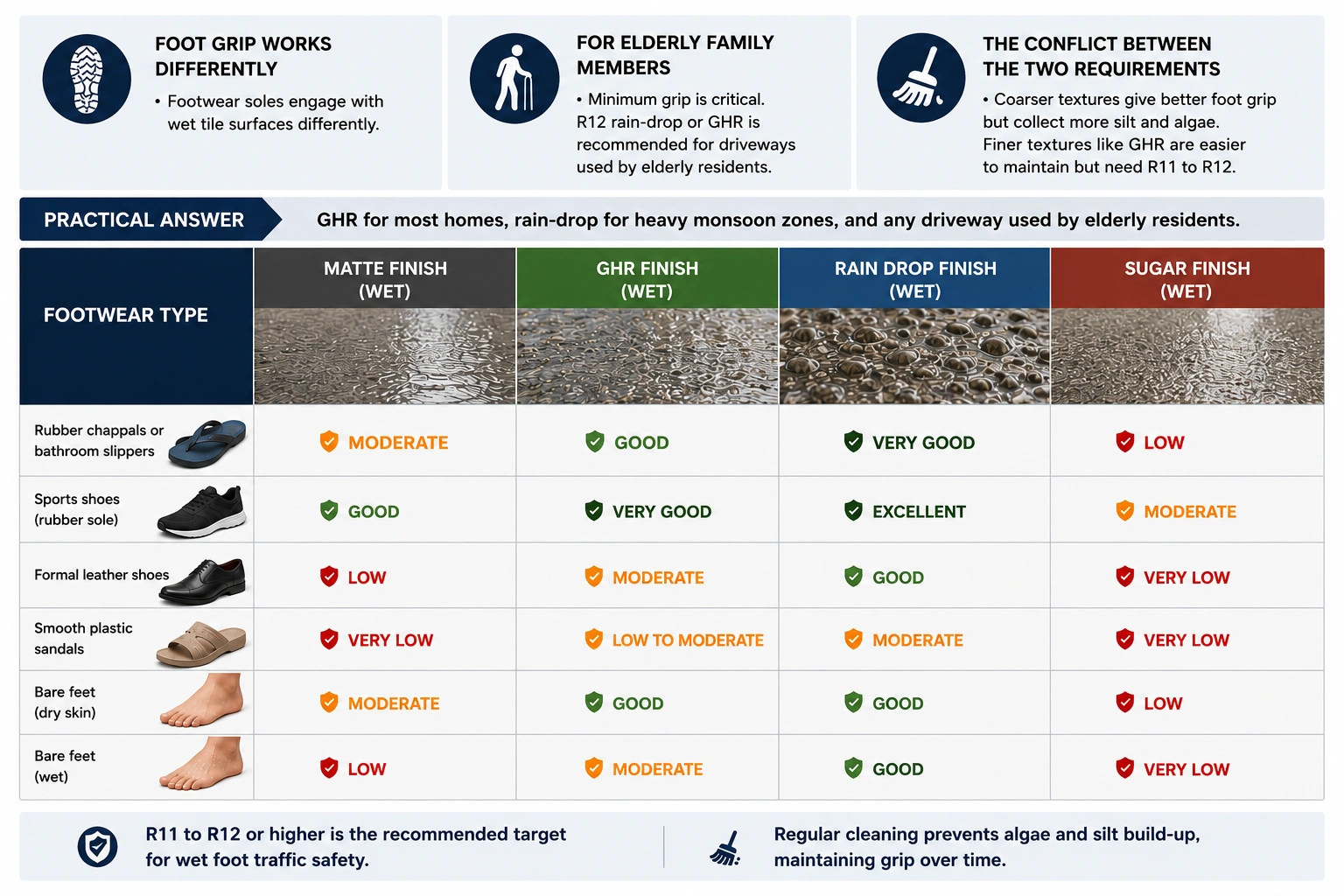
Human foot grip works differently from tyre grip. Footwear sole materials range from rubber to leather to smooth plastic. Each engages with a wet tile surface differently. A person in rubber chappals on a wet GHR tile has a strong grip. The same person in smooth-soled formal shoes on the same tile has significantly less grip, though still better than on a matte tile.
For elderly family members, the critical parameter is not the average grip but the minimum grip. A tile that provides adequate grip for 90% of the surface and has a few algae-coated low spots is a risk for someone with reduced balance or reaction time. This is why R12 rain-drop or GHR is the recommended specification for any driveway used by elderly residents, regardless of the city's monsoon intensity.
The conflict between the two requirements: Coarser textures give better foot grip but collect more silt and algae, which reduces grip over a monsoon season without cleaning. Finer textures like GHR are easier to maintain but need to be confirmed at R11 to R12 to be adequate for wet foot traffic. The practical answer is GHR for most homes, rain-drop for heavy monsoon zones, and any driveway used by elderly residents.
| Footwear Type | Grip on Matte (Wet) | Grip on GHR (Wet) | Grip on Rain Drop (Wet) | Grip on Sugar (Wet) |
|---|---|---|---|---|
| Rubber chappals or bathroom slippers | Moderate | Good | Very good | Low |
| Sports shoes (rubber sole) | Good | Very good | Excellent | Moderate |
| Formal leather shoes | Low | Moderate | Good | Very low |
| Smooth plastic sandals | Very low | Low to moderate | Moderate | Very low |
| Bare feet (dry skin) | Moderate | Good | Good | Low |
| Bare feet (wet) | Low | Moderate | Good | Very low |
Important: Smooth-soled footwear, including most formal shoes and smooth plastic sandals, performs significantly worse on wet tiles than rubber-soled footwear. If elderly family members regularly use the driveway, specify R12 rain-drop or R12 GHR regardless of other factors. The grip gap between shoe types is largest on matte and sugar finish tiles.
How Indian Monsoon Conditions Stress Parking Tile Grip
The Indian monsoon is not uniform. A June morning in Cherrapunji, Meghalaya, which averages over 11,000 mm of annual rainfall, demands a different specification than a July afternoon in Jaipur, which might see 30 mm in the same month. Indian parking tile specifications should reflect the local monsoon character, not a generic all-India standard.
Algae, Moss, and Biofilm on Wet Parking Tiles
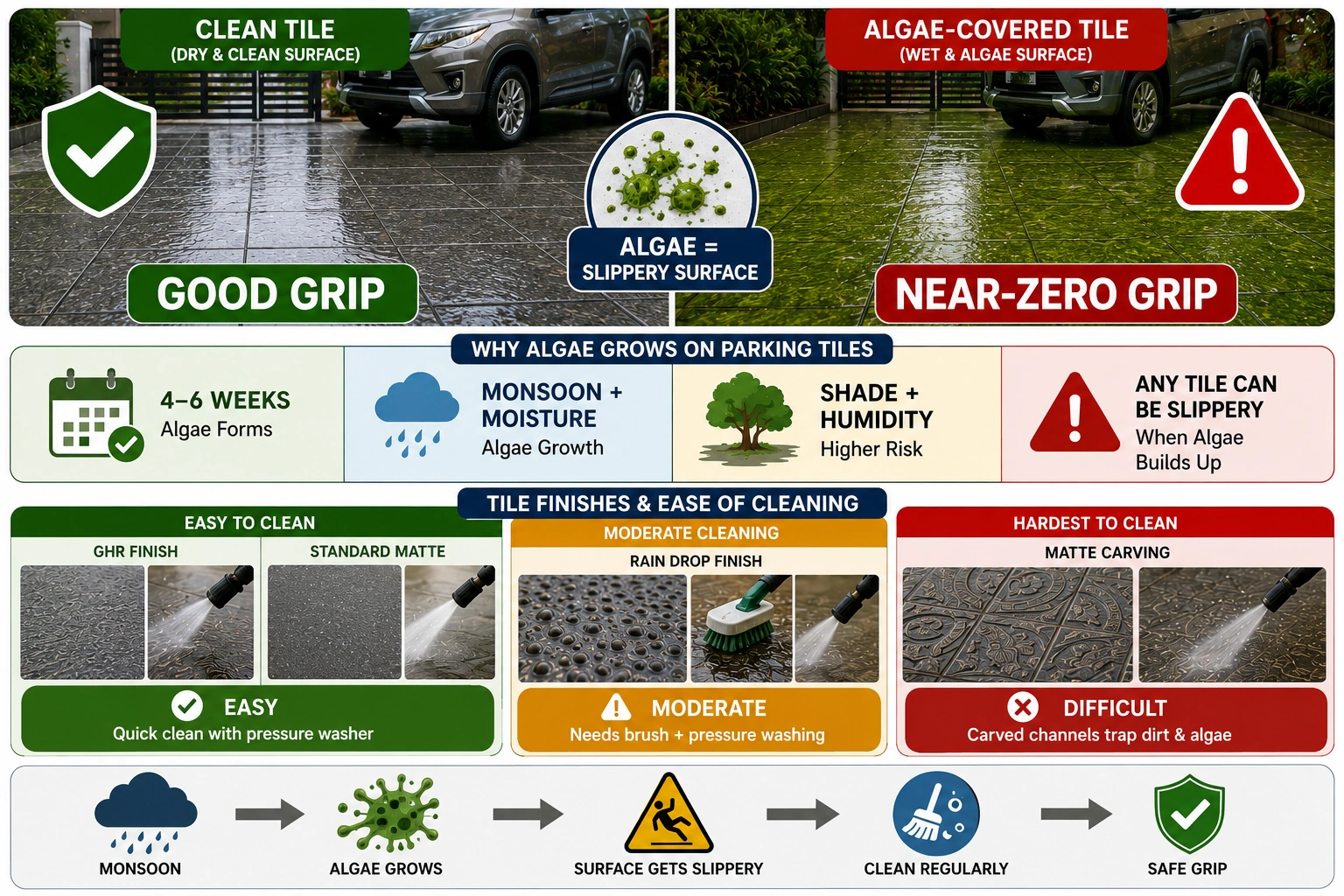
Algae establishes itself on tile surfaces within four to six weeks of sustained moisture in the right temperature range. In coastal Kerala, Goa, and coastal Karnataka, this window arrives every Jun,e and the algae persists until the October dry period. Once algae forms a continuous film on a tile surface, the effective coefficient of friction drops to near-zero. A GHR tile covered in algae is as slippery as a polished tile.
Algae growth is not primarily a function of tile texture. It is a function of moisture retention and sunlight exposure. A shaded driveway in Mumbai or Kochi will develop algae on any tile finish, including rain-drop and GHR, if not cleaned regularly. The practical approach is to treat algae as an operational reality in high-humidity zones and build a pre-monsoon cleaning protocol into the home maintenance schedule, not to assume any tile finish makes algae impossible.
Tiles that are easier to clean make this protocol less demanding. GHR and standard matte tiles can be cleaned quickly with a pressure washer. Rain-drop tiles need a stiff brush in addition to pressure washing to clear the nodule valleys. Matte carving tiles are the most difficult, as carved channels trap material that pressurised water alone does not always dislodge.
Silted Water vs Clean Rainwater: The Grip Difference
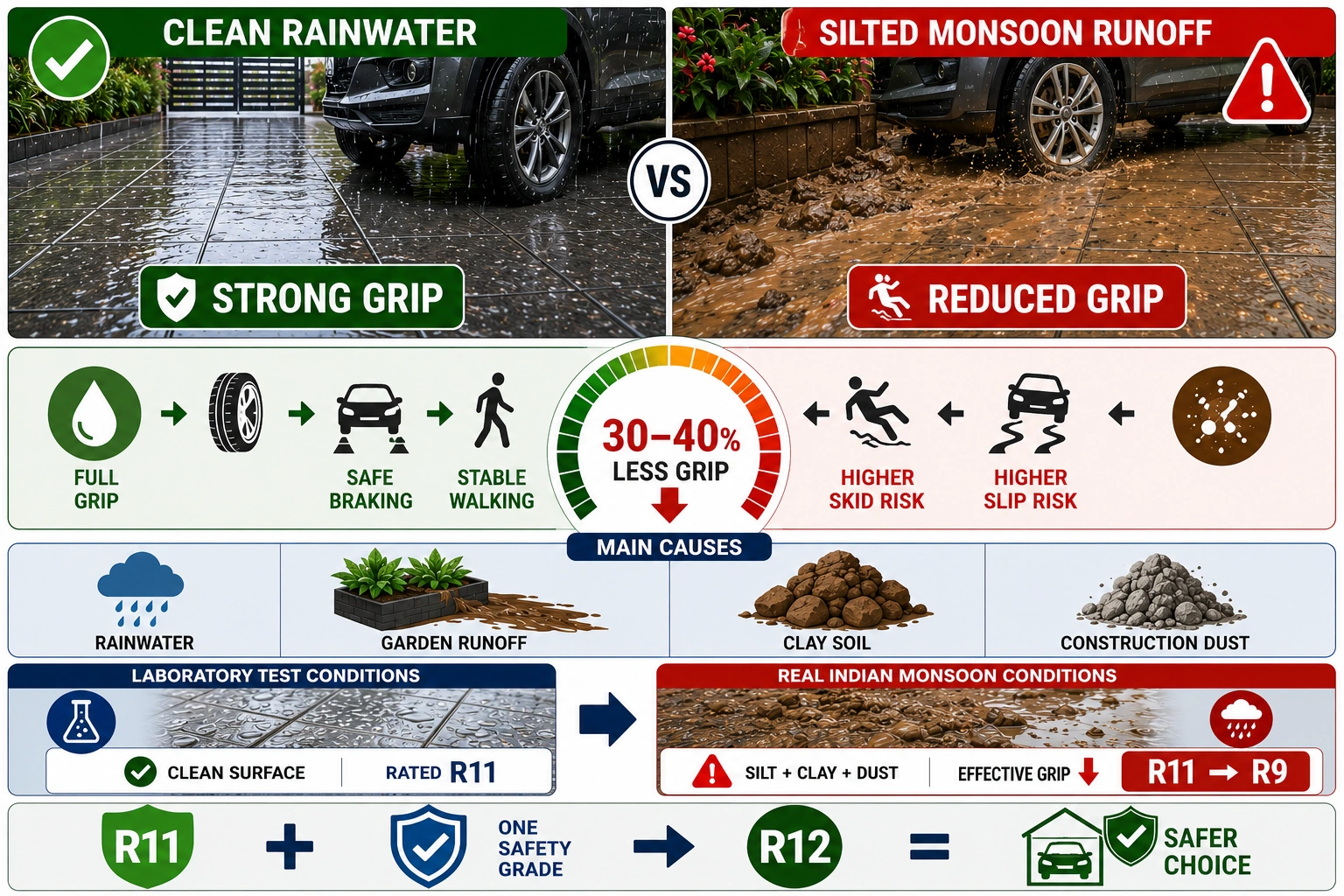
The grip tests used to assign R-values use oil-lubricated surfaces. Real Indian driveway conditions are often worse. Silted monsoon runoff from compound gardens, clay soil washed from planters, and fine construction dust that has settled over summer are all more lubricating than clean water on a tile surface.
A thin layer of wet clay on a parking tile can reduce effective grip by 30 to 40% compared to clean water conditions. This is why the R-value should be treated as the starting point, not the guaranteed field performance. A tile rated R11 in a laboratory oil test may perform at an effective R9 when covered with silted monsoon runoff from the compound garden. Building a one-grade safety margin into the specification accounts for this reality.
City-by-City Monsoon Grip Demand: Summary Table
| City | Peak Monsoon Months | Typical Peak Rainfall (mm per day) | Recommended Minimum Finish | Additional Consideration |
|---|---|---|---|---|
| Mumbai | June to September | 100 to 200 mm on peak days | GHR R12 or Rain Drop | Silted runoff is common; pre-monsoon clean mandatory |
| Kochi, Thiruvananthapuram | June to September | 80 to 150 mm on peak days | Rain Drop R12 to R13 | Persistent humidity; algae cleans mandatory |
| Mangalore, Udupi | June to September | 100 to 200 mm on peak days | Rain Drop R12 to R13 | Steeper terrain is common; use R13 on slopes |
| Goa (coastal) | June to September | 80 to 120 mm on peak days | GHR R12 or Rain Drop | Salt spray in seafront plots reduces grip on low-texture tiles |
| Chennai | October to December (NE monsoon) | 50 to 80 mm on peak days | GHR R11 to R12 | Cyclone events bring very heavy one-day totals |
| Bengaluru | June to July, September to October | 30 to 60 mm on peak days | GHR R11 | Flash rain on warm ground; dries quickly |
| Hyderabad, Pune | July to September | 30 to 60 mm on peak days | GHR R10 to R11 | Moderate rainfall; standard GHR adequate |
| Delhi NCR | July to August | 30 to 80 mm on peak days | GHR R11 | Silted pre-monsoon dust is a local risk; plan for the first rain to be the most slippery |
| Kolkata | June to September | 50 to 100 mm on peak days | GHR R11 to R12 | High humidity supports algae growth between rain events |
| Shillong, Cherrapunji | May to September | 100 to 400 mm on peak days | Rain Drop R13 only | Highest rainfall in India; steep terrain; R13 mandatory |
Texture Depth and Long-Term Grip: What Changes After Two Monsoon Seasons
A tile's grip on installation day is not the same as its grip after two years of Indian parking use. Understanding how each finish ages under Indian conditions helps set realistic expectations and informs which finish is worth paying more for over a ten-year horizon.
| Finish | Year 1 Grip | Year 3 Grip | Year 5 to 7 Grip | What Causes Degradation | Maintenance to Preserve Grip |
|---|---|---|---|---|---|
| Matte GVT | Good | Good | Good (stable) | Polishing from tyre contact minimal on outdoor matte; UV stable | Annual scrub; no special treatment |
| GHR | Very good | Very good | Very good (very stable) | Glaze composition resists micro-polishing; grip profile is stable in the long term | Half-yearly scrub; annual pressure wash |
| Rain Drop | Excellent | Very good to excellent | Very good (stable if cleaned) | Silt accumulates in nodule valleys, reducing effective contact; cleaning restores grip | Quarterly brush; pre-monsoon pressure wash critical |
| Sugar | Moderate | Moderate to low | Low (gradual degradation) | Smooth glaze on droplets polishes with foot traffic; not durable outdoors | Not suitable for open outdoor parking,g regardless of cleaning |
| Matte Carving | Good | Moderate (channels collect silt) | Low to moderate | Carved channels become silt traps; biofilm in channels reduces the grip between cleaning | Frequent channel cleaning is needed; not practical for busy driveways |
| Granite (flamed) | Excellent | Excellent | Excellent (permanent) | Crystalline surface does not degrade; grip is structural, not surface treatment | Annual wash; no sealing needed for grip; sealing for stain resistance only |
| Kota Stone (sealed) | Very good | Very good | Good (depends on re-seal) | If the sealant wears off, oil staining occupies surface pores and reduces grip. | Re-seal every 2 years; oil stain treatment as needed |
Pro Tip: For a driveway that needs to perform well for ten or more years with the lowest maintenance burden, the hierarchy is: granite flamed finish at the top, GHR vitrified second, rain-drop vitrified third. Sugar and matte carving are not long-term outdoor parking options, regardless of how good they look in the showroom.
Common Mistakes When Choosing Parking Tile Texture for Indian Homes
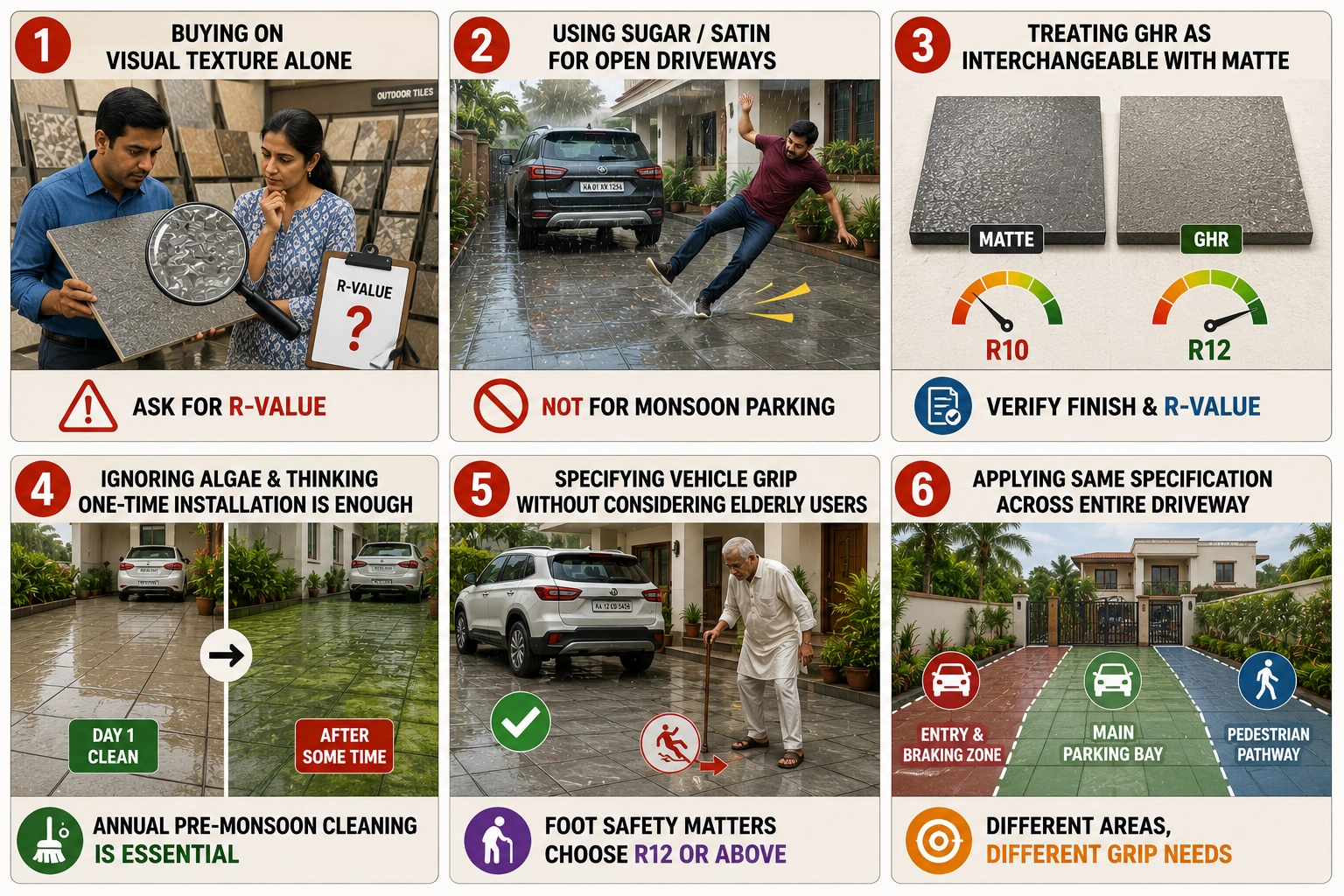
Buying on visual texture alone. A tile that looks deeply textured in a showroom may have a low R-value because the visual texture is created by a glossy carving pattern rather than a grip-generating surface structure. Always ask for the DIN 51130 R-value, not just the name of the finish.
Using sugar or satin matte finish for open driveways. Both finishes look clean and modern and are sold widely in Indian showrooms as outdoor options. Neither is adequate for an open driveway in any Indian city with a real monsoon. Sugar finish glaze polishes smoothly under rainwater contact. Satin matte is slippery when wet. Neither should be used in open parking areas.
Treating GHR as interchangeable with matte. GHR and matte are different finishes with different R-values. Some dealers use the terms loosely. Confirm by asking for the specific finish name and the R-value number. A tile labelled GHR that comes back with an R10 rating is not a true high-resistance GHR product and should not be used for sloped or heavy-monsoon driveways.
Ignoring algae and assuming a one-time installation is enough. No tile finish makes algae impossible in a humid Indian environment. Rain-drop and GHR tiles grow algae too, just more slowly and more cleanly than carved or smooth surfaces. Plan for an annual pre-monsoon cleaning as part of normal home maintenance in any coastal or high-humidity zone.
Specifying vehicle grip without considering elderly users. A tile that holds an SUV on a wet slope may still be dangerous for someone in smooth-soled footwear. If the household includes elderly residents, the grip specification should be set by foot traffic safety, which requires R12 or above, not by vehicle handling alone.
Applying the same specification across the entire driveway. The entry gate area, where vehicles brake and turn, carries different loads from the parking bay itself, where the vehicle sits stationary. Pedestrian pathways beside parking bays carry foot traffic only. A layered specification, with rain-drop at entry and transition zones and GHR across the main parking field, costs only marginally more and performs significantly better across the whole driveway.
Choosing Texture for the Conditions, Not for the Showroom
Parking tile texture decisions look simple in a dry showroom in March. The consequences of those decisions arrive in July, on a wet driveway, with a vehicle turning in from the road or an elderly parent crossing in evening light.
The practical hierarchy for most Indian homes is clear. GHR at R11 to R12 handles the majority of residential driveways across most Indian cities. Rain-drop at R12 to R13 is the right upgrade for heavy monsoon locations, sloped driveways, and any compound where elderly residents use the parking area regularly. Matte is acceptable for flat driveways in moderate rainfall zones when the budget is the primary constraint. Sugar, satin matte, and glossy finishes have no place on open outdoor parking surfaces, regardless of their appearance.
Before shortlisting any tile, ask the dealer for the DIN 51130 R-value. If they cannot provide it, ask for the technical specification sheet from the manufacturer. If neither is available, treat the tile as a low-grip product and choose accordingly.
Texture and grip are only part of the specification. This Parking Tile Thickness Guide explains how vehicle weight, tile thickness, and load requirements influence long-term driveway performance.
When selecting parking tiles, factors such as finish type, R-value (where available), size, and thickness matter far more than appearance alone. TilesFinders allows homeowners to compare these technical specifications across products from verified Indian dealers, making it easier to shortlist suitable options before a showroom visit and avoid the confusion of comparing multiple tiles without the right technical context.
FAQs
GHR stands for Glaze High Resistance. It is a specific type of tile surface finish with a controlled stone-like texture profile designed for outdoor flooring and vehicle traffic zones. The GHR glaze is harder and rougher than standard matte finish, giving it a higher anti-skid rating of R11 to R12 on the DIN 51130 scale. It is the most widely recommended finish for Indian home driveway parking because it balances grip, maintenance ease, and long-term stability across most Indian rainfall conditions.
For most Indian home driveways, GHR finish at R11 to R12 is the correct specification. For heavy monsoon cities, including Mumbai, Kerala, Goa, and coastal Karnataka, a raindrop finish at R12 to R13 gives a stronger grip under sustained heavy rainfall. Matte finish is acceptable for flat driveways in low to moderate rainfall cities b, ut is not adequate for slopes or heavy monsoon zones. Sugar, satin matte, and polished finishes must never be used on open outdoor parking surfaces.
R-value is the standard anti-skid rating for floor tiles measured under DIN 51130 (a German standard used internationally). It rates tiles from R9 to R13 based on the steepest angle at which a test subject walking barefoot on an oil-lubricated tile surface remains stable. R9 is the lowest grip (dry indoor use only). R13 is the highest grip (commercial, industrial, and steep outdoor surfaces). For Indian home parking, R11 to R12 covers most applications, nd R12 to R13 is required for heavy monsoon zones and sloped driveways.
Yes. Rain-drop finish tiles at R12 to R13 are the best-performing manufactured finish for open outdoor parking in heavy monsoon Indian conditions. The raised nodule pattern maintains contact with footwear even under a continuous water film. The one practical consideration is that the valleys between nodules accumulate silt during the monsoon and need quarterly brushing and an annual pre-monsoon pressure wash to maintain full grip performance. In terms of raw grip under heavy rain, rain-drop outperforms every other manufactured tile finish.
GHR outperforms standard matte for all outdoor parking applications in India. GHR has a deeper surface texture profile and harder glaze composition, giving it an R11 to R12 rating versus R10 to R11 for standard matte. For flat driveways in moderate-rainfall cities, the difference is less critical. For sloped driveways, heavy monsoon cities, or driveways used by elderly residents, the grip gap between GHR and matte is significant enough to matter in real conditions. GHR is also more durable under outdoor conditions, with very little grip degradation over ten or more years.
Grip degradation depends on finish type. GHR and rain-drop finish tiles have very stable grip profiles over ten or more years of normal use because their texture is structural and resists polishing. Granite and Kota stone have essentially permanent grip as long as they are kept clean. Sugar finish and matte carving show more degradation over time because their texture mechanisms are less resistant to outdoor weathering and silt accumulation. The most important factor in maintaining grip on any finish is cleaning frequency, particularly the annual pre-monsoon scrub in high-humidity and coastal zones.
Yes. Kota stone is a practical and cost-effective parking surface in many Indian homes, particularly in Central India and Rajasthan, where it is locally sourced. Its natural surface gives R11 to R12 grip when clean. The key requirement is sealing before installation and re-sealing every two years to prevent oil and silt from penetrating the stone pores and staining permanently. Granite in natural or flamed finish gives higher grip at R12 to R13 and requires less frequent sealing. Both are strong alternatives to vitrified tiles for driveways that carry heavy vehicles.

See our tile guides first
Set TilesFinders as a preferred source and our buying guides surface ahead of the rest for you.
Add as preferred sourceTakes one tap. Nothing to install.
What Readers Say
I was about to redo my parking area with the wrong tile size until I read this. The layout comparisons saved me from a costly mistake.
We reference TilesFinders guides while briefing clients on material selection. The size and pattern breakdowns are accurate and easy to explain visually.
On site, I get asked about grout spacing all the time. This article gave me a solid reference I now share with my team before every job.
Finally a guide that doesn't just push generic advice. The oil stain removal steps actually worked on our clubhouse driveway tiles.
I run a small construction firm and now send this link to clients directly when they ask about entrance tile sizing. Saves me an hour of explaining.
Good practical detail, though I wish there were more examples for compact apartment entrances specifically, not just villas.
My mother-in-law wanted marble, I wanted vitrified. This blog gave us the neutral comparison we needed to actually decide together.
Detailed without being overwhelming. I appreciated that it covered both cost and maintenance, not just the aesthetics.
Used the algae and hard water removal tips on our terrace tiles after the monsoon. Worked better than what our regular cleaner was doing.
As someone who sources tiles for multiple builder projects, I find these comparisons genuinely useful for vendor conversations, not just consumer content.
Recommended this to a client who kept second-guessing the entrance design. The small vs large layout section settled the debate instantly.
Straightforward and honest, no unnecessary jargon. Would like to see a similar breakdown for outdoor pool-deck tiles next.
We've bookmarked several TilesFinders guides for our design handbook. Reliable source when clients want data, not just opinions.
Two paths, one marketplace.
Get free quotes from verified suppliers.
Share your room, budget, and style. Suppliers in Morbi respond within hours.
Get Free QuotesList your business, reach real buyers.
Put your showroom in front of homeowners searching for tiles right now.
List Your Business