Parking Tile Thickness Guide: 9mm vs 12mm vs 15mm for Cars, SUVs, and Trucks in India
Learn how to choose the right parking tile thickness for cars, SUVs, and trucks. Compare 9mm, 12mm, and 15mm tiles based on load capacity, tile category, and driveway use.
- Why Tile Thickness Is the First Number to Decide
- How Tile Thickness Works Under Vehicle Load
- Parking Tile Thickness by Use Case: The Full Decision Guide
- Quick Reference: Thickness by Vehicle Type and Use Case
- How Tile Category Affects Thickness Requirements
- How Tile Size Interacts with Thickness
- The Full Load Path: Tile, Screed, PCC, and Soil Working Together
- Common Tile Thickness Mistakes in Indian Parking Projects
- Specifying Thickness Correctly Before the First Tile Is Laid
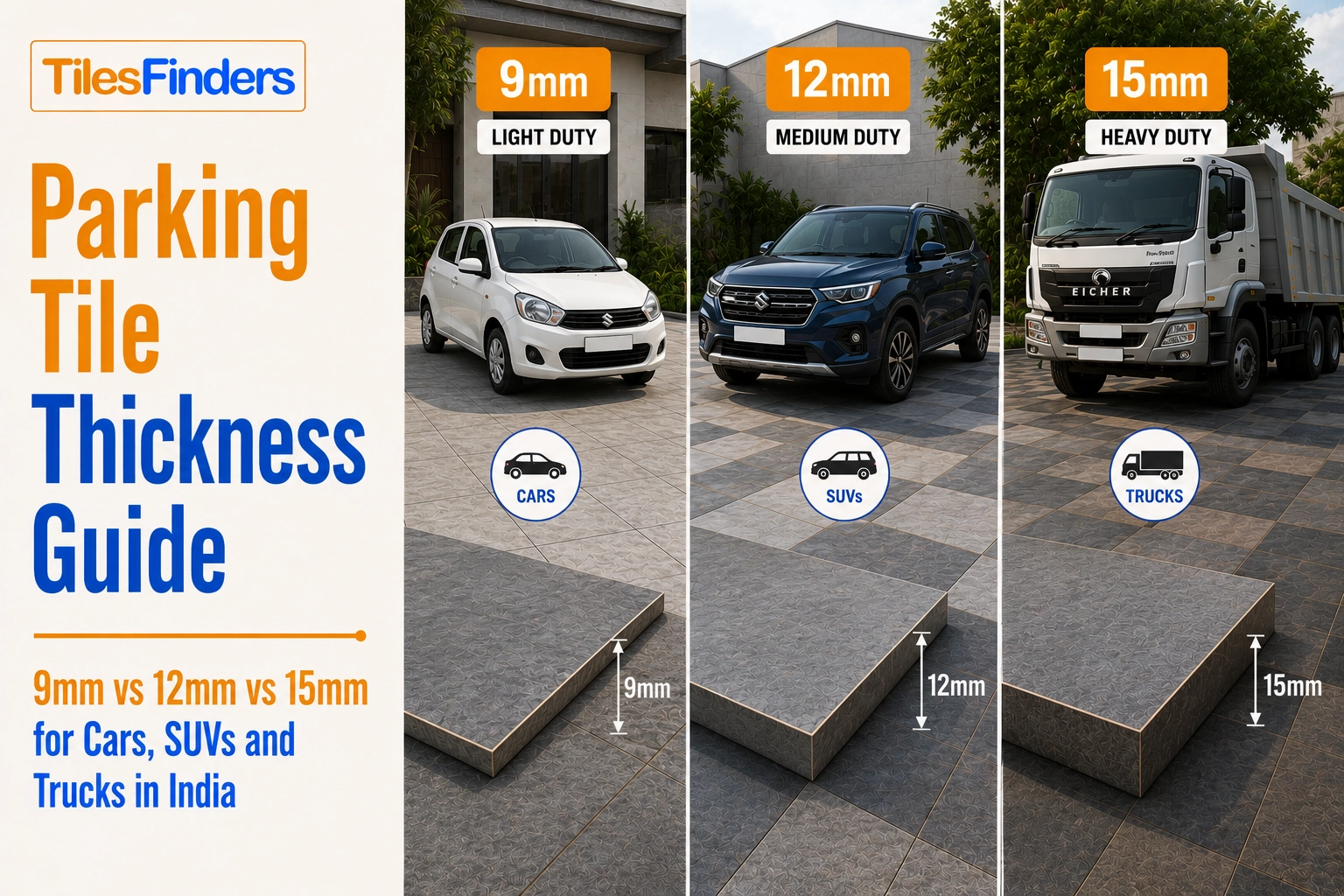
Parking tile thickness is one of the most important structural decisions for any driveway. While 9mm tiles are suitable mainly for two-wheelers and light use, 12mm is the standard choice for most Indian homes with hatchbacks, sedans, and compact SUVs. For full-size SUVs, society compounds, and heavier vehicle loads, 15mm Full Body vitrified tiles provide greater durability and long-term reliability.
Most homeowners buying parking tiles ask two questions: what colour and what size. Thickness is rarely the first question. That is exactly why parking tiles crack.
Tile thickness is the single structural variable that determines whether a tile survives a 1,500 kg SUV rolling over it every morning or shatters within the first monsoon season. Colour has nothing to do with it. Size matters, but only in combination with thickness. The load path from tyre to tile to mortar bed to PCC base depends almost entirely on how thick the tile is and how rigid its material category is.
This guide gives you the actual numbers. It maps Indian vehicle weights to tile thickness requirements, explains why 9mm fails under SUV loads that 12mm handles, tells you when 15mm is worth the extra cost, and shows you how tile category and tile size both interact with thickness to change the load rating.
If you are sourcing tiles for a home driveway, a housing society compound, a commercial parking structure, or a logistics yard, the decision framework here will get you to the right specification faster than any showroom conversation.
Why Tile Thickness Is the First Number to Decide
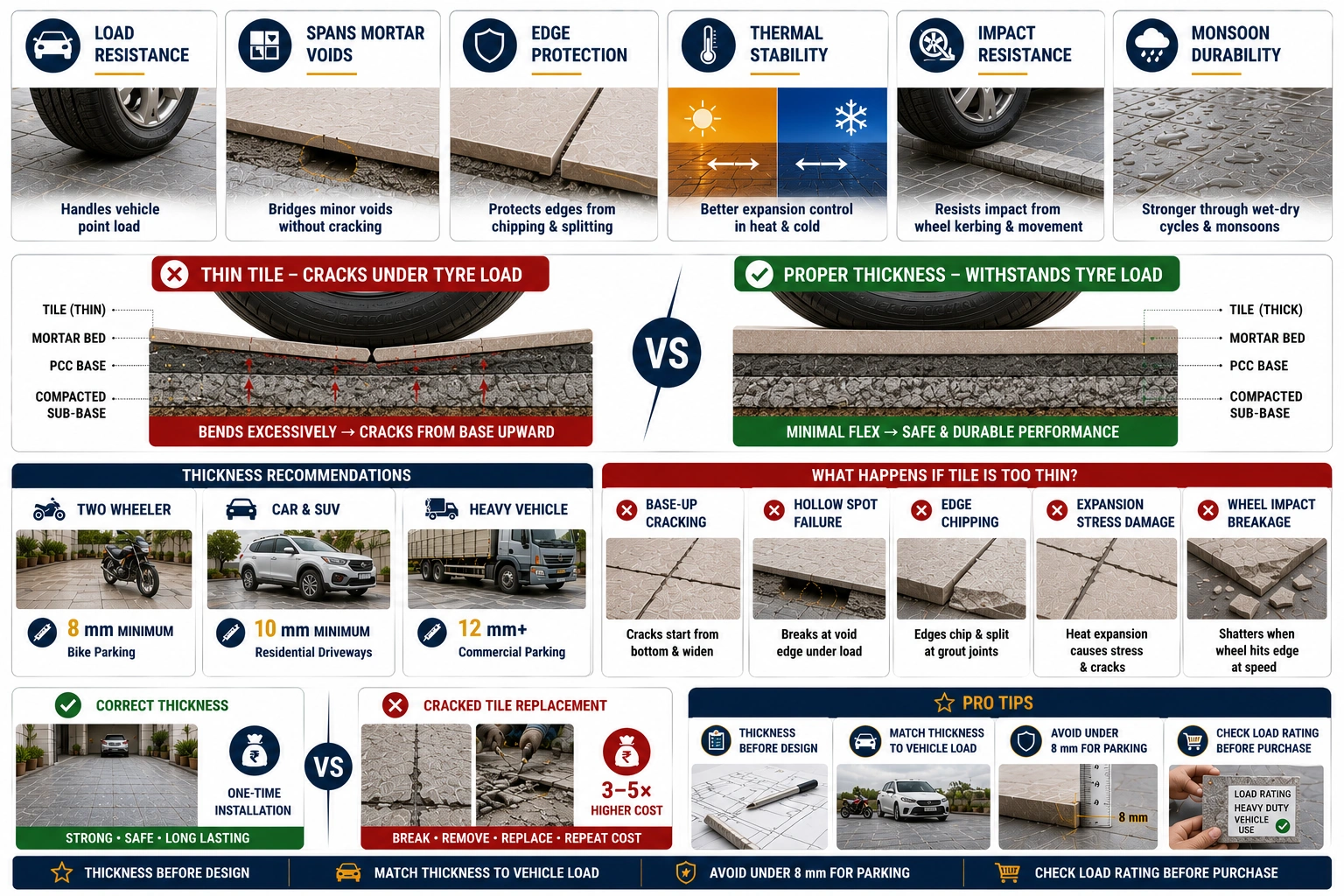
Tile thickness determines three things at once: the tile's bending strength under load, its resistance to point-load cracking from tyre contact, and its ability to span minor voids or uneven spots in the mortar bed below without fracturing.
A tile with insufficient thickness for its load behaves like a short bridge that is too thin for the trucks crossing it. It does not fail by being squashed from above. It fails by bending. When a tyre rolls onto a tile, the tile flexes slightly. If the flex exceeds the material's modulus of rupture, the tile cracks from the bottom face upward. This crack is invisible from above until it widens, which is usually after several load cycles.
The damage is almost always irreversible. A cracked parking tile cannot be patched effectively. The entire tile must be removed and replaced, which means breaking out the mortar, matching the batch, and re-grouting. Getting the thickness right before installation costs nothing extra. Replacing cracked tiles costs three to five times the original installation price for that section.
| What Thickness Controls | What Happens When Under-Specified |
|---|---|
| Bending resistance under vehicle point load | Tile cracks from base upward after repeated tyre load cycles |
| Spanning ability over mortar voids | Hollow spots cause the tile to snap at the void edge under tyre load |
| Edge integrity at tile joints | Thin tile edges chip and split at grout joints under wheel movement |
| Thermal mass and expansion behaviour | Thinner tiles heat and cool faster, increasing expansion stress |
| Resistance to impact from wheel kerbing | Thin tiles shatter when a vehicle wheel mounts the tile edge at speed |
| Long-term durability through Indian monsoon cycles | Repeated wet-dry cycles amplify flex damage in thin tiles over time |
How Tile Thickness Works Under Vehicle Load
Understanding the load mechanics helps you see why thickness rules are not arbitrary. Two concepts explain almost all parking tile failures related to thickness.
Point Load vs Distributed Load
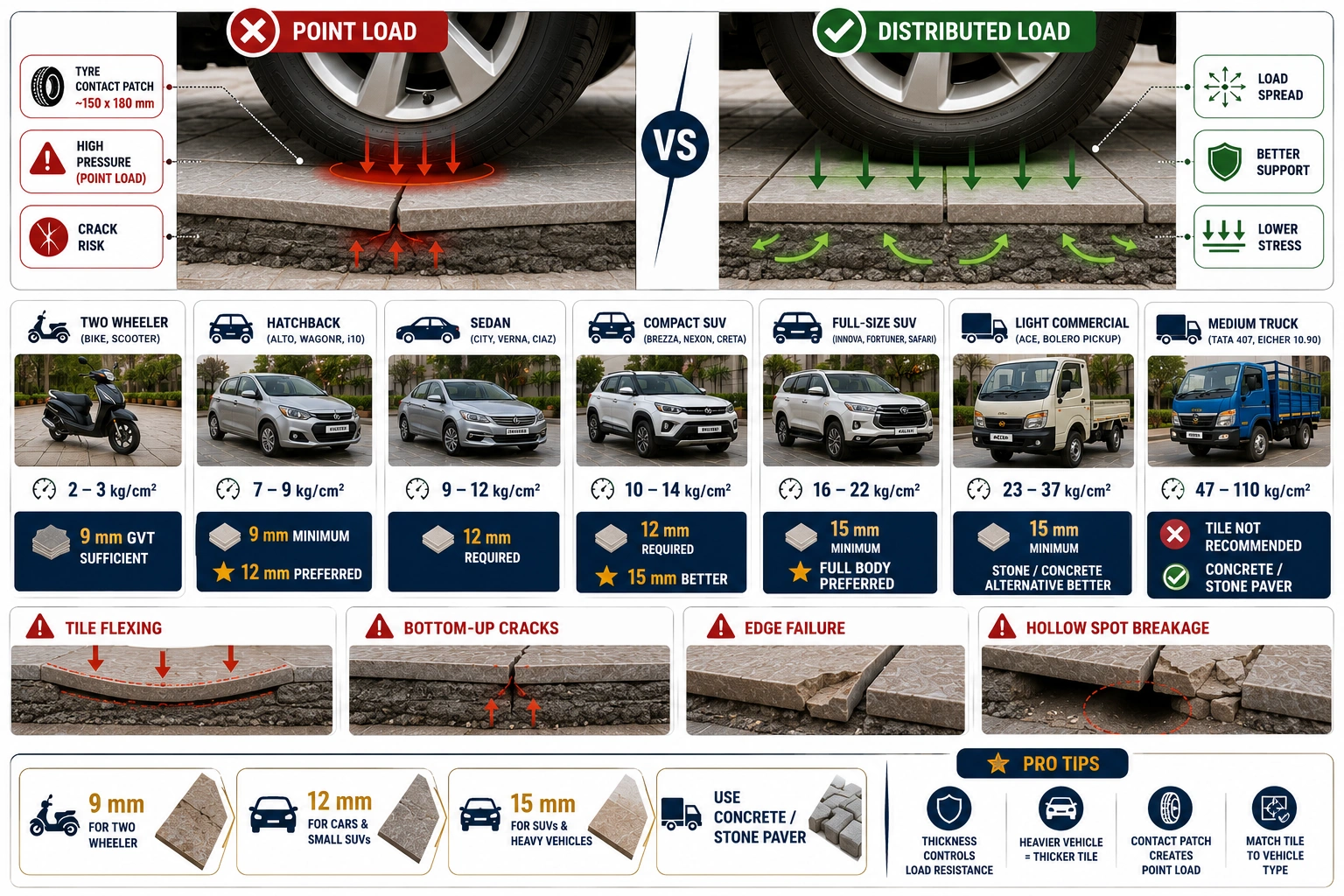
A vehicle does not load a tile evenly across its surface. Each tyre contacts the tile across a small footprint called the contact patch. For a typical Indian hatchback tyre, this patch is roughly 150 mm by 180 mm, about the size of a hand. A full 2x2 tile (6900x600 mm) receives the entire weight of one quarter of the vehicle concentrated into that small contact area.
For a Maruti Swift at 855 kg kerb weight, with two front tyres carrying roughly 55% of the load, each front tyre contact patch carries approximately 235 kg on a 150x180 mm area. That is roughly 8.7 kg per square centimetre of contact, which is a point load, not a distributed one.
Larger, heavier vehicles increase this load significantly. A Toyota Innova Crysta at 1,985 kg kerb weight produces over 20 kg per square centimetre at each front contact patch on a hard, sloped driveway stop. The tile must resist this without flexing beyond its modulus of rupture. Thickness, more than any other single variable, determines that resistance.
| Vehicle | Approx. Kerb Weight (kg) | Front Axle Load (approx.) | Load per Tyre Contact Patch (approx.) | Implication for Tile |
|---|---|---|---|---|
| Two-wheeler (bike, scooter) | 100 to 200 kg | 50 to 70 kg per wheel | 2 to 3 kg / cm2 | 9mm GVT is sufficient on a solid PCC base |
| Hatchback (Alto, WagonR, i10) | 750 to 950 kg | 200 to 260 kg per wheel | 7 to 9 kg / cm2 | 9mm at minimum; 12mm strongly preferred |
| Sedan (City, Verna, Ciaz) | 1,000 to 1,300 kg | 275 to 360 kg per wheel | 9 to 12 kg / cm2 | 12mm required on all but the firmest PCC |
| Compact SUV (Brezza, Nexon, Creta) | 1,100 to 1,450 kg | 300 to 400 kg per wheel | 10 to 14 kg / cm2 | 12mm required; 15mm for long-term reliability |
| Full-size SUV (Innova, Fortuner, Safari) | 1,800 to 2,400 kg | 490 to 660 kg per wheel | 16 to 22 kg / cm2 | 15mm minimum; Full Body category strongly preferred |
| Light commercial (Tata Ace, Mahindra Bolero Pickup) | 1,600 to 2,800 kg (GVW) | 700 to 1,100 kg per front wheel | 23 to 37 kg / cm2 | 15mm minimum; a stone or concrete alternative may be better |
| Medium truck (Tata 407, Eicher 10.90) | 3,500 to 8,500 kg (GVW) | 1,400 to 3,400 kg per front wheel | 47 to 110 kg / cm2 | Tile is not recommended; use a stone paver or concrete |
Kerb weights and load distributions are approximate and vary by variant and load condition. Contact patch areas assume standard Indian tyre sizes. GVW (Gross Vehicle Weight) used for commercial vehicles represents the full load condition.
How the Sub-base Changes the Equation
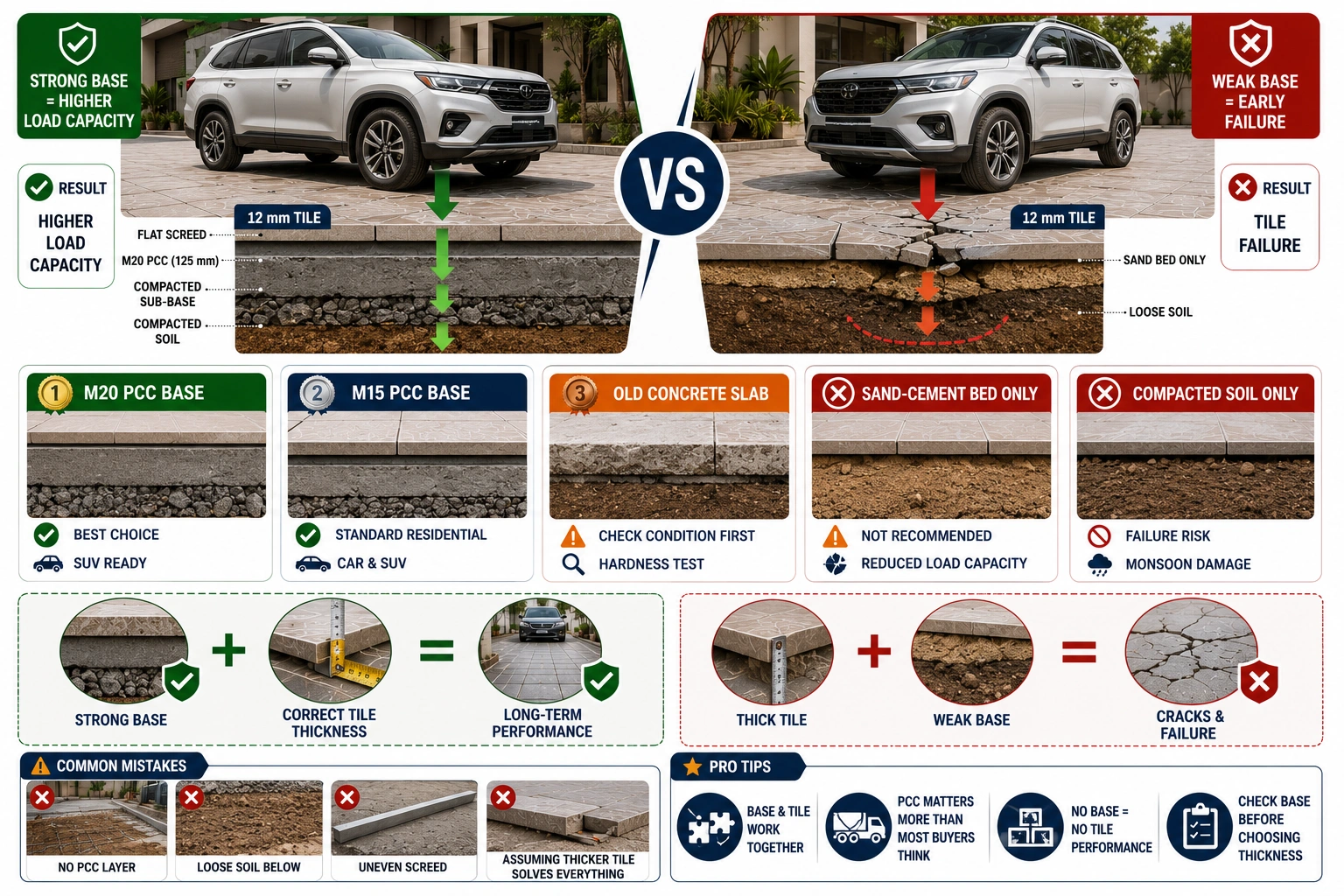
The thickness requirement for a tile is not fixed. It depends heavily on how solid the support below the tile is. A tile on a properly cured M20 PCC base with a well-compacted semi-dry mortar screed needs less thickness to handle the same load than the same tile on a sand bed over loose soil. The base multiplies or reduces the tile's effective load capacity.
| Base Condition | Effect on Required Tile Thickness | Indian Field Reality |
|---|---|---|
| M20 PCC (125mm), fully cured, flat screed | Reduces required thickness by one grade (12mm handles SUV loads) | Best practice: used in well-supervised projects |
| M15 PCC (100mm), fully cured, flat screed | Standard requirement: use specified thickness without reduction | Common in residential projects |
| Sand-cement bed only (no PCC) | Increases required thickness by one grade; not recommended for vehicles | Still seen in older society driveways and low-cost projects |
| Compacted soil only (no concrete base) | Tile cannot be used for any vehicle load; it will fail in the first monsoon | Common mistakes in self-built rural driveways |
| Old existing concrete slab (condition unknown) | Commission a hardness test; if solid and flat, treat as M15 base | Common in renovation or resurfacing scenarios |
Important: Tile thickness specifications in this guide assume a proper PCC base, correct slope, drainage planning, and expansion joints. Refer to this Parking Tile Installation Guide for the complete installation process before finalising tile thickness. If the base is inadequate, no tile thickness will prevent failure. The base and the tile work as a system, not independently.
Parking Tile Thickness by Use Case: The Full Decision Guide
The four thickness grades available in the Indian market for parking tiles are 9mm, 12mm, 15mm, and 18mm and above. Each has a defined load envelope. Using a lower grade outside its envelope is what causes failures. Using a higher grade than needed is safe but adds cost and weight.
9mm Tiles: What They Handle and Where They Fail
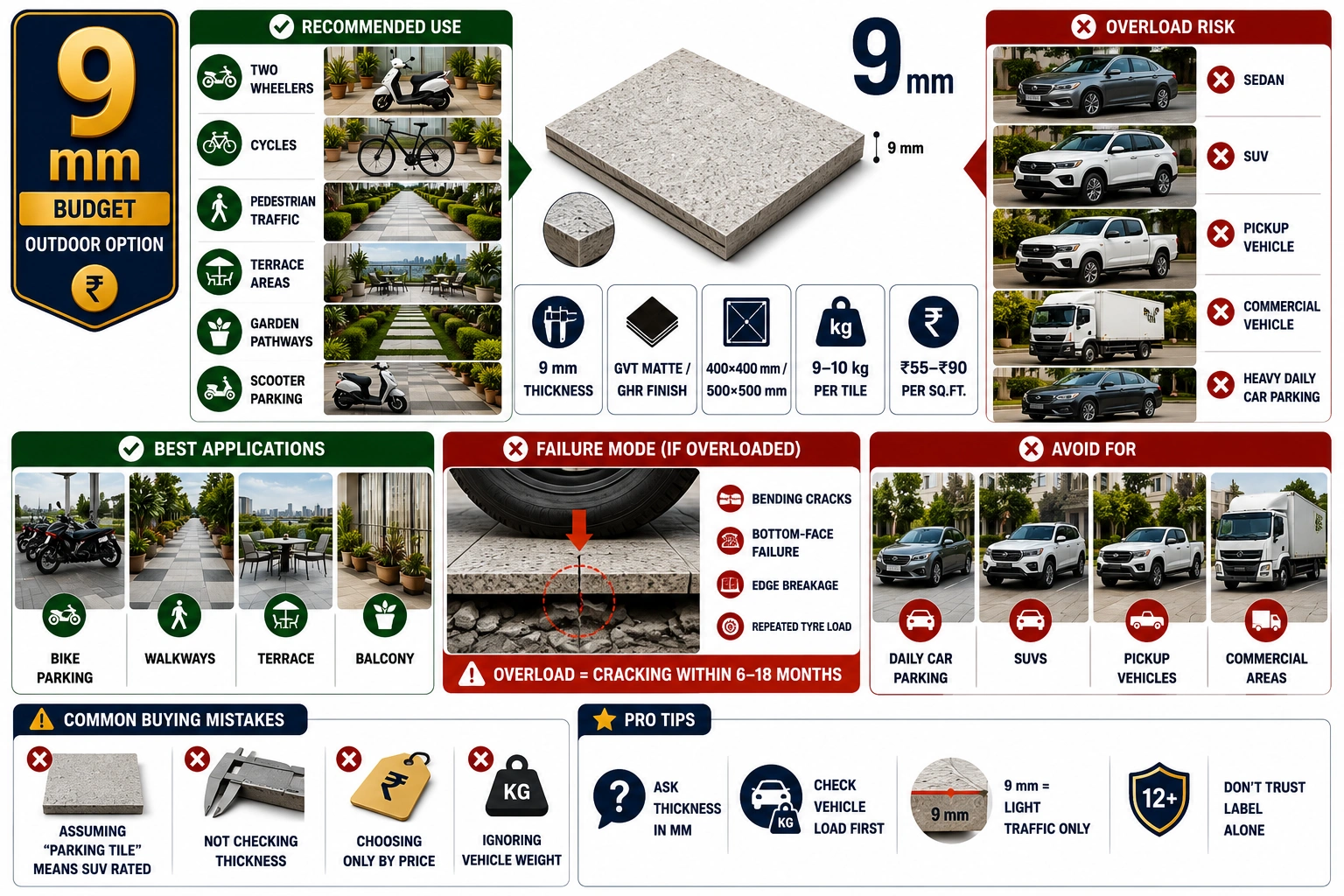
9mm is the lightest specification available for outdoor use in India. At this thickness, GVT tiles in matte or GHR finish are the primary product. Most 400x400 mm (16x16) and 500x500 mm (20x20) outdoor parking tiles sold in Indian hardware shops are 9mm grade, which is why they are priced attractively and why they fail under heavier Indian vehicles.
| Parameter | 9mm Tile Specification |
|---|---|
| Typical Indian market availability | GVT matte, GHR finish in 400x400 and 500x500 mm; some 600x600 mm |
| Approximate weight per tile (600x600) | Around 9 to 10 kg per tile |
| Suitable vehicle load | Two-wheelers, cycles, and light pedestrian traffic only |
| Conditionally suitable for | Hatchbacks on M20 PCC base with full screed; not recommended for daily use |
| Not suitable for | Sedans, SUVs, pickup vehicles, and commercial vehicles |
| Failure mode if overloaded | Bottom-face bending crack under repeated tyre load; typically appears within 6 to 18 months |
| Typical price range (GVT matte) | Rs. 55 to Rs. 90 per sq. ft. |
| Best application in the Indian context | Two-wheeler parking bays, pedestrian pathways, terrace and balcony floors |
Important: 9mm tiles are widely sold in Indian markets as 'parking tiles' without load qualifications. Many dealers do not specify thickness unless asked. Always ask for the tile's thickness in millimetres before purchasing for any application where a four-wheel vehicle will park or drive. A tile labelled 'parking tile' in a showroom is not automatically rated for SUV load.
12mm Tiles: The Correct Specification for Most Indian Home Parking
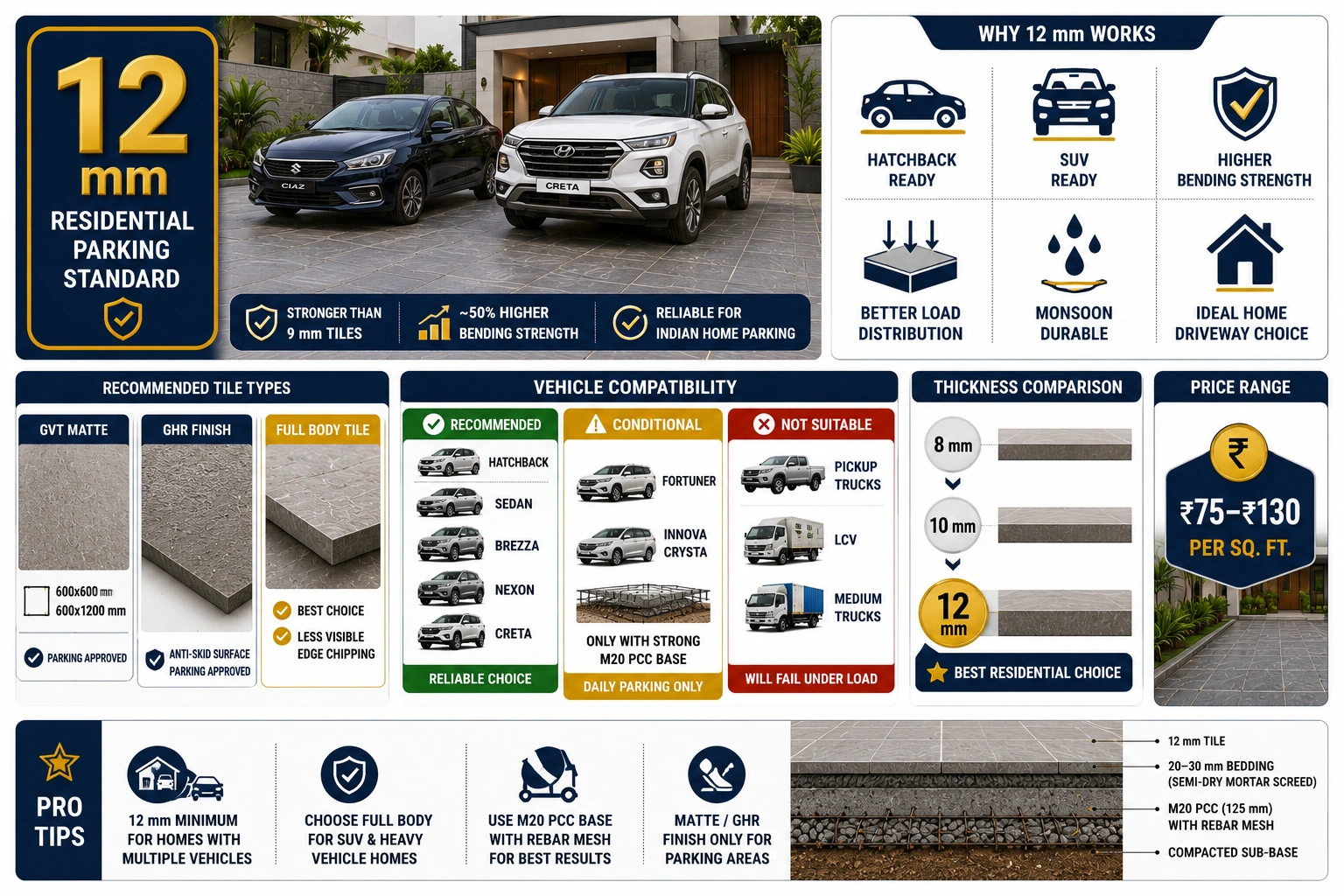
12mm is the working standard for residential car parking in India and covers the majority of home driveways from hatchbacks to large sedans reliably. The extra 3mm over 9mm tiles increases the bending resistance by roughly 50% (since bending strength scales with the square of thickness), which is why 12mm handles sedan and compact SUV loads that 9mm cannot.
Most quality GVT brands in India offer their matte and GHR parking tile ranges in 12mm thickness in the 600x600 mm (2x2) and 600x1200 mm (2x4) formats. Full-body tiles in 12mm are also available from leading manufacturers and are the preferred choice for home driveways where SUVs are present.
| Parameter | 12mm Tile Specification |
|---|---|
| Typical Indian market availability | GVT matte/GHR in 600x600 and 600x1200 mm; Full Body in the same sizes; some Colour Body |
| Approximate weight per tile (600x600) | Around 14 to 16 kg per tile |
| Suitable vehicle load | Hatchbacks, sedans, compact SUVs (Brezza, Nexon, Creta) reliably; full-size SUVs conditionally |
| Conditionally suitable for | Fortuner, Innova Crysta on M20 PCC with full rebar mesh base; daily parking, not repeated entry/exit cycles at speed |
| Not suitable for | Loaded pickup vehicles, LCVs, and medium trucks |
| Failure mode if borderline overloaded | Edge chipping at grout joints over time under repeated turning movement; corner cracking under impact kerbing |
| Typical price range (GVT matte, 12mm) | Rs. 75 to Rs. 130 per sq. ft. |
| Best application in the Indian context | Home driveway for 1 to 2 cars, housing society standard parking bays, clean parking areas for hatchback-to-sedan range |
Pro Tip: For driveways shared between a compact hatchback and an Innova or Fortuner, always specify 12mm as the minimum and choose the Full Body category over the standard GVT. Full Body tiles have the same colour through the entire thickness, so even if edge chips appear under heavy load, they are less visible than on a surface-glazed GVT tile.
15mm Tiles: When to Upgrade Beyond Standard Specification
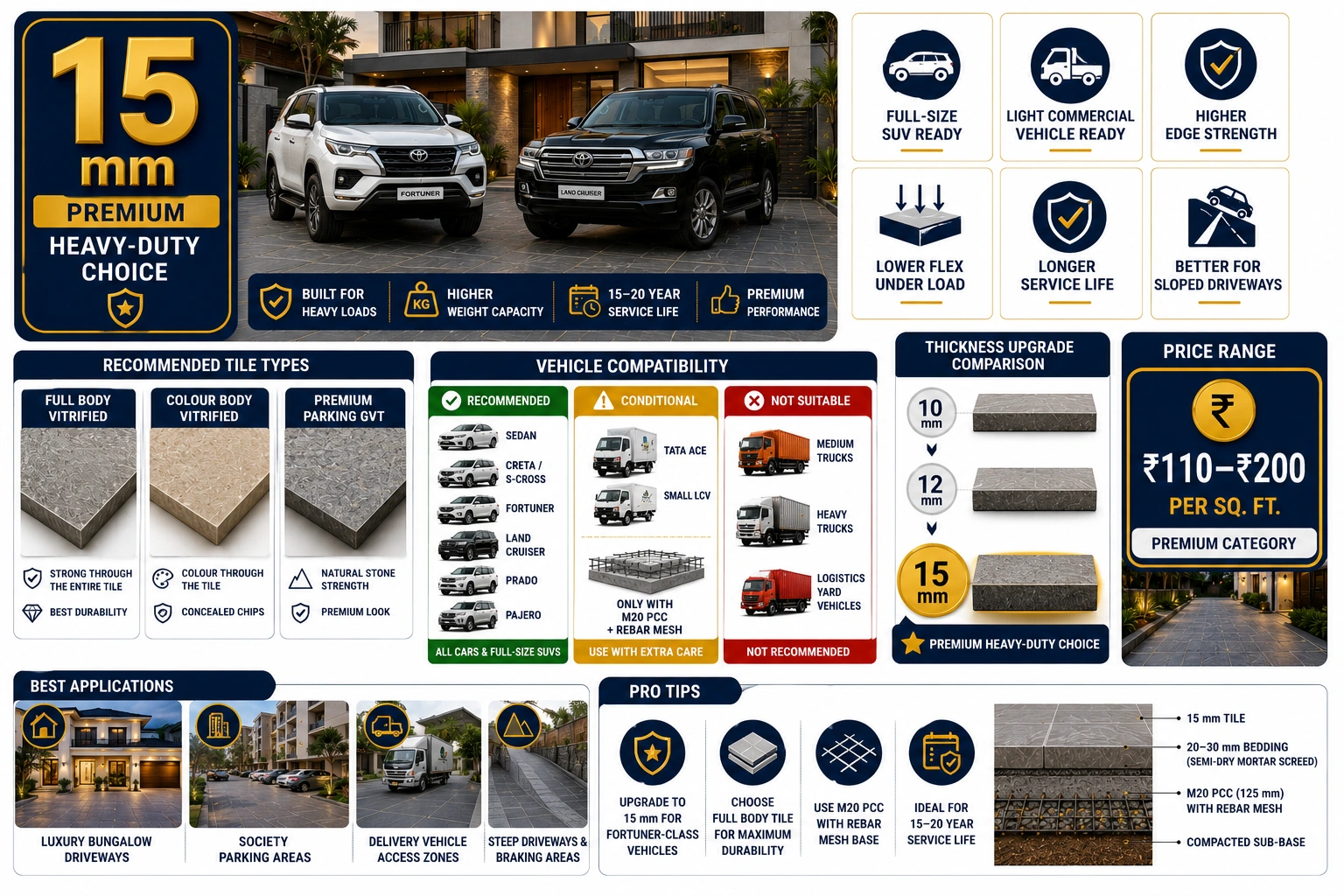
15mm becomes the correct specification when the driveway regularly carries full-size SUVs above 2,000 kg, light commercial vehicles, or when the project demands a 15 to 20 year service life without tile replacement under normal Indian conditions. It is also the right choice when the base quality is uncertain or when the driveway slope is steep enough to create braking loads in addition to static vehicle weight.
In the Indian market, 15mm parking tiles are less widely stocked than 9mm or 12mm. Full Body vitrified, Colour Body vitrified, and high-grade natural stone tiles are the main categories available at 15mm thickness. Some premium GVT brands offer 15mm in select parking series. Prices are higher, and fewer dealers stock them as standard inventory, so lead time must be factored into project planning.
| Parameter | 15mm Tile Specification |
|---|---|
| Typical Indian market availability | Full Body vitrified, Colour Body vitrified, premium GVT parking series, natural stone (Kota, granite) |
| Approximate weight per tile (600x600) | Around 20 to 22 kg per tile; installation requires two-person handling |
| Suitable vehicle load | All cars, full-size SUVs (Fortuner, Pajero, Land Cruiser), reliable, loaded pickup vehicles, conditionally |
| Conditionally suitable for | Tata Ace and similar LCVs under GVW on solid M20 PCC with rebar |
| Not suitable for | Medium or heavy trucks; dedicated logistics yards |
| Advantage over 12mm | Significantly lower flex under tyre load; better edge integrity; longer service life under repeated heavy cycles |
| Typical price range (Full Body, 15mm) | Rs. 110 to Rs. 200 per sq. ft.; natural stone varies by grade |
| Best application in the Indian context | Bungalow driveways with Fortuner/Prado/Patrol class vehicles; society compounds with delivery vehicle access; long driveways with steep braking zones |
18mm and Above: Commercial Parking Specifications
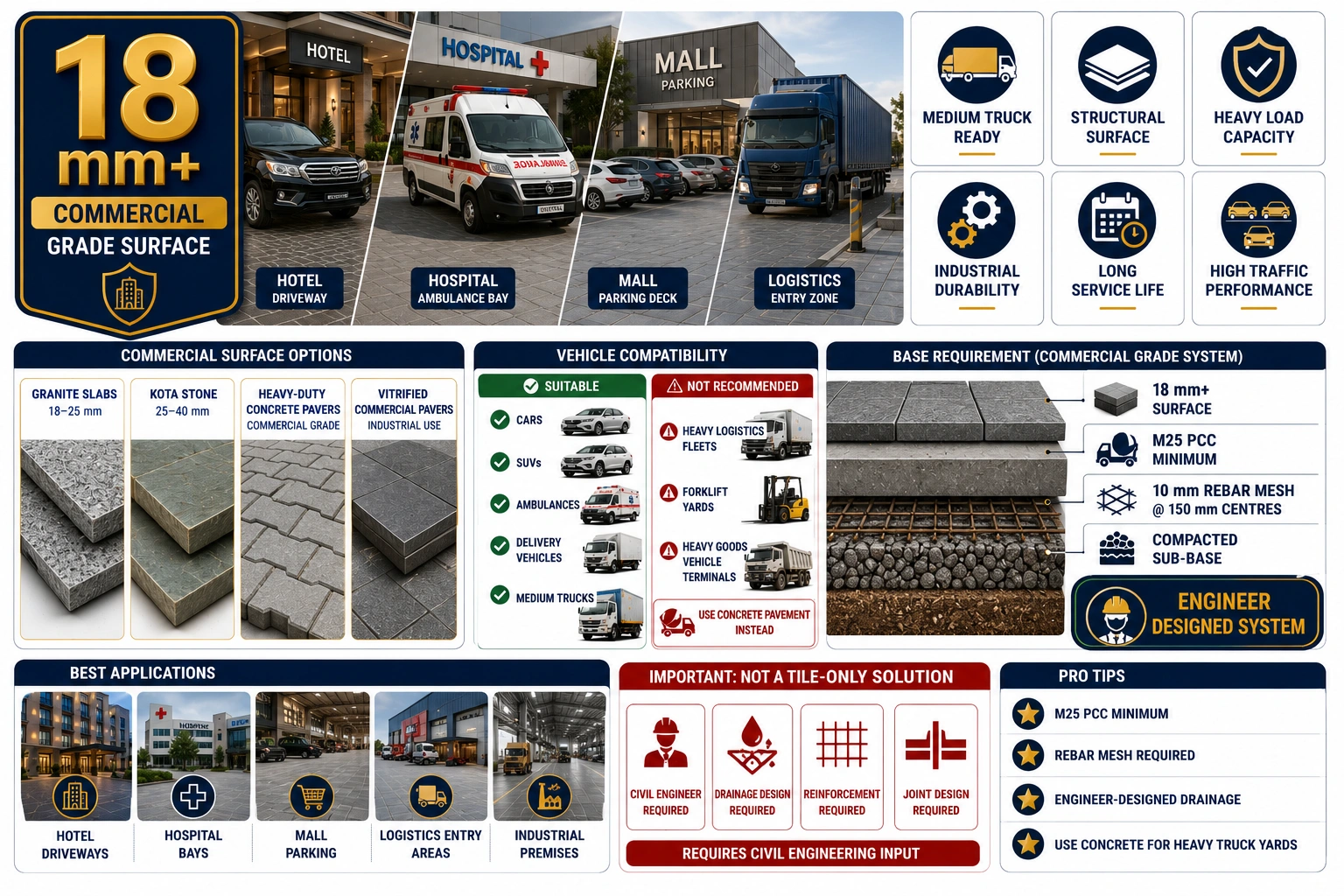
18mm tiles and thicker move outside the standard Indian residential tile market into industrial and commercial specification territory. At this thickness, natural stone (granite, Kota stone, sandstone), heavy-duty concrete pavers, and specialist vitrified commercial tiles are the primary products.
At 18mm and above, the tile transitions from a cladding material to a structural surface element. The sub-base specification also changes: minimum M25 PCC with 10mm rebar mesh at 150mm centres is required for commercial vehicle zones. Civil engineering input is required for these specifications and should not be based solely on this guide.
| Parameter | 18mm and Above Specification |
|---|---|
| Main products available in India | Granite slabs (18 to 25mm), Kota stone (25 to 40mm), heavy vitrified commercial pavers, and concrete tiles |
| Suitable vehicle load | All passenger vehicles, light commercial vehicles, and medium trucks on the M25 base with full reinforcement |
| Applications in India | Hotel and resort driveways, mall parking decks, hospital ambulance bays, logistics park entry zones |
| Not a tile-only solution | Requires a civil engineer for base design, drainage, and joint specification |
| When to use instead of tiles | Regular medium truck access, forklift zones, heavy goods vehicle yards; concrete is often the more practical choice here |
Quick Reference: Thickness by Vehicle Type and Use Case
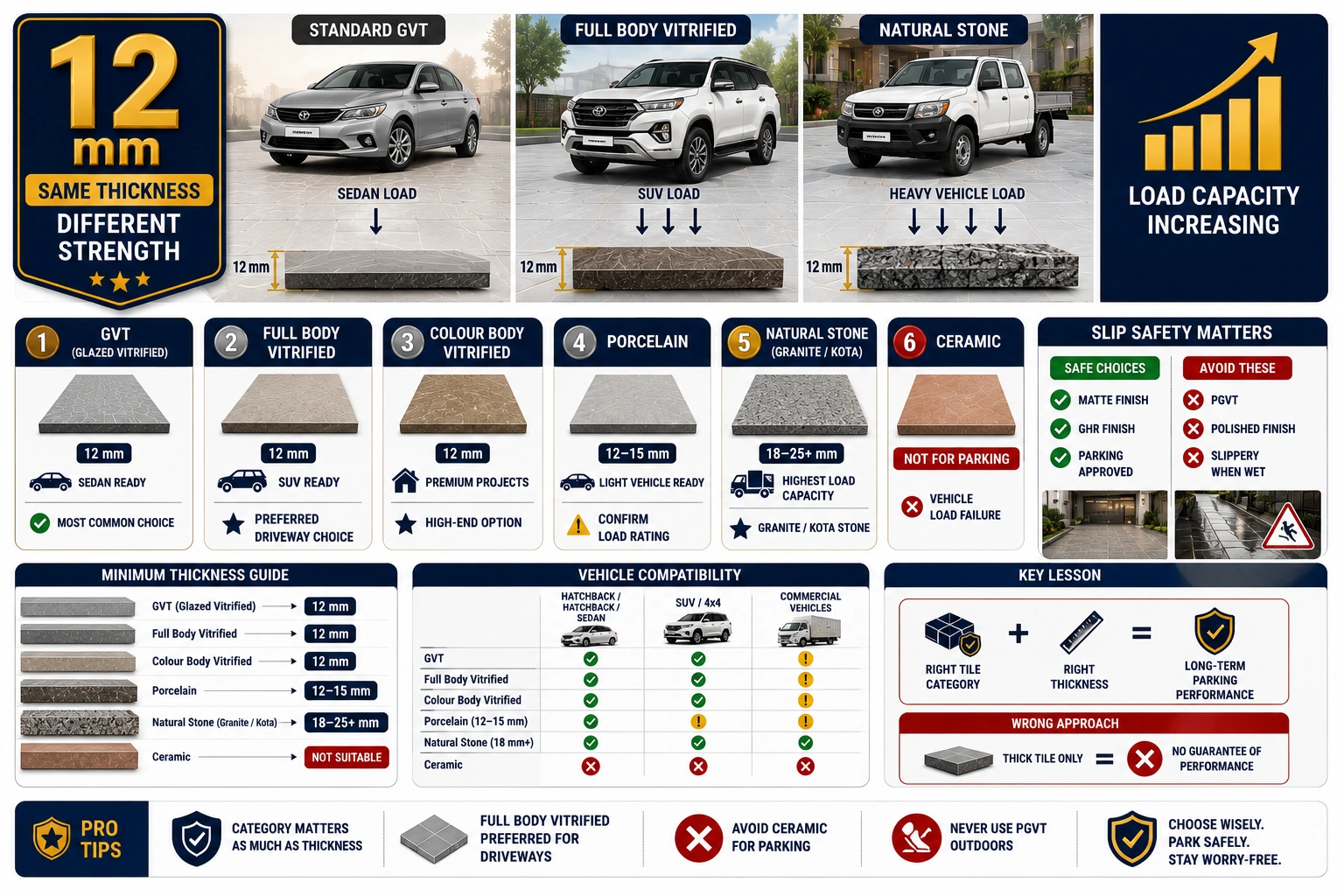
Use this table as the first check before specifying any parking tile project.
| Use Case / Vehicle Type | Minimum Thickness | Preferred Thickness | Tile Category | Notes |
|---|---|---|---|---|
| Two-wheeler parking only | 9mm | 9mm | GVT matte / GHR | Solid PCC base still required |
| Hatchback (Alto, i20, WagonR) | 9mm | 12mm | GVT matte / GHR | 12mm strongly preferred; 9mm only on M20 base |
| Sedan (City, Verna, Ciaz) | 12mm | 12mm | GVT matte or Full Body | Do not use 9mm for sedans |
| Compact SUV (Brezza, Nexon, Creta) | 12mm | 12mm Full Body | Full Body or Colour Body vitrified | GVT acceptable; Full Body preferred at edges |
| Full-size SUV (Innova, Fortuner, Safari) | 12mm | 15mm | Full Body vitrified or natural stone | 12mm on M20 base with rebar; 15mm recommended for comfort margin |
| Society compound (mixed vehicles) | 12mm | 15mm | Full Body vitrified | Plan for the largest vehicle present; 15mm gives headroom for delivery vans |
| Loaded pickup or LCV (Tata Ace, Bolero P/U) | 15mm | 15mm + M20 rebar base | Full Body or granite | Tile at the limit; confirm with the civil engineer if frequent loading is used |
| Medium truck or heavy goods vehicle | Not recommended | Use concrete or stone | Granite / concrete paver | Tile not suitable for regular medium truck traffic |
How Tile Category Affects Thickness Requirements
Two tiles can be the same thickness but carry different loads depending on their material category. A 12mm Full Body vitrified tile handles more than a 12mm standard GVT tile of the same size because its body composition, firing temperature, and hardness differ. This is why category selection and thickness are inseparable decisions.
| Tile Category | Body Composition | Hardness Advantage for Parking | Minimum Thickness for 4-Wheeler | Notes |
|---|---|---|---|---|
| GVT (Glazed Vitrified) | Vitrified body, surface glaze | Good; glaze adds surface hardness | 12mm for sedans; 9mm for hatchback only | Most widely available parking tile in India; adequate for most home driveways |
| Full Body Vitrified | Colour and texture through full thickness | Better than GVT; no glaze-body interface to crack | 12mm for all passenger vehicles | Preferred for driveways; chip edges stay the same colour as the surface |
| Colour Body Vitrified | Body shade matches surface design | Similar to Full Body, the premium segment | 12mm for all passenger vehicles | High-end projects; limited parking-specific range |
| Porcelain | Fine kaolin clay, dense but softer than vitrified | Moderate; harder than ceramic, softer than GVT | 12mm for light 4-wheelers; 15mm for SUVs | Good for premium home driveways; confirm load rating with dealer |
| Natural stone (Kota, Granite, Sandstone) | Natural rock; no glaze layer | Excellent for thick grades; stone hardness throughout | 25mm minimum (Kota stone); 18mm granite | Highest load capacity; sealing required; installation heavier |
| Ceramic | Clay body, higher porosity | Poor; not rated for outdoor vehicle load | Not suitable for any vehicle parking | Do not use for parking, regardless of thickness |
| PGVT / Polished finishes | Vitrified body with polished surface | Body adequate; surface dangerously slippery when wet | Not suitable for vehicle parking (slipping risk) | Never use polished tiles on any outdoor driving or parking surface |
How Tile Size Interacts with Thickness
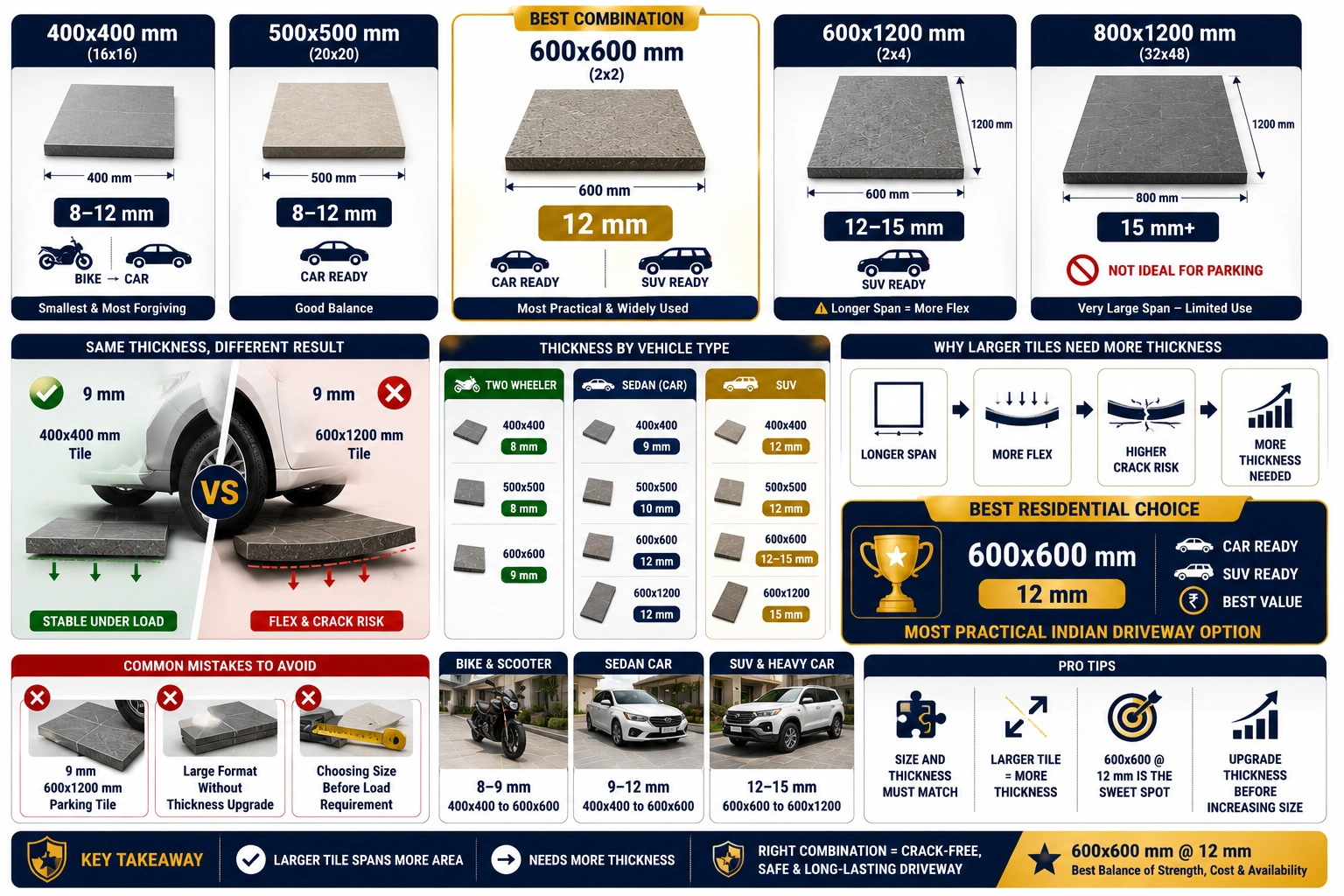
Larger tiles require more thickness for the same load because they span a larger unsupported area between mortar contact points. A 16x16 tile (400x400 mm) at 9mm may handle a small car on a solid base, but a 600x1200 mm (2x4) tile at the same 9mm thickness will flex and crack under the same load because it spans three times the area with the same cross-section.
The relationship is not linear. Bending stiffness scales with the cube of thickness and inversely with the square of the span. Practically, this means that as tile size increases, you must increase thickness more aggressively than the size change alone would suggest.
| Tile Size | Minimum Thickness for Two-Wheeler | Minimum Thickness for Car (Sedan) | Minimum Thickness for SUV | Notes |
|---|---|---|---|---|
| 400x400 mm (16x16) | 8mm | 9mm | 12mm | Smallest common parking size; most forgiving on thickness |
| 500x500 mm (20x20) | 8mm | 10mm | 12mm | Good balance of size and thickness efficiency |
| 600x600 mm (2x2) | 9mm | 12mm | 12 to 15mm | Standard Indian driveway format; most 12mm tiles are this size |
| 600x1200 mm (2x4) | 10mm | 12mm | 15mm | Longer span increases flex under load; do not use 9mm for any vehicle |
| 800x1200 mm (32x48) | Not recommended for parking | 15mm minimum if used | Not recommended | Very large format; span too great for most parking loads; use only on exceptional bases |
Pro Tip: The 600x600 mm (2x2) format at 12mm thickness is the most practical combination for the widest range of Indian residential parking applications. It balances load capacity, ease of installation, availability across Indian dealers, and cost per square foot better than any other size-thickness combination. For SUV-heavy driveways, move to the Full Body category at 12mm before jumping to 15mm, as the Full Body in 12mm handles most full-size SUV loads.
The Full Load Path: Tile, Screed, PCC, and Soil Working Together
Tile thickness does not work in isolation. The load from a vehicle tyre passes through the tile, through the mortar screed, into the PCC base, and is distributed into the sub-base soil. Each layer must be specified to carry what the layer above delivers to it. Specifying a 15mm tile on a 50mm sand bed is like putting premium tyres on a car with broken axles.
| Layer | Function in Load Path | Minimum Spec for SUV Load | What Failure Looks Like |
|---|---|---|---|
| Tile | Direct load receiver; bending resistance | 12mm Full Body or 15mm GVT minimum | Crack from base upward; hollow sound |
| Mortar screed (bedding) | Load distribution into PCC; slope correction | 25 to 40mm semi-dry 1:4 mix; fully compacted | Hollow spots; tile debonds and cracks at the void edge |
| PCC base | Primary structural layer; prevents sub-base flex from reaching the tile | M20, 125mm minimum with 8mm rebar for SUV | PCC cracks, heaves at cold joints, tile above follows |
| Granular sub-base | Drainage prevents clay expansfrom ion reaching the CC | 150mm compacted gravel or moorum | PCC settles unevenly; the tile field develops dips |
| Native soil | Final load sink | Compacted, tested for bearing; black cotton soil must be replaced | Long-term settlement, tilting, and cracking field-wide |
When a parking tile project is over-specified on tile and under-specified on base, the tile acts like a rigid lid over a problem that is getting worse every monsoon. When the base fails, the tiles above it fail simultaneously across a section, not one by one. This is why society compounds and large driveway projects should have a civil engineer review the full load path specification before any work starts.
Common Tile Thickness Mistakes in Indian Parking Projects
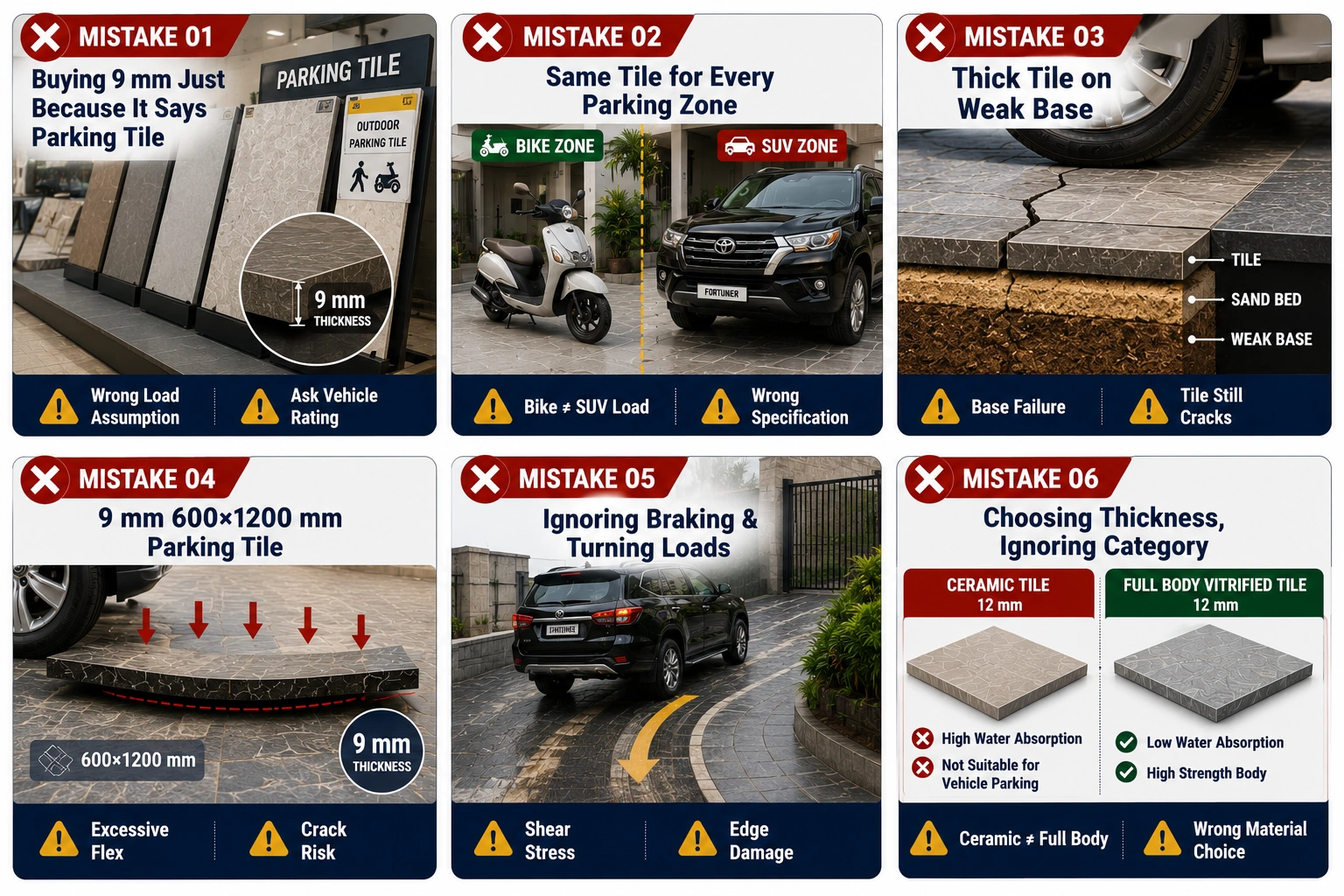
Buying 9mm tiles because they are labelled 'parking tiles' in the showroom. The word 'parking tile' on a product display refers to the tile's finish and outdoor suitability, not its load rating. 9mm tiles rated for pedestrian and two-wheeler use are routinely sold under this label. Always ask: what is the thickness in millimetres, and what is the maximum vehicle load this tile is rated for?
Using the same tile throughout when vehicle types differ in one driveway. A driveway that carries an Activa from the second floor and a Fortuner on the ground level needs different specifications for each zone. Tiling the entire compound with 9mm to save cost means the Fortuner zone fails within two years, even if the bike parking zone holds. Zone the specification to the load.
Assuming that a thicker tile fixes a bad base. A 15mm tile on a sand bed still fails under sedan loads. Thickness compensates for load, not for base inadequacy. If the base specification is wrong, no tile thickness will save the installation. Fix the base before upgrading the tile.
Using 600x1200 mm tiles at 9mm on parking floors. Large-format tiles at minimum thickness create the worst possible bending scenario. The long span of a 600x1200 mm tile multiplies the flex under a tyre load in the middle of the tile. For 600x1200 mm parking tiles, 12mm is the absolute minimum regardless of vehicle type.
Not accounting for braking and turning loads in the thickness specification. Static vehicle weight is one load. A vehicle braking hard on a driveway slope, or turning tightly on a compact driveway, creates additional shear and impact forces on the tile surface. Driveways with a steep entry ramp or tight turning radius should be specified one thickness grade higher than the vehicle's static load alone would require.
Specifying thickness correctly, skipping the tile category. A 12mm ceramic tile and a 12mm Full Body vitrified tile are not equivalent. Ceramic at any thickness is unsuitable for vehicle parking because of its water absorption and lower body strength. Thickness without the right category is an incomplete specification.
Specifying Thickness Correctly Before the First Tile Is Laid
Parking tile thickness is a structural decision, not a product preference. The wrong thickness adds no visible cost until the day a tile cracks under a tyre and an entire section needs to be removed and relaid at three times the original cost.
The sequence is always the same: identify the heaviest vehicle that will regularly use the driveway, confirm the base specification, match the tile category to the load, and then select the correct thickness for that combination. Skipping any step in this sequence moves the failure risk from 'very low' to 'when, not if'.
For most Indian home driveways carrying a mix of hatchbacks and compact SUVs, 600x600 mm Full Body vitrified at 12mm on an M20 PCC base covers the application well and is available from most quality Indian tile manufacturers. For premium bungalow driveways with Fortuner or Land Cruiser class vehicles, move to 15mm and confirm the PCC specification includes rebar.
Before finalising your purchase, compare tile thickness, finish type, load rating, and category rather than focusing only on colour or size. Platforms like TilesFinders make this easier by allowing homeowners to filter parking tiles by specification across verified Indian dealers, helping avoid costly selection mistakes that only become visible after installation.
FAQs
The minimum tile thickness for any vehicle parking in India is 9mm, and only for two-wheelers and light pedestrian traffic on a proper PCC base. For hatchbacks and above, 12mm is the minimum practical specification. For full-size SUVs like the Fortuner or Innova Crysta on a regular home driveway, 12mm Full Body vitrified on a M20 PCC base with rebar is the minimum, and 15mm provides a more reliable long-term result.
9mm tiles can be used under a hatchback on a solid M20 PCC base as a minimum, but this is not recommended for daily long-term use. For sedans, compact SUVs, and anything heavier, 9mm tiles will develop bending cracks over time, regardless of how good the base is. The bending stiffness of a 9mm tile is not sufficient for repeated tyre point loads from passenger car weights. Use 12mm as the starting specification for any four-wheel vehicle parking.
12mm Full Body vitrified tiles on a properly constructed M20 PCC base with 8mm rebar mesh will handle Innova and Fortuner class vehicles in a home driveway with normal use. The specification is at the upper limit of its load envelope for these vehicles, which is why 15mm is the more comfortable recommendation if the budget allows. For repeated daily entry and exit cycles with heavy braking on a slope, 15mm gives significantly better long-term performance.
Standard vitrified or ceramic parking tiles are not rated for medium and heavy-truck traffic. Light commercial vehicles like a Tata Ace under GVW can be accommodated on a 15mm Full Body vitrified on an M20 rebar PCC base, but this is at the limit of tile application for commercial vehicle loads. For regular truck access, granite stone (18 to 25mm) or concrete pavers are the appropriate surface materials, not tiles.
Yes, directly. Larger tiles flex more under the same load because they span a greater unsupported area. A 400x400 mm tile at 9mm handles more than a 600x1200 mm tile at the same thickness. For 600x1200 mm format tiles used in parking areas, 12mm is the absolute minimum regardless of vehicle type. For the most common home driveway combination (600x600 mm tiles), 12mm handles most passenger vehicle loads on a proper PCC base.
Both are 12mm thick, but their body composition differs in ways that matter for parking. GVT has a surface glaze layer over a vitrified body. If the tile chips at an edge or corner under tyre impact, the chip exposes the body below the glaze, which looks different. Full Body vitrified has the same colour and composition through the entire 12mm thickness, so edge chips are less visible, and the structural integrity is more uniform under load. For parking driveways, Full Body is the preferred choice at 12mm when the budget allows.
Full-body vitrified tiles in 12mm (for most full-size SUVs on a proper PCC base) or 15mm (for high-load or long-service-life applications) are the best Indian market option for heavy SUV parking. Full Body tiles offer consistent strength through the tile thickness, good surface hardness in matte or GHR finish, and better edge resistance than standard GVT at the same thickness. Natural stone such as granite or Kota stone in 20mm and above is the next step up for applications approaching light commercial vehicle loads.

See our tile guides first
Set TilesFinders as a preferred source and our buying guides surface ahead of the rest for you.
Add as preferred sourceTakes one tap. Nothing to install.
What Readers Say
I was about to redo my parking area with the wrong tile size until I read this. The layout comparisons saved me from a costly mistake.
We reference TilesFinders guides while briefing clients on material selection. The size and pattern breakdowns are accurate and easy to explain visually.
On site, I get asked about grout spacing all the time. This article gave me a solid reference I now share with my team before every job.
Finally a guide that doesn't just push generic advice. The oil stain removal steps actually worked on our clubhouse driveway tiles.
I run a small construction firm and now send this link to clients directly when they ask about entrance tile sizing. Saves me an hour of explaining.
Good practical detail, though I wish there were more examples for compact apartment entrances specifically, not just villas.
My mother-in-law wanted marble, I wanted vitrified. This blog gave us the neutral comparison we needed to actually decide together.
Detailed without being overwhelming. I appreciated that it covered both cost and maintenance, not just the aesthetics.
Used the algae and hard water removal tips on our terrace tiles after the monsoon. Worked better than what our regular cleaner was doing.
As someone who sources tiles for multiple builder projects, I find these comparisons genuinely useful for vendor conversations, not just consumer content.
Recommended this to a client who kept second-guessing the entrance design. The small vs large layout section settled the debate instantly.
Straightforward and honest, no unnecessary jargon. Would like to see a similar breakdown for outdoor pool-deck tiles next.
We've bookmarked several TilesFinders guides for our design handbook. Reliable source when clients want data, not just opinions.
Two paths, one marketplace.
Get free quotes from verified suppliers.
Share your room, budget, and style. Suppliers in Morbi respond within hours.
Get Free QuotesList your business, reach real buyers.
Put your showroom in front of homeowners searching for tiles right now.
List Your Business