Top Tile Testing Labs & Certification Bodies in India
What IS 15622 actually tests, which labs certify Indian tiles, CGCRI and Morbi's regional testing, and the two-minute check to verify a BIS licence is real.
- What IS 15622 Actually Tests
- BIS: The Body That Makes Certification Mandatory
- CGCRI: India's Primary Government Ceramics Testing Institute
- Regional Labs: National Cera Lab and the Morbi Cluster
- International Bodies: SGS, Intertek, and TÜV
- Checking a Certification Is Real, Not Just Printed
- Verifying Compliance Before You Order in Bulk
BIS certification under IS 15622 is now mandatory for ceramic and vitrified tiles sold in India, verifiable through the BIS Care app, with CGCRI in Kolkata and regional labs like National Cera Lab in Morbi handling the underlying mechanical and chemical testing, and international bodies like SGS, Intertek, and TÜV covering export-grade certification.
A triangle with "ISI" printed inside it on a tile box means very little on its own. It's a claim, not proof, and the actual weight behind that claim comes from a small set of testing laboratories and certification bodies that most buyers never hear about, let alone know how to check. This guide covers what those institutions actually test, how the mandatory Indian certification system works, and the specific two-minute check that separates a genuine licence from a printed symbol with nothing behind it.
What IS 15622 Actually Tests
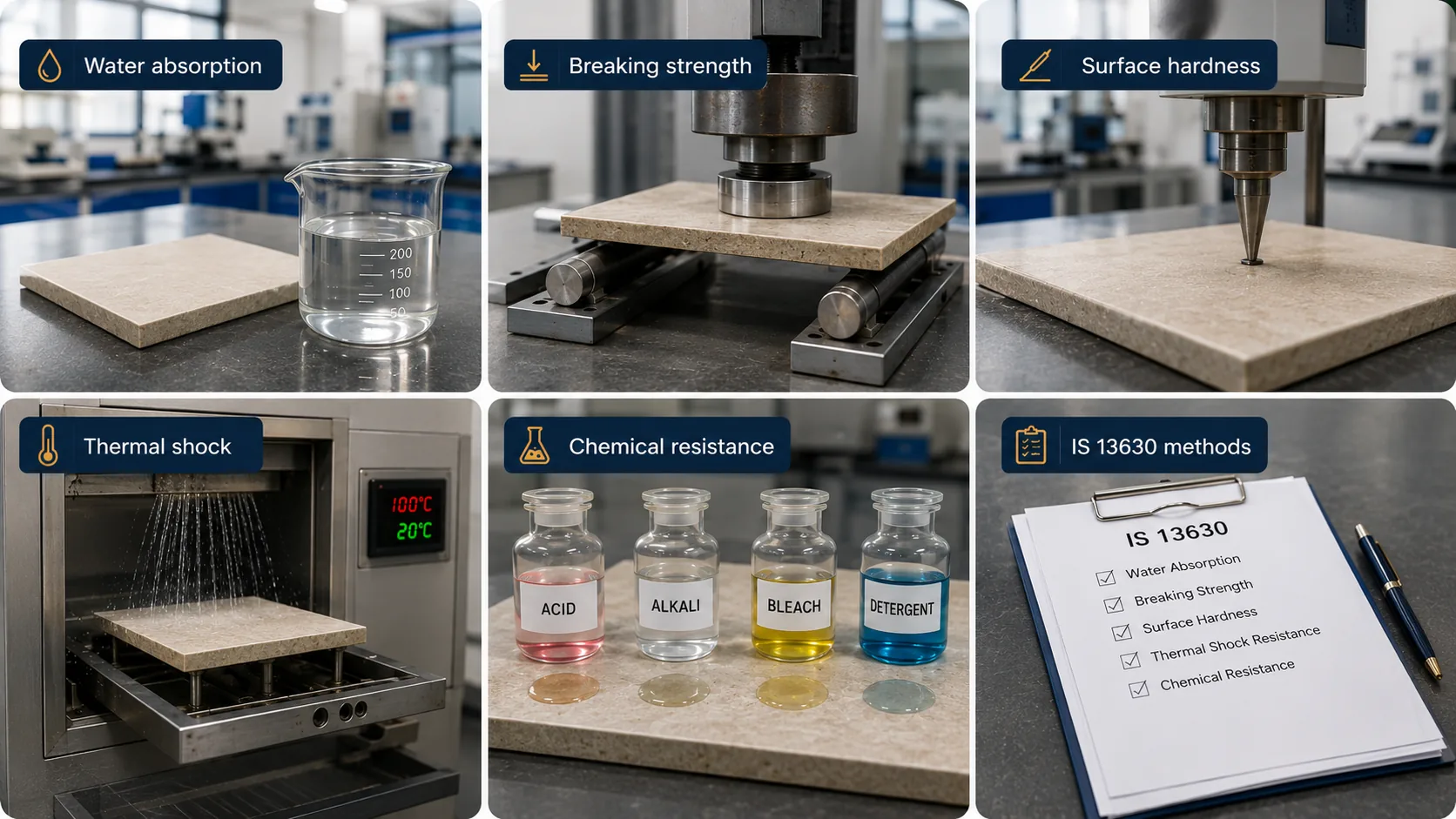
IS 15622, the Bureau of Indian Standards specification for ceramic and vitrified tiles, isn't a single pass-or-fail checkbox. It sets out specific thresholds across several measurable properties, and understanding what's actually being tested makes any certification claim easier to evaluate rather than just trust.
Water absorption is the headline figure, and the one most buyers already ask about, since it determines whether a tile is realistically ceramic, porcelain, or vitrified grade under Indian market classification. Beyond that, the standard covers breaking strength, essentially how much force the tile withstands before fracturing; scratch and surface hardness; thermal shock resistance, how the tile handles rapid temperature change without cracking; and chemical resistance against household cleaning agents and, for kitchen and bathroom applications, stronger substances. A separate multi-part testing standard, IS 13630, lays out the exact laboratory methods used to measure each of these properties consistently across different labs and manufacturers.
From The Marketplace
Popular tiles right now
-5964e477-fa88-4b26-b25e-30eedf69c0c1.jpg)
BIS: The Body That Makes Certification Mandatory
The Bureau of Indian Standards is the regulatory body behind all of this, and its role changed meaningfully in recent years: BIS certification for ceramic and vitrified tiles moved from a voluntary quality mark to a mandatory requirement under a formal quality control order. Every manufacturer selling vitrified or ceramic tiles in India now needs a valid BIS licence and the accompanying ISI mark, a genuine shift from the era when the mark was a nice-to-have differentiator rather than a legal baseline.
The certification process itself runs through several stages: documentation review, product testing at a BIS-recognised laboratory, factory inspection, technical scrutiny, and finally licence issuance. None of that happens instantly, and it's part of why counterfeit or expired ISI marks still show up in the market, particularly among smaller, less established sellers.
CGCRI: India's Primary Government Ceramics Testing Institute
The CSIR-Central Glass & Ceramic Research Institute, based in Kolkata, is the country's leading government-linked testing and research body for ceramics, glass, refractories, and related materials. Its Testing & Characterisation Cell evaluates mechanical strength, heat resistance, and chemical resistance against both national and international standards, serving manufacturers, exporters, academic institutions, and other laboratories.
CGCRI's role matters most visibly in export contexts, where an international buyer wants assurance beyond a manufacturer's own claims or even a domestic BIS certificate. A CGCRI test report, backed by a recognised CSIR institute rather than a private lab, carries specific credibility weight in that conversation, and reduces the kind of quality disputes that can derail an export relationship.
Regional Labs: National Cera Lab and the Morbi Cluster
Given that Morbi, Gujarat produces the large majority of India's tiles, it's no surprise the region has its own dedicated testing infrastructure rather than relying solely on Kolkata or Delhi-based institutions. National Cera Lab, based in Morbi, offers ceramic floor and wall tile testing services directly within the manufacturing cluster, alongside broader B2B chemical testing.
Regional labs like this exist for a practical reason: with hundreds of manufacturers concentrated in one area, having testing capacity embedded locally cuts turnaround time significantly compared to shipping samples to a centralised national lab for every batch or product line requiring verification.
International Bodies: SGS, Intertek, and TÜV
For manufacturers with serious export ambitions, particularly to the US, Europe, or the Gulf, domestic BIS certification alone often isn't enough. Global testing and certification groups including SGS, Intertek, and TÜV SÜD or TÜV Rheinland all maintain operations in India and provide ISO, CE, and other internationally recognised testing and certification services for building materials, tiles included.
The reason a manufacturer pays for this on top of BIS certification is straightforward: an international buyer's own import compliance process usually maps more directly onto a globally recognised certificate than a purely domestic one, even when the underlying quality bar is comparable. For a buyer specifically sourcing from an export-oriented Indian manufacturer, asking whether they hold any of these certifications alongside BIS is a reasonable extra diligence step.
Checking a Certification Is Real, Not Just Printed
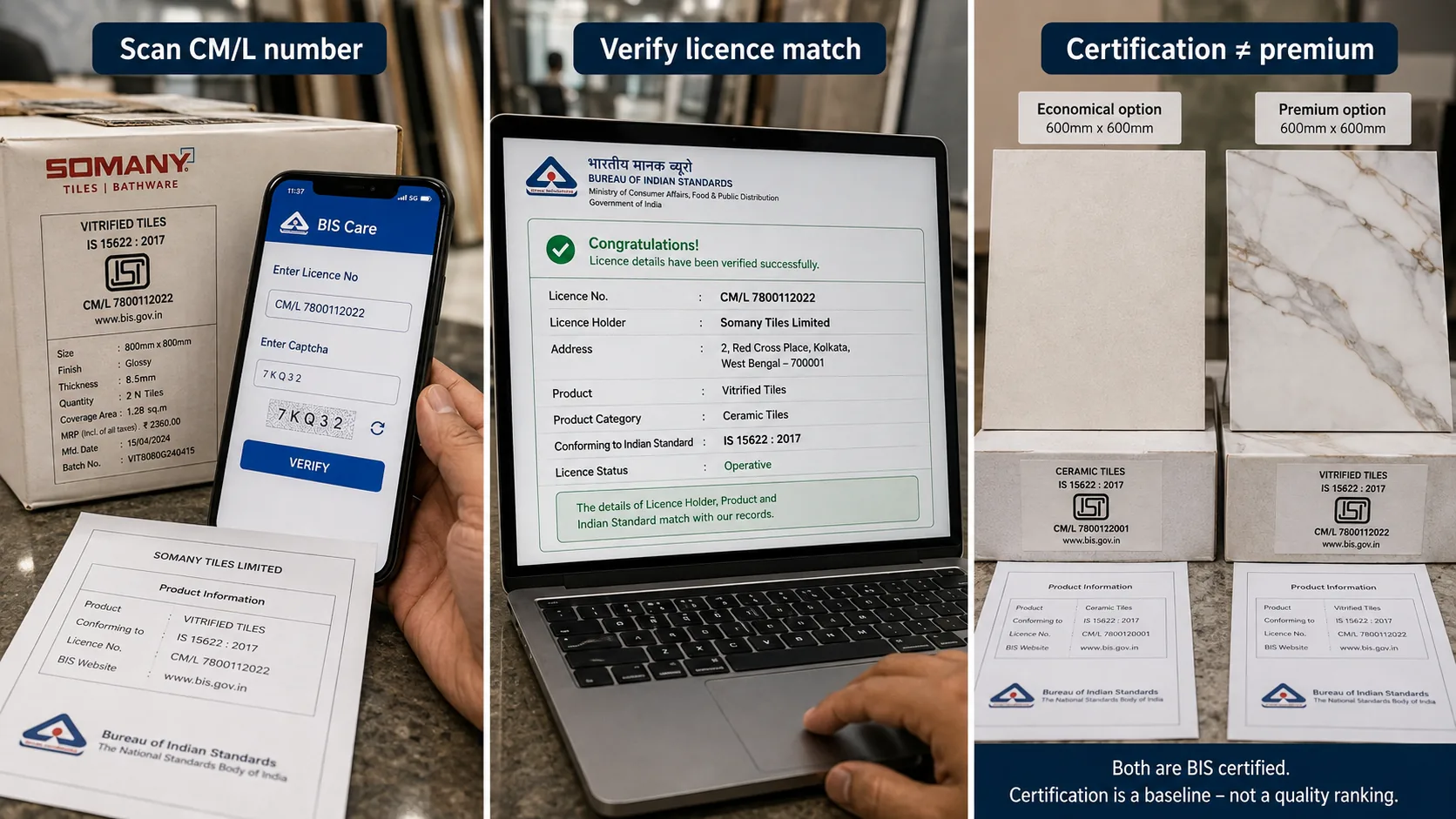
The gold-standard check takes about two minutes and works for any ceramic or vitrified tile sold in India. Download the free BIS Care app, or use the BIS web portal directly, and enter or scan the CM/L licence number printed on the box or the manufacturer's documentation. A genuine result returns the licence holder's name, the certified product category, and the relevant IS number. If that number doesn't return a match, or returns a different company entirely, treat it as a serious red flag rather than a paperwork oversight.
It's worth being clear about what certification does and doesn't tell you. A valid BIS licence confirms the tile meets IS 15622's baseline thresholds; it doesn't mean the tile is premium, doesn't guarantee shade consistency across batches, and doesn't cover design or aesthetic quality at all. Two tiles at very different price points can both carry a completely legitimate ISI mark. Certification is a floor, not a ranking.
Verifying Compliance Before You Order in Bulk
A licence number checks out or it doesn't, but confirming a supplier actually deals in compliant, traceable stock in the first place is a separate question entirely.
TilesFinders lists verified tile suppliers across India, useful as a starting point before you get to the paperwork stage of confirming a specific batch's certification.

FAQs
Yes, for ceramic and vitrified tiles specifically. Under the current IS 15622 quality control order, manufacturers must hold a valid BIS licence and carry the ISI mark. A dealer claiming a branded tile doesn't need one is either selling old non-compliant stock or something counterfeit.
Use the free BIS Care app or the BIS portal, and enter or scan the CM/L licence number printed on the box. It returns the licence holder's name, the certified product, and the relevant IS number, confirming the licence is real and current rather than expired or fabricated.
CGCRI evaluates mechanical strength, heat resistance, and chemical resistance against national and international standards, work that matters most for export credibility, since international buyers often want third-party verification beyond a manufacturer's own claims.
Not exactly. BIS certification confirms a tile meets the minimum thresholds set out in IS 15622, water absorption limits, breaking strength, and similar baseline properties, not that it's a premium or aesthetically superior product. A certified budget tile and a certified premium tile can both legitimately carry the same ISI mark.
Primarily for export. International buyers, particularly in the US, Europe, and the Gulf, often want testing and certification from a globally recognised third party rather than relying solely on a domestic certificate, since it maps more directly onto their own import compliance requirements.


Handpicked for You
See our tile guides first
Set TilesFinders as a preferred source and our buying guides surface ahead of the rest for you.
Add as preferred sourceTakes one tap. Nothing to install.
What Readers Say
I was about to redo my parking area with the wrong tile size until I read this. The layout comparisons saved me from a costly mistake.
We reference TilesFinders guides while briefing clients on material selection. The size and pattern breakdowns are accurate and easy to explain visually.
On site, I get asked about grout spacing all the time. This article gave me a solid reference I now share with my team before every job.
Finally a guide that doesn't just push generic advice. The oil stain removal steps actually worked on our clubhouse driveway tiles.
I run a small construction firm and now send this link to clients directly when they ask about entrance tile sizing. Saves me an hour of explaining.
Good practical detail, though I wish there were more examples for compact apartment entrances specifically, not just villas.
My mother-in-law wanted marble, I wanted vitrified. This blog gave us the neutral comparison we needed to actually decide together.
Detailed without being overwhelming. I appreciated that it covered both cost and maintenance, not just the aesthetics.
Used the algae and hard water removal tips on our terrace tiles after the monsoon. Worked better than what our regular cleaner was doing.
As someone who sources tiles for multiple builder projects, I find these comparisons genuinely useful for vendor conversations, not just consumer content.
Recommended this to a client who kept second-guessing the entrance design. The small vs large layout section settled the debate instantly.
Straightforward and honest, no unnecessary jargon. Would like to see a similar breakdown for outdoor pool-deck tiles next.
We've bookmarked several TilesFinders guides for our design handbook. Reliable source when clients want data, not just opinions.
Two paths, one marketplace.
Get free quotes from verified suppliers.
Share your room, budget, and style. Suppliers in Morbi respond within hours.
Get Free QuotesList your business, reach real buyers.
Put your showroom in front of homeowners searching for tiles right now.
List Your BusinessMore Blogs
See all
Children's Room Tiles in India: Safe, Fun, and Durable Flooring Complete Guide
Create a children's room floor that grows with your child. Discover safe tile finishes, durable m...
Read More
How to Calculate Tile Quantity and Wastage for Terraces and Balconies
Learn how to calculate tile quantity and wastage for terraces and balconies using layout formulas...
Read More
Terrazzo Tiles in India: Complete Guide to the Speckled-Surface Trend
From mid-century homes to modern design: compare genuine aggregate terrazzo with printed vitrifie...
Read More