Modern Elevation Tiles Design India: Architects' Picks
Discover modern elevation tiles for Indian homes, including stone, wood, concrete, and 3D designs. Compare finishes, sizes, costs, and architect-recommended facade ideas.
- Why the Exterior Wall is No Longer an Afterthought
- What Architects Actually Look For in Elevation Tiles
- How Indian Climates Change the Specification Game
- Types of Elevation Tiles Architects Specify Most in India
- Finish Guide: What Works on an Indian Exterior
- Tile Sizes Architects Prefer for Front Elevation Walls
- Modern Elevation Tiles Design Ideas for 2026
- Expert Tips Before Specifying or Buying Elevation Tiles
- Common Mistakes in Elevation Tile Selection
- Elevation Tiles Price Range in India (2026)
- Finding the Right Elevation Tiles for Your Project
The front wall of a house does more work than any other surface in the building. It faces the sun in summer, absorbs monsoon water for months, and carries the first impression of the property for decades. Architects across India know this. When they specify modern elevation tiles design India projects, they think about three things in parallel: how it looks on day one, how it holds up after five monsoons, and how easy it is for the client to keep clean.
Most homeowners pick elevation tiles by walking into a showroom and choosing whatever looks good under halogen lights. That approach fails regularly. A tile that looks warm and rich indoors can look washed out or glary on a sun-facing facade. A finish that seems bold in a sample can feel overwhelming across 300 sq. ft. of front wall.
This guide lays out what practising architects actually recommend for exterior wall cladding in Indian conditions, from tile categories and finishes to size combinations and common specification errors.
Why the Exterior Wall is No Longer an Afterthought
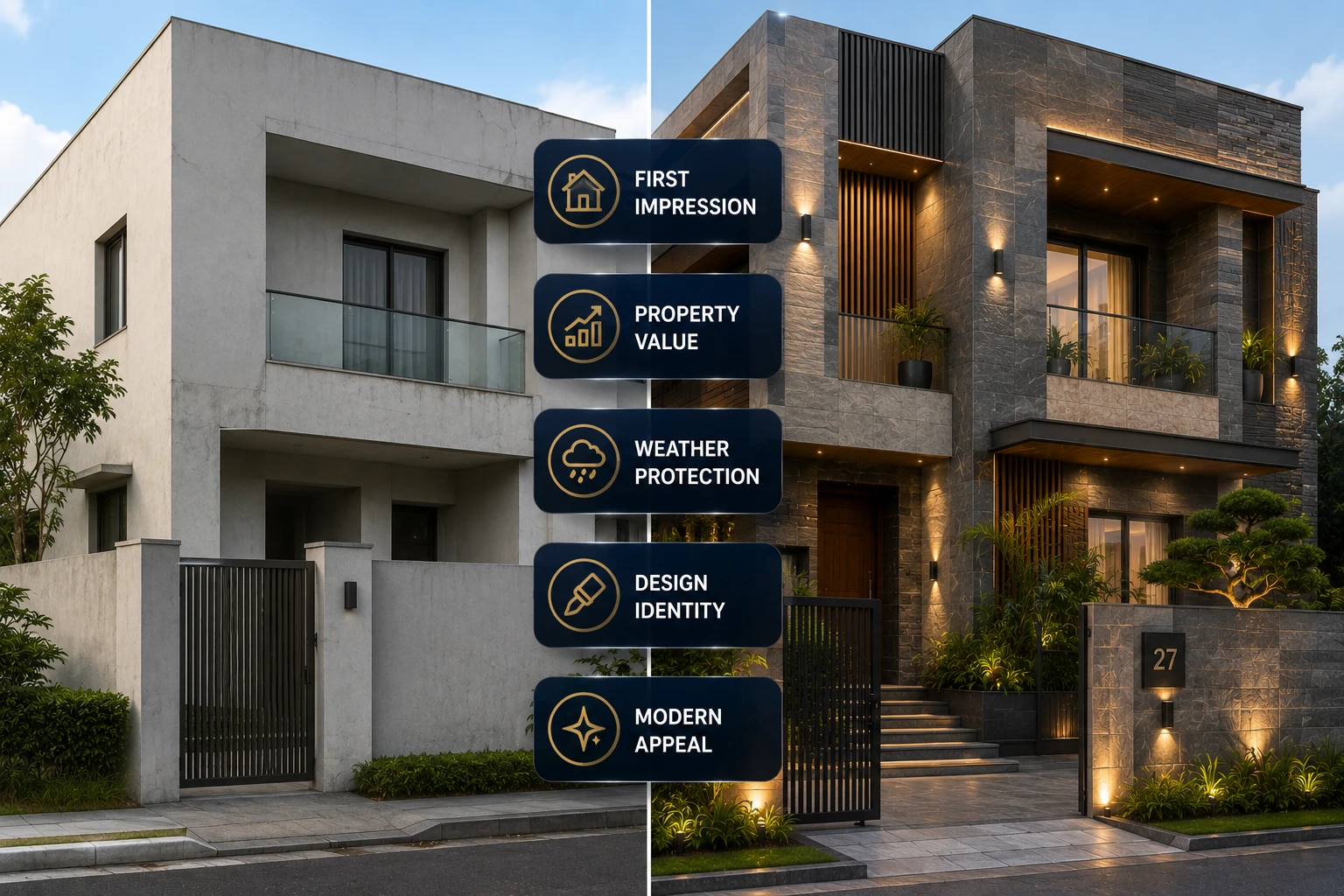
Ten years ago, most Indian homes had painted walls with maybe a stone cladding strip near the entrance. That thinking has changed. Exterior wall tiles for Indian homes have moved from an occasional upgrade to a standard specification on most new residential projects in cities like Bangalore, Pune, Hyderabad, and Ahmedabad.
The shift is partly practical. Paint needs reapplication every two to three years, especially in coastal cities like Mumbai, Chennai, and Kochi, where salt air and humidity accelerate deterioration. A well-laid tile cladding on an exterior wall can hold its appearance for fifteen to twenty years with basic cleaning. That calculus makes tile cladding financially sensible even for mid-range 3BHK and 4BHK projects.
The other driver is architectural: tiles give architects the ability to create textural contrast on otherwise plain concrete facades. A concrete-finished main wall combined with a wood-look tile panel at the entrance, or a stone-textured base section with smooth plaster above, lets a house read as designed rather than simply built.
Before choosing a facade material, read our Elevation Tiles Guide to understand tile categories, finishes, durability, and installation considerations for Indian homes.
What Architects Actually Look For in Elevation Tiles
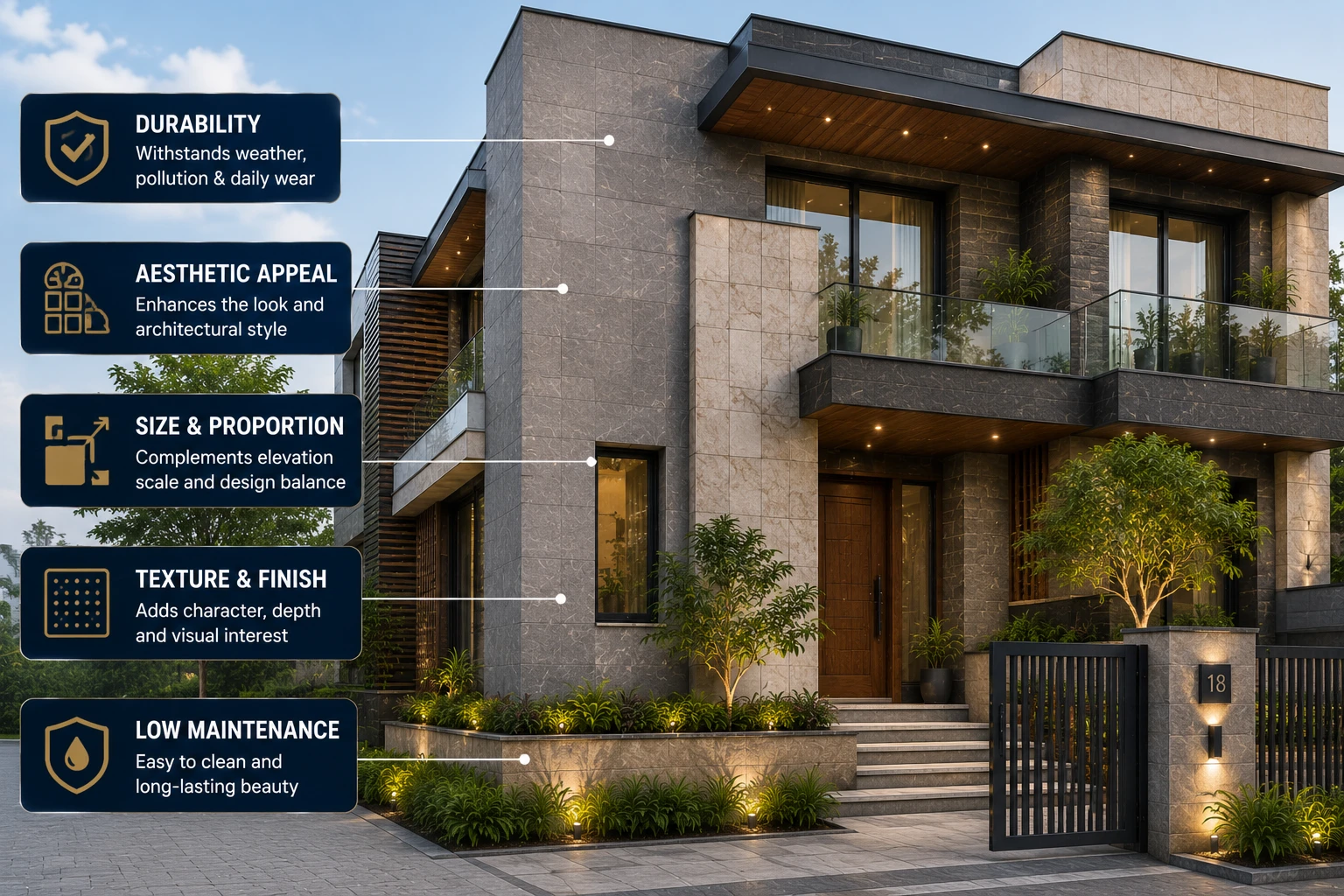
Architects' specification criteria differ from what a homeowner instinctively looks for. Experienced architects in India check: water absorption rate (the lower, the better for exposed walls), frost resistance for projects above 1000 metres altitude, UV stability so colour does not shift after three years of direct sun, surface texture for grip when tiles are used near staircases or entrance steps, and thickness (most elevation tiles run 8 to 12 mm; thinner tiles risk cracking under thermal expansion).
They also look for rectified tiles, where edges are machine-cut to precise dimensions. Rectified edges allow very thin grout joints, which makes the finished wall look cleaner and reduces water entry points. On a 300x600 mm ceramic elevation tile, a 3 mm grout joint reads well visually. On a large-format 600x1200 mm GVT panel, architects typically want 2 mm joints or less.
How Indian Climates Change the Specification Game
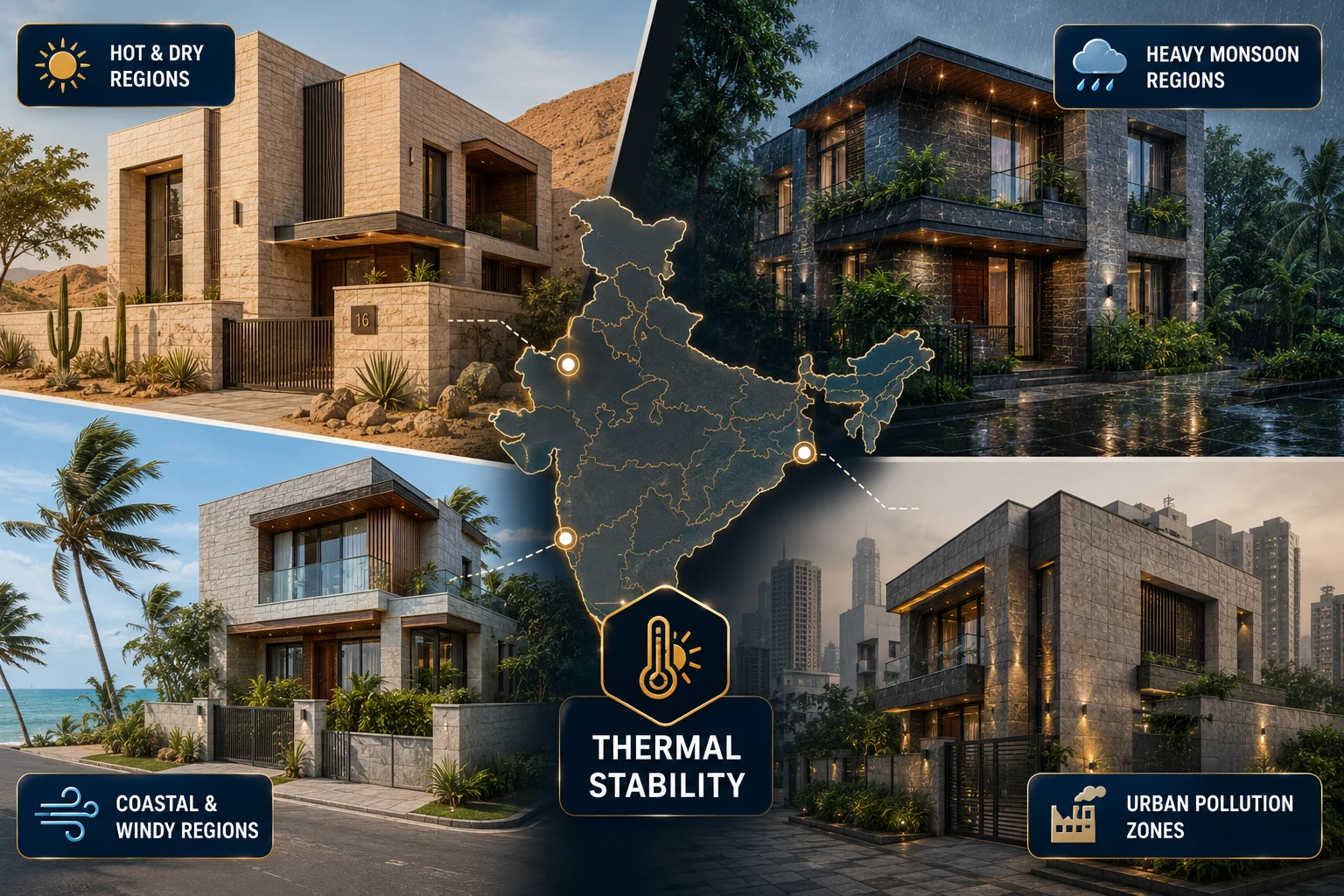
India is not one climate. A tile that works on a Jaipur villa may be wrong for a Kochi apartment. Jaipur sees extreme daytime heat and near-zero night temperatures in winter, which creates thermal stress on tiles. Kochi faces continuous humidity and salt-laden air. Chennai gets both intense sun and heavy rainfall in the northeast monsoon season.
Architects working in coastal cities (Mumbai, Chennai, Kochi, Surat, Visakhapatnam) prefer GVT or full-body tiles for elevation because their water absorption sits below 0.1%. In Rajasthan and central India, the primary concern is UV and heat resistance. In hilly regions like Shimla, Mussoorie, or the outskirts of Pune, frost resistance becomes a factor that many tile brands do not specify clearly, so architects ask for lab test data before finalising the product.
Types of Elevation Tiles Architects Specify Most in India
The tile market uses several category names that get mixed up regularly. Knowing the difference matters because the wrong category on an exposed wall can lead to spalling, colour fade, or water seepage within two to three monsoons.
GVT Elevation Tiles with High Depth Punch
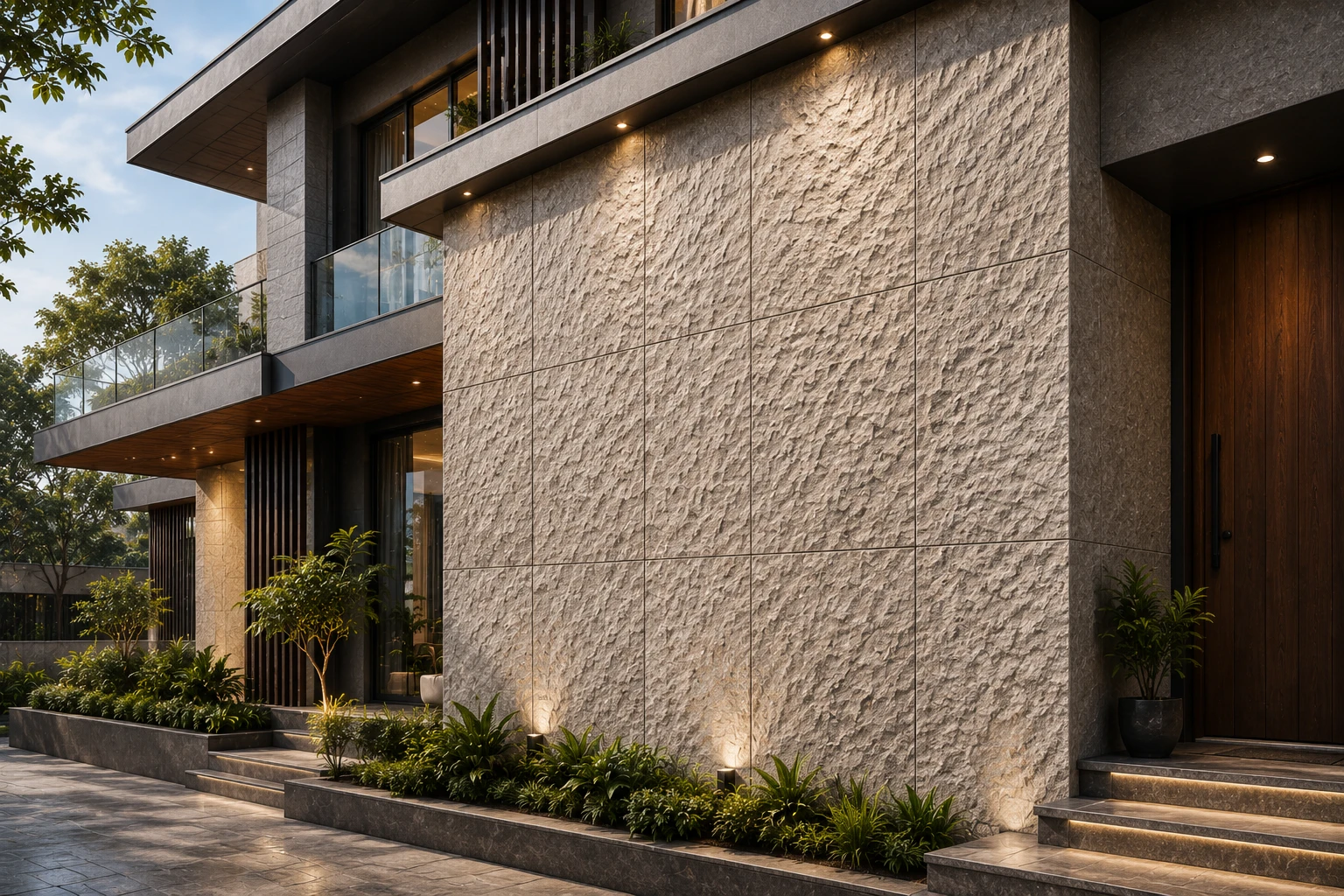
GVT (Glazed Vitrified Tiles) with a high-depth punch finish is the most specified category for elevation cladding in Indian residential architecture today. The High Depth design has 2.5 to 5 mm physical depth on the tile surface, which creates a genuine stone or brick texture rather than a printed illusion. This category is available in 300x450 mm (12x18 inch) and 300x600 mm (12x24 inch) sizes.
These are wall-only tiles. They are not suitable for floors, steps, or any surface that bears foot traffic. Architects specify them primarily for front facades, entrance feature walls, compound walls, and balcony cladding. The glazed surface has good UV resistance and handles monsoon water well. GVT has a water absorption rate below 0.1%, which is far better than ceramic for exposed outdoor use.
Price range: approximately ₹120 to ₹350 per sq. ft., depending on design complexity and brand. Morbi-manufactured GVT High Depth tiles are available from ₹120 onward; imported or premium domestic brands go higher.
Ceramic Elevation Tiles
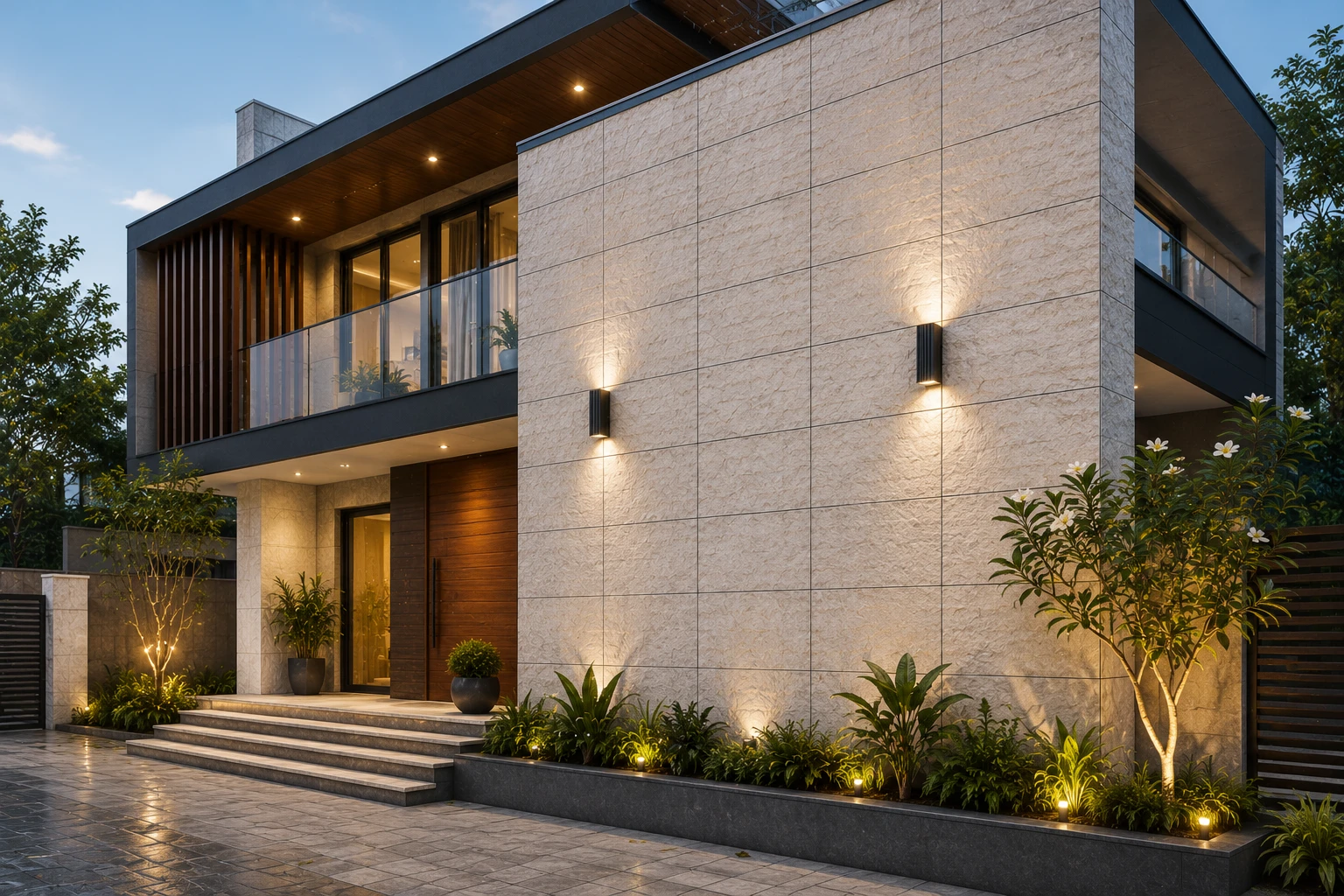
Ceramic elevation tiles are the most affordable option and work well for partially sheltered exterior walls, compound boundary walls, and interior accent walls. Water absorption in ceramic runs from 12 to 16%, which means a fully exposed facade in a monsoon-heavy city is not the right fit. In areas with covered parking or deep overhangs protecting the front wall from direct rain, ceramic elevation tiles do fine.
Available sizes: 300x300 mm (1x1), 300x450 mm (12x18), and 300x600 mm (12x24). The 300x450 and 300x600 sizes are wall-only. Finishes include glossy, matte, high-depth embossed, and decorative third-fired options. For boundary walls and entrance porch walls where rain exposure is lower, ceramic tiles keep project costs in check without sacrificing visual quality.
Price range: ₹30 to ₹80 per sq. ft. for standard ceramic elevation tiles.
Wood-Look Elevation Tiles
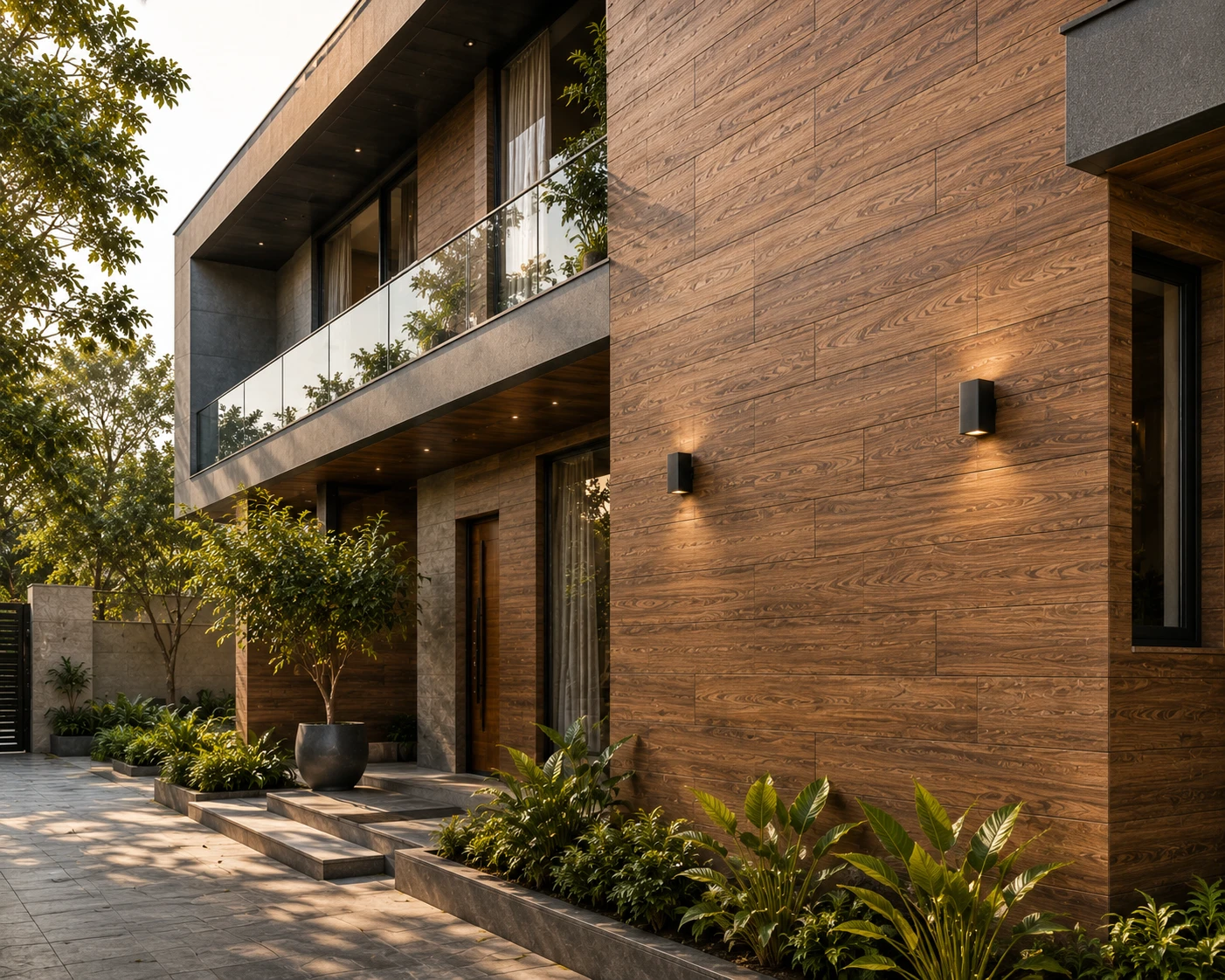
Wood plank tiles for exterior walls have grown rapidly in Indian residential architecture since 2022. These are GVT tiles printed with digital wood grain textures, available in 200x1200 mm (8x48 inch) plank format. The plank proportion gives facades the horizontal layering of real wood cladding without the maintenance problems real timber creates in Indian weather, including warping in humidity, paint peeling, and termite risk.
Architects use wood-look tiles on entrance columns, feature panels flanking the main gate, and partial wall sections combined with plain plaster or concrete-look tiles. The contrast between a warm wood-tone plank and a cool grey or off-white main wall is one of the most popular elevation combinations in Bangalore and Pune residential projects right now.
Price range: ₹90 to ₹220 per sq. ft. for GVT wood plank tiles in 8x48 inch format.
Stone-Finish Elevation Tiles
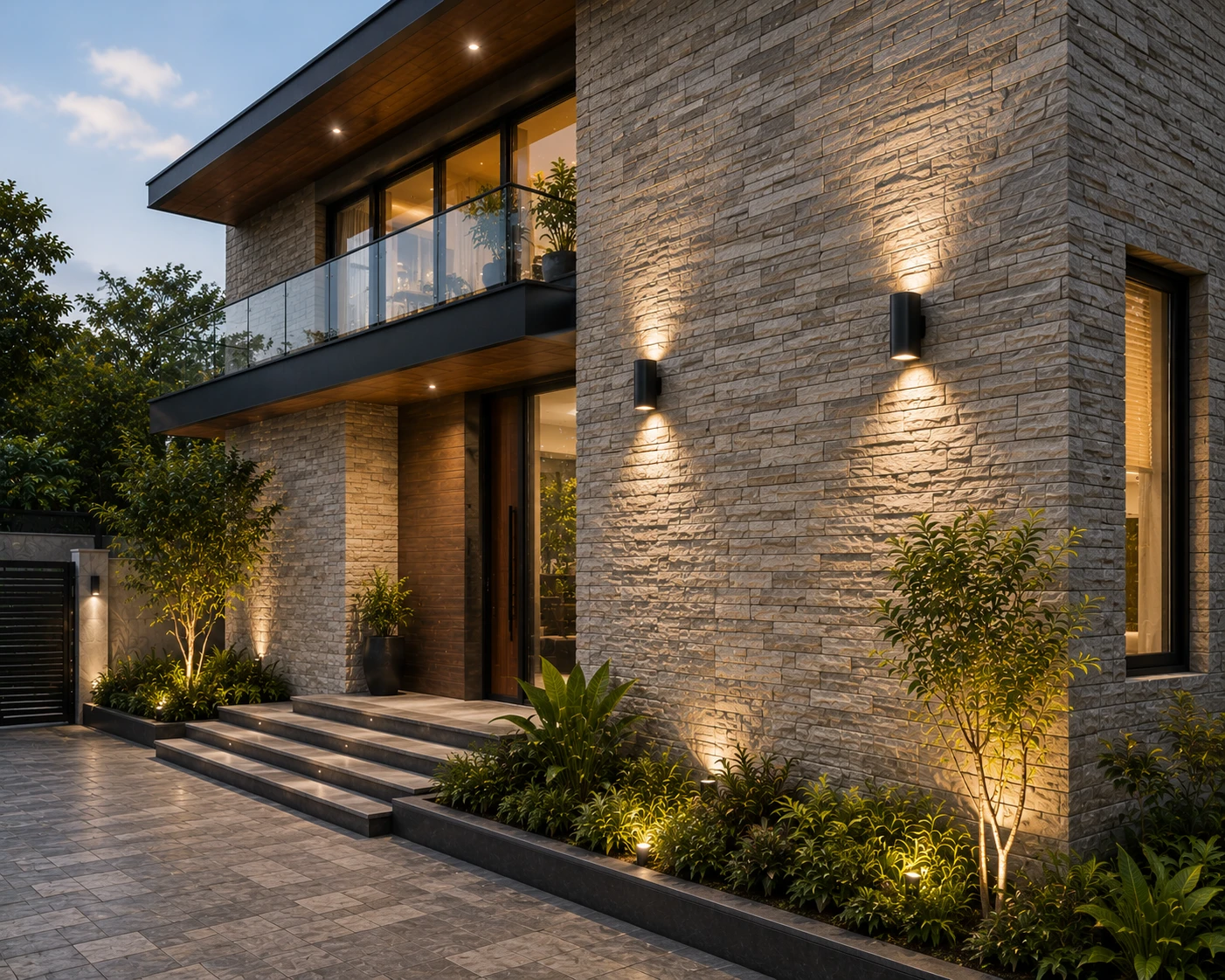
Stone-look elevation tiles cover a wide range: slate-texture tiles in 300x600 mm, sandstone-finish tiles, granite-look GVT in larger formats, and natural quartzite or sandstone cladding pieces. For projects where architects want an authentic stone appearance without natural stone's unpredictable maintenance, stone-finish GVT in matte or GHR (Glaze High Resistance) finish is the standard recommendation.
The GHR finish gives a stone-like textured surface with high scratch resistance and is good for both exposed elevation walls and high-traffic entrance areas. Available in 300x450 mm and 300x600 mm sizes for elevation use. Natural stone slabs (sandstone, kota stone, quartzite) remain popular in Rajasthan and Gujarat for traditional or farmhouse-style homes, where local stone is also more economical.
Price range: ₹80 to ₹250 per sq. ft. for stone-finish GVT elevation tiles; natural stone cladding varies widely from ₹60 to ₹400 per sq. ft., depending on stone type and finish.
3D Elevation Tiles
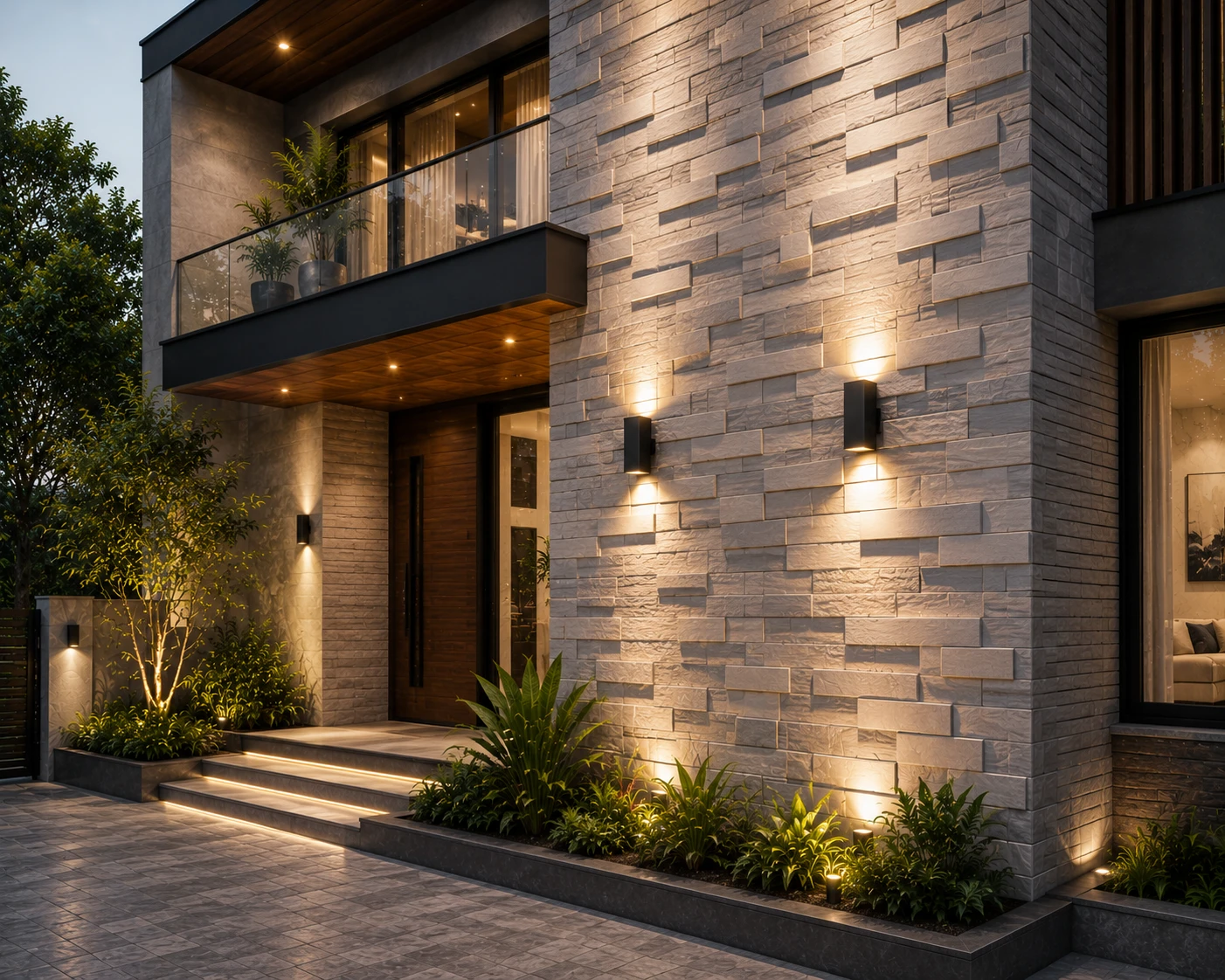
3D elevation tiles use embossed or high-depth designs to create physical depth and shadow play on the wall surface. Wave patterns, honeycomb designs, geometric reliefs, and brick stack bonds are popular options. These tiles work best as accent panels rather than full-facade coverage. Architects typically use 3D tiles on entrance gate columns, the wall flanking the main door, or a feature section of the compound wall.
Full-facade use of 3D tiles can make a home look busy and difficult to maintain, since textured surfaces collect dust and require more careful cleaning. A single well-placed 3D panel, however, can give an otherwise plain elevation considerable character. Available in GVT and ceramic base, both in High Depth punch finish, in 300x450 and 300x600 sizes.
Finish Guide: What Works on an Indian Exterior
The finish on an elevation tile affects how it ages in the sun and rain, how often it needs cleaning, and how it reads in different lighting conditions. This table covers the finishes architects regularly specify for exterior cladding in India.
| Finish | Look | Outdoor Use | Cleaning | Best For |
| Matte | Flat, no reflection | Good | Easy, dust shows less | Full facade walls |
| GHR (Glaze High Resistance) | Stone-textured | Excellent | Moderate | Exposed facade, entrance steps |
| High Depth (Embossed) | 3D texture, depth | Good | Moderate (grooves collect dust) | Feature panels, entrance walls |
| Matte Carving | Matte with glossy veins | Good | Moderate | Accent sections |
| Glossy | Reflective, smooth | Avoid on exposed walls | Easy, but shows watermarks | Covered porches only |
| Sugar / Rain Drops | Textured glossy drops | Moderate | Easy | Semi-exposed boundary walls |
Glossy finishes reflect the sun harshly on a south-facing or west-facing wall and show water marks prominently after rain. Most architects in India default to matte or GHR finish for primary facade walls and reserve glossy tiles for covered areas or interior elevation accents.
Tile Sizes Architects Prefer for Front Elevation Walls
Size choice on an elevation is about proportionality. A large 600x1200 mm tile on a small house front can look heavy and overpowering. A small 300x300 mm tile on a tall villa facade can look too busy. Architects match tile size to the wall area and building scale.
| Size (mm) | Common Name | Wall Only? | Best Application |
| 300x450 | 12x18 inch | Yes | Compound walls, feature panels, and entrance niches |
| 300x600 | 12x24 inch | Yes | Primary facade cladding, boundary walls, balcony cladding |
| 200x1200 | 8x48 inch (plank) | Yes (wall) | Wood-plank elevation panels, column cladding |
| 600x600 | 2x2 | Wall + floor | Larger facade sections, contemporary flat facades |
| 600x1200 | 2x4 | Wall + floor | High-end large-format facade cladding on contemporary homes |
The 300x600 mm size is the most commonly used for front elevation tiles design in Indian residential projects. It works across house scales, handles grout lines cleanly, and is available in the widest range of textures and designs. The 8x48-inch plank tiles are the go-to choice when architects want a wood-slat facade look on columns or entrance panels.
Modern Elevation Tiles Design Ideas for 2026
Architects working on residential projects across India in 2026 are leaning toward combinations rather than single-material facades. The most repeated brief in architectural studios right now: something that looks considered but not excessive.
Monochrome Concrete-Look Facade
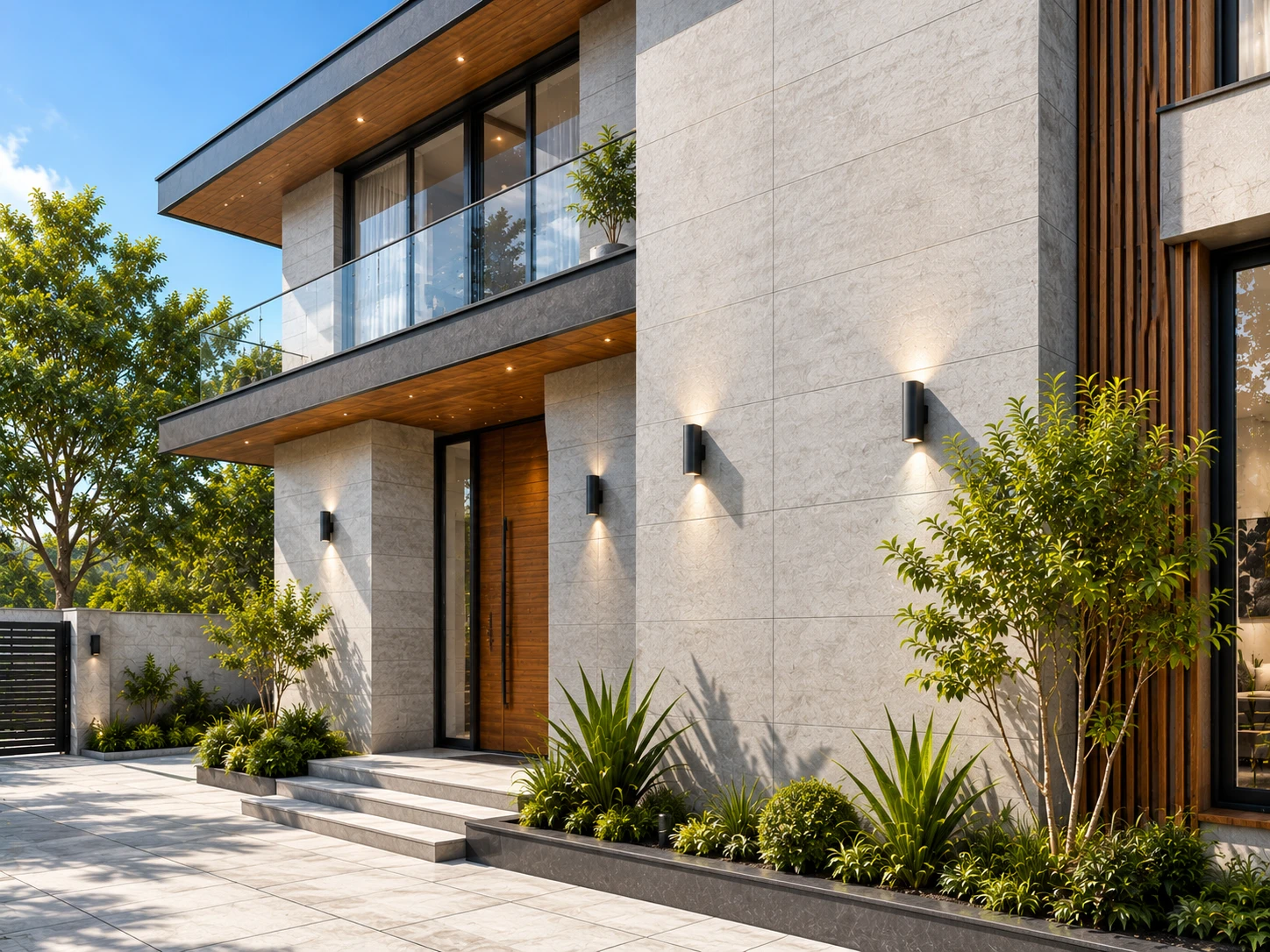
Grey concrete-textured tiles in matte finish across the primary facade wall, combined with a smooth plaster band above the first floor. White aluminium window frames and a dark grey main door complete the look. This works particularly well for contemporary 3-storey independent houses in Bangalore and Hyderabad. The concrete-look tile ages better than actual cement plaster, which cracks over time.
Tile recommendation: GVT matte finish in 300x600 mm (12x24), concrete grey or charcoal tone. Approximate wall cost: ₹110 to ₹160 per sq. ft. installed.
Warm Wood Slat Elevation
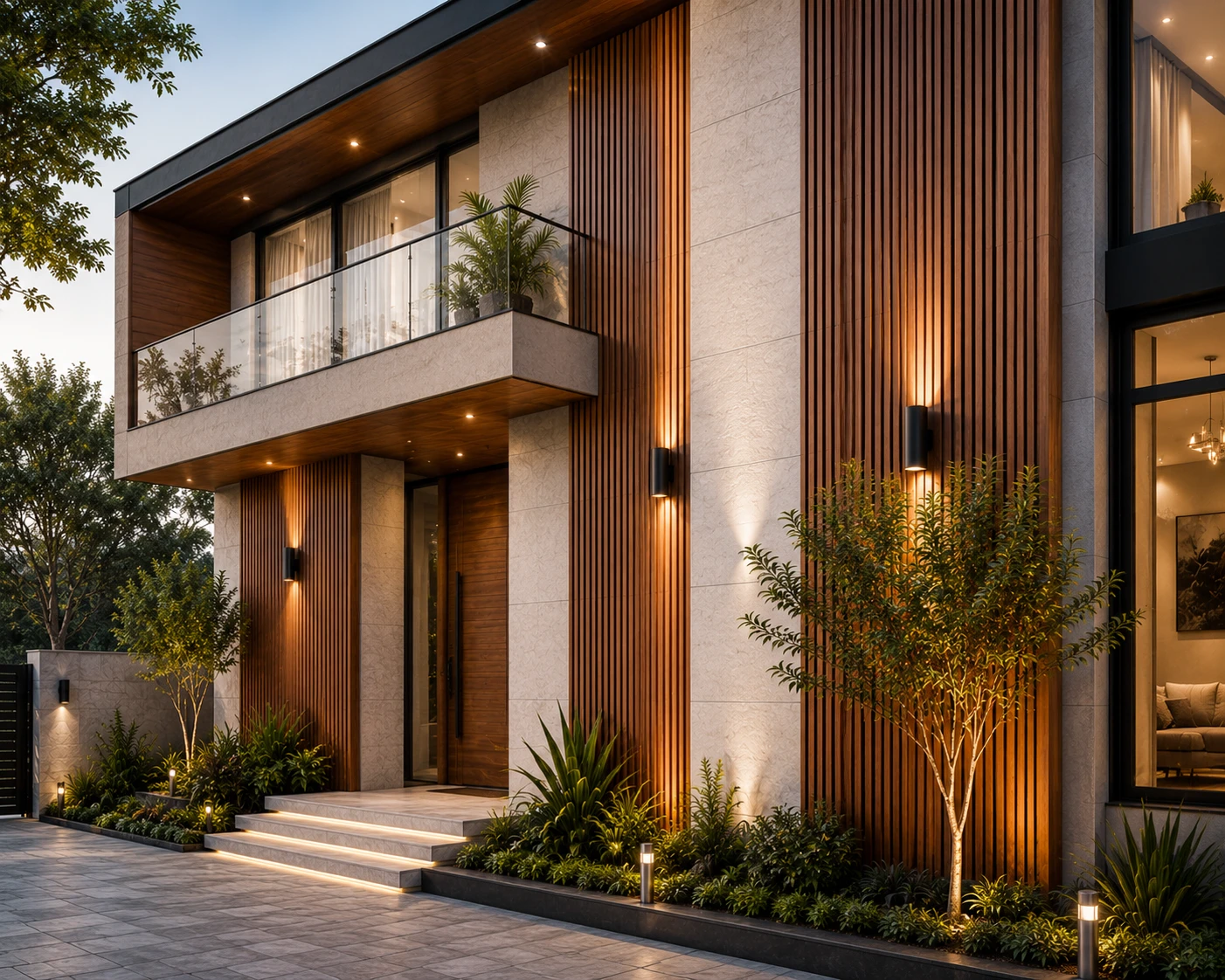
8x48 inch wood-plank GVT tiles laid vertically on the entrance column and flanking wall panels, combined with a beige or cream main wall in plain matte finish. This gives the facade warmth without covering the entire front in wood-look tile, which can quickly look overdone. Architects in Pune and Ahmedabad use this combination regularly on 4BHK row houses and villas.
Key detail: lay the plank tiles vertically to emphasise building height. Horizontal laying works for low bungalow-style homes. Grout colour matching the lighter wood grain tone keeps the tile joints from breaking the wood-plank illusion.
Stone-Textured Accent Wall with Plain Plaster
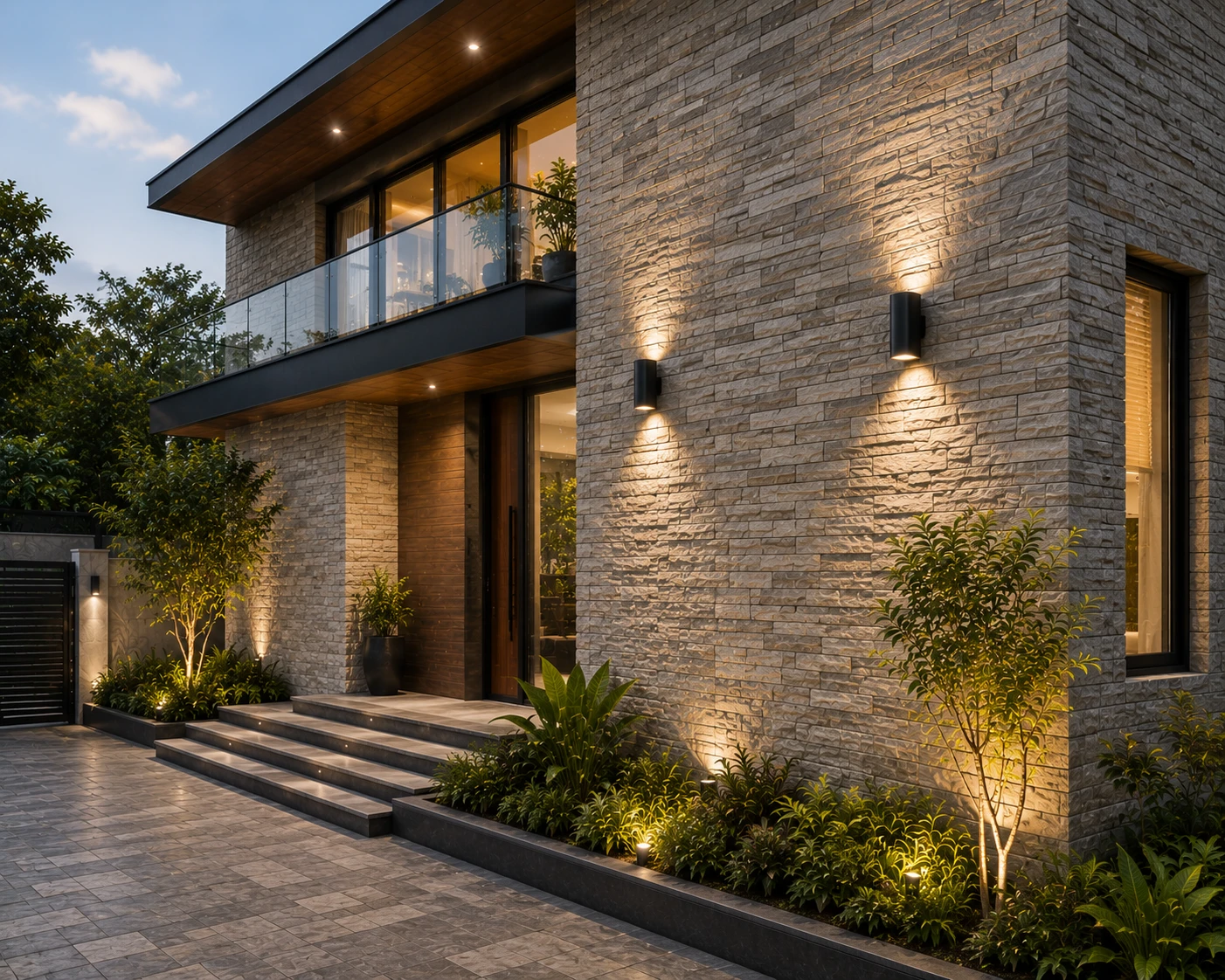
A stone-finish GVT tile in GHR finish covers the lower two metres of the front facade (roughly up to first-floor sill level), with smooth off-white plaster above. This creates a visual grounding effect: the heavier, textured base makes the house look rooted and solid. Architects commonly pair this with a contrasting stone-finish band at the parapet level, too.
Tile recommendation: 300x600 mm GVT in GHR finish, sandstone or slate look, beige or warm brown tone. This combination appears frequently on traditional-modern hybrid homes in Chennai, Coimbatore, and smaller Tamil Nadu cities.
Brick-Look Tiles on Boundary and Entrance
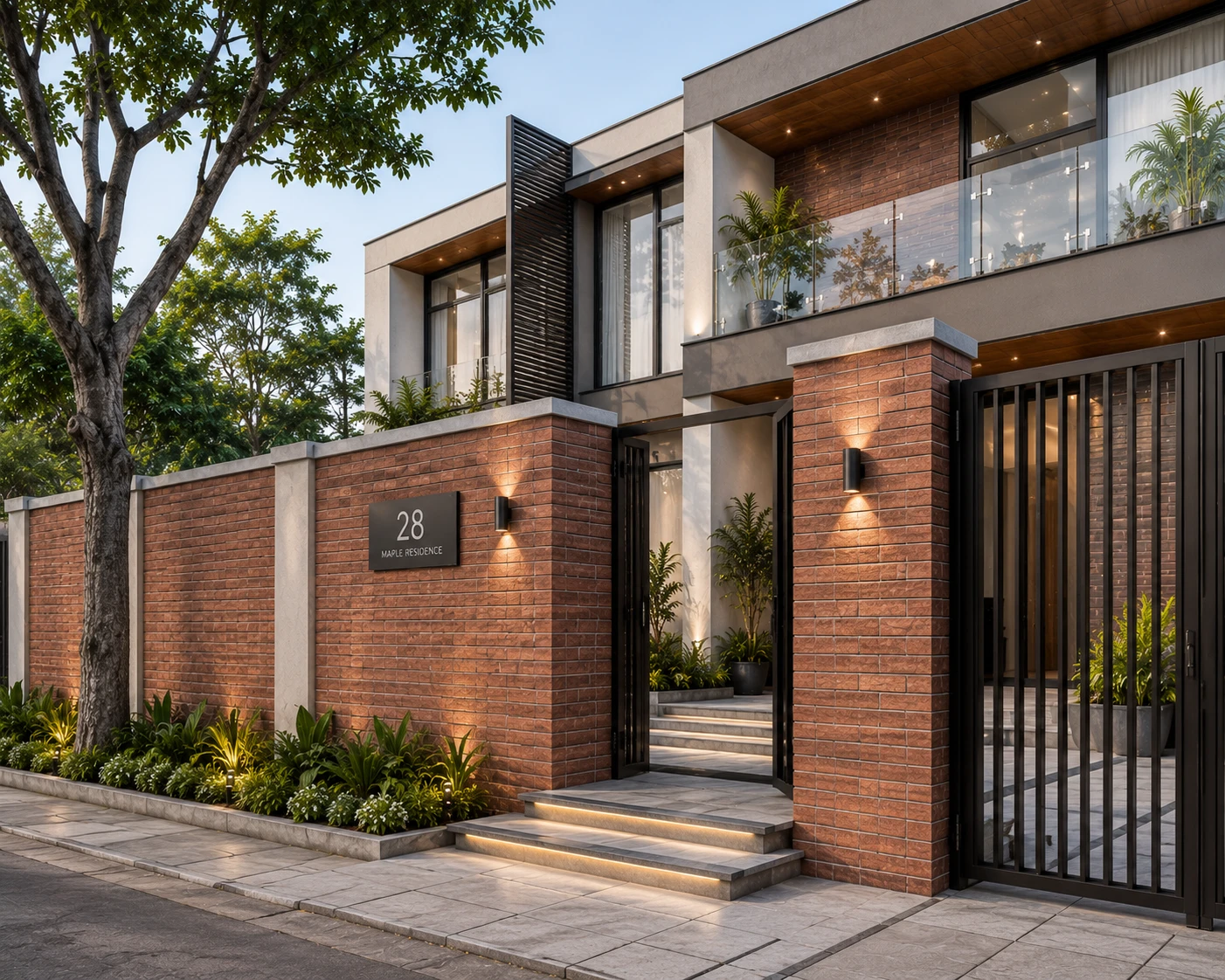
Brick-look High Depth elevation tiles in terracotta or red-brown tones on the compound boundary wall and gate piers, combined with a clean white or light grey main house facade. The brick texture reads as heritage and craft, which gives even a contemporary home some visual warmth and anchoring. Jali-inspired geometric patterns on boundary wall sections can work alongside brick tiles in Rajasthan and Gujarat contexts.
Ceramic brick-look tiles work well here since boundary walls typically have deeper eave coverage from the gate. If the compound wall is fully exposed, GVT in brick-look High Depth finish is the safer technical choice. Price: ₹80 to ₹180 per sq. ft., depending on category and brand.
3D Wave or Geometric Feature Panel
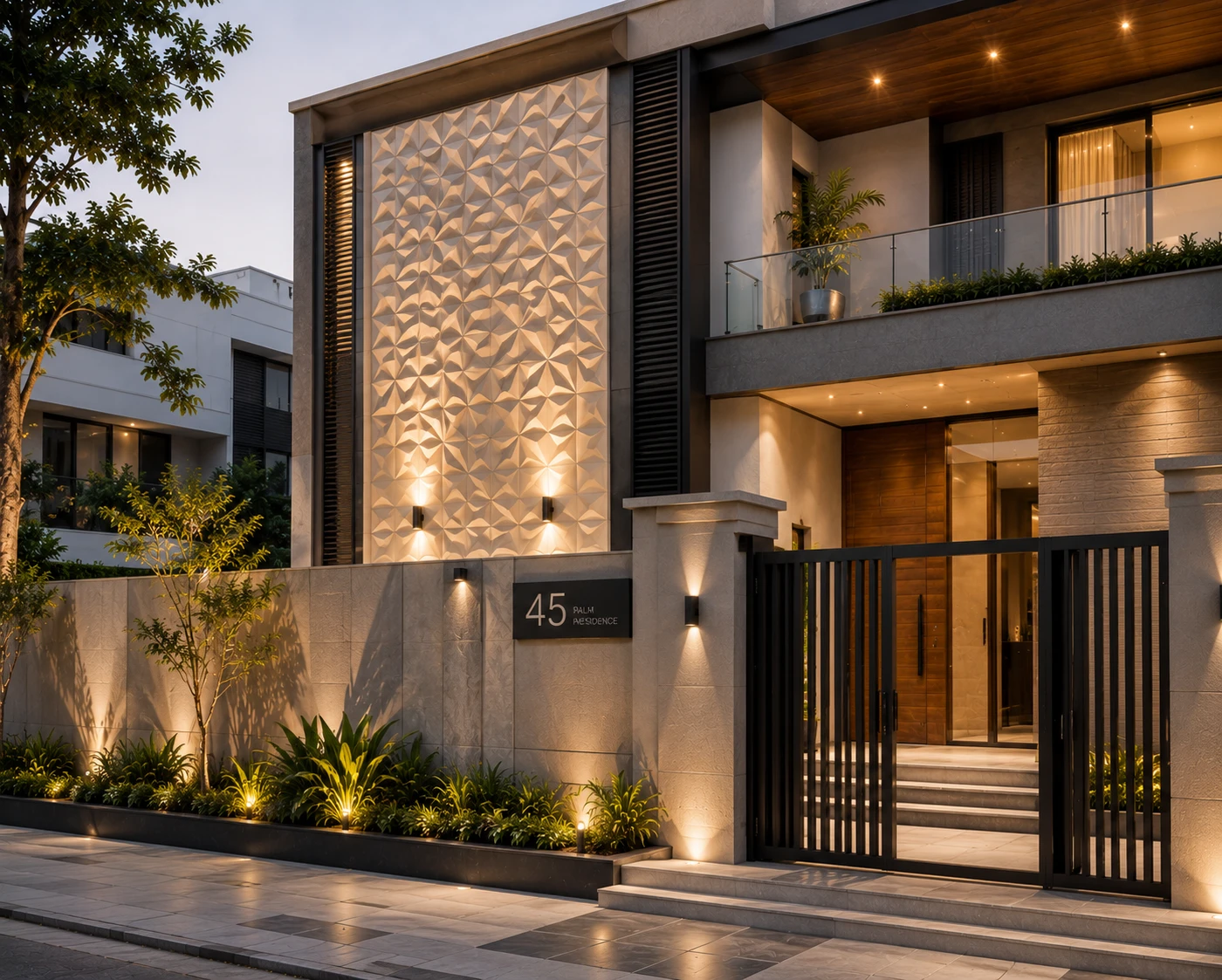
A single 3D tile panel (wave, honeycomb, or geometric relief) on the wall flanking the main entrance door, framed by plain matte tiles on either side. This approach gives the facade a focal point without requiring the maintenance burden of a fully 3D-tiled elevation. Architects specify this panel to be no wider than 1.5 to 2 metres, keeping it readable as an accent rather than a dominant surface.
This trend is growing in urban apartment lobby exteriors in Mumbai, Delhi, and Bengaluru, where builders want a design statement that photographs well for marketing. For residential homes, the panel approach works because it is achievable within a mid-range elevation budget.
Looking for more facade inspiration? Explore the latest Front Elevation Tile Designs to see trending combinations used by architects across India.
Expert Tips Before Specifying or Buying Elevation Tiles
1. Test the Tile in Actual Sunlight, Not Showroom Lighting
Showrooms use warm directional light that flatters tiles. A glossy tile that looks rich indoors can look washed out or mirror-like on a south-facing wall at noon. Always ask for a sample and observe it in outdoor light at the site, in both morning and afternoon sun. This step catches problems before 300 sq. ft. of the wrong tile gets laid.
2. Check the Water Absorption Rate on the Product Sheet
For exposed elevation walls in a monsoon-heavy region, ask the dealer for the technical data sheet and confirm water absorption below 3%. For fully exposed primary facades in high-rainfall cities (Kochi, Mumbai, Shillong), target below 0.5%. Ceramic tiles with 12 to 16% absorption are not suitable for these locations.
3. Order 10% Extra Stock
Elevation tiles get cut for corners, window reveals, and awkward wall sections. Ordering 8 to 10% more than the measured wall area avoids a scenario where you need five more cartons three months after installation, and the batch is no longer in production. Batch colour variation in the next order is a real risk.
4. Use Rectified Tiles for a Cleaner Finish
Rectified elevation tiles have machine-cut edges with consistent dimensions. This allows 2 to 3 mm grout joints, which look significantly cleaner on a facade than the 5 to 8 mm joints that non-rectified tiles require. The cost difference between rectified and non-rectified is small; the visual difference on an elevation is large.
5. Match Grout Colour to Tile Tone
A contrasting grout on elevation tiles highlights every joint, which makes a wall look tiled rather than architecturally finished. Most architects in India recommend a grout that is one shade darker than the tile body or closely matches the main tile colour. This keeps the tile reading as a surface rather than a grid.
6. Check for Anti-Efflorescence Treatment
Efflorescence (white mineral deposits on tile joints) is common on Indian elevation walls in areas with hard groundwater or high alkalinity in cement. Ask your contractor to use anti-efflorescence admixtures in the tile adhesive and grout mortar. Many homeowners discover this problem six months after installation and have no easy fix.
7. Confirm Structural Wall Prep Before Ordering
Elevation tiles require a flat, cured, and clean substrate. Tiles laid over fresh or damp concrete, or over an existing painted wall without proper surface preparation, will debond within one to two monsoons. Architects typically specify a hacking treatment on the existing wall surface and a cement-polymer bonding agent before the tile adhesive goes on.
Common Mistakes in Elevation Tile Selection
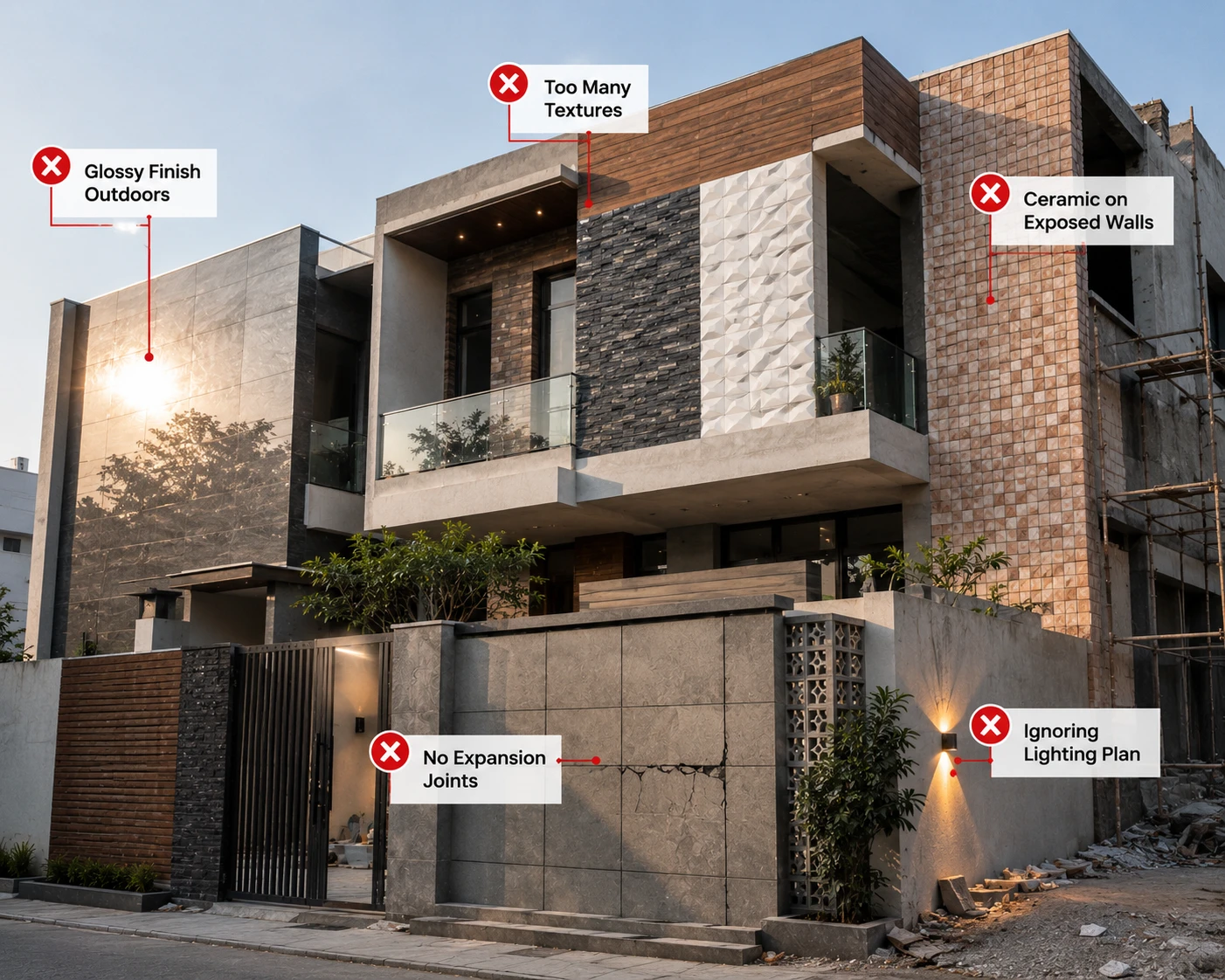
Using glossy finish on an exposed south-facing wall: Glossy tiles on a fully exposed facade reflect afternoon sun into neighbouring properties and develop water marks after every rain. They also show dust and staining more than matte tiles. Matte or GHR finish is the correct choice for any wall that faces direct sun and monsoon rain.
Mixing too many tile textures on one facade: More than two tile types on a single front wall looks busy and unresolved. A common error is using stone-look tiles plus wood-look tiles plus 3D tiles plus a painted section, all on the same facade. Architects keep elevation material palettes to two or a maximum of three distinct textures.
Using ceramic tiles on a fully rain-exposed elevation: Ceramic tiles have high water absorption and are not meant for rain-exposed exterior surfaces without deep overhang protection. Buyers attracted by the lower cost of ceramic tiles end up with spalling, staining, and grout deterioration within a few monsoons. GVT or full-body tiles are the right call for any exposed facade wall.
Skipping expansion joints on large tile sections: Thermal expansion makes tiles move. Without expansion joints every 3 to 4 metres on a large tiled elevation, the tiles push against each other and debond or crack. This is a contractor error that architects and site supervisors need to watch for actively during installation.
Buying tiles before finalising the lighting plan: Exterior lighting changes how tiles read at night significantly. A terracotta brick-look tile that looks warm in daylight can look flat or orange under cool-white LED floodlights. It is worth placing a few sample tiles on the wall and observing them at night under the planned exterior fittings before finalising the order.
Elevation Tiles Price Range in India (2026)
| Category | Typical Size | Price Range (per sq. ft.) | Best For |
| Ceramic elevation tiles | 300x450, 300x600 | Rs. 30 to Rs. 80 | Boundary walls, covered porches |
| GVT High Depth elevation | 300x450, 300x600 | Rs. 120 to Rs. 350 | Exposed facades, feature walls |
| Wood plank GVT (8x48) | 200x1200 | Rs. 90 to Rs. 220 | Column cladding, entrance panels |
| Stone-look GVT (GHR finish) | 300x600 | Rs. 80 to Rs. 250 | Front facade, entrance steps, wall |
| 3D elevation tiles (GVT) | 300x450, 300x600 | Rs. 150 to Rs. 400 | Feature accent panels |
| Natural stone cladding | Varies | Rs. 60 to Rs. 400+ | Farmhouses, traditional homes |
Prices above are approximate 2026 market rates and vary by brand, dealer location, and order quantity. GST at 18% applies to tile purchases. Installation adds ₹40 to ₹80 per sq. ft., depending on tile size, wall complexity, and scaffold requirement for upper floors.
If you're comparing different facade styles, browse these Exterior Wall Tile Ideas for modern home exteriors featuring stone, wood, concrete, and textured finishes.
Finding the Right Elevation Tiles for Your Project
The front wall of a house carries more long-term responsibility than most people give it credit for during the design phase. A well-specified elevation tile does its job quietly: it handles fifteen years of Indian sun, eight to ten monsoons, dust from roads, and the occasional hard cleaning without losing its surface character.
Before finalising any elevation tile, take a sample to the actual wall, observe it in morning and afternoon sun, and confirm the technical category and finish are suited to the exposure level. Ask your architect or site supervisor to check the water absorption rating on the product sheet if the wall faces rain directly.
You can explore a wide range of elevation tiles design options across categories, including GVT High Depth, wood plank, stone-look, and ceramic elevation tiles on TilesFinders, where you can compare designs, sizes, and finishes from leading Indian manufacturers. The platform lets architects and homeowners review options across different budget ranges before visiting a showroom.
FAQs
GVT tiles with a high-depth punch finish are the most widely specified for exposed facades in Indian conditions. They have water absorption below 0.1%, strong UV resistance, and the 3D surface texture gives walls genuine architectural character. For budget projects or partially sheltered walls, ceramic elevation tiles in 300x450 or 300x600 mm work well. The right choice depends on the wall's exposure level, the local climate, and the budget.
The 300x600 mm (12x24 inch) size is the most common recommendation for residential elevation cladding in India. It works well across house scales, is available in the widest design range, and handles grout joints cleanly. For wood-look plank facades, 200x1200 mm (8x48 inch) is the standard size. Larger 600x1200 tiles work on contemporary premium homes but need a well-prepared, flat substrate and experienced tilers.
Match the tile category to your region's primary climate challenge. For monsoon-belt cities (Mumbai, Kochi, Goa, Shillong), choose GVT or full-body tiles with water absorption below 0.5%. For hot-dry regions (Rajasthan, Gujarat interiors), UV stability and thermal resistance matter more. For hilly regions above 1000 metres altitude, ask specifically for frost-resistant tiles and check the product data sheet for that rating. Always use matte or GHR finish on exposed walls rather than glossy.
Yes. Many GVT High Depth and stone-look tiles work on both exterior elevation walls and interior accent walls, such as living room feature walls, lobby walls, or dining area accent panels. The same tile carries through from exterior to interior, giving a house design continuity that architects often plan intentionally. Confirm the finish is appropriate for each application: GHR finish works well both outside and inside, while purely decorative third-fired tiles are interior-only.
Elevation tiles are made for outdoor exposure. They have lower water absorption, stronger resistance to UV fading, and usually a heavier body (8 to 12 mm thickness) compared to regular interior wall tiles. Standard indoor wall tiles (3 to 7 mm, high gloss ceramic) will deteriorate quickly on an exposed facade. Always confirm the tile is rated for exterior or elevation use before ordering for a front wall.
GVT elevation tiles on a well-prepared surface with correct adhesive and grout last 20 to 30 years without a significant change in appearance. Ceramic elevation tiles in sheltered positions last 10 to 15 years. The main failure points are poor substrate preparation, wrong adhesive for outdoor use, missing expansion joints, and choosing a glossy finish that shows wear faster. With correct installation, tiled elevations outlast painted walls by a significant margin and require no periodic repainting.

See our tile guides first
Set TilesFinders as a preferred source and our buying guides surface ahead of the rest for you.
Add as preferred sourceTakes one tap. Nothing to install.
What Readers Say
I was about to redo my parking area with the wrong tile size until I read this. The layout comparisons saved me from a costly mistake.
We reference TilesFinders guides while briefing clients on material selection. The size and pattern breakdowns are accurate and easy to explain visually.
On site, I get asked about grout spacing all the time. This article gave me a solid reference I now share with my team before every job.
Finally a guide that doesn't just push generic advice. The oil stain removal steps actually worked on our clubhouse driveway tiles.
I run a small construction firm and now send this link to clients directly when they ask about entrance tile sizing. Saves me an hour of explaining.
Good practical detail, though I wish there were more examples for compact apartment entrances specifically, not just villas.
My mother-in-law wanted marble, I wanted vitrified. This blog gave us the neutral comparison we needed to actually decide together.
Detailed without being overwhelming. I appreciated that it covered both cost and maintenance, not just the aesthetics.
Used the algae and hard water removal tips on our terrace tiles after the monsoon. Worked better than what our regular cleaner was doing.
As someone who sources tiles for multiple builder projects, I find these comparisons genuinely useful for vendor conversations, not just consumer content.
Recommended this to a client who kept second-guessing the entrance design. The small vs large layout section settled the debate instantly.
Straightforward and honest, no unnecessary jargon. Would like to see a similar breakdown for outdoor pool-deck tiles next.
We've bookmarked several TilesFinders guides for our design handbook. Reliable source when clients want data, not just opinions.
Two paths, one marketplace.
Get free quotes from verified suppliers.
Share your room, budget, and style. Suppliers in Morbi respond within hours.
Get Free QuotesList your business, reach real buyers.
Put your showroom in front of homeowners searching for tiles right now.
List Your Business