Bookmatch Tiles: Luxury Statement Walls for Premium Interiors
Discover how bookmatch tiles create luxury statement walls with mirrored marble patterns. Explore sizes, materials, costs, installation tips, and ideal applications for premium interiors.
- What Bookmatch Tiles Are and How the Effect Works
- Why Bookmatch Feature Walls Work in Luxury Interiors
- Best Tile Types for Bookmatch Feature Walls
- Recommended Tile Sizes for Bookmatch Walls
- Where Bookmatch Tiles Work Best in Indian Homes
- Bookmatch Tiles vs Natural Stone Bookmatching: Cost in India
- How Bookmatch Tiles Are Installed: What You Need to Know
- Design Tips for Getting Bookmatch Walls Right
- Common Mistakes with Bookmatch Tile Projects
- Choosing the Right Bookmatch Tiles for Your Space
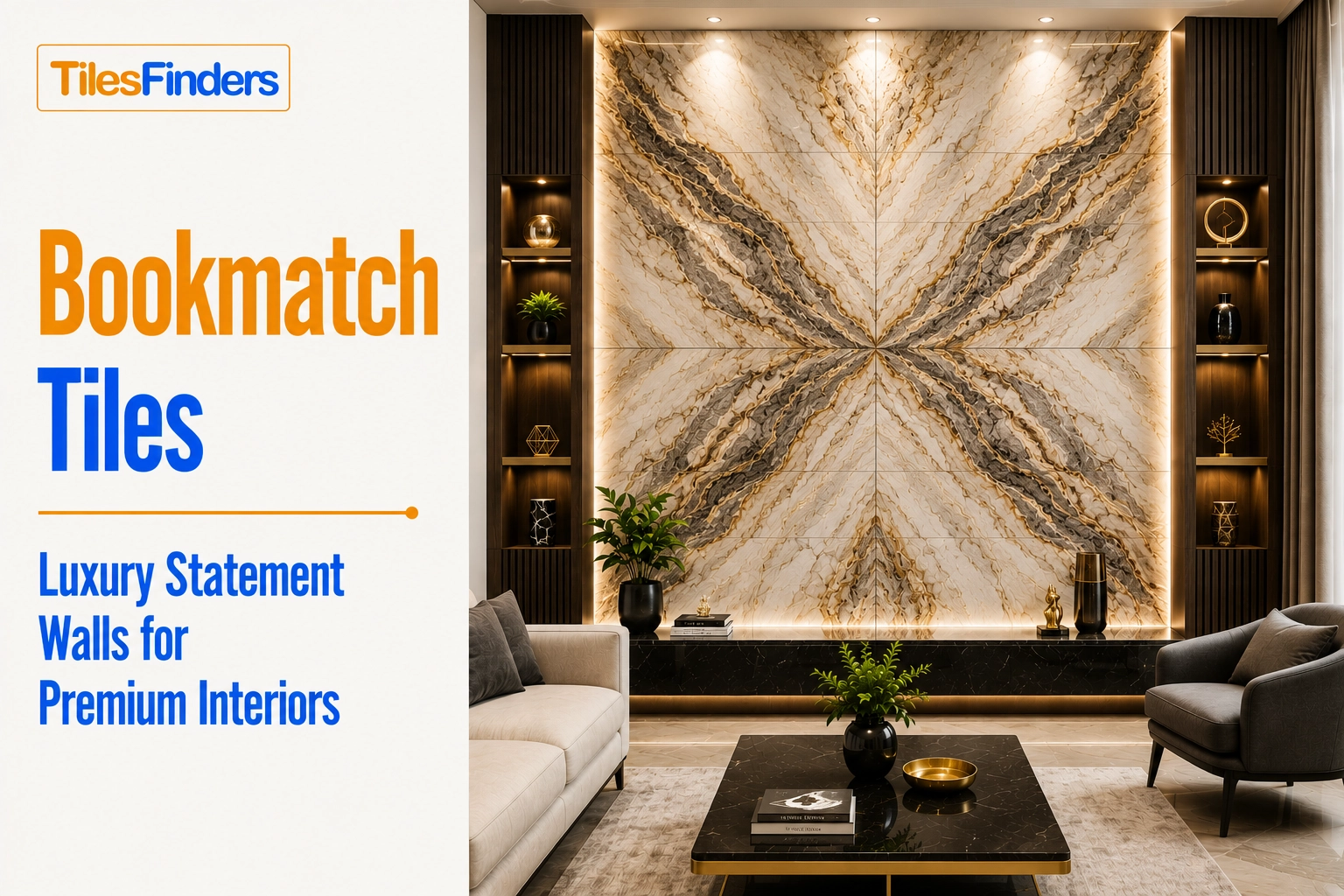
Bookmatch tiles create a mirrored marble or stone pattern by arranging matching tiles in reverse, producing a luxury statement wall effect similar to expensive natural stone slabs. They are most commonly used on living room feature walls, bedroom headboards, bathroom vanity walls, dining areas, and entrance foyers.
Some walls stop people mid-conversation. That pause, that instinctive turn of the head, is what bookmatch tiles are built to create.
The bookmatching technique comes from natural stone craftsmanship, where adjacent slabs are opened like a book to reveal a perfectly mirrored veining pattern. Applied to tiles, it brings that same visual drama into living rooms, hotel lobbies, master bedroom feature walls, and premium bathroom walls across Indian homes and commercial spaces.
Most homeowners discover bookmatch tiles after seeing them in a designer's portfolio or a luxury property listing and assuming they are out of reach. The reality in 2026 is different. Indian tile manufacturers from Morbi now produce high-quality bookmatch GVT and PGVT tiles that deliver the same effect at a fraction of the cost of natural stone bookmatched slabs.
While bookmatch surfaces are gaining popularity, they are part of a broader shift in design preferences. Explore other popular styles in Trending Tile Looks for 2026 to see how bookmatch compares with subway, marble, wood-look, and 3D tile trends shaping modern interiors.
This guide covers what bookmatch tiles are, how they work, which rooms they suit best, their cost in India, and what to check before buying.
What Bookmatch Tiles Are and How the Effect Works
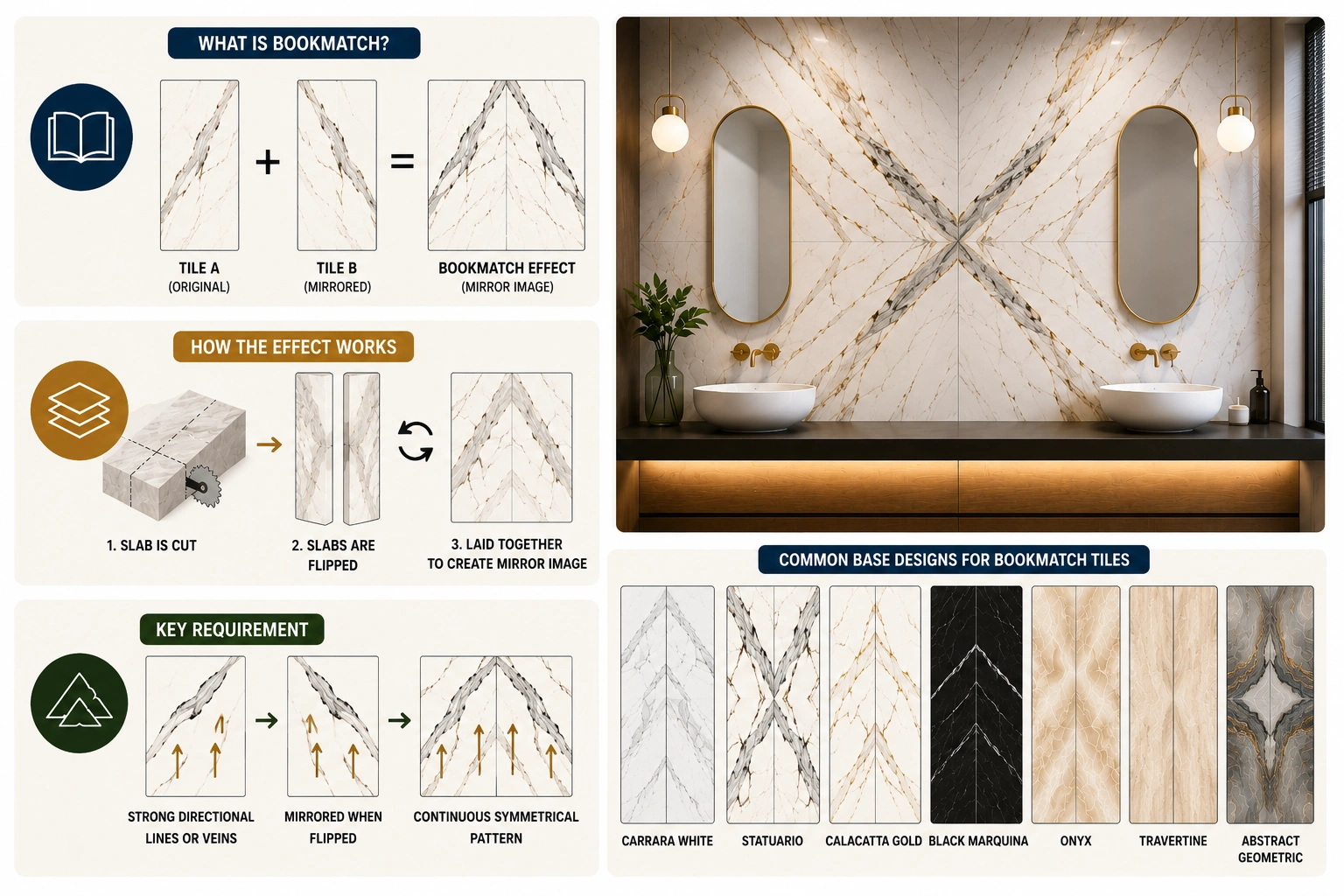
Bookmatching is a pattern-matching technique where two or more tiles are arranged so their surface designs mirror each other, the way two facing pages of an open book mirror the spine. The result is a continuous, symmetrical pattern across the wall surface that reads as one unified design rather than a grid of individual tiles.
In natural stone, bookmatching is achieved by slicing a block and flipping alternate slabs. In vitrified tiles, it is achieved through digital printing technology, where the same base design is printed in its original orientation and in a flipped or rotated version. These paired tiles, when laid correctly, create the mirror-image effect across the full wall.
The most common base designs for bookmatching are marble veining patterns: Carrara white, Statuario, Calacatta gold, and black marquina. But the technique also works with onyx, travertine, and abstract geometric prints. The key requirement is a design with strong directional lines or flowing veins that read clearly when mirrored.
Why Bookmatch Feature Walls Work in Luxury Interiors
A plain tiled wall, even in a beautiful marble finish, reads as repetition. The eye sees the pattern, registers the tile grid, and moves on. A bookmatched wall works differently.
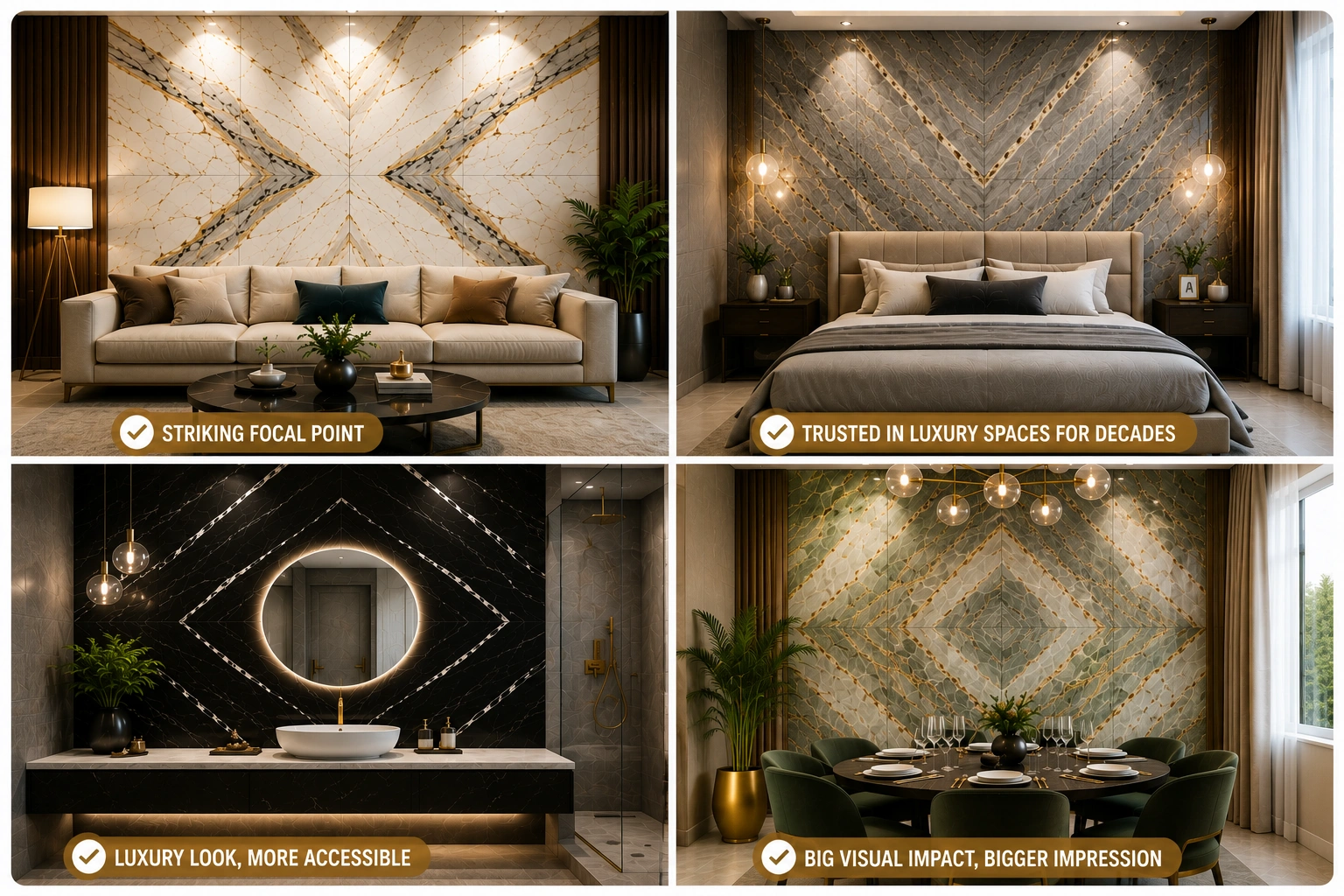
The mirrored symmetry creates a focal point that reads like a single large artwork. Interior designers use this to anchor a room without adding furniture or accessorising heavily. One bookmatched wall behind a sofa, a bed headboard, or a bathroom vanity changes the character of the entire room.
Bookmatch tiles create dramatic statement walls, while Subway Tiles Design remain a timeless choice for kitchens and bathrooms where a cleaner, more structured look is preferred.
Premium hotels, high-end restaurants, and luxury residential projects in Mumbai, Delhi, Hyderabad, and Bangalore have used bookmatched stone for decades. The tile version brings this language into 3BHK and 4BHK apartments and independent villas where a full slab installation budget is not available.
The visual payoff is significant. A bookmatched wall in a 12-by-10-foot living room creates the impression of a grander, more considered space. It signals that the interior was designed, not assembled.
Best Tile Types for Bookmatch Feature Walls
Not every tile category suits bookmatching. The technique works best with tiles that carry a strong surface design, usually a veining or flowing pattern, that reads clearly when mirrored.
PGVT (Polished Glazed Vitrified Tiles)
PGVT tiles are the most popular choice for indoor bookmatch feature walls. The polished high-gloss surface amplifies the depth and movement in marble-look designs, giving bookmatched veins the liquid quality of real stone. PGVT absorbs less than 0.05% water and holds up well on bathroom walls and living room feature walls.
Because PGVT is polished, it should stay on walls only. The polished surface is slippery and not suitable for floor use in wet or high-traffic areas. For bookmatch walls, this is never a concern.
Approximate price range: ₹80 to ₹250 per sq. ft., depending on design complexity and brand.
GVT (Glazed Vitrified Tiles) with Posh or Matte Finish
For a softer, more contemporary interpretation of bookmatching, GVT tiles in Posh finish (smooth matte with near-zero light reflection) work beautifully. The muted surface gives bookmatched marble a quieter, more restrained quality that suits minimalist and Japandi-influenced interiors.
GVT tiles work on both walls and floors, giving more flexibility for coordinating a bookmatched wall with matching floor tiles in larger projects.
Approximate price range: ₹70 to ₹180 per sq. ft.
Large Format Slabs (800x2400 mm and 800x3000 mm)
For the most dramatic bookmatch effect, large-format slab tiles in 32x96 (800x2400 mm) or 32x120 (800x3000 mm) sizes reduce grout lines to near-zero and let the mirrored pattern run almost uninterrupted. These slab formats are used in premium villa projects and high-end commercial lobbies where seamless stone-like coverage is the goal.
These sizes work for walls, floors, kitchen platforms, and window sills. Installation requires experienced fixers due to the tile's weight and handling requirements.
Approximate Price range: ₹150 to ₹400 per sq. ft. for quality slab tiles.
Full Body Tiles
Full body tiles carry their colour and pattern through the entire tile thickness, not just the surface glaze. For bookmatch applications near edges, corners, or areas where tile chipping might expose the body, full-body tiles maintain visual consistency. They suit high-end commercial bookmatched walls where edge details are visible.
Approximate Price range: ₹90 to ₹200 per sq. ft.
Recommended Tile Sizes for Bookmatch Walls
Size choice has a direct effect on how convincing the bookmatched pattern appears. Larger tiles mean fewer grout lines interrupting the design and a more continuous stone-like surface.
| Size (mm) | Common Name | Best For | Grout Line Impact |
| 600x1200 | 2x4 | The living room and bedroom feature walls, the most common choice | Moderate lines, manageable with colour-matched grout |
| 800x1600 | 32x64 | Premium bedroom walls and hotel-style bathrooms | Fewer lines, stronger slab effect |
| 800x2400 | 32x96 | Luxury villa walls, lobby cladding, dramatic floor-to-ceiling | Near-seamless, maximum visual continuity |
| 800x3000 | 32x120 | Full-height feature walls in large homes and commercial spaces | Minimal grout, closest to a natural stone slab |
| 1200x1800 | 6x4 | Wide feature walls where the horizontal format suits the layout | Balanced proportions for landscape orientation |
| 1200x2400 | 8x4 | Grand living room walls and reception areas in villas | Very few lines across height |
For apartments, the 2x4 (600x1200 mm) and 32x64 (800x1600 mm) formats are practical and widely available. For villas and commercial projects, the 32x96 and 32x120 slab formats deliver the most impact.
Important: all sizes listed above work for wall applications. Never use PGVT tiles (the most common bookmatch tile) on wet or outdoor floors, as the polished finish becomes slippery.
Where Bookmatch Tiles Work Best in Indian Homes
Living Room Feature Wall
-3d35d91d-fb25-48b4-8377-6d279d8fcee3.webp)
The living room is where most homeowners place their first bookmatch wall. A floor-to-ceiling bookmatched panel behind the main sofa creates an instant focal point. In Indian drawing rooms where the television wall often dominates, a bookmatched wall on the opposite or perpendicular side rebalances the room.
Calacatta gold and Statuario white bookmatched patterns in warm tones complement the typical warm-toned furnishing palette of Indian living rooms. For a bolder statement, black marquina bookmatching with gold veining reads dramatically against a light ceiling and neutral floor.
If you want a feature wall with texture rather than mirrored veining, 3D Wall Tiles offer another striking way to add depth, movement, and visual interest to living rooms and accent walls.
Master Bedroom Headboard Wall
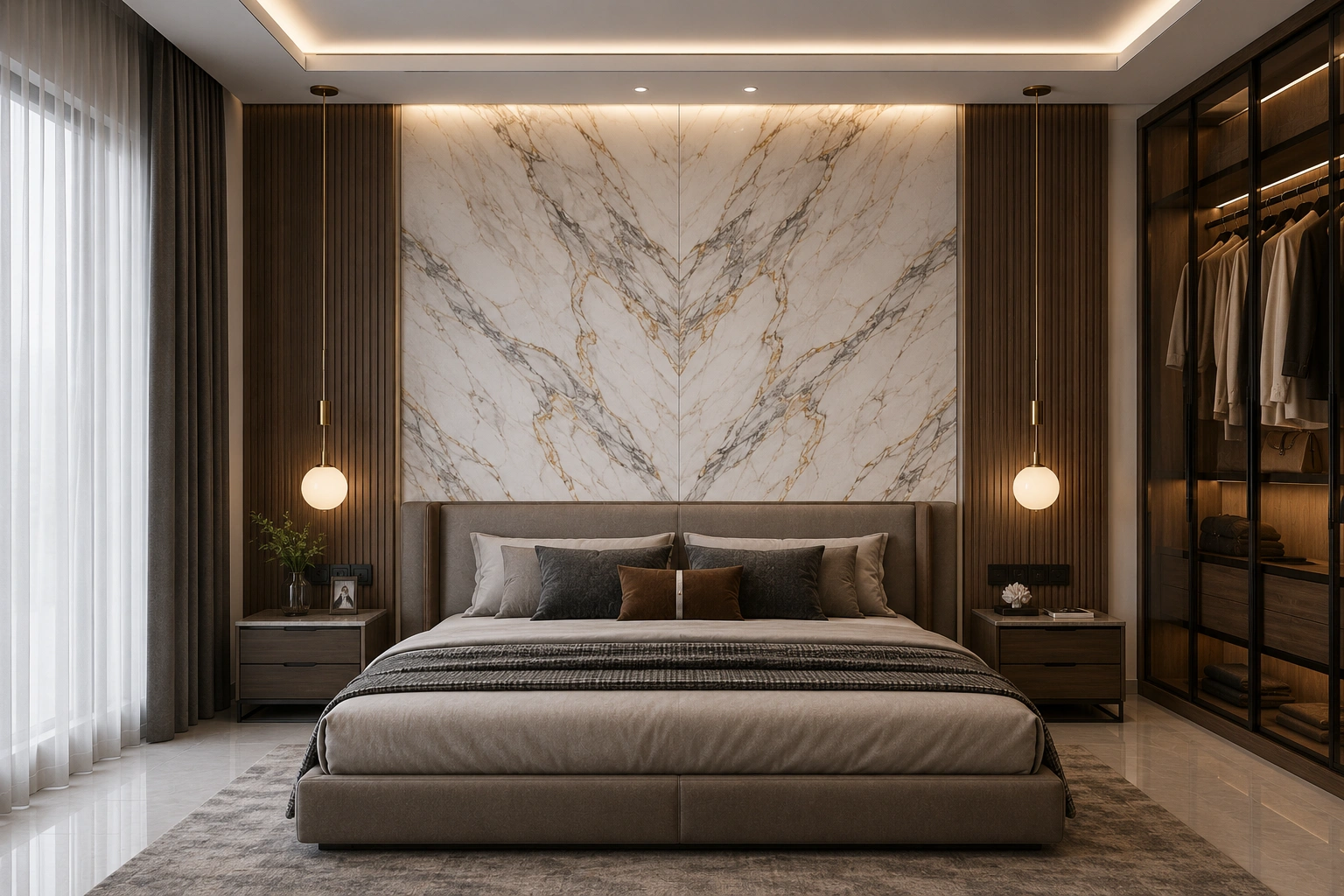
The headboard wall is the second most common application in Indian premium homes. A bookmatched panel behind the bed frame, running from floor to ceiling or framed at three-quarter height, gives the bedroom the visual quality of a boutique hotel suite. It eliminates the need for wallpaper, paint, murals, or heavy wall art behind the bed.
For bedrooms, softer marble patterns in cream, warm white, or pale taupe work better than dramatic black veining, which can feel visually heavy in a space meant for rest.
Bathroom Feature Wall and Vanity Backdrop
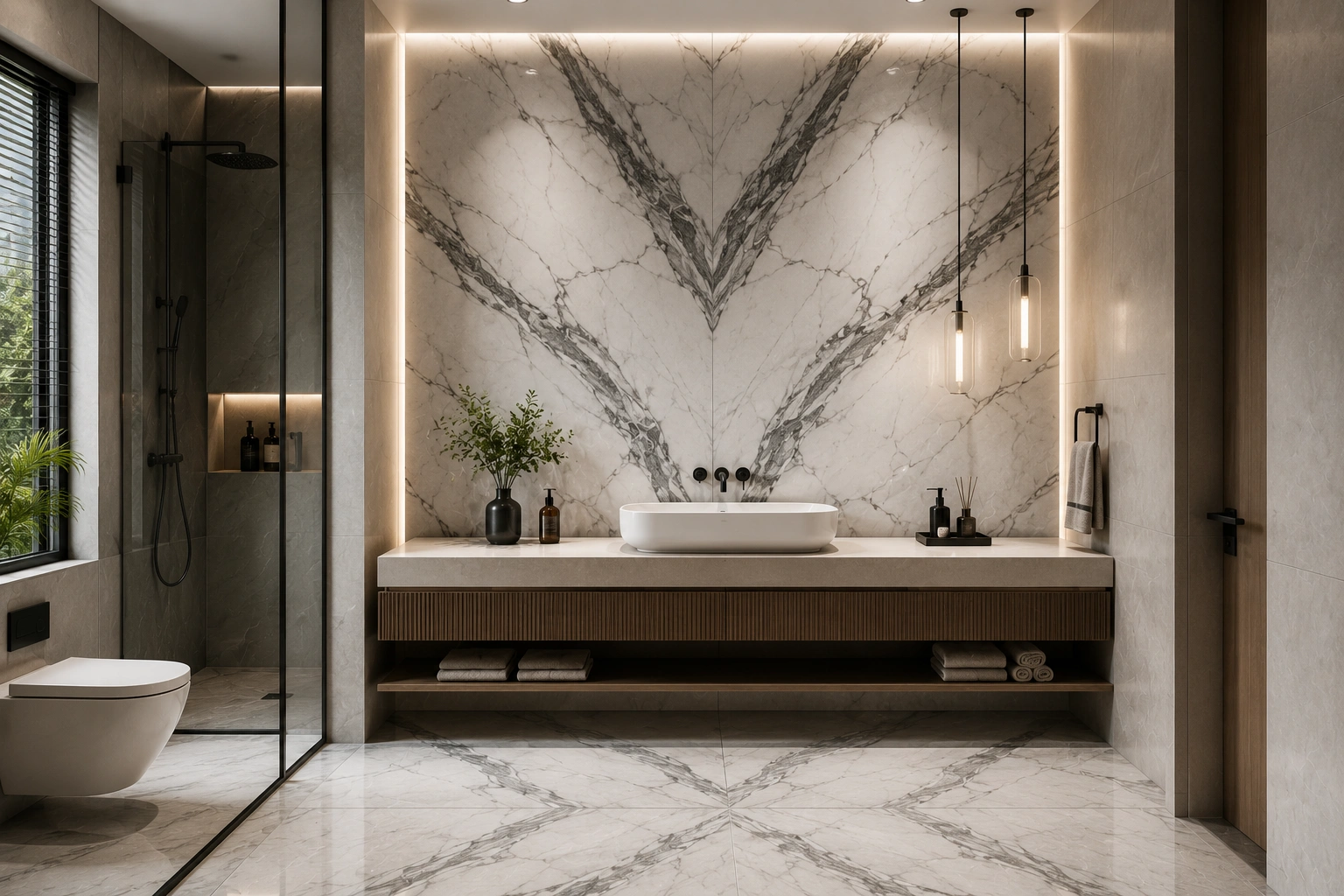
Premium bathrooms in Indian homes are where bookmatching has the most concentrated visual impact per square foot. A bookmatched panel behind the washbasin vanity or across the shower enclosure wall gives a spa-like quality that is difficult to achieve with any other single design decision.
PGVT tiles in polished finish suit dry bathroom walls and vanity backdrops. For shower enclosure walls that come into contact with water, choose GVT tiles in matte or Posh finish to prevent slipperiness. Water absorption for both GVT and PGVT is less than 0.05%, indicating excellent moisture resistance.
Entrance Foyer and Lobby
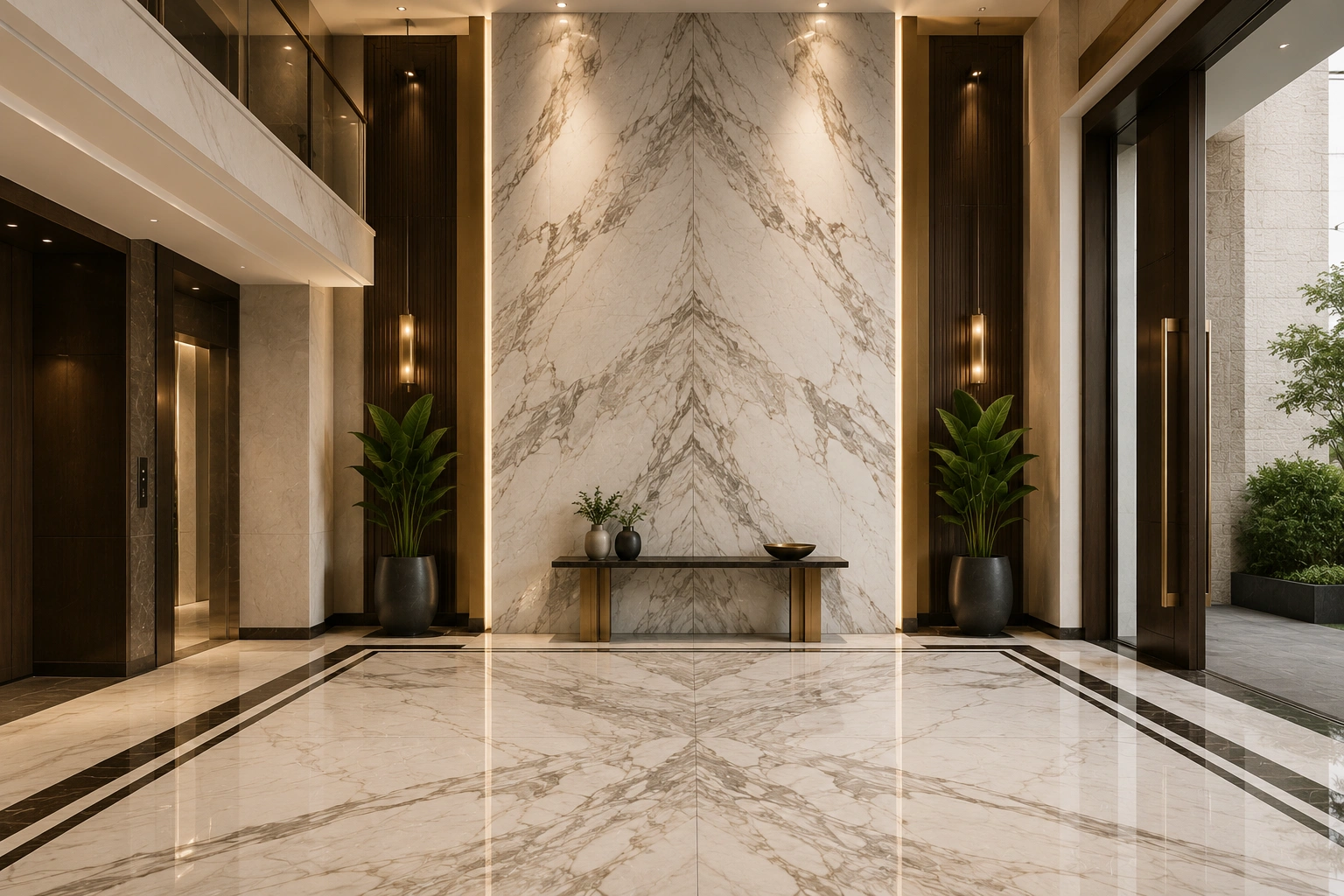
The entrance foyer is often overlooked in Indian home renovations despite being the first interior space a visitor sees. A narrow floor-to-ceiling bookmatched wall in the foyer, in a dramatic onyx or dark marble pattern, makes an immediate impression while requiring only 20 to 40 sq. ft. of tile.
For residential societies and commercial lobbies, bookmatched walls in the reception area immediately signal the quality of the space and reduce the need for expensive art installations.
Dining Room Accent Wall
-9e0e33ae-391d-4768-927e-74bb89c2a7c2.webp)
The wall behind the dining table in an open-plan living and dining layout is a natural location for a bookmatched feature panel. It frames the dining area without needing a physical partition. Light Calacatta or Arabescato patterns in warm cream tones complement most Indian dining furniture without overpowering the space.
Bookmatch Tiles vs Natural Stone Bookmatching: Cost in India
One of the strongest practical arguments for tile bookmatching over natural stone is cost. The visual effect is similar. The price difference is substantial.
| Material | Approx. Cost Per Sq. Ft. (Material Only) | Installation Cost | Maintenance |
| Bookmatched PGVT tiles (Indian) | ₹80 to ₹250 | ₹40 to ₹80 per sq. ft. | Low, occasional wipe-down |
| Bookmatched GVT slab tiles (32x96+) | ₹150 to ₹400 | ₹80 to ₹150 per sq. ft. | Low |
| Natural marble (bookmatched, Indian) | ₹300 to ₹800 | ₹150 to ₹300 per sq. ft. | High (sealing, polishing) |
| Imported natural stone (bookmatched) | ₹800 to ₹2,500+ | ₹200 to ₹500 per sq. ft. | Very high |
For a 10 by 10 foot (approximately 100 sq. ft.) feature wall, the total installed cost of quality bookmatched PGVT tiles runs between ₹1.2 lakh and ₹3.3 lakh all-in. The same wall in imported bookmatched natural stone can run ₹10 lakh to ₹25 lakh or more.
All tile prices above are approximate 2026 market ranges. Prices vary by brand, dealer city, and grade. GST at 18% applies to tile materials.
How Bookmatch Tiles Are Installed: What You Need to Know
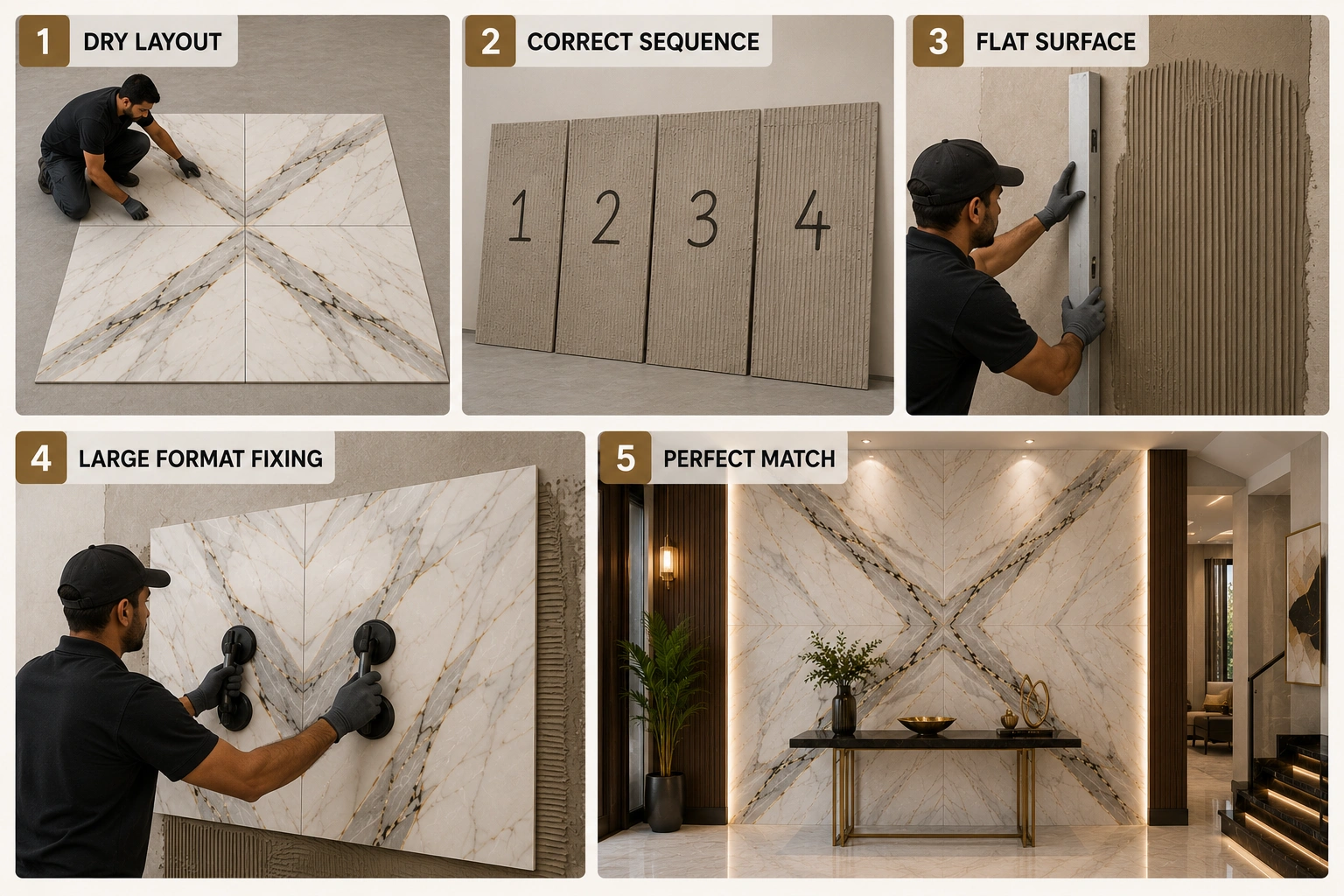
The bookmatching effect is entirely dependent on correct installation sequencing. A beautiful tile laid out of sequence breaks the mirror pattern and cannot be fixed without removing and relaying the affected tiles.
Understanding the Tile Sequence
Bookmatch tiles come in sets, typically sold in pairs or in boxes where alternating tiles carry the mirrored design. Before installation begins, lay out the full wall on the floor in the correct sequence to verify the pattern reads correctly. This dry-lay step is not optional on bookmatch projects.
Mark each tile with a temporary chalk number on the back to preserve the sequence before your mason begins fixing. The sequence established in the dry-lay becomes the exact installation order.
Wall Preparation
Large format tiles, particularly the 32x96 and 32x120 slab sizes, require a flat, plumb wall surface. Any undulation or tilt in the wall throws the joint alignment off across the full run of tiles. In older buildings where walls are not perfectly flat, a skim coat or tile adhesive bed levelling is needed before installation begins.
Use a polymer-modified tile adhesive, not plain cement mortar, for tiles above 600x1200 mm. The higher bond strength handles the weight of large-format tiles without slippage during the fixing process.
Grout Choice
Grout colour is more critical in bookmatch installations than in standard tile work because any visual interruption of the pattern is magnified. Use a grout colour that closely matches the lightest shade in the tile background. For white Calacatta bookmatching, an off-white or ivory grout with a 2 mm joint maintains pattern continuity. For dark stone bookmatching, a dark charcoal grout maintains depth.
Epoxy grout is worth the extra cost for bathroom bookmatched walls. It does not stain, does not absorb moisture, and holds its colour for years without the periodic cleaning that cement grout requires in wet areas.
Hiring the Right Mason
Not every tile mason has experience with large-format book-matched installations. Ask specifically whether the contractor has worked with tiles above 600x1200 mm and whether they are familiar with dry-laying before fixing. The labour cost for bookmatched large format installations is higher than standard tile work, typically ₹80 to ₹150 per sq. ft., and that reflects the skill and time required.
Design Tips for Getting Bookmatch Walls Right
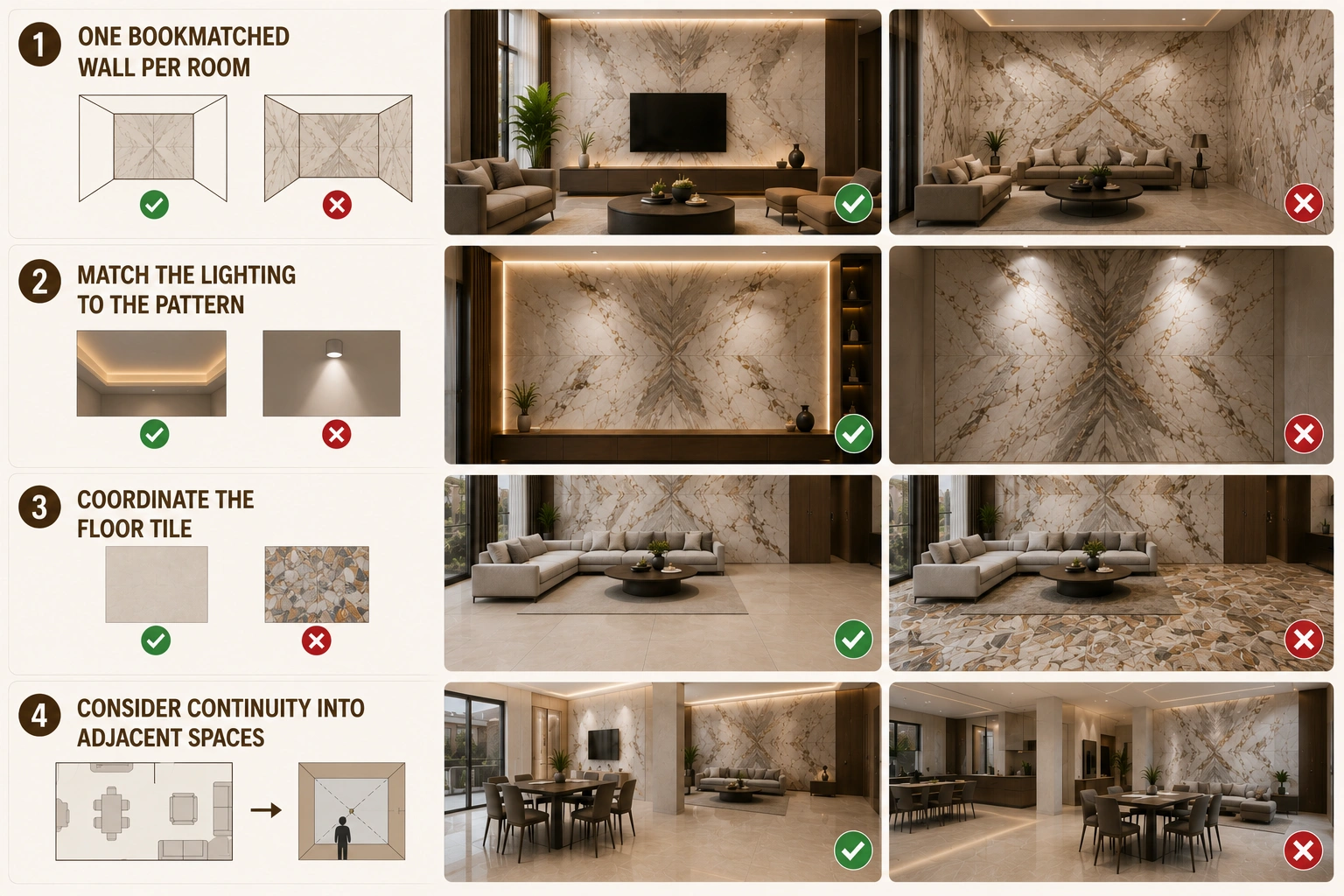
One Bookmatched Wall Per Room
The visual power of bookmatching comes from contrast with the surrounding space. Applying bookmatched tiles to all four walls of a room eliminates the focal point effect and creates visual overload. One wall, done well, is the principle that interior designers follow consistently.
Match the Lighting to the Pattern
Polished PGVT bookmatch tiles respond dramatically to light direction. Recessed LED strips at ceiling level or cove lighting behind a false ceiling wash the wall with light and bring out the depth of the veining pattern. Harsh downlights aimed directly at a polished bookmatch wall create glare rather than drama. Test your lighting setup before finalising the wall design.
Coordinate the Floor Tile
The floor directly in front of a bookmatched feature wall should not compete with it. A plain GVT tile in a neutral ivory or warm grey, in a large format like 2x4 (600x1200 mm), grounds the room without pulling visual attention away from the wall. Heavily patterned floor tiles under a bookmatched wall create visual conflict.
A bookmatched feature wall works best with a calm, neutral floor. Many homeowners pair it with wood-look flooring, making Wood Look Tiles vs Real Hardwood a useful comparison when choosing the right surface for the rest of the room.
Consider Continuity into Adjacent Spaces
In open-plan homes where the living room flows into the dining area or kitchen, a bookmatched wall visible from multiple vantage points needs to read well from different angles and distances. Test the tile layout from the far end of the room, not just standing directly in front of the wall.
Common Mistakes with Bookmatch Tile Projects
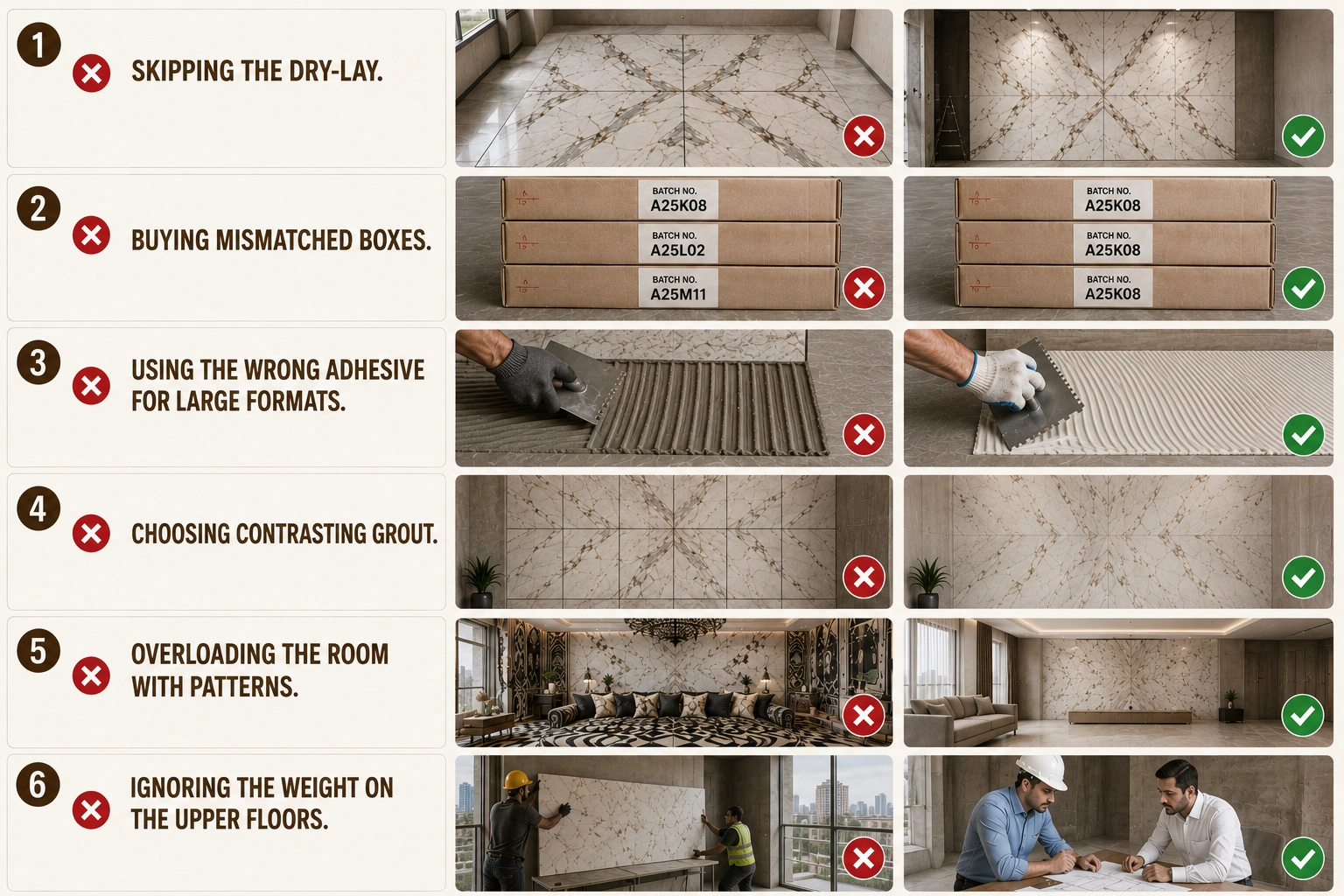
Skipping the dry-lay. The single most common and most expensive mistake in bookmatch installations. If tiles are laid directly without verifying the pattern sequence on the floor first, mismatches are only visible after the adhesive has set.
Buying mismatched boxes. Bookmatch tiles must come from the same production batch and the same set. Tiles from different batches may have slight colour or pattern variation that breaks the mirror effect. Always verify batch numbers on all boxes before accepting delivery.
Using the wrong adhesive for large formats. Standard cement mortar does not provide the bond strength or working time needed for slab-format tiles. Polymer-modified adhesive is the correct choice for anything above 600x1200 mm.
Choosing contrasting grout. A dark grout on a white marble bookmatch pattern turns the tile grid into the visual focus of the wall instead of the pattern. Colour-matched or tone-on-tone grout keeps attention on the book-matched design.
Overloading the room with patterns. Bookmatched tiles paired with geometric flooring, patterned sofas, and decorative ceilings create visual noise. The wall needs a calm room around it to work as intended.
Ignoring the weight on the upper floors. Large-format slab tiles are heavy. In high-rise apartments above the fifth or sixth floor, check with your structural consultant before installing full-height 32x96 or 32x120 slab tiles across a large wall. Builder guidelines and slab loading capacity matter here.
Choosing the Right Bookmatch Tiles for Your Space
A well-installed bookmatch wall is one of the few interior design choices that remains impressive a decade after installation. The pattern does not date the way paint colours or wallpaper trends do. The material holds up without demanding attention. And the visual effect continues to register with everyone who enters the room.
The decision that matters most is not which pattern to choose but where to place it. One wall, with the right tile size, the right finish, and careful installation, delivers the full effect. Spreading bookmatching across multiple walls or rooms dilutes it.
Before finalising, take tile samples home and observe how the veining pattern reads under your actual ceiling height and room lighting. Place two samples side by side to preview the mirror effect. And confirm your installation contractor is experienced with the specific tile size you have chosen.
You can browse a curated range of bookmatch GVT and PGVT tiles across marble-look, onyx, and stone patterns on TilesFinders, where you can compare designs, sizes, and finishes from leading Indian manufacturers before visiting a showroom or placing a bulk order.
FAQs
Bookmatch tiles are pairs or sets of tiles printed with a mirrored design so that when placed side by side on a wall, they create a continuous, symmetrical pattern. The technique replicates natural stone bookmatching, where adjacent stone slabs are flipped like pages of a book to reveal mirrored veining. In vitrified tiles, the effect is achieved through high-resolution digital printing.
Polished PGVT tiles yield the deepest, most dramatic results for indoor dry walls, as the high-gloss surface reflects light and accentuates the veining depth. For a quieter, more contemporary look, GVT tiles in Posh or matte finish suit minimalist and Japandi-influenced interiors. Avoid sugar or embossed textured finishes on bookmatch tiles, as surface texture interrupts the visual continuity of the mirror pattern.
Yes. Bookmatch GVT and PGVT tiles work well on bathroom walls, including shower enclosures, vanity backdrops, and full bathroom feature walls. Both GVT and PGVT absorb less than 0.05% water, which makes them well-suited for wet wall applications. For shower walls where water contact is direct and frequent, a matte or Posh finish GVT tile is safer than a polished finish, which can feel slippery to touch.
Quality bookmatched PGVT tiles from Indian manufacturers range from ₹80 to ₹250 per sq. ft. for material. Large format GVT slab tiles in 32x96 or 32x120 sizes run ₹150 to ₹400 per sq. ft. Installation adds ₹40 to ₹150 per sq. ft., depending on tile size and project complexity. These are approximate 2026 market figures and vary by brand, city, and dealer.
A 10 by 10 foot wall covers approximately 9.3 sq. metres or 100 sq. ft. For 600x1200 mm (2x4) tiles, each tile covers 0.72 sq. metres, so approximately 13 to 14 tiles are needed per full run. Always order 10% extra to account for cuts, edge tiles, and future replacements from the same batch. Confirm the exact tile count with your contractor after the dry-lay step.
No. GVT and PGVT bookmatch tiles need no special maintenance beyond regular cleaning with a damp cloth or mild tile cleaner. They do not require sealing, polishing, or annual treatment, unlike natural stone bookmatched walls, which need periodic sealing and professional polishing to maintain their surface. This low upkeep requirement is one of the practical advantages of tile bookmatching over natural stone.
Bookmatch tile installation, particularly in large formats above 600x1200 mm, requires an experienced tile mason familiar with dry-laying, pattern sequencing, and polymer-modified adhesive use. A DIY installation without prior experience risks breaking the pattern sequence or misaligning tiles in ways that cannot be corrected after the adhesive sets. Professional installation is strongly recommended for any bookmatched project.

See our tile guides first
Set TilesFinders as a preferred source and our buying guides surface ahead of the rest for you.
Add as preferred sourceTakes one tap. Nothing to install.
What Readers Say
I was about to redo my parking area with the wrong tile size until I read this. The layout comparisons saved me from a costly mistake.
We reference TilesFinders guides while briefing clients on material selection. The size and pattern breakdowns are accurate and easy to explain visually.
On site, I get asked about grout spacing all the time. This article gave me a solid reference I now share with my team before every job.
Finally a guide that doesn't just push generic advice. The oil stain removal steps actually worked on our clubhouse driveway tiles.
I run a small construction firm and now send this link to clients directly when they ask about entrance tile sizing. Saves me an hour of explaining.
Good practical detail, though I wish there were more examples for compact apartment entrances specifically, not just villas.
My mother-in-law wanted marble, I wanted vitrified. This blog gave us the neutral comparison we needed to actually decide together.
Detailed without being overwhelming. I appreciated that it covered both cost and maintenance, not just the aesthetics.
Used the algae and hard water removal tips on our terrace tiles after the monsoon. Worked better than what our regular cleaner was doing.
As someone who sources tiles for multiple builder projects, I find these comparisons genuinely useful for vendor conversations, not just consumer content.
Recommended this to a client who kept second-guessing the entrance design. The small vs large layout section settled the debate instantly.
Straightforward and honest, no unnecessary jargon. Would like to see a similar breakdown for outdoor pool-deck tiles next.
We've bookmarked several TilesFinders guides for our design handbook. Reliable source when clients want data, not just opinions.
Two paths, one marketplace.
Get free quotes from verified suppliers.
Share your room, budget, and style. Suppliers in Morbi respond within hours.
Get Free QuotesList your business, reach real buyers.
Put your showroom in front of homeowners searching for tiles right now.
List Your Business