Best Pooja Room Tiles in Delhi NCR: Designs, Price and Where to Buy in 2027
Discover the best pooja room tiles in Delhi NCR for 2027. Compare marble-look designs, floor grip, stain-resistant epoxy grout, local pricing (₹40–₹600/sq ft), and top showrooms.

- A Room Most Contractors Underestimate
- What Goes Down Underfoot
- The Backdrop Behind the Idol
- The Detail Everyone Forgets
- Where the Pooja Room Meets the Rest of the House
- Keeping It Looking Right Through the Year
- Colour, and the Vastu Question
- What It Costs in 2027
- Sourcing It in Delhi NCR
- Find Pooja Room Tiles in Delhi NCR
A Delhi NCR pooja room is judged on grip, stains, and look, not weather, so matte vitrified floors with a marble look wall backdrop are the practical 2027 pick, at roughly Rs. 40 to Rs. 600 per sq ft.
A pooja room is usually the smallest room in a Delhi NCR home, sometimes not even a full room, just a ledge or a corner unit tucked beside the kitchen. Yet it gets a level of attention that a much bigger bedroom rarely receives, because this is the one space judged on how it feels every single day rather than how it survives wear and tear.
That single fact changes the whole tile conversation. A driveway gets picked for load and water absorption. A facade gets picked for weather resistance. A pooja room gets picked for how it feels underfoot, how easily it wipes clean after an aarti, and how it looks under the soft glow of a diya rather than under harsh daylight. Delhi NCR's own swing between a 45-degree summer and a near-freezing winter barely touches this room directly, since it sits indoors, but it does shape one thing homeowners notice immediately: a cool marble or vitrified floor is genuinely pleasant to stand on barefoot through a Delhi summer, and that comfort ends up mattering as much as the design itself.
A Room Most Contractors Underestimate
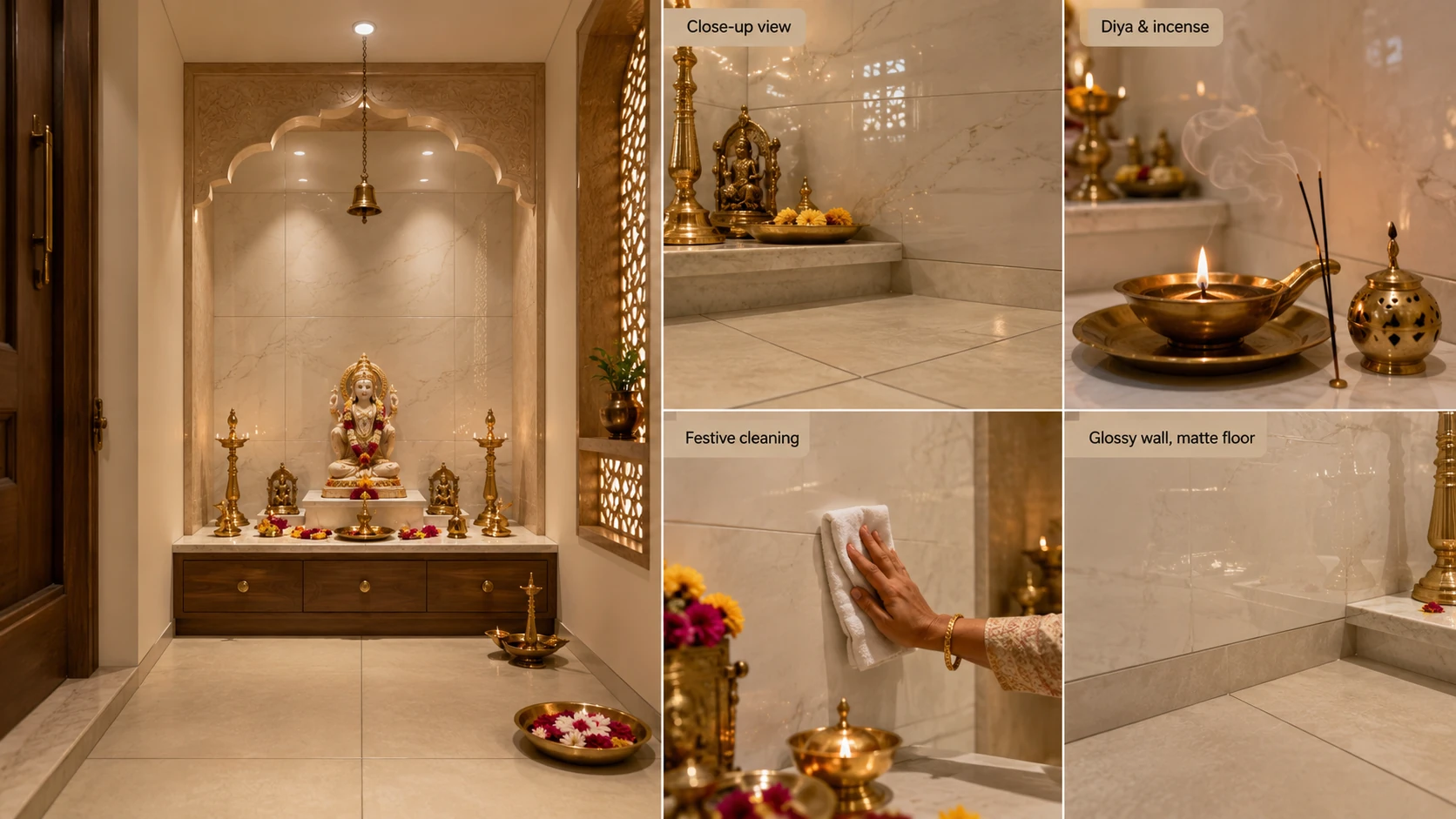
Ask a contractor to walk through a full house renovation and the pooja room usually comes up last, treated as a smaller version of whatever decision was made for the rest of the flooring. That approach misses what actually makes this room different.
A living room floor is judged over years of foot traffic. A pooja room floor and its backdrop wall are judged every single morning, often at close range, by someone standing or sitting directly in front of it with incense burning and a diya lit a few inches away. The margin for a finish that looks slightly off, or a grout line that has already started to yellow, is much smaller here than anywhere else in the house.
Delhi NCR also brings a seasonal rhythm to this room that other cities do not deal with in quite the same way. Diwali usually means a proper deep clean and sometimes a fresh coat of paint around the pooja corner, which is also when small tile or grout issues from the rest of the year tend to surface and get noticed.
The city's dust load, driven by construction activity and the drier months between festivals, settles more visibly on light coloured matte surfaces than on a glazed one, which is one more reason glossy or satin finishes have stayed popular for the wall behind the idol even as matte has taken over the floor.
What Goes Down Underfoot
Since most rituals here are performed standing or seated on the floor, often barefoot, grip matters more in a pooja room than in almost any other part of the house. A glossy tile that looks stunning in a showroom becomes a genuine hazard the moment it gets wiped with water, which happens often in this room. Matte or satin-finish vitrified tiles solve this quietly, offering the barefoot grip a glossy surface cannot, while also resisting oil and turmeric far better than a plain ceramic tile would.
The bigger decision most homeowners wrestle with is real marble against a marble-look tile. Makrana White and Ambaji White remain the classic choices for anyone who wants the actual stone, and there is no substitute for that if authenticity matters to the family. But marble is porous, and a room where turmeric, kumkum, and lamp oil are part of daily use is exactly where that porosity shows up fastest, as stains that set into the stone rather than sitting on top of it.
A marble-look vitrified or glazed vitrified tile reproduces the same veined look at a fraction of the cost, needs no sealing, and shrugs off the same stains that would mark real stone within months. For most Delhi NCR homeowners renovating in 2027, this has become the practical default, with real marble reserved for those who specifically want the material rather than just the look.
The Backdrop Behind the Idol
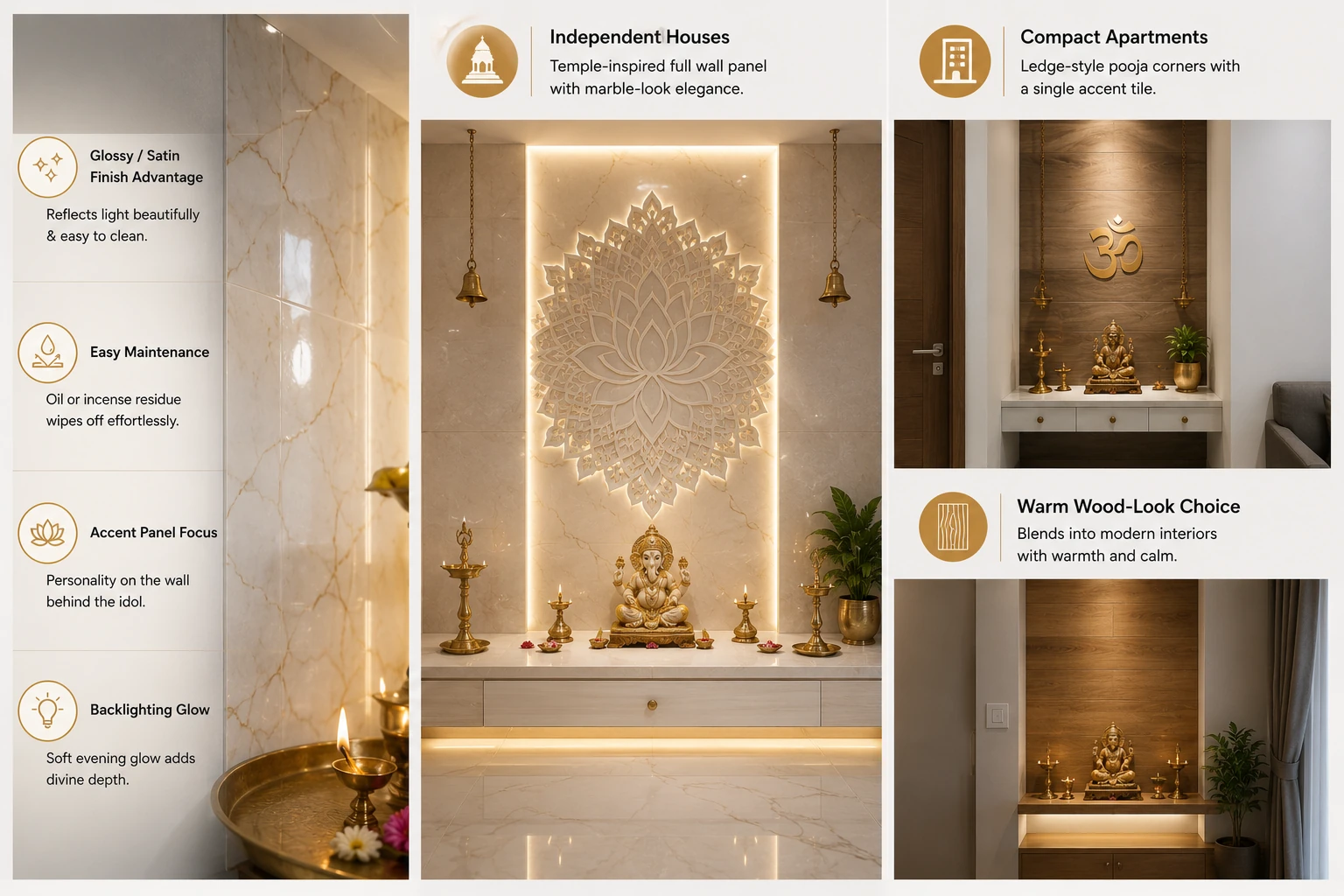
Once you move from the floor to the wall behind the idol, the rules flip. Nobody stands on this surface, so grip stops mattering, and a glossy or satin finish becomes a genuine advantage rather than a risk. A glazed marble look tile reflects diya and lamp light softly across the wall in a way a flat matte surface cannot, and oil or incense residue wipes off a glazed surface more easily than off anything textured.
This is also where most of the personality in a 2027 pooja room shows up, and rarely across the whole wall. The current preference among Delhi NCR homeowners is a single character panel behind the idol rather than tiling the entire room in one design, using a mandala or lotus motif tile, or a jali style lattice pattern, sometimes paired with backlighting for a soft glow once evening sets in.
Independent houses in Gurugram and Faridabad tend to lean toward this more traditional, temple-inspired treatment, with a full marble-look floor and a carved-looking panel as the centrepiece. Compact apartments in Noida and Dwarka are taking a different route, building ledge-style pooja corners with a single accent tile rather than a dedicated room, and increasingly reaching for warm wood-look tiles that blend into an otherwise contemporary interior instead of standing apart from it.
From The Marketplace
Popular tiles right now









The Detail Everyone Forgets
Almost nobody budgets a moment's thought for grout colour, and this is precisely where regret shows up fastest in a pooja room. White grout looks immaculate on installation day and then discolours within months, since turmeric, kumkum, and incense residue stain a white grout line faster than almost any other surface in the house. Homeowners often blame the tile itself when this happens, when the actual culprit is nearly always the grout underneath it.
Cream, beige, or a soft gold grout tone hides this early staining for far longer than white ever will, and epoxy or polymer-modified grout resists oil and turmeric penetration in a way standard cement grout simply cannot. It is a small, inexpensive substitution at the point of installation that saves a wall from looking neglected within its first year of daily use.
Where the Pooja Room Meets the Rest of the House
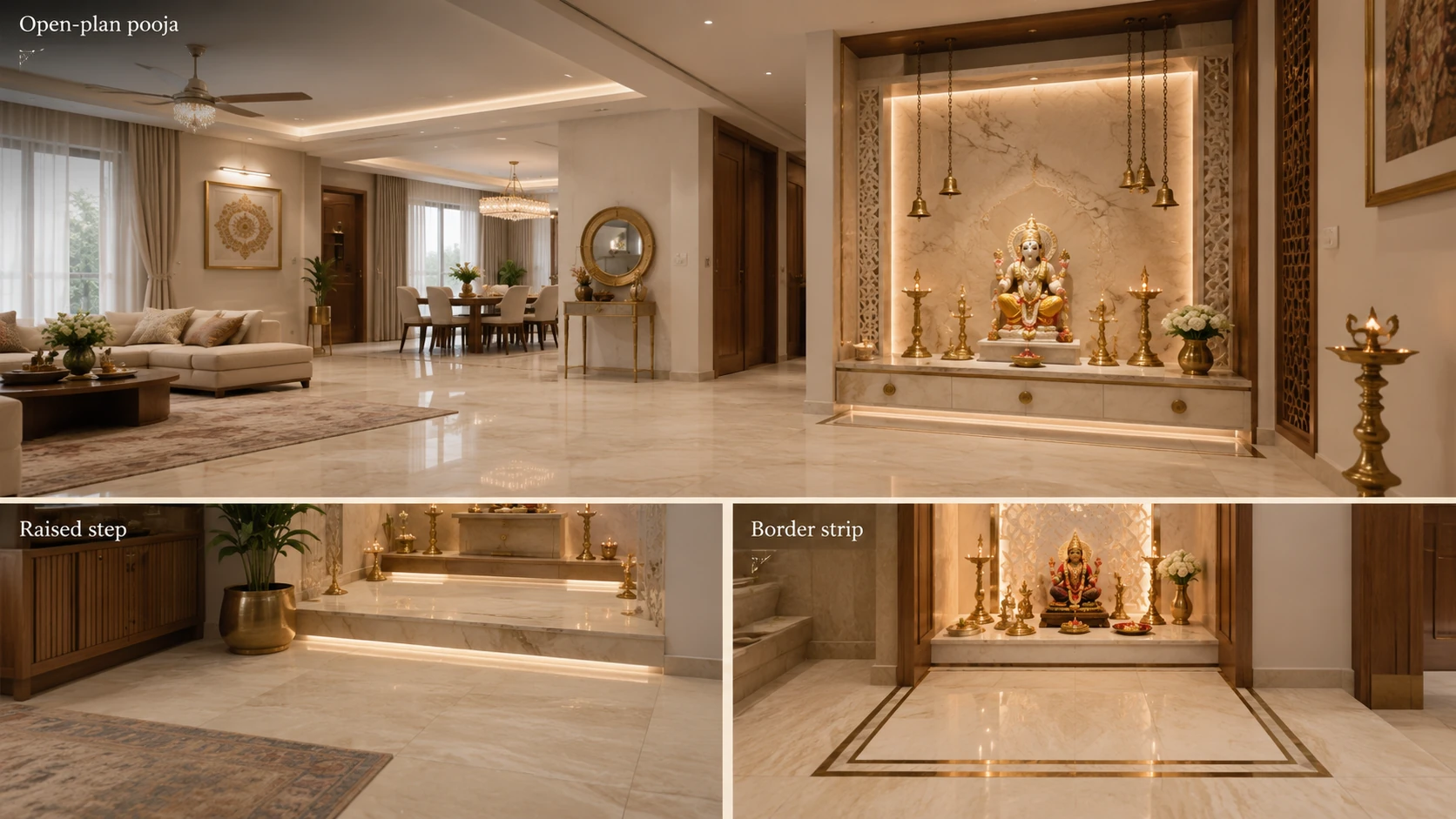
Very few Delhi NCR pooja rooms are fully closed off anymore. Most sit as an open corner off a living room or a ledge built into a passage near the kitchen, which means the flooring choice cannot be made in isolation from whatever runs through the rest of that space.
A hard visual break, where the pooja room floor changes abruptly in colour or tone from the adjoining area, tends to look like an afterthought rather than an intentional design choice. Homeowners who get this right usually keep the pooja room floor within the same broad tonal family as the hallway or living room it opens into, sometimes stepping up half a shade lighter or introducing a border strip at the threshold rather than a jarring colour change.
A raised platform or a slightly recessed step at the entry to the pooja corner is common in larger independent houses in Gurugram and Faridabad, and this small level change is often used as the natural point to switch tile categories, moving from the whole home flooring into the marble look or real marble finish reserved for the sacred space itself. In compact Noida and Dwarka apartments without room for a step, a simple border tile in a contrasting but complementary tone does the same visual job of marking the transition without disrupting the flow of the room.
Keeping It Looking Right Through the Year
A pooja room earns its keep through daily use, and that daily contact with oil, smoke, and water is exactly what tests a tile finish over time. Matte vitrified floors hold up well against routine wiping, but they should be cleaned with a mild, non-acidic cleaner rather than anything harsh, since repeated use of strong chemical cleaners can dull a matte surface faster than normal wear would. Real marble needs a different discipline altogether, with periodic resealing and an outright avoidance of acidic cleaning agents, since even a diluted lemon- or vinegar-based cleaner can etch the stone's surface permanently.
The glazed or satin wall behind the idol is more forgiving day to day, since a soft cloth wipe usually lifts oil and ash residue without much effort, but the grout lines around it still need attention on a fixed schedule rather than only when discolouration becomes obvious. Many Delhi NCR households already build a pooja corner deep clean into their Diwali preparations, and using that same yearly rhythm to check grout condition and reseal any real marble surfaces keeps the room from ageing unevenly compared to the rest of the house.
Colour, and the Vastu Question
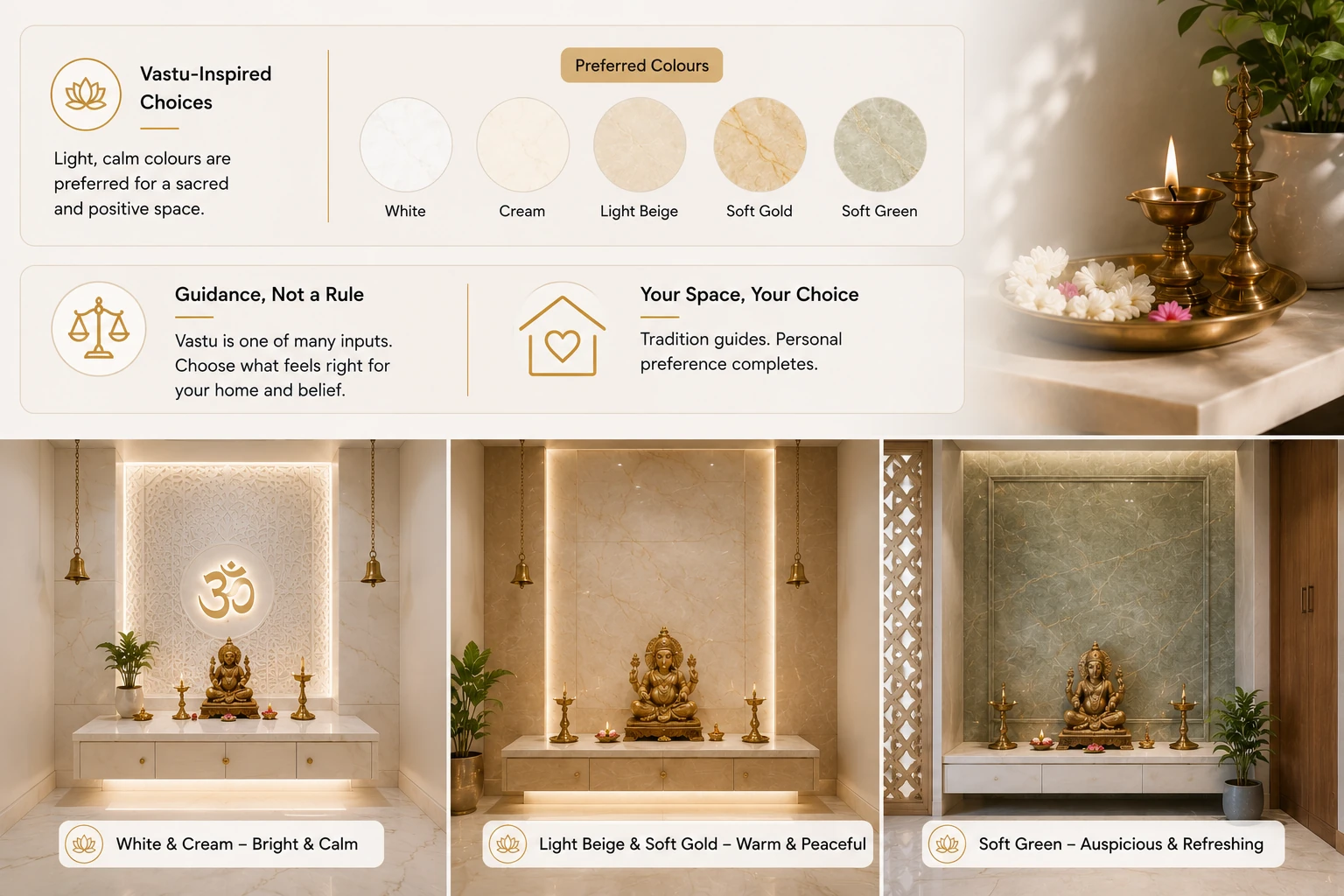
Colour choice here draws as much from common Vastu practice as from personal taste, and most Delhi NCR homeowners arrive at the showroom already carrying a preference shaped by this tradition. White, cream, light beige, and soft gold dominate the requests, seen as bright and calming for a sacred corner of the home, while very dark tones, particularly black, are generally set aside based on the same widely followed preference for light, uplifting shades in this specific room.
A softer green marble look sometimes comes up too, drawing on the same tradition that treats certain green-toned stones as auspicious for sacred spaces. None of this is a fixed rule, and it is worth treating as one input among several rather than a requirement, especially for homeowners following a different tradition or a simple personal preference.
What It Costs in 2027
Because the room itself is small, often no larger than 36 to 60 square feet, the grade of material affects the total bill far less here than it would in a living room or bedroom, which is exactly why many homeowners choose to spend more per square foot in this one corner of the house than anywhere else.
| Material | Price Range (Rs/sq ft) | Notes |
| Standard matte vitrified | Rs. 40 to Rs. 90 | Good barefoot grip, budget-friendly |
| Marble look GVT/PGVT | Rs. 90 to Rs. 250 | Marble appearance without sealing or staining issues |
| Real marble (Makrana/Ambaji White) | Rs. 250 to Rs. 600+ | Authentic material, needs sealing and more upkeep |
| Jali or motif accent tiles | Rs. 60 to Rs. 200 | Used for one backdrop wall, not the full room |
Put together for a typical 6x6 foot pooja room, a mid-range marble look vitrified floor paired with a single accent panel behind the idol usually lands around Rs. 10,000 to Rs. 18,000 for material, with installation adding roughly Rs. 2,000 to Rs. 4,000 given the small footprint and the extra cutting a motif panel needs.
A larger dedicated pooja room in an independent Gurugram or Faridabad house, closer to 10x8 feet with a full real marble floor and a carved-look marble panel behind the idol, moves into a different range entirely, often running Rs. 45,000 to Rs. 90,000 for material once the higher per square foot cost of real marble and the labour for cutting and polishing are factored in.
Sourcing It in Delhi NCR
Delhi NCR's tile trade does not sit in one place, and where you go depends on what you are comparing. Kirti Nagar and Raja Garden in West Delhi mix brand showrooms with independent dealers and carry a strong range of marble look and motif tiles well suited to this specific room. Lajpat Nagar has grown into a destination for large format brand showrooms, some running to several thousand square feet, displaying marble look and glazed vitrified ranges alongside full bathware collections under one roof.
Okhla and South Delhi serve homeowners closer to the Noida border and Faridabad with their own set of brand studios, while Jagatpuri remains the city's recognised wholesale stretch, useful for comparing standard vitrified pricing before deciding whether a marble look upgrade is worth the difference. For anyone set on real marble specifically, Loni Road in Ghaziabad carries a dense concentration of stone dealers alongside the usual vitrified stockists.
Builders specifying a repeated pooja corner design across many flats in a single project generally do better sourcing matching marble look GVT directly from manufacturers in Morbi, Gujarat, through a supplier platform such as TilesFinders, which keeps shade consistent across units and typically costs less than buying the same volume through Delhi NCR retail.
Find Pooja Room Tiles in Delhi NCR
A Delhi NCR pooja room comes together through a handful of small, specific decisions rather than one big tile choice, floor grip, a wall backdrop, and a grout colour that will not turn on you within a year. If you are planning a pooja corner or sourcing marble-look ranges in bulk for a builder project, TilesFinders connects you with verified Delhi NCR dealers and Morbi manufacturers to look through current options and place an informed order.

FAQs
Not necessarily, and usually not. A matte tile on the floor for grip paired with a glossy or satin marble look tile on the wall behind the idol is the more common combination, since the two surfaces are asked to do different jobs.
Only on the floor, where it loses grip once wet from routine cleaning. On the wall behind the idol, a glossy or satin marble look finish is not just acceptable but genuinely preferred, since it catches diya light well and wipes clean easily.
Smaller formats such as 300x300 mm or 300x600 mm generally work better than large format tiles here, since they cut down on wastage and sit more naturally within a compact footprint that often includes a motif panel or border.
Yes, noticeably. Marble is porous and needs periodic sealing, and turmeric, kumkum, and oil stain it faster than a vitrified marble look tile, which has near-zero water absorption and never needs sealing at all.
This is almost always grout discolouration from turmeric, kumkum, and incense residue rather than any fault in the tile itself. Epoxy grout in a cream, beige, or gold tone resists this far longer than plain white cement grout.


See our tile guides first
Set TilesFinders as a preferred source and our buying guides surface ahead of the rest for you.
Add as preferred sourceTakes one tap. Nothing to install.
What Readers Say
I was about to redo my parking area with the wrong tile size until I read this. The layout comparisons saved me from a costly mistake.
We reference TilesFinders guides while briefing clients on material selection. The size and pattern breakdowns are accurate and easy to explain visually.
On site, I get asked about grout spacing all the time. This article gave me a solid reference I now share with my team before every job.
Finally a guide that doesn't just push generic advice. The oil stain removal steps actually worked on our clubhouse driveway tiles.
I run a small construction firm and now send this link to clients directly when they ask about entrance tile sizing. Saves me an hour of explaining.
Good practical detail, though I wish there were more examples for compact apartment entrances specifically, not just villas.
My mother-in-law wanted marble, I wanted vitrified. This blog gave us the neutral comparison we needed to actually decide together.
Detailed without being overwhelming. I appreciated that it covered both cost and maintenance, not just the aesthetics.
Used the algae and hard water removal tips on our terrace tiles after the monsoon. Worked better than what our regular cleaner was doing.
As someone who sources tiles for multiple builder projects, I find these comparisons genuinely useful for vendor conversations, not just consumer content.
Recommended this to a client who kept second-guessing the entrance design. The small vs large layout section settled the debate instantly.
Straightforward and honest, no unnecessary jargon. Would like to see a similar breakdown for outdoor pool-deck tiles next.
We've bookmarked several TilesFinders guides for our design handbook. Reliable source when clients want data, not just opinions.
Two paths, one marketplace.
Get free quotes from verified suppliers.
Share your room, budget, and style. Suppliers in Morbi respond within hours.
Get Free QuotesList your business, reach real buyers.
Put your showroom in front of homeowners searching for tiles right now.
List Your BusinessMore Blogs
See all
Marble Tiles for Pooja Room: Why Devotees Prefer Them
Natural stone or marble-look vitrified? Discover why Indian families prefer marble for pooja room...
Read More
Best Pooja Room Tiles Design India: Premium Picks
Upgrade your mandir with 2026's top 8 premium tile designs. Discover how to pair PGVT walls with ...
Read More
Golden Tile Design Ideas: 20+ Luxurious Looks for Indian Living Rooms and Pooja Rooms
Explore 20+ golden tile ideas for Indian living rooms and pooja rooms with luxury designs, Vastu-...
Read More