Marble Tiles for Pooja Room: Why Devotees Prefer Them
May 22, 2026 98
Natural stone or marble-look vitrified? Discover why Indian families prefer marble for pooja rooms and how to balance Vastu, authentic aesthetics, and stain-free maintenance in 2026.

Marble Tiles for Pooja Room: Why Devotees Prefer Them
Walk into any old temple in India and look down. The floor under your bare feet is almost always stone, usually marble. Worn smooth from decades of pilgrims, it stays cool even in summer, and the veining in the white surface catches the light from the diyas without reflecting it harshly. Something about that surface feels right for prayer.
That image follows an Indian family home. Marble tiles for pooja room spaces are chosen more often than any other material in dedicated mandirs and pooja niches across the country, not because marble is cheap or low-maintenance, but because it carries a visual and cultural association that no other tile material replicates.
This guide explains what is behind that preference, then gives an honest account of what natural marble actually involves versus what marble-look vitrified tiles offer, so that families can make a choice that matches both their devotion and their daily reality.
Why Marble Has Always Been the Material of Sacred Spaces
Marble's association with sacred spaces in India is not a decorative coincidence. It runs through temple construction across centuries, from the white Makrana marble of the Taj Mahal and the Dilwara Jain temples to the polished floors of south Indian Shiva and Vishnu shrines. The material was chosen for temples because it is non-porous enough to be cleaned after rituals, cool enough to be comfortable underfoot for long puja sessions, and luminous enough to reflect lamp and torchlight in a way that creates the atmosphere associated with divine presence.
In Hindu tradition, white is associated with Saraswati and Shiva, with purity and the sattvic quality that Vastu recommends for prayer spaces. Marble is naturally white in its most revered form, Makrana white, and that connection between colour, material, and spiritual significance is not lost on families choosing tiles for their home mandir.
There is also a sensory dimension. Bare feet on a cool marble floor is a different physical experience from stepping onto ceramic tile or vitrified tile. The weight of the stone, its temperature, and its sound underfoot are part of why people associate it with reverence and attentiveness. These are not things a tile specification sheet can capture, but they explain why families who can afford natural marble still choose it for the mandir when they would use vitrified everywhere else in the home.
If you also want help with pooja room tile layouts, vastu considerations, colours, and complete mandir tile planning, read our complete pooja room tiles design and vastu guide.
Natural Marble vs Marble-Look Vitrified: The Honest Comparison
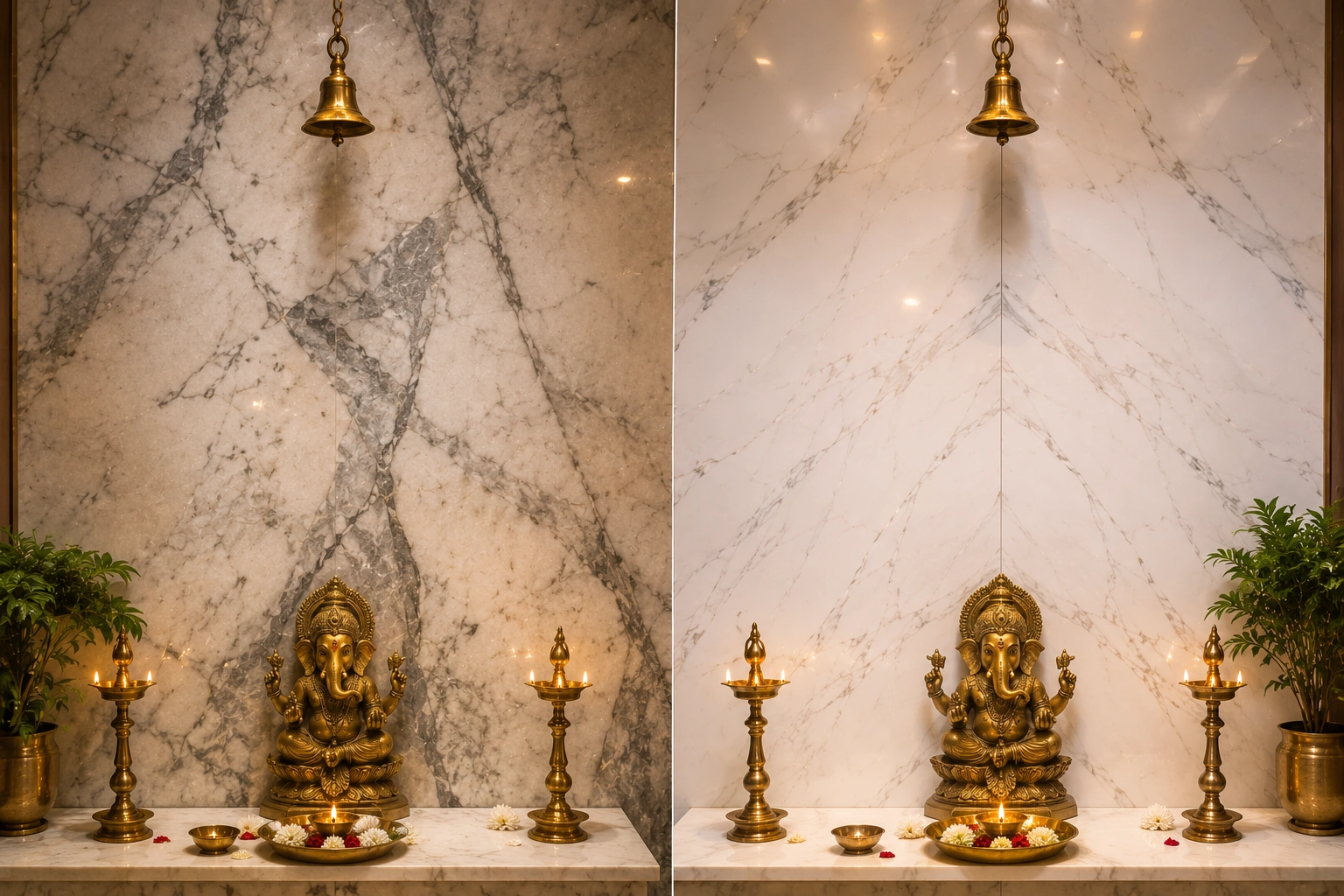
Natural marble vs vitrified marble for pooja room decisions comes down to one central trade-off: authenticity and sensory quality on one side, practical maintenance in a working ritual space on the other. Both sides of that trade-off deserve a clear account.
| Feature | Natural Marble | Marble-Look Vitrified (GVT or PGVT) |
| Material origin | Quarried natural stone (Makrana, Italian, Greek) | Vitrified tile body with digital marble-look print on surface |
| Water absorption | 0.2% to 0.5% (varies by stone variety) | Below 0.05% for GVT and PGVT |
| Kumkum and haldi staining | Stains within minutes if not sealed. Permanent without professional treatment. | Does not stain. Wipes clean with a damp cloth. |
| Diya oil contact | Absorbs into stone if left unwiped. Leaves dark marks. | Sits on surface. Wipes off cleanly. |
| Abhishek water | Handles water well when polished. Open veins in some varieties absorb moisture. | Fully water-resistant at the tile surface. |
| Maintenance | Requires sealing every 6 to 12 months. Acid cleaning for stains. Professional polishing when worn. | Standard floor or wall cleaning only. No sealing. No professional polishing. |
| Coolness underfoot | Naturally cool. Stays cooler than vitrified in summer. | Cooler than ceramic but warmer than natural stone. |
| Visual appearance | Natural veining with depth and variation. No two slabs identical. | Digitally printed veining. High-quality prints are very close to natural stone. |
| Slip resistance (floor) | Polished marble is slippery when wet. Honed finish is safer. | GVT in matte or GHR finish is anti-skid. PGVT polished is slippery when wet. |
| Available sizes | Cut to order (slabs and tiles). Common sizes: 1x1, 2x2, 2x4, slab. | GVT: 2x2, 2x4, 6x4, 32x96 slab. PGVT: 2x2, 2x4, 6x4, 32x96 slab. |
| Price range (per sq. ft.) | ₹80 to ₹800+ depending on variety and finish | ₹60 to ₹200 for GVT and PGVT in marble-look |
| Longevity without maintenance | Degrades in appearance without sealing and polishing. Stains accumulate. | Holds appearance with routine cleaning for 15 to 20 years. |
| Vastu alignment | Fully aligned. Traditional sacred material. | Aligned. Same colour and visual effect with better stain resistance. |
The practical conclusion for most Indian homes: natural marble is the right choice when the family commits to maintain it correctly, when the mandir has good ventilation and is not exposed to heavy kumkum and haldi use on the tile surface directly, and when the authenticity of natural stone matters to the family's sense of devotion. Marble-look tiles are the right choice when the mandir is used daily with full rituals, when maintenance time is limited, and when the family wants the same visual without the maintenance burden.
Vastu and Marble: Why White Works
Vastu for pooja rooms consistently recommends light, sattvic colours that reflect available light and create a sense of openness. White marble tiles for mandir walls and floors are the most aligned choice within that recommendation because white is the Vastu colour of purity, and marble is the material historically associated with sacred construction in India.
The veining in marble, whether in natural stone or in a marble-look vitrified tile, also matters from a Vastu perspective. Soft grey or gold veining on a white base is considered balanced and appropriate. Heavy dark veining that creates a visually busy or heavy impression is generally not recommended for primary mandir surfaces. The goal is a surface that feels still and composed, not dynamic or restless.
From a practical Vastu standpoint, the colour alignment is the same whether the family chooses natural Makrana white marble or a white PGVT marble-look tile. Both are white in base tone and both reflect morning light from the east or northeast, which is the most favoured mandir direction. The material choice does not change the Vastu compliance; the colour does.
Marble for Pooja Room Walls
Marble texture tiles for pooja room wall applications require different considerations for natural marble and marble-look vitrified, because the wall in a working mandir faces specific stresses: agarbatti smoke deposits, diya oil vapour, kumkum powder that drifts onto adjacent surfaces, and water splash during flower offerings.
Natural Marble on Pooja Room Walls
Natural marble on a pooja room wall in a large dedicated space reads as genuinely sacred in a way that very few other materials match. A full marble slab on the deity feature wall, cut to the height of the room, with natural veining running through it, is the closest a home mandir can get to the interior of a traditional Indian temple.
The maintenance challenge on walls is less acute than on floors because wall surfaces do not bear foot traffic or direct water contact from mopping. However, agarbatti smoke deposits a fine carbon layer on nearby surfaces over months of daily use. On natural marble, this layer needs periodic cleaning with the right stone cleaner. Standard household tile cleaners can damage polished marble surfaces. And kumkum powder that drifts onto the wall can leave a faint pink tint if not wiped immediately.
Natural marble wall tiles are available in standard sizes, including 2x2 and 2x4 for field tiles, and slabs in 32x96 for a continuous-look panel. Installation requires an adhesive rated for heavy stone and a skilled installer, since marble slabs weigh significantly more than vitrified tiles and must be installed with appropriate structural support.
Marble-Look Vitrified on Pooja Room Walls
Marble look tiles for pooja room walls in GVT or PGVT give the same white-grey veined appearance on the deity feature wall without the weight, installation complexity, or maintenance routine of natural stone. A PGVT 2x4 tile in a Statuario marble pattern, polished to a high shine, reflects diya light beautifully and holds that appearance through years of daily agarbatti smoke, kumkum, and flower offerings.
The surface of a marble-look PGVT tile is non-porous, with water absorption below 0.05%. Agarbatti ash that settles on the wall does not penetrate the surface. A weekly wipe with a damp cloth keeps the tile looking as clean as the day it was installed. There is no sealing schedule, no professional polish requirement, and no risk of permanent staining from ritual substances.
Sizes available for walls include 12x24 in ceramic with a marble-look print (wall-only), and 2x2, 2x4, 6x4, and 32x96 slab sizes in GVT or PGVT tiles. The large-format 2x4 on the feature wall with fewer grout lines is the most popular arrangement in modern Indian home mandirs in 2026.
Marble for Pooja Room Floors
The floor in a dedicated pooja room or mandir niche faces the most demanding conditions of any surface in the space: bare feet, water from abhishek and flower offerings, diya oil drips, and regular wet mopping. The floor tile choice has safety and maintenance implications that the wall tile does not.
Natural Marble on Pooja Room Floors
Marble pooja room floor tiles in natural stone, specifically Makrana white or a similar light variety, deliver the authentic temple-floor experience that many families specifically want in their home mandir. The material is cool underfoot, which becomes particularly noticeable during longer prayer sessions, and the natural veining of stone slabs on the floor carries a sense of reverence that printed tiles approximate but do not fully replicate.
The practical considerations are significant. Polished natural marble on a floor is slippery when wet. Mandir floors are regularly wet. A honed finish reduces the slip risk but also reduces the light-reflective quality that makes polished marble visually appealing. The maintenance requirement of sealing every six to twelve months is more critical on floors than on walls because floor marble faces direct water contact and foot abrasion.
Kumkum and haldi dropped directly on an unsealed marble floor stain within minutes. With a well-maintained sealing schedule and immediate wiping of ritual substances, natural marble floors remain beautiful for decades. Without that routine, they stain, dull, and eventually require professional restoration.
Marble-Look Vitrified on Pooja Room Floors
GVT in a matte or GHR finish with a marble-look print is the recommended option for mandir floors where natural marble's maintenance demands are not practical. The surface does not stain from kumkum or haldi, handles abhishek water without absorption, and the matte or GHR finish provides anti-skid grip that polished natural marble and PGVT cannot offer.
A white marble-look GVT in 2x2 on the mandir floor, paired with a marble-look PGVT in the same design family on the feature wall, creates a coordinated floor-to-wall look that reads as a continuous marble environment without the mixed-finish safety problem of using polished stone on the floor.
PGVT in a marble-look print on the floor, though visually appealing, is not recommended for mandir floors for the same reason it is not recommended for any wet-contact floor: the polished surface becomes slippery when water is present. Use PGVT on the walls and matte GVT on the floor of the same design family for a safe and visually consistent result.
Marble Tile Design Ideas for Pooja Rooms
The best marble tiles design for pooja room spaces follows a consistent logic: marble as the primary surface, either on the feature wall or the floor, with simpler plain or cream tiles on the surrounding surfaces. Here are the arrangements that work well across different home types.

Finish Guide for Marble Tiles in a Mandir
In a mandir specifically, finish choice has three dimensions that do not all apply in other rooms: light reflection for atmosphere, safety for bare feet on wet floors, and ease of cleaning ritual substances.
| Finish | Material It Applies To | Mandir Wall? | Mandir Floor? | Stain Resistance | Notes for Marble Application |
| Polished (natural marble) | Natural stone | Yes. Light-reflective, traditional. | Use with caution. Slippery when wet. Honed is safer. | Sealing required. Stains if unsealed. | The authentic temple finish. Requires maintenance commitment. |
| Honed (natural marble) | Natural stone | Yes. Less light-reflective than polished. | Yes. Better grip than polished. | Still requires sealing, but less prone to showing scratches. | Safer floor choice for natural marble in active mandirs. |
| PGVT Polished (vitrified) | GVT or PGVT | Yes. Best light reflection for mandir feature walls. | No. Slippery when wet. | Does not stain. Wipes clean. | Best finish for marble-look on the deity feature wall. |
| High Glossy GVT (vitrified) | GVT | Yes. Strong light reflection. | No. Slippery when wet. | Does not stain. | Good alternative to PGVT for walls where PGVT is over budget. |
| Matte GVT (vitrified) | GVT | Yes. Calm, non-reflective surface. | Yes. Anti-skid, safe for wet mandir floors. | Does not stain. | Best finish for marble-look on mandir floors. Pairs with PGVT walls. |
| GHR (Glaze High Resistance) GVT | GVT | Yes. | Yes. Best grip for heavy-use mandir floors. | Does not stain. | Strongest floor finish for mandirs with frequent abhishek or children. |
| Satin Matte (vitrified) | GVT | Yes. Between matte and glossy. | No. Slippery when wet, despite appearing matte. | Does not stain. | Wall-only. Do not confuse with true matte for floor use. |
What to Check Before Buying Marble Tiles for Your Mandir
For natural marble, ask about the stone variety and its absorption rate before buying. Different marble varieties have different porosity levels. Makrana white is among the lower-absorption natural marbles available in India, which makes it more suitable for a mandir than more porous varieties. Italian Carrara and Statuario have specific absorption profiles that require sealing before installation. Ask the stone supplier for the absorption rate and sealing schedule before confirming.
For marble-look vitrified, confirm the water absorption certificate. A genuine GVT or PGVT tile should have water absorption below 0.05%. Some lower-grade tiles marketed as vitrified do not meet this standard. Ask for the technical data sheet or BIS certification to confirm.
Check the veining pattern on multiple tiles, not just the sample. Marble-look tiles are digitally printed, which means the same pattern repeats across tiles in a batch. When laid in a room, this repetition can become visible as a pattern cycle on the wall or floor. Ask to see at least eight to ten tiles laid together before confirming, to judge whether the repetition is noticeable at room scale.
Take a sample into the actual room lighting. Marble-look tiles in cool or warm LED settings look very different. A tile with soft grey veining under a warm 2700K LED takes on a yellowish base. Under cool 4000K light, the same tile reads as crisp and white. Test the sample in the light source you plan to install in the mandir before ordering.
Confirm the grout width and colour before installation. Marble-look vitrified tiles in 2x4 or larger look best with very narrow grout joints (1 to 2mm) that minimise the visual break in the marble pattern. Wide grout lines interrupt the veining continuity and reduce the slab-like appearance. White or cream grout closely matched to the tile base colour maintains the seamless look. Confirm this with the installer before work begins.
Buy 10 to 15% more tiles than the measured area. Marble-look tiles, particularly in large formats like 2x4, generate more cutting wastage in niches and around mandir frame mounting points. Buffer stock also protects against batch discontinuation for future repairs.
Mistakes Worth Avoiding
Installing natural marble without sealing it first. Unsealed marble in a working pooja room stains from kumkum within the first week of use. Sealing before installation and after each polishing cycle is not optional for natural marble in a mandir space. Many families skip this step to save time or cost and regret it within months.
Using PGVT marble-look tiles on the mandir floor. The polished finish on PGVT reflects diya light beautifully and looks identical to a polished marble floor in catalogue images. On an actual mandir floor that receives abhishek water, flower water, and wet mopping daily, the PGVT surface becomes a slip hazard. Use matte GVT in the same marble-look print for the floor.
Choosing a marble-look tile with very bold, heavy veining for the full wall and floor. A tile with dramatic black or dark grey veining on a white base looks striking as a large sample. Applied across a full wall and floor of a small mandir, the heavy veining can feel restless and visually heavy rather than calm. In a compact space, softer veining, cream on white or light grey on white, creates a more appropriate atmosphere.
Not testing the pattern repetition before ordering. Marble-look digital prints repeat in a cycle. In a small pooja room or niche, the same vein pattern appearing identically on adjacent tiles breaks the illusion of natural stone. Always view multiple tiles laid together before committing to a batch.
Mixing two different marble-look designs on the wall and floor. A Statuario white-grey vein on the wall paired with a Botticino cream-gold vein on the floor creates a surface conflict rather than a coordinated environment. If using marble-look vitrified on both surfaces, choose tiles from the same design family. The wall tile in polished finish and the floor tile in matte finish of the same pattern create coordination without monotony.
Find the Right Marble Tiles for Your Pooja Room
Marble in a pooja room is not just a tile choice. It carries the memory of temple floors, the cultural weight of a material that has been associated with sacred construction in India for centuries, and the practical question of what that choice actually requires to maintain in a home where daily puja happens through busy mornings and working weeks.
The right answer is different for each family. Some will choose natural marble because nothing else carries the same presence underfoot. Others will choose marble-look vitrified because it delivers the same atmosphere without demanding a maintenance routine. Both are valid decisions.
You can browse marble-look vitrified tiles in GVT and PGVT across sizes, finishes, and veining patterns on TilesFinders to compare options from Indian manufacturers and build a shortlist before visiting a showroom.
FAQs
For a mandir floor that receives abhishek water and daily ritual activity, GVT tiles in a marble-look print with a matte or GHR finish are the safest and most practical choice. They do not stain from kumkum or haldi, handle water without absorption, and the matte finish provides an anti-skid grip that polished natural marble, and PGVT cannot offer on a wet floor. If the family specifically wants natural marble, a honed finish is safer than polished for a working mandir floor. Makrana white in 2x2 with a honed finish and a sealed surface is the most appropriate natural stone option.
Yes. Marble is one of the most Vastu-aligned tile choices for a pooja room. Vastu recommends white and light sattvic colours for prayer spaces, and white marble, whether natural or as a marble-look vitrified tile, satisfies this recommendation. The material is historically associated with temple construction in India and carries the spiritual and cultural weight that Vastu principles support for sacred spaces. Both natural marble and marble-look vitrified tiles in white or cream are considered appropriate from a Vastu standpoint.
Natural marble is a quarried stone with natural veining, a cooling touch underfoot, and a depth in its visual character that digital prints closely approximate but do not fully replicate. It requires sealing every six to twelve months and stains from kumkum and haldi if not wiped immediately. Marble-look vitrified tiles (GVT or PGVT) have a digitally printed marble pattern on a vitrified body with less than 0.05% water absorption. They do not stain, need no sealing, and require only standard cleaning. For families with the time and commitment to maintain natural stone correctly, marble is the more authentic choice. For families with active daily rituals and limited maintenance time, marble-look vitrified delivers the same visual with far less upkeep.
For natural marble: wipe ritual substances (kumkum, haldi, diya oil) immediately after contact before they can penetrate the stone. Use a pH-neutral stone cleaner for regular mopping. Avoid acidic cleaners, vinegar, and lemon-based products as they etch the marble surface. Reseal the marble every six to twelve months using a penetrating stone sealer. For marble-look vitrified tiles: a damp cloth with a mild neutral cleaner handles routine cleaning. Agarbatti ash wipes off the smooth surface cleanly. For grout lines darkened by smoke deposits, a paste of baking soda and water applied for ten minutes before scrubbing removes the staining.
In a compact pooja room or niche, lighter marble patterns read better than bold ones. A marble-look PGVT in 2x2 with soft cream or light grey veining on the back wall of the niche, with plain white ceramic 12x18 on the sides, keeps the space open while still providing the marble visual. Avoid very bold or dark veining in small spaces as it creates a visually heavy feeling that contradicts the calm atmosphere a mandir requires. A uniform soft-vein pattern across wall and floor in a coordinated design family gives a small mandir a sense of completeness without visual clutter.
Natural marble for pooja room applications in India ranges from approximately ₹80 per sq. ft. for basic domestic varieties to ₹400 or more per sq. ft. for premium Makrana white or imported Italian stone, excluding installation. Marble-look GVT tiles cost approximately ₹60 to ₹130 per sq. ft. Marble-look PGVT tiles range from approximately ₹80 to ₹200 per sq. ft., depending on size, brand, and veining detail. For a standard mandir niche of 15 to 20 sq. ft. of wall area and 10 to 15 sq. ft. of floor, total tile cost at mid-range marble-look vitrified pricing falls between approximately ₹4,000 and ₹10,000, excluding GST, grout, and installation.
For the deity feature wall: polished PGVT finish or high-gloss GVT gives the best light reflection for a marble-look tile, and polished natural marble is the traditional choice for natural stone. For the mandir floor: matte or GHR finish on marble-look GVT is the safest choice for a surface that regularly receives ritual water. Never use PGVT polished or polished natural marble on a mandir floor without addressing the slip risk. For natural marble floors, a honed finish is a safer alternative to polished, while still maintaining the marble character.
