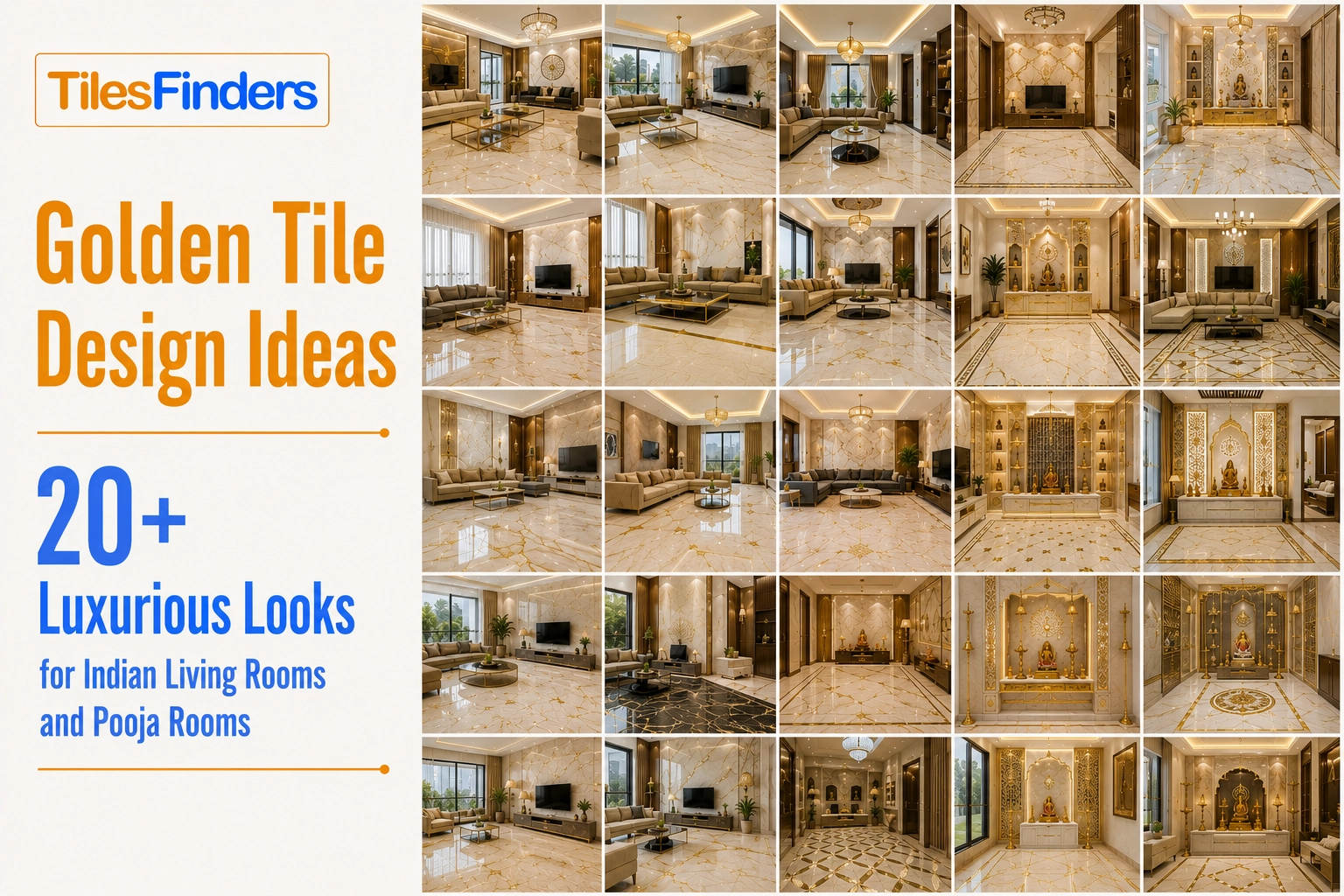
Golden Tile Design Ideas: 20+ Luxurious Looks for Indian Living Rooms and Pooja Rooms
Explore 20+ golden tile ideas for Indian living rooms and pooja rooms with luxury designs, Vastu-friendly options, tile sizes, finishes, prices, and expert styling tips.
- Golden Tile Design Ideas for Indian Living Rooms
- Golden Tile Design Ideas for Pooja Rooms
- Golden Tile Accent and Transition Ideas
- Quick Pairing Reference: Golden Tile Designs by Interior Style
- Common Mistakes in Golden Tile Design for Indian Homes
- Indian Market Snapshot: Golden GVT at a Glance
- Find Your Golden Tile Design on TilesFinders
22 golden tile design ideas for Indian living rooms and pooja rooms, from Calacatta gold floors to saffron patterns, priced from Rs. 60 to Rs. 500 per sq.ft.
Gold in Indian interiors is not just an aesthetic choice - it is a cultural one. From the saffron and gold of temple floors to the warm sandstone of Rajasthani havelis, the golden palette has always carried weight in Indian design. In 2026, gold-tone tiles in Indian living rooms and pooja rooms range from understated sand-gold GVT at Rs. 65 per sq.ft to gold-veined marble-look slabs at Rs. 220 per sq.ft, and the design ideas that work with them span minimalist contemporary to classical Indian traditional.
This guide covers 22 golden tile design ideas grouped by room and style - living room floor and wall designs, pooja room floor ideas, and accent applications - with the right tile type, size, finish, and price for each idea.
Golden Tile Design Ideas for Indian Living Rooms
The living room is where golden tiles deliver the most visual impact in an Indian home. At the living room scale, the warm tone grounds the space and pairs naturally with the brass, copper, and dark wood accents that define contemporary Indian interior design.
1. Calacatta Gold Full-Floor Living Room
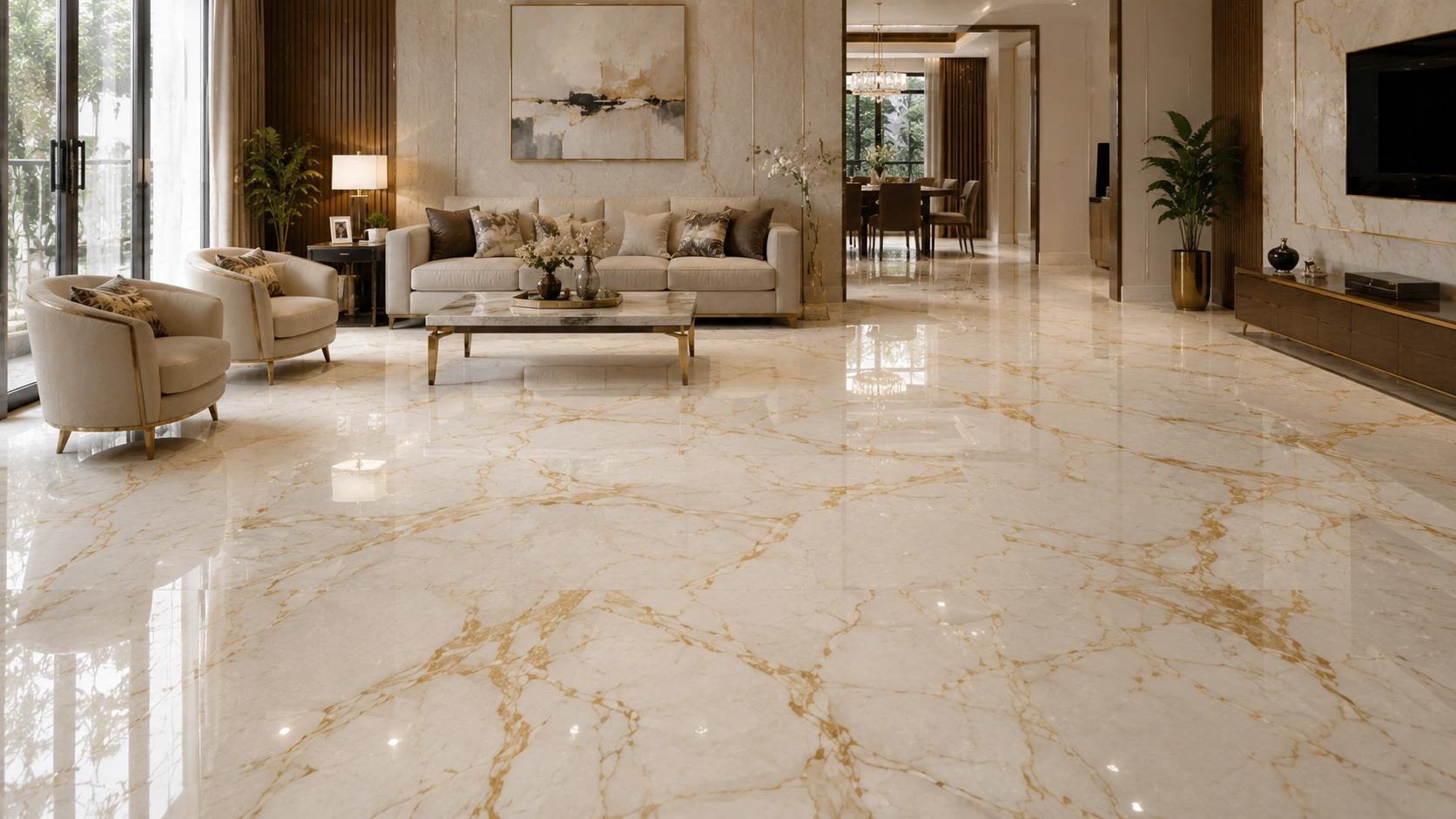
Gold-vein Calacatta-look GVT | 800x1600 mm | Matte finish | Rs. 160 to Rs. 220/sq.ft
A Calacatta Gold-look GVT at 800x1600 mm, with a bright white base and bold warm gold veining, is the most aspirational golden living room floor specification available from Morbi manufacturers in 2026. In his format, a 300 sq. ft. living room uses only 22 tiles, producing a near-seamless white-and-gold floor that reads as an Italian marble slab from any position in the room. Pair with warm-white recessed lighting at 2700K, off-white walls, and brushed brass light fittings for a 5-star lobby feel in a residential setting.
2. Sand-Gold Travertine Open-Plan Floor
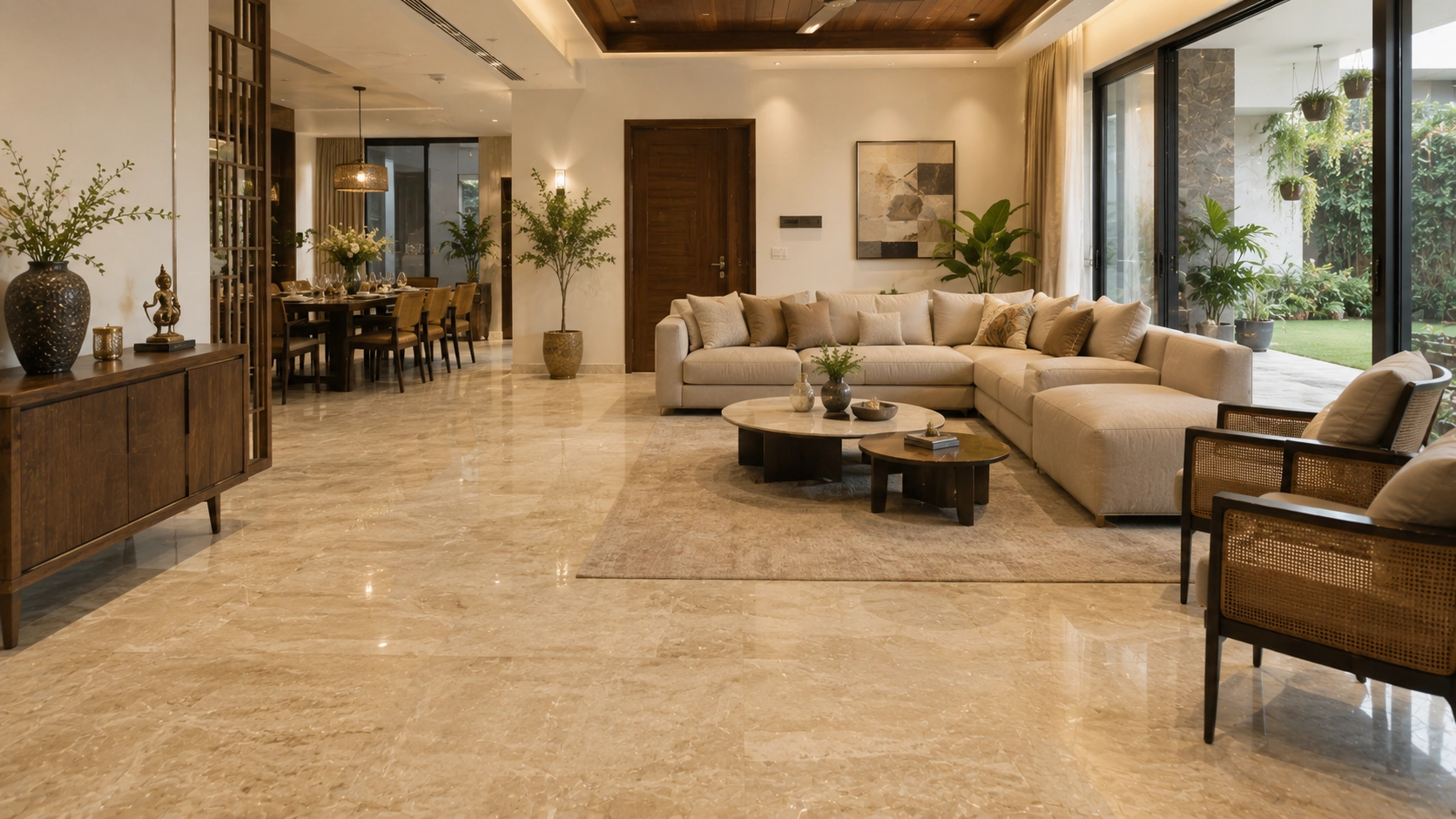
Sand-gold travertine-look GVT | 600x1200 mm | Textured matte | Rs. 85 to Rs. 140/sq.ft
In an open-plan living and dining area above 350 sq. ft., a sand-gold travertine-look GVT at 600x1200 mm in textured matte creates a warm, grounded base that reads as natural stone. The pitted and banded surface of the travertine print at 600x1200 mm keeps the pattern varied across the floor at room scale, and the warm ochre tone ages visually with sunlight exposure to look richer rather than faded. Works in homes with east or south-facing windows where morning and afternoon light enter the floor plane.
3. Golden Yellow Checkerboard with White
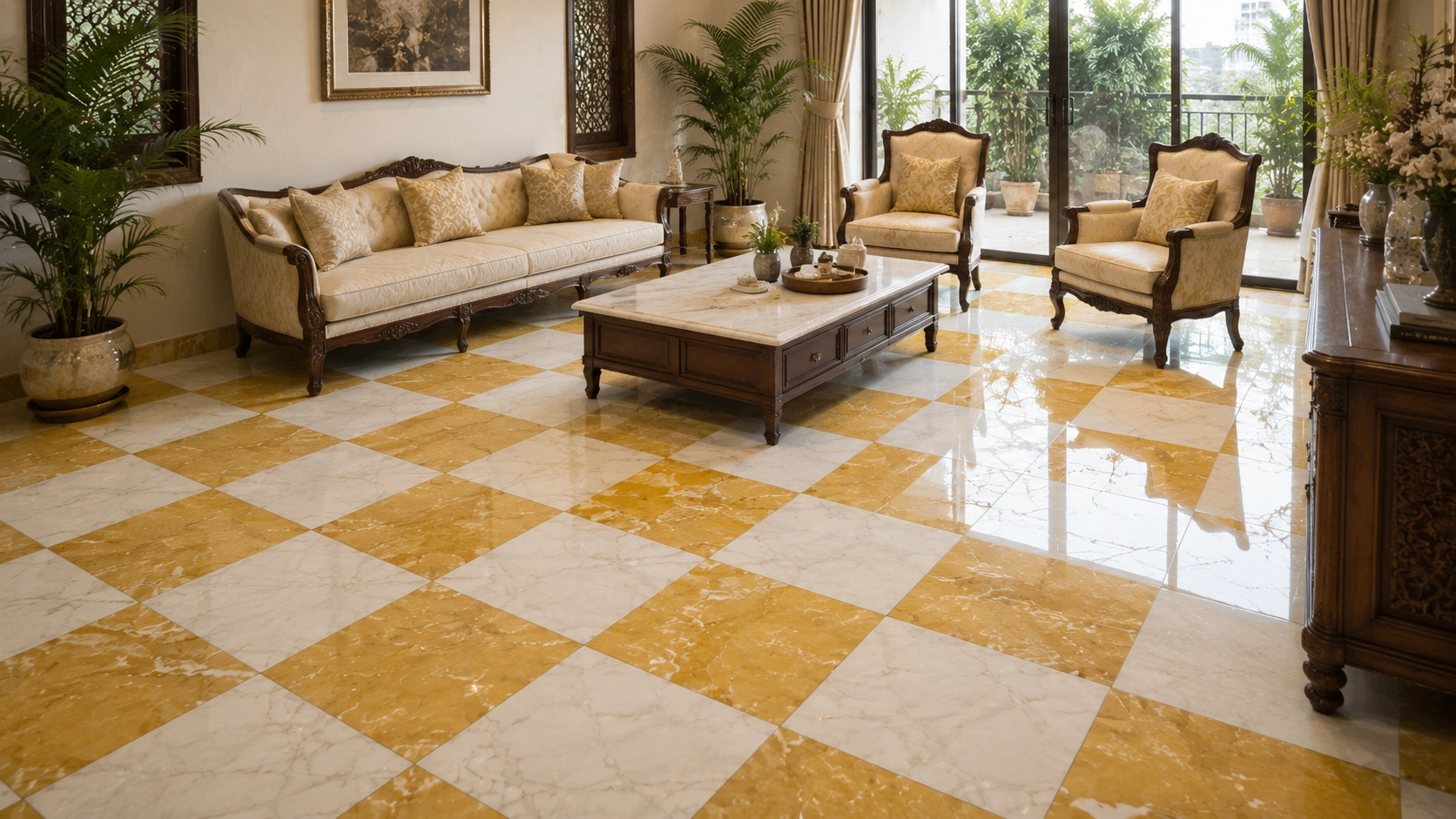
Warm golden yellow GVT + white GVT | 600x600 mm | Matte | Rs. 70 to Rs. 120/sq.ft combined
A diagonal checkerboard pattern of warm golden yellow and crisp white GVT at 600x600 mm is a contemporary reinterpretation of the traditional Indian kothi (diamond) floor pattern. This design suits a living room with a classical Indian or Indo-colonial design reference - think arched doorways, cane furniture, and terracotta planters. Lay the pattern on a 45-degree diagonal to the room's main axis so the diamonds are not parallel to the walls, which makes the floor feel larger and more dynamic.
4. Honey Onyx Feature Strip Inlay
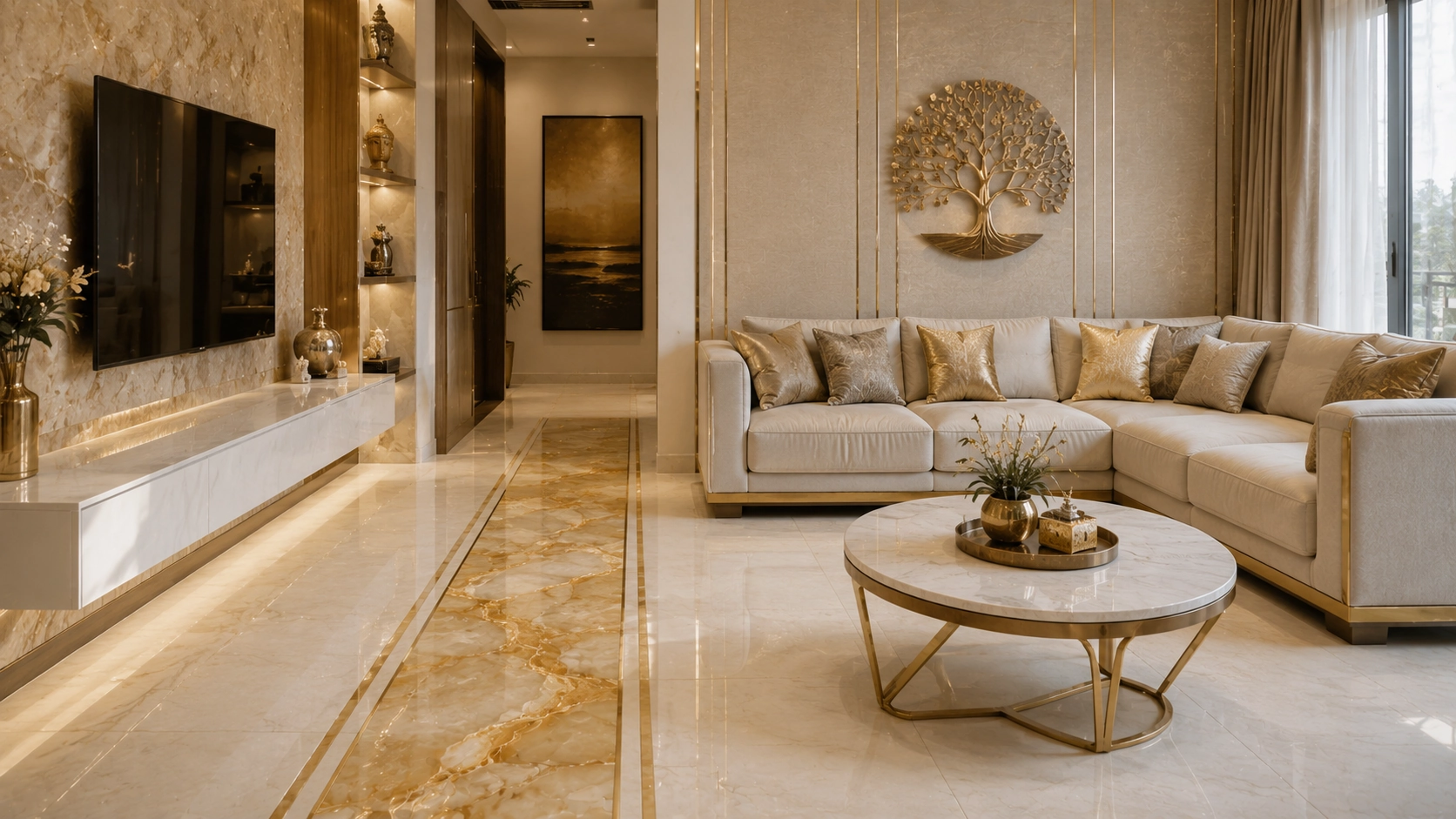
Sand-gold GVT base + honey onyx-look GVT border strip | 600x600 mm base, 100x600 mm strip | Matte + GHR | Rs. 80 to Rs. 160/sq.ft combined
A plain sand-gold GVT field floor with a honey onyx-look GVT inlay strip running along the perimeter of the room (a 200 mm wide border in a deeper amber-gold tone) creates a traditional Indian framed floor design without using actual natural stone. The GHR finish on the inlay strip adds visible depth contrast against the matte field tile, and the amber-gold-on-sand-gold combination stays entirely within the warm palette while creating a clear design hierarchy between field and border.
5. Warm Amber Rustic Living Room
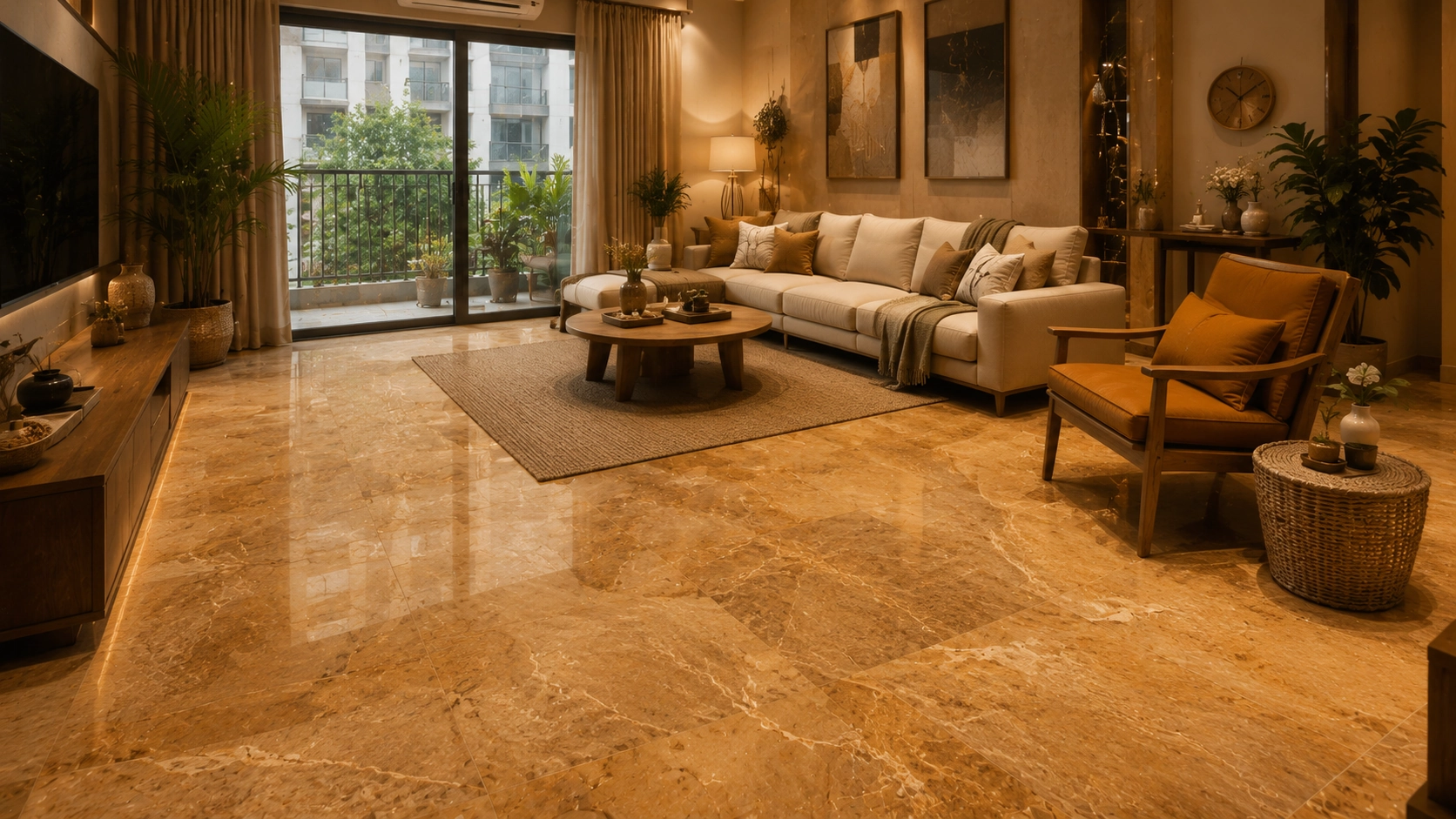
Warm amber stone-look GVT | 600x600 mm | Textured matte | Rs. 80 to Rs. 130/sq.ft
A warm amber stone-look GVT with a textured matte surface replicating aged Indian sandstone creates a wabi-sabi or heritage-rustic living room floor in a thoroughly contemporary material. This design suits homes with exposed brick walls, reclaimed wood beams, or jali-screen room dividers - interiors where the material language draws from Indian vernacular architecture. The textured matte surface at 600x600 mm reads as natural stone at close range b, ut is easier to clean than actual sandstone and requires no sealing.
6. Gold-Vein Grey Marble Living Room Floor
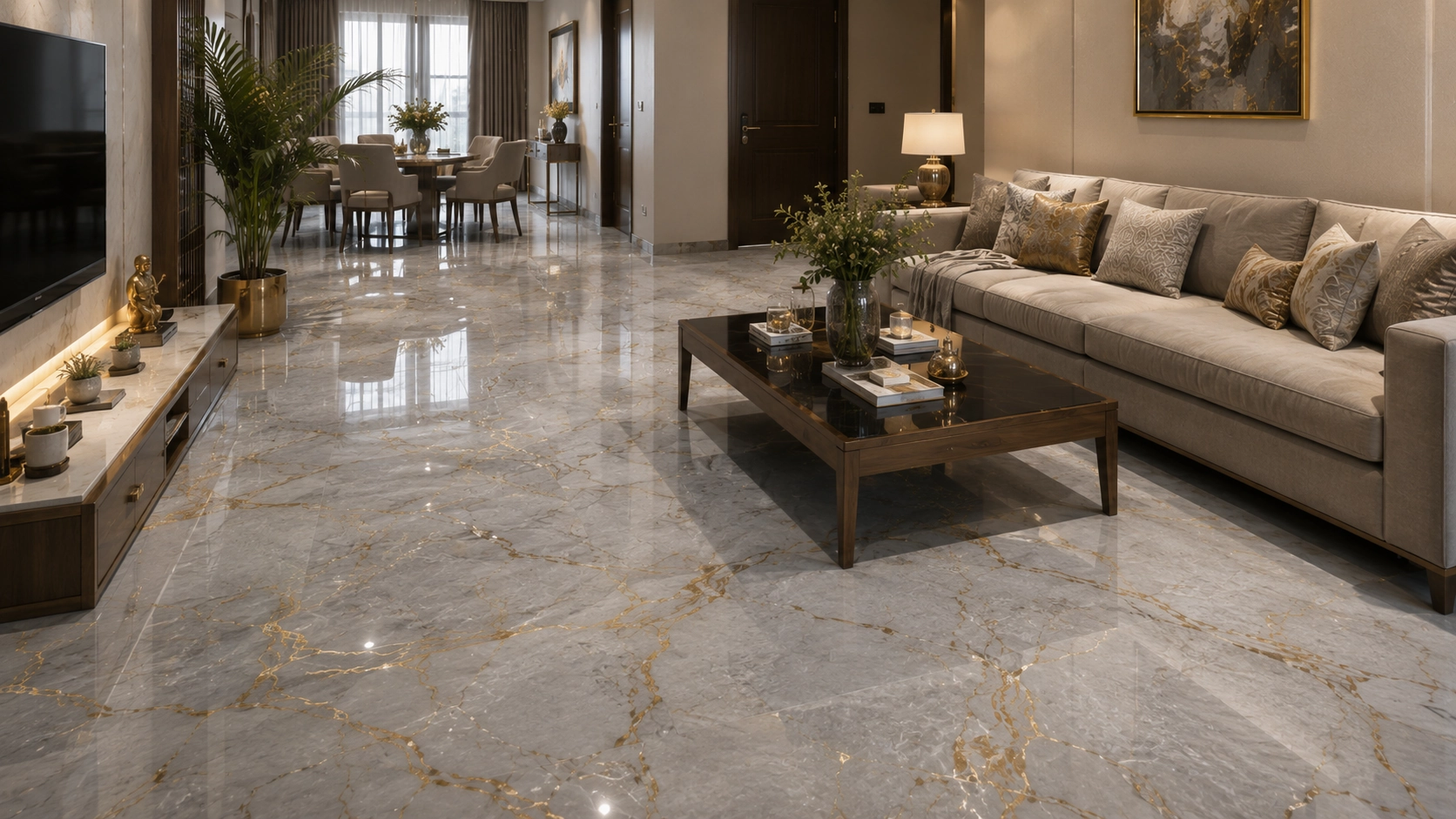
Grey marble-look GVT with gold veining | 800x1600 mm | Matte | Rs. 150 to Rs. 210/sq.ft
A grey base marble-look GVT with gold veining - replicating marble varieties like Golden Grey or Nero Gold - creates a sophisticated living room floor where the gold reads as a refined accent within a cool base tone. This design suits a minimalist Indian living room where the furniture palette is charcoal, white, and brass, and the floor is meant to carry subtle warmth through the gold vein without reading as a warm golden floor overall. The combination of a cool grey base and gold veining is one of the most specified floor designs in luxury Indian apartments in 2026.
7. Gold-Tone Living Room TV Wall
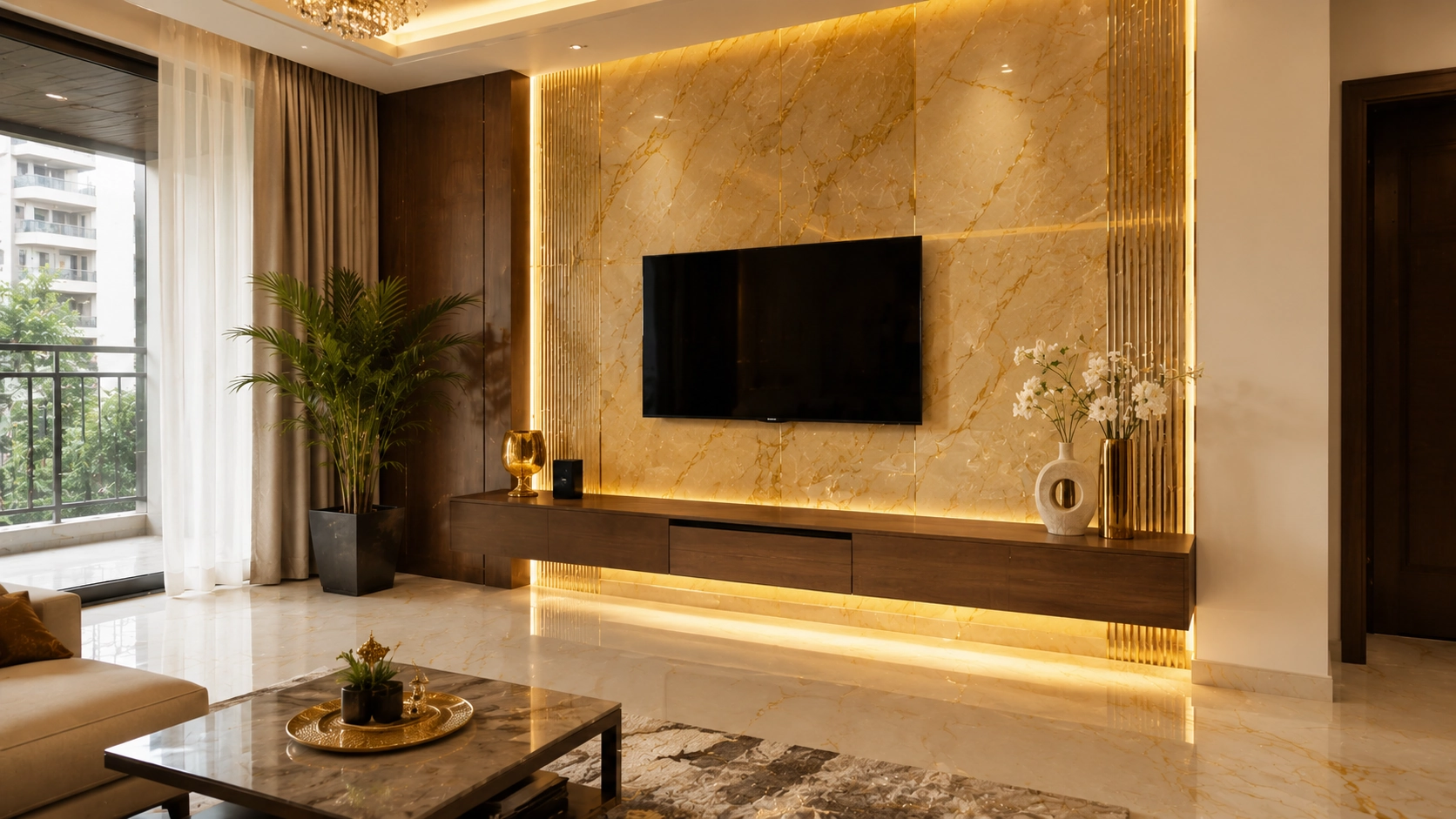
Honey amber or gold-vein marble-look GVT | 600x1200 mm vertical | Matte or GHR | Rs. 100 to Rs. 190/sq.ft
A honey amber or gold-vein marble-look GVT accent wall behind the TV in a living room creates a warm anchor point for the room's main seating axis. At 600x1200 mm in vertical orientation, a 10 ft x 12 ft TV wall uses approximately 19 sq.ft of tile with two vertical joints per row and a single horizontal joint midway. Under warm-white recessed lighting at 2700K, the amber or gold-vein wall glows behind the TV and creates a visual backdrop that is dramatically more interesting than a painted wall.
8. Gold-Speckle Mosaic Sofa Backdrop
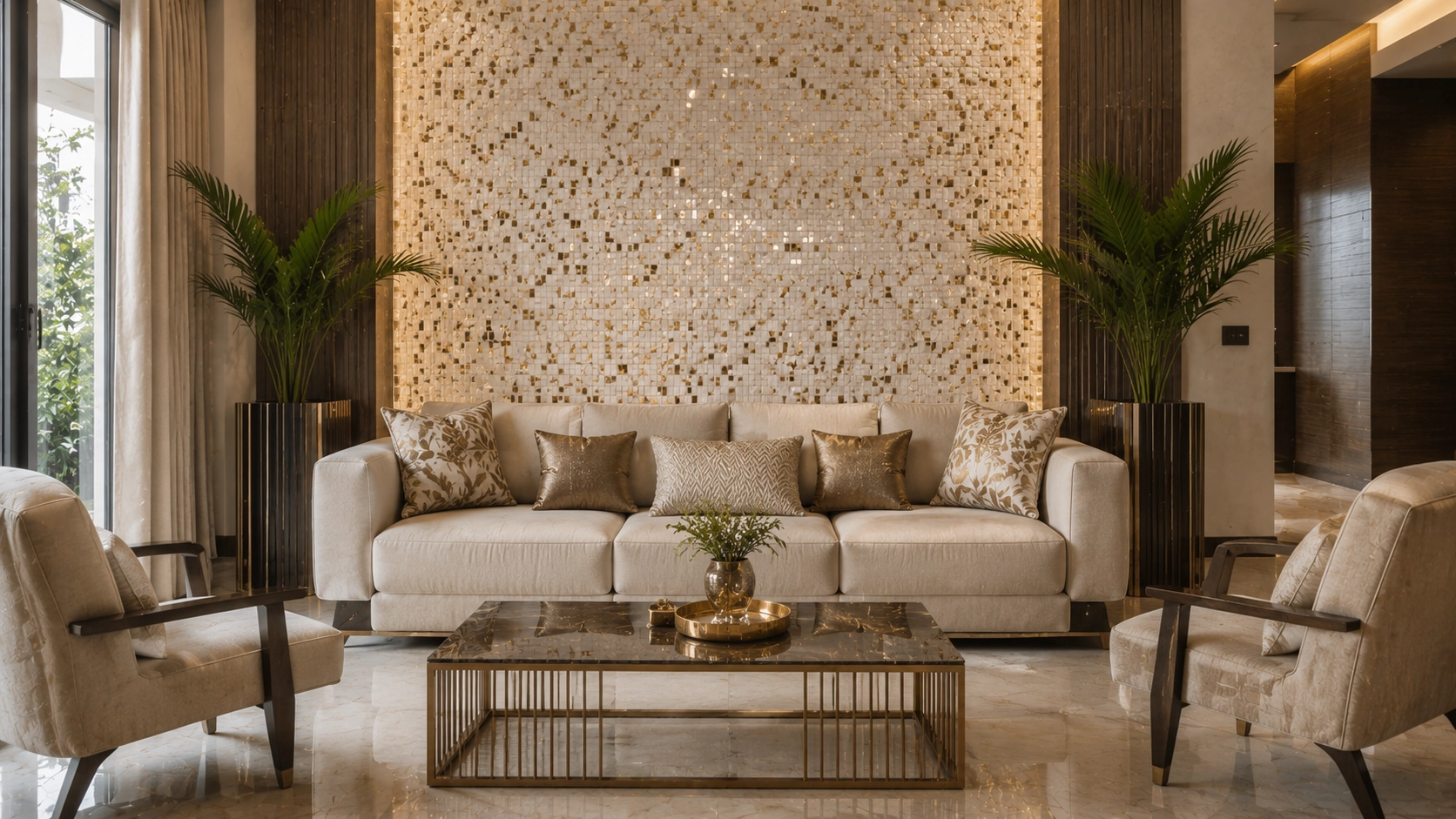
Gold-speckled or metallic gold mosaic tiles | 300x300 mm sheets | Metallic glaze | Rs. 250 to Rs. 500/sq.ft (accent zone only)
A gold-speckled or metallic mosaic tile accent panel behind the sofa, approximately 6 ft x 8 ft (48 s .ft), creates a textural gold backdrop that reads differently from a plain flat tile wall. The mosaic texture catches light from multiple angles, producing a subtle shimmer that changes with viewing angle and time of day. This is a wall-only application; metallic mosaic tiles are PEI 1 to PEI 2 and not suitable for floors. Limit the mosaic to the sofa backdrop panel only; tiling the full living room wall in metallic mosaic reads as excessive.
9. Warm Gold and Dark Charcoal Two-Zone Floor
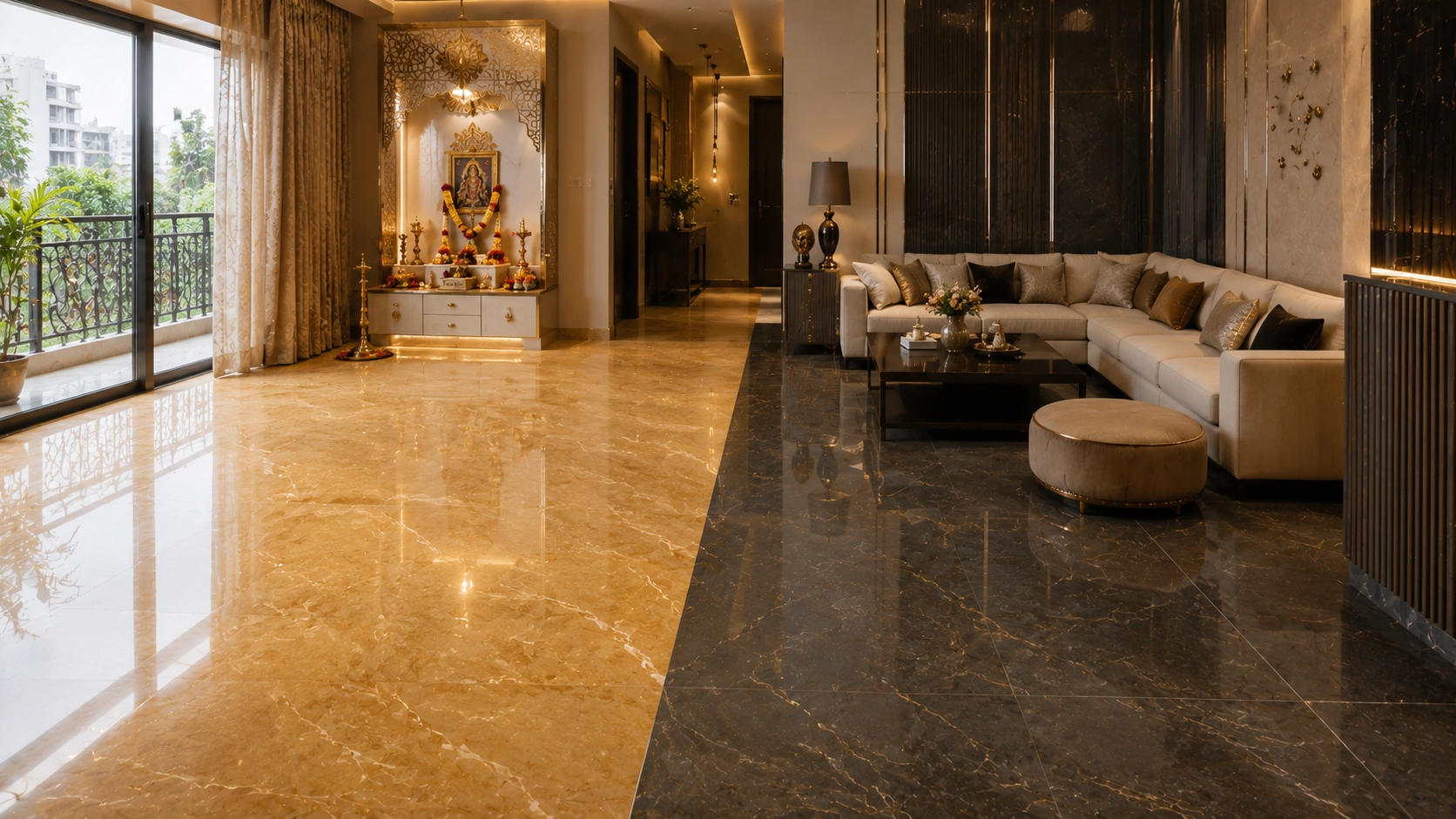
Sand-gold GVT (living area) + charcoal grey GVT (dining area) | 600x1200 mm | Matte | Rs. 80 to Rs. 140/sq.ft
In an open-plan living and dining space, using a warm sand-gold GVT for the living seating zone and a charcoal grey GVT for the dining zone - both in the same 600x1200 mm format and matte finish - creates a two-zone floor that differentiates spaces without a physical divider. The gold-warm tone defines the relaxed seating area; the cooler charcoal anchors the more formal dining zone. The transition line between the two colours becomes the visual room divider, marked naturally by the dining table position.
10. Golden Geometric Border Entry Living Room
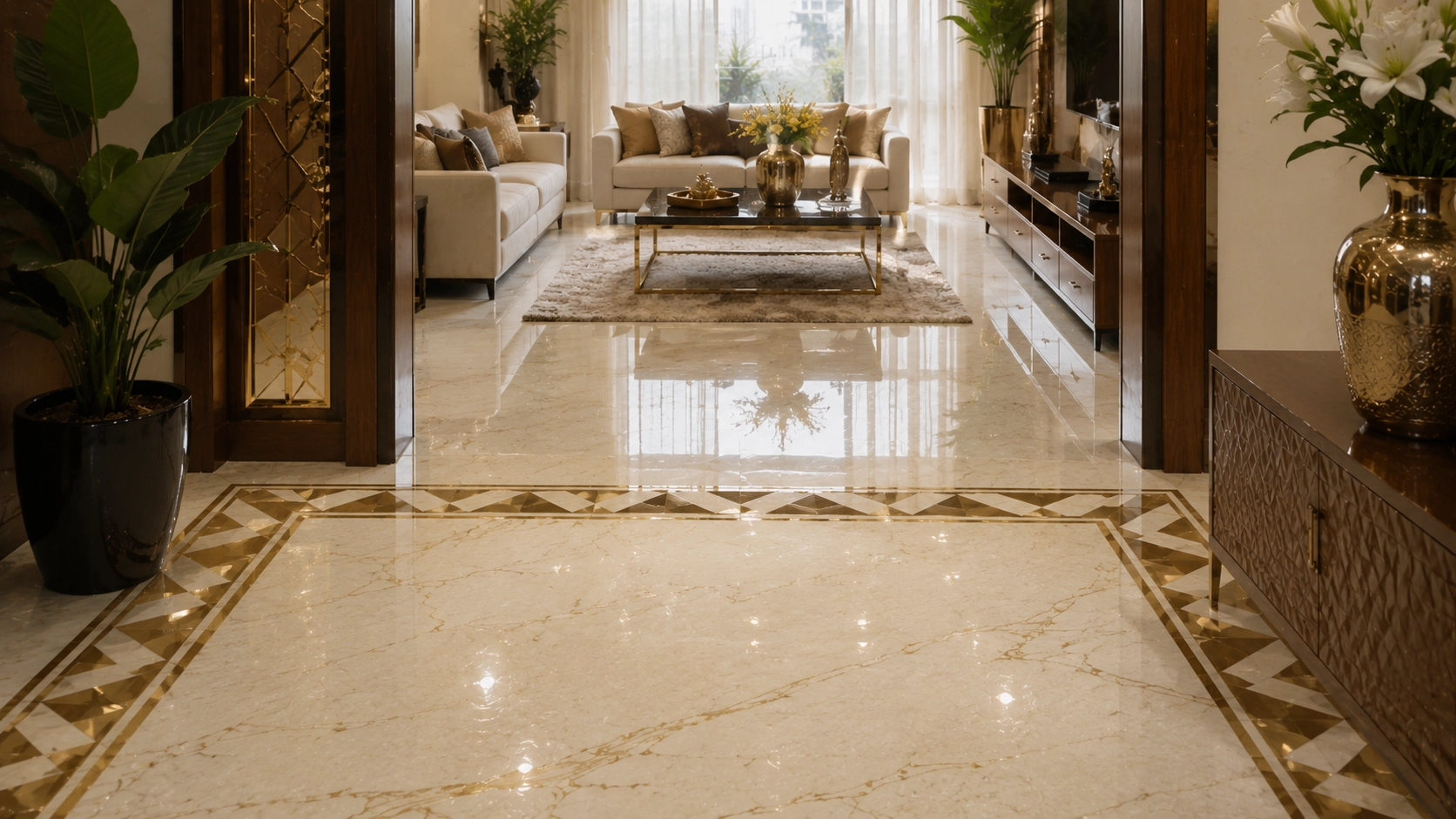
Plain cream GVT field + golden geometric border | 600x600 mm field, 200x200 mm border | Matte | Rs. 70 to Rs. 130/sq.ft combined
A cream or white GVT living room floor with a golden tile geometric border running 2 to 3 tiles deep at the room perimeter creates a traditional Indian durbar (court hall) floor reference in a contemporary material. The border at 200x200 mm in a warm golden yellow GVT frames the room without covering the main field in a strong colour. Works particularly well in a formal living room or baithak that receives guests, where the framed floor signals deliberate design and cultural continuity.
Golden Tile Design Ideas for Pooja Rooms
The pooja room in an Indian home carries the highest design intention of any space. Material, colour, and pattern choices here are layered with spiritual meaning, family tradition, and Vastu alignment. Golden tiles are among the most appropriate and widely used floor choices for Indian pooja rooms across all regions and communities.
Design principle: The pooja room floor is the most sacred surface in an Indian home - it is literally the ground on which the family's daily spiritual practice stands. Material choices here should honour both function (durability, ease of cleaning for kumkum, flowers, and incense ash) and symbolism (gold, saffron, and white are the three most auspicious floor tones in Indian temple and home shrine design). GVT golden tiles at 0.05% absorption clean completely with a damp mop, leaving no flower stain or kumkum residue that natural stone or terracotta would absorb.
11. Solid Golden Yellow Pooja Room Floor
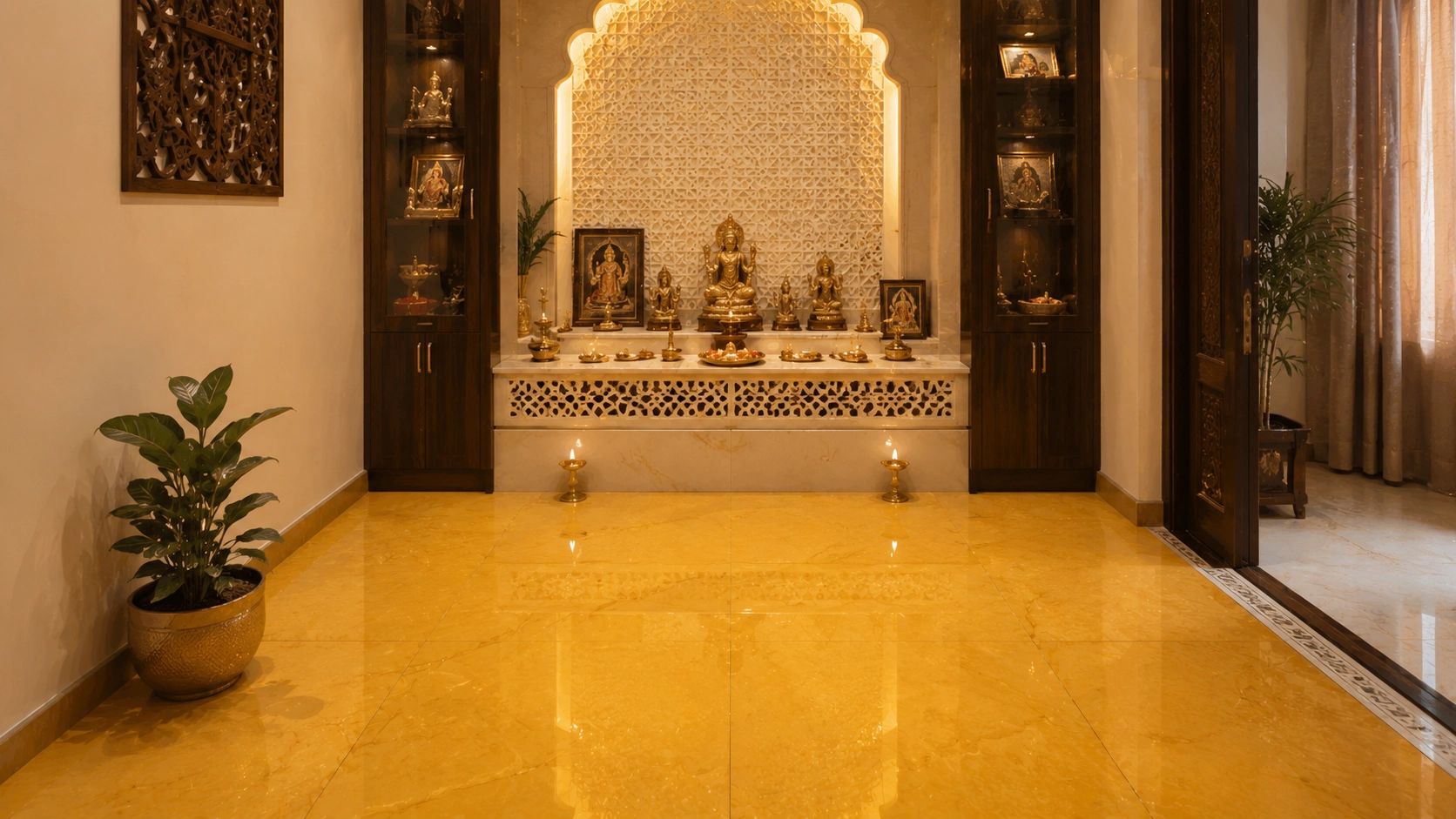
Solid golden yellow GVT | 300x300 mm | Matte | Rs. 60 to Rs. 100/sq.ft
A uniform, solid, golden yellow GVT floor at 300x300 mm is the most traditional and widely used pooja room floor specification in Indian homes. The 300x300 mm scale is appropriate for compact pooja rooms of 30 to 80 sq.ft and the solid warm gold colour is auspicious across Hindu, Jain, and Buddhist traditions. The matte finish avoids reflections that can be distracting in a meditative space, and the small tile format makes it easier to create a clean floor edge against the pooja platform base.
12. Saffron and White Diamond Pattern
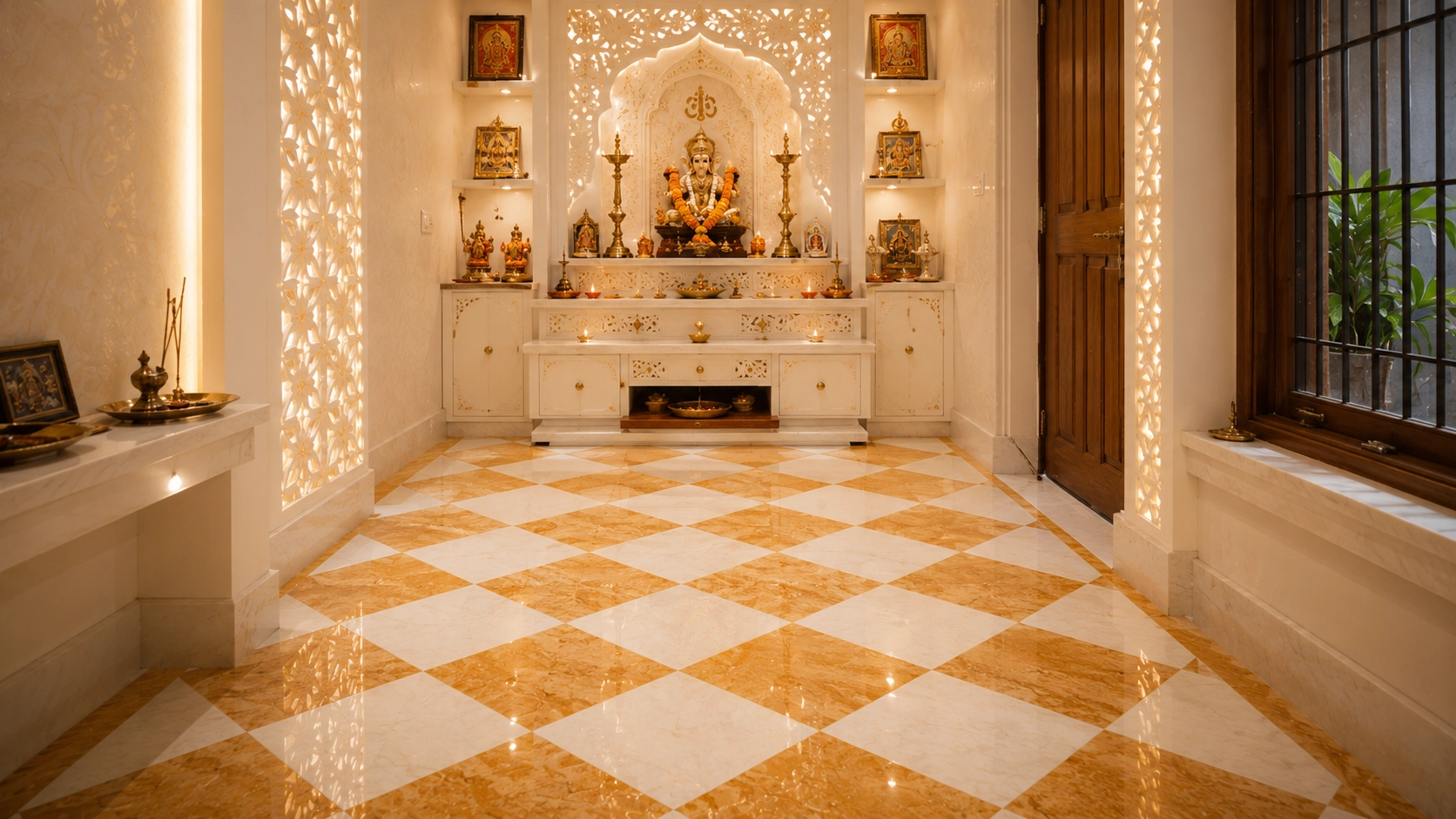
Saffron-orange GVT + white GVT | 300x300 mm diagonal | Matte | Rs. 60 to Rs. 110/sq.ft combined
A diagonal diamond pattern alternating saffron-orange and white GVT at 300x300 mm is a contemporary pooja room floor design with deep roots in South Indian temple floor traditions, where saffron and white are the two primary colours of sacred space. The diagonal orientation at 45 degrees to the room walls makes the small square tiles read as diamonds, which adds a decorative quality without requiring custom shapes. Particularly popular in Tamil Nadu, Kerala, Karnataka, and Andhra Pradesh homes.
13. Golden Floor with White Marble-Look Border
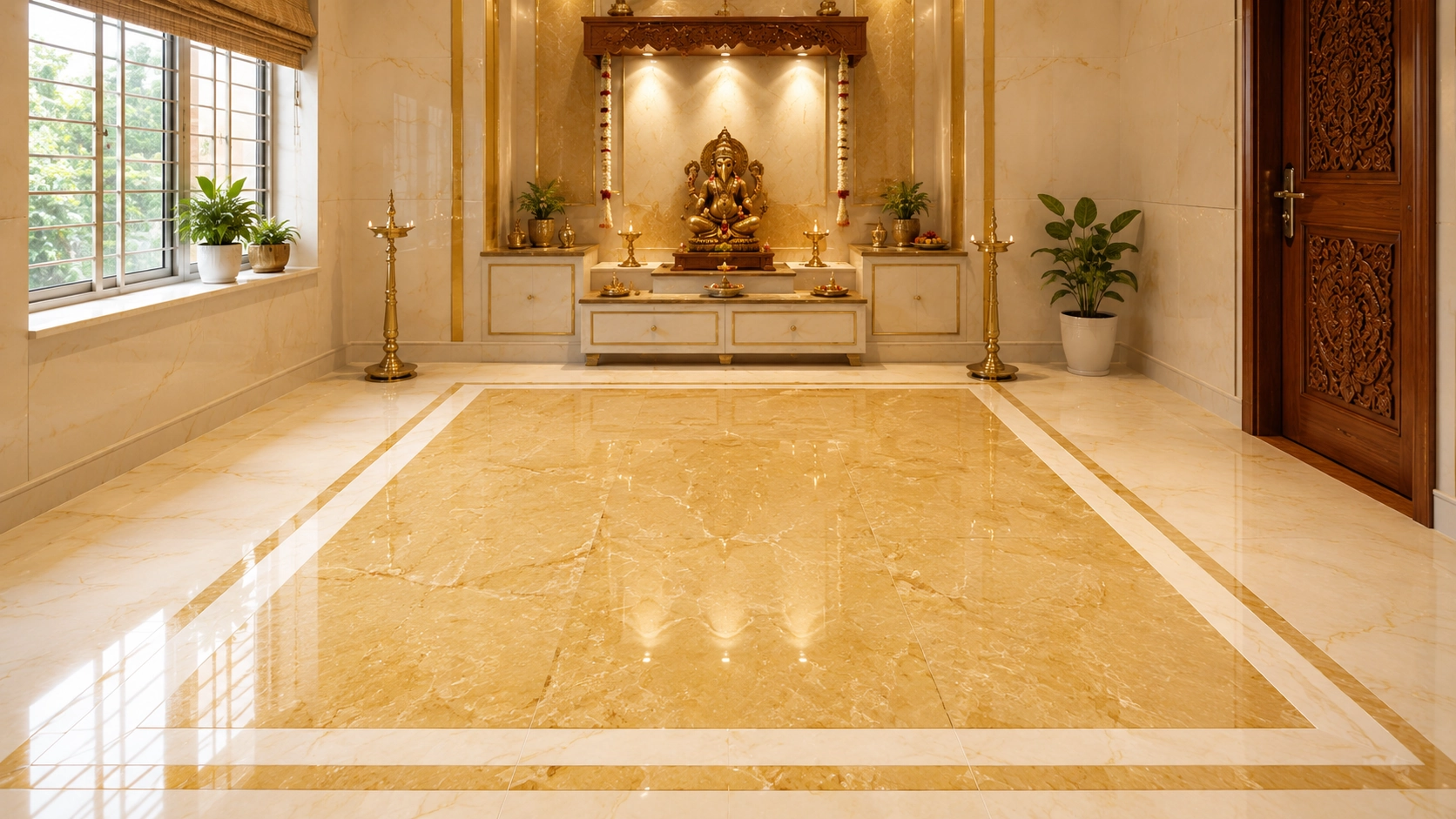
Warm golden GVT field + white marble-look GVT border | 300x300 mm field, 150x600 mm border | Matte | Rs. 70 to Rs. 120/sq.ft combined
A warm golden GVT field with a white or cream marble-look GVT border in a rectangular frame running one tile deep at the pooja room perimeter creates a traditional Indian mandap (altar canopy) floor reference. The white border marks the transition between the sacred inner floor and the surrounding domestic space, echoing the threshold ritual of removing footwear before entering a puja zone. This design is common in heritage Indian homes and is equally effective in a compact apartment pooja room, where the border adds visual weight and formality to a small space.
14. Lotus Motif Inlay Floor
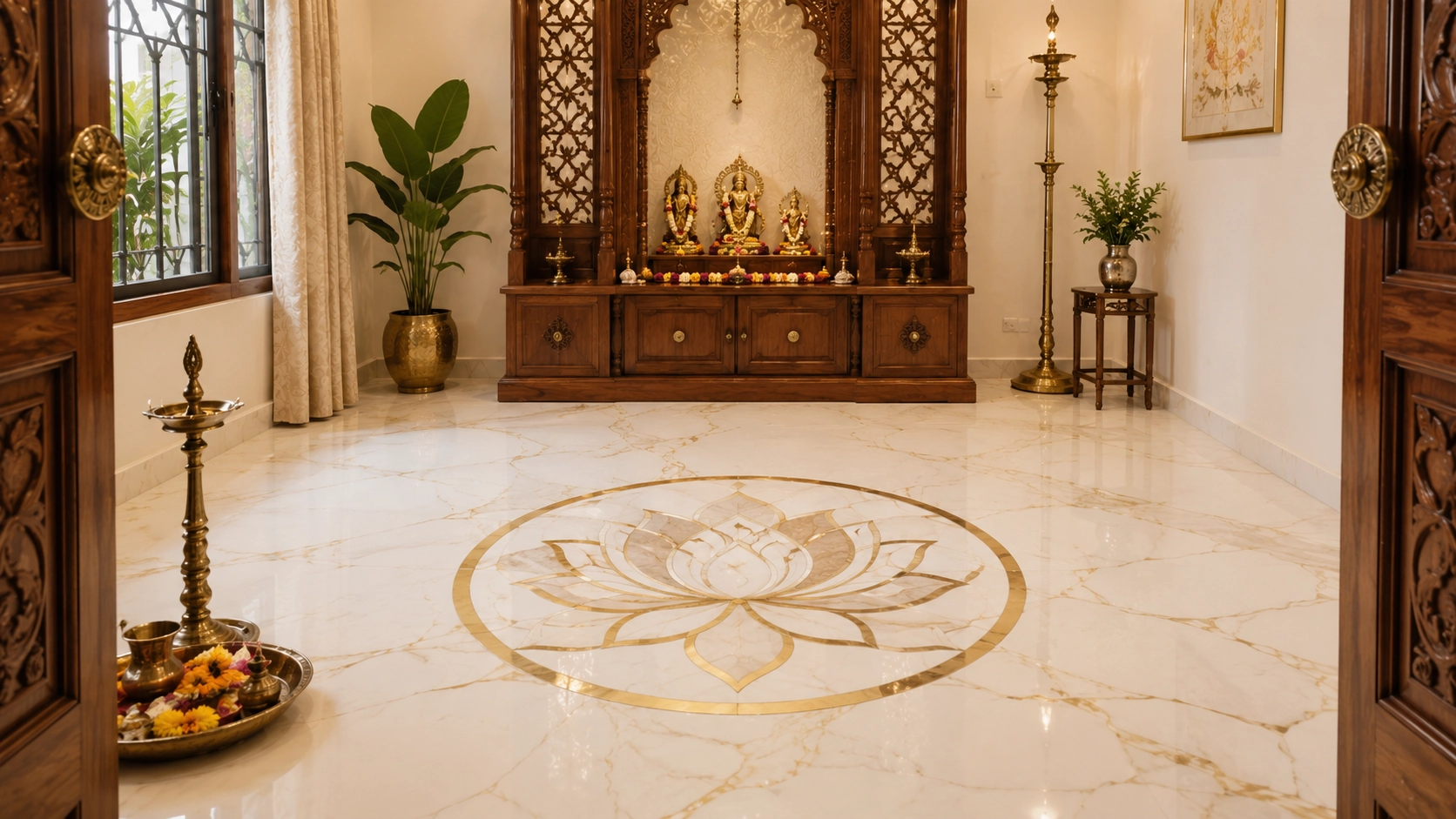
Warm golden GVT field + contrasting darker gold or rust accent tiles (cut to lotus petal shapes) | 300x300 mm field | Matte | Rs. 80 to Rs. 150/sq.ft
A lotus inlay pattern at the centre of the pooja room floor - typically a 2 ft x 2 ft central medallion in a deeper amber or rust tile cut to petal shapes set into the golden field - is the most elaborately designed pooja room floor option. The lotus is the most sacred symbol in Hindu and Buddhist iconography,, and its presence on the floor directly below the idol platform connects the ground plane to the spiritual intention of the space. The inlay can be created from cut GVT tiles in complementary tones rather than imported custom ceramic inlay pieces.
15. Warm Stone-Look Pooja Room
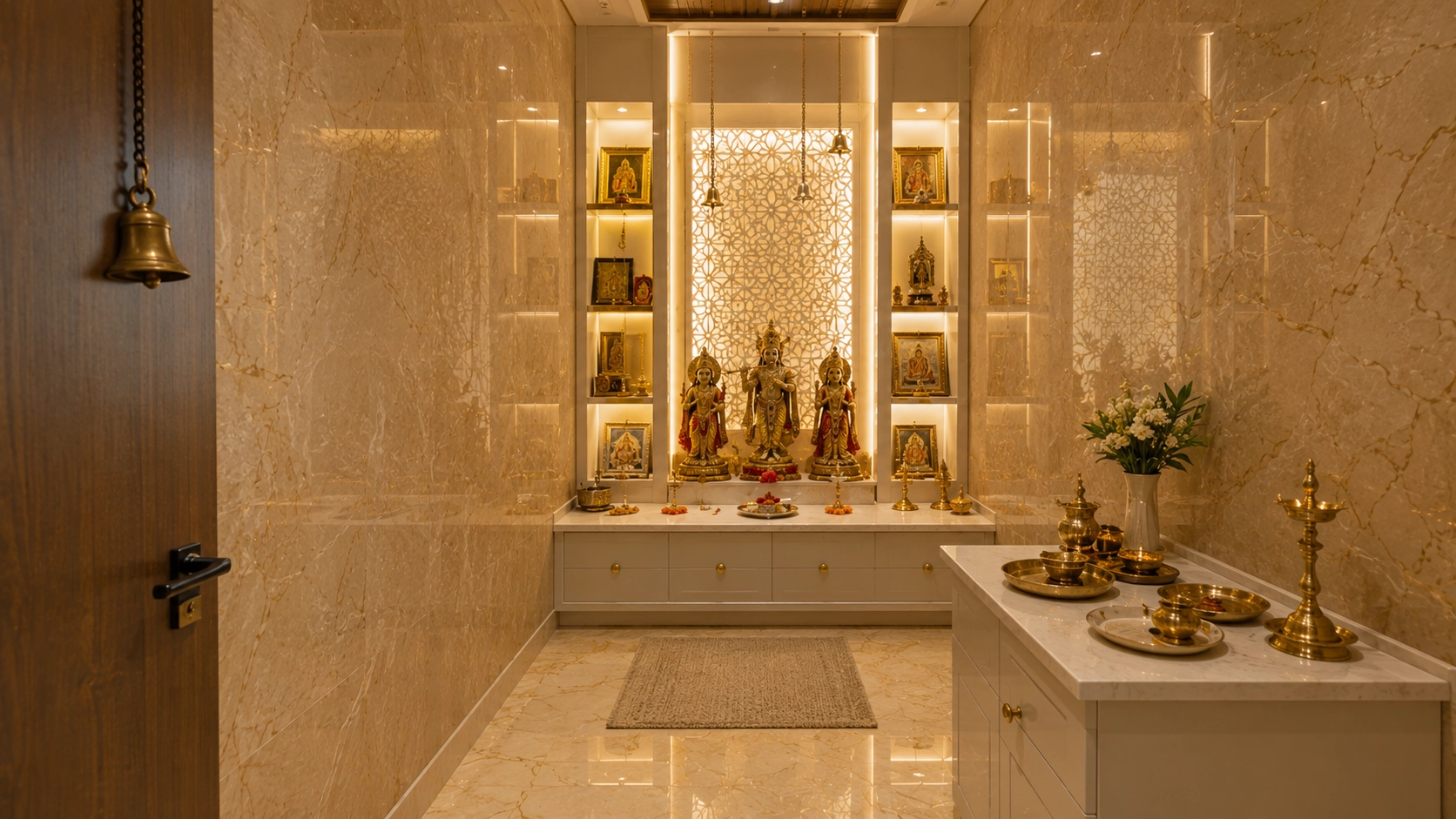
Warm honey stone-look GVT | 300x300 mm | Textured matte | Rs. 70 to Rs. 115/sq.ft
Warm honey stone-look tiles in textured matte finish at 300x300 mm replicate the surface of natural honey limestone or Jaisalmer yellow sandstone - the stone used in Rajasthani temples and royal residences for centuries. This design suits pooja rooms in homes with a heritage Indian or traditional Rajasthani design reference, where the brief is to connect the spiritual space to the material culture of Indian stone architecture without the maintenance demands of actual natural stone.
16. Dual-Tone Gold and Brass Geometric Floor
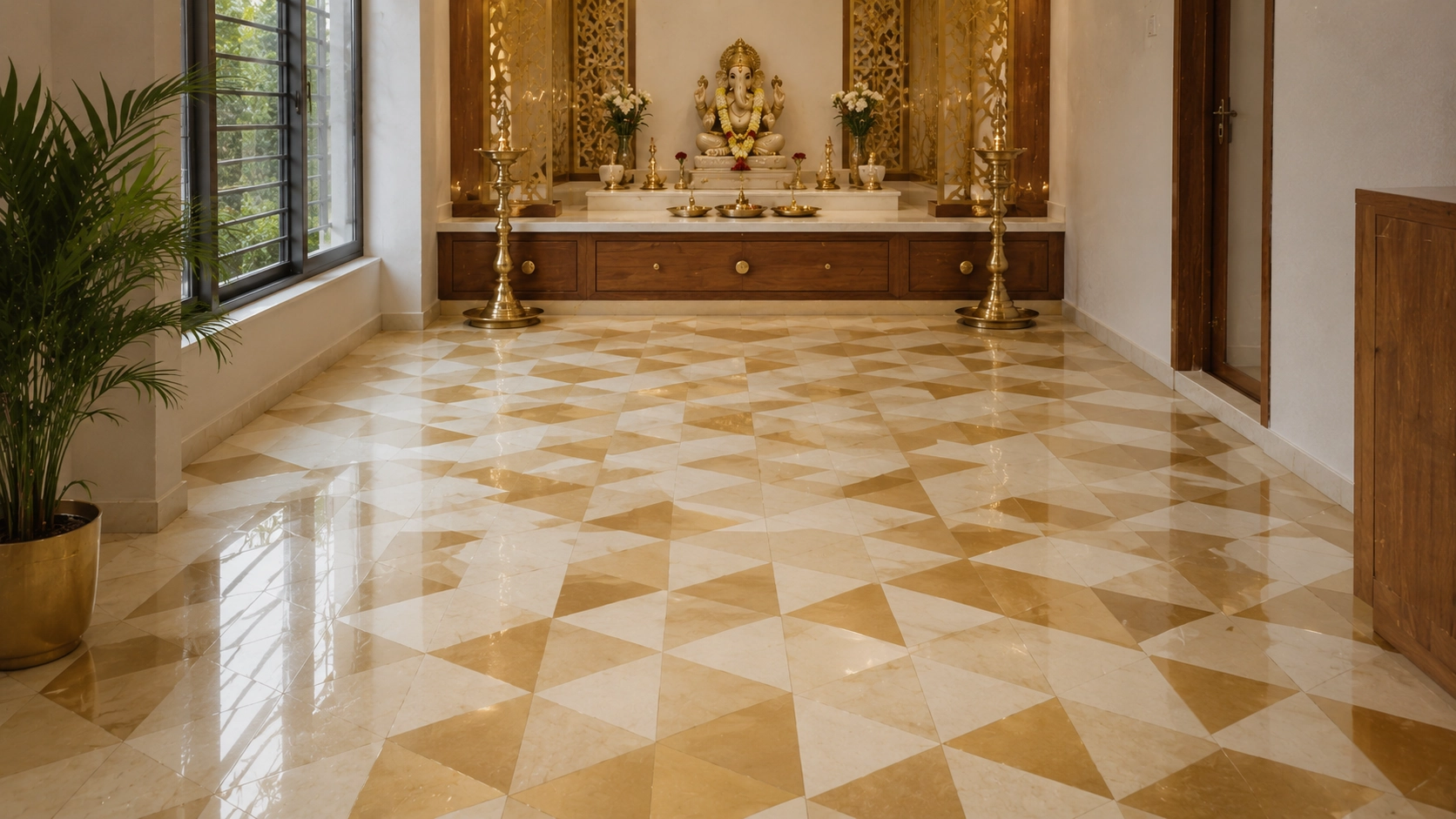
Deep amber GVT + pale gold GVT | 200x200 mm | Matte | Rs. 70 to Rs. 130/sq.ft combined
A dual-tone geometric pattern using two golden tones - a deeper amber and a lighter pale gold - at 200x200 mm creates a sophisticated floor design that reads as a continuous gold surface from a distance and reveals its geometric structure on closer inspection. This design avoids the stark contrast of a colour-and-white combination while still creating pattern and visual interest. The two-tone gold approach references the tradition of bimetal work in Indian temple decoration - the layering of gold and bronze that appears in temple finials, idols, and interior metalwork.
Want to learn more before choosing a design? Read our Golden Tiles in India Guide to understand tile types, Vastu significance, finishes, maintenance tips, and buying advice for Indian homes.
Golden Tile Accent and Transition Ideas
Golden tiles work as accents and transition elements as effectively as they do as main floor surfaces. In Indian homes where the living area and pooja room are adjacent or visible from each other, using golden tile accents to connect the two spaces creates a coherent, warm palette across the home.
17. Gold-Tile Threshold Between Living and Pooja Zone
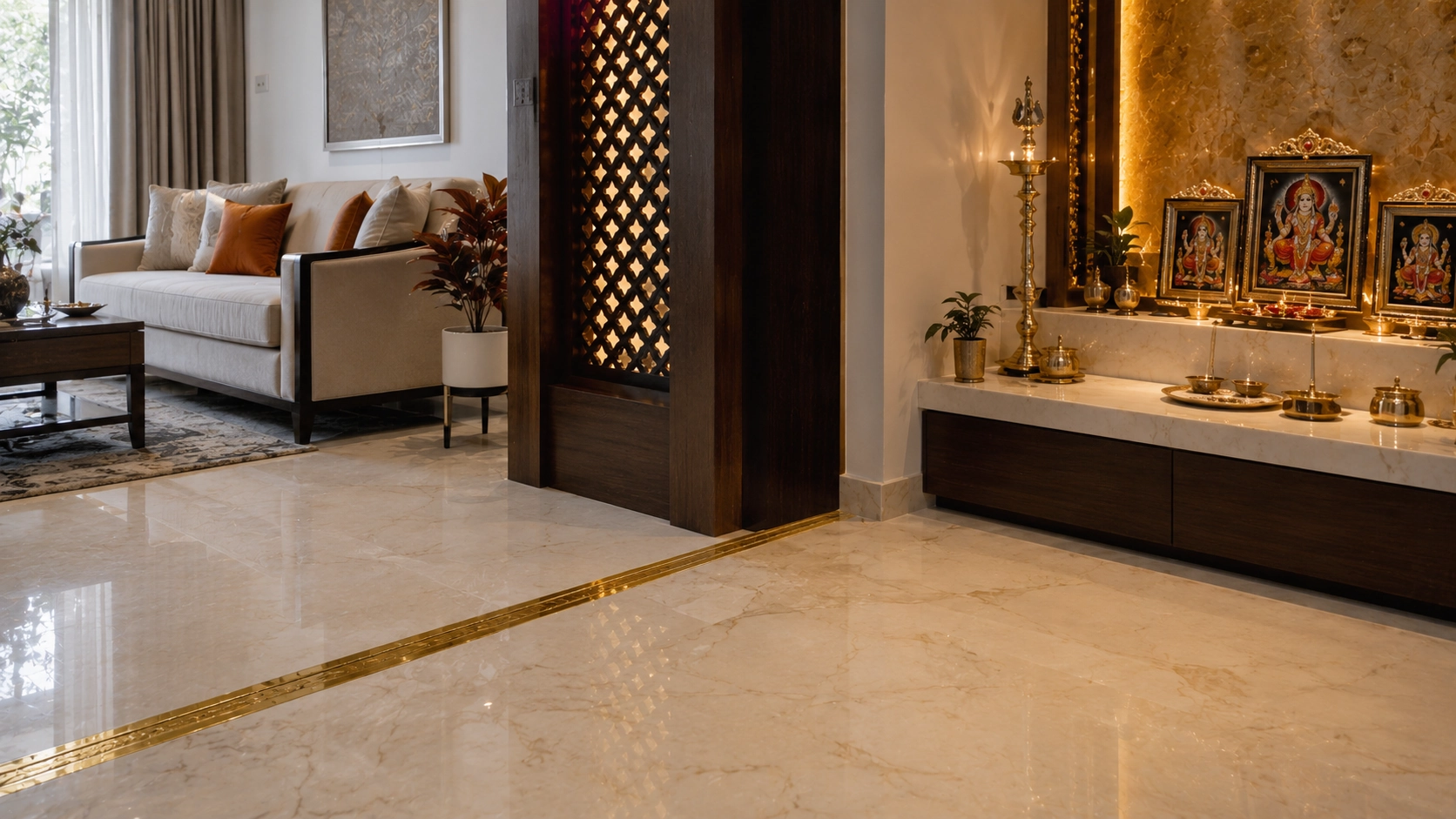
Warm golden GVT threshold strip | 100x600 mm or 200x600 mm | Matte | Rs. 70 to Rs. 120/sq.ft
A warm golden tile strip at the threshold of the pooja room door - one to two tiles wide, running the full doorway width - creates a visual and symbolic transition between the domestic living space and the sacred pooja zone. In many Indian homes, the threshold is the point at which footwear is removed and a different level of mindfulness begins. A golden tile threshold that is visually distinct from both the living room floor and the pooja room floor marks this transition point without requiring a physical door or screen.
18. Gold Inlay Strip in Living Room Marble Floor
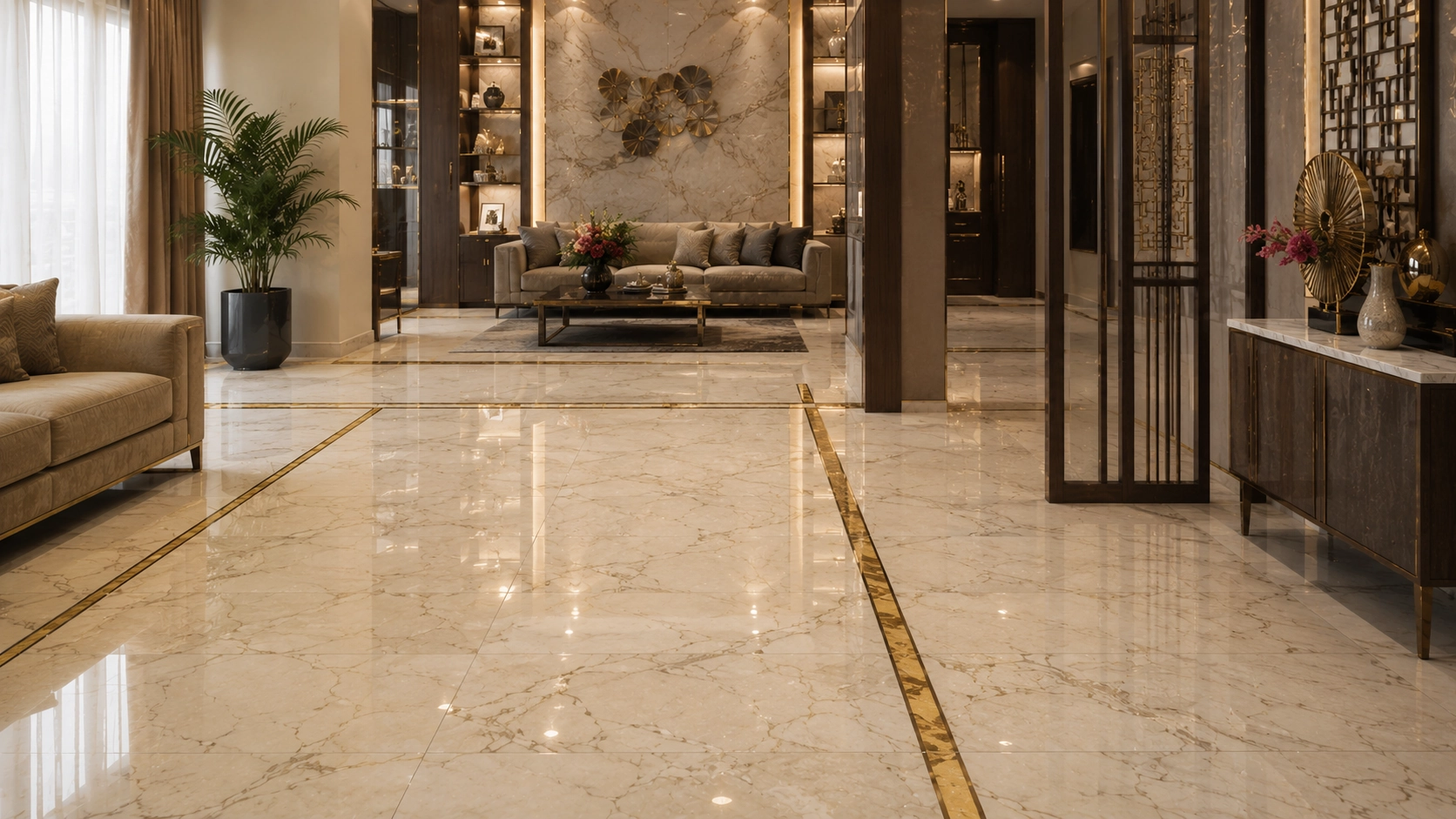
Gold-look GVT inlay strip set into cream marble-look GVT floor | 100x600 mm | Matte | Rs. 90 to Rs. 160/sq.ft (inlay zone)
A gold inlay strip running centrally along a cream marble-look living room floor - from the entrance of the room to the main seating area - creates a visual axis that draws the eye into the space and adds a warm gold accent to a predominantly white or cream floor without changing the floor tone overall. This design is common in premium Indian villa and penthouse projects where the architect wants a single directional design element in a large open-plan living area.
19. Metallic Gold Kitchen Backsplash Strip
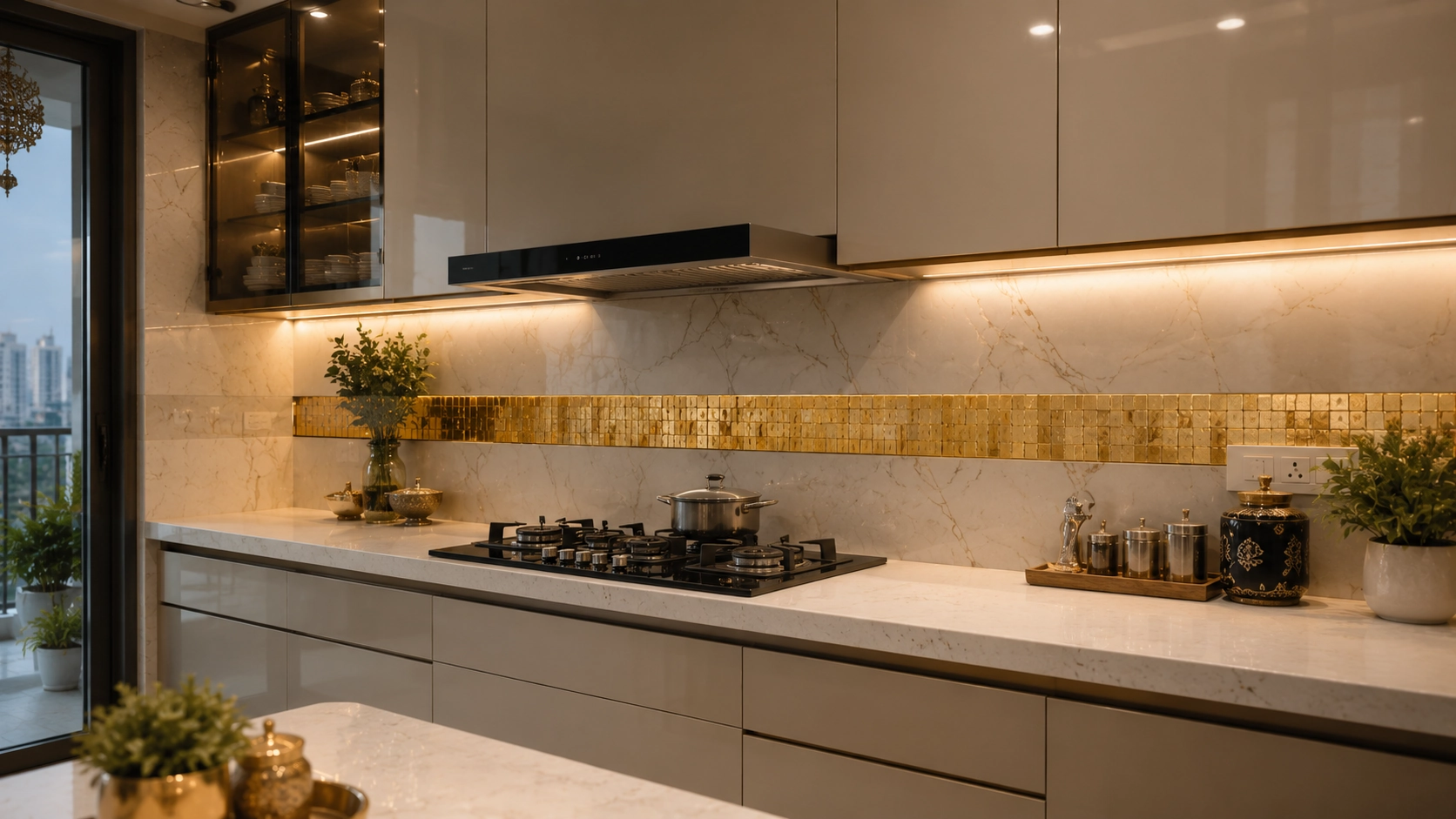
Metallic gold mosaic or gold-glaze subway tile | 75x150 mm or 75x300 mm | Metallic glaze | Rs. 200 to Rs. 450/sq.ft (backsplash zone only)
A metallic gold tile kitchen backsplash, either in a small mosaic format or a rectangular subway format in a gold glaze, creates a warm focal point above the cooking counter in an Indian kitchen. The backsplash area in a standard modular kitchen runs 2 ft tall by 8 to 12 ft wide - 16 to 24 sq ft of tile. At Rs. 200 to Rs. 450 per sq.ft for a metallic gold tile, the total backsplash material cost is Rs. 3,200 to Rs. 10,800. This is a wall-only application; metallic gold tiles are not floor-rated.
20. Gold Border on Bathroom Feature Wall
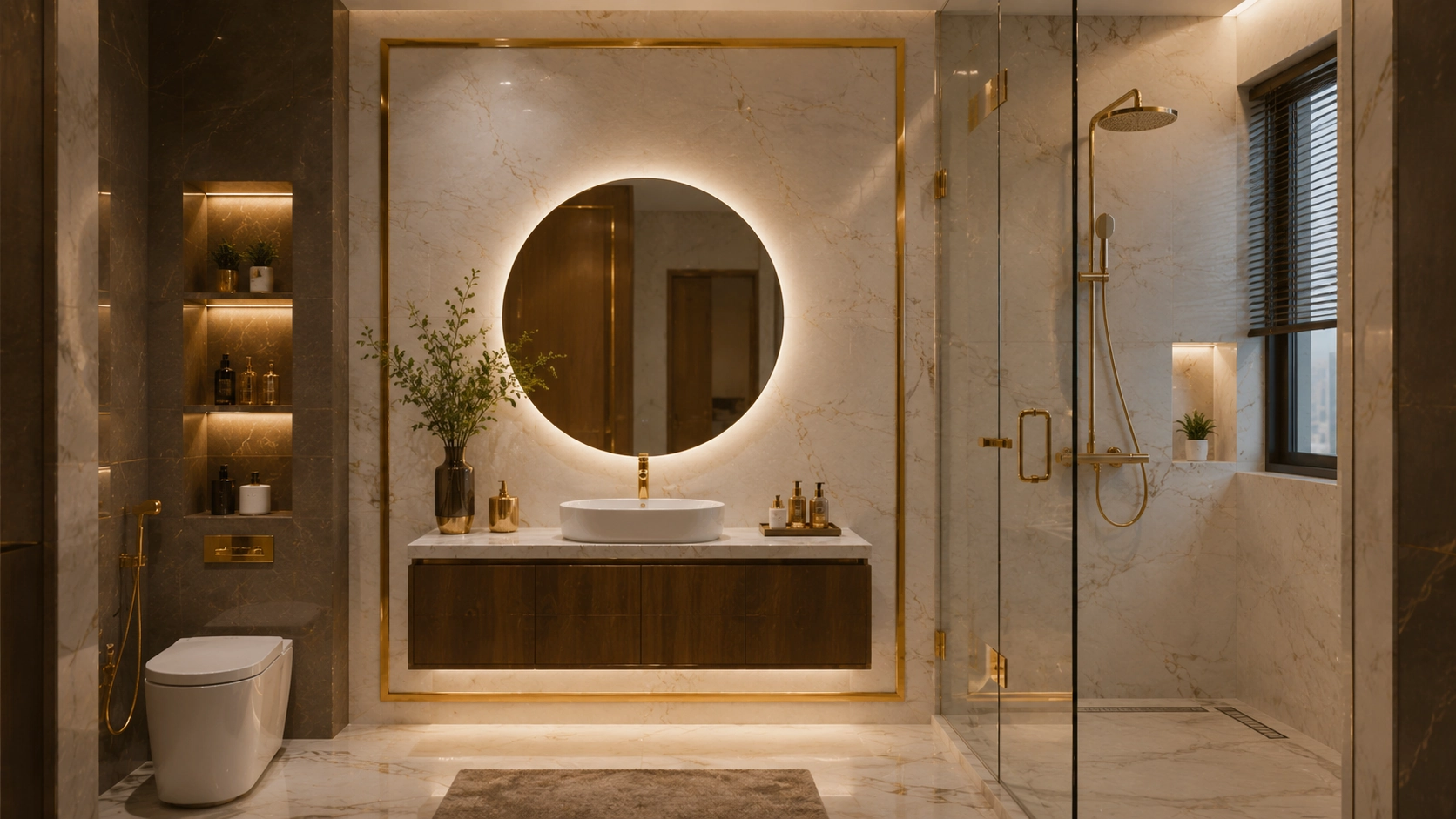
Plain white or grey bathroom wall tile + gold border strip | 50x600 mm gold strip | Metallic or GHR glaze | Rs. 180 to Rs. 400/sq.ft (border zone only)
A gold border strip - 50 to 75 mm wide - running horizontally at eye height on the main bathroom wall creates a luxury accent that reads as a gold seam through the tile field. In a standard Indian bathroom, a single gold border strip on the vanity wall and the shower wall adds a spa-hotel quality to an otherwise plain white or grey tile specification without changing the main tile at all. The border can be in metallic gold glaze or in a gold-tone GHR finish, depending on the wall type and desired effect.
21. Sand-Gold Floor in North-East Facing Study or Meditation Room
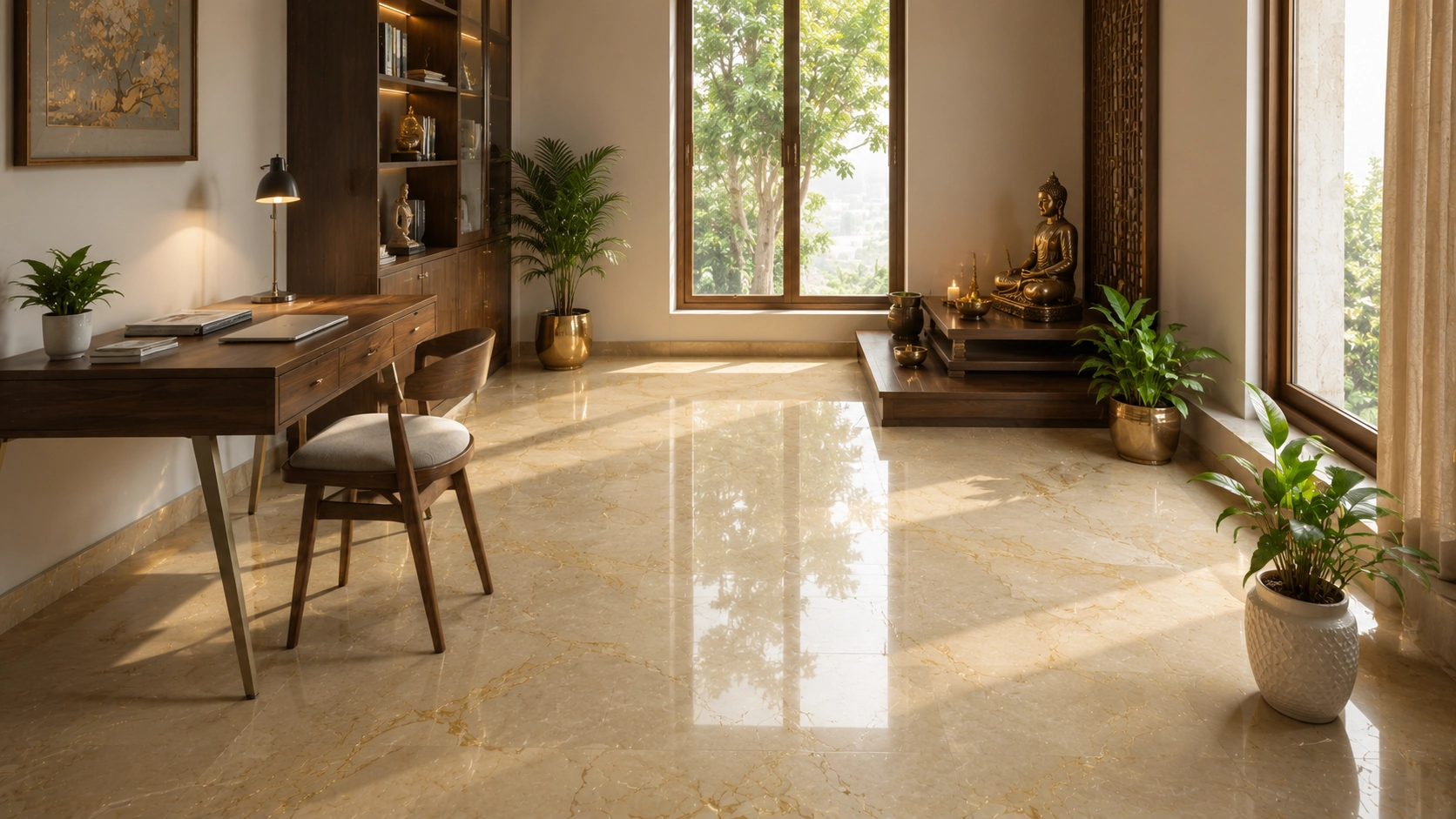
Sand-gold or warm ochre GVT | 400x400 mm or 600x600 mm | Matte | Rs. 65 to Rs. 115/sq.ft
A sand-gold or warm ochre GVT floor in a home study, meditation room, or yoga room positioned in the northeast zone of the home aligns directly with Vastu principles for this direction - the zone of wisdom, clarity, and positive beginnings. The warm golden tone creates an energetically balanced, grounded space for focused work or spiritual practice without the stimulating intensity of a bright golden yellow. The 400x400 mm format is particularly effective in compact study rooms of 80 to 120 sq.ft where it adds warmth without creating a large-tile awkwardness at the room edges.
22. Gold-Vein Slab Pooja Room Back Wall
-d7631efa-a9ee-4661-ace8-f007a6ec072a.webp)
Gold-vein marble-look GVT | 600x1200 mm | Matte or GHR | Rs. 100 to Rs. 180/sq.ft
A gold-vein marble-look GVT on the back wall of the pooja room - the wall against which the idol platform or mandir sits - creates a sacred backdrop that reads as stone temple wall cladding. At 600x1200 mm in vertical orientation, a standard pooja room back wall of 4 ft x 7 ft uses approximately 7 sq ft of tile. This is a highly cost-effective way to create a premium look for the most important visual moment in the pooja room. The gold veining in the marble-look tile echoes the gold in the idol finishes and brass deepam (lamp) stands, creating a coherent warm palette across the entire shrine area.
Quick Pairing Reference: Golden Tile Designs by Interior Style
| Interior Style | Recommended Golden Tile Design | Size and Finish | Key Pairing Element |
| Luxury contemporary Indian | Calacatta Gold marble-look floor (Idea 1) or gold-vein grey marble-look (Idea 6) | 800x1600 mm matte | Brushed brass fixtures, dark walnut furniture, warm-white recessed lighting at 2700K |
| Heritage/classical Indian | Golden checkerboard with white (Idea 3) or golden geometric border (Idea 10) | 600x600 mm matte | Teak or rosewood furniture, cane seating, terracotta planters, antique brass accents |
| Rustic/wabi-sabi | Sand-gold travertine-look (Idea 2) or warm amber stone-look (Idea 5) | 600x1200 mm or 600x600 mm textured matte | Rattan furniture, jute rugs, clay pots, lime-washed walls |
| Minimalist modern | Gold-vein grey marble (Idea 6) or sand-gold and charcoal two-zone (Idea 9) | 800x1600 mm matte | White walls, matte black fixtures, linear LED lighting, no visible clutter |
| Vastu-aligned traditional | Solid golden yellow floor (Idea 11) or saffron-white diamond (Idea 12) | 300x300 mm matte | Brass idols, marigold garlands, orange textiles, no cool-toned accents |
| South Indian traditional | Saffron and white diamond (Idea 12) or dual-tone amber geometric (Idea 16) | 300x300 mm or 200x200 mm matte | Temple-style lamp, kolam border at entrance, bronze or panchaloha idol stands |
| Rajasthani/Mughal heritage | Warm honey stone-look floor (Idea 15) or golden border on cream field (Idea 13) | 300x300 mm matte | Jaali screens, indigo or rust textiles, blue-and-white pottery, brass wall sconces |
Common Mistakes in Golden Tile Design for Indian Homes
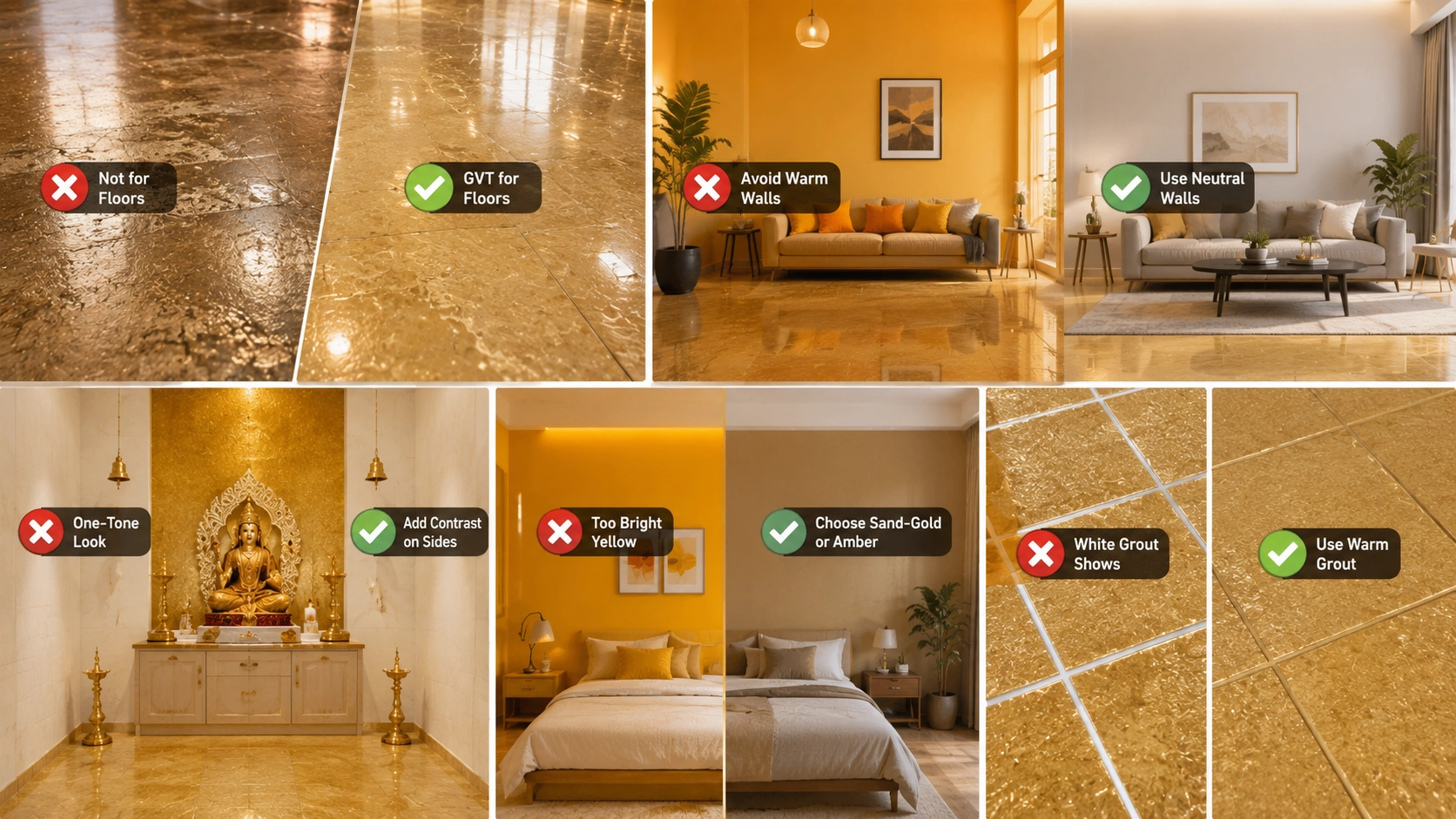
- Using metallic gold tiles on floors. Metallic gold tiles (ceramic or glass with a metallic glaze) are PEI 1 to PEI 2 and will lose their metallic finish under foot traffic within months. All golden tiles for floors must be GVT with a PEI 4 rating. Metallic gold is for walls and accents only.
- Pairing golden floors with yellow or warm-orange walls. A golden floor with yellow walls creates a single-temperature room where both surfaces merge, and the space reads as dense and small. Golden floors need a neutral or contrasting wall - white, off-white, greige, or a cool grey.
- Overusing the golden tile across every surface in the pooja room. Floor, back wall, and side walls all in the same golden tile create a flat, one-material space. Use the golden tone on the floor and back wall, and keep the side walls lighter (cream or white) to give the altar depth and focus.
- Choosing a vivid bright yellow for a bedroom or meditation room. Bright golden yellow is a stimulating colour in colour psychology and in Vastu. For restful spaces - master bedroom, meditation room, children's room - specify sand-gold, warm ochre, or amber GVT instead of a vivid yellow.
- Forgetting the grout colour. White grout on a sand-gold or amber tile creates a visible grid that reads as clinical rather than warm. Specify warm cream or beige grout matched to the tile tone. The grout colour decision should be made when the tile is ordered, not during installation.
Indian Market Snapshot: Golden GVT at a Glance
| Format | Design Category | Price Range (Morbi, material) | Best Ideas in This Guide |
| 300x300 mm matte | Solid golden yellow, saffron GVT | Rs. 60 to Rs. 100/sq.ft | Ideas 11, 12, 15 (pooja room floor) |
| 600x600 mm matte / textured matte | Sand-gold, amber stone-look, checkerboard | Rs. 70 to Rs. 130/sq.ft | Ideas 3, 5, 9, 10 (living room) |
| 600x1200 mm matte | Sand-gold travertine-look, gold-vein marble-look wall | Rs. 85 to Rs. 160/sq.ft | Ideas 2, 7, 22 (living room + pooja wall) |
| 800x1600 mm matte | Calacatta gold, gold-vein grey marble-look | Rs. 150 to Rs. 220/sq.ft | Ideas 1, 6 (premium living room floor) |
| Mosaic/accent (wall only) | Metallic gold, gold-speckled mosaic | Rs. 200 to Rs. 500/sq.ft | Ideas 8, 19, 20 (accent walls, backsplash, border) |
Note: All GVT golden tiles listed above are manufactured in Morbi, Gujarat, under IS 15622:2006, with water absorption at 0.05% or below. Stock formats (300x300 mm, 600x600 mm, 600x1200 mm) ship within 7 to 14 days. The 800x1600 mm marble-look designs ship in 10 to 21 days, depending on design availability at the factory.
Find Your Golden Tile Design on TilesFinders
From solid golden yellow pooja room floors at Rs. 60 per sq.ft to Calacatta Gold marble-look slab living room floors at Rs. 220 per sq.ft, the full golden tile range from Morbi, Gujarat manufacturers is on TilesFinders. Browse by design idea, size, finish, and budget to find the right golden tile for your living room or pooja room project.
FAQs
For a premium Indian living room, Calacatta Gold marble-look GVT at 800x1600 mm matte finish (Rs. 150 to Rs. 220 per sq.ft) is the most aspirational choice. For a mid-budget living room, sand-gold travertine-look GVT at 600x1200 mm matte (Rs. 85 to Rs. 140 per sq.ft) delivers warm stone character at a practical price. For a heritage or traditional living room, a golden yellow and white checkerboard at 600x600 mm is the right design language.
Solid golden yellow GVT at 300x300 mm matte finish is the most traditional and auspicious pooja room floor tile across Indian regions and traditions. A saffron and white diagonal diamond pattern at 300x300 mm is the standard for South Indian homes. For a back wall cladding behind the idol platform, gold-vein marble-look GVT at 600x1200 mm in matte or GHR finish creates a temple stone backdrop.
Yes. Gold and saffron-yellow tones are among the most auspicious colours in Vastu Shastra for a pooja room. They are associated with divine energy, clarity, and prosperity. A golden floor in a pooja room is considered to amplify the positive energy of the space, particularly when the room is in or oriented toward the northeast zone of the home.
Yes, white walls are the best pairing for golden floor tiles. White gives the warm gold tone room to register as the dominant colour statement in the room. Avoid yellow or warm-orange walls with golden floors, as matching warm tones across floor and wall creates a single-temperature room that reads as dense. White walls, warm-white lighting at 2700K, and dark or brass-toned furniture complete the golden tile living room correctly.
300x300 mm is the correct size for a compact Indian pooja room of 30 to 80 sq.ft. Larger tiles (600x600 mm and above) produce awkward cuts at the edges of a small room and do not allow for border or pattern designs that suit the pooja room's design tradition. The 300x300 mm format also gives a better proportional scale to the idol platform and mandir furniture.
GVT golden tiles in a pooja room are cleaned completely with a damp mop and a pH-neutral cleaner. Kumkum, haldi, flower petal stains, and incense ash all clean off GVT at 0.05% water absorption without leaving residue, because the non-porous glaze surface does not absorb pigment or organic matter. Wipe spills immediately, particularly turmeric and kumkum, and mop weekly. No sealing, no special treatment.
Gold-vein marble-look GVT has a white, cream, or grey base with gold veining running across the tile surface, replicating natural marble varieties with warm gold tones. Solid golden yellow GVT has a uniform warm yellow or ochre tone across the full tile surface without veining. Both are GVT at 0.05% water absorption; the choice is between a formal marble aesthetic and a warm, monochrome golden tone.
Sand-gold or warm ochre GVT at 400x400 mm or 600x600 mm in matte finish is the right specification for a meditation or yoga room. Bright golden yellow is too stimulating for a meditative space. The softer, earthier sand-gold and ochre tones in matte finish create a warm, grounded floor that supports stillness without visual distraction, aligning with Vastu guidance for northeast-zone rooms.

See our tile guides first
Set TilesFinders as a preferred source and our buying guides surface ahead of the rest for you.
Add as preferred sourceTakes one tap. Nothing to install.
What Readers Say
I was about to redo my parking area with the wrong tile size until I read this. The layout comparisons saved me from a costly mistake.
We reference TilesFinders guides while briefing clients on material selection. The size and pattern breakdowns are accurate and easy to explain visually.
On site, I get asked about grout spacing all the time. This article gave me a solid reference I now share with my team before every job.
Finally a guide that doesn't just push generic advice. The oil stain removal steps actually worked on our clubhouse driveway tiles.
I run a small construction firm and now send this link to clients directly when they ask about entrance tile sizing. Saves me an hour of explaining.
Good practical detail, though I wish there were more examples for compact apartment entrances specifically, not just villas.
My mother-in-law wanted marble, I wanted vitrified. This blog gave us the neutral comparison we needed to actually decide together.
Detailed without being overwhelming. I appreciated that it covered both cost and maintenance, not just the aesthetics.
Used the algae and hard water removal tips on our terrace tiles after the monsoon. Worked better than what our regular cleaner was doing.
As someone who sources tiles for multiple builder projects, I find these comparisons genuinely useful for vendor conversations, not just consumer content.
Recommended this to a client who kept second-guessing the entrance design. The small vs large layout section settled the debate instantly.
Straightforward and honest, no unnecessary jargon. Would like to see a similar breakdown for outdoor pool-deck tiles next.
We've bookmarked several TilesFinders guides for our design handbook. Reliable source when clients want data, not just opinions.
Two paths, one marketplace.
Get free quotes from verified suppliers.
Share your room, budget, and style. Suppliers in Morbi respond within hours.
Get Free QuotesList your business, reach real buyers.
Put your showroom in front of homeowners searching for tiles right now.
List Your Business