Best Pooja Room Tiles Design India: Premium Picks
Upgrade your mandir with 2026's top 8 premium tile designs. Discover how to pair PGVT walls with safe matte floors for a luminous, Vastu-aligned sacred space.

Most families arrive at the tile decision for their pooja room after everything else in the renovation is already finalised. The modular kitchen is ordered. The bathroom tiles are chosen. The living room floor is confirmed. The mandir gets one hour in a showroom, often on the same day as several other purchases, and the choice is made under time pressure with too many options and not enough clarity on what actually works in a sacred space.
The result is often a pooja room tiles design that is functional but not considered. It works. It does not feel chosen.
This guide presents eight premium design combinations that do feel chosen, each with the specific material, look, finish, and size that make them work, and the type of home and mandir space they suit best.
What Makes a Pooja Room Tile Design Truly Premium
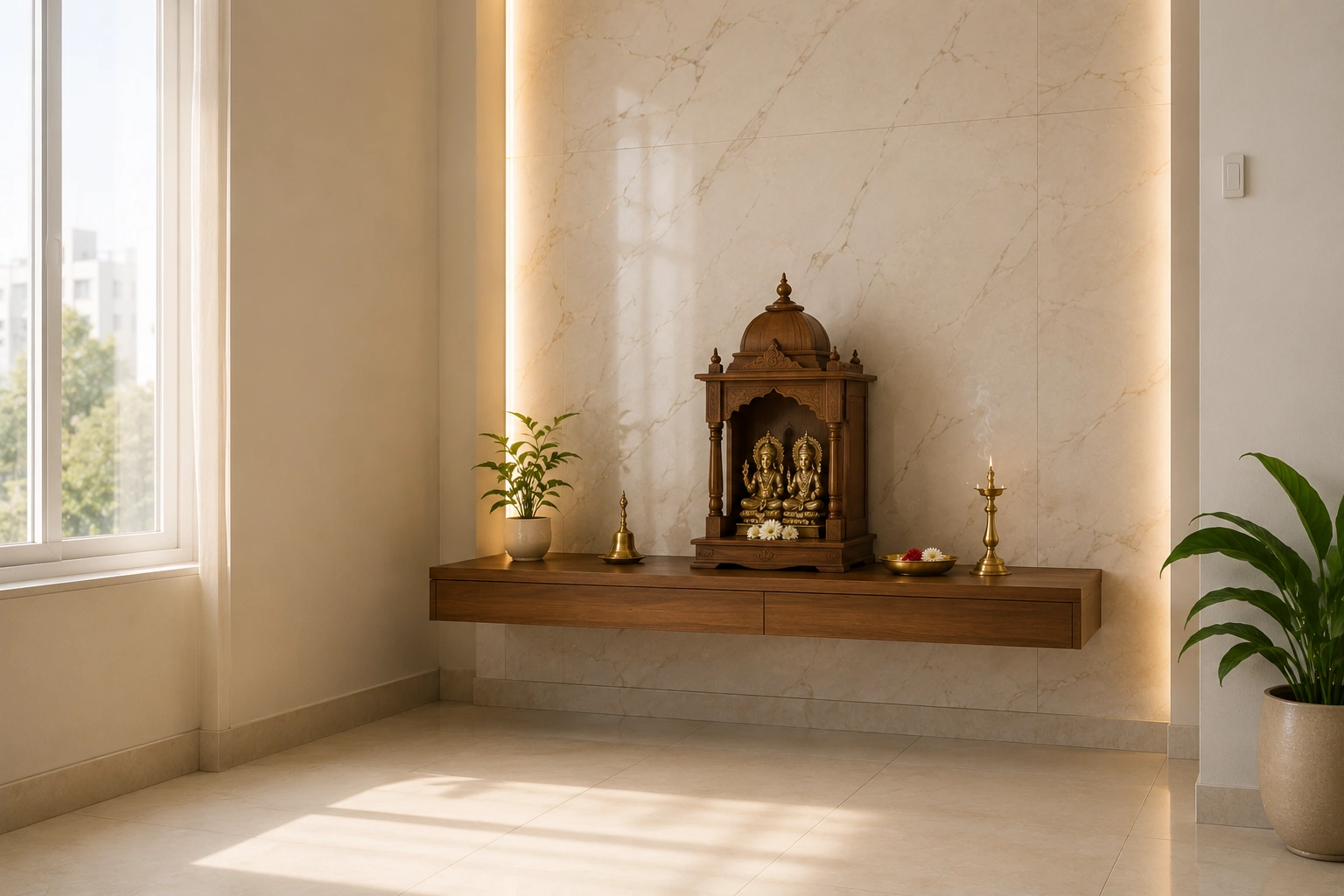
Premium in a pooja room context does not mean expensive by default. It means considered. A premium tile for a pooja room is one where every surface has a reason: the feature wall tile was chosen for how it reflects diya light, the surrounding wall tile was chosen to recede without competing, and the floor tile was chosen for safety and material coherence with the wall. When those three decisions are made in relation to each other rather than independently, the result reads as premium regardless of the price point.
That said, the picks in this guide do lean toward the upper end of the tile quality range available in India, because a pooja room is the one space in the home where families almost universally agree that quality matters more than cost-cutting. The tiles described below use PGVT, large-format GVT, Full Body vitrified, Third Fired decorative ceramics, and premium marble-look prints because those materials deliver what the space requires: light reflection, stain resistance, dignity of appearance, and longevity without heavy maintenance.
Eight Premium Pooja Room Tile Design Picks for 2026
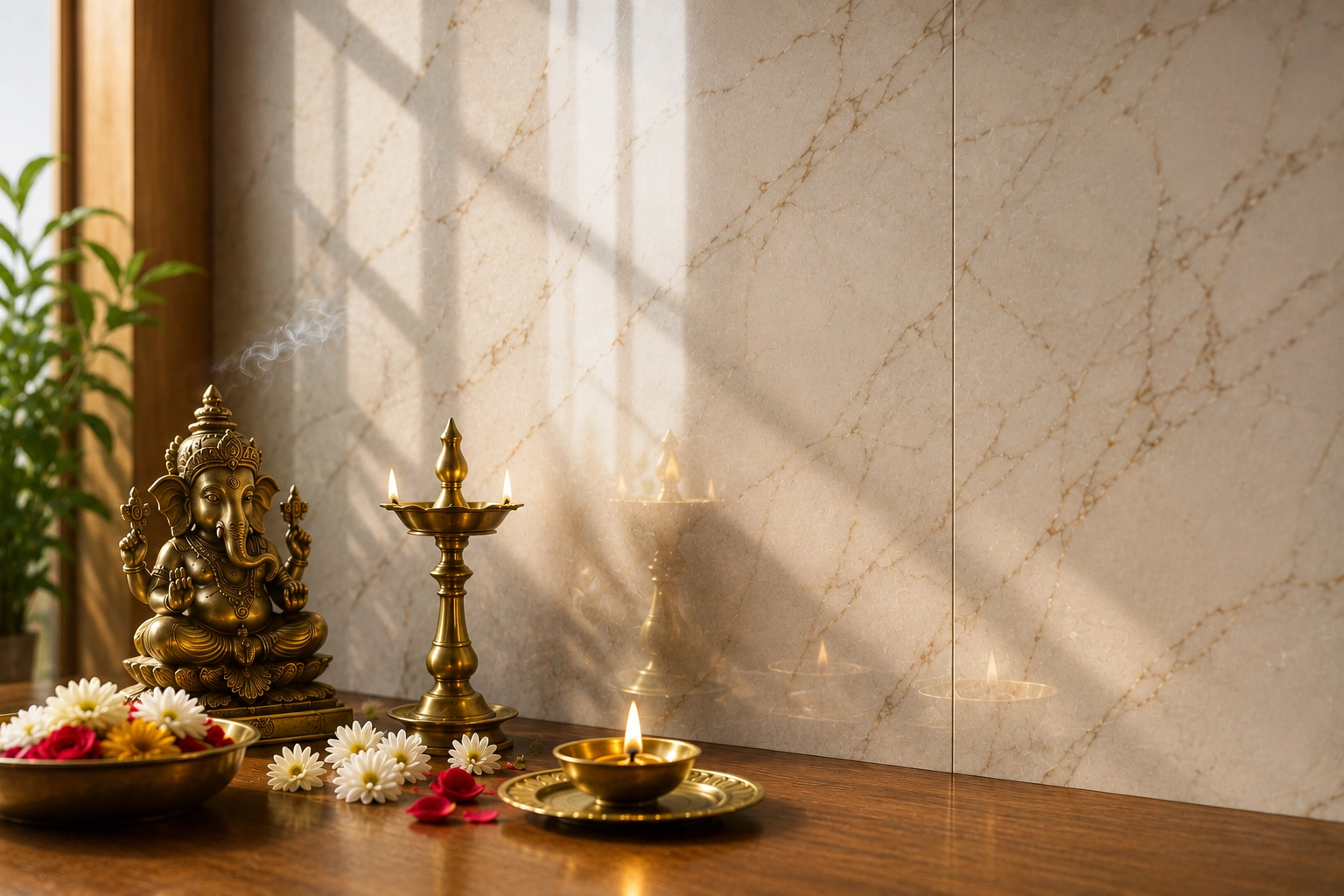
These pooja room tile design ideas are described as complete combinations, not individual tiles. Each pick names the feature wall tile, the surrounding wall tile, the floor tile, the finish approach, and the home context it suits.
Pick 1: Statuario White PGVT Feature Wall with Matte GVT Floor
White tiles pooja room design at its most considered. A Statuario marble-look PGVT tile in 2x4 on the deity feature wall, with bold soft-grey veining on a white base. The polished surface reflects diya light outward into the room. Plain white ceramic 12x24 on the surrounding walls. White marble-look GVT in 2x2 with a matte finish on the floor.
The material logic: PGVT on the wall for light reflection, matte GVT on the floor for anti-skid grip. Both carry the same Statuario marble-look design family so the floor-to-wall read is continuous without the polished finish extending to the floor where it would create a slip hazard during ritual water contact.
Suits: dedicated pooja rooms in modern 3BHK and 4BHK apartments and villas. Works with brass or gold deity accessories, teak or walnut floating shelf, and warm 2700K recessed LED lighting above the deity.
Pick 2: Calacatta Gold Feature Wall with Ivory Surrounding Tiles
Calacatta Gold marble-look is a white base with warm gold and caramel veining, as distinct from the cooler grey veining of Statuario. On a PGVT 2x4 feature wall, the gold tones in the veining pick up and amplify warm LED and diya light, creating a luminous quality that feels connected to gold and brass-heavy traditional Indian mandir interiors.
Material: PGVT on the feature wall, 2x4 size. Surrounding walls: plain ivory or cream GVT 2x2 in a matte finish. Floor: ivory marble-look GVT 2x2 in matte finish. A single row of gold mosaic border tiles framing the deity area on the feature wall completes the composition.
Suits: large dedicated pooja rooms in traditional homes, south Indian households where gold and brass are culturally central to mandir interiors, and older family homes undergoing renovation where the mandir design has to feel connected to the home's existing material palette.
Pick 3: Full PGVT Cream Marble Room with Gold Border Strips
PGVT tiles for pooja room applications across all four walls in a dedicated room create a continuously luminous interior that no other tile material replicates at this price range. A cream marble-look PGVT in 2x2 on the deity wall, the two side walls, and the back wall. Matte GVT in the same cream marble-look on the floor. Gold ceramic border strip tiles at the top of the deity wall and at the ceiling line.
The caveat worth naming: PGVT on all four walls creates a very reflective interior. This works well in rooms with controlled warm lighting (recessed LEDs, diyas, oil lamps) where the reflections are warm and directional. In a room with overhead tube lighting, the multi-surface PGVT reflection can feel cold and commercial rather than sacred. Lighting choice is critical to making this pick work.
Suits: dedicated pooja rooms of 30 to 60 sq. ft. in premium homes where the mandir is a formal, architecturally distinct space with its own controlled lighting. Not suited to small niches or open-plan mandirs where lighting control is limited.
Pick 4: Large Format Slab Wall with Minimal Wooden Mandir
Large format tiles for pooja room feature walls in 32x96 slab size bring the mandir as close as a tile can get to the continuous stone slab look of premium temple interiors. A single 32x96 PGVT panel in a white marble-look with near-zero grout lines on the deity feature wall. A floating teak or walnut mandir shelf mounted directly onto the tile surface. Plain matte GVT 2x2 in a matching cream tone on the floor and surrounding walls.
Material: PGVT slab (32x96) on the feature wall, which is wall-rated. GVT 2x2 in matte finish on all other surfaces. The slab installation requires structural support and adhesive rated for heavy vitrified panels. This is not a standard tile job and needs an experienced installer.
Suits: large dedicated pooja rooms in villas and independent homes where the deity wall has the full floor-to-ceiling height needed for a 32x96 slab panel. Also works in premium apartment pooja rooms where the height from counter to ceiling on the feature wall is 2.4 metres or more. The overall design sensibility is contemporary minimalist, where the tile does the work and the mandir structure is deliberately simple.
Pick 5: 3D Relief Feature Panel with Plain Ivory Field Tiles
3D tiles pooja room design using Third Fired decorative ceramics as a feature panel delivers a hand-crafted quality that no flat digital print can replicate. A Third Fired panel in a temple arch, lotus relief, or geometric mandala pattern covering the deity's back wall, set within plain ivory ceramic 12x24 on the surrounding walls and plain matte GVT 2x2 on the floor.
Material: Third-fired ceramic tiles are wall-only and decorative. They have a shallow to medium relief depth appropriate for a mandir wall that is away from direct high-volume agarbatti smoke. The raised pattern catches diya and lamp light on its edges, creating a shifting visual quality as the light source moves through the ritual. Plain ceramic 12x24 on the surrounding walls keeps the focus entirely on the relief panel.
Suits: traditional and transitional Indian homes where a hand-crafted or temple-carved aesthetic is more in keeping with the family's sensibility than a polished vitrified look. Works in both dedicated pooja rooms and larger niches where the Third Fired panel covers the full back wall.
Pick 6: Temple Arch Ceramic Feature Wall for Traditional Homes
A dedicated ceramic tile with a printed temple arch, gopuram-style motif, or sacred geometry pattern on the feature wall, framed by plain white ceramic 12x24 on surrounding surfaces and a matte GVT 2x2 on the floor in white or cream. This is the most traditionally rooted pick in the list and the most accessible in cost.
Material: ceramic 12x24 for both the motif feature tiles and the plain surrounding tiles. Wall-only. Floor in GVT 2x2 matte, which is separately rated for floor use. The motif tile is typically available in glossy or semi-gloss finish, which reflects diya light adequately at the cost level of ceramic.
Suits: south Indian homes, Rajasthani havelis, and traditional north Indian homes where temple imagery and classical Indian design motifs are part of the household visual culture. Also suitable for apartment niches where budget limits the use of large-format vitrified tiles but the family still wants a distinctly sacred quality to the wall treatment.
Pick 7: Full Body Dark-Vein Marble Wall for Contemporary Mandirs
A departure from the white-and-cream palette of most pooja room designs. Full Body tiles in a dark-vein marble look on the deity feature wall, using a Nero Marquina style (black base with white veining) or a grey-black Graphite marble pattern. Plain cream or off-white matte GVT 2x2 on the surrounding walls and floor.
Material: Full Body vitrified in 2x4 on the feature wall. Full Body tiles have the colour running through the tile body, which makes them chip-resistant at edges, relevant for a feature wall panel where the edge tile is visible. The surrounding walls in plain cream matte GVT provide strong contrast that makes the deity and offerings read clearly against the dark feature wall, which the lamp and diya light illuminate from the front.
Vastu note: a dark feature wall is not conventionally recommended for pooja rooms. This pick is included because it is being adopted in contemporary minimalist homes where the aesthetic is deliberately modern, and where the bright diya and deity lamp illumination in front of the wall provides sufficient forward light regardless of the tile colour behind. Families with a strong traditional Vastu orientation are better served by picks 1 through 6.
Suits: contemporary apartment mandirs and open-plan prayer corners in design-forward homes where the overall interior is dark-palette modern. Works with brushed steel or matte black mandir accessories, minimalist floating shelf, and directional spotlighting on the deity.
Pick 8: Compact Niche Design with Third Fired Accent Back Wall
Specifically for apartment wall niches of 10 sq. ft. or less. A Third Fired decorative ceramic panel with a lotus relief or temple arch pattern on the back wall of the niche. Plain white ceramic 12x18 on the two narrow niche side walls. A 1x1 matte GVT tile on the niche floor if it is inset into the wall.
Material: Third Fired ceramic (wall-only) on the back face of the niche, ceramic 12x18 (wall-only) on the sides. A 1x1 matte GVT on the niche floor shelf if applicable. The Third Fired back wall is the only design element needed in a compact niche. Nothing on the sides beyond a clean white or cream plain tile. No border strips, no additional motifs. The niche is too small to carry more than one design decision.
Suits: 2BHK and 3BHK apartments where a dedicated pooja room is not possible and the mandir is a niche in the living room or bedroom wall. The Third Fired panel in a compact niche gives the prayer space a sense of presence and intention that a plain tile cannot, without requiring the surface area of a full dedicated room.
If you also want broader guidance on vastu, pooja room tile materials, layouts, colours, and practical buying decisions, read our complete pooja room tiles design and vastu guide.
Premium Picks at a Glance
| Pick | Feature Wall | Surrounding Walls | Floor | Approx. Cost Tier | Best Home Type |
| 1. Statuario PGVT + Matte GVT Floor | Statuario marble-look PGVT 2x4, polished | Plain white ceramic 12x24 | White marble-look GVT 2x2, matte | Mid to premium (₹80 to ₹200 per sq. ft.) | Modern 3BHK and 4BHK apartments |
| 2. Calacatta Gold + Ivory Surrounds | Calacatta Gold marble-look PGVT 2x4, polished | Ivory GVT 2x2, matte | Ivory marble-look GVT 2x2, matte | Mid to premium (₹90 to ₹220 per sq. ft.) | Traditional large homes, south Indian |
| 3. Full PGVT Cream Room + Gold Border | Cream marble-look PGVT 2x2, polished | Cream marble-look PGVT 2x2, polished | Cream marble-look GVT 2x2, matte | Premium (₹100 to ₹200 per sq. ft.) | Premium 3BHK and 4BHK, villa pooja rooms |
| 4. Large Format Slab + Minimal Mandir | White marble-look PGVT 32x96 slab, polished | Cream matte GVT 2x2 | Cream matte GVT 2x2 | Premium (₹150 to ₹250 per sq. ft. for slab) | Villas and large apartments with tall walls |
| 5. 3D Relief Panel + Plain Ivory | Third Fired ceramic, lotus or arch relief | Plain ivory ceramic 12x24 | Matte GVT 2x2, white or cream | Mid (₹120 to ₹350 per sq. ft. for Third Fired) | Traditional and transitional Indian homes |
| 6. Temple Arch Ceramic Feature Wall | Printed temple arch ceramic 12x24, glossy | Plain white ceramic 12x24 | Matte GVT 2x2, white | Entry to mid (₹40 to ₹120 per sq. ft.) | South Indian, Rajasthani, traditional homes |
| 7. Full Body Dark-Vein Marble Wall | Nero or Graphite marble-look Full Body 2x4 | Cream matte GVT 2x2 | Cream matte GVT 2x2 | Mid to premium (₹90 to ₹200 per sq. ft.) | Contemporary minimalist apartments |
| 8. Compact Niche with Third Fired Back | Third Fired ceramic relief, wall-only | Plain white ceramic 12x18 | Matte GVT 1x1 (if niche has a shelf floor) | Mid (₹120 to ₹250 per sq. ft. for Third Fired) | 2BHK and 3BHK apartments with wall niches |
How to Choose Between These Designs
The right pick depends on three factors answered in sequence. First, the room type: is this a dedicated pooja room, a partition mandir, or a wall niche? Picks 1 through 4 and 7 are for dedicated rooms or large partition mandirs. Picks 5 and 6 work across dedicated rooms and larger niches. Pick 8 is specifically for compact niches.
Second, the lighting setup. Picks 1, 2, 3, and 4 depend on polished or high-gloss PGVT surfaces to reflect light. They only deliver their intended quality under warm directional lighting, diyas, oil lamps, or warm 2700K recessed LEDs. Under cool overhead tube lighting, the same picks can read as clinical. If the mandir lighting cannot be controlled or changed, picks 5, 6, and 8, which use ceramic and Third Fired materials with a less demanding relationship to light quality, are more forgiving.
Third, the Vastu orientation of the family. Picks 1 through 6 and Pick 8 are all Vastu-aligned, using white, cream, ivory, and gold tones. Pick 7 is a departure from conventional Vastu colour guidance and is suited to families whose primary decision driver is contemporary design rather than Vastu compliance.
Five Things to Confirm Before Ordering Premium Pooja Room Tiles
1. Test the tile under your mandir's actual lighting before ordering. Premium tiles look significantly different under warm and cool light. PGVT marble-look tiles in particular shift in colour temperature. Take a sample into the room, place it on the wall at the position of the deity, and check it at the time of day you do morning puja. That is the lighting moment that matters most.
2. Confirm the installer's experience with the tile format you have chosen. Large-format tiles in 2x4 and 32x96 slab sizes require installers with specific experience in heavy tile handling and large-format adhesive application. A standard tile installer who works primarily with ceramic 12x24 may not have this experience. Ask before confirming the booking.
3. Confirm grout width before installation begins. Marble-look tiles in premium designs look best with very narrow grout joints of 1 to 2mm that minimise the visual break in the veining pattern. Confirm this with the installer before work starts, not during.
4. Order the mandir shelf or wooden structure before finalising tile sizes. The deity shelf or mandir frame mounting dimensions determine how much of the feature wall is visible around it. A large wooden mandir structure on a 2x4 PGVT wall may cover much of the tile. Confirm the structure dimensions first, then decide whether the large-format tile investment is visible enough to justify the cost.
5. Buy 10 to 15% more than the measured area. Premium tiles, particularly Third Fired decorative ceramics and large-format PGVT slabs, are more likely to be discontinued between your purchase and any future repair need. Buffer stock also accounts for cutting wastage around niche edges, electrical points, and mandir frame mounting holes.
A premium pooja room tiles design is not built around one tile. It is built around how three surfaces, the feature wall, the surrounding walls, and the floor, work together to create an environment where the deity, the diya, and the morning ritual feel right.
The eight picks in this guide are starting points. Each can be adapted to your room dimensions, your family's aesthetic preferences, and your budget bracket. Take the picks that resonate, request samples of the specific tiles, test them in the actual room under the actual lighting, and confirm the material specifications before ordering.
You can browse pooja room tiles across PGVT, GVT, Full Body, Third Fired, and ceramic categories on TilesFinders to compare designs and request samples from Indian manufacturers.
FAQs
The most consistently effective pooja room tiles design for Indian homes combines a marble-look PGVT tile in 2x4 on the deity feature wall in a polished finish with plain white or cream ceramic 12x24 on the surrounding walls and a marble-look GVT 2x2 in matte finish on the floor. This combination works across room sizes from a medium niche to a full dedicated room, satisfies Vastu colour guidelines with white and cream tones, reflects diya and lamp light from the polished feature wall, and requires only routine cleaning for both the ceramic wall tiles and the vitrified floor tiles.
PGVT tiles in a marble-look print, particularly in large formats like 2x4, give the most premium appearance in a pooja room at a practical price point. The polished surface, the near-continuous veining with minimal grout interruption, and the way the tile reflects lamp light all contribute to a look that reads as elevated without requiring natural stone. For a further premium step, Full Body vitrified tiles in a dark marble-look on the feature wall with cream surrounding tiles is increasingly used in contemporary high-end home mandirs. Third Fired decorative ceramic panels with raised relief patterns give a different kind of premium: handcrafted and ornate rather than sleek and polished.
It depends on the exact size of the space. A 2x4 tile on the feature wall works in dedicated rooms above 20 sq. ft. where the feature wall has sufficient height to show at least one full tile without heavy cutting at the top and bottom. In a compact niche below 10 sq. ft., a 2x4 tile would require significant cutting and the large format would overpower the proportions. For compact niches, a 2x2 tile on the back wall or Third Fired ceramic panels in standard sizes are more proportionate. The 32x96 slab size is only appropriate in rooms with a full floor-to-ceiling height feature wall in spaces above 40 sq. ft.
Yes, particularly Third Fired decorative ceramics with raised relief patterns in lotus, temple arch, or geometric mandala designs. They work best as a complete feature panel covering the deity back wall, surrounded by plain ceramic tiles on the remaining wall surfaces. In a compact niche, one Third Fired panel on the back wall is enough to give the space a hand-crafted, sacred quality. The practical limit is relief depth: shallow relief textures (0.3 to 1mm Texture punch) are easier to clean in a working mandir than deep carved-look patterns, which collect agarbatti ash in their grooves with daily use.
White, cream, ivory, beige, and light yellow are the Vastu-recommended colours for pooja room tiles. White is the most widely applicable and works across all mandir directions. Cream and ivory are warmer alternatives that suit homes with warm LED lighting and wooden mandir structures. Light yellow is specifically beneficial in north-facing rooms with limited natural light. Gold-toned marble-look tiles, such as Calacatta Gold PGVT, fall within the Vastu-approved range and suit traditional Indian mandirs with brass and gold accessories. Dark tones including charcoal, navy, and black are not recommended for primary mandir surfaces under standard Vastu guidance.
Marble-look PGVT tiles for a pooja room feature wall cost approximately ₹80 to ₹200 per sq. ft. depending on size, brand, and veining detail. Third Fired decorative ceramics used for 3D feature panels cost approximately ₹120 to ₹350 per sq. ft. Large-format slab tiles in 32x96 size cost approximately ₹150 to ₹300 per sq. ft. or more for premium designs. Full Body vitrified tiles in 2x4 run approximately ₹90 to ₹200 per sq. ft. All prices are approximate, vary by brand and dealer, and exclude GST and installation. For a dedicated pooja room of 40 sq. ft. with a premium tile design, total tile material cost typically falls between ₹8,000 and ₹30,000 depending on the pick chosen.
Keep the rule simple: one design tile on the feature wall, one plain or minimal tile everywhere else. All tiles should share a colour family, either white-cream-ivory or a coordinated tone, so the different surfaces read as a single composed environment rather than separate decisions. Avoid mixing two different marble-look designs on the wall and floor: use tiles from the same design family in different finishes instead (polished PGVT on the wall, matte GVT of the same marble pattern on the floor). If using a Third Fired or decorative tile on the back wall, the surrounding and floor tiles should be the plainest possible option in the same colour family to let the decorative surface carry all the visual weight.

See our tile guides first
Set TilesFinders as a preferred source and our buying guides surface ahead of the rest for you.
Add as preferred sourceTakes one tap. Nothing to install.
What Readers Say
I was about to redo my parking area with the wrong tile size until I read this. The layout comparisons saved me from a costly mistake.
We reference TilesFinders guides while briefing clients on material selection. The size and pattern breakdowns are accurate and easy to explain visually.
On site, I get asked about grout spacing all the time. This article gave me a solid reference I now share with my team before every job.
Finally a guide that doesn't just push generic advice. The oil stain removal steps actually worked on our clubhouse driveway tiles.
I run a small construction firm and now send this link to clients directly when they ask about entrance tile sizing. Saves me an hour of explaining.
Good practical detail, though I wish there were more examples for compact apartment entrances specifically, not just villas.
My mother-in-law wanted marble, I wanted vitrified. This blog gave us the neutral comparison we needed to actually decide together.
Detailed without being overwhelming. I appreciated that it covered both cost and maintenance, not just the aesthetics.
Used the algae and hard water removal tips on our terrace tiles after the monsoon. Worked better than what our regular cleaner was doing.
As someone who sources tiles for multiple builder projects, I find these comparisons genuinely useful for vendor conversations, not just consumer content.
Recommended this to a client who kept second-guessing the entrance design. The small vs large layout section settled the debate instantly.
Straightforward and honest, no unnecessary jargon. Would like to see a similar breakdown for outdoor pool-deck tiles next.
We've bookmarked several TilesFinders guides for our design handbook. Reliable source when clients want data, not just opinions.
Two paths, one marketplace.
Get free quotes from verified suppliers.
Share your room, budget, and style. Suppliers in Morbi respond within hours.
Get Free QuotesList your business, reach real buyers.
Put your showroom in front of homeowners searching for tiles right now.
List Your Business