Best Elevation Tiles in Chennai: Designs, Price and Where to Buy in 2027
Discover how to pick weather-resistant elevation tiles for Chennai facades in 2027. Compare zone-by-zone designs, installation specs, pricing (₹40–₹280/sq ft), and top local suppliers.
- Why Chennai Facades Fail in Patches, Not All at Once
- Matching the Tile to the Zone
- 2027 Design Directions Chennai Homeowners Are Actually Choosing
- What This Actually Costs
- The One Spec Most Homeowners Never Ask About
- How to Source This, Depending on Who You Are
- Before You Confirm the Order
- Explore Elevation Tile Options
Chennai facades fail zone by zone, not all at once, so the smarter approach for 2027 is matching tile type to wall zone rather than tiling the whole facade in one product, at roughly Rs. 30 to Rs. 350 per square foot.
Elevation work is one of the few home renovation jobs most Chennai homeowners only get right, or wrong, once. Once the scaffolding comes down, redoing a section of facade means putting it back up again, at a cost most people would rather avoid a second time. That makes the tile selection stage worth more attention than it usually gets.
This guide skips the usual one-size-fits-all tile list and instead breaks the facade down the way a contractor actually looks at it, zone by zone, along with 2027 pricing and where Chennai buyers source these tiles from.
Why Chennai Facades Fail in Patches, Not All at Once
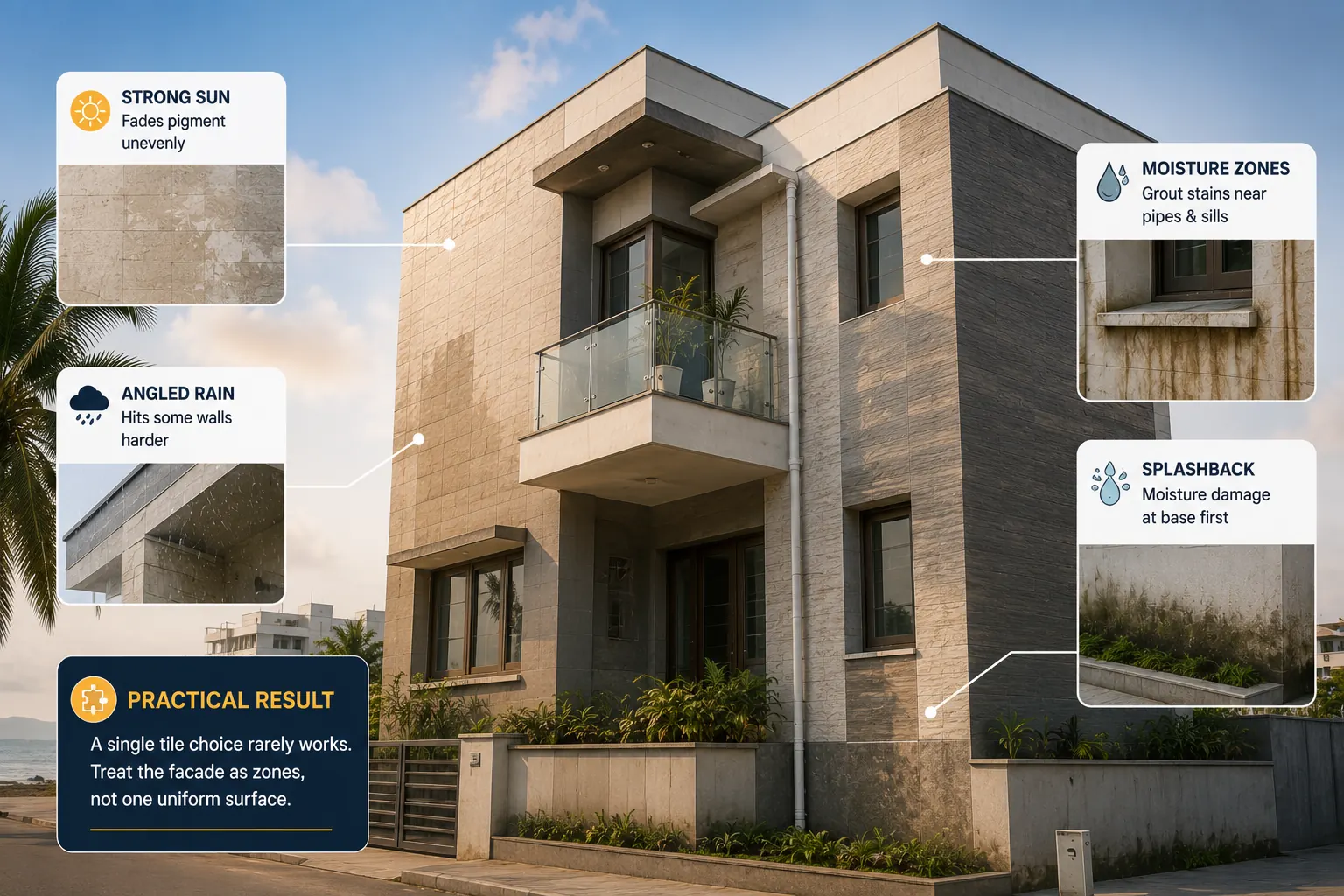
Walk around any Chennai neighbourhood a few years after a facade renovation, and the damage is rarely even. The wall facing the afternoon sun fades first. The section near a downpipe or windowsill shows grout staining while the rest of the wall looks fine. The base near the ground picks up moisture from splashback long before the upper storeys show any wear.
This happens because Chennai's climate attacks a facade unevenly. Salt-heavy coastal air, common from Besant Nagar up through the northern belt, corrodes grout and adhesive faster wherever moisture sits longest. The northeast monsoon between October and December drives rain in at an angle rather than straight down, so upper sections facing that direction take a harder hit than sheltered corners. Strong, near-constant sun fades pigment unevenly depending on which wall faces east or west.
The practical result is that a single tile choice for the entire facade is rarely the smartest move. A better approach treats the facade as a set of zones, each with a different job to do.
Matching the Tile to the Zone
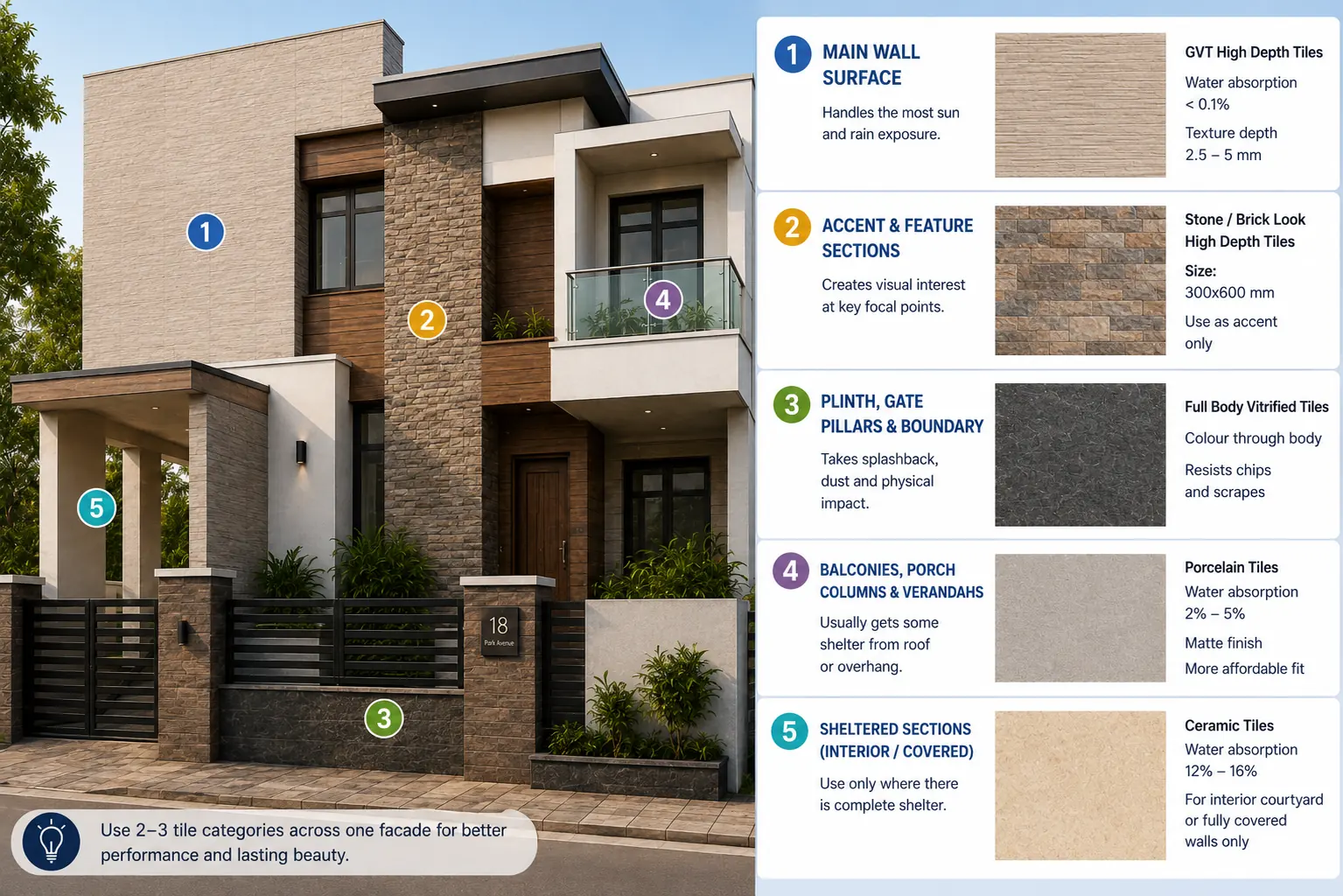
Architects working on Chennai homes typically specify two or three different tile categories across one facade, not one product for everything.
The Main Wall Surface
This is the largest, flattest area of the facade and the one that takes the most direct sun and rain exposure. GVT High Depth tiles, with water absorption below 0.1 percent and a genuine textured surface of 2.5 to 5 mm, are the category most architects reach for here, since a flat printed pattern is far more likely to show weathering unevenly than a tile with real physical depth.
Accent and Feature Sections
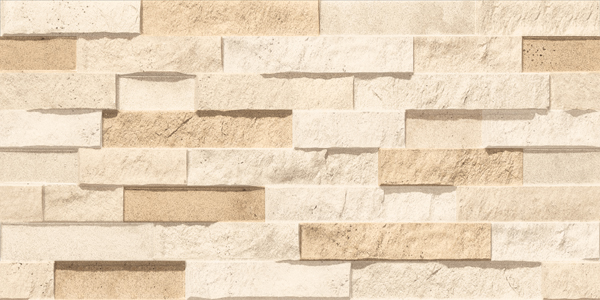
Entrance walls, the strip around the main door, and balcony fronts are usually where homeowners want the most visual interest, since this is what visitors and passersby actually notice first. Stone-look or brick-look High Depth tiles in a contrasting tone work well here in smaller formats such as 300x600 mm, kept as an accent rather than spread across the whole wall.
Plinth, Gate Pillars, and Boundary Walls
The lowest section of any facade takes splashback, dust, and physical knocks that the upper storeys never see. Full body vitrified tiles, which carry colour through the entire thickness, are the practical choice here, since a scrape or chip does not reveal a different colour underneath the way it would on a surface printed tile.
Balconies, Porch Columns, and Verandahs
These sections usually get some roof or overhang protection, which changes the calculation. Porcelain tiles, with water absorption between 2 and 5 percent and typically a matte finish in the Indian market, are a reasonable and more affordable fit here, since they are not fully exposed to direct rain the way the main wall is.
Ceramic elevation tiles, with water absorption often in the 12 to 16 percent range, still have a place, but only on sheltered sections such as an interior courtyard wall or a fully covered boundary wall, never on a wall that takes direct cyclone season rain.
From The Marketplace
Popular tiles right now
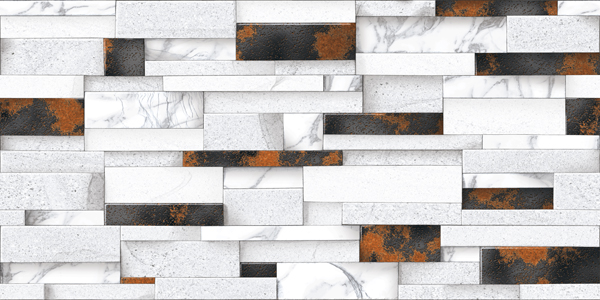
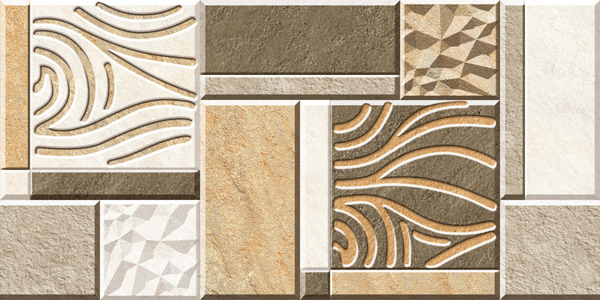

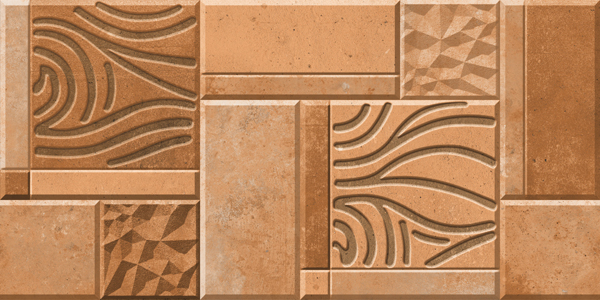
2027 Design Directions Chennai Homeowners Are Actually Choosing
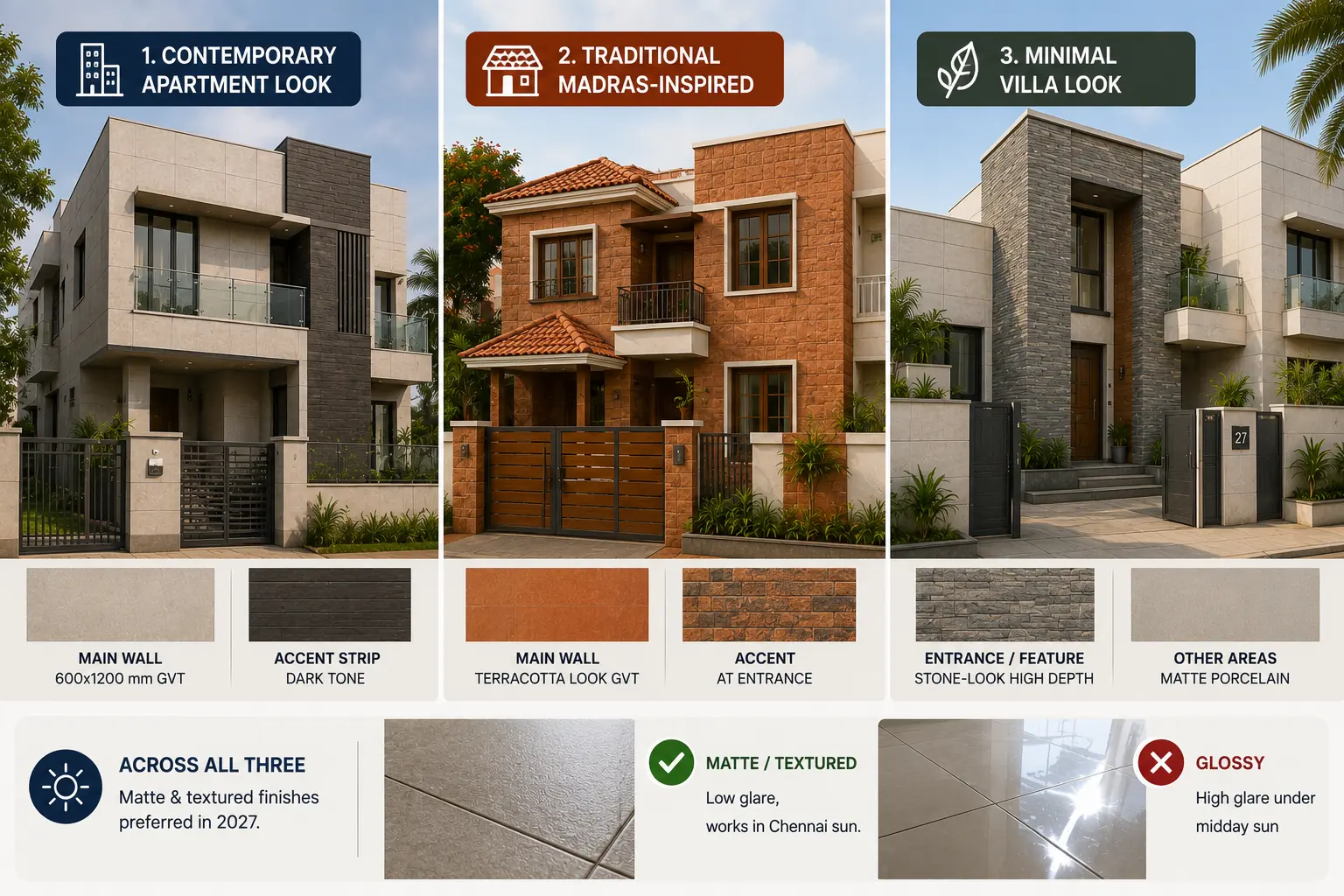
Design requests coming into Chennai showrooms this year tend to fall into three broad looks, each pairing a different tile strategy with the zoning approach above.
- Contemporary apartment look: large format 600x1200 mm flat GVT panels across the main wall, paired with a single dark accent strip around balcony fronts, kept deliberately minimal to suit compact plots along OMR and the newer South Chennai developments.
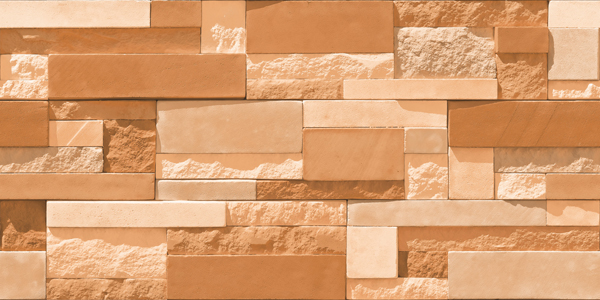
- Traditional Madras-inspired facade: warm terracotta and rust tones in GVT rather than actual clay, echoing the city's older tiled roof aesthetic while avoiding the porosity problems real terracotta has outdoors.
- Minimal villa look: a restrained material palette with stone-look High Depth tiles used sparingly at the entrance and matte porcelain elsewhere, avoiding busy patterns that fight with strong Chennai sunlight.
Across all three, matte and textured finishes are winning out over glossy ones this year, largely because a glossy surface throws visible glare under Chennai's midday sun in a way a matte tile does not.
What This Actually Costs
Because most Chennai facades now mix two or three tile categories across different zones, the realistic way to budget is by scheme rather than a single flat rate.
| Scheme | Typical Mix | Blended Cost (Rs/sq ft) | Approx. Cost for 500 sq ft Facade |
| Budget | Ceramic main wall, porcelain balconies | Rs. 40 to Rs. 70 | Rs. 20,000 to Rs. 35,000 |
| Mid-range | Porcelain main wall, full body plinth, small accent | Rs. 90 to Rs. 140 | Rs. 45,000 to Rs. 70,000 |
| Premium | GVT High Depth main wall, stone look accent, full body plinth | Rs. 150 to Rs. 280 | Rs. 75,000 to Rs. 1,40,000 |
Installation, including scaffolding, adhesive, and labour for vertical fixing, typically adds another Rs. 30 to Rs. 80 per square foot on top of these material figures, and runs higher for premium schemes that use heavier High Depth tiles.
The One Spec Most Homeowners Never Ask About
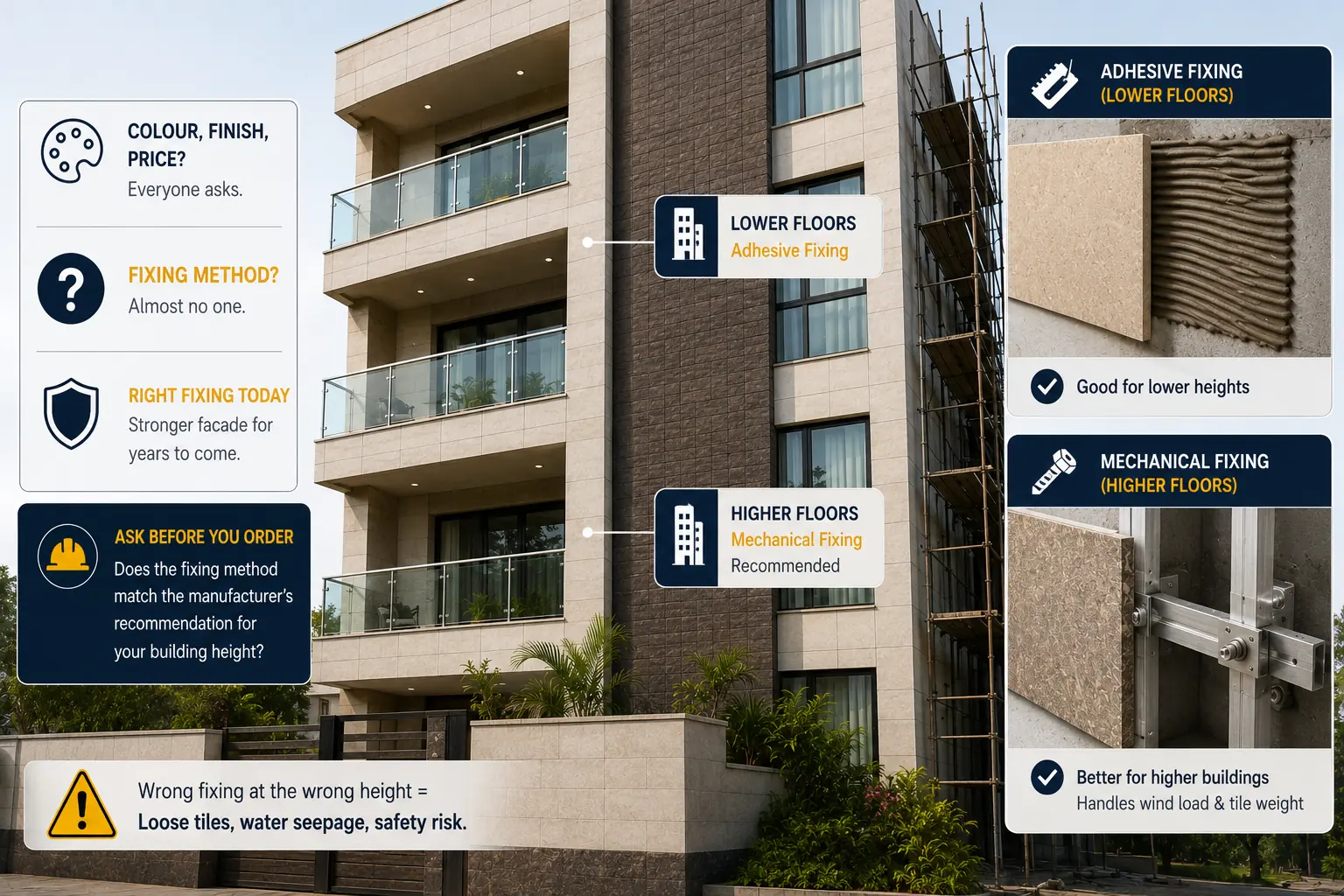
Nearly every Chennai facade conversation covers colour, finish, and price. Almost none of them cover fixing method, which is the detail that actually determines whether a facade survives its first few cyclone seasons.
Adhesive fixing with a polymer-modified, exterior-rated adhesive is generally adequate for lower floors. Manufacturers typically recommend mechanical cladding systems or anchors beyond a certain building height, since wind load and the tile's own weight both increase the risk of adhesive failure higher up a structure. This becomes especially relevant for High Depth tiles, which weigh noticeably more per square foot than a flat printed tile of the same size.
Before signing off on any elevation order, ask the contractor directly which fixing method they plan to use and whether it matches what the tile manufacturer recommends for your building's height, rather than assuming standard adhesive fixing will work for every floor.
How to Source This, Depending on Who You Are
The right buying route in Chennai depends less on which part of the city you live in and more on the size and nature of the project.
- Individual homeowners comparing designs in person: Egmore remains the densest cluster, with several brand display centres along Ethiraj Salai, Montieth Road, and Anna Salai within walking distance of each other, useful for seeing multiple finishes under real light in one visit.
- Homeowners in the IT corridor or newer developments: Vadapalani and OMR showrooms are closer and used to specifying for apartment-style facades common in those areas.
- South and South West Chennai independent house owners: dealers around Tambaram, Madipakkam, and Kovilambakkam are accustomed to full house facade projects rather than just accent walls.
- Contractors and builders buying in volume: the wholesale stretch around Egmore, along with Kovilambakkam and Vanagaram, carries more competitive per square foot rates on standard ceramic and vitrified ranges.
Before You Confirm the Order
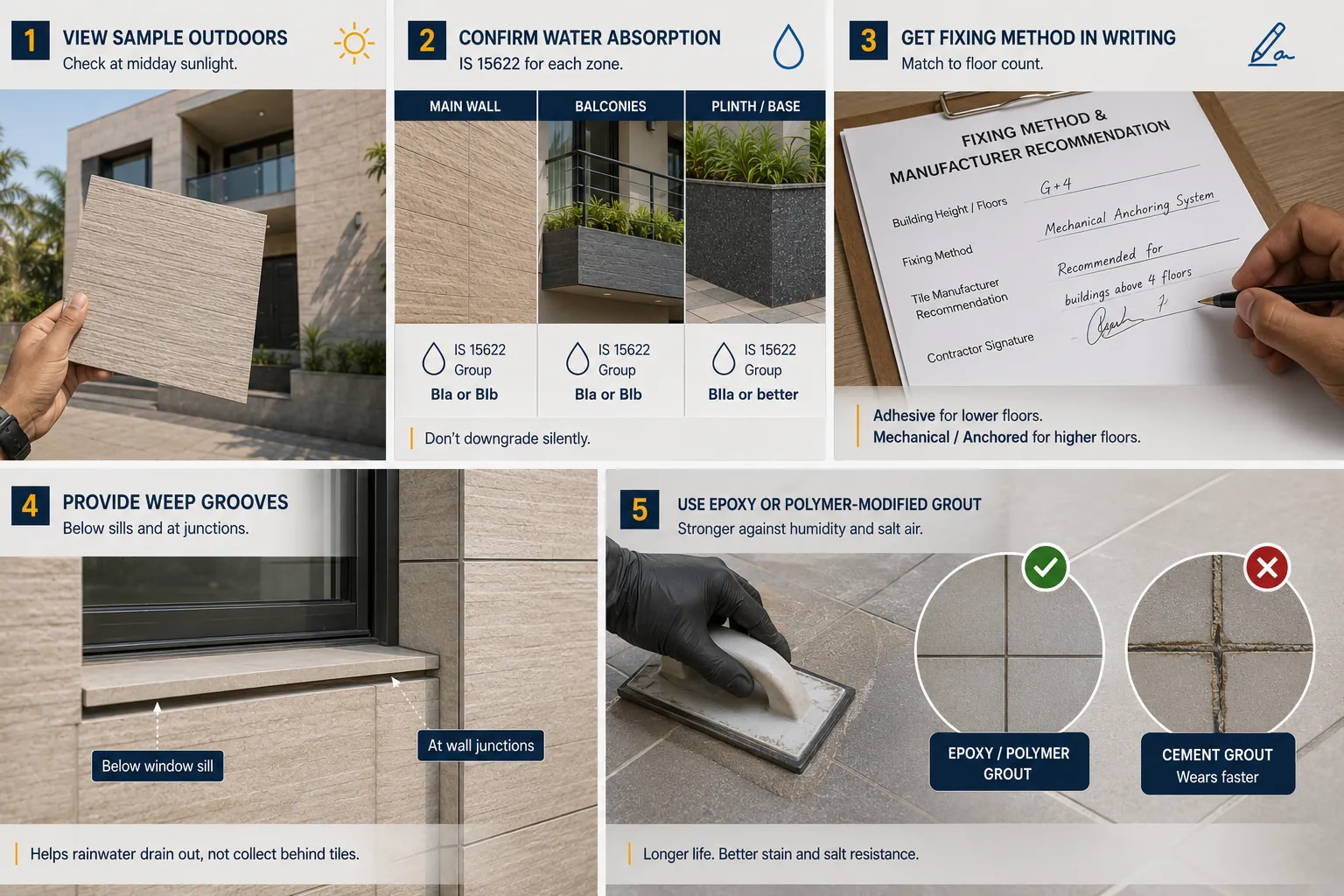
- View a sample panel outdoors at midday, not just under showroom lighting, since Chennai's sun changes how a design reads once it is actually on the wall.
- Confirm the water absorption group under IS 15622 for each zone, not just the main wall tile, since balconies and plinths often get quietly downgraded to save cost.
- Ask for the fixing method in writing, matched to your building's floor count, along with the tile manufacturer's own recommendation for that height.
- Build in weep grooves below window sills and at wall junctions so wind-driven cyclone season rain has somewhere to drain instead of collecting behind the tile line.
- Specify epoxy or polymer-modified grout throughout, since standard cement grout wears faster in Chennai's constant humidity and salt air.
Explore Elevation Tile Options
Getting a Chennai facade right comes down to matching each wall zone to the tile category built for that level of exposure, rather than picking one product for the whole house. If you are planning a facade project or sourcing in bulk for a builder job, TilesFinders connects you with verified dealers and Morbi manufacturers to explore current elevation tile ranges and place an informed order.
FAQs
No. Most architects mix two or three tile categories across a facade, matching GVT High Depth to the fully exposed main wall, porcelain to sheltered balconies and porches, and full body vitrified to the plinth and boundary wall where physical impact is more likely.
Sun direction, rain angle during the October to December cyclone season, and moisture exposure near the ground all vary across different parts of the same wall, so different sections age at different rates depending on which tile category was used there.
Generally yes for the main sun-facing wall. Glossy finishes throw noticeable glare under Chennai's strong midday sun and show dust and salt residue more visibly than matte or textured tiles.
A budget scheme using ceramic and porcelain runs roughly Rs. 20,000 to Rs. 35,000 for material, a mid-range mix around Rs. 45,000 to Rs. 70,000, and a premium GVT High Depth scheme roughly Rs. 75,000 to Rs. 1,40,000, before installation.
Yes. Fixing method matters as much as the tile itself. Lower floors generally manage fine with exterior-rated adhesive, while taller buildings often need mechanical cladding systems or anchors, particularly for heavier High Depth tiles.
Large apartment projects needing consistent shade across thousands of square feet typically source directly from manufacturers in Morbi, Gujarat, through a supplier platform such as TilesFinders, rather than buying the full quantity through city retail.


See our tile guides first
Set TilesFinders as a preferred source and our buying guides surface ahead of the rest for you.
Add as preferred sourceTakes one tap. Nothing to install.
What Readers Say
I was about to redo my parking area with the wrong tile size until I read this. The layout comparisons saved me from a costly mistake.
We reference TilesFinders guides while briefing clients on material selection. The size and pattern breakdowns are accurate and easy to explain visually.
On site, I get asked about grout spacing all the time. This article gave me a solid reference I now share with my team before every job.
Finally a guide that doesn't just push generic advice. The oil stain removal steps actually worked on our clubhouse driveway tiles.
I run a small construction firm and now send this link to clients directly when they ask about entrance tile sizing. Saves me an hour of explaining.
Good practical detail, though I wish there were more examples for compact apartment entrances specifically, not just villas.
My mother-in-law wanted marble, I wanted vitrified. This blog gave us the neutral comparison we needed to actually decide together.
Detailed without being overwhelming. I appreciated that it covered both cost and maintenance, not just the aesthetics.
Used the algae and hard water removal tips on our terrace tiles after the monsoon. Worked better than what our regular cleaner was doing.
As someone who sources tiles for multiple builder projects, I find these comparisons genuinely useful for vendor conversations, not just consumer content.
Recommended this to a client who kept second-guessing the entrance design. The small vs large layout section settled the debate instantly.
Straightforward and honest, no unnecessary jargon. Would like to see a similar breakdown for outdoor pool-deck tiles next.
We've bookmarked several TilesFinders guides for our design handbook. Reliable source when clients want data, not just opinions.
Two paths, one marketplace.
Get free quotes from verified suppliers.
Share your room, budget, and style. Suppliers in Morbi respond within hours.
Get Free QuotesList your business, reach real buyers.
Put your showroom in front of homeowners searching for tiles right now.
List Your BusinessMore Blogs
See all
Elevation Tiles: The Complete Guide to Transforming Your Home Exterior
Complete guide to elevation tiles for home exteriors, covering tile types, sizes, finishes, 3D de...
Read More
Front Elevation Tiles: Trending Designs for Indian Homes
Explore trending front elevation tiles for Indian homes, including stone, wood, brick, and 3D des...
Read More
Modern Elevation Tiles Design India: Architects' Picks
Discover modern elevation tiles for Indian homes, including stone, wood, concrete, and 3D designs...
Read More