Subway vs Mosaic vs Large-Format Backsplash Tiles: Which Works Best Behind Indian Gas Hobs
Compare subway, mosaic, and large-format backsplash tiles for Indian gas hobs. Learn which option offers the best heat resistance, grease control, grout performance, cleaning ease, and value.
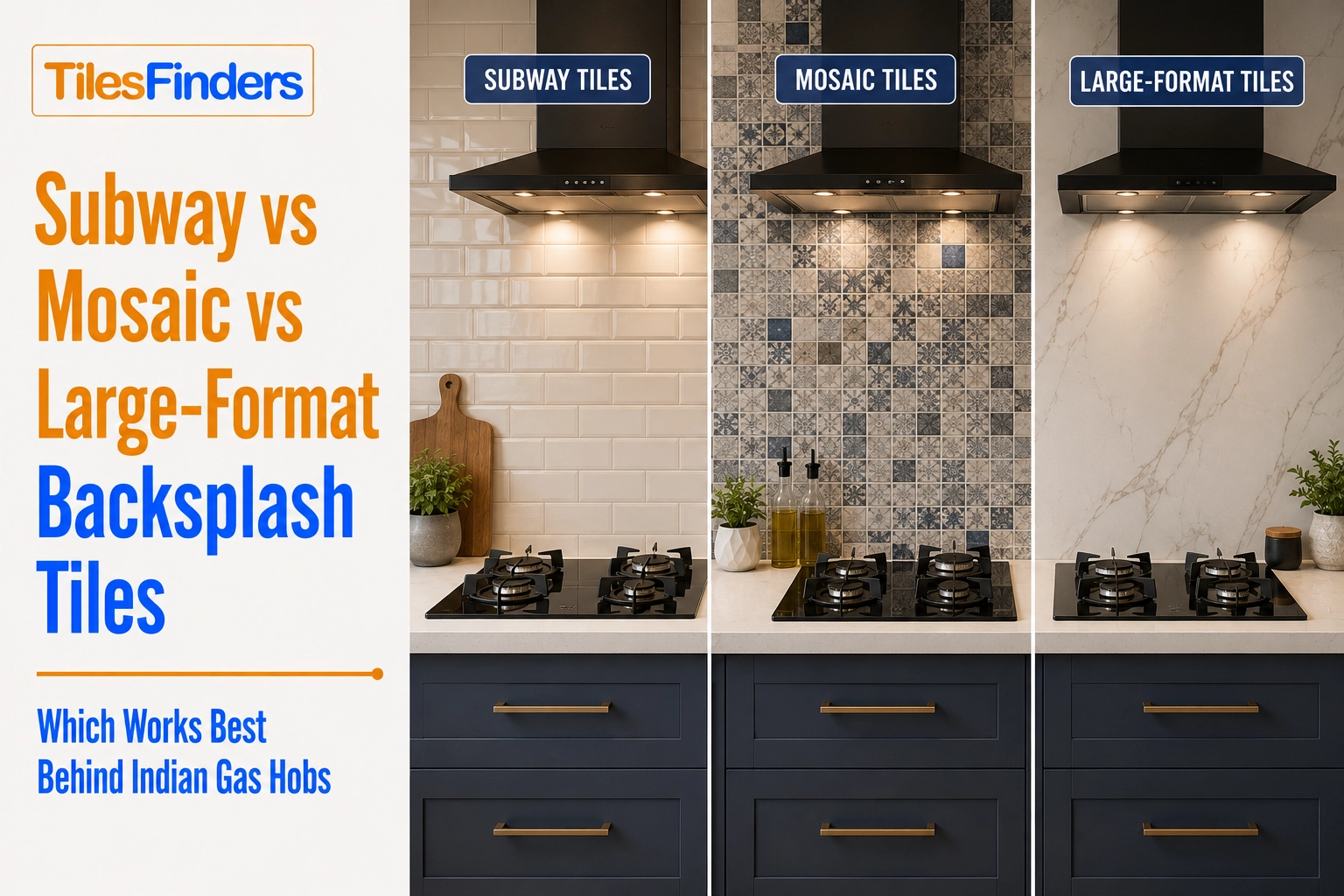
Large-format tiles or slabs perform best behind Indian gas hobs thanks to minimal grout lines, superior cleaning ease, and strong heat resistance, while subway tiles remain the best budget-friendly all-around option. Mosaic tiles are ideal as decorative accents away from the hob or in hybrid backsplash layouts, balancing visual appeal with easier maintenance where grease exposure is lower.
The zone directly behind an Indian gas hob is the single most demanding backsplash location in the home: concentrated radiant heat, frequent oil splatter, and the most intensive daily cleaning of any tiled surface in the kitchen. This guide compares subway, mosaic, and large-format backsplash tile specifically for this zone, not for general kitchen backsplash use.
What the Hob Zone Actually Demands
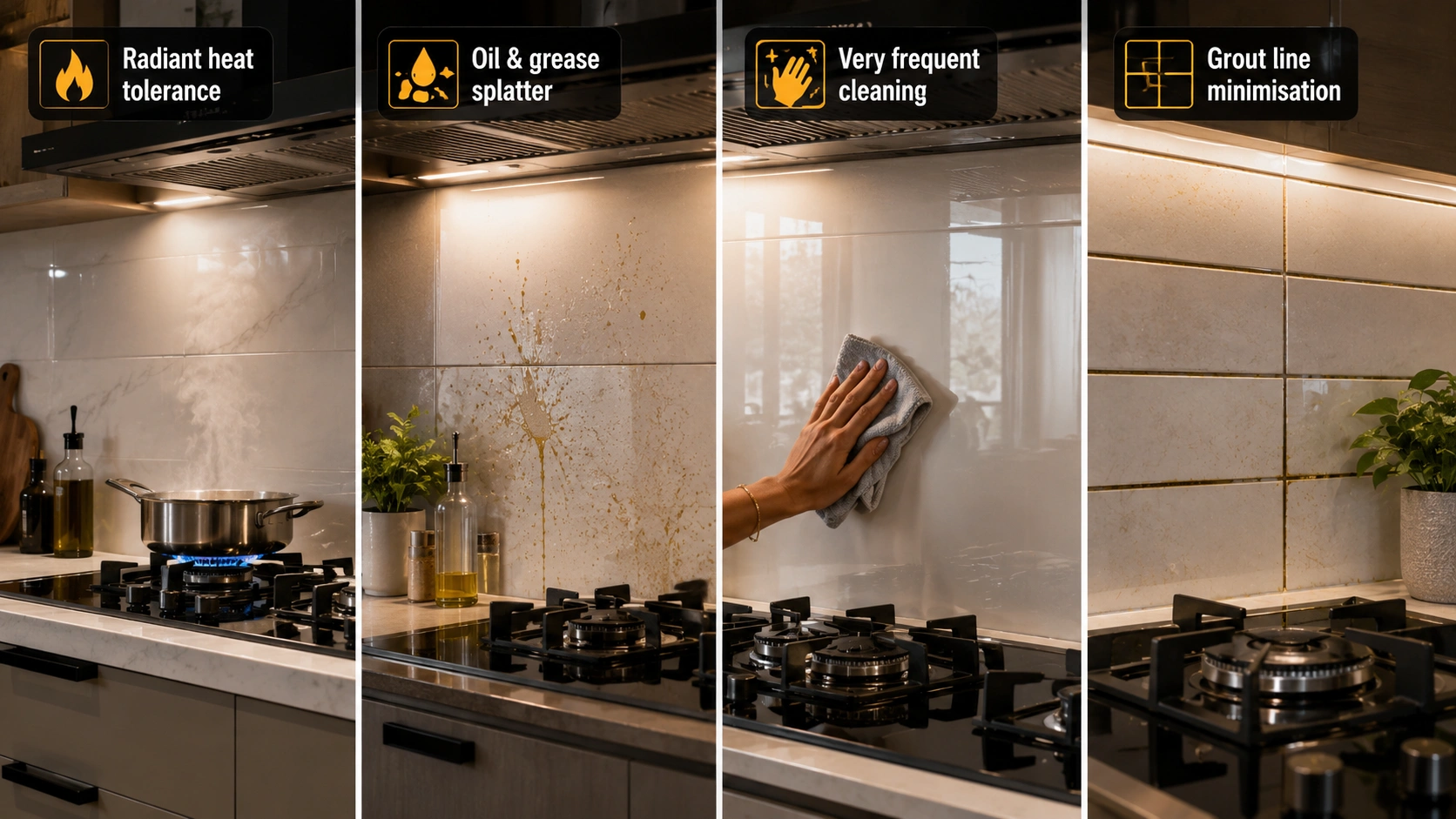
- Radiant heat tolerance within roughly 150mm of the burners is more concentrated and sustained than anywhere else on the backsplash.
- Frequent oil and grease splatter, requiring a surface that wipes clean easily and does not retain residue in surface texture or grout lines.
- Very frequent cleaning, often multiple times during a single cooking session, meaning the finish needs to withstand repeated wiping without dulling or scratching.
- Grout line minimisation directly behind the burners, since grout lines in this specific zone accumulate grease residue faster than anywhere else on the backsplash.
From The Marketplace
Popular tiles right now

-a7bc331f-ba60-41ce-834f-5a1d0c7ac3b1.jpg)
-cf3c0ebc-ac46-4340-85de-6d8a2a7a8ba0.jpg)

-039c8fa9-2a2c-482f-9482-da1f0679a179.jpg)
-b7419414-4f4c-41cc-ba0e-8bc90096e6ff.jpg)
Three-Way Comparison for the Hob Zone
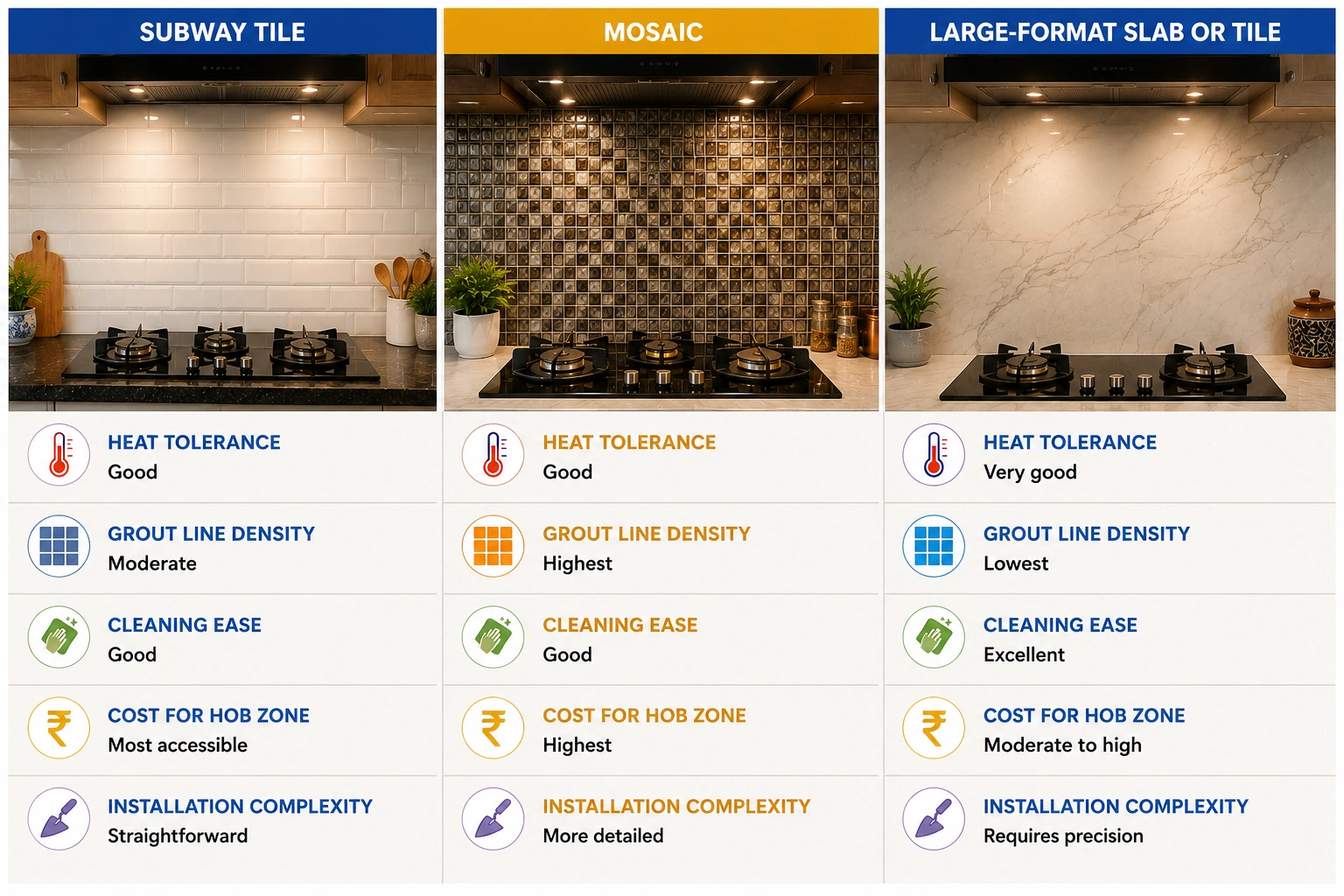
| Factor | Subway Tile | Mosaic | Large-Format Slab or Tile |
| Heat tolerance | Good, standard glossy ceramic handles, typical hob radiant heat well | Good for glass and vitrified mosaic; confirm rating for other materials | Very good, GVT slab at thickness handles sustained heat exposure confidently |
| Grout line density directly behind burners | Moderate, roughly 1.2 linear metres of grout per sq.ft | Highest of the three, 9 to 11 linear metres of grout per sq.ft, given the small chip size | Lowest, potentially zero if a single continuous piece covers the hob zone |
| Grease and residue cleaning ease | Good, smooth, glossy surface wipes clean easily | Good on the tile surface itself, but the dense grout line network requires more attention | Excellent, minimal grout lines mean minimal residue-trapping joints |
| Cost for the hob zone specifically | Most accessible, Rs. 55 to Rs. 100/sq.ft | Highest, Rs. 150 to Rs. 400/sq.ft for glass mosaic | Moderate to high, Rs. 85 to Rs. 250/sq.ft, depending on material |
| Installation complexity for this zone | Straightforward, widely available installer expertise | More detailed, small chip installation takes longer per sq.ft | Requires precise measurement and, for the slab, coordination with a fabricator |
The direct answer: Large-format tile or slab is the best-performing choice specifically for the hob zone, given its minimal grout line count directly where grease accumulates fastest. Subway tile is the most practical, accessible alternative, offering good heat tolerance and easy cleaning at a significantly lower cost. Mosaic, despite its visual appeal, is the weakest performer specifically in this zone due to its high grout line density, though it remains an excellent choice for backsplash areas away from direct hob exposure.
Where Each Format Still Makes Sense
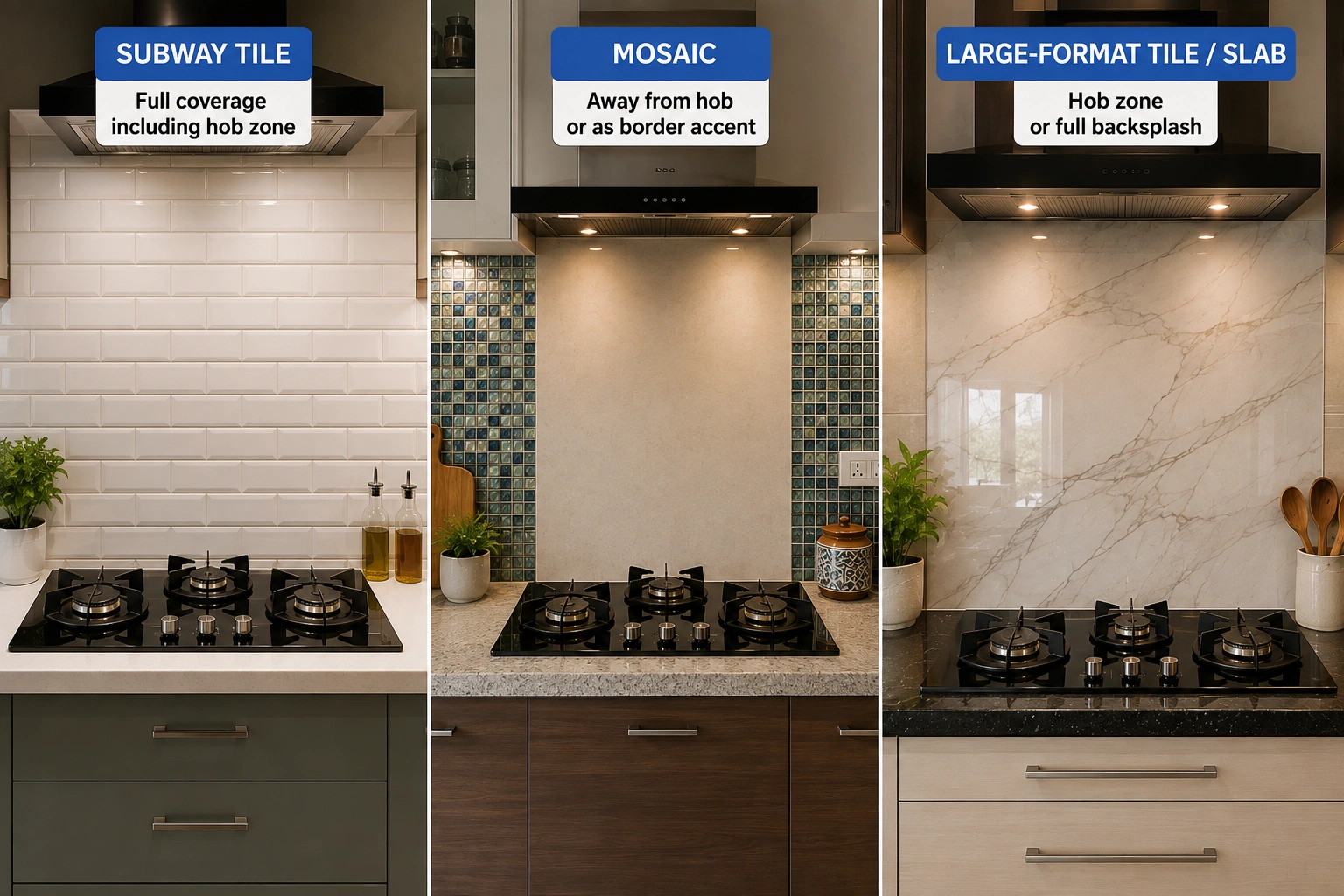
| Format | Best Placement Relative to the Hob | Reasoning |
| Subway tile | Full backsplash coverage, including the hob zone | Good all-round performance at accessible cost makes it a sound choice for the full backsplash run without needing to change material at the hob |
| Mosaic | Backsplash areas away from direct hob splatter, or as a bordering accent around a large-format hob zone panel | Its visual and light-reflecting qualities are better utilised where grease accumulation is less intense |
| Large-format tile or slab | The hob zone, specifically, whether as the full backsplash material or a dedicated accent panel behind the burners | Minimal grout lines directly address the zone's highest-stress cleaning demand. |
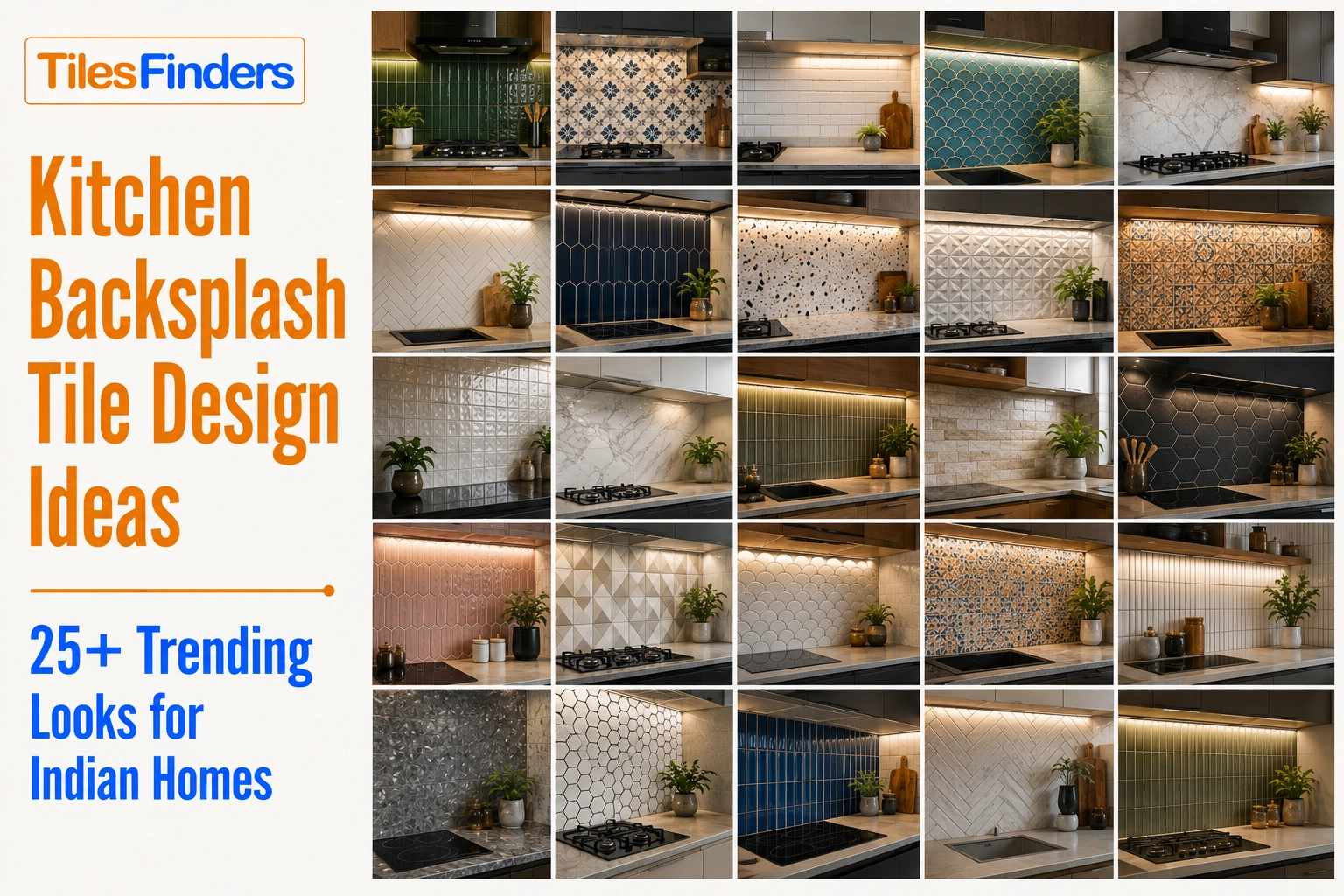
Once you've decided which tile format suits your cooking habits, the next step is choosing a style that complements your kitchen. Explore our Kitchen Backsplash Design Ideas to compare subway, marble-look, mosaic, geometric, and minimalist layouts for modern Indian kitchens.
A Practical Hybrid Approach
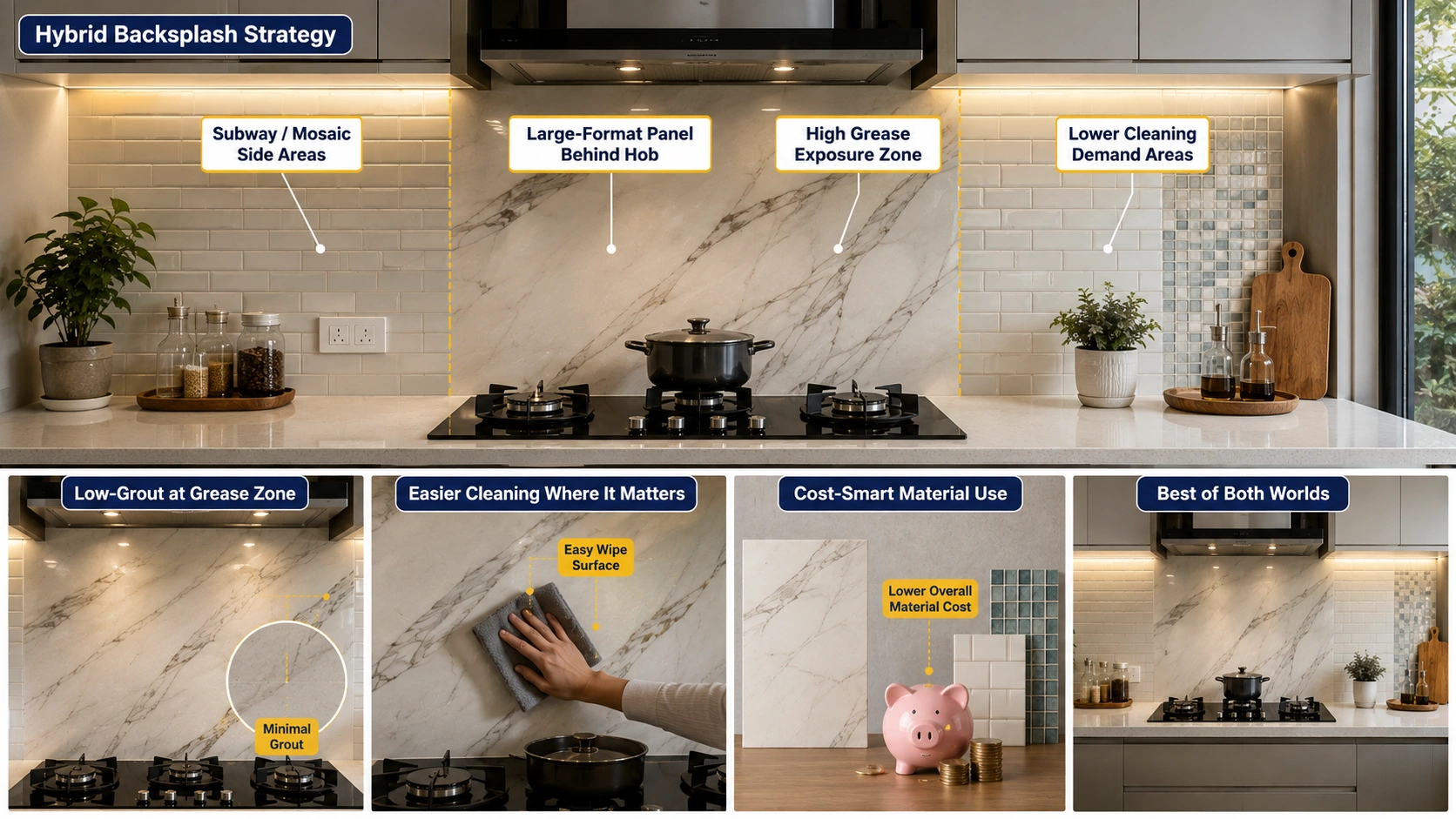
Many well-planned Indian kitchen backsplashes in 2026 and 2027 use a hybrid strategy: a large-format panel directly behind the hob, roughly 600mm to 900mm wide, where grease exposure is highest, transitioning to subway tile or mosaic for the remaining backsplash length where the cleaning demand is less intense. This delivers the low-grout benefit exactly where it matters most while keeping the overall material cost lower than full large-format coverage across the entire backsplash run.
Buying Checklist
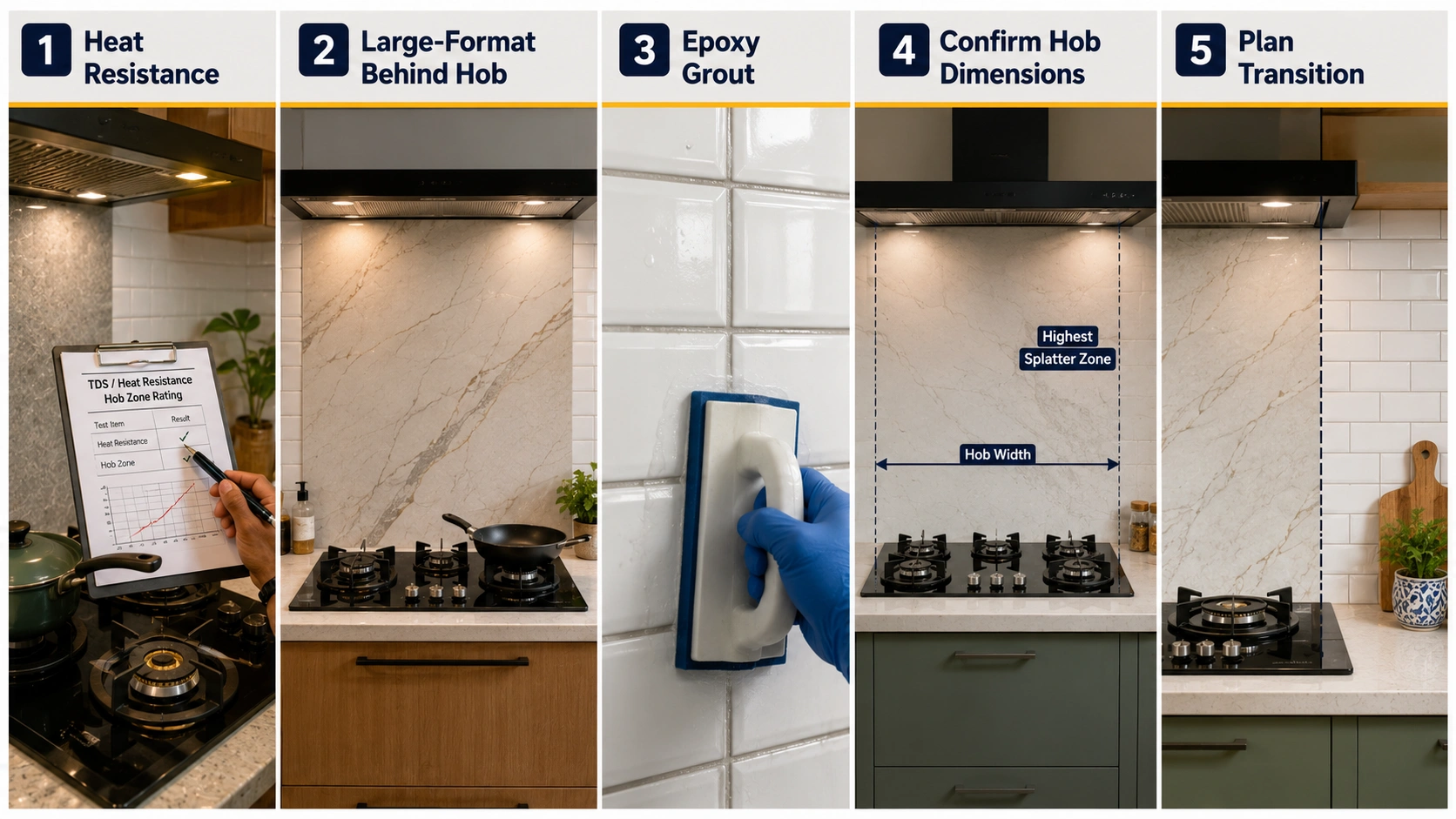
- Confirm heat resistance specifically for the hob-adjacent zone, requesting the TDS rating rather than assuming standard backsplash specifications apply within 150mm of the burners.
- Consider a large-format panel specifically behind the hob, even if using subway or mosaic elsewhere, to minimise grease-trapping grout lines exactly where they accumulate fastest.
- Specify epoxy grout for any grout used within the hob zone, given the concentrated oil exposure this specific area experiences.
- Confirm the exact hob and burner dimensions before finalising panel size, ensuring the large-format zone genuinely covers the highest-splatter area.
- Plan the transition point between materials if using a hybrid approach, deciding the exact boundary between the hob zone panel and the surrounding backsplash material before installation.
Choosing the right material is only half the process. Our Backsplash Installation Guide covers panel sizing, grout selection, coverage heights, edge finishing, and installation best practices to help ensure long-lasting performance behind Indian gas hobs.
Hob-Zone Backsplash Materials in India: 2026 Context
Large-format GVT suited to hob-zone backsplash panels is manufactured across Morbi, Gujarat, alongside standard backsplash and countertop production, with heat resistance documentation increasingly available for products specifically marketed for kitchen backsplash use. Subway tile remains the highest-volume, most consistently available backsplash material across Indian ceramic manufacturing centres, making it the most straightforward format to source and install without lead time concerns.
Compare Hob-Zone Options on TilesFinders
Subway, mosaic, and large-format backsplash materials suited to Indian gas hob zones can be compared by heat resistance and grout density on TilesFinders, with hybrid panel planning support available before you order.
FAQs
Large-format tile or slab performs best in this specific zone, given its minimal grout line count directly where grease and oil splatter accumulate fastest. A subway tile panel is a strong, more accessible alternative for the same zone.
Not generally, but it is the weakest performer specifically in the hob zone due to its high grout line density, roughly 9 to 11 linear metres per sq.ft. Mosaic remains an excellent choice for backsplash areas away from direct hob splatter.
Using a large-format panel directly behind the hob, roughly 600mm to 900mm wide, where grease exposure is highest, and transitioning to subway tile or mosaic for the remaining backsplash length, balancing low-grout performance where it matters most against overall material cost.
Yes, standard glossy ceramic subway tile handles typical Indian gas hob radiant heat well within normal cooking use, making it a sound choice for the full backsplash run, including the zone closest to the burners.
Rs. 85 to Rs. 250 per sq.ft, depending on the specific GVT design, for a panel typically covering 600mm to 900mm in width directly behind the hob, a modest total cost given the confined area, even at the higher end of this range.
Yes, epoxy grout is recommended specifically within the hob zone, given its concentrated oil exposure, even if standard cementitious grout is used for the rest of the backsplash away from direct splatter.
Yes, this is an effective hybrid design, using large-format tile for the high-grease zone directly behind the burners and mosaic as a decorative border or accent around it, combining low-grout practicality with mosaic's visual interest.
Confirm the exact hob and burner dimensions before finalising the panel size, generally sizing the panel to cover the width of the hob plus some margin on each side, ensuring the highest-splatter area is genuinely covered.


Related Tiles
See our tile guides first
Set TilesFinders as a preferred source and our buying guides surface ahead of the rest for you.
Add as preferred sourceTakes one tap. Nothing to install.
What Readers Say
I was about to redo my parking area with the wrong tile size until I read this. The layout comparisons saved me from a costly mistake.
We reference TilesFinders guides while briefing clients on material selection. The size and pattern breakdowns are accurate and easy to explain visually.
On site, I get asked about grout spacing all the time. This article gave me a solid reference I now share with my team before every job.
Finally a guide that doesn't just push generic advice. The oil stain removal steps actually worked on our clubhouse driveway tiles.
I run a small construction firm and now send this link to clients directly when they ask about entrance tile sizing. Saves me an hour of explaining.
Good practical detail, though I wish there were more examples for compact apartment entrances specifically, not just villas.
My mother-in-law wanted marble, I wanted vitrified. This blog gave us the neutral comparison we needed to actually decide together.
Detailed without being overwhelming. I appreciated that it covered both cost and maintenance, not just the aesthetics.
Used the algae and hard water removal tips on our terrace tiles after the monsoon. Worked better than what our regular cleaner was doing.
As someone who sources tiles for multiple builder projects, I find these comparisons genuinely useful for vendor conversations, not just consumer content.
Recommended this to a client who kept second-guessing the entrance design. The small vs large layout section settled the debate instantly.
Straightforward and honest, no unnecessary jargon. Would like to see a similar breakdown for outdoor pool-deck tiles next.
We've bookmarked several TilesFinders guides for our design handbook. Reliable source when clients want data, not just opinions.
Two paths, one marketplace.
Get free quotes from verified suppliers.
Share your room, budget, and style. Suppliers in Morbi respond within hours.
Get Free QuotesList your business, reach real buyers.
Put your showroom in front of homeowners searching for tiles right now.
List Your BusinessMore Blogs
See all
Stylish Kitchen Backsplash Ideas That Are Easy to Clean
Upgrade your kitchen with beautiful, practical, easy-clean backsplash ideas—from glossy classics ...
Read More
Best Backsplash Tile Colours for White Kitchen Cabinets
Upgrade your white kitchen cabinets with the right backsplash. Discover the best colours, easy-to...
Read More
Indian Modular Kitchen Tile Combinations: Wall, Floor and Backsplash Trios
Discover tile colours, layouts, and size combinations that help small Indian kitchens between 80 ...
Read More