Restaurant Tile Selection: FSSAI Hygiene, Anti-Skid and Grease Resistance Standards Explained
Understand how restaurant tiles support FSSAI hygiene principles with the right anti-skid finish, grease resistance, grout, and commercial flooring specifications for safer food service spaces.
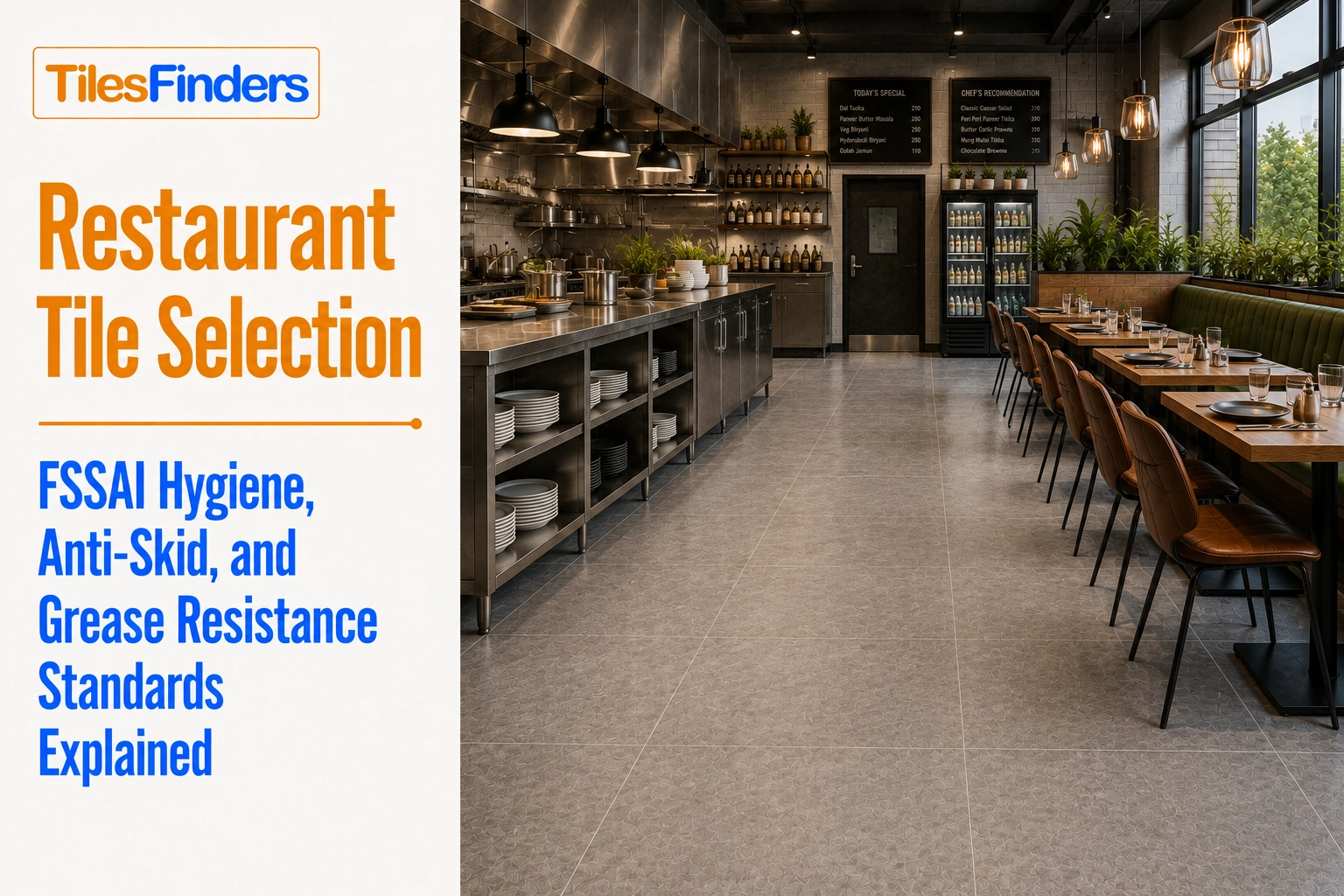
- The General Hygiene Principles Behind Food Premises Flooring
- Anti-Skid Requirements for Restaurant Floors
- Grease Resistance and Cleanability
- Tile Specification Checklist for FSSAI-Adjacent Compliance
- Hygiene-Focused Restaurant Flooring in India: 2026 Context
- Source Hygiene-Ready Restaurant Tiles on TilesFinders
Choose restaurant tiles with low water absorption, R11 anti-skid surfaces, epoxy grout, and easy-to-clean finishes to support hygienic commercial kitchens and food service operations. Following practical FSSAI hygiene principles while selecting durable commercial tiles helps create safer, cleaner, and long-lasting restaurant flooring.
Any Indian food business, from a small cafe to a full-service restaurant, operates under FSSAI (Food Safety and Standards Authority of India) food safety licensing, which includes general hygiene expectations for food preparation and service surfaces, flooring included. Choosing the right restaurant tiles is an important part of meeting these hygiene standards, as flooring must withstand frequent cleaning, grease exposure, and heavy commercial footfall. This guide explains the hygiene principles behind these expectations in practical terms and translates them into the tile specification decisions a restaurant owner actually needs to make.
Before you rely on this guide for compliance: This guide explains FSSAI's general, well-established hygiene principles for food premises flooring at a practical level. It is not a substitute for the exact current licensing requirements that apply to your specific business category and state. Verify the precise requirements with a food safety consultant or your local FSSAI licensing office before finalising a compliance-critical tile specification, particularly for a new restaurant seeking first-time licensing.
From The Marketplace
Popular tiles right now





The General Hygiene Principles Behind Food Premises Flooring
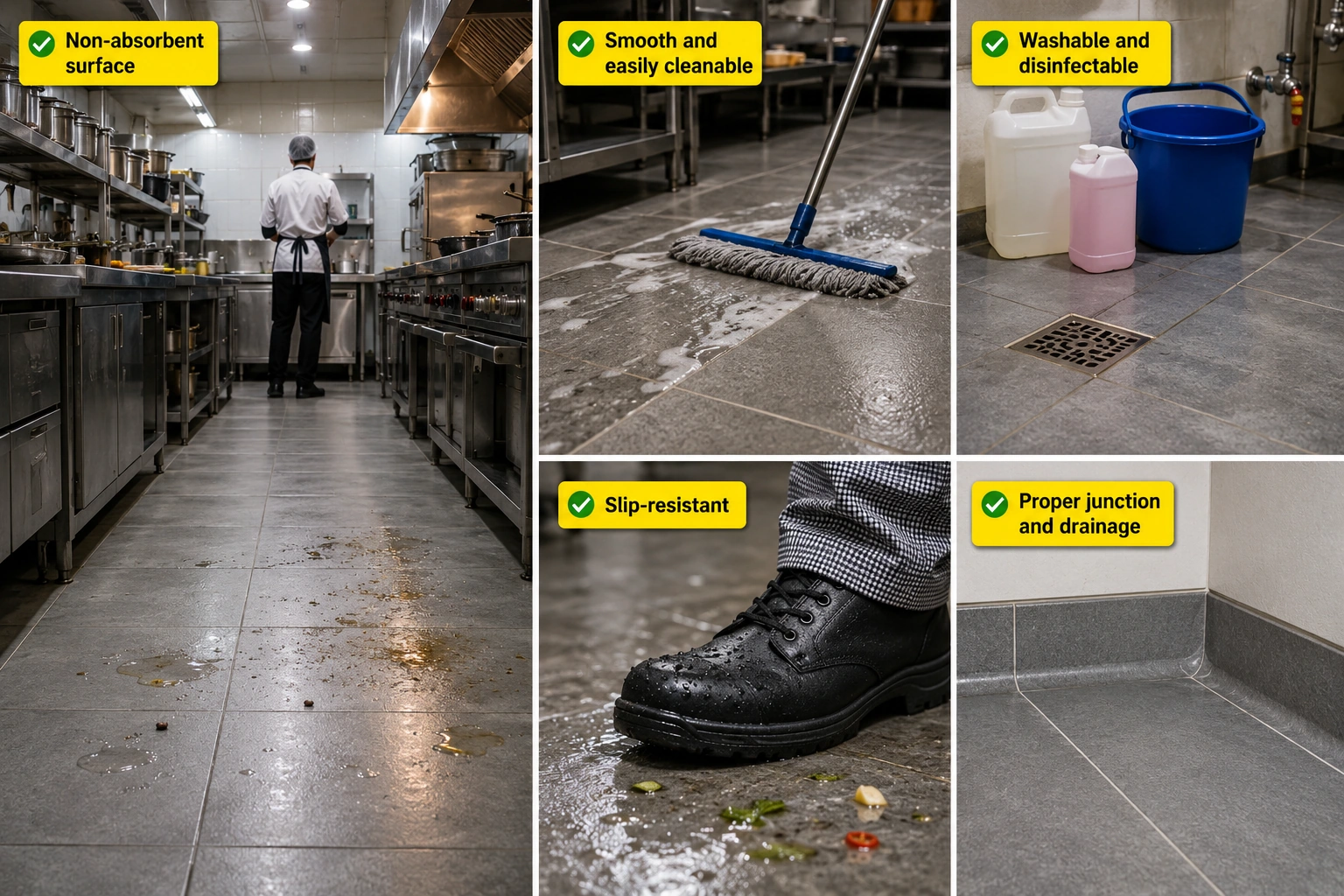
FSSAI's hygiene and sanitary practice expectations for food business premises are built on a consistent set of underlying principles rather than a single rigid specification. Understanding these principles helps translate them into a genuinely correct tile choice rather than guessing at compliance.
| Principle | What It Means in Practice | Tile Property That Satisfies It |
| Non-absorbent surface | The floor should not soak up spilled food, oil, or cleaning chemicals | GVT at 0.05% water absorption or below, the correct default for any food preparation or service floor |
| Smooth and easily cleanable | The surface should not have deep texture or crevices that trap food debris and bacteria | Matte or anti-skid matte GVT with a fine, consistent surface, avoiding heavily textured decorative finishes in food preparation zones specifically |
| Washable and disinfectable | The floor should tolerate frequent washing with cleaning agents and disinfectants without degrading | Non-porous GVT combined with epoxy grout, which resists chemical degradation better than standard cementitious grout |
| Slip-resistant | The floor should minimise fall risk for staff moving quickly with hot food, liquids, and loaded trays | Anti-skid matte GVT rated R11 for kitchen and service floors, given the combination of water, oil, and food debris these zones see |
| Proper junction and drainage detail | Floor-to-wall junctions and drainage points should not create crevices where debris and moisture accumulate | Coved skirting detail at the floor-wall junction in kitchen zones, coordinated with the installer at the planning stage |
Anti-Skid Requirements for Restaurant Floors
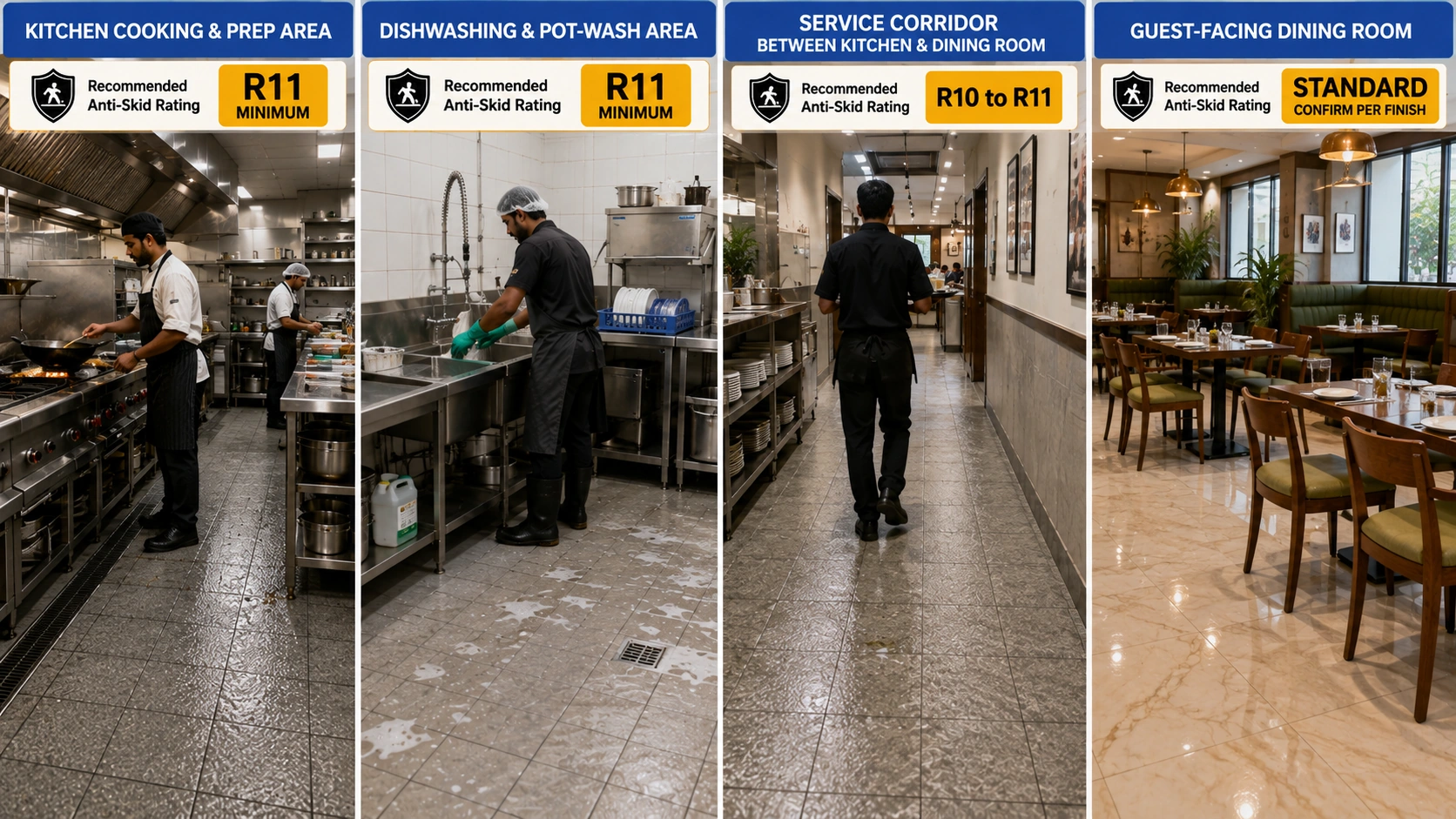
Slip-resistance in a restaurant’s kitchen and service area is not just a general safety best practice, it is central to the hygienic and safe operation expectation that runs through food safety licensing. Kitchen staff move quickly, often carrying hot liquids and sharp tools, across a floor that routinely has oil, water, and food debris on it.
| Zone | Recommended Anti-Skid Rating | Reasoning |
| Kitchen cooking and prep area | R11 minimum | Combined oil, water, and food debris exposure with fast staff movement carrying hot items |
| Dishwashing and pot-wash area | R11 minimum | Sustained standing water and detergent exposure, similar to a residential wash area but at higher volume |
| Service corridor between kitchen and dining room | R10 to R11 | Frequent staff transit carrying loaded trays, moisture tracked from the kitchen |
| Guest-facing dining room | Standard, confirm per finish | Lower fall risk than kitchen zones, though any glossy or polished finish still carries the same wet-floor caution as residential use |
Grease Resistance and Cleanability
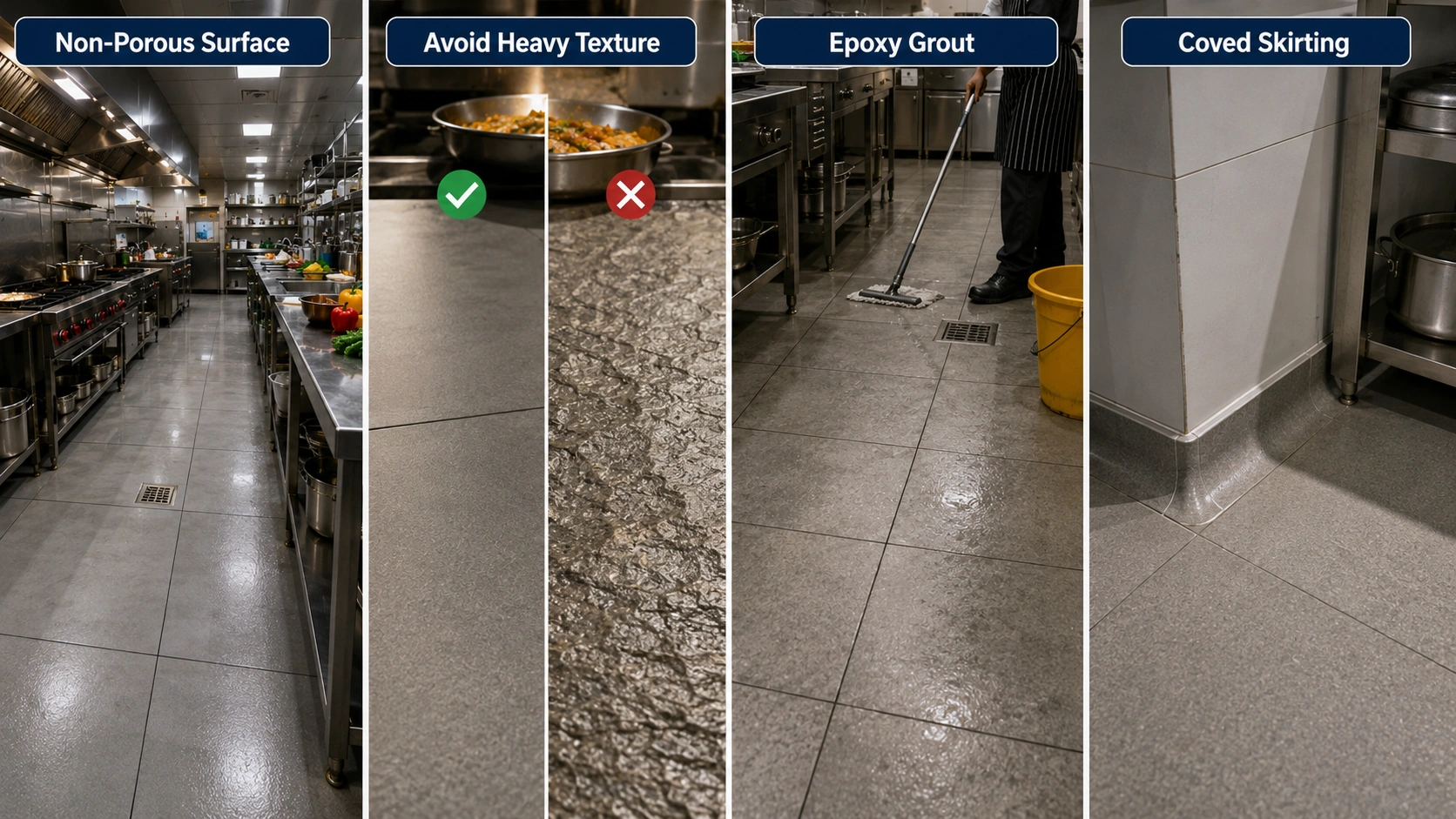
- Choose a non-porous surface as the baseline requirement. GVT tiles at 0.05% water absorption or below resists oil and grease absorption far better than standard ceramic or any porous natural material.
- Avoid heavily textured decorative finishes in food preparation zones specifically. A sugar finish or deeply textured stone-look surface, while appropriate elsewhere, can trap grease in its texture more than a smooth matte or fine anti-skid surface.
- Specify epoxy grout throughout kitchen and food preparation floors. Standard cementitious grout degrades faster under sustained grease and chemical cleaning exposure than in a typical residential application.
- Plan for a coved skirting detail at the kitchen floor-wall junction. This eliminates the sharp interior corner where grease, moisture, and debris would otherwise accumulate and become difficult to clean thoroughly.
Tile Specification Checklist for FSSAI-Adjacent Compliance
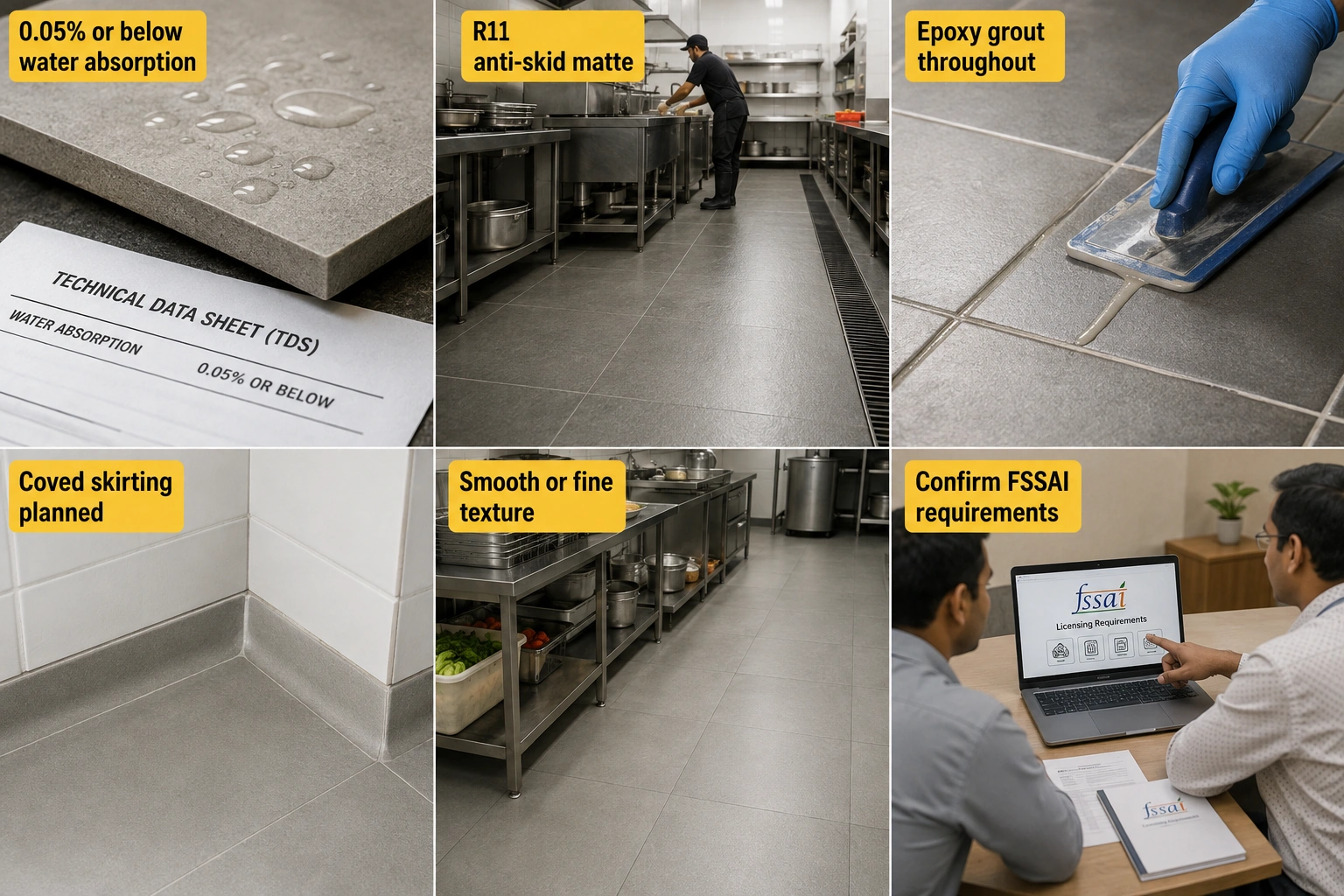
- Specify GVT at 0.05% water absorption or below for all food preparation and service floors, confirmed in the written TDS.
- Specify anti-skid matte at R11 for kitchen, dishwashing, and service corridor floors.
- Specify epoxy grout throughout food preparation and kitchen zones, given sustained grease and chemical cleaning exposure.
- Plan coved skirting at the kitchen floor-wall junction with your contractor before installation begins.
- Choose a smooth or fine-texture finish for food preparation floors, reserving heavily textured decorative finishes for guest-facing dining areas only.
- Confirm current FSSAI licensing requirements for your specific business category and state with a food safety consultant before finalising any specification intended to support a new license application.
Meeting hygiene standards is only one part of selecting commercial flooring. Our Restaurant Tiles Guide helps you compare floor and wall tiles for cafés, dhabas, quick-service restaurants, and fine dining spaces based on durability, maintenance, and commercial performance.
Hygiene-Focused Restaurant Flooring in India: 2026 Context
Anti-skid GVT suited to food service hygiene requirements is manufactured widely in Morbi, Gujarat under IS 15622:2006 at water absorption 0.05% or below, with R10 and R11 rated products generally available within standard commercial anti-skid ranges. Epoxy grout suited to commercial kitchen use is widely available from major Indian grout manufacturers, distributed across metro and tier-2 cities, and is treated as a standard specification item by most experienced commercial kitchen fit-out contractors.
Commercial flooring should support both food safety and customer experience. Explore our Restaurant Floor Tile Designs guide to discover flooring ideas that combine hygiene-friendly specifications with ambience suited to cafés, bars, family restaurants, and premium dining spaces.
Source Hygiene-Ready Restaurant Tiles on TilesFinders
Anti-skid GVT rated R11 with confirmed water absorption at 0.05% or below, suited to commercial kitchen and food service floors, is available on TilesFinders from verified Morbi manufacturers, with technical documentation available for your licensing and compliance records.
FAQs
No. FSSAI's hygiene expectations are principle-based, non-absorbent, smooth, washable, slip-resistant surfaces, rather than naming specific products or brands. Any tile meeting these underlying principles, such as anti-skid GVT at low water absorption, satisfies the intent, though exact current requirements should be confirmed with a food safety consultant.
R11 is the recommended target for kitchen, dishwashing, and service corridor floors, given the combination of oil, water, and food debris exposure alongside fast staff movement carrying hot items and loaded trays.
Not recommended. Standard ceramic's higher water absorption compared to GVT makes it less suited to the non-absorbent surface expectation central to food premises hygiene principles. GVT at 0.05% absorption or below is the correct default.
A coved skirting is a curved, rather than sharp-angled, junction between the floor and wall, eliminating the interior corner where grease, moisture, and debris would otherwise accumulate and become difficult to clean thoroughly, an important detail in food preparation zones.
Not necessarily. Kitchen and service floors need anti-skid rating and grease-resistant, easily cleanable surfaces as the priority, while guest-facing dining room floors can prioritise ambience and design more freely, provided any glossy or polished finish chosen there still avoids wet-contact risk zones.
Yes. Epoxy grout resists grease and chemical cleaning degradation better than standard cementitious grout, supporting the washable and disinfectable surface expectation central to food premises hygiene, particularly in kitchen and food preparation zones.
Generally not recommended for food preparation zones specifically, since heavily textured surfaces can trap grease and food debris more than a smooth matte or fine anti-skid finish. Decorative and textured finishes are better reserved for guest-facing dining areas.
A food safety consultant familiar with your specific business category and state, or your local FSSAI licensing office directly, particularly before finalising a specification intended to support a new restaurant license application, since exact requirements and their interpretation can vary by jurisdiction and business type.


See our tile guides first
Set TilesFinders as a preferred source and our buying guides surface ahead of the rest for you.
Add as preferred sourceTakes one tap. Nothing to install.
What Readers Say
I was about to redo my parking area with the wrong tile size until I read this. The layout comparisons saved me from a costly mistake.
We reference TilesFinders guides while briefing clients on material selection. The size and pattern breakdowns are accurate and easy to explain visually.
On site, I get asked about grout spacing all the time. This article gave me a solid reference I now share with my team before every job.
Finally a guide that doesn't just push generic advice. The oil stain removal steps actually worked on our clubhouse driveway tiles.
I run a small construction firm and now send this link to clients directly when they ask about entrance tile sizing. Saves me an hour of explaining.
Good practical detail, though I wish there were more examples for compact apartment entrances specifically, not just villas.
My mother-in-law wanted marble, I wanted vitrified. This blog gave us the neutral comparison we needed to actually decide together.
Detailed without being overwhelming. I appreciated that it covered both cost and maintenance, not just the aesthetics.
Used the algae and hard water removal tips on our terrace tiles after the monsoon. Worked better than what our regular cleaner was doing.
As someone who sources tiles for multiple builder projects, I find these comparisons genuinely useful for vendor conversations, not just consumer content.
Recommended this to a client who kept second-guessing the entrance design. The small vs large layout section settled the debate instantly.
Straightforward and honest, no unnecessary jargon. Would like to see a similar breakdown for outdoor pool-deck tiles next.
We've bookmarked several TilesFinders guides for our design handbook. Reliable source when clients want data, not just opinions.
Two paths, one marketplace.
Get free quotes from verified suppliers.
Share your room, budget, and style. Suppliers in Morbi respond within hours.
Get Free QuotesList your business, reach real buyers.
Put your showroom in front of homeowners searching for tiles right now.
List Your BusinessMore Blogs
See all
Best Porcelain and Vitrified Counter Top Tiles India 2027: Low-Grout, Heat-Resistant Picks
Discover the best porcelain and vitrified countertop slabs for Indian kitchens in 2027, featuring...
Read More
Restaurant Tiles in India: Flooring and Wall Guide for Cafes, Dhabas and Fine Dining
From busy dhabas to elegant fine dining, discover restaurant floor and wall tiles designed for du...
Read More
Restaurant Floor Tile Designs: 20+ Commercial Looks That Set the Right Ambience
Craft memorable dining spaces with restaurant floor tile ideas that combine ambience, durability,...
Read More