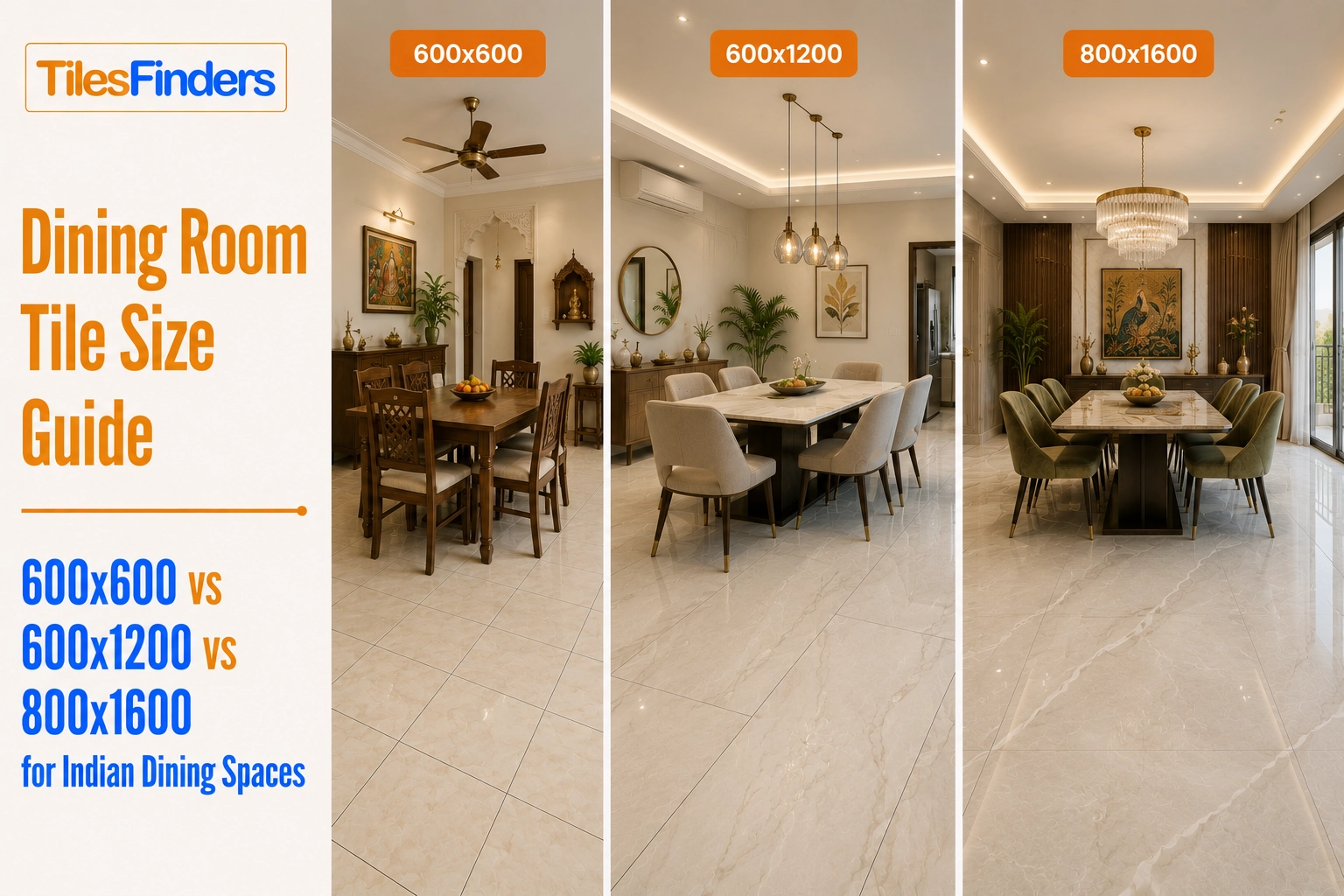
Dining Room Tile Size Guide: 600x600 vs 600x1200 vs 800x1600 for Indian Dining Spaces
Compare 600x600, 600x1200, and 800x1600 mm dining room tile sizes for Indian homes. Learn which size suits your room dimensions, budget, installation requirements, and design goals.
- Why Tile Size Matters More Than Most Buyers Expect
- Understanding Indian Dining Room Dimensions
- 600x600 mm Tiles for Dining Rooms
- 600x1200 mm Tiles for Dining Rooms
- 800x1600 mm Tiles for Dining Rooms
- Direct Size Comparison: 600x600 vs 600x1200 vs 800x1600
- Size Selection by Indian Home Type: Quick Reference
- Cost Comparison: Same Room, Three Tile Sizes
- Installation Considerations by Size
- Common Mistakes When Choosing Dining Room Tile Size
- Compare Dining Room Tile Sizes on Tilesfinders
600x600 mm tiles work best for compact dining rooms, 600x1200 mm offers the best balance for most Indian homes, while 800x1600 mm suits large dining spaces and luxury interiors. Choose tile size based on room area, layout, installation requirements, and budget, not showroom trends, to achieve the best visual and practical result.
Tile size is the most argued decision in dining room flooring, and most buyers get it wrong. The common mistake is picking a size that looks impressive in a showroom sample but either overscales a compact dining space or undersells a large one.
This guide compares 600x600 mm, 600x1200 mm, and 800x1600 mm tiles directly for Indian dining rooms. Each size is measured against real Indian home dimensions, grout line counts, installation costs, wastage, and the specific conditions dining spaces create. By the end, you will know which dining room tile size fits your space, your layout, and your budget.
All sizes discussed here are GVT (Glazed Vitrified Tiles) from Morbi, Gujarat, available in matte and sugar finishes suited to dining room floors.
Why Tile Size Matters More Than Most Buyers Expect
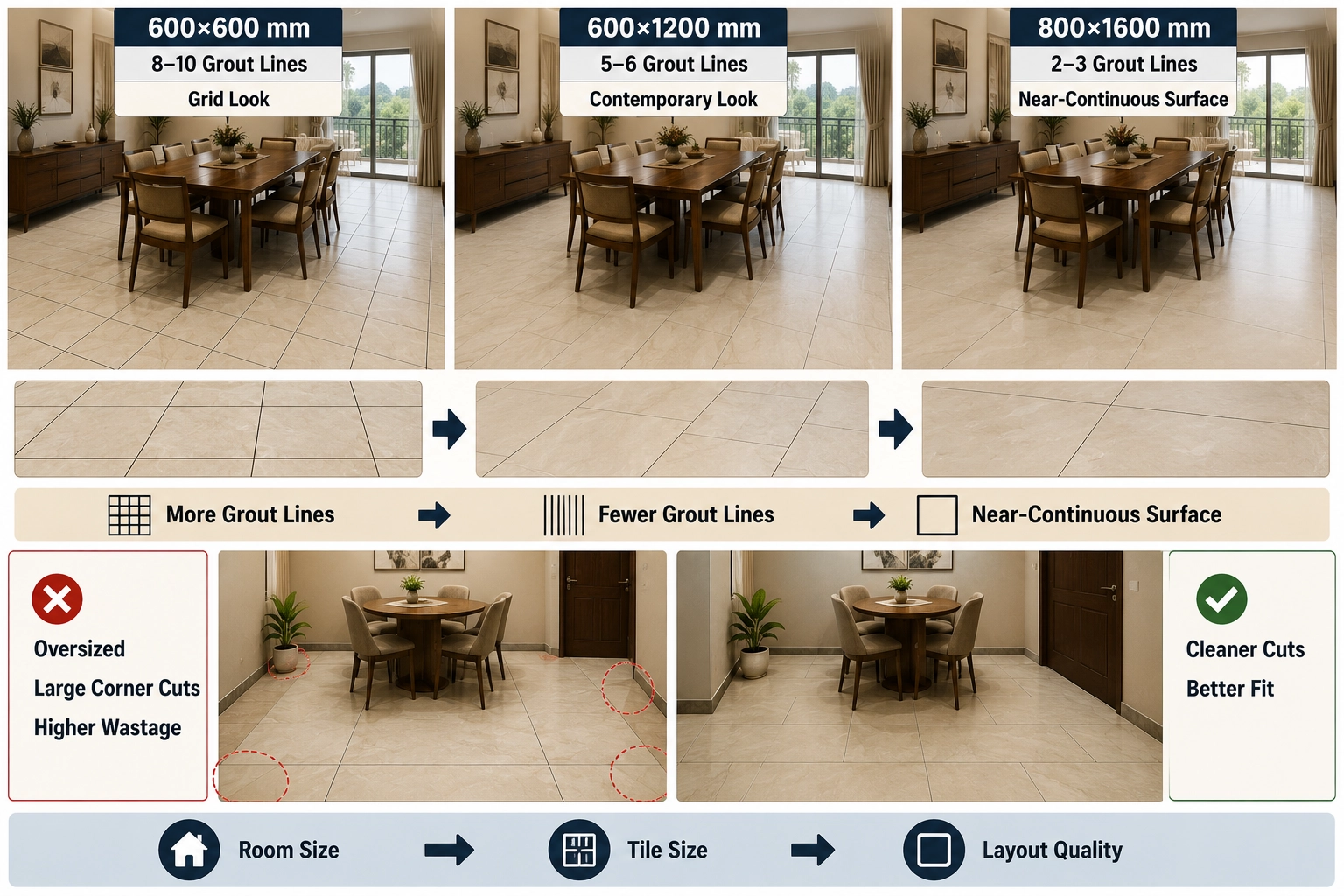
Tile size affects five things simultaneously: how large the room looks, how many grout lines cut across the floor, how much tile is wasted on cuts at room edges, how difficult installation is, and how the floor wears over time.
A 600x600 mm tile in a 200 sq ft dining room creates 8 to 10 grout lines across the 12-foot width of the room. A 600x1200 mm tile in the same space creates 5 to 6 lines. An 800x1600 mm tile creates just 2 to 3 lines. The visual difference between all three is significant. The 600x600 mm reads as a grid. The 600x1200 mm reads as a directional, contemporary surface. The 800x1600 mm reads as one near-continuous slab.
At the same time, an 800x1600 mm tile in a 90 sq ft dining alcove in a 2BHK flat looks oversized, creates large triangular cuts at every corner, and increases wastage from 10% to 20% or more. A 600x1200 mm tile in the same compact space handles edge cuts more cleanly and still reduces grout lines compared to a 600x600 mm tile. The right dining room tile size is a function of the actual room, not a preference or a trend.
Before deciding on tile size, materials, or finishes, browse our Dining Room Tiles Guide to compare popular dining room tile options, layouts, and buying considerations for Indian homes.
Understanding Indian Dining Room Dimensions
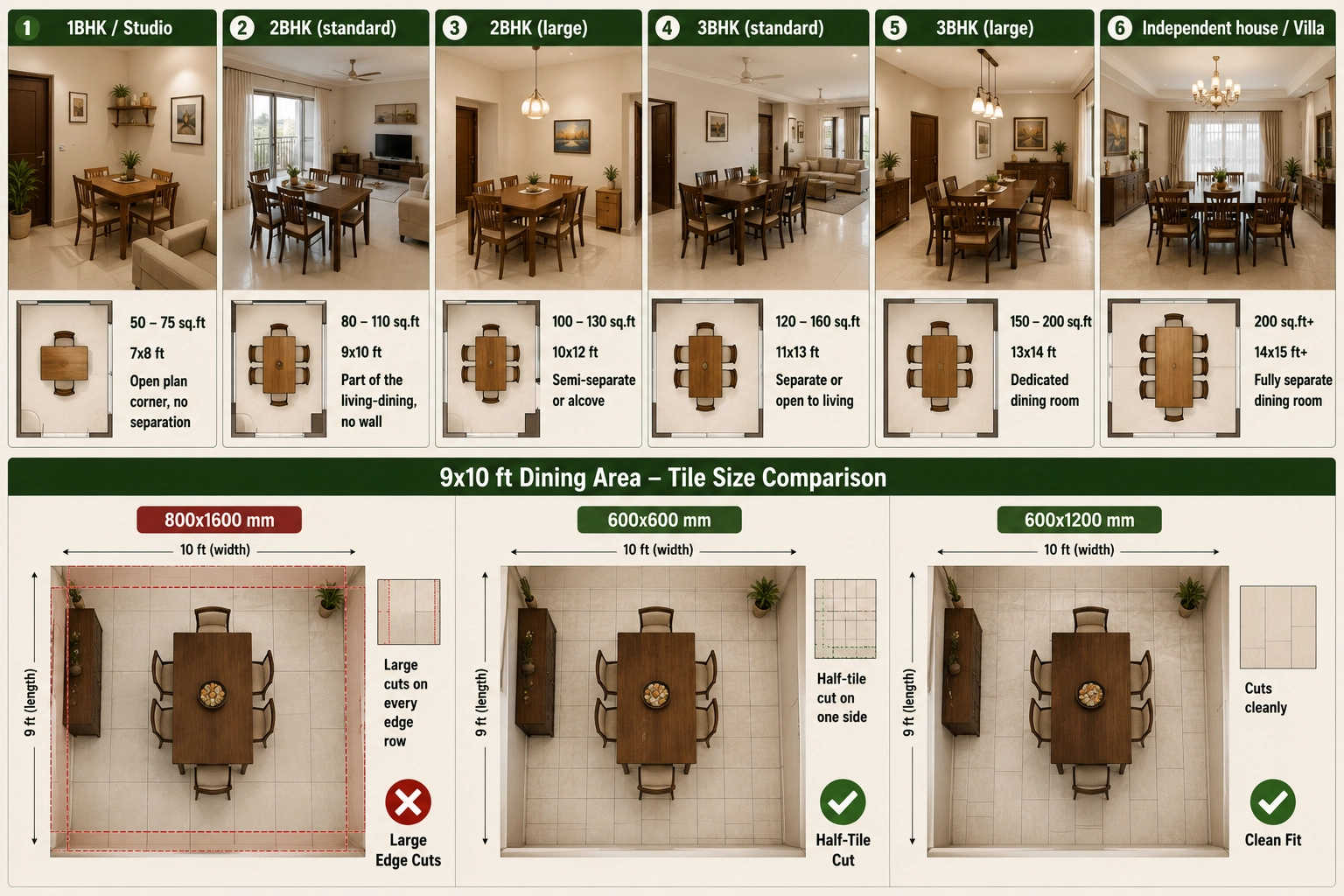
Before comparing tile sizes, it helps to know what dining room dimensions actually look like in Indian homes. Most buyers do not have a dedicated 200 sq ft dining room. Most have a dining zone within a larger living-dining space, or a compact separate dining room in a mid-range apartment.
Typical Dining Areas by Home Type
| Home Type | Dining Area | Approximate Dimensions | Typical Configuration |
| 1BHK / Studio | 50 to 75 sq.ft | 7x8 ft or 8x9 ft | Open plan corner, no separation |
| 2BHK (standard) | 80 to 110 sq.ft | 9x10 ft or 10x11 ft | Part of the living-dining, no wall |
| 2BHK (large) | 100 to 130 sq.ft | 10x12 ft or 11x12 ft | Semi-separate or alcove |
| 3BHK (standard) | 120 to 160 sq.ft | 11x13 ft or 12x14 ft | Separate or open to living |
| 3BHK (large) | 150 to 200 sq.ft | 13x14 ft or 13x16 ft | Dedicated dining room |
| Independent house / Villa | 200 sq.ft+ | 14x15 ft or larger | Fully separate dining room |
These dimensions directly determine which tile size makes sense. A 9x10 ft dining area is 90 sq.ft. An 800x1600 mm tile would need 9 tiles across the 10-foot width and require a large cut on every edge row. A 600x600 mm tile needs 5 tiles across and leaves a half-tile cut on one side. A 600x1200 mm tile needs 4 tiles across and cuts cleanly.
600x600 mm Tiles for Dining Rooms
What 600x600 mm Tiles Look Like in a Dining Space
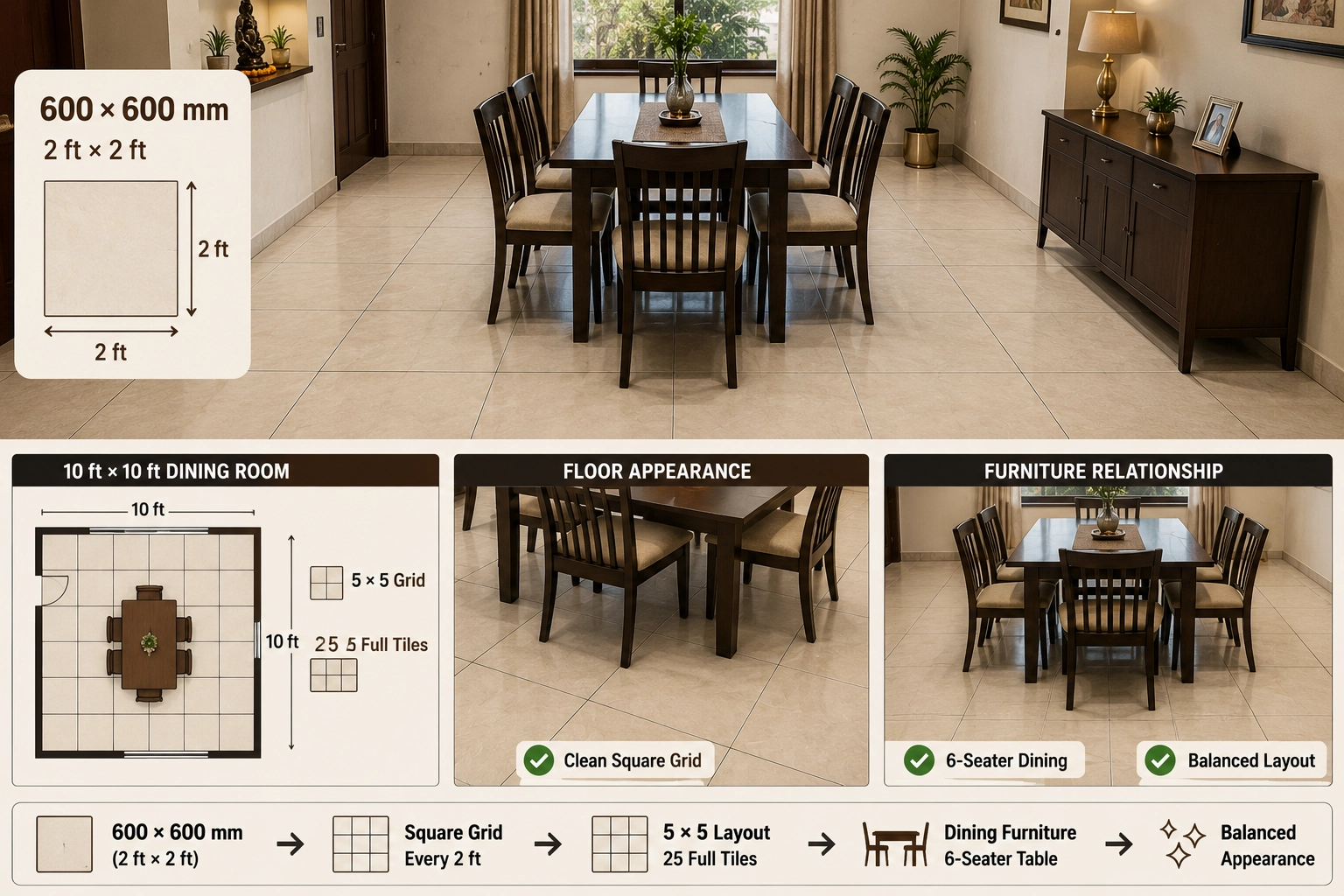
600x600 mm is 2 feet by 2 feet. It is the most common floor tile size sold in India and the default choice across all price points. In a dining room, it produces a clean square grid on the floor with grout lines every 2 feet in both directions.
In a 10x10 ft dining room, this means 5 tiles across and 5 tiles down, giving 25 full tiles plus edge cuts. The grid is readable but not dominant. Most standard dining furniture (6-seater table, 4 chairs) sits well over this grid without the tile joints interfering visually.
When 600x600 mm is the Right Choice
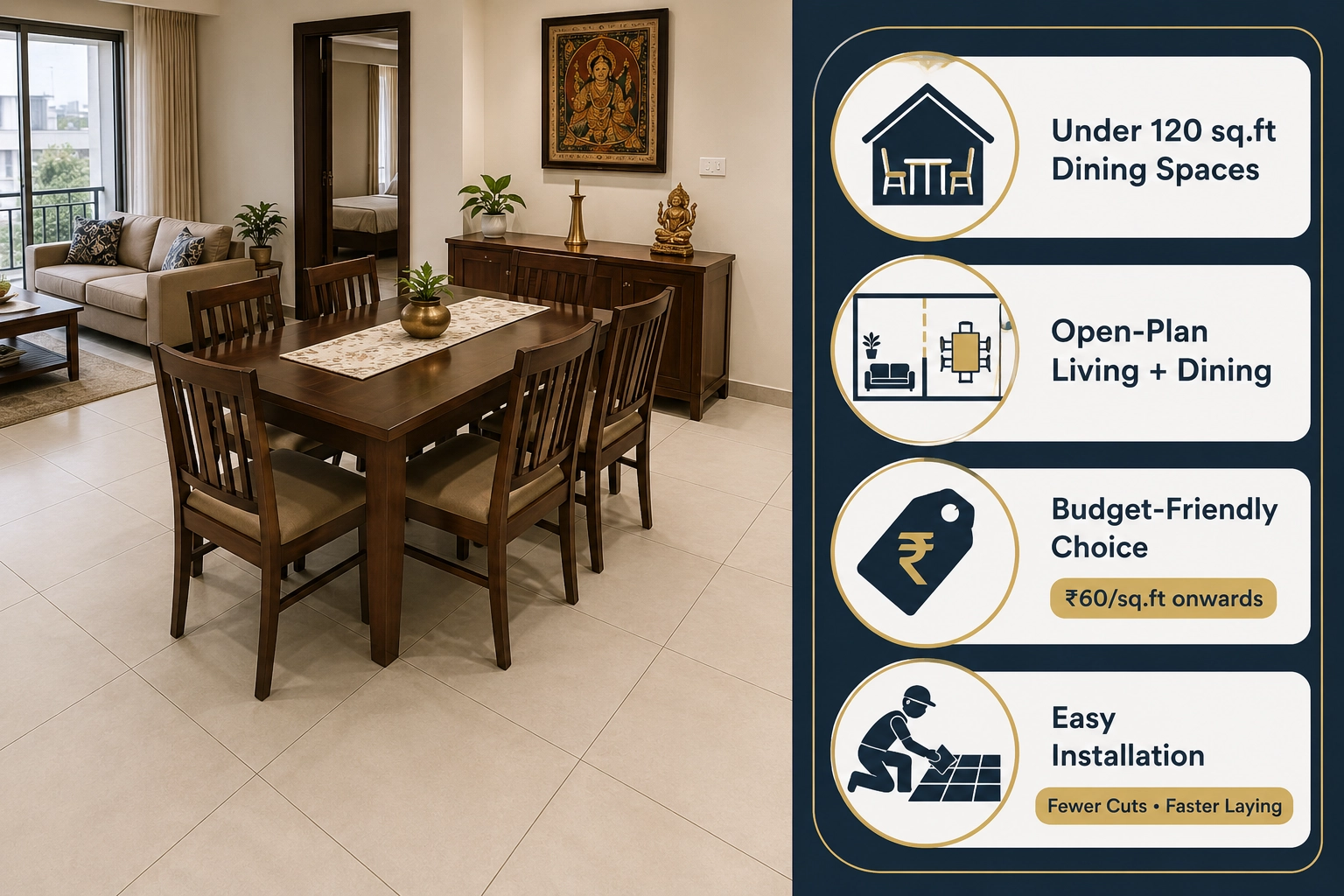
- Dining rooms and dining zones under 120 sq. ft., especially in 1BHK and standard 2BHK homes.
- Open-plan living-dining spaces where the same tile continues from the living area, keeping the floor visually consistent.
- Buyers are on a tighter material budget. 600x600 mm GVT tiles in matte or sugar finish start at Rs. 60 per sq.ft from Morbi, Gujarat, which is 20 to 35% lower than 600x1200 mm and 40 to 50% lower than 800x1600 mm.
- Installations where a non-specialist installer is being used. 600x600 mm requires fewer cuts, tolerates minor alignment errors better, and is faster to lay than larger formats.
When 600x600 mm Falls Short
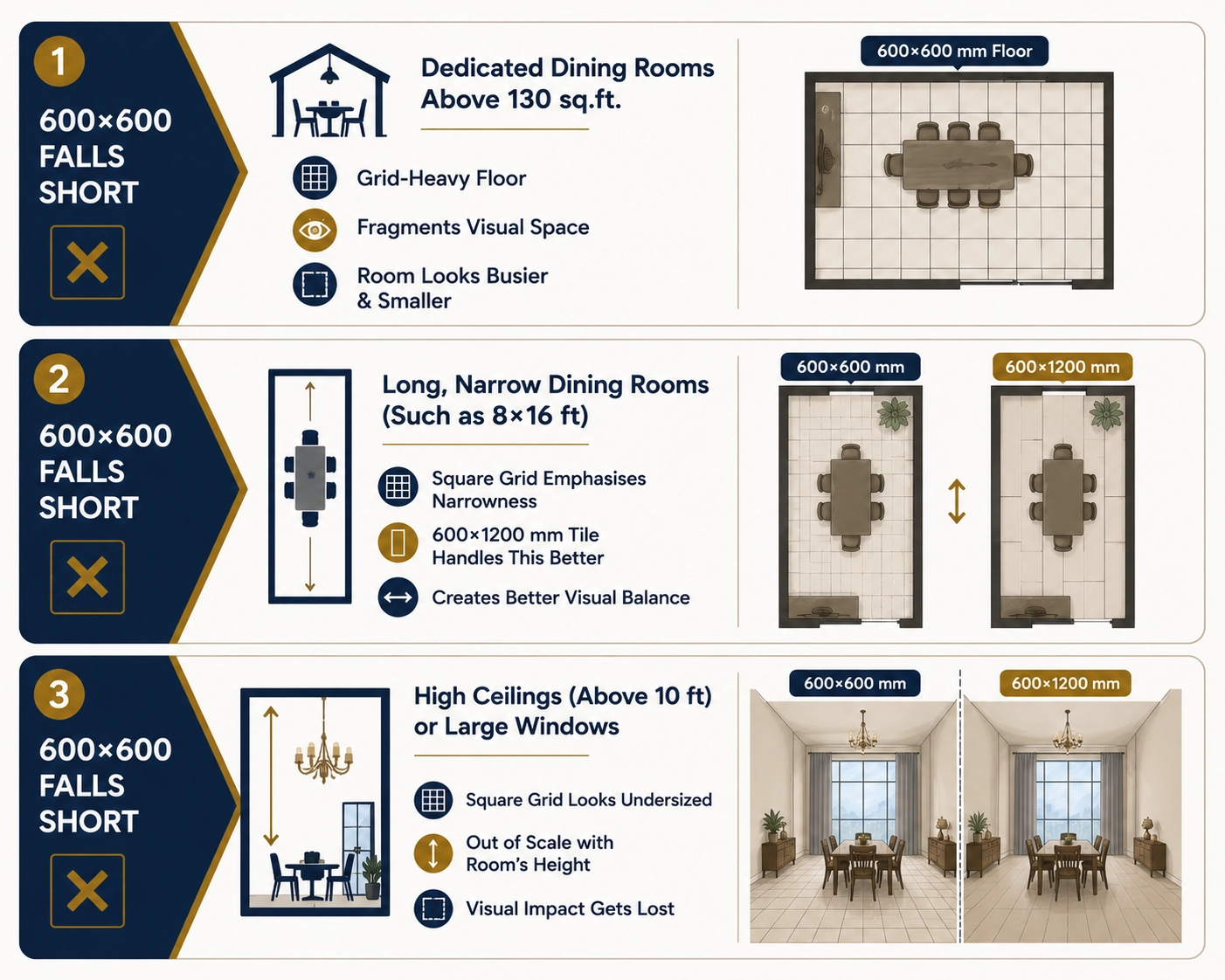
- In dedicated dining rooms above 130 sq. ft., 600x600 mm produces a grid-heavy floor that fragments the visual space. The room looks busier and smaller than it is.
- In long, narrow dining rooms (such as 8x16 ft), the square grid emphasises the narrowness rather than correcting it. A 600x1200 mm tile laid lengthwise handles this better.
- When the dining room has high ceilings (above 10 ft) or large windows, the square grid on the floor can look undersized relative to the room's vertical scale.
| Factor | 600x600 mm Performance |
| Typical grout lines in a 10x12 ft room | 5 across, 6 along (11 total visible lines per run) |
| Full tiles needed for 120 sq.ft (with 10% wastage) | Approx. 37 tiles |
| Edge cut wastage in a rectangular room | 8 to 12% |
| Installation difficulty | Low (standard skill) |
| Price range (GVT, matte/sugar) | Rs. 60 to Rs. 110 per sq.ft |
| Best room size | Under 120 sq.ft |
| Suitable finishes for the dining floor | Matte, Sugar, GHR |
Pro tip: If you are using 600x600 mm tiles in a dining room that opens into a living room with the same tile, align the grout lines across both rooms. A continuous grid that runs uninterrupted from the living room into the dining area makes both spaces feel larger. Misaligned grout lines at the room boundary create a visual stutter that buyers notice years later.
600x1200 mm Tiles for Dining Rooms
What 600x1200 mm Tiles Look Like in a Dining Space
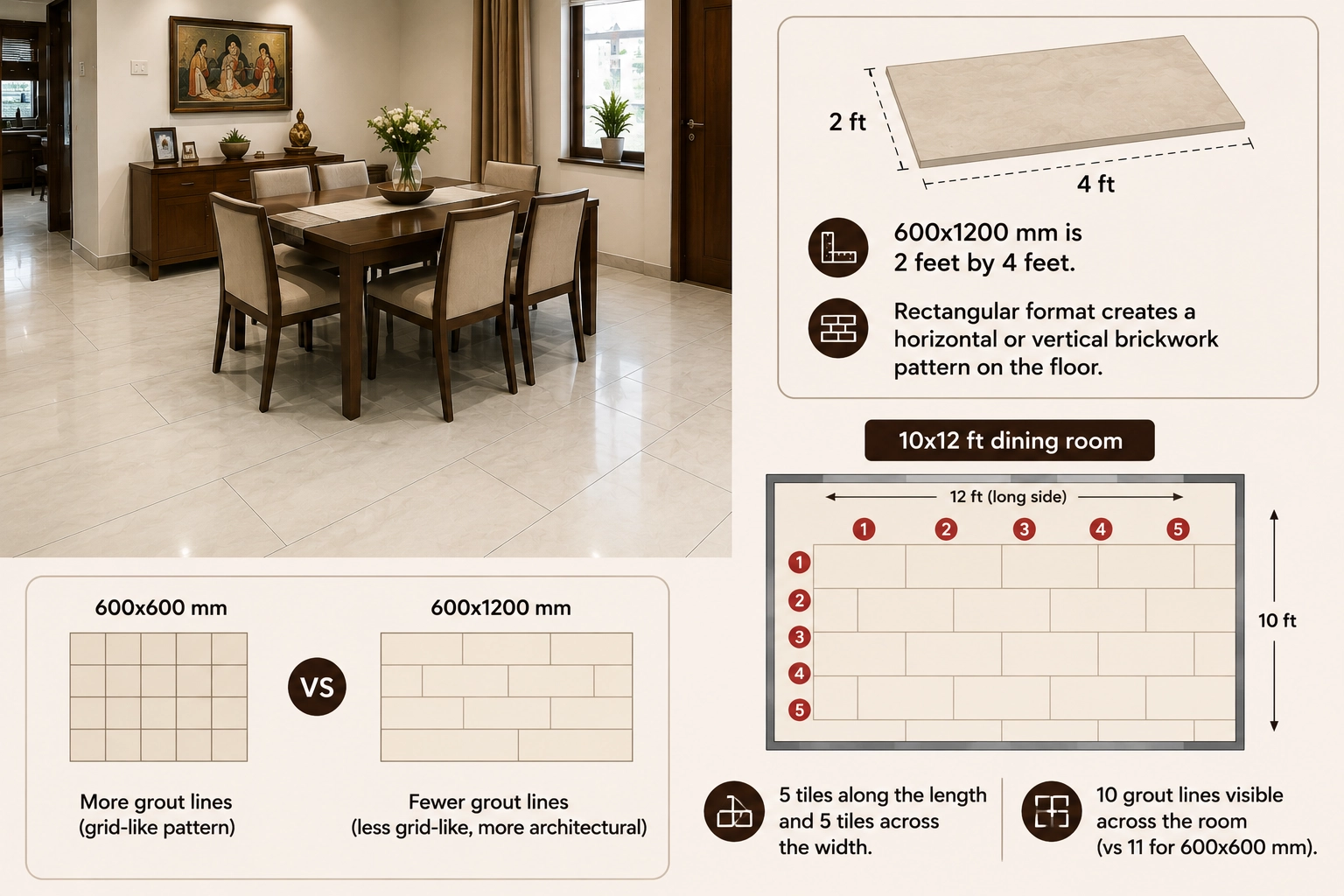
600x1200 mm is 2 feet by 4 feet. It is a rectangular format that produces a horizontal or vertical brickwork pattern on the floor. In a dining room, this format cuts the number of grout lines roughly in half compared to 600x600 mm, and the rectangular shape gives the floor a more directional, contemporary look.
In a 10x12 ft dining room, 600x1200 mm tiles laid with the long side along the 12-foot wall create 5 tiles along the length and 5 tiles across the width. The result is 10 grout lines visible across the room versus 11 for 600x600 mm, but the grout pattern is less grid-like and more architectural.
When 600x1200 mm is the Right Choice
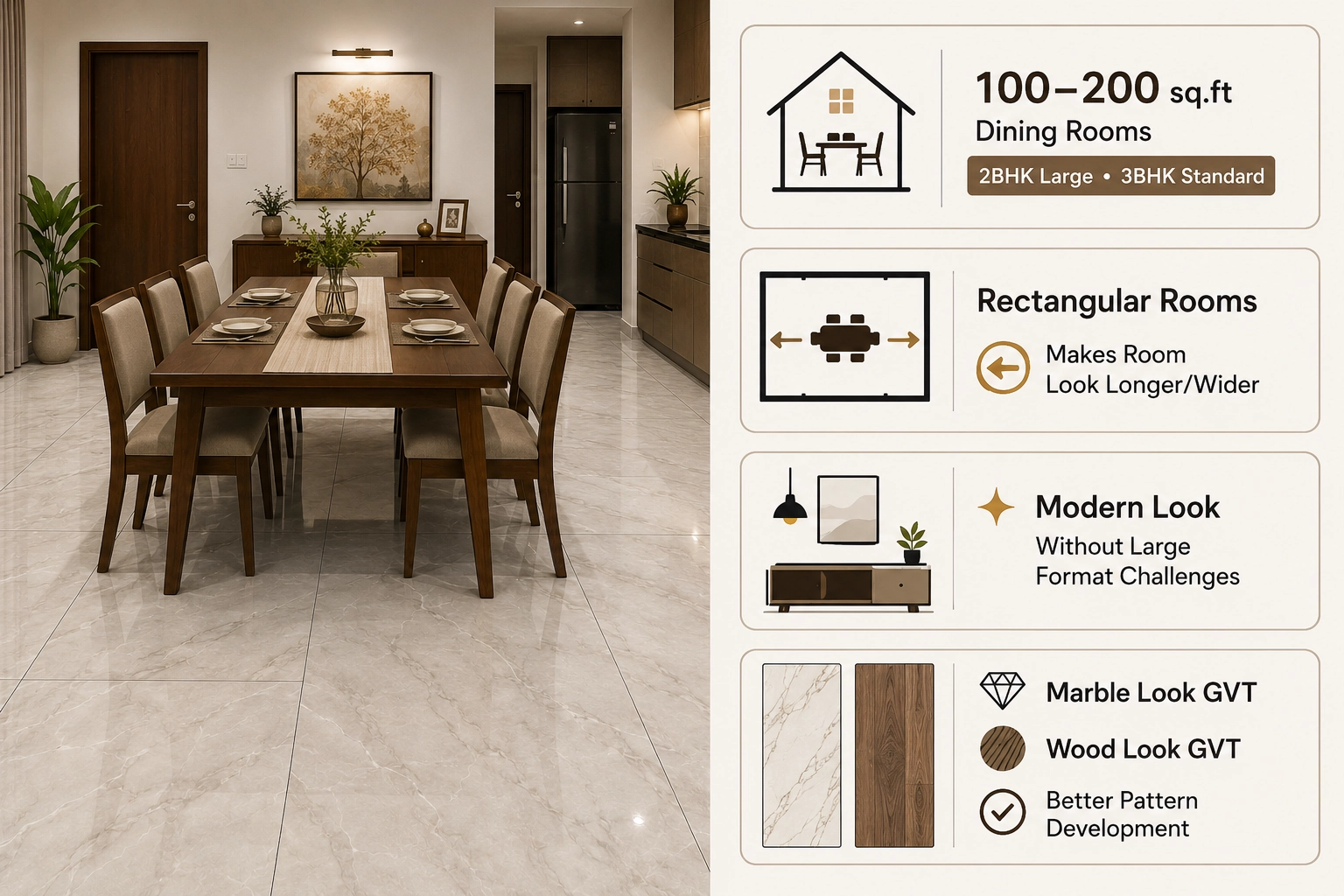
- Dining rooms between 100 and 200 sq. ft., covering standard 2BHK large and 3BHK standard configurations.
- Rectangular dining rooms where the longer tile can be oriented along the room's length to make the room feel wider or longer, depending on the direction chosen.
- Buyers who want a contemporary look without committing to very large format tiles. The 600x1200 mm format reads as modern without the handling and cutting challenges of 800x1600 mm.
- Dining rooms with marble look or wood look GVT designs. Both design styles look better on a 2x4 tile than on a 600x600 mm tile because the pattern repeat has more room to develop across a larger tile face.
When 600x1200 mm Falls Short
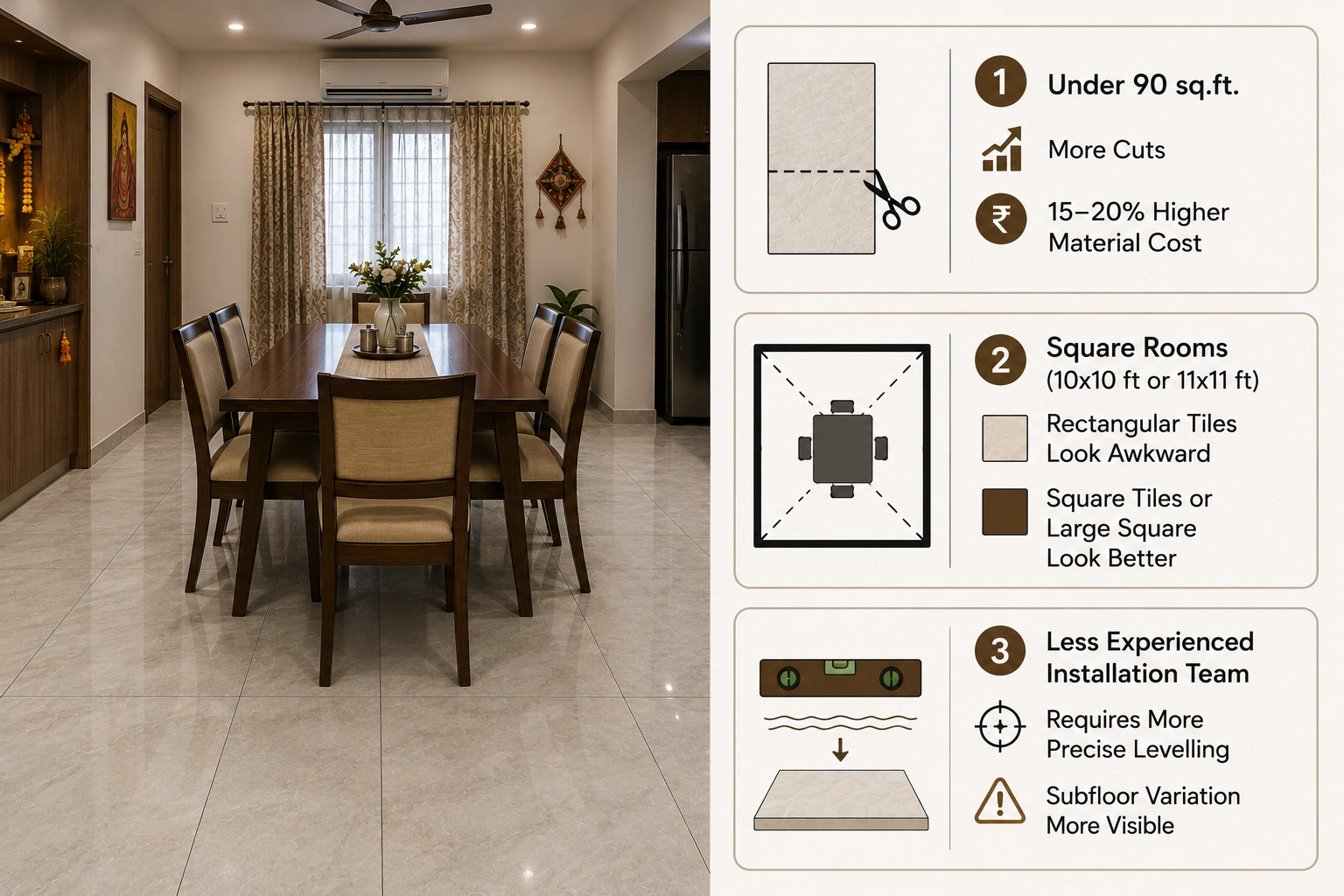
- In dining areas under 90 sq. ft., the 4-foot length of the tile means every edge row requires a large cut. This increases wastage significantly and can raise material cost by 15 to 20%.
- In square dining rooms (10x10 ft or 11x11 ft), the rectangular format can look slightly awkward. Square tiles or large-format square options read better in square rooms.
- When the installation team is less experienced. 600x1200 mm requires more precise levelling than 600x600 mm. Any variation in the subfloor shows more visibly across a larger tile surface.
| Factor | 600x1200 mm Performance |
| Typical grout lines in a 10x12 ft room | 5 across, 3 to 4 along (8 to 9 total visible lines per run) |
| Full tiles needed for 120 sq.ft (with 10% wastage) | Approx. 18 to 19 tiles |
| Edge cut wastage in a rectangular room | 10 to 15% |
| Installation difficulty | Medium (experienced tiler needed) |
| Price range (GVT, matte/sugar) | Rs. 75 to Rs. 160 per sq.ft |
| Best room size | 100 to 200 sq.ft |
| Suitable finishes for the dining floor | Matte, Sugar, GHR |
Note: When laying 600x1200 mm tiles in a dining room, always run the long side of the tile parallel to the longest wall. Laying the tile perpendicular to the longest wall makes the room appear shorter and cuts more tiles on the dominant edges. This is one of the most common installation mistakes with rectangular tile formats.
800x1600 mm Tiles for Dining Rooms
What 800x1600 mm Tiles Look Like in a Dining Space
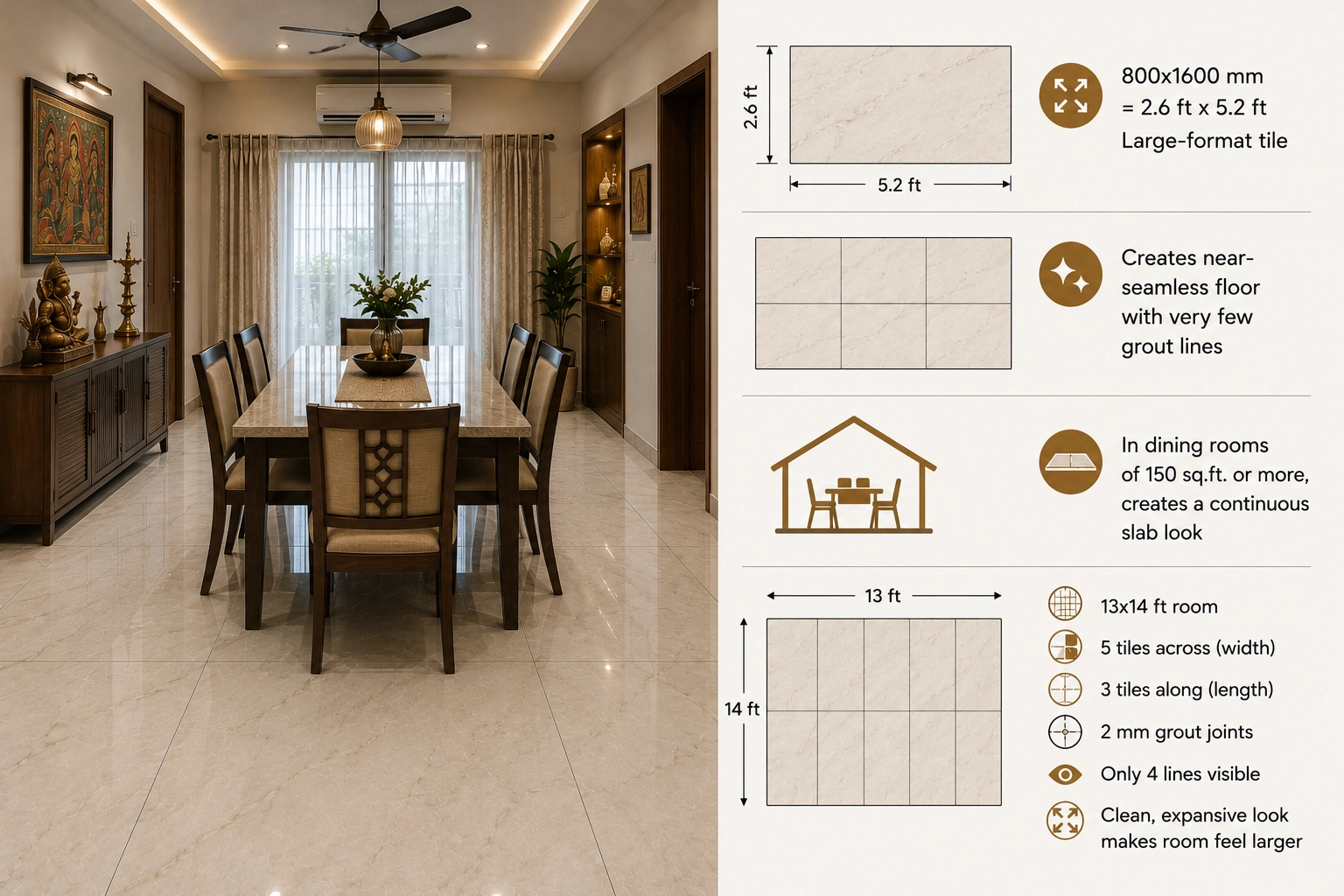
800x1600 mm is approximately 2.6 feet by 5.2 feet. It is a large-format tile that creates a near-seamless floor surface with very few visible grout lines. In a dedicated dining room of 150 sq. ft. or more, it creates the appearance of a continuous slab floor, similar to polished concrete or natural stone.
In a 13x14 ft dedicated dining room, 800x1600 mm tiles produce 5 tiles across the width and 3 tiles along the length. With standard 2 mm grout joints, only 4 lines are visible across the room. The visual impact is a clean, expansive surface that makes the room read as significantly larger than the same space with 600x600 mm tiles.
When 800x1600 mm is the Right Choice
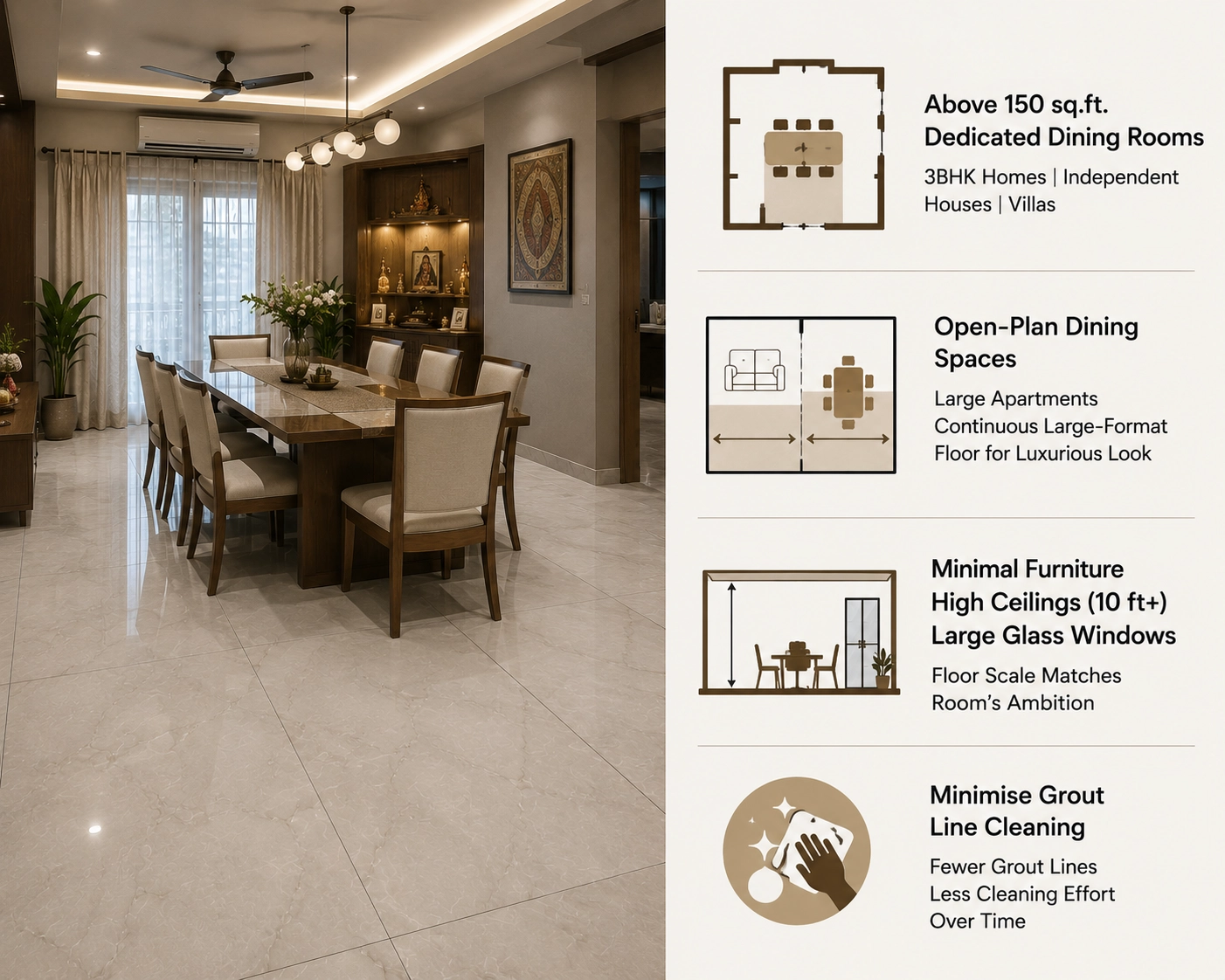
- Dedicated dining rooms above 150 sq. ft. in 3BHK homes, independent houses, and villas.
- Open-plan dining spaces in large apartments where a continuous large-format floor across the living-dining zone creates a luxurious visual sweep.
- Dining rooms with minimal furniture, high ceilings (10 ft or above), or large glass windows where the floor scale needs to match the room's vertical and horizontal dimensions.
- Buyers who want to minimise grout line cleaning. In a dining room with oil and food spills, fewer grout lines mean significantly less cleaning effort over time.
When 800x1600 mm Falls Short
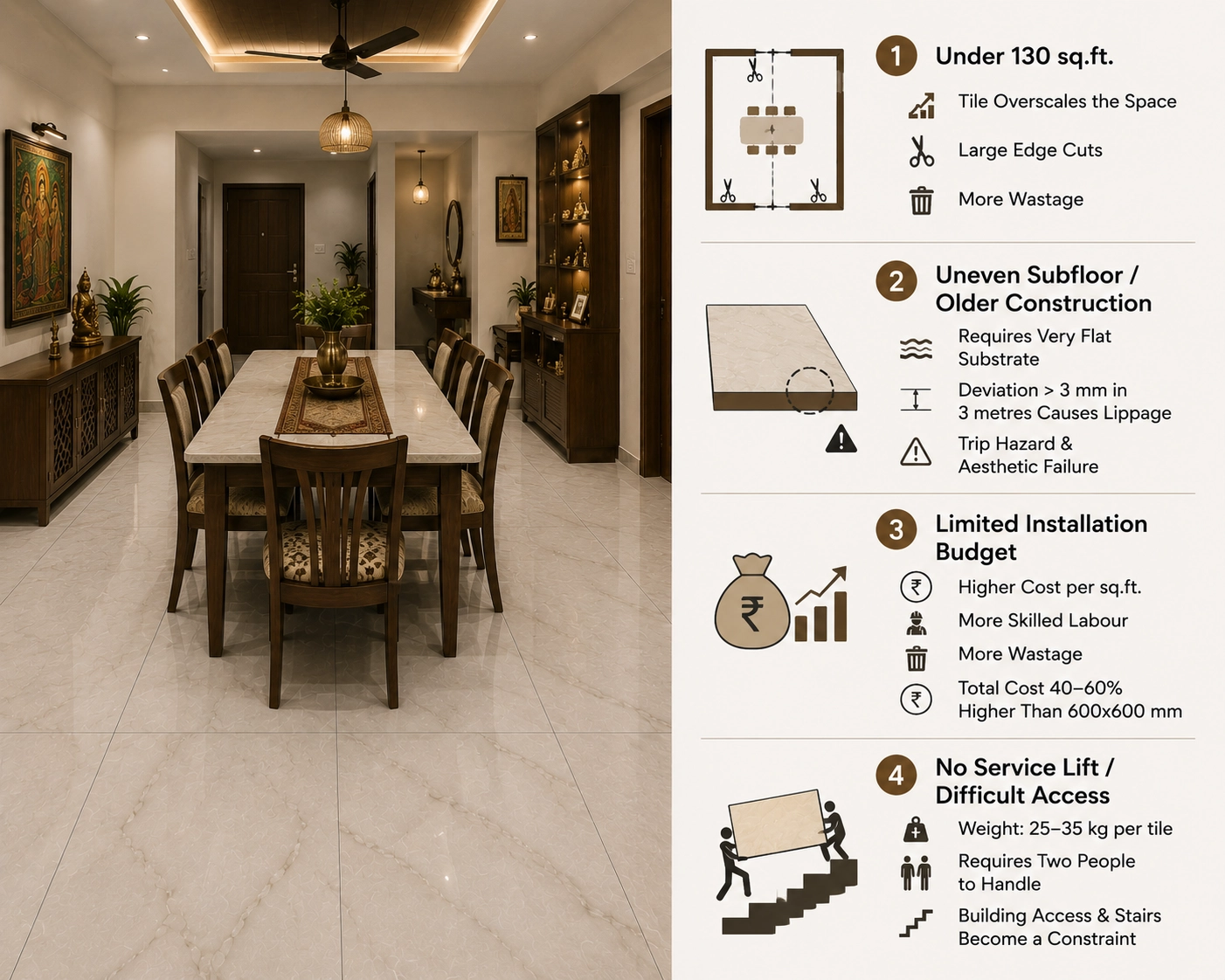
- In dining areas under 130 sq. ft. ft. The tile overscales the space. Edge cuts are large and wasteful, and the floor looks as if the tile is fighting the room rather than fitting it.
- Where the subfloor is uneven, or the building is older construction. 800x1600 mm tiles require a very flat substrate. Any deviation over 3 mm in 3 metres will cause lippage (one tile edge sitting higher than the adjacent tile), which is both a trip hazard and an aesthetic failure.
- When the installation budget is limited. 800x1600 mm tiles cost more per square. ft t requires more skilled labour and generates more wastage. The total installed cost is typically 40 to 60% higher than 600x600 mm for the same area.
- In buildings without a service lift or easy large-item access. 800x1600 mm tiles weigh 25 to 35 kg per tile and require two people to handle. Building access and staircase dimensions become a practical constraint.
| Factor | 800x1600 mm Performance |
| Typical grout lines in a 13x14 ft room | 4 across, 2 to 3 along (6 to 7 total visible lines per run) |
| Full tiles needed for 150 sq.ft (with 10% wastage) | Approx. 12 to 13 tiles |
| Edge cut wastage in a rectangular room | 12 to 20% |
| Installation difficulty | High (specialist required) |
| Price range (GVT, matte/sugar) | Rs. 90 to Rs. 180 per sq.ft |
| Best room size | Above 150 sq.ft |
| Suitable finishes for the dining floor | Matte, Sugar only |
| Weight per tile (approx.) | 25 to 35 kg |
Pro tip: If you choose 800x1600 mm tiles for your dining room, ask your contractor to use a laser level and self-levelling compound on the subfloor before tile installation. Any unevenness in the base shows as lippage across the large tile surface. The levelling cost of Rs. 8 to Rs. 15 per sq.ft is a fraction of what tile replacement costs if lippage occurs after installation.
Direct Size Comparison: 600x600 vs 600x1200 vs 800x1600
| Comparison Factor | 600x600 mm | 600x1200 mm | 800x1600 mm |
| Tile area per piece | 0.36 sq.ft | 0.72 sq.ft | 1.39 sq.ft |
| Grout lines in a 10x12 ft room | 11 lines across + along | 8 to 9 lines | 5 to 6 lines |
| Visual effect | Traditional grid | Contemporary, directional | Seamless slab look |
| Best room size | Under 120 sq.ft | 100 to 200 sq.ft | Above 150 sq.ft |
| Price range (GVT matte) | Rs. 60 to Rs. 110/sq.ft | Rs. 75 to Rs. 160/sq.ft | Rs. 90 to Rs. 180/sq.ft |
| Installation skill needed | Standard | Experienced | Specialist only |
| Edge cut wastage | 8 to 12% | 10 to 15% | 12 to 20% |
| Subfloor tolerance | High (forgiving) | Medium | Low (very flat required) |
| Epoxy grout cost impact | Higher (more joints) | Medium | Lower (fewer joints) |
| Weight handling | Easy (single person) | One to two persons | Two persons minimum |
Size Selection by Indian Home Type: Quick Reference
| Home Type | Dining Area | Recommended Size | Why |
| 1BHK / Studio | 50 to 75 sq.ft | 600x600 mm | Compact space, minimal waste, lower cost |
| 2BHK standard | 80 to 110 sq.ft | 600x600 mm | Standard size fits without oversizing |
| 2BHK large | 110 to 130 sq.ft | 600x600 mm or 600x1200 mm | 600x1200 mm if the budget allows and the room is rectangular |
| 3BHK standard | 120 to 160 sq.ft | 600x1200 mm | Best balance of scale, cost, and visual impact |
| 3BHK large | 150 to 200 sq.ft | 600x1200 mm or 800x1600 mm | 800x1600 mm if dedicated dining room with flat subfloor |
| Independent house / Villa | 200 sq.ft+ | 800x1600 mm | Room scale supports large format without waste |
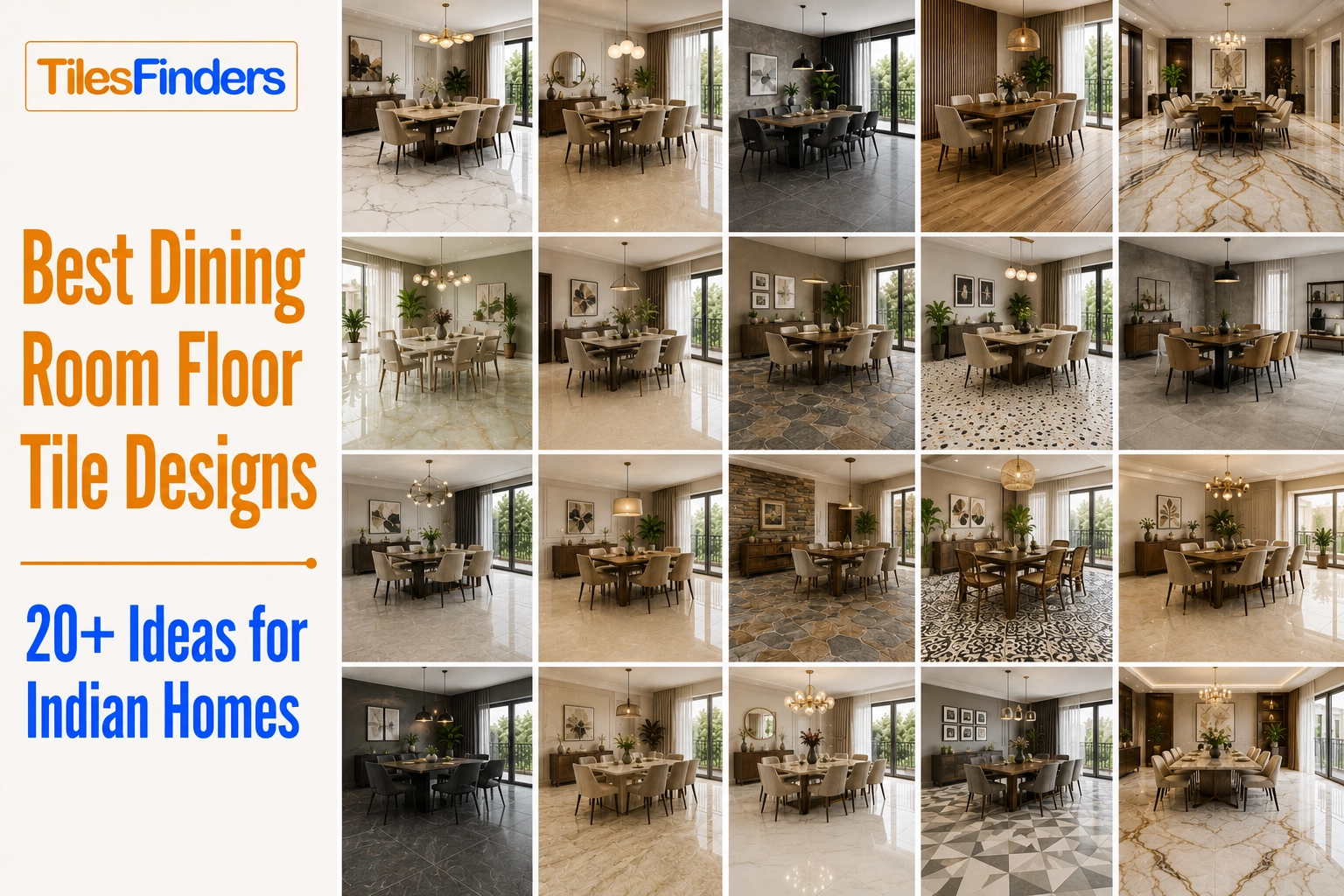
Once you have selected the right tile size, explore these Dining Room Floor Tile Designs for inspiration on marble-look, wood-look, stone-look, terrazzo, and modern dining room flooring ideas.
Cost Comparison: Same Room, Three Tile Sizes
To make the price difference concrete, here is what a 150 sq ft dining room costs in materials and installation across all three tile sizes. Prices are from Morbi, Gujarat GVT suppliers, matte finish, mid-range quality.
| Cost Element | 600x600 mm | 600x1200 mm | 800x1600 mm |
| Tile material price | Rs. 80/sq.ft | Rs. 110/sq.ft | Rs. 140/sq.ft |
| Area with 10% wastage | 165 sq.ft | 165 sq.ft | 170 sq.ft (higher wastage) |
| Total tile material cost | Rs. 13,200 | Rs. 18,150 | Rs. 23,800 |
| Labour + adhesive | Rs. 35/sq.ft | Rs. 40/sq.ft | Rs. 55/sq.ft |
| Labour cost (150 sq.ft) | Rs. 5,250 | Rs. 6,000 | Rs. 8,250 |
| Epoxy grout (approx.) | Rs. 3,500 | Rs. 2,500 | Rs. 1,500 |
| Total installed estimate | Rs. 21,950 | Rs. 26,650 | Rs. 33,550 |
The cost difference between 600x600 mm and 800x1600 mm for a 150 sq.ft dining room is approximately Rs. 11,600 in total installed cost. Whether that difference is worth it depends on whether the room's dimensions actually support the larger format.
Note: These cost estimates use mid-range GVT tile prices from Morbi, Gujarat, as of 2026. Prices vary by brand, design complexity, and local dealer margin. Always get three quotes before confirming a budget. Labour rates also vary by city: Mumbai and Bengaluru labour costs run 20 to 30% higher than the estimates above.
Installation Considerations by Size
Subfloor Requirements
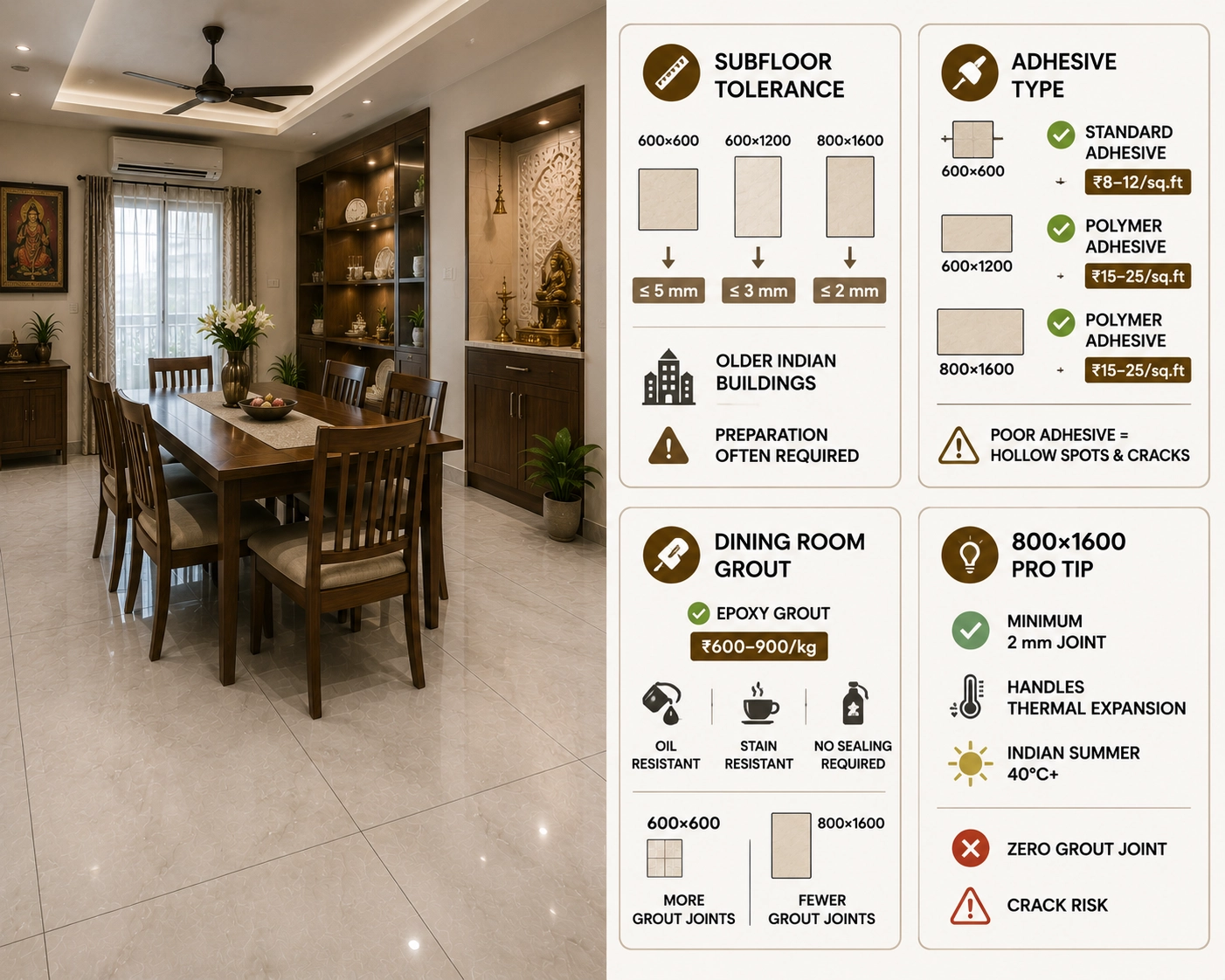
600x600 mm tiles tolerate minor subfloor variation. A deviation of up to 5 mm over 2 metres is generally acceptable. 600x1200 mm tiles require flatness within 3 mm over 2 metres. 800x1600 mm tiles require a maximum 2 mm deviation over 2 metres. In older construction in Indian cities, the floor slab is often not flat to this standard without preparation work.
Adhesive Requirements
600x600 mm tiles can be laid with standard grey cement-based tile adhesive at Rs. 8 to Rs. 12 per sq.ft. 600x1200 mm and 800x1600 mm tiles require a polymer-modified full-bed adhesive at Rs. 15 to Rs. 25 per sq.ft. Skimping on adhesive quality with large format tiles causes hollow spots that crack the tile under foot traffic and chair loading.
Grouting
All three sizes require epoxy grout for dining room floors. Cement grout in a dining area stains with oil and food within months. Epoxy grout at Rs. 600 to Rs. 900 per kg handles all common food and cleaning agent contact without staining or sealing requirements. The number of grout joints is highest with 600x600 mm, so the epoxy grout cost is marginally higher for smaller tiles despite each joint being shorter.
Pro tip: For 800x1600 mm tiles, specify a minimum 2 mm grout joint width even though the tile edges look like they can butt up tight. All tiles expand slightly with temperature. Indian summers with outdoor temperatures above 40 degrees Celsius create thermal expansion in floor tiles. A 2 mm joint absorbs this movement. Zero-grout or 0.5 mm joints crack within one summer in most Indian cities.
Common Mistakes When Choosing Dining Room Tile Size
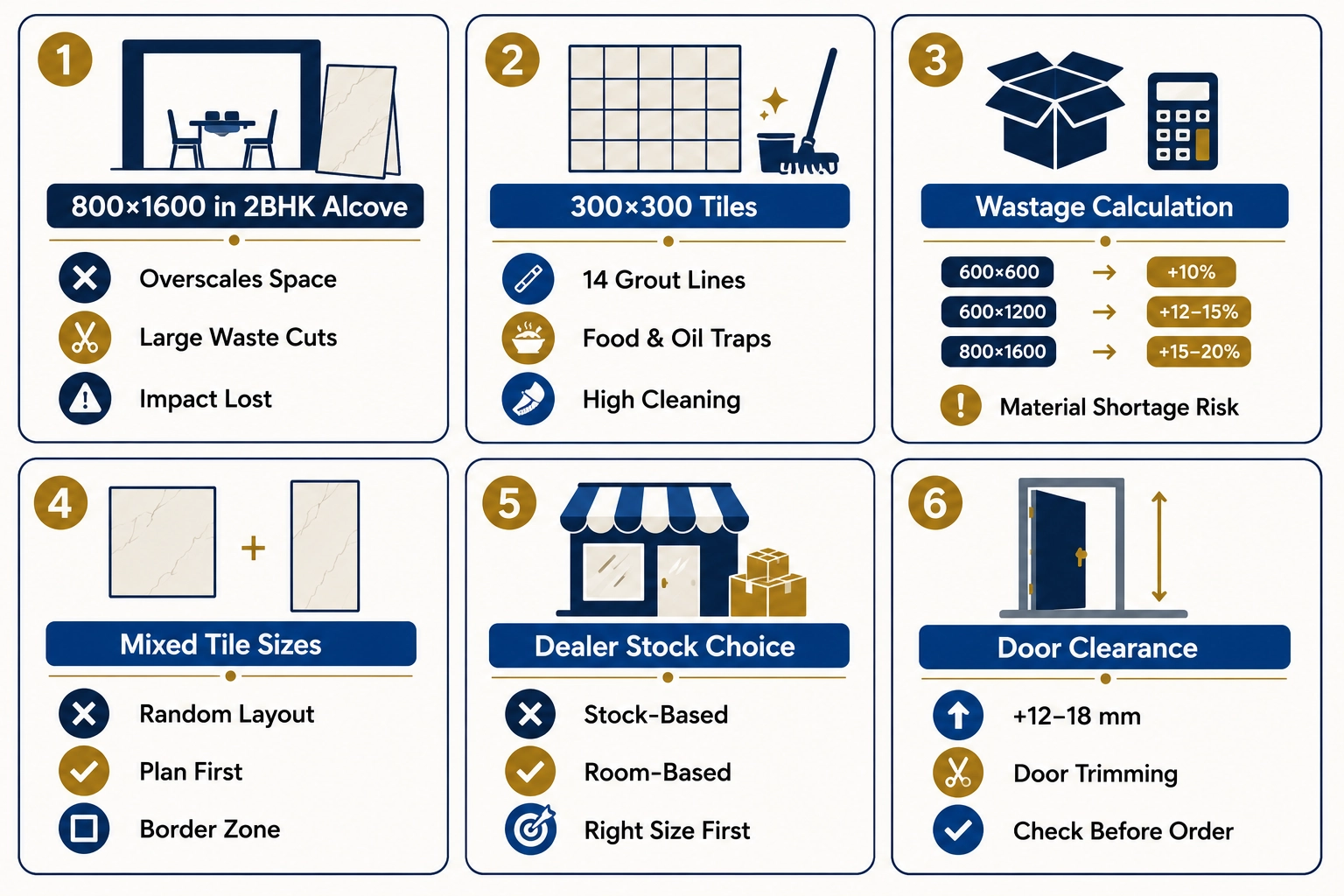
- Choosing 800x1600 mm for a 2BHK dining alcove: The tile overscales the space, creates large waste cuts, and the visual impact is lost in a room too small to show the format's strength.
- Using 300x300 mm tiles in any dining room above 80 sq.ft: This produces 14 grout lines across a 12-foot room width. Cleaning the grout in a dining room where oil and food fall daily becomes a full-time task within a year.
- Not accounting for wastage correctly: 600x600 mm needs 10% extra. 600x1200 mm needs 12 to 15% extra. 800x1600 mm needs 15 to 20% extra. Buyers who order based on room area alone run short on site.
- Mixing two tile sizes in one dining room floor without a design plan: Randomly mixing 600x600 mm and 600x1200 mm tiles without a deliberate border or transition zone looks unplanned. If you want a two-size design, decide on the pattern before ordering.
- Choosing tile size based on what the dealer has in stock: Stock availability is not a design or performance criterion. If the right size for your room is 600x1200 mm but the dealer only has 600x600 mm, order the right size from a different supplier.
- Ignoring door frame heights with large format tiles: 800x1600 mm tiles add 12 to 18 mm to the finished floor height, including adhesive bed. Existing door frames in an older home may need trimming to clear the new floor level. Check this before ordering.
Compare Dining Room Tile Sizes on Tilesfinders
Choosing between 600x600 mm, 600x1200 mm, and 800x1600 mm is easier when you can see the available designs at each size side by side. On TilesFinders, the catalogue lets you filter by size and finish so you can compare GVT dining room floor tiles from verified Morbi and Gujarat suppliers at each price point before visiting a dealer.
FAQs
600x1200 mm is the best choice for most Indian dining rooms. It fits rooms from 100 to 200 sq. ft., reduces grout lines compared to 600x600 mm, and is available across all major GVT design categories from Morbi, Gujarat suppliers. Price starts at Rs. 75 per sq.ft. For rooms under 100 sq. ft., 600x600 mm is the right fit. For dedicated rooms above 200 sq. ft., 800x1600 mm delivers the best visual result.
600x600 mm is not too small for dining rooms under 120 sq.ft. It is the correct size for compact dining areas in 1BHK and standard 2BHK homes. In rooms above 130 sq. ft., 600x600 mm starts to produce a grid-heavy floor with too many visible grout lines. The tile itself is not small. The issue is the ratio between tile size and room size.
Using 800x1600 mm tiles in a 2BHK dining area under 110 sq. ft. is not recommended. The tile overscales the space, requires large edge cuts that waste material, and the format's visual strength is lost in a small room. 600x600 mm or 600x1200 mm tiles are the right choice for 2BHK dining rooms.
For 600x600 mm tiles: 37 to 38 tiles with 10% wastage. For 600x1200 mm tiles: 19 to 20 tiles with 12% wastage. For 800x1600 mm tiles: 11 to 12 tiles with 15% wastage. Always round up to the nearest full carton and confirm the carton quantity contains the same batch number for colour consistency.
Yes. Fewer grout lines mean fewer spaces where food and oil collect. 800x1600 mm tiles have the fewest grout lines and are the easiest to mop clean in a dining room. 600x600 mm tiles have the most grout lines and require the most attention to grout cleaning over time. Regardless of size, using epoxy grout in a dining room reduces staining in grout joints across all tile sizes.
600x600 mm GVT matte tiles cost Rs. 60 to Rs. 110 per sq.ft from Morbi, Gujarat suppliers. 600x1200 mm GVT matte tiles cost Rs. 75 to Rs. 160 per sq.ft. For a 120 sq.ft dining room, the material cost difference is Rs. 1,800 to Rs. 6,000 depending on brand and design. Total installed cost difference (including higher adhesive and labour for 600x1200 mm) is Rs. 3,500 to Rs. 8,000.
600x1200 mm tiles make a small dining room look bigger compared to 600x600 mm tiles, provided the room is at least 90 sq.ft. The elongated format reduces visible grout lines and directs the eye along the room's length. For very small dining areas under 80 sq. ft., 600x600 mm in a light marble look or off-white solid tone achieves a similar effect at a lower cost.
600x600 mm tiles can be installed by most trained tile layers. 600x1200 mm tiles require an experienced installer who understands full-bed adhesive application and precise levelling. 800x1600 mm tiles require a specialist with laser levelling equipment and experience handling heavy, large-format tiles. Using an under-qualified installer on 800x1600 mm tiles leads to lippage and cracking within months of installation.

See our tile guides first
Set TilesFinders as a preferred source and our buying guides surface ahead of the rest for you.
Add as preferred sourceTakes one tap. Nothing to install.
What Readers Say
I was about to redo my parking area with the wrong tile size until I read this. The layout comparisons saved me from a costly mistake.
We reference TilesFinders guides while briefing clients on material selection. The size and pattern breakdowns are accurate and easy to explain visually.
On site, I get asked about grout spacing all the time. This article gave me a solid reference I now share with my team before every job.
Finally a guide that doesn't just push generic advice. The oil stain removal steps actually worked on our clubhouse driveway tiles.
I run a small construction firm and now send this link to clients directly when they ask about entrance tile sizing. Saves me an hour of explaining.
Good practical detail, though I wish there were more examples for compact apartment entrances specifically, not just villas.
My mother-in-law wanted marble, I wanted vitrified. This blog gave us the neutral comparison we needed to actually decide together.
Detailed without being overwhelming. I appreciated that it covered both cost and maintenance, not just the aesthetics.
Used the algae and hard water removal tips on our terrace tiles after the monsoon. Worked better than what our regular cleaner was doing.
As someone who sources tiles for multiple builder projects, I find these comparisons genuinely useful for vendor conversations, not just consumer content.
Recommended this to a client who kept second-guessing the entrance design. The small vs large layout section settled the debate instantly.
Straightforward and honest, no unnecessary jargon. Would like to see a similar breakdown for outdoor pool-deck tiles next.
We've bookmarked several TilesFinders guides for our design handbook. Reliable source when clients want data, not just opinions.
Two paths, one marketplace.
Get free quotes from verified suppliers.
Share your room, budget, and style. Suppliers in Morbi respond within hours.
Get Free QuotesList your business, reach real buyers.
Put your showroom in front of homeowners searching for tiles right now.
List Your Business