Dining Room Tiles in India: Complete Buyer's Guide for 2026
Explore the best dining room tiles in India for 2026. Compare GVT, vitrified, wall and floor tiles by size, finish, safety, durability, and price to choose the right option for your home.
- What Makes Dining Room Tiles Different From Other Rooms
- Best Types of Dining Room Floor Tiles in India
- Best Types of Dining Room Wall Tiles in India
- Right Tile Size for Your Dining Room
- Finish Guide: What Works and What to Avoid
- Dining Room Tiles Price Guide India 2026
- Common Mistakes Buyers Make When Choosing Dining Room Tiles
- Technical Note for Larger Dining Rooms
- Browse Verified Dining Room Tile Options
Matte, Sugar, and GHR finish GVT tiles are the best choices for Indian dining room floors due to their durability, stain resistance, and slip safety. For most homes, 600x600 mm and 600x1200 mm tiles offer the ideal balance of aesthetics, maintenance, and cost.
Choosing dining room tiles in India is not as simple as picking a colour you like. The dining room takes daily foot traffic, chair scraping, food spills, and the occasional dropped vessel, which means the tile body, finish, and size all have to work together.
This guide covers the tile types, finishes, sizes, and price ranges that suit Indian dining rooms, whether you are fitting out a compact 2BHK flat or a larger family home. You will also find clear guidance on what not to buy, so you do not end up with a floor that looks great in the showroom and becomes a problem six months later.
From vitrified tiles for dining room floors to accent wall tiles for a feature wall behind the dining table, the options are wide. Read on to find the right fit for your home.
What Makes Dining Room Tiles Different From Other Rooms
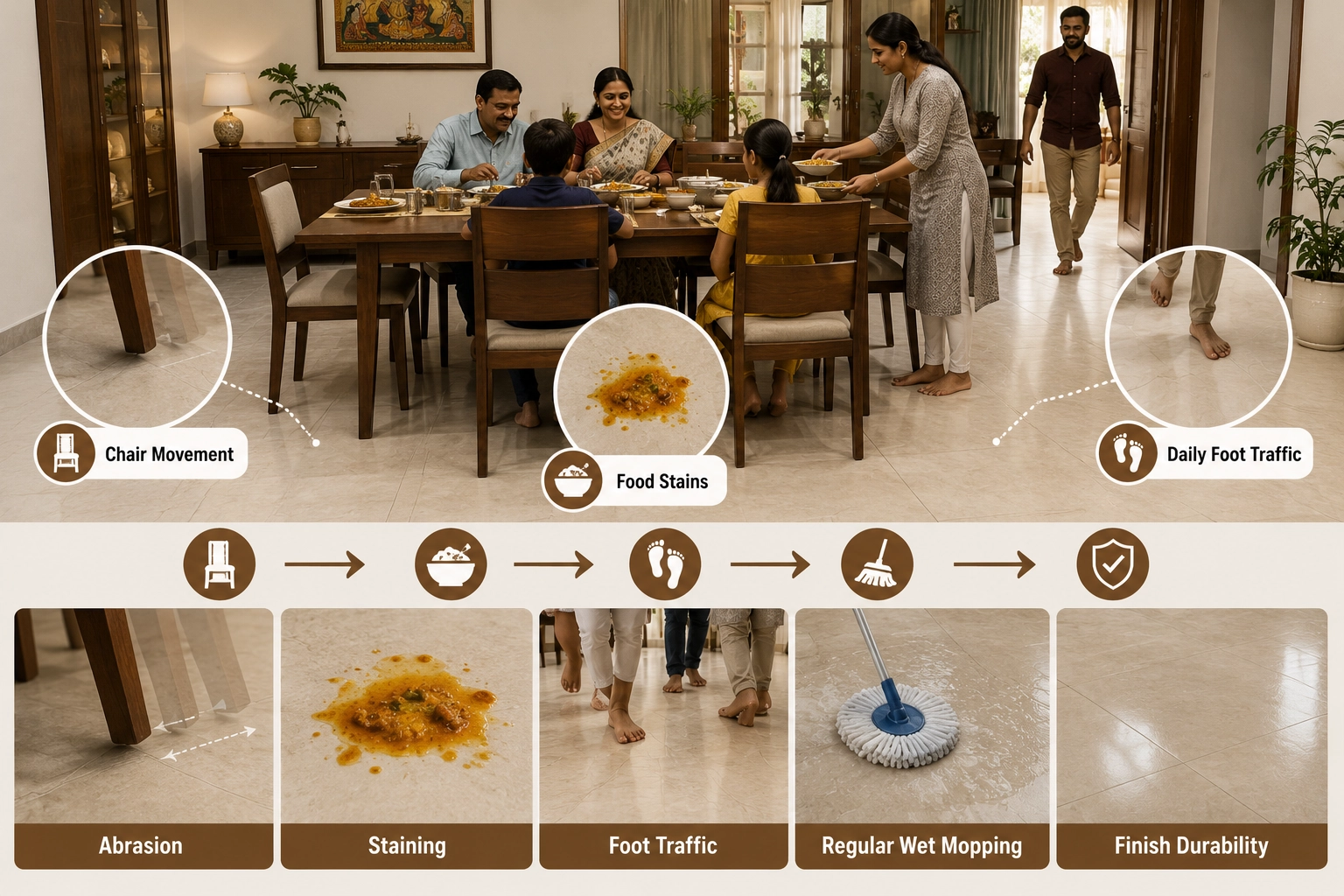
Most buyers treat all living spaces as interchangeable when it comes to tiles. That is a mistake the dining room punishes quickly.
A dining room in an Indian household sees chair legs dragged across the floor multiple times a day, cooking oil and curry stains from food service, and foot traffic from family and guests. These are surface-wear conditions that do not apply to a bedroom and are more concentrated than in a living room.
The right tiles for the dining area must handle abrasion, staining, and regular wet mopping without losing their finish within three to four years. That puts certain finishes and tile bodies ahead of others before you even look at design.
Traffic Patterns and Spill Loads in Indian Dining Spaces
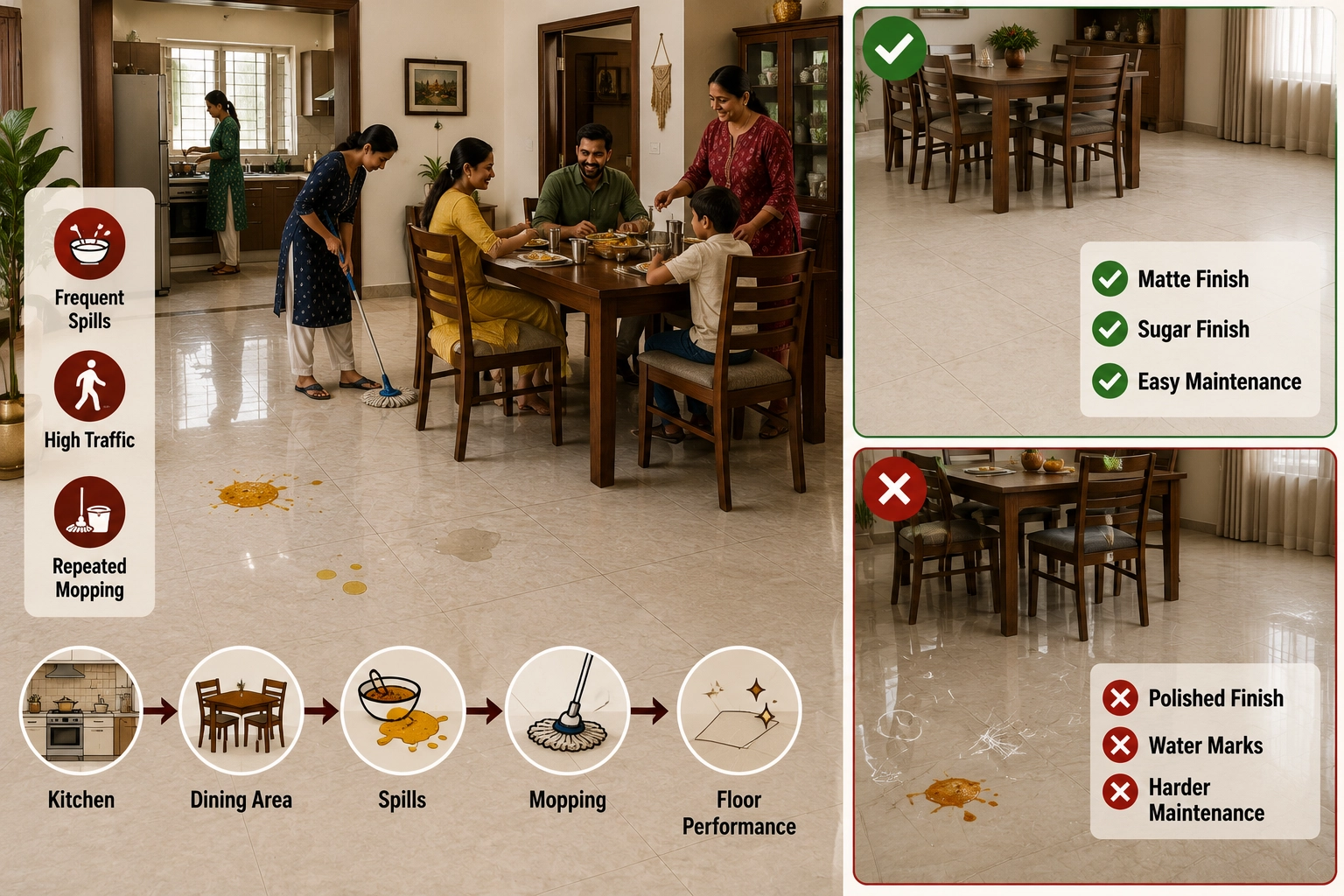
In most Indian homes, the dining room sits adjacent to the kitchen. This creates a zone of high spill frequency. Oil, dal, and liquid stains fall regularly, and the floor takes repeated mopping with water and cleaning agents.
A tile finish that stains easily or shows water marks will look dirty within weeks. GVT tiles with a matte or sugar finish handle this well. Polished finishes, while visually striking, trap stains in micro-scratches over time and become hard to maintain on a dining floor.
Why Finish Choice Matters More Than Size
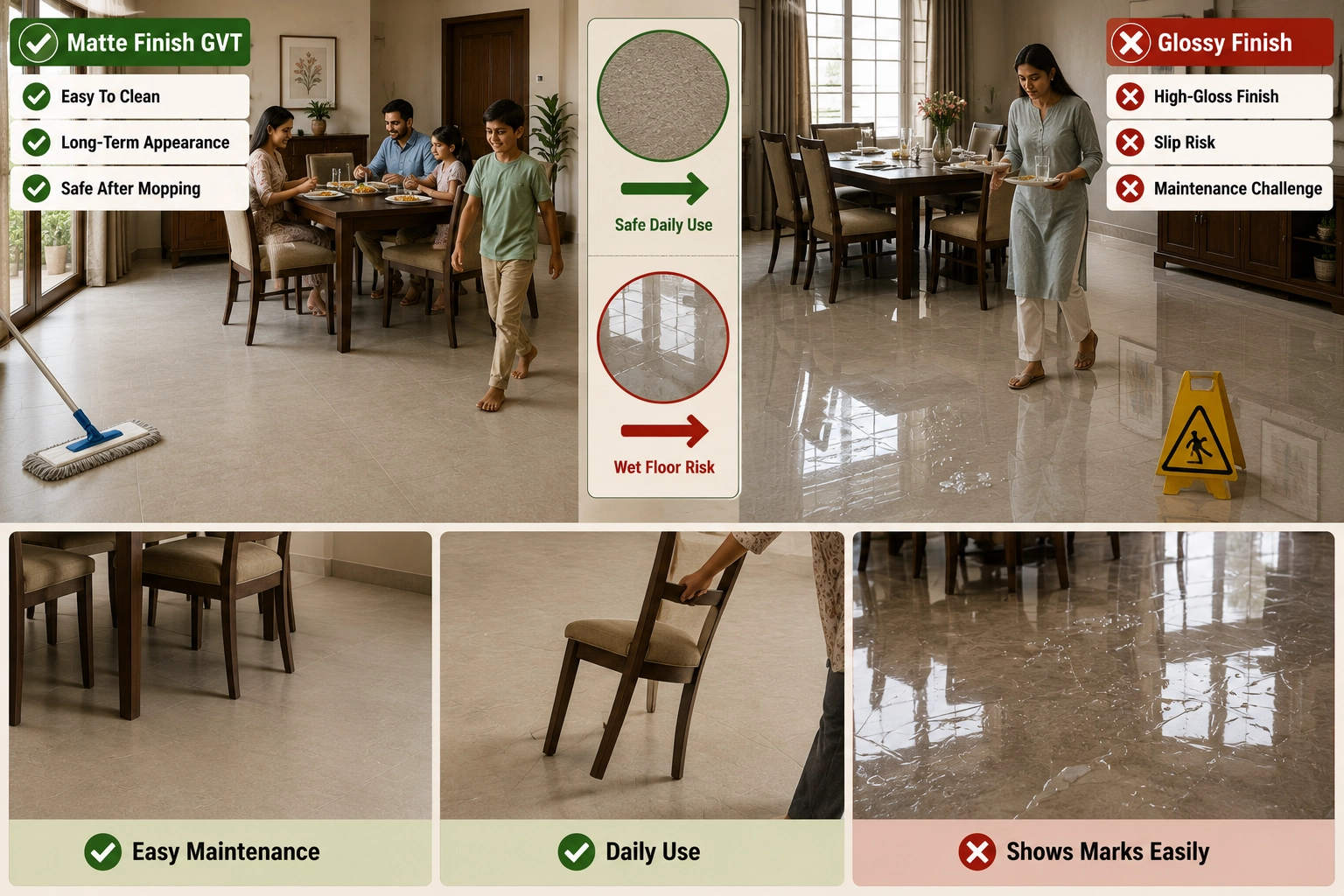
Buyers spend most of their time debating tile size. The more consequential decision is to finish.
A matte finish GVT tile with a slip coefficient above 0.4 (dry) and 0.3 (wet) is safe, easy to clean, and holds its appearance through years of use. A glossy or high-gloss vitrified tile in the same space is a slip risk and a maintenance challenge. The look is appealing in the showroom. The reality at home is different.
Note: Do not use glossy or high-gloss finishes on dining room floors. These finishes have a lower wet slip resistance and become slippery when mopped. This applies to both GVT and double-charged tiles.
Best Types of Dining Room Floor Tiles in India
Three tile types suit dining room floors in Indian homes: full-body vitrified tiles, double charge vitrified tiles, and glazed vitrified tiles (GVT). Each serves a different budget and performance need.
Full Body Vitrified Tiles for Dining Rooms
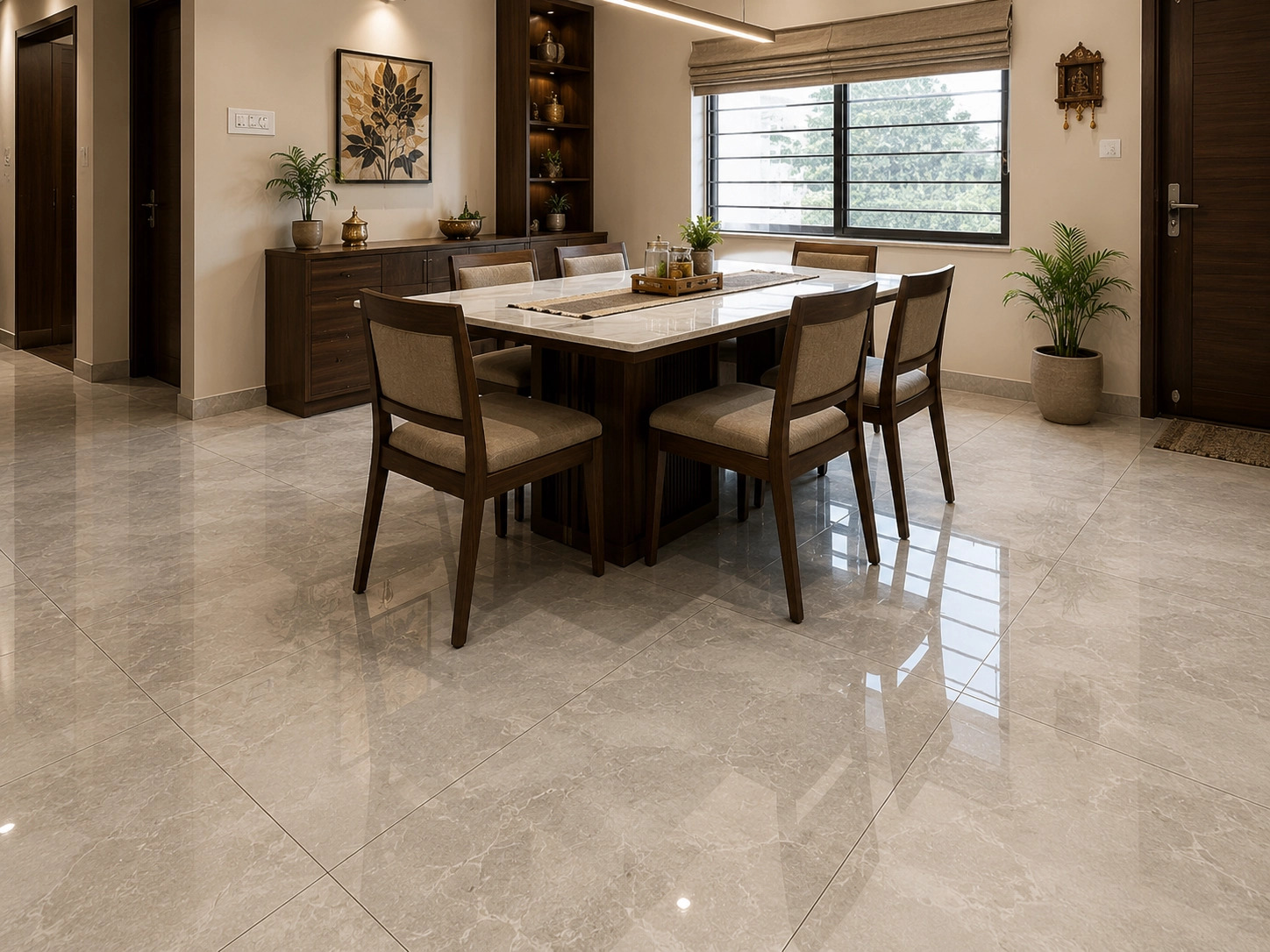
Full-body vitrified tiles carry colour and pattern through the full thickness of the tile body. A chip or scratch does not expose a different-coloured base layer. This makes them a strong option for dining room floors where chair legs create repetitive point pressure.
Full-body vitrified tiles from Morbi, Gujarat, are available in sizes from 600x600 mm up to 800x1600 mm. Water absorption is 0.05% or lower, which is what IS 15622:2006 defines for vitrified tiles. This low absorption means liquid spills sit on the surface instead of soaking in, making cleaning straightforward.
Price range for full-body vitrified tiles for dining room floors: Rs. 55 to Rs. 180 per sq.ft, depending on size, finish, and brand. Most 600x600 mm full body tiles for dining rooms fall in the Rs. 60 to Rs. 100 per sq.ft range from Morbi-origin suppliers.
Double Charge Vitrified Tiles for Dining Floors
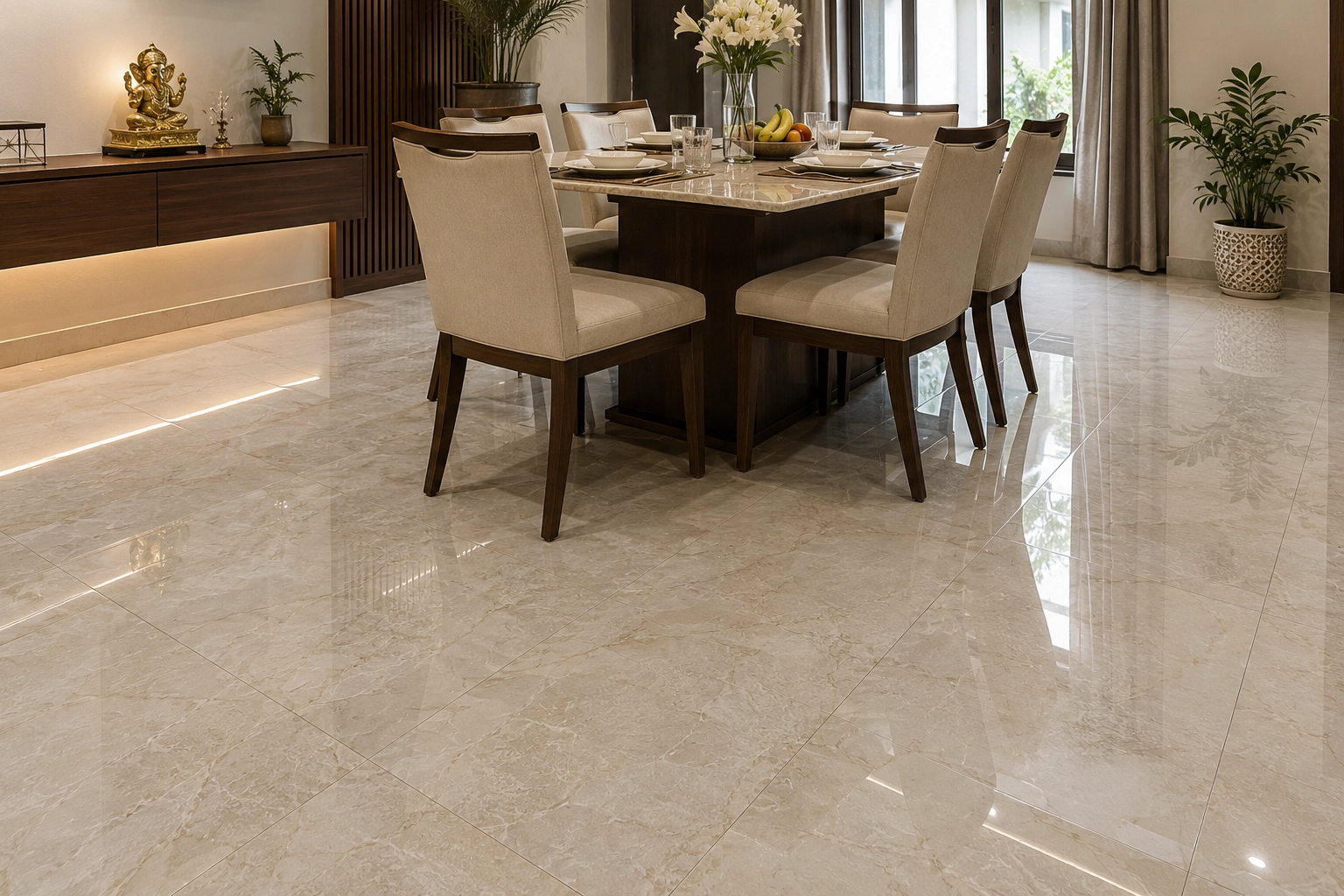
Double charge tiles use a two-layer pressing method where the pattern layer is 3 to 4 mm deep. They carry a polished finish from the factory. While they look good, the polished surface creates a wet-slip concern on dining floors that see frequent mopping.
Note: Double charge tiles with a polished finish are not recommended for dining floors in households with children or elderly family members. The wet coefficient of friction on polished double charge tiles can drop below safe thresholds after mopping. If you want the look of double charge tiles, use them on dining room walls only.
Price range: Rs. 40 to Rs. 90 per sq ft from Morbi, Gujarat suppliers.
Glazed Vitrified Tiles (GVT) for Dining Rooms
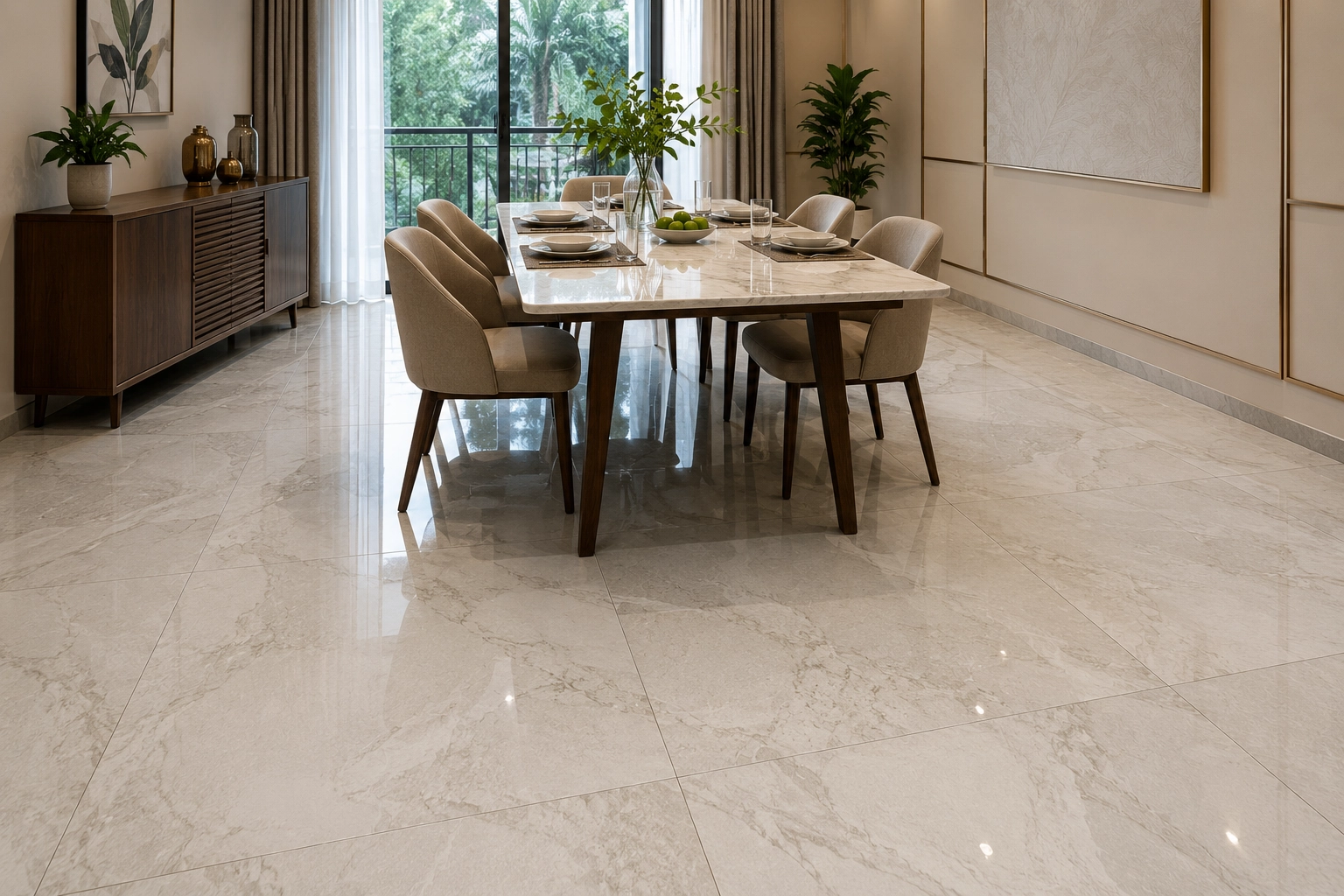
GVT tiles feature a printed glaze layer on a vitrified tile body, offering a wide range of design options, including marble, wood, stone, and solid tone finishes. The glaze layer is fired onto the tile surface and is distinct from full-body tiles, where the colour runs through the entire body thickness.
GVT tiles from Morbi, Gujarat, are available in sizes from 600x600 mm up to 800x1600 mm in matte, sugar, GHR, and satin matte finishes. For dining room floors, matte, sugar, and GHR finishes are safe choices. Water absorption in GVT is 0.05% or lower, as per IS 15622:2006, making liquid spills easy to clean.
Price range for GVT dining room floor tiles: Rs. 55 to Rs. 180 per sq.ft, depending on size, finish, and design. Most 600x600 mm GVT matte tiles fall in the Rs. 60 to Rs. 100 per sq.ft range from Morbi-origin suppliers.
Best Types of Dining Room Wall Tiles in India
Dining room walls carry different requirements than floors. There is no foot traffic, no chair abrasion, and no wet-slip concern. The wall is where you have room to work with finish, texture, and visual weight. The tile type you choose for a dining room wall depends on the effect you want, the wall's position in the room, and your budget.
Four tile types suit dining room walls in Indian homes: ceramic tiles, glazed vitrified tiles (GVT), polished glazed vitrified tiles (PGVT), and High-Depth punch or 3D tiles.
Ceramic Tiles for Dining Room Walls
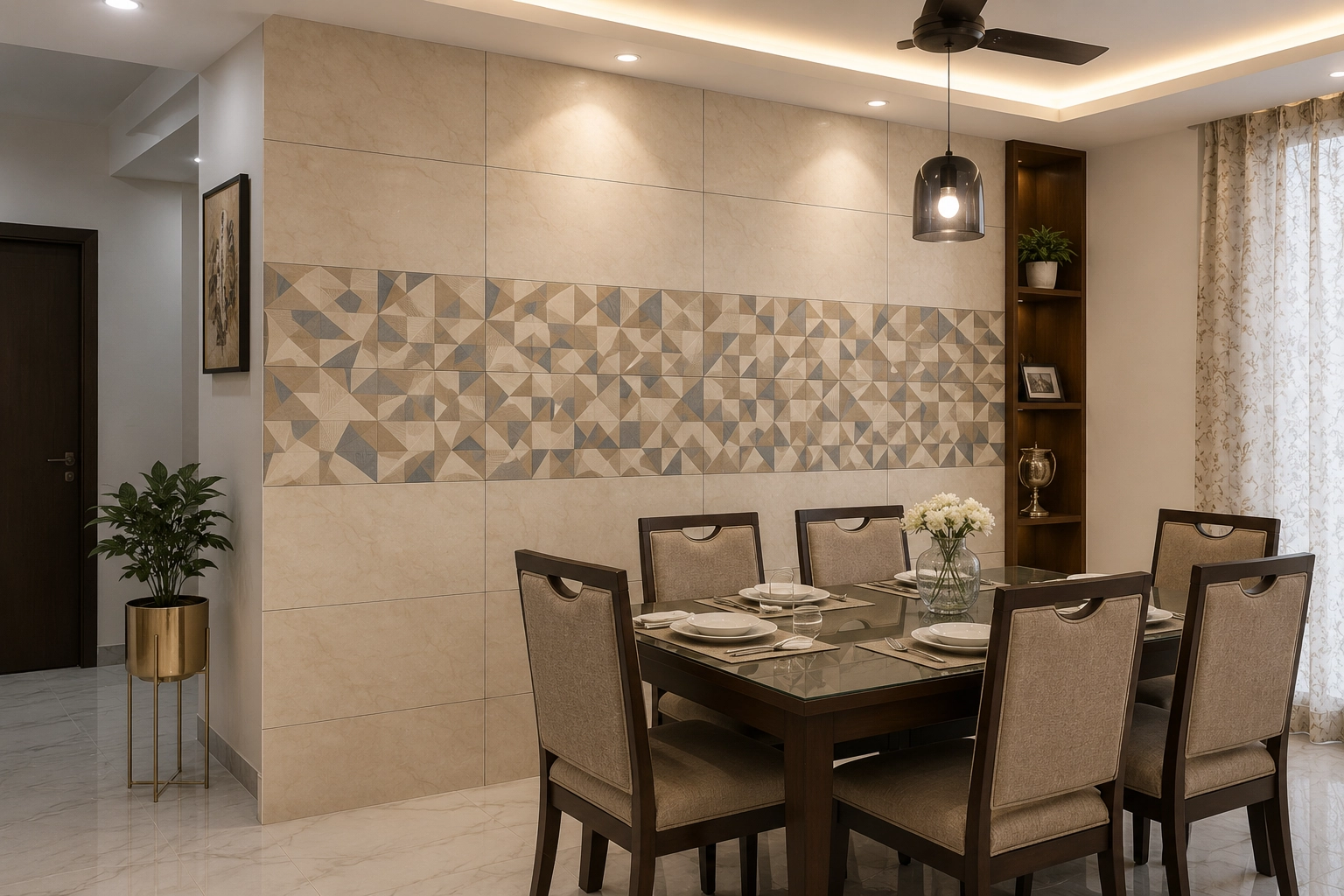
Ceramic tiles are the most widely used wall tile type in Indian dining rooms. They carry a water absorption of 12 to 16% under IS 13630 norms, which is acceptable for wall applications. They are lighter than vitrified tiles, which makes installation on wall surfaces easier and reduces load on the wall structure.
For dining room accent walls, ceramic tiles in 300x600 mm or 300x450 mm sizes work well. They are available in textured finishes, wood-look prints, solid colours, and geometric patterns. The lower price point makes ceramic a practical choice for covering a full dining room wall or for buyers who want to experiment with a bold colour without a large material investment.
Price: Rs. 25 to Rs. 65 per sq.ft for standard ceramic wall tiles from Morbi and Gujarat suppliers.
Glazed Vitrified Tiles (GVT) for Dining Room Walls
-32367569-e940-446c-897a-c14fd10c4fbd.webp)
GVT tiles on a dining room wall deliver a sharper, more detailed print than ceramic. The vitrified tile body gives a denser surface that holds the glaze layer more precisely, which means marble look, stone look, and wood look designs read more realistically on GVT than on ceramic.
Large format GVT tiles in 600x1200 mm or 800x1600 mm on a single feature wall behind the dining table create a strong focal point. A marble look or stone look GVT in cream, grey, or beige tone on one wall anchors the dining space without the cost or maintenance of natural stone. Matte and satin matte finishes both work well on dining room walls. Glossy GVT is also suitable for wall use only.
Water absorption in GVT is 0.05% or lower under IS 15622:2006. This low absorption makes GVT wall tiles easy to wipe clean in a dining room where cooking oil and food splashes reach the walls near the serving area.
Price: Rs. 60 to Rs. 220 per sq.ft, depending on size and finish. Large format 800x1600 mm GVT wall tiles run Rs. 90 to Rs. 220 per sq.ft from Morbi, Gujarat suppliers.
Polished Glazed Vitrified Tiles (PGVT) for Dining Room Walls
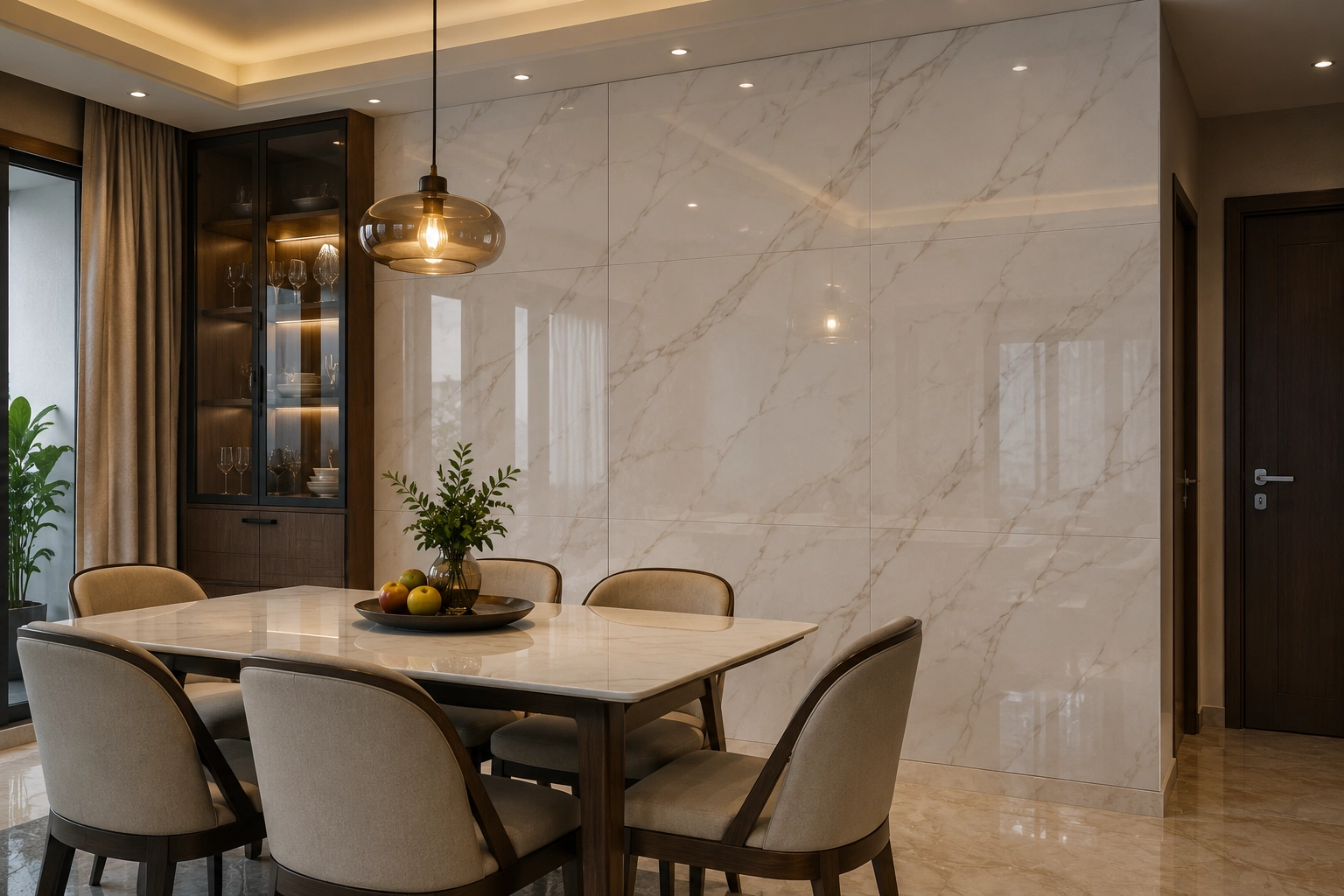
PGVT tiles carry a polished finish applied after firing, which gives a high-sheen mirror-like surface. On a dining room wall, this finish reflects light and makes the space feel larger and more formal. PGVT is a wall and elevation tile only.
Note: PGVT must never be used on dining room floors. The polished surface layer is not designed for foot traffic load or chair abrasion and will wear, scratch, and become a slip hazard within months of floor use. PGVT is rated for wall and elevation surfaces only.
For a dining room feature wall, PGVT in 600x1200 mm with a marble look or solid tone design adds a formal, reflective character. It works particularly well in dining rooms with a single overhead pendant light, where the tile surface catches and distributes the light across the wall.
Price: Rs. 70 to Rs. 200 per s .ft from Morbi and Gujarat suppliers.
High-Depth Punch and 3D Tiles for Dining Room Walls
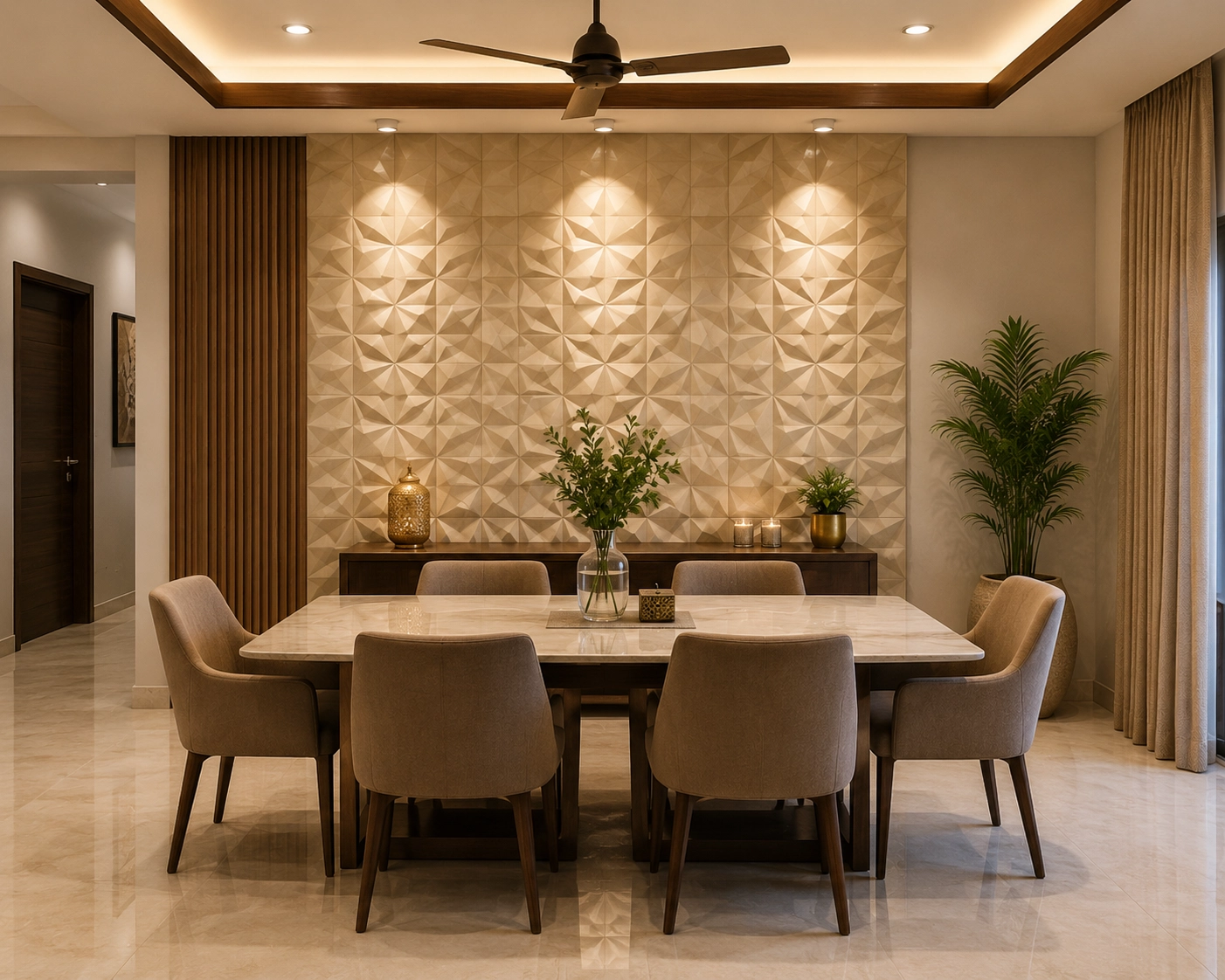
High-Depth punch tiles and 3D textured wall tiles add physical dimension to a dining room backdrop wall. The raised or recessed surface creates shadow lines that shift with the light throughout the day, giving the wall a living quality that flat tiles cannot achieve.
These tiles are for wall and elevation use only. They are not safe for floor use. The raised surface creates a trip hazard, and the tile body is not rated for floor load or chair impact.
Note: High-Depth punch tiles and 3D textured tiles must not be installed on dining room floors under any circumstances. If a supplier or contractor suggests using them on the floor, do not proceed.
In a 10x12 ft dining room, a 3D tile panel of 3 to 4 ft width behind the dining table reads as a deliberate design feature without overwhelming the space. Pair with flat, neutral tiles on the remaining walls to give the textured panel room to work.
Price: Rs. 80 to Rs. 250 per sq.ft for High-Depth or 3D finish wall tiles from Morbi and Gujarat suppliers.
Right Tile Size for Your Dining Room
Tile size changes how a room reads visually. Larger tiles reduce grout lines and make a space feel more open. Smaller tiles create a busier pattern and can make a compact dining room feel smaller.
Size vs Room Dimension: Indian Apartment Context
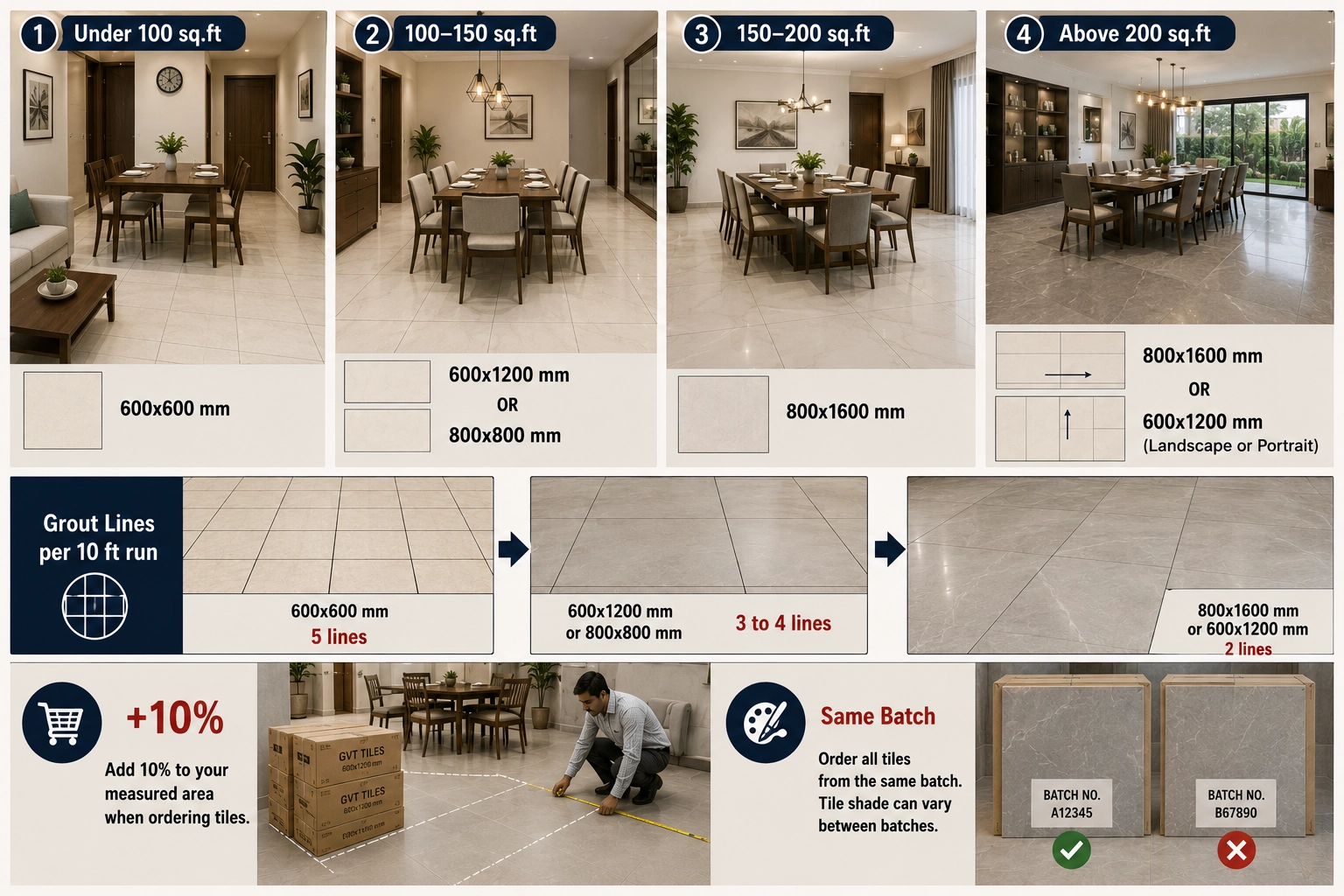
In a 2BHK flat, the dining area is often 80 to 110 sq. ft. ft t, sometimes carved out of the living room rather than a separate room. In a 3BHK or independent home, a dedicated dining room runs 120 to 200 sq.ft.
For rooms under 120 sq. ft., 600x600 mm tiles are the right fit. They do not overscale the space. For rooms above 120 sq ft, 800x800 mm or 2x4 tiles (600x1200 mm) read better and need fewer cuts at edges. For very large dining rooms above 200 sq. ft., 800x1600 mm or 1200x600 mm slabs are a good option.
Tile Size Comparison Table
| Room Size | Recommended Tile Size | Grout Lines per 10 ft run | Price Range (GVT) |
| Under 100 sq.ft | 600x600 mm | 5 lines | Rs. 60 to Rs. 100/sq.ft |
| 100 to 150 sq.ft | 600x1200 mm or 800x800 mm | 3 to 4 lines | Rs. 75 to Rs. 140/sq.ft |
| 150 to 200 sq.ft | 800x1600 mm | 2 to 3 lines | Rs. 90 to Rs. 180/sq.ft |
| Above 200 sq.ft | 1200x600 mm or 800x1600 mm | 2 lines | Rs. 100 to Rs. 200/sq.ft |
Pro tip: Always add 10% to your measured area when ordering tiles. Cuts at room edges, doorways, and furniture legs use more tiles than buyers expect. Ordering from the same batch number matters too. Tile shade can vary between production batches, and a second order from a different batch will not match exactly.
Finish Guide: What Works and What to Avoid
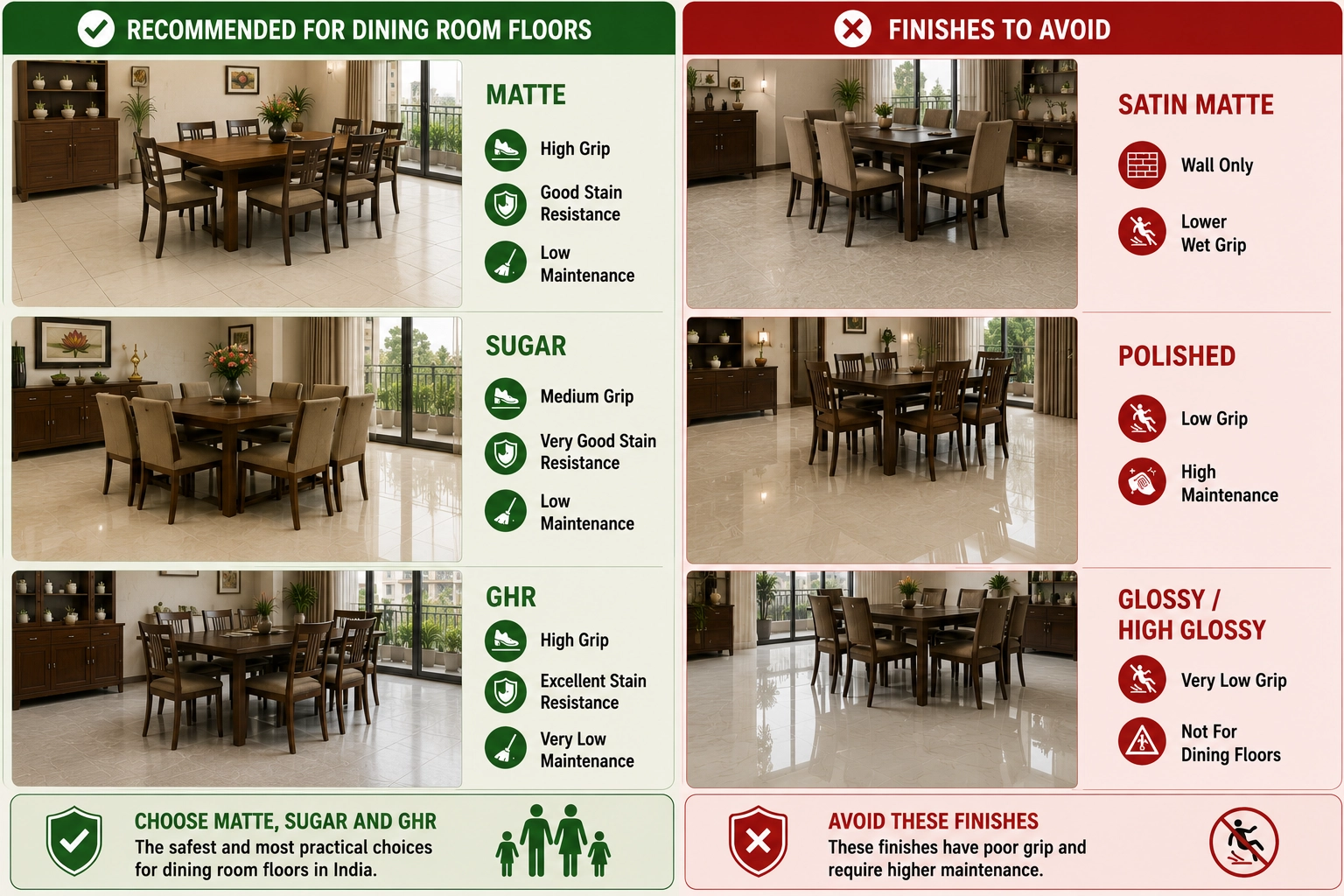
The finish on a dining room floor tile is a safety and maintenance decision, not just a visual one.
| Finish | Slip Resistance (Dry / Wet) | Stain Resistance | Maintenance Load | Suitable for Dining Floor |
| Matte | High / High | Good | Low | Yes |
| Sugar (Lappato) | Medium / Medium | Very Good | Low | Yes |
| GHR (Glazed High Resistance) | High / High | Excellent | Very Low | Yes |
| Satin Matte | Medium / Low | Good | Medium | Walls only |
| Polished | Low / Very Low | Poor (long term) | High | No |
| Glossy / High Glossy | Low / Very Low | Average | High | No |
Matte and sugar finishes are the two safest choices for dining room floor tiles in India. GHR finish, where available, performs even better on stain resistance and is worth the slight price premium for households with young children.
Note: Satin matte finish must not be used on dining room floors. Despite the word "matte" in the name, satin matte has a lower wet-surface grip than standard matte. It is a wall and elevation finish only.
Dining Room Tiles Price Guide India 2026
Prices below are from Morbi, Gujarat, origin tiles as of early 2026. Retail prices at local dealers may run 15 to 25% higher due to transport, handling, and dealer margin.
| Tile Type | Size | Finish | Price Range | Best For |
| GVT (Glazed Vitrified) | 600x600 mm | Matte / Sugar | Rs. 60 to Rs. 100/sq.ft | Standard dining floors |
| GVT (Glazed Vitrified) | 800x800 mm | Matte / GHR | Rs. 75 to Rs. 130/sq.ft | Medium to large dining rooms |
| GVT (Glazed Vitrified) | 600x1200 mm | Sugar / Matte | Rs. 80 to Rs. 160/sq.ft | Rectangular dining layouts |
| GVT (Glazed Vitrified) | 800x1600 mm | Matte | Rs. 90 to Rs. 180/sq.ft | Large dedicated dining rooms |
| Double Charge Vitrified Tiles | 600x600 mm | Polished | Rs. 40 to Rs. 80/sq.ft | Walls only (not dining floors) |
| Ceramic Wall Tile | 300x600 mm | Matt / Glossy | Rs. 25 to Rs. 65/sq.ft | Dining room walls |
For a 120 sq ft dining room floor using 600x1200 mm GVT tiles at Rs. 90/sq.ft, the material cost is Rs. 10,800 to Rs. 12,000 (with 10% wastage). Add Rs. 25 to Rs. 45 per sq.ft for labour and adhesive, bringing the total installed cost to Rs. 13,800 to Rs. 17,400 for a standard finish.
Common Mistakes Buyers Make When Choosing Dining Room Tiles
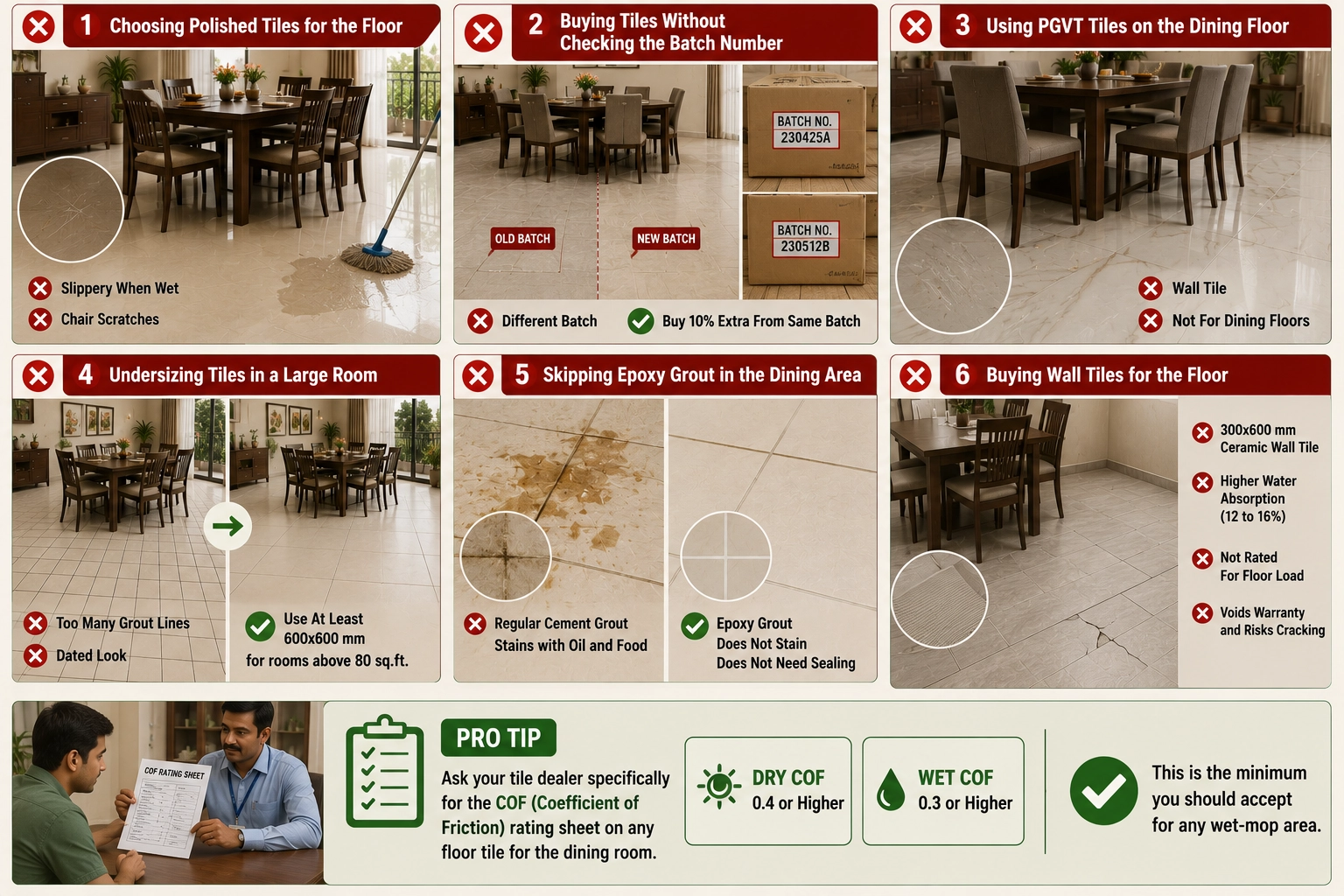
- Choosing polished tiles for the floor: Polished finish looks good in photos, but becomes slippery when wet and shows chair-leg scratches within a year of regular use.
- Buying tiles without checking the batch number: If you need to reorder tiles, a different batch will not match exactly. Always buy 10% extra from the same batch.
- Using PGVT tiles on the dining floor: PGVT (Polished Glazed Vitrified Tiles) are wall tiles. They have a polished surface layer applied after firing, which is not suited to floor foot traffic or chair abrasion.
- Undersizing tiles in a large room: 300x300 mm tiles in a 150 sq ft dining room create more grout lines, more cleaning work, and a dated look. Use at least 600x600 mm in any dining room above 80 sq.ft.
- Skipping epoxy grout in the dining area: Regular cement grout in a dining room stains with oil and food. Epoxy grout costs Rs. 600 to Rs. 900 per kg versus Rs. 40 to Rs. 80 per kg for cement grout, but it does not stain and does not need sealing. On dining room floors, epoxy grout pays for itself within a year.
- Buying wall tiles for the floor: 300x600 mm ceramic tiles are suitable for the wall area. They carry higher water absorption (12 to 16%) and are not rated for floor load. Using them on the floor voids the manufacturer's warranty and risks cracking.
Pro tip: Ask your tile dealer specifically for the COF (Coefficient of Friction) rating sheet on any floor tile you are considering for the dining room. A COF of 0.4 dry and 0.3 wet or higher is the minimum you should accept for any wet-mop area.
Technical Note for Larger Dining Rooms
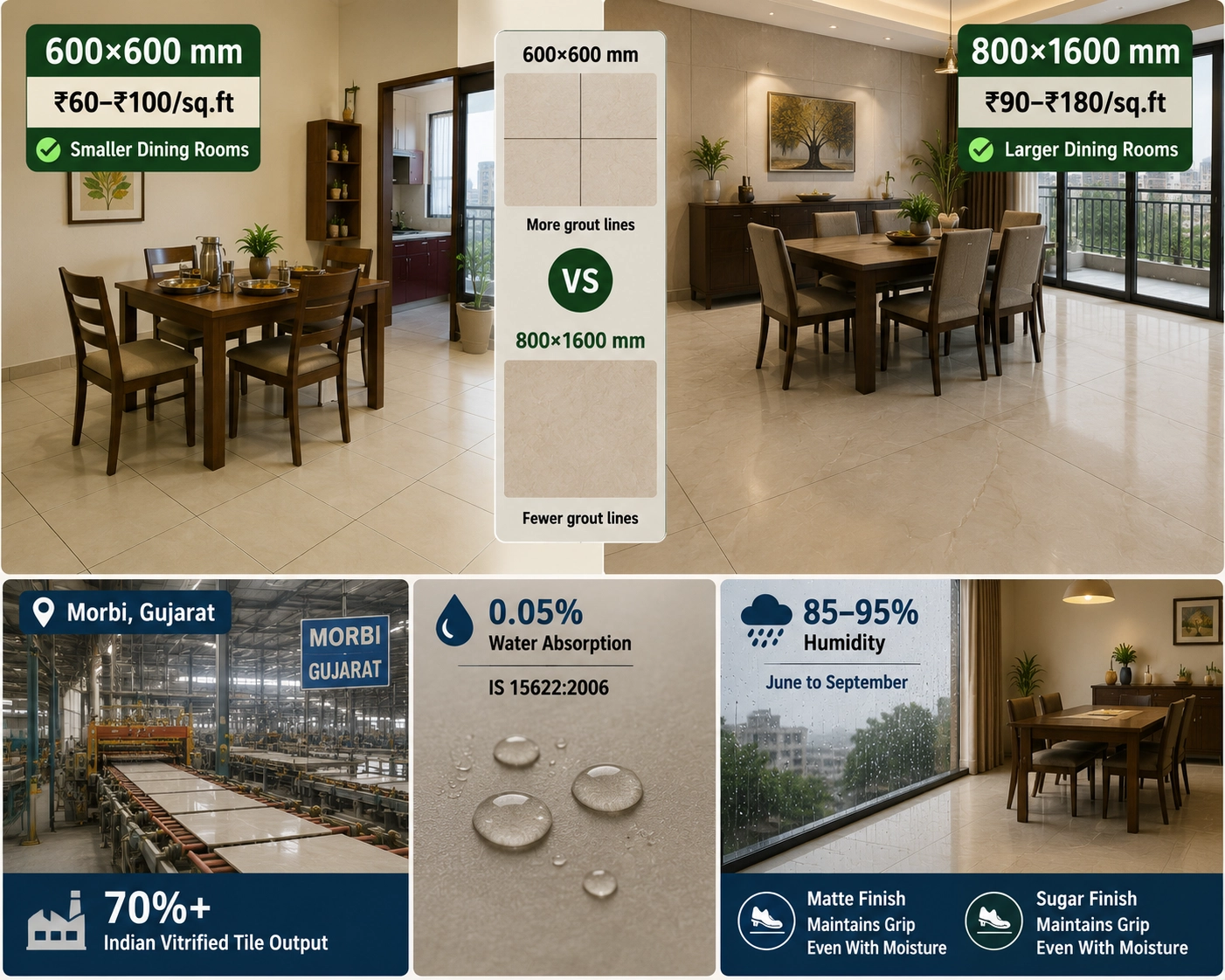
GVT tiles in 800x1600 mm size with matte finish absorb 0.05% water and comply with IS 15622:2006. These are produced primarily in Morbi, Gujarat, which supplies over 70% of India's vitrified tile output. Price for this size in matte finish runs Rs. 90 to Rs. 180 per sq.ft from Gujarat-origin suppliers. The 24x24 (600x600 mm) size at Rs. 60 to Rs. 100 per sq.ft is more economical and covers smaller dining rooms without visible oversizing.
India's monsoon season, which brings 85 to 95% humidity in many parts of the country from June to September, makes surface moisture a year-round concern in ground-floor and semi-basement dining rooms. The 32x64 (800x1600 mm) format in matte GVT at Rs. 90 to Rs. 170 per sq.ft handles this climate well. Morbi and Gujarat factories have been producing humidity-resistant, low-absorption vitrified tiles specifically for Indian conditions for over two decades. A matte or sugar finish maintains grip even when the floor carries ambient moisture from Indian seasonal conditions.
Browse Verified Dining Room Tile Options
Most buyers narrow down tile choices faster when they have filtered options by surface (floor or wall), finish (matte, sugar, or GHR for floors), and size. On Tilesfinders, you can filter dining room floor tiles by finish type and size to compare what is available within your price range. The catalogue pulls directly from verified Morbi and Gujarat suppliers with current stock and pricing.
FAQs
600x600 mm tiles work well for rooms under 120 sq.ft. For rooms between 120 and 200 sq. ft., 600x1200 mm or 800x800 mm tiles give a cleaner look with fewer grout lines. Above 200 sq. ft., 800x1600 mm slabs are worth considering. The rule is that the tile should not overpower the room or create more than 5 to 6 grout line cuts in a 10-foot run.
Matte, sugar (lappato), and GHR (Glazed High Resistance) finishes are safe for dining room floors. Polished, glossy, high-gloss, and satin matte finishes are not suitable for floors in any wet-mop area. The wet slip coefficient on polished finishes drops below safe levels after mopping.
GVT matte tiles in 600x600 mm cost Rs. 60 to Rs. 100 per sq.ft from Morbi, Gujarat suppliers. Larger format tiles in 800x1600 mm cost Rs. 90 to Rs. 180 per sq.ft. Installed cost, including labour and adhesive,e runs Rs. 25 to Rs. 45 per s .ft extra. A 120 sq ft dining room floor typically costs Rs. 13,000 to Rs. 18,000 fully installed.
Yes. GVT (Glazed Vitrified Tiles) with matte or sugar finish are among the best options for dining room floors in India. They absorb 0.05% water or less, which means spills sit on the surface and clean easily. GVT is compliant with IS 15622:2006 and holds up well under regular chair and foot traffic.
GVT tiles carry a printed glaze layer on a vitrified body. They come in matte, sugar, and GHR finishes, all of which are safe for dining floors. Double-charged tiles carry a polished finish, which is slippery when wet. GVT is the better choice for dining room floors. Double-charged tiles are more suited to walls or low-traffic areas where mopping is infrequent.
Yes. Epoxy grout is strongly recommended for dining room floors in Indian homes. Food oil, curry, and liquid spills stain cement grout within a few months and are nearly impossible to remove. Epoxy grout at Rs. 600 to Rs. 900 per kg does not stain and does not need periodic sealing. The additional cost over cement grout is worth it in any dining area.
No. In rooms under 120 sq. ft., 800x1600 mm tiles look oversized and require many cuts at edges, which increases wastage and installation cost. Use 600x600 mm or 600x1200 mm tiles in compact dining rooms. Reserve 800x1600 mm tiles for rooms above 150 sq.ft where the scale works naturally.
Stone-look or marble-look GVT tiles in 600x1200 mm on an accent wall behind the dining table are a popular and practical choice for Indian dining rooms. Ceramic tiles in 300x600 mm with textured or wood-look prints also work well on dining walls at a lower price point. Keep wall tile finishes to matte, satin matte, or gloss on walls only, never the floor.

See our tile guides first
Set TilesFinders as a preferred source and our buying guides surface ahead of the rest for you.
Add as preferred sourceTakes one tap. Nothing to install.
What Readers Say
I was about to redo my parking area with the wrong tile size until I read this. The layout comparisons saved me from a costly mistake.
We reference TilesFinders guides while briefing clients on material selection. The size and pattern breakdowns are accurate and easy to explain visually.
On site, I get asked about grout spacing all the time. This article gave me a solid reference I now share with my team before every job.
Finally a guide that doesn't just push generic advice. The oil stain removal steps actually worked on our clubhouse driveway tiles.
I run a small construction firm and now send this link to clients directly when they ask about entrance tile sizing. Saves me an hour of explaining.
Good practical detail, though I wish there were more examples for compact apartment entrances specifically, not just villas.
My mother-in-law wanted marble, I wanted vitrified. This blog gave us the neutral comparison we needed to actually decide together.
Detailed without being overwhelming. I appreciated that it covered both cost and maintenance, not just the aesthetics.
Used the algae and hard water removal tips on our terrace tiles after the monsoon. Worked better than what our regular cleaner was doing.
As someone who sources tiles for multiple builder projects, I find these comparisons genuinely useful for vendor conversations, not just consumer content.
Recommended this to a client who kept second-guessing the entrance design. The small vs large layout section settled the debate instantly.
Straightforward and honest, no unnecessary jargon. Would like to see a similar breakdown for outdoor pool-deck tiles next.
We've bookmarked several TilesFinders guides for our design handbook. Reliable source when clients want data, not just opinions.
Two paths, one marketplace.
Get free quotes from verified suppliers.
Share your room, budget, and style. Suppliers in Morbi respond within hours.
Get Free QuotesList your business, reach real buyers.
Put your showroom in front of homeowners searching for tiles right now.
List Your Business