Glossy vs Matte Tiles for Retail Showrooms: What Converts Better
Discover whether glossy or matte tiles perform better in Indian retail showrooms. Compare customer experience, safety, maintenance costs, and long-term commercial flooring performance.
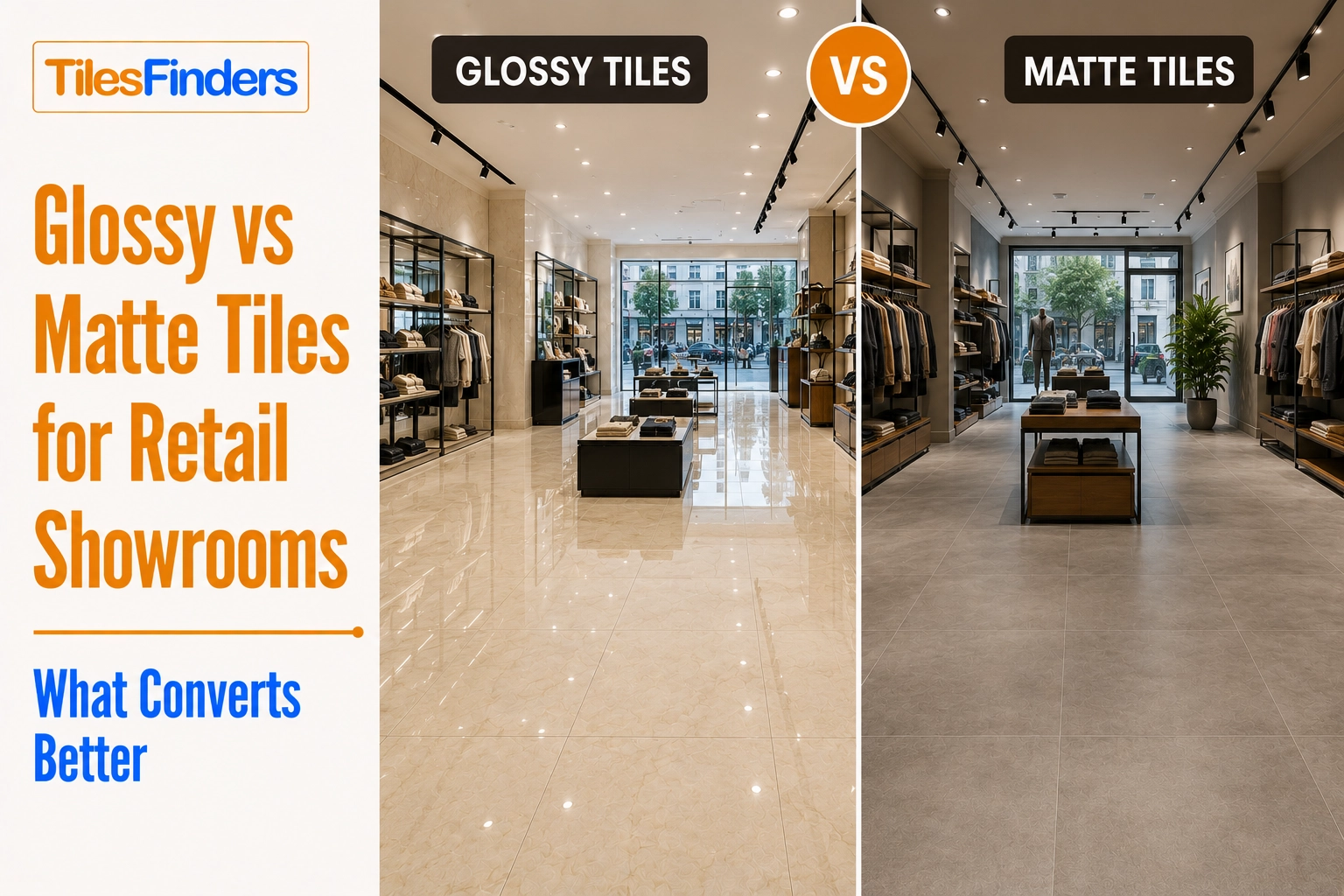
- What Converting Better Actually Means for a Showroom Floor
- Test 1: First Impressions and Visual Impact at Entry
- Test 2: Dwell Time and Customer Comfort in the Space
- Test 3: Floor Safety and Monsoon-Season Risk
- Test 4: Maintenance Cost Over the Lease Period
- Verdict by Retail Category: Which Finish for Which Showroom
- Where Glossy Tiles Genuinely Earn Their Place in a Showroom
- The Manufacturing Reason Matte GVT Outperforms Glossy in Indian Retail Conditions
- Specify the Right Finish for Your Showroom Floor
Matte tiles outperform glossy tiles in most Indian retail showrooms due to better slip resistance, lower maintenance, and a cleaner appearance over time. Glossy tiles are best reserved for feature walls and accent applications. When customer safety, durability, and long-term showroom presentation matter, matte and GHR finishes remain the preferred flooring choice for modern Indian retail spaces.
Matte tiles convert better in most Indian retail showrooms, making them the preferred choice for modern showroom tile designs. That is the direct answer, and any experienced retail interior designer will give you the same recommendation.
The longer answer is that the word converts is doing some work here, and glossy tiles earn their place in specific applications within the same showroom. Understanding where each finishes wins and loses is what turns this from a preference debate into a commercial decision.
This guide tests both finishes against four key factors that actually affect retail conversion: first impressions, customer dwell time, floor safety, and maintenance costs over the lease period. It then provides a retail-category verdict, allowing you to apply the answer directly to your own showroom brief.
What Converting Better Actually Means for a Showroom Floor
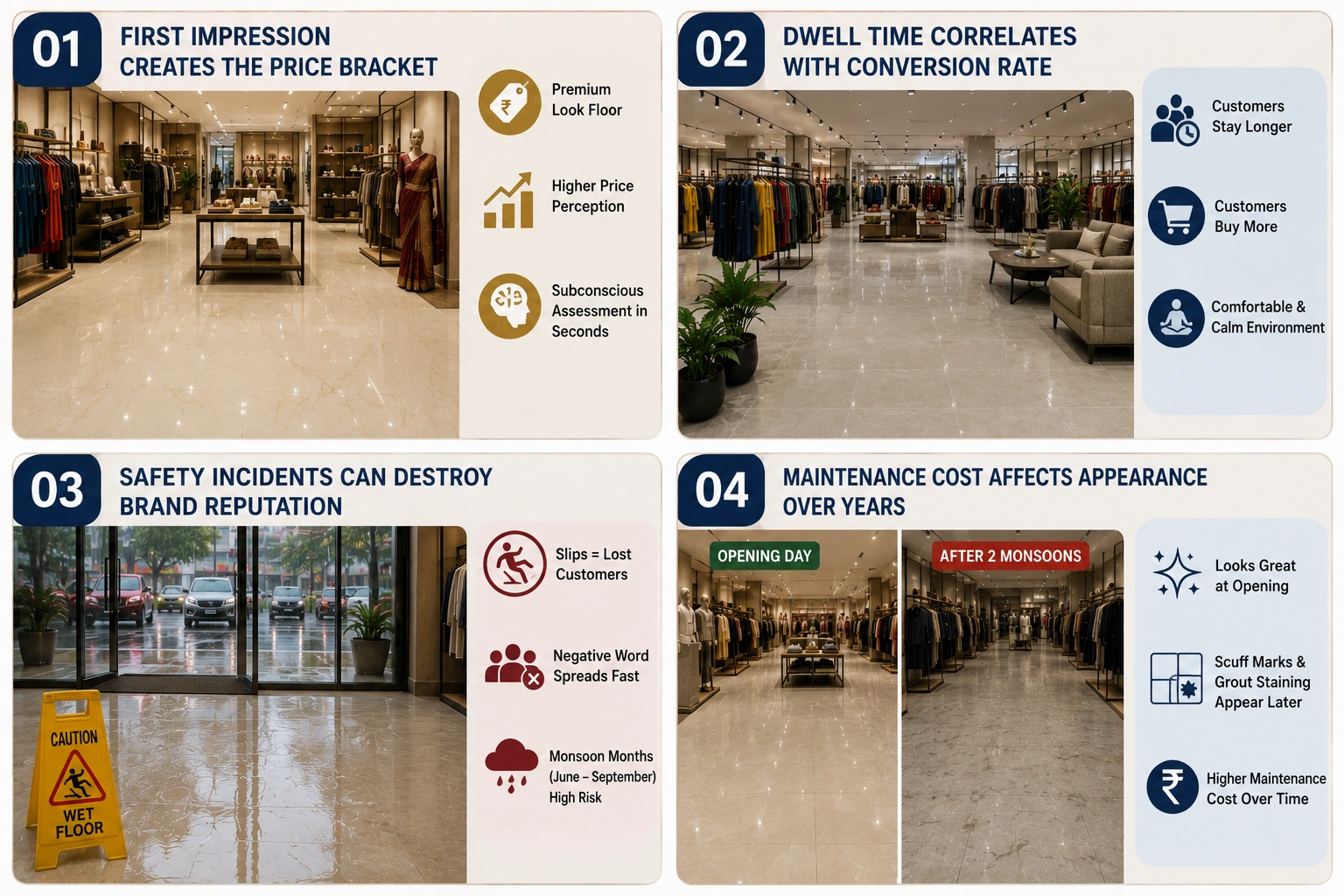
A tile finish does not directly cause a sale. What it does is contribute to or undermine the environment in which a customer makes a buying decision. The mechanisms are indirect but measurable across retail categories:
First impressions create the price bracket.
A customer's subconscious assessment of whether a showroom's pricing is reasonable happens in the first few seconds of entry, before they have looked at a single price tag. A floor that reads as premium (large format, consistent sheen, no visible wear) positions the product above the customer's first pricing assumption. One that reads as dated or tired does the opposite.
Dwell time correlates with conversion rate.
Customers who stay longer buy more. Retail environments that feel comfortable, calm, and visually coherent keep customers in the space. Environments that feel cold, busy, or institutional signal to customers that they should transact quickly and leave. The floor's contribution to this is significant because it anchors the colour temperature and visual weight of the entire space.
Understanding where each finishes wins and loses is what turns this from a preference debate into a commercial decision. For a complete overview of material selection, installation methods, and pricing, refer to our showroom tiles guide.
Safety incidents can destroy a brand's reputation faster than any other single event.
A customer who slips in a showroom does not come back. Their social network hears about it. In India's monsoon season, when tracked-in moisture is unavoidable in ground-floor and mall-frontage showrooms from June to September, the floor finish is a direct variable in whether a slip incident occurs.
Maintenance cost affects the floor's appearance over the years, not just at opening.
A showroom floor that looked impressive at the inauguration but shows scuff marks, grout staining, and finish degradation by the second monsoon season signals neglect of customers, regardless of how well-maintained the merchandise is. The tile finish you choose determines how much effort and cost are required to keep the floor at opening-day standard.
Test 1: First Impressions and Visual Impact at Entry
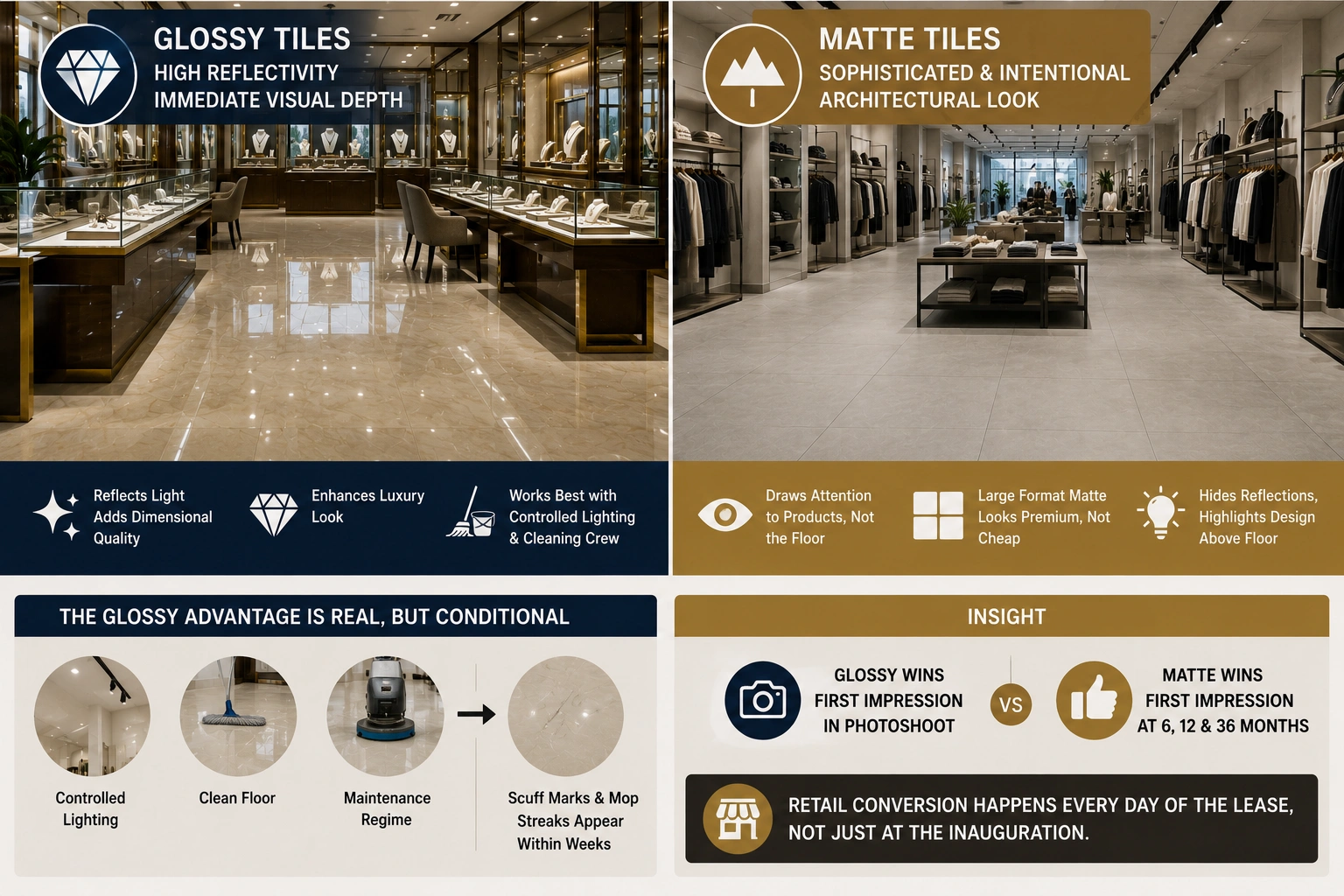
This is where the glossy finish argument is strongest, and it deserves an honest hearing.
Glossy: High reflectivity creates an immediate visual depth that matte tiles cannot match. A glossy marble-look tile in a jewellery showroom or luxury hotel reflects light and gives the space a dimensional quality. 0 In a showroom with controlled lighting and a cleaning crew, this effect is real and impactful. | Matte: Reads as sophisticated and intentional in contemporary retail. A large-format matte GVT slab in a showroom with good lighting does not look cheap - it looks architectural. The absence of reflection draws the eye to the products displayed above the floor rather than to the floor itself. |
The glossy first-impression advantage is real but conditional. It depends on controlled lighting, a clean floor, and a maintenance regime that keeps the gloss consistent. In a retail environment with variable lighting, high footfall, and a standard cleaning crew, glossy tiles show scuff marks and mop streaks under track lighting within weeks of opening. The first-impression advantage erodes fast.
The visual impact of flooring plays a major role in customer perception. Explore these showroom floor designs to see how different tile layouts, finishes, and formats influence retail environments.
Insight: Glossy wins the first impression in a photoshoot. Matte wins the first impression at 6 months, 12 months, and 36 months after opening day. Retail conversion happens every day of the lease, not just at the inauguration.
Test 2: Dwell Time and Customer Comfort in the Space
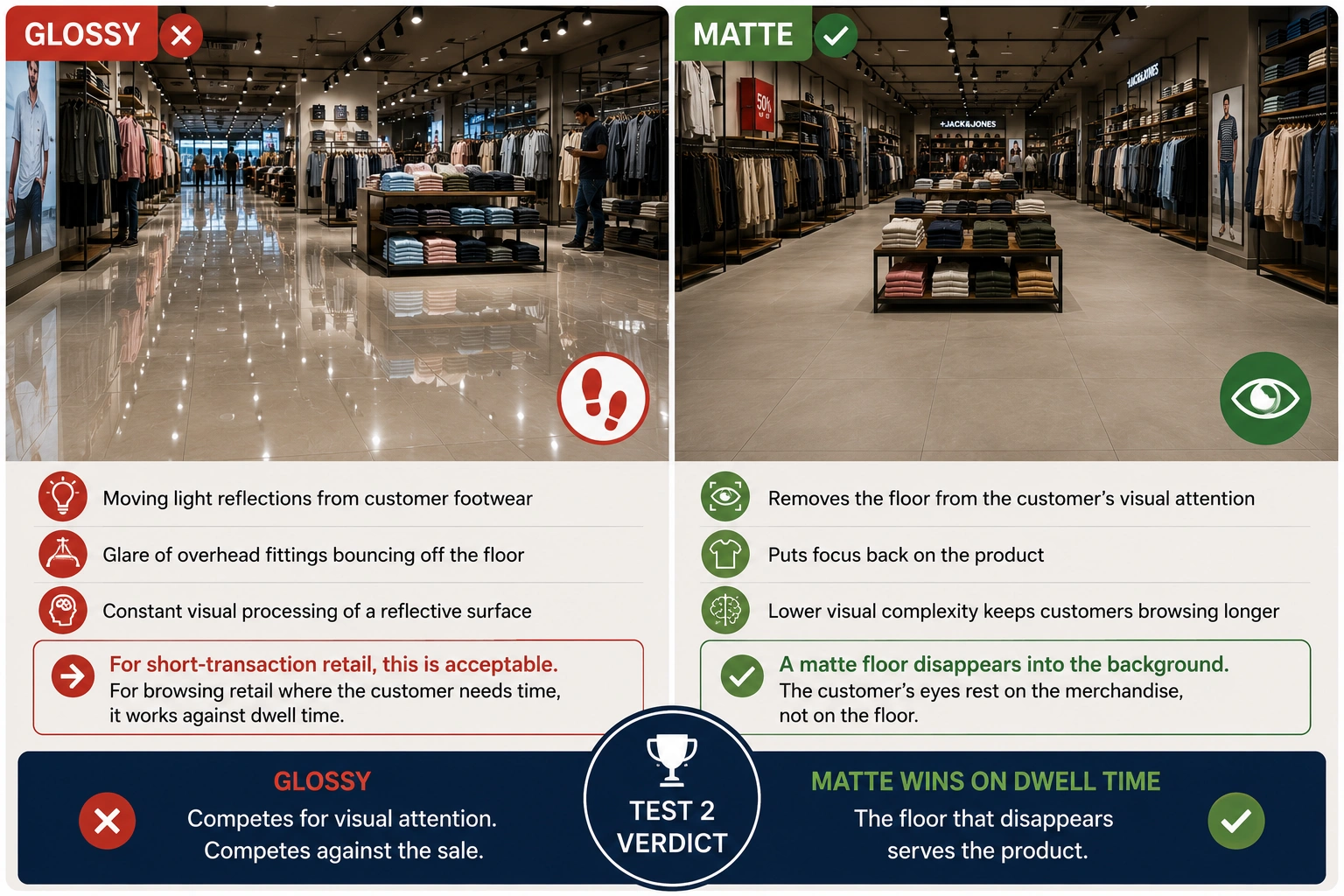
Glossy: High-gloss floors under the track lighting common in Indian retail showrooms create visual noise: moving light reflections from customer footwear, the glare of overhead fittings bouncing off the floor, and the constant visual processing of a reflective surface. For short-transaction retail, this is acceptable. For browsing retail where the customer needs time, it works against dwell time. | Matte: Removes the floor from the customer's visual attention and puts it back on the product. A matte floor in a well-lit showroom disappears into the background. The customer's eyes rest on the merchandise, not on the floor, managing their visual field. Retail research consistently finds that environments with lower visual complexity keep customers browsing longer. |
Test 2 verdict: Matte wins on dwell time. The floor that disappears serves the product. The floor that competes for visual attention competes against the sale.
Test 3: Floor Safety and Monsoon-Season Risk
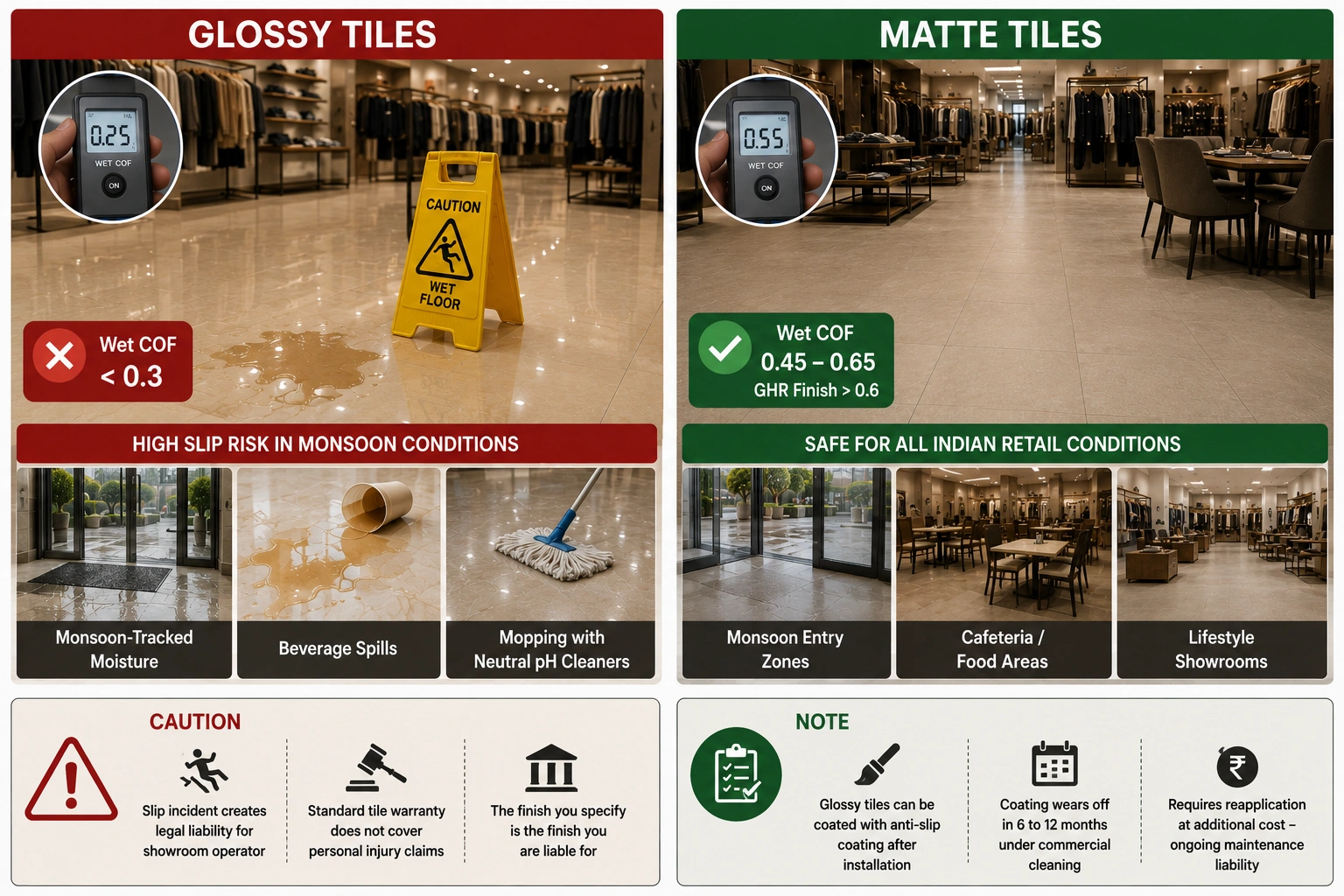
This is not a close contest.
Glossy: Polished and glossy finishes test below 0.3 wet COF under standard conditions. After mopping with the neutral pH cleaning agents used in most retail environments, wet COF on a glossy tile can drop further. In a showroom where monsoon-tracked moisture, beverage spills, and mopping happen simultaneously, a glossy floor is a documented liability risk. The question is not whether a slip will occur, but when. | Matte: Matte finish GVT tiles test at 0.45 to 0.65 wet COF depending on surface texture and manufacturing grade. GHR finishesthe tiles test above 0.6 wet COF. These are safe commercial floor ratings across all Indian retail conditions, including monsoon season entry zones and cafeteria or food-adjacent areas in lifestyle showrooms. |
Caution: A single slip incident in a showroom in India, where the customer's injury can be attributed to an inadequate floor finish, creates legal liability for the showroom operator, not the tile manufacturer. The standard tile warranty does not cover personal injury claims. The finish you specify is the finish you are liable for.
Note: Glossy tiles can be specified with anti-slip coating applied after installation, but these coatings wear off under commercial cleaning routines within 6 to 12 months and require reapplication at additional cost. The coating is not a substitute for an inherently safe finish; it is an ongoing maintenance liability.
Test 4: Maintenance Cost Over the Lease Period
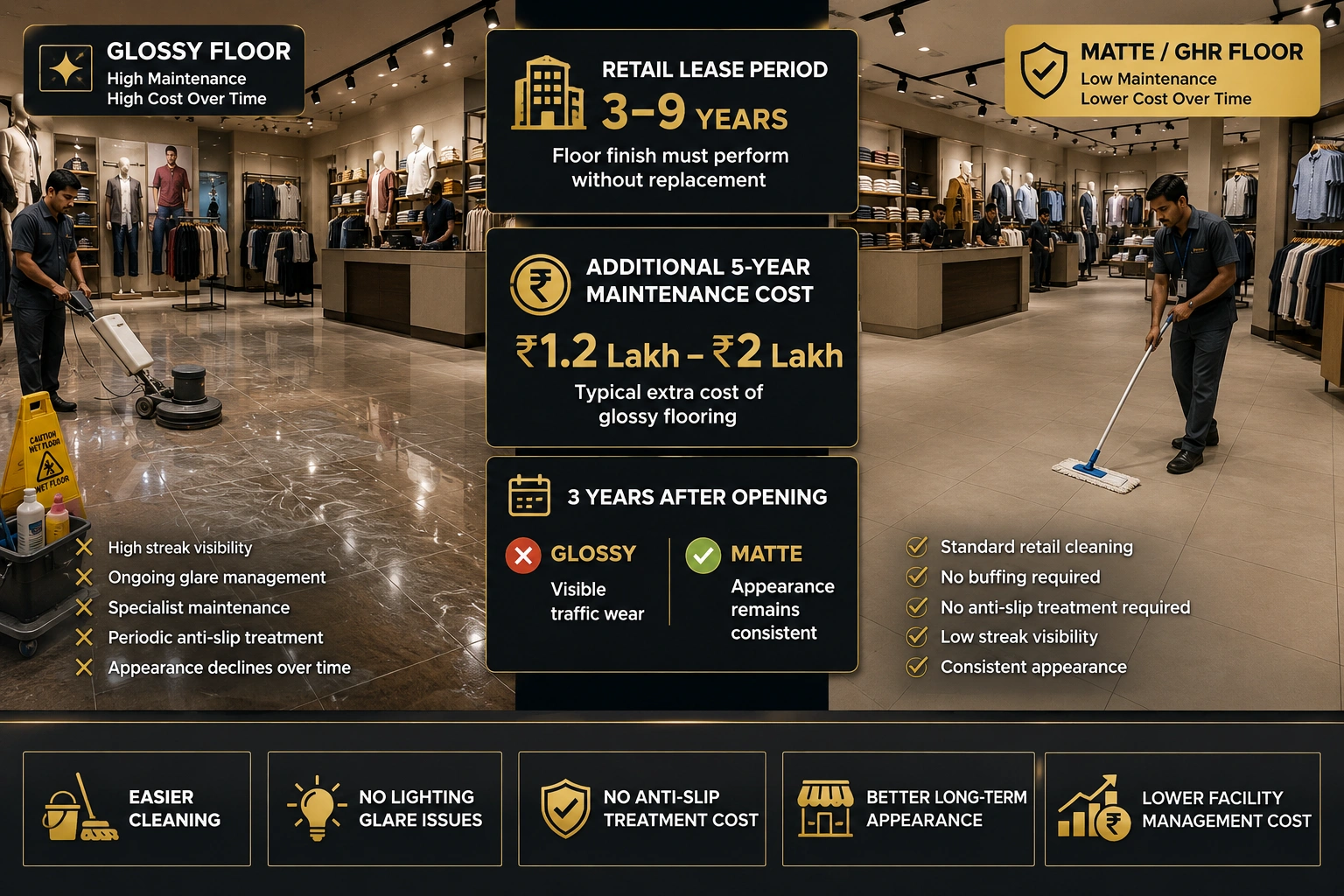
Most retail showrooms in India operate on 3 to 9-year leases. The tile finish chosen at fit-out has to perform across that full period without a replacement cycle that would require store closure.
| Maintenance Task | Glossy Floor | Matte Floor |
| Daily cleaning | Damp mop + dry buff to avoid water marks | Damp mop, no buffing required |
| Scuff mark removal | Requires a specialist product, often leaves a dull patch | Wipes off with neutral pH cleaner |
| Track lighting glare management | Ongoing: angle changes expose different reflection zones | Not required |
| Mop streak visibility | High: streaks visible under track lighting, same day | Low: streaks are dry and invisible on matte surface |
| Anti-slip treatment (if required) | Rs. 20 to Rs. 40/sq.ft every 6 to 12 months | Not required for matte/GHR finish |
| Appearance at 3 years post-opening | Visible wear pattern in traffic lines, difficult to restore | Consistent with opening day, if grouted with epoxy |
Cost note: For a 1,000 sq.ft showroom floor, the additional maintenance cost of glossy tiles over a 5-year lease, including periodic anti-slip treatment, specialist buffing service, and more frequent grout cleaning, typically adds Rs. 1,20,000 to Rs. 2,00,000 in facility management cost versus a matte floor maintained with a standard retail cleaning routine. This figure rarely appears in the original fit-out budget.
Test 4 verdict: Matte wins decisively. Glossy tiles create an ongoing maintenance liability that grows year on year and directly affects the floor's appearance during the peak revenue-earning years of the lease.
Verdict by Retail Category: Which Finish for Which Showroom
| Retail Category | Floor Finish Verdict | Wall Finish | Reason |
| Jewellery / Luxury | Matte or Sugar (floor) | Glossy accent acceptable | Matte keeps focus on product; sugar adds sheen without glare |
| Automobile | Matte / GHR (floor) | Matte | Dark matte resists tyre rubber; no glare under showroom lighting |
| Apparel / Fast Fashion | Matte (floor) | Glossy on feature walls | High footfall degrades glossy fast; walls can carry gloss safely |
| Electronics / Tech | Matte / GHR (floor) | Matte | Controlled lighting + clean lines: matte reads as precision |
| Pharmacy / Optical | Matte (floor) | Glossy wall tiles | Clinical associations come from wall finish, not floor gloss |
| Furniture / Decor | Matte (floor) | Matte or subtle texture | Floor must not compete with the furniture display above it |
| Cosmetics / Beauty | Matte (floor) | Glossy feature wall | Beauty retail: glossy wall behind the product display, matte floor |
| Food and Beverage Retail | GHR / Anti-skid matte (floor) | Glossy wall tiles | Spill and moisture risk demands the safest possible floor finish |
The pattern in the table above is consistent: glossy belongs on walls, not floors, in virtually every Indian retail category. On walls, glossy tiles are easier to wipe clean than matte, reflect retail track lighting to add brightness, and carry no slip liability. On floors, none of those advantages apply and all the liabilities do.
Pro tip: If your designer or contractor is proposing glossy floor tiles for a showroom, ask them to show you a reference project where those tiles have been in use for at least 18 months, not a render or an opening-day photograph. The 18-month appearance of a glossy commercial floor is the honest comparison point.
Where Glossy Tiles Genuinely Earn Their Place in a Showroom
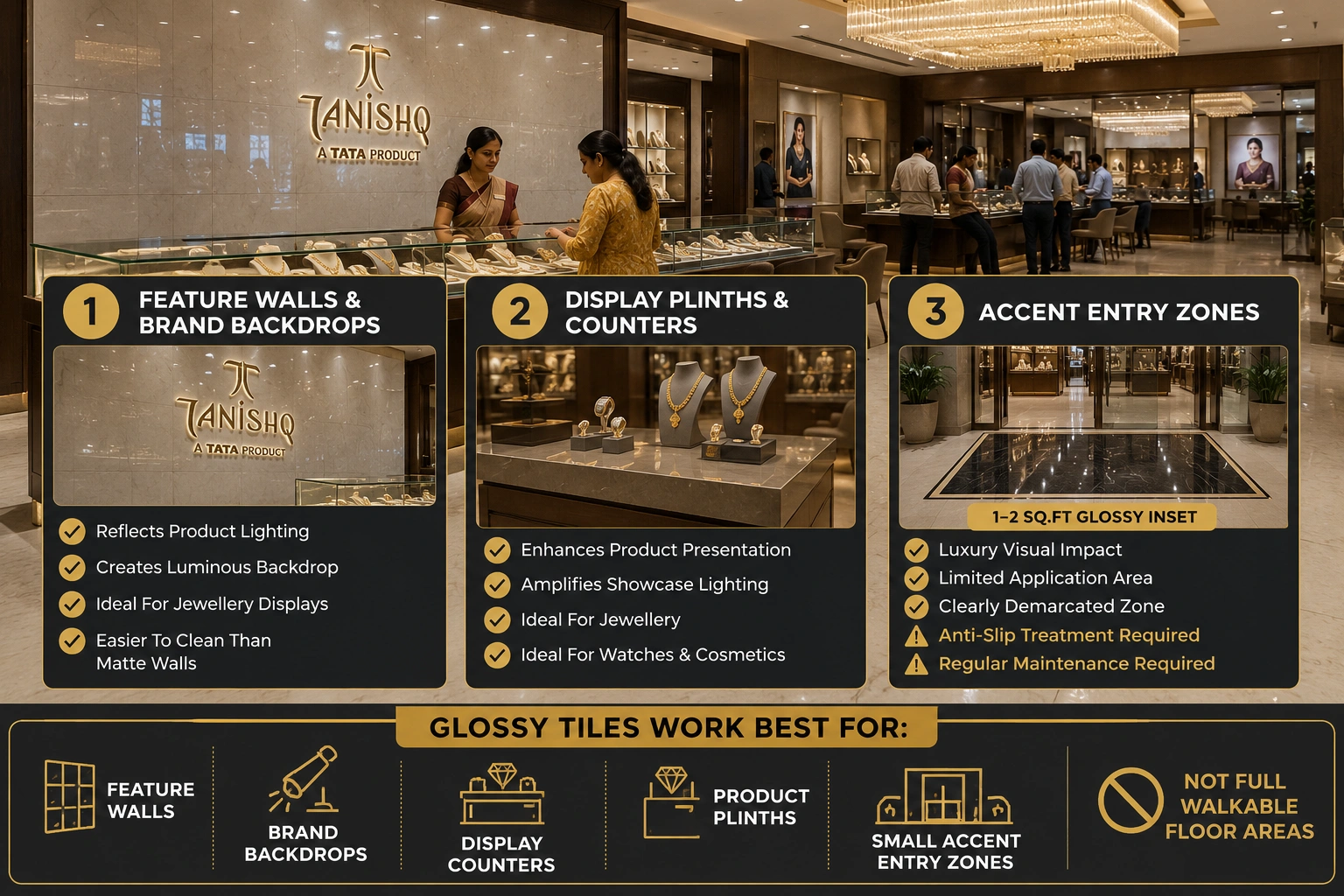
This guide argues for matte on floors. It is not an argument against glossy tiles across the board. There are three showroom applications where glossy tiles are the right choice:
Feature walls and brand backdrop panels.
A full-height glossy tile wall behind a jewellery display counter or cosmetics brand back wall reflects product lighting and creates a luminous backdrop that matte tiles cannot match. Glossy wall tiles are also easier to wipe clean than matte wall tiles, which is commercially relevant in cosmetics and food retail.
Display plinths and product presentation surfaces.
Not a floor tile application, but worth naming: glossy tile surfaces on product display plinths and counter tops create a reflective base for jewellery, watches, and cosmetic products that amplifies product lighting effectively.
Small accent entry mat zones in luxury retail, with a safety caveat.
A 1 to 2 sq ft glossy inset at a jewellery showroom threshold can create a visual moment without covering the full walkable floor area in a slip-risk finish. This is only viable when the inset is clearly demarcated from the surrounding floor, is polished regularly, and carries an anti-slip treatment that is maintained. The safety caveat is not optional.
The Manufacturing Reason Matte GVT Outperforms Glossy in Indian Retail Conditions
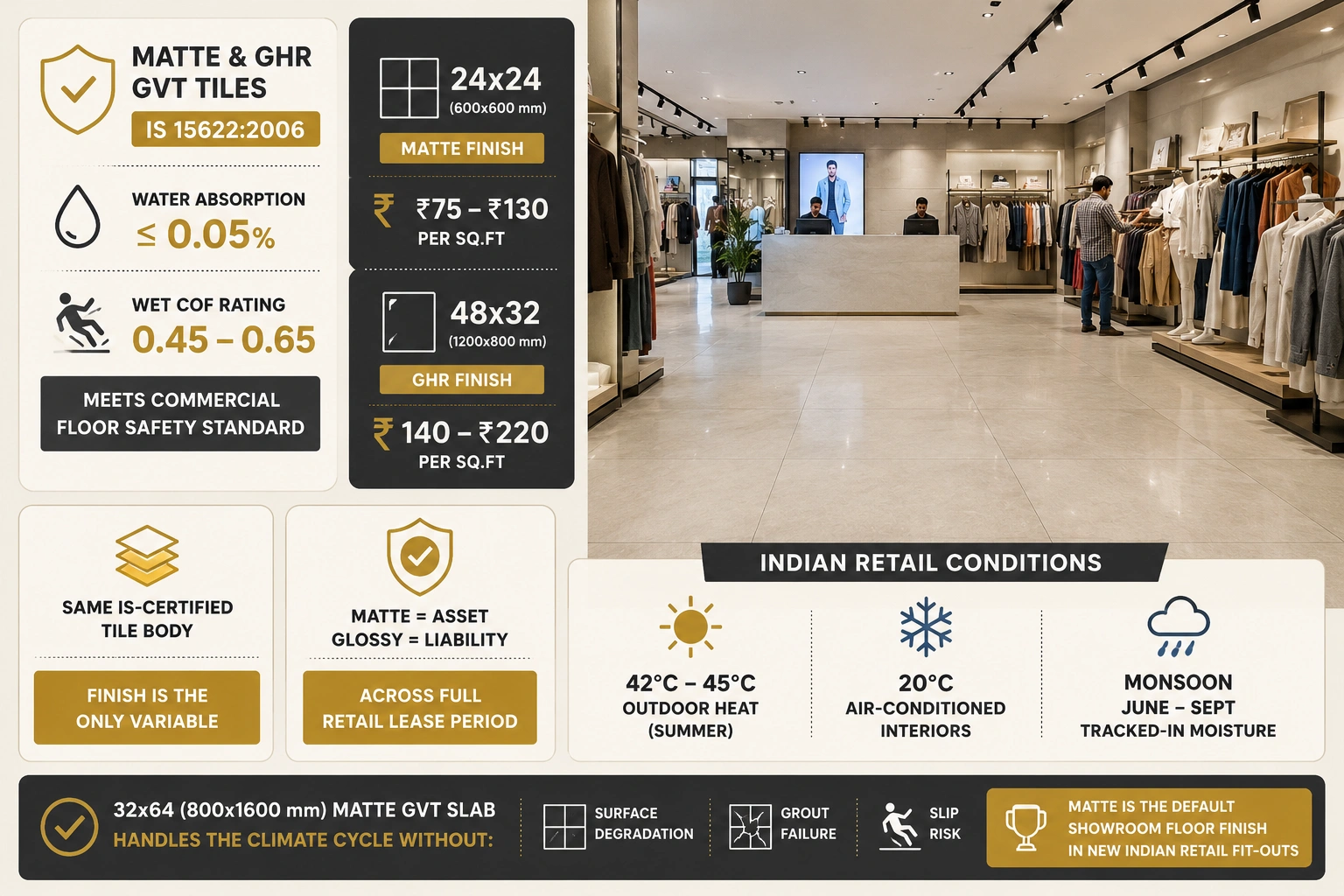
Matte and GHR finish GVT tiles manufactured in Morbi, Gujarat, under IS 15622:2006, with water absorption at 0.05% or lower and wet COF ratings between 0.45 and 0.65, meeting the commercial floor safety standard across all Indian retail conditions. The 24x24 (600x600 mm) format in matte finish costs Rs. 75 to Rs. 130 per sq.ft from Morbi suppliers, and the 48x32 (1200x800 mm) large slab in GHR finish costs Rs. 140 to Rs. 220 per sq.ft, both from the same IS-certified tile body that the glossy finish tiles are manufactured on. The finish is the only variable between them. It is also the variable that determines whether the floor is a commercial asset or a maintenance liability across the full retail lease period.
India's retail lease environment makes this decision consequential in a way that it is not in markets with milder climates. A showroom in Ahmedabad, Hyderabad, or Nagpur cycles between 42 to 45 degrees Celsius outdoor heat and 20 degrees Celsius air-conditioned interiors daily across summer months, while the monsoon season from June to September adds tracked-in moisture that a 32x64 (800x1600 mm) matte GVT slab from Gujarat manufacturers handles without surface degradation, grout failure, or slip risk. The same slab in a glossy finish carries none of those performance guarantees through that climate cycle, which is the operational reason that matte has become the default showroom floor finish in new Indian retail fit-outs, independent of any design preference.
Specify the Right Finish for Your Showroom Floor
Comparing matte and sugar finish options for your specific showroom category is faster when you can filter by finish and retail application in one place. On TilesFinders, showroom floor tiles in matte, sugar, and GHR finishes from verified Morbi and Gujarat manufacturers are catalogued with current 2026 pricing and technical specifications.
FAQs
Matte tiles convert better across most Indian retail showrooms. They maintain a consistent, clean appearance over years of commercial use, reduce visual distraction from the floor surface, and carry no wet-slip liability during the monsoon season. Glossy tiles win on the opening-day photograph. Matte wins on every other day of the lease.
No. Polished and glossy finish tiles test below 0.3 wet COF after mopping, which is below the commercial safety threshold of 0.4. In monsoon season, when tracked-in moisture is unavoidable in ground-floor and mall-frontage showrooms from June to September, a glossy floor is a documented slip liability. Anti-slip coating applied after installation wears off within 6 to 12 months and requires reapplication.
Sugar (lappato) or matte finish GVT in 800x1600 mm or 600x1200 mm is best for jewellery showroom floors in India. Sugar finish gives a soft sheen that reads as premium without the wet-slip risk of polished or glossy. Matte finish is the safest choice. Glossy tiles are appropriate for the feature wall behind the display counter, not the floor.
Yes. Glossy tiles on showroom walls are appropriate and commercially beneficial. Wall tiles carry no slip liability. Glossy wall tiles reflect retail track lighting to add brightness, are easy to wipe clean of cosmetic and food residue in relevant retail categories, and create a luminous backdrop for product displays. The argument against glossy applies specifically to floors, not walls.
Matte finish gives the highest slip resistance and lowest maintenance load. Sugar (lappato) gives a soft sheen with medium slip resistance, suitable for lower-traffic enclosed showroom areas. GHR (Glazed High Resistance) is a premium matte-category finish with the highest stain resistance of the three, recommended for showrooms with high footfall and food or beverage exposure. None of the three is a polished or glossy finish.
Yes. Glossy floors photograph with visible reflections of overhead lighting and camera equipment, which professional retail photographers manage through lighting angle adjustments. Matte floors photograph more cleanly with a consistent surface appearance. For social media photography taken from standing height by non-professionals, matte floors produce more consistent results without unexpected glare or reflection artefacts.
Matte or GHR finish is the only appropriate choice for ground-floor showrooms in high-humidity coastal cities. Mumbai, Chennai, and Kochi see monsoon humidity at 85 to 90% from June to September, and tracked-in moisture on footwear creates a wet-floor condition at showroom entry zones daily during this period. A glossy floor in these cities is a seasonal liability for the full monsoon period every year of the lease.
For a 1,000 sq.ft showroom, glossy floor maintenance over 5 years adds an estimated Rs. 1,20,000 to Rs. 2,00,000 in facility management cost above a matte floor, covering periodic anti-slip treatment, specialist buffing service, and more frequent grout cleaning. A matte GVT floor with epoxy grout requires only a standard damp-mop routine from a regular cleaning crew, with no specialist service schedule.

See our tile guides first
Set TilesFinders as a preferred source and our buying guides surface ahead of the rest for you.
Add as preferred sourceTakes one tap. Nothing to install.
What Readers Say
I was about to redo my parking area with the wrong tile size until I read this. The layout comparisons saved me from a costly mistake.
We reference TilesFinders guides while briefing clients on material selection. The size and pattern breakdowns are accurate and easy to explain visually.
On site, I get asked about grout spacing all the time. This article gave me a solid reference I now share with my team before every job.
Finally a guide that doesn't just push generic advice. The oil stain removal steps actually worked on our clubhouse driveway tiles.
I run a small construction firm and now send this link to clients directly when they ask about entrance tile sizing. Saves me an hour of explaining.
Good practical detail, though I wish there were more examples for compact apartment entrances specifically, not just villas.
My mother-in-law wanted marble, I wanted vitrified. This blog gave us the neutral comparison we needed to actually decide together.
Detailed without being overwhelming. I appreciated that it covered both cost and maintenance, not just the aesthetics.
Used the algae and hard water removal tips on our terrace tiles after the monsoon. Worked better than what our regular cleaner was doing.
As someone who sources tiles for multiple builder projects, I find these comparisons genuinely useful for vendor conversations, not just consumer content.
Recommended this to a client who kept second-guessing the entrance design. The small vs large layout section settled the debate instantly.
Straightforward and honest, no unnecessary jargon. Would like to see a similar breakdown for outdoor pool-deck tiles next.
We've bookmarked several TilesFinders guides for our design handbook. Reliable source when clients want data, not just opinions.
Two paths, one marketplace.
Get free quotes from verified suppliers.
Share your room, budget, and style. Suppliers in Morbi respond within hours.
Get Free QuotesList your business, reach real buyers.
Put your showroom in front of homeowners searching for tiles right now.
List Your Business