Best Glitter Finish Vitrified and Ceramic Tiles India 2027: Bathroom and Feature Wall Picks
Glitter tile picks for Indian bathrooms, pooja rooms and feature walls, with real panel costs, lighting requirements, ceramic versus vitrified options and practical small-order buying advice.
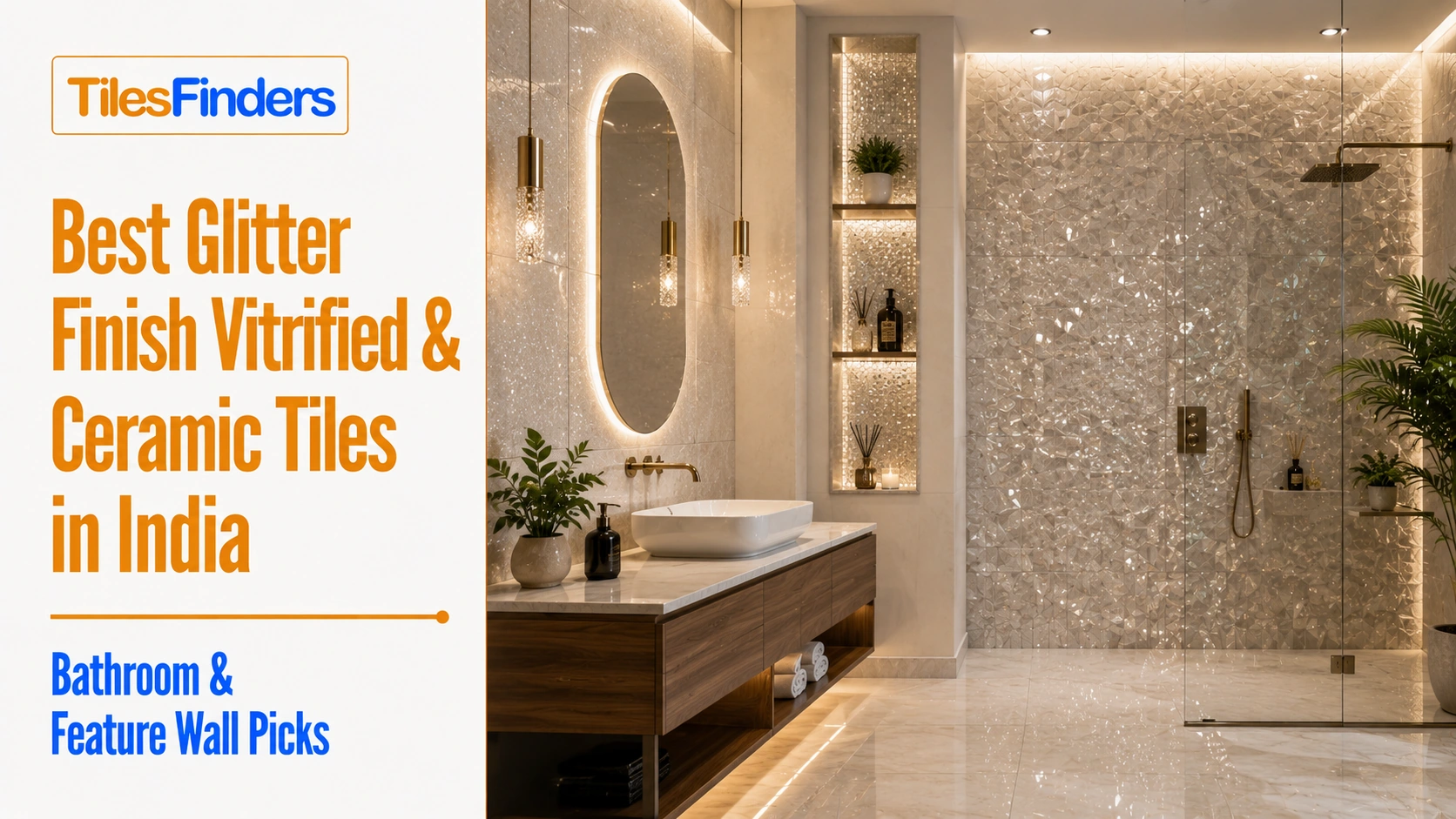
For small glitter panels, total purchase cost matters more than the per-square-foot rate; lighting matters more than upgrading to the costliest tile. Ceramic works well for drywall applications, while vitrified suits larger panels; keep glitter strictly on walls and order one extra box for repairs.
The room rarely buys glitter tiles by the square foot. They are typically chosen for a vanity backdrop, pooja panel, or niche, which means the quantity is small and the per-square-foot rate is the wrong number to compare. This guide starts with what these panels actually cost in total, which changes the buying decision considerably, then gives picks for each application and covers the small-order problems that only show up on purchases this size.
What These Panels Actually Cost
Total material cost for typical glitter applications, comparing an entry-tier tile at around Rs. 110 per sq.ft with a premium one at around Rs. 220 per sq. ft.
| Application | Typical Area | At Rs. 110/sq.ft | At Rs. 220/sq.ft | Difference |
| Small display niche | 4 sq.ft | Rs. 440 | Rs. 880 | Rs. 440 |
| Pooja backdrop panel | 6 sq.ft | Rs. 660 | Rs. 1,320 | Rs. 660 |
| Bathroom vanity backdrop | 12 sq.ft | Rs. 1,320 | Rs. 2,640 | Rs. 1,320 |
| Living room console backdrop | 20 sq.ft | Rs. 2,200 | Rs. 4,400 | Rs. 2,200 |
| Full feature wall | 80 sq.ft | Rs. 8,800 | Rs. 17,600 | Rs. 8,800 |
What that table should change about your decision: On a pooja panel, the entire gap between the cheapest credible glitter tile and the most expensive one is around Rs. 660. On a vanity backdrop, it is around Rs. 1,320. These are not sums worth optimising, and yet buyers routinely spend an afternoon comparing rates on exactly these purchases because per-square-foot is how tile is always priced. For any panel under roughly 20 sq.ft, the sensible approach is to choose the tile you actually want and stop thinking about the rate. The calculation only becomes meaningful at full-wall scale, where the same choice costs nearly Rs. 9,000 more. |
From The Marketplace
Popular tiles right now









The Small-Order Problems Nobody Warns You About
| Problem | Why It Happens | What to Do |
| Minimum order quantity | Suppliers sell by the box, and some decorative ranges carry a minimum beyond that | Ask the minimum before falling in love with a range; a 6 sq.ft panel may require you to buy 20 |
| Overage is proportionally brutal | On a 6 sq.ft panel, one broken tile can be 15% of the order | Order a full extra box rather than a percentage, since percentages are meaningless at this scale |
| Batch matching for future repair | A small leftover is your only future repair stock, and decorative ranges are discontinued faster than standard ones | Keep every offcut, and store them flat somewhere dry |
| Discontinuation risk | Decorative and glitter ranges turn over faster than core floor ranges | Assume you cannot rebuy in three years, and keep spares accordingly |
| Cutting waste on a defined panel | A panel with a planned boundary needs clean cuts on more edges than a floor does | Add one box beyond your calculation, not a percentage |
Before narrowing down a specific panel, it helps to understand where glitter finish actually works best across an Indian home. Our Glitter Finish Tiles Guide covers suitable applications, placement limitations and the lighting conditions that make the sparkle perform.
The one-line rule for small decorative orders: Calculate what you need, then add one full box. On a purchase this size, the extra box costs a few hundred rupees, covers breakage during installation, gives you future repair stock from the correct batch, and removes the risk of running short on a panel you cannot match later. Percentage-based overage rules are built for floors and do not translate to a six-square-foot panel. |
The Picks, Ranked by What You Need Them For
1. BEST OVERALL
Gold Glitter Ceramic, Pooja Backdrop
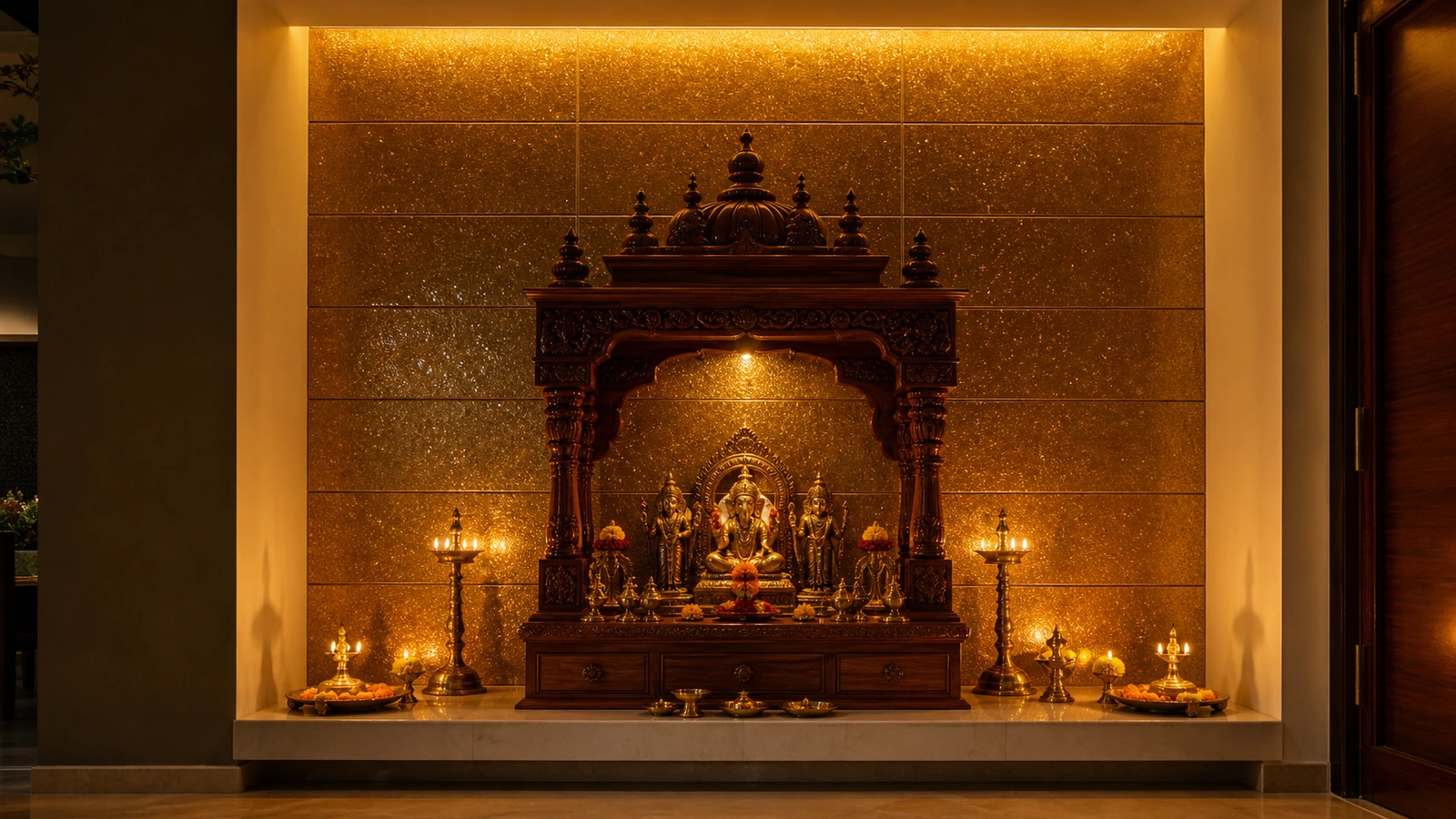
Gold glitter ceramic | 300x600 mm | Glossy | Rs. 110 to Rs. 190/sq.ft
Typical panel cost: About Rs. 660 to Rs. 1,140 for a 6 sq.ft panel
The strongest use of this finish anywhere in the home. Diya flame is a moving point source, and glitter answers it in a way no fixed fitting reproduces. At this panel size, the gap between the cheapest and dearest option is a few hundred rupees, so buy the one you like.
Choose this if: you have a pooja shelf or niche and lamp light reaches the wall directly.
Skip it if: the panel sits behind a deep shelf that blocks flame light, unless you add a concealed warm light at the panel head.
2. THE SAFE BET
White Glitter Ceramic, Vanity Backdrop
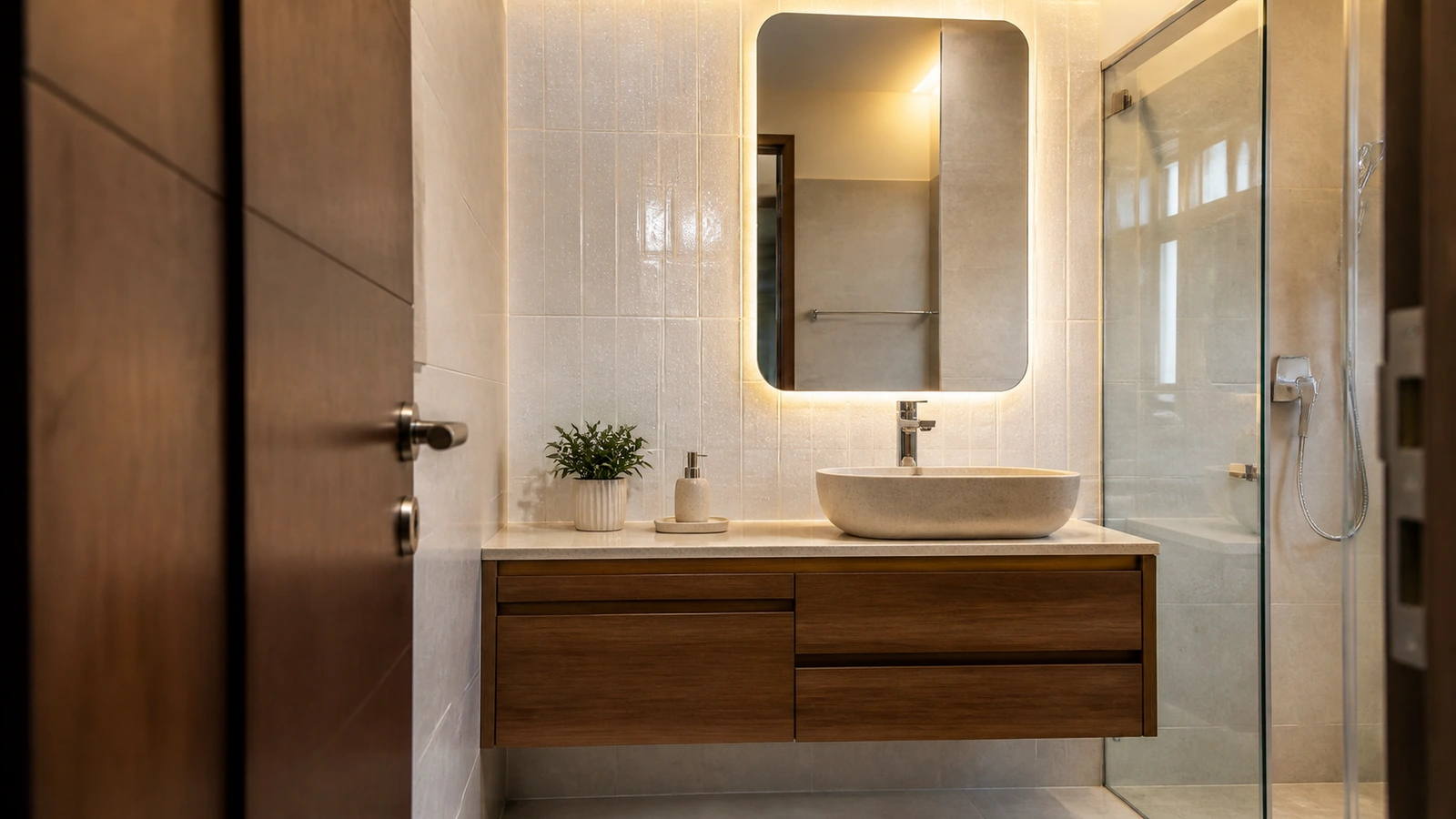
White glitter ceramic | 300x600 mm | Glossy | Rs. 100 to Rs. 175/sq.ft
Typical panel cost: About Rs. 1,200 to Rs. 2,100 for a 12 sq.ft panel
The pick that works in almost any bathroom. A ceramic body is correct for a dry vanity wall; white suits every fitting metal; and existing mirror lighting usually activates these bathroom tiles without a single extra fitting.
Choose this if: this is your first glitter purchase and you want the lowest chance of regret.
Skip it if: you want the panel to be the room's talking point, since white sparkle is the most restrained option here.
3. THE DRAMA PICK
Charcoal Glitter Ceramic, Dark Bathroom Accent
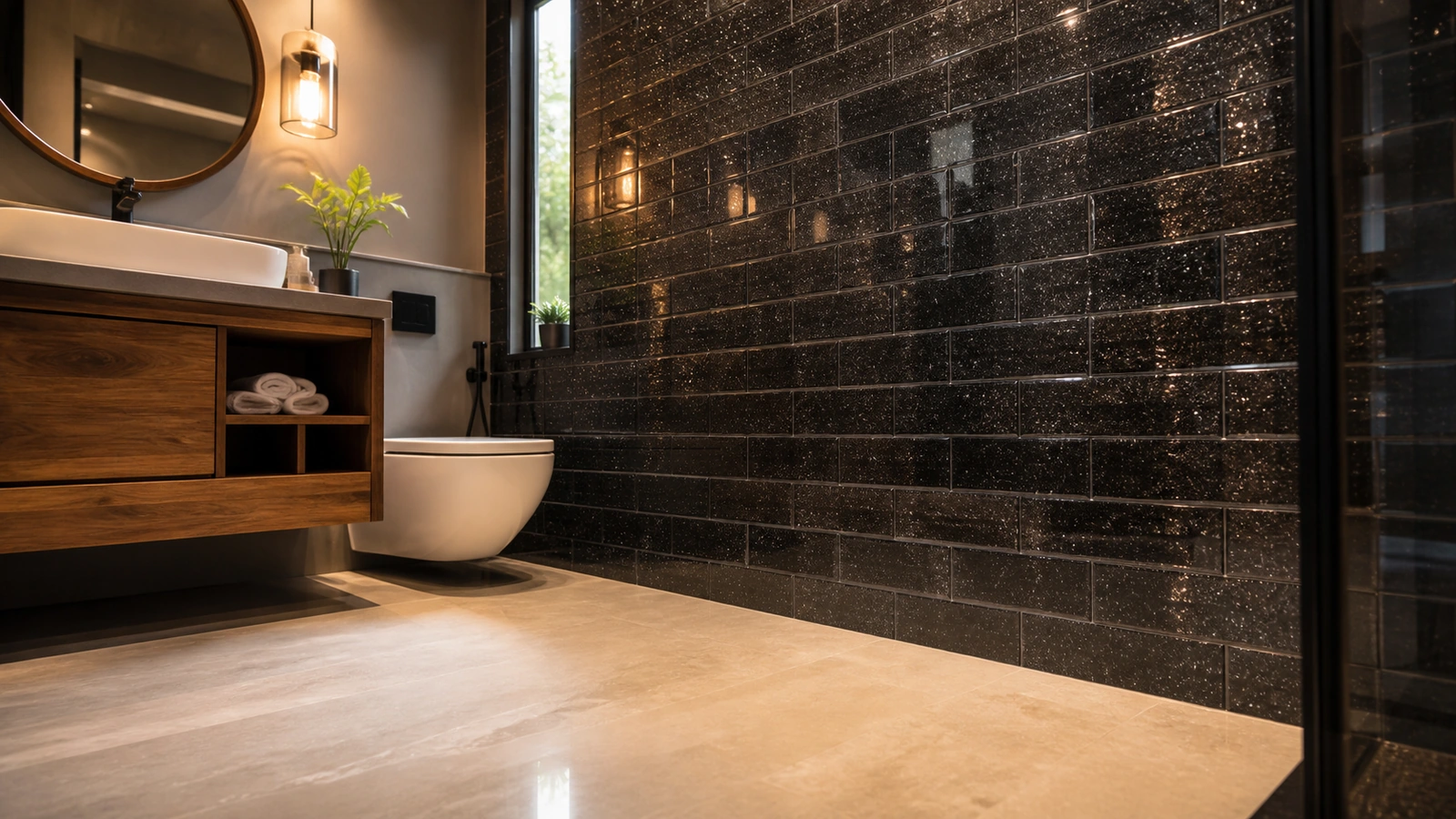
Charcoal glitter ceramic | 300x600 mm | Glossy | Rs. 115 to Rs. 190/sq.ft
Typical panel cost: About Rs. 1,380 to Rs. 2,280 for a 12 sq.ft panel
Sparkle reads far more dramatically against a dark field than a pale one, because the contrast between the dark base and the reflective points is greater. The most striking bathroom option in this guide.
Choose this if: the bathroom has good vanity lighting and pale flooring to stop the room closing in.
Skip it if: the room has no natural light and only a ceiling fixture, which will leave it reading as simply dark.
4. THE FESTIVE CLASSIC
Deep Red Glitter with Gold Border
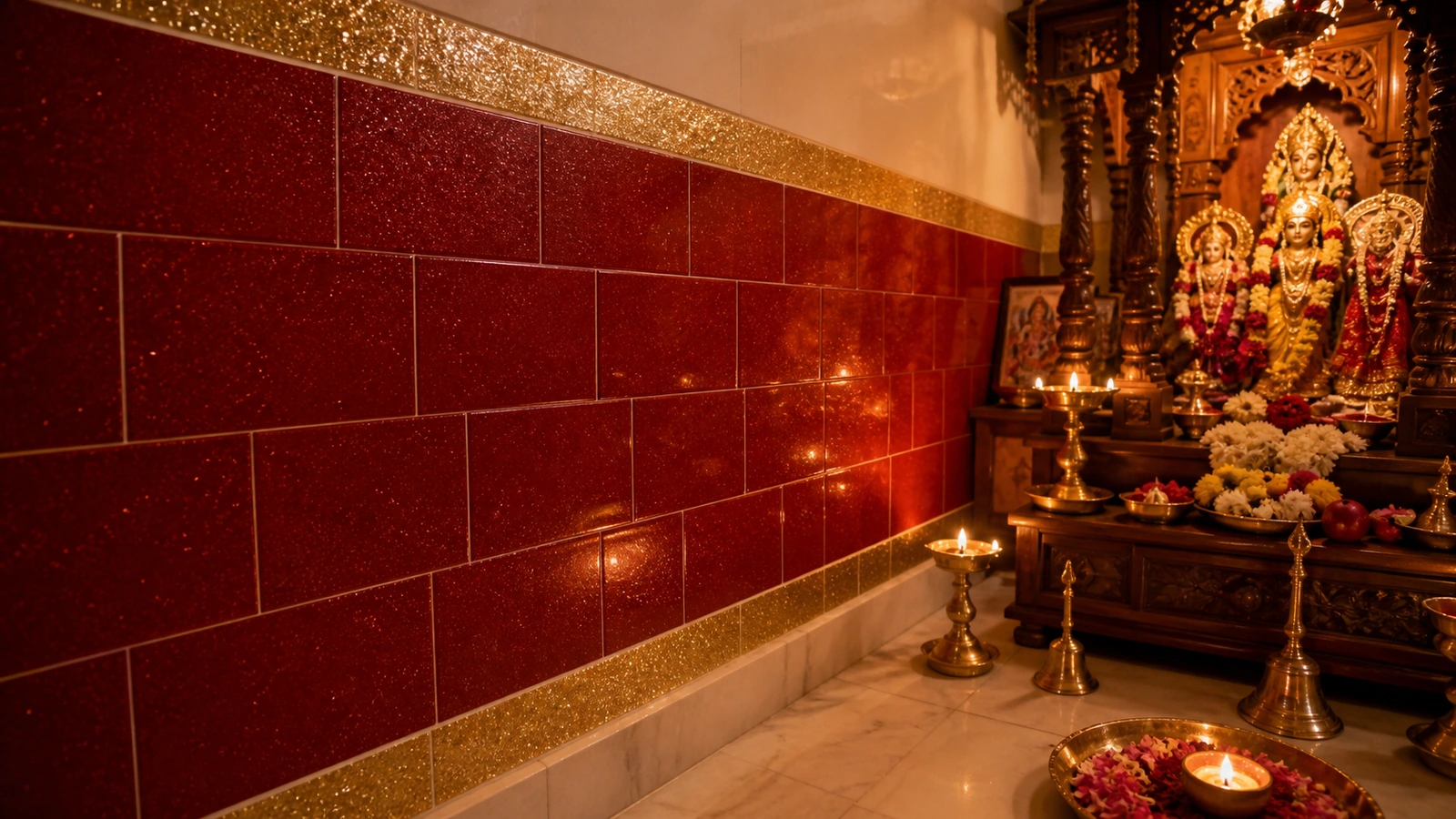
Deep red glitter field with gold glitter border | 300x600 mm | Glossy | Rs. 120 to Rs. 200/sq.ft
Typical panel cost: About Rs. 720 to Rs. 1,200 for a 6 sq.ft panel
The traditional festive palette, with sparkle concentrated in the border rather than spread across the whole field, so there is a quieter surface for it to read against.
Choose this if: you want the pooja space to feel celebratory rather than restrained.
Skip it if: you prefer a calm devotional scheme, where a single-tone gold or ivory panel suits better.
5. BEST FOR SMALL APARTMENTS
Ivory Glitter Ceramic, Pooja Niche
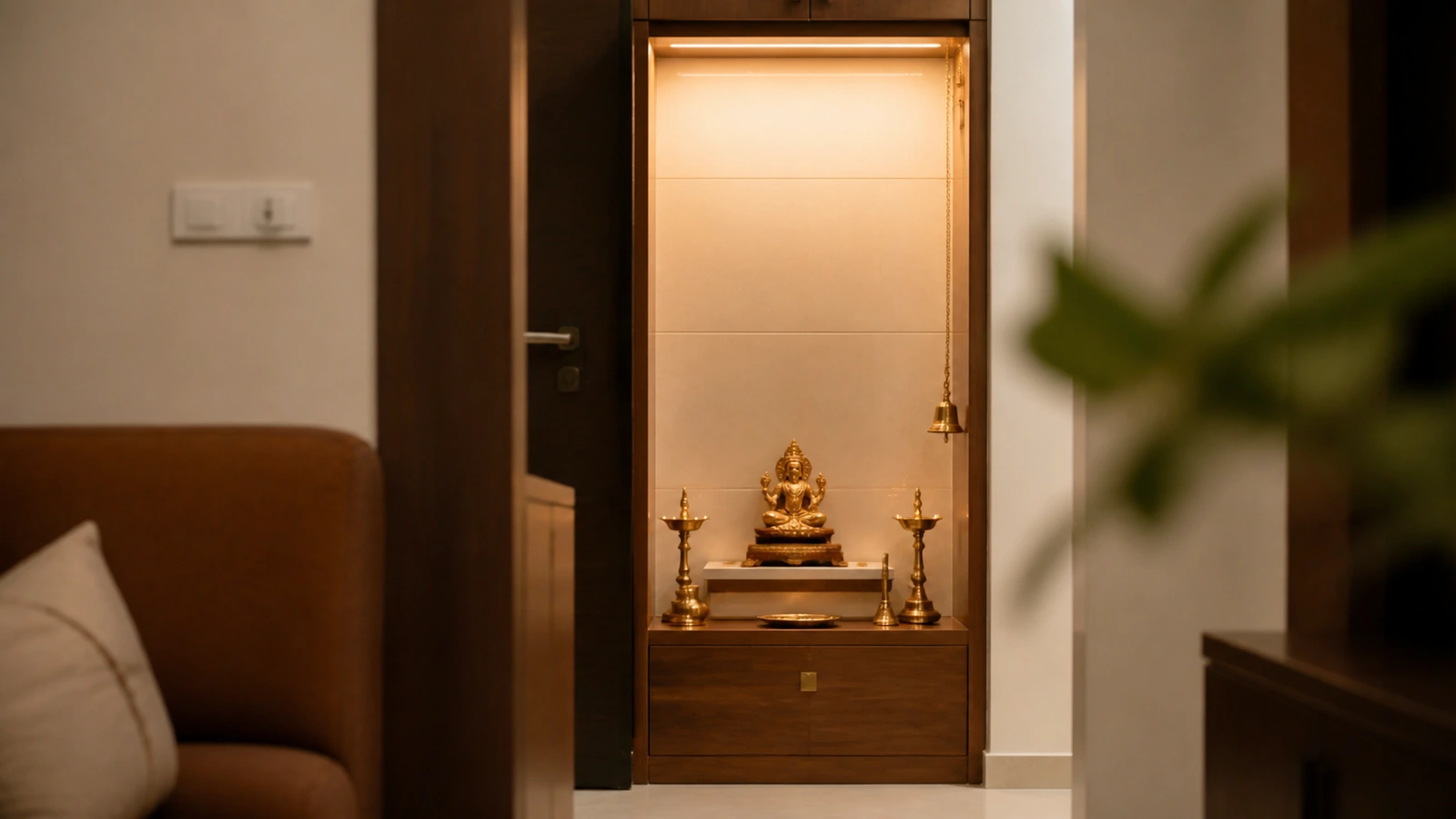
Ivory glitter ceramic | 300x450 mm | Glossy | Rs. 100 to Rs. 175/sq.ft
Typical panel cost: About Rs. 400 to Rs. 700 for a 4 sq.ft niche
For a pooja corner rather than a dedicated room. The smaller format lines a shallow niche without excessive cutting, and the total spend here is genuinely trivial against the visual effect.
Choose this if: you have an alcove or corner rather than a separate pooja room.
Skip it if: the niche is deep and the light source sits outside it, which shadows the back panel entirely.
6. BEST FOR GUEST-FACING ROOMS
Aqua Glitter Ceramic, Powder Room
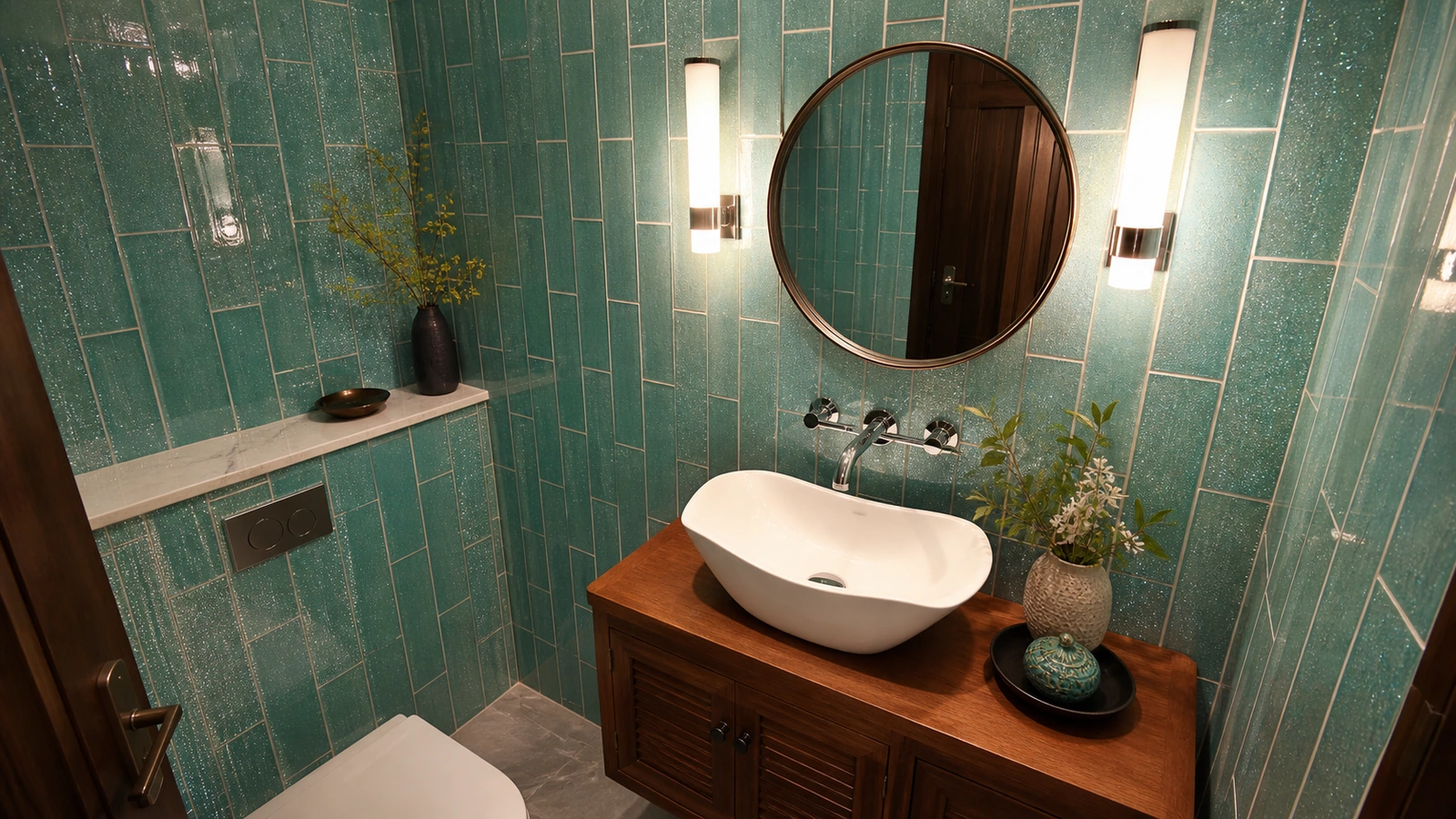
Aqua glitter ceramic | 300x600 mm | Glossy | Rs. 110 to Rs. 185/sq.ft
Typical panel cost: About Rs. 3,300 to Rs. 5,550 for a 30 sq.ft powder room
A powder room is dry, small and lightly used, which makes it the one bathroom where fuller wall coverage is defensible rather than excessive.
Choose this if: you have a guest powder room and want one room to be memorable.
Skip it if: this is a main family bathroom, where daily humidity and heavy use make full coverage impractical.
7. THE GROWN-UP CHOICE
Champagne Glitter GVT, Console Backdrop
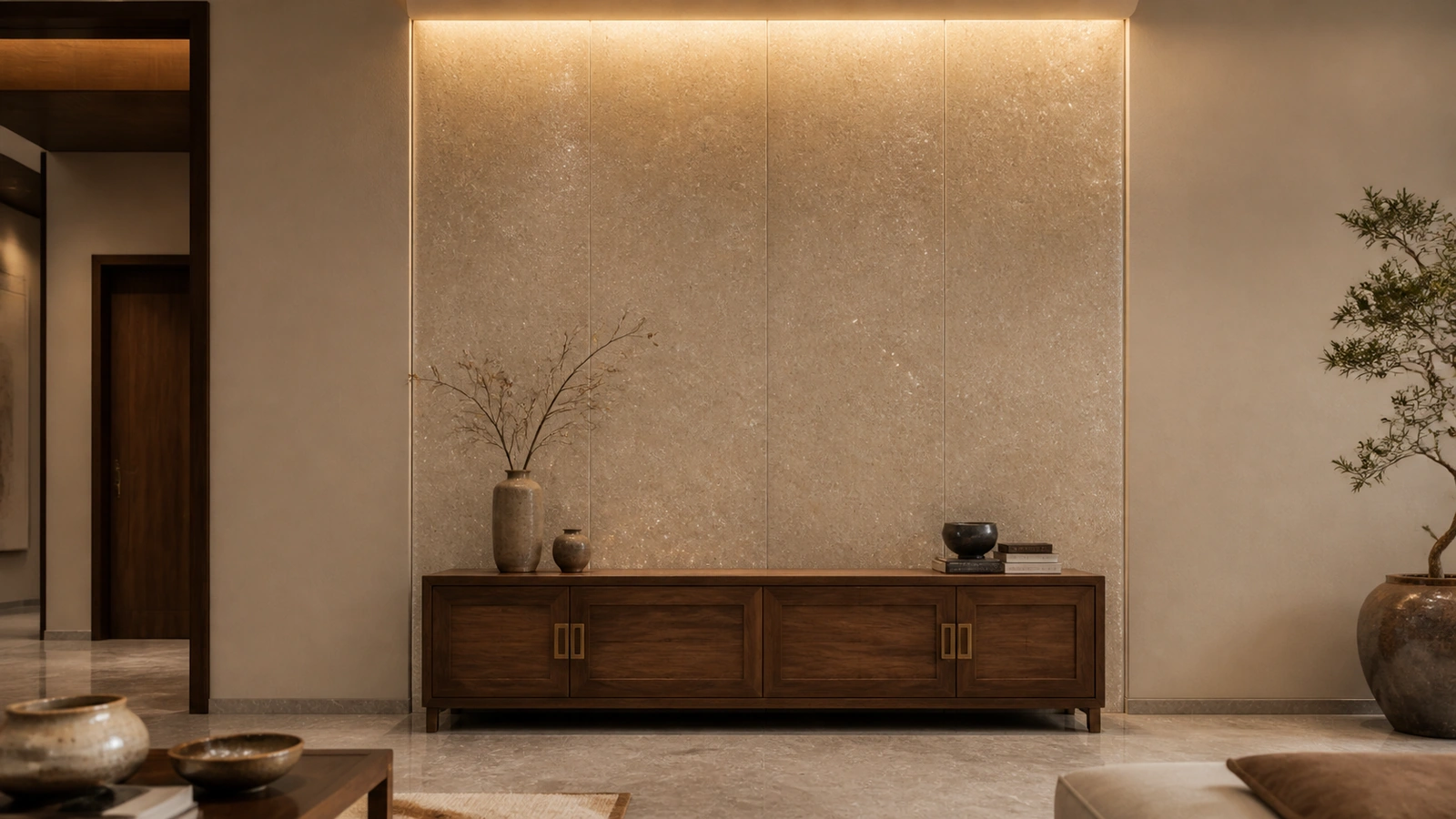
Champagne glitter GVT | 600x1200 mm | Glossy | Rs. 140 to Rs. 220/sq.ft
Typical panel cost: About Rs. 2,800 to Rs. 4,400 for a 20 sq.ft panel
A contained full-height panel behind a console, the sensible middle ground between a small accent and a whole wall. Vitrified tile and the larger format mean fewer joints across the panel height.
Choose this if: you want sparkle in a living room without it reading as decorative excess.
Skip it if: you cannot fit a concealed strip at the panel head, since a ceiling downlight will flatten it.
8. BEST FOR BEDROOMS
Pearl Glitter GVT, Headboard Panel
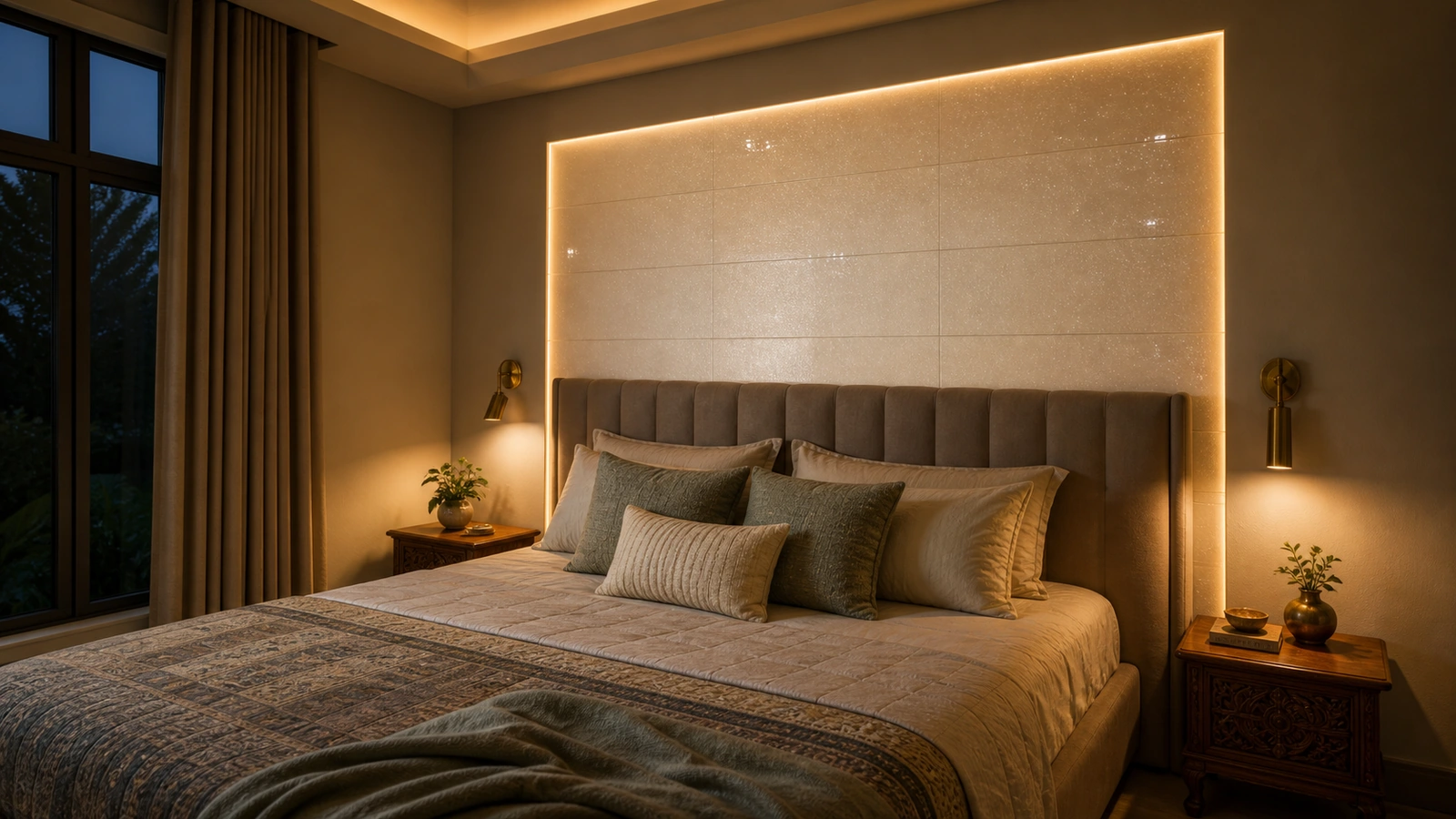
Pearl white glitter GVT | 600x1200 mm | Glossy | Rs. 135 to Rs. 215/sq.ft
Typical panel cost: About Rs. 3,240 to Rs. 5,160 for a 24 sq.ft panel
Soft pearl sparkle behind the bed, sized to the bed width rather than the wall width so it frames the headboard instead of filling the room. Appears at night when the room is used and recedes by day.
Choose this if: you have cove or bedside lighting on a dimmer for evening activation.
Skip it if: the bedroom is lit mainly by a bright central ceiling light, which floods the panel and removes the subtlety.
9. BEST FIRST IMPRESSION
Bronze Glitter GVT, Entrance Panel
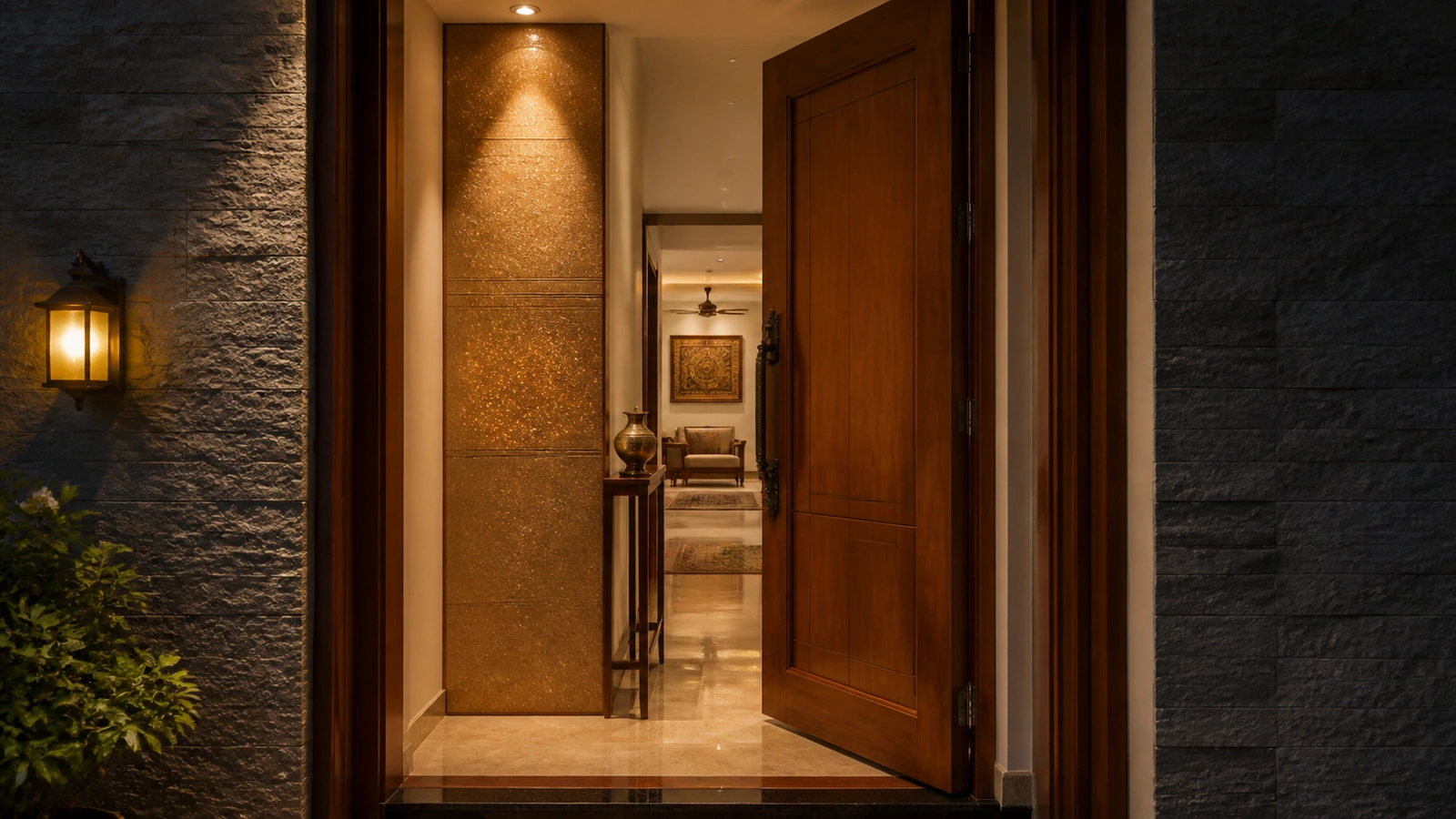
Bronze glitter GVT | 600x1200 mm | Glossy | Rs. 140 to Rs. 220/sq.ft
Typical panel cost: About Rs. 1,680 to Rs. 2,640 for a 12 sq.ft narrow panel
A narrow full-height panel beside the entrance door. An entrance is passed through rather than sat in, so a narrow accent reads better than a broad one and costs proportionally less.
Choose this if: you want a warm arrival moment and can angle a single spot across the panel.
Skip it if: the entrance is wide and open, where a narrow panel can look lost rather than deliberate.
Where the Money Is Better Spent
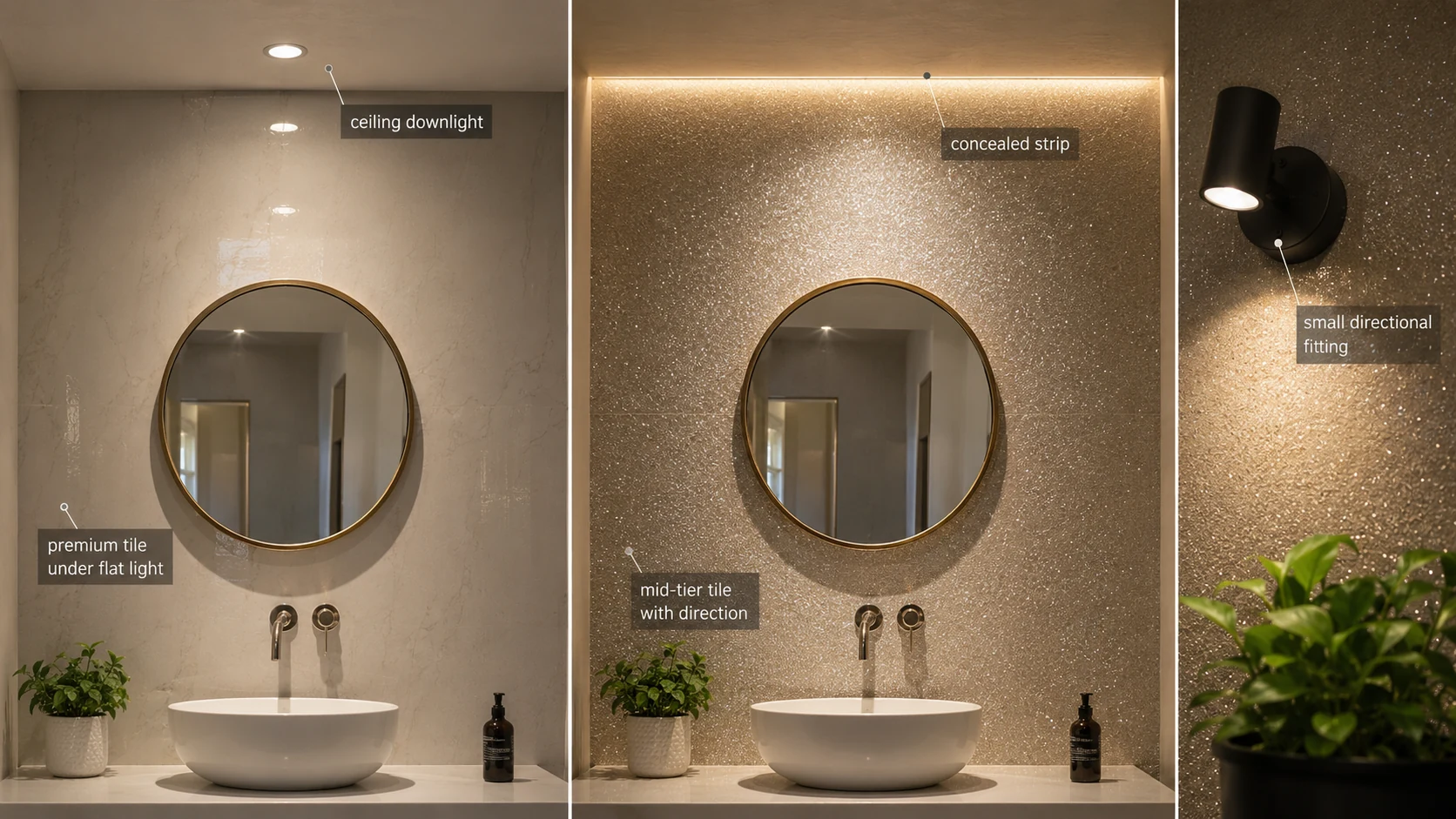
If you are choosing between a better tile and better lighting, choose the lighting: Glitter depends entirely on a directional light source to produce sparkle at all. A mid-tier tile properly lit by a concealed strip or a small directional fitting will consistently outperform a premium tile lit by a ceiling downlight, because the premium tile under flat light is simply a glossy wall. On a 12 sq.ft vanity panel, the difference between tiers is around Rs. 1,320, which is comparable to the cost of a decent light fitting. Spend it on the fitting. |
Once the budget and lighting are settled, the remaining question is how to use the sparkle without overwhelming the room. These Glitter Tile Design Ideas show different panel treatments for pooja rooms, bathrooms, living spaces and festive settings.
| If Your Budget Is | Spend It On | Rather Than |
| Rs. 2,000 for a pooja panel | Mid-tier tile plus a small warm directional fitting | Premium tile with no dedicated light |
| Rs. 4,000 for a vanity backdrop | Good tile plus a proper mirror light close to the wall | Premium tile relying on the ceiling fixture |
| Rs. 6,000 for a console panel | Mid-tier tile plus a concealed top-edge strip | Premium tile with ambient room lighting only |
Before You Order
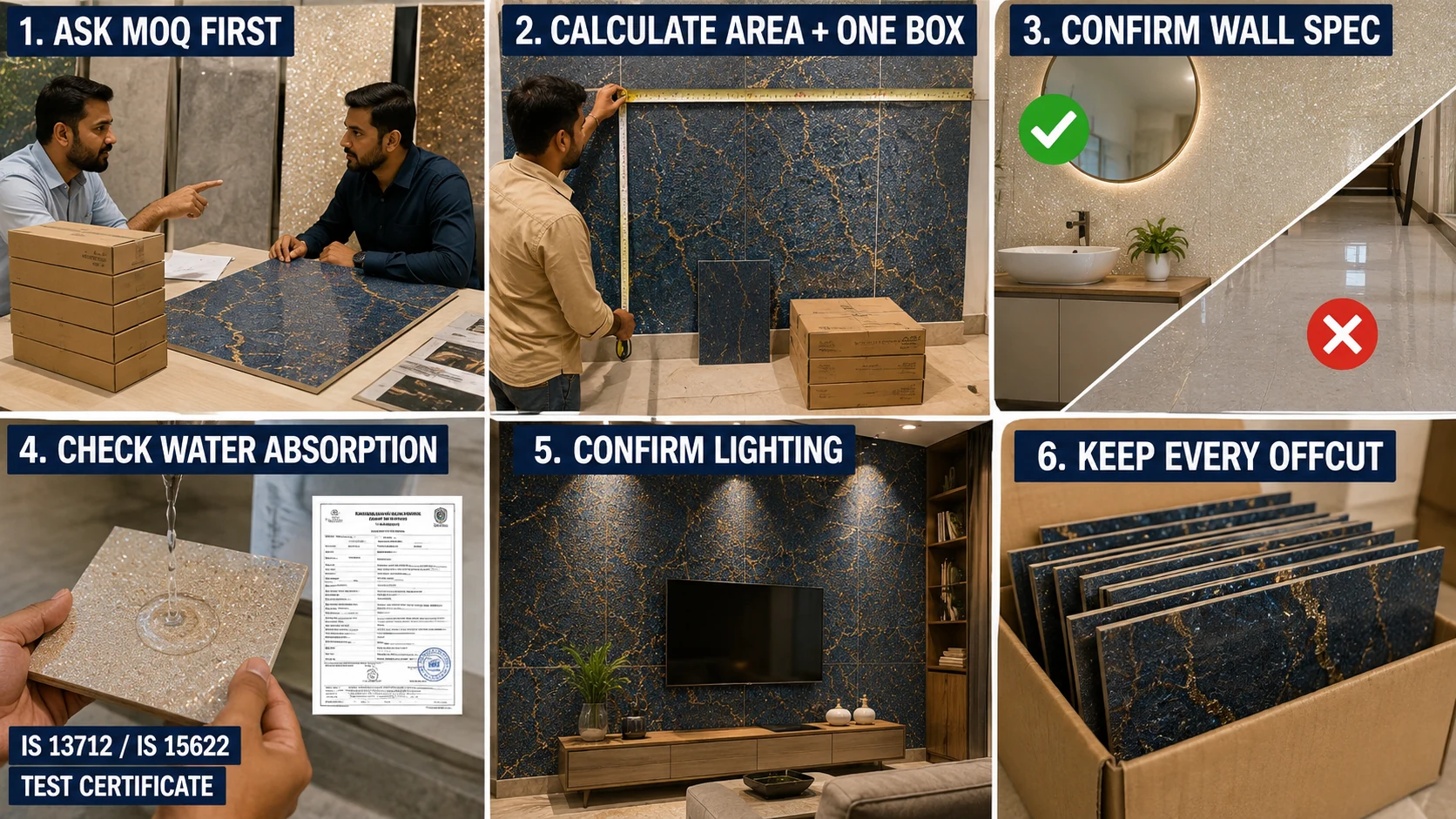
- Ask the minimum order quantity first, before comparing anything, since some decorative ranges require far more than a small panel needs.
- Calculate your area, then add one full box, rather than applying a percentage that means nothing at this scale.
- Confirm wall specification, since glitter is a glossy glaze and is never appropriate for any floor.
- Confirm water absorption against the room, referencing IS 13712 for ceramic wall tile and IS 15622 for vitrified, with the test certificate requested.
- Confirm the lighting before confirming the tile, since a directional source is what makes this finish work at all.
- Keep every offcut, because decorative ranges are discontinued faster than core ranges and your leftovers are your only future repair stock.
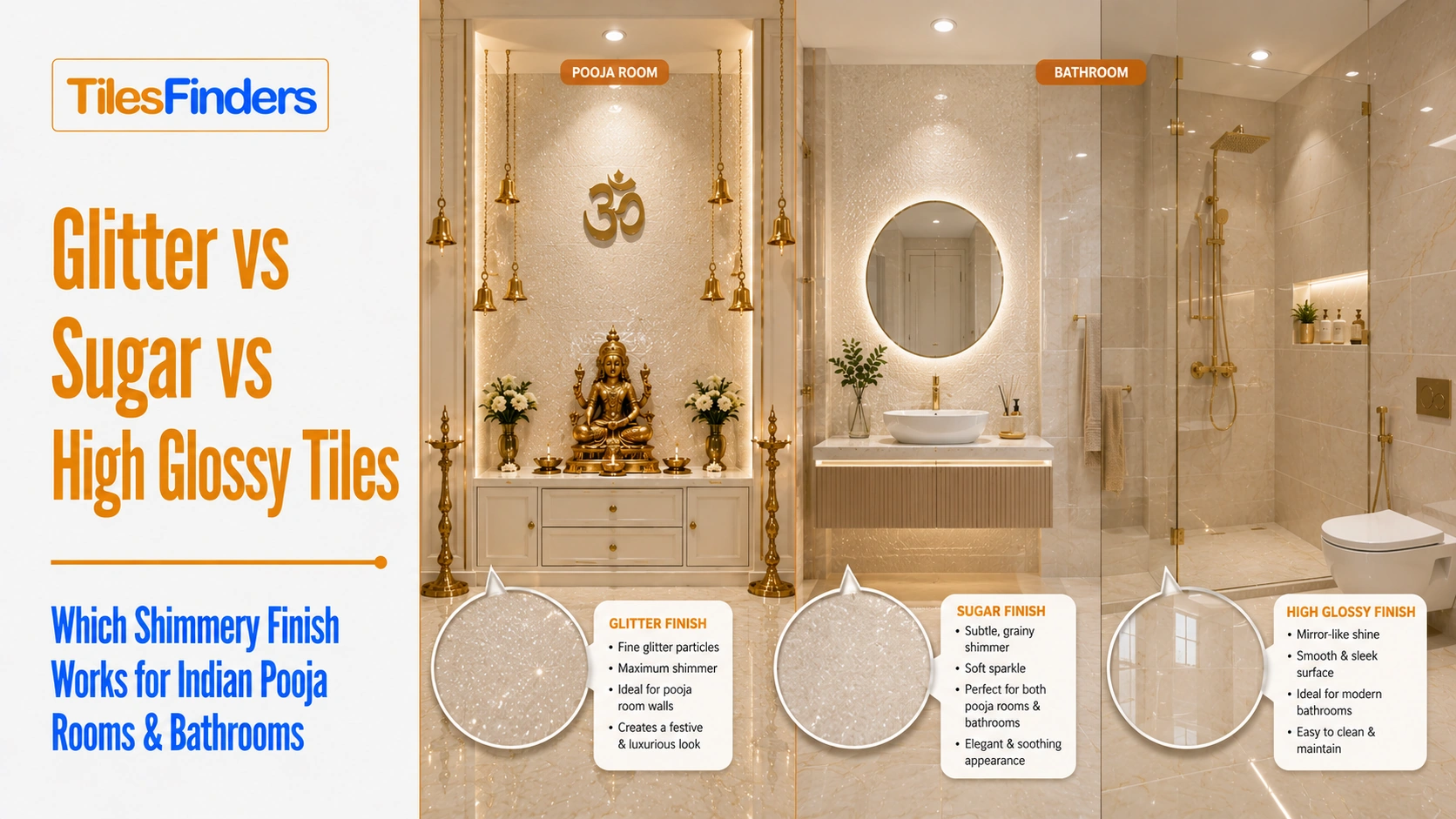
Glitter is only one way to create a reflective or shimmery wall, and the practical differences become important when bathrooms are involved. Our Glitter vs Sugar vs High Glossy Tiles comparison breaks down shine, surface texture, maintenance and wet-floor suitability.
Compare Glitter Ranges on TilesFinders
Glitter ranges in ceramic and vitrified bodies can be browsed on TilesFinders by size, tone and format, so you can check minimum quantities and confirm wall specification before committing to a panel.
FAQs
For a typical 6 sq.ft backdrop, roughly Rs. 660 at entry tier and Rs. 1,320 at premium. The gap between the cheapest and most expensive credible option is small enough that choosing on appearance rather than rate is the sensible approach at this size.
Only at full-wall scale. On panels under about 20 sq.ft the total difference between tiers is typically one to two thousand rupees. On an 80 sq.ft feature wall the same choice costs nearly Rs. 9,000 more, at which point it genuinely matters.
One full box beyond your calculation, not a percentage. On a six-square-foot panel, a percentage-based overage is meaningless, while an extra box covers installation breakage and gives you future repair stock from the correct batch.
Ceramic is entirely appropriate for drywall applications such as a vanity backdrop or pooja panel, and usually costs less. Vitrified suits larger formats and full-height panels where the 600x1200 mm size is wanted.
On a small panel, the absolute difference is minor, so buy what you actually want. But if the choice is between a premium tile and a proper light fitting, choose the fitting, since glitter without a directional source is simply a glossy wall regardless of what it costs.
No. Glitter finish is a glossy glaze and offers no meaningful grip when wet. Specify an anti-skid matte, punch or sugar finish for the floor with a confirmed wet coefficient of friction of 0.4 minimum, and keep glitter for the walls.
You will likely be unable to match it, which is why keeping offcuts matters more for decorative ranges than for standard ones. Store the spares flat and dry, and treat them as the only repair stock you will ever have.
Gold glitter ceramic for a pooja backdrop, where the panel is small enough that total cost is trivial, the application is the strongest use of the finish anywhere in the home, and diya flame provides exactly the point-source lighting the effect requires.


See our tile guides first
Set TilesFinders as a preferred source and our buying guides surface ahead of the rest for you.
Add as preferred sourceTakes one tap. Nothing to install.
What Readers Say
I was about to redo my parking area with the wrong tile size until I read this. The layout comparisons saved me from a costly mistake.
We reference TilesFinders guides while briefing clients on material selection. The size and pattern breakdowns are accurate and easy to explain visually.
On site, I get asked about grout spacing all the time. This article gave me a solid reference I now share with my team before every job.
Finally a guide that doesn't just push generic advice. The oil stain removal steps actually worked on our clubhouse driveway tiles.
I run a small construction firm and now send this link to clients directly when they ask about entrance tile sizing. Saves me an hour of explaining.
Good practical detail, though I wish there were more examples for compact apartment entrances specifically, not just villas.
My mother-in-law wanted marble, I wanted vitrified. This blog gave us the neutral comparison we needed to actually decide together.
Detailed without being overwhelming. I appreciated that it covered both cost and maintenance, not just the aesthetics.
Used the algae and hard water removal tips on our terrace tiles after the monsoon. Worked better than what our regular cleaner was doing.
As someone who sources tiles for multiple builder projects, I find these comparisons genuinely useful for vendor conversations, not just consumer content.
Recommended this to a client who kept second-guessing the entrance design. The small vs large layout section settled the debate instantly.
Straightforward and honest, no unnecessary jargon. Would like to see a similar breakdown for outdoor pool-deck tiles next.
We've bookmarked several TilesFinders guides for our design handbook. Reliable source when clients want data, not just opinions.
Two paths, one marketplace.
Get free quotes from verified suppliers.
Share your room, budget, and style. Suppliers in Morbi respond within hours.
Get Free QuotesList your business, reach real buyers.
Put your showroom in front of homeowners searching for tiles right now.
List Your Business