Glitter vs Sugar vs High Glossy Tiles: Which Shimmery Finish Works for Indian Pooja Rooms and Bathrooms
Shimmer behaves differently across glitter, sugar and high glossy tiles; understand their finish, light response and safety before specifying them for pooja rooms or bathroom walls.
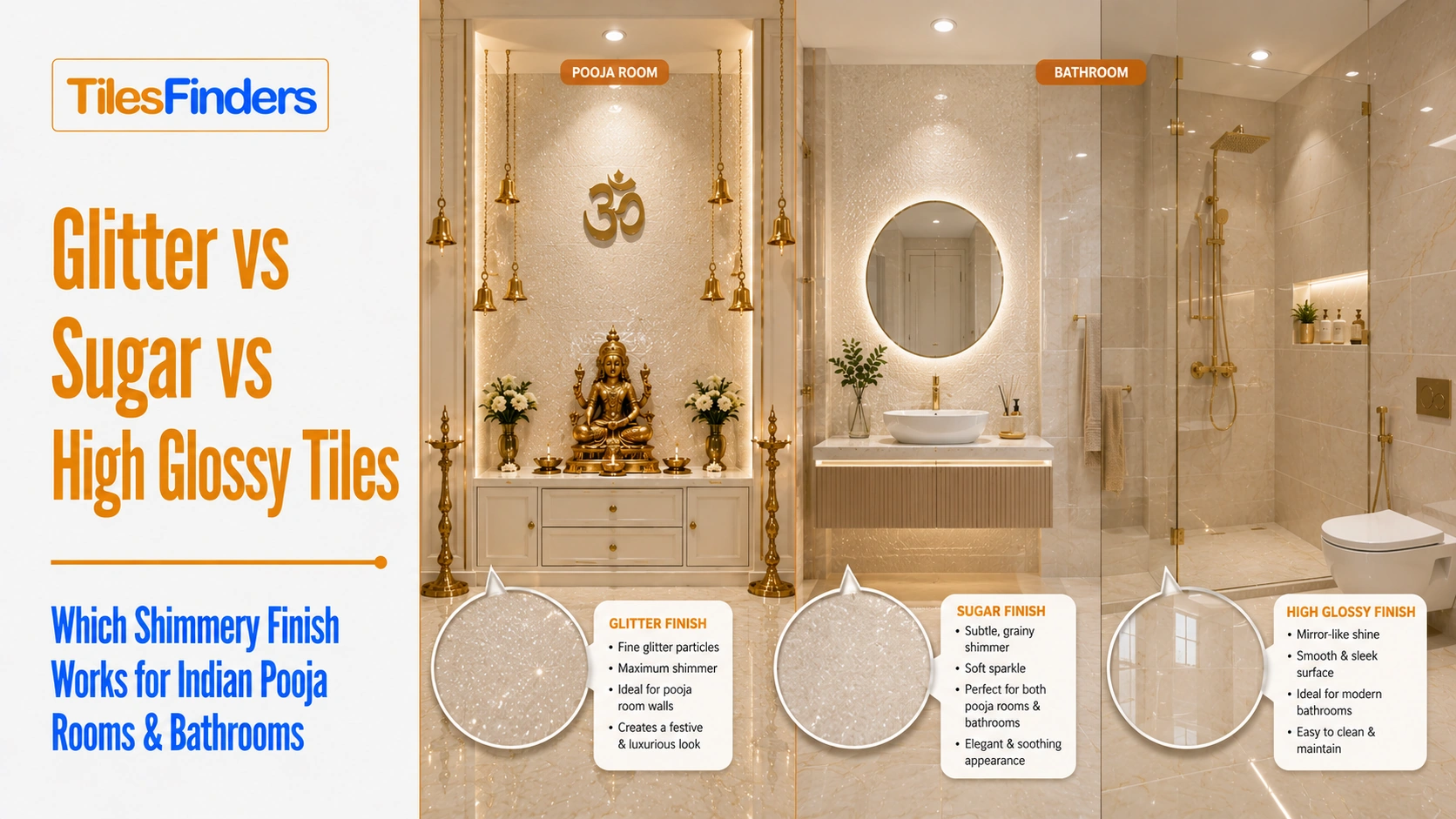
- Where Each Sits on the Gloss Scale
- Three Different Mechanisms, Not Three Grades of the Same Thing
- The Safety Divergence
- Full Specification Comparison
- For a Pooja Room
- For a Bathroom
- Maintenance Compared
- Choosing Between Them
- Confirm Before Ordering, Whichever You Choose
- Compare Shimmery Finishes on TilesFinders
Sugar is the only one of the three suitable for wet bathroom floors when the required wet COF is confirmed; glitter and high glossy belong on walls. Choose glitter for diya-lit pooja accents, high glossy for reflective bathroom walls, and sugar for subtle shimmer with better water-spot concealment.
All three of these shine, but they shine for three completely different physical reasons, and one of those reasons has a safety consequence the other two do not. This guide reads the specification rather than the sales description: where each sits on the measurable gloss scale, what actually produces the shine, and which glitter tiles can go on a bathroom floor rather than only on the walls.
Where Each Sits on the Gloss Scale
Gloss is measurable. It is expressed in gloss units, or GU, taken with a gloss meter at a fixed angle, and it is the closest thing to an objective number for how reflective a surface is. Indicative ranges below, since exact figures vary by manufacturer.
| Finish | Indicative Gloss Units | What That Means in the Room |
| Plain matte, for reference | 5 to 15 GU | Absorbs light, no visible reflection |
| Sugar finish | 10 to 25 GU | A soft, diffused shimmer rather than a reflection |
| Polished sugar | 20 to 40 GU | A more pronounced shimmer while retaining surface character |
| Satin matte, for reference | 20 to 45 GU | Low sheen, semi-reflective |
| Glitter finish | 60 to 90 GU on the glaze | A glossy base carrying discrete points of sparkle |
| High glossy | 60 to 90 GU | A continuous mirror-like reflection across the whole surface |
Reading that table correctly: Glitter and glossy tiles sit in the same gloss band, because glitter is built on a glossy glaze. The difference between them is not how much they shine but how the shine is distributed, continuous across the surface for high glossy, concentrated into points for glitter. Sugar sits far lower, closer to satin matte than to either of the others, which is the first clue that it belongs in a different conversation entirely. |
Three Different Mechanisms, Not Three Grades of the Same Thing
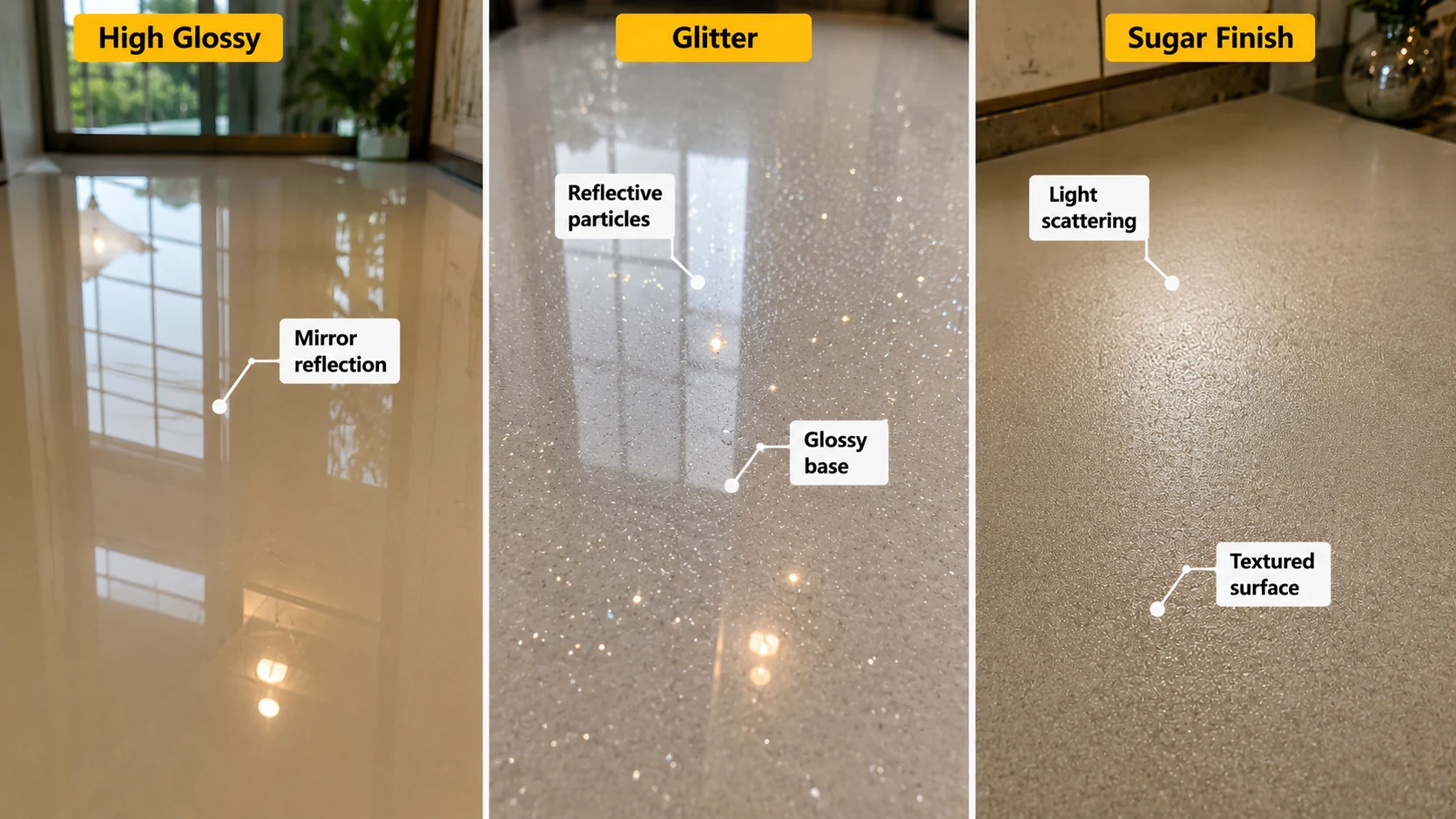
What actually produces the shine in each case: High gloss is pure specular reflection. The glaze is smooth, so light arriving at one angle leaves at the matching angle, which is what a mirror does and why you see reflections of the window and the light fitting rather than the tile. Glitter takes that same smooth, glossy glaze and suspends reflective particles inside it, so alongside the mirror reflection you get discrete points that flare when the light hits them and go dark when it does not. Sugar works on the opposite principle. Its surface carries a fine granular texture, so light arriving at one angle scatters in many directions rather than one, which produces a soft diffused shimmer instead of a reflection. That scattering is why sugar reads as gentle rather than bright, and the texture producing it is also why sugar behaves completely differently underfoot. |
The Safety Divergence
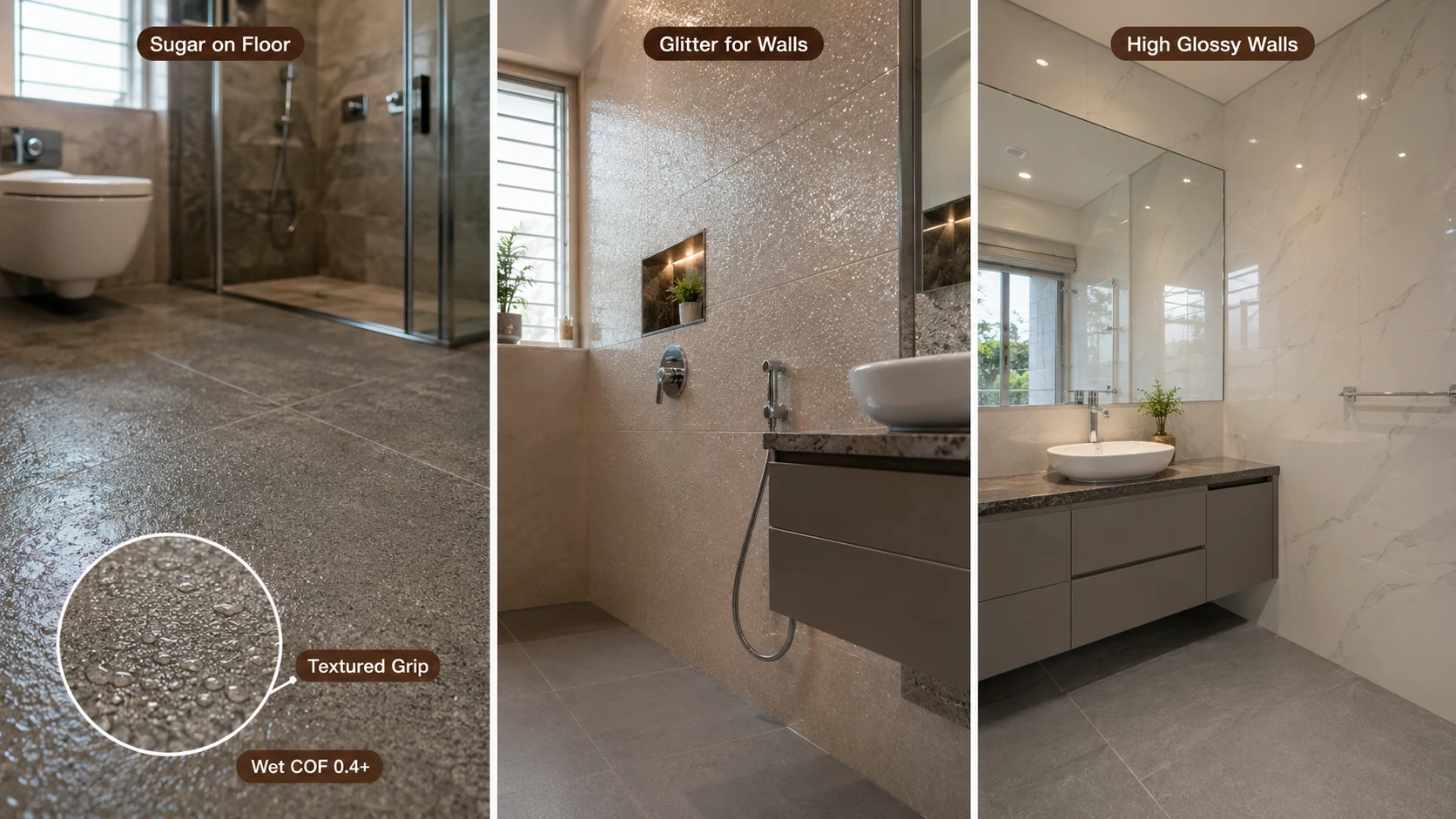
Only one of these three can go on a bathroom floor: Sugar finish carries genuine surface texture, which is why sugar tiles appear alongside plain matte, GHR and matte carving among the finishes appropriate for wet floors. Glitter and high glossy are both smooth glossy glazes, and a smooth glaze offers no meaningful grip when wet regardless of how it looks. This is the single most consequential difference between the three, and it is invisible in a photograph. If your bathroom project involves the floor as well as the walls, that decision is already made: sugar or another confirmed anti-skid finish on the floor, with glitter or high glossy available for the walls if you want them. In every case, confirm a wet coefficient of friction of 0.4 minimum for the floor rather than inferring it from the finish name. |
For bathrooms and outdoor areas where genuine surface texture matters, Rain Drops is another finish worth considering. Its dimpled surface is designed to improve grip by disrupting the water film underfoot, making it more functional than purely decorative shimmer finishes. Explore our Rain Drops Finish Tiles Guide to understand where this textured finish works best.
From The Marketplace
Popular tiles right now






Full Specification Comparison
| Sugar | Glitter | High Glossy | |
| Shine mechanism | Light scattered by fine surface texture | Reflective particles suspended in a glossy glaze | Specular reflection from a smooth glaze |
| Gloss units | 10 to 25, or 20 to 40 polished | 60 to 90 on the glaze | 60 to 90 |
| Visual character | Soft diffused shimmer | Discrete points of sparkle on a bright base | Continuous mirror-like reflection |
| Surface texture | Fine granular | Smooth | Smooth |
| Suitable for wet floors | Yes, with wet COF confirmed | No | No |
| Suitable for walls | Yes | Yes | Yes |
| Shows water spots and marks | Least, texture disguises them | Moderate | Most, every mark is visible on a mirror surface |
| Needs a point light source | No, works under ambient light | Yes, or the effect is largely lost | No, reflects whatever is present |
| Repairable if scratched | No, glazed surface | No, glazed surface | No, glazed surface |
For a Pooja Room
| Finish | Verdict | Reasoning |
| Glitter | Strongest choice | Diya and lamp flame is a moving point source, which is exactly what glitter needs. The sparkle responds to the light in a way the other two cannot |
| High glossy | Good, with a caveat | Reflects lamp light warmly, but also reflects everything else in the room, including clutter and the viewer, which can distract from a devotional space |
| Sugar | Good for a quieter scheme | A soft shimmer that reads as calm rather than celebratory, suited to a household wanting restraint over sparkle |
The pooja room detail worth planning: Whichever finish you choose, the panel should be positioned so lamp light reaches it directly rather than being blocked by the shelf or the idol itself. A glitter or glossy panel set behind a deep shelf receives almost no direct flame light and will underperform badly. Where the shelf is deep, either bring the panel forward to the shelf edge or add a small concealed warm light at the panel head. |
For a Bathroom
Bathrooms need the wall and the floor answered separately, and this is where the three genuinely diverge.
| Surface | Best Choice | Reasoning |
| Bathroom floor | Sugar, or another confirmed anti-skid finish | The only one of the three with genuine surface texture, and the only one appropriate where water meets bare feet |
| Vanity or mirror backdrop wall | Glitter | Seen daily at close range, activated by vanity lighting, and out of direct splash contact |
| Shower enclosure walls | High glossy or sugar | Glossy wipes down easily and resists soap film; avoid glitter here as heavy cleaning dulls the glaze over time |
| General bathroom walls | Sugar or high glossy | Sugar disguises water spotting best; high glossy makes a small bathroom feel larger through reflection |
| Powder room, dry and low use | Any of the three on walls | Low humidity and light use remove most of the practical constraints |
The water spot problem, which decides more bathrooms than aesthetics do: In hard water areas, and much of India qualifies, evaporating water leaves mineral deposits that are visible in direct proportion to how reflective the surface is. On high gloss, those deposits show clearly and need frequent wiping to keep the surface looking as intended. On sugar, the granular texture breaks up the reflection and disguises them considerably better. If your household is unlikely to wipe down bathroom walls regularly, this is a stronger argument for sugar than any visual consideration. |
Maintenance Compared
| Sugar | Glitter | High Glossy | |
| Routine cleaning | Mild detergent, soft cloth | Mild detergent, soft cloth | Mild detergent, soft cloth |
| Water spot visibility | Low | Moderate | High |
| Wiping frequency for best appearance | Occasional | Regular | Frequent |
| Risk from abrasive cleaning | Glaze can dull | Glaze can dull, and sparkle appears diminished | Glaze can dull, and scratches are highly visible on a mirror surface |
| Consequence of a scratch | Localised, texture disguises it | Visible, and the sparkle is interrupted | Highly visible against a continuous reflection |
If you are also comparing textured finishes for balconies, wash areas or other wet zones, Rain Drops Tile Design Ideas can help you explore where this surface works visually as well as functionally.
Choosing Between Them
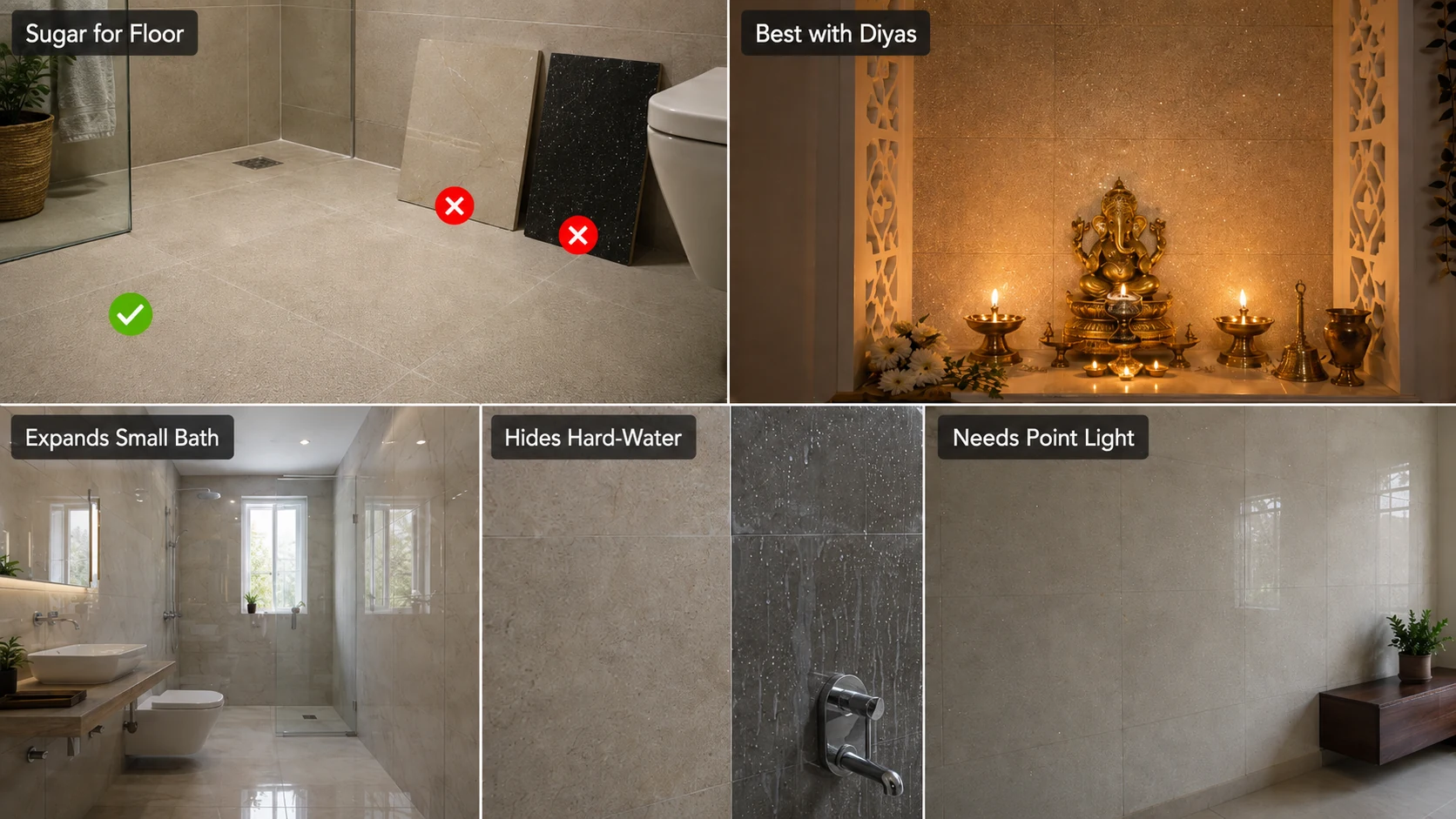
- If the surface is a floor, the answer is sugar or another confirmed anti-skid finish. Glitter and high gloss are eliminated at this step, and no other consideration changes that.
- If it is a pooja room wall lit by diyas, glitter responds to flame better than either alternative and is the strongest choice.
- If it is a small bathroom you want to feel larger, high glossy tile reflects and expands the space more effectively than the other two.
- If your water is hard and wiping is occasional, sugar disguises mineral spotting best and will look better for longer with less effort.
- If you want shimmer without drama, sugar sits far lower on the gloss scale and reads as calm rather than celebratory.
- If there is no directional light source and none can be added, avoid glitter, since it depends on a point source and will read as an ordinary glossy tile without one.
Confirm Before Ordering, Whichever You Choose
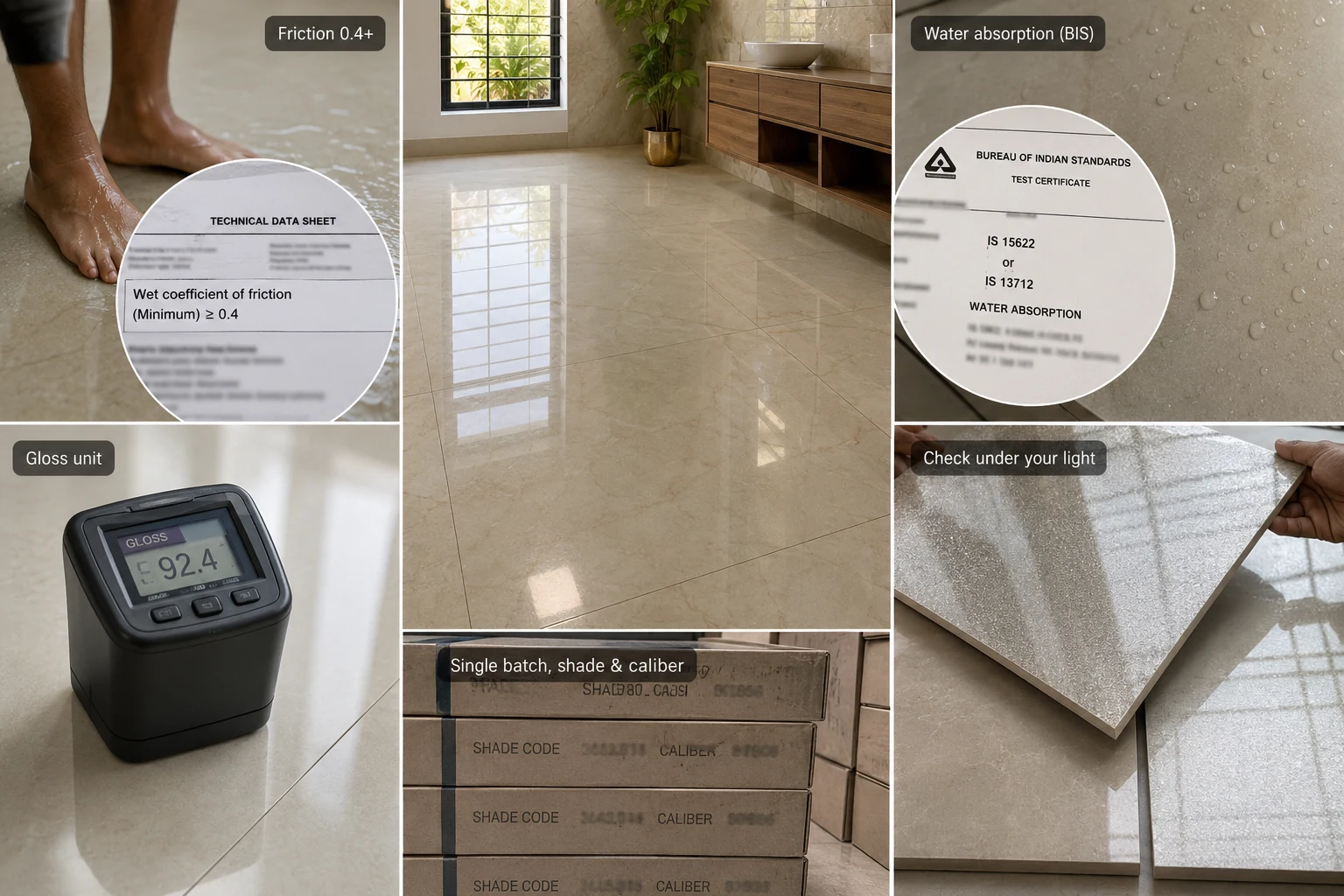
- Wet coefficient of friction of 0.4 minimum for any floor, confirmed from the technical data sheet rather than inferred from the finish name.
- Water absorption against the room, referencing the Bureau of Indian Standards specifications, IS 15622 for vitrified tile and IS 13712 for ceramic, with the test certificate requested.
- Gloss unit figure where the supplier can provide it, which is the only objective way to compare two tiles described with the same adjective.
- Sample viewed under your own lighting, particularly for glitter, which shows almost nothing under diffuse showroom flood lighting.
- Single batch, shade code and calibre across the full quantity, since reflective surfaces show tonal variation more clearly than matte ones.
Compare Shimmery Finishes on TilesFinders
Sugar, glitter and high glossy ranges can each be browsed on TilesFinders by size, body type and application, so you can confirm which surfaces a specific finish is rated for before deciding between them.

FAQs
Sugar, and only sugar. Its fine granular texture provides genuine grip, which is why it appears alongside plain matte, GHR and matte carving among finishes suitable for wet floors. Glitter and high glossy are smooth glossy glazes and offer no meaningful wet grip.
They sit in the same gloss band, around 60 to 90 gloss units, because glitter is built on a glossy glaze. The difference is distribution: high glossy reflects continuously across the whole surface like a mirror, while glitter concentrates the effect into discrete points that flare under a directional light.
A measured figure taken with a gloss meter at a fixed angle, expressing how reflective a surface is. It is the only objective way to compare two tiles that a supplier might describe with the same word, and worth asking for when comparing finishes.
Glitter, because diya and lamp flame is a moving point source and that is precisely what glitter needs to perform. High glossy reflects lamp light warmly but also reflects everything else in the room, and sugar suits a household wanting a quieter, calmer scheme.
Sugar, by a clear margin. Its granular texture scatters light and breaks up the reflection, which disguises mineral deposits. High glossy shows them most, since every mark is visible against a mirror-like surface, which matters in hard water areas.
Yes, but softly. It sits at roughly 10 to 25 gloss units, or 20 to 40 for polished sugar, so it produces a diffused shimmer rather than a reflection. It reads as gentle rather than bright, which is the point of choosing it.
Better not. Constant water contact and the heavier cleaning a shower requires will dull the glaze over time, and once a glazed surface is dulled, there is no polish layer to restore. High glossy or sugar are the better shower wall choices.
High glossy, because continuous specular reflection bounces light around the room and visually expands it. The trade-off is that it also shows every watermark, so it suits a household that wipes down regularly.
No. All three are glazed surfaces, and a glazed finish cannot be re-polished the way a mechanically polished vitrified tile can. A scratch is permanent, which is why abrasive cleaners should be avoided on all three.


See our tile guides first
Set TilesFinders as a preferred source and our buying guides surface ahead of the rest for you.
Add as preferred sourceTakes one tap. Nothing to install.
What Readers Say
I was about to redo my parking area with the wrong tile size until I read this. The layout comparisons saved me from a costly mistake.
We reference TilesFinders guides while briefing clients on material selection. The size and pattern breakdowns are accurate and easy to explain visually.
On site, I get asked about grout spacing all the time. This article gave me a solid reference I now share with my team before every job.
Finally a guide that doesn't just push generic advice. The oil stain removal steps actually worked on our clubhouse driveway tiles.
I run a small construction firm and now send this link to clients directly when they ask about entrance tile sizing. Saves me an hour of explaining.
Good practical detail, though I wish there were more examples for compact apartment entrances specifically, not just villas.
My mother-in-law wanted marble, I wanted vitrified. This blog gave us the neutral comparison we needed to actually decide together.
Detailed without being overwhelming. I appreciated that it covered both cost and maintenance, not just the aesthetics.
Used the algae and hard water removal tips on our terrace tiles after the monsoon. Worked better than what our regular cleaner was doing.
As someone who sources tiles for multiple builder projects, I find these comparisons genuinely useful for vendor conversations, not just consumer content.
Recommended this to a client who kept second-guessing the entrance design. The small vs large layout section settled the debate instantly.
Straightforward and honest, no unnecessary jargon. Would like to see a similar breakdown for outdoor pool-deck tiles next.
We've bookmarked several TilesFinders guides for our design handbook. Reliable source when clients want data, not just opinions.
Two paths, one marketplace.
Get free quotes from verified suppliers.
Share your room, budget, and style. Suppliers in Morbi respond within hours.
Get Free QuotesList your business, reach real buyers.
Put your showroom in front of homeowners searching for tiles right now.
List Your Business