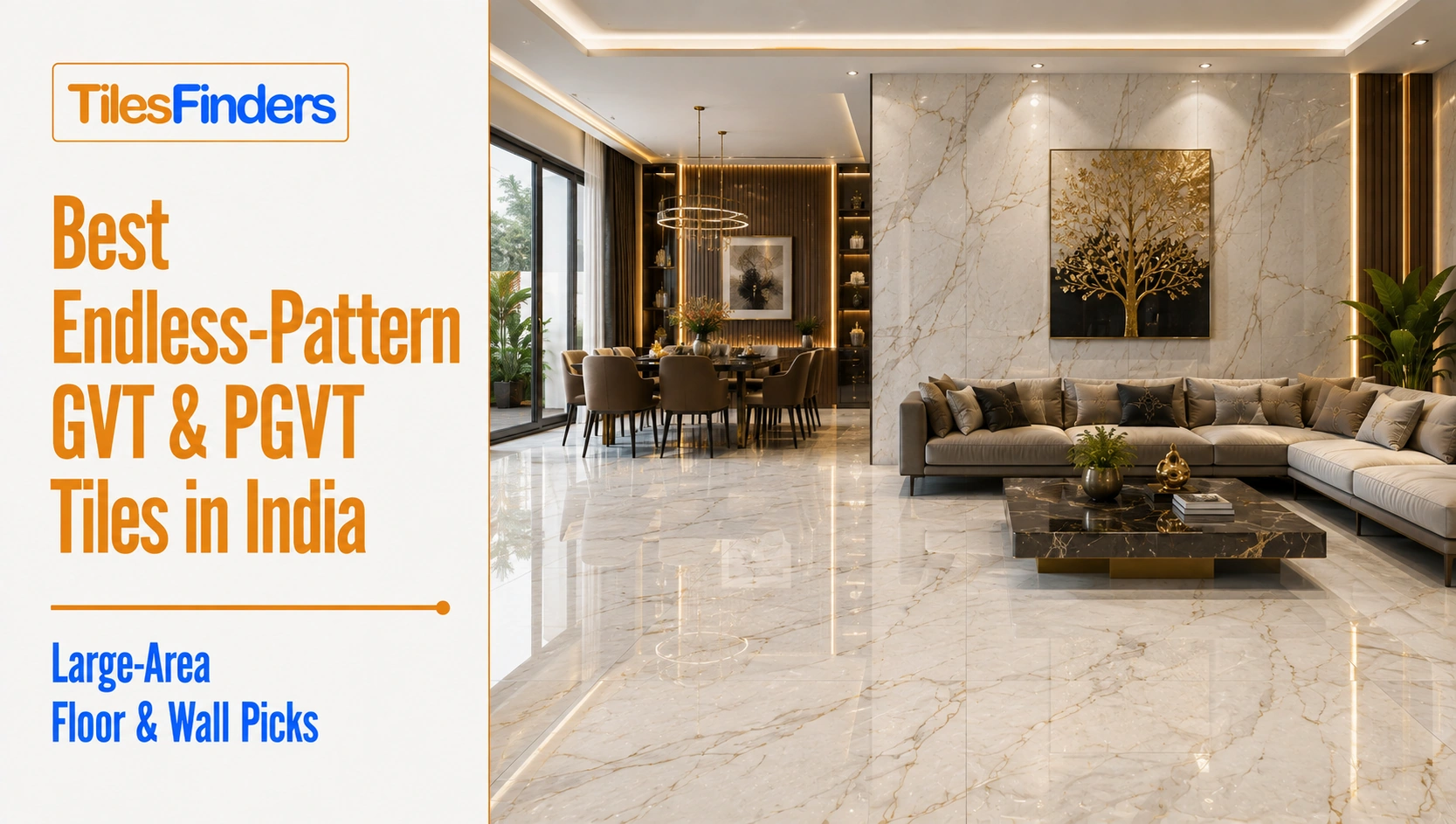
Best Endless-Pattern GVT and PGVT Tiles India 2027: Large-Area Floor and Wall Picks
Explore the best endless-pattern GVT and PGVT tiles for large Indian floors and walls, with realistic installed costs, design picks, budgeting tips, and smarter ways to control project expenses.
- Where the Money Actually Goes on a Large-Area Endless Install
- Floor Picks with Indicative Installed Cost
- Wall Picks with Indicative Installed Cost
- Worked Example: 1,000 sq.ft Living Room Floor
- What Is Safe to Trim, and What Never Is
- Getting a Quote You Can Actually Compare
- Specification Baseline for Every Pick
- Price Your Full Project on TilesFinders
Endless GVT and PGVT tiles can create a continuous premium look, but the installed cost is often close to twice the tile price. For large Indian projects, budget carefully for overage, adhesive, levelling, labour, and substrate correction before choosing the finish.
On a large area, the tile is roughly half of what you will actually spend. Every picks guide quotes the tile price and stops there, which is why large-area budgets overrun so reliably. This guide gives the picks with their tile price and an indicative all-in installed cost, shows where the other half of the money goes, and identifies which line items are safe to trim and which will cost you far more if you do, especially when choosing an endless tile design for a large space.
On the numbers below: Installed cost varies considerably by city, site condition, and contractor. Labour in a metro can be double that of a smaller city, and substrate correction can range from nothing to a major line item depending on what is already there. Treat every figure here as an indicative planning range for a first budget, then get two local quotes against the same written scope. The purpose of these numbers is to show you the shape of the spend, not to replace a quotation. |
From The Marketplace
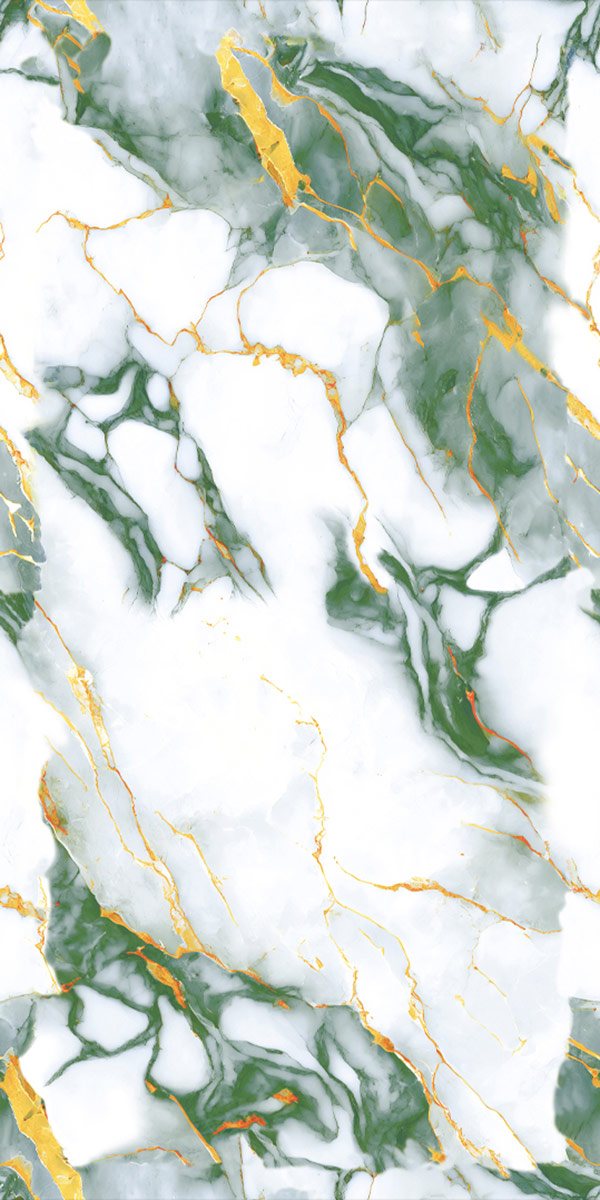
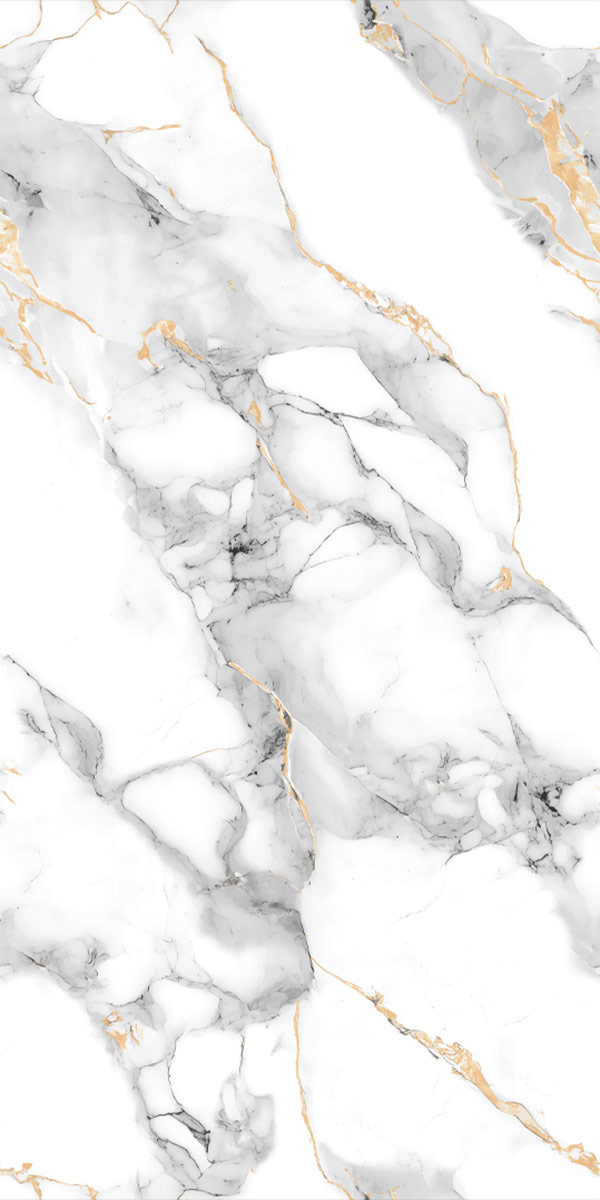
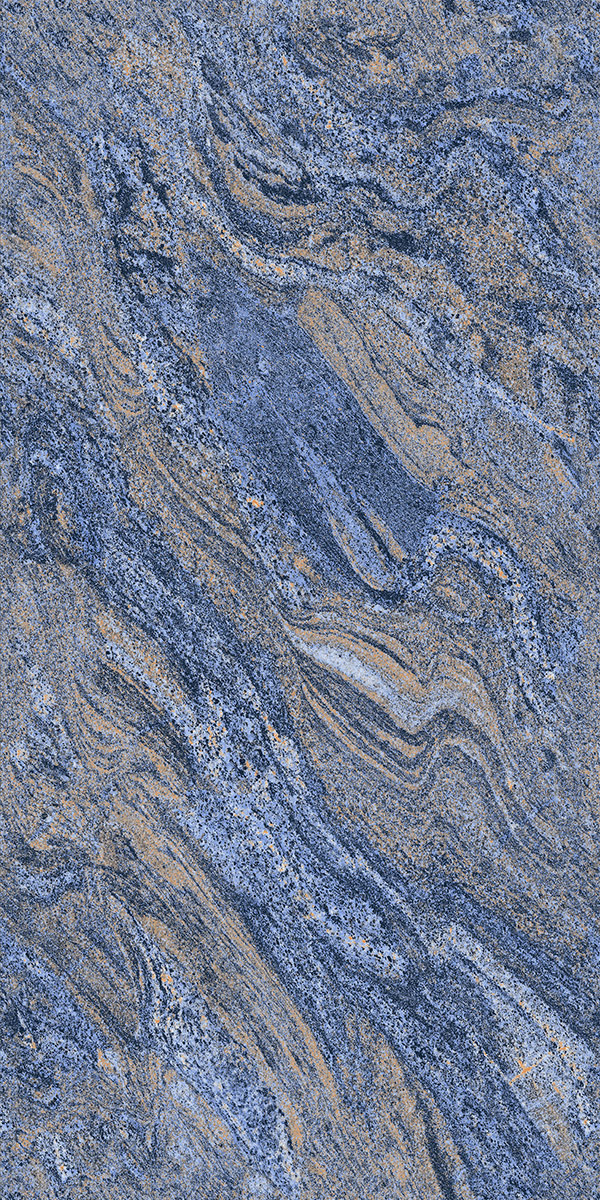
Popular tiles right now
-48b89f9d-378a-442d-a457-558ffe58a1a1.jpg)




Where the Money Actually Goes on a Large-Area Endless Install
| Line Item | Indicative Range per sq.ft | Why It Is What It Is |
| Tile | Rs. 110 to Rs. 280 | The only figure most buyers plan around, and typically around half the total |
| Overage at 10 to 15% | Rs. 12 to Rs. 42 | Higher than standard tile because off-sequence pieces have limited reuse and a later batch will not continue the sequence |
| Adhesive, large-format grade | Rs. 25 to Rs. 45 | Large formats require a higher-grade adhesive with full-bed coverage, not the basic mix used for small tiles |
| Grout, cement | Rs. 5 to Rs. 12 | Adequate for dry areas; stains more readily and is the cheaper of the two options |
| Grout, epoxy | Rs. 25 to Rs. 45 | Genuinely worth it in wet areas and kitchens, and on any pale grout where staining would show |
| Levelling clip system | Rs. 8 to Rs. 18 | Mechanical clips that hold adjacent tiles flush while adhesive cures; the single most effective defence against lippage on large formats |
| Labour, large-format sequenced laying | Rs. 40 to Rs. 90 | Higher than standard tiling because sequencing, larger pieces, and levelling systems all take longer |
| Substrate correction if required | Rs. 0 to Rs. 60 | The wild card; a flat, sound existing base costs nothing, an uneven one can rival the tile in cost |
The line item that decides whether your budget holds: Substrate correction is the only figure in that table that can be zero or can rival the tile itself, and it is rarely quoted before someone inspects the actual floor. Large-format tiles are far less tolerant of an uneven base than small ones, because a big rigid piece cannot follow a dip, so it bridges it, and either sits proud at one edge or debonds later. This is why a large-format quotation given over the phone, without a site visit, is not a quotation. Insist on the floor being checked with a straightedge before any number is agreed, and get the correction cost stated as a separate line rather than absorbed invisibly. |
Before comparing individual picks, it helps to understand how endless-pattern systems are specified for large surfaces. This endless pattern tiles guide explains the planning, layout, and continuity factors that matter when covering expansive floors or walls.
Floor Picks with Indicative Installed Cost
Idea 1: Pale Concrete-Look Endless GVT, Entry Tier Large Floor
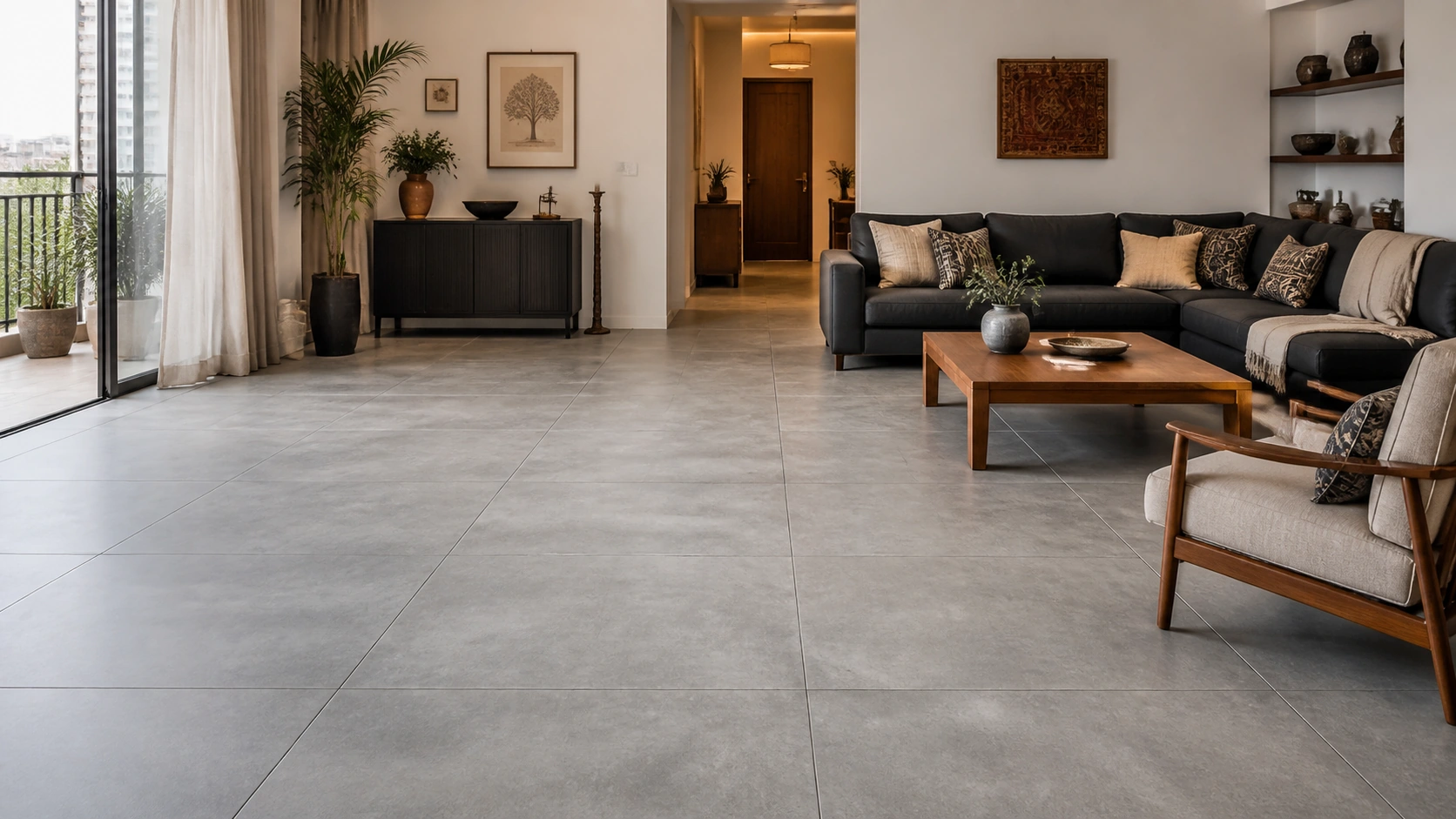
Endless pattern GVT, pale grey concrete-look | 2x2 or 24x24 (600x600 mm), rectified | Matte, PEI 4 | Tile Rs. 110 to Rs. 160/sq.ft | All-in indicative Rs. 200 to Rs. 310/sq.ft
The most budget-tolerant genuine entry into the category. Concrete-look forgives minor sequencing imperfection better than veined patterns, and the 600 mm format is meaningfully cheaper to lay than 800 mm while still suppressing the grid across a large floor.
Pair with: Cement grout in a matched mid-tone for dry areas, a levelling clip system despite the modest tile price, and a one-third offset rather than 50% brick bond.
Avoid: Skipping the levelling clips to save Rs. 8 to Rs. 18 per sq.ft, which is the cheapest line item on the sheet and the one most directly responsible for whether the finished floor looks professional.
Idea 2: Mid-Grey Concrete-Look Endless GVT, Large Open Living Floor
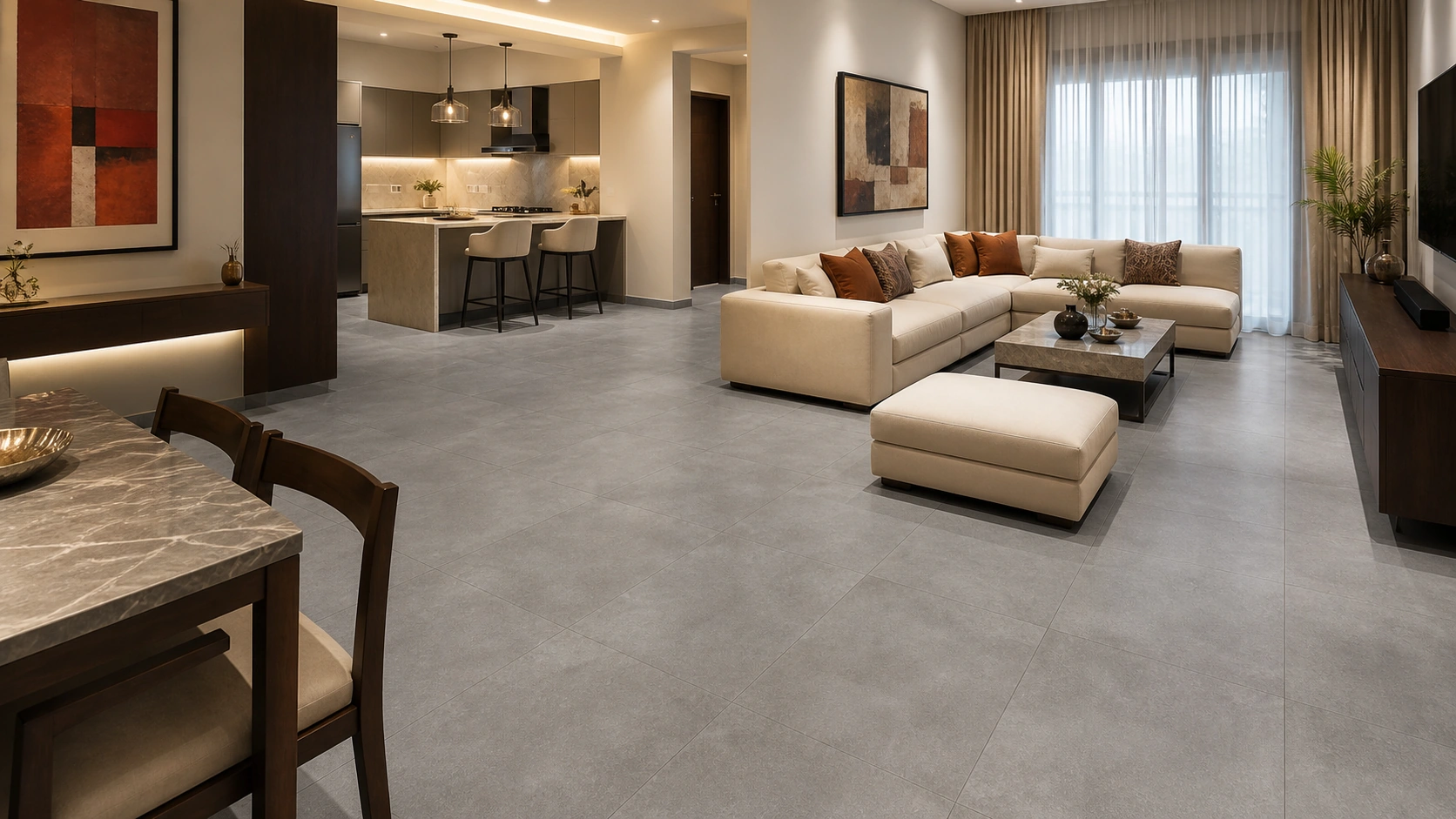
Endless pattern GVT, mid-grey concrete-look | 32x32 (800x800 mm), rectified | Matte, PEI 4 | Tile Rs. 135 to Rs. 200/sq.ft | All-in indicative Rs. 235 to Rs. 375/sq.ft
The larger format reduces joint count further across a genuinely open floor, which is where the category earns its money. Note that the format itself raises labour and levelling cost, so the all-in gap over the 600 mm pick is wider than the tile prices suggest.
Pair with: Straight stack-bond or one-third offset given the 800 mm bow sensitivity, epoxy grout if the floor runs into a kitchen zone, and substrate flatness verified before ordering.
Avoid: Choosing 800 mm purely because it looks more premium, without budgeting the higher labour, levelling, and substrate correction that the format genuinely requires.
Idea 3: Ivory Marble-Look Endless GVT, Premium Living Room Floor
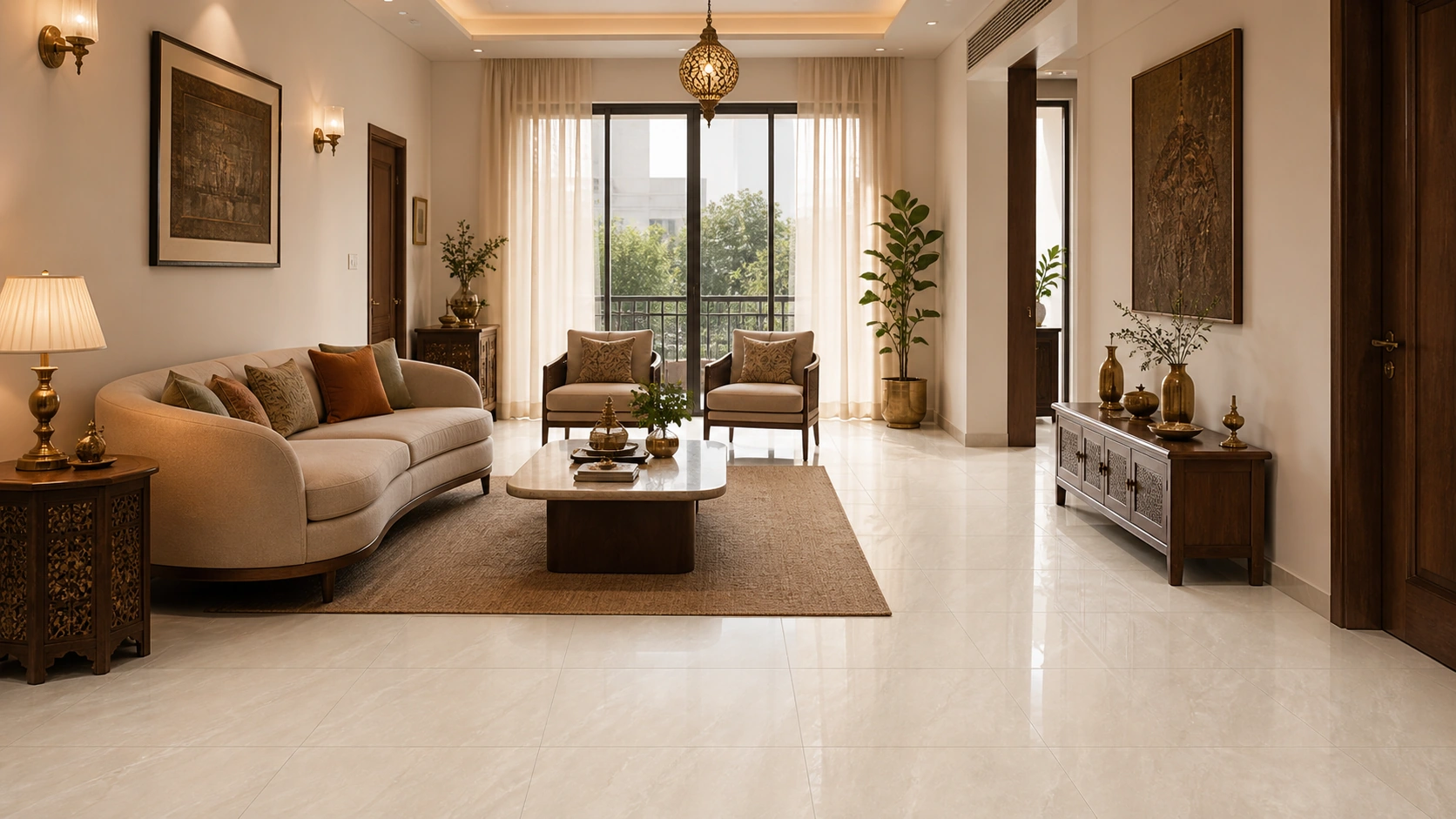
Endless pattern GVT, soft ivory veining | 2x2 or 24x24 (600x600 mm), rectified | Matte, PEI 4 | Tile Rs. 150 to Rs. 210/sq.ft | All-in indicative Rs. 245 to Rs. 370/sq.ft
Veined patterns are less forgiving of sequencing error than concrete-look, so the practical premium here is partly in requiring a more careful installer rather than only in the tile price.
Pair with: Epoxy grout tone-matched to the ivory, since a pale cement grout on a premium floor will discolour visibly within a few years and undo the appearance you paid for.
Avoid: Pale cement grout, which is the classic false economy on a light-toned premium floor and typically shows staining within two to three years.
Idea 4: Large-Scale Marble-Look Endless PGVT, Commercial Lobby Floor
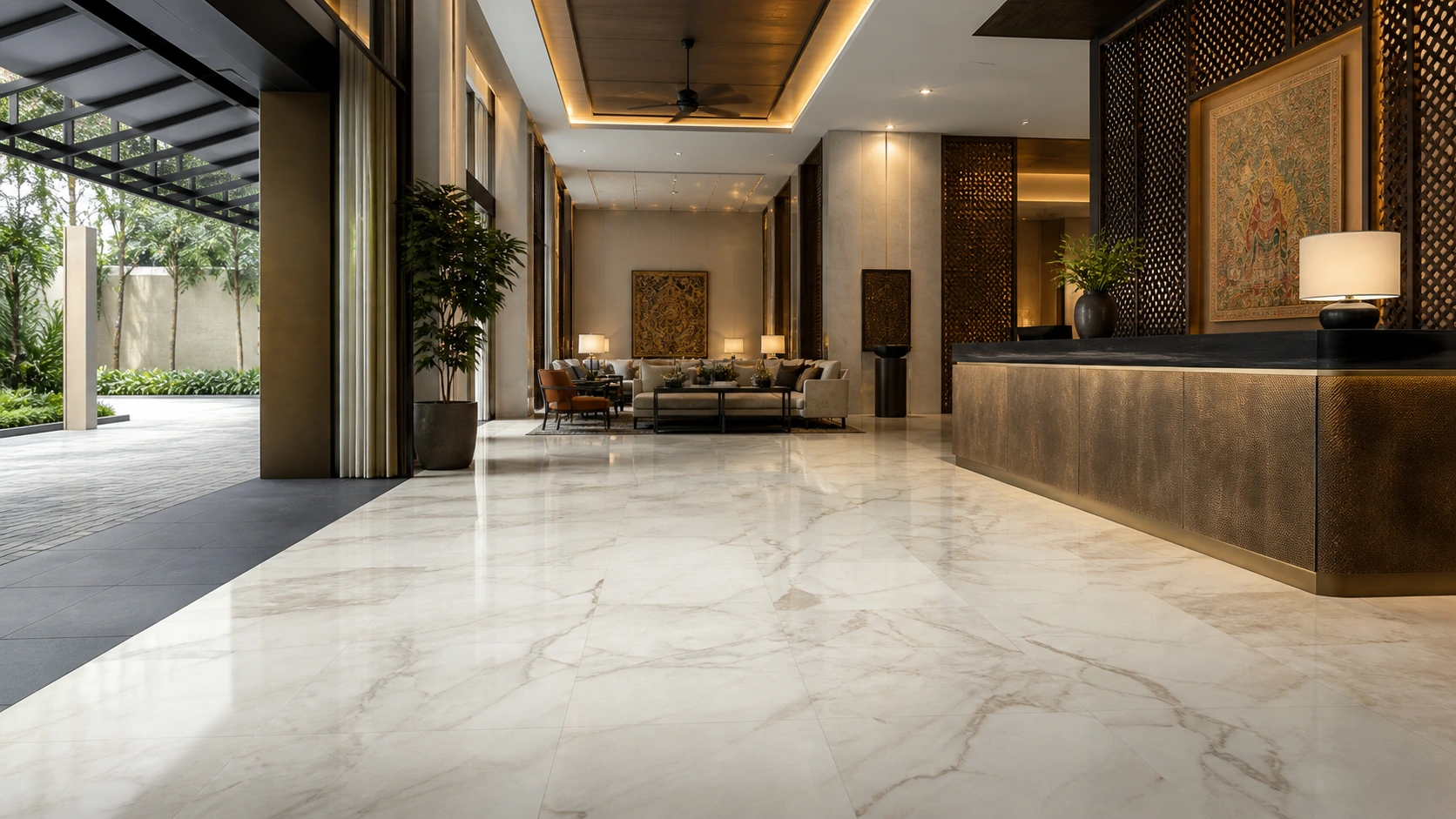
Endless pattern PGVT, large-scale veining | 32x32 (800x800 mm), rectified | Semi-polished, PEI 5 | Tile Rs. 180 to Rs. 270/sq.ft | All-in indicative Rs. 295 to Rs. 465/sq.ft
The commercial specification, with PGVT tiles rated at PEI 5 abrasion resistance confirmed on the technical data sheet. Their mechanical polish is repolishable years later, which is a genuine long-term cost advantage over a glazed finish that cannot be restored.
Pair with: Epoxy grout throughout for cleaning-chemical resistance, and an anti-skid matte specification kept for the entrance zone where wet footwear arrives.
Avoid: Running this polished finish into the entrance zone itself, which is a slip liability during monsoon and a false economy against the cost of a separate entrance specification.
Once the cost side is clear, the next step is seeing how different endless patterns actually perform visually. These endless tile design ideas cover continuous looks for living rooms, lobbies, and feature surfaces, making it easier to connect a design preference with the right specification.
Wall Picks with Indicative Installed Cost
Wall installations carry a different cost shape: no substrate levelling in the floor sense, no levelling clips at the same intensity, but higher labour per sq.ft for vertical work and full-height handling.
Idea 5: Warm Travertine-Look Endless GVT, Feature Wall
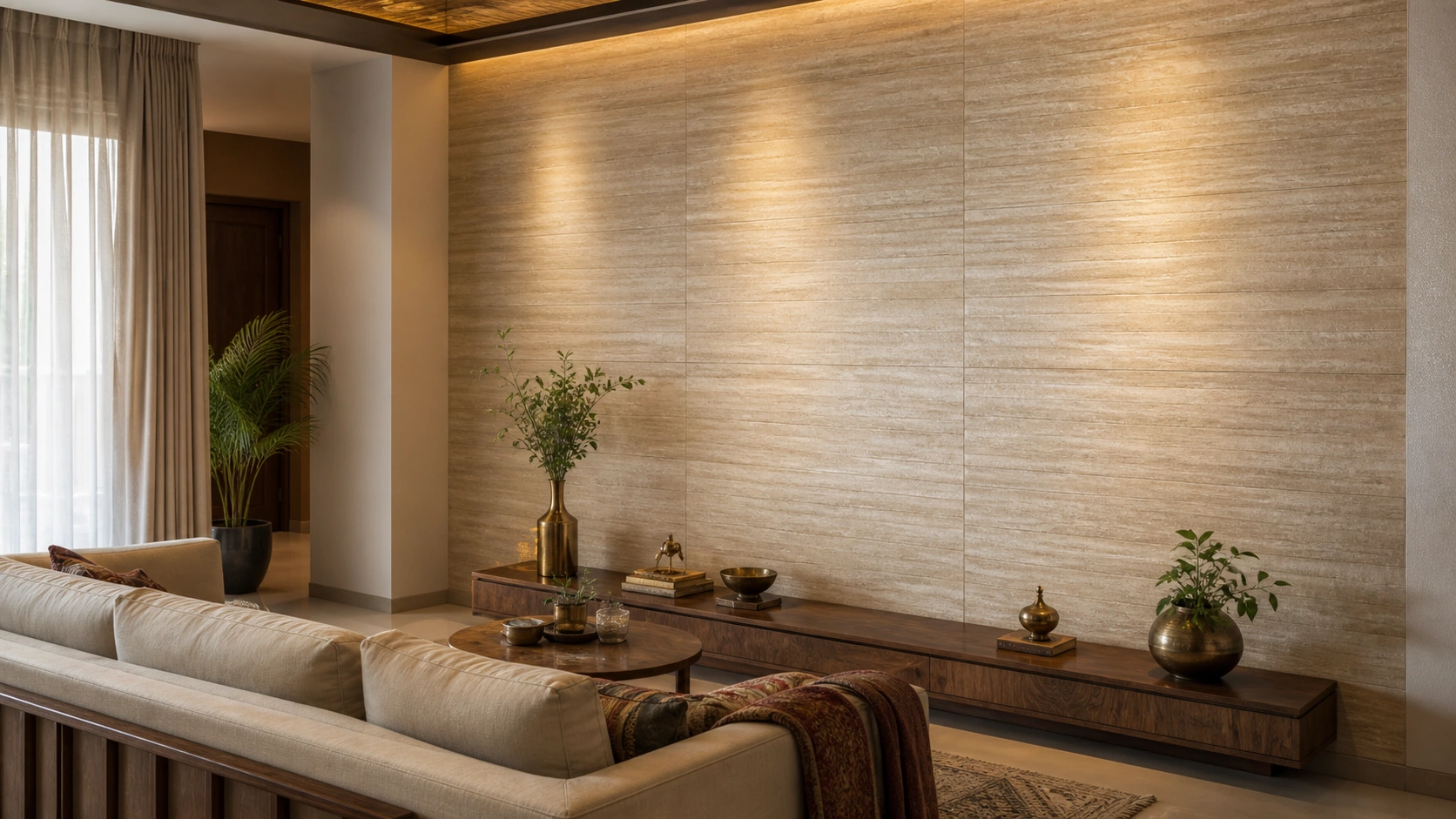
Endless pattern GVT, warm linear travertine | 2x4 (600x1200 mm), rectified | Matte | Tile Rs. 145 to Rs. 215/sq.ft | All-in indicative Rs. 250 to Rs. 380/sq.ft
A feature wall is the highest return per rupee in this entire category, because the area is small relative to a floor, nothing covers it, and the full composition stays visible permanently.
Pair with: Tone-matched epoxy or premium cement grout, and wall-wash lighting budgeted as part of the same project rather than as an afterthought.
Avoid: Budgeting the tile but not the lighting, which routinely leaves a well-chosen feature wall flatly lit by ceiling downlights and looking considerably cheaper than it was.
Idea 6: Book-Matched Marble-Look Endless PGVT, Statement Wall
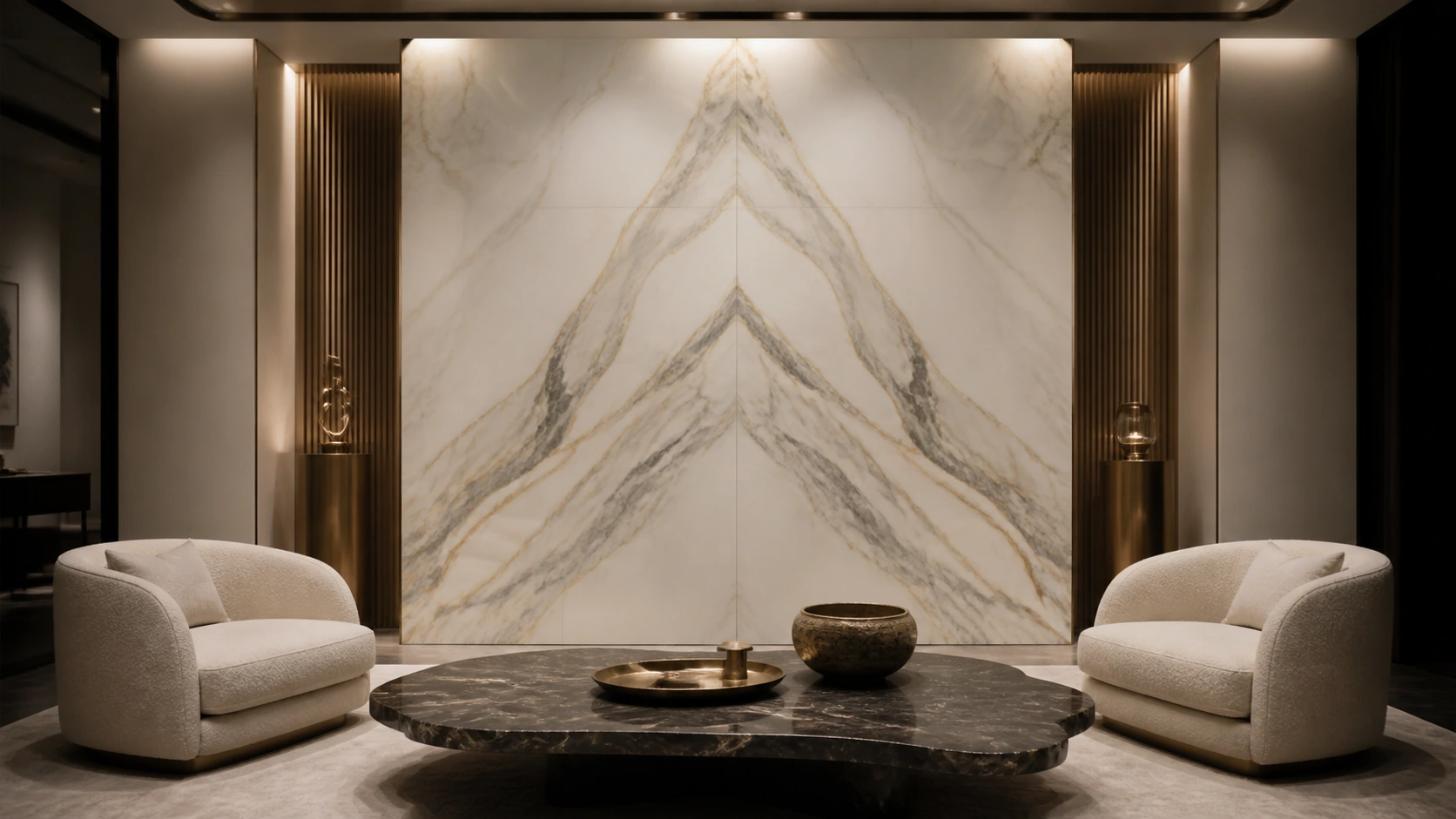
Endless pattern PGVT, book-matched veining | 2x4 (600x1200 mm) or slab, rectified | Polished, dry area only | Tile Rs. 180 to Rs. 300/sq.ft | All-in indicative Rs. 300 to Rs. 500/sq.ft
The highest-impact specification available, and the one with the highest installation risk, since mirrored pairs must stay together and correctly oriented. The all-in range is wide precisely because installer skill varies most on this pick.
Pair with: 12 to 15% overage since unmatched leftovers have almost no use, a confirmed experienced installer, and a dry location only given the polished finish.
Avoid: Any wet or splash-adjacent location, and any installer who has not laid book-match tile before, since a single reversed pair breaks the symmetry across the whole composition.
Idea 7: Concrete-Look Endless GVT, Full-Height Commercial Reception Wall
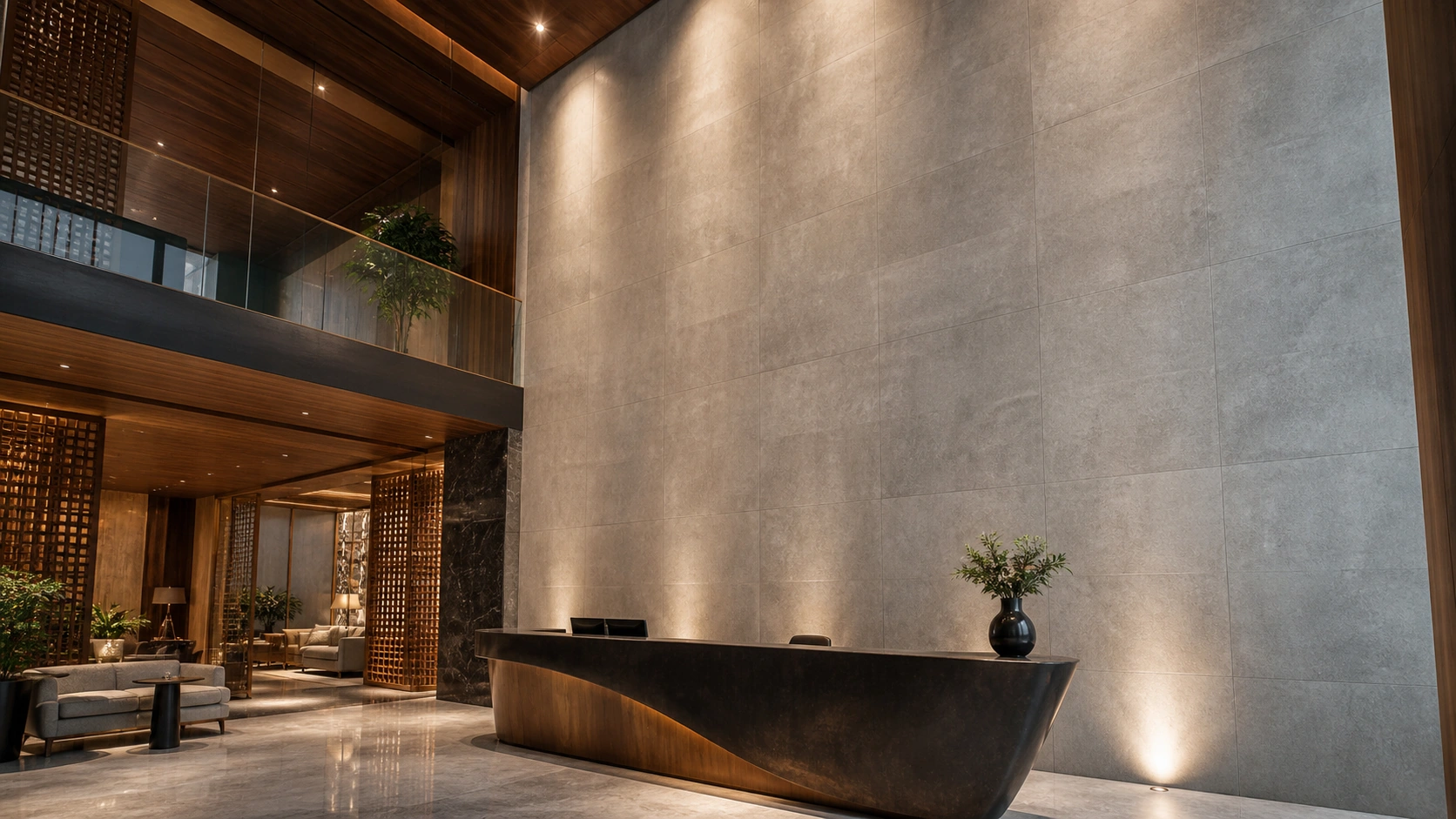
Endless pattern GVT, large-scale concrete-look | 2x4 (600x1200 mm), rectified | Matte | Tile Rs. 140 to Rs. 210/sq.ft | All-in indicative Rs. 245 to Rs. 375/sq.ft
A restrained commercial wall specification that reads as architectural rather than decorative, and forgives sequencing imperfection better than veined alternatives on a large vertical surface.
Pair with: Vertical wall-wash lighting at 3500K to 4000K, and substrate plumb verified across the full height before starting.
Avoid: Ground-level-only lighting on a double-height wall, which leaves the upper half in shadow and wastes the material bought for it.
Worked Example: 1,000 sq.ft Living Room Floor
Using Pick 2, the mid-grey concrete-look at 800x800 mm, on a floor with a reasonably sound existing base needing light correction. Figures are indicative planning ranges only.
| Line Item | Basis | Indicative Cost |
| Tile, 1,000 sq.ft | At Rs. 165/sq.ft mid-range | Rs. 1,65,000 |
| Overage at 12% | 120 sq.ft additional | Rs. 19,800 |
| Adhesive, large-format grade | At Rs. 35/sq.ft | Rs. 35,000 |
| Grout, cement, tone-matched | At Rs. 9/sq.ft | Rs. 9,000 |
| Levelling clip system | At Rs. 12/sq.ft | Rs. 12,000 |
| Labour, sequenced large format | At Rs. 60/sq.ft | Rs. 60,000 |
| Light substrate correction | At Rs. 25/sq.ft | Rs. 25,000 |
| Indicative total | 1,000 sq.ft installed | Rs. 3,25,800 |
| Effective rate | Per sq.ft installed | Rs. 326/sq.ft |
The number worth internalising: The tile was Rs. 165 per sq.ft. The finished floor was around Rs. 326 per sq.ft, roughly double. A buyer who budgeted Rs. 1,65,000 for this floor is short by more than Rs. 1,50,000, and that gap appears after demolition has started, when stopping is not an option. Budget from the installed rate, not the shelf rate. |
What Is Safe to Trim, and What Never Is
| Line Item | Safe to Trim? | Consequence If You Do |
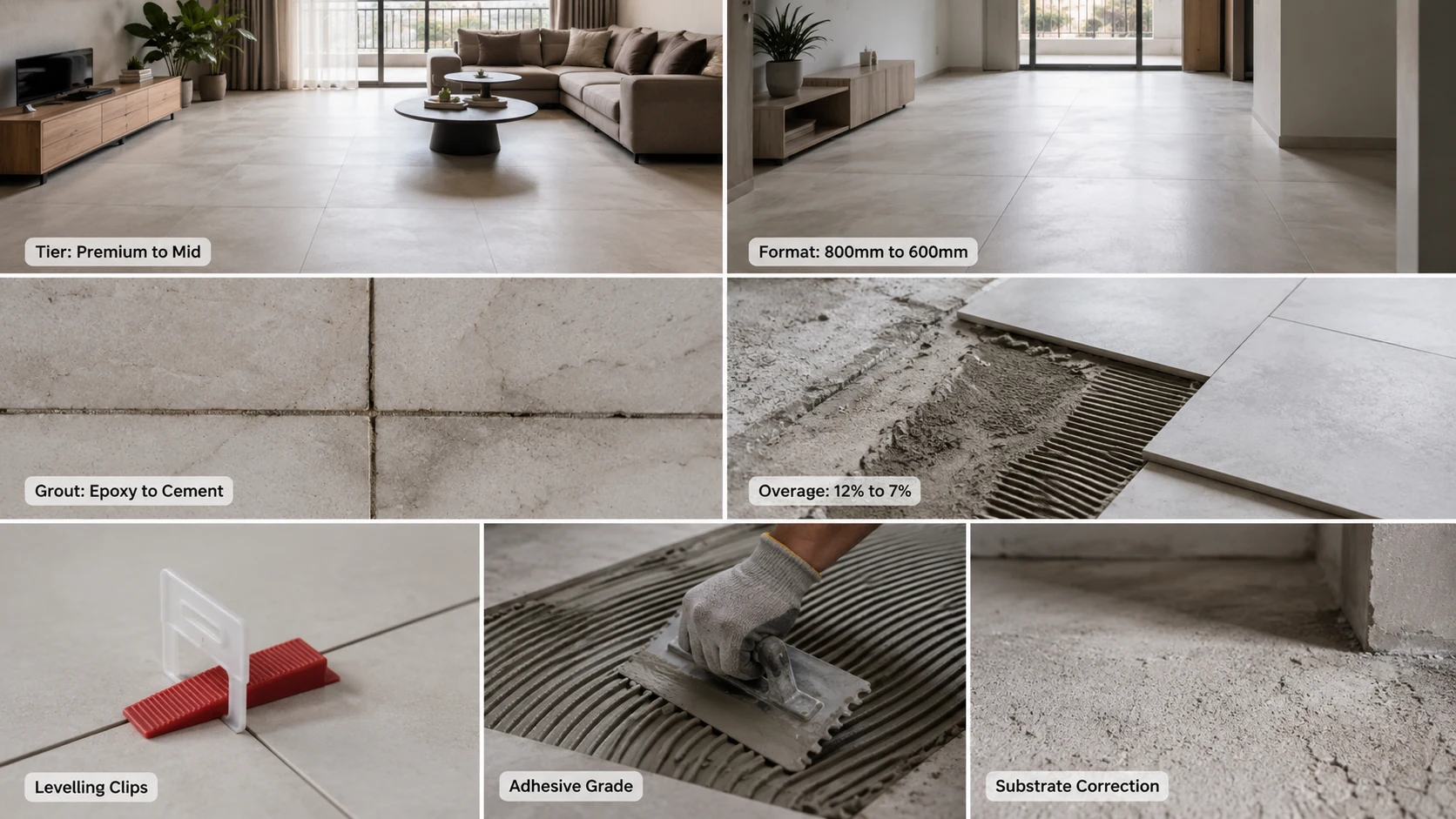
| Tile tier, moving from premium to mid | Yes | A concrete-look tile at Rs. 130 genuinely performs close to one at Rs. 200 on a large floor; this is the most sensible saving available |
| Format, moving from 800 mm to 600 mm | Yes | Saves on tile, labour, levelling, and substrate tolerance simultaneously, with modest visual cost |
| Grout, epoxy to cement in dry areas | Usually yes | Acceptable in a dry living room, but a false economy under a pale premium tile where staining will show |
| Overage, cutting 12% to 7% | No | You cannot buy matching sequence later; running short mid-installation is the worst position to be in on this category |
| Levelling clip system | No | The cheapest line on the sheet and the one most directly responsible for whether the floor reads as professional |
| Adhesive grade | No | Large formats debond without full-bed coverage in a suitable grade; this is the root of most hollow-tile failures |
| Substrate correction | No | Large tiles bridge dips rather than following them, so an uncorrected base produces lippage and later debonding |
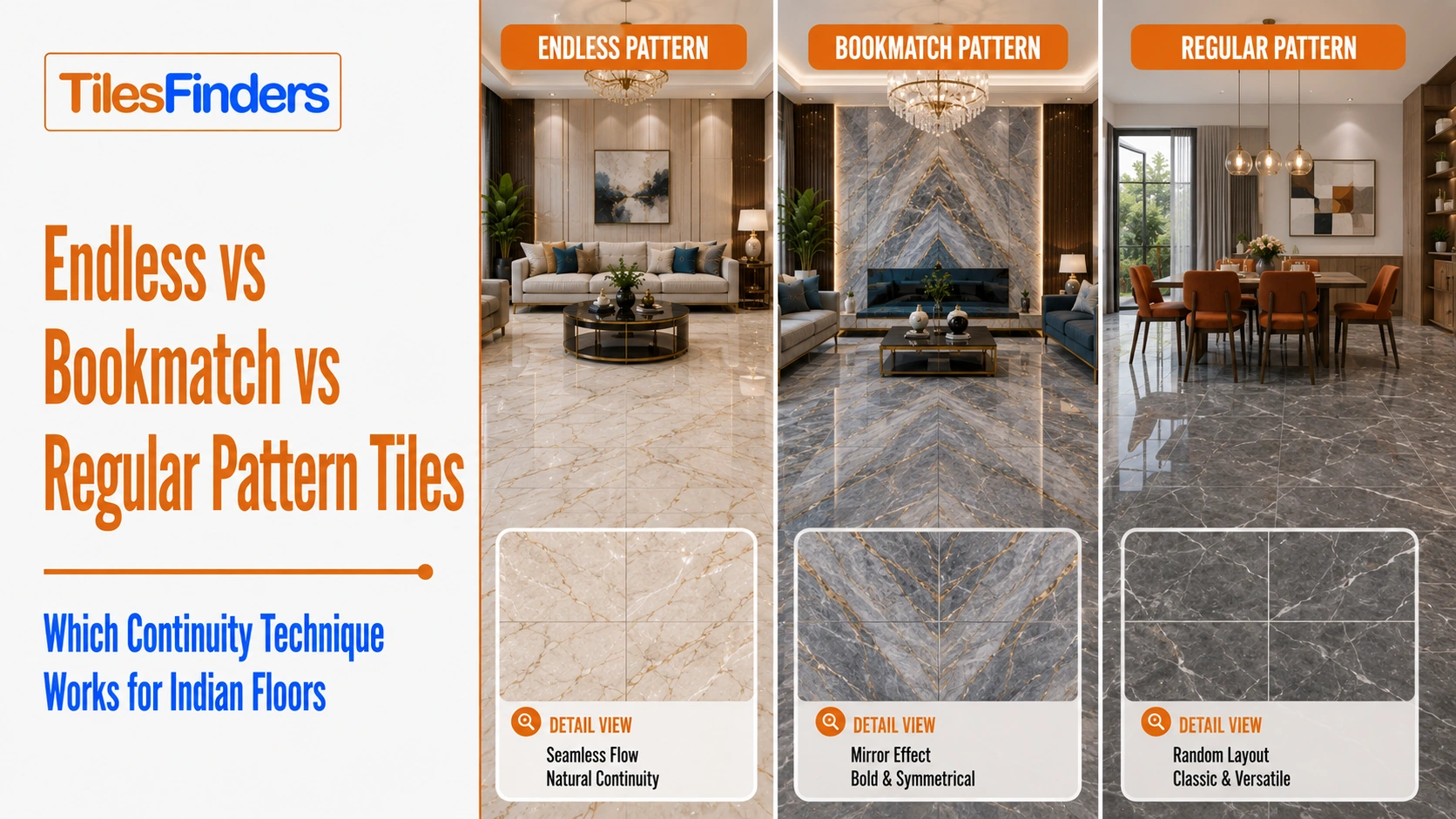
Price is only one part of choosing a continuity technique; installation risk, repairability, and future modifications can change the better option entirely. This endless vs bookmatch vs regular comparison breaks down those trade-offs across practical criteria for Indian floors.
Getting a Quote You Can Actually Compare
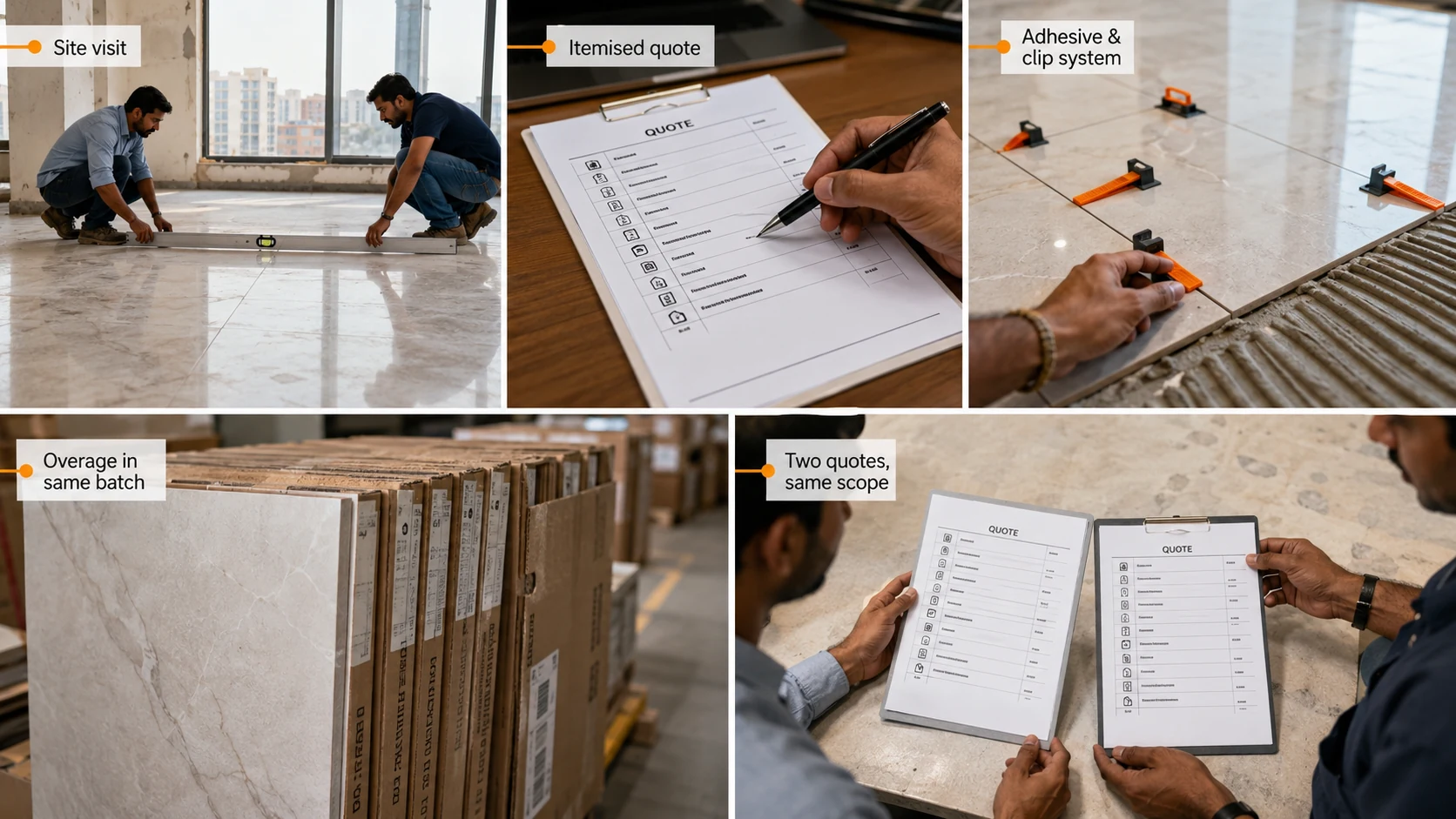
- Insist on a site visit with a straightedge before any figure is agreed. A large-format quote given without inspecting floor flatness is a guess, and the correction cost is the item most likely to surprise you.
- Ask for the quote itemised across the eight lines above, rather than as a single per-sq.ft rate, so you can see what has been assumed and what has been omitted.
- Confirm the adhesive grade and whether a levelling clip system is included, since both are commonly omitted from a headline rate and both matter.
- Confirm the overage percentage is in the quantity, not added later, and that it comes from the same batch, shade code, and calibre code.
- Get two quotes against the same written scope, since comparing two rates built on different assumptions tells you nothing useful.
Specification Baseline for Every Pick
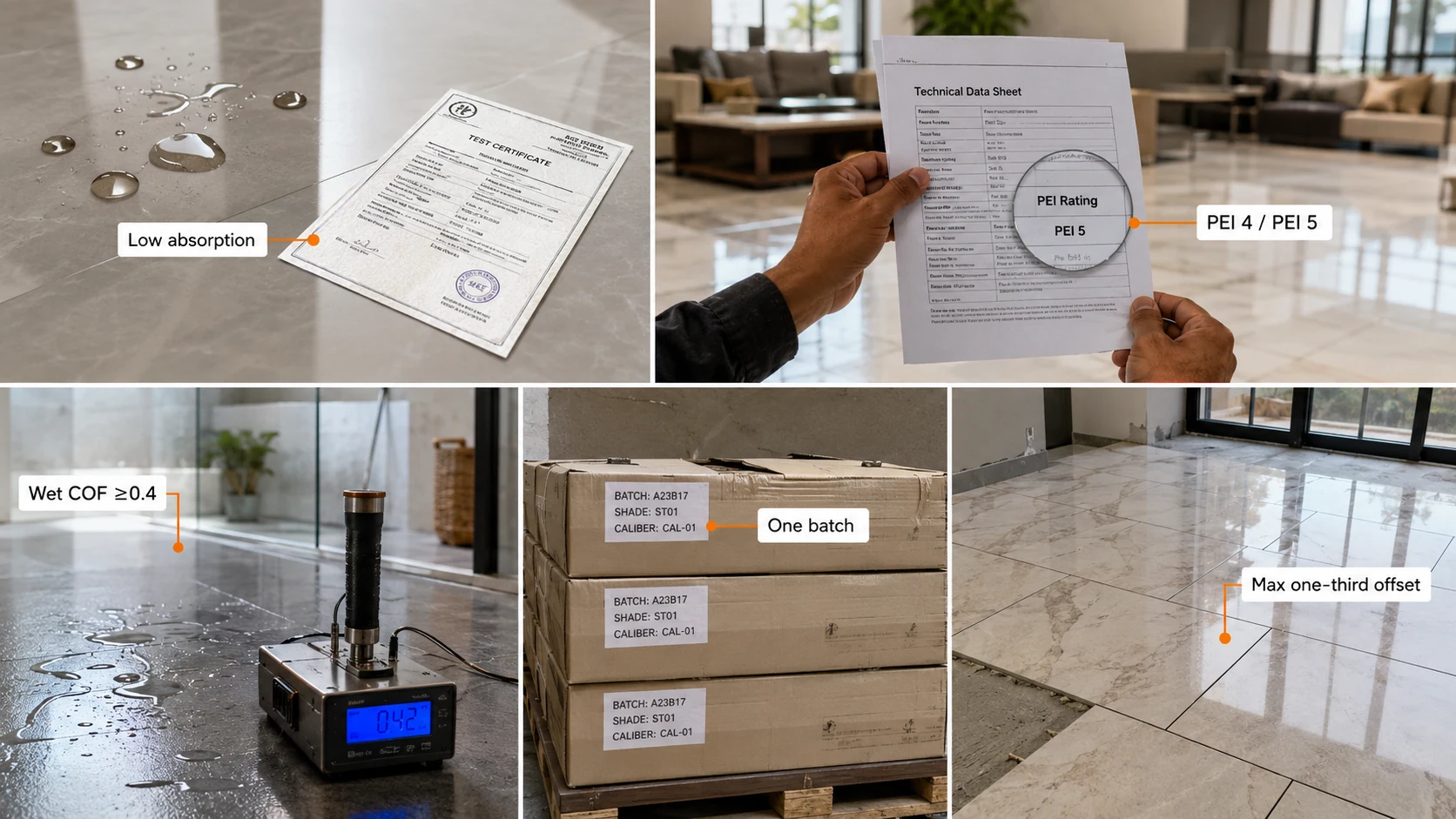
- Water absorption 0.05% or below, the benchmark set by the Bureau of Indian Standards under IS 15622 for vitrified tile, with the test certificate requested.
- PEI 4 minimum for residential floors, PEI 5 for commercial, as stated on the manufacturer's technical data sheet.
- Confirmed wet coefficient of friction 0.4 minimum for any floor that gets wet, with polished finishes kept out of wet zones entirely.
- Single batch, single shade code, single calibre code across the full quantity including overage.
- One-third maximum offset above 600 mm, since a 50% brick bond maximises lippage on the formats where bow is greatest.
Price Your Full Project on TilesFinders
Endless-pattern GVT and PGVT ranges can be compared on TilesFinders by format, edge finish, rating, and batch availability, so you can build a realistic installed budget rather than planning against the tile price alone.
FAQs
Indicatively, around Rs. 200 to Rs. 465 per sq.ft all-in, depending on tile tier, format, and substrate condition, against tile prices of Rs. 110 to Rs. 280. As a planning rule, the installed cost tends to be roughly double the tile price on a large area.
Because adhesive, overage, grout, levelling systems, labour, and substrate correction together typically equal or exceed the tile itself. Large formats raise several of these at once, since they need higher-grade adhesive, more labour, levelling clips, and a flatter base.
Mechanical clips that hold adjacent tiles flush while the adhesive cures, which is the most effective defence against lippage on large formats. At roughly Rs. 8 to Rs. 18 per sq.ft it is the cheapest line on the sheet and the one most directly responsible for a professional-looking finish.
On tile tier and format. A mid-range concrete-look tile performs close to a premium one across a large floor, and dropping from 800 mm to 600 mm saves on tile, labour, levelling, and substrate tolerance simultaneously.
Overage, levelling clips, adhesive grade, and substrate correction. Each is comparatively small, and each causes a failure that costs far more to remedy than the saving, particularly on an endless pattern where running short cannot be fixed by a later purchase.
Because it depends entirely on the existing floor's flatness, which nobody can assess remotely. Large-format tiles bridge dips rather than following them, so an uneven base produces lippage or later debonding. Insist on a straightedge check before agreeing any figure.
In wet areas and kitchens, yes. On a pale premium tile in a dry room, also usually yes, since cement grout under a light tile typically discolours visibly within two to three years and undermines the appearance you paid for.
The 600 mm format is meaningfully cheaper across tile, labour, and levelling, and is more tolerant of an imperfect base, while still suppressing the joint grid well. Choose 800 mm only where the visual difference genuinely matters, and the additional installed cost has been budgeted.
Get both against the same written scope, itemised across tile, overage, adhesive grade, grout type, levelling system, labour, and substrate correction. Two headline per-sq.ft rates built on different assumptions cannot be compared meaningfully.


See our tile guides first
Set TilesFinders as a preferred source and our buying guides surface ahead of the rest for you.
Add as preferred sourceTakes one tap. Nothing to install.
What Readers Say
I was about to redo my parking area with the wrong tile size until I read this. The layout comparisons saved me from a costly mistake.
We reference TilesFinders guides while briefing clients on material selection. The size and pattern breakdowns are accurate and easy to explain visually.
On site, I get asked about grout spacing all the time. This article gave me a solid reference I now share with my team before every job.
Finally a guide that doesn't just push generic advice. The oil stain removal steps actually worked on our clubhouse driveway tiles.
I run a small construction firm and now send this link to clients directly when they ask about entrance tile sizing. Saves me an hour of explaining.
Good practical detail, though I wish there were more examples for compact apartment entrances specifically, not just villas.
My mother-in-law wanted marble, I wanted vitrified. This blog gave us the neutral comparison we needed to actually decide together.
Detailed without being overwhelming. I appreciated that it covered both cost and maintenance, not just the aesthetics.
Used the algae and hard water removal tips on our terrace tiles after the monsoon. Worked better than what our regular cleaner was doing.
As someone who sources tiles for multiple builder projects, I find these comparisons genuinely useful for vendor conversations, not just consumer content.
Recommended this to a client who kept second-guessing the entrance design. The small vs large layout section settled the debate instantly.
Straightforward and honest, no unnecessary jargon. Would like to see a similar breakdown for outdoor pool-deck tiles next.
We've bookmarked several TilesFinders guides for our design handbook. Reliable source when clients want data, not just opinions.
Two paths, one marketplace.
Get free quotes from verified suppliers.
Share your room, budget, and style. Suppliers in Morbi respond within hours.
Get Free QuotesList your business, reach real buyers.
Put your showroom in front of homeowners searching for tiles right now.
List Your Business