Endless vs Bookmatch vs Regular Pattern Tiles: Which Continuity Technique Works for Indian Floors
Compare endless, bookmatch, and regular pattern tiles across cost, installation, repairability, floor suitability, and long-term practicality to choose the right continuity technique for Indian spaces.
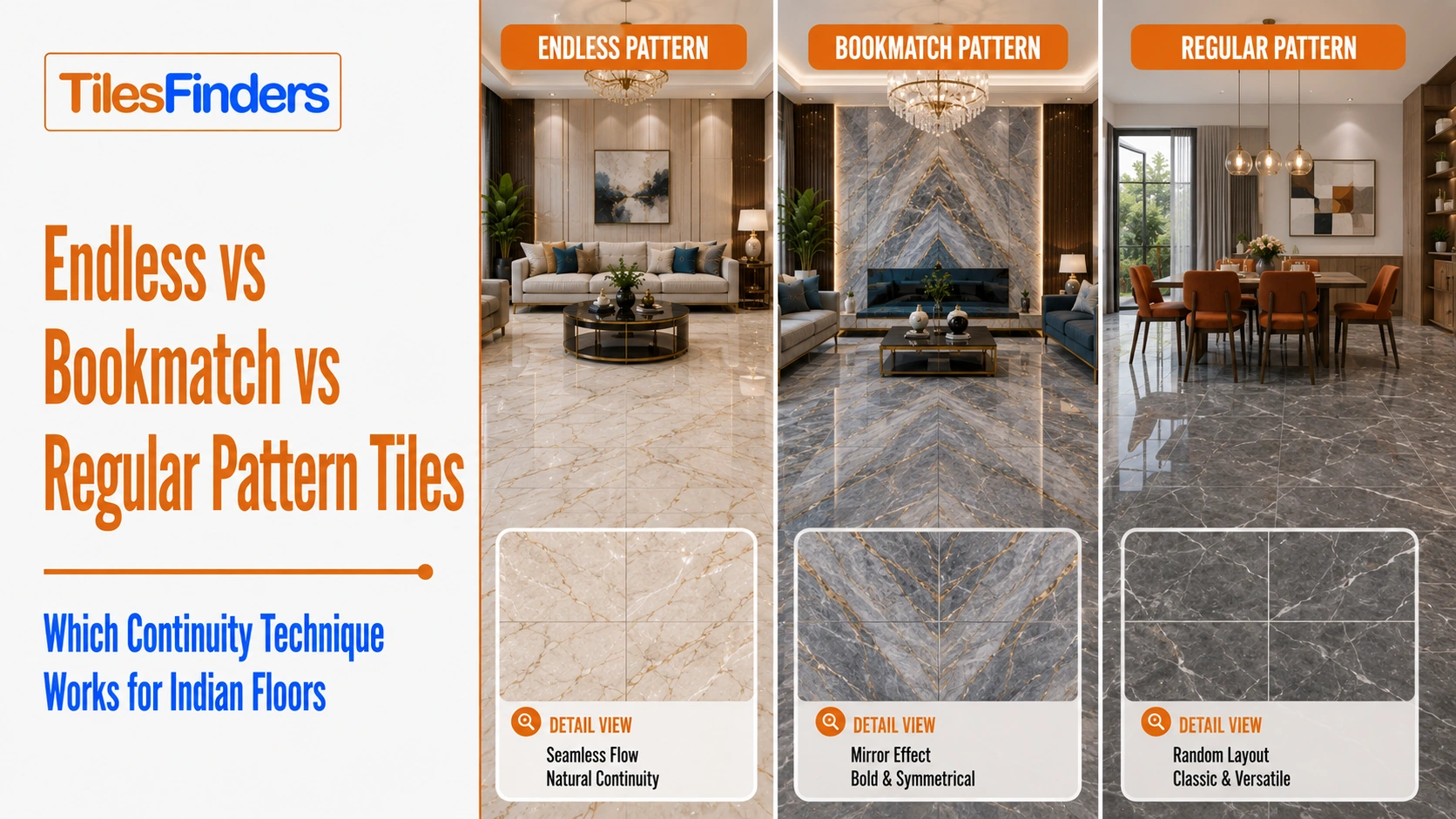
- First, Correct the Category Error
- The Scorecard
- Why Each Score Is What It Is
- Decision Path: Which One For Your Room
- What Each Technique Genuinely Fails At
- The Indian-Specific Factors That Shift These Scores
- Cost Reality: What You Actually Pay
- Specification Baseline for All Three
- Compare All Three Techniques on TilesFinders
Regular tiles win for most Indian floors because they offer better repairability, lower cost, easier installation, and greater tolerance for imperfect rooms. Endless patterns suit large uninterrupted surfaces, while bookmatch works best as a dramatic wall feature rather than a floor solution.
Scored across the eight criteria that actually decide how a floor performs over ten years, one of these three wins comfortably, and it is not the expensive one. This guide scores each technique honestly, explains every score, and gives a decision path for choosing between them based on your specific room rather than on which endless design tiles look best in a catalogue.
First, Correct the Category Error
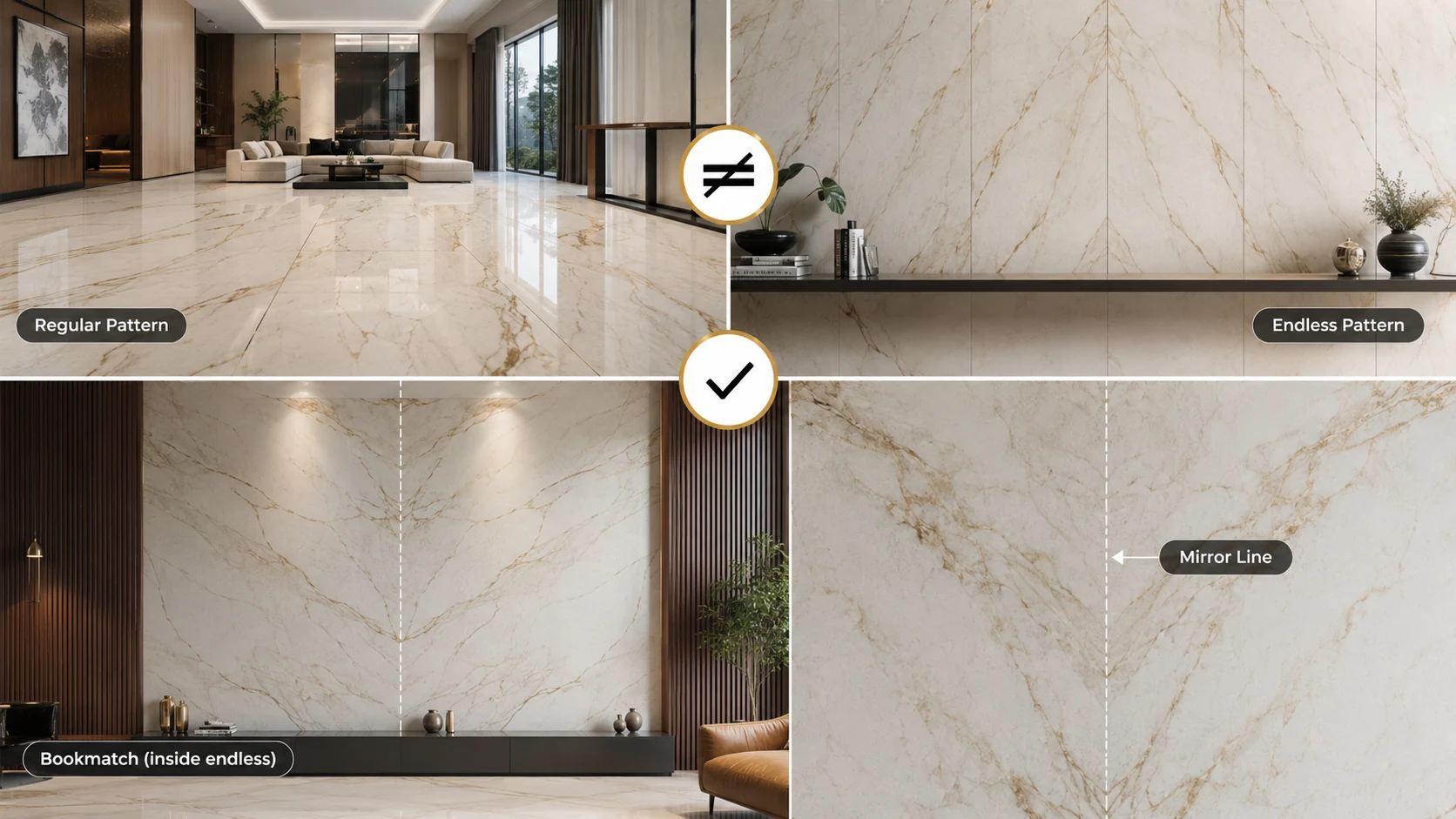
These are not three parallel options: Regular pattern and endless pattern are genuinely different products. Bookmatch is not a third product; it is a specific technique that exists inside the endless pattern family, where bookmatch tiles are printed as mirrored pairs so veining reflects across a centre line. So the honest structure is two categories, regular and endless, with bookmatch as a particular and demanding way of executing the second. Treating bookmatch as a parallel choice is what leads people to specify it on floors, where its central defining feature, a mirror line, cannot work properly. |
From The Marketplace
Popular tiles right now
-3c0e954e-6bd7-4051-8e84-535c6e13fd05.jpg)
-263777fa-8850-48d2-892b-cf4248031df3.jpg)
-889fd924-c830-4d60-8bbe-269b8556ab53.jpg)
-b111e9d9-e88d-4c5e-96f7-dff11ba52624.jpg)
-e3e955e6-07ca-42cc-832c-1d0c01082b9e.jpg)
-95469d35-4777-49d1-8a56-781a41e7900d.jpg)
-021b2f40-4e2b-4607-8348-48043c6cee98.jpg)
-e2d7338b-eba8-42cc-a30a-249f3a5d5f0b.jpg)
-b44dd52b-bb4f-46d1-95fd-67961eaaee35.jpg)
The Scorecard
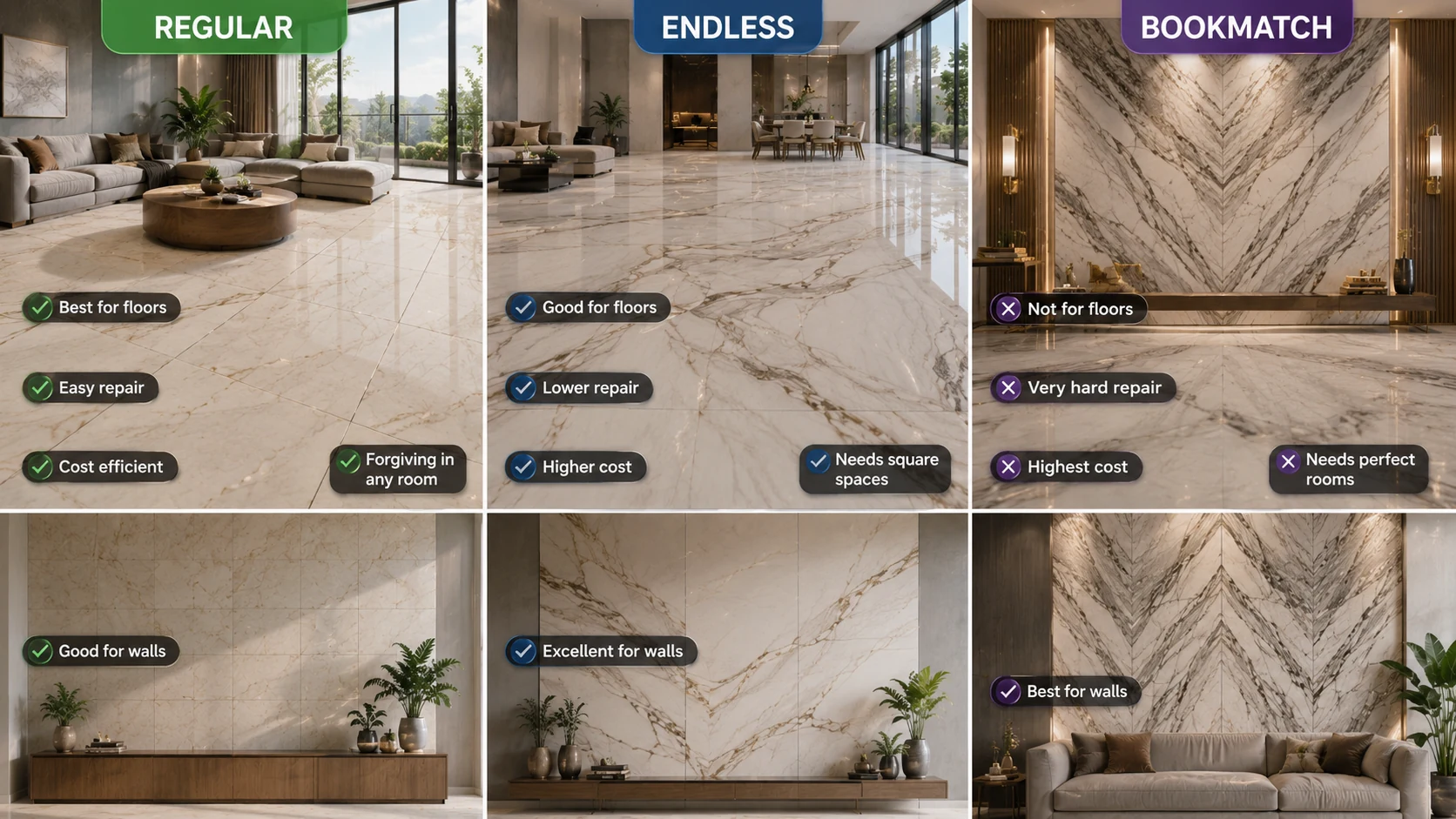
Each technique scored out of 5 on eight criteria, weighted equally. Scores reflect performance in typical Indian residential conditions rather than in a controlled showroom.
| Criterion | Regular | Endless | Bookmatch |
| Visual impact at first sight | 2 | 4 | 5 |
| Suitability for floors | 5 | 4 | 2 |
| Suitability for walls | 3 | 5 | 5 |
| Installation risk, higher is safer | 5 | 2 | 1 |
| Repairability after damage | 5 | 1 | 1 |
| Cost efficiency per sq.ft installed | 5 | 2 | 1 |
| Forgiveness in out-of-square rooms | 5 | 3 | 2 |
| Future extension and resale | 5 | 2 | 1 |
| Total out of 40 | 35 | 23 | 18 |
What the scorecard actually says: Regular pattern tile wins on practicality by a wide margin, and it is the correct default for most Indian floors. Endless pattern is worth its lower score only where the surface is large, open, and unlikely to be repaired or extended. Bookmatch scores lowest overall but scores highest on impact, which is the entire point of it, and it earns its place on one wall rather than across a floor. A low total is not a verdict against a technique; it means the technique has to be deployed deliberately rather than by default. |
Why Each Score Is What It Is
Visual impact: Regular 2, Endless 4, Bookmatch 5
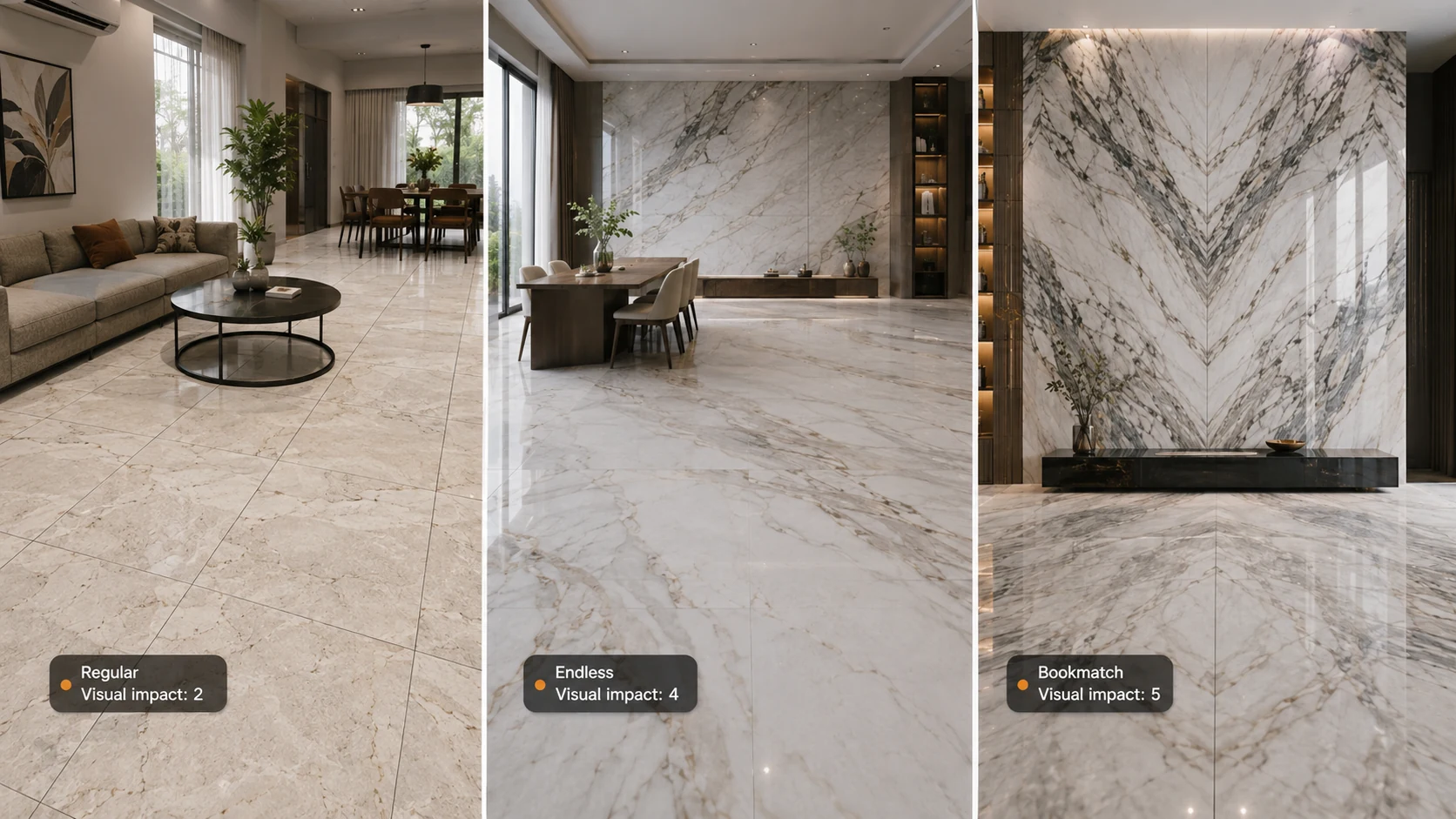
Regular tile carries face variation designed to look natural and unremarkable, which is a strength in most rooms and a weakness when the brief is a statement. Endless pattern removes the repeating grid and reads as one continuous surface. Bookmatch adds symmetry, and a mirrored composition is the closest tile gets to looking like a single quarried slab, which is why it commands the highest impact score and the highest price.
Suitability for floors: Regular 5, Endless 4, Bookmatch 2
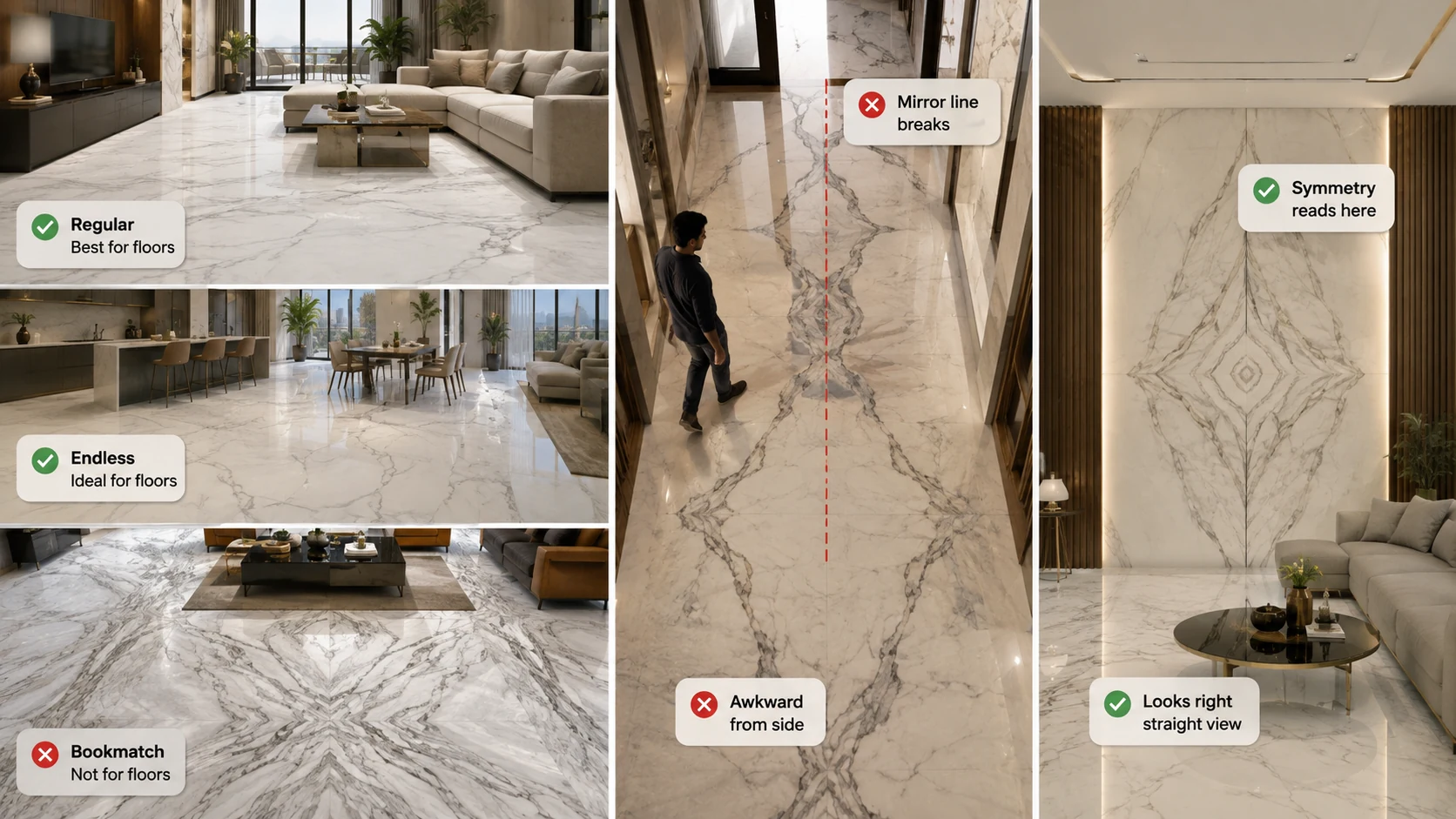
The viewing-centre problem that rules bookmatch out of most floors: A bookmatched composition has a mirror line, and a mirror line only reads as intentional symmetry when viewed square-on from a fixed position. A wall provides exactly that: people look at it from the seating position or the doorway. A floor does not, because people walk across it, around it, and view it from every angle in the room. Seen from the side, a mirrored floor composition reads as an odd repeated smear rather than as symmetry, which is why bookmatch on a floor frequently disappoints buyers who saw it presented beautifully on a vertical showroom panel. |
Installation risk: Regular 5, Endless 2, Bookmatch 1
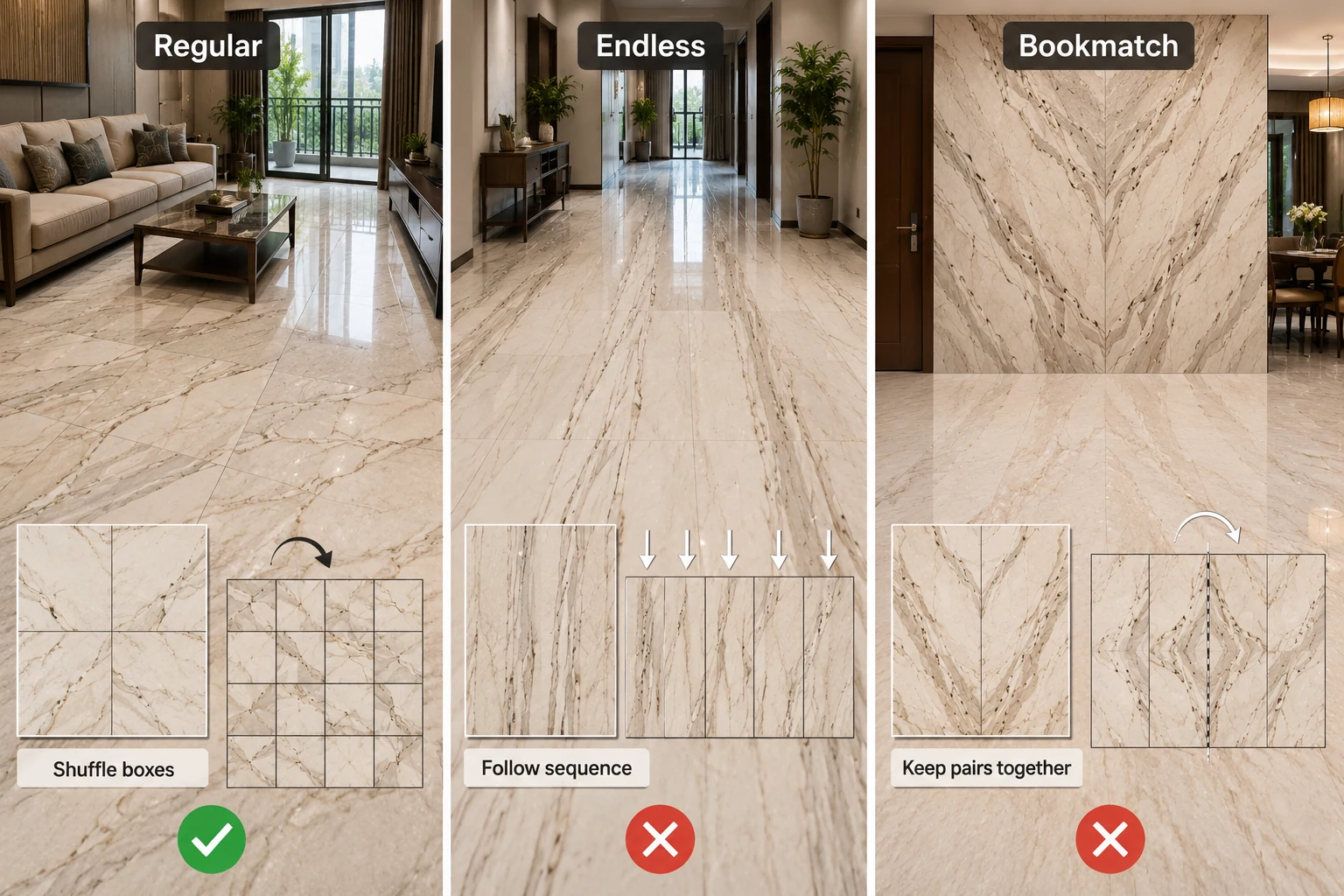
Regular tile is what every installer does by default, including shuffling boxes to distribute face variation, which is correct practice. Endless pattern requires the opposite, strict sequencing, and an installer following habit will scramble it permanently. Bookmatch adds a further requirement: that mirrored pairs stay together and stay oriented correctly, and a single pair reversed breaks the symmetry across the whole composition.
Repairability: Regular 5, Endless 1, Bookmatch 1
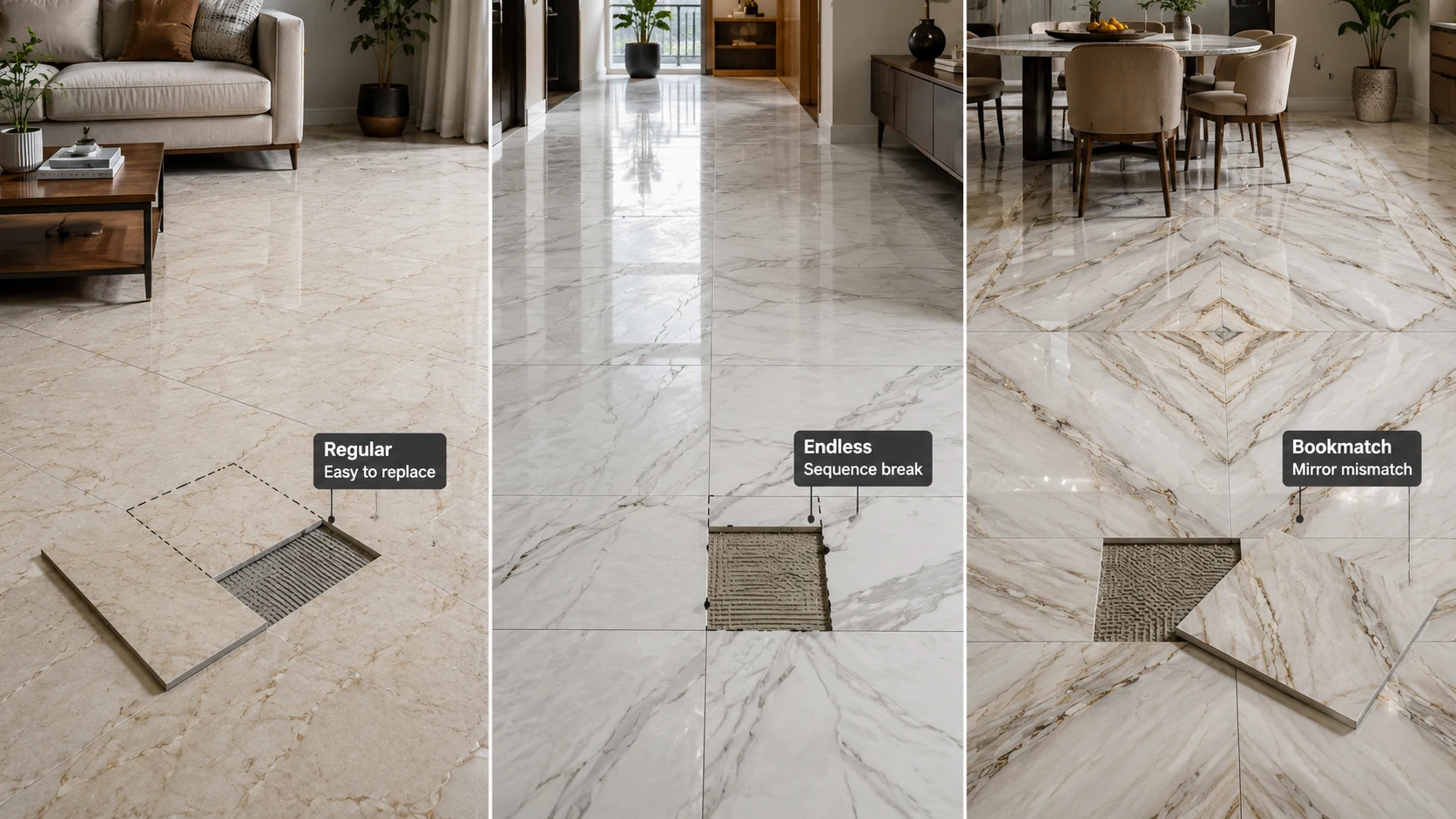
This is the score most buyers underestimate, and it matters most in India: If a regular tile cracks, you replace it with a similar tile, and the face variation absorbs any small difference. If an endless pattern tile cracks, the replacement must occupy that exact position in the sequence, and a later batch will not continue the original sequence. Bookmatch is worse still, since a damaged tile has a mirrored partner whose match is now broken. Indian homes are frequently modified, extended, or repaired over their lifetime, and plumbing and electrical work routinely means lifting floor tiles years after installation. A floor that cannot be patched is a genuine long-term liability, not a theoretical one. |
Cost efficiency: Regular 5, Endless 2, Bookmatch 1
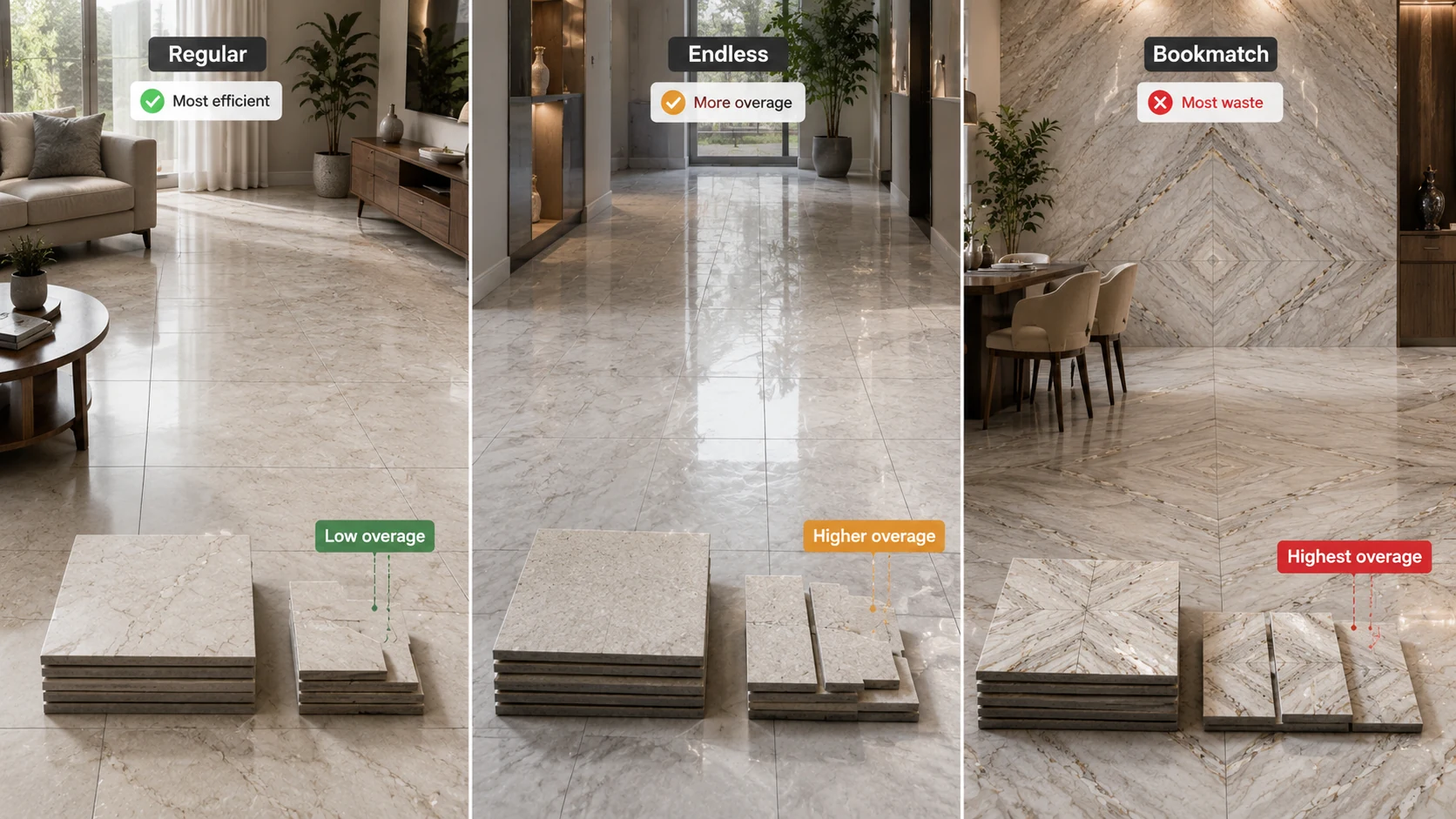
Beyond the higher tile price, Endless and bookmatch both require larger overage, 10 to 15% rather than 5 to 10%, because off-sequence pieces have limited reuse. Bookmatch requires the most, since pairs must be kept intact, and any unmatched leftovers have almost no use. The installed cost gap is therefore wider than the shelf price gap suggests.
Forgiveness in out-of-square rooms: Regular 5, Endless 3, Bookmatch 2
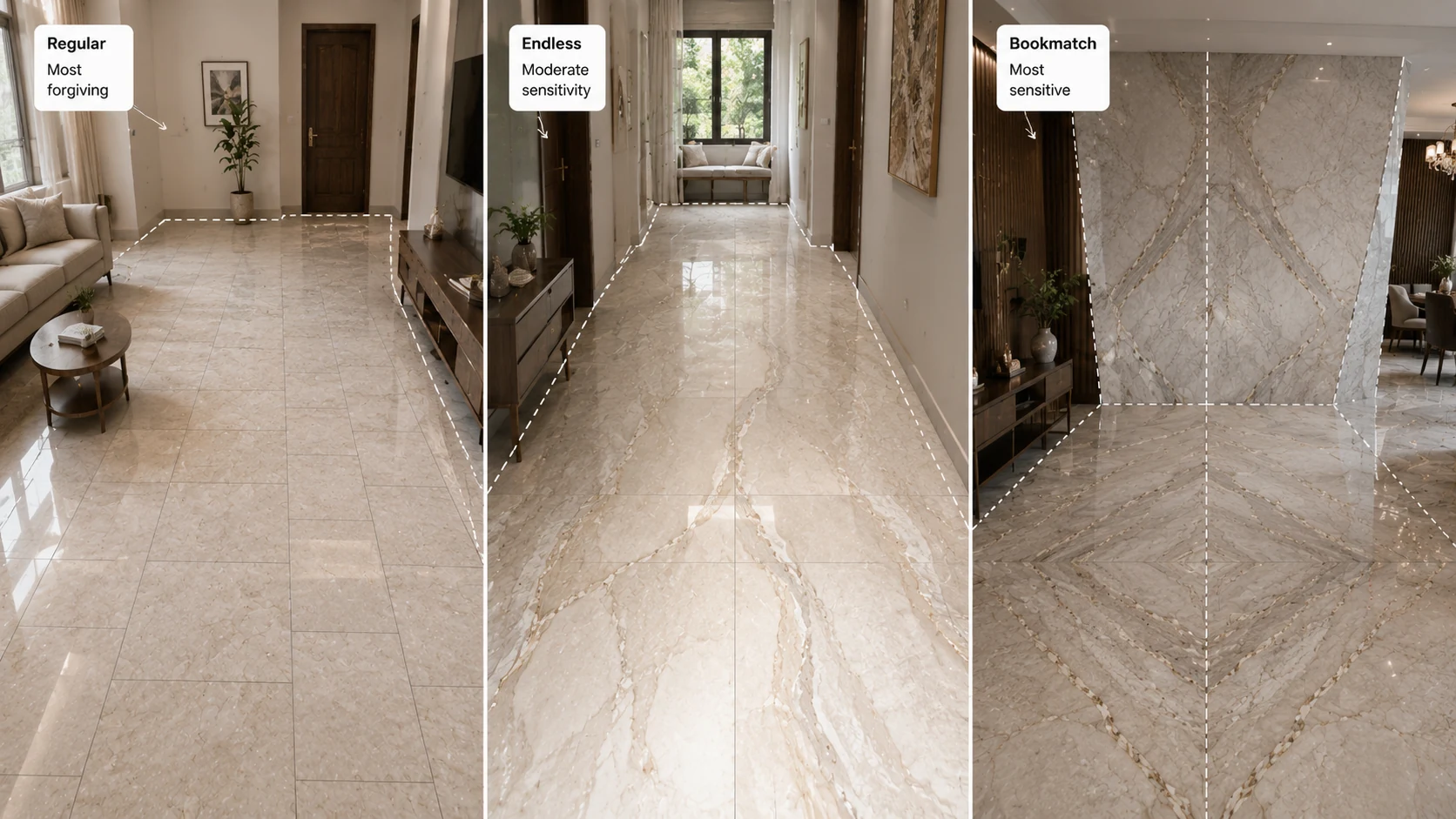
Very few Indian rooms are perfectly rectangular. Regular tile absorbs this easily because no single tile position matters. Endless pattern is more sensitive, since cuts interrupt the composition and a room that tapers produces uneven interruption. Bookmatch is the most sensitive of all, because an out-of-square room shifts the mirror line away from the room's visual centre, which is precisely what bookmatch exists to establish.
Future extension and resale: Regular 5, Endless 2, Bookmatch 1
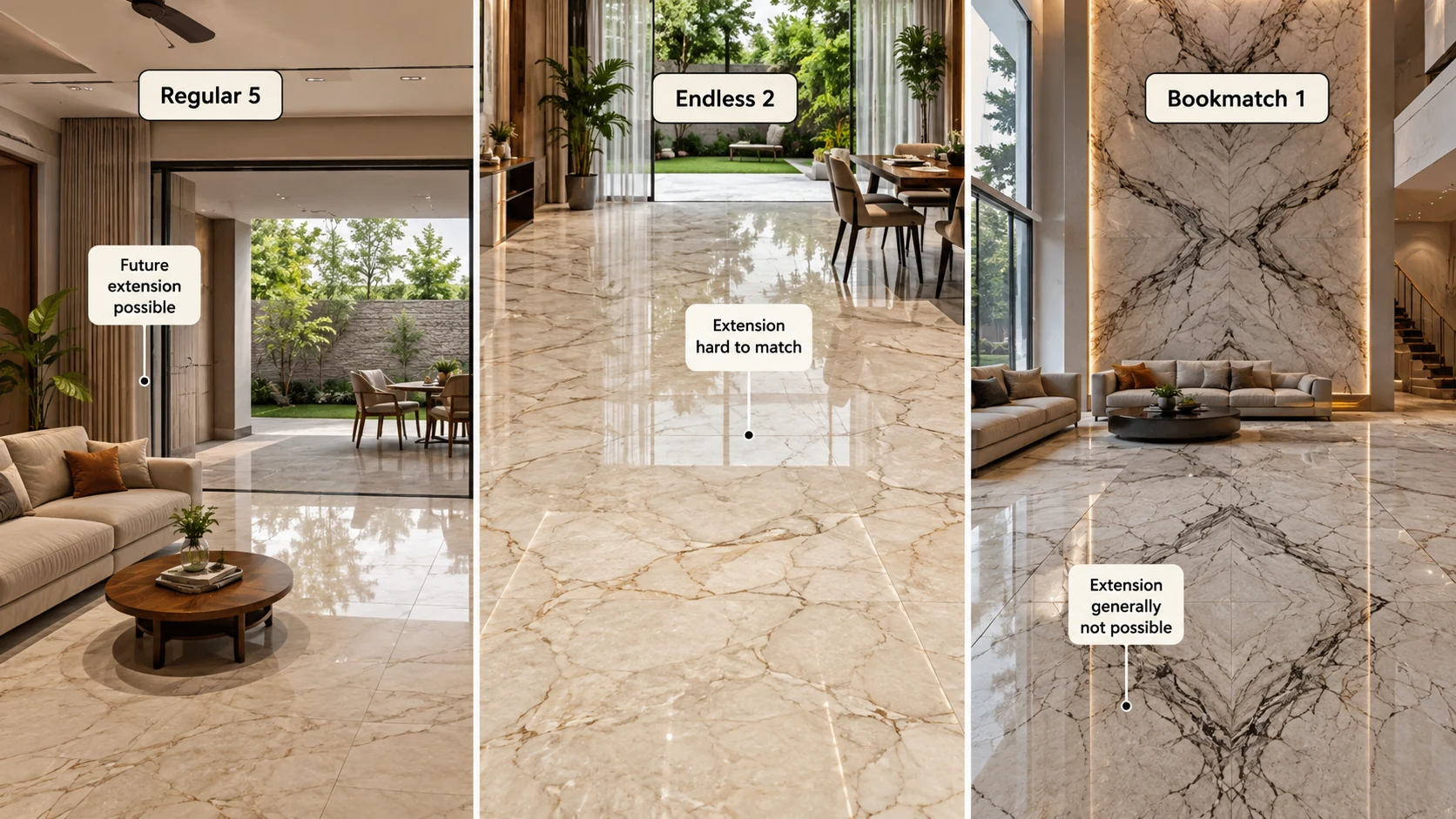
Matching a later addition to a regular tile floor is usually achievable. Matching an extension to an endless or bookmatched floor generally is not, since the sequence cannot be continued from a new batch. For a property likely to be extended, subdivided, or sold with the expectation of modification, this is a real consideration rather than a marginal one.
For a deeper look at how endless patterns are specified across large Indian surfaces, see our guide to endless pattern tiles in India. It explains where seamless joins genuinely work, what installation conditions they require, and when the premium is justified.
Decision Path: Which One For Your Room
- Is this a wall or a floor? If a wall, all three are available and bookmatch becomes genuinely worth considering. If a floor, eliminate bookmatch immediately unless the room has a single dominant viewing position, which almost no residential floor does.
- Will the surface stay largely uncovered and uninterrupted? If furniture, a large rug, or frequent cuts around fixtures will break it up, choose regular. Continuity you cannot see is continuity you should not pay for.
- Is the room likely to be modified, extended, or have floor access needed within ten years? If yes, choose regular. Bathrooms and kitchens above or below plumbing runs fall into this category more often than owners expect.
- Is this a large, open, low-modification surface such as a living room, lobby, or feature wall? If yes, endless pattern earns its premium here specifically.
- Do you want one dramatic focal composition rather than an even surface? If yes, and it is a wall, specify bookmatch and keep every other surface in the room plain.
- Is the installer experienced with sequenced laying? If not and you cannot change installer, regular is the safer specification regardless of what the design brief says.
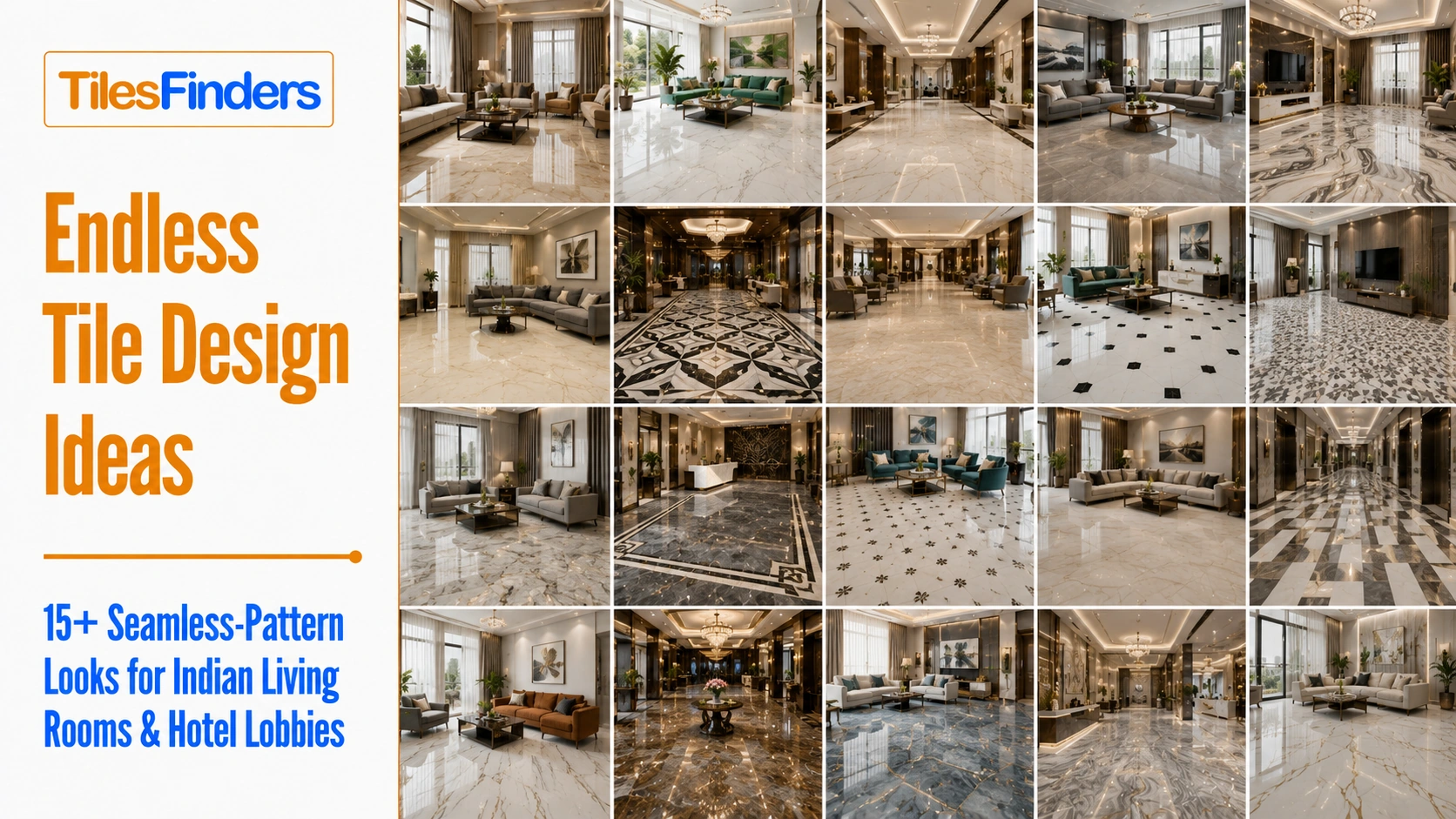
If endless is the right choice for your space, explore these endless tile design ideas for Indian living rooms and hotel lobbies. The collection shows different patterns, colours, lighting, and combinations of applications before you commit to a single continuous surface.
What Each Technique Genuinely Fails At
| Technique | Fails At | Symptom When It Goes Wrong |
| Regular pattern | Making a statement, and hiding the grid on large open surfaces | The floor reads as a repeating grid of identical units rather than as one surface |
| Endless pattern | Repairs, extensions, and heavily cut rooms | Broken or repetitive pattern where tiles were shuffled, or an unmatchable patch after a repair |
| Bookmatch | Floors, out-of-square rooms, and any surface viewed from multiple angles | The mirror line sits off-centre or reads as a smear rather than as symmetry |
The Indian-Specific Factors That Shift These Scores
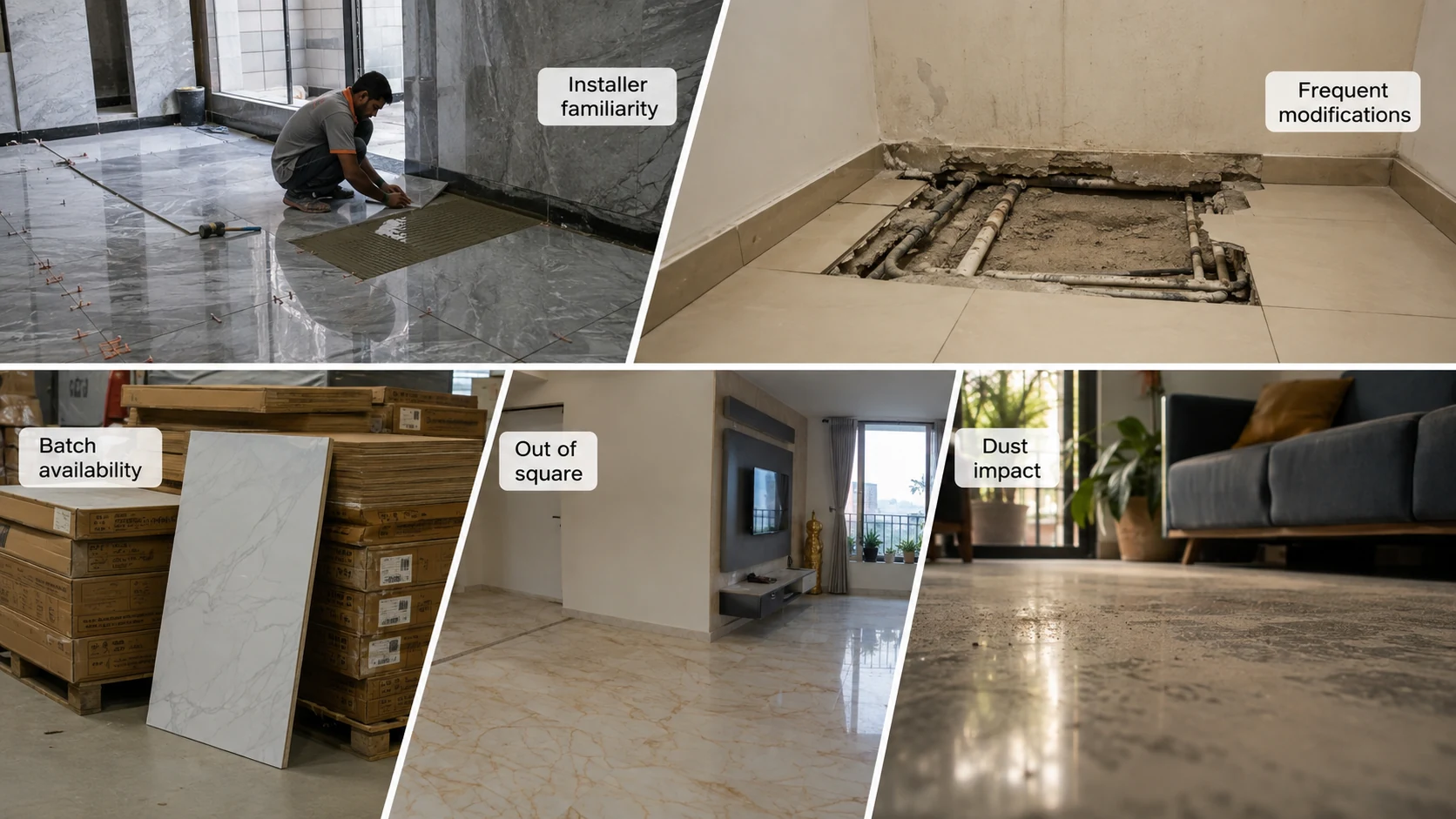
- Installer familiarity varies considerably by city. Sequenced laying is routine in metro commercial projects and much less common in smaller-city residential work, which raises the practical risk on endless and bookmatch outside major markets.
- Homes are modified more often than the specification assumes. Extensions, plumbing access, and rewiring routinely mean lifting tiles years later, which is precisely where the repairability scores bite.
- Batch availability is not uniform. Confirming a single batch, shade code, and calibre code for the full quantity is easier in a metro than in a smaller market, and endless pattern depends on it absolutely.
- Rooms are frequently out of square, which penalises the two techniques that depend on a controlled composition and barely affects the one that does not.
- Dust levels affect perceived finish more than pattern choice does. In high-dust regions, a matte regular tile often looks better maintained than a premium continuous floor that shows every settled particle.
Cost Reality: What You Actually Pay
| Technique | Tile Price Range | Overage Needed | Practical Notes |
| Regular pattern | Rs. 60 to Rs. 160/sq.ft | 5 to 10% | Leftovers remain useful for future repairs, which have real value |
| Endless pattern | Rs. 110 to Rs. 280/sq.ft | 10 to 15% | Off-sequence pieces have limited reuse; a later top-up will not match the sequence |
| Bookmatch | Rs. 180 to Rs. 300/sq.ft | 12 to 15% | Pairs must stay intact; an unmatched leftover has almost no practical use |
Specification Baseline for All Three
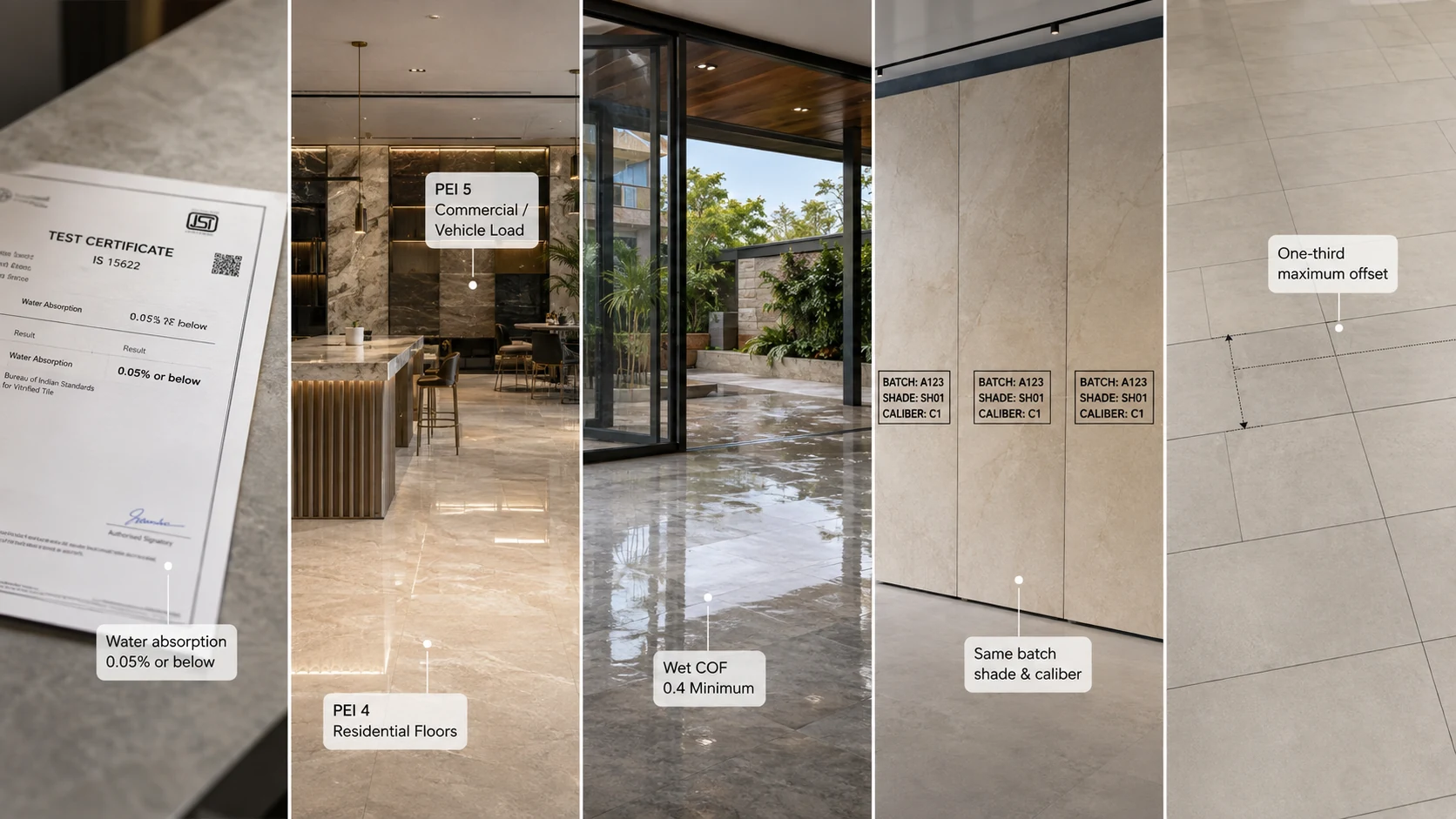
- Water absorption 0.05% or below, the benchmark set by the Bureau of Indian Standards under IS 15622 for vitrified tile, with the test certificate requested.
- PEI 4 minimum for residential floors, PEI 5 for commercial or vehicle load, as stated on the manufacturer's technical data sheet.
- Confirmed wet coefficient of friction 0.4 minimum for any floor that gets wet, regardless of which continuity technique is chosen.
- Single batch, single shade code, and single calibrator code across the full quantity, which matters for all three and is non-negotiable for endless and bookmatch.
- One-third maximum offset for any tile with a side above 600 mm, since a 50% brick bond maximises lippage on large formats whatever the pattern.
Compare All Three Techniques on TilesFinders
Regular, endless, and bookmatched ranges can be compared on TilesFinders by format, edge finish, batch availability, and rating, so the practical trade-offs behind the scorecard are visible before you commit to a technique.
FAQs
No. Bookmatch is a specific technique within the endless pattern family, where tiles are printed as mirrored pairs so veining reflects across a centre line. Regular and endless are the two genuine product categories; bookmatch is a demanding way of executing the second.
Because a mirror line only reads as intentional symmetry when viewed square-on from a fixed position. Walls provide that; floors do not, since people walk across and around them and view them from every angle. From the side, a mirrored floor composition reads as an odd repeated smear rather than as symmetry.
Regular pattern, which scored 35 out of 40 against 23 for endless and 18 for bookmatch, largely on repairability, cost efficiency, installation safety, and tolerance of out-of-square rooms. It is the correct default; the other two should be chosen deliberately for specific surfaces.
Only from original leftover stock occupying that exact sequence position. A later batch will not continue the original sequence, which is why the repairability score is the lowest on the card and why 10 to 15% overage should be ordered upfront and kept.
Only from original leftover stock occupying that exact sequence position. A later batch will not continue the original sequence, which is why the repairability score is the lowest on the card and why 10 to 15% overage should be ordered upfront and kept.
Considerably. Regular tile absorbs it easily since no single tile position matters. Endless pattern suffers uneven interruption at the cuts, and bookmatch suffers most because the mirror line shifts off the room's visual centre, defeating its entire purpose.
On a large, open, low-modification surface such as a living room floor, hotel lobby, or feature wall, yes. On a small, fixture-heavy, or likely-to-be-modified surface, the premium buys continuity you will not see and repairability you will later miss.
5 to 10% for regular pattern, 10 to 15% for endless, and 12 to 15% for bookmatch, since pairs must stay intact and an unmatched leftover has almost no practical use.
Yes, meaningfully. Sequenced laying is routine in metro commercial work and less common in smaller-city residential projects. If your installer has not laid sequenced tile before and cannot be changed, regular is the safer specification, whatever the design brief says.
Bookmatch, which scores highest on visual impact and is the only technique whose defining feature, a mirror line viewed square-on, works exactly as intended on a wall.


See our tile guides first
Set TilesFinders as a preferred source and our buying guides surface ahead of the rest for you.
Add as preferred sourceTakes one tap. Nothing to install.
What Readers Say
I was about to redo my parking area with the wrong tile size until I read this. The layout comparisons saved me from a costly mistake.
We reference TilesFinders guides while briefing clients on material selection. The size and pattern breakdowns are accurate and easy to explain visually.
On site, I get asked about grout spacing all the time. This article gave me a solid reference I now share with my team before every job.
Finally a guide that doesn't just push generic advice. The oil stain removal steps actually worked on our clubhouse driveway tiles.
I run a small construction firm and now send this link to clients directly when they ask about entrance tile sizing. Saves me an hour of explaining.
Good practical detail, though I wish there were more examples for compact apartment entrances specifically, not just villas.
My mother-in-law wanted marble, I wanted vitrified. This blog gave us the neutral comparison we needed to actually decide together.
Detailed without being overwhelming. I appreciated that it covered both cost and maintenance, not just the aesthetics.
Used the algae and hard water removal tips on our terrace tiles after the monsoon. Worked better than what our regular cleaner was doing.
As someone who sources tiles for multiple builder projects, I find these comparisons genuinely useful for vendor conversations, not just consumer content.
Recommended this to a client who kept second-guessing the entrance design. The small vs large layout section settled the debate instantly.
Straightforward and honest, no unnecessary jargon. Would like to see a similar breakdown for outdoor pool-deck tiles next.
We've bookmarked several TilesFinders guides for our design handbook. Reliable source when clients want data, not just opinions.
Two paths, one marketplace.
Get free quotes from verified suppliers.
Share your room, budget, and style. Suppliers in Morbi respond within hours.
Get Free QuotesList your business, reach real buyers.
Put your showroom in front of homeowners searching for tiles right now.
List Your Business