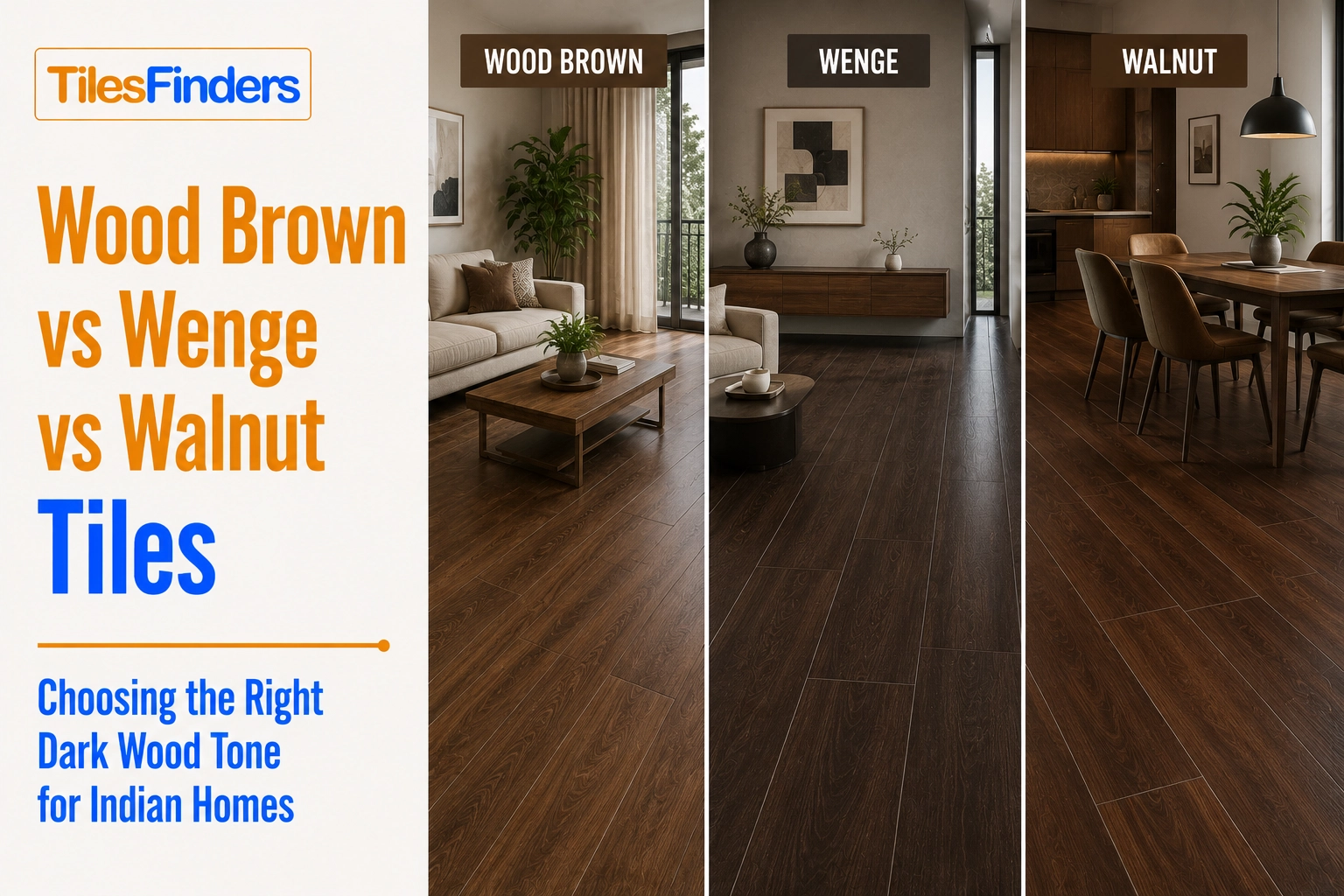
Wood Brown vs Wenge vs Walnut Tiles: Choosing the Right Dark Wood Tone for Indian Homes
Compare wood brown, wenge, and walnut tiles for Indian homes based on lighting, room suitability, furniture pairing, Vastu, maintenance, and GVT buying specifications to choose the right dark wood tone.
- Defining the Three Tones: Wood Brown, Wenge, and Walnut
- How All Three Tones Read in Indian Light
- Room-by-Room Comparison: Wood Brown vs Wenge vs Walnut
- Full Comparison Scorecard: Wood Brown vs Wenge vs Walnut
- How to Choose: Four Questions
- Dark Wood Tone GVT from Morbi, Gujarat: Availability Reference 2026
- Compare Dark Wood Tone Tiles on TilesFinders
Wood brown is the most versatile and easiest dark wood tone for Indian homes, walnut delivers a rich premium appearance, while wenge works best only in large, well-lit spaces with light furniture. Choose your tile based on room size, lighting, maintenance needs, and the overall interior style for the best long-term result.
Wood brown, wenge, and walnut are three warm-toned tile colour families that are frequently confused in Indian tile showrooms and online catalogs. They are all in the brown spectrum, but they behave very differently in an installed room. Wood brown reads as natural and warm. Wenge reads as dark and dramatic. Walnut reads as rich and formal. Choosing the wrong one for a room or furniture combination produces either a floor that feels too light, too heavy, or too colour-matched to the furniture above it.
This guide compares the three dark wood tones directly across Indian light conditions, room types, furniture pairing, Vastu alignment, and buying specifications. The goal is a clear, actionable answer for which tone belongs in which Indian space.
Defining the Three Tones: Wood Brown, Wenge, and Walnut
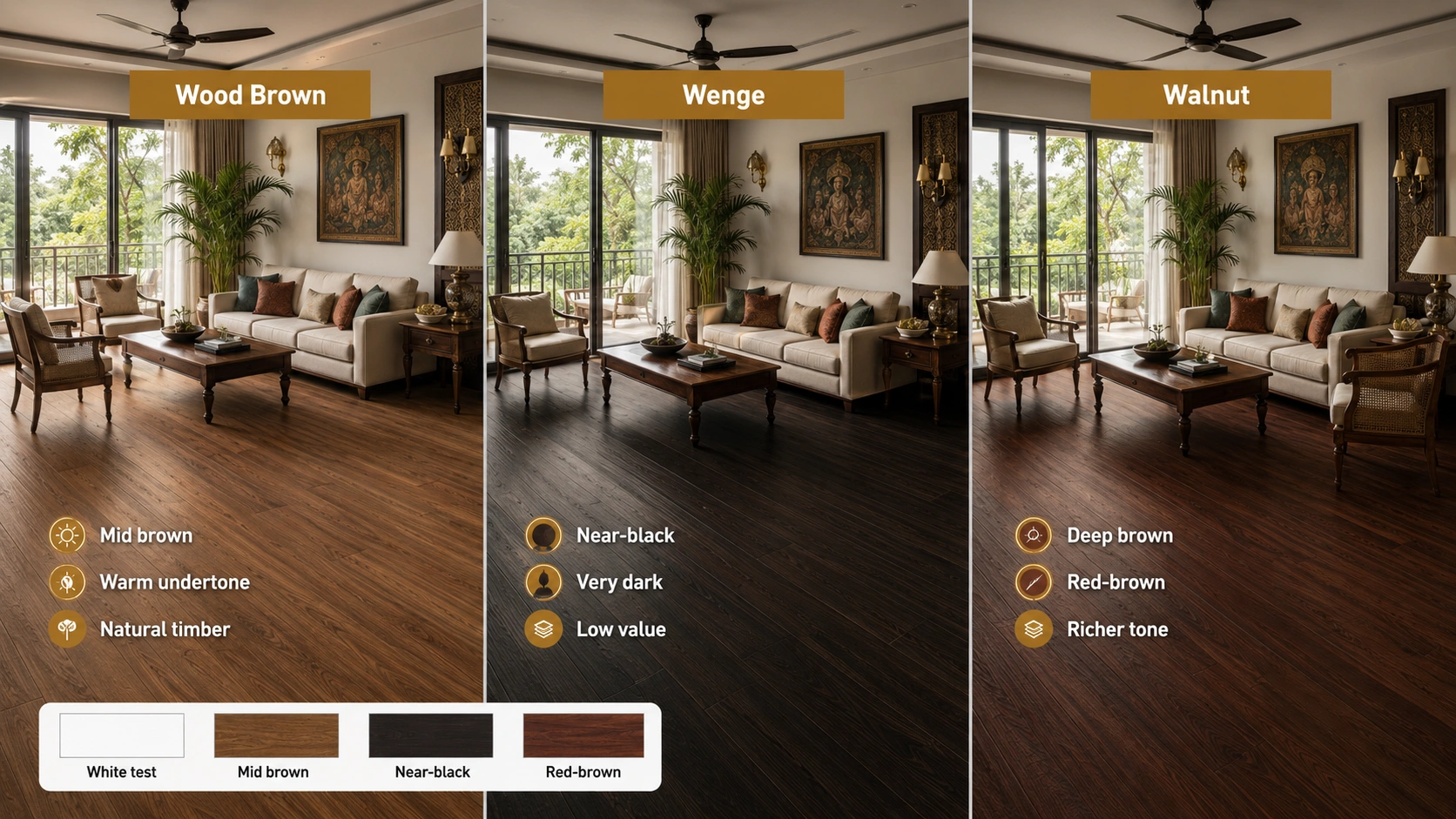
The three terms are used loosely in Indian showrooms. These definitions establish the practical starting point for comparison.
| Tone | Colour Description | Undertone | Value (Lightness) | Indian Material Reference |
| Wood brown | Medium warm brown. The most natural and balanced of the three. Neither too light nor too dark. Reads as natural timber in its mid-register. | Warm red-orange-brown. Clearly warm without being vivid. | Medium. Reads as a natural timber floor from a standing distance. | Standard Indian teak, sal wood, and Indian rosewood in its mid-register. The timber of everyday Indian furniture. |
| Wenge | Very dark brown, close to near-black. A distinctive, almost-black brown with a very subtle warm undertone barely visible except in strong direct light. | Very slight warm brown, almost neutral at practical viewing distances. | Very low. Reads as near-black in most lighting conditions. One of the darkest timber-tone tiles available. | African wenge timber (imported to India), very aged dark rosewood, and ebony in its darker register. |
| Walnut | Deep warm brown with a clear red-brown pull. Darker than wood brown but lighter and significantly warmer than wenge. Reads as aged, rich timber. | Warm red-brown. More red saturation than wood brown, less darkness than wenge. | Medium-low. Noticeably darker than wood brown but not as dark as wenge. | Indian walnut (Juglans regia), aged teak in its darker varnished state, and dark rosewood. |
Note: In Indian tile showrooms, the same GVT plank tile is sometimes labelled wenge by one supplier and dark walnut or dark brown by another. The practical test: hold the tile against a white surface. If the tile appears nearly black or very dark brown, it is likely wenge. If it reads as a clearly warm, red-brown dark timber, it is walnut. If it reads as a natural mid-brown, it is wood brown. The undertone and value are the two distinguishing variables, not just the colour name.
How All Three Tones Read in Indian Light
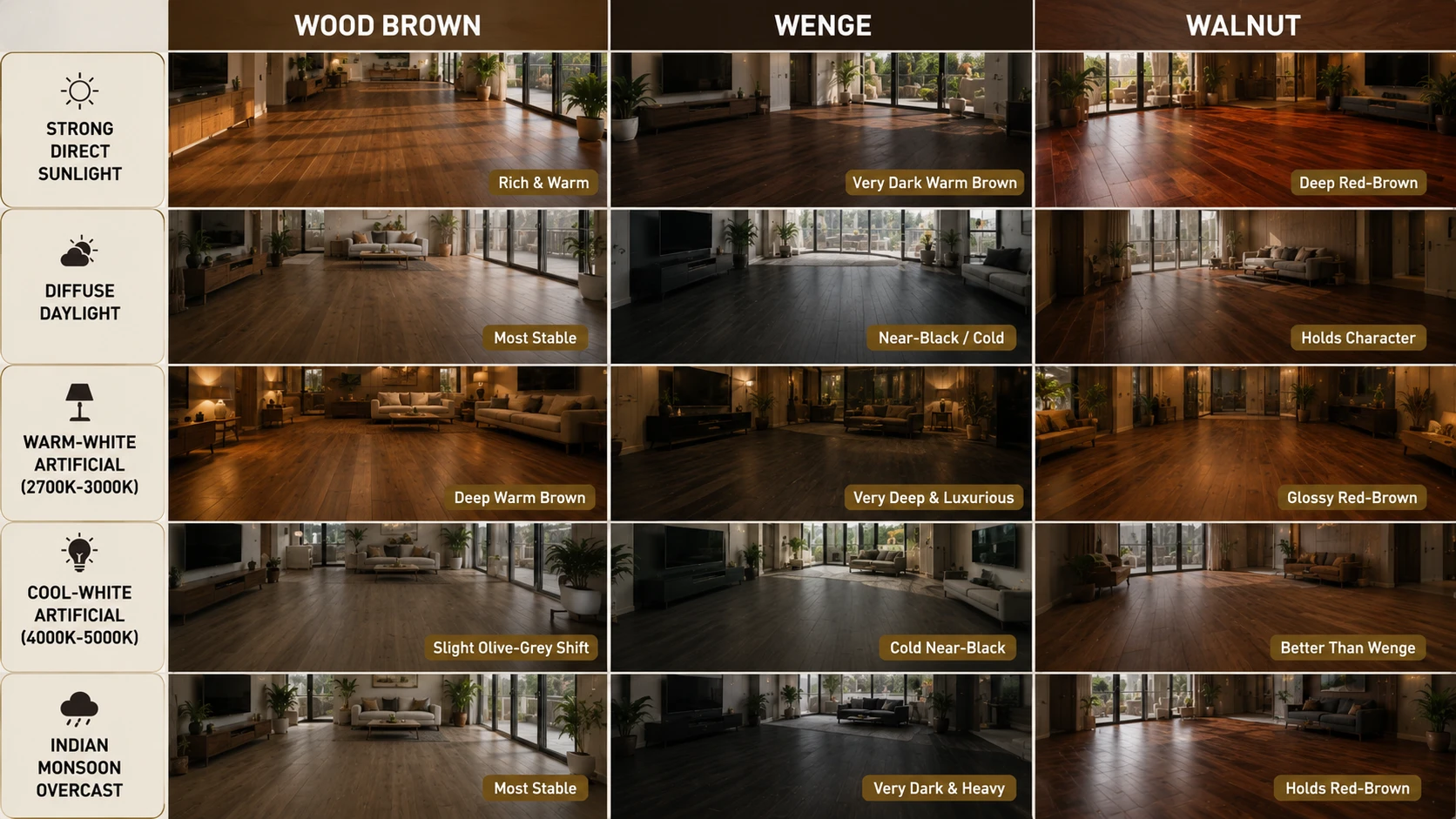
| Light Condition | Wood Brown | Wenge | Walnut |
| Strong direct sunlight (south or west facing) | Reads as a rich, warm natural timber. Most flattering condition for wood brown. | The subtle warmth of wenge becomes visible in strong direct light. Reads as very dark warm brown rather than near-black. | Reads as a deeply rich red-brown timber. Most flattering condition for walnut. The red-brown undertone is at its richest under strong sun. |
| Diffuse daylight (north facing, overcast) | Most stable of the three in diffuse light. Holds its warm brown character across lighting changes. | Reads as near-black or very dark grey-brown in diffuse cool light. The subtle warmth is entirely lost. Wenge in a north-facing room reads as a very dark, slightly cold floor. | Slightly less warm in diffuse light, but holds its character better than wenge. The red-brown undertone keeps the floor from reading as a dark grey. |
| Warm-white artificial (2700K to 3000K) | Deepened to a rich, warm brown. Excellent under warm-white light. Reads as premium natural timber. | The near-black tone is warmed slightly. Reads as a very deep, intimate, luxurious dark floor. Most appropriate lighting for wenge. | Deepened and enriched to a glossy, luxurious red-brown. Reads as the highest-quality dark timber under warm-white light. |
| Cool-white artificial (4000K to 5000K) | Slight olive-grey shift. Less damaging than for weng,e but not ideal. Warm-white preferred. | Reads as cold near-black or very dark grey. Most damaged of the three by cool-white light. Wenge under cool-white fluorescent light reads as an oppressive dark floor. | Holds better than wenge under cool-white. The red-brown undertone prevents the complete grey shift. Still better under warm-white. |
| Indian monsoon overcast (heavy cloud) | Most stable of the three. Holds warm brown character in monsoon overcast. | Reads as very dark and heavy in sustained overcast. Wenge durinthe g Indian monsoon in a north-facing room needs warm-white supplemental lighting to prevent a cave-like reading. | Better than wenge in overcast. Holds red-brown character better than wenge across variable monsoon light. |
Verdict: Wood brown is the most lighting-stable of the three across all Indian conditions. Walnut is stable across most conditions but benefits from warm-white lighting. Wenge is the most lighting-sensitive of the three: at its best under warm-white artificial light and direct sun, and at its worst in north-facing rooms and during the Indian monsoon, where it reads as a near-black, cave-like floor that can feel oppressive. If wenge is specified for a north-facing Indian room, warm-white supplemental lighting at 2700K is not optional; it is mandatory.
Wood brown remains the most versatile dark wood tone for Indian homes, thanks to its balanced warmth, lighting stability, and compatibility with almost every interior style. If you're exploring finishes, room suitability, and buying tips, read our Wood Brown Tiles Guide for a complete overview.
Room-by-Room Comparison: Wood Brown vs Wenge vs Walnut
Living Room
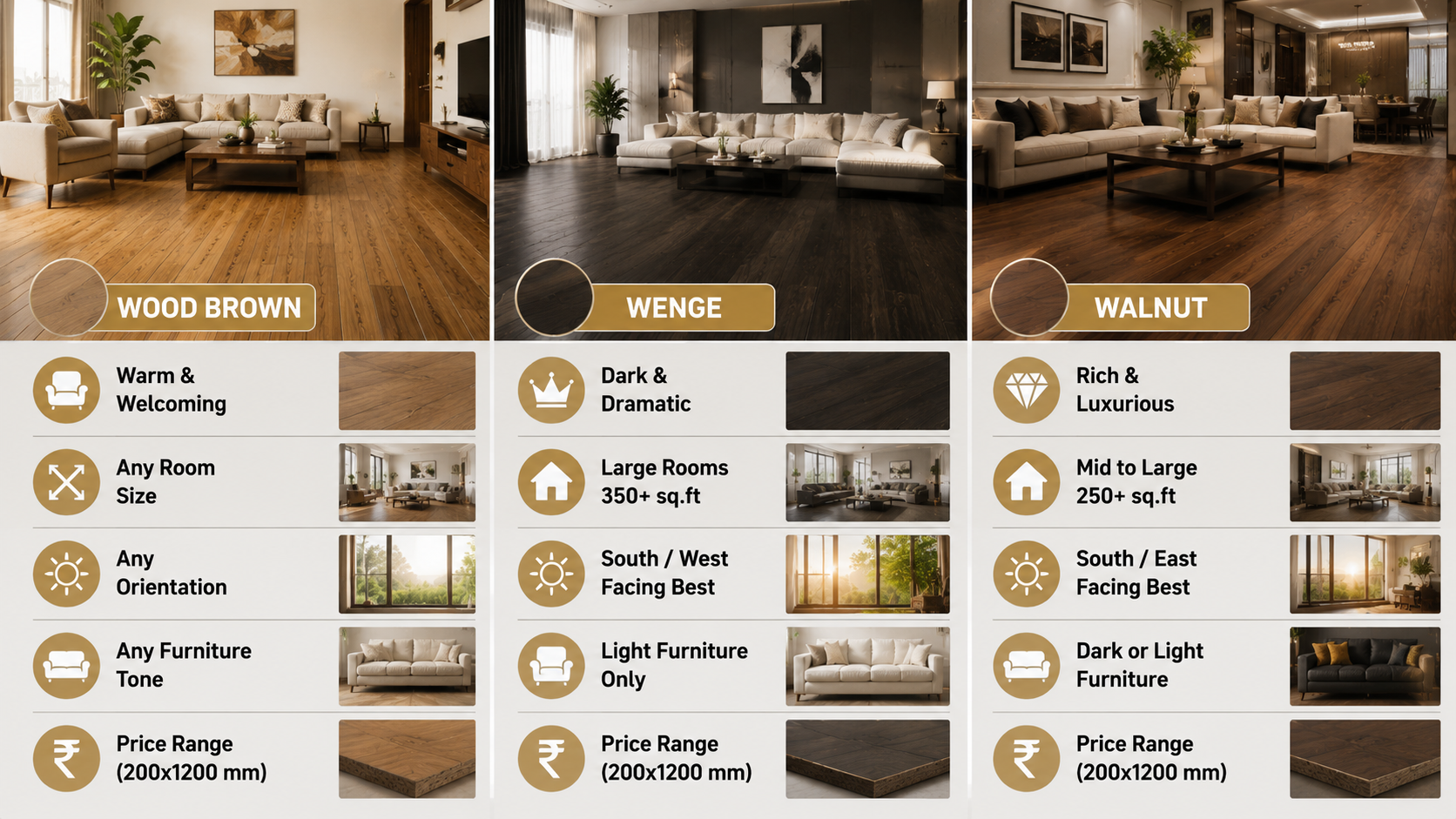
| Factor | Wood Brown | Wenge | Walnut |
| Design personality | Warm, natural, welcoming. A floor that grounds the room without making a strong statement. | Dark, dramatic, architectural. A statement floor that dominates the room's character. Best in a large, well-lit formal living room. | Rich, formal, and luxurious. A floor that reads as premium without the extremity of wenge's near-black darkness. |
| Room size suitability | Any size living room. The most size-flexible of the three. | Large living rooms above 350 sq. ft. with ceilings at 10 ft or above. In compact or low-ceiling rooms, wenge reads as heavy and enclosed. | Living rooms above 250 sq.ft. Walnut works in mid-size rooms better than wenge, but benefits from good light. |
| Best orientation | Any. Wood brown is the most orientation-stable. | South or west-facing with strong natural light. North-facing only with warm-white supplemental lighting. | South or east facing preferred. North-facing with warm-white supplemental lighting. |
| Furniture pairing | Any furniture tone. Mid-range teak, dark walnut, pale blonde wood, white lacquer. | Light or white furniture only. Dark or mid-toned furniture disappears against wenge. The room needs strong light and light-toned furniture. | Dark teak, walnut, or wenge furniture for a monochrome dark palette. Or cream and white upholstery for maximum contrast. |
| Price range (GVT plank) | Rs. 100 to Rs. 175/sq.ft for 200x1200 mm matte | Rs. 110 to Rs. 185/sq.ft for 200x1200 mm matte | Rs. 105 to Rs. 180/sq.ft for 200x1200 mm matte |
Bedroom
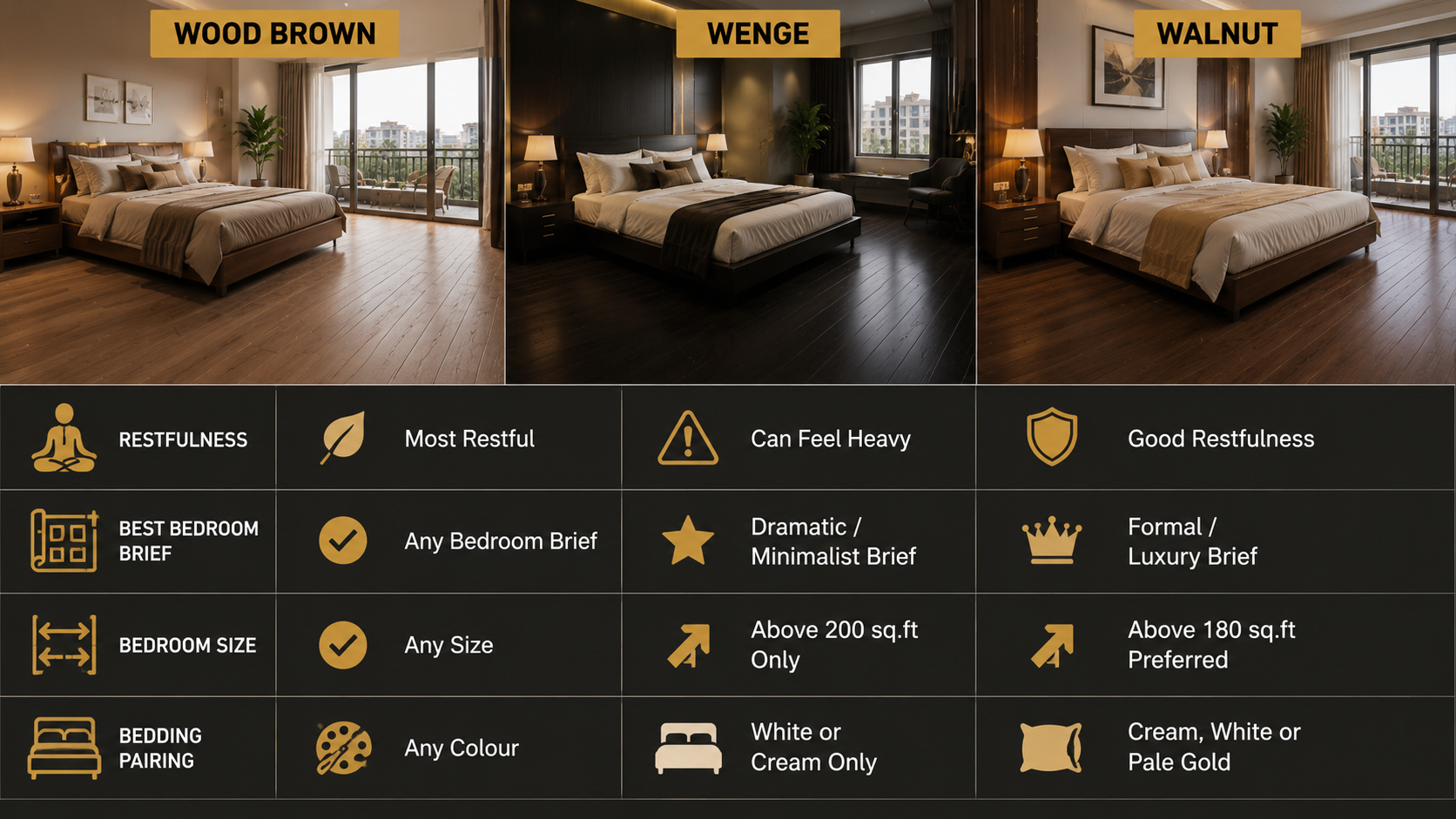
| Factor | Wood Brown | Wenge | Walnut |
| Restfulness | The most restful of the three. Warm, natural, and visually settled. Suitable for any bedroom size or orientation. | Can feel heavy or cave-like in a bedroom, particularly if the room is compact or north-facing. A wenge bedroom needs white walls, white bedding, and warm-white lighting to feel restful rather than oppressive. | Good. The rich warmth of walnut creates an enveloping bedroom feel without the heaviness of wenge. Well-suited to a formal master bedroom with cream or white bedding. |
| Best bedroom brief | Any bedroom brief. The most universally applicable warm tone for Indian bedrooms. | A bedroom with a deliberate, dramatic,c or contemporary minimalist brief where the dark floor is a confident design statement rather than a default choice. | A formal or luxurious master bedroom brief. A boutique hotel-suite feel with cream bedding and warm lighting. |
| Bedroom size | Any. Works in 120 sq ft to 400 sq.ft bedrooms equally well. | Above 200 sq.ft only. In compact bedrooms, wenge reads as too dark and heavy for a sleeping space. | Above 180 sq. ft. preferred. Walnut in compact bedrooms can read as dark if the wall and bedding are not sufficiently light. |
| Bedding pairing | Any. Wood brown works with white, cream, indigo, sage, rust, or any bedding colour. | White or cream only in a wenge bedroom. Coloured bedding against a wenge floor can produce an unresolved dark palette. | Cream, white, or pale gold bedding. The red-brown undertone of walnut pairs particularly well with cream linen. |
Need inspiration before making your final choice? Explore our Wood Brown Tile Design Ideas to see how warm-toned wood brown tiles transform Indian bedrooms, living rooms, and other modern interiors with timeless elegance.
Kitchen and Bathroom
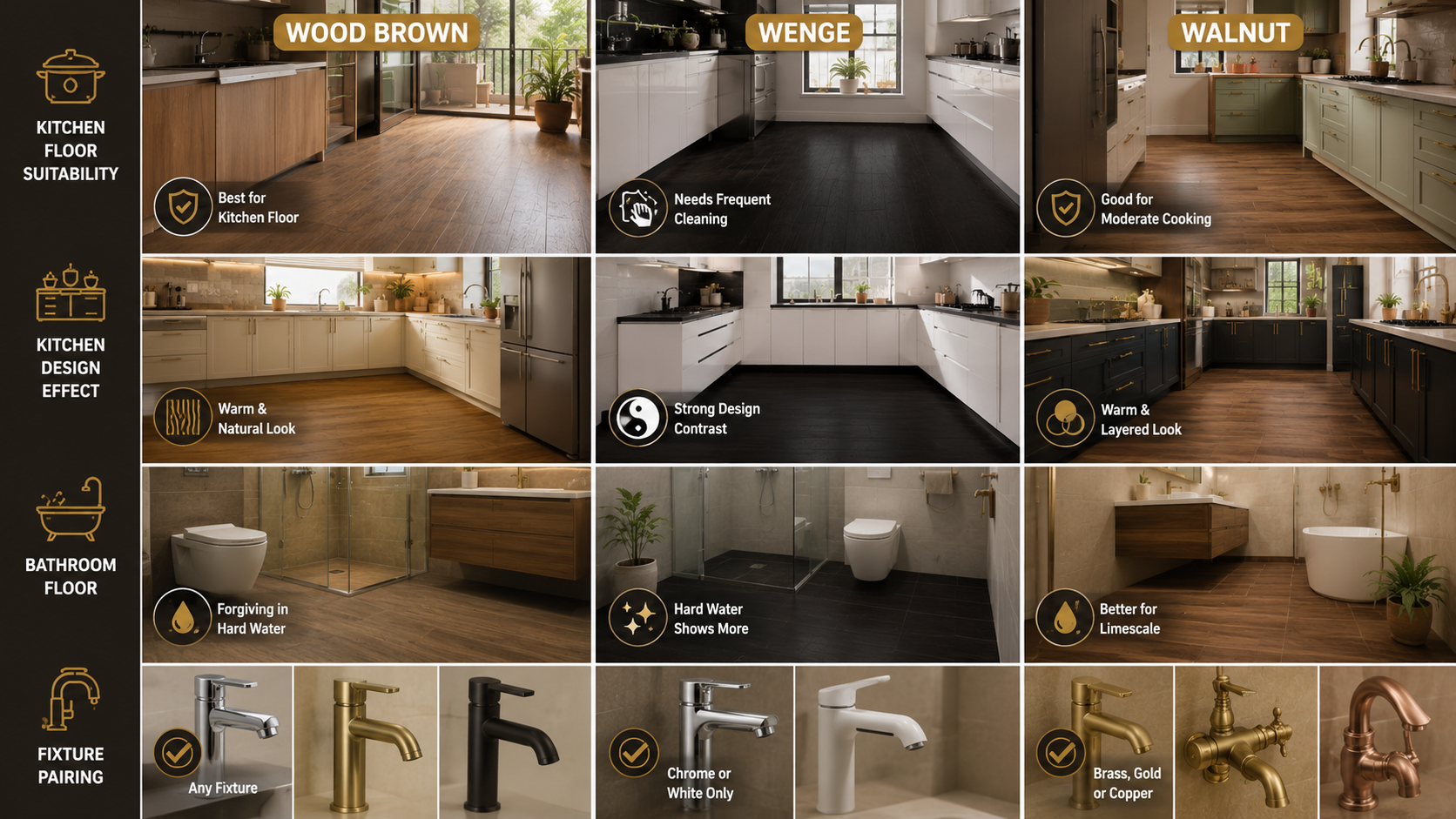
| Factor | Wood Brown | Wenge | Walnut |
| Kitchen floor suitability | Best of the three for a kitchen floor. Most forgiving of soiling visibility. Anti-skid GVT at 600x600 mm standard specification. | Kitchen floors in wenge require frequent cleaning to maintain the dark surface's clean appearance. Minor soiling is visible against the near-black tone. Not recommended for heavy Indian cooking kitchens. | Good for kitchens with moderate cooking. Less forgiving than wood brown but better than wenge. Anti-skid specification at 600x600 mm. |
| Kitchen design effect | Warm, natural kitchen floor under any cabinet colour. Works with white, cream, grey, and dark-stained cabinets. | A very strong design statement kitchen floor. Works only with white or very pale cabinets, where the dark floor and light cabinet create a graphic contrast. | Rich warm kitchen floor under white or pale cabinets for a warm-contrast kitchen. Or under dark cabinets for a deep, layered kitchen palette. |
| Bathroom floor | Mid warm brown anti-skid GVT.The grey-brown variant is most forgiving for limescale in hard-water cities. | Anti-skid wenge GVT at 300x300 mm creates a dramatic, spa-like dark bathroom. Requires white or very pale wall tiles. Hard water deposits are visible on the wenge between cleans. | Anti-skid walnut brown at 300x300 mm creates a warm, luxurious bathroom. Better for limescale visibility than wenge. Pairs with brushed brass or antique gold fixtures. |
| Fixture pairing | Any. Most fixture-flexible of the three. | Chrome or white fixtures only. Brushed brass on wenge can read as gold-against-black, which can feel busy. | Brushed brass, antique gold, or aged copper. The red-brown warmth of walnut pairs best with warm metal fixtures. |
Full Comparison Scorecard: Wood Brown vs Wenge vs Walnut
| Criteria | Wood Brown | Wenge | Walnut |
| Lighting stability | Highest. Most consistent across Indian conditions. | Lowest. Most sensitive to light changes. Needs warm-white light. | Medium-high. Holds warmth better than wenge across conditions. |
| Room size suitability | Any size. Most flexible. | Large rooms only (350+ sq.ft). Not for compact spaces. | Medium to large rooms (180+sq. ft.t preferred). |
| Furniture compatibility | Highest. Works with any furniture tone. | Low. Needs light-toned furniture for contrast. | Medium. Best with contrasting light or dark furniture. |
| Soiling visibility | Lowest. Most forgiving of cooking and living soiling. | Medium. Minor soiling is visible against a near-black surface. | Medium-low. More forgiving than wenge, less than wood brown. |
| Design personality | Natural, welcoming, warm, settled. | Dramatic, architectural, statement. | Rich, formal, luxurious. |
| Vastu alignment | Earth element. South and southwest zones. | No specific Vastu recommendation. Use with caution in bedrooms. | Earth-fire element. South zone, formal spaces. |
| North-facing room suitability | Good. Most stable in diffuse light. | Poor without warm-white supplemental lighting. | Acceptable with warm-white lighting. Better than wenge. |
| Kitchen floor suitability | Best. Most forgiving for Indian cooking soiling. | Least suitable. Minor soiling visible, heavy cooking environment. | Good. Better than wenge for kitchen use. |
| Price range (GVT plank 200x1200 mm) | Rs. 100 to Rs. 175/sq.ft | Rs. 110 to Rs. 185/sq.ft | Rs. 105 to Rs. 180/sq.ft |
| Best single application | Living rooms (any), bedrooms (any), kitchens | Large formal living room, home theatre, meditation room with warm lighting | Formal dining room, luxury master bedroom, study room |
How to Choose: Four Questions
Question 1: What size is the room, and what is the ceiling height?
If the room is under 250 sq. ft. or has a ceiling below 9.5 ft, wood brown or walnut are the correct choices. Wenge in a compact or low-ceiling room reads as oppressive and dark. For large rooms above 350 sq. ft. with ceilings at 10 ft or above, all three tones are viable. Wenge requires the largest room to work correctly.
Question 2: Which direction does the room face?
- South or west-facing with strong natural light: all three tones work. Wenge is at its best here.
- East-facing, morning light: wood brown and walnut work well. Wenge is manageable with warm-white supplemental lighting.
- North-facing or heavily overcast (monsoon rooms): wood brown only as a confident first choice. Walnut with warm-white supplemental lighting. Wenge only with a committed warm-white artificial lighting plan that compensates for the lost natural warmth.
Question 3: What is the planned furniture tone?
Light or white furniture: all three tones work, with wenge delivering the highest contrast. Mid-toned warm wood (honey teak, mango): wood, brown or walnut. Avoid wenge with mid-toned furniture as both surfaces can read as the same dark family. Dark furniture (ebony lacquer, dark walnut, very dark teak): wood brown for harmony, walnut for layered depth, wenge for a bold monochrome dark palette. The furniture tone question is more critical for wenge than for the other two because wenge absorbs mid-toned surfaces and loses the contrast that makes it work.
Question 4: Is the brief a statement floor or a background floor?
Background floor: the floor should recede and let furniture, textiles, and art define the room. Wood brown is the best background floor of the three. Walnut can function as a background floor in a room with bold furniture colours. Statement floor: the floor is the primary design element, and everything else refers to it. Wenge or very dark walnut is the statement floor specification. If the answer is unclear, wood brown is the safer choice: it is the only one of the three that does not require the rest of the room to be planned specifically around the floor's demands.
Pro tip: Place 30x30 cm samples of all three tones on the actual room floor for 48 hours. View at 8 am under natural light, 1 pm under peak natural light, 7 pm under planned evening lighting, and 10 pm under full artificial light only. Any tone that reads wrong at any of these four time points will look wrong for a significant portion of daily life in the room. The tone that reads correctly at all four is the right specification for that room.
Dark Wood Tone GVT from Morbi, Gujarat: Availability Reference 2026
| Tone | Most Common Design | Format | Price Range (Morbi) | Face Variations (Mid Tier) | IS 15622:2006 |
| Wood brown | Mid brown aged teak-look GVT, warm brown stone-look GVT matte | 200x1200 mm plank, 600x600 mm, 800x800 mm | Rs. 100 to Rs. 175/sq.ft (plank), Rs. 75 to Rs. 145/sq.ft (square) | 4 to 6 mid-tierr). Widest availability. | 0.05% absorption, PEI 4. Anti-skid variant available. |
| Wenge | Wenge-look GVT plank, very dark brown stone-look GVT matte | 200x1200 mm plank, 600x600 mm | Rs. 110 to Rs. 185/sq.ft (plank), Rs. 85 to Rs. 155/sq.ft (square) | 4 to 6 (mid-tier). Narrower design range than wood brown. | 0.05% absorption, PEI 4. Anti-skid variant available. |
| Walnut | Dark walnut-look GVT plank, rich brown stone-look GVT matte | 200x1200 mm plank, 600x600 mm, 600x1200 mm | Rs. 105 to Rs. 180/sq.ft (plank), Rs. 80 to Rs. 155/sq.ft (square) | 4 to 6 (mid-tier). Good availability between the wood brown and wenge range. | 0.05% absorption, PEI 4. Anti-skid variant available. |
Note: All three dark wood tone GVT formats above are manufactured in Morbi, Gujarat, under IS 15622:2006 at water absorption 0.05% or below, PEI 4 for floor use. In coastal Indian cities with monsoon humidity of 85 to 95%, all three tones at 0.05% absorption are unaffected by humidity and require no sealing. Anti-skid variants in 300x300 mm, 400x400 mm, and 600x600 mm are available across all three tones for bathroom, kitchen, and balcony floor applications.
Compare Dark Wood Tone Tiles on TilesFinders
Wood brown, wenge, and walnut GVT tiles from Morbi, Gujarat manufacturers are available on TilesFinders across plank and square formats and multiple quality tiers. Request physical samples of all three dark wood tones and view them in your actual room under your actual lighting conditions before placing a bulk order.
FAQs
Wood brown is a medium warm brown that reads as natural timber at mid-range. Wenge is a near-black, very dark brown with barely perceptible warmth that reads as dramatically dark. Walnut is a deep red-brown, darker than wood brown but lighter and significantly warmer than wenge. The practical test: against a white surface, wood brown reads as a clear warm brown, walnut reads as a noticeably darker and redder brown, and wenge reads as very dark brown or near-black.
Wood brown at 200x1200 mm matte plank is the most universally suitable dark wood tone for any Indian living room, regardless of size, orientation, or furniture. Walnut suits a formal or luxury living room above 250 sq. ft. with cream or white furniture and warm lighting. Wenge suits large formal living rooms above 350 sq. ft. with high ceilings and south or west-facing orientation, paired with white or very light furniture.
In most Indian bedrooms, yes. Wenge in a bedroom reads as heavy and cave-like unless the room is large (above 200 sq.ft), has a ceiling above 9.5 ft, uses white walls and cream or white bedding, and is lit with warm-white fixtures at 2700K. In a compact Indian bedroom with standard 9 ft ceilings, wenge is not the correct specification. Wood brown or walnut delivers a warm, dark floor without the oppressive quality wenge can produce.
Wood brown is the most broadly Vastu-aligned of the three. The warm brown earth tone is recommended for the south and southwest zones as an earth element colour. Walnut's red-brown undertone gives it some fire element association and suits south-facing formal rooms. Wenge has no specific Vastu alignment, and its near-black tone is not typically recommended for bedrooms or family spaces in Vastu guidance.
Technically, yes, with an anti-skid specification. Practically, wenge is the least suitable of the three dark wood tones for an Indian kitchen with heavy daily cooking. Minor soiling, oil residue, and cleaning product marks are more visible against the near-black surface than against mid or dark brown. If a dark kitchen floor is wanted, walnut or dark wood brown anti-skid GVT is the better specification for Indian cooking conditions.
Light or white furniture is the most important pairing rule for wenge. Mid-toned wood furniture (honey teak, mango wood) disappears tonally against wenge, and the room loses contrast. Dark furniture (ebony lacquer, very dark walnut) creates a bold monochrome dark palette that can work in large formal rooms. White upholstered furniture against a wenge floor is the most dramatic and design-forward combination.
At 200x1200 mm matte plank format from Morbi, wood brown is Rs. 100 to Rs. 175 per sq. ft., walnut is Rs. 105 to Rs. 180 per sq. ft., and wenge is Rs. 110 to Rs. 185 per sq ft. The price differences are marginal at mid-tier within the same format. The specification decision should be made on design and lighting grounds, not on the small price difference between the three tones.
Wood brown is the easiest to maintain. The mid-range warm brown tone is the most forgiving of cooking soiling, dust, pet hair, and water marks between cleans. Wenge is the hardest to maintain because minor soiling reads clearly against the near-black surface. Walnut sits between the two: more forgiving than wenge but requiring more attention than wood brown in a kitchen or bathroom application.

See our tile guides first
Set TilesFinders as a preferred source and our buying guides surface ahead of the rest for you.
Add as preferred sourceTakes one tap. Nothing to install.
What Readers Say
I was about to redo my parking area with the wrong tile size until I read this. The layout comparisons saved me from a costly mistake.
We reference TilesFinders guides while briefing clients on material selection. The size and pattern breakdowns are accurate and easy to explain visually.
On site, I get asked about grout spacing all the time. This article gave me a solid reference I now share with my team before every job.
Finally a guide that doesn't just push generic advice. The oil stain removal steps actually worked on our clubhouse driveway tiles.
I run a small construction firm and now send this link to clients directly when they ask about entrance tile sizing. Saves me an hour of explaining.
Good practical detail, though I wish there were more examples for compact apartment entrances specifically, not just villas.
My mother-in-law wanted marble, I wanted vitrified. This blog gave us the neutral comparison we needed to actually decide together.
Detailed without being overwhelming. I appreciated that it covered both cost and maintenance, not just the aesthetics.
Used the algae and hard water removal tips on our terrace tiles after the monsoon. Worked better than what our regular cleaner was doing.
As someone who sources tiles for multiple builder projects, I find these comparisons genuinely useful for vendor conversations, not just consumer content.
Recommended this to a client who kept second-guessing the entrance design. The small vs large layout section settled the debate instantly.
Straightforward and honest, no unnecessary jargon. Would like to see a similar breakdown for outdoor pool-deck tiles next.
We've bookmarked several TilesFinders guides for our design handbook. Reliable source when clients want data, not just opinions.
Two paths, one marketplace.
Get free quotes from verified suppliers.
Share your room, budget, and style. Suppliers in Morbi respond within hours.
Get Free QuotesList your business, reach real buyers.
Put your showroom in front of homeowners searching for tiles right now.
List Your Business