Wood Brown Tiles in India: Complete Guide to Warm-Tone Flooring
Wood brown tiles in India with five warm sub-tones, room-wise applications, plank vs square formats, technical buying specs, and GVT vs natural wood flooring comparison.
- What Wood Brown Covers: Sub-Tones and Sub-Categories
- Format Guide: Plank vs Square in Wood Brown GVT
- Wood Brown Tiles: Room-by-Room Guide
- Wood Brown GVT vs Natural Wood Flooring in Indian Conditions
- Buying Wood Brown Tiles in India: Key Specifications
- Wood Brown GVT from Morbi, Gujarat: Format and Price Reference 2026
- Browse Wood Brown Tiles on TilesFinders
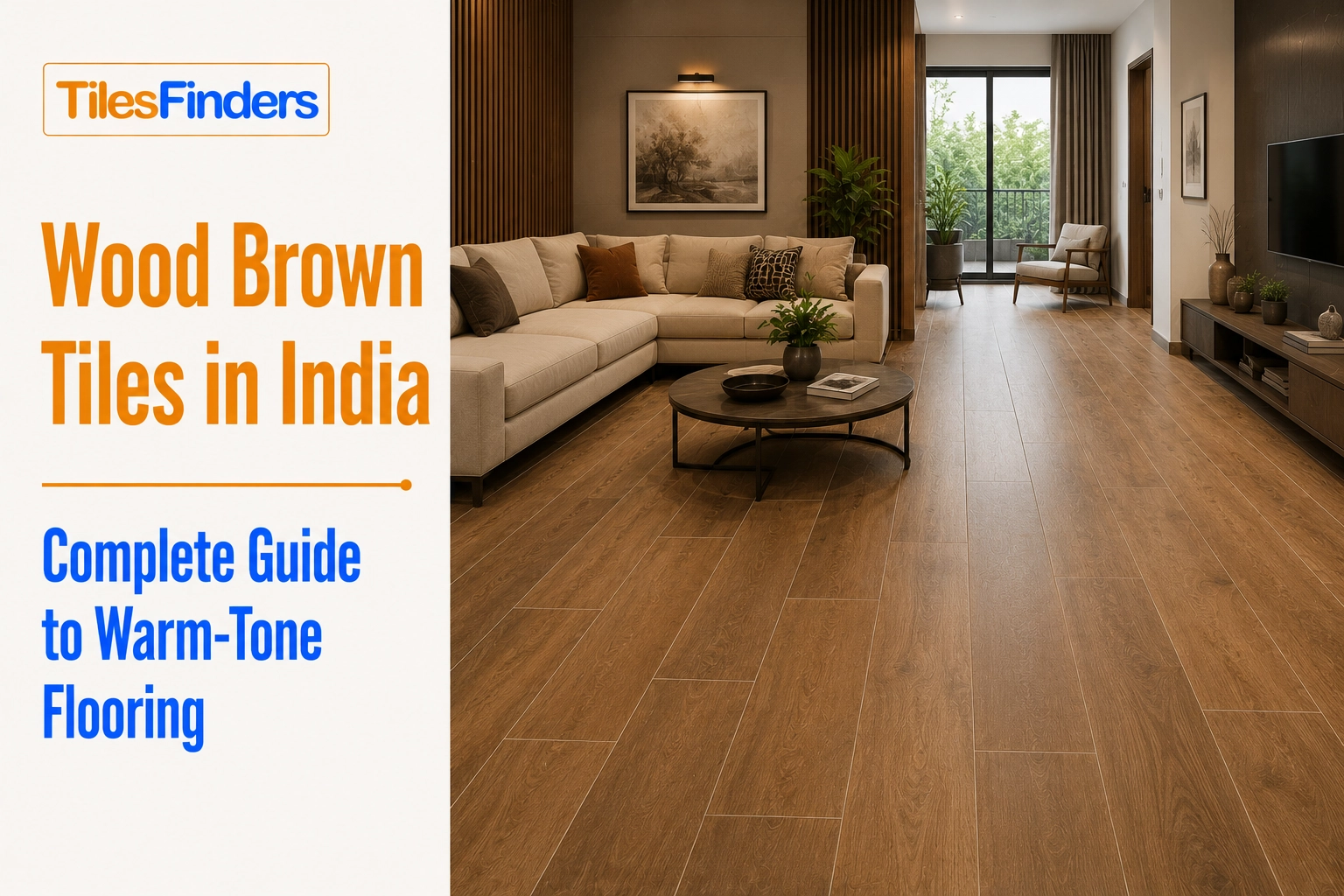
Wood brown GVT tiles offer the warmth of natural timber with better durability, lower maintenance, and superior performance in Indian conditions, including monsoon humidity and wet areas. Choose the right brown sub-tone, format, and technical specifications based on your room, lighting, and design style.
Wood brown is the most furniture-friendly floor colour in Indian interior design. A warm brown floor works with dark teak, pale mango wood, painted white cabinetry, rattan, cane, and deep green or rust textiles without the colour-temperature conflict that affects cooler greys, clinical whites, or assertive terracotta tones. It is the default warm neutral for Indian bedrooms, living rooms, and kitchens that want a grounded, natural feel without a strong colour statement.
In 2026, wood-brown tiles in India cover three material approaches: wood-look GVT planks that digitally replicate timber grain, brown stone-look GVT that replicates natural stone in warm brown tones, and plain brown GVT in matte or sugar finishes. This guide covers the full range, including which sub-tone of brown suits, which room and brief, how brown reads in Indian light conditions, the correct technical specification for each application, and the price range across tiers.
What Wood Brown Covers: Sub-Tones and Sub-Categories
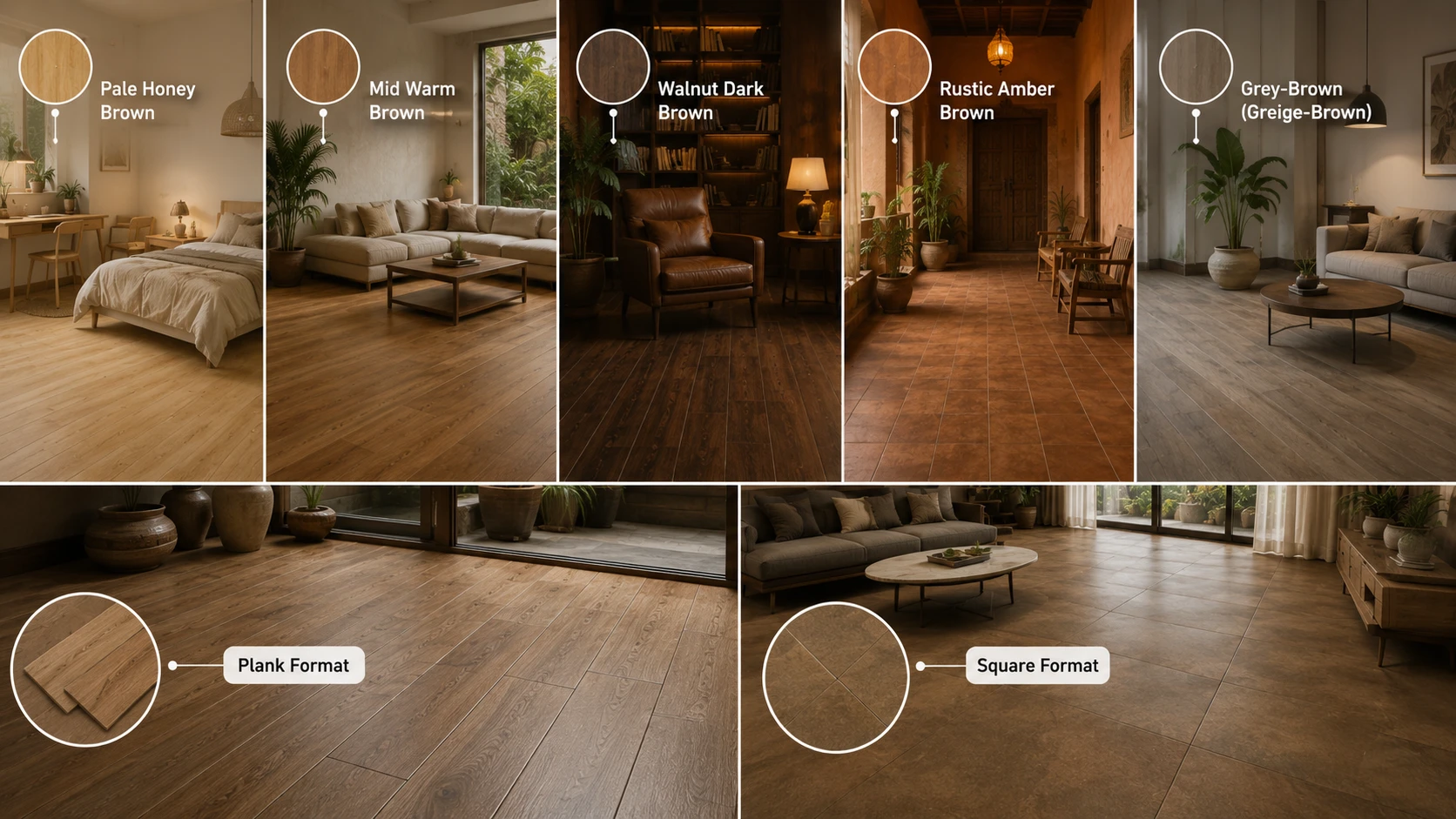
Wood brown is a broad descriptor. In the Indian tile market, it spans at least five distinct sub-tones, each with a different design application.
| Sub-Tone | Colour Description | Indian Material Reference | Primary Design Application |
| Pale honey brown | Warm light brown with a slight yellow pull. The lightest end of the wood brown range. Reads as pale teak or blonde wood. | Pale Indian teak, raw mango wood, jute fibre. | Bedrooms, study rooms, and north-facing living rooms where a light, warm floor is desired without adding obvious colour. |
| Mid warm brown | Medium warm brown. The most widely recognised wood brown tone. Neither too light nor too dark. Reads as a natural wood floor. | Standard Indian teak, sal wood, and Indian rosewood in its mid-tone register. | Living rooms, dining rooms, any room where a warm, settled, natural floor tone is the brief. |
| Walnut dark brown | Deep warm brown with red-brown pull. Closer to the dark end of the spectrum. Reads as aged walnut or dark teak. | Indian walnut (Juglans regia), aged teak, dark rosewood. | Master bedrooms, formal dining rooms, libraries, and home offices where a rich, deep, warm floor is wanted. |
| Rustic amber brown | Warm brown with a slight orange-amber pull. Sits between brown and terracotta on the warm spectrum. | Aged bamboo, warm cane, amber-toned Indian timber. | Heritage interiors, wabi-sabi rooms, rustic living rooms, and covered courtyards. |
| Grey-brown (greige-brown) | Cool-toned brown with a grey pull. The most neutral of the wood brown sub-tones. Sits between warm brown and cool grey. | Driftwood, weathered reclaimed timber, grey-wash teak. | Contemporary minimalist living rooms, bedrooms with a Japandi brief, and rooms where the brief is neutral but slightly warmer than grey. |
Note: In Indian tile showrooms, wood brown tiles are displayed in two format families: plank formats (200x1200 mm, 150x900 mm, 200x1000 mm) for wood-look tiles that replicates timber planks, and square or near-square formats (600x600 mm, 800x800 mm) for brown stone-look GVT and plain brown GVT. The format is part of the design decision: plank formats read as timber flooring; square formats read as stone or plain tile flooring in a warm brown tone.
How Wood Brown Tiles Read in Indian Light
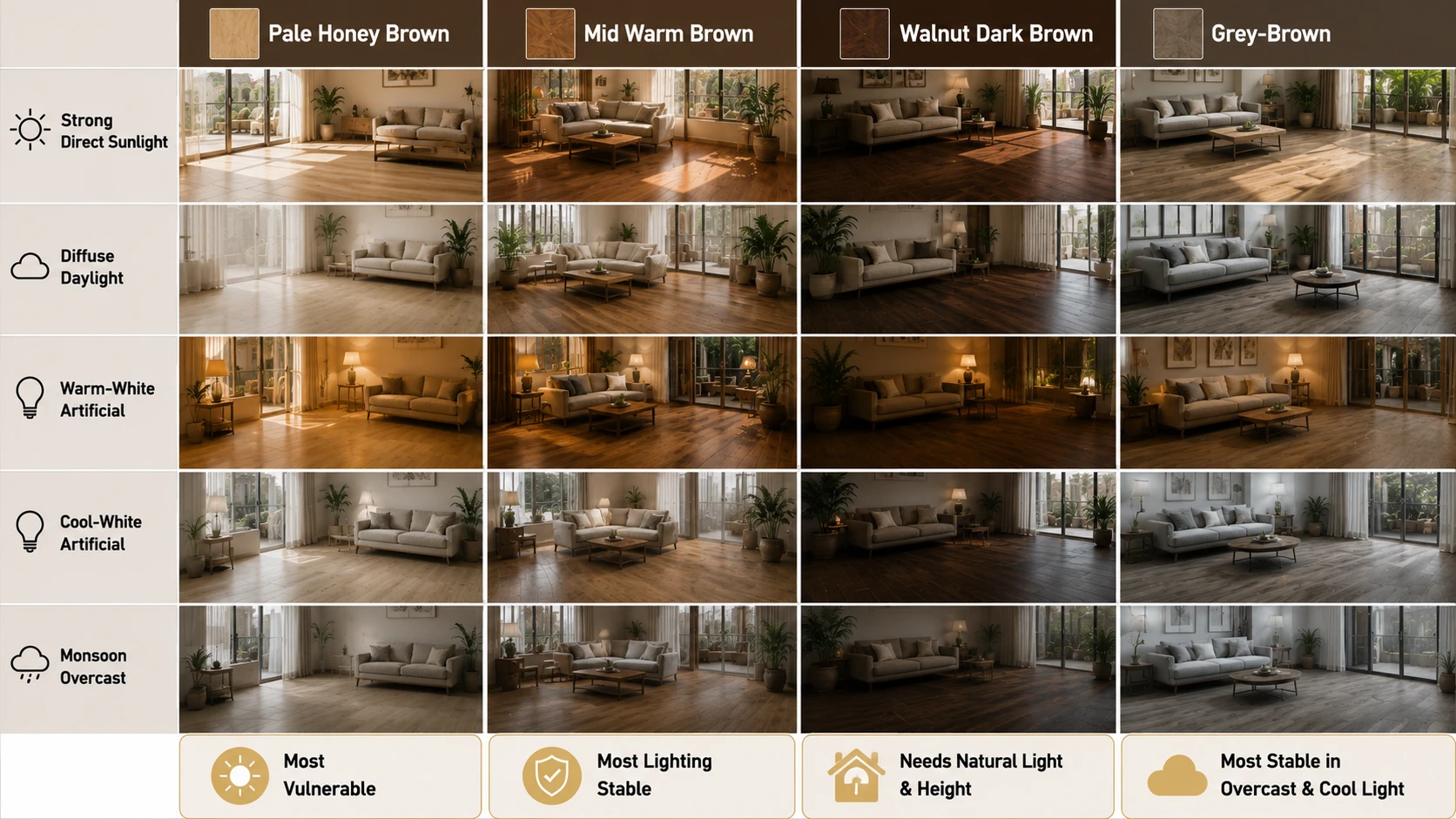
| Light Condition | Pale Honey Brown | Mid Warm Brown | Walnut Dark Brown | Grey-Brown |
| Strong direct sunlight (south or west facing) | Reads as warm pale gold-brown. Light and bright. Most flattering in strong sun. | Reads as rich warm timber. Deepens and enriches under direct sunlight. Very flattering. | Can read as very dark under strong direct sun. Needs high-ceiling, open rooms for this to work well. | Reads as warm brown in direct sun. The grey pull lightens, and the warmth comes forward. |
| Diffuse daylight (north facing, overcast) | Can read as pale or slightly washed-out in cool diffuse light. Needs warm-white artificial supplement. | Most stable of the four in diffuse light. Holds its warm brown character better than pale honey or grey-brown. | Appears as a settled, deep, warm floor. The darkness is more contained and less heavy in diffuse light. | Most stable in diffuse and overcast light. The grey component prevents the washed-out shift that pure warm browns show in cool light. |
| Warm-white artificial (2700K to 3000K) | Warmed to a soft gold-brown. Most flattering artificial lighting for pale honey. | Deepened to a rich, luxurious,s warm brown. Reads as premium natural timber under warm light. | Amplified to a deep, enveloping dark brown. Intimate and warm in a bedroom or study under warm light. | Warmed slightly. The grey pull is mostly neutralised by warm light. Reads as a soft, warm brown. |
| Cool-white artificial (4000K to 5000K) | Shifts towards pale, slightly greenish-grey. Loses its warmth. Specify warm-white in any room with pale honey floors. | Can read as slightly olive-grey under cool light. Less damaging than for pale honey, but still not ideal. | Holds its dark character best. Dark brown is the most lighting-stable of the four. | Most appropriate for cool-white lit spaces. Reads as a warm grey-brown that reads well under cool task lighting. |
| Monsoon overcast (heavy cloud, high scatter) | Most vulnerable to reading flat or slightly grey. Warm-white artificial light is essential in monsoon months. | Holds well. Mid warm brown is the most monsoon-stable of the warm brown sub-tones. | Stable. Dark tones are less affected by ambient light temperature shifts. | Best performing of the four in monsoon overcast. The grey component stabilises the tone across variable light. |
Verdict: Mid warm brown is the most lighting-stable wood brown sub-tone across Indian conditions. Grey-brown is the most stable in diffuse, overcast, and cool-white lit spaces. Pale honey brown is the most vulnerable to light shifts and requires warm-white supplemental lighting in north-facing rooms or during the Indian monsoon. Walnut dark brown is stable in its darkness but needs generous natural light and ceiling height to avoid reading as heavy.
Format Guide: Plank vs Square in Wood Brown GVT
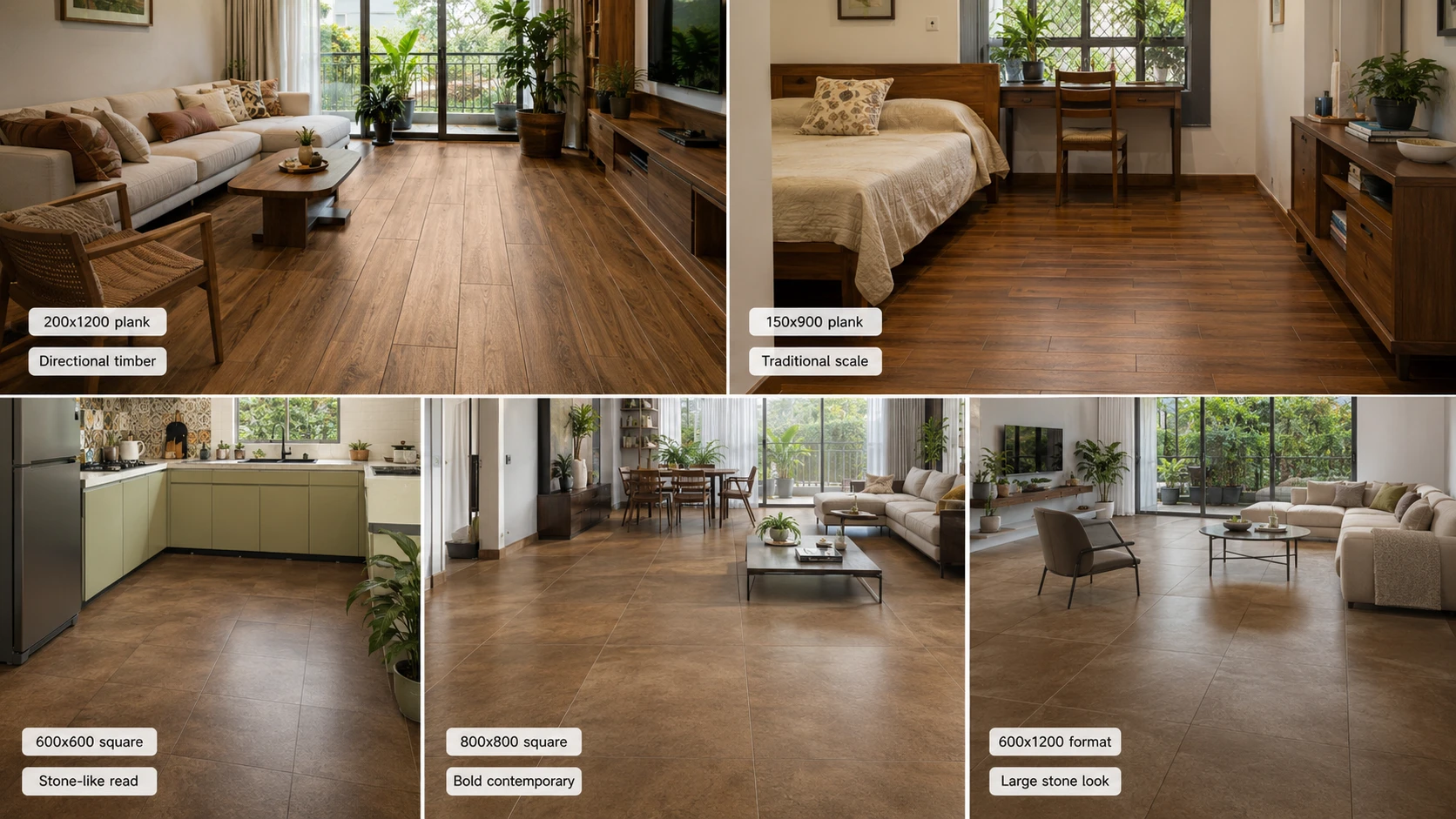
The format decision for wood brown tiles is as much a design choice as a practical one. Plank and square formats create fundamentally different room reads.
| Format | Visual Effect | Best Room Application | Best Sub-Tone | Price Range (GVT, Morbi) |
| 200x1200 mm plank | Creates a strong directional timber-plank floor. The long axis pulls the eye down the room's length. Reads clearly as a wood floor rather than stone or plain tile. | Living rooms, bedrooms, and open-plan layouts where directionality is wanted. Most popular plank format from Morbi. | Mid warm brown aged teak, pale honey reclaimed wood, grey-brown driftwood. | Rs. 90 to Rs. 200/sq.ft |
| 150x900 mm plank | Slightly narrower plank. Reads as more traditional timber flooring than the 200x1200 mm format. Proportionally correct for rooms under 250 sq.ft. | Bedrooms, compact living rooms, corridors. Traditional Indian timber floor scale reference. | Mid warm brown, walnut, dark brown. | Rs. 85 to Rs. 175/sq.ft |
| 200x1000 mm plank | Mid-length plank. Longer than standard subway but shorter than the primary plank format. Fewer options from Morbi compared to 200x1200 mm. | Bedrooms and compact dining rooms where 200x1200 mm creates too many long cuts. | Mid warm brown, pale honey. | Rs. 85 to Rs. 170/sq.ft |
| 600x600 mm | Square format reads as stone or plain tile, not timber. The brown tone reads as a warm stone floor rather than wood. Less directional than plank. | Kitchens, bathrooms, utility rooms, and balconies where the timber-plank read is not wanted. Also for brown stone-look GVT. | Rustic amber brown, mid warm brown stone-look, grey-brown. | Rs. 65 to Rs. 145/sq.ft |
| 800x800 mm | Large square reads as an architectural stone floor in a warm brown tone. Bold, contemporary. | Living rooms, dining rooms, and formal spaces where a brown stone-look floor (not timber-look) is the brief. | Walnut dark brown, mid warm brown stone-look. | Rs. 90 to Rs. 155/sq.ft |
| 600x1200 mm | Long rectangular, reads as large-format stone rather than timber. Fewer grout lines than 600x600 mm. | Living rooms and dining rooms with a warm brown stone-look brief rather than a timber-plank brief. | Mid warm brown, grey-brown, rustic amber. | Rs. 80 to Rs. 155/sq.ft |
Wood Brown Tiles: Room-by-Room Guide
Idea 1: Mid Warm Brown Wood-Look Plank Living Room
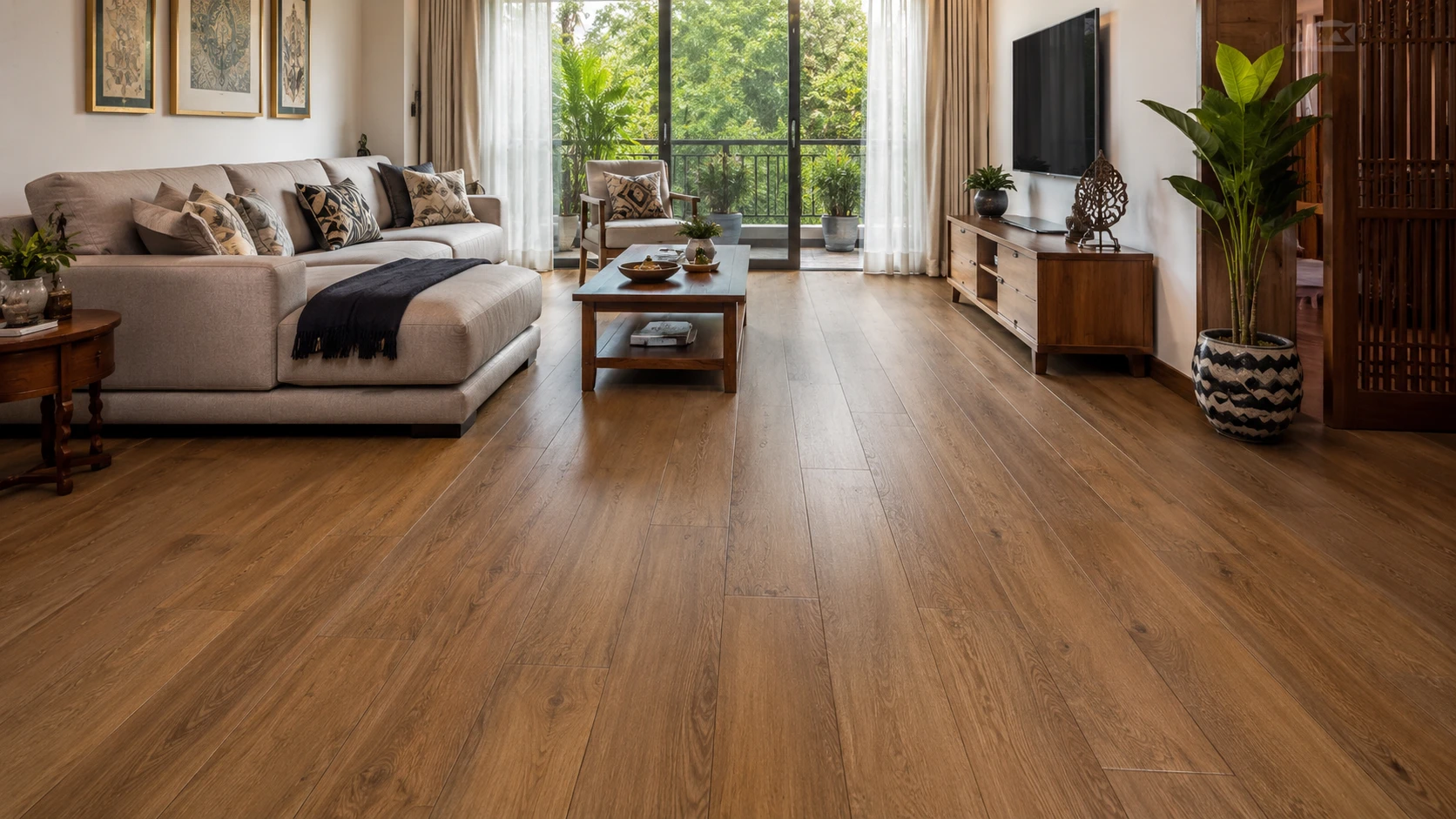
Wood-look GVT plank | 200x1200 mm | Matte | Rs. 100 to Rs. 175/sq.ft
A mid warm brown wood-look GVT plank at 200x1200 mm in matte finish is the primary living room wood brown specification in India in 2026. The plank format creates a strong directional floor that makes the room read along its longest axis. Under warm-white lighting at 2700K, the mid brown plank reads as a premium natural timber floor without any of the humidity sensitivity, termite risk, or sealing requirement that actual wood flooring carries in Indian conditions. At 4 to 6 face variations, the grain variation across planks reads as natural timber at the room scale. Works in any Indian living room regardless of orientation.
Idea 2: Grey-Brown Driftwood Plank for Japandi Living Room
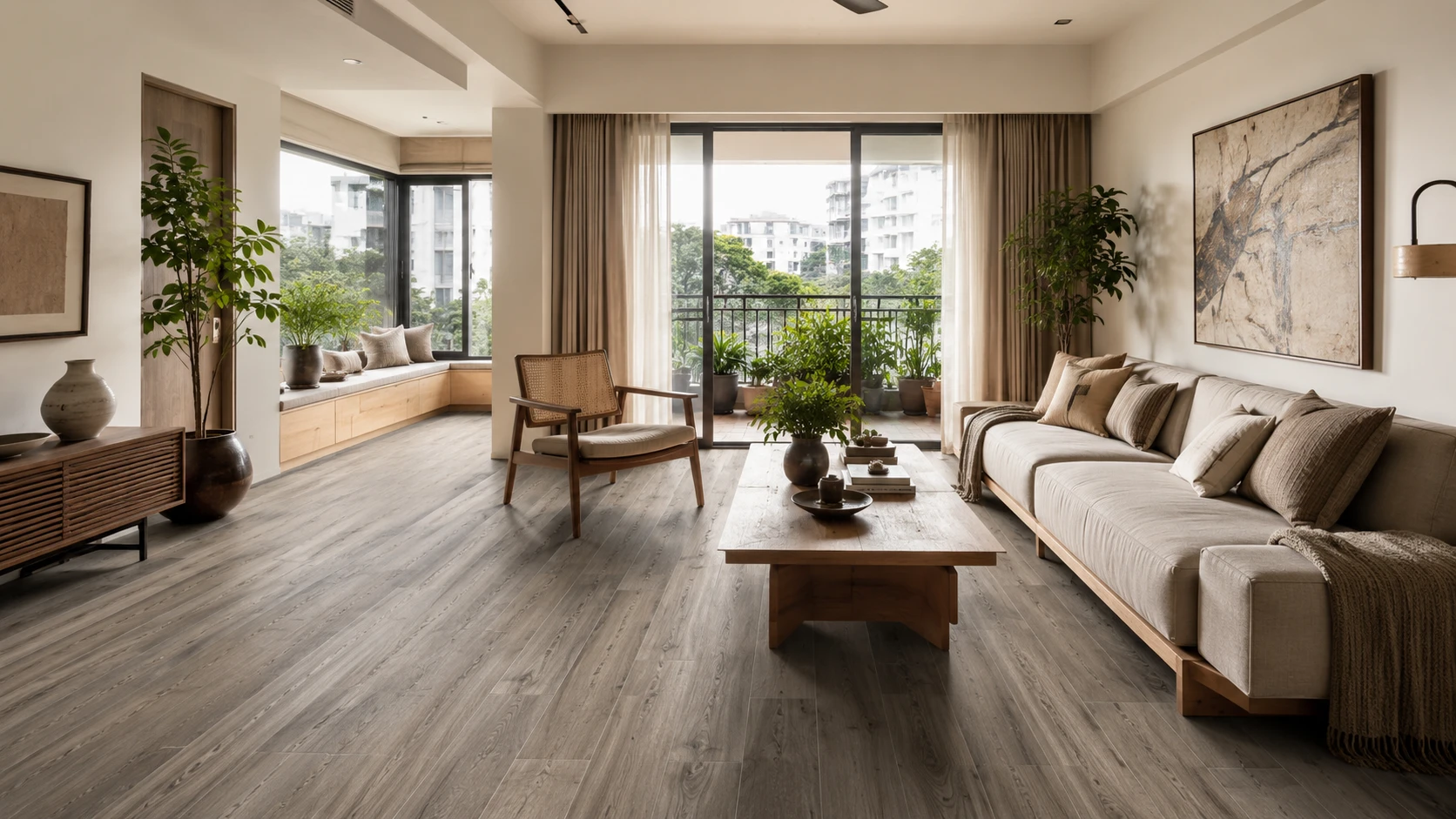
Wood-look GVT plank | 200x1200 mm | Matte | Rs. 95 to Rs. 165/sq.ft
A grey-brown or driftwood GVT plank at 200x1200 mm suits a living room designed around a Japandi or contemporary minimalist brief. The grey pulls in the driftwood tone reads as a weathered, wabi-sabi timber floor that connects to Japanese design vocabulary while remaining warm enough to suit Indian interiors. This tone is the most furniture-flexible of the wood brown sub-tones: it reads well with both warm wood furniture and cool grey or white upholstered pieces, making it the default choice for rooms where the furniture palette is not yet settled.
Idea 3: Walnut Dark Brown Floor for Formal Dining Room
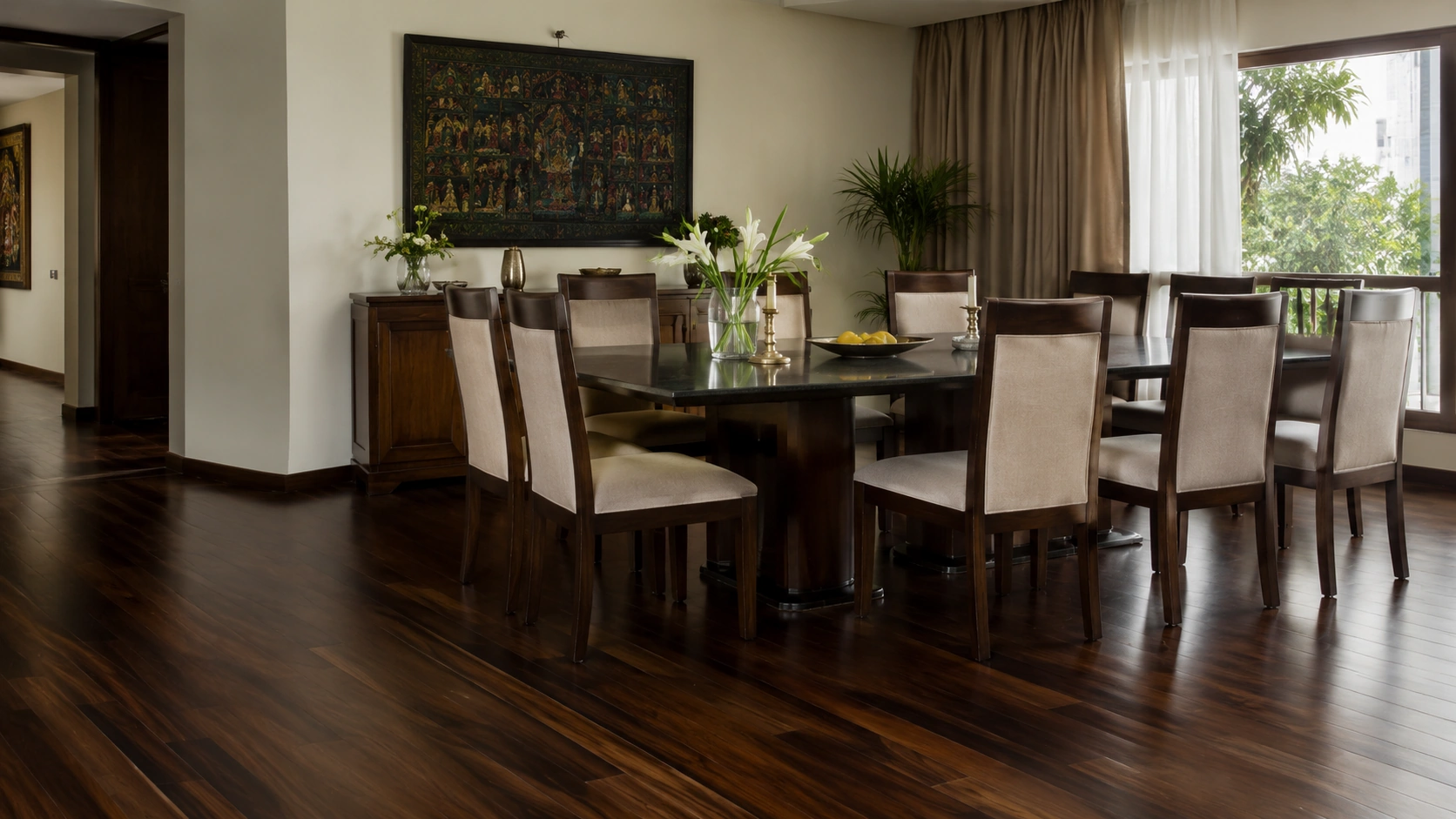
Wood-look GVT plank or brown stone-look GVT | 200x1200 mm plank or 800x800 mm | Matte | Rs. 100 to Rs. 160/sq.ft
A deep walnut brown floor in a formal dining room creates a rich, enveloping base beneath a dark dining table and statement chandelier. In plank format, it reads as premium dark timber. In 800x800 mm square format, it reads as architectural dark stone. Both suit a formal dining room with high ceilings above 10 ft. Under a warm-white pendant or chandelier, walnut dark brown reads as a deeply luxurious floor surface. Pairs with dark teak or ebony-lacquered dining furniture and white or very pale walls.
Idea 4: Pale Honey Brown Bedroom Floor
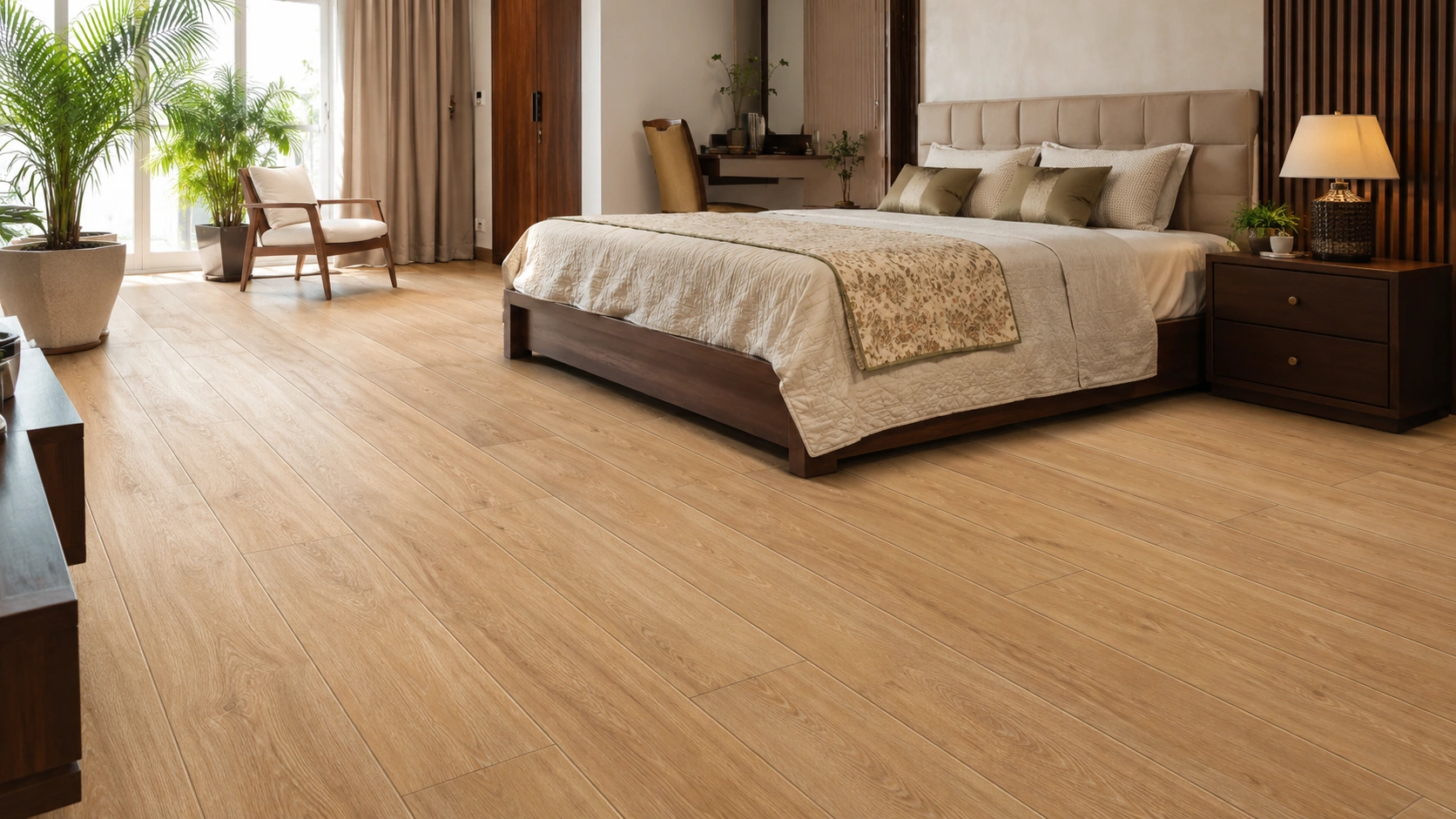
Wood-look GVT plank | 200x1200 mm | Sugar finish | Rs. 90 to Rs. 155/sq.ft
A pale honey brown wood-look GVT plank at 200x1200 mm in sugar finish creates the lightest and most airy version of the timber floor for an Indian master bedroom. The pale honey sub-tone reads as blonde or natural teak under warm-white bedside lighting and adds warmth without making the room feel dark. Sugar finish adds a slight tactile depth that reads closer to actual wood grain than a standard matte finish. Pairs with cream or white bedding, pale wood or white furniture, and warm-white lighting at 2700K.
Idea 5: Brown Stone-Look Kitchen Floor
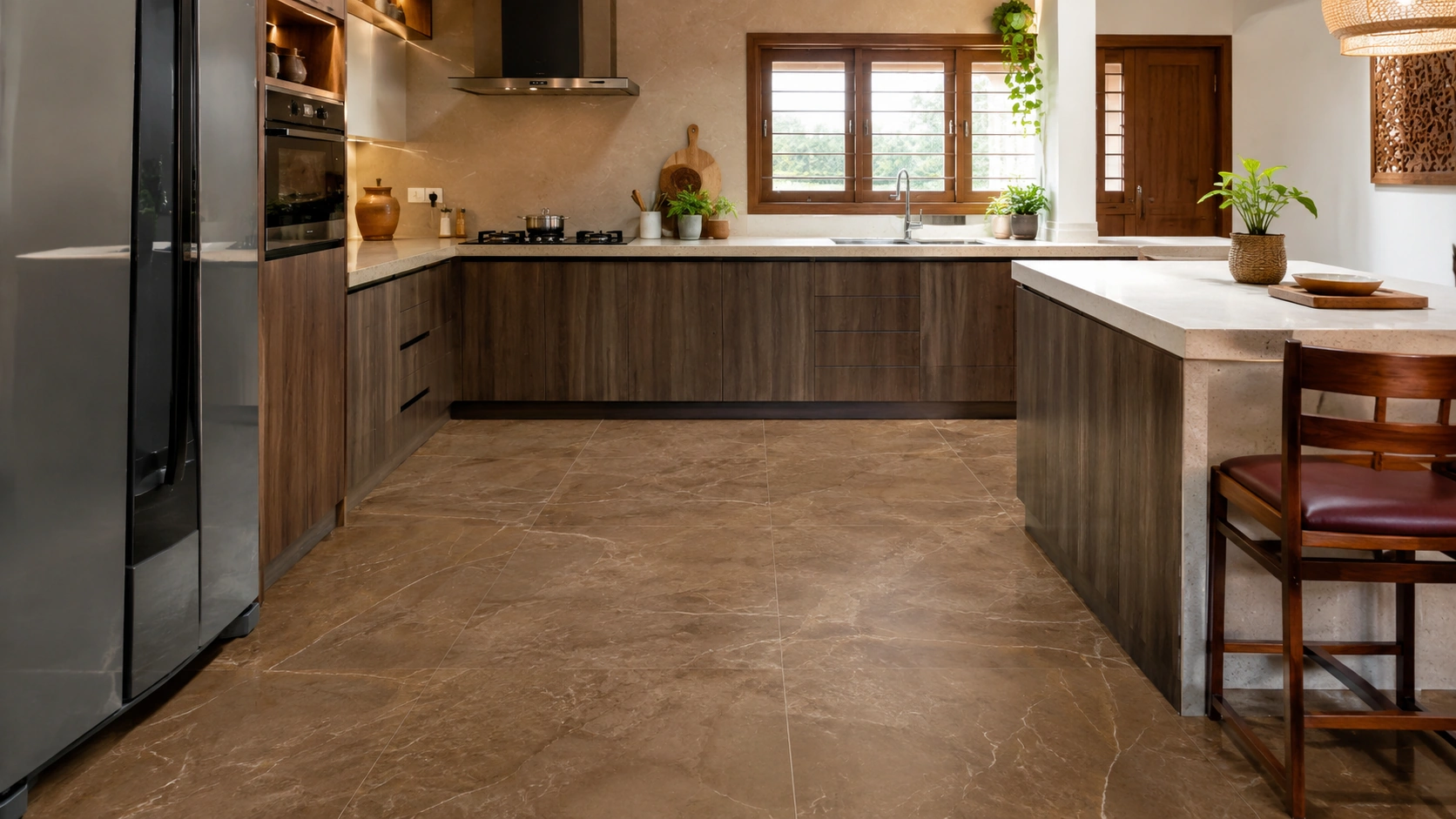
Brown stone-look GVT anti-skid | 600x600 mm | Anti-skid matte | Rs. 75 to Rs. 135/sq.ft
A warm brown stone-look GVT at 600x600 mm in anti-skid matte finish is the most practical wood brown specification for an Indian kitchen floor. At 0.05% water absorption and PEI 4 with an anti-skid rating, it handles daily cooking, oil, and cleaning chemical exposure without staining or becoming slippery. The stone-look format at 600x600 mm is more appropriate for kitchens than a plank format, which creates complex cuts around kitchen fixtures and reads as overly decorative in a working kitchen environment. Mid warm brown hides cooking, soiling the best of the wood brown sub-tones.
Idea 6: Rustic Amber Brown Covered Courtyard
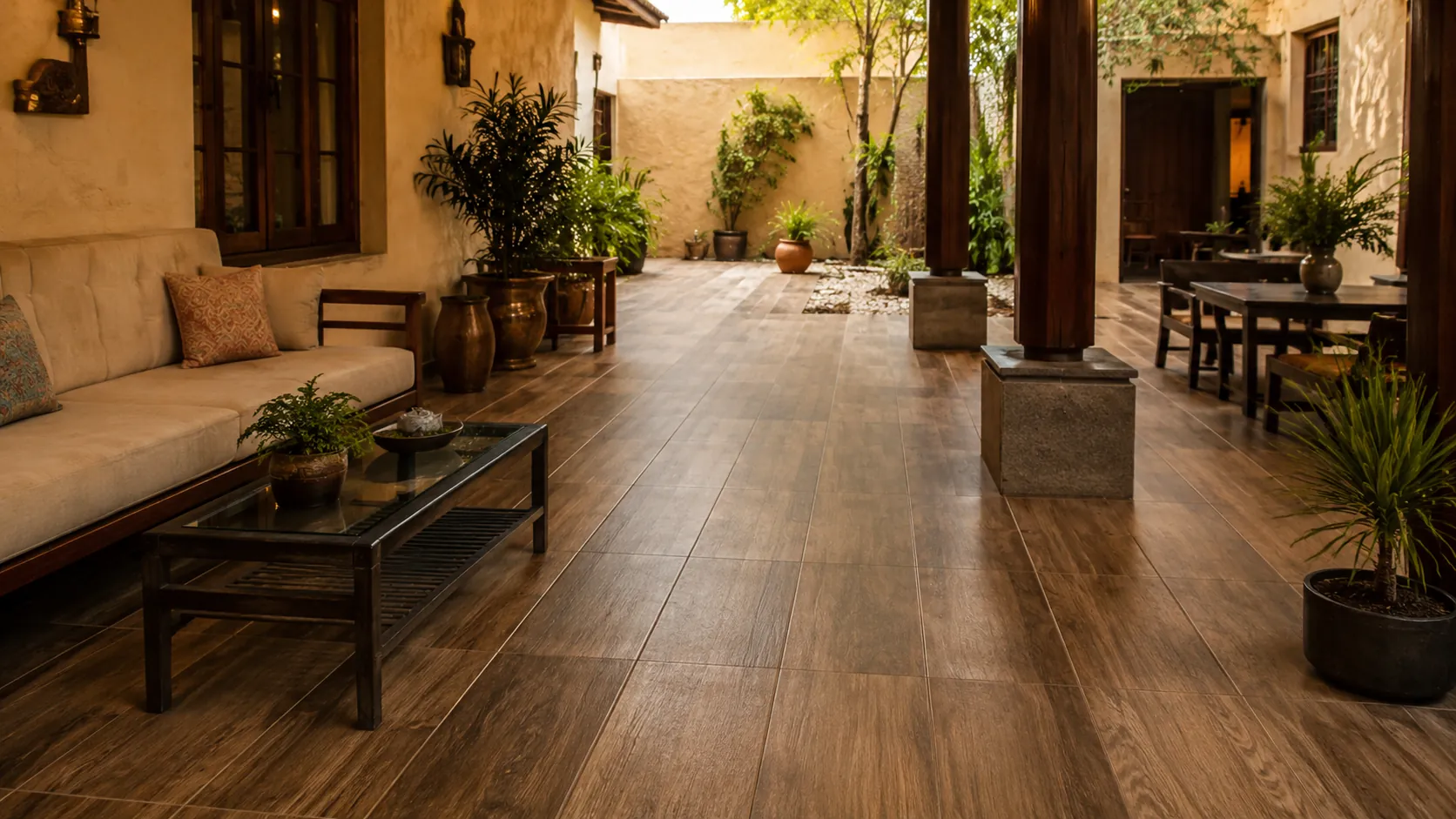
Rustic amber brown GVT anti-skid | 400x400 mm or 600x600 mm | Anti-skid matte or textured matte | Rs. 70 to Rs. 125/sq.ft
A rustic amber brown GVT at 400x400 mm or 600x600 mm in anti-skid matte or textured matte finish for a covered courtyard or verandah in an independent home creates a warm, organic outdoor-adjacent floor that reads as aged natural stone or timber without the maintenance of either. The rustic amber sub-tone sits between terracotta and mid warm brown and suits any courtyard with clay pots, cane furniture, and a natural material palette. An anti-skid rating is required for any courtyard that receives footwear traffic after rain.
Idea 7: Grey-Brown Bathroom Floor
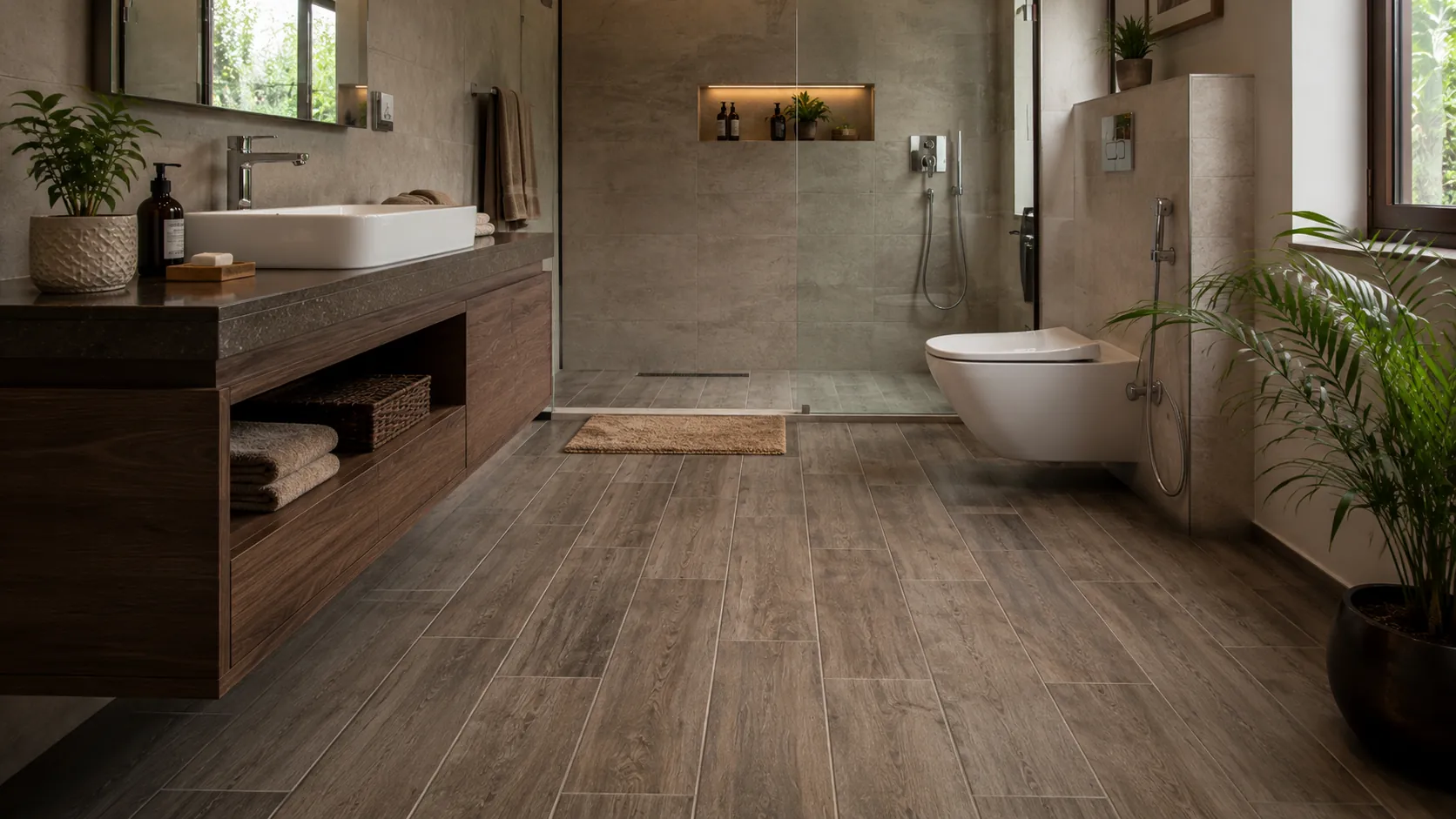
Grey-brown anti-skid GVT | 300x600 mm | Anti-skid matte | Rs. 70 to Rs. 120/sq.ft
A grey-brown anti-skid GVT at 300x600 mm creates a contemporary, spa-adjacent bathroom floor that is warmer than grey but more neutral than terracotta or full warm brown. The grey-brown sub-tone is the most forgiving of limescale and hard water deposits in Indian bathrooms, making it the best-maintained wood brown option for bathroom floors in Delhi, Bengaluru, and other hard-water Indian cities. Pairs with white or pale grey ceramic wall tiles and brushed nickel or chrome tapware.
Idea 8: Dark Brown Plank Feature Floor in Home Office
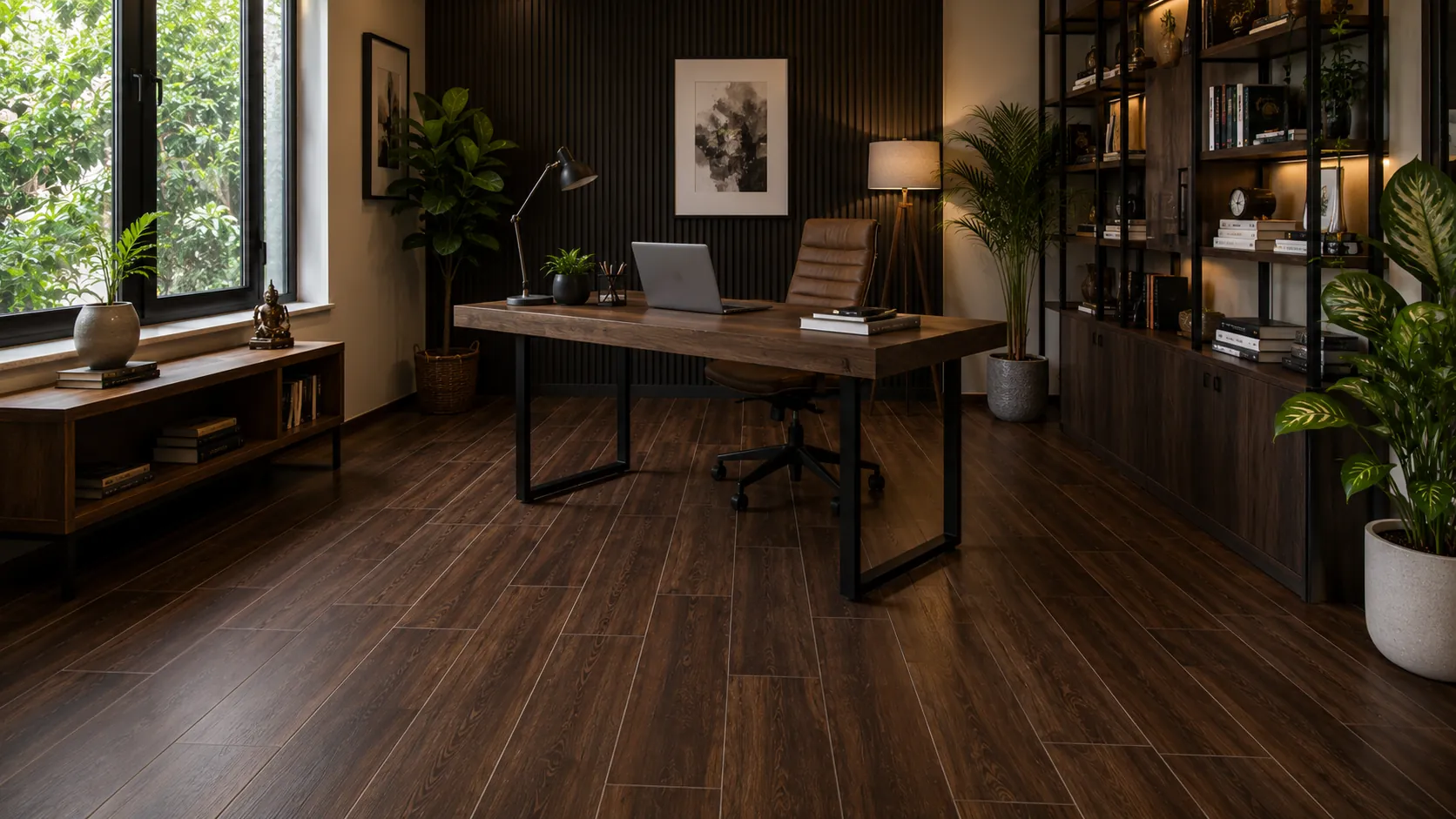
Wood-look GVT plank | 200x1200 mm | Matte | Rs. 100 to Rs. 170/sq.ft
A dark walnut or deep brown wood-look GVT plank at 200x1200 mm in a home office or study creates a professional, serious floor that reads as a library or executive space. Under cool-white task lighting at 3500K to 4000K, dark brown plank is the most appropriate wood brown sub-tone because it holds its character better under cool light than pale honey or mid warm brown. Pairs with dark wood shelving, leather or charcoal upholstery, and a framed desk.
Wood Brown GVT vs Natural Wood Flooring in Indian Conditions
| Factor | Wood Brown GVT | Natural Wood Flooring (Teak, Mango, Bamboo) |
| Monsoon humidity | Unaffected. GVT at 0.05% absorption does not expand, contract, or warp in 85 to 95% monsoon humidity. | Significant risk. Indian hardwoods expand in monsoon humidity and contract in dry winter. Without climate control throughout the year, natural wood floors develop gaps, cupping, and squeaking. |
| Termite risk | None. Vitrified tile body is inorganic and cannot be damaged by termites. | High in most of India. Termites are a serious risk to natural wood flooring in Indian conditions without chemical treatment. |
| Water in kitchens and bathrooms | Anti-skid GVT at 0.05% absorption is safe in kitchens and bathrooms. No damage from water contact. | Not suitable for kitchens and bathrooms. Water penetration swells and stains natural wood. Most Indian carpenters and architects advise against natural wood in these rooms. |
| Maintenance | Weekly mop. No oiling, no sanding, no sealing, no specialist treatment. | Annual oiling or waxing for most hardwoods. Sanding and refinishing every 5 to 10 years. Higher long-term cost. |
| Authentic grain visual | High-quality wood-look GVT at 6 to 8 face variations reads as natural timber at room scale. Visible as a tile on close inspection. | Genuine natural grain and texture. Each plank is unique. Patina development over time adds to the authentic character. |
| Cost comparison | Rs. 90 to Rs. 200/sq.ft installed for wood-look GVT, including adhesive and laying. No annual maintenance cost. | Rs. 250 to Rs. 600/sq.ft for teak or mango wood flooring installation, plus Rs. 30 to Rs. 60/sq.ft annual oiling and periodic refinishing. |
| 5-year total cost (200 sq.ft floor) | Rs. 18,000 to Rs. 40,000 for material and installation. Rs. 2,500 to Rs. 4,000 for cleaning supplies over 5 years. | Rs. 50,000 to Rs. 120,000 for material and installation. Rs. 3,000 to Rs. 6,000 annual oiling times 5 years. Total: Rs. 65,000 to Rs. 150,000. |
Verdict: Wood brown GVT outperforms natural wood flooring on every practical metric in Indian conditions: monsoon humidity, termite risk, wet-area safety, maintenance, and 5-year total cost. Natural wood delivers an authentic grain and patina that GVT at any price level cannot fully replicate. For rooms where the authentic natural timber character is the primary design priority and climate control is maintained year-round, natural wood flooring remains the correct specification. For all other rooms in Indian homes, wood brown GVT is the better long-term decision.
Buying Wood Brown Tiles in India: Key Specifications
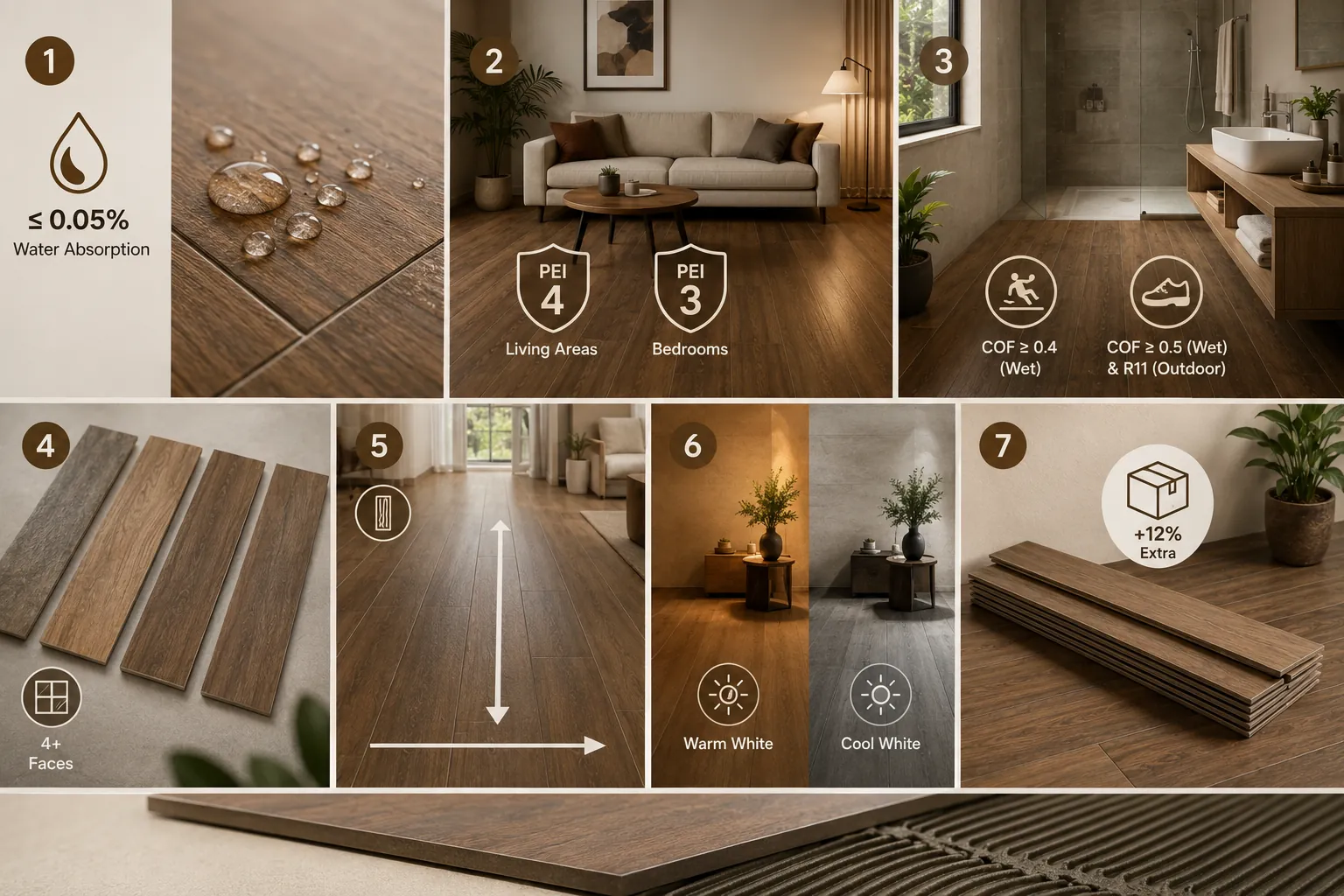
- Water absorption 0.05% or below per IS 15622:2006 for all floor GVT. The fundamental vitrified tile quality requirement. Request this in the written TDS before ordering. At the entry budget tier, some brown tiles sold as GVT do not meet this threshold.
- PEI 4 for living rooms, kitchens, dining rooms, and all heavy-traffic floors. PEI 3 minimum for bedrooms. Confirm in TDS. Wood-look plank GVT at PEI 3 or below wears through the grain print on a living room floor within 5 to 7 years of daily use.
- Anti-skid rating for wet areas. COF 0.4 wet minimum for bathroom and kitchen floors. COF 0.5 wet and R11 for outdoor and balcony applications. Request COF from the TDS, not verbally.
- Face variation count for wood-look planks. The single most important quality variable in wood-look GVT. Minimum 4 face variations for rooms above 150 sq.ft. 6 or more for rooms above 300 sq.ft. Wood-look plank with 2 face variations produces a very obvious repeating grain pattern on any floor above 150 sq.ft.
- Plank laying direction. Decide the plank direction relative to the room before ordering. The standard rule is to lay planks parallel to the room's longest dimension. Confirm the room's long axis before placing tiles. The adhesive and grout cost of relaying a misdirected plank floor is high.
- View under warm-white and cool-white light. Brown sub-tones shift more than any other warm neutral under different light temperatures. Pale honey brown under cool-white fluorescent light can read as a pale greenish-grey. Mid warm brown under cool-white can read as olive-grey. Always view the room's actual light type.
- Order 12% extra for plank formats. Plank-format tiles have higher cut waste than square tiles at room edges and around fixtures. A 12% overage is the standard allowance for 200x1200 mm plank installations in standard Indian room shapes.
Spec to request from Morbi supplier: For wood-look GVT planks: (1) IS 15622:2006 TDS with water absorption figure, (2) PEI rating, (3) face variation count with sample board of minimum 9 tiles, (4) calibration tolerance (maximum plus or minus 0.5 mm for 200x1200 mm plank), (5) batch number. For bathroom and kitchen applications, add (6) COF wet rating confirmation.
Wood Brown GVT from Morbi, Gujarat: Format and Price Reference 2026
| Sub-Tone | Best Format | Design | Price Range (Morbi) | IS Standard | Lead Time |
| Pale honey brown | 200x1200 mm plank, 600x600 mm | Reclaimed wood-look, blonde teak-look GVT matte or sugar | Rs. 90 to Rs. 155/sq.ft (plank), Rs. 65 to Rs. 110/sq.ft (square) | IS 15622:2006, 0.05% absorption, PEI 4 | 7 to 14 days |
| Mid warm brown | 200x1200 mm plank, 600x600 mm, 800x800 mm | Aged teak-look, warm walnut-look, brown stone-look GVT matte | Rs. 100 to Rs. 175/sq.ft (plank), Rs. 75 to Rs. 145/sq.ft (square) | IS 15622:2006, 0.05% absorption, PEI 4 | 7 to 14 days |
| Walnut dark brown | 200x1200 mm plank, 800x800 mm, 600x1200 mm | Dark walnut-look GVT, deep brown stone-look GVT matte | Rs. 100 to Rs. 170/sq.ft (plank), Rs. 90 to Rs. 155/sq.ft (square) | IS 15622:2006, 0.05% absorption, PEI 4 | 10 to 21 days |
| Rustic amber brown | 600x600 mm, 400x400 mm | Rustic stone-look or aged clay-look GVT textured matte | Rs. 70 to Rs. 130/sq.ft | IS 15622:2006, 0.05% absorption, PEI 4 | 7 to 14 days |
| Grey-brown (driftwood) | 200x1200 mm plank, 600x600 mm | Grey-wash wood-look, driftwood-look GVT matte | Rs. 95 to Rs. 165/sq.ft (plank), Rs. 70 to Rs. 130/sq.ft (square) | IS 15622:2006, 0.05% absorption, PEI 4 | 7 to 14 days |
Note: All wood brown GVT formats above are manufactured in Morbi, Gujarat, under IS 15622:2006 at water absorption 0.05% or below. In coastal Indian cities with monsoon humidity of 85 to 95%, GVT at 0.05% absorption is unaffected by humidity levels regardless of the brown sub-tone. Natural wood flooring in the same coastal conditions expands and contracts seasonally and requires annual maintenance. Anti-skid variants (COF 0.4 wet minimum) are available in 300x300 mm, 400x400 mm, and 600x600 mm across all five sub-tones for wet-area applications.
Browse Wood Brown Tiles on TilesFinders
The full wood brown tile range from Morbi, Gujarat manufacturers is on Tilesfinders across all five sub-tones, plank and square formats, and three quality tiers. Filter by sub-tone, format, finish, and room to find the right warm-tone floor tile for your project.
FAQs
Wood brown tiles in India cover wood-look GVT planks (200x1200 mm and similar formats with a digital timber grain print), brown stone-look GVT in square and rectangular formats, and plain brown matte GVT. All three are manufactured in Morbi, Gujarat, as GVT at 0.05% water absorption and PEI 4 for floor use. Wood-look planks read as a timber floor; square brown stone-look GVT reads as a warm stone floor.
Wood brown GVT outperforms natural wood flooring on humidity resistance, termite immunity, wet-area safety, maintenance, and 5-year total cost in Indian conditions. Natural wood delivers authentic grain and patina that GVT cannot fully replicate. For most Indian homes where monsoon humidity, kitchen water exposure, and termite risk are real, wood brown GVT is the more practical specification. In a climate-controlled room where authentic timber character is the primary design brief, natural wood remains the correct material.
Wood-look GVT planks at 200x1200 mm from Morbi range from Rs. 90 to Rs. 200 per sq.ft, depending on sub-tone, face variation count, and quality tier. Brown stone-look GVT at 600x600 mm ranges from Rs. 65 to Rs. 145 per sq.ft. Anti-skid brown GVT for bathroom and kitchen floors at 300x300 mm or 600x600 mm ranges from Rs. 65 to Rs. 120 per sq.ft.
Mid warm brown wood-look GVT plank at 200x1200 mm in matte finish is the most versatile and widely specified sub-tone for Indian living rooms. It reads as natural timber under any lighting condition and pairs with most furniture tones. Grey-brown driftwood plank is the best choice for a Japandi or minimalist brief. Walnut dark brown suits formal living rooms with high ceilings and dark furniture.
Yes, with anti-skid specification. Grey-brown or mid warm brown anti-skid GVT at 300x300 mm or 300x600 mm with COF 0.4 wet minimum and R10 to R11 rating is safe for Indian bathroom floors. Grey-brown is the most forgiving sub-tone for limescale visibility in hard-water cities. Standard matte or plank GVT without an anti-skid rating should not be used on bathroom floors.
Minimum 4 face variations for a room above 150 sq.ft. Six or more for a room above 300 sq.ft. Wood-look plank GVT with 2 face variations produces a repeating grain pattern that is visible on any floor above 100 sq. ft., making the floor read as printed linoleum rather than natural timber. This is the single most important quality variable to check before ordering wood-look GVT.
Parallel to the room's longest dimension is the standard rule for plank flooring. In a 12 ft x 16 ft living room, the planks run along the 16 ft dimension. This creates a floor that draws the eye down the room's length and makes the room read as longer than it is. Laying planks perpendicular to the longest dimension makes the room read as wider but shorter, which is less commonly wanted.
For wood-look plank GVT, use a grout colour matched to the wood tone: warm brown or tan for mid warm brown planks, pale grey-brown for driftwood planks, dark brown or coffee for walnut dark brown planks. The grout should read as the gap between planks, not as a contrasting element. White grout on a wood-look floor breaks the timber read immediately. For brown square-format tiles, use a slightly darker or matching warm brown grout.

See our tile guides first
Set TilesFinders as a preferred source and our buying guides surface ahead of the rest for you.
Add as preferred sourceTakes one tap. Nothing to install.
What Readers Say
I was about to redo my parking area with the wrong tile size until I read this. The layout comparisons saved me from a costly mistake.
We reference TilesFinders guides while briefing clients on material selection. The size and pattern breakdowns are accurate and easy to explain visually.
On site, I get asked about grout spacing all the time. This article gave me a solid reference I now share with my team before every job.
Finally a guide that doesn't just push generic advice. The oil stain removal steps actually worked on our clubhouse driveway tiles.
I run a small construction firm and now send this link to clients directly when they ask about entrance tile sizing. Saves me an hour of explaining.
Good practical detail, though I wish there were more examples for compact apartment entrances specifically, not just villas.
My mother-in-law wanted marble, I wanted vitrified. This blog gave us the neutral comparison we needed to actually decide together.
Detailed without being overwhelming. I appreciated that it covered both cost and maintenance, not just the aesthetics.
Used the algae and hard water removal tips on our terrace tiles after the monsoon. Worked better than what our regular cleaner was doing.
As someone who sources tiles for multiple builder projects, I find these comparisons genuinely useful for vendor conversations, not just consumer content.
Recommended this to a client who kept second-guessing the entrance design. The small vs large layout section settled the debate instantly.
Straightforward and honest, no unnecessary jargon. Would like to see a similar breakdown for outdoor pool-deck tiles next.
We've bookmarked several TilesFinders guides for our design handbook. Reliable source when clients want data, not just opinions.
Two paths, one marketplace.
Get free quotes from verified suppliers.
Share your room, budget, and style. Suppliers in Morbi respond within hours.
Get Free QuotesList your business, reach real buyers.
Put your showroom in front of homeowners searching for tiles right now.
List Your Business