Terracotta Red vs Brick Red vs Wine Red Tiles: Which Suits Your Space
Compare terracotta red, brick red, and wine red tiles for Indian homes. Learn how undertones, lighting, room usage, finishes, and budgets affect the best shade choice.
- Why Red Tile Shade Matters More Than Just the Colour Name
- Terracotta Red Tiles: Warm, Earthy, Traditional
- Brick Red Tiles: Medium Depth, Versatile, Indian Classic
- Wine Red Tiles: Deep, Cool, Contemporary
- How Indian Home Lighting Changes Each Shade
- Side-by-Side Comparison: Room Suitability, Category and Price
- Common Mistakes When Choosing Red Tile Shades
- Find the Right Red Tile Combination for Your Space
Terracotta red offers earthy warmth, brick red provides classic versatility, and wine red delivers a bold contemporary look. Your ideal choice depends on lighting, room style, and intended application. Always check tile samples under your home's actual lighting before purchase, as red undertones can appear dramatically different after installation.
Walk into any tile showroom in India and ask for red tiles. The dealer will show you a shelf that includes terracotta, brick red, maroon, burnt orange, wine red, and deep burgundy, all described as red. Picking the wrong shade for your room is a mistake that is visible every day after installation.
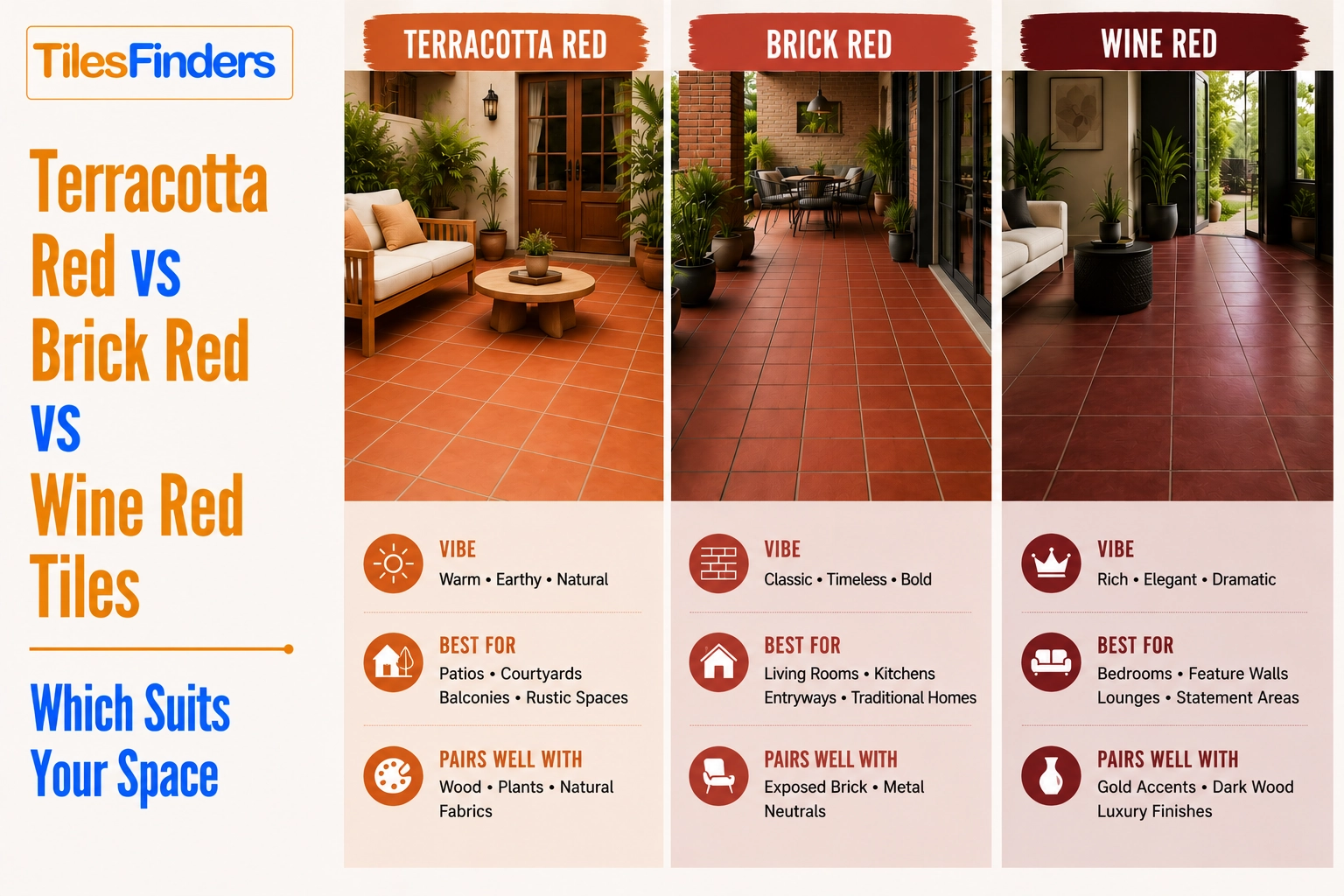
The three main red tile shades in the Indian market each have different undertones, different room applications, and different tile categories. Understanding what makes terracotta, brick red, and wine red distinct from one another is the starting point for any red-tile decision.
If you are still deciding whether red tiles suit your home at all, our Red Tiles Guide covers colour psychology, Vastu guidance, and room-by-room recommendations for Indian homes. This guide focuses specifically on which shade of red to choose once you have decided to use red tiles.
Why Red Tile Shade Matters More Than Just the Colour Name
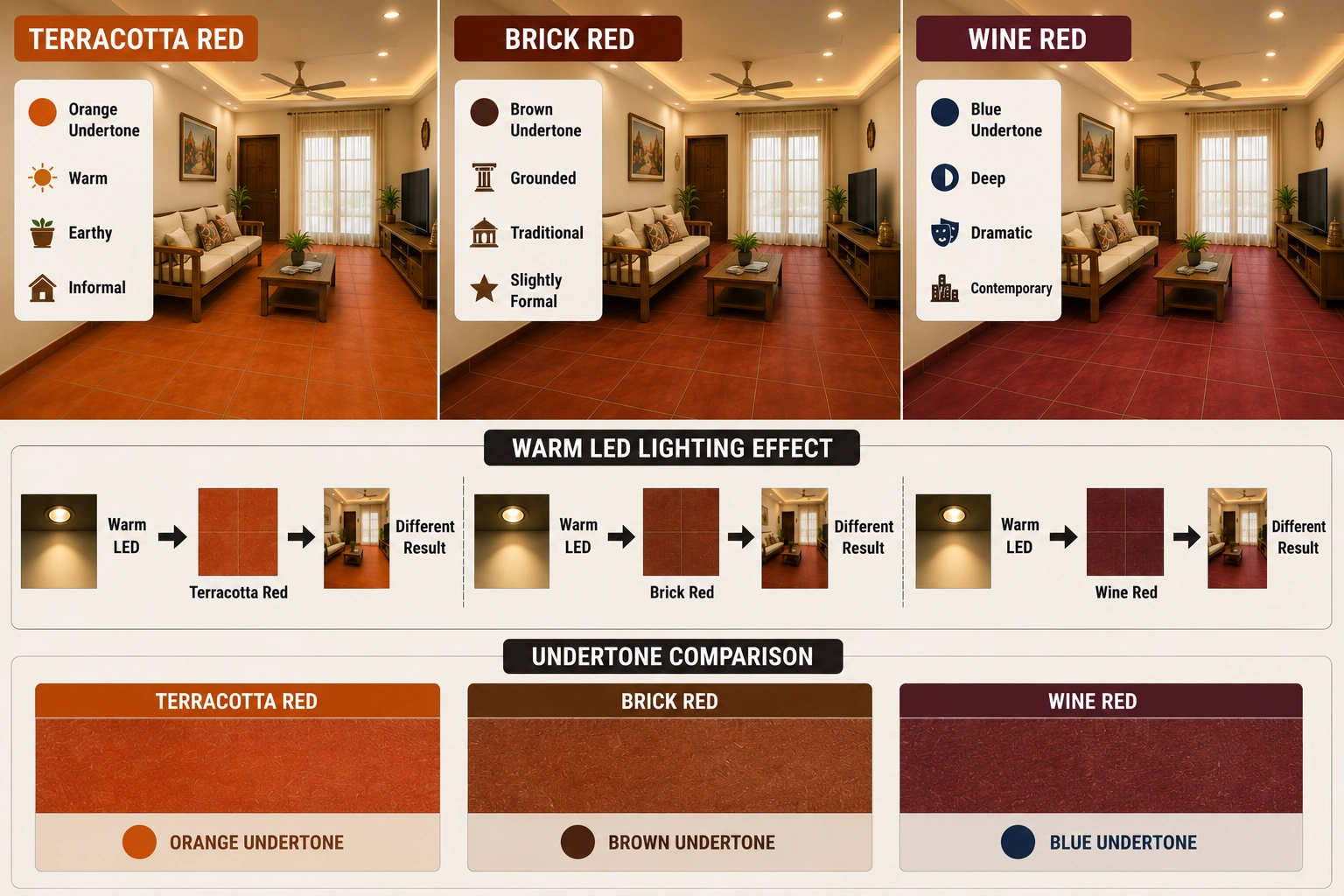
Red is not a single colour in tile design. Terracotta red carries a strong orange undertone and reads as warm, earthy, and informal. Brick red carries a brown undertone and reads as grounded, traditional, and slightly formal. Wine red carries a cool blue undertone and reads as deep, dramatic, and contemporary.
Place all three shades in the same Indian living room under the same warm LED lighting,g and you will see three very different visual results. The undertone of the tile interacts with the room's light source and wall colour to produce the final appearance. Getting the undertone right for your room is more important than finding a tile labelled with the exact shade name you had in mind.
Terracotta Red Tiles: Warm, Earthy, Traditional
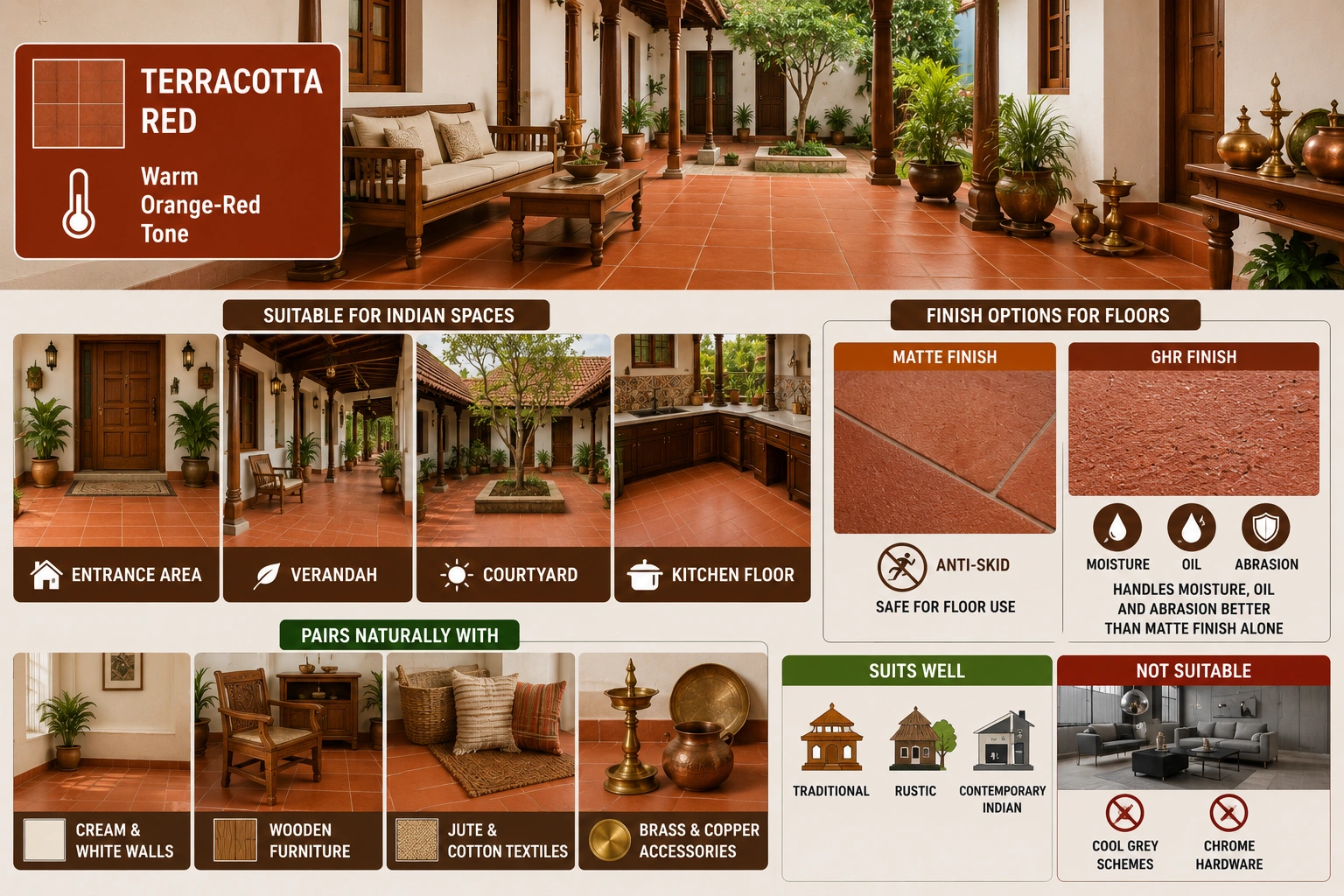
Terracotta red is the warm orange-red shade that references fired clay. In Indian homes, this is the shade most associated with traditional architecture, handmade clay tiles, and vernacular building materials. The dominant undertone is orange, which means terracotta reads as warm and alive even in rooms with limited natural light.
Terracotta red GVT tiles in matte or GHR finish are available in sizes from 400x400 mm (16x16) through 600x600 mm (2x2) and 600x1200 mm (2x4). These tiles work on floors and walls. The matte and GHR finishes are safe for floor use, anti-skid in wet areas, and well-suited to Indian outdoor applications like entrance areas, verandahs, and courtyards. The GHR finish, specifically, is the right choice for Indian kitchen floors and outdoor-facing areas because it handles moisture, oil, and abrasion better than a matte finish alone.
Terracotta pairs naturally with: cream and white walls, wooden furniture, jute and cotton textiles, and brass and copper accessories. It suits traditional, rustic, and contemporary Indian design directions. It does not suit very cold-toned modern interiors (grey-black-white palette with chrome hardware) because the orange warmth of terracotta clashes with cool grey schemes.
Brick Red Tiles: Medium Depth, Versatile, Indian Classic
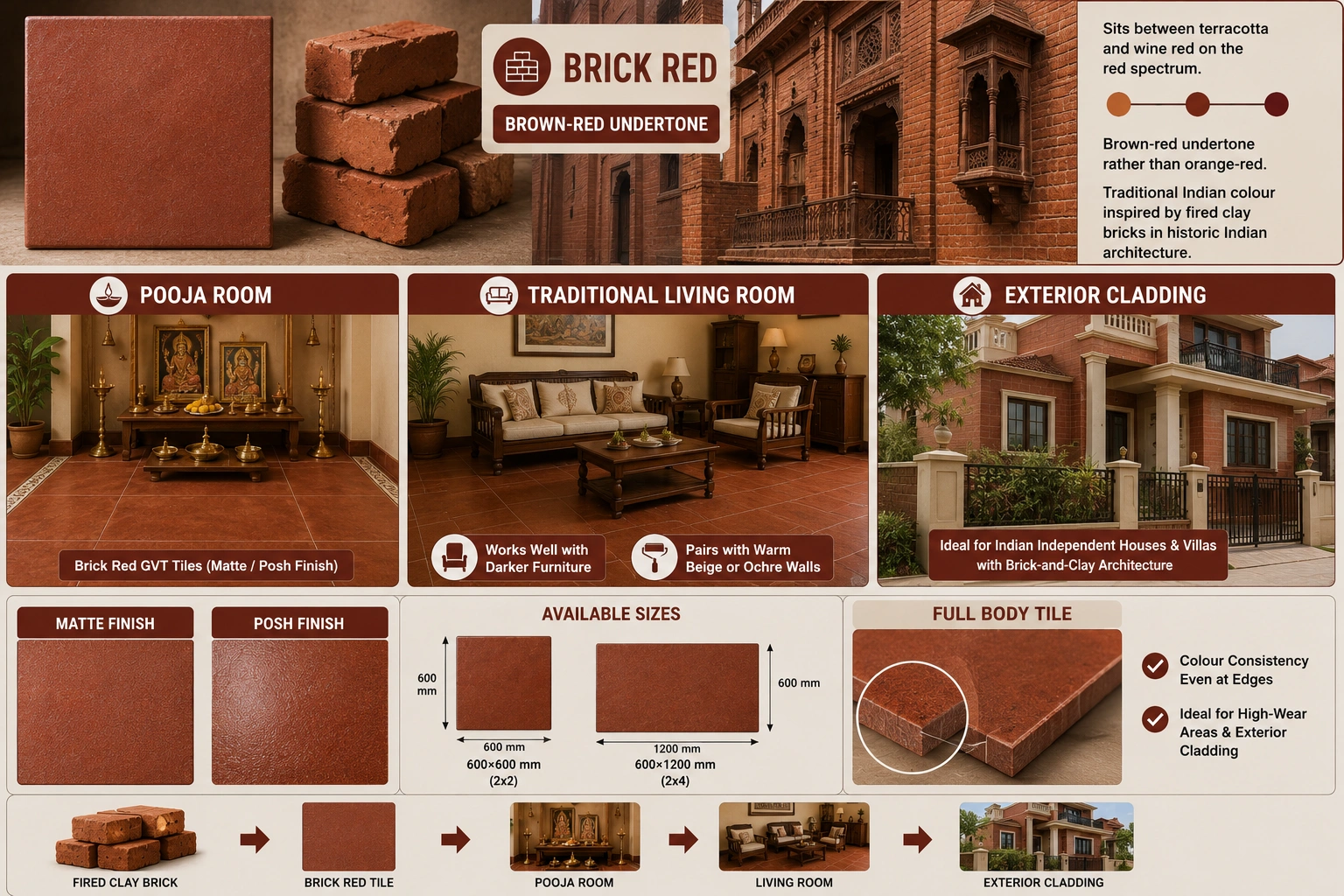
Brick red sits between terracotta and wine red on the red spectrum. The undertone is brown-red rather than orange-red, making it slightly darker and more grounded than terracotta. Brick red reads as traditional Indian, referencing the colour of fired clay bricks that appear in historic Indian architecture across the country.
Brick red GVT tiles in matte or Posh finish in 600x600 mm (2x2) or 600x1200 mm (2x4) are the most commonly used red tiles in Indian pooja rooms and traditional living rooms. The brown undertone in brick red makes it more versatile than terracotta for pairing with darker furniture and deeper wall colours. Where terracotta needs light neutral walls to avoid looking heavy, brick red can hold its own against warm beige or ochre walls.
Brick red also works well for exterior cladding on Indian independent houses and villas where the architecture references vernacular brick-and-clay styles. Full Body brick red tiles in 600x600 mm ensure colour consistency even at tile edges and in high-wear areas, which matters for exterior cladding where the tile body can be exposed at cut edges.
Wine Red Tiles: Deep, Cool, Contemporary
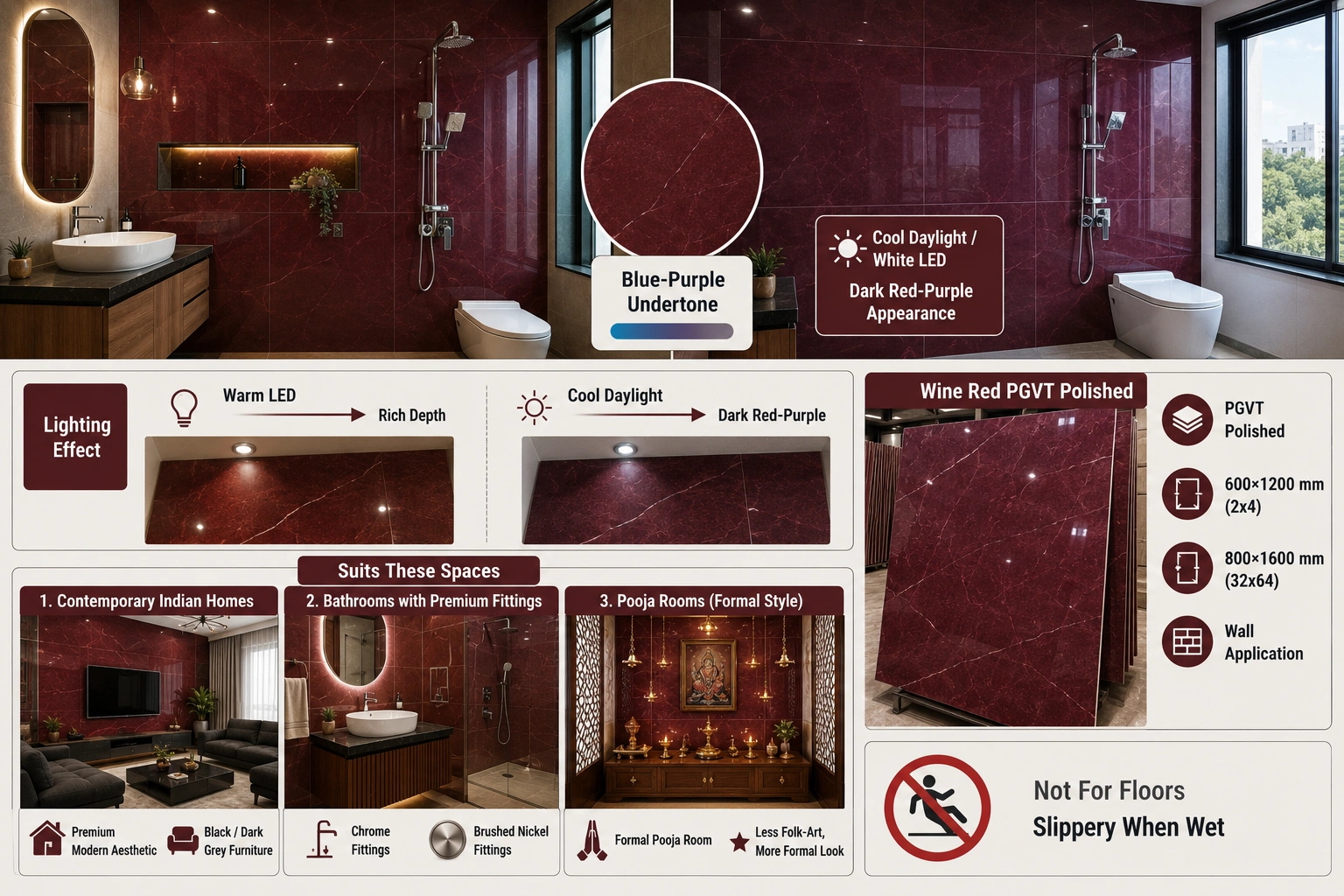
Wine red is the deepest and coolest of the three shades. The blue-purple undertone makes it look distinctly different from both terracotta and brick red. Under warm LED lighting, wine-red tiles glow with a rich depth. Under cool daylight or white LED, they read more clearly as dark red-purple. This shade shifts noticeably with light conditions, which makes in-room sample checking especially important before purchasing.
Wine red tiles in India are primarily available as PGVT polished in 600x1200 mm (2x4) or 800x1600 mm (32x64) for wall applications. The polished surface amplifies the depth of the dark colour and gives bathroom feature walls and living room accent walls their dramatic, high-end appearance. Wine red PGVT is wall-only; it is never suitable for floors because the polished surface is slippery when wet.
Wine red suits: contemporary Indian homes with a premium modern aesthetic, bathrooms with chrome or brushed nickel fittings, living rooms with black or dark grey furniture, and pooja rooms in homes where a more formal and less folk-art approach to the prayer space is wanted. It does not suit traditional or rustic Indian interiors, where the cool undertone clashes with warm natural materials.
How Indian Home Lighting Changes Each Shade
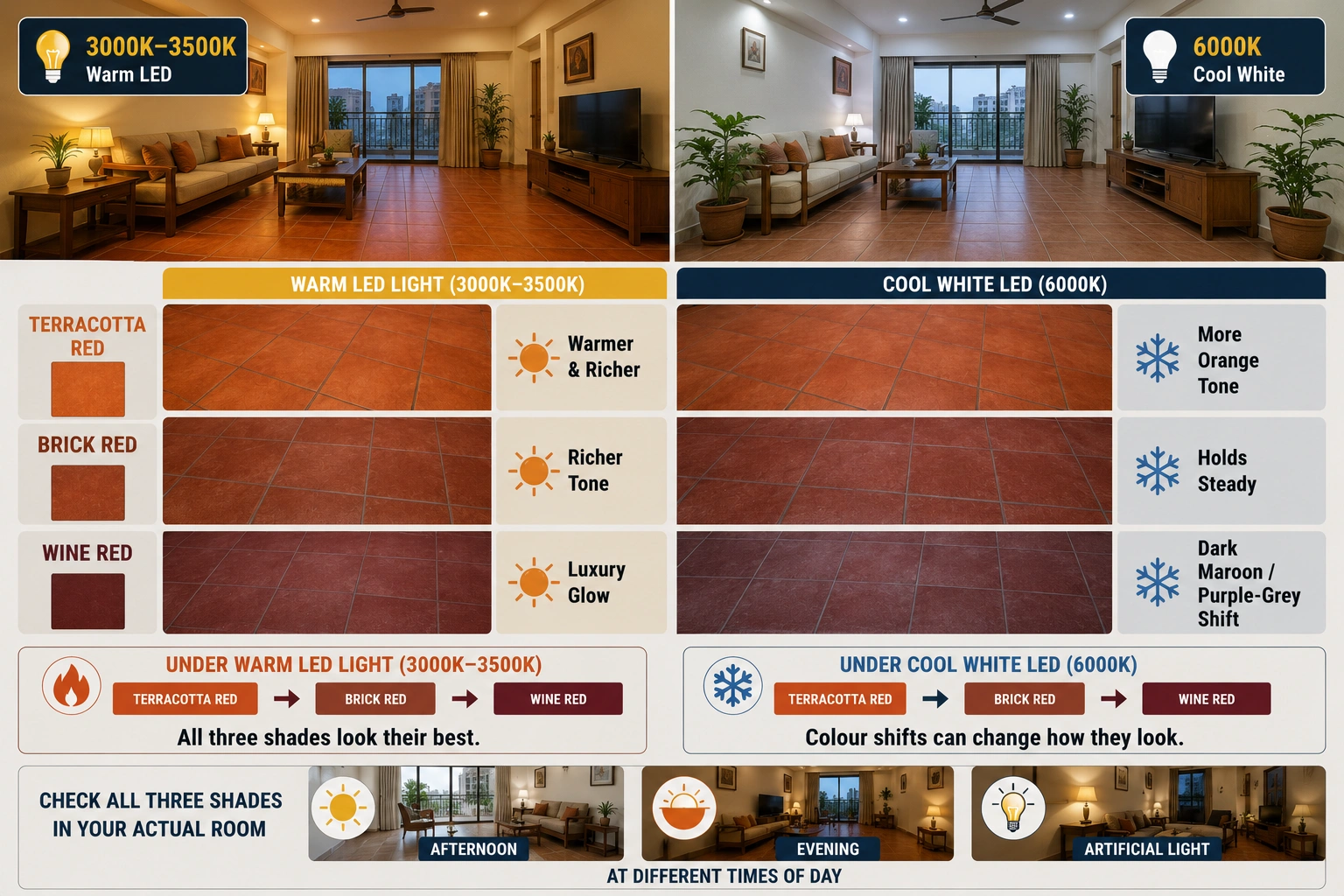
Most Indian homes use warm LED panels in the 3000K to 3500K range for main room lighting. Under this warm light, terracotta and brick red tiles become warmer and richer. The orange and brown undertones amplify. Wine red under warm light glows and looks luxurious. All three shades look their best under warm Indian home lighting.
Under cool white LED (6000K) or strong afternoon north-facing daylight, the picture changes. Terracotta can shift toward a more clearly orange tone. Brick red holds relatively steady because its brown undertone is less affected by cool light. Wine red under very cool light can shift toward a dark maroon or purple-grey that may not match what you saw in the warm showroom. Check all three shades in your actual room at different times of day.
Side-by-Side Comparison: Room Suitability, Category and Price
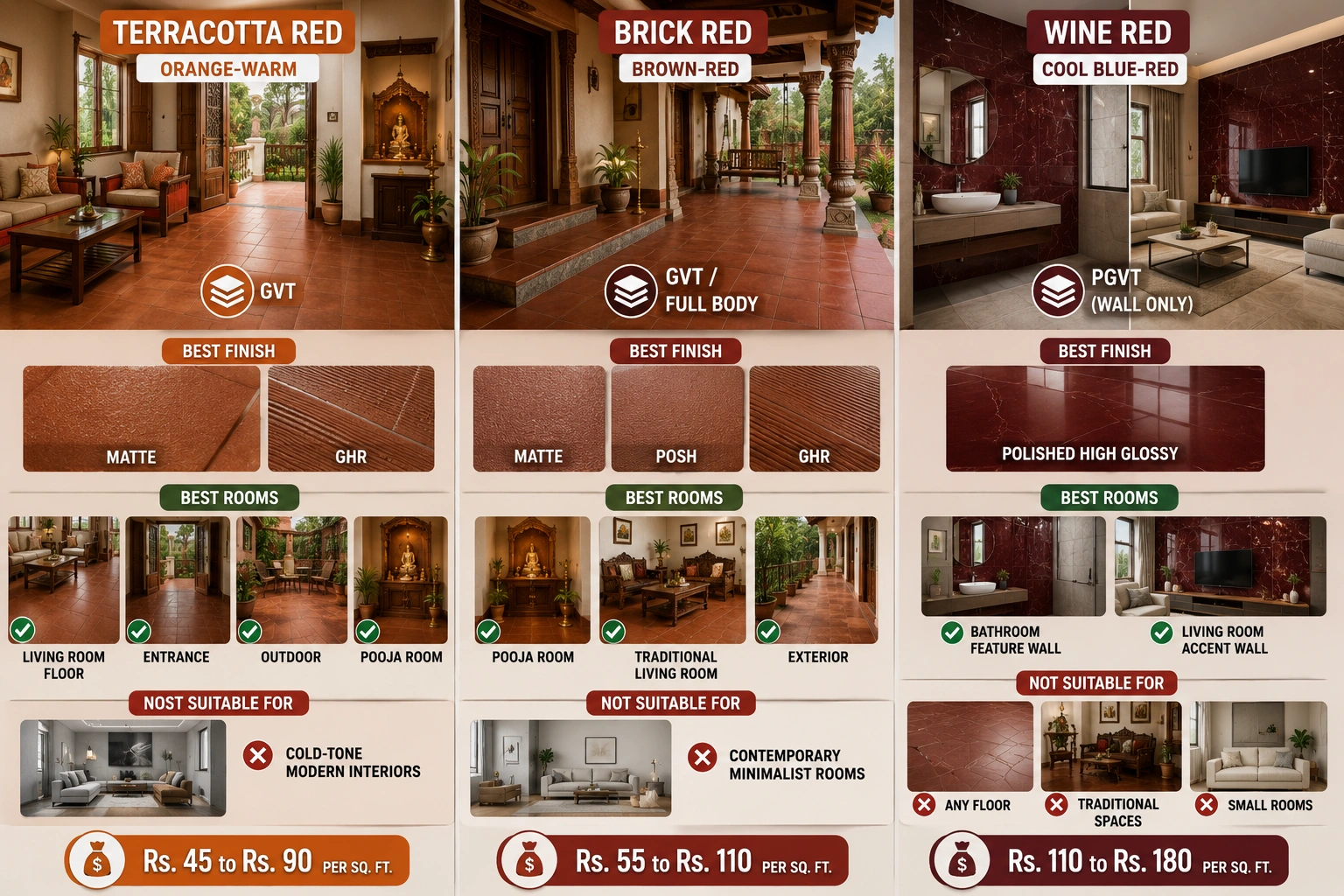
| Shade | Undertone | Category | Best Finish | Best Rooms | Not Suitable For | Price Range |
| Terracotta Red | Orange-warm | GVT | Matte, GHR | Living room floor, entrance, outdoor, pooja room | Cold-tone modern interiors | Rs. 45 to Rs. 90 per sq. ft. |
| Brick Red | Brown-red | GVT, Full Body | Matte, Posh, GHR | Pooja room, traditional living room, exterior | Contemporary minimalist rooms | Rs. 55 to Rs. 110 per sq. ft. |
| Wine Red | Cool blue-red | PGVT (wall only) | Polished High Glossy | Bathroom feature wall, living room accent wall | Any floor, traditional spaces, small rooms | Rs. 110 to Rs. 180 per sq. ft. |
Common Mistakes When Choosing Red Tile Shades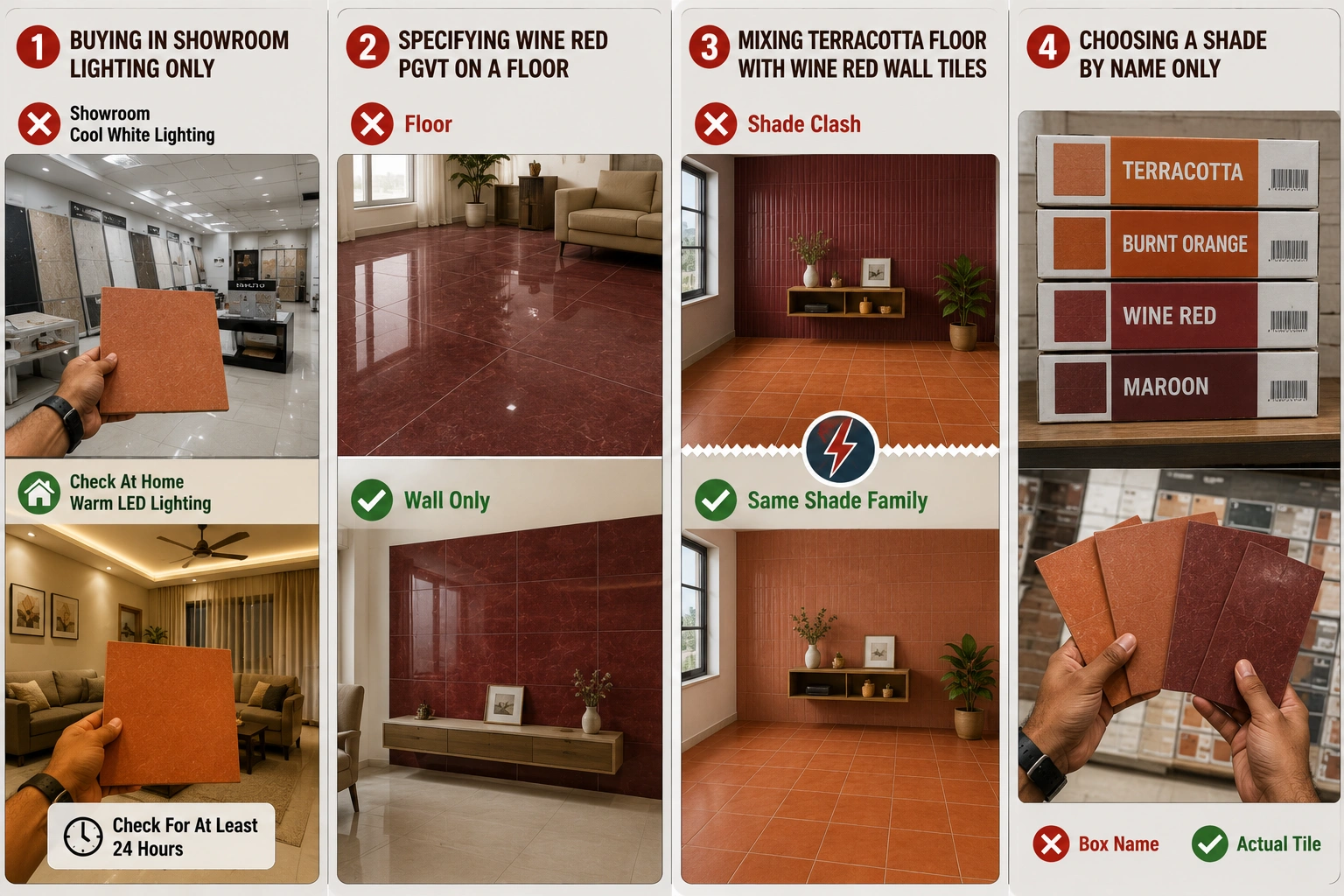
Buying terracotta tiles under showroom cool white lighting and installing them in a warm-LED home. The tile looks more orange in the warm home than it did in the showroom. Always bring a tile sample home and check it under your actual room lighting for at least 24 hours before ordering.
Specifying wine red PGVT on a floor. Wine red PGVT is wall-only. No polished PGVT tile is suitable for any floor application in any shade. This is a technical category rule, not an aesthetic suggestion.
Mixing terracotta floor tiles with wine red wall tiles in the same room. The warm-orange undertone of terracotta and the cool-blue undertone of wine red clash visually. The two shades are from opposite ends of the red spectrum. If you want red on both floors and walls in the same room, use the same shade family: terracotta floor with a slightly lighter terracotta wall tile, or brick red floor with a deeper brick red accent wall.
Choosing a shade by name without checking the actual tile in person. Tile manufacturers and dealers name their shades inconsistently. One company's terracotta is another's burnt orange. One company's wine red is another's maroon. Always judge by the tile itself, not the name on the box.
Find the Right Red Tile Combination for Your Space
Once you have decided on the red shade that suits your room, the next step is checking how it pairs with your wall colour, furniture, and trim. The red tiles pairing guide covers wall colour combinations, furniture pairings, and trim choices that work with each red shade in Indian interiors.
Browse terracotta, brick red, and wine red tiles on Tilesfinders to compare GVT, Full Body, and PGVT options across sizes and finishes from Gujarat manufacturers.
FAQs
Terracotta red has a warm orange undertone and references fired clay in colour. Brick red has a brown-red undertone and is slightly darker and more grounded. Terracotta reads as warmer and more traditional. Brick red is slightly more versatile and holds up better against darker wall colours. Both are available in GVT matte finish for floors in India.
Wine red and maroon are very close in the Indian tile market, but not always identical. Wine red carries a subtle blue-purple undertone and is typically seen in polished PGVT. Maroon can lean slightly browner depending on the manufacturer. In practice, the shade difference between wine red and maroon varies by brand. Check the actual tile sample rather than relying on the colour name.
All three shades look their best under warm LED lighting at 3000K to 3500K, which is the most common Indian home lighting setup. Terracotta and brick red become richer and warmer. Wine red develops a luxurious, deep glow. Under cool white lighting, terracotta can shift toward orange, and wine red can appear more purple. Always check the tile sample under your actual home lighting before ordering.
Yes. Terracotta red GVT tiles in GHR or outdoor-rated finish in 400x400 mm or 600x600 mm are well-suited for Indian outdoor areas,s including entrances, verandahs, and courtyards. Use GHR finish for areas exposed to rain and moisture. Avoid polished PGVT entirely for any outdoor application. For south-facing outdoor areas in hot climates, consider lighter terracotta shades as darker tiles absorb more solar heat.

See our tile guides first
Set TilesFinders as a preferred source and our buying guides surface ahead of the rest for you.
Add as preferred sourceTakes one tap. Nothing to install.
What Readers Say
I was about to redo my parking area with the wrong tile size until I read this. The layout comparisons saved me from a costly mistake.
We reference TilesFinders guides while briefing clients on material selection. The size and pattern breakdowns are accurate and easy to explain visually.
On site, I get asked about grout spacing all the time. This article gave me a solid reference I now share with my team before every job.
Finally a guide that doesn't just push generic advice. The oil stain removal steps actually worked on our clubhouse driveway tiles.
I run a small construction firm and now send this link to clients directly when they ask about entrance tile sizing. Saves me an hour of explaining.
Good practical detail, though I wish there were more examples for compact apartment entrances specifically, not just villas.
My mother-in-law wanted marble, I wanted vitrified. This blog gave us the neutral comparison we needed to actually decide together.
Detailed without being overwhelming. I appreciated that it covered both cost and maintenance, not just the aesthetics.
Used the algae and hard water removal tips on our terrace tiles after the monsoon. Worked better than what our regular cleaner was doing.
As someone who sources tiles for multiple builder projects, I find these comparisons genuinely useful for vendor conversations, not just consumer content.
Recommended this to a client who kept second-guessing the entrance design. The small vs large layout section settled the debate instantly.
Straightforward and honest, no unnecessary jargon. Would like to see a similar breakdown for outdoor pool-deck tiles next.
We've bookmarked several TilesFinders guides for our design handbook. Reliable source when clients want data, not just opinions.
Two paths, one marketplace.
Get free quotes from verified suppliers.
Share your room, budget, and style. Suppliers in Morbi respond within hours.
Get Free QuotesList your business, reach real buyers.
Put your showroom in front of homeowners searching for tiles right now.
List Your Business